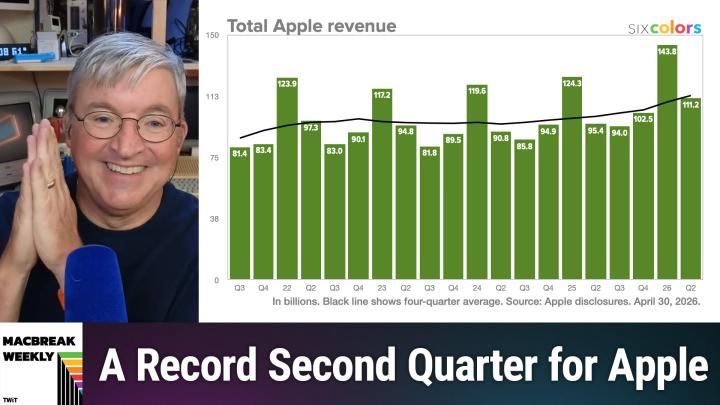
Apple's Big Q2 2026 Quarter
AI-generated, human-reviewed.
Apple posted an extraordinary $111 billion in revenue in its recent non-holiday quarter, signaling major momentum across product categories and services. On this week’s MacBreak Weekly, Leo Laporte, Jason Snell, Andy Ihnatko, and Christina Warren provided in-depth analysis of Apple’s financial results, their implications for shareholders and Apple users, and why the company is changing course by ending its ‘net cash neutral’ policy.
Apple’s Blockbuster Earnings: Revenue and Profit Surge
Apple’s latest earnings report—covering January to March 2026—demonstrated not just solid numbers, but a steady upward trajectory. On MacBreak Weekly, Jason Snell highlighted how every product category and global region saw year-over-year revenue increases. Notably, both the iPhone 17 and Apple’s services division drove these gains, cementing Apple’s efficiency in hardware and ongoing digital services.
The hosts pointed out that Apple achieved $111.2 billion in revenue for the second straight non-holiday quarter, a huge leap from just five years ago. Jason Snell called Apple “the world’s greatest cash generation machine,” with roughly $30 billion in profit generated in just three months.
What’s Fueling Apple’s Success? iPhone 17 and Service Expansion
The iPhone 17 release stands out as the most successful iPhone debut in Apple’s history, accounting for about half of all company revenue this quarter. The hosts underscored that strong China demand and visible design updates helped drive this growth.
Equally noteworthy is Apple’s services business, which now delivers about 28% of total revenue—up from just 9% several years ago. Apple services include Apple Music, TV+, iCloud, App Store, and more. The high profit margins of digital services (where costs don’t scale linearly with revenue) mean this segment could soon deliver as much profit as hardware.
Apple Ends Its Cash Neutral Policy: Why Now?
One of the most insightful moments on the show broke down Apple’s announcement that it will no longer pursue “cash neutral”—the strategy of keeping cash on hand equal to its debt. Andy Ihnatko and Jason Snell explained that under Tim Cook, Apple returned trillions to shareholders to avoid stockpiling cash, but now, the company wants more flexibility.
The reasons? The hosts pointed to:
- The escalating arms race in AI, where competing tech giants are making massive R&D investments.
- Ongoing challenges in Apple’s hardware supply chain, particularly in chip and memory procurement.
- The possibility that Apple wants to preserve capital for potential acquisitions, investments, or infrastructure needs—like funding new manufacturing partnerships with companies such as Intel or Samsung.
Apple’s board also authorized another $100 billion in stock buybacks but “uncoupled” it from cash holdings, signaling that more strategic options may be on the table if AI development or supply constraints require big outlays.
Supply Chain Strains and Mac Mini Shortages
The panel spent time on Apple’s supply chain headwinds, which have caused shortages of popular products like the Mac Mini and Mac Studio. These are largely due to AI-driven surges in demand for high-performance chips, and competition from other companies vying for TSMC’s cutting-edge semiconductor manufacturing capacity.
To reduce risk, Apple is exploring partnerships with Intel and Samsung for some chip fabrication in the United States, expanding geographic and supplier diversity. The takeaway: Apple users may see expanded choices in where and how their devices are built, influencing availability, performance, and potentially price.
What Apple’s Moves Mean for Users and Shareholders
- Investors should see Apple’s shift from strict cash neutrality as a sign the company is preparing more proactively for major investments or strategic maneuvers.
- Users and tech watchers can expect Apple devices to remain in high demand, especially with the success of iPhone 17 and the resilience of Mac, iPad, and wearables sales.
- The growing focus on services, combined with potential AI advancements, will likely improve the integration and value of the Apple ecosystem—so long as supply challenges are managed.
- Those considering a Mac purchase should monitor supply availability, especially for desktops that use advanced chips.
Key Takeaways
- Apple reported $111.2 billion in non-holiday quarter revenue, with all product categories and geographies showing growth.
- iPhone 17 drove the company’s most successful launch ever; China sales rebounded on new models.
- Services now make up 28% of revenue and are approaching parity in profit with hardware.
- Apple ended its “cash neutral” policy, seeking flexibility for large investments or navigating supply chain constraints.
- Ongoing chip and memory shortages are causing select Mac shortages—prompting Apple to consider new supplier partnerships.
- Investors can expect more share buybacks and possibly acquisitions or infrastructure spending in strategic areas like AI.
The Bottom Line
According to the MacBreak Weekly panel, Apple’s record-setting quarter is more than a headline—it's a reflection of a company steadily building both its product appeal and its financial strength. However, Apple’s pivot on cash strategy and heightened attention to supply chain flexibility indicate that even the most dominant tech firms are navigating unpredictable waters in AI and global manufacturing. For both fans and investors, the coming year will be critical as Apple weighs where to invest and how to maintain its momentum.