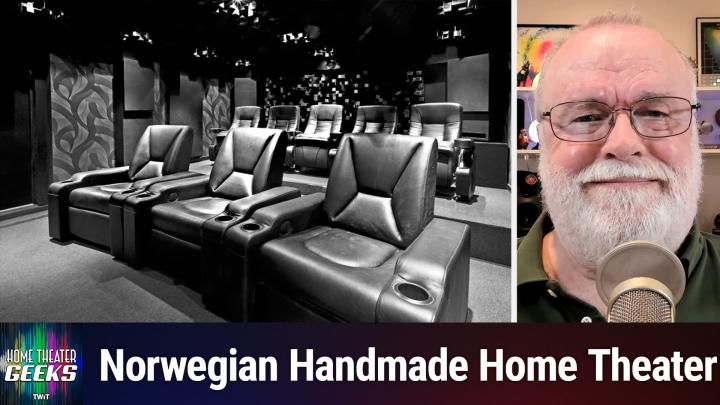
Building the Ultimate DIY Home Theater: Lessons from a World-Class Basement Build
AI-generated, human-reviewed.
DIY Home Theater: Pro-Quality Results from the Ultimate Basement Build
If you've ever wondered how close a home-built theater can get to a professional cinema, Bjorn Erik Forberg's basement project in Norway answers that question definitively. On Home Theater Geeks, host Scott Wilkinson—who originally profiled this build for AVS Forum in 2014—revisits a theater that remains one of the most ambitious DIY home cinema projects ever documented: custom-built speakers, handmade acoustic diffusers, a room-within-a-room isolation structure, and a 138-inch screen, all assembled by one person in his spare time.
Here's what made it exceptional, and what every home theater builder can take from it.

Why This DIY Home Theater Sets the Standard
Bjorn Erik Forberg is a THX Level 2-certified installer, so he came to this project with a clear performance target: a room at least 6 × 3.5 meters (roughly 20 × 11.5 feet), seating for six, and complete sonic isolation from the rest of the house. "I am very fond of loudspeaker systems that produce lots of energy," he explained—which, given that his system has been measured at 134 dB SPL, is something of an understatement.
What makes the build remarkable isn't just the spec sheet. It's that Forberg didn't just choose components—he built them. The speakers, the subwoofers, the acoustic diffusers, and the room itself were all constructed from scratch in the workshop he built in the other half of his basement. It took roughly six months to plan the room, nine months to finalize the speaker design, and another six months to build everything in his limited spare time outside his day job.
How He Built It: Step by Step
1. Start with the right space—and divide it strategically
The house Forberg and his wife selected had a long, narrow basement, which he divided in two: one half became the theater, the other a workshop where every component was fabricated. If you're planning a serious DIY build, having dedicated workspace adjacent to the room itself is not a luxury—it's a practical necessity.
2. Build a room within a room for serious sound isolation
Forberg's walls are double-layer plasterboard with Green Glue damping compound between the layers, plus an air gap at the door. This "room within a room" approach is the gold standard for sound isolation, and it's what allows this system to operate at cinematic levels without disturbing anyone else in the house. If high-volume listening is a priority, this isn't optional—it's the foundation everything else rests on.

3. Design the speakers yourself—or at minimum, understand what you're building
The front LCR (Left, Center, Right) speakers were based on a design by Norwegian audio engineer Stig Erik Tangen, which Forberg modified. Each LCR uses three Beyma 15-inch woofers covering 25–200 Hz, a TAD 12-inch midrange handling 175–2,000 Hz, and a Beyma horn-loaded ribbon tweeter from 2,200 to 21,000 Hz. The result: speakers with a sensitivity of 103 dB/W/m that can reproduce the full frequency range without assistance from the subwoofers.
That last point is worth flagging because it departs from conventional home theater practice. Most systems cross the main speakers over to the subwoofers so that all low-frequency content is handled by the subs. Forberg set his mains to run "large"—full range, from 28 Hz to 20 kHz—reserving the subwoofers exclusively for the LFE (Low Frequency Effects) channel. Not many speaker systems can support that approach; these can.

4. Maintain a consistent sonic signature across all channels
The surround speakers follow the same design logic as the LCRs: a Beyma 15-inch woofer (25–900 Hz) paired with a Beyma horn tweeter (900–21,000 Hz). Sensitivity measures 101 dB for the surrounds. This matters more than most builders realize—sonic consistency between the front and surround channels is what makes immersive audio actually feel immersive rather than disjointed.
5. Take subwoofer integration seriously
The eight subwoofers (six in the front wall, two in the rear corners) use Beyma 18-inch drivers and extend from 13 to 120 Hz. When Forberg first tested the system, the only adjustments needed were level settings—the transition between mains and subs was inaudible. That kind of seamless integration doesn't happen by accident; it comes from designing the entire system as a coherent whole from the start.
6. Solve acoustic problems with diffusion, not just absorption
Using a program called AcousticCalculator, Forberg identified that the most problematic reflections in his room fell between 750 and 3,500 Hz, concentrated down the center and near the side walls. His solution: handmade diffuser panels built from 2×2-inch lumber cut to varying lengths, installed along the ceiling. For the back wall, he modified the design to extend diffusion down to 200 Hz.
The result is a room that sounds, in Forberg's words, "very natural and open"—because it is. He's not over-damped. By using targeted diffusion rather than blanketing everything in absorption, he preserved the liveliness that makes both music and film soundtracks feel real. The measured frequency response runs flat from 13 Hz to 21 kHz; he added a small LFE boost for movie playback.

7. Audition multiple screens before committing
Finding a screen that didn't degrade the sound was, by Forberg's account, his biggest challenge. He evaluated ten options before settling on a 138-inch, 2.35:1 acoustically transparent woven screen from Norwegian company DreamScreen. He built the frame with a hinged top so the screen can be raised to access the speakers behind it—a practical detail that reflects the same systems-thinking that runs through the entire project. The projector, positioned behind the audience, is a Sony VPL-VW55ES.
8. Keep the electronics out of the room
All amplification—eleven Crown I-Tech amplifiers (nine I-Tech 4000s and two I-Tech 8000s) providing active crossover and DSP for every channel—is housed outside the theater and controlled via IR repeaters. The surround processor is a Sherbourn PT-7030. Keeping heat-generating, fan-cooled equipment out of the listening space eliminates noise and clutter. DreamScreen seating (three Cineseat Promotor in the front row, five Cineseat Theatre in the second) completes the package.
Pros and Cons at a Glance
Pros
- Room construction totaled approximately $8,000—a fraction of what a contractor would charge for equivalent isolation
- Complete customization of every acoustic and sonic variable
- Double-wall, air-gap, Green Glue isolation allows high-SPL listening without compromise
- High-sensitivity speakers (103/101/100 dB) deliver exceptional dynamics and headroom
- Diffusion-based acoustic treatment produces natural, open sound rather than a dead, over-damped room
- Professional cinema presentation: speakers behind an acoustically transparent screen, electronics out of sight
Cons
- Not a weekend project—the design phase alone took over a year
- Equipment costs were approximately $140,000 (partly inflated by Norway's 25% VAT)
- Requires real skills: carpentry, acoustics knowledge, electronics experience
- The build is site-specific—if you move, you likely can't take it with you
That last point proved painfully relevant. Forberg has since moved from this house, and the theater could not come with him. If you visit the build thread on AVS Forum and scroll to the final pages, you'll find what Scott Wilkinson calls a heartbreaking sight: the room was torn down. Unlike many home theater owners, Forberg never had the chance to upgrade his system to 4K, Atmos, or HDR.
Key Takeaways
The system Forberg built was already a decade old when Wilkinson revisited it—HD rather than 4K, 7.1 rather than Atmos—and it almost certainly still outperforms the vast majority of home theaters being built today. That says something important: the fundamentals of thoughtful room design, robust isolation, matched speaker voicing, and targeted acoustic treatment don't become obsolete when the format changes. Get those right, and the content sounds exceptional regardless of the codec.
The $8,000 room cost is also worth sitting with. That figure includes framing, double-layer plasterboard, Green Glue, lumber for diffusers, and all construction labor—performed by one person. Equipment is the expensive part of any serious system. But the room itself, done properly with your own hands, is achievable.
The Bottom Line

Bjorn Erik Forberg's theater is a case study in what's possible when expertise, patience, and obsessive attention to detail converge. It's also an honest picture of the tradeoffs: serious DIY means serious time, serious skill, and—at the electronics level—serious money. But the underlying lesson isn't that you need to spend $140,000. It's that the decisions Forberg made about isolation, speaker design, crossover philosophy, and acoustic treatment are available to anyone willing to learn them.
Watch the full episode of Home Theater Geeks and find the link to Forberg's original AVS Forum build thread in the show notes: https://twit.tv/shows/home-theater-geeks/episodes/530