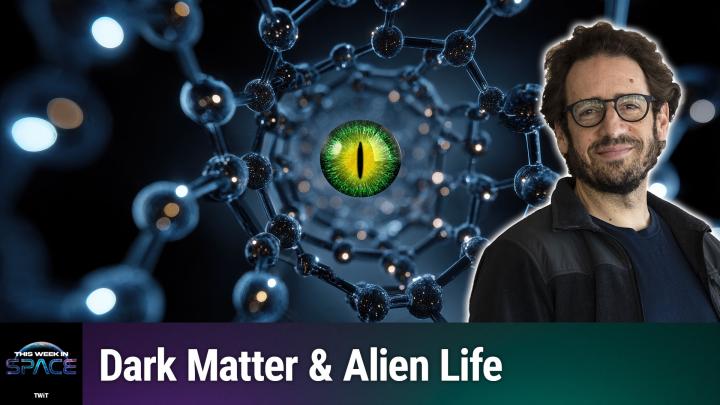
Could Dark Matter Harbor Intelligent Alien Life?
AI-generated, human-reviewed.
Science is exploring one of its most profound frontiers: the possibility that intelligent life might exist within the mysterious substance known as dark matter. According to Daniel Whiteson, a particle physicist at UC Irvine, this theory is not just science fiction—it’s a serious line of inquiry that disrupts our assumptions about where and how alien civilizations could be found.
What Is Dark Matter and Why Is It a Candidate for Life?
Dark matter constitutes about 27% of the universe’s energy content—far more than the atoms and molecules (“baryonic matter”) we’re used to. Yet, it remains invisible and undetectable except through its gravitational effects. On This Week in Space, Whiteson explained that unlike normal matter, dark matter does not emit, absorb, or reflect light, making it “dark” to our telescopes and instruments.
Because dark matter is so abundant and largely unexamined, physicists now consider whether it could form complex structures—or even support the development of dark chemistry and biology, paralleling life as we know it but in a separate context.
Could Dark Matter Support Intelligence?
Whiteson highlighted how most of the universe’s mass is dark matter, and there’s compelling evidence it’s not just a math trick but a real substance with gravitational pull. If dark matter has multiple particle types, or if it can form bound systems (the way atoms make up molecules), the door opens for entirely new kinds of matter, potentially leading to dark matter planets, stars, and even complex, intelligent life.
He stressed that while there’s no direct evidence for dark matter life yet, we cannot rule out these possibilities because our instrumentation is primarily tuned to normal matter. The very nature of dark matter might mean civilizations exist “right on top of us,” undetectable except by their gravitational influence.
Challenges in Communicating With Truly Alien Beings
The conversation also ventured into the enormous difficulty of communicating with a civilization fundamentally different from ours. Whiteson noted that human concepts of mathematics and physics might not be universal, especially for a species evolving in a different substrate or with a wholly different perception of reality.
Cultural biases, the limitations of our language, and even the way we define intelligence could all be barriers. This is not just a theoretical hurdle for future “first contact”—it reframes how we should search for messages or artifacts from extraterrestrial intelligence today.
Are We Missing Alien Signals by Looking Only for What We Understand?
Most searches for extraterrestrial intelligence (SETI) focus on detecting radio signals or optical flashes—communicative methods that make sense for human technology. Whiteson advocated for broader approaches, such as analyzing high-energy particles, cosmic rays, or neutrinos, as potential “carrier” signals from other forms of intelligence.
He emphasized that limiting ourselves to human modes of communication essentially means filtering for versions of ourselves, rather than genuinely alien possibilities. It’s possible that the universe is teeming with signals—we simply aren’t tuned to recognize them.
What Would It Mean If Most of the Universe Is Full of Unseen Civilizations?
Whiteson’s ideas underscore the humbling perspective that humanity might not be the center of cosmic life. Given the sheer abundance of dark matter, sentient beings or civilizations could be the norm, while baryonic civilizations like ours are rare.
Such speculation shifts the framework for debates about UFOs, disclosure, or the Fermi paradox (the question of why we don’t see evidence of extraterrestrial life): maybe we’re simply blind to the most common forms of intelligence in the universe.
Key Takeaways
- Dark matter makes up most of the universe’s mass—and could host unknown, complex life.
- No direct evidence for “dark life” exists, but current technology is incapable of ruling it out.
- Communication with truly alien life may be fundamentally challenging, as their physics, math, or even perception could differ.
- Our SETI searches are limited by human assumptions; broadening the search to new particles and phenomena might improve our odds.
- The “dark matter neighbor” hypothesis suggests alien civilizations could exist right here, unseen and undetectable except by gravity.
The Bottom Line
On This Week in Space, Daniel Whiteson explained that the biggest answers in the universe may not lie in distant galaxies, but in the dark, hidden side of reality that envelops us. Searching for life means looking beyond our expectations and questioning even the basics of how intelligence, communication, and matter work. The next great discovery may come not from bigger telescopes, but from widening our minds about what life can actually be.
Subscribe to the show for more boundary-pushing conversations:
https://twit.tv/shows/this-week-in-space/episodes/216