Flock Cameras Face Growing Scrutiny Over Privacy and Surveillance
AI-generated, human-reviewed.
Automated license plate reader (ALPR) systems like Flock are rapidly expanding across the United States, amassing vast databases of vehicle movements and raising major concerns about privacy, surveillance, and civil liberties. On Tech News Weekly, 404 Media co-founder Jason Koebler explained how these cameras are used, why a federal judge recently called them "indiscriminate mass surveillance," and what new legislation could mean for the future of automated license plate tracking.
How Flock Cameras Work and Who Uses Them
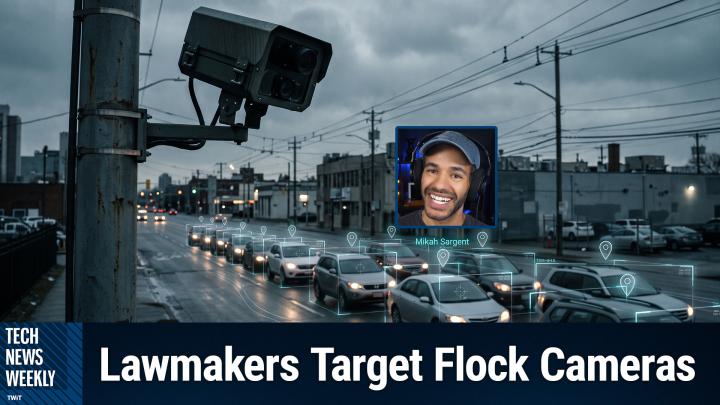
Flock cameras are specialized devices that automatically scan and record the license plates of every passing vehicle. The captured data—including plate numbers, timestamps, and locations—gets stored in massive databases. Law enforcement agencies are the primary customers, but large private companies like Lowe's and Home Depot have also installed Flock cameras at many retail locations, citing loss prevention as justification.
Data from these cameras doesn’t just stay local. It’s frequently shared across jurisdictions and, through federal grant programs, can even be funneled directly to national databases managed by agencies like the Department of Homeland Security and the US Postal Inspection Service. This interconnected network allows authorities to track a car’s movements across multiple states with just a few clicks.
Recent Court Ruling: Indiscriminate Mass Surveillance
A recent case in Oklahoma has drawn national attention. According to Koebler, a sheriff’s deputy used Flock to track a woman based solely on her California license plate and travel pattern. After a minor traffic stop, the officer used Flock data to retrace her multi-state journey, ultimately discovering drugs. However, a federal judge ruled the search unconstitutional due to its blanket, suspicionless nature—marking the first time a federal judge has classified an ALPR search as "indiscriminate mass surveillance" and ordered the evidence thrown out.
This decision signals a critical shift away from previous rulings, where courts have long held that drivers have no "reasonable expectation of privacy" on public roads. The judge cited recent Supreme Court decisions recognizing that new digital surveillance technologies—like networked ALPRs—collect vastly more data than traditional methods, fundamentally changing the privacy calculus.
Why Flock and Similar Networks Are Growing Controversially
On Tech News Weekly, Koebler detailed how the ALPR network is becoming an automatic step in policing. Minor traffic infractions routinely prompt license plate searches that reveal detailed travel histories for any vehicle. Officers can use this "pattern of life" data to establish pretexts for broader investigations, sometimes leading to invasive searches based on little real suspicion.
Compounding the problem, many private businesses now add to the data pool, and federal programs require small towns and local agencies to share their plate scans—even if those communities have tried to limit use locally. Transparency and oversight remain limited: it's often unclear how long the data is stored, who can access it, and for what purposes.
What Congress and Lawmakers Are Doing
Escalating public concern and investigative reporting—much of it by 404 Media—has prompted Congressional action. Bipartisan lawmakers have introduced the Ban Flock Act, led by Bernie Sanders, Alexandria Ocasio-Cortez, and others, which would cut off federal funding for state and local governments that deploy these cameras and ban federal agency use altogether. A separate proposal from Senator Josh Hawley would require stricter limits, such as shorter data retention and bans on integrating plate data with facial recognition systems.
If passed, these laws could force a major rollback in automated plate tracking nationally, with direct effects for both law enforcement operations and the companies selling these systems.
Key Takeaways
- Flock cameras automatically scan and record license plate numbers, creating detailed databases of vehicle movements across the US.
- Their use by police and large private companies is growing, often with little oversight or transparency.
- A federal court recently ruled that searching the Flock database without cause constituted unconstitutional "indiscriminate mass surveillance."
- Congress is now considering new laws to ban or heavily restrict the use of ALPR systems like Flock.
- Federal agencies, including the Postal Service and the Department of Homeland Security, currently use ALPR data, but this may change if new laws are enacted.
- Public debate is intensifying over whether the benefits for crime-solving outweigh the mass collection of innocent people’s travel data.
- Strict limitations on data retention and stronger privacy controls may be on the horizon.
- The legal and social controversy is likely to continue as surveillance technology advances.
The Bottom Line
Flock and similar license plate reader networks have quietly reshaped surveillance in America, blurring the boundaries between crime-fighting and mass tracking of ordinary citizens. As courts, lawmakers, and privacy advocates grapple with the implications, the outcome could set significant precedents for digital privacy. Staying aware of how this technology works and the debates surrounding it, is crucial for anyone concerned about civil liberties in the age of AI-powered surveillance.
Subscribe to Tech News Weekly for the latest insights into emerging technology, privacy, and policy:
https://twit.tv/shows/tech-news-weekly/episodes/458