The Future of Mars: How Biotech May Turn the Red Planet Green in Our Lifetime
AI-generated, human-edited.
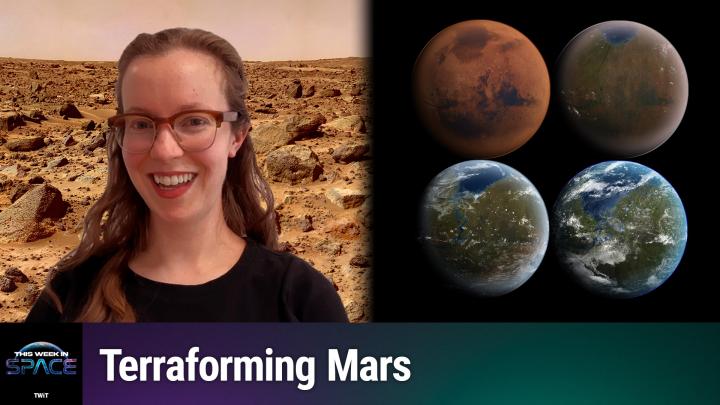
When most people think about terraforming Mars, it conjures up visions of giant machines or sprawling domes—and timelines that stretch across centuries, if not millennia. But what if humanity could jumpstart the process and see Mars become a garden planet within decades instead of lifetimes?
On the latest episode of This Week in Space, host Rod Pyle, co-host Dr. Rick Janet, and special guest Dr. Erika Alden DeBenedictis tackled this very possibility by exploring the exciting world of rapid Mars terraforming. As Dr. DeBenedictis—a synthetic biologist, CEO of Pioneer Labs, and co-founder of the Astera Institute—shared new insights from her recent research, the conversation centered on how advances in biotechnology might dramatically accelerate putting down roots on the Red Planet.
The Current State of Mars: Promises and Perils
The discussion begins with a review of Mars’ environment. Once believed to be warmer and wetter, Mars is now recognized as a cold, dry, and challenging world that nevertheless holds crucial ingredients for life—most notably, abundant near-surface ice and water, and mineral-rich soil. Unfortunately, the picture isn’t all rosy. The Martian regolith contains perchlorates, a highly toxic compound hazardous to both humans and most earthly life forms.
Complicating matters, past theories about simply releasing CO₂ from the Martian ice caps to create a thick greenhouse atmosphere have been debunked. There simply isn’t enough trapped CO₂; the caps’ reserves, once melted, fall far short of what’s needed for a breathable or protective atmosphere.
A Biological Approach: Lessons from Earth’s Past
Dr. DeBenedictis, drawing on both her background in space mission planning and molecular biology, described a new paradigm inspired by Earth’s own ancient history. Billions of years ago, Earth's atmosphere was radically transformed by the arrival of photosynthetic microbes that split water molecules, releasing oxygen and forever altering the course of life. Could a similar process be engineered on Mars?
Rather than relying on brute-force geoengineering, her team proposes using genetically tailored microbes and plants, specifically engineered or selected to withstand Martian conditions. These organisms wouldn’t just survive in the harsh Martian soil—they’d thrive, break down perchlorates, and ultimately “breathe out” the oxygen needed for a future Martian atmosphere.
The Roadmap: Practical Steps to Terraform Mars
The Pioneer Labs team is already making headway in the lab. They’ve cultivated microbes capable of growing in Mars regolith simulant with only water added, and are working to enhance their resistance to perchlorates and other Martian toxins. The goal is for these microbes to efficiently process the raw regolith into richer, less toxic soil, gradually paving the way for higher-order plant life.
This process would be paired with targeted warming techniques—like deploying heat-retaining “blankets” of specialized, IR-reflective glitter to warm select areas of the Martian surface and spur biological activity. Add in the promise of powerful new launch vehicles (think Starship), and it becomes feasible to rapidly scale up the delivery of equipment and starter ecosystems.
Dr. DeBenedictis and her colleagues suggest that—unlike past models that required thousands of years—the right combination of biology and engineering could create pockets of green, breathable Mars in a matter of decades. Advanced greenhouses, powered by in-situ-produced bioplastics, could come first, with planetary-scale change following as oxygen accumulates.
Ethics, Business, and the Broader Case for Terraforming
Ethical considerations were not ignored. The panel acknowledged the fierce debate over planetary protection and the risk of contaminating a world that might still harbor ancient or even extant Martian life. For Dr. DeBenedictis, the answer lies in responsible sequencing: intensifying the search for life first, then proceeding cautiously with terraforming. She sees an “addition, not replacement” ethos, envisioning Mars as a new, unique environment rather than a copy of Earth.
On the business side, challenges remain—particularly regarding property rights, legal frameworks, and sustainable investment. However, producing valuable materials like greenhouses, water, or building supplies on Mars could generate real economic incentives for private and national actors alike.
Mars as Humanity’s New Garden
Throughout the discussion, a genuine optimism emerged. Rather than a sterile landscape or an unreachable fantasy, Mars could become a place of life, growth, and even beauty—perhaps more “Scotland” than “desert.” Dr. DeBenedictis’s vision is not of a replacement Earth but of an inspiring, attainable addition to the places humanity calls home.
Listen to the full episode of This Week in Space for all the details, tech insights, and a healthy sense of humor about our next steps beyond Earth.