"We're Actually Living in a Lot of That Future": EFF's Cindy Cohn on the State of Digital Privacy
AI-generated, human-reviewed.
"We're Actually Living in a Lot of That Future": EFF's Cindy Cohn on 30 Years of Digital Privacy Battles
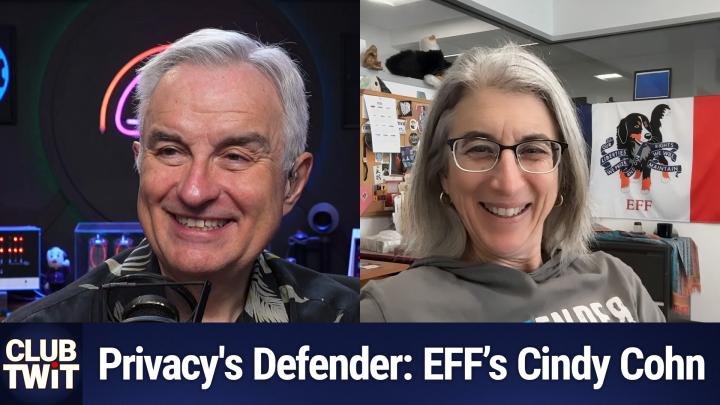
The scary surveillance future that privacy advocates warned about for decades isn't coming — it's already here. That's the sobering message from Cindy Cohn, outgoing executive director of the Electronic Frontier Foundation (EFF), in a candid Club TWiT interview with Leo Laporte. But Cohn isn't giving up. She's written the playbook.
Why Privacy Is the Foundation of Every Other Right
Cohn argues that privacy is frequently misunderstood. Most people think of it as something you invoke when you want to hide — a kind of invisibility cloak. But on Club TWiT, Cohn reframed it as a structural check on power.
Without privacy, people can't organize against those in power, can't speak anonymously, and can't participate meaningfully in a self-governing society. That's not an abstract concern — it's the legal and philosophical foundation behind every case EFF has fought for three decades.
The Encryption Battle That Built the Internet You Use Today
Cohn's first major fight, chronicled in her new book Privacy's Defender, began in 1996 when the U.S. government classified encryption software as a military munition. A Berkeley math PhD student named Daniel Bernstein wanted to publish his encryption algorithm — and was told he'd need to register as an arms dealer to do so.
EFF challenged the export licensing regime as an unconstitutional prior restraint on free speech, and won — first at the district court level, then at the Ninth Circuit. The government ultimately backed down, and the result is the encrypted internet we rely on today: Signal, WhatsApp, HTTPS, and more all trace their legal foundation to that victory.
That win had staying power. When the FBI demanded Apple unlock the San Bernardino shooter's iPhone years later, Apple cited the Bernstein case in its refusal — a moment Cohn described as a direct vindication of EFF's early work.
Room 641A: The Secret Room Where the NSA Watched Everything
The second battle took EFF into even darker territory. An AT&T technician named Mark Klein walked into EFF's San Francisco office with schematics revealing a secret room — Room 641A — on the sixth floor of an AT&T building on Folsom Street. Inside, NSA equipment was intercepting internet backbone traffic and routing it to the government.
EFF sued AT&T rather than the government directly, because telecom companies have a clear statutory prohibition against sharing customer data. The case worked its way through the courts for over 16 years. While EFF didn't achieve a clean legal victory — the Supreme Court ultimately ruled the surveillance programs could remain classified even though their existence was publicly known — the litigation forced real changes. One NSA internet metadata collection program was shut down entirely, another was dramatically scaled back by Congress, and the secretive FISA Court was required to publish far more of its decisions than ever before.
National Security Letters: Secret Demands With Permanent Gag Orders
The third fight involves National Security Letters (NSLs) — a type of self-issued FBI subpoena that lets the government demand customer metadata from service providers without a judge's approval, and permanently gag the company from ever disclosing it received one.
EFF took on cases for Credo Mobile and Cloudflare, fighting in secret for six years under the codename "Case Q." The government was issuing hundreds of thousands of these letters annually — far beyond their intended use in targeted terrorism investigations. EFF's legal pressure, combined with Congressional action, resulted in mandatory three-year review periods for gag orders and limited transparency reporting. Still, Cohn is clear: the fight isn't over.
What's at Stake Right Now
Cohn connected these historical battles directly to today's headlines. On Club TWiT, she and Laporte discussed reports of the so-called "DOGE" team accessing Social Security Administration databases containing hundreds of millions of records, IRS data being repurposed for immigration enforcement, and facial recognition technology being used to identify and track protesters.
These aren't hypothetical risks. They're the direct consequence of a surveillance infrastructure built up over decades — by both government agencies and private data brokers — now available to whoever holds political power. Cohn noted that law enforcement has become the largest purchaser of data from commercial data brokers, effectively bypassing the warrant requirements the Constitution was designed to enforce.
The addition of AI makes it significantly more dangerous. Powerful machine learning tools can now cross-reference data at a scale and speed that no previous generation of surveillance infrastructure could match.
What You Need to Know
- Encryption works — and it took a lawsuit to make it legal. The secure internet you use every day exists because EFF won a First Amendment case in the 1990s.
- The government doesn't need to hack you. It buys your data from brokers, issues NSLs to your service providers, and taps partnerships with agencies that already hold your records.
- "If it can't be used against you, why do foreign governments want it?" Cohn's pointed question about government databases applies equally to commercial data collection.
- Privacy law in the U.S. is still broken. There is no comprehensive federal privacy legislation, and proposals that lack a private right of action — letting individuals sue companies directly — are, in Cohn's view, toothless.
- You can fight back. EFF tools like Privacy Badger and Cover Your Tracks are free. Supporting EFF directly funds active litigation and policy work.
The Bottom Line
Cindy Cohn spent 30 years fighting for the legal foundations that protect your digital life — and she's not done. Her book Privacy's Defender is both a history of how we got here and a clear-eyed look at the road ahead. The surveillance infrastructure her cases helped expose and constrain is now more powerful than ever, being used in ways that affect real people's lives daily. The case for caring about privacy has never been easier to make — even if, as Cohn admits, that's not exactly a good thing.
Get the book: Privacy's Defender: My Thirty-Year Fight Against Digital Surveillance by Cindy Cohn.
Support the EFF: eff.org
This interview was recorded as a special Club TWiT live event. Club TWiT members get access to exclusive interviews like this one, ad-free versions of all TWiT shows, and a members-only Discord community. Join at https://twit.tv/clubtwit.