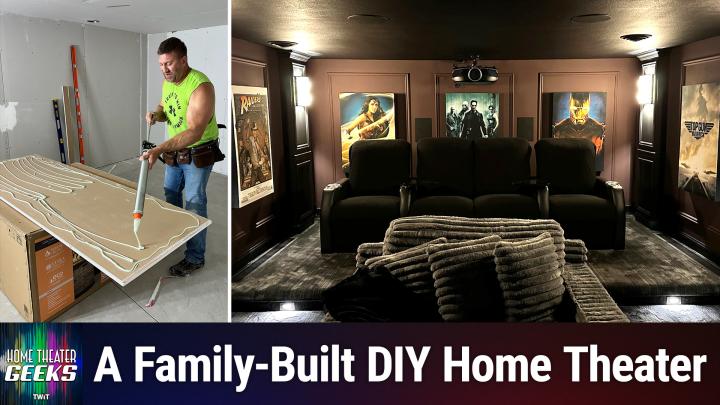
Home Theater Geeks 538 Transcript
Please be advised that this transcript is AI-generated and may not be word-for-word. Time codes refer to the approximate times in the ad-free version of the show.
Scott Wilkinson [00:00:00]:
In this episode of Home Theater Geeks, I feature a DIY delight for home theater of the month. So stay tuned.
Jeremy Mills [00:00:11]:
Podcasts you love from people you trust. This is twit.
Scott Wilkinson [00:00:27]:
Hey there, Scott Wilkinson here, the home theater geek. In this episode I'm featuring a home theater of the month that's a DIY delight built by listener Jeremy Mills, who lives in Wisconsin. And this is going to be a real treat for those of you who want to build a home theater and do it yourself and save some money. Hey Jeremy, welcome to the show.
Jeremy Mills [00:00:56]:
Hey, thanks for having me, Scott.
Scott Wilkinson [00:00:58]:
So glad to have you here and to look at your lovely home theater.
Jeremy Mills [00:01:03]:
Thank you.
Scott Wilkinson [00:01:04]:
Now, where are you located?
Jeremy Mills [00:01:07]:
I am in central Wisconsin, town called Waupaca and originally from Texas. This would be my second home theater that I've built, but only the first one I built from scratch.
Scott Wilkinson [00:01:22]:
Well, great. So tell us, my first question is always how did you get interested in the home theater hobby?
Jeremy Mills [00:01:31]:
Oh, probably when I got into kind of AV was with the Nintendo system. I just had to learn how to plug in a coax cable to the back of the tv. And my uncle showed me how and I was fascinated that it was that simple to, to change from regular TV to an external source. And then I would say probably in earnest. In the 90s, my mom was a decorator for a kaleidoscope of homes in the Dallas Fort Worth area. And I went through one of these million dollar homes and I saw home theater for the first time. Walked in and it was a, basically a bedroom modified for a, had a big huge projector. It was a 4x3 image, but it was the opening of Top Gun and I saw a big screen.
Jeremy Mills [00:02:24]:
I didn't even know what I was looking at. I didn't know how to process what I was seeing because I said, you can't do this. And a house, this is supposed to be in a movie theater. And from then on I, that was a goal in life. I said, I'm gonna have a home theater one way or another. And it started with, you know, a, a, a rear projection TV and some surround sound speakers. And then bought a home. And while they were building the home, had it converted two of the bedrooms into a home theater.
Jeremy Mills [00:02:55]:
And then when we moved up here to Wisconsin, learned the joys of owning a basement and having a blank slate to do whatever I wanted. And, and, and then it was a few years later when we really started designing and, and planning the home theater.
Scott Wilkinson [00:03:19]:
So what were your design goals for this home theater in terms of sound isolation or decor or number of, you know, you wanted to have maximum audio channels. What was your, your ideal situation here that you were shooting for?
Jeremy Mills [00:03:36]:
Well, I got to have a mulligan with the first theater in Texas where I thought, oh, I'll have them insulate the walls. Oh, and then it's soundproof, right? Well, I never really did a deep dive into sound isolation, soundproofing, things of that nature. And so this time we moved here in 2019 and then probably two or three years of just research. And that's, that's one of the most important things I think is research. It's free. You can ask people, you can ask experts. Read forums. ABS Forum is probably the biggest resource that I used for education.
Jeremy Mills [00:04:20]:
What would you do differently? What, what do you like, what do you dislike about your own theater? Learning from other people's mistakes is way cheaper than learning from your own. So I, I would say what was most important to me has always been video. The, the beauty of the screen, resolution, contrast, having the best possible picture for the money that you're willing to spend. And then I've probably not got the best hearing.
Scott Wilkinson [00:04:59]:
So anybody of our age doesn't have the best hearing. Right.
Jeremy Mills [00:05:04]:
So while I can, I can hear just fine. It was always a law diminishing returns for me. Could I buy a hundred thousand dollar speakers? Yes. Would I be able to tell the difference between that and the Polk audio speakers that I have? Maybe. But would it be worth the, the money for the amount of times more money, say for the amount of improvement that I would receive?
Scott Wilkinson [00:05:37]:
Yeah.
Jeremy Mills [00:05:38]:
Whereas going from the 1080p projector I had, I had an Epson 3020 I think in Texas and now I have an Epson 6050 ub and I can tell a big difference in many, in many ways. And I didn't spend a whole lot more money versus the one I had originally. You know, I spent $3,000 for this Epson 6050 and probably about 2400 for the 3020 back in 2010.
Scott Wilkinson [00:06:11]:
Right.
Jeremy Mills [00:06:12]:
So that's gotten better for me. But sound isolation was important. We had a baby. She, she's four now, but we had an infant baby girl. And I said, I want to be able to watch this theater at reference levels if I want to and not wake up the baby. And, and so we did, we, I, I, we went all in with the sound isolation. I said I'm not going to do this wrong. I want to research.
Jeremy Mills [00:06:45]:
I had, I'd actually reached out to the Erskine Group, Dennis Erskine, Erskine.
Scott Wilkinson [00:06:51]:
Erskine, yeah, Erskine.
Jeremy Mills [00:06:53]:
And he was very generous with his time and, and resources and advice. Like I said, ABS Forum was, was critical soundproofing company. I bought a lot of the. My green glue. So I, I did, I did. Building the room was, was the hard part. But sound isolation was very important, I would say. Correct.
Scott Wilkinson [00:07:24]:
So when did you, when did you acquire your current home? You said 2019.
Jeremy Mills [00:07:29]:
Correct? Actually, I guess it was 2020. It was fall of 2020. Yeah.
Scott Wilkinson [00:07:34]:
It was right in the middle of the pandemic.
Jeremy Mills [00:07:36]:
Correct. We had to wear masks to, to look at the house. And again, wide open, empty, Huge basement. Our basement's probably 2, 000 square feet. It's a big ranch.
Scott Wilkinson [00:07:52]:
Was it an existing home?
Jeremy Mills [00:07:54]:
It is, it was, it was. Previous owners were in their 80s and they didn't want the upkeep of a corner lot with the landscaping. And so, so we, we made a good offer and they took it. And then we have to live through Covid.
Scott Wilkinson [00:08:14]:
Swell.
Jeremy Mills [00:08:15]:
Right.
Scott Wilkinson [00:08:17]:
Well, so how long you said the planning phase was? Was quite long. You took your time doing your research and I agree with you, 100 AVS is a great place to do research because there are tons of who know what they're doing, who have done it wrong before and learned from that and are willing to share very.
Jeremy Mills [00:08:36]:
It's a great community and yeah, I just can't thank it. Thank it enough. You know, it's. It's so useful. And your podcast too is especially useful. Just learning what's out there when you have experts. And I'm gonna leave some people out, so I won't mention anybody, but, but yeah, I would say big mouth in DC on AVS forum was tremendous for helping with sound and helping.
Scott Wilkinson [00:09:09]:
He helps a lot of people. He's a, he's a legend.
Jeremy Mills [00:09:13]:
Correct.
Scott Wilkinson [00:09:14]:
So how long was the planning phase? How. What would you say? How long did it take you to end up with a, with a plan ready to go?
Jeremy Mills [00:09:23]:
I would say from when we started. I mean, the research has been going for a decade. You know, it's always been what would I want to do if I had a little bit more money? And, and this time my generous wife said, well, let's do it. And, and she's a buy once, cry once kind of gal. And I, I embraced that. You know, we didn't do half inch drywall. We did five, eight. We didn't, you know, we got a.
Jeremy Mills [00:09:55]:
When it came to buying a an HDMI cable, well, get one that you know is going to be good that you don't have to replace because they're not easy to replace when they're in wall. And so buy one that has good reviews and things like that, you know, Buy, buy. Quality within budget.
Scott Wilkinson [00:10:16]:
Right. So you spent a decade researching.
Jeremy Mills [00:10:20]:
Yeah, and I would say a good three years. We probably started framing in January 2014. And by December 2014 we were watching movies.
Scott Wilkinson [00:10:43]:
Wait, I thought you said you bought the house in 2019.
Jeremy Mills [00:10:45]:
All right, sorry, sorry.
Scott Wilkinson [00:10:49]:
No problem.
Jeremy Mills [00:10:50]:
2024-34. January 2024 to December of 2024.
Scott Wilkinson [00:10:56]:
Okay, so the build took about a year.
Jeremy Mills [00:10:58]:
About a year.
Scott Wilkinson [00:10:59]:
That's what I wanted to know.
Jeremy Mills [00:11:01]:
Correct.
Scott Wilkinson [00:11:01]:
And then you, you did it almost all yourself.
Jeremy Mills [00:11:05]:
Correct. By, by necessity. But it, we could have definitely done it sooner without a one year old baby. Who, I mean, when. Just get her down for a nap. Tina, come down. We're like, all right, let's, let's get this wall framed. Or let's.
Jeremy Mills [00:11:25]:
Oh. The worst was, was hanging the drywall. The drywall, 5, 8 sheet of drywall is about 75 pounds. And the two of us. Well, I'm getting ahead of ourselves, but yes, it was research. Research. And then started to buy stuff as it went on sale or looking at materials. You know, two by fours went from $7, $8, a two by four, a stud in 2021.
Jeremy Mills [00:11:55]:
2022. And then thankfully, by the time we were ready to build, they had come back down to a reasonable two and a half, $3 for a stud of. And then. But we would buy materials that we knew we'd use levels, you know, tools. Hey, this is on sale. We're going to need it. So we kind of dipped our toe into the water. The construction phase that was, that was right around.
Jeremy Mills [00:12:21]:
It was winter of 24.
Scott Wilkinson [00:12:23]:
Got it, got it. Well, you sent me some great pictures of the construction phase. So let's start taking a look at those. Here I believe is. Is the basement just starting to be framed out right?
Jeremy Mills [00:12:37]:
Correct. So one of the earliest things was figuring out where we wanted the theater. And between these columns, you see the little poles are about 14. It's just just an inch or two over 14ft from pole to pole. But they weren't totally lined up. They were almost staggered a bit. But I said, how big do I want this screen? And so I hung some PVC pipe right there. And I said, okay, that's what a, that's what a 10 foot screen will look like.
Scott Wilkinson [00:13:11]:
And very smart, by the way, to visualize it ahead of time.
Jeremy Mills [00:13:14]:
I said I have to, I have to get a big screen. I'm not going. You know, what's the point if you're not? And then.
Scott Wilkinson [00:13:23]:
Right.
Jeremy Mills [00:13:24]:
But at first, the goal was actually going to be acoustically transparent. I was going to go with a 14 foot screen with a 2.35 to 1 aspect ratio. And for various reasons, I didn't quite have my head wrapped around the. The stage and an infinite baffle. And it was. It was. I was getting a little overwhelmed. So I said, well, I've got these big tower speakers.
Jeremy Mills [00:13:59]:
What if I built the wall kind of as a. Not a false wall, because it's a real wall, but if I left room for the speakers to push through. And so that's what I did.
Scott Wilkinson [00:14:14]:
As we. We move on to the next one, we'll see some more framing.
Jeremy Mills [00:14:19]:
Right. And you know, I'm not a. I wasn't a carpenter when this started. I just.
Scott Wilkinson [00:14:24]:
You are now.
Jeremy Mills [00:14:25]:
I am now. You know why? Because the YouTube. YouTube is. I'd also like to thank YouTube because you can Google. How do I anchor a floor in concrete? And then you find this.22 caliber nail gun and you drive nails in. You pop a chalk line, you put the. You build the wall and you learn how to do it as you go. And then you learn about acoustic caulk.
Jeremy Mills [00:14:59]:
And. And you just, you. You take notes and you write them down and you go slow. And we did nothing if not go slow. So. So we built this. You can see where the chair is. And this is where I was.
Jeremy Mills [00:15:14]:
This is where I was experimenting with ideal seating position.
Scott Wilkinson [00:15:19]:
The sweet spot, as they say.
Jeremy Mills [00:15:21]:
Exactly. And I said, I want. If there's a. If there's a. Oh, a proper. What's the term? A proper viewing position.
Scott Wilkinson [00:15:34]:
Viewing distance. Yeah.
Jeremy Mills [00:15:36]:
Correct for your field of view. If it's 35%. If it's 45%. I always wanted the most, said I want it to be immersive. And what ended up happening was we. We compromised. I wanted kind of an array of surround sound speakers for the sides, but it ended up not being a deep enough theater to need that. But again, so we have two rows, but this is.
Jeremy Mills [00:16:04]:
This is showing the insulation that my wife did the ceiling ins. Oh, man. Almost entirely by herself. And one of the pictures, you can see where I said, oh, Tina, I'm sorry, we have to actually go back and adjust the service and return air for the ventilation because right now it's just a tin can shooting right into baby Ellie's room. Because you could put your. You could put your mouth up to this up in the top Left, that's the. Or that's the service here. But either one, you could talk and it would almost be like a tin can on a string.
Scott Wilkinson [00:16:48]:
Right, Right into the baby's room.
Jeremy Mills [00:16:50]:
Correct. And it was so frustrating. So we ended up doing well. We'll get there. But it's.
Scott Wilkinson [00:16:56]:
Here we go. Let's go to the next picture. This is, I guess, the hallway outside of the theater, right?
Jeremy Mills [00:17:04]:
Correct. This is showing the. The. The insulation on the outside. And then into the storage room behind the screen wall. You can see the cutouts for the speakers.
Scott Wilkinson [00:17:12]:
Right.
Jeremy Mills [00:17:14]:
And we ended up insulating this ceiling portion and drywalling it right outside the door as well.
Scott Wilkinson [00:17:22]:
Moving to the next picture, we can see. Oh, this is very interesting. This is. Tell us what this is.
Jeremy Mills [00:17:29]:
This is a duct muffler. And I didn't know these things exist, but you can. It works similar to a rifle suppressor. You can scream into one, into this, and almost no noise comes out the other side. It's baffled. It's got insulation, and it definitely quiets a lot of the sound coming through in both directions. Yeah, Correct. This goes.
Jeremy Mills [00:17:56]:
Right. We have one of these in the theater right before the service outlet, if you will. The air.
Scott Wilkinson [00:18:07]:
Air, yeah, the air outlet.
Jeremy Mills [00:18:09]:
Yeah, air outlet.
Scott Wilkinson [00:18:09]:
In fact, the next picture shows it.
Jeremy Mills [00:18:11]:
Correct. And then another one. That's correct. That's the service here. So that's where the. The air comes out. And. And by the way, you can also see we had to leave some of the copper.
Jeremy Mills [00:18:22]:
This is our hot and cold water coming to our master bathroom. Thankfully, the hat channel was just deep enough to sit proud of those copper pipes. So when we nailed up the. Or screwed up the drywall, it didn't make contact with anything but the hat channels.
Scott Wilkinson [00:18:44]:
Excellent. And here's a picture of the hat channels, which are ways of isolating the drywall from the rest of the room from the rest of the house, which further helps with isolation.
Jeremy Mills [00:18:59]:
Correct. And this is where AVS forum Big Mouth in DC Especially was helpful with making sure you have one and a quarter inch fine thread drywall screws so they don't penetrate too far, but they. The fine thread versus coarse thread, getting the right fasteners, all of these things I never would have thought about.
Scott Wilkinson [00:19:20]:
This level of detail is really, really good.
Jeremy Mills [00:19:23]:
Absolutely. And when you think about it, you're like, of course. But then, you know, running, running your seams perpendicular to one another. It took a lot of forethought. My wife is an engineer, and while I may dive in and. And swim, she is a let's think this out. And it's sometimes extremely hard for the two personalities to coexist because like, well, what do you want me to do while you think about it? Because I'm, I'm a blunt instrument to. You know, when you're a hammer, everything looks like a nail.
Jeremy Mills [00:20:03]:
And but thank God she, she thought of everything. And most of the time she kept cost down by preventing me from making a mistake that I would have probably just lived with. You know, it would have been something like, oh, we didn't run the drywall perpendicular one another. And now I've gone and hung up 12 sheets of drywall.
Scott Wilkinson [00:20:32]:
Right. I'm not going to do that again.
Jeremy Mills [00:20:35]:
Actually, if you'll go back one, one slide. One other thing we learned was that you see the T of of wood leaning up against the wall on the right hand side of the image.
Scott Wilkinson [00:20:46]:
Yep.
Jeremy Mills [00:20:47]:
That is a jig that helped us hold up sheets of drywall on the ceiling.
Scott Wilkinson [00:20:52]:
Ah, very important.
Jeremy Mills [00:20:54]:
You, you get a sheet, you put it in the corner and that you get into place. And that, that, that jig, once you move it vertical, it locks the drywall into place so that you can, you can screw it in without.
Scott Wilkinson [00:21:12]:
Because having to support its weight. Correct.
Jeremy Mills [00:21:15]:
At the same time, £75 doesn't sound like much until you're both having to lift it overhead and then you're supporting it on your head while you're trying to get a drywall screw into the nail gun, you know, into the gun and then you screw it up. Oh, it was, we learned that was trial by fire. We learned that the hard way too.
Scott Wilkinson [00:21:34]:
The hard way. The next picture we saw a moment ago is, is you, I think.
Jeremy Mills [00:21:39]:
Right, that's me with the green and my 21 year old son, he, he made the mistake of visiting. He lives in Texas, was finishing up college and he visited and I put him to work. And boy, it was nice having his help too because he got to, you know, we got the popsicle sticks on the ground to shim up the drywall just the right amount. And that way the drywall is touching nothing but hat channels. All that in the entire theater.
Scott Wilkinson [00:22:07]:
Another element of isolation that's really important. Next picture I think is there's the first layer of drywall all up and you can see the cutouts in the. That's the screen wall there in the front where your floor standing speakers are going to sort of insert into that and stick out a little bit, but they're kind of going to kind of be wall mounted which, which is Very cool. I don't think I've ever seen that before.
Jeremy Mills [00:22:37]:
Yeah, there may be a reason why. I don't know. I don't have any idea if, if, if this is approved, if anybody would, would walk in and just walk right out. But the, the floor standing speakers, you know, I have them on carpet spikes. So they're. I guess you would say that they're sort of isolated. They're isolated and they're not, they don't actually make contact with this wall. The center channel does rest on this platform here, but I have them on rubber isolation.
Jeremy Mills [00:23:10]:
I have it on rubber isolation pad. And this entire wall is decoupled. So I don't know. It sounds good to me.
Scott Wilkinson [00:23:20]:
I'm sure it's fine. I really am sure.
Jeremy Mills [00:23:23]:
I would be curious to hear from somebody who knows more than me if what problems this might exacerbate or cause and what might be done to help it sound better, you know, other than acoustic treatments down downstream, what might be done to this front wall here to help with problems. I know there's something when you have the, the front of the speaker, the noise that comes lateral to that speaker. But I can't remember what the term is, you know, like with an infinite baffle, what you're, what you're mitigating there. But, but anyway.
Scott Wilkinson [00:24:09]:
Well, yeah, you're, you're. Yeah, it's, it's hard, A little hard to explain. You're mitigating the back wave, for one thing. And we were talking about this off the air, you know, you're not having to worry about the sound coming off the back of the speaker.
Jeremy Mills [00:24:29]:
Correct.
Scott Wilkinson [00:24:30]:
It's only the front of the speaker. And there's not a lot of diffusion of that sound around the, the cabinet of the speaker because it hits that, that wall which becomes what we call an infinite baffle.
Jeremy Mills [00:24:42]:
Okay.
Scott Wilkinson [00:24:43]:
So that's how that works.
Jeremy Mills [00:24:45]:
Okay.
Scott Wilkinson [00:24:47]:
Anyway, let's keep looking at some pictures. These are very good.
Jeremy Mills [00:24:50]:
Thank you.
Scott Wilkinson [00:24:53]:
So after the first, first level of, first layer of drywall, you, you actually did double layer. And here's the infamous green glue.
Jeremy Mills [00:25:02]:
Yes. And it was actually fun. It was frightening how expensive green glue is. And I was never more glad that I didn't choose a larger theater because, I mean, what are we talking. It was $400 for a five gallon pail of green glue. And I'm sure you can get better, but I know it works. I know it works.
Scott Wilkinson [00:25:30]:
And what we should explain to everybody that we've talked about green glue on the show a lot, but it's a very special kind of glue that is acoustically damping so that when you use it to glue on a layer of drywall, you're also including some acoustical damping to it so that it doesn't. So the wall vibrates less.
Jeremy Mills [00:25:55]:
Right. It's adding mass without adding sound transmission.
Scott Wilkinson [00:26:00]:
Correct.
Jeremy Mills [00:26:01]:
It's. It's an elastomeric product, I believe, and somewhat like a mass loaded vinyl, but it's rubber. So the idea behind it stops the sound vibrations.
Scott Wilkinson [00:26:15]:
Correct.
Jeremy Mills [00:26:15]:
Or helps to stop it.
Scott Wilkinson [00:26:16]:
Yeah, yeah, it mitigates.
Jeremy Mills [00:26:18]:
It mitigates it, you know, depending on the length of the sound wave. But it does add mass without a lot of size.
Scott Wilkinson [00:26:27]:
Mm. Moving on. We can see. Oh, this is my favorite picture of all the pictures. You see my boy? That's your boy. Look at that.
Jeremy Mills [00:26:38]:
I didn't. I didn't ask him to do that. In fact, I. I came in to find them doing this and writing all over everything. I said, well, get it out of your system, you know? Right. You can write all over the drywall. Right. All over the.
Jeremy Mills [00:26:52]:
Whatever you want. And he was using that. That speed square correctly. So I was proud. I was proud of him.
Scott Wilkinson [00:26:58]:
Proud of him. Proud papa. You are. I get it. Yeah.
Jeremy Mills [00:27:02]:
And then. Yeah. So this is us building the. Oh, the riser. The broadband absorption riser. It is not a bass trap. It is. I was taught that by Dennis.
Jeremy Mills [00:27:21]:
It's not a. It's not technically a bass trap, but it is a broadband absorption platform. But you can see there too. I'm six, three, and we had barely eight feet to the bottom of the joists. So every. Every five, eight, I'm counting of that drywall. You can even see the Atmos speakers. You can see both layers.
Jeremy Mills [00:27:49]:
And I'm on this 18 inch platform thinking, well, if my dad, who's six' six, comes over, he's gonna have to watch his head because it was a low ceiling.
Scott Wilkinson [00:28:01]:
But again, so what it is what it is. And you're not going to be standing watching a movie.
Jeremy Mills [00:28:06]:
Correct.
Scott Wilkinson [00:28:08]:
Okay, so here. Here again is the broadband absorption. This is a riser on which you're going to play seat. So it's got that function.
Jeremy Mills [00:28:17]:
Correct.
Scott Wilkinson [00:28:17]:
It's also got the function of absorbing a wide range of frequencies so they don't reflect all around the room and mush up the sound.
Jeremy Mills [00:28:26]:
Correct. Based on, again, information online, these. This platform is the. The perimeter is touching the concrete, but the joists are elevated, so it creates a larger chamber that is insulated. And later you'll see some pictures Where I've cut vents in the sides and back. And that's supposed to help the larger, longer sound waves from low frequencies bounce off the wall and enter into those chambers and kind of get absorbed. So it helps with low frequency absorption. And that's just the finished platform with the, with the electrical roughed in and getting ready for the columns.
Scott Wilkinson [00:29:25]:
And here we see the columns a little more finished. These are where the surrounds are going to be, right?
Jeremy Mills [00:29:30]:
Correct. This is where we've kind of roughed in just to, to see how they fit, make sure I did my measurements correct and then see how the speakers, the in wall or in column speakers fit and you know, and make sure the wires can be attached. You know, it's. It was my first time building columns and turned out pretty good. I, I'm happy with it. I have four sets of, of two driver subwoofers. Again I say subwoofers, they're. I think they're nine inch drivers.
Jeremy Mills [00:30:07]:
So maybe woofers is better.
Scott Wilkinson [00:30:09]:
I, I would say maybe so.
Jeremy Mills [00:30:11]:
Yeah, I think they publish 30 hertz so that would be, that would be exceptional for, for in walls to get down to 30. But collectively they sound amazing because you've
Scott Wilkinson [00:30:27]:
got, well, you said four pairs.
Jeremy Mills [00:30:29]:
I've got a total of eight, two, four, six, eight drivers back there. Not to mention the two 12 inch subwoofers on the front wall. And then here's where I went with. I have one set, one pair of surround side surround speakers. And then I thought best to go with rear surround that point at the main listening position as opposed to another set of side surrounds in the columns because those would technically point at the, at the back row, but kind of behind the back row.
Scott Wilkinson [00:31:09]:
Sure. Well, which is sort of where surround side surrounds can be. And you could have done both if you'd had enough channels in your processing.
Jeremy Mills [00:31:20]:
Well and this is where I thought I might even try to do an. A raid side surround where one channel would fire to both speakers on the right side or both side surrounds on the left. But then just didn't. I. I don't know why. I think it was simply I didn't have a good amplifier. I was worried I would over stress the speaker. They were eight ohm speakers and I know if I did an array it would drop that to what, four ohms and I did not have speakers that could do that.
Scott Wilkinson [00:31:59]:
You didn't have amps that could do that?
Jeremy Mills [00:32:00]:
I didn't have amps that could do that.
Scott Wilkinson [00:32:02]:
Yeah, yeah. What is your, what are you using for a, for a processor or an AVR.
Jeremy Mills [00:32:08]:
I have an Onkyo, I have the R50. And it's, it's a, it's not an amplifier. The next step that I want to have, I have separate amps for the front right and center, but not for my surround sounds.
Scott Wilkinson [00:32:28]:
Ah, right. Now those are 50 to. To power those.
Jeremy Mills [00:32:31]:
Yes, sir.
Scott Wilkinson [00:32:32]:
Got it.
Jeremy Mills [00:32:34]:
So definitely limited with amplification and resistance on that.
Scott Wilkinson [00:32:40]:
Right. Well, you know, again, this is a never ending hobby. You can always upgrade theater.
Jeremy Mills [00:32:46]:
Home theater is never done.
Scott Wilkinson [00:32:47]:
Never done. That's right. So, okay, so tell us what we're looking at here.
Jeremy Mills [00:32:53]:
This is a decoupled. This is for the Atmos speakers so that you could have your, your cake and eat it too. So I got my surrounds or the, sorry, the Atmos speaker, the height channel, if you will, in the ceiling. And I didn't want them to just sit on the drywall, so we built a sound isolation box. And then that is an MDF box with supports that sit on top of the hat channels. And then you screw the drywall that I'd cut out, you screw the drywall into the mdf. And then you caulk that with acoustic caulk. And then you screw your height channel speaker into this decoupled drywall.
Scott Wilkinson [00:33:45]:
And again, it's a great idea.
Jeremy Mills [00:33:47]:
And I don't know if it, if it mattered, but. But I did it because. Yeah, this is from the soundproofing company, which was advice for forgetting the gentleman's name, but where I bought the green glue and those and the clips, the isolation clips.
Scott Wilkinson [00:34:08]:
Right. Well, it's, it's a great idea, I think. And here we see after you've drywalled over those boxes with just the. The speaker openings.
Jeremy Mills [00:34:21]:
Correct. And due to the, due to the depth, due to the size of the theater, I went with two height channels. I did not go with four. Laziness. I was broke. Tired of cutting into drywall.
Scott Wilkinson [00:34:39]:
Yeah.
Jeremy Mills [00:34:40]:
And you know how often people sit back there? Twice in the last year and a half, I've had two people sit on the back row.
Scott Wilkinson [00:34:49]:
Got it. So it works fine for what normally happens in there. I think that's great.
Jeremy Mills [00:34:56]:
Correct. And then you can see the return and service error. H VAC ducts or openings.
Scott Wilkinson [00:35:03]:
Yep.
Jeremy Mills [00:35:03]:
Stays very comfortable in there. It's based on the volume of the room. One was all we needed. One of each was all we needed per code.
Scott Wilkinson [00:35:11]:
Right. And then the next one shows us the surround boxes that you built. And this is from the equipment room, right?
Jeremy Mills [00:35:21]:
No, this is actually the rear surround. Oh, this is on the outer wall. As you come down the stairs, you see this. And these were again, decoupling boxes for the rear surrounds.
Scott Wilkinson [00:35:34]:
Got it.
Jeremy Mills [00:35:35]:
And these are actually also on. Or no, I'm sorry. We were gonna do this, but we built the columns instead. So this is the same, I guess, idea behind keeping the speakers from vibrating the drywall. They're screwed into the. The mdf.
Scott Wilkinson [00:35:55]:
Excellent. Excellent.
Jeremy Mills [00:35:57]:
And they almost touched the. The drywall, but they sit just shy. So we got lucky there too. Measured it just right, thankfully.
Scott Wilkinson [00:36:07]:
Yep. Okay. Next up, I think, was some paint and trimming. And, oh, there's your wife hanging a light sconce.
Jeremy Mills [00:36:15]:
Correct. This is where we were sconces. I thought they looked great. And this is where we're adjusting the height. We're trying to figure out, well, where do we want to put the Scots? I didn't want it too high or too short, so we kind of did right in between. And. Yeah. And this is where we're.
Jeremy Mills [00:36:37]:
We're looking. We're experiment, experimenting with paint colors. I wanted a dark room. And of course, she. The wife acceptance factor. She wanted it to look good with the lights on. And. And as a Texas Aggie, I.
Jeremy Mills [00:36:54]:
I said, well, how about maroon? And she said, yeah, that looks good.
Scott Wilkinson [00:36:59]:
Excellent. And the next picture is the first coat of paint I think on it is.
Jeremy Mills [00:37:05]:
We. We actually had quite a few issues. We went. We went with the best paint Lowe's offered, and that was crap. No offense to Lowe's, but it was flaking off. It wasn't curing properly. They admitted there was a problem. We ended up going to Sherwin Williams and ended up having to paint this room about three times.
Scott Wilkinson [00:37:30]:
Oh, man.
Jeremy Mills [00:37:32]:
My beautiful, lovely wife did most of the painting. She's the painter. I was the. The grunt and the carpenter, but she did the painting. She has a steady hand. I drink too much coffee and bourbon. She. She did the painting.
Jeremy Mills [00:37:50]:
So. Thank you.
Scott Wilkinson [00:37:51]:
Yep. That fact. There she is painting some of the trim.
Jeremy Mills [00:37:54]:
There she's painting again. And this is. Again, I. I've never done trim. I. I was happy that I got some good miters. We. We didn't know exactly how to end a few of these.
Jeremy Mills [00:38:09]:
If you look at the. The top step of the riser just to the left of that column. We had to do some, like a. We had to get creative because the column did not go all the way up against the front of the step. We wanted to leave room for the carpet to wrap over.
Scott Wilkinson [00:38:28]:
Sure.
Jeremy Mills [00:38:28]:
So we. We ended up just having to. To nail some blocks up there. But again, stuff that you don't think about. How can you think about everything before you do it? You know, it's.
Scott Wilkinson [00:38:40]:
It's impossible.
Jeremy Mills [00:38:41]:
It's impossible. So a few things we were just like, having to figure out what to do on the fly. But this is when the. The lighting has been connected and you see the step lighting, the. Everything's connected. I don't have a Crestron control system, by the way. I. That was not in the budget.
Jeremy Mills [00:39:02]:
We have dimmers that work really nice. I push the dimmer once, all the lights shut off, and I can have that go off over the course of 30 seconds. And that's all I need to do there, you know, and push it twice and the lights go up to maximum. So Bob's your uncle. That's. That was all we needed. I didn't need it to brew coffee or.
Scott Wilkinson [00:39:26]:
Right.
Jeremy Mills [00:39:26]:
You know, start up a. A preview or. You know, I don't have a Kaleidoscape. I have a Roku Ultra and I have a Blu Ray, a Panasonic Blu Ray. So it's a pretty simple. I. I do have to do a little more work to watch a movie, but.
Scott Wilkinson [00:39:45]:
But once it started, it's the same. It's correct. You know, I agree with you. Moving on. I think the next picture is. Oh, that's almost finished.
Jeremy Mills [00:39:57]:
That is. That is the columns. All the trim is done. The columns are painted. The speakers have not been installed. We've done some picture molding to frame the acoustic panels we were. We are going to build and have built. I've also taken this to show the lighting's in place.
Jeremy Mills [00:40:18]:
The grills for the H Vac have been put in place, and I've cut the grill soffits in the. In the riser. And those are the. Those I haven't. We're about to have carpet put in, and so I got the grills cut. And we're not putting anything in there that could be damaged by the carpet people.
Scott Wilkinson [00:40:44]:
Right. Right. Very good. I think the next couple of pictures are. Oh, there's the finished. The finished paint job with the trim and the carpet in there. There's the carpet.
Jeremy Mills [00:40:56]:
There's the carpet. And now the speakers have all been put into place. All that's left is hanging the projector, putting the grills in the riser and then the acoustic panels.
Scott Wilkinson [00:41:10]:
Right. I like that carpet.
Jeremy Mills [00:41:13]:
It's. It's amazing and it's comfortable. It's so plush and nice, but it is an absolute vacuuming nightmare. And every. Every footprint. But I don't care. It's so soft and it's so dead. When you think it's shiny, it's.
Jeremy Mills [00:41:33]:
It's absolutely a black hole.
Scott Wilkinson [00:41:37]:
Speaking of which, I really like that you painted the ceiling black.
Jeremy Mills [00:41:41]:
Yes.
Scott Wilkinson [00:41:42]:
You know, your wife wanted some color colored walls, and I get that. But to, to have the ceiling black means that you're not getting very much reflection from the screen back off the ceiling and into your eyes.
Jeremy Mills [00:41:56]:
Correct. And she kind of drew the line at flat black, which, which this back wall looks flatter than it is. It's actually an eggshell and the ceiling is satin, I believe. It's not quite eggshell. That's boring everybody. But.
Scott Wilkinson [00:42:22]:
Well, this is an important point about building a home theater is the reflectivity of the, of the paint, even black paint. If it's a, if it's a, A gloss black paint, you're still going to get a lot of reflection.
Jeremy Mills [00:42:36]:
Right. It won't be like.
Scott Wilkinson [00:42:38]:
I would have gone with eggshell or flat, but your wife sort of said, I'd rather have it the satin. Okay.
Jeremy Mills [00:42:44]:
Well, because it also changed the perceived color of the paint. You know, that flat, the flat black did not look great. Was, you know, it looks like a chalkboard. It really affected the aesthetic quality because originally we did paint it flat and I just. It looked terrible and it looked unfinished and it looked like primer. So when we went to eggshell or satin, now I can't remember, it looked way better and the color looked richer. And really, when you're, when you're 12ft from that 10 foot screen. Yeah.
Jeremy Mills [00:43:32]:
There may be some reflection off the walls or the columns, but that's the back rows problem, not me.
Scott Wilkinson [00:43:40]:
You never sit there. So nobody.
Jeremy Mills [00:43:42]:
Right. And if they're not watching the screen, that means they're not enjoying the movie.
Scott Wilkinson [00:43:45]:
There you go. I like it. I like it. Okay, let's go on here. Okay. Now you're putting up some movie posters that are actually acoustic treatments, right?
Jeremy Mills [00:43:55]:
Correct. And I do have a few pictures in there that show the construction, but basically they are one by four pine frames. And then I bought Owens Corning 703 insulation, which is a rigid insulation with a high sound transmission coefficient. And. Or is it low? Scott, what is it? Higher? Low STC. It's almost like a 1.0. It's. It's like a 0.98.
Jeremy Mills [00:44:30]:
So I guess the higher the number,
Scott Wilkinson [00:44:32]:
the less sound gets transmitted.
Jeremy Mills [00:44:35]:
Transmitted, yeah. But it's, it's very absorptive. As soon as, when, when we had this theater before the carpet went in you could not have a conversation in it. It was so echoey. And then the carpet helped a tremendous amount. And then when we bought the. The OC703, I just. I just pulled out five or six bats or, or panels and set them around the room.
Jeremy Mills [00:45:02]:
And it was amazing. You could have a whispered conversation in the room. And it was so much easier to hear. There was so much less reverb and echo. It was night and day. So. So this is an acoustically transparent cotton twill with a printed image that's stretched over that one by four frame. And then you have the 2 inch OC703 placed right up against the image, the back side of the image, and then stapled into place with landscape fabric, which is also acoustically transparent.
Jeremy Mills [00:45:42]:
And then you leave about an inch of gap between the insulation and the wall. And that's supposed to.
Scott Wilkinson [00:45:51]:
Yeah, that's an air gap.
Jeremy Mills [00:45:52]:
An air gap which helps with sound absorption. And we have a total of seven in the room.
Scott Wilkinson [00:46:00]:
I don't have any pictures of, of the construction of this, but I do have the door panel, which we'll see in a minute. So if we move on to the next picture, we'll see. Here's your panel on the sidewall.
Jeremy Mills [00:46:12]:
Correct. This is the first reflection on the right hand side as you face the screen. And this was a picture that I saw online. And I contacted the artist and asked if I could get a large image and have his permission to have it printed. And he gave it. And I just thought it was an iconic. My favorite scene from my favorite movie. And I just love it.
Scott Wilkinson [00:46:40]:
And
Jeremy Mills [00:46:43]:
no faces, no words, just, you know, exile.
Scott Wilkinson [00:46:47]:
Anybody who's watched a movie knows this image.
Jeremy Mills [00:46:50]:
Right. It makes me smile every time I see it and looks great.
Scott Wilkinson [00:46:56]:
Yep.
Jeremy Mills [00:46:57]:
You can see the speakers in the column.
Scott Wilkinson [00:47:00]:
Sorry. Oh, sorry. We're moving on to the screen now. And here you are assembling the screen. And I gotta tell you, I've done this myself. It's a pain in the butt.
Jeremy Mills [00:47:09]:
It's. It's not bad. It's. I've done it. I've done it three times now. And it gets. It gets easier. They're.
Jeremy Mills [00:47:18]:
They're making them easier to build. Of course. I'm sitting here and my kids come running in, running right on the. Just right all over the back. I said, no, no, don't, don't step on it. You don't know what you're standing on. And thankfully they didn't damage it. They got right off.
Jeremy Mills [00:47:37]:
But. And, and of course my wife helped. She Took the picture and then we got back to work. But we had to get this thing built and boy, it's, it's like building, you know, a picture frame and then hanging it. Hanging. It's the anxiety for me getting it just right, just perfectly level.
Scott Wilkinson [00:47:57]:
And there it is. And you can see the, the screen and you can also see the center channel and the right front floor stander in their positions.
Jeremy Mills [00:48:06]:
Correct. And the only thing not in this picture is I had, I have two elemental designs. A two 300 subwoofers. It's a 12 inch driver. It was kind of a, a DIY. It was popular with DIYers. That subwoofer. I don't know if you've heard of them.
Jeremy Mills [00:48:28]:
Elemental designs, sure. They, they hit pretty hard for a 300, $400 subwoofer which you have to
Scott Wilkinson [00:48:38]:
build the cabinet and.
Jeremy Mills [00:48:40]:
Correct. And these came, these came built. Oh, but, but it's still that, that brand I don't think even exists anymore. But these subwoofers were, were, are finished and they have nice cabinets and built in amplifiers and they sound excellent. And in you on a, in a small room like this having dual front subs with the rear column subs, you don't have to push them too hard. You get, you get the point.
Scott Wilkinson [00:49:10]:
Yeah, right, I, I agree. I think we have a couple pictures. Yeah. Here you are building the, the door acoustic treatment.
Jeremy Mills [00:49:24]:
Correct. I wanted a panel because the door hit right at the first reflection point on the left hand side. I wanted something on the back side of the door. And originally we thought about trying to do the Han Solo and carbonite as a panel, thinking that would look kind of nice. But I couldn't find an image that size that was any good. So I thought of the origin of my son's name, which was Logan is Logan. And Logan is one of my favorite comic book characters, Wolverine. So I thought, well, that would be kind of nice having, you know, an homage to Logan in the theater.
Jeremy Mills [00:50:08]:
And so we built it a full size image. Again, this, you can see the frame, the printed image and the insulation.
Scott Wilkinson [00:50:19]:
Right. So when you're in the theater, you see this when you close the door.
Jeremy Mills [00:50:25]:
Correct?
Scott Wilkinson [00:50:26]:
Yeah, it's great.
Jeremy Mills [00:50:29]:
And it helps a lot.
Scott Wilkinson [00:50:31]:
Oh, I'm sure having absorbers at the first reflection points which are when this. The points at which the front speaker sound wave is hits the sidewalls and reflects off back into the listening room. You want to, you want to damp that to some degree.
Jeremy Mills [00:50:49]:
Right. I think the theory is that it helps clarify that that sound Stage so that you're not hearing that noise a split second after you hear it for the first time.
Scott Wilkinson [00:51:02]:
Right.
Jeremy Mills [00:51:02]:
You know, you got it coming straight out of the speaker and then bouncing off the wall and hitting you a split second later.
Scott Wilkinson [00:51:08]:
It muddies up the image. Yeah.
Jeremy Mills [00:51:10]:
Right.
Scott Wilkinson [00:51:12]:
Okay. Well, I think it's time to take a look. You were gracious enough to shoot a little video tour of. Of your finished room. Well, finished as of now.
Jeremy Mills [00:51:24]:
Right.
Scott Wilkinson [00:51:25]:
So here we're at the doorway. That's. Go ahead.
Jeremy Mills [00:51:29]:
This is. We're coming into the. See the screen lit up. You can sort of see the subwoofers. Right. And I have the. We bought this couch. Maybe pause it so I can.
Scott Wilkinson [00:51:48]:
Yeah.
Jeremy Mills [00:51:48]:
If we get to there, do a great video. Yeah. So we were walking through Sam's, and all the kids and I, Tina, we all piled on this couch like, man, we don't ever want to get out of this thing. I said, you know, we built. We built the front row for recliners. You can see it doesn't quite fit within the. The niche of that first step. But we like this so much.
Jeremy Mills [00:52:12]:
It was so comfortable that we just bought it and we said, we'll. We'll enjoy it while we can. And we all fit on it. It's.
Scott Wilkinson [00:52:20]:
All four of you fit on that thing.
Jeremy Mills [00:52:22]:
Yeah. Again, the kids are tiny, so they kind of sit in our laps or.
Scott Wilkinson [00:52:26]:
Yeah, right.
Jeremy Mills [00:52:28]:
But it's. It's a lot of fun. We've. We've watched a few cartoons on there, and the kids can only sit there for 60 minutes or so before they're bouncing off the walls and running around. Right. But this is where you can see the rest of the panels. I've got a. We did our favorite movies.
Jeremy Mills [00:52:47]:
I got my Iron man, the Matrix, Tina got Wonder Woman and Indiana Jones, and then Top Gun, Maverick. Oh, there you can see the vents for the floor. You can see them demonstrating the. The dimmer.
Scott Wilkinson [00:53:08]:
Yeah. Turning out the lights.
Jeremy Mills [00:53:12]:
It's not very interesting with the lights off.
Scott Wilkinson [00:53:14]:
Well, except when you're watching a movie, and that's what it's supposed to be.
Jeremy Mills [00:53:18]:
Yeah. And I don't know. Do I get one of the door. Okay, good.
Scott Wilkinson [00:53:25]:
I don't remember if you got one door. There you go. Almost.
Jeremy Mills [00:53:30]:
Yeah. And we got it. We did an automatic door closure, which isn't the most beautiful thing, but it's a wonderfully functional piece where you. You. It closes behind you, and you don't have to worry about. Because it was just a. We didn't build a door jam. I Didn't want something like that.
Jeremy Mills [00:53:49]:
I wanted something that closed more like a. A real movie theater door.
Scott Wilkinson [00:53:54]:
And you said the projector's a Epson 6050UB.
Jeremy Mills [00:53:59]:
Correct. And I wish Epson would finally come out with a native 4K projector. Not that I could afford it right now, but still.
Scott Wilkinson [00:54:09]:
No, I agree, I agree.
Jeremy Mills [00:54:12]:
I don't know if my eyes could tell the difference between it. That you shift technology and. But really, when, when we first started this, Scott, I wanted the JVC probably. The N7 was probably the one that I wanted the most.
Scott Wilkinson [00:54:28]:
And I don't blame you a bit for that.
Jeremy Mills [00:54:30]:
I know it's gonna have the contrast and I've just seen so many good reviews, probably from you too.
Scott Wilkinson [00:54:40]:
Yeah.
Jeremy Mills [00:54:40]:
But I think it was still it. I think it was still at $9,000 and, and that was, that was over budget.
Scott Wilkinson [00:54:52]:
I get it, I get it.
Jeremy Mills [00:54:54]:
One day.
Scott Wilkinson [00:54:55]:
One day. Again, it's never done right. And you can always replace it. It's easy to do since it's hanging up there on the ceiling.
Jeremy Mills [00:55:03]:
Absolutely.
Scott Wilkinson [00:55:05]:
Now, speaking of budget, what did you sink into this project? What kind of money are we talking about here?
Jeremy Mills [00:55:13]:
$20,914.
Scott Wilkinson [00:55:19]:
How do you know that so exactly?
Jeremy Mills [00:55:21]:
Because my wife calculated every, every receipt, every electrician, everything. Now we had to. Obviously that's somewhat of a joke because we, we did have the carpet quoted just the inside of the theater. So we know that was, what was it, $5,000 for just the inside carpeted with that riser, the drywall. We bought all of it. And that included part of the wall that's not part of the theater. So there was a little guesstimation, a little rounding up with screws. You know, we don't have every receipt for every box of drywall screws I had.
Jeremy Mills [00:56:12]:
Plus some of the things, you know, like when I bought an 8 foot bubble level or you know, an I beam level. Is that. But just for the theater. No, I've used it many times. So it's. It was an expense that we bought for the, you know, tools and, and things like that was an expense that we did not add to the theater costs.
Scott Wilkinson [00:56:34]:
Got it, got it. Still, let's just say $21,000.
Jeremy Mills [00:56:41]:
21,000.
Scott Wilkinson [00:56:42]:
I mean, and that you, you mentioned to me before that that also in basically does. It doesn't include equipment you already had.
Jeremy Mills [00:56:53]:
Correct. My wife wants to say, well, you spent, you know, I got those, those speakers, I think retailed at two grand each back when they were new. The Pole Polk RTI A9 so they have six drivers, they have three passive subs and then two mid range and one tweeter. But they were, they were probably $2,000 retail. I got them at clearance for 500 each, but I bought three of them thinking, well, I'm going to have an acoustically transparent screen, so I want three identical tower speakers behind there.
Scott Wilkinson [00:57:28]:
It's the right way to do it.
Jeremy Mills [00:57:30]:
And I was even thinking of putting them in there upside down so that the tweeters would be at ear level. There was a lot of things that my wife was like, are you going to be able to tell that? And I said, I'll know. And so, yeah, that, that was 1500 bucks that, that I bought those back in 2016 or 2017. Things like that, that I'd already owned. The subwoofers, there were things that I already owned. We already owned those recliners. So it wasn't a cost now, but it was, it's, it's part of the value of the theater.
Scott Wilkinson [00:58:09]:
Sure.
Jeremy Mills [00:58:10]:
All the Blu ray, you know, I still feel like physical media is my preference.
Scott Wilkinson [00:58:17]:
I'm with you, brother.
Jeremy Mills [00:58:19]:
If, if I had a Kaleidoscape that could bit for bit copy or Download locally a 4k movie with Dolby Atmos and Dolby Vision, then nobody will know the difference. But I have maybe 500 Blu Ray steelbooks and I like the, the aesthetic value of a steelbook. I like the artwork. I like the being able to hold something in my hand and display it as well as watching the movie.
Scott Wilkinson [00:58:57]:
And when you say Blu Ray, you mean also Ultra hd? Blu Ray.
Jeremy Mills [00:59:01]:
Ultra HD is, is the only thing I buy now if I can find it. I mean, if Walmart stocks, it's either Walmart or Amazon, unfortunately for physical media.
Scott Wilkinson [00:59:13]:
But yeah. And you did, as we said before, almost all this work yourself, except for the carpet. Correct. You said the, the drywall taping and mudding and texture. You. You let a professional do that.
Jeremy Mills [00:59:29]:
Correct. We, we hung the drywall. We had a professional only charged us $2,000 to tape and mud and then texture all of the drywall inside and out. And, you know, it kind of got to where we're like, well, look, could we do that ourselves? Yes, but then you have to buy a banjo. You have to buy a paint sprayer that can do consistent texture. You have to buy a lot of equipment that we probably won't use a lot, you know. Will I use a level? Yeah, I'll use a lot of levels. Will I use a nail gun? Absolutely.
Jeremy Mills [01:00:08]:
And then with the electrician, I Wanted a licensed electrician, I wanted a permit. I wanted it to be legal. And with an electric, you know, with, with plumbing, yeah, you could flood the toilet, you could break a toilet, you could do something wrong. But with electrical, you can kill yourself, you can burn your down. So I wanted, I wanted the. I have two 20amps circuits just for the theater. And in fact, just one dedicated circuit is just the projector. I don't know if that's any better or worse.
Jeremy Mills [01:00:43]:
But the other is for all the theater equipment. And I had a, had an electrician do that. And then the carpet. I don't know anybody that can or wants to do their own carpet installation and stretching and, you know, they're, that's what they're there.
Scott Wilkinson [01:01:01]:
Specialized job.
Jeremy Mills [01:01:03]:
It's a very specialized job that, I mean, so those were the only things that we outsourced everything else we did ourself, including carrying whatever 300 sheets of five, eight drywall downstairs. Yeah. So, yeah, we got our workout.
Scott Wilkinson [01:01:22]:
Wow. Well, this is. It's a great, great job. I have to tell you.
Jeremy Mills [01:01:27]:
I am. Thank you.
Scott Wilkinson [01:01:28]:
Really, really impressed. And I want everybody to know, and this is why I wanted you on the show, was to make sure that everybody knows that it's possible to. To get a really outstanding theater in your home for a reasonable amount of money. Okay. $21,000 is, you know, not chump change.
Jeremy Mills [01:01:51]:
Right.
Scott Wilkinson [01:01:52]:
But for what you're getting here with, with that amount of money and a lot of sweat equity and help from your very understanding wife and hard working,
Jeremy Mills [01:02:05]:
I mean, she worked her butt off. And I mean, really, if I had a good reason for wanting something and I could make a good case, like when I had to make her take down some of that insulation in the ceiling so that we could put up those duct mufflers, she did it. And I got a little bit of grief, but not too much. And especially when this was my dream, you know, having a dedicated home theater. And it's not a media room. I'll be the first to say it. It is for watching movies where we don't go down there to watch the brewers or the Packers. We watch just movies we don't watch in the office.
Jeremy Mills [01:02:47]:
And because I don't want to have to replace the lamp, you know, it's
Scott Wilkinson [01:02:52]:
like we're not here to watch that projector all the time.
Jeremy Mills [01:02:55]:
Exactly. Let's watch a movie. And gosh, it's so fun to watch movies. They sound so good. It we had. The only real movie party we've had was for Wicked and My wife invited all of her sisters and their nieces, and all of them got to sit in there and watch Wicked 1 and 2, and I didn't even get to. I didn't even watch it. I didn't.
Jeremy Mills [01:03:20]:
I didn't really want to. I wanted them to enjoy it.
Scott Wilkinson [01:03:22]:
Yeah. But it was.
Jeremy Mills [01:03:23]:
For me, it was. The fun part was hearing them exclaim like, oh, my gosh, this is amazing. And it looks fantastic. And they really. They're less picky than I am, you know, much less than a Dennis Erskine, who would. Who might not want to watch a movie in there. But I'm the hardest critic on my own theater.
Scott Wilkinson [01:03:47]:
Sure.
Jeremy Mills [01:03:47]:
And they loved it and they had fun, and they said it sounded great and it looked great, and that's mission accomplished.
Scott Wilkinson [01:03:56]:
Mission accomplished, yes, absolutely. Well, congratulations, Jeremy, that. That's a wonderful theater. Great job, and I hope it inspires others in our audience to. If they want to take that on, they can do it.
Jeremy Mills [01:04:11]:
They can.
Scott Wilkinson [01:04:13]:
And go to AVS Forum for lots of. Of help and advice.
Jeremy Mills [01:04:16]:
Definitely. The only dumb question is the one you don't ask.
Scott Wilkinson [01:04:20]:
That's right. Damn straight. Well said. Congratulations.
Jeremy Mills [01:04:23]:
Yes, thank you.
Scott Wilkinson [01:04:25]:
Well, thank you again, Jeremy. Really great job. Thanks for being here.
Jeremy Mills [01:04:29]:
Thank you. This was fun.
Scott Wilkinson [01:04:30]:
Good, good. Good. Bye.
Jeremy Mills [01:04:32]:
Bye.
Scott Wilkinson [01:04:34]:
So there is a wonderful DIY home theater that I hope you enjoyed. Now, if you have a question for me, send it on along to HTGWIT tv and I'll answer as many as I can right here on the show. And if you have a home theater you're proud of, as Jeremy is justifiably proud of his, send me some pics. I'd love to see them, and maybe we'll get you on the show to talk about it. Until next time, geek out.