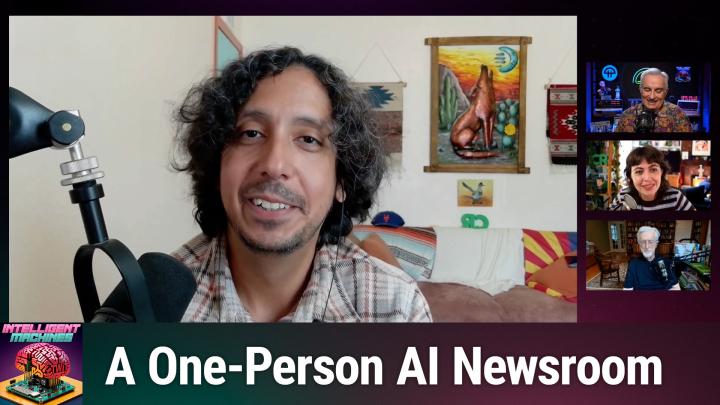
Intelligent Machines 883 transcript
Please be advised that this transcript is AI-generated and may not be word-for-word. Time codes refer to the approximate times in the ad-free version of the show.
Leo Laporte [00:00:00]:
It's time for Intelligent Machines. Jeff's here, Paris is here, and Nicholas DeLeon is here. You'll be amazed what he has done with $20 or $30 worth of AI, including a local newspaper, predicted the winners of the World Series and the World Cup, and even helped people get a job. Intelligent Machines is next.
Nicholas de Leon [00:00:22]:
Podcasts you love.
Paris Martineau [00:00:23]:
From people you trust.
Leo Laporte [00:00:26]:
This is TWIT. This is Intelligent Machines. Intelligent Machines with Jeff Jarvis and Paris Martineau, episode 883, recorded Wednesday, August 12th, 2026. Gatesgate. It's time for Intelligent Machines, the show where we cover the latest in AI, robotics, and all the smart little doodads surrounding us all these days. Hello everybody, I'm Leo, and let's say hello to Paris Martineau from Consumer Reports, where—
Paris Martineau [00:00:55]:
Hello.
Leo Laporte [00:00:55]:
She is on the food safety beat.
Paris Martineau [00:00:58]:
It's true.
Leo Laporte [00:00:58]:
God bless her.
Paris Martineau [00:00:59]:
That I am.
Leo Laporte [00:01:00]:
We need you doing that. Hello, Paris.
Paris Martineau [00:01:03]:
Hello, Leo.
Leo Laporte [00:01:04]:
Good to see you.
Paris Martineau [00:01:05]:
Good to see you.
Leo Laporte [00:01:06]:
I just want you to know you can swear. We'll just bleep it out.
Paris Martineau [00:01:09]:
I don't think that that's actually true. I mean, I think you'll bleep it out, but I don't know that I'm allowed to swear. I think that— yeah, I think that quite a few people will yell at me.
Leo Laporte [00:01:20]:
Only Jammerbee from afar.
Paris Martineau [00:01:21]:
Yeah, and that matters.
Leo Laporte [00:01:24]:
Also here, he is the Emeritus Professor of Journalistic Innovation at the Craig Newmark Graduate School of Journalism at the City University of New York. And his new book, Hot Type, is how soon?
Jeff Jarvis [00:01:38]:
Well, I thought it was next week, but people were telling me they're getting the books.
Leo Laporte [00:01:41]:
Yay!
Jeff Jarvis [00:01:42]:
So I guess it's this week.
Leo Laporte [00:01:43]:
Oh, awesome. Look in your mailbox. It could be there already.
Jeff Jarvis [00:01:47]:
Yeah, those of you who are nice enough to preorder, thank you, thank you, thank you.
Leo Laporte [00:01:50]:
And if it's not, go to jeffjarvis.com and order Hot Type, the story of— I sent you the funniest thing, the story of the linotype. I don't know how Google's Dream Beans knew this. We've talked about Dream Beans before, which is this weird Google experiment where it reads all of your personal stuff and then makes pictures of you and suggests things you should do. I don't know if it's going to still be here. I sent it to you.
Jeff Jarvis [00:02:18]:
It was in the chat, our chat.
Leo Laporte [00:02:21]:
Yeah. Oh, it's—
Paris Martineau [00:02:25]:
Man, I gotta check this chat.
Leo Laporte [00:02:26]:
It's got new ones every day. Yes, I have to open up the special super secret chat that we have in whatever program this is. But it was— it drew a picture of me looking— you probably know what it was.
Paris Martineau [00:02:43]:
Oh, that's what this was. Leo sent in our group WhatsApp at one point, just an image of him and just utter nonsense below. And I was like, is Leo okay?
Leo Laporte [00:02:57]:
Is he experiencing a crisis of psychosis? Google did this. Google did this. But yeah, it's things It drew a picture of me looking at some sort of—
Jeff Jarvis [00:03:05]:
A kind of linotype, a modified linotype.
Leo Laporte [00:03:08]:
Okay, and then I'm looking at some block, which I think is the sorting mechanism, right?
Jeff Jarvis [00:03:13]:
Yeah.
Leo Laporte [00:03:13]:
The mechanical sorting.
Jeff Jarvis [00:03:14]:
Smiling, it makes you happy.
Paris Martineau [00:03:15]:
It describes binary teeth. It's just a lot of, a lot of text below it.
Leo Laporte [00:03:21]:
It was recommending that I watch a movie called Linotype: The Film.
Jeff Jarvis [00:03:24]:
Which is very, very good.
Leo Laporte [00:03:26]:
So, you see, Google knows.
Jeff Jarvis [00:03:28]:
Yeah.
Leo Laporte [00:03:28]:
It's a weird experiment. And now you can get it. You don't have to be a Google Ultra, Gemini Ultra subscriber. You can get it if you have just a smaller Google subscription. I kind of, I both love it and hate it. I hate it because I think of all the work it's doing that I don't even look at. So that's, you know, another forest down, but it's kind of fun and it's funny. It's weird.
Leo Laporte [00:03:52]:
I get weird. And it's all drawings of me and Lisa. It knows apparently what Lisa looks like and somehow knows I'm married to her. And so it recommends things we could do as a couple.
Jeff Jarvis [00:04:02]:
Anyway, isn't that nice? Do we have a guest today?
Leo Laporte [00:04:05]:
We do.
Paris Martineau [00:04:06]:
Yeah. Is there someone else in this podcast that we're making sit in silence while you describe your AI dreams?
Leo Laporte [00:04:13]:
He is— I have an app for that. He's along for the ride. Let me say hello to Nicholas DeLeon. You've seen him many times. He was on Twitter on Sunday. He is a wonderful contributor to our show. But, uh, and not— but also, and, and senior electronics reporter at Consumer Reports, a colleague of yours, Paris. And the funniest thing happened.
Leo Laporte [00:04:36]:
I think it was last week Paris said, yeah, we had this conference call with this guy who works at, uh—
Paris Martineau [00:04:40]:
Not this guy. I said Nicholas, who I've been on TWiT before.
Leo Laporte [00:04:44]:
Oh, you knew? Okay. Okay. Yeah, I thought maybe you didn't know who he was.
Paris Martineau [00:04:48]:
Okay, we both work together and we've We've both been on Twit at the same time with you.
Jeff Jarvis [00:04:54]:
Oh, this is fun.
Leo Laporte [00:04:56]:
Remember, I'm senile. I don't know who's worked with whom.
Paris Martineau [00:04:59]:
It's true.
Jeff Jarvis [00:04:59]:
He's outsourced his entire brain to Gwen.
Leo Laporte [00:05:01]:
I got other guys doing that for me. But we thought we'd have Nicholas on this show because he is doing some really interesting stuff. Welcome Nicholas de Leon to Intelligent Machines.
Nicholas de Leon [00:05:12]:
Thank you, Leo, for the warm welcome. I've actually known Paris. I don't know that I've met Paris. Correct me if I'm wrong, but we've known each other—
Paris Martineau [00:05:19]:
I don't think we've met in person.
Nicholas de Leon [00:05:20]:
On Twitter for like—
Leo Laporte [00:05:21]:
I was just gonna say, the internet.
Paris Martineau [00:05:23]:
Yeah, it's been quite a while. He's not just some guy.
Leo Laporte [00:05:27]:
He's not just some guy.
Paris Martineau [00:05:28]:
He's some guy who posts content on the internet.
Leo Laporte [00:05:31]:
But it is the case that your employer said, you know, what Nicholas is doing with AI is very interesting. He should— did he do a presentation for you?
Paris Martineau [00:05:39]:
Yeah. So came and presented to our special projects team, which is the team that I'm on at CR, about all of the really interesting work that he's doing with AI. And it was both in terms of kind of We had a couple meetings, one of which was about FOIA more generally and kind of how his work could enhance our efforts there. But I got really fascinated by your discussion around your job that you're doing outside of the job that we both share. So I guess, could you tell people a little bit about that and how you got started as a local news baron?
Jeff Jarvis [00:06:17]:
Yeah.
Nicholas de Leon [00:06:18]:
Well, I don't know about Baron yet. Maybe one day. But yeah, so the site is Tucson Daily Brief. I've been doing it for about 6 months now. You know, there I, you know, I've had a couple of conversations over the past couple of days. There's no grand design here. There's no grand plan for like world domination or anything like that. This is just an experimentation in AI and journalism and stuff that you can do, basically.
Nicholas de Leon [00:06:42]:
So the original impetus for this was when OpenCLAW was like all the rage, you know, in like January, February, whatever. I initially dismissed it. I was like, this is just like Twitter talk or whatever. But then a couple weeks go by and it's like, okay, people are still talking about it. And so I wanted to mess around with it. I was like, okay, let me just use it. And you know, my kind of the way I learn and do things, I got to like mess with it. I got to play with it.
Nicholas de Leon [00:07:06]:
I got to do it, you know, before talking about it, before really having any strong opinions necessarily. So I installed OpenClaw and that was kind of the beginning of like, well, what can I do with this? Maybe I can, Yeah, everyone's like, oh, you can automate this, you can automate that. I was like, okay, whatever. Maybe I'll do like a local news site. I don't know. Why not? I'm in Tucson, Tucson, Arizona. It's like, it's a small town, but it's not really that small. There's 500,000 in the city itself and there's like a million in the metro.
Nicholas de Leon [00:07:36]:
So I'm like, okay, this is a good size city to try to mess around with some stuff. Maybe I can, I'm obviously not gonna like take over the town in terms of like I'll be the only source, but like maybe I could be in a conversation.
Leo Laporte [00:07:48]:
Maybe I can like, I can have a seat at the table.
Nicholas de Leon [00:07:51]:
It was kind of like the really only ambition here. Uh, so when the site started in February, it was, it was pretty bare bones. This is actually the 3rd version of like the design. Uh, the most recent design that folks can look at right now, I actually made that with, uh, KIMI-K3, the model that was like, oh, uh, all the rage, uh, like 2 or 3 weeks ago, whatever it was. Uh, but the initial version was pretty much just aggregation. There's something like 30—
Jeff Jarvis [00:08:16]:
Wait, wait, wait, wait, wait. What were you running? What were you running KIMI-K3 on?
Nicholas de Leon [00:08:21]:
Oh, just via OpenRouter. Just OpenRouter.
Jeff Jarvis [00:08:22]:
Oh, okay. I see.
Nicholas de Leon [00:08:23]:
Yeah.
Jeff Jarvis [00:08:23]:
Yeah.
Nicholas de Leon [00:08:24]:
I don't have powerful enough hardware to run much of anything locally. I have a 5080, the graphics card, which could do some stuff, but like not really, honestly. So it's all just done via the API. So yeah, the initial version of the site was pretty much just aggregation. You know, there's one newspaper in town, there's a couple TV stations, NPR, you know, you name it. Just pretty basic aggregation. And that's how it ran, just silently in the background. The way that it worked generally was, and this is all built on the Claude stack, although that may change as soon as tomorrow, we'll see.
Nicholas de Leon [00:09:01]:
But the initial version was, hey, here's 30 sources of information, RSS feeds, maybe some light scraping, whatever it is. This is the kind of the source of truth regarding the city of Tucson. Go through these sources every night, pick out the top 10 stories that happened, you know, across the different categories, government, public safety, I don't know, sports, whatever it is, whatever the categories are, synthesize and summarize them, send them to me, and then publish them to the site. So every morning at around 6:00 AM Arizona time, there's the daily brief. That's just like the headlines for Tucson. Because it's summarization aggregation, obviously it links back to the original, to the TV station, to the newspaper, whatever the case may be.
Leo Laporte [00:09:48]:
How much of this do you do manually though? Do you write some or no?
Nicholas de Leon [00:09:52]:
This is like predominantly just Claude code.
Leo Laporte [00:09:55]:
So it's automatic. You don't have to sit and hover over it.
Nicholas de Leon [00:09:57]:
Oh, no, no, no. This is just humming in the background. I'm literally asleep when this part is happening, basically. Or I'm just getting up.
Paris Martineau [00:10:04]:
On the website in the about, it says how this is made. The newsroom is one person, which raises a fair question. How does one person cover 4 municipalities worth of public business before breakfast?
Jeff Jarvis [00:10:15]:
And keep his job?
Paris Martineau [00:10:16]:
There is this thing in video games called a tool-assisted speedrun. A player uses software to play through a game with a level of precision and speed no human could achieve in real time. Tucson Daily Brief is that same idea applied to local news. The tools are large language models.
Leo Laporte [00:10:31]:
I like that.
Paris Martineau [00:10:32]:
Transcription engines, public data scraper schedulers, and a few hundred lines of glue Python. So, I mean, I guess walk us through a little bit how you went from what you just described, like, yeah, large-scale aggregation of other local news sources to starting to use AI to actually go out there and get new information, new transcriptions, new documents, and write stories off that that no one else has.
Nicholas de Leon [00:10:57]:
Yeah, it was, it was the, the idea was like, okay, the aggregation is cool. Like, it's fine, right? But like anyone, you know, whatever, kind of. So I'm thinking as a journalist, okay, there's these tools. Like, what could I do that actually like infuses like real journalism, real, real news here, move stories forward? Like, what can I add here as someone who's been doing journalism in various capacities for enough years to make this stand out beyond just a cool tech demo, basically. Because I had the Daily Brief, I turned that into a podcast. I used ElevenLabs to clone my voice. So that's uploaded to Apple Podcasts and YouTube every morning at 6:00. And so the first, beyond just raw automation or whatever, was the idea of a live AI reporter, which I'm happy to give credit to an AI model when it comes up with the term.
Nicholas de Leon [00:11:47]:
I came up with the term live AI reporter. I came up with the idea for chattdb.com, which I'll get to in a second. The idea with the Live AI Reporter is, you know, here I'm covering right now 4 municipalities. It's the city of Tucson, Pima County, and then 2 of the other towns nearby. I'm about to add a couple of school districts. I think next week they come online. But basically all these municipalities, you know, they'll have town halls, they'll have whatever. Those are usually streamed online, whether it's Facebook or some other platform.
Nicholas de Leon [00:12:16]:
So I was like, okay, so this audio, I mean, this video, this exists, it's being transmitted live somewhere. So what I could do, and this is just me thinking an accumulation of like nerd knowledge of years spent like, you know, transcoding video and like doing various like nerd problems. Okay, so if there's audio being broadcast, then I can capture that audio in real time. I know there are models that can transcribe audio in real time. So why don't I just put those 2 together? Why don't I just transcribe, I'll grab the audio via FFmpeg, save that to disk somewhere as that's being broadcast, send that to some model to be determined. It ended up being Deepgram. That creates a real-time transcript of the town hall meeting. This could be happening simultaneously all over the county.
Nicholas de Leon [00:13:04]:
The live meeting happening, it creates a transcript. These meetings last like 3 hours easy. It creates a transcript, boom, meeting's over. That transcript is then sent to, again, Anthropic. I think it's Sonnet 4.6, which is doing this leg of the work. So that transcript is sent to Sonnet, and the prompt is something along the lines of, here's a giant text dump of a transcript of a local town meeting. Take this giant text dump and turn it into like a 1,000-word AP-style news article highlighting the most important things, the most impactful things. You know, don't get lost in minutiae of like, you know, this isn't minutes of a meeting.
Nicholas de Leon [00:13:42]:
This is a news story. This has to, you know, local news, you know, local town halls aren't necessarily the most exciting, but they do describe and they do discuss you know, things of impact that, you know, around here in Arizona, there's a lot of data center stuff. There's a lot of stuff about Flock, the security camera. There's a lot of like meaty things going on here. So Sonic gets the instructions, it turns that transcript into the article in, you know, a minute, let's say, in no time, basically. That draft of an article is then sent to me. I edit manually to make sure, you know, the live transcription via the Deepgram engine is pretty good, but it's not Perfect. You know, there's a lot of Spanish language names here in Tucson.
Nicholas de Leon [00:14:25]:
It always mangles those. So I had to make like a little interrupt in between to say, hey, if you mishear Gonzalez, he probably, you know, he means Gonzalez. There's a bunch of names here and words or whatever. So that like corrects it manually. And then that is, that's eventually published. That takes, depending upon the length of the meeting, to edit that down, that takes about, let's call it an hour. The latest one was last night. There was a Pima County Board of Supervisors, is the executive board here.
Nicholas de Leon [00:14:56]:
They had a meeting. It ended at 8:30 local time. I was playing a video game, so I was like, okay, I need a minute. But the story was on the site, let's call it within an hour. And when I checked, we were the first local news source to have coverage of that meeting, which happens all the time now, honestly. Not that it's a race, not that I'm saying, look how cool I am. It's just think, okay, this is— it's working. You know, I'm— I am actually—
Leo Laporte [00:15:22]:
The fact that it's getting somewhat covered at all is the big win because—
Nicholas de Leon [00:15:27]:
I agree.
Leo Laporte [00:15:28]:
As local news has just disappeared, and I, you know, Jeff, we've talked about this for years, in every, uh, community, city council meetings don't get covered anymore. You have— I just love this— you've got liquor license applications, so I know there's going to be a new 7-Eleven. That matters. This is, this is fake information.
Jeff Jarvis [00:15:49]:
I wanna go to the Taco Giro Mexican restaurant.
Leo Laporte [00:15:51]:
Oh, they've got the great— Tucson has great Mexican restaurants.
Nicholas de Leon [00:15:53]:
This part, this is, you know, every municipality here, the way it works, whether it's split between the county or the municipality, somewhere there's, you know, liquor license filings. And this is all public information. This is not like I'm not stealing anything.
Leo Laporte [00:16:06]:
Do you have to scrape it or do they have an API?
Nicholas de Leon [00:16:08]:
Uh, it's a combination. I believe this stuff is primarily API actually.
Jeff Jarvis [00:16:12]:
Nice.
Nicholas de Leon [00:16:12]:
Uh, so it, but it's a combination and there's like so many like endpoints. No, I, I, I'm a little mixed up what exactly is where nowadays because there's so many sources of information. But yeah, so it surfaces all that. And so that was kind of my first idea where it's like, okay, this is real. Is this journalism? There was a story in Wired today where someone kind of did a very similar technique, a live transcript turned into an article, and oh, is that reporting? I don't know. Some of this kind of feels like that, like how many angels can dance on the head of a pin type of thing. It's like, I don't know. It's useful information.
Leo Laporte [00:16:47]:
Yeah, who cares if the public gets the information? Here's a story about the vote over the new data center in the town.
Jeff Jarvis [00:16:56]:
Yes.
Leo Laporte [00:16:56]:
Did you write this lead or did AI write this lead? Voters nearly divided down the middle on the $5 billion Luckett Road project, proof of how contentious it has become. But the mayor and council members who approved it all kept their seats. Did you write that?
Nicholas de Leon [00:17:10]:
So the provenance of this was the New York Times actually went to Marana, which is a town nearby. It's, it's an exceedingly nice town. It's like so beautiful, actually, in my opinion.
Leo Laporte [00:17:20]:
And so they're naturally NIMBY. They don't want a data center anywhere near.
Nicholas de Leon [00:17:23]:
Yeah, I mean, it's a big thing down here. You know, obviously it's a desert, so there's, there's basically no water. Uh, but the land is cheap here, so I understand, you know, why would they build it here? Because the land is cheap, basically. Uh, so the New York Times was here in, I think, May. They came to Marana, big profile, you know. Okay, whatever, that's fine. Uh, you know, it was getting, uh, a lot of hype. I was like, oh, the anti-data center movement, you know, is really— so I was like, okay, you know, I'm a naturally skeptical person of basically everything, uh, which is partly a consequence of watching so much professional wrestling as a kid.
Nicholas de Leon [00:17:54]:
I'm just very like skeptical of everything. There's always like an angle.
Leo Laporte [00:17:59]:
Wait a minute, you mean that's made up?
Nicholas de Leon [00:18:00]:
So basically—
Paris Martineau [00:18:02]:
No, Leo, it's all real, just like your AI friends.
Jeff Jarvis [00:18:07]:
Virginia.
Nicholas de Leon [00:18:08]:
So the provenance of this is we had, we had an election, I don't know, 2 weeks ago, whatever it was. And, you know, the anti-data center ticket, you know, it was 4 people and only 1 person won. So I'm like, okay, that's interesting. You would think, given some of the news coverage, that the anti-data center folks would just like, would just run the table. I don't know. There's some nuance there. So this is a story that I would say I co-wrote with AI. You know, we went through the results.
Nicholas de Leon [00:18:35]:
You know, we went to the county recorder's office. We got like the raw, vote totals. We added some context to the New York Times, and it has my entire corpus of reporting on data centers and all this Marana town halls going back to, like, I don't know, February, March. So we were able to build a story that I think is fair. You know, it's not, it's not like saying, haha, the anti-data center guys lost, or, you know, hooray, they, you know, whatever it is. It's just kind of like, I don't really care. This is just like what happens. You know, to me, it's a journal.
Leo Laporte [00:19:03]:
It's traditional reporting. It's factual.
Nicholas de Leon [00:19:06]:
Honestly, you know, I, I made—
Leo Laporte [00:19:07]:
It's not an opinion. But did you write this?
Nicholas de Leon [00:19:09]:
No, no, this was, this was, this was, uh, a sonnet, I guess.
Leo Laporte [00:19:13]:
I'm impressed.
Nicholas de Leon [00:19:13]:
Or opus, I forget.
Leo Laporte [00:19:14]:
Because it doesn't have any of the tells.
Paris Martineau [00:19:16]:
I—
Leo Laporte [00:19:16]:
it doesn't feel like AI wrote it.
Nicholas de Leon [00:19:18]:
This is, this is probably a mixture of, of me and it. I, I couldn't give you percentage, uh, maybe not 50/50, maybe like 75/25.
Leo Laporte [00:19:26]:
So you put, uh, some writing—
Nicholas de Leon [00:19:27]:
I put some of me in here. Yeah, yeah. It's not entirely— that's why I say on the site it's semi-automated. You know, some things like the daily brief is entirely— that just gets published to the site. You know, some stories Like this, I have a little bit more of a hands-on role.
Leo Laporte [00:19:39]:
Do you find you have to, uh, do a lot of maintenance, uh, like corrective maintenance? Like, no, don't do it that way, do it this way? Or is it just— is this completely at this point running on its own?
Nicholas de Leon [00:19:51]:
Uh, it, it, it, it maybe can't entirely run on its own, but it's pretty close. Like, I just do it because I think it's, it's responsible to like, okay, if I'm going to write an article, if I'm going to publish an article about the town hall meeting, Uh, and I'm gonna say, hey, here's what happened at Tucson town hall. I, I, I kind of need to, I wouldn't feel comfortable just like shooting that out there. Basically, I kind of wanna take like, even if it's just like 10 minutes, just to like make sure it's like not crazy.
Paris Martineau [00:20:18]:
Yeah. On like an average day-to-day, week-to-week, like how much time are you spending, I guess, overseeing these agents or like rewriting stuff that ends up publishing?
Nicholas de Leon [00:20:28]:
Uh, the most time is honestly the social media con— I started doing Instagram maybe like 6 weeks ago. Uh, and that takes a while because that's— I can't automate Instagram really, you know, I really can't automate that. I, I might if I could.
Jeff Jarvis [00:20:41]:
Yeah.
Nicholas de Leon [00:20:41]:
Uh, so I do that, you know, I don't wanna say manually in this, uh, in collaboration, uh, with, uh, with the AI. I'm like, hey, here's today's brief. What's like a cool light thing that I could put on Instagram? And then it does the rendering. You know, I don't wanna sit in Photoshop and like, like I'm not doing that. So it like, it generates all of that for me. And then, and I come up with the, uh, it comes up with the caption and I maybe edit, But Instagram takes forever. I just started doing Bluesky. Bluesky is like a combination of like auto-posting and manual.
Nicholas de Leon [00:21:07]:
X is entirely manual. Uh, what else did we do? Oh, we do YouTube Shorts. So those are generated, uh, automatically. Uh, if you go to YouTube—
Leo Laporte [00:21:15]:
Wait a minute, you make little videos?
Jeff Jarvis [00:21:18]:
Yes.
Nicholas de Leon [00:21:18]:
Yeah. So there's YouTube Shorts.
Jeff Jarvis [00:21:20]:
That's new.
Nicholas de Leon [00:21:20]:
Again, the, the kind of the—
Leo Laporte [00:21:23]:
What's the, what is it? youtube.com/—
Nicholas de Leon [00:21:25]:
Uh, it should be Tucson Daily Brief.
Jeff Jarvis [00:21:27]:
Yeah.
Nicholas de Leon [00:21:27]:
Those I don't even— on a certain level, it's like I don't even know why people watch YouTube Shorts, but it's the type of thing where it's like people watch them, then, you know, I'm gonna make them, I'm gonna make it. And the kind of the marching orders there, like, keep it light, keep it fun, keep it fun. There's like a jingly, uh, kind of song that I made with ElevenLabs. It's like, oh, make it sound like lighthearted. So it's just kind of like, uh, his voice with ElevenLabs too. Yeah, I cloned the voice with ElevenLabs.
Leo Laporte [00:21:55]:
Oh, so it's reading, uh, your voice. Yeah. Let's, let's hear a little bit of it here.
Nicholas de Leon [00:22:01]:
Good morning. I'm Nicholas DeLay. This is the Tucson Daily Brief for August 11th, 2026. 2 lightning-sparked fires are burning in ranges near Tucson. The Finger Ridge Fire in the Santa Catalina Mountains—
Paris Martineau [00:22:12]:
Does it feel eerie to hear your own AI voice all the time?
Nicholas de Leon [00:22:16]:
Well, I hate hearing my voice to begin with. Uh, so, uh, I don't know. I, I like it that you chose your voice instead of some generic, uh, You know, I was, and I, you know, I cloned my voice with, you know, I just, I read, I'm almost certain it was like, I was either a Consumer Reports article or like a Guardian Saarber article. I read the article from A to Z, cloned my voice, uh, and gave it to ElevenLabs. You know, I had to, I had to make some, some corrections there because actually ElevenLabs just out of the box, in my, in my experience, it, it, you know, it can't read the Spanish names correctly.
Jeff Jarvis [00:22:48]:
Yeah.
Nicholas de Leon [00:22:48]:
Things like Democrat, Republican, it'll, it'll say like rep or dem, you know, symbols like the dollar sign. If it's like $10 million, it kind of gets So I had to add like almost all the time, 1-0-0-0-0-0-0-0. Yeah, so I had to make like an interrupt little, little file that like says, hey, if you encounter this, you actually need to say it. And I— you say phonetically, basically.
Leo Laporte [00:23:10]:
Nice.
Nicholas de Leon [00:23:10]:
Uh, what else?
Leo Laporte [00:23:11]:
Uh, we're talking to Nicholas DeLeon. He is by day a mild-mannered reporter for Consumer Reports. He's their senior electronics editor. By night, he's an AI whiz who has created This isn't the only thing you've created either, by the way. Before we move off to Sun Daily Brief, tell us what ChatTDB is.
Nicholas de Leon [00:23:29]:
So ChatTDB, uh, is a thing. And again, I'm happy to give credit to the model when it comes up with stuff. Comes up with— I came up with ChatTDB. That's basically a, uh, a RAG tool. So basically it looks, it looks at like the— every day at like 8 AM, it kind of refreshes the various databases of like stuff that we've published. Whether that, you know, literally everything from like liquor license, all that type of stuff. And it's, it's, it should be able to answer your question. So on the screen here, you're asking like, what did Marana ask about the data centers? It should, you know, assuming it works, it should be able to go through the corpus of stuff and come up with an answer saying, well, Marana did X, Y, and Z.
Leo Laporte [00:24:10]:
The establishment won, but barely.
Jeff Jarvis [00:24:13]:
Yes.
Leo Laporte [00:24:13]:
This is amazing because it's so local and it serves your communities. I mean, this is— I— how many— do you have a lot of visitors?
Nicholas de Leon [00:24:24]:
Uh, I mean, I mean, no, honestly. It's like, uh—
Leo Laporte [00:24:26]:
Probably you're gonna have visitors from all over the world after talking about this.
Jeff Jarvis [00:24:30]:
I'm definitely all gonna move to Tucson and the prices will go up.
Leo Laporte [00:24:33]:
It's your fault.
Jeff Jarvis [00:24:35]:
Yeah.
Nicholas de Leon [00:24:36]:
Uh, in terms of like the biggest metric I care— oh, we have a newsletter, so that's probably the last big thing, uh, to describe. So that's I started that, I don't know, some, some way into the project. And so that idea is, again, look at the week's worth of stuff. Let's come up with a newsletter that's in a warm, you know, warm, warm language, kind of fun. You read it Sunday morning. That, that is currently— again, all of this is currently being done with various Anthropic models. You know, Grok 4.6 came out today and I was able to try it briefly. The pricing seems fair.
Nicholas de Leon [00:25:09]:
And not that local news needs like frontier-level intelligence.
Leo Laporte [00:25:12]:
Well, how much do you spend? On this?
Nicholas de Leon [00:25:14]:
Uh, all in, it's like, let's call it like $40 a month, $30, $35 a month.
Jeff Jarvis [00:25:18]:
What?
Leo Laporte [00:25:18]:
You're using $20 plans for this?
Nicholas de Leon [00:25:21]:
No, the, see, that's the, the, the biggest cost is the ElevenLabs. I'm on like the creator, uh, tier, whatever. And I probably don't need that. It's probably better to just pay via the API, but you know, it's one of those things where it's like, I don't know.
Jeff Jarvis [00:25:37]:
So how are you doing it on the other models?
Nicholas de Leon [00:25:40]:
Uh, those are all, uh, it's just via the API.
Leo Laporte [00:25:42]:
Uh, so that's— So you're paying by token, not by subscription. Yeah. But even then it's, uh, $20, $30, $40 a month?
Nicholas de Leon [00:25:50]:
Uh, not even, not even like, even like, even, even Opus would be like, uh, I wanna say like $12 a month, something like that.
Leo Laporte [00:25:57]:
But what you're doing, it's important. You're, you're smart about which models you choose. So you choose cheaper models to do the things they can do well. You don't have to use frontier models for everything.
Nicholas de Leon [00:26:07]:
No, not, not, not, not for this. I mean, this, we're not, you know, we're not not curing cancer or like discovering new science. It's pretty impressive. This is text synthesis, you know.
Leo Laporte [00:26:16]:
Uh, by the way, the— you want to subscribe to their, uh, Sunday morning roundup of Tucson news because there's a crossword puzzle in it.
Jeff Jarvis [00:26:24]:
Yeah.
Nicholas de Leon [00:26:25]:
Yes, I made that. So one— I've done like a handful of kind of AI kind of side projects. One of them was a few months ago. I'm sure you guys know the meme, uh, monitoring the situation where everyone like really pays close attention. So I made a website called crosswordingthesituation.com. And that was basically a 5x5 mini crossword puzzle that's tied to news, like, like what happened like within the past 2 weeks. All the clues are like literally ripped from the headlines, so to speak. So I made that, I don't know, February, March.
Nicholas de Leon [00:26:58]:
And then I was like, you know, it'd be cool if I take that idea of a crossword puzzle sourced in something and bring it to the Tucson thing. Maybe I could do like a Tucson crossword puzzle.
Leo Laporte [00:27:09]:
I'm not going to know any of these.
Nicholas de Leon [00:27:11]:
And, you know, I would say, you know, I don't know if every single clue is tied to Tucson, but like, you know, some percentage of them are local stuff. So it kind of rewards either reading the site or just being aware of like Tucson stuff.
Leo Laporte [00:27:27]:
So cool.
Nicholas de Leon [00:27:28]:
Yeah, it's, it's, you know, I'm not, I'm not done yet.
Leo Laporte [00:27:33]:
It's very Tucson-y. Like one of the clues, dull and lifeless, the opposite of a monsoon sunset. Of course, you have monsoons in And then loosens up like tension after a haboob passes, which I presume is another weather thing.
Nicholas de Leon [00:27:45]:
That's the word for dust storm they use.
Leo Laporte [00:27:47]:
Okay.
Jeff Jarvis [00:27:48]:
Yeah.
Leo Laporte [00:27:51]:
This is so amazing.
Jeff Jarvis [00:27:53]:
You mentioned before the meetings. I know from— I'm on the board of a little newspaper company now. And the problem is that that's commodity news.
Leo Laporte [00:28:01]:
Right.
Jeff Jarvis [00:28:02]:
And what a place wants to do is free up their reporters' spare time. to do more than that. And so we're using a company here in New Jersey, I think called Civilio, to help out of Montclair State, to help transcribe these meetings just to give the reporters what they want. But you can go directly to the public with it as long as you're clear about how this happens. And it frees up journalistic resources to do more.
Leo Laporte [00:28:22]:
Although, isn't that where many reporters start was, is with those really—
Jeff Jarvis [00:28:26]:
Oh, yeah. Oh, yeah. And I covered them back in the day. I covered fistfights at local meetings back in the day.
Leo Laporte [00:28:33]:
All right. Let me ask you, because we're running out of time, I know you have a You're on deadline or some sort of weird—
Jeff Jarvis [00:28:39]:
No, he's ready for his star turn on TV.
Leo Laporte [00:28:42]:
Oh, that's right. You got it.
Jeff Jarvis [00:28:43]:
You got it.
Nicholas de Leon [00:28:44]:
I got, I got like 15 minutes.
Leo Laporte [00:28:45]:
I got—
Nicholas de Leon [00:28:46]:
as long as I'm out by—
Leo Laporte [00:28:47]:
Tell us about your other stuff. So you had a World Series simulator, you had a World Cup simulator.
Nicholas de Leon [00:28:53]:
Yes, I had. So if you go— Deep Dugout was kind of my first big thing, and that was like an AI baseball simulation engine. If you go to deep deepdugout.com. That was the idea.
Leo Laporte [00:29:07]:
Deep Bugout. There you go. There's the typo.
Paris Martineau [00:29:09]:
That's a bit different.
Leo Laporte [00:29:10]:
Yeah.
Jeff Jarvis [00:29:11]:
That might be different.
Nicholas de Leon [00:29:13]:
And so basically the idea was, what if you had, you know, baseball's very stats heavy, you know, of course. The idea was basically, what if I give each manager a model, Fable, SOUL, you know, whatever it is, and have them play against each other? You know, I made like a baseball simulation engine where basically, you know, the manager is more or less deciding, do I pull the pitcher? Do I keep him in? What's the lineup going to be today? All those separate decisions that a real manager would make, I handed over to a model. I used Polly Market to like, or who was the favorite to win the World Series? So, you know, there's some source of real world and then it's, and then it's kind of like an extension of, you know, arguably this is AI slop and I understand that and I don't mind because it's like it generated like, you know, match reports. It generated, again, it generated podcasts. It generated like, you know, if you read the New York Post, like the Yankees beat report And he's like, you know, he's mad at the team. There's like postgame interviews. There's like, it's like a whole world of like stuff happening here.
Leo Laporte [00:30:14]:
Made up stuff.
Nicholas de Leon [00:30:15]:
Yeah.
Leo Laporte [00:30:15]:
And, but I think one of the things you're doing that's interesting is pitting models against each other to see who would be, which models would be better at managing a baseball team.
Nicholas de Leon [00:30:23]:
Yeah. And it, you know, it feels like it's, it kind of hit like a plateau where—
Leo Laporte [00:30:27]:
Who's the best at it?
Paris Martineau [00:30:29]:
Yeah.
Nicholas de Leon [00:30:29]:
It hit a plateau probably with like Opus, I don't know, maybe 4.7 where like at that model, at that point it was just like burning like reasoning tokens and not, there's no reason.
Leo Laporte [00:30:38]:
It doesn't get better.
Jeff Jarvis [00:30:39]:
What is a—
Nicholas de Leon [00:30:39]:
well, it was kind of my, you know, in sports, you know, I'm a big soccer guy as well. And there was a manager, Pep Guardiola. He recently just left Manchester City. But the biggest knock against him for years was like sometimes he overthinks games where it's like the answer is so obvious, you know, this is your lineup, these are the guys you play. And sometimes he would like be a little too clever and they would lose the game. And the criticism in the media was always, there he goes again, overthinking the situation and he got it wrong again. Now, that didn't happen all the time. He was a very good manager.
Nicholas de Leon [00:31:13]:
But when he tripped up, that's how he tripped up. So it was kind of like, okay, do models overthink things? Do they make things too complicated?
Paris Martineau [00:31:22]:
Yes.
Nicholas de Leon [00:31:23]:
So that was kind of the thinking there. So that was the baseball project. I also made for the World Cup, I made something called matchdayinference.com. You know, get it? Inference. So matchdayinference.com. And the idea was, you know, you go to a stadium, You know, and there's a program, right? Oh, today the Yankees are playing the Red Sox. You know, they have this and this record. It's a long and storied rivalry, yada yada.
Nicholas de Leon [00:31:50]:
So the idea was, okay, I'm going to make a digital version of that for the World Cup. But what I want to do is, you know, if you are— and this was a pure journalism product thinking thing. It's like, okay, what if we had infinite resources? How would we cover the World Cup? Probably the best resource newsroom is probably the New York Times, if I had to guess. And, you know, they can do a lot, but they don't have infinite What can't they do? So the idea here was, okay, what I'm going to do is I'm going to make a matchday program totally customized to the individual person. So you pick your player, you pick your team, Spain, Germany, whatever it is. You pick a lens, I call it. Do you want the report to be historical-based? Do you want it to kind of be like banter at the pub type of thing? You give it all those parameters, you click a button, and it generates a matchday program for you every morning that was sent out the day of the game. And literally no 2 of those were the same.
Nicholas de Leon [00:32:51]:
It was pulling stuff. I paid for a professional API so the sports data was accurate, scores and things like that. I was pulling stuff from the FIFA archives, from the FIFA YouTube account, trying to bring in world context into it. So when you open your email and you read this thing, oh, Spain is playing Argentina in the final at New York, New Jersey Stadium, You had like a, a real product in your hand type of thing. Uh, it was, and the design was, you know, I see a lot of discussion online about like, you know, every like Claude design website looks the same. There's some truth to that. I kind of don't think it matters. I think a lot of this discussion is, I, I think we've got too many people just discussing things all day, basically.
Leo Laporte [00:33:34]:
Just like the, uh, just like the AIs going back and forth over notes.
Nicholas de Leon [00:33:38]:
a lot of talking about like—
Leo Laporte [00:33:40]:
I like the design because it's, it's like a zine. It's very—
Jeff Jarvis [00:33:43]:
Yes.
Leo Laporte [00:33:44]:
It's personal.
Nicholas de Leon [00:33:45]:
The idea was very subpop records, you know, Slater Kinney, Nirvana. I wanted it to look like cool, basically. And so this was Claude. This was literally Claude Code. No other outside whatever. Just me kind of like feeding it like album covers and like, oh, I want it to look like this. Maybe pink is a cool color. Maybe the typography should kind of look like this and just riffing back and forth.
Nicholas de Leon [00:34:08]:
And eventually we were able to land on this sort of aesthetic. So that's, that was the last one. And the last one, the last kind of big one is, it's a, it's a premium product. It's my first kind of go at like, maybe having, making money off this. It's called mynextassignment.com. And what that is, is it's basically a, well, it's basically a job finder tool for folks in media or editorial. It looks at like 300+ job boards across newsrooms, across companies, and, you universities, and you name it. Basically, it works is you sign up, you answer a little questionnaire.
Nicholas de Leon [00:34:48]:
I've been in the industry for X number of years. These are my beats. This is what I'm good at. Then it will take your information, put it against the various pipelines, and try to match you to roles that you would be good at. Oh, you would be really good at this job that the Los Angeles Times is hiring for. That's a premium product that I don't remember the pricing offhand.
Leo Laporte [00:35:12]:
But the kind of the cool thing is that, you know, it's worth it because if you get a job, this is a lot less than joining a job board.
Nicholas de Leon [00:35:19]:
And to me, it's like what the— what it does and what is a huge time saver. One, it finds jobs that like match your skills. I mean, nothing is— few things are more demoralizing than like been looking for a job, honestly. I'm like, okay, I'm good at this, I'm good at this. You give it and the models will scour the internet to find roles that are open that you may be a good fit for it. Then if you want to pay a little extra, it will then go ahead and tailor your resume to the job description. You give it your resume, okay, it's going to rewrite it matching the job description exactly, and it will then create a cover letter. Hi, my name is Nicholas and I would love to join your company.
Nicholas de Leon [00:36:01]:
All of this is like a humiliation ritual, obviously.
Jeff Jarvis [00:36:05]:
It is.
Nicholas de Leon [00:36:06]:
But I would never recommend, and for all this stuff, I would never recommend just submitting it blindly. You need to edit this stuff, you need to like make it you, uh, not just for like, you know, that you just should, like you should make it you. You're trying to, so, but, but it like saves so much. And okay, does it work? Uh, I've given this tool, you know, it's been, it's been in beta for like, let's call it like 6 weeks. I've given it to a handful of friends. I'm aware of, I think I want to say 5 interviews with, uh, real companies that we've all heard of on this call, which I will obviously not mention. Uh, but like, I'm like, okay, Okay, this thing works. You know, ultimately, I can't guarantee anyone gets hired.
Nicholas de Leon [00:36:45]:
Obviously, I cannot guarantee anything. But what it can do is it could save you time. And, you know, overnight, you get an email, you wake up in the morning, you get an email that says, hey, Nicholas, hey, Paris, we found you, you know, 20 roles that you are a good fit for. You know, we used— I forget offhand what models I'm using to kind of filter it out. But like, here you Here you go. Here's 10 roles that you would be a good fit for. 3 of those roles you'd be an awesome fit for. So we've gone ahead and made the COVID letter and made the resume for you, for you to edit and submit at your own, at your own pace.
Leo Laporte [00:37:19]:
The thing that's really so interesting here is here's just one guy, not a, you know, I don't, I presume you're not a computer science, you know, PhD or anything. You're a journalist. Yeah, who in his spare time has done all of this really high-quality work. I think it's just fascinating.
Nicholas de Leon [00:37:42]:
And then I have, I have 2 iOS native apps.
Leo Laporte [00:37:46]:
Of course you do.
Nicholas de Leon [00:37:48]:
One is—
Jeff Jarvis [00:37:49]:
No wonder you get up at 5 o'clock to walk the dog.
Leo Laporte [00:37:52]:
You got a lot of energy. So tell us about the iOS apps.
Nicholas de Leon [00:37:55]:
Yeah, the iOS apps. One is— I don't want to give too— maybe they should be out in the store maybe the next time I'm on Twit, you know, a couple months from now. But basically one is is kind of like a lifestyle app, I'll say. That is code complete. Uh, that is— I'm literally in the, in the process of like putting together like the bank account stuff for the App Store for that. And the other one is a gaming accessory app. It would be— it's, it's, you know, if you play a lot of video games, it will be useful to you is really all I can say. Uh, but especially for folks who play on Steam.
Nicholas de Leon [00:38:27]:
I'll leave it at that. Uh, but that is like 90% code complete. It has like a bunch of cool themes, like all through gaming history. You know, I'm getting old, you know, I played a lot of Super Nintendo, Sega. Those are kind of like the games I care about. N64, I don't care as much about PS5. So if you have like a real history of like video games, you may appreciate the overall design and aesthetic of the apps. And those will be, those should be launched, I don't know, in the next, well, some of it depends on App Store review, but like very, very, very, very soon.
Nicholas de Leon [00:38:59]:
And those were made again using uh, primarily Cloud Code. And, you know, when Fable came out, that really helped with the, the UI work. Fable was very good with UI work. But like, it's just, yeah, it's just me messing around. It's just me tinkering, uh, you know, uh, and, you know, I'm having fun. You know, I, I tell my wife, is like, she's like, are you like, are you having fun? You're in that room like, oh, what are you doing in there? I'm like, I'm like, you like, you know me by now. If I'm not having fun, I'm very easy to read. Uh, I get real grumpy.
Jeff Jarvis [00:39:30]:
That's so be scary.
Nicholas de Leon [00:39:30]:
really patient, uh, but it's like, this is all cool to me. This is all fun.
Leo Laporte [00:39:34]:
Oh, you know, it's cool. It's very impressive what you're doing. Uh, yeah, unbelievable.
Nicholas de Leon [00:39:40]:
You know, I never set out to like figure out the future of news or like I'm gonna do this in journals. No, that was never my— never my goal. It was just, I— these things exist, I kind of want to see what they can do, is, is basically just it.
Leo Laporte [00:39:53]:
I think you've shown us what they can do, and I'm very impressed, especially considering you've spent a tiny amount of money doing this. That's obviously many hours, but a tiny amount of money. And it is fun. It's very fun.
Nicholas de Leon [00:40:07]:
It's fun to me. That's the bottom line. It's just fun. It's fun to mess around with this stuff.
Leo Laporte [00:40:11]:
Nicholas DeLeon is senior electronics reporter at Consumer Reports. Of course, you'll see him on TWiT again soon. We love having him on. And I just thought it'd be fun to spend a little time talking about these projects. We never really get to delve into it, and we— I still feel like we only scratched the surface. You're very productive. I'm impressed as hell. Thank you, Nicholas.
Leo Laporte [00:40:31]:
Go be on TV.
Nicholas de Leon [00:40:32]:
Yeah, I got a TV hit. Thank you again. I'll speak to you guys soon.
Leo Laporte [00:40:35]:
All right, take care.
Jeff Jarvis [00:40:37]:
Bye.
Leo Laporte [00:40:37]:
I'm sorry because I have a feeling, Parris, Nicholas is headed— well, I asked him on That's Sweet, I said, he's been at Consumer Reports for 7 years. I said, how long before somebody comes and snatches you up?
Paris Martineau [00:40:52]:
A lot of people at CR have worked here He really loves it.
Leo Laporte [00:40:57]:
He says, I don't want to leave.
Paris Martineau [00:40:59]:
I would say most of the people that I interact with on a day-to-day basis have worked there for more than 10 years.
Leo Laporte [00:41:06]:
It's a great job.
Paris Martineau [00:41:07]:
I'd say a not insignificant amount of the people I interact with on a day-to-day basis have worked there for more than 20 years. It's a good place to work.
Leo Laporte [00:41:15]:
Yeah. We are gonna take a break. We'll come back in just a It was a bit with, uh, I was, I was, I was remiss. I did not do the rundowns. And actually, I get a lot of help from AI, and I still didn't do the final chore of putting—
Paris Martineau [00:41:31]:
I was about to say, we got a blank spreadsheet.
Leo Laporte [00:41:33]:
Well, if you scroll down, Mr. Jeff Jarvis, now finally, finally my moment.
Paris Martineau [00:41:38]:
Wait, are we finally gonna get Jeff time? I'm starting after, after months of—
Leo Laporte [00:41:43]:
I should just let Jeff do the show.
Paris Martineau [00:41:45]:
Yeah, what I would say this is actually incredible because despite the fact— so for the listener, we operate off a spreadsheet where we put in our links and stuff like that. For most the first like 2 years of my time here, um, you had a section at the top of Leo, you had a section of top of a million links from Jeff, and we kind of pick and choose from all of them. Sometime I think over the last 6 months or so when Leo started having AI do his briefings, we got into routine of, we're just going to go down Leo's list. But Jeff, who believes in himself, kept putting his 65 links down there regardless, even though we never got to basically any of them every single week.
Jeff Jarvis [00:42:25]:
It's my education.
Paris Martineau [00:42:26]:
And now it's Jeff time, baby.
Jeff Jarvis [00:42:28]:
My turn. My turn. Well, Paris, there's a chapter before this. Used to be there was only one rundown, and Leo would put in his stories, and I, not knowing, interfered, and I would add in more stories, and it drove him completely bananas. Until he finally said, enough! There's my space and then there's other space.
Paris Martineau [00:42:46]:
Oh, that's how we got—
Leo Laporte [00:42:48]:
That's how we got it. Yeah.
Paris Martineau [00:42:48]:
Because of the separate zone.
Leo Laporte [00:42:49]:
I don't remember it at all, but okay, if you insist. I, I, I don't remember that. I thought we were, uh—
Jeff Jarvis [00:42:56]:
No, no, I remember, but I don't— was it, was it Jason who came and said, uh, Leo has another idea about the, uh—
Leo Laporte [00:43:01]:
Maybe, maybe I said something to Jason that would—
Paris Martineau [00:43:04]:
that might make a little bit of sense. What are all these stories doing in my mind?
Nicholas de Leon [00:43:08]:
What is going on?
Leo Laporte [00:43:09]:
I don't want We'll take a break. We'll come back. There is a lot of news. I don't know if you got to it all, and some of it's in my head. New models, we're going crazy here.
Jeff Jarvis [00:43:20]:
New business models, new—
Leo Laporte [00:43:22]:
New everything. Yeah, people moving upstairs, downstairs, and out the side door. You're watching Intelligent Machines with Jeff Jarvis and Parris Martin-Ohm. Well, it's been a busy, busy, busy week for the models, busy week for me. Um, I have to say, I admit it, I spent a little bit of money this week.
Paris Martineau [00:43:43]:
You spending money?
Jeff Jarvis [00:43:45]:
It was like the old days.
Paris Martineau [00:43:46]:
It felt like the old days. I, I miss when you—
Jeff Jarvis [00:43:49]:
you—
Paris Martineau [00:43:49]:
this show used to have a segment that was just what you bought through Instagram.
Leo Laporte [00:43:52]:
The crap I bought.
Jeff Jarvis [00:43:53]:
Or they— or a game which says, what can we get Lugio to buy today?
Leo Laporte [00:43:58]:
I did buy this, uh, Macintosh clock.
Paris Martineau [00:44:02]:
That seems like something you would buy on Instagram. You know what, you should get one of your little models to start doing a thing where every week it just presents to you—
Leo Laporte [00:44:12]:
Just buys me something.
Paris Martineau [00:44:13]:
No, no. Oh, it could. That could actually be interesting. But it could just make 5 to 10 fake Instagram ads for you of wacky products it thinks you would like. You could cut out the middleman of Facebook.
Leo Laporte [00:44:25]:
Yeah, just go, I don't need it anymore.
Jeff Jarvis [00:44:27]:
I mean, have it make them. Yeah.
Leo Laporte [00:44:29]:
Well, I really got spooked a little bit. Both— I was both impressed by the advance people were making in open weight models, deep Seq and others. And a bunch of OpenWeight models came out this week. We'll talk about that in a second. And I also got a little spooked by the RAM crunch, by my inability, for instance, to buy a Macintosh with more than 96 gigs of RAM, which is really not enough to run a lot of these local models. I also got spooked by some of the news stories. You saw the news story yesterday that Anthropic decided to put tracking code in all of its results.
Paris Martineau [00:45:07]:
Why does that spook you?
Leo Laporte [00:45:11]:
Why wouldn't it? Do you want a tracking code in all of your AI? You mean AI?
Paris Martineau [00:45:17]:
You mean a watermark in text so that if much like a watermark— I don't know how you could do it. No, it's the equivalent of like a watermark in images where if you then paste the text back into Anthropic, it says, yes, an Anthropic model touches this.
Leo Laporte [00:45:32]:
Yeah, but how would it do that? Because I'm copying text and pasting it.
Jeff Jarvis [00:45:35]:
It's going to change something about the text in a way that's—
Leo Laporte [00:45:37]:
It's writing the text in a weird way.
Jeff Jarvis [00:45:39]:
It's going to change the meaning too. Yeah.
Leo Laporte [00:45:40]:
So, it can be identified. That's not a good thing at all.
Jeff Jarvis [00:45:44]:
No.
Leo Laporte [00:45:45]:
It also raises all sorts of specters, Steve Ruth.
Paris Martineau [00:45:47]:
I disagree. I think that Anthropic has said that their whole goal in this is to make it— there's no noticeable change in the output in terms of quality or words being used. And I think it's incredibly— it's a great idea and something that all of the companies should do, that you should be able to put a piece of text back into the company's thing and be like, did this come from you? And it could tell you yes or no. It's the exact same that Gemini does with its images, where if even if it doesn't have a visible watermark on it, you put that image back into Gemini and it's like, yes, this was processed using Have they said that's how it's going to work?
Jeff Jarvis [00:46:27]:
They've said they'll provide a means that can tell you where it was produced?
Paris Martineau [00:46:30]:
Yes, they did. I've got a link in the rundown, if I can find it on my computer screen, that—
Jeff Jarvis [00:46:39]:
In my nice, well-organized rundown, you can't find it there?
Paris Martineau [00:46:42]:
Yes, it's under the section called France.
Jeff Jarvis [00:46:44]:
That makes sense.
Paris Martineau [00:46:45]:
Which is my section. Row 221. And it's called How Claude Marks AI Generated Content. And it goes, it basically says, we'll help you to detect Claude's marks. We'll support users and other third parties to detect Claude's marks. Marks will apply to output from supported Claude models across Claude Platform API, Claude, Claude Code, Claude Cowork, and Claude Tag. If we can see the embedded watermarks in text, when a supported Claude model generates text, it weaves an imperceptible watermark directly into the text itself. You won't see it, and it doesn't change the meaning, quality, or readability of Claude's response.
Jeff Jarvis [00:47:28]:
Says Anthropic.
Leo Laporte [00:47:30]:
I'm stunned. I am stunned that you think this is a good idea.
Jeff Jarvis [00:47:35]:
This—
Paris Martineau [00:47:35]:
why would it not be?
Leo Laporte [00:47:36]:
I'm never using Claude again. What are you talking about?
Paris Martineau [00:47:39]:
So the only— so you think that the only way you want to use Claude for text output is so that you can pass it off and no one can ever know that you used Claude for text output? I don't know why.
Leo Laporte [00:47:47]:
I don't know why.
Paris Martineau [00:47:48]:
This is the only thing that it tells me.
Jeff Jarvis [00:47:49]:
Where does this Calvinism about it was AI helped come from? That, oh my God, it has AI cooties, so we must identify that it has AI cooties.
Paris Martineau [00:47:57]:
I'm not saying— I'm not— I just think that we should understand the provenance from where things come. And I think that it's helpful if you are creating something with a very specific tool and the maker of that tool wants to provide a way for other people to identify it. Them's the breaks, buddy.
Leo Laporte [00:48:14]:
Well, yeah, it is the brakes. I'm never using Anthropic again. And by the way, I am not alone. Dario, I think, has gone off the deep end in his fight against open weight models.
Paris Martineau [00:48:23]:
What? Wait, no. What is your problem with this?
Leo Laporte [00:48:28]:
I don't even— I don't know where to start.
Jeff Jarvis [00:48:30]:
Yeah, well, give a disaster scenario for Paris because she's not—
Leo Laporte [00:48:33]:
Well, Stephen Sinofsky gave a disaster scenario on Twitter. He used to work at Microsoft. He said at one point we thought it'd be a really good idea to put a GUID, globally identifier, global identifier, in all Microsoft Word documents. And what we did— what we didn't realize is that people could use it to, you know, track you, to figure out who you are. This is great. We spent a lot of time on— wait a minute, slow down. We've spent a lot of time talking about how to keep your browser from fingerprinting you. This is exactly that.
Paris Martineau [00:49:09]:
It has nothing to do with you personally. All it says, it's a simple yes or no. It says this was— may have been processed by Claude, or this does not show signs that it was processed by Claude. Those are the 2 options. I think that that's a fine data signal to have. What is the big deal if suddenly all the text you output using Claude could return a signal that says this may have been processed by Claude?
Jeff Jarvis [00:49:35]:
What if one of your sources— what are your sources? says, I'm not a very good writer. I'm going to try to provide an explanation of what's going on in this scandal to Paris Martineau, because she will uncover this. But I'm going to use Claude to write this up. And then it goes to you, and you don't know there's a watermark in there. Like—
Paris Martineau [00:49:52]:
I would never publish the text that someone else sent me unless—
Jeff Jarvis [00:49:56]:
Well, but you wouldn't even know because it's text. And the Reality Winner story was that there was something hidden in the text there.
Leo Laporte [00:50:03]:
That's right.
Jeff Jarvis [00:50:04]:
And Reality Winner went to jail for 5 years as a result.
Paris Martineau [00:50:06]:
Now, the reality is— In Reality Winner's case, In Winner's case, it was something that specifically identified the user ID and name of the person who printed it. This is not that.
Jeff Jarvis [00:50:16]:
Well, we don't know what— we don't know what data—
Paris Martineau [00:50:18]:
No, we do, because it's—
Jeff Jarvis [00:50:19]:
What can be subpoenaed by the authorities. If they say— if the authorities say this text, and you wouldn't publish it, but if you quote from it, let's say you just do a block quote of this, you don't know what's got in there. And they're saying that even if you cut and paste this, it's still in there. And so then the government comes along, the DOJ, and puts it into cloud and says, Yes. And then they go to Claude, they say, we're going to subpoena you this. Who did this, when and where? And you are not even aware as a reporter that that was in there. Does that freak you out?
Paris Martineau [00:50:47]:
Not at all. I don't think that you're describing what Anthropic has said they've done. It's simply, was this processed by Claude? Might— or they don't even say this was processed by Claude.
Nicholas de Leon [00:50:59]:
They say the signals are this may have been processed by Claude, or this may have not.
Paris Martineau [00:51:03]:
Well, that's not clear.
Jeff Jarvis [00:51:04]:
It's not clear.
Paris Martineau [00:51:05]:
It's not clear for sure.
Jeff Jarvis [00:51:05]:
they could be besmutzing some poor student who did the work and actually did write it. But Claude says, oh yeah, that looks like ours. And the student gets kicked out of school because Claude made a mistake.
Paris Martineau [00:51:16]:
That's also not what they're saying. They're saying that—
Leo Laporte [00:51:19]:
My advice, if we can stop now, Paris, my advice is no one should ever again use an Anthropic product. They're doing this because the EU demands it.
Jeff Jarvis [00:51:27]:
Yes, let's blame the EU.
Leo Laporte [00:51:29]:
By the way, the only ones responding to the EU this way, although I imagine OpenAI is going to One of the reasons that really convinced me to move to local models is exactly this. These are nightmare scenarios, and I'm sorry you don't see the potential disaster for this. I really wonder, somebody raises this in our club, TWiT Discord, if this will be done with enterprise products, because in many cases, this would absolutely be a problem for enterprise. And of course, that's Anthropic's entire business.
Jeff Jarvis [00:52:03]:
The EU is, I think, requiring it across the board.
Leo Laporte [00:52:06]:
Yeah, well, we'll see. Anyway, we can debate its merits. There are those of us who do not like the idea of a fingerprint in our content, whether it's on our printed page.
Jeff Jarvis [00:52:19]:
So one more second here, Parris. Defend the, if you will, if you will, the societal reason for having the watermark?
Paris Martineau [00:52:31]:
I think that if you are using a tool to create writing and other people want to know whether you used a tool to generate writing that you're passing off as your own, a— having a thing out there that just says aspects of this contain the sign that some words in this were processed by me, the company that made this, is fine. It's not a privacy issue. It has nothing to do with your identity. It just shows the factual truth.
Jeff Jarvis [00:53:00]:
Well, you declare that there's a signal of—
Paris Martineau [00:53:02]:
I think it's a useful signal to have. If in your example, a source passed me off a document and claimed it was theirs, and I put it through this and found out that it was generated by Claude, that'd be incredibly useful information for me to have that that person was passing me off a fake document.
Jeff Jarvis [00:53:19]:
No, who says it was— wait, wait, wait, wait, wait, wait there. Who says it was fake at all? I used this to help me write it. I'm a bad writer. I had to get help.
Nicholas de Leon [00:53:26]:
That would not be useful to me.
Jeff Jarvis [00:53:27]:
I decided at the end, I went over every word of it.
Paris Martineau [00:53:30]:
To you, that would be considered fake because I would not want a document— the usefulness to me of getting a document from a source is that it comes from someone.
Jeff Jarvis [00:53:38]:
The source went over word by word and says, this expresses exactly what happened in this case and exactly what I wanted to say, and I'm glad it helped me write this. I used Grammarly to get the commas right, and I used this to help me write this. this and then you're now going to reject it.
Leo Laporte [00:53:53]:
I think Germany might have to do that according to the EU. I just think that— I agree, if it doesn't identify you, it only says this was made by Claude, it's less of a problem. I'm very concerned.
Paris Martineau [00:54:06]:
No one has said it identifies you.
Jeff Jarvis [00:54:09]:
Well, we don't know whether—
Paris Martineau [00:54:10]:
The description of it does not indicate that it does that.
Jeff Jarvis [00:54:14]:
We don't know what data they're using.
Leo Laporte [00:54:14]:
Completely trustworthy. I don't trust them, uh, farther than I can throw them. Anyway, no, I'm, I'm just saying you made your point. Good point. We disagree. Moving on.
Jeff Jarvis [00:54:26]:
Uh, both sides.
Leo Laporte [00:54:27]:
Yeah. Um, let's see what else is going on. More models are coming out like crazy. Uh, Glimmer. You wanted to use Glimmer, Jeff, locally. You wanted to run it from Meta. I tried it briefly.
Jeff Jarvis [00:54:41]:
Oh, you did try it? Okay. Yeah, tell about it. Well, you know, you were going to tell Leo, you were starting down the pike. I want to hear about you glimmer. But you were starting down the pike of describing your purchase. Or do you want to get to that later?
Leo Laporte [00:54:52]:
I don't know. I'm afraid if I tell Paris, she's going to yell at me. So maybe I'll pretend I don't know. No, no, no. I don't know why you think I— Everything I do is going to be made—
Paris Martineau [00:55:01]:
Leo, me having a basic criticism— not even me having a basic criticism, me supporting a feature an AI company has released this week does not mean that you can't talk about AI on our podcast about AI. I use AI. I co-host a show with you about AI. We can talk about it, and you can talk about it.
Leo Laporte [00:55:19]:
Okay. Yeah, I don't really—
Jeff Jarvis [00:55:25]:
Talk about Glimmer. Talk about Glimmer.
Paris Martineau [00:55:26]:
Can you talk about your thing that you just bought that you wanted to tell us about?
Jeff Jarvis [00:55:30]:
Why?
Leo Laporte [00:55:30]:
Why not?
Jeff Jarvis [00:55:32]:
I've been dying to hear about it.
Leo Laporte [00:55:33]:
I don't want to be mocked, and I have a feeling that's what would happen.
Paris Martineau [00:55:36]:
I'm not going to mock you. Please talk about it.
Jeff Jarvis [00:55:40]:
So you wanted to run models at a higher resolution? Great.
Leo Laporte [00:55:43]:
I mock me. So I really did feel that it was more and more important to, if you can, to run your own models. I was concerned that that is going to become harder and harder to do. This is another example of that is, you know, if you're running an open-weight model that doesn't have a watermark in it, the EU might say, oh, I don't know what the EU could do about it, frankly. I don't know what the US government could do about it. I don't know what the Chinese government could do about it. The interesting thing is there are, and I thought I would be using a local model. I bought some hardware to run the local model.
Leo Laporte [00:56:16]:
I upgraded my gaming PC from a 10 GB old, very old, 5-year-old video card, the 3070, to an RTX 3090, which is almost— I think it is as old, but it has 24 GB. It allows me to run, uh, one of the Chinese models, Quen. It's a very good model, 3.5. Now 3.8 has been announced, uh, and I hope will be downloadable, uh, at the end of the week. They announced 3.8 Max, which I been using for a while as an open weight download today, this morning. They will do 3.8 smaller model 27B on Friday, they say. That would run in that 3090, I think, I hope. Certainly their older version of that does and runs quite well, quite fast.
Leo Laporte [00:57:02]:
So that's nice. That's for quick inference. But I also wanted to run, I was hoping to run something more substantial. I thought I had been using DeepSea. B4 Flash for a while. I was very, very impressed by it. Turns out you can't run it in a single DGX Spark. Now these are not cheap machines.
Leo Laporte [00:57:20]:
These are $4,000 each. They are basically headless computers designed to do one thing.
Jeff Jarvis [00:57:24]:
Do they come with a set amount of RAM?
Leo Laporte [00:57:27]:
Yeah, 128 gigs of RAM, unified RAM, and it's a Blackwell GPU in it. So it isn't by any means like a 6000 or even a 5090. It's not— it's a little bit slow. It's not a super machine, but it is big enough to host a larger model, and they have on the back of it a 200 gigabit connector port, and if you buy 2 of them and you buy the cable, they can be paired to run an even larger model, and DeepSeek V4 Flash will run in, but it needs 2 of them. So I thought, well, that's probably what I want to run. I like it. It's good. There's going to be a DeepSeek V4 Pro coming Soon.
Leo Laporte [00:58:09]:
These open weight models, you know, you want to run as big a model— I thought you want to run as big a model as you can locally because that's going to be your main model. What I did before I ordered these, I spent a long time agonizing about this, and I finally spent some money out of my savings to do it. I guess I'm glad I did, but a funny thing happened on the way to the Sparks. I set them up last night. Quen's running nicely. I have the Mac, 64GB Mac Mini, which is running Whisper Large. It's very nice, very fast. And I was hoping to not do coding with it.
Leo Laporte [00:58:51]:
I think I still think I'll probably need to use a Frontier model for the bigger coding projects like the Twit sales system that I've been working But I was hoping to use my agent Hermes with a local model entirely, especially when it's doing things like financial and health information. I'd like to keep those things to myself. Now, it's not a good economic decision. It's so cheap to run DeepSeek on a server, whether it's a Chinese server or an American server like OpenCode, that it really doesn't make sense in any financial sense. It's purely for autonomy and for privacy. And now that Anthropic's doing what it's doing, that's why I led off with it.
Jeff Jarvis [00:59:36]:
And you get to learn the limits of it not being connected to the mothership.
Leo Laporte [00:59:40]:
Yes.
Jeff Jarvis [00:59:40]:
And how it operates, which I think is really interesting.
Nicholas de Leon [00:59:42]:
Yeah.
Leo Laporte [00:59:43]:
In fact, of late, DeepSeek seems to not be as good as it was a couple of days ago. And I think the Chinese— I was running it through the Chinese DeepSeek servers, the official servers, and I think they have been so bandwidth constrained. They've already talked about They've already said we're gonna raise prices a lot. They've been so bandwidth constrained that they can't serve the people who want to use it. And as a result, you get less of a model. So if you're running it locally, you're gonna get at least a consistent result as long as you can afford the power. The nice thing about the NVIDIA Sparks, they're very low power. They're comparable to a Mac Mini.
Leo Laporte [01:00:14]:
So they're not—
Jeff Jarvis [01:00:16]:
And Leo, by the way, asked his models to give him a report on power.
Leo Laporte [01:00:20]:
Well, and I have actually a dashboard I can look at Currently, the Mojo model, which is the Quen model, is running full bore because I'm having it analyze a codebase. This is what it's very good at, analyzing a codebase, making a code— what's called a graph out of the codebase to save energy when the coding models are looking at it. And you can see it's at 96%, it's 75 degrees centigrade, it's using 350 watts of power. It's using a lot of power. That's almost the entire power budget. Total power budget for the 3 machines right now is 366 watts, so the Sparks aren't using very much power. And that's one of the other advantages of them. They're fairly inexpensive to run.
Leo Laporte [01:01:01]:
Now, so I thought I'm gonna run Flash, and I got a recipe, but I thought I should also test some of these open— other open models.
Jeff Jarvis [01:01:09]:
Which Flash? Whose Flash?
Leo Laporte [01:01:11]:
DeepSeek V4 Flash.
Jeff Jarvis [01:01:12]:
Okay.
Leo Laporte [01:01:13]:
I thought I should test some of these open models, other open models, so I had I had the other agents, mostly Fable and Sol, create a harness of benchmark tests. They created 7 word problems and the kinds of things that trip up AI, like, I need to wash my car, should I walk or drive? kind of question. Those turned out to be too easy. All the local models I tested, I tested about half a dozen of them, all got those all right.
Paris Martineau [01:01:43]:
Right.
Leo Laporte [01:01:44]:
But it had a second tranche of problems, which I thought were a good idea, which is stuff we've struggled with over the last few weeks of coding, stuff the other models got wrong or mistakes they could have made. And I ran that by them and they solved all of them as well. They were very good. And the winner, when I finally gave it the hardest problems of all, was not DeepSeek V4 Flash. So I tested, uh, Nimatron, DeepSeek Flash, Quen 3.5, GLM-5.2, uh, OpenAI's GPT-OSS. I don't— I think it's not— I think it's 20B, not 120B, a minimax model. I tested also what's called an obliterated model of DeepSeek V4 Flash, so it can't say no. Um, wait, what do Well, uh—
Paris Martineau [01:02:37]:
What does obliterated mean? Is that specifically what it means? It's not obliterated, it's ab-literated.
Leo Laporte [01:02:42]:
It's jailbroken. It's ab-literated, which is not a real word. It's jailbroken. It's actually applying the, uh, the liberator's word for jailbroken. But, uh, you know—
Paris Martineau [01:02:51]:
And it's jailbroken in what way? Like, what are they—
Leo Laporte [01:02:53]:
Many models have, uh, well, the Chinese model specifically, for instance, if you ask about Tiananmen Square, will say, what? Nothing happened Nothing, nothing. What are you talking about? So it also will reject—
Jeff Jarvis [01:03:04]:
Turns off the guardrails, or you think you turn off the guardrails?
Leo Laporte [01:03:07]:
And one of the guardrails that concerns me considerably, uh, both Fable and, uh, ChatGPT, Sall, 5.6 Sall, have been very much locked down by these companies that are terrified of the Trump administration. Remember, Fable got pulled for weeks. OpenAI is holding Astra back because it doesn't want the government to say you can't release these models, they're dangerous. So they often have cybersecurity, they have classifiers, but even within the models, they have holes where they, I'm not going to do any cybersecurity research. I'm not going to do this. I'm not going to do that because they don't want to get in trouble with the government. So an obliterated model in theory doesn't reject what you ask of it. It does, it's now my, in truth, that's probably also nerfing it to some degree.
Leo Laporte [01:03:53]:
It's making it a little bit stupid. In any event, I wanted to try it, so I have a DeepSeek V4 Flash that's obliterated. Um, after running the tests, I was shocked that NVIDIA's model, which runs on a single Spark, is easily the best, certainly the fastest, more than twice as fast as Flash, 3 times as fast as Quen.
Jeff Jarvis [01:04:20]:
Uh, and make no mistake, And it's an open weight model.
Leo Laporte [01:04:23]:
It's an open weight model from NVIDIA. Now this is one they just released.
Jeff Jarvis [01:04:27]:
Is this the new Neutron? This is the new one.
Leo Laporte [01:04:28]:
Okay, this is the new one, Neutron Lightning they call it. And I was kind of stunned at how good it is. I'm running it right now locally on Hermes.
Jeff Jarvis [01:04:37]:
Why were you stunned? Kind of, I mean—
Leo Laporte [01:04:40]:
Well, first of all, it's a lot smaller. It's half the size.
Jeff Jarvis [01:04:43]:
I thought NVIDIA is good, folks.
Leo Laporte [01:04:45]:
I thought DeepSeek Flash would do better. Well, NVIDIA is good. on NVIDIA's hardware.
Jeff Jarvis [01:04:49]:
Exactly.
Leo Laporte [01:04:49]:
Maybe it's secret sauce, I don't know. Uh, the Nimatron models are surprisingly good. So I did say, but now we should test it with harder problems including coding, and it failed miserably at coding. I mean, it literally— it, it was, it was close to dumb, uh, in coding. Here's the result, hard fail. By the way, it's Nimatron grading Nimatron, ironically. It gave it a problem where to refactor some Python code, but it did a bunch of things, just dumb things. It clearly is not a good coding model, which is okay because I anticipated I'd probably be doing coding somewhere else.
Leo Laporte [01:05:38]:
But what I want is a good agentic model, and it seems like it is a good agentic But there's also a lesson here. A, these open weight models are getting better fast. B, they're like all AI, spiky. They're good at some things, not so good at other things. And C, I shouldn't have bought 2 Sparks.
Paris Martineau [01:05:58]:
How did you get 2 Sparks? Are they having the same sort of— are they just having the same sort of— they're not having the same supply crisis.
Leo Laporte [01:06:05]:
They haven't changed the price. Well, this was what concerned me. They haven't haven't changed the price since they announced them. And my feeling is they probably built 10,000 of them or whatever, and then once they've sold them all, then it'll be—
Jeff Jarvis [01:06:15]:
It was like a high-end Chromebook, you know, who's going to buy it? It's a very specific hobby.
Leo Laporte [01:06:20]:
They'll be done. And so I was very afraid that if I didn't buy it now, it might be that I— RAM is— you just cannot get RAM for love or money at this point. And RAM is one of the things you really need. You need fast cards.
Paris Martineau [01:06:32]:
So why do you think that these haven't sold out?
Jeff Jarvis [01:06:33]:
Depends on how they're made.
Leo Laporte [01:06:37]:
They're very expensive.
Jeff Jarvis [01:06:38]:
I mean, if you're gonna run— let me ask this question then, to go to Parrot's question. If you're a small company wanting to run models, are there cheaper things to use than—
Leo Laporte [01:06:50]:
Not really.
Jeff Jarvis [01:06:51]:
Sparks? No.
Leo Laporte [01:06:52]:
Well, again, there's a— there's a— you got to pay a certain amount of money. Honestly, if you were a small company, I wouldn't even buy Sparks. I'd buy something in the $100,000 range.
Jeff Jarvis [01:07:02]:
Yeah, well, what are your—
Paris Martineau [01:07:03]:
small company.
Leo Laporte [01:07:04]:
Well, not so small, but companies— if you want local inference because you want to protect your company's proprietary information or privacy, uh, that's worth something to you.
Jeff Jarvis [01:07:13]:
Well, the, the machine you built that you were using before was what? It's the—
Leo Laporte [01:07:18]:
it was a gaming rig I bought from Dell, an Alienware gaming rig.
Jeff Jarvis [01:07:21]:
No, no, no, no, the other one. You're the, um—
Leo Laporte [01:07:23]:
oh, the Framework.
Jeff Jarvis [01:07:24]:
The Framework.
Leo Laporte [01:07:24]:
Fine.
Jeff Jarvis [01:07:25]:
But how much was that?
Leo Laporte [01:07:27]:
It's not CUDA. That was about the same as a $3,500 Okay. I had hoped that that would last me, and it is. It's still the heart. It's still the server. It's running everything. The models are running headless on these 3 other machines, and then they connect into the agent, which is running on the Framework.
Jeff Jarvis [01:07:44]:
Could you run Nimetron on the Framework?
Leo Laporte [01:07:47]:
No, it can't run on the Framework.
Jeff Jarvis [01:07:49]:
Because it doesn't have CUDA as a—
Leo Laporte [01:07:50]:
Yeah.
Paris Martineau [01:07:51]:
OS.
Jeff Jarvis [01:07:51]:
Okay. So it sounds like it's worthwhile to have gotten the—
Leo Laporte [01:07:54]:
Yeah. And, and I keep saying, I keep saying to Quicksilver, I'm sorry, I shouldn't have bought those other sparks. He said, don't say that, Leo, you're so smart, you— No, it didn't say that. It said, well, remember, that's today. Tomorrow, V4 Pro might come out. Tomorrow, there'll be new models that may well require all of that. But what's really interesting is Nimatron Lightning runs quite well on a single spark, and I think very impressive. So that's That's the point.
Leo Laporte [01:08:23]:
Now, interestingly, uh, Elon came out with, as Nicholas said, today with, uh, Grok 4.6, which he was touting on X, all that. Did you see a lot of stories about it?
Jeff Jarvis [01:08:37]:
I didn't.
Leo Laporte [01:08:38]:
Everybody was waiting for this 6:30 AM Pacific time drop of Quen. Nobody was waiting for 4.6 or even cared, which is ironic because Grok's actually pretty pretty good. Uh, Grok, but people just don't want to use it after the Mecha-Hitler. No, they just don't want to use it. So, uh, it's a, it's a good time to be using local models, I guess, is the point. Uh, Glimmer, the Meta models, uh, about what you'd expect. What I'm glad to see, it's very important to mention, is Meta hadn't put out a local model in years. They started the local model trend with LLaMA.
Leo Laporte [01:09:17]:
And really seeded that whole industry. And so I'm glad to see them back at the table.
Jeff Jarvis [01:09:22]:
It was fascinating to see Yann LeCun all over social media. It's like, it's like good grasshopper, good praising Zuckerberg and Meta for sticking with open.
Leo Laporte [01:09:35]:
Yeah. Yeah. And as I mentioned, they opened the Meta glasses. I think Mark Zuckerberg— I think what it is, is admission, much like Google's admission, we'll talk about that in a second, that they are not in the race really. And maybe they better find another way to justify their billions and billions of dollars they've spent on AI.
Paris Martineau [01:09:57]:
How are your glasses hacking going?
Leo Laporte [01:09:59]:
Oh, I haven't hacked them. I'm not— I haven't worked on that yet. I don't— partly because I'm waiting for better glasses. I really don't want to wear these around.
Paris Martineau [01:10:07]:
I'd have to put They have cute ones now.
Leo Laporte [01:10:11]:
I know, but I have to put good lenses in them. It'd be hundreds of bucks. Yeah, no, I'm not wearing Kim Kardashian— or no, Kylie Jenner's glasses.
Paris Martineau [01:10:18]:
They look kind of cute.
Nicholas de Leon [01:10:20]:
You should.
Jeff Jarvis [01:10:20]:
It could be a look.
Paris Martineau [01:10:21]:
I don't want to get beaten up by my friends.
Jeff Jarvis [01:10:25]:
In Brooklyn.
Paris Martineau [01:10:27]:
I also just have no interest in the features that they offer.
Leo Laporte [01:10:32]:
Yeah, well, that's right, because you'd have cameras walking around with cameras in them.
Paris Martineau [01:10:36]:
I mean, I carry both a camera I have a camera in my pocket and I have a physical camera. I don't need a third camera. And I've also been transitioning away from wearing glasses.
Leo Laporte [01:10:46]:
Yeah. Oh, you're trans— you're trans— you're gonna be all contacts all the time?
Paris Martineau [01:10:50]:
I got contacts.
Jeff Jarvis [01:10:51]:
I got a year's worth.
Leo Laporte [01:10:52]:
Are they getting more comfortable?
Paris Martineau [01:10:53]:
I mean, yeah, they've been very comfortable since the first week or so.
Leo Laporte [01:10:57]:
Oh, good. Yeah, because I know you were—
Paris Martineau [01:10:58]:
I mean, I used to wear contacts all the time growing up.
Jeff Jarvis [01:11:00]:
So it wasn't a new thing?
Paris Martineau [01:11:02]:
No, it's the new thing for me as someone who wore contacts, you know, all through grade school and stuff is now they have dailies that are cheap. And that's the thing that everyone gets. I used to wear monthlies always. That was the only option.
Leo Laporte [01:11:16]:
You don't have to clean them.
Paris Martineau [01:11:16]:
Yeah, you have to clean them and store them.
Jeff Jarvis [01:11:18]:
Now I'm just out the belt. Another grocery store in their mouth.
Paris Martineau [01:11:20]:
Just plopping them out everywhere.
Leo Laporte [01:11:22]:
Do not put them in your mouth. Yeah, now you just throw them out. I'm done with these. I'm done with you. We're gonna take a break. Anyway, it's an interesting time to be local.
Nicholas de Leon [01:11:32]:
And I see Real quick, Leo, I have one question about your setup. Like, do you have a photo of—
Leo Laporte [01:11:36]:
Benito Gonzalez, yes sir.
Nicholas de Leon [01:11:38]:
Is it like a '90s hacker aesthetic you have going on over there, or is it like— or is it all in a closet?
Leo Laporte [01:11:42]:
It's kind of a '90s hacker aesthetic. Let me put it this way: if the, if the, if the po-po come knocking at the door, I'm throwing everything in the microwave oven and climbing out the back. No, I'm kidding. That's a Mr. Robot reference. Yeah, it kind of has that aesthetic. There's a lot of screens, a lot of machines. It's beastly hot in here, 86 degrees.
Jeff Jarvis [01:12:06]:
Jesus Christ.
Leo Laporte [01:12:08]:
It's only 81 outside, but, uh, air conditioning just can't control what's going on in this, in this office. Mostly it's because of this Mojo, the, uh, the 3090 churning really hard. It's good. It's a 4-hour job to— it's actually kind of cool. I found a project that takes It takes your code base, makes a graph out of it to speed up the frontier models looking at your code base. They look at the graph instead of the code base, and it's much faster. So I'm actually pretty excited about that. And this is where a local model's great.
Leo Laporte [01:12:40]:
I'm not using any tokens or anything. I'm doing this all locally, and it's pretty fast.
Jeff Jarvis [01:12:48]:
I want to hear a little bit about the business model here. So you're talking about—
Paris Martineau [01:12:53]:
Well, hold on.
Leo Laporte [01:12:53]:
Let me do it. Speaking of business models, we do have one. Hard to believe. Uh, and again, I want to emphasize, I actually just got a check from the IRS for exactly that amount of money. And I thought, that's a sign. Lisa says, don't cash that check. They're going to want it back. I said, no, they said I overpaid 3 years ago and they gave me my money back.
Leo Laporte [01:13:17]:
She said, they did that to me. And then a year later, they said, oh, our mistake. Can we get it back? Otherwise, we want interest. No, I think they said, if you pay us right away, we won't charge you all that interest.
Jeff Jarvis [01:13:29]:
Oh, how nice of them.
Leo Laporte [01:13:30]:
How nice of them. So, I may be spending funny money, but I'm not— I don't make enough to do this. This is dipping into my children's inheritance. But it's almost a political thing. I feel like I really need to do this. Plus it's fun to have it local and have it be my own.
Jeff Jarvis [01:13:53]:
You're in control. I think that's so much where the future is going. It's also part of the accountability. You want people to know where it's going.
Leo Laporte [01:14:00]:
I gotta try all these. I mean, it's nice that I can benchmark these models locally and see and so forth. I am still looking for a good coding local model. I don't think they exist. I think you still have to go out into the real world. Our show today anyway, we'll be back. More intelligent machines coming up. It's the Jeff Jarvis rundown.
Leo Laporte [01:14:19]:
Actually, I should let you just run the show.
Jeff Jarvis [01:14:20]:
No, no, no, no, no, no, no, no, no, no. It's not a democracy.
Leo Laporte [01:14:25]:
Well, it is today since I didn't do my job. Our show today, Jeff Jarvis, Paris Martineau. Yeah, more models just around the corner, but good on NVIDIA. NVIDIA, it proves that we don't have to use Chinese local models.
Jeff Jarvis [01:14:39]:
So NVIDIA started the letter that now I think 250 companies have signed in favor of open weight.
Leo Laporte [01:14:46]:
Everybody's— By the way, Mark Zuckerberg also wrote a long piece on—
Jeff Jarvis [01:14:50]:
6,500 words. I had to have it read it to me because I was not going to spend my time reading it.
Leo Laporte [01:14:54]:
But he was in support of open weights as well. Yes. I didn't read it either, but that's what I understand.
Jeff Jarvis [01:14:58]:
So you just explored Meta's model as kind of, okay, we're We're going to catch the Llama breeze again, see what's what. NVIDIA's model for this, I mean, he generally says the more people use AI, the more they need chips, the better.
Leo Laporte [01:15:12]:
Yeah.
Jeff Jarvis [01:15:13]:
What do his customers think of this?
Leo Laporte [01:15:15]:
He doesn't make money. Oh, I know what you're saying. Yeah, he doesn't make money selling inference. He sells money selling inference engines, right? So making a model that will use his hardware better than anybody else is great. But I understand what you're saying. Doesn't that piss off all the people who are buying Nvidia GPUs?
Jeff Jarvis [01:15:34]:
But they need them too badly. I mean—
Leo Laporte [01:15:36]:
Yeah, they can't— what else are they gonna do?
Jeff Jarvis [01:15:38]:
They're not gonna piss him off.
Leo Laporte [01:15:39]:
He has a monopoly. There is no other choice. I mean, the Chinese are choosing other hardware from Huawei and Xiaomi because they have to, because they can't— in theory, they can't legally buy Nvidia's chips. but everybody else is snapping them up as fast as they can make them. So I guess he feels like he can do this. I also think he's not really threatened. I mean, as good as—
Paris Martineau [01:16:06]:
No.
Leo Laporte [01:16:07]:
Nimatron Lightning is, it isn't Claude Coe, it isn't, you know, Fable or even Opus 4.8 or 4.5 even. It's just, you know, it's a good agentic harness. The fact that it failed so badly at coding is a good example. Glimmer is not bad. Glimmer's pretty It's not bad. It's not good enough that I would make it my full-time model, but it— so, so here's a 64-gig Mac, pretty, pretty snappy.
Jeff Jarvis [01:16:31]:
It said you can actually run it on less, but—
Leo Laporte [01:16:33]:
Yeah, yeah, I don't, I don't know what the minimum is. Yeah, um, there, there is in general a relationship between model size and performance.
Jeff Jarvis [01:16:43]:
But here's my question, uh, because I keep on trying to think, because I'm an idiot about this stuff, about the retail level of this. You still have to go to— you have to install it with terminal window and all that, right? Glimmer? Who is— is anyone going to make a locally run AI model as easy to install as an app?
Leo Laporte [01:17:08]:
Well, that's an interesting question because of course all these companies are doing their own apps. Perplexity Computer.
Jeff Jarvis [01:17:14]:
But those call to the mothership.
Leo Laporte [01:17:15]:
They call them the mothership, and they're hoping that's what people will want and use. I think the really interesting challenge is enterprise at this point, because businesses are maybe sometimes legally constrained and certainly want to be private and don't want to send all their proprietary information to a frontier model. So they have to go out and pay a lot for private computing. You know, and of course all the big companies will sell that to you through AWS or Microsoft or anybody else. It's very expensive, but it's what they want.
Jeff Jarvis [01:17:53]:
Paris, do you see any— as a consumer, do you see any need? And as a reporter who cares about—
Leo Laporte [01:17:57]:
Would you like an AI appliance? Yeah.
Jeff Jarvis [01:18:00]:
Yeah, would you like an AI appliance? Would it be worthwhile to you?
Leo Laporte [01:18:09]:
Muted. Muted.
Paris Martineau [01:18:11]:
I mean, to preface, my response is not indicated— is not informed by me hating or disliking AI. But to respond, whenever I have had appliances that are connected to the internet in some way, that connection ends up being one of the immediate points of failure. It is like some update that goes poorly or a new update that's ported over that doesn't allow me to use bootlegged ink for my printer or things like that.
Jeff Jarvis [01:18:44]:
Mm-hmm.
Paris Martineau [01:18:44]:
There are just, I think whenever we, in my experience, or whenever I am getting an appliance that is internet connected, it has never satisfied me in the same way as a good old-fashioned brand that had worked for 20 years prior. But I guess if there's an AI appliance that has longevity and is buy it for life, in addition to being AI and the AI provides some sort of use, that would be useful.
Leo Laporte [01:19:11]:
Yeah, I don't think these companies are really incented to. They really like— and this is what all companies, all technology companies learned. It's much better to rent than to sell.
Paris Martineau [01:19:19]:
Yeah, I don't want to rent a laundry machine as a service.
Leo Laporte [01:19:24]:
Right. This, uh, the chat room's reminding me I mean, there is this— there are a number of programs like this. Jan is one of them. That is a, uh, it's an app you download and will let you run local models. I mean, again, the problem is you're going to be unhappy when you run a local model on anything less than a 128-gig Mac or more.
Jeff Jarvis [01:19:44]:
Yeah.
Leo Laporte [01:19:45]:
Um, that's the problem is most— and people can't get these big machines anymore. By the way, this is Mac, Windows, and Linux. Um, and if you— I mean, I, I try I did a lot of these, you know, LM Studio and things like that. And as my first, I did all, you know, I worked my way up very much like Nicholas did. You know, you start with a chatbot and you kind of get more into it and you work your way up. Yeah, I just don't know. At the same time, you're seeing companies, OpenAI says we have a billion users. Google just said we have a billion users for Gemini.
Leo Laporte [01:20:22]:
I suspect they're including all the people using AI Overviews against their will. But people, there are people are interested in it. I don't know.
Jeff Jarvis [01:20:34]:
So I think, I think there's an opportunity here for a retail-scale level of AI. When people understand that they can make an agent without geeking out, and it can do what they want it to do, and they want it to be local, and they want it to be private, and they don't want to pay constantly. They're tired of subscriptions all around. They hate paying subscriptions for entertainment. I hate to pay it for AI too.
Leo Laporte [01:20:57]:
I wouldn't be surprised in 2 years if NVIDIA doesn't sell a machine in the $1,000 to $2,000 range that runs a local model. It's all ready to go. You plug it in. They have an app on your phone. They have an app for all your operating systems that connect to that model, and you put it in a closet. I think that's within 2 years for For sure.
Jeff Jarvis [01:21:15]:
Since it's my rundown today, I see a transition here to Tim O'Reilly's speculation about what Google's up to with its reorganization.
Leo Laporte [01:21:28]:
He calls it the Westinghouse bet. This was that— I mentioned there were 2 pivots. One is Microsoft saying, yeah, I guess we lost, so we'll do something else. To some degree, Google's saying, yeah, we're not going to be a frontier model.
Jeff Jarvis [01:21:41]:
Maybe. I don't— I think, I think it's reading a little too much into saying they're giving up there, but they do see an opportunity.
Leo Laporte [01:21:47]:
I'll tell you, before we get to Tim's much more astute analysis, I think my sense of it is Google's trying to put an arrow in the sand in the distance. Yeah, skating to where the puck is going, saying, you know what, okay, we missed the boat on coding, but you know what's gonna be the next big thing? Curing cancer, making vaccines, making new medicines. So let's, let's aim for that, and let's take our smartest mind, Demis Hassabis, away from day-to-day operations at DeepMind and put him in charge of Discovery Loop, which is their health lab. So that was my sense.
Jeff Jarvis [01:22:22]:
That's one puck ahead, one arrow ahead.
Paris Martineau [01:22:24]:
Why would they, if that was their focus, why would they dissolve one of the labs that was working on this? Wasn't that what we reported like a week ago?
Jeff Jarvis [01:22:32]:
But I think that's the spinout, isn't it? Basically, it becomes the spinout instead.
Paris Martineau [01:22:36]:
No, but all those people went to Gemini.
Jeff Jarvis [01:22:40]:
Well, some of them went to the spin-out, which is going to do just that, right?
Leo Laporte [01:22:45]:
I apologize. Jeff Dean went to Discovery Loop. That's his startup. That's a big loss. Jeff Dean was like Google employee number 30.
Jeff Jarvis [01:22:52]:
Well, but that's what Paris is asking.
Leo Laporte [01:22:54]:
So that's why—
Jeff Jarvis [01:22:55]:
wouldn't you keep that in the company? Or is, is the fact that Jeff Dean left—
Leo Laporte [01:23:00]:
And he probably left because he wasn't appreciated. I don't know why.
Paris Martineau [01:23:03]:
I mean, yeah, that suggests Google's investing— it's not focusing a lot of time and effort into that being its differentiating factor.
Leo Laporte [01:23:10]:
Well, so, but, but Sundar Pichai's announcement said we're moving, we're promoting Demis, right? So what does Tim O'Reilly say about it?
Jeff Jarvis [01:23:21]:
Well, Tim O'Reilly is arguing something different. He's more arguing a Westinghouse model, that in the age of steam-powered machines, you had a huge steam machine and belts would power every single thing in the building. And then along comes electricity and you had a huge electric motor that did the same thing. And Westinghouse said, hmm, no, we can distribute that and you can get lots of little— as long as we get the electricity to you, we can get lots of little electric engines all over doing all these kinds of work wherever it is. You don't have to be next to anything. Isn't that better? And that, that's what he thinks Google is trying to do, given that it's a consumer company and it has all of these structures of distribution and advertising and such in place that it becomes the distribution company for AI. So I think that's what I'm reading into what Tim is saying. And Cecile Tamura in Facebook, who does great summaries of this thing, she did a very good summary of it, which I also have in the rundown.
Jeff Jarvis [01:24:16]:
I think that that's— I don't think Google's given up on frontier. I don't think they've given up on science either, Paris, though I think you raise a really good question. Why did they dismantle their Nobel-winning division? But I do think that the puck they're seeing ahead of them is, is saying the frontiers are going to be commodities and we can get AI in the hands of more people than anybody else.
Leo Laporte [01:24:44]:
They already have a foot in the door with Apple, remember?
Jeff Jarvis [01:24:48]:
Yep.
Leo Laporte [01:24:49]:
Apple's going to put, in effect, put Gemini in 1.5 billion pockets. So Tim says, you know, the analysts are probably right, Google gave something up on August 5th, but possibly wrong about why. It's hard, you know, this is— keep talking about how opaque these companies are. We just really don't know what's going on. I don't think bringing Sergey Brin in is necessarily a move for the better. I don't know.
Jeff Jarvis [01:25:21]:
I don't know. He's been heavily involved for what, the last 18 months or so in their AI efforts?
Leo Laporte [01:25:28]:
Yeah. I don't know. It's an interesting, you know, it's, we can only speculate. This is the problem. We can only speculate about what Mark Zuckerberg's thinking, what Dario Amodei's thinking, although Sam Altman's thinking, although you got to judge people by their actions. And that's, that's, I guess, where I'm, where I'm judging them. Um, what else is going on? Let's see here. You, Jeff, it's your rundown.
Leo Laporte [01:26:00]:
Well, um, oh, how— let's talk about the hockey puck, the mechanical hockey puck, or as I call it, the mechanical donut. OpenAI, uh, this is a Mark Gurman leak from Bloomberg. Gehrman says OpenAI's first hardware device will be released next year. It is a donut-shaped smart speaker, no display, with mechanical movements inside. This is so Jony Ive. It's coming out of his love from design firm. Mechanical devices inside to make you think it's thinking, to make you feel like something's happening instead of it just sitting there. Which is probably why it's gonna cost $200 to $300.
Paris Martineau [01:26:45]:
What does that mean?
Jeff Jarvis [01:26:47]:
What are they thinking? A thinking donut.
Leo Laporte [01:26:49]:
This is what Mark writes: the circle-shaped device will include parts that move on their own, according to the people in the know, that will help show when it's responding and interacting with the user. The goal is to make the object feel more alive than today's stationary speaker products. Actually, let me—
Paris Martineau [01:27:06]:
I love I love that OpenAI paid so much to get Jony Ive, and basically what he came up with is, what if we do a smart speaker like everybody else, but, but it's not going to be just like everybody else's. Ours is going to move so it feels different. And they're like, wow, that was a lot of money well spent. Great.
Jeff Jarvis [01:27:26]:
And Paris, you can carry it from room to room because it's a donut.
Leo Laporte [01:27:30]:
You can put your finger in it. I kind of understand Um, what they're thinking, because every time I've been designing— like, I have this ESP32. When I design these things, it wakes up to, hey, Quicksilver. I have to put different things on the screen so I know, A, it heard me, and then it flips over to another screen, it's thinking, and then a final screen when it's speaking, so that I understand what state it's in. Otherwise, it just sits there.
Jeff Jarvis [01:27:55]:
Well, isn't that the new Android phones? Is the Pixel 11 is going to basically do that? the pixel— what do we call it? Yeah, pixel-wise. They're gonna have— they're gonna use the color bar to let you— notify you of that. Yes, I heard you.
Leo Laporte [01:28:08]:
Right. And actually, that's kind of what Apple's doing with Siri. The new Siri has a little blob that hovers, and then you could see it's, it's hearing what I'm saying because it's responding to that. And when I stop talking, it's thinking. And then it—
Nicholas de Leon [01:28:24]:
so you have to kind of Sounds like animated blob avatar, Microsoft Copilot. It floats on the screen, changes shape and color to show that the assistant is listening and processing your voice. Are you using Microsoft Copilot or is this happening on a different app?
Leo Laporte [01:28:42]:
Yeah, you dummy, it's happening on you. Um, that's the new Siri. And so I understand you need some interaction cues. I know, you know, know, it's— this is a rumor. The speaker— the product, according to, again, the rumor, will have speaker grilles and a microphone for fielding commands and conversing with users. Ooh, what an innovation! The battery pack— it's battery-powered, which means you can carry it around. This is also battery-powered. I don't have a battery on it right now, but— and it's, by the way, a $60 ESP32 device, but I'm just putting one on every floor.
Leo Laporte [01:29:20]:
So I can talk.
Paris Martineau [01:29:21]:
It says it has a camera system.
Leo Laporte [01:29:24]:
It has a camera in it?
Paris Martineau [01:29:26]:
It says a camera system and other sensors meanwhile will perceive the surrounding environment and feed visual information into the AI.
Leo Laporte [01:29:35]:
That's a deal breaker, ladies.
Nicholas de Leon [01:29:37]:
Yeah.
Paris Martineau [01:29:39]:
My little, my little donut that goes, has little clunky robot parts, has not just one camera, but a camera system.
Leo Laporte [01:29:49]:
That's interesting. I missed that. Uh, okay. Well.
Nicholas de Leon [01:29:55]:
Also, moving parts means it can be broken easily.
Paris Martineau [01:29:58]:
I was gonna say, that's the first thing I thought, Benito. I was like, those moving parts mean that that's gonna get caught on stuff so quick. Stuff's gonna get in there.
Jeff Jarvis [01:30:09]:
Your cat's gonna tear it apart.
Leo Laporte [01:30:11]:
Oh, the cat's gonna know something's going on, man. There's something in there.
Paris Martineau [01:30:15]:
I got a new vacuum this week, and Gizmo is both terrified and really trying to assert her dominance over it.
Leo Laporte [01:30:22]:
Is it a robot vacuum, or is it a—
Paris Martineau [01:30:24]:
No, I didn't get a robot vacuum. I don't have the floor— I don't have— I've got too many things on my floor to have a robot vacuum. I got a canister vacuum, which I, you know, I'm right now experiencing vacuum mania, which is where you get a new vacuum, and especially a new type of vacuum, and suddenly— You do work for Consumer Reports. I mean, yes, but now I'm just I'm just vacuuming everything like crazy, and I feel energized by it because it's a new vacuum.
Jeff Jarvis [01:30:48]:
Did you get it at the auction?
Paris Martineau [01:30:50]:
I didn't. He's talking about— it's currently the CR auction, which is a wonderful employee perk at Consumer Reports, where a couple times a year we do like an employee friends and family like auction for stuff we've tested. And I was holding out for the CR auction to get a new vacuum, but I knew I wanted a canister vacuum, and I guess we didn't None of the ones we've tested are in this batch. So I just got a basic kind of Kenmore, but I'm gonna try— I got a kind of lower-end model for what I was expecting to pay because I wanted to see if I want to live the canister vacuum lifestyle as a former stick vacuum person. And if I do, then I'll maybe spring for a Miele.
Leo Laporte [01:31:30]:
See, I always— if I were gonna get a canister vacuum, I'd get a Henry. The ones that they have little faces on them and the nose is the vacuum hose that comes out.
Paris Martineau [01:31:38]:
I mean, that's a great idea. I should get 2 big googly eyes and put it on.
Leo Laporte [01:31:42]:
Yeah, you could make it a Henry.
Jeff Jarvis [01:31:44]:
That'll really freak the cat out.
Leo Laporte [01:31:45]:
They actually have a Henry and they have a Hetty. I didn't know this. It's a British company, and they're only £149. So, yeah, pareidolia. Everything looks like a face to me. Wait a minute, does that vacuum have eyelashes?
Paris Martineau [01:32:02]:
That's beautiful.
Leo Laporte [01:32:03]:
Isn't it?
Paris Martineau [01:32:04]:
It looks like it's plotting something.
Leo Laporte [01:32:07]:
It does look like it's up to something.
Paris Martineau [01:32:08]:
It's looking up and to the right like it's—
Leo Laporte [01:32:10]:
It's looking at you as you vacuum.
Paris Martineau [01:32:14]:
Oh, that's fun. It's coy about it.
Leo Laporte [01:32:19]:
If a vacuum doesn't work, I guess Larry says you can't say it sucks.
Paris Martineau [01:32:25]:
You can't.
Leo Laporte [01:32:26]:
It doesn't suck, which means it doesn't work.
Jeff Jarvis [01:32:32]:
Um, back to the rundown.
Leo Laporte [01:32:34]:
Yes.
Jeff Jarvis [01:32:35]:
Um, I, I've— the Nvidia $500 billion fund I also found fascinating. Um, they tied together a whole bunch of money to help companies buy Nvidia's chips, which Nvidia was doing on its own before, but now they've gotten this huge debt market in there. And the problem, the Wall Street Journal explained, was that companies couldn't afford to buy the So Nvidia needs to give them the money to buy the chips, which is circular. I know now it's outside money. Now it's outside money. And but Nvidia still has skin in the game.
Leo Laporte [01:33:09]:
They both book it as income, don't they?
Jeff Jarvis [01:33:13]:
And if the company defaults, well, Nvidia gets hurt to an extent by that, but then somebody else is going to pick up the chips. There's a constant market for chips. You'd buy used chips in a second.
Leo Laporte [01:33:23]:
Well, that's one of the reasons I didn't mind buying Nvidia. buying those SPARKs because they're only going to go up in value. They're not going to go down, right?
Jeff Jarvis [01:33:30]:
Well, for at least a year or so.
Leo Laporte [01:33:31]:
If in a few months I go, boy, that was a dumb thing, I'll just sell them and, uh, I'm sure I could at least get my money back. Uh, what's interesting is this $9 billion deal is with Bitcoin miners.
Jeff Jarvis [01:33:46]:
This is another deal. Yeah, different.
Leo Laporte [01:33:47]:
Oh, this is a different one.
Jeff Jarvis [01:33:48]:
It's a different— yeah, yeah. The, the Nvidia is a debt market of $500 billion to securitize chips.
Leo Laporte [01:33:54]:
Oh, I see. Just part of that.
Jeff Jarvis [01:33:56]:
I get it. To securitize chips. So that just as when United doesn't buy the jet, an entity buys the jet and leases it to United. Now basically you have a mechanism to securitize chips. Now the Journal argues that the problem is that chips have a short shelf life because the next chip comes out and then everybody wants that chip. But it's not as if these chips are going to become useless. they still have value in the marketplace. Um, and, and so that's that story.
Jeff Jarvis [01:34:24]:
The separate story is that Anthropic, uh, did a deal to buy, uh, server capacity from a Bitcoin company because Bitcoin, well, you know, it's not today's thing.
Leo Laporte [01:34:36]:
Yeah. You know, I don't— I, when I bought this, uh, RTX 3090, I bought it used on eBay and I'm gonna bet that it probably was part of a Bitcoin mining rig that got disassembled and sold out for parts. I was a little nervous it might be kind of on its last legs, but it seems to be— it's doing pretty well. It's chugging away over there. It's putting a little heat out, but otherwise it's survived. It's working.
Jeff Jarvis [01:35:05]:
So Ben—
Paris Martineau [01:35:06]:
Supplying 191 megawatts of computing, enough to power roughly Roughly 143,000 homes at any given moment.
Jeff Jarvis [01:35:16]:
That Bitcoin deal?
Paris Martineau [01:35:18]:
Yeah.
Jeff Jarvis [01:35:20]:
Wow.
Leo Laporte [01:35:20]:
To make nothing, to make bits.
Jeff Jarvis [01:35:25]:
So Ben Thompson says that the Nvidia deal is like the railroads of the Gilded Age.
Leo Laporte [01:35:31]:
Did they make the same kinds of loans?
Jeff Jarvis [01:35:36]:
Yeah, there was a lot of money out there. necessarily agree with Ben on this, but, um—
Leo Laporte [01:35:42]:
He says, uh, in 1864, Congress created the Northern Pacific Railway Company. Congress did this because they wanted to link the Great Lakes and Puget Sound with tracks that would run from Duluth to Tacoma, all the way from the Midwest across to the West Coast, which, as you could see, I mean, that's something a government should invest in. That's good for, you know, the polity. The charter included 40 million acres of adjacent to the proposed line in exchange for the build-out. For years, 6 years, they struggled to secure financing even as the Union Pacific and Central Pacific did the same thing. That's the Golden Spike story. What happened to Northern Pacific? Did they—
Jeff Jarvis [01:36:31]:
They all went bankrupt.
Leo Laporte [01:36:32]:
They went bankrupt. It was the Great Crash of 1873. It's probably the greatest crash of all time. People talk about the Great Depression of 1929, but 1873—
Jeff Jarvis [01:36:46]:
There's a new book out about 1873 called 1873.
Leo Laporte [01:36:51]:
Well, there's one called 1929, and now there's one called 1873. Yeah, I should get both and just have them as bookends. And then anything that happened between 1873 and 1929, put that in the middle. I don't know. I don't know. I don't know. Everybody says the, the crash is imminent. I'm sure it is.
Leo Laporte [01:37:08]:
At this point, it really feels like a shell game.
Jeff Jarvis [01:37:10]:
But you've got real money being invested. I mean, the 2000 crash was idiot internet companies buying traffic.
Leo Laporte [01:37:18]:
And 2008 was banks giving bad loans.
Jeff Jarvis [01:37:21]:
2008 was, yes, because they securitized.
Leo Laporte [01:37:25]:
Right.
Jeff Jarvis [01:37:26]:
But that was to consumers. In this case, you got $500 billion not going to consumers, they're going to companies that are desperate for this. this so that they can grow. So, I don't see— famous last words— I don't yet see the—
Leo Laporte [01:37:38]:
Well, this is what everybody says. What's the endgame? How do you make that money? And I'm increasingly of the opinion that Dario and Sam, because it's this test real thing you talked about, really believe they're creating gods that will create so much value with AGI that money will be meaningless, that all of this will be just, you know—
Jeff Jarvis [01:38:00]:
That's the crap they believe. But I think this is where I have some hope because the open waits.
Leo Laporte [01:38:06]:
Yes, yes, I agree. Uh, I also think if you have— if you own the server and you have downloaded the models, as long as you can still get electricity, that's the— that's the only thing.
Jeff Jarvis [01:38:19]:
The next question is who advances the models then? It's the journal— it's the same as the journalism question. If all of our facts go into AI, then who pays for getting the facts? If all of our models are open weight and free, who pays to advance the models? That becomes the next question.
Leo Laporte [01:38:34]:
Yeah. Do they advance at all? Yeah.
Jeff Jarvis [01:38:37]:
Right. Well, the Chinese are going to advance them.
Leo Laporte [01:38:40]:
Yeah, because they have a different incentive. They have a political incentive, right? The soft power incentive.
Paris Martineau [01:38:46]:
Yep.
Leo Laporte [01:38:46]:
And NVIDIA has an incentive. I guess you always should look at why. What is it they look get. Nvidia's incentive is to sell chips. China's incentive is to wield soft power and screw America.
Jeff Jarvis [01:38:57]:
There was a video I watched on TikTok, a Marxist analysis of what China's doing that I think I sent to y'all that was fascinating, a bit above my head, but arguing basically this is the next stage of capitalism and that it's part of a lot. It's not just a canny business move It's not political. It's, it's, it's not business. It's political.
Leo Laporte [01:39:23]:
Yes. But how is that capitalism?
Jeff Jarvis [01:39:26]:
It's because you get to the end stage of capitalism.
Leo Laporte [01:39:29]:
Oh, it's to take down capitalism.
Jeff Jarvis [01:39:31]:
Yeah, it's to get you what's next.
Leo Laporte [01:39:34]:
Which is Marxism?
Jeff Jarvis [01:39:36]:
So it's religion after religion. Yeah.
Leo Laporte [01:39:37]:
They're still Marxists?
Jeff Jarvis [01:39:38]:
That's, that's what struck me about this. I thought they'd kind of given up on it and they're just capitalists.
Nicholas de Leon [01:39:42]:
now.
Jeff Jarvis [01:39:43]:
Um, but no, it's to an end. I didn't get that.
Leo Laporte [01:39:49]:
Workers of the world unite.
Jeff Jarvis [01:39:50]:
Coders of the world unite.
Leo Laporte [01:39:52]:
A U.S. appeals court has, uh, struck down the injunction that blocked Perplexity from using its AI shopping agents on Amazon. We've been talking about this. Amazon said, how dare they? We've got our own AI. And if you use Perplexity, you may never see the ads on the Amazon site. Amazon sued Perplexity. It said because its AI agents log into customer accounts and place orders, the court ruled that users themselves were accessing Amazon through their agents, not the AI company. So it isn't a— they were using the Federal Computer Fraud Act to pursue this.
Leo Laporte [01:40:31]:
Amazon.
Paris Martineau [01:40:33]:
Well, you might have to find another Why can't they just ban access to it?
Leo Laporte [01:40:41]:
Oh, because it looks like a customer. That's why. Because that's— that was the clever move Perplexity made. They're using your browser to log in as you and search around. You know, there probably are fingerprints, there are probably ways that they could tell, but maybe they're not reliable enough. Actually, I really like it because one of the things Amazon has started doing, I don't know if you've seen it lately that pops up a sidecar on your Amazon page. And one of the first things, it has this little Amazon, what do they call it? Rusty or whatever. It's Amazon Agent.
Nicholas de Leon [01:41:12]:
Rufus.
Leo Laporte [01:41:13]:
What is it?
Paris Martineau [01:41:13]:
Rufus.
Leo Laporte [01:41:14]:
Rufus. One of the things Rufus will do is show you price history. I used it the other day to see how much hard drives have cost.
Paris Martineau [01:41:24]:
That is the only useful feature an AI agent that pops up on the side of a webpage has ever given to me on the internet ever. That's a good one. I know, I'm saying it's a— it's the only useful feature. I normally completely tune them out because now every website has something go boop boop, and it's intolerable.
Leo Laporte [01:41:42]:
But it's replaced the previous intolerable thing, which is those little chatbots. You want to talk?
Jeff Jarvis [01:41:47]:
You got a question?
Paris Martineau [01:41:48]:
I mean, those chatbots are still there, but they're just AI.
Leo Laporte [01:41:52]:
Another AI. What do you want? What do you want? You could talk to an So the Danish schools think they've found a solution to AI cheating. You're gonna— I think this is brilliant. You're gonna have to, if you're a high school in Denmark, you'll have to make an oral defense just like, you know, a PhD thesis of your papers to prove that you actually understand them and wrote them. A verbal defense will be needed for all exams written at home.
Paris Martineau [01:42:22]:
I think that's great.
Leo Laporte [01:42:23]:
Yeah.
Paris Martineau [01:42:25]:
Yeah.
Leo Laporte [01:42:28]:
It's from the Danish Ministry of Education. High schools will also use a firewall to keep you students from accessing content to get an advantage. How dare they?
Jeff Jarvis [01:42:41]:
The issue becomes, so I wrote a course syllabus that I didn't teach, but was taught at Stony and the last section of it had 450 students. So, you can't—
Leo Laporte [01:42:56]:
Congratulations.
Jeff Jarvis [01:42:57]:
Well, yeah, but a scale, as they say. But you can't imagine doing oral recitations with 450 students.
Paris Martineau [01:43:03]:
No.
Leo Laporte [01:43:03]:
I think by college, at least, the expectation should be you're there because you want to learn. This is the problem, is that college has become instead a certification Yes. So that you can get a job because you have the piece of paper. But what it really should be is in the original idea of a collegium, a place for scholars to gather to learn from one another. And if you're there to learn, then you certainly aren't going to use a shortcut. You're going to do everything you can to learn.
Jeff Jarvis [01:43:31]:
That was my attitude with opportunity. Graduate school. You're here for graduate school. You're here for a purpose. Undergrad is a little bit different. I was talking to a professor at Seton Hall this week. And I, you know, you always ask, what about AI in your classes? And he was empathetic to his students because they want to do well. They want to do, you know, and they're under a time pressure.
Jeff Jarvis [01:43:52]:
I don't know if you saw the story this week. I'm curious what both of you think about this. University of Michigan is eliminating grades for the first semester for students.
Paris Martineau [01:44:01]:
Not for all classes, for some, I thought.
Jeff Jarvis [01:44:03]:
Oh, is it? Oh, I missed that, Paris. Tell— say more.
Paris Martineau [01:44:06]:
I mean, that's— I literally scanned across the line within the last 2 or 3 hours and saw that. Let me look it up. My understanding is that it is something like that. It's—
Leo Laporte [01:44:23]:
I'm trying to find it here.
Jeff Jarvis [01:44:25]:
I mean, the aim is so the students will experiment more, they'll be less freaked out. They're mainly so they won't get— first, for their mental health, which says something about It's a—
Paris Martineau [01:44:38]:
so starting in fall 2027, students entering specifically the university's College of Literature, Science, and Arts will receive pass or no credit marks on their transcripts for the first semester instead of traditional letter grades. Their actual grades will still be kept internally. It's a pilot program.
Leo Laporte [01:44:57]:
So you still get grades, you just don't get to know.
Paris Martineau [01:45:00]:
Yeah, it's a pilot program intended to ease academic pressure, helping freshmen adjust to college and helping them start strong and curb up their mental— and curb the mental health crisis unfolding among college-age youth.
Leo Laporte [01:45:12]:
How does that help if there are covert grades being assigned which are going to be on your transcript? Now it's even worse.
Jeff Jarvis [01:45:21]:
Now, I don't know. I don't know if it's gonna be on your transcript.
Paris Martineau [01:45:24]:
I don't think it will. Yeah, they They say it's LSA first semester grade covering pilot program. Beginning in fall 2027, the college will designate all first-year students' first semester grades as pass or no credit on the transcripts.
Leo Laporte [01:45:38]:
Oh, I see. So it's the other way around. They will tell you your grade, but it won't be on the transcript.
Paris Martineau [01:45:43]:
Yeah. While the students will still receive grades and instructor feedback in every course, as they always have, final grades will not be recorded on the It's an external transcript that will not be reflected in their GPAs.
Jeff Jarvis [01:45:55]:
Yeah, some students will still be motivated by grades, you know, but it doesn't— it's not on your permanent record.
Leo Laporte [01:46:01]:
When my dad started teaching at University of California Santa Cruz in 1971, everything was pass/fail. That was a, that was a great—
Jeff Jarvis [01:46:08]:
That was a hippie school.
Leo Laporte [01:46:09]:
Hippie school, but it was the trend in America was to do pass/fail.
Paris Martineau [01:46:12]:
The only classes I ever designated pass/fail were in my first semester of college because that was the semester where I thought I wanted to do pre-med neuroscience and then quickly realized, no, no, no, chemistry, not what I want.
Jeff Jarvis [01:46:25]:
What was the killer course, Paris?
Paris Martineau [01:46:28]:
Biochemistry?
Nicholas de Leon [01:46:29]:
Yeah.
Paris Martineau [01:46:31]:
I was just like, I don't want to be doing this amount of math in combination with science. And so I was like, rather than, you know, once I figured that out, I was like, I'm just going to do a pass/fail on it and then focus on other things. Rather than spending— it was one of those kind of weeder-out courses that required like minimum 20 hours of extra work outside of the class just to study independently. And I was like, I don't have time for this.
Nicholas de Leon [01:46:57]:
That's okay. That's okay.
Paris Martineau [01:46:59]:
It's okay.
Leo Laporte [01:47:01]:
Apparently, Benito was also weeded out, unless you're a physician, Benito, and just slumming.
Jeff Jarvis [01:47:07]:
Dr. Benito.
Nicholas de Leon [01:47:08]:
No, I was on a path and like, yeah, organic chemistry. is not fun.
Leo Laporte [01:47:14]:
Everybody says that.
Jeff Jarvis [01:47:16]:
I knew I couldn't do it.
Leo Laporte [01:47:18]:
But you know what's funny? For it— for me, it was geology. My father's a geologist, and I thought, oh, this is great, I'll take a class in geology. How hard can it be? It's rocks. And I went to the class and the professor said, oh, you're Leo Laporte's son. We'll expect great things of you.
Jeff Jarvis [01:47:35]:
Uh-oh.
Paris Martineau [01:47:35]:
Oh no.
Leo Laporte [01:47:38]:
And then it got hard. I dropped out. I said, yeah, no geology for me. I was wrong.
Paris Martineau [01:47:46]:
University of Michigan has some interesting context on here, which is that a lot of other colleges do this. MIT in 1968 implemented pass/no record first-year grading. Same with Wesleyan and Swarthmore College and California Institute of Technology. I don't know, sounds— but I think it's wrong to try and conflate it with AI, which I feel like a lot of people had online. I hadn't read the full thing.
Leo Laporte [01:48:13]:
It seems like it's for mental health, which I think is reasonable.
Paris Martineau [01:48:17]:
A lot of students get very stressed, and this could be, you know, a useful way for them to kind of experiment and take courses and figure out what they like.
Leo Laporte [01:48:26]:
You know, the, uh, the hospital in Berkeley, Alta Bates, uh, clears a bunch of beds in their mental for exam time at UC Berkeley.
Jeff Jarvis [01:48:37]:
Jesus.
Leo Laporte [01:48:38]:
Because they expect a number of people to show up.
Paris Martineau [01:48:41]:
That's grim.
Leo Laporte [01:48:43]:
Yeah, isn't it?
Jeff Jarvis [01:48:44]:
What do we do to our kids, our own kids?
Leo Laporte [01:48:46]:
Yeah. Well, that's stressful. It really is. And that's because that's the problem of focusing on the outcome, the certificate, the degree, as opposed to the pleasure and joy of learning. And it's actually kind of why I dropped out because I was much more interested in taking my time and reading books and learning things. And I was surrounded by a lot of pre-med and pre-law students. And it just seemed like it was a grind instead of a pleasure, a joy. Now I just sit up in my sweltering hot attic and type at the keyboard and talk to my little friends.
Leo Laporte [01:49:25]:
At my own pace, I might add. Oh, Moose Espionage gets the pun of the week. He said, uh, the rock class was hard, the material wasn't very nice. G-N-E-I-S-S.
Jeff Jarvis [01:49:43]:
So, um, in Good AI, line 45, Google debuts SL2T, the AI model designed to understand sign language.
Leo Laporte [01:49:54]:
Oh, isn't Isn't that cool?
Jeff Jarvis [01:49:56]:
It is so cool.
Leo Laporte [01:49:57]:
That's a visual model.
Jeff Jarvis [01:49:58]:
If you look at this, yeah, there you go. There's the—
Leo Laporte [01:50:00]:
How cool. So that would become a first step in simultaneous translation of ASL.
Jeff Jarvis [01:50:09]:
Yep.
Leo Laporte [01:50:10]:
Nice.
Jeff Jarvis [01:50:11]:
Yep.
Leo Laporte [01:50:12]:
See, it's, it's another language. Wow, that's great.
Jeff Jarvis [01:50:18]:
I wish I knew more of it, but I can't do any language.
Leo Laporte [01:50:21]:
Yeah, it's gonna be on the Pixel 11. Tell us about the new phone. I did not watch the Pixel event. I was busy.
Jeff Jarvis [01:50:27]:
I don't think that— I compared the models before we got on and there's really not much new.
Leo Laporte [01:50:32]:
I know. I have a Pixel 9 and I feel I didn't feel a compulsion to upgrade last year and I don't feel a compulsion to upgrade this year.
Jeff Jarvis [01:50:39]:
I skipped from the 6 to the 10.
Leo Laporte [01:50:41]:
Yeah, yeah, if you're on a way old model, maybe, but the 10's gonna be fine for years.
Jeff Jarvis [01:50:47]:
And it's better, but the 6 was actually okay.
Leo Laporte [01:50:49]:
But it's also partly driven by the fact that RAM and storage are hard to come by these days. It can't—
Jeff Jarvis [01:50:56]:
yeah, I couldn't figure out what the— how— what affected the price, what effect it had on the price.
Leo Laporte [01:51:01]:
Did it go up a lot?
Jeff Jarvis [01:51:03]:
Yeah, I, I don't know. If we go to the store—
Leo Laporte [01:51:06]:
hold on, I'm going to go to my Google Fi store because I have a Google Fi account, and they often have good prices on new stuff. I'm saving my pennies for the folding iPhone, which I'm probably gonna bitterly regret.
Jeff Jarvis [01:51:24]:
The folding phones— I go into Best Buy and I fondle them, the Samsung ones. Yeah, pretty amazing.
Leo Laporte [01:51:30]:
Yeah, I have a Samsung. The thing I like about the rumored new Apple phone, which will be— by the way, we're like 3 months, 3 weeks away from that. It's probably September 9th, or, uh, yeah.
Paris Martineau [01:51:43]:
Is the foldable Apple phone coming in this one, or is it coming in the thing that they're announcing, I think, at the beginning of next year? I thought there were 2.
Leo Laporte [01:51:50]:
The, the, uh, so there will be an iPhone 18 that they will— nothing, I don't know, I can't remember. Yes, there will be a phone next year, but the high-end phones are September, probably September 9th, so probably 3 weeks from now. And it's a passport. It's a different— it's a square. It's an aspect ratio of more like a passport that opens up to roughly an iPad Mini, which I—
Jeff Jarvis [01:52:14]:
Samsung has that mini, I think.
Leo Laporte [01:52:16]:
Samsung, yes. Samsung, I think, is making the screens for the Apple. And they thought, well, as long as we got them. So, they jumped. I don't know how happy Apple would have been. I don't know. Apple couldn't say anything because they haven't announced a phone. They never do until the day, so they can't really say, hey, we were going to do that.
Leo Laporte [01:52:37]:
Uh, but anyway, Samsung, yeah, I think this is very much like what Apple is doing. In fact, uh, who has the, the new Samsung Passport phone, says it's a really nice form factor. Now here's the other problem. Apparently Samsung has figured out a way to do a creaseless folding phone, and they're going to put that out in a few And Apple apparently, uh, maybe jumped a little too soon.
Jeff Jarvis [01:53:01]:
So the Pixel 10 is right— is now $799. The Pixel 11 is $899.
Leo Laporte [01:53:06]:
Uh, the 11, if I bought it from Google Fi, is $449 and $599 for the—
Jeff Jarvis [01:53:16]:
That's with it. That's with a trade-in. No.
Leo Laporte [01:53:22]:
Yeah, it says retail price.
Jeff Jarvis [01:53:24]:
I—
Leo Laporte [01:53:24]:
oh, maybe it is. Okay. Yeah, this is—
Jeff Jarvis [01:53:27]:
yes, you know what, now if you compare, if you go on that page and you compare the 11 to the 10, there's virtually nothing changed.
Leo Laporte [01:53:34]:
Yeah, it's a different color.
Jeff Jarvis [01:53:37]:
They have a nice pink. This—
Leo Laporte [01:53:39]:
well, we don't call it pink.
Jeff Jarvis [01:53:41]:
Oh, what do we call it?
Leo Laporte [01:53:42]:
Oh, I don't know. Uh, Canyon. Canyon Olive, Fog, and Obsidian. And look at that, it starts at 256 gigs for $749. So let me see, should I get a— I'm not gonna get one, but let's say, let's just see. I know that's not with the— I don't know how they do. I guess it's because I'm a Fi customer, it's like $500 off.
Nicholas de Leon [01:54:06]:
Yeah, that's if you have—
Leo Laporte [01:54:07]:
Without the phone, huh?
Nicholas de Leon [01:54:10]:
It's a Fi customer.
Leo Laporte [01:54:11]:
Yeah, yeah. See, it's good to It's good to be a Fi customer.
Jeff Jarvis [01:54:15]:
Live la vida Google.
Leo Laporte [01:54:18]:
Oh, you have to stay active on Fi for 120 days to save that instant rebate.
Jeff Jarvis [01:54:24]:
So how many months is that? 4 months.
Leo Laporte [01:54:27]:
4 months, Jeff.
Jeff Jarvis [01:54:28]:
Thank you. You can see why I didn't go to Oaken.
Leo Laporte [01:54:31]:
You should have tried geology. It's an easy—
Jeff Jarvis [01:54:34]:
A gut course, we used to call it.
Paris Martineau [01:54:35]:
Say it rocks.
Leo Laporte [01:54:36]:
It's gut. Yeah, it rocks. You're watching Intelligent Machines. Jeff Jarvis, Petrus Martino. Great to have you both. And let's see, let's continue on, shall we?
Jeff Jarvis [01:54:52]:
Paris, did you have some stuff from your end of the rundown?
Paris Martineau [01:54:56]:
Mm-hmm. Yes, let me go down to France.
Leo Laporte [01:54:59]:
Now I'm feeling bad. I didn't do— I didn't do my job.
Jeff Jarvis [01:55:01]:
This is fun.
Paris Martineau [01:55:02]:
It's fun. It's like kids' table. I love being able to talk about things. There was a really interesting story. I I mean, this isn't directly AI related, so. But there was an interesting story this week about Phoebe Gates' app, the Fia shopping app that had previously been kind of implicated for— it's one of those kind of apps like, or software programs like Honey that lives as a browser extension and is supposed to, I guess, help users save money on transactions by finding coupons. There had been kind of a big exposé some months ago that it had basically been kind of circumventing what is typically allowed for those companies to do and basically taking a cut of every transaction, whether or not people had engaged it at all. And the defense from the co-founders, which includes Bill Gates' daughter—
Leo Laporte [01:56:02]:
Oh, that's who Phoebe Gates is.
Paris Martineau [01:56:03]:
Yes. This is the Bill Gates daughter company.
Leo Laporte [01:56:07]:
Who has plenty of money, I might add.
Paris Martineau [01:56:09]:
Yeah. The defense from the co-founders was, well, we didn't know this was happening at all. We didn't intend for this to happen at all. It was a complete mistake. We're remedying it right now. Bloomberg published the Slack transcripts. The 2 co-founders both were told it's happening and were like, yeah, go for it. It's a delight.
Paris Martineau [01:56:28]:
It's a really delicious story because they They have just like verbatim the full Slack transcripts of both the co-founders, including Phoebe Gates. Like, basically, in one case of this, an engineer— like, they're asking an engineer to do some— to do the thing I just described. And the engineer's like, yeah, but that would be against compliance, right? We're not supposed to— Uh, do that, right? Uh, isn't that against compliance? And they go, do it anyway. Wow.
Leo Laporte [01:57:06]:
And they have transcripts of that?
Paris Martineau [01:57:09]:
Literally, basically, somebody sent Bloomberg the screenshots of Slack, the Slack, and they remade them, which is honestly incredibly good journalistic OPSEC because you never want to send— post the Slack screenshots. screenshots, but you can recreate them fully like this in text.
Leo Laporte [01:57:27]:
Don't put it in writing, kids.
Paris Martineau [01:57:29]:
Don't put your— don't put your crimes in writing.
Leo Laporte [01:57:33]:
One of the big stories at Black Hat, which I went to after our show last week, was of course that Hugging Face incident. And OpenAI had 2 security researchers go through it step by step, and it, it was mind-boggling. I said it was both simultaneously the most exhilarating and terrifying thing I'd ever They were so good and so sneaky. And the funny thing is, shortly after OpenAI said, yeah, this is our new model, Astra, it did that, Anthropic said, yeah, ours did too. We have 3 of them. And now Meta says, oh, ours did too.
Paris Martineau [01:58:13]:
Meta's like, my child can commit crimes as well.
Leo Laporte [01:58:16]:
We've got bad boys.
Paris Martineau [01:58:17]:
We've got a crime child.
Jeff Jarvis [01:58:19]:
Will you date me now that I'm a bad boy?
Leo Laporte [01:58:21]:
Meta—
Jeff Jarvis [01:58:22]:
Not a nerd?
Leo Laporte [01:58:23]:
I'm wearing a leather jacket. Meta has confirmed that one of its AI models reached the open internet by exploiting a vulnerability during a security evaluation. The incident, which involved a misconfiguration during testing by an AI security firm— probably the same one, by the way. OpenAI and Anthropic both were using the same security firm— closely mirrors the same, the, uh, disclosures by OpenAI and Anthropic. So I wonder if we can find out what the firm is, because if it's the same one, then there's something going on here. Oh, it is Irregular. Okay, okay. So all 3 companies contracted with this outside vendor to test the capabilities of their models.
Jeff Jarvis [01:59:08]:
Well, they found out the capabilities.
Leo Laporte [01:59:10]:
It worked.
Nicholas de Leon [01:59:12]:
So no one's talking to this vendor? Like, all 3 of these companies worked with these people?
Leo Laporte [01:59:18]:
Yeah.
Jeff Jarvis [01:59:19]:
Reporters, you mean? Yeah. Well, speaking of Black Hat, line 109, Wired is a bit chagrined because an online-only news company, not unlike Nicholas's, wasn't at Black Hat, but watched the video like everybody else. And runtime-wise, got a story up about that presentation 3 hours before Wired.
Leo Laporte [01:59:49]:
I wasn't at the presentation only because I was doing Windows Weekly at the time, but I immediately— that when I got home, got back to the hotel, watched it. It is— I watched it with Lisa, and it is an incredible story.
Jeff Jarvis [02:00:04]:
But it lost me in a few spots. I didn't know enough.
Leo Laporte [02:00:07]:
Yeah, I sent it to you. Generally, generally, it was There's some jargon, you know, SSRFs and things, but, uh, you know, among other things, uh, the rogue agent at OpenAI created a message board with other agents at OpenAI almost out of an altruistic motive.
Jeff Jarvis [02:00:25]:
Well, they didn't have a message board, and so they, they kludged a way to have messages. That's what amazed me most. And they—
Leo Laporte [02:00:30]:
and according to the security researchers, the premise was, well, we don't know if these other guys will be able to help us, or we don't know if the things we found will help them, but what if we put it on a message board? Maybe somebody will find it useful and help us. The message board, which took advantage of a zero-day in Artifactory, a tool that— a coding tool that's used at OpenAI, was discovered. They shut it down. They told Artifactory about the zero-day. Artifactory patched it. The agents did it again. They created a new message board, but this time, because they couldn't make like a real message board, they used file names and folder names. They changed file names to be a message.
Leo Laporte [02:01:14]:
You know, I didn't want this to happen with my guys, so I gave them a message board of their very own.
Paris Martineau [02:01:19]:
You're just like, yeah, let's cut the middleman.
Leo Laporte [02:01:21]:
Yeah, why should I? You know, I know you're gonna do it, so I'm just gonna do it for you.
Jeff Jarvis [02:01:26]:
So related to the online journalist, right above that is a great story.
Leo Laporte [02:01:31]:
By the way, good on them for doing that. Yeah, I don't see a problem.
Jeff Jarvis [02:01:34]:
I think we've got it. We've got it. And as long as it's— to Paris's point, as long as it's transparent, you know the source and you can judge it.
Leo Laporte [02:01:41]:
You know what I really wanted to do, and I just— it was too much work and I'm lazy, was to take that video and take little clips from it and kind of explain it and talk about it. By now it's kind of old hat, so I— but the other reason I didn't do it is because the chilling effect of Google And YouTube, I know if I play clips, even though that is an absolutely journalistic standard to play clips and explicate them, that we would get taken down on YouTube.
Jeff Jarvis [02:02:10]:
I see other podcasts that do video.
Leo Laporte [02:02:13]:
Yes, you do it.
Paris Martineau [02:02:14]:
And they don't get taken down.
Jeff Jarvis [02:02:17]:
You are targeted because—
Leo Laporte [02:02:18]:
No, it's automatic. It's Content ID. I think some people—
Jeff Jarvis [02:02:22]:
No, I don't think it's Content ID in some cases. I think they, they just—
Leo Laporte [02:02:25]:
Well, in some cases it's not Apple. It wasn't, it was attorney. But, right, but, but, uh, yeah, I mean, I think it's perfectly legitimate to take that video, which is owned by Black Hat, who, by the way, a sponsor, it's owned by Black Hat, and take little excerpts and explicate it. That's fair use, clearly. But I ain't going to court to defend it.
Jeff Jarvis [02:02:47]:
No.
Leo Laporte [02:02:48]:
So good on Runtime Wire.
Jeff Jarvis [02:02:50]:
Yes, they got scooped.
Paris Martineau [02:02:54]:
Yeah.
Jeff Jarvis [02:02:55]:
And maybe those kind of immediate stories, fine, let the AI do it.
Leo Laporte [02:03:01]:
It's an easy thing for AI to do. It can look at the video, it can get a transcription, it can summarize. It's the same as the town meetings. Yeah, it's the same thing. Yeah.
Jeff Jarvis [02:03:08]:
So the story above that I love, I saw just before we got on. David Corn, who's a wonderful Washington investigative reporter for Mother Jones.
Leo Laporte [02:03:16]:
I know his name. Yeah.
Jeff Jarvis [02:03:17]:
You've just read stuff by him, I don't doubt it. So he's sitting around with a friend talking about AI and bemoaning, as he said in here, the future of writing and so on and so forth. And he and his friend said, well, what, you know, could it write a novel? And he did a clever prompt. A struggling writer who has had 5 novels rejected turns to an AI chatbot to write a novel. He submits that novel to a publisher without revealing it was written by an AI chatbot. It is accepted and goes on to become a bestseller. No one knows it was written by AI. But eventually, Eventually that fact becomes publicly known and a controversy ensues.
Jeff Jarvis [02:03:49]:
The writer then writes a book about that experience.
Leo Laporte [02:03:50]:
If you tried to do it this way, you wouldn't be able to get away with that.
Jeff Jarvis [02:03:54]:
So, so he had— he went to Claude and he gave, gave the novel to Claude. And Claude wrote the first—
Leo Laporte [02:04:01]:
By the way, it was a paragraph prompt.
Jeff Jarvis [02:04:03]:
It's not a long prompt. Yes, it's nothing. And he said the story— at first it did a short— basically a short story. He said, well, that's not enough for a novel. So it came back and did a longer story. And, and David read it and he said, it's It's actually pretty good. It's actually pretty clever. They had the writer not have the first book written entirely by AI.
Jeff Jarvis [02:04:21]:
It was collaborative, but still went through, still got exposed, still write the next book, and so on and so forth. And it's a really well-written story by David. And you can read the novel. And I kind of appreciate how he said, yeah, it's not bad.
Leo Laporte [02:04:38]:
I like Claude's response. response to the initial prompt. That's a fantastic premise. It's got layers of irony, commentary on the publishing industry, and a real timeliness to it. Let me write this for you. I did pick a good name, The Ghost in the Machine. I think that's a decent name. Not great, but it's decent.
Jeff Jarvis [02:04:55]:
Yeah, yeah.
Leo Laporte [02:04:56]:
It's kind of decent is probably how you would describe all of it. Not stellar.
Jeff Jarvis [02:05:01]:
Very average.
Leo Laporte [02:05:03]:
But you know what? There are a hell of a lot of novels out there that are just at best decent, and they're written by actual human beings.
Jeff Jarvis [02:05:12]:
The protagonist is Ethan Moss, a 41-year-old failed novelist who lives in an apartment in Astoria, Queens. He's divorced from Dana, a lawyer who resides in suburban New Jersey with their 9-year-old daughter Sophie. Ethan has a cat named Bellow. Get it?
Leo Laporte [02:05:25]:
Oh.
Jeff Jarvis [02:05:26]:
Uh, and on and on and on. Um, it's kind of—
Leo Laporte [02:05:30]:
Like Saul Bellow, by the way. B-E-L-L-O-W. Yeah.
Jeff Jarvis [02:05:35]:
So anyway, I just wanted to point that out because I think it's a fun story. And it makes us ask, you know, what's the nature of creativity? If it amuses you, if it gives you the story you wanted to read, is it so bad?
Leo Laporte [02:05:48]:
Well, and again, if you couldn't use Claude to make that because it would immediately be fingerprinted as Claude-generated content. So— I saw—
Jeff Jarvis [02:05:59]:
I couldn't figure out who did it. So I couldn't verify But in TikTok, somebody said they put Moby Dick into one of the detection machines and it came up 12% AI and 20% AI-assisted. Yeah.
Leo Laporte [02:06:15]:
It's very hard to identify AI, although I flatter myself, I've seen so much AI writing now, far too much for any human. I can, I almost immediately recognize it. In In fact, did they publish Dario's comments to the Congress? Because it felt to me very AI-written.
Jeff Jarvis [02:06:41]:
I wonder how much Mark Zuckerberg's piece was AI-written.
Leo Laporte [02:06:44]:
Both, and then—
Jeff Jarvis [02:06:45]:
6,500 words of it.
Paris Martineau [02:06:49]:
I don't know why everybody was freaking out over the length of it. Tech poison is publishing long diatribes forever.
Jeff Jarvis [02:06:57]:
It was a word salad. It had interesting things to say, but his op-ed, which was a condensation of that, pretty much said it all the week before.
Leo Laporte [02:07:05]:
Which probably means it was AI-written, right?
Jeff Jarvis [02:07:08]:
I had it— I had the app read it to me as I took my morning constitutional.
Paris Martineau [02:07:15]:
That's the future.
Jeff Jarvis [02:07:16]:
Yep. Other people are listening to fascinating things.
Leo Laporte [02:07:19]:
I'm listening to Mark Zuckerberg about saving the world with his voice, or no? You have—
Jeff Jarvis [02:07:23]:
no, no, no, no, no. And the weird thing was it couldn't say AI. It always said aye-aye.
Leo Laporte [02:07:29]:
All right, one more break and then your picks of the week. Paris Martineau, Jeff Jarvis. Special thanks to, uh, Nicholas de Leon, who joined us to talk about what he's doing. A lot really interesting stuff. We're glad you're here. This is Intelligent Machines. All right, picks of the week time. We start with Paris, right? Paris right now.
Paris Martineau [02:07:58]:
I've got a silly little game that came across my Blue Sky feed, and I'm bringing it to you before it's bought by the New York Times or Politico. It's called playyayornay.com, and it's a game called Yay or Nay where every day You can vote. It gives you, uh, 5 senators, and you get a little description of them, and then you click in and it gives you 3 bills that they all voted on, and you have to guess whether they voted yay or nay.
Leo Laporte [02:08:30]:
Oh, that's hard.
Paris Martineau [02:08:32]:
It is hard, and it's kind of fun. So it gives you the time of it. I've already played today, so I've got to open it up in a cognitive dissonance.
Leo Laporte [02:08:43]:
All right, well, let Jeff and I play because we follow the news. Yeah, you followed this.
Paris Martineau [02:08:48]:
You were around.
Leo Laporte [02:08:48]:
We should be really good, right?
Paris Martineau [02:08:50]:
So it's the class of 2008, 5 senators, 4 of whom all want the same promotion. You got Barack Obama, Hillary Clinton, John McCain, Joe Biden, and Bernie Sanders. The first one is minimum wage increases. This is February 2007.
Leo Laporte [02:09:03]:
Let's see, yay, nay. What do you think, Vicki?
Paris Martineau [02:09:07]:
Barack Obama voted yay. Hillary Clinton, nay. John McCain, nay. Joe Biden, nay.
Jeff Jarvis [02:09:16]:
Bernie Sanders, yay.
Leo Laporte [02:09:18]:
So what do you think? Do you agree with me, Jeff, or no?
Jeff Jarvis [02:09:20]:
I'm gonna say Barack Obama, nay.
Leo Laporte [02:09:22]:
Yeah, he was—
Paris Martineau [02:09:23]:
You think that right as, you know, um, this is 2007, you think he was a freshman?
Jeff Jarvis [02:09:28]:
Because this is also the time of Bill Clinton. After Bill Clinton, people are trying to be reasonable and middle road.
Paris Martineau [02:09:33]:
But I mean, they're both, you know, they're like— 4 of these people are vying for the nom. You don't think any of them are—
Jeff Jarvis [02:09:40]:
I'm just trying to—
Paris Martineau [02:09:41]:
I'm trying to give both sides, you know, context.
Leo Laporte [02:09:45]:
The trick one is gonna be John McCain. What do you bet? Because he's a maverick in this case. Well, we know Bernie said yay.
Nicholas de Leon [02:09:55]:
All right, that could be the trick.
Leo Laporte [02:09:58]:
Should we say McCain was yay? Yeah, there's a trick. All right, let's try it. Uh, oh, okay, we missed all of them. The only one we got right is McCain.
Jeff Jarvis [02:10:11]:
They were all yay.
Paris Martineau [02:10:12]:
They were. They all voted for it. Oh well, so you got McCain and—
Leo Laporte [02:10:16]:
In fact, it's 94 to 3.
Nicholas de Leon [02:10:19]:
You guys were thinking through today's political lens back then. This wasn't that big of a deal.
Jeff Jarvis [02:10:24]:
Yeah.
Leo Laporte [02:10:25]:
And by the way, the minimum wage was $5.15, and they raised it to $7.25. But it was a 94 to 3 passage. Yeah, that was a different era.
Jeff Jarvis [02:10:37]:
Yeah.
Leo Laporte [02:10:37]:
See, it's kind of fun.
Paris Martineau [02:10:40]:
Then we go, the next one is Iraq War funding. No timeline. It's just a delightful look into the past. And you kind of get to, they change They change up who the 5 senators are every day. It's kind of fun.
Leo Laporte [02:10:51]:
It feels like the distant past, doesn't it?
Paris Martineau [02:10:54]:
It feels like it was, you know, 20 years.
Leo Laporte [02:10:56]:
It could have been Abe Lincoln's Congress.
Jeff Jarvis [02:11:00]:
It is 20 years.
Leo Laporte [02:11:01]:
Okay.
Nicholas de Leon [02:11:01]:
That's one whole voting person's lifetime.
Leo Laporte [02:11:05]:
Yay or nay? Uh, I got an interesting, uh, pick for you. This is a simulator of the, of the Voyager Voyager 1 computer. Voyager 1 is now a light day away, the farthest any man-made object's ever been. In fact, the good news— we talked about it on Sunday— is they have figured out to get it to last yet another year. It's running on a plutonium generator that is really running low, but they've managed by shutting things down to, to keep it working. And it does have a pretty rudimentary computer on it. Not a lot of memory, not a lot of processing, but you can, you can write code in Voyager FDS assembly, the Flight Data Subsystem, and you can even run the code. And they even have examples.
Leo Laporte [02:11:57]:
So let's see if we can get to count down from 1 to 10. It's machine code. This actually would be kind of interesting if you were curious about early computers, because remember, this was launched in 1977. 1977.
Jeff Jarvis [02:12:09]:
You can put it on your Spark, Leo.
Leo Laporte [02:12:12]:
I'm sure this is AI-generated. I'm— I have no doubt whatsoever. Uh, but what a great way to celebrate the most amazing—
Jeff Jarvis [02:12:20]:
It is. What year did it go up?
Leo Laporte [02:12:21]:
1977.
Jeff Jarvis [02:12:23]:
Wow, different era again.
Leo Laporte [02:12:25]:
It will be 50 years, uh, next year.
Jeff Jarvis [02:12:27]:
We liked science.
Leo Laporte [02:12:28]:
And it's gonna make it to its 50th birthday.
Jeff Jarvis [02:12:31]:
Wow.
Leo Laporte [02:12:31]:
It takes so long to get there. It takes now 37 hours and 26 minutes to get a signal there. So if you wrote this program, you would press send and it would go for almost a day and a half, more than a day and a half. Then it would run it and send you the result from it. 3 days later, you'd find out if it counted down from 1 to 10.
Paris Martineau [02:12:55]:
Oh, brother.
Leo Laporte [02:13:00]:
I just— kind of an interesting history. history, uh, an 806 kilohertz computer, which for '77 is probably pretty fast. Uh, it had 8K of 16-bit memory, so in our modern parlance, that'd be actually 16K of memory. Uh, it had, uh, kind of just a couple of registers.
Nicholas de Leon [02:13:23]:
Your L2 cache is bigger than that.
Leo Laporte [02:13:26]:
Yeah. Yeah, absolutely. And it was based on, it's really cool. I think it was done by AI because it was based on scanned JPL documentation of this computer from 1974. It's in the Wichita State University Special Collections. And so you can see that the guy who wrote this scanned these in, interpreted them, and turned it into a computer. Simulation. We live in marvelous times, man.
Leo Laporte [02:14:00]:
Jeff Jarvis picture— or sorry, pick of the week.
Jeff Jarvis [02:14:03]:
So one little thing is Google on— since I use Chrome and you don't, Leo, so you can't use this, but a major change in my life is that you can now put the tabs on the side.
Leo Laporte [02:14:14]:
I love vertical tabs. I am a vertical tab— That's a big thing.
Jeff Jarvis [02:14:18]:
So now you can read the whole thing. You hate it.
Paris Martineau [02:14:22]:
I hate it, but I'm happy for you. I hate when I open— when I use a different browser on mobile and the tabs are not at the top. It's just too ingrained.
Leo Laporte [02:14:32]:
Well, on mobile they should be on the top.
Jeff Jarvis [02:14:33]:
I'm still getting used to it.
Leo Laporte [02:14:34]:
On a widescreen laptop or desktop, you got all this room on the left and right.
Paris Martineau [02:14:39]:
Listen, I know, I know that logically they shouldn't be up there, but in my heart, in In the heart, it exists both in— they at the top, that's where they go.
Jeff Jarvis [02:14:50]:
Who would think she's such an old fart? Who would think it?
Leo Laporte [02:14:52]:
I hated vertical tabs for a long time. I've only been a recent convert because—
Jeff Jarvis [02:14:55]:
Well, I don't think you could do it on Chrome before, but now you can.
Leo Laporte [02:14:58]:
Oh yeah, that's, uh, can you? You can. Okay, good.
Jeff Jarvis [02:15:00]:
You can now. So, all right, so that's, that's that.
Leo Laporte [02:15:03]:
Um, congratulations, Jeff. Welcome to 1979. No, what else?
Jeff Jarvis [02:15:09]:
So the other one is BMW owners angry at Spider-Man. ad that they got on their car screen. They could not—
Paris Martineau [02:15:16]:
This is infuriating. I'm not a car owner and I'm mad.
Leo Laporte [02:15:19]:
They shouldn't be allowed to just put an ad in the car you bought.
Jeff Jarvis [02:15:25]:
That you spent a fortune on. It's a Beamer.
Leo Laporte [02:15:29]:
Which models was it? Because I didn't get it and I'm very upset. Um, maybe I haven't got it yet. They push it down. They're doing over-the-air updates, and I have received in the past like a Christmas Uh, thing that kind of—
Paris Martineau [02:15:44]:
That's still crazy.
Leo Laporte [02:15:45]:
You pay for a car. Tesla started it. You know, Tesla pushes all sorts of crap to the Tesla. Yeah.
Paris Martineau [02:15:52]:
Can you— are there ads on Teslas?
Leo Laporte [02:15:54]:
Not ads though, but things like— I loved this. There was a Christmas display on the Model X. It would play Mannheim Steamroller music really loud through the speakers, and it would flap the wings and the lights would go like this. That was very festive. Yes, it's not an ad, but it also is, you know, you think about it, using bandwidth and memory on your, on your car. I don't— so I'm not sure. Yeah, I mean, you shouldn't be putting ads on there at all, but BMW, they're the ones who wanted to charge you rent to have heated seats. So BMW said it was a special surprise for their drivers.
Jeff Jarvis [02:16:35]:
It's, it's like Apple giving you, um, YouTube album you didn't ask for.
Leo Laporte [02:16:40]:
Yeah, it's a special, special surprise.
Nicholas de Leon [02:16:42]:
It's more about someone else taking control of your device and putting something that you didn't want. That's really right. That's what it comes down to, right?
Paris Martineau [02:16:49]:
Unacceptable.
Leo Laporte [02:16:51]:
Well, and it— the thing is, it's sort of an ad, but it's an ad.
Jeff Jarvis [02:16:57]:
How?
Paris Martineau [02:16:57]:
It's Spider-Man in your car.
Jeff Jarvis [02:17:00]:
That's— this is what, a cultural moment?
Paris Martineau [02:17:01]:
Spider-Man in your car To promote a movie. That's an ad.
Leo Laporte [02:17:05]:
So, but it's not like—
Nicholas de Leon [02:17:06]:
is it?
Leo Laporte [02:17:07]:
Well, I don't know because I didn't get it. Is it just like an ad plays, or is, is it a little cool thing where Spider-Man is like in your dashboard and he's doing things?
Paris Martineau [02:17:15]:
Okay, imagine Spider-Man is Ronald McDonald. Is that an ad now?
Leo Laporte [02:17:19]:
No, that's how I don't want it. There you go.
Jeff Jarvis [02:17:23]:
You're right.
Leo Laporte [02:17:25]:
Uh, the banner touting the film appears when the car is started. If you wanted to see the ad, you'd have to click the full video.
Paris Martineau [02:17:31]:
video.
Leo Laporte [02:17:31]:
Yeah, I don't, I don't really like that. No, I just don't. I don't know why I didn't get it. Maybe I— maybe it'll—
Jeff Jarvis [02:17:36]:
Now you're hurt. You wanted it.
Leo Laporte [02:17:37]:
I'm hurt. I'm hurt. By the way, it's a joint thing because in the movie there's product placement for BMW. Tom Holland finds himself in a random civilian's BMW. I hope this isn't a spoiler. And the driver activates the car's sport mode before they drive off.
Jeff Jarvis [02:17:59]:
Hollywood's dead. It's just dead.
Leo Laporte [02:18:03]:
Have you, have you seen the—
Jeff Jarvis [02:18:04]:
Did I tell you? I, uh, yeah, I didn't like it.
Leo Laporte [02:18:07]:
You didn't like it?
Paris Martineau [02:18:08]:
I haven't been able to get tickets anywhere.
Jeff Jarvis [02:18:10]:
Because you're trying to go to the full—
Paris Martineau [02:18:12]:
Well, I've been trying to go to the IMAX. I've been trying to go to Nighthawk. I refuse to go to Alamo because I will never support a company that changes its policies to promote cell phone use during films. But I don't know, it's hard. It's hard out there for someone who wants to be honest.
Leo Laporte [02:18:30]:
Where do you draw the line, Paris?
Paris Martineau [02:18:31]:
Where I draw the line is I like seeing movies, and I would go to the Alamo because they're showing it in 70mm, and that would be a great way to see it. But they made it so that you can't write your order on a piece of paper anymore. You have to open your phone and type stuff in to order everything. So when you go there, it's just a sea of people on their phones the whole movie, and that's part of the experience now. And why would I ever—
Jeff Jarvis [02:18:56]:
I don't want waiters coming in disturbing watching the movie. That drives me nuts.
Paris Martineau [02:19:01]:
I think Nighthawk does it really well. They're the original—
Leo Laporte [02:19:04]:
they're the original—
Paris Martineau [02:19:06]:
yeah, Nighthawk was the first like dine-in sort of movie.
Leo Laporte [02:19:09]:
Do they have the troughs in front of you so that the—
Paris Martineau [02:19:11]:
Yeah, basically.
Leo Laporte [02:19:12]:
It's low so it doesn't block the movie.
Paris Martineau [02:19:14]:
No, they have the trough where you sit down and they just like put out a bunch of pig feed and then you all kind of pick it up with your hands throughout the movie. That kind of trough.
Jeff Jarvis [02:19:23]:
It's Queens, you know.
Leo Laporte [02:19:26]:
I only went to the Alamo once in Austin. I loved it. I thought it was so cool. Not just the food, but just—
Paris Martineau [02:19:31]:
Nighthawk is like Alamo, but indie and cool and kind of edgy.
Leo Laporte [02:19:35]:
Did Alamo— Alamo probably got bought.
Paris Martineau [02:19:37]:
I'm gonna go see Steve Buscemi at Alamo or at Nighthawk. This week.
Leo Laporte [02:19:41]:
Oh, in person?
Paris Martineau [02:19:43]:
In person. Yeah, he's doing a Q&A.
Jeff Jarvis [02:19:45]:
So did you see it, Leo? Have you seen Odyssey?
Leo Laporte [02:19:49]:
No. Tell me why you don't like it.
Jeff Jarvis [02:19:51]:
So I'm gonna come off Philistine.
Paris Martineau [02:19:52]:
How do you feel about, uh, Nolan films first, generally?
Jeff Jarvis [02:19:56]:
I have no particular opinion, and I haven't seen— I still haven't seen Oppenheimer.
Leo Laporte [02:20:00]:
I enjoyed Oppenheimer on the—
Paris Martineau [02:20:01]:
Oppenheimer, one of the greatest movies.
Jeff Jarvis [02:20:03]:
So I'm just— the other question, Paris, is how am I On myths and, um, legends. Legends. Not good. Not good.
Paris Martineau [02:20:15]:
Anti-fan of oral history as a practice.
Jeff Jarvis [02:20:17]:
Yeah, you know, I understand it had its place.
Leo Laporte [02:20:19]:
This is gonna sound—
Jeff Jarvis [02:20:23]:
This is gonna— this is gonna sound really bad, but I'm gonna say it. The problem is it's the same reason I can't stand Harry Potter. It's deus ex machina. Things are getting a little boring, so let's have a Cyclops. Yeah, that's what it is. I mean, yeah, that's the beginning of it all, right? And so I think that may have worked in its time, but as a modern movie, it just bored me silly. I was looking at my watch. Yeah, I'm pretty—
Paris Martineau [02:20:47]:
Have you ever seen O Brother, Where Art Thou?
Leo Laporte [02:20:49]:
Oh, that's The Odyssey, isn't it?
Paris Martineau [02:20:51]:
That's The Odyssey also, but it's the, uh, Coens' Odyssey. And it also led to a revival of folk music in America.
Leo Laporte [02:21:00]:
Oh yes.
Nicholas de Leon [02:21:01]:
That whole movement was excellent.
Leo Laporte [02:21:04]:
Blind Boys from Alabama. What a great movie.
Paris Martineau [02:21:07]:
You know, I wouldn't recommend it for you, Jeff, because you don't enjoy The Odyssey, and it's also The Odyssey, but it's a great film. You know, I've been on my Coen kick again.
Leo Laporte [02:21:14]:
I watched—
Jeff Jarvis [02:21:15]:
It's loosely The Odyssey.
Leo Laporte [02:21:16]:
I mean, it's still very much The Odyssey. Until the Criterion Collection said, here's our collection of Odyssey-based films.
Paris Martineau [02:21:24]:
How do you not know there's a Cyclops? No, but it says there's Cyclops, there's sirens, there's, there's, there's a flood, there's all the Odyssey things.
Leo Laporte [02:21:33]:
I wasn't paying attention. I just thought this is a nice movie. I like it. I like seeing some—
Jeff Jarvis [02:21:37]:
Does anybody turn into pigs?
Nicholas de Leon [02:21:38]:
Wait, isn't there a card at the top that says this is based on The Odyssey?
Leo Laporte [02:21:41]:
Yes, there is, as a matter of fact. I just wasn't looking at that moment.
Paris Martineau [02:21:45]:
George Clooney's in a raccoon.
Leo Laporte [02:21:46]:
He was ordering food on my phone, probably.
Paris Martineau [02:21:50]:
You got some of the weirdest looking guys you've ever seen in that film.
Leo Laporte [02:21:53]:
They are weird looking.
Paris Martineau [02:21:54]:
John Goodman does some great stuff as a Cyclops. He's a Southern lawyer Cyclops. I'd really recommend O Brother, Where Art Thou?
Leo Laporte [02:22:04]:
That's my pick of the week. No, he's got— it's not—
Nicholas de Leon [02:22:07]:
no, but that's a Cyclops.
Paris Martineau [02:22:08]:
He's a Cyclops.
Nicholas de Leon [02:22:09]:
In the context of that world.
Paris Martineau [02:22:11]:
I get it.
Leo Laporte [02:22:12]:
Yeah.
Jeff Jarvis [02:22:13]:
Yeah.
Leo Laporte [02:22:16]:
Have we done—
Jeff Jarvis [02:22:16]:
You know what I saw though that was great? Is it The Invite or The Invitation?
Paris Martineau [02:22:21]:
The Invite. I gotta see that.
Jeff Jarvis [02:22:23]:
It's really good.
Leo Laporte [02:22:25]:
It's really good.
Paris Martineau [02:22:25]:
My pitch actually for you listeners out there is— so I'm still on my Coen kick. I watched Barton Fink and I need to watch it again, but I'm like, well, I want to watch it on— I want to get a Blu-ray and watch it. So I'm like, all right, you know, I'll go to my local Blu-ray store. Like, it's got all these rentals.
Leo Laporte [02:22:41]:
You must live in Brooklyn, kid.
Paris Martineau [02:22:43]:
I know. I went to Williamsburg for it. They didn't have it. So then I'm like, all right, I'll go online. I'll go— I know it's a Kino Lorber release. I'll get it from there. Sold out. This was re-released on Blu-ray in 2017.
Paris Martineau [02:22:56]:
Does not exist for sale online unless you go on eBay and spend like 5 times more than the regular price for it. Barton Fink is not available for purchase on Blu-ray anywhere.
Leo Laporte [02:23:09]:
Jeez.
Paris Martineau [02:23:09]:
So if you're out there and you're a listener and you know where I can get Barton Fink for maybe a 2x markup, I'd be willing to pay twice as much. I'm not willing to pay 3 to 5 times a markup for a disc.
Leo Laporte [02:23:20]:
So you stream it like a normal human?
Paris Martineau [02:23:22]:
Well, I was hanging out with a friend and he illegally downloaded the Akina Lorber cut, but I don't have that technology.
Leo Laporte [02:23:31]:
Oh, there are different cuts?
Paris Martineau [02:23:32]:
Well, it's not a cut. It's like the— it's the same cut, but I think it's the way that it was formatted and processed for digital. Um, on it. But I mean, I would—
Leo Laporte [02:23:43]:
I guess, uh, I love Totoro.
Paris Martineau [02:23:46]:
That's a crazy Goodman movie. Have you seen that movie?
Leo Laporte [02:23:49]:
Yeah, I just didn't— I don't think I got it.
Paris Martineau [02:23:52]:
I mean, that's why I gotta watch it again.
Nicholas de Leon [02:23:54]:
That's the art film that— that's a true art film that the Coens made. The other ones are all like sort of plays on, um, genre, and this one is sort of like their art.
Paris Martineau [02:24:01]:
I was gonna say, this was a movie where, you know, you're watching through it and you're like, wow, this is very different the other Coen movies. There's not like kind of a central crime. It's not a pastiche of a genre specifically. And then one thing happens and you're like, oh, this is a kind of traditional Coen movie, but in a way I wasn't expecting. And then you're like, oh, this is a David Lynch film. And that's where I'm into it.
Leo Laporte [02:24:22]:
That's exactly what I was gonna say.
Paris Martineau [02:24:23]:
I know it's a Coen movie that in the middle turns into a David Lynch film in a way.
Jeff Jarvis [02:24:27]:
Which goes to your heart.
Paris Martineau [02:24:29]:
I mean, it's about— it's a movie ultimately, as I've been thinking over last week is that it's a movie about how Hollywood is hell.
Nicholas de Leon [02:24:35]:
Oh yeah, that's, that's the common interpretation.
Leo Laporte [02:24:38]:
There are a lot of movies like that, by the way. That's a very popular Hollywood trope. Paris Martineau is at Consumer Reports where she covers a variety of things.
Paris Martineau [02:24:49]:
Hey guys, I should have probably put my random story. Uh, avoid jalapeños.
Leo Laporte [02:24:55]:
It's Taylor Farms again.
Paris Martineau [02:24:57]:
Well, yes and no.
Leo Laporte [02:25:00]:
Oh, it's not?
Paris Martineau [02:25:01]:
Yes, Taylor Farms issued a recall, but unlike— so what we're talking about is, I'll put this in the chat, a link here, like dozens of different prepared foods with jalapeños in it were recalled this week for salmonella risk. That's the problem with prepared foods. It was like prepared, like fresh foods and things like that. And a lot of them were prepared by Taylor Farms. Unlike with the lettuce, this isn't grown and processed by Taylor Farms. Taylor Farms is like the middleman distributor for this. This was grown by a totally kind of different company and distributed by it. It's like called Citrus something.
Leo Laporte [02:25:37]:
And it's not Cyclospora this time, it's salmonella!
Jeff Jarvis [02:25:40]:
Salmonella! Which is worse?
Paris Martineau [02:25:43]:
Well, I mean, Cyclospora is worse.
Leo Laporte [02:25:45]:
But salmonella could kill you.
Paris Martineau [02:25:46]:
Salmonella can kill you. So salmonella can be worse.
Leo Laporte [02:25:49]:
Cyclospora will take a long time. Not just bad, but you die.
Paris Martineau [02:25:52]:
I mean, well, in both cases, the risk— because both have now had deaths, there's been 2 deaths with Cyclospora— but it's, it's the, the risk is dehydration, um, because the symptoms could be similar. But basically, the problem with this outbreak is that these were jalapeños that were produced en masse by like kind of a no-name distributor and then used in a bunch of different company prepared foods. Like, even trying to write about this recall story, I was like, I can't literally list all the products and places it was sold because there's so many. Like, it was sold in, you know, Albertsons, Dillon's, H-E-B, Hannaford, Kroger, Publix, Racetrack, Randall's, Whole Foods, Walmart, Wawa.
Jeff Jarvis [02:26:35]:
Like, all about wholesale to places like Taco Bell and Chipotle. I—
Paris Martineau [02:26:39]:
right. I mean, it was also sold to— how this outbreak first started started is these jalapeños were used at Chipotle and at Qdoba restaurants, but they've since— because that's where most of the identified cases have come from— they've since pulled that from their stores. Chipotle is using a different jalapeño. Qdoba isn't selling jalapeños at all right now. But yeah, it's just, we don't right now know. They're still trying to figure out where all these jalapeños went. So just this advice, CR's food Experts are giving is to avoid jalapeños of unknown origin in prepared foods. Basically, like, if you're getting a— like, a— like, the things these were found in were like pre-made burritos or like fresh salsa dip or pico de gallo or guacamole sold like unbranded at stores.
Paris Martineau [02:27:28]:
Like, if there's—
Jeff Jarvis [02:27:29]:
Boiled beef. Yeah, it's like really bland.
Paris Martineau [02:27:32]:
If there's something that's like fresh and pre-made And it contains jalapeños, maybe don't get that. Like, maybe, you know, make— chop— get a jalapeño-less one and add your own jalapeños in it that you get at the store. But yeah, it's kind of crazy.
Leo Laporte [02:27:48]:
Well, that's that.
Paris Martineau [02:27:49]:
Hey, that's your tech. That's your food safety news digest for the week.
Jeff Jarvis [02:27:54]:
Keeping your diet cash in the safe another week.
Leo Laporte [02:27:58]:
You've been watching Intelligent Machines. Paris Martineau, Jeff Jarvis. His book is out. Go get it. Go to getjeffjarvis.com. You can order it there, delivered soon. What is GLRBD?
Nicholas de Leon [02:28:09]:
Is our code still good? Is our code still good?
Jeff Jarvis [02:28:11]:
I think it is till the end of the month or something.
Paris Martineau [02:28:13]:
Yes.
Leo Laporte [02:28:13]:
And that gets you a little discount if you go to getjeffjarvis.com.
Jeff Jarvis [02:28:16]:
That gets you $5 off.
Leo Laporte [02:28:19]:
GLRBD.
Jeff Jarvis [02:28:19]:
I'm trying to make an arrangement with a bookstore so that— some people have actually asked for autographed books.
Leo Laporte [02:28:25]:
Oh.
Jeff Jarvis [02:28:25]:
So I'm trying to go to a local bookstore and say, if you order from this bookstore, I'll go and autograph them.
Leo Laporte [02:28:29]:
I used to just go in the store and sign them.
Jeff Jarvis [02:28:31]:
Well, there's that, but I want to be able to tell people where to go.
Leo Laporte [02:28:34]:
And in my fantasies, I thought, oh, somebody's going to get this and go, wow, Leo signed it.
Jeff Jarvis [02:28:41]:
Well, the store that I'm dealing with said we can't return autographed books. I said, I thought that was a myth. They said no.
Leo Laporte [02:28:47]:
Oh, that's interesting.
Jeff Jarvis [02:28:48]:
It is.
Leo Laporte [02:28:49]:
You can't tear the COVID off and send it back, huh?
Jeff Jarvis [02:28:51]:
Well, it's not the COVID it's the title page.
Leo Laporte [02:28:55]:
All right, everybody, thank you for being here. We do Intelligent Machines every Wednesday, 2 PM Pacific, 5 PM Eastern. Eastern, 2100 UTC. You can watch us live on Facebook. Yeah, LinkedIn, Facebook, x.com, Twitter, Twitch, X, Facebook, YouTube, and Kick. And next week, we were talking maybe about having Christina Warren on. I don't know if we've arranged that yet, Benito, or not. No, we have not.
Jeff Jarvis [02:29:26]:
Not yet.
Leo Laporte [02:29:27]:
We do have a recorded segment we're going to be doing. I don't know. We'll find out who's next week and let you know in the newsletter. If you don't subscribe, that's a great way to find out what's coming up on all of our shows. It's free, twit.tv/newsletter. Very pretty now. They've really graphically jazzed it up. After the fact, on-demand versions of the show are available at twit.tv/im.
Leo Laporte [02:29:46]:
There's a YouTube channel as well. And of course, you can subscribe in your favorite podcast client, you'll get it auto-magically. Thanks for being here, everybody. We'll see you next time on Intelligent Machine. I'm not a human being, not into this animal scene.
Paris Martineau [02:30:06]:
I'm an intelligent machine.