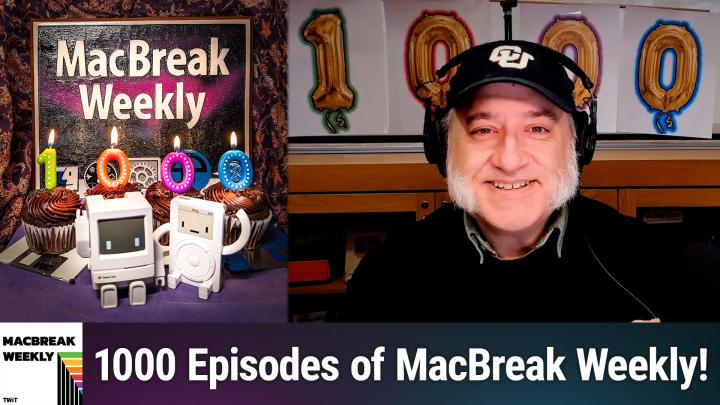
MacBreak Weekly 1000
Please be advised this transcript is AI-generated and may not be word for word. Time codes refer to the approximate times in the ad-supported version of the show.
Leo Laporte [00:00:00]:
It's time for MacBreak Weekly. We celebrate our 1000th episode with our stalwarts Andy Ihnatko, Alex Lindsey and Jason Snell, 45 App Store awards finalists. We will not, I promise, go through all of them. We'll talk about the no frills update for iOS 27. But two things that may be pretty frilly in the upcoming version of iOS, including that folding phone. Apple seems to figure out a way to get rid of the crease. That and a lot more coming up next on MacBreak Weekly's 1000th episode.
Leo Laporte [00:00:39]:
This is MacBreak Weekly. Episode 1000, recorded Tuesday, November 25, 2025. Death by chocolate. It's time for MacBreak Weekly. Ladies and gentlemen, the 1000th episode. Happy birthday to us. Happy birthday.
Jason Snell [00:01:06]:
Whoa.
Leo Laporte [00:01:08]:
Happy birthday. Wait a minute. Should I put it this way? Is that backwards?
Jason Snell [00:01:12]:
No, it's forward. Now it's. Oh, no.
Andy Ihnatko [00:01:16]:
We're starting all over again.
Jason Snell [00:01:19]:
Oh, no.
Andy Ihnatko [00:01:21]:
I think Apple Talk is here to stay. I don't care about Internet anymore.
Leo Laporte [00:01:25]:
That's, like, too far in advance. You went and got flat balloons. That's.
Andy Ihnatko [00:01:29]:
Yeah, I was going to get the real ones, and then the real ones were like six bucks each. And then I'd have to, like, walk through the neighborhood and through the library carrying.
Leo Laporte [00:01:36]:
You look like a. So this way, you roll them up. Well, I put them in your briefcase.
Andy Ihnatko [00:01:40]:
Not. Not. I'm not afraid of looking like a. So long as I look like a. That's consistent with my idiom. And that would have been a different. A balloon, but, hey, not a clown.
Jason Snell [00:01:50]:
Hey, who you calling an idiot?
Leo Laporte [00:01:54]:
Hey, it's Jason Snellers dot com. He's wearing the official Twit kepi.
Jason Snell [00:01:58]:
I've got the twit. Yeah, Twit Fez on here. I got it.
Leo Laporte [00:02:02]:
Happy thousands. Happy thousands.
Jason Snell [00:02:05]:
Happy to be a part of the final 3% of.
Leo Laporte [00:02:08]:
No, I think more than that. Really? 30%.
Jason Snell [00:02:11]:
No, no, no, no. More than something like that.
Leo Laporte [00:02:13]:
Alex Lindsay has been here for all 1000.
Jason Snell [00:02:15]:
Hello.
Alex Lindsay [00:02:17]:
I was here in the first one and I'm here in the last one. There's.
Leo Laporte [00:02:20]:
So he was. Look, this is what Alex looks like on this cake. It starts like this one. 1000. It's magical. Who wants a piece of cake?
Andy Ihnatko [00:02:32]:
I do.
Alex Lindsay [00:02:32]:
Just pass it through. Zoom. Yeah, this is the new Zoom feature that they haven't announced that you can. You can. It's a. It's the transporter.
Leo Laporte [00:02:38]:
This is going to blow them out here let's see. Let's see.
Alex Lindsay [00:02:41]:
Lisa is transporter. He's putting.
Leo Laporte [00:02:43]:
There you go. Can you see? Can you see that?
Alex Lindsay [00:02:47]:
Zoom office.
Leo Laporte [00:02:49]:
We're gonna set off the fire alarm, I believe. Look at that. Beautiful. All right, just slice that. You didn't bring a plate and a cake slicer? Well, you might as well just.
Alex Lindsay [00:03:00]:
Just a problem.
Leo Laporte [00:03:01]:
Uh oh, oh, oh, oh. Marauder. A marauder.
Andy Ihnatko [00:03:05]:
It goes back in the freezer for the next 1000th episode.
Leo Laporte [00:03:08]:
You know what this cake is called? Death by Chocolate.
Jason Snell [00:03:12]:
Ah, perfect. What's a way to go?
Leo Laporte [00:03:14]:
What a way to be an honorable death. I'm going to try a little bit of it. It's got double chocolate. Good News is only 280 calories per serving. Bad news is there's 138 servings.
Alex Lindsay [00:03:29]:
There you go.
Leo Laporte [00:03:30]:
That's tasty. Did I introduce everybody? Alex.
Jason Snell [00:03:33]:
Yeah.
Leo Laporte [00:03:34]:
Andy. Hello. Jason.
Jason Snell [00:03:37]:
Hi.
Leo Laporte [00:03:37]:
So glad you could be with us on this momentous occasion.
Andy Ihnatko [00:03:42]:
Yes. I hope if people in Discord are going nuts that my thousand is off center. It's because I was framing myself up and I realized that if it was centered, then I would have, like mouse ears when they do the single. And I decided, you know what? I kind of want to avoid that meme. And I'll just. I can choose to not do that.
John Ashley [00:04:02]:
Andy, can you move your head to.
John Ashley [00:04:03]:
The right a little bit, please?
Leo Laporte [00:04:04]:
Just for the thumbnail. Just get it right there. This way. A little closer.
Andy Ihnatko [00:04:12]:
If I go any more anymore, just.
John Ashley [00:04:14]:
Fall off your chair.
John Ashley [00:04:15]:
Okay. Like that.
Leo Laporte [00:04:16]:
You know what we're talking about, Andrew? We want the ears. The ears, baby.
Andy Ihnatko [00:04:21]:
You know, you know what? It's because I. The things I do and I do and I do for this Y I.
Leo Laporte [00:04:30]:
H N A T K O Actually, that, that would.
Andy Ihnatko [00:04:34]:
That would make me Roy. Like that. The sort of like you're Roy Dyspeptic animator. That was like the grown up guy who would draw. Draw and drink.
Leo Laporte [00:04:43]:
You didn't have to really do that. I was just joking. Oh, she's making me a piece of cake. Oh, that sounds delicious.
Alex Lindsay [00:04:49]:
I had.
Andy Ihnatko [00:04:49]:
I had. I had one of the cup. One of the. One of the Mac. Break 1,000 cupcakes for breakfast.
Leo Laporte [00:04:54]:
Oh, yum. You made them. You made them. I didn't make this.
Andy Ihnatko [00:04:57]:
I made the money that made the cupcakes.
Leo Laporte [00:05:01]:
I made it happen is what you say.
Andy Ihnatko [00:05:03]:
Yes, exactly.
Leo Laporte [00:05:04]:
Oh, that looks death by chocolate.
Andy Ihnatko [00:05:06]:
For sure.
Leo Laporte [00:05:07]:
For sure.
Andy Ihnatko [00:05:08]:
I mean, if you're going to go to sugar, if you're going to get dessert, get dessert. Don't like don't, don't. Don't slap at it. Just get dessert.
Leo Laporte [00:05:15]:
How did we get to a thousand? It's because of you guys, I'll be honest. It's. It's your turns out showing up.
Alex Lindsay [00:05:23]:
They were like, do this one more time.
Leo Laporte [00:05:25]:
Yeah. Number, number go up.
Jason Snell [00:05:27]:
Sure. Lucky we got ten fingers, huh?
Andy Ihnatko [00:05:31]:
I think everybody was just kept tuning in like week after week because maybe this is the. Maybe this is the one in which the cops will come in and shut it all.
Jason Snell [00:05:41]:
Maybe we're lucky. A guy in a Max Headroom mask will exactly jam the signal.
Leo Laporte [00:05:46]:
This is what Santa's gift looks like on Christmas morning. Just a nibble. Just a nibble. And the carrot for Rudolph is gone. Do you really want to go through 45 App Store Awards finalists for 2025? Do you really want to do that?
Jason Snell [00:06:01]:
No. No.
Andy Ihnatko [00:06:03]:
I mean, it's something. There's not a whole lot to talk about. There's like two really good juicy stories and then the rest is. Now, enjoy the extended mix of the Vision Pro theme. Here are released from Paisley Studios.
Leo Laporte [00:06:22]:
Here are the MacBreak Weekly cupcakes that Andrew has. You had. You had the same idea with the 1000. Oh, I have to put it up on the screen. 1000 candles. Although I, I. When I went to the store to get the candles, I could get all the numbers, but the one one was very popular. And I realized, what is this?
Andy Ihnatko [00:06:42]:
I was in the exact same situation where, like, I was at, like, a really good party store in Brookline that has nothing. It wasn't like one of these. I went to the supermarket aisle or I went to.
Jason Snell [00:06:52]:
It was.
Andy Ihnatko [00:06:53]:
They had like 18 different kinds of, like, number sets, and almost none of them had a 1 leftover. How many people are 1 years old or 10 years old or 100 years old?
Leo Laporte [00:07:02]:
I guess it's very popular.
Andy Ihnatko [00:07:05]:
I was. I'm happy.
Leo Laporte [00:07:06]:
Sweet 16.
Andy Ihnatko [00:07:07]:
Yep.
Leo Laporte [00:07:08]:
10, 11, 12.
Andy Ihnatko [00:07:10]:
Okay, that's true. Teenage.
Leo Laporte [00:07:11]:
13, 14, 15, 16.
Andy Ihnatko [00:07:13]:
I'm thinking in binary.
Leo Laporte [00:07:14]:
17, 18. Anyway, happy birthday to us.
Andy Ihnatko [00:07:20]:
Yes.
Leo Laporte [00:07:21]:
And I guess that we'll just leave it at the. I don't usually like to celebrate these milestones, but 1000.
Jason Snell [00:07:26]:
I had a friend who had his thousandth episode of his podcast this year. And like, that's a. I mean, okay, first off, most podcasts, people say, I would like to do a podcast, and they do, like three episodes, right? And then. Then they post a fourth episode that's like, I'm sorry, I've been delayed, but the next episode will come soon, and there's never Another episode. Right. So the. Just sticking to it long enough to get, you know, any kind of run is impressive. And to reach a thousand, I think is.
Jason Snell [00:07:56]:
That's when I certainly stand up and I feel like I got to stand up and clap when you get there, because that is such a. That's a lot like, if it's a weekly show.
Alex Lindsay [00:08:05]:
Right.
Jason Snell [00:08:05]:
You can do the math. If that's a weekly show, that is almost 20 years.
Alex Lindsay [00:08:10]:
Almost.
Jason Snell [00:08:12]:
That's a commitment.
Andy Ihnatko [00:08:13]:
It helps, though, when you pick a topic where there's going to be, by definition, new topics every single week, as opposed to, hey, welcome to the Chair Refurnishing podcast every week.
Leo Laporte [00:08:24]:
Well, we have a few of those. I just have to point out, Annie, that's. It was survival of the fittest. We had quite a few shows that did not make it to a hundred, let alone a thousand.
Jason Snell [00:08:35]:
Sure. Most don't. Most. Most. Absolutely. Absolutely. Don't. I.
Jason Snell [00:08:39]:
Yeah. I'm reminded that they. We used to get these emails and, and even letters back in the day at Macworld that were like, why don't you do more about beginner stuff? We. We want to know more about beginner stuff. What we always would say is, you know, everybody's a beginner at a different time. And then you read enough articles about being a beginner and you don't want to read those articles anymore because you're not a beginner anymore. It's like, it's a bad idea. There's no way to replicate that over time because you, You'd.
Jason Snell [00:09:05]:
If you're always just focused on beginners, you will lose every reader after three months or something. So you got to have something where. Where. Where things are happening. And I mean, this is the kind of show where you're not going to dip back into the archive and listen to episode 324. And that's okay, but it means that we've got that forward momentum. I think that's really good.
Leo Laporte [00:09:26]:
I'm sorry, I mean, cake.
Jason Snell [00:09:27]:
Yeah.
Leo Laporte [00:09:27]:
All right.
Andy Ihnatko [00:09:27]:
I mean, your most out of Rosetta.
Jason Snell [00:09:30]:
I mean, I mean, we're talking about. It's only been about 20 years of podcasting. Right. So it's only really now that. That a weekly podcast, it would even be possible to hit a thousand episodes, which is, I think, why they're starting to happen.
Andy Ihnatko [00:09:44]:
Yeah, it's. It's like you have to. If you, if you start now, you're pretty much behind the eight ball. You really got to. You really gotta get on the whole catch up.
Jason Snell [00:09:52]:
I'd say two a day, get There really fast. If you don't get there.
Andy Ihnatko [00:09:59]:
There are some content creators that are. That are. That have. Feel like they have to be that way. Like on TikTok saying, oh, my God, I posted my morning video, but what's my early.
Leo Laporte [00:10:06]:
Good way to kill yourself, fast boy. Just wear yourself out. We did Patrick Delahanty, our. Our CTO says we do have some shows that didn't even make it to 10, including red.
Jason Snell [00:10:22]:
You remember that?
Leo Laporte [00:10:24]:
It was a good name. I come. I know. I feel like I come up with good names. Reddit up was all about. We read it on Reddit and it was good. Who was. Who were the hosts? Was it Sarah and.
Leo Laporte [00:10:36]:
Oh, and omg, Chad, I think, hosted that with Sarah. But, you know, it didn't turn out. I thought it was a great idea. I thought it was a great show. Only made it to nine.
Alex Lindsay [00:10:49]:
Wow.
Andy Ihnatko [00:10:50]:
Well, you know, a good artist knows when to lay down its tools, when another brushstroke would be vulgar. And so you finished it.
Leo Laporte [00:10:58]:
The last thing they did was the ice bucket challenge. And soon mix a lot. Wow. 2014, the last episode. And I don't even. I don't even know who Simon Pegg is, so.
Andy Ihnatko [00:11:13]:
Simon Peg, of course.
Leo Laporte [00:11:14]:
Who's Simon Pegg?
Jason Snell [00:11:15]:
Comedian.
Leo Laporte [00:11:16]:
Oh, yeah. He did those movies based.
Jason Snell [00:11:18]:
And he was Scotty in Star Trek and he did the Cornetto Trilogy.
Leo Laporte [00:11:21]:
Yeah, the Cornetto trilogy, That's right.
Jason Snell [00:11:23]:
Yeah.
Leo Laporte [00:11:24]:
Hot Dogson. I never knew why it was a Cornetto.
Jason Snell [00:11:27]:
Oh, because Cornetto is an ice cream in the UK and somebody's eating a Cornetto. In each of the three movies, there.
Andy Ihnatko [00:11:35]:
Are three different colors, flavors of Cornetto. And so the end in Shaun of the Dead, they. There is one. There's someone who's eating one kind in the second one, there's hot second kind. And in the end of the world. The end of the world, Is that what they call. Yeah, it's the.
Jason Snell [00:11:51]:
It's.
Andy Ihnatko [00:11:51]:
It's the third kind. But again, they box themselves in because unless they come up, I don't know if there's a fourth kind of Cornetto, because otherwise they don't have an ability to do.
Leo Laporte [00:11:58]:
It's all in the Cornetto company at this point. You know, the green light balls on their corner. Yeah. You know what the big. Okay, so there's a lot of stories. And there. Yeah, there are 45 App Store awards finalists, which we'll probably get to a few of those in a little bit.
Jason Snell [00:12:14]:
I mean. Yeah, to be clear, it's. It's literally Apple in Apple's App Store using its marketing team to promote apps in its App Store. And I'm very happy for the independent developers who've gotten a little bit of Apple's marketing energy put behind their apps. That's great. But also, just to be clear, you know, this is the thing, like I'm happy for them but also it's, you know, it is just kind of an Apple marketing exercise.
Leo Laporte [00:12:38]:
They should have learned from the Academy Awards that, you know, you dilute it. When there were, you know, four best movie nominees. Five. That was good. When there were, I don't know how many there are now. 20. It takes away 45 finalists is a lot of finalists.
Andy Ihnatko [00:12:52]:
Well again, it's like as Jason said, it's promotional. It's like, it's not like they're, it's not like as much as you might lobby, as much as you might try to be like the, the, the Hollywood Foreign Press Organization and host dinners and give people voters Rolex watches. They're not going to choose one of the ICE apps. Ice spotting apps like as one of the.
Leo Laporte [00:13:10]:
No, I think that's pretty.
Andy Ihnatko [00:13:11]:
Even though I would say it's one of the most significant and most.
Leo Laporte [00:13:13]:
It's topical. Yeah, it would be topical.
Andy Ihnatko [00:13:16]:
We were wondering, is there an app that we pick instead of the ICE Watch app that helps people understand how Apple intelligence works?
Leo Laporte [00:13:24]:
I'll give you a.
Andy Ihnatko [00:13:24]:
How about that for hot.
Leo Laporte [00:13:25]:
I'll give you a couple of, you know, just dip your toe in. Mac Game of the Year. Mac Game of the year finalists. Assassin Creed's Shadows. Cyberpunk. These are four year old PC titles. Cyberpunk 2077 and Neva, which I don't think is probably on Windows for depicting an emotionally moving tale enhanced with striking imagery. Oh, arcade game.
Leo Laporte [00:13:51]:
Oh, they have several game categories. Okay, fine. Vision Pro. Hey, we could do a Vision Pro segment out of this. What do you see? What do you know?
Jason Snell [00:14:01]:
It's time to talk the Vision Pro.
Andy Ihnatko [00:14:05]:
The rare acapella version.
Leo Laporte [00:14:06]:
Do it yourself version. Camo Studio.
Jason Snell [00:14:09]:
Yeah, so yeah, Camo Studio. So you can, you can record. What is it? You can record stuff inside of Vision Pro. I think is what that one is. I think.
Alex Lindsay [00:14:22]:
Stream it.
Jason Snell [00:14:23]:
Stream it. Yeah, yeah. And then, then the other two we've actually talked about.
Leo Laporte [00:14:27]:
Explore DJ the Camera Soldier. We did talk about that.
Jason Snell [00:14:30]:
That was a really cool. I met the people who did that. That's a really cool multimedia thing. Reminded me of kind of like a multimedia CD ROM where there's like, there's immersive video and there's and you're on the Omaha beach and it's. And it's pretty cool. Explore POV is if you want to have kind of like various nature things all over the world. These people have just gone and captured immersive video everywhere.
Leo Laporte [00:14:53]:
Nice.
Alex Lindsay [00:14:54]:
James is on one of our shows, and he's been shooting this stuff since long before the immersive camera. He's been shooting with the Canon R5 for quite some time. So it's a lot of really.
Leo Laporte [00:15:03]:
You know, this is the promise of being early on a platform like this is. You stand out because there's not a lot of.
Jason Snell [00:15:09]:
There's not a lot there.
Leo Laporte [00:15:10]:
Competition Vision Pro Game of the Year finalist Fishing Haven. Gears and Goo.
Jason Snell [00:15:16]:
Gears and Goo is a. Is a tower defense game that I have to say show. I mean, the reason you pick it is it shows off the technical.
Leo Laporte [00:15:24]:
Like the way I played Goo. It's goo, right? It's just goo in. In a.
Jason Snell [00:15:29]:
Well, so. So it's tower defense and you put it on a. Basically on a table or whatever, and you can actually watch all the things.
Leo Laporte [00:15:35]:
Oh, that's neat.
Jason Snell [00:15:36]:
And objects. You know, objects like that. And there's so few games that do this on Vision Pro, but when it's like a. Like their board game game does this too. The objects really do blend in with the scenery. And they look. They look real.
Leo Laporte [00:15:49]:
That's pretty cool.
Jason Snell [00:15:49]:
You basically get a tower defense game going on on your. On your dining room table. It's. It's a fun effect and it's pretty well done.
Alex Lindsay [00:15:56]:
Do Kingdom Rush on it on in VR would be kind of fun.
Leo Laporte [00:15:59]:
Yeah.
Jason Snell [00:15:59]:
So this is kind of like that Kirsten Coupe. It's. It's. It's cute.
Leo Laporte [00:16:03]:
Okay.
Jason Snell [00:16:03]:
And it looks good.
Leo Laporte [00:16:04]:
Good on you.
Jason Snell [00:16:05]:
I get why they picked it.
Leo Laporte [00:16:06]:
Good on you, gentlemen. And then finally, Porta Newbie immersive puzzles. Every time I look at stuff like this, I feel like I know I would be nauseated within minutes. I just. I feel like maybe it's the cake. It's the cake. It's the cake. Did you eat the cupcakes, Andy, before you again?
Andy Ihnatko [00:16:30]:
I had a cupcake for breakfast. I considered having a cupcake for lunch. Kind of was like. It was one of those diet drinks. Have a shake for breakfast, another for lunch, and then a sensible dinner. No, I decided that perhaps the point of having a half dozen. Actually this was also a death by chocolate cupcake, by the way. So, yes, we're definitely.
Leo Laporte [00:16:48]:
Oh, really? I didn't realize that was a genre of Cake Weekly.
Andy Ihnatko [00:16:51]:
We have Definitely chosen our poison. Well, yeah, I just.
Leo Laporte [00:16:54]:
The name got me. Lisa said, what kind of cake did you get? And I said, I don't know. Some sort of murder. Murder cake.
Jason Snell [00:17:01]:
Murder cake.
Leo Laporte [00:17:02]:
Murder cake.
Andy Ihnatko [00:17:02]:
Fugu cake. What is that?
Leo Laporte [00:17:06]:
How could blowfish hurt you? Anyway, congratulations to all 45. Now you see.
Jason Snell [00:17:12]:
Now you know, we're done talking.
Leo Laporte [00:17:18]:
Unplugged Vision Pro unplugged.
Alex Lindsay [00:17:23]:
I think there was other things to talk about with the Vision Pro, though. I don't know. If we did a whole vision, probably.
Leo Laporte [00:17:26]:
We could do two in one day.
Alex Lindsay [00:17:27]:
All right, all right.
Jason Snell [00:17:28]:
Yeah, we'll bring it back out. But I just didn't want to go too far with the parentheses open there.
Leo Laporte [00:17:31]:
I just want to point out that Andy put that story at the bottom of his list of stories. I put it at the top. Andy was right.
Andy Ihnatko [00:17:42]:
Thank you, Lisa. I'm saying that I was looking at the rundown and thinking that we might just need to have something else here just in case.
Leo Laporte [00:17:49]:
Okay. I'll give you some other stories that I thought were big. Really big. This comes from our friend Mark Gurman. The Mark Gurman review of the week. He says that Apple's gonna do a TikTok thing with iOS 27. It's gonna be a snow leopard.
Jason Snell [00:18:08]:
Yeah.
Leo Laporte [00:18:08]:
And I thought I saw a lot of people saying, yeah, good thinking. Maybe they'll even do that with Tahoe. You think?
Andy Ihnatko [00:18:15]:
Yeah, wouldn't that be great? Because I've been hearing a lot more people complaining about the quality of Mac software, just OS software, just going down, of just encountering bugs that are just surprisingly dumb for what they were experiencing, what they were looking forward to for the Mac experience. I like when I upgraded to Tahoe, it was like, okay, the following four things are not working. And it doesn't seem like something that should. Spotlight should not be a problem. Spotlight is the one things where they say, I don't care if I'm an outlier. It seems as though that's the sort of thing that should definitely be working, particularly if one of the big Spotlight features of the OS is Spotlight. And so if Apple sort of on the down low said that once every two years, we are just going to focus on fit and finish. We are obviously going to keep it up to date, but we're not going to try to razzle dazzle you in an even numbered year.
Andy Ihnatko [00:19:08]:
We are going to razzle dazzle you with the fact that I upgraded and I don't want to fly up to Cupertino with a banana cream pie in the hopes that maybe I'll bump into Tim Cook or somebody and I can basically throw pie at that person's face.
Jason Snell [00:19:20]:
Yeah, I think the 26 updates were really ambitious if you consider the features, plus you throw in the design and taking a year after that. Also they've got this Apple Intelligence thing that they're trying to figure out, right? So like saying we're going to take it light on the, on the OS stuff and try to, you know, tune it up and get it, get it really nice and functional, as Mark points out. Like Snow Leopard and Mountain lion both actually did have lots of new features, but the goal was to tighten things up and, and make features work better. And sometimes that led to new features among those features. But the goal was to tighten things up. And what Mark says here is they're going to tighten things up across the, the os is in 27. And then also they're going to do whatever they're going to do with Apple Intelligence. That's going to be the other focus.
Jason Snell [00:20:08]:
And that makes sense, right? Like that's, that's the thing that's going to probably take a lot of their attention and, and, but yeah, I mean, you mentioned Spotlight. That's a great example. Spotlight in Tahoe is great. They added a whole bunch of stuff. It's the biggest update to Spotlight since Spotlight started 20 years ago. However, there are also lots of bugs. So this is how that goes. Fixing those bugs would be really nice because those features are great.
Jason Snell [00:20:32]:
But if some people just have stoplights.
Alex Lindsay [00:20:35]:
Stop working just with my messages, I type someone's name, I try to find somebody's name and I go, oh, you can't find it. So then I put plus and I put their name in and they go, oh, I found this whole conversation you were just acting with them and you're like, there are very few features that, that are new that I'm like, oh my gosh, I can't believe this. I couldn't, I can't believe I would live without this. I would have been much happier with Apple going much slower along. You know, they can build, rebuild the interface, but I think that this, the aggressive nature of the last couple version, last couple oss, I think is. Has kind of undermined some trust where you just go, well, I don't know if I really want to upgrade, you know, like, and as much as it used to be. And I think that I don't, I don't think Apple has to keep up with the Joneses. I don't think they have to have all these new Features, I think that they have some new features keep on moving forward.
Alex Lindsay [00:21:29]:
But I think that most users, I think the average Apple user just wants it to work.
Andy Ihnatko [00:21:35]:
Yeah.
Alex Lindsay [00:21:35]:
You know, and more important than anything else, it's way more important for things just keep on like being bulletproof is way more important to the average Apple user.
Leo Laporte [00:21:45]:
I agree.
Alex Lindsay [00:21:45]:
Than being new and innovative. Like I just, I just, I just think that they just want it to like just. I want it to be invisible and, and you can keep on adding things, but when you add a whole bunch of things, that means I have to learn a bunch of new things. And right now in this operating system, it's close to the most broken operating system I think I've worked worked in since, you know, since I can remember.
Leo Laporte [00:22:07]:
And, and it's, it's worse for us because we're the people, the people in our lives complain to. They don't call Tim Cook, they call Alex Lindsay say Alex, this phone's not working. What do.
Alex Lindsay [00:22:19]:
Yeah, exactly. And so there's just a lot of.
Leo Laporte [00:22:21]:
We bear the brunt and there is.
Alex Lindsay [00:22:23]:
There are things that are cool but I just, I feel like, and again I feel like Apple could go half the speed with features right now and their users would actually be happier. I just feel like there's a lot of teens.
Leo Laporte [00:22:35]:
I agree.
Alex Lindsay [00:22:36]:
They're just a little bit more, I don't know, I feel like release discipline would be good.
Andy Ihnatko [00:22:43]:
Yeah, just, just. It was particularly harsh this time because the kind of bugs are like the kind of things that infuriate the kind things that actually kind of infuriate me because launching apps via Spotlight is something that's just second nature by this point. And when I hit command spacebar bbe and I don't see bbedit it says oh well here is the definition. BBEdit is a third party application created by Barebones Software. No, that's not what it. Here is a mention of bbedit in your email. No Spotlight. Try again.
Andy Ihnatko [00:23:14]:
And yeah, that's. I know, I know it's as Jason said, it's a big big update.
Alex Lindsay [00:23:18]:
It was a big, big update.
Jason Snell [00:23:19]:
It's a bug. I know exactly what's causing that bug. Do with the Spotlight indexers and that sometimes you have a preference of what you want to see in Spotlight and if you turn off show me apps or it gets turned off by accident then the apps disappear which is, I mean it's bad. It's a bug. I think the new Spotlight features, I think they're actually very, very good. But this and this is the thing. I don't know what is going on. There's a whole public beta cycle.
Jason Snell [00:23:43]:
I didn't have any of these problems in the public beta. So it's surprising that it has bit as many people as it has afterward, which says to me, I guess the public beta is not doing its job and the amount of testing that Apple is doing of these features is not an appropriate level. If there are things, but I will say this, that wasn't broken during the betas. This is a, this is a bug that happens in certain circumstances that should have been caught, but what it isn't as an example of Apple building something that's broken and shipping it because it, it has worked for me. I have some issues where Spotlight sometimes does stop working, but throughout the summer, you know, I didn't encounter any of the bugs that I've seen people report or if I did a restart, fixed it, which again, that's a problem. But it's a weird problem. It's not necessarily about Apple's ambition as much as it is that they don't seem to be backstopping it with enough testing to stop this stuff before they ship it. Right? Like, I mean, I think, I think that's the issue here, is that they, these things are widespread enough that they should have been caught in the beta process and either they weren't or they were and they didn't care and they shipped it and either way it's bad.
Alex Lindsay [00:24:54]:
Although I will say I was today's years old that when I found out that I could just turn stuff off on Spotlight and just leave the only applications on because the only thing I want for is applications, I was like, I can turn these.
Andy Ihnatko [00:25:04]:
Like, when Jason said that, I was.
Alex Lindsay [00:25:05]:
Like, I can turn these off.
Jason Snell [00:25:09]:
Because there's multiple indexes.
Alex Lindsay [00:25:11]:
And I was like, now I just turned everything off except for applications, because the only thing I use Spotlight for is applications. And so I, you know, like, I just, I used Find for the other stuff because I need to have a more complicated search. But, but yeah, you can turn off.
Jason Snell [00:25:27]:
Files and folders and menu items and results from Clipboard and all of those things. And. But this is the thing, Alex.
Alex Lindsay [00:25:35]:
Apps.
Jason Snell [00:25:36]:
It's great, but like, sometimes what happens is you turned, you don't even remember three years ago, you turned off one of those things and then the update happens and they change the behavior of what happens to Spotlight based on those settings and. And you're like, wait a second, where did this thing go? And it turns out it's because they weren't previously doing the same behavior with that setting set the way it was that they are now? And I've heard that from a bunch of people. It's like, why can't I launch Maps from Spotlight? And the answer was because two years ago you turned off the show data from Maps option in the Spotlight settings because you didn't want to see map suggestions. But now it's not going to show you the Maps app. It's like, and that's the kind of you have a 20 year old piece of software and you have a lot of unintended consequences. And I just bring it back to with all the public beta going on, did nobody see this or did it get reported? Not fixed. Is Apple's testing not careful enough for stuff like this? Because clearly lots of people are having Spotlight issues. That's a great example where it's not that it didn't work, it's that obviously it was much less reliable than Apple thought.
Jason Snell [00:26:41]:
But shouldn't that have been caught in the summer?
Andy Ihnatko [00:26:43]:
Yeah, there are a lot of things that we were talking earlier about. We don't in general spend a lot of time talking about fundamental stuff and basic stuff, but there are a lot of basics that even people like us, we tend to forget. And one of the banes of my existence over the past couple years has been that horrifying dark forest gap between getting the notification on your Mac that says that, hey, a new update is available, would you like to install it now or install it tonight or remind you later? And because even though, like, look, I don't have enough time, I'm so busy right now, I don't have time to basically shut down my entire workspace, close down all my documents, everything like that, and basically put bookmarks everywhere so I can get started up again. I just don't have time right now. And so we delay like days and days and days, but you forget that it's actually still doing things in the background to prepare for the update. Like it's, it's doing things to the operating system that boots up the operating system and handles this sort of stuff. And suddenly a day comes by and oh, I can't sync anything to my iPhone or to my iPad because now USB is messed up because that's being controlled by this underlying operating system that's being kind of screwed up a little bit and you're sort of like feeling your arm being twisted. Whereas if I had remembered that from, I must have learned that a number of years ago and then quickly forgot it.
Andy Ihnatko [00:28:04]:
But the hate and the disappointment stuck by because those things are eternal. And so the thing is, we could all use a refresher course on what happens during updates. And just because we are used to the idea of having smooth updates from Apple doesn't mean that they're going to be smooth. And Alex kind of has the right idea, which is I'm just going to hang by and if I have a working operating system, I'm not going to change that until I have a good reason to change that. You take that too far, but that's a good, that's a thing that I tend to forget.
Alex Lindsay [00:28:32]:
Yeah, I mean, the main computer that I'm like, interacting with people, I'm a couple versions behind Sonoma or whatever. And then my, my M3 Ultra is on the, on Tahoe. So I get to see Tahoe every once in a while, you know, and, and I, I think with my phone, I, I, I, you know, I hesitate to complain about my phone because I know it's on a beta, so I never know what's not, what's working and what's not working. But I can say that I, I'm on the beta and I force restart messages once a day at least, because the interface, the new Aqua interface or whatever is sitting over it gets stuck where I can't get to the bottom of the messages or I can't type, or it stops seeing the keyboard and the only way out is to restart it again.
Jason Snell [00:29:17]:
Classic.
Alex Lindsay [00:29:18]:
Just force restart and open up. Here's the worst part is I've gotten really good at. Barely bothers me now because I go, oh, it's stuck. And I go restart. And I open it up again and I'm right back to where I was and I go back to what I was doing. And it's kind of like when you.
Andy Ihnatko [00:29:32]:
When you bumped your elbow on a corner, like at work so many times that there's a callus there and you'll no longer feel the pain.
Alex Lindsay [00:29:37]:
Yeah, yeah, yeah. It's like, it's like not even bothered. The first couple times, there was like a lot of shaking the phone and trying to figure out why I couldn't do it. And now, you know, weeks into this one problem that I'm having, which is again, the interface just gets stuck, you know, I can't get to it. I've gotten so good at fixing it. It takes, you know, it's offset a second or two. But I have friends, you know, someone, someone else is going to run into that and go, oh. You know, and I think that again, I Think less, less features working better would be huge improvement.
Leo Laporte [00:30:07]:
Is Apple bad at software?
Jason Snell [00:30:10]:
I think, well, I think Apple is worse at software than they are at hardware for sure. I think their hardware is so good now that it really shows you. I, I, I said this on our discord and I think Apple is trying to do software at a level that literally nobody else is. They have so many different OSes supporting so many different platforms and I know that they all sort of have common baseline things. That's one of the reasons they do that, that they have similar apps or the same app running across platforms that they've all, they're all on Darwin, they're basically all on this OS 10, you know, iOS sub layer that is shared in common is because one company has to maintain a mobile OS, a desktop OS, a tablet OS, a TV box OS, a VR OS, a WatchOS. Like they've got all of these different operating systems. I think part of it is hiring. They don't hire enough people.
Jason Snell [00:31:06]:
They are very limited with what they do. The way that they're structured, where they don't have lots of silos, they've got everybody kind of cross training makes it hard for them to do more of it. I think the complexity is really ramped up. But I'd say also that some of it is the way they've defined their job. Like everything we're talking about here is exacerbated by the fact that they have to do a major update every fall for the iPhone. And so then everything gets updated then because you can't have all your different OSes having different, like if you update messages, but it's only on the iPhone and the Mac comes six months later and those features don't work in the meantime across your platform, that's not great. So they want to do them all at once. But then every year is a brutal schedule and then this year they set themselves a higher bar which is because of what happened last year.
Jason Snell [00:31:54]:
They wanted to ship everything. They announced wwdc and I think they probably shipped some of that stuff a little earlier than they should have because they set these goals for themselves. So I think part of it is the reason we talk about maybe doing taking a year off and having a light update is because the one year cycle is relentless. And I think it would be much healthier if they spread the features out over two years. And, and, and when they drop features in, I would even not drop all the features and then spend two years fixing them. I would rather they just sort of be more lightly spread out Like Alex says, over a couple of years with enough time for them to make them, you know, not, not shipping them wincing and knowing that bugs are going to hit people, but instead feeling like they're more rock solid before they actually ship them.
Alex Lindsay [00:32:41]:
And sometimes I wonder, at least on the mobile platforms, whether there is a certain gen Alpha pressure that Apple has related to. I know this sounds crazy, but it is. They have such a lock on kids under 18 years old right now that the question is on the gen Alpha, gen Z, you know, world, are they trying to make sure that they have all the cool little features that they could have somewhere else and making sure that they stay happy because it's such a lock into the future, you know, for if when you have, you know, 85% of the market share in one, in one vertical, that is, you know, if they stay there long enough, they're not going to go anywhere, you know. And so, and so I wonder whether that that has some pressure on them on the mobile devices where the mobile devices seem to be the least stable and the most number of features. And I don't know if that's true or not because I think that again, I feel like I'm an average Apple user where I just don't need, you know, if they. There's very few things again that I feel like I need that I haven't been here for two years that I needed like that. Oh my goodness, I was waiting for this thing. I mean having one or new thing, a couple new things every time would be enough for me.
Alex Lindsay [00:33:48]:
But I don't know whether that's the maybe internal pressures that we don't know. But I also think that the siloing that Apple has sometimes is the problem. I mean you have a bunch of apps you look at like USDZ or whatever. I've been dealing with USDZ this week. It's managed completely differently in every place that it occurs. Like just how you rotate an object is different in Preview than it is in Keynote and it is in converter and this is, you know, and so there's different versions of those things and you know, none of them all, you know, preview works the best probably because it's the most public facing one. But those are the challenges I think that Apple has to do with lots of different teams doing different ways. I mean, you know, and that's the, and figuring out what.
Alex Lindsay [00:34:32]:
But it feels like you want to get everybody into the room and say what are the best practices between all of these? And unify it.
Jason Snell [00:34:37]:
It's just incredibly Ambitious. And that's the thing. And it's hard and they struggle and they don't like to be seen as struggling. And I think that is part of the problem is that that leads them to hold themselves to these timelines and they're embarrassed when they're seen as struggling. Even though they're making it. They're doing a hard thing, but it's it, you know, it is hard to do and that it's okay. I agree with you, Alex. I don't want them to lose ambition, but I do think that sometimes they pour their hearts into these features that add complexity when no complexity is being asked.
Jason Snell [00:35:13]:
Asked. Like when they, when they're like, because if you add a complex feature, nobody will use it on the iPhone, right? Like, nobody will ever find it other than us nerds. No one will ever find it. And maybe that's okay. But like, like, those are the features that, like, did we need a lock screen with like 15 different options of shuffling photos? And it's a cool feature, but like, how many people even know that it's there? I think, I think they set the bar for themselves high and then they have a hard time clearing it. I think they're their own worst enemy.
Andy Ihnatko [00:35:44]:
And one of the problems is, I mean, it's easy for us to say, oh, wouldn't be great if they did like a TikTok release and a big one on even years and a maintenance fit and finish one in the other years. The problem is that this is like a huge, huge ship that doesn't respond very quickly to steering adjustments. And every year they do the features that they're capable of doing that year and the features that they are required to do that year because of hardware that's coming out or because of a project that they need to be able to release a year away from that. So we are right to expect better performance and more stability in major operating system releases, at least with the 0.1 release. But nonetheless, we do have to expect that There's a lot that they gotta do. And sometimes, sometimes a broken light bulb just is not going to get changed because at some point they have to change this filters elsewhere in the bowels of the ship and that's way, way more important, even though you never see it or deal with it.
Leo Laporte [00:36:44]:
We're doing our 1000th episode of MacBreak Weekly, and for the thousandth time, we're discussing whether Apple's any good at software.
Jason Snell [00:36:53]:
Amazing.
Leo Laporte [00:36:54]:
There is some consistency in the. Very proud, proud of that.
Andy Ihnatko [00:36:59]:
It's all content, baby.
Jason Snell [00:37:01]:
Alex.
Leo Laporte [00:37:01]:
Lindsay, is here. Andy Inacco. Jason Snow. We're glad you're here too for episode 1000. Want more? In just a little bit, but right now a word from our sponsor. ThreatLocker. Man, I keep reading about massive security issues all over the place. It was just a big hack, supply chain hack on NPM and people who use the Node Package Manager or your JavaScript or, you know, like going well, oh my God, what do I do? There's a solution.
Leo Laporte [00:37:37]:
There really is. There's a way out. Ransomware is just killing businesses worldwide. And it comes in a variety of ways. Phishing emails, infected downloads through npm, for instance, malicious websites, RDP exploits. Don't be the next victim. ThreatLocker's Zero Trust platform. And this is the key.
Leo Laporte [00:37:56]:
Zero trust. Three little words that make all the difference. It takes a proactive. Here they come. Deny by default approach. That means every action is blocked unless it's explicitly authorized. That means that accidental package you downloaded on NPM cannot do its job because it's not been authorized. It protects you from both known and unknown threats, protects you from supply chain attacks.
Leo Laporte [00:38:26]:
And that's why companies that can't afford even a minute of downtime Trust threat locker. JetBlue uses threat locker. The Port of Vancouver uses ThreatLocker. ThreatLocker shields you from zero day exploits and supply chain attacks while providing complete audit trails for compliance. ThreatLocker's innovative ring fencing technology. That's what they call their zero trust. Their ring fencing technology isolates critical applications from weaponization. It stops ransomware cold.
Leo Laporte [00:39:00]:
It also limits lateral movement. So even if somebody gets into your network, and that's the whole idea of zero trust, is never assume just because somebody's in your network that they are trustworthy. It limits lateral movement within your network. They're in there, but they can't do anything. ThreatLocker works across all industries, supports Mac environments as well as PCs. They've got a great 24. 7 US based support team ready to help you. And it's kind of a side effect of this great written fencing technology.
Leo Laporte [00:39:31]:
You get comprehensive visibility and control. You know exactly who's doing what, when and where. Mark Tolson, IT director for the city of Champaign, Illinois, another, you know, city governments and hospitals and schools are just prime targets for ransomware. Because ransomware people think, well, they've got insurance, they're going to have money, they're going to pay up. Mark Tolson is the IT director for the city of Champaign, Illinois. Said, we're not going to pay up, we're going to get ThreatLocker. He says Quote, ThreatLocker provides that extra key to block anomalies that nothing else can do. If bad actors got in and tried to execute something, I take comfort knowing that ThreatLocker will stop that.
Leo Laporte [00:40:14]:
Mark didn't wake up this morning and see headlines and went oh no, I gotta get into work. Mark knew he was safe. Stop worrying about cyber threats. Get unprecedented protection quickly, easily and cost effectively with ThreatLocker. Visit threatlocker.com/twit to get a free 30 day trial and learn more about how ThreatLocker can help mitigate unknown threats and ensure compliance. That's threatlocker.com/twit. When Shaihalud comes calling, you can say, hey, don't Worry, we got ThreatLocker. threatlocker.com/twit. I'm sure Steve will be talking about that by the way on Security now right after this show. Big.
Leo Laporte [00:40:57]:
Another big exploit. Man, it's just a mess out there. Okay. Hey, I thought this was interesting news. How about, how about this one? Johnny I've and Sam Altman of Open AI were on stage talking to Steve Jobs widow, she runs the Emerson Collective and interviewed the two of them for their, their Emerson Collective demo day and they said they. Well I liked what they said. Let me now I'm an open a. I'm an AI fan and I'm very interested.
Leo Laporte [00:41:39]:
We had heard that OpenAI had hired the former Apple designer Jony I've to do something an AI device of some kind. Johnny said he thinks that it will be available sometime even less than two years from now. Okay, well don't get your hopes up too high.
Alex Lindsay [00:42:03]:
I think the challenge is that Jony I've is a designer but he doesn't manage the logistics of building a product Right. And I think that that's going to be what is really bit him in the butt before.
Leo Laporte [00:42:14]:
Yeah, well, I mean Sam Altman said that Ives design is elegantly simple with a touch of whimsy like butterfly keys whimsy that could be difficult to build in.
Alex Lindsay [00:42:27]:
I mean again I think the problem is that and I feel like when Johnny Ives is brilliant, but when he had a lot of control over the Apple product line, I do not think it was a positive effect. And I think that the problem is that he's going to have a lot of control here because he's the guy that came from Apple and OpenAI is going to be happy to be there and they're not a hardware company and I think that they're going to have a hard time building a product that is usable like that's My fundamentally, I just think they're going to have a hard time building one that works, that can be produced, that's going to actually be usable.
Leo Laporte [00:43:04]:
We've seen a lot of companies fail in this space trying to make the pin. Remember that the thing that projected on your hand. I've worn many a pendant, I've worn many glasses. It's hard, but. But it's, it's an interest look. I want. I. I'm gonna withhold judgment.
Leo Laporte [00:43:22]:
We'll find out. Johnny said, I love solutions that teeter on appearing almost naive in their simplicity. I also love incredibly intelligent, sophisticated products that you want to touch and you feel no intimidation and you want to use almost carelessly, that you use them almost without thought, that they're just tools. Sam Altman jumped into adequate Axios. I hope that when people see it, they say, that's it. And I've promised, yeah, they will. So there's my little dramatic reading of.
Andy Ihnatko [00:44:00]:
The dialogue, bringing the spirit of sitting in the most beautiful cabin by a lake and in the mountains and just sort of enjoying the peace and calm. And I understand this is, this is the sort of stuff that you can. The only stuff you can say about a product that's not gonna be released for two years that you really can't say that much about. And you really have to create a word picture. You have to create a theater of the air around this product. But it does sound a little bit silly.
Leo Laporte [00:44:23]:
Johnny.
Andy Ihnatko [00:44:24]:
It's fine in context, but trying to.
Leo Laporte [00:44:25]:
Make something you want to eat. He says, there was an earlier prototype we were quite excited about, but I did not have any feeling of, I want to pick up that thing and take a bite out of it. And then finally we got there all of a sudden, so they're making prototypes, you know, and that makes sense. Look, he says, imagine, you know, what does it mean? He says that this thing is going to be able to know everything you've ever thought, read or said. And finally we have the first prototypes.
Andy Ihnatko [00:44:59]:
It's falling into all the traps that you don't want to see about anything. AI that's being promised. It's like they are really, really going for the long bomb here.
Leo Laporte [00:45:09]:
Well, they always have.
Andy Ihnatko [00:45:11]:
Well, yeah, I mean, and it, it is again, when you get this kind of a scale. Of interest involved, you do have to dream big. But it's amazing to think about trying to plan release of an AI powered product two years in the future when everything is evolving so quickly. And if enough for the fact that this was a partnership with OpenAI where they actually can co develop a piece of hardware to work with a specific model that they must be developing to work alongside it, as opposed to Gemini 5 running on whatever phone is available two years from now. It's hard to imagine them understanding what people want out of that kind of a device without actually Google glassing it with that. We're going to just release this thing and see how people interact with it and see how people use it and we're just going to keep adjusting our target as we see where the Darts are actually landing. It seems like the only way to actually do it is to, to let the public tell you what they actually want. This is not.
Andy Ihnatko [00:46:14]:
I know it's a famous saying of. Oh, of Henry Ford and that from Henry Ford and Steve Jobs used to quote all the time. Well, if I, if I relied on what, on what. If I, if I built only what people told me to build, I'd be building a mechanical horse instead of a car. And there is a lot of truth to that. But at some point you can't just simply say, here is where the Puck is. I'm going to be there two years in the future and I'm hoping that people are going to be there, there at the Puck where I intended for it to be in two years time.
Leo Laporte [00:46:45]:
True, but if you don't start thinking about it now, you won't be there in two years either. So it's appropriate to start thinking about it.
Andy Ihnatko [00:46:51]:
Of course. But I'm just saying it's hard to imagine deciding right now what something's going to be two years from now with a technology that's.
Leo Laporte [00:46:58]:
How long did the iPhone take to develop?
Andy Ihnatko [00:47:02]:
Was it five, six years?
Alex Lindsay [00:47:04]:
Yeah, I think it was five or six years.
Leo Laporte [00:47:06]:
So it takes a while.
Andy Ihnatko [00:47:07]:
But they, but they had a, but they had a phone. Like they knew what a phone was and they knew what. Here's, here's at least 60% of what this device needs to do and we're going to add. We're also going to take the 20% of what smartphones do. On top of that, we're going to make that better and then we're going to bring maybe 20% of our own stuff brand new to this platform. Whereas it's like if it is not that, not that it is exactly this, but if it is something like a fountain in the form factor of a fountain pen that you simply carry it in your pocket, how are you going to teach people that they want to carry this? Microphone, Camera. Smart. Absorbing every single thing that you say, think and Observe all day long.
Andy Ihnatko [00:47:45]:
Are they going to want that or are they going to want the modality of. I am explicitly taking my phone out, I'm explicitly making a request of this phone and then I'm explicitly going to turn the phone off, put it back.
Leo Laporte [00:47:57]:
That's very 1980s. You're very ancient history. No. Well, this is the world that they're anticipating. And they may be wrong, but the world they're anticipating is a world filled with intelligences all around you. You are but one more intelligence in a group of intelligence, which is. Which you have marshaled to your advantage. But you need an interface to it.
Leo Laporte [00:48:18]:
And to assume that it's going to be something that you swipe or type on or even speak to is perhaps a box you don't want to live in. Let's think out of the box. And I'm glad it's Jony. I've. I agree it's very speculative, but who bet, you know, now's the time to do it. And I doubt John is the only guy thinking about presenting another sense.
Andy Ihnatko [00:48:39]:
I agree with you in the sense that we're not. We're going to be that tapping actual physical buttons and that interacting with an actual interface of some kind is not going to go away, but it's going to be simply another way of interacting with software and that in a couple of years we're going to be interacting with agenic software that simply understands what we want to do and it has access to the right APIs to make that happen.
Leo Laporte [00:49:00]:
All I'm saying is we're very close to that now.
Andy Ihnatko [00:49:03]:
It kind of sucks right now, but it's kind of okay.
Leo Laporte [00:49:06]:
Gemini 3. Pretty mindball blowing. I think we're very close to it. We're making progress much faster than anybody anticipated. This week alone, Anthropic released a new model, Google released a new model, both of which are very close to human IQ intelligence or better than human IQ intelligence. We're very close to this. The thing is it's happening fast. If I were Sam Altman and Johnny, I've.
Leo Laporte [00:49:31]:
I'd be doing exactly what they're doing. You got to start to think about what will the interface be. They may get it wrong. It may be another butterfly keyboard.
Alex Lindsay [00:49:39]:
I think. I think the issue is that, I think that what made Johnny I've, you know, like sometimes you see like a lead singer for a band, you know, David Lee Roth really thought he was going to do great after.
Leo Laporte [00:49:47]:
Right.
Alex Lindsay [00:49:48]:
You know, and you're saying Johnny, I've.
Leo Laporte [00:49:50]:
Has lead singer disease is that what you're saying?
Alex Lindsay [00:49:52]:
I just think he's an incredible designer, but I think there was a tension between him and Steve Jobs that made the magic. And I think that I don't think we saw a lot of magic after he and Steve Jobs weren't collaborating, you know, and I think that that's the hard part there. And I also think that I just, I think there's also an issue of ecosystem trust that, you know, are we going to trust chatgpt? I think this, this is Apple's real advantage in this, in this area is that the only company I think right now that I would, would trust with doing this kind of thing would probably be on device with Apple as opposed to, you know, a cloud based whatever, you know. And so, so I think that that's going to be the challenges. Are people really going to want something that just seen everything they're doing and being around all the things they're doing and seeing all the conversations that they're having? You know, I don't, I don't know if people are ready for that. I don't know if they really want that. You know, like, I know I don't, like, I'm pretty forward, you know, forward.
Andy Ihnatko [00:50:47]:
Thinking, but I'm like, it'll be okay, it'll be okay. If OpenAI's existing customers feel that way, they're building one hell of a relationship and one hell of a user base. My AI of choice is Gemini, partly because I like Google's approach to AI as an assistant as opposed to a push this button, I expect it to do your homework for you on and on and on. And also because I already have invested a whole bunch of trust with Google for my personal information, so that's already spent money, so to speak. But as much as I like Gemini, oh my God. Opening ChatGPT has three times the number of monthly users and that's a huge, huge step up. So when they do come up with their magical device in a couple of years, they're going to have people who already have that amount of trust in OpenAI who have already been sharing their deepest, darkest secrets with it and like a friend or therapist or a coworker. So that's going to be an advantage that Apple may or may not be able to counter.
Leo Laporte [00:51:43]:
A user interface guru though, that does the design, right? I mean, it's got to be somebody who spends time thinking about how humans interact.
Andy Ihnatko [00:51:52]:
Exactly.
Jason Snell [00:51:52]:
What Jony I've isn't because he's not a human interface designer, he's a hardware designer. And this product. I'm sorry but like, show me how this isn't just the Humane pin with better funding because the Humane pin, the entire project was. We don't, I mean we don't know. But again, I'm not going to play the game of we don't know because Sam Altman and Johnny I've are brilliant. Right? I'm not going to play that game because they're not going to invent another sense, they're not going to invent another limb. Our human bodies are what they are, our human minds are what they are. And that means you're first off, society, our society is what it is.
Jason Snell [00:52:24]:
We're not going to do everything by voice interface because you're talking out loud in public. So a lot of people aren't going to want to do that. So now what do you need? You need maybe a screen you can tap on quietly. Oh gee. Well, you know, we have hardware that fits these modes. We have things you can stick in your ears that have microphones. We have things that have screens on them that you can tap app that are connected to the network at a high speed in a way that a small device wouldn't. So now what are they doing? I mean I know that their snake oil here is, well, we're just going to do something different but in the end it sure feels to me like they're going to do a thing that's like a phone or a thing that's like AirPods or the thing that's like a watch or a thing that's like an AI pin because those are the modes that exist.
Jason Snell [00:53:03]:
And I don't believe they're going to invent a new mode. I just don't. I think, I think this is people with lots of money who have a really high opinion of themselves who've bought into the fact that AI is about to just be, go super intelligent, which I also do not believe, but their job is to believe it because all of their money is based on that premise. And I just, I mean again, show me how this is not a well funded AI pin. I just don't believe it.
Alex Lindsay [00:53:30]:
Or, or, or, or a plan to dilute some of the early.
Jason Snell [00:53:34]:
Or a weird Android phone.
Alex Lindsay [00:53:35]:
And so the, it would, it would.
Leo Laporte [00:53:37]:
Be different if Sam Altman had hadn't spent so much time hyping us up.
Alex Lindsay [00:53:43]:
Yeah, yeah, I feel like, and again, I, I think that, I do think that the whatever form the glasses take that Apple's doing or Meta's taking, that one feels way more real but really really hard like to do well than, than some kind of pin, you know, I just, I'm not, you know, I guess I'm. Yeah, I'm not, not buying it.
Leo Laporte [00:54:02]:
What about telepathic?
Alex Lindsay [00:54:06]:
You know, I don't think people are going to want that. Like, I just don't think I, I. There's no way that I guarantee you.
Leo Laporte [00:54:11]:
They'Re in the labs working on that.
Jason Snell [00:54:12]:
I look forward to them inventing a.
Alex Lindsay [00:54:14]:
New color right now. He's talked about it in there and he's, you know, got people plugging into their brain and they got, they got people looking at that stuff. I would never, I mean, well, it.
Leo Laporte [00:54:22]:
Might just be a hat.
Alex Lindsay [00:54:23]:
I know I would never put.
Jason Snell [00:54:25]:
It all comes back to smart hats, Leo.
Leo Laporte [00:54:26]:
It might be a smart hat. I'm not kidding.
Alex Lindsay [00:54:28]:
It's one thing to be able to control. I mean, I just, the, the level of intrusiveness to that to me is so deep.
Leo Laporte [00:54:35]:
Yeah. I don't want to, I'm not going to have them drill us a hole.
Alex Lindsay [00:54:37]:
No, that's, I'm talking about the level of something trying to read what I'm thinking. I am not interested. Like, I'm not interested in playing. Like, I would be not okay with that. You know, like, it's, it's a, that's a, that's, it's one thing to not. We have enough trouble getting people to not send the wrong emails to each other or text to each other while they're under some kind of legal whatever, let alone they wear a hat that is just, just sucking up all that information. Like, that's a. Yeah.
Andy Ihnatko [00:55:04]:
I mean, my, my central thing is like, I'm kind of with Jason here. It's like there you just have to sort of turn off like every single hypey thing you hear about AI but my, the question that my test is against any sort of device like this is that explain to me how this is going to be any better than a $24 Bluetooth earbud in my ear and simply talking to the AI of my choice inside.
Leo Laporte [00:55:26]:
That was the form factor for the movie Her.
Andy Ihnatko [00:55:32]:
And actually remember that one of the biggest technical advances was a safety pin in his pocket so that to make the pocket shorter so that the camera part of the phone can stick out of pocket again. That's exactly what I keep thinking about. Explain to me how this is. Anything that you're going to be shipping is going to be better than a Bluetooth earbud and some sort of wireless WI fi direct sort of camera. I would even better have a magnetic pin that I can simply take off when it's inappropriate and simply put in my pocket when I don't want anything to. When it's absolutely inappropriate to have a working camera pointing at what I'm looking at. And I'm saying that's absolutely the perfect form factor for anything. I'm just saying that when you try to sell me on the idea of hey, we have this completely new form factor for that will create this brand new paradigm for whatever I'm saying.
Andy Ihnatko [00:56:23]:
Okay, are you explaining to me that it just simply takes audio and takes video and then so explain to me why I want a $600 thing in my pocket as opposed to a $50 thing that I simply keep recharged and connect to my phone and work on an AI platform of my choice that actually does all the compute on the phone.
Leo Laporte [00:56:43]:
Because I was acting this way about the Vision Pro. But I think you guys lack imagination. I think that there is all sorts of possibilities. The next 10 years are going to be bizarre.
Jason Snell [00:56:58]:
They're going to be weird. But these are guys. These are, these are not. I mean, sorry, maybe they're not the guys. Open AI OpenAI should not be making hardware like consumer hardware. It's stupid. It's a waste of money and a waste of time. I think it's that Sam Altman fancies himself a little Steve Jobs and he's got a pet Johnny I've.
Jason Snell [00:57:15]:
And he's got all the money to why not do it? But like their, their challenge is what's their business model? How are they going to integrate ads in a consumer product in order to make it work? It. They're losing money at a rapid pace with the promise that they will eventually figure it out and make lots of money. And like, good luck, they may very well do that. Their product is really interesting but like this hardware thing is a distraction and I mean it in both ways. They are distracted from doing what they should be focusing on and it's here to distract us.
Leo Laporte [00:57:46]:
Ah, interesting. It's also here to get investors to pour more money into the. Of course the advantage that companies like Apple and Microsoft and Amazon and Google have is that they have their own revenue and Meta have their own revenue streams independent. Meta is spending almost every penny it makes on AI now and that's a lot of pennies. That's a hell of a lot of pennies.
Alex Lindsay [00:58:08]:
I think it makes sense for them because what else are they going to do?
Leo Laporte [00:58:11]:
What else are they going to do?
Alex Lindsay [00:58:12]:
You know, so, so I mean the platform is pretty, you know, it is.
Leo Laporte [00:58:15]:
More likely that you're going to see this kind of hardware. Those companies, because they can afford to pour money.
Andy Ihnatko [00:58:21]:
Also because Zuckerberg just does not seem like he has any sort of a plan. He is like, he is like a chicken. When he sees a flashing light, he has to go towards the flashing light. Whereas you feel as though Google, you feel as though OpenAI. You feel as though perplexity. All these companies have an idea of, here's a lane that we think we can do really good things in. Some with bigger ambitions than others. But Meta is like, he's just, let's be honest, you jangle the keys and he'll go in a different direction.
Leo Laporte [00:58:44]:
Who's dreaming more about this than Apple? This is where Apple sees themselves, right? They want to be the hardware makers. They'll let other. And they were smart. They said, you know, maybe other people will, maybe we'll use Gemini. By the way, they picked the right horse.
Jason Snell [00:59:00]:
If it requires a thing in your ear or a thing in your pocket that's got a nice screen that you might want to look at to read whatever it is and it runs the AI agent, I think they're okay with it. I mean, honestly. And that's, and that's where I'm sure that they're racking their brains like what are we missing here? But I just have a hard time thinking that, I mean the risk is that it's all commoditized. But even then, like, I think what Apple has shown over the last 20 years is that Apple makes nice hardware that's well integrated and that's not a commodity. That's not a commodity. We see what the commodity products are cheaper, right? And they're worse. So like Apple has a, a place to fit into a world where apps fade away and AI comes to the fore. Because if they really at the end of the day are still.
Jason Snell [00:59:48]:
I mean, in fact, we talked about Apple software weaknesses. You know, if, if a lot of that fades into the background and it's really about. Apple has great chips on device to run some AI stuff and it's got great modems to connect to the cloud and it's got great integration between its smartphone in your pocket and, and it's headphones in your ears and its thing on your wrist. Maybe that's its great advantage.
Alex Lindsay [01:00:10]:
I think the other thing is, again, it's just being faster than the other person when being chased by a bear. A lot of people that use Apple products that go, I wish Apple wouldn't be so aggressive, but it's not. Very many Apple users are going, well, I'm going to jump ship next year if this doesn't work. I think that it would take a lot to get down that path.
Leo Laporte [01:00:30]:
For the average Apple, it has to be 10 times better than the existing product to woo people away.
Alex Lindsay [01:00:35]:
Yeah. And so the thing, and every year, I mean like, you know, the benefit of being an Apple user for a long period of time I was on X or whatever talking to somebody about the fact that they were Talking about like 3D looks pretty good on headsets or. But the meta doesn't have a really easy way to do that. And I'm like, as an Apple user, I have 650 movies that I bought on Apple TV and half of them are 3D, you know, and you throw them on. And so the lock in of having all that content and all the other stuff that's all there and having it all, I think that that's where these, both Google and Apple and others and meta to some degree have this huge advantage of. There's already this tie in, I think meta. The challenge that they have is that there's a lot of trust issues. And so it's kind of like when I look at meta products, I have a trust issue.
Alex Lindsay [01:01:21]:
I had the portal day one and I turned it on when I used it and unplugged it when I didn't. And that's a problem for meta. And I think, think, I think Google has less of that problem. But it's still like, you know, they are making money with our data.
Leo Laporte [01:01:35]:
I had two portals but I gave them to Burke and he took them apart.
Alex Lindsay [01:01:39]:
Took them apart.
Leo Laporte [01:01:41]:
I don't know what he did with them but.
Alex Lindsay [01:01:43]:
And the portals were, you know, this gets into like the. And this is where meta almost was in. The portal was an amazing piece of hardware. I don't think people realize how hard it is to make a piece of hardware like that. But it was just an amazing piece of hardware that was developed. It was just. But, but meta is overall experiences and I think that that's going to be the issue that a lot of people are going to have is that I think even inside of all of the stuff that's happening and all the disruption that might happen, Google and Apple are still, you know, the inside track, you know, on making this work because they have a bunch of hardware, they have a bunch of people integrated, they have a bunch of people and Google is, you know, kicking, you know, down the field. Google's definitely running down the field with a lot of these things.
Alex Lindsay [01:02:23]:
I think Apple, again, as someone who uses, I don't know, three or four different AI tools any given day and probably ChatGPT every hour, I don't feel like I'm waiting. There's never a time when I'm like, waiting for Apple to figure out its intelligence thing, you know, Like, I don't have any sense of that right now. And I think that there'll be some time when I wish. There's lots of things that I wish Apple would do, but it gets down to things like, I just wish I could say I had this conversation with someone on email in 2014 or somewhere around 2014 about this thing. And can you find those emails? For me, like, that of just not having to do a Boolean search. That would be transformational for me. That's all I need it to do. Like, I don't.
Alex Lindsay [01:03:01]:
And if it does the other things down the path, I think that's great. But I think that. So I think Apple's got a lot more time than people think. I keep saying that, but I just don't think it's that much of a rush. And I think that it's way harder for OpenAI to build a piece of hardware. I mean, hardware is so hard.
Andy Ihnatko [01:03:18]:
Apple and Google, as usual, are yin and yang. They're contrasting attitudes where Apple's goal is we will do everything that we do is to the service of selling more phones, selling more watches, selling more laptops, selling more AirPods. Whereas Google's approach is everything we do is the more we can get people to use the service, the more money that we make. And so therefore, we're going to put as few obstacles as possible to let people use our services on any device that they want to bring with them. And between the two of them, they cover a lot of the pie chart. And I agree with you. I don't know how OpenAI OpenAI's big advantage is, of course, its user base, but at some point it's going to need the advantage of Apple being able to control the full stack of hardware. It's going to need the advantage of Gemini, of Google being able to control the full stack of AI and access to as many platforms as possible with the intimacy that they have.
Andy Ihnatko [01:04:13]:
And they're not going to be able to get that. It's going to be fun to watch.
Leo Laporte [01:04:16]:
Let's take a break. We've got more to talk about. You're watching MacBreak Weekly 1000th episode with Andy Ihnatko, Alex Lindsay and Jason Snell. Our show today, brought to you by Framer. If you're still jumping between tools just to update the website. Oh man, I got a better way. Framer F R A M E R unifies design, CMS and publishing all on one canvas. No handoff, no hassle, everything you need to design and publish all in one place.
Leo Laporte [01:04:50]:
Framer already built the fastest way to publish beautiful production ready websites. And now it's redefining how you design for the web. With the recent launch of Design Pages, a free canvas based design tool. Framer! Framer is more than a site builder. It's a true all in one design platform. From social assets to campaign visuals to vectors and icons, all the way to a live site, Framer is where ideas go live, start to finish. And did I mention it's free? Framer is a free. I might have mentioned that it's free.
Leo Laporte [01:05:28]:
Free, full feature design tool. Think unlimited projects, unlimited pages, unlimited collaborators and all the essentials. Vectors, 3D transforms, gradients and wireframes. Everything you need to design totally free. Framer is your entire workflow in one place. No figma imports, no messy HTML. It's faster, it's cleaner and more efficient. You got to try this.
Leo Laporte [01:05:54]:
And you can use it to design websites, sure. But more than just websites, Framer lets you create social assets, campaign visuals, icons, even site resources, all inside the tool. No more switching back and forth, which means no more duplication of effort. No more cutting and pasting, no more export and import. It's all there. Framer stands above the others because it's not just a site builder. Framer is a true design tool that also just happens to publish professional production ready sites. If you're ready to design, iterate and publish all in one tool, start creating for free at framer.com/design and when you're ready to go pro, use the code MacBreak for a free month of Framer Pro.
Leo Laporte [01:06:38]:
That's framer.com/design and use the promo code MacBreak. framer.com/design promo code MacBreak. rules and restrictions may apply. Thank you framer for supporting MacBreak Weekly. There is a lot of concern right now in the hardware world about the rising cost of of components, particularly ram, like doubling in price. Lenovo has said they are stockpiling components. They're more than 50% more inventory because they're concerned about the prices going up. Are we going to see big price jumps on next year's Apple products?
Jason Snell [01:07:18]:
I think Apple generally, and they talked about this a little bit, they do a lot of long term contracts and buying in order to mitigate all this stuff. And they do, Apple plays a lot of games in order to make sure that they're not surprised by changes. So my, my guess is no.
Leo Laporte [01:07:36]:
When you're big enough you can control that a little.
Jason Snell [01:07:38]:
And often they have long term deals that lock in prices and that they take, you know, the first million of whatever out of the factory. So I think it's less likely. They also do a lot of hedging. So they're, they, they, they play a lot of games where they're, they'll, they'll spend money to get confidence that the price, price won't go up. So if that makes any sense, like they'll pay more than the upfront in order to guarantee that they get what they need. So they're generally insulated from this. If it happens long term they may have to deal with it. But like I think they've addressed recently in their, in their earnings calls that they try very hard to keep that stuff, kind of keep a lid on it and so I doubt that they will be affected.
Leo Laporte [01:08:24]:
Well, in that case, let's all get ready for the folding iPhone next year. According to Gurman, 100 iPhone folds have been made using a new technology that eliminates the ugly crease. No more ugly crease. Udn, another supply chain journal reports that Apple was heavily involved in redesigning both the panel and the fold mechanism in order to eliminate the crease. It is a Samsung screen after all. Presumably the same screen I have here on my Galaxy Fold.
Jason Snell [01:09:01]:
Yeah, or it's the next one, whatever.
Leo Laporte [01:09:03]:
Maybe the next one.
Jason Snell [01:09:04]:
The next Galaxy Fold. I think it's really interesting too that I mean this is a Samsung and Apple work together to make this display. Obviously Apple has been taking samples of Samsung's folding displays for a while now and talking to them because Samsung is not just a phone competitor, they're a display display supplier. And it sounds like Apple worked with Samsung to Apple designed some things that they wanted to be part of the device production for Apple. So it sounds like maybe this display will be a little different than what is offered by others and maybe that will have some secret sauce in it, I don't know.
Leo Laporte [01:09:35]:
UDN writes the inner screen is exclusively supplied by Samsung. I'm Getting this from 9 to 5 Mac but the panel structure, material processing process which is a little redundant but anyway and laminated pressing method are all designed by Apple and the key component bearings are also shared by Apple and two suppliers, new reishing and amphino development so that when the panel and bearing are integrated, the permanent creases of the traditional folding machine in the middle of the screen can be avoided.
Jason Snell [01:10:08]:
We'll see.
Andy Ihnatko [01:10:09]:
Yeah, exactly. Isn't it interesting that we've never had, even back in the 80s, we've never had a mechanically operated, operated phone where there's a mechanism that makes it work, that has to work properly. It has to keep working for years and years and years. And now we've actually got it. And it's been demonstrated over the past four or five years that that is by far the most vulnerable part of any sort of a folding device. How do you design that hinge to not only make that ditch as inconspicuous as possible, but also so that the thing doesn't get one little, tiny, tiny, tiny piece of windblown sand in the wrong place and suddenly you've got a big crack right down the middle of the display.
Leo Laporte [01:10:47]:
It won't be cheap. 9 to 5 says they should call it the Ultra because analyst Fubon says based on their supply chain analysis and Apple's typical margins, they expect the iPhone price to reach $2,400, which is a bit of a premium over the Galaxy. But I think it's a couple hundred bucks more than the Galaxy.
Andy Ihnatko [01:11:08]:
But Apple, Apple users will pay it. They've got the extra money for something.
Leo Laporte [01:11:12]:
So will you guys. Are you guys going to. Are you guys going to.
Jason Snell [01:11:14]:
No, not really.
Alex Lindsay [01:11:15]:
Me?
Andy Ihnatko [01:11:18]:
Not even interested.
Jason Snell [01:11:19]:
I am. And the reason I am is that I am an iPad forward person. Right. Like iPad.
Leo Laporte [01:11:24]:
But what if it's an iOS, not iPad, OS? I was wondering about this.
Jason Snell [01:11:27]:
Well, here. We'll see about that. But what I'm thinking is right now I use my iPad. Most of the time. I don't even. My iPhone is like on a dock in the kitchen at night. Right. But, like, what if I had one device that was basically an iPad mini most of the time, you know, when I'm using it, and then I could fold it closed and I could take it, put in my pocket and take it with me.
Jason Snell [01:11:51]:
I'm interested in seeing how that would work and how that would feel because I like my iPad so much. Could that device replace my iPad for a lot of things? I don't know.
Leo Laporte [01:12:02]:
And you'll pay 2,400 bucks for an iPad? Not a bigger one.
Jason Snell [01:12:05]:
I have.
Leo Laporte [01:12:06]:
Yeah, I have, too.
Jason Snell [01:12:07]:
Yeah.
Andy Ihnatko [01:12:08]:
Yeah. I'm absolutely the target audience for this because there's nothing I'm so forward for the idea of so many times. Right. I will just travel with, like, my phone and like a folding keyboard because I might want to do a little bit of writing, do a little bit of work. I want to have that availability. But it doesn't justify, I tried to tell myself, no, no, no, you're just going to be calling around this, this 12 and 12.9 inch iPad Pro and doing nothing with it. It doesn't justify it. But nonetheless, for $2,400, I don't think that's overpriced.
Andy Ihnatko [01:12:35]:
I think that's. But that's a very, very rarefied error for people that can justify that kind of expense for essentially absolutely the cost of a top tier iPhone Pro plus a top tier iPad mini, the ability to fold it and stick it inside a jacket pocket has to be a very, very useful thing for that buyer or that buyer simply has the amount of money they can spend on that kind of a thing.
Leo Laporte [01:13:03]:
Thing.
Andy Ihnatko [01:13:03]:
But again it's different for Apple than for other makers because you can. Whereas when the first Samsung foldable came out, you kind of had to anticipate that it was, they were just getting it out there to see how well it works, like they're confident in it. But there were going to be problems with it with Apple. People are going to anticipate that. No, they have waited this long. If they've been watching, listening to MacBreak Weekly, they know how long they've worked on co developing the right kind of screen and the right kind of hinged mechanism to make it work. They have a high expectation of fit, finish and style that they feel as though $2,400 will very, very much justify. But so I'm more interested actually in the trifold devices that are starting to come out.
Andy Ihnatko [01:13:46]:
The idea of having again a shirt pocketable or jacket pocketable device that turns into essentially a full size iPad, that is super sweet. I don't have, I don't have $3,000 for that, but yeah, exactly. It's still, boy, it really is racing the edge. Even the people who are Huawei is making it, Samsung is making it and doing it in very, very, we will release it in this market explicitly because we can't make enough of these. And also I don't think we want to deal with all the customer service if we start to sell more of these than we actually need. Bleeding edge stuff to be sure, but oh my God, that is George Jetson like push button world of the future stuff where you just simply keep folding something until it's in a package that you actually want. I think you unfold it until it's your 65 inch 4K HDR display that you're just leaning against the side of the bus terminal because Your bus is 15 minutes late and you want to watch some, you want to watch some Apple tv.
Leo Laporte [01:14:43]:
Darren Okey in our discord agrees with. He says bifold makes no sense. Trifold. Now that makes sense. I don't know. Of course next September Apple's gonna show it and everybody's gonna go have to have it and we'll see. I might end up getting it but it just, that's a lot. And I don't like the folding phones.
Leo Laporte [01:15:06]:
I have to be honest.
Jason Snell [01:15:09]:
I mean isn't always the story, it's all about the implementation. I also think yeah, the price is going to have to come down. But as a starting point, if it has iPad like characteristics on the inside, right. I mean Apple's great advantage is that Apple's platform has done way better by tablet stuff than Android has. And so if they can bring what they've got on the iPad side to that device when it's open, things could be interesting. And I like again I'm not saying that this is going to be the case, but I at least like I enjoy imagining could I end up in a world where I do have my phone, you know, on my nightstand every night and then in the morning when I were to read my RSS feeds, I just flip it open and I got an iPad mini there. That sounds pretty fun. That sounds, I don't know whether it's practical or not, not.
Jason Snell [01:15:57]:
It's always going to be about the details and how Apple implements it and how good that's that display is and all of that stuff.
Leo Laporte [01:16:04]:
By the way, that's iOS 27. I mean some of their effort's going to go into Apple intelligence, some of their effort's going to go into making this software sing on this kind of unique platform. And they may not have a lot of time to do Snow Leopard.
Jason Snell [01:16:17]:
I don't know. I feel like they've got all the pieces for this thing. The real question is how much of the iPad interface are they going to put on it? Right. Is it going to be. Well, I mean they'll call it. First off, iOS and iPadOs are the same thing. All they do is change features essentially based on the hardware. So they can call it whatever they want.
Jason Snell [01:16:35]:
But is it very iPad like when you open it or does it really only do like full screen and left, right tile?
Andy Ihnatko [01:16:41]:
Well, who knows. There's an interesting story from Reddit. A Redditor exploited a problem, a security problem with ipados or whether it was iPhone OS or ipados 26.1 that allowed him to basically install iPad OS. Oh, I saw that on an iPhone 17 Pro. And he said that it runs everything perfectly fine. When he connects an external display, he gets like the full iPad desktop experience. And it suddenly made. And of course, Apple has already closed the bug because again, it is a security hole that they need to patch.
Andy Ihnatko [01:17:14]:
But the idea. But as Jason said, the idea that, no, the line between what kind of device this is and what kind of software it can run is very fungible, very, very malleable. If Apple decides that they want every iPhone to have a desktop experience like the iPad, every time you plug it into an external display, they could absolutely.
Leo Laporte [01:17:36]:
I think it's going to be the iPhone mullet. So it's iOS in the front and then it's ipados in the back. What do you think? So you get the best of both worlds.
Jason Snell [01:17:46]:
I don't see why you wouldn't do it. If you can run ipados multitasking on the iPad mini, you could run it on the open fold screen.
Leo Laporte [01:17:52]:
Yeah. So you have iOS in the front because it's appropriate for that form factor. And then you open it up and suddenly it's an iPad. Yeah, that makes sense.
Andy Ihnatko [01:18:00]:
I don't think Apple would step on a rake that way and say that we're going to make it a very. We're going to make it very useful.
Leo Laporte [01:18:05]:
They won't say it, but they won't say it.
Jason Snell [01:18:08]:
I think the challenge is going to be in how they handle, like, simple multitasking, because a thing the iPad does not do now is simple multitasking. You have a mode you go into, and they've added a bunch of stuff in the 26.2 beta to make that, you know, even easier to get things in slide over and split view. But like, you probably on a screen like that want to make it really easy for people to just get a two, you know, one on the right, one on the left kind of app view and, you know, that would be something that's not quite. I mean, it's there in ipados, but how you get to it is probably more complicated. So I think that's the question is like, do they want to simplify, have a simplified step, or do they just want to have full on iPad or both? Both. We'll see.
Andy Ihnatko [01:18:49]:
And how do they handle the transition of you're using an iPhone, then you suddenly pop it open. Does that imply that the user wants the app that it's on The I that's on the iPhone screen to turn into an iPad app or not. There's going to be a lot, a lot of fine details. I'm really excited about this because every single piece of news we've had about it is not about Apple. Oh, of course we've been experimenting with what would happen if we did a foldable iPhone. The amount of investment that we are from, where the information we're getting from analysts demonstrates that Apple is really, really deeply invested and committed to making this a superior experience compared to other foldables out there. Not just a, hey, we made one of those which is kind of like what the. I'm not going to say it.
Andy Ihnatko [01:19:29]:
We're not going to just make another one of those. We are actually going to make one that makes sense for us and that we and only we can do. And again, I'm very, very certain that unless I have a very, very, very, very, very serious change in my economic situation this time next year I could have $2,400 to spend on improving my upgrading my hardware. I do not have $2,400 to spend on a third phone for this edge case scenario. But my God, I'm going to be in the Apple Store or I'm going to be like calling Apple saying, hey, how about you send me one of those for about a month and I could pretend that I own it Now.
Leo Laporte [01:20:04]:
Andy, if you were in Italy, you could go to Media World and get a good deal on an iPhone. They accidentally sold a bunch of 13 inch iPads for €15, the equivalent of about $17. Yeah, it was a deal for loyalty card holders on November 8, 11 days later they said, oopsie, I don't know how you say it in Italian. Oh my God, oopsies. And they said, said hey, can we have him back?
Andy Ihnatko [01:20:35]:
Yeah.
Leo Laporte [01:20:37]:
Or pay or pay up.
Andy Ihnatko [01:20:40]:
Oh no, they, they also offered, oh, but if you want to keep it, we will give you, we will charge you not the full price, but we will give you a 150$. Yeah, how about I keep the thousand dollar iPad? Apparently it's, it's in the US the problem here is that the user, the user terms of service in the buy does not include that critical line. By the way, if there's an obvious mistake in pricing, we are not going to honor these prices and we might try to not like sell you this thing at the advertised price. Apparently that doesn't exist in the sales agreement. And for that reason there's a question of do you just want to fight in Italy? With Italian consumer laws. Do you want to try to fight this and stand your ground for as long as it's going to take for them to say, okay, we agree that we don't have have legal standing here and we're going to stop trying to charge your card an extra gold of $950 for this. I think a lot of people would be like, do I really have to start fighting and fighting and fighting this each and every week or do I simply accept that, okay, it was fun for a while. Maybe they won't get it back in the original resellable condition because maybe I just Before I got your email, I put all kinds of really, really offensive stickers all over the place back of it for my favorite offensive proto punk bands.
Andy Ihnatko [01:21:58]:
And now it's your job to get out the WD40 and clean it up. Thank you for ripping me off.
Leo Laporte [01:22:02]:
They don't say how many they sold. I'm hoping it's many. Anyway, it's going to be a lovely Christmas. Let's see, what else should we talk about?
Andy Ihnatko [01:22:14]:
Airdrop.
Leo Laporte [01:22:15]:
Airdrop. It's now on Android devices. So you're really happy about that? Is that what you're talking about?
Andy Ihnatko [01:22:21]:
Yeah, I'm super happy because that's one of my biggest, biggest pain points of being in it being my only platform that is not Apple is my phone and the amount of times I've had to like I need to just share a URL or a note or a picture between two devices and I have to basically paste into a Google keep note or use like a third party utility that I have to make sure is installed on all my devices. The idea of just simply being able to use the standard peer to peer file data sharing platform for Android that recognizes and interfaces with these standard peer to peer files and data sharing platform standard on iOS. That is a big solution. I don't have the right phone for this, but the key to this is it only works right now on the latest Pixel phones, but the technology underlying it. This is basically Apple came out with airplay and then sorry, Airshare and then the WI FI alliance said, hey, that's a good idea, let's basically take this, build upon it and turn it into a standard called WI Fi Direct that could be supported by pretty much anything with Wi Fi and Bluetooth.
Leo Laporte [01:23:29]:
So it didn't take Apple's cooperation to do this.
Andy Ihnatko [01:23:32]:
They asked. They actually the Verge asked Google explicitly. They said no, we had absolutely no help from Apple on this whatsoever. What happened was the EU of course had a IT was a compliance thing where they made Apple support this new standard in iOS 26. And it just took this long for Google to actually implement it. They say that they're going to try to expand it to Android proper so you don't necessarily have to have the latest Google Pixel flagship phone to make it work. But people who have the right hardware have been saying, no, it's not a hack, it's not a trick, it just simply works. The only limitation is that it doesn't work in the contacts only mode.
Andy Ihnatko [01:24:11]:
You have to. On the iPhone side, you do have to say click, hey, allow airdrop from everybody for the next 10 minutes. And versus automatically turns itself off. Google says that they are working on a way to implement contacts only sharing that way because again, it does not feel like there is any amount of detente between Apple and Google that's making this work. And there's still the question of can Apple be kind of petulant and figure out a way to stop this from working and would they do that? I don't think they would because that would be more petulant than it would take effort to be that petulant and that's expensive and they may as well just simply allow this thing to keep on happening.
Leo Laporte [01:24:50]:
Android has had quick share for some time, which is basically airdrop between Android devices and Windows systems, but now they go cross platform.
Andy Ihnatko [01:24:59]:
Yeah, and the last thing is it doesn't work between Android phones and Mac because the EU did not force Apple to support Wi Fi direct on Macs. So airdrop does not work, only works on iOS devices, but it works like Bejesus on iOS devices, which is a good thing.
Leo Laporte [01:25:17]:
You know what also works? It's kind of interesting. Delta Airlines has decided to incorporate airtag information into their baggage handling system. So if you have an airtag in your luggage, and I know Alex, you have airtags in all your carry ons checks.
Alex Lindsay [01:25:35]:
I saw that, I was like, I don't know what I need from Delta to do this. You know, like I kind of.
Leo Laporte [01:25:41]:
Well, you already know where your bags are. But this way you could go to the Delta representative and say, I know where my bag is.
Alex Lindsay [01:25:48]:
I've done that already. Like, hey, it's called my phone. I just go, here's where the bag.
Leo Laporte [01:25:52]:
Is right back there, baby.
Alex Lindsay [01:25:54]:
So I guess the integration is great. I mean, I think that, you know, I fly a lot of United and United tells you everything. I mean I have air tags and all my stuff. But United also tells you it got on the plane, it got off the plane, it's going to heat. I love that. So they've gotten much better got their own stuff. But I. So I think that that's, you know, so I don't feel as needed.
Alex Lindsay [01:26:12]:
But I. The biggest reason I have air tags in is someone accidentally. And I really don't think it's really. In most countries, you're not worried about nefarious someone like stealing your bag. It's someone grabbing a bag that looks like yours and just knowing that it ran off.
Andy Ihnatko [01:26:26]:
You know, like it's.
Alex Lindsay [01:26:27]:
And it's. You know, it's driving down the road somewhere and. And being able to, you know, follow up with that person.
Leo Laporte [01:26:32]:
Andy, are you sure that the. It doesn't work between the Pixel 10 Pro and Mac? Max Lee woods in our YouTube chat says he said he has used it.
Andy Ihnatko [01:26:39]:
Oh.
Leo Laporte [01:26:40]:
To airdrop to Pixel. Between Pixel 10 Pro and I have a Pixel 9, I should see if.
Alex Lindsay [01:26:46]:
I can get it to work.
Andy Ihnatko [01:26:47]:
I didn't. I don't have a Pixel 10 Pro in front of me in my house. So I did. I. But I called somebody who had one and had them try it. They said that did not work.
Leo Laporte [01:26:54]:
Okay. So that's.
Andy Ihnatko [01:26:55]:
That's what I was going on. But if someone is making it work then. And also I. Someone else basically was sorry. I called. I talked to another person who said that it doesn't work that way. But ideally I will have tried it myself. And I have not done that because I don't.
Andy Ihnatko [01:27:08]:
I lack the correct hardware.
Leo Laporte [01:27:10]:
We're gonna have to get Andy a raise. That's all I can say.
Andy Ihnatko [01:27:14]:
I will support that. This is color printing, man. You know.
Leo Laporte [01:27:20]:
Oh, you printed those out? You didn't go out to the party store and buy those?
Andy Ihnatko [01:27:24]:
Like I said, I actually did weigh it out because there is a store in my neighborhood that does like balloons. And I thought, how. How big of a snickerdoodle am I gonna look like walking?
Leo Laporte [01:27:34]:
What's the printer you did that on? That looks pretty darn good. Is that dye sub?
Andy Ihnatko [01:27:38]:
No, it's a color laser printer.
Leo Laporte [01:27:40]:
Hp. Lots of color. Lots of. It's rich.
Andy Ihnatko [01:27:44]:
Really, really good stuff. I replaced my actual dry toner laser printer that dates to iOS like 11, like last year.
Leo Laporte [01:27:55]:
And we always called the color laser printers business color because they were so desaturated. But that's really looks.
Andy Ihnatko [01:28:02]:
My difficulty is that I just don't print things often enough to. If I have like an inkjet cartridge, it will just absolutely dry out.
Leo Laporte [01:28:08]:
Oh, yeah, that would kill it.
Andy Ihnatko [01:28:10]:
But this is. This actually has good long longevity. So I can. It makes, it makes sense. And this actually has like modern printing features as opposed to, as opposed to the 2013 Laserjet.
Leo Laporte [01:28:23]:
So the EU giveth with AirDrop, but it also taketh away. Poland is now probing Apple over app tracking transparency saying it gives Apple an advantage over other advertisers. Hey, to the Polish anti monopoly regulator, ATT may have limited advertisers ability to collect user data for advertising purposes. Yeah, that's the point. While simultaneously favoring Apple's ad program. But we know that, right? It doesn't prohibit first party tracking, just third party tracking. They did this five years ago. They held a similar probe.
Leo Laporte [01:29:07]:
They're doing it again.
Alex Lindsay [01:29:10]:
I mean it just feels like the politicians that are doing this don't understand the difference between third party and first party.
Leo Laporte [01:29:15]:
Right?
Alex Lindsay [01:29:16]:
They don't.
Leo Laporte [01:29:17]:
It does give Apple an advantage though. I mean, that's an advantage.
Alex Lindsay [01:29:19]:
I mean, yeah, it gives you advantage if you're doing first party, but it also.
Leo Laporte [01:29:22]:
It's our fun phone. Right.
Alex Lindsay [01:29:23]:
It's a huge privacy intrusion for third party. The idea that I can take your information and sell it to somebody else. I get that there's an advantage to having first party, but it's still we can we as users. It's not like Apple's turning it off automatically. It's asking users, do you want someone to take your data and sell it to somebody else ongoingly like and. And users have the choice to say no, I would like to not have my data sold to somebody else. And I just feel like that feels so clear to me that I just find it fascinating that any politician would sit there and I just feel like they don't understand it. They're just being.
Alex Lindsay [01:30:05]:
And I get that the companies that sell it are making a big deal about it and trying to make it sound normal, but it's not right. If I'm okay with it for sure, but it's not. Not I should be able to as a user. Turn that off.
Leo Laporte [01:30:18]:
So let's take a little break. We'll come back with more. You're watching MacBreak Weekly with Andy Ihnatko, Alex Lindsay and Jason Snell. Our 1000th episode and I've eaten all the cakes, so I may pass out momentarily. We'll see. I know my blood sugar is going sky high. Our show today, brought to you by Spaceship. Oh, I love these guys.
Leo Laporte [01:30:42]:
If you've been listening for a while, you know we've been talking about Spaceship for quite some time and I'm actually pretty. I feel a little Bit proprietary about it, like maybe we helped them succeed. They just passed a major milestone. Brand new, right? Over 5 million domains under management. You don't go from 0 to 5 million by chance. It's because Spaceship delivers real quality and features that make sense not just for domains, but for everything that helps you build and run your online presence. That means hosting business, email, even tools for creating, imagining web apps all in one straightforward platform. Take a look at their great website.
Leo Laporte [01:31:23]:
It really is amazing. All the features they have. I, they have a really nice end to end messaging thing they call Thunderbolt which I've been using. And it's nice because it's tied to your domain name. So if you're a business, you know, if you're Yahoo.com, that could be a messaging address or it could even be, you know, salesahoo.com could be the messaging address, which is really, really cool. I had somebody email me, say hey yeah, but there's no Leo's IM. I bought it from a spaceship for $4.99 a year, set it up with Thunderbolt for no additional cost. But then somebody said yeah, but there's no website on it.
Leo Laporte [01:32:00]:
And I said, oh, oh well that's easy to fix. I went to the Spaceship interface, couldn't have been easier. Clicked a button, forwarded it to my website. They even automatically added an SSL certificate. You know, they, they, they did the whole process with one button. I was blown away. So now it's ssl. You go to Leo's im, you'll get automatically sent over to my website.
Leo Laporte [01:32:24]:
I just, I really, they've made it really, really easy. It's not the only reason though. People are switching. The pricing has something to do with it too too essentially Black Friday and Cyber Monday level value. But you don't have to wait for Thanksgiving all year round. You don't have to wait for a sale to get a great deal. I couldn't believe the pricing. In fact, right now Twit listeners get exclusive offers that make it even better.
Leo Laporte [01:32:50]:
Just go to spaceship.com/twit so whether you're planning a new online project or moving an existing one, Spaceship has what you need to get launched, connected and running smoothly. Plus more affordably too. Also check out their business email, all the stuff they have. It's really impressive. They've done it right and below market for domain names just makes it sweeter. Check out spaceship.com/twit to see the exclusive offers and find out why millions have already made the move. That's Spaceship. We thank Them So much for their support and for making a really, you know, 21st century domain registrar.
Leo Laporte [01:33:34]:
It's just the best spaceship.com/twit. You should check it out. Oh, it's time for the Vision Pro segment again.
Leo Laporte [01:33:53]:
You don't get to the premier Vision Pro podcast in the world without multiple Vision Pro segments in a single episode. It's only one. This is from the Road to VR.com new Apple immersive content coming soon. Division Pro from Real Madrid. That's football and Red Bull. Apple has announced that they are going to support the Spanish football club Real Madrid with new immersive documentary coming exclusively to Vision Pro. They are using. Get ready, Alex.
Leo Laporte [01:34:29]:
30 over 30.
Alex Lindsay [01:34:32]:
Using 100. And it sounds like it's only a mere 30.
Leo Laporte [01:34:36]:
Only 30.
Alex Lindsay [01:34:37]:
A mere 30, yeah.
Leo Laporte [01:34:38]:
During their 20, 25, 26 Champions League, which pitted Real Madrid against Juventus. That will be something to see. Except do you think switching from camera to camera in Vision Pro might be a little.
Alex Lindsay [01:34:53]:
Well, I don't think they said that it was going to be live, so, you know.
Leo Laporte [01:34:56]:
No, no, I think it's a documentary.
Alex Lindsay [01:34:58]:
Yeah. So I think that we've already seen a lot of stuff that's edited, you know, and cutting between different locations and everything else. I think it is something that you do want to be jumping and seeing something else and moving back. And I think that it's going to be. I will say that I've done a lot of what I happen to have done a lot of 360 with, with soccer and I, I find it very difficult to make it good.
Andy Ihnatko [01:35:20]:
Yeah, we'll see. I mean, like, I've got like more.
Alex Lindsay [01:35:23]:
Power to them, but, but like that's not, that's not the place. I mean, now there's also some, I think, I believe there's some partnerships with basketball. Basketball is actually pretty cool in 360. I haven't done as much in 180, but. But in 360 it's pretty cool. Things that are closer to you I think generally makes more sense than what things that are far away. The problem with the soccer pitch is it's so big that it doesn't really resolve very well.
Leo Laporte [01:35:46]:
So, so the little people running around.
Alex Lindsay [01:35:48]:
I think that, that, you know, locker room stuff, prepping things, practicing, if you're talking about documentary, there's opportunity, seeing the fans, there's, there's things that you can experience behind, I don't know, stuff. I think it's behind the scenes, stuff that's going to be interesting to see how, how they, how that works.
Leo Laporte [01:36:05]:
You know, let's go to the locker room. I think that's a great idea.
Alex Lindsay [01:36:08]:
Well, like, you know, people like dealing with injuries or dealing with, you know, how, you know, there's all kinds of crazy prep things that people do and everything else that could be interesting. I think the actual games themselves will probably, you know, there'll be a goal here and there. That's because where you end up Putting all your 180 cameras and 360 cameras are at the goal. Because that's where, you know, like, that's, that's, that's where it makes makes sense. That's where everyone's going to try to get to. So. But, but. So you'll see some goals, you'll see some maybe close, but I think most of it's going to be probably just telling the story around it.
Jason Snell [01:36:38]:
So.
Alex Lindsay [01:36:38]:
So that'll be a sense.
Leo Laporte [01:36:40]:
We mentioned a couple of months ago that there was going to be a series called the World of Red Bull Extreme Sports and Vision Pro. The first one is coming next week, December 4th, backcountry skiing featuring the world's top free skiers taking on the wilderness of Revelstoke, British Columbia.
Alex Lindsay [01:36:58]:
And Red Bull's been doing immersive for.
Leo Laporte [01:37:00]:
A decade, right, on GoPros, though, right?
Alex Lindsay [01:37:04]:
With all kinds of things with GoPros, with, with a variety of 3D cameras, with, you know, immersive cameras. So they, they have a lot of experience in this area. They Apple, when it came out, I mean, very quickly gave us some Red Bull stuff that was, you know, felt a little long in the tooth from a quality perspective. So it'll be interesting to see what they, what they come up with here.
Leo Laporte [01:37:25]:
Next episode, Big wave surfing from Tahiti will arrive sometime next year. Takes them a long time to make.
Alex Lindsay [01:37:32]:
These, you know, interesting, the rendering. As someone who's working on footage from the head from the, you know, the rendering takes a long time. There's not really a way to speed.
Leo Laporte [01:37:43]:
It up a lot of pixels.
Alex Lindsay [01:37:43]:
So as you start to work on it, especially trying to squeeze all the quality out of it that you want to. It is. It's still a big. It's much easier than it used to be, but it's still an incredible amount of work to get it. To get it just right.
Leo Laporte [01:37:56]:
And barring anybody with any other Vision Pro news, I believe that is. Here's your Vision Pro segment, part two.
Alex Lindsay [01:38:06]:
Now, you know, we're done talking.
Leo Laporte [01:38:08]:
The Vision Pro peeking Tom, in our Discord chat, our club Twitch chat reminds me that last week we were talking about the demise of the Mac Pro, not announced by Apple, but kind of a Mark Gurman exclusive. And I said, well, we got to ask Alex Lindsey how he feels about that. That German's point is that, well, they got the studio and that's all anybody really needs.
Alex Lindsay [01:38:33]:
I don't know. I think that there's still a place for the Pro. You know, I don't know what they're going to do, but I think that, I mean, all I have are studios. So I will say, like I say, I think there's a place for the Pro and then I'll ask my house. Yeah, but I think that, you know, there is, you know, being able to have more expandability, I think makes a big difference. Being able to have a lot more USB lanes, USB C or Thunderbolt lanes, being able to add potentially cards and other things to the, to the, to the case. I think what's interesting is that the Pro has really made something that's the same as the Studio, but with extendability. And I think that there's still some arguments to make that extendability work.
Alex Lindsay [01:39:11]:
So I don't. I mean, I feel like it would be a loss if Apple never released another one, but who knows? I mean, it's, it's one of those things that, again, I'm, I've been pretty happy with the studio. There's definitely things that I wish I had, I could put inside the computer. I have a lot of sonnet boxes sticking out, holding my video cards, you know, and that's the kind of thing that would be nicer to put in the box, you know, than, than have it outside the box. But from a cost perspective, it's, it's just made more sense to have the studio. Yeah, and it's great to take a studio and throw it in a little studio bag you can buy for $40 on Amazon and take it with you, you know, like you, you know, and just plug it into any old monitor and have it go.
Leo Laporte [01:39:46]:
And I mean, clearly Apple is abandoning some users, but they've apparently decided, or at least the rumor is they've decided those users are too few to worry about.
Alex Lindsay [01:39:56]:
I think that the issue is, is that when you look at the ecosystem that supports, for instance, the Vision Pro, it's really important to have all of that hardware there. You know, that's, that's. The issue is, is that you need my, my M3 Ultra. Now, it's not the nicest. It's not the most powerful Ultra, it's the base Ultra. But it's rendering immersive content at half res at one frame a second.
Leo Laporte [01:40:21]:
Yikes.
Alex Lindsay [01:40:24]:
And that's a pretty fast computer. So the need for heavy processing, the need for a lot of ram, the need for potentially extendability, extensibility and you.
Leo Laporte [01:40:34]:
Can'T do that on any other. You couldn't do that on Windows or a Linux box. You have to have a Mac.
Alex Lindsay [01:40:38]:
I think that there is going to be some support. I think eventually there could be some. I think you feel like you want it to be available to be honest with in Resolve. I think you want resolve to be able to run it runs on a PC and it'd be great to be able to get a PC with four, you know, enterprise level Nvidia GPUs to push through the system. Because a lot of this isn't so much, specially a lot of the things that take a long time is noise reduction. So that noise reduction is typically a third party. It's not something that Apple's doing, it's a third party to remove that out. And that's what's really slowing things down.
Alex Lindsay [01:41:14]:
And so I think that there would be. The problem with VR is that noise doesn't really work, it kind of takes you out of it. So you have to get rid of all that noise but then you have to gain things up to shoot. And so there's this back and forth that you're kind of dealing with. And then there's also very, very complicated sharpening that's required to make this work. To sharpen some things and not other things. And, and so I think that that's, you know, I think that those things take a long time to render and we would love to see something either a more powerful Mac or PCs that, or access to PCs that had multiple GPUs to run them.
Leo Laporte [01:41:52]:
Right.
Jason Snell [01:41:52]:
Well, I mean there is going to be a more powerful Mac because even German reports there's going to be an M5 Ultra. But like I just, I'm not. The reason I'm not seeing it is because first off, external gpu, it's just a ship that sailed with Apple silicon and I can't imagine them deconstructing.
Alex Lindsay [01:42:09]:
I kind of wandered off. No, I don't, I don't expect to bring it back.
Jason Snell [01:42:12]:
And then I mean you mentioned expandability and like your M3 Ultra Mac studio has what, six Thunderbolt 5 ports? So it's got six lanes of whatever that is.
Alex Lindsay [01:42:28]:
I don't think it has six lanes.
Jason Snell [01:42:30]:
It does 120 gigabyte per second. I think it's, I think all six are there and there's no difference between that and the Mac Pro. So the only really difference is it's inside the box rather than doing it in a breakout box. And I just, I mean, boy, that's not a lot of difference.
Alex Lindsay [01:42:49]:
Yeah, I mean it just depends if you're doing video. Like video processing would be great to have. You know, you got to put a quad card in or a couple quad cards in. You know, these computers are so fast that being able to put like, I could easily, like, let's say for a Zoom ISO situation, I could easily put two quad cards into the Pro and have 16 outputs that are going out from, you know, for that kind of thing. And the computer's fast enough to run it without.
Jason Snell [01:43:15]:
Couldn't you put that in a breakout, a Thunderbolt 5 driven breakout box instead?
Alex Lindsay [01:43:19]:
You could, I think that at some point you would end up with, you may still end up with bandwidth issues with the way that those work. But it's also just when you're racking it up, it's, it's a lot less convenient to rack up a breakout. You know, at some point it becomes, hey, I need a certain level of density in the rack without some other cable sticking out. And there's definitely places where we would, we might pick that be just because it's more compact and more. But I don't know if that's enough for everybody.
Jason Snell [01:43:45]:
You know, I mean that's what I keep coming back to is that it sounds like functionally they could probably do it and it's just a matter of maybe it's more convenient to have it in a box. And like it makes me wonder if what Apple really needs to do is create a box for the Mac Studio.
Alex Lindsay [01:44:01]:
Yeah, but I mean Sonnet makes the Mac Studio, you know, like it's, you know. But, but, but I think that there are. Yeah. And I, those are the things I.
Leo Laporte [01:44:10]:
Would PCIe be faster anyway than Thunderbolt 5. I know it's fast, but wouldn't, couldn't you get even faster if you were in the box? Or do you not need faster than 128 gigabytes?
Alex Lindsay [01:44:23]:
120 gigabytes? Yeah, I think. Or gigabit.
Leo Laporte [01:44:25]:
I think it's a gigabit or gigabyte.
Alex Lindsay [01:44:27]:
I don't think it's gigabyte. Gigabit.
Leo Laporte [01:44:29]:
Is it gigabit?
Alex Lindsay [01:44:30]:
Yeah, so, so that's, you know, it's not that it's fast, but it's not you know, as fast and again when you start talking about things like you know, 2110 and being, you know 2110 is a lot, you know, like you know, you go oh I'd like 8k1, 8k signal uncompressed is depends on the, on the frame rate but it's somewhere between 48, 96 gigabits a second. You know. So having you know the bandwidth goes away really fast, you know. So that's the, you know those are the kind of things that I think that the theoretically a hardware machine could handle. So, so anyway, so it's you know again I think that it'll be interesting to see you know what, where they go with it but I do think that there's a market for. I don't think that market's necessarily massive but I don't think that. I think that Apple there was a long time before the Mac Pro got kind of refreshed that a lot of us that were doing really high end work just assumed that we had to go to a PC like you know, like we're going to go up to a certain level and then we just. And I bought a bunch of PCs to do some of the work that I did.
Alex Lindsay [01:45:39]:
And I think that Apple having the Mac Pro there is more about staying in that place for certain people to not have that ecosystem, you know get mixed up with that. You know and I think that that still important to Apple even if they're not selling millions of them.
Leo Laporte [01:45:56]:
Okay, well I hope that answers your question. It's not coming back dead, Jim. It's dead.
Alex Lindsay [01:46:07]:
I'm not saying it's alive or dead. I'm just saying I don't know.
Leo Laporte [01:46:11]:
You would buy one. You're saying you would buy one even though you have stocked up on studios.
Alex Lindsay [01:46:15]:
I would, I would it there somebody would buy one. I think there's people that would buy them. I think that there's, I think that there are. Again I, I run out of you know, IO often and I think even having cards that gave me more IO would be, would be useful for me. So.
Jason Snell [01:46:31]:
Yeah, I just, yeah, I just, I think there are, there are people out there who would buy them. Is not an. There aren't enough of them for Apple. Yeah, it's not a distinction and it's to do things that you could do with, with the Thunderbolt stuff on an Ultra. It's just less clean and that's probably not enough for them to do it.
Alex Lindsay [01:46:52]:
I say this, that own. That someone who owns two studios and no Pros and I do pretty high end work, so I hear you.
Andy Ihnatko [01:46:59]:
The fundamental thing is just Apple's path does not include a Mac Pro anymore. It just doesn't need to do it. It can't do can't serve that customer as well as other hardware manufacturers can. And it doesn't need the business and it doesn't need the people that needed Mac Pros 10 years ago are being extremely well served by the direction that Apple has taken its hardware in. And so it's just not necessary anymore.
Leo Laporte [01:47:24]:
An Apple Thanksgiving surprise. An extra early release of Pluribus this week because they know you want to watch TV with friends and family around the turkey or something.
Andy Ihnatko [01:47:35]:
You want to all be upset. Set together as a family for reasons other than the family family business.
Jason Snell [01:47:39]:
I still haven't had time to sit.
Alex Lindsay [01:47:41]:
Down and watch it.
Leo Laporte [01:47:41]:
Alex. It is now the biggest Apple TV series launch of all time.
Alex Lindsay [01:47:47]:
It's a matter of collecting the whole family together to 99.
Leo Laporte [01:47:50]:
I know you don't want to watch it without him. 99% on Rotten Tomatoes. What's great about it is because of the way Vince Gilligan, the creator of Breaking Bad and Better Call Saul, is doling the details out. And we're not going to do any spoilers here because we got to protect Alex's virgin mind. The way he's doling it out is really making it great for conversation on Reddit. There's all sorts of theories. In fact, Carol Sturka, who is the character Ray S E Horn plays on the show, is doing a Reddit ask me anything in character. I guess Roddy Ho did one.
Leo Laporte [01:48:28]:
I missed that from Slow Horses. This is the ama. I am Carol Sturka, author of Blood Song of Wakaro. Ask me anything.
Alex Lindsay [01:48:39]:
I think they should do so many more of these. I. I'm always surprised.
Leo Laporte [01:48:42]:
Brilliant.
Alex Lindsay [01:48:42]:
That they haven't done, like having. I feel like everyone should have Twitter accounts. Like the characters should have, you know, X accounts or whatever.
Andy Ihnatko [01:48:50]:
And and the the other thing I learned from that ama, like, announcement.
Leo Laporte [01:48:54]:
Oh, it's over. Oh, shoot, I missed it. Okay, well, it's Friday.
Andy Ihnatko [01:48:57]:
We have something to talk about next week. But there's also like a sample of this drippy fantasy author's book.
Leo Laporte [01:49:05]:
Like Apple Pieces. Oh my gosh. Oh my gosh. That's wonderful.
Andy Ihnatko [01:49:10]:
And I guess I can call it Drippy because even she has contempt for her own work. Like in the first 10 minutes of.
Leo Laporte [01:49:14]:
The first episode, Did they ask her, like, philosophical questions. Like, on Reddit, people are going on and on about why isn't she doing this or doing that? But she's in character, right? I mean, I don't know. Did you read it? I missed it. Well, I'll go back and read it.
Andy Ihnatko [01:49:39]:
Yeah.
Leo Laporte [01:49:40]:
Somebody says, we want you to be happy. Carol, have you heard anything about Walter White? Do you like Chapel Roan? Knowing the fact that you and Mrs. Sturka live in Albuquerque, I have a question. If you ask for some blue crystallic, like, substance, would they bring it to you?
Andy Ihnatko [01:50:03]:
Yeah. I mean, the funny thing is, like, looking at the people who, the band members of Spinal Tap used to say that it was very, very weird when they're playing, like, concerts with 10,000 people buy into it because they're on stage pretending to be this fake band, and then these thousand peoples are pretending to be their fans.
Leo Laporte [01:50:24]:
Right?
Andy Ihnatko [01:50:25]:
And on the ama, the people, like, probably wisely understanding that they were not going to get inside information about the production or spoilers. They were asking her questions as fans of this drippy fantasy author.
Leo Laporte [01:50:38]:
They're asking about the crocheted hats there. It's just fantastic. What a wonderful show. 99 on Rotten Tomatoes. Alex, get the family together. You know what I am.
Alex Lindsay [01:50:51]:
We're in down, we're down Cemetery Road right now. We're just finishing. We're just staying caught up to it. And then, and then I've been traveling, so that's been.
Leo Laporte [01:50:57]:
Yeah, no, I envy you because I wish I could binge this. I hate it that I have to wait a week. I, I'm totally unable to, to not watch it when it comes out.
Alex Lindsay [01:51:07]:
Other than spoilers, I, I actually prefer to be behind, like, you know, and, and then catch up over a couple episodes in a couple days in a row. I find it hard now to remember what happened. I mean, and I've always had this problem. It's not like, new for me, but, but I, I, that I, I vastly prefer to watch something once a night, like every other, every night down the road than once a week. And so I do find this, this pattern of trying to hold people into their subscriptions by spreading them out to be a pain in the neck. You know, like, it's, you know, it's, it's, you know, I, I, I really love the experience of, I mean, we really went back and my family went back and watched all these old shows and, you know, five seasons or eight seasons of them, watching them, one a night, you know, over months, is such a much, it's a much better experience than interesting once a week. Yeah, I don't talk to anyone about it. Either.
Alex Lindsay [01:51:55]:
It's not like I'm wandering around. There's no water.
Leo Laporte [01:51:57]:
Well, it's almost impossible if you're on Reddit. I don't go to Reddit until I've seen the football games, watched the F1 race, and watched Pluribus, because otherwise it's just spoiled heaven. Yeah, it's really good. I'm really, really quite enjoying it. You guys liking it? If you have. You've watched it, right?
Andy Ihnatko [01:52:19]:
Yeah, I think I'm an episode behind right now. But, yeah, every. It's just. No spoilers whatsoever. But it's just.
Leo Laporte [01:52:27]:
Well, there's a big reveal in the episode that you haven't watched yet, so.
Andy Ihnatko [01:52:32]:
But highest quality characterization. It is. It is what you expect from the maker of Breaking Bad and Better Call Saul. Like, everything, everything, everything. Everybody does. There's a reason for why they do it. And every character is very, very well drawn. And they don't.
Leo Laporte [01:52:47]:
He's a brilliant director.
Andy Ihnatko [01:52:50]:
I hate to feel like this sounds like, so pathetic, but it's like, it's amazing. And you're so grateful when you know that the answer to the question, if you ask the creator, why did this character do this? Or why was this? Does. I don't understand this. This doesn't make any logical sense. The answer is not. Well, the answer to that is screw you. That's the answer. Watch the next.
Andy Ihnatko [01:53:10]:
Just keep watching. Like, no, there's probably a reason why you don't understand it.
Leo Laporte [01:53:14]:
Well, I'll give you an example that isn't really in any way a spoiler, but at one point, she flushes a camera memory card down the toilet, and Vince Gilligan, as is his want, dwells on this memory card being flushed down the toilet. And everybody in red says, oh, he wouldn't do that unless it was going to be important later.
Jason Snell [01:53:33]:
And it's a punchline. It's a dwelling. Because he's waiting for you to laugh. Because it's paralleling an earlier flush.
Leo Laporte [01:53:42]:
Exactly, exactly. I think that people are so involved in it, they've come up with such elaborate schemes around the whole thing. But I'm sure he's enjoying every bit of it, as are the players.
Andy Ihnatko [01:53:56]:
Jason, the fact that you're overlooking the importance of the clutch symbolism in this dialectic means that you are not nearly the fan that I thought you were. And perhaps I can't have you on my discord for this anymore.
Leo Laporte [01:54:07]:
Jammer B Says it's Chekhov's thumb drive. And I think that that is a deep cut, very deep, and I like it. But I don't think it is. Well, we'll see. You never know. We don't know. And somebody said, oh, that's a spoiler. That's not a spoiler.
Leo Laporte [01:54:22]:
Trust me, it's not spoiling a thing.
Andy Ihnatko [01:54:25]:
Nope.
Leo Laporte [01:54:27]:
You see, Jason's backing me up.
Jason Snell [01:54:29]:
Yeah, I guess. I guess that punch line is not. It won't be as punchy.
Leo Laporte [01:54:33]:
Oh, yeah. Well, maybe it will now that you know that it's a punch line. I hadn't thought about that. But now that you say it. I see I missed that. And now that you say it. That's why the discussions are fun, because people can. People who are fans of the oeuvre.
Leo Laporte [01:54:50]:
So I think Mark Gurman did the Financial Times dirty. We've been talking about. Well, Mark Gurman was talking for months about Tim Cook. Turf war, turf war about Tim Cook stepping down and John Ternus is the likely successor. The Financial Times, and we talked about this extensively last week, Alex. It was our con. I think we all agreed that it was probably a planted story that Apple was planning the story in the Financial Times. That's where you would do it to get investors kind of ready for the notion that Tim Cook might be retiring sometime next year, despite the fact that Gurman's been beating this drum for six months.
Leo Laporte [01:55:32]:
Sunday, he said, oh, no, that's not, that's true. Not true. I. It's not. The moment of his retirement is not at hand. So did he do a rug pull on the Financial Times? What happened?
Jason Snell [01:55:44]:
I mean, he obviously, I mean, they did. Here's the weird thing. I mean, he says, I already reported this. I believe the FT story did very, very much say Bloomberg previously reported this. I think they did that did him that solid, which is the right thing to do. His issue is with the timing.
Leo Laporte [01:56:01]:
I.
Jason Snell [01:56:02]:
So, okay. I don't know. Mark Erman has really good sources. However, I will just say if he. He seems less certain, then I think he would have come out harder if he had been more certain and, and would have said, this is not true. Here's what's going to happen. And instead he was like, it was more like, that's not what I hear. Which is kind of soft.
Jason Snell [01:56:24]:
And it was sort of like in the last few weeks, I have not heard anything about this. But would he. Are these sources more recent and higher up that are more aware of things that have gone on since then? Also, I will say the FT is playing a game that Mark Gurman also plays, which is no earlier than the end of January. And anybody will tell you that no.
Leo Laporte [01:56:45]:
Earlier than the end of 2029 means.
Jason Snell [01:56:47]:
From, from January and the end of January to the end of time or, or the end of the year if it's going to be next year. Either way, I and German's like, no, it's probably not even first half. Like, I'm not sure those reports are in conflict. I do feel like maybe the FT got so excited about this story that, that they make it seem more imminent than their reporting actually bears out. Right. Like they're like as, as you know, no earlier than the end of January. They don't say it's going to come at the end of January and it might, in fact, you know, they might not know and just been reassured that it's going to happen, but it's not going to happen in January. Well, that's not that different than when Mark German reported.
Jason Snell [01:57:32]:
So yeah, he, he, he does them dirty a little bit and says that he think that he thinks they just made a mistake. Stake I have a hard time believing that four bylined reporters at the Financial Times did a whoopsie. I think it's more likely that either they've got information Mark Gurman sources haven't given him or that they're actually talking about the same thing in different ways. That's my, that's my guess.
Leo Laporte [01:57:58]:
He says, this is where I have concerns. Based on everything I've learned in recent weeks, I don't believe a departure by the middle of next year is likely. In fact, I would be shocked if Cook steps down in the timeframe outlined by the Financial Times. Some people have speculated the story was a test balloon orchestrated by Apple or someone close to Cook to prepare for Wall Street. To prepare Wall street for a change. Well, he must have been listening to our show last week, but that isn't the case either. Jason Snell. I believe the story was simply false.
Leo Laporte [01:58:32]:
So I don't know what to say.
Jason Snell [01:58:35]:
Yeah, simply false. On the one hand, I don't see a lot of new reporting here. This feels more like he's going to go on what he already knows and say this isn't right. And I guess the danger there is that something has changed and there's more information that he's not aware of. And what he didn't say is I talked to all my sources and they say that this is wrong. He says, in the last few weeks I've checked in with people and I got no sign of this. That's not the same thing. Right, right.
Jason Snell [01:59:01]:
And that's what I mean. Like, I think he's hedging a little bit here because he's like, my sources think this isn't quite right. Although again, I think maybe he's taking the FT report a little too literally and and so saying I don't think so. But then to say, you know, they just got this wrong, this is false. I don't know. I mean, maybe, maybe. But like it would seem like a weird thing for the FT to do to to just make that up 100%.
Leo Laporte [01:59:29]:
Yeah.
Andy Ihnatko [01:59:29]:
And both things can be true. I mean I don't see anything in either of these reports that contradict each other.
Jason Snell [01:59:35]:
I agree.
Andy Ihnatko [01:59:35]:
It's and the and the conclusions we are still free to conclude why did the Financial Times suddenly get as as Jason said, the thing that stands out to everybody who is looking at this was that four bylines on this thing. They didn't just simply see something on Reddit and decide gee, I need to Post something by 130 in the afternoon to make my quota. Here's it's going to be this so it's it's possible that again the, the. The line of succession is shaping up that they want to it's possible that Apple wants to make that more visible even if Tim does not have any specific timeline for leaving. But just to reassure people, just like there was a time where people were wondering, analysts were wondering what happens when Steve Jobs leaves. Well again there is a clearly someone who is ready to take over or plan to take over. They're not just going to simply go out on LinkedIn and see who has the right credentials to hire. They got a plan.
Andy Ihnatko [02:00:25]:
It's fine.
Leo Laporte [02:00:26]:
Apple announced to celebrate the 40th anniversary of their very successful accessibility efforts, a Accessibility phone grip the Hikawa phone grip and stand which is Magsafe compatible. So it just goes on with a magnet so popular 70 buck stand. It's sold out our already.
Andy Ihnatko [02:00:47]:
You can't get it only in that colorway though other colors.
Leo Laporte [02:00:51]:
Let's see the green one colors you.
Andy Ihnatko [02:00:52]:
Can go to the does anybody want.
Jason Snell [02:00:54]:
Chartreuse also sells them.
Leo Laporte [02:00:55]:
Chartreuse is sold out different colors so you can go to Hikawa and get it.
Jason Snell [02:00:59]:
The special ones from Apple that were in the special colors are not Ah.
Leo Laporte [02:01:02]:
Crater and Chartreuse are sold out but you go to Hikawa and get one. Okay that's the limit.
Andy Ihnatko [02:01:08]:
I'm betting it's on thingiverse by now too.
Leo Laporte [02:01:10]:
Yeah, I mean it looks like you could easily 3D print something like that.
Andy Ihnatko [02:01:13]:
It looks very attractive. Again it is accessibility oriented but it looks looks Like a very interesting design of something that could be used as. I just. I'm. I'm leaning. I'm leaning far forward with my phone. I don't want to drop it over this. Over the seawall sort of stability versus I want it propped up so I can actually use it standing on a table.
Andy Ihnatko [02:01:31]:
Looks nice.
Leo Laporte [02:01:34]:
Well, okay.
Andy Ihnatko [02:01:36]:
AliExpress either already has it or will be having it available in the next 11 days. I'm guessing that too as well.
Leo Laporte [02:01:42]:
Yeah, right. It doesn't take long to clone. Bailey Hakawa is a designer. She came up with a design after interviewing phone users with varying disabilities. The design allows the grip to be held in different ways. It can also be used as a stand. It's made of soft touch premium silicone, which I guarantee you your 3D printed Alibaba one will not be so that's cool. Apparently Bailey Hakawa is also known for her toilet seat.
Leo Laporte [02:02:12]:
Wait a minute. This I gotta see. Hold on. Oh, interesting. Ooh, deep listening toilet seat, bowl of spaghetti toilet seat.
Alex Lindsay [02:02:21]:
Oh man.
Leo Laporte [02:02:23]:
Many of which are sold out, I might add. So don't mock it. You can still get the timeless wooden toilet seat in round.
Andy Ihnatko [02:02:31]:
I don't have a statement. Toilet seat sort of lifestyle. I'm happy for.
Leo Laporte [02:02:37]:
You don't want the garden toilet seat. You don't want that. It's so sold out, so you can't get it anyway. Handmade to order. Or the shabuki toilet seat in chamomile. A mere $1,200. I like this. Phone cases and toilet seats are both public and deeply private spaces.
Leo Laporte [02:02:56]:
Both are dirty. What do phone cases and toilet seats have in common? Well, now we know. Wow, that's cool. Okay. Apple is very hip. That's all I can say. What else? Anything else? You saw the new ad. I can't show it or they'll take me down.
Leo Laporte [02:03:17]:
For some reason, they don't want me to show their ads. Apple is highlighting the cooling. The vapor chamber cooling in the iPhone 17 Pro. I guess I could show this picture of an ice cube melting or not melting. It's a minute long video with a man running in the desert. A drop of water falling from the sky to land on his forehead with a sizzle. That's how hot it is, kids.
Andy Ihnatko [02:03:45]:
Maybe you don't want to be exercising in that kind of weather.
Leo Laporte [02:03:47]:
Don't exercise in the sizzle heat. If it's sizzling, you should be nizzling.
Andy Ihnatko [02:03:53]:
I've.
Alex Lindsay [02:03:54]:
I've heard about these. These things called ads.
Leo Laporte [02:03:56]:
Oh yes, ads.
Alex Lindsay [02:03:57]:
Ads.
Leo Laporte [02:03:58]:
Oh, yes.
Alex Lindsay [02:03:59]:
Interruptions.
Jason Snell [02:03:59]:
I mean, it happened in sports. If you don't pre record it and watch it on a delay. Live sports go by.
Alex Lindsay [02:04:06]:
I see them go by really quickly as I do a triple click on my. Or it takes. It's actually nine, maybe ten clicks on a. On an average football game. Just. Yep.
Leo Laporte [02:04:17]:
Yeah, I know there's only 11 minutes of action, but I like to. I like to watch. Actually, the ads on football games are usually the highest high end ads. So I like to watch on the super bowl, maybe even on the regular NFL season. Man, those are expensive ads. There's a lot of viewers on those things. Google also has an ad I do not like. Who does the ads with the vanilla ice cream cones implying that we are using soft serve cones.
Jason Snell [02:04:44]:
Google.
Leo Laporte [02:04:45]:
Is it Google? I don't like those. I don't like those. The iPhone is not vanilla. Google, you're vanilla.
Jason Snell [02:04:50]:
Excellent. You know, I don't love that about it. But the thing I hate about that ad, and forgive me all those of you who think that we're about to reach AI superintelligence, but there's a moment where the woman is talking to her AI on her. On her Google phone and says, oh, what flowers would go with this? And it says something. And I'm like, that's not true. Don't believe him. And then. And he's like, well, these flowers live till Saturday.
Jason Snell [02:05:11]:
And it goes in that very AI way. Sure, those will live till Saturday. And I'm like, don't believe it. It doesn't know it's a lie. Don't listen. But it's like, all right, well, whatever. Vanilla ice cream.
Leo Laporte [02:05:25]:
The new Google Ad. Best phones forever. It's any Apple, even though it looks like the Pixel and the iPhone are friends, but the iPhone is apparently Ariana Grande and the Pixel phone is the wicked witch of the west because it's green and it features an iPhone fawning over a Pixel smartphone before breaking into the Wicked for Good song, which I don't know because I still have not seen either of those movies and never played.
Andy Ihnatko [02:05:54]:
It's clever and it's a little edgy. The four good songs because I knew you, I have been changed for good.
Leo Laporte [02:06:03]:
They're stealing from Apple's stealing from them. Is that what they're implying?
Andy Ihnatko [02:06:07]:
Exactly. This relationship is one in which Glinda has learned so much and taken so much inspiration from El Faba and goodness, I'm so much improved because I knew you and because. Yeah, and because I was inspired. Inspired. I was inspired, quote unquote, by you. I. I It's. It's fun.
Leo Laporte [02:06:28]:
If you know. If you know the movies, then it would be meaningful. Although they do put the green Pixel phone in a witch hat and the purple iPhone in a tiara, so I guess it's obvious who's who, though.
Andy Ihnatko [02:06:41]:
Those cases, if those were for sale, there is. Oh, they would do well, either one of those. I'd probably take off the tiara and the hat accessories.
Leo Laporte [02:06:48]:
But the green one has freckles, which is great. Great.
Andy Ihnatko [02:06:52]:
Yep, we're good.
Leo Laporte [02:06:54]:
Okay.
Jason Snell [02:06:55]:
Pretty tired to be carting out the you copied some things from us trope when both sides have copied so much from both from each other. Right Back to the original sin of Android being a knockoff of the iPhone from the beginning. Have we not moved past this? But I guess it's just too rich a topic. I mean, if I was in the pitch meeting for something related to Wicked, this is probably the best pitch out of that. But it just feels like, have we. Not really. Have we not moved on? The vanilla ice cream is much better than this.
Andy Ihnatko [02:07:25]:
It's just a bit.
Alex Lindsay [02:07:25]:
I just want to point out how much I like vanilla ice cream. That's the problem, is that I go.
Andy Ihnatko [02:07:29]:
Well.
Jason Snell [02:07:31]:
I see that ad. Yeah.
Alex Lindsay [02:07:32]:
You can add all the other things that you want. Vanilla ice cream sprinkles on it.
Leo Laporte [02:07:36]:
Yeah.
Alex Lindsay [02:07:36]:
It's not competing with everything else. That's what Zach.
Leo Laporte [02:07:39]:
Dip it in chocolate.
Alex Lindsay [02:07:40]:
So even if they shared it, if.
Andy Ihnatko [02:07:42]:
You'Re trying to evaluate a new ice cream place, there's no place to hide. If you make a really good French vanilla, which is delicious in and of. Of a ton itself, I'm going to. I'm going to be back to taste the rest of the menu. If you do not know how to do a good French vanilla.
Alex Lindsay [02:07:53]:
Exactly.
Andy Ihnatko [02:07:54]:
Again, good point. How much. How much. How much junk do you have to mix into it in order to make it taste really, really tasty?
Leo Laporte [02:07:59]:
French vanilla is the litmus test for good ice cream. I think that's fair. Fair. Yeah. Semaphore. Now, we've talked before about how Apple News does not pay very well. Publications are. We're really torn about it.
Leo Laporte [02:08:12]:
Cnn, apparently, according to Semaphore, has dropped out of the Apple News feed. No longer offering their content on Apple News. Don't know what that means. CNN has no comment, nor does Apple. Is it because CNN has decided that it's giving away their news on Apple News isn't a good way to make money? Conde Nasten people, according to Semaphore, have enthusiastically embraced Apple News as A source of eyeballs and revenue.
Jason Snell [02:08:45]:
You.
Andy Ihnatko [02:08:49]:
Yeah. TNN started, they have a pay wall now. They create new subscription tiers and paywall tiers for two different levels. And so that's basically. This is not the situation they were in 10 years ago when they started this relationship. So it's time to talk, right?
Leo Laporte [02:09:03]:
Ah, it's time to talk. Maybe that's. It's like YouTube and ABC. All right, let's take our final break and if you will prepare your picks of the week as we wrap up our 1000th episode of MacBreak Weekly. Thank you, Moto Goyo for ten pounds. He gave us ten pounds. I'm going to go out and try to buy an iPad for that £10 on our YouTube super chat. So thank you, Moto Goyu.
Leo Laporte [02:09:30]:
He said, and then you review toilet seats after I give you money. Sorry, didn't mean to ruin it for you. We will have more in just a bit, but first a word from our sponsor. Out Systems, the number one AI powered low code development platform. For years there was always this build versus buy conundrum. We've been through it at twit. Should we build our own sales system or buy it? We decided to build it. It's been interesting.
Leo Laporte [02:10:00]:
Should we build our own backend or buy it? Well, we bought it from somebody who built it. Problem is, you know, you buy it, it's going to be kind of of the same as everybody else's. It's going to be generic, you know, software that everybody else is using. You build it, it's often great time and expense. We decided we were going to build our own app at one point. Spent $80,000 as many years ago on an app that we. I didn't feel like we could release. It just wasn't very good.
Leo Laporte [02:10:32]:
So it's always a risk. But now there's a third way. Thanks to out systems, low code and AI organizations all over the world are creating their own custom apps and AI agents on the Outsystems platform. And with good reason. Outsystems is all about outcomes, helping teams quickly deploy apps and AI agents and deliver results. And man, they have the success stories. Just take a look at their website. They helped a top US bank deploy an app for customers to open new accounts.
Leo Laporte [02:11:06]:
Accounts on any device. Man, I wish we'd gone to them. Delivered 75% faster onboarding times. Huge success. They helped one of the world's largest brewers deploy a solution to automate tasks and clear bottlenecks, which delivered a savings of 1 million development hours. They even helped a global insurer accelerate development of a portal and app for their employees. Their in house System delivered a 360 view of customers and a way for insurance agents to grow policy sales. Again I wish we had chosen Outsystems all those years ago.
Leo Laporte [02:11:46]:
Outsystems platform is truly a game changer for development teams. With AI powered low code teams can build custom future proof applications and AI agents at the speed of buying. And the nice thing about building without systems is you get all these benefits built in fully automated architecture. You get security, you get integrations, you get data flows, you get permissions. All the things you would need to write is there already. Without systems it's so easy to create your own purpose built apps and agents. There's really no need to consider that off the shelf generic ware software solution. Again Outsystems: number one AI powered low code development platform.
Leo Laporte [02:12:31]:
Learn more at outsystems.com/twit that's outsystems.com/twit. Nnow there is a third way build by. outsystems.com/twit. We thank them so much for their support of Mac. Break Weekly on our 100,000th episode. I wish it were no our thousandth episode episode. How many years that would be a hundred thousand would be 200 years maybe with AI that's going to. Maybe that'll be possible.
Jason Snell [02:13:01]:
100,000 would be would be of a weekly podcast. Would be almost 2000 years.
Andy Ihnatko [02:13:06]:
Wish we thought about that before he ate that death by chocolate stuff.
Leo Laporte [02:13:11]:
Deeply regretting it now. I put some holiday decorations on my screen but I think think I should have paid attention to your pick of the week first Jason Snell yes indeed.
Jason Snell [02:13:25]:
Festivitas, an app that I think I picked a year ago by Simon Stovering, is back. There's a new update to it. This is an app that lets you hang it's very clever. It lets you hang Christmas lights, holiday lights that you choose the colors. You can choose the styles from your menu bar from your dock. Lots of options. And then new in this version is snow. It will drop snow on your desktop or or in front of your stuff.
Jason Snell [02:13:56]:
If you'd prefer to have snow in front of your windows, it'll do that too. So really and he added shortcut support so you can automate it. I actually this morning set up a thing where every 10 minutes a shortcut runs and it will like or maybe it's 20 minutes and and it chooses a random number and if it hits like in 10% of the time it hits then it snows for the next 10 minutes until it runs which is really great. I love the delight of like oh, it started snowing right. Like it's, it's. And that's also. You can automate this and all that. Super clever, really well built.
Jason Snell [02:14:28]:
And then also new is, is an iPhone and iPad app that adds a bunch of like holiday light widgets and stuff that it doesn't take over the.
Leo Laporte [02:14:38]:
Screen in the same way though. I.
Jason Snell [02:14:39]:
No it can't because of iPhone iOS but, but he built a. He's had a year to think about how to do it and so he's built a bunch of widgets that have those holiday lights that he designed for this Mac app on the other. But it like it's just a really fun festive. Now is the time to do it. And yeah, it looks, they, they look really good. So Festivitas Festivitas app I think is how you get there.
Leo Laporte [02:15:02]:
Yeah, that app and they, they, they sell it on gumroad. It's not in the Mac App Store.
Jason Snell [02:15:07]:
Yeah, it's a gumroad for the Mac Paywitch want. I think he recommends €4 but kind of whatever. Summons in Denmark. Yep, nice.
Leo Laporte [02:15:15]:
€4, €4.63. That's a good deal. Jason's picks done. So that means it's Nandy and Akko you're next.
Andy Ihnatko [02:15:26]:
We're talking about Airdrop on Android and maybe that will be expanding in the future, maybe it will not. We do not. But so I'm going to re recommend a solution that I've been using for quite a while. It's called blip.net. it's a standard service that you can install on Mac, Android, Windows, Linux, iPad, iPhone, everything. And it is a direct peer to peer file transfer solution that works right through the sharing sheets of whatever platform that you're actually using. So all you have to do is you have to just simply have your email address logged in for each of these devices. For each one of these apps you configure it with the same email address.
Andy Ihnatko [02:16:06]:
And the go between of blip.net is just simply making sure that each one of your devices knows how to find and connect to each other of your devices over the Internet. So it's not like Dropbox where it's sending it to a server and then download and then setting off like a download link. Blip.net never actually keeps a copy of your thing. It's just again facilitating a direct transfer between one and the other. It's very, very fast. It's free for Personal use. If you want to give them some money for like enterprise, because you're using it for business, they will give you some perks such as like, they will give you files like priority routing when you were actually using it. A couple of the things, but mostly I'm using it on the free tier because for me it's just truly just because I have this video that I want to send from share from one device to another or this note, this link that I want to be able to use this link from my Android phone that I want to use like on my Mac right now.
Andy Ihnatko [02:17:01]:
Now happens very, very quickly, very, very naturally. You just get a notification to send something again, I can highlight something or highlight a note on my Android phone. Use the sharing sheet. Choose Blip. Blip will say, okay, here are your four devices or five devices that I recognize as being available on Blip. Which one do you send it to? Tap My MacBook. My MacBook gets notifications saying, hey, this, here's this file coming in. Do you want to accept it? And then boom.
Andy Ihnatko [02:17:25]:
It just simply works. Very, very good. Again, I've been using it for months and months and months. Very, very reliable. Very, very simple. And again, if you. All you need to do is just occasionally airdrop files, so to speak, between one place to another, you're not using it for business where I've got it. You're not in the Alex Lindsay mode.
Andy Ihnatko [02:17:40]:
I've got an 8 terabyte, like 8K video that needs to be deployed from one place to another. Absolutely free and absolutely reliable.
Leo Laporte [02:17:48]:
Very nice, very nice. By the way, it is now snowing in our club Twit Discord. And I've decorated it with lights thanks to. What is it? Festivitas.
Jason Snell [02:17:58]:
Festivitas.
Leo Laporte [02:17:59]:
Festivitas. I'm having a. Does it stay there? Like, is it on all my. It's not just. It's not app specific. It's everywhere. Oh yeah, look, my doc is also dockerated.
Jason Snell [02:18:09]:
Yeah, you can put it everywhere.
Leo Laporte [02:18:11]:
It's everywhere. Wow. Even with Scrooge, I love it. Thank you, Andy. And now, Alex Lindsay's pick of the Week.
Alex Lindsay [02:18:21]:
Week. Not all adapters are made equally and this is one that I felt like it would be worth mentioning if someone needs to do this. So I'm very sensitive because of what I do. I'm very sensitive to whether something can handle eight channels of audio or two channels of audio. And a lot of your HDMI USB C to HDMI adapters only do two channels. It's not really published anywhere. I found out about it by accident. And this is the one that I use.
Alex Lindsay [02:18:52]:
You can see that I purchased it four times, I think. So it's not very expensive. It's 949. But this is made by uni or uni or whatever you want to call it. They actually make two of these. One of them is shorter. It's like this long and a little more square. And that one is stereo.
Alex Lindsay [02:19:09]:
This longer one here is the one that will handle more than stereo. And so what's kind of cool is it if you're listening to, you know, Apple music or whatever, and you plug that into your. Into your phone, it'll send out a whole bunch of channels, you know, that are. You know, whether you're sending them to a theater, which is what I do, or to a. You know, to your. To your. Some kind of surround system. All of those things work better.
Alex Lindsay [02:19:34]:
So it's not very expensive949, but it is. I have four or five adapters, and this is the only one. I can't say this is the only one that exists. It's just the only one that's worked. So I would recommend it.
Leo Laporte [02:19:48]:
See, and I thought you were going to mention the Lexar 2 terabyte MagSafe SSD that you put on your phone, on the back of your phone, and then you can record to it using ProRes Raw. See, I thought that's what you were going to recognize.
Alex Lindsay [02:20:03]:
You know, I use a lot of. I have a lot of drives. It wouldn't be that bad to do it that way. The problem is I have rigs that are all around that would get in the way. Something for people like me that sometimes the phone doesn't really work. I use a lot of these little. These are the. What are these called?
Leo Laporte [02:20:21]:
But that works. You can record right out the usb. Oh, look at that. Look how small.
Alex Lindsay [02:20:25]:
Yeah, these are little crucial x10s. I generally use these for most of that recording out of the phone. And you can definitely record those. That's cool. In fact, there's formats that you can only record from the iPhone 17 if you want to record raw. You can only record if you have an external drive. It won't record. It won't actually even try to record to the phone.
Leo Laporte [02:20:43]:
That's the only way to do it.
Alex Lindsay [02:20:45]:
Yeah, exactly. So it's important. Yeah, it's cool.
Leo Laporte [02:20:48]:
Well, mine's $139 and yours is a lot less. Nine dollars.
Alex Lindsay [02:20:53]:
See, how often does that happen?
Leo Laporte [02:20:57]:
Hey, I want to thank everybody for being here for a thousandth episode, a special thanks to our Club Twit members who make this and everything we do at TWIT possible. You pay a quarter now of our operating costs. I think that number is actually going up. I know it will next year as advertising starts to fade into the background. It's really important to us. We want to keep doing what we're doing and with your help we can ad free versions of all the shows. You get access to that beautifully holiday decorated Club Twit Discord. It's snowing right now.
Leo Laporte [02:21:32]:
You also get all that special edition content that we put out only in the club in the Club Twit plus feed including Micah's crafting corner and Chris Marquardt's photo show and Stacy's book club with Stacy Higginbotham. We had a great time with the Dungeons and Dragons. I think we'll be doing that again. So please if you will give yourself a gift for the holiday season. twit.tv/clubtwit. You will find a 10% off couple coupon with the annual plan. You can use it for yourself or the geek in your life. There's also a two week free trial.
Leo Laporte [02:22:06]:
So if you want to know what it's like. Club Twit. Thank you in advance. twit.tv/clubtwit. Andy Ihnatko Anything to report?
Andy Ihnatko [02:22:18]:
I had a busy week as Alex knows. Last week the last stuff that I needed to do. I'm talking about like waking up at 2am and leaving the house at 3am A couple of days I got Andy.
Alex Lindsay [02:22:28]:
To do some stuff for me.
Leo Laporte [02:22:29]:
Oh nice.
Andy Ihnatko [02:22:30]:
And then, and then just as I'm trying to get caught up on sleep like my. My sister who I sister from like far away that I love more than anything. Like hey, I'm going to be in town tomorrow. Like can you want like oh, I really wanted to sleep but okay, I'll abs. There's no way I'm not seeing you. So. Yes.
Leo Laporte [02:22:47]:
Oh nice.
Andy Ihnatko [02:22:48]:
I'm not, I'm. This has not been forgotten. This has not been dead. I'm not deprioritizing it but last week was a very fun.
Leo Laporte [02:22:56]:
Just giving you an opportunity. No apology necessary.
Andy Ihnatko [02:22:59]:
Thank you. No again, thank you for keeping it very, very much live in the public consciousness. I know that people will be almost disappointed when I have an announcement to make because. Oh no, we're no longer hearing him explain why it's not this week.
Leo Laporte [02:23:11]:
Thanks to you. Mr. Jason Snell. sixcolors.com is the upgrade that you did with Mike hurley in the UK that's online right@sixcolors.com Jason Sure.
Jason Snell [02:23:21]:
And you can, you can see it on YouTube as well. And there we did our little multicam final cut camera multicam thing for that. We got done a couple episodes since then so people can check in if they want to.
Leo Laporte [02:23:33]:
Love it. Appreciate you, Jason. Thank you for being here. And of course, Alex Lindsay, who's been here since the beginning, he's at officehours.global every single morning still answering questions.
Alex Lindsay [02:23:47]:
You know, I think since the last time I was here, we did do another immersive roundtable discussion.
Leo Laporte [02:23:52]:
Nice.
Alex Lindsay [02:23:53]:
We had Adam on from Sandwich talking about his production. So you can check that out at the. Oh, Global Immersive on YouTube. Great discussion. I think that we could have that Adam Brenton and I could have talked for two or three more hours. Such a good time. So I think that that would be. There you go.
Leo Laporte [02:24:12]:
Good. And of course, if you want to hire Alex, he's busy, but that's because he's the best. 090.media thanks to Darren Okey in our Club Twit discord for the MacBreak Weekly holiday card. Also thanks to Festivitas for giving it snow and some holiday lights as well. We hope you all have a wonderful Thanksgiving if you're in the United States. And we will be back next week with another episode, episode 1001. But now, as it has been for the last thousand episodes, I have 1000th time to tell you, get back to work because break time is over. Bye bye!