MacBreak Weekly 1006 Transcript
Please be advised this transcript is AI-generated and may not be word for word. Time codes refer to the approximate times in the ad-supported version of the show.
Leo Laporte [00:00:00]:
It's time for MacBreak Weekly. Shelly Brisbin from the Texas Standard Radio show joins us as we talk about, well, 2026. What is Apple going to do in 2026 with AI, with Macs, and with iPhones? Apple's future on this show next. Every year at this time, we'd like to survey our audience to find a little bit more about you. As you may know, we respect your privacy. We don't do anything, in fact, we can't do anything to learn about who you are. And that's fine with me. I like that.
Leo Laporte [00:00:33]:
But it helps us with advertising, it helps us with programming to know a little bit about those of you who are willing to tell us your privacy is absolutely respected. We do get your email address, but that's just in case there's an issue. We don't share that with anybody. What we do share is the aggregate information that we get from these surveys. Things like 80% of our audience buy something they heard in an ad on our shows or 75% of our audience are it decision makers. Things like that are very helpful with us when we talk to advertisers. They're also very helpful to us to understand what operating systems you use, what content you're interested in. So, enough.
Leo Laporte [00:01:10]:
Let me just ask you if you will go to twit.tv/survey26 and answer a few questions. It should only take you a few minutes of your time. We do this every year. It's very helpful to us. Your privacy is assured, I promise you. And of course, if you're uncomfortable with any question or you don't want to do it at all, that's fine too. But if, if you want to help us out a little bit. twit.tv/survey26, thank you so much.
Leo Laporte [00:01:42]:
This is MacBreak Weekly, episode 1006, recorded Tuesday, January 6, 2026: Unemployable. It's time for MacBreak Weekly, the show. We talk about the latest Apple news with our esteemed panel of guests. Now, as you probably know if you saw last week's episode, Alex Lindsay has been spirited away to the spaceship campus at Apple Computer, where he will no longer be allowed to podcast ever again. But good news. Shelly Brisbin's here.
Leo Laporte [00:02:20]:
It's good to see you, Shelly from the beautiful Texas Standard. Many years, many years. You've been wearing the blue bandana.
Shelly Brisbin [00:02:30]:
Yes, the blue bandana is new, but I've been here for many there for many years.
Leo Laporte [00:02:34]:
Okay, I didn't realize, I thought the Blue bandana was a long tradition.
Shelly Brisbin [00:02:39]:
It is our 10th anniversary blue and.
Leo Laporte [00:02:41]:
Oh, okay. What color was the bandana before then?
Shelly Brisbin [00:02:44]:
There wasn't one, Leo.
Leo Laporte [00:02:45]:
Well, how do you do a Texas Standard Radio without.
Shelly Brisbin [00:02:48]:
I know.
Leo Laporte [00:02:49]:
Banana.
Shelly Brisbin [00:02:51]:
See, I didn't say any better than I did.
Leo Laporte [00:02:53]:
Gotta have a banana without a banana. You know, I remember meeting Willie Nelson. Got to go on his bus. And Willie keeps in the bus a store of red bandanas and a little bottle of Old Whiskey river to give out to visitors. So somewhere, I don't know where it went, I have a red bandana from Mr. Willie Nelson, ladies and gentlemen. Of course, that was 30 years ago, so I doubt I still have it. The Whiskey river, long gone.
Leo Laporte [00:03:22]:
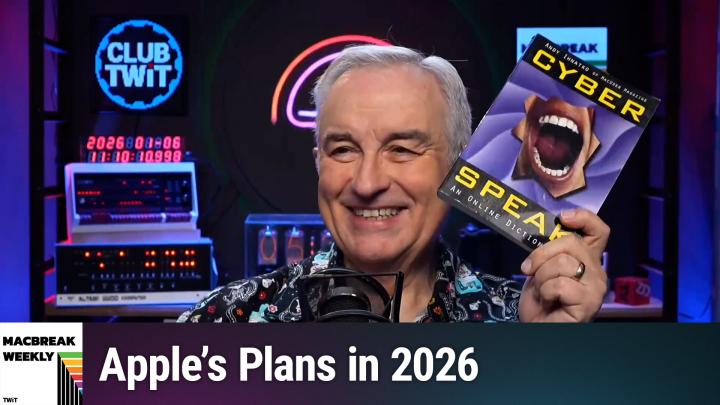
Andy Ihnatko, also here, the author of this fine volume, Cyberspeak, An Online Dictionary.
Andy Ihnatko [00:03:30]:
And the great thing is, like, these 1990s book covers, they don't age. They don't age poorly at all. It's just as cutting edge and timely.
Leo Laporte [00:03:37]:
I could have done that. This is if you, if you're listening to the show and you're saying, what is he talking about? When he's. What he's talking about Marilyn's curse. Just. That's page 121 right there of this fabulous glossary of Cyber Speak. I ordered this.
Andy Ihnatko [00:03:56]:
Thank you.
Leo Laporte [00:03:58]:
And I've been meaning to thank you for this fine volume also for this. You know, part of it is I want to have a copy of everybody's books. So I have a special shelf dedicated to. To host volumes. And now this will take its pride of place there. Mr. Jason Snell from 6colors.com.
Jason Snell [00:04:18]:
Do you have a copy of Providing Internet services via macOS. One of the finest ways to serve web pages on classic Mac OS by me and Carl Steadman. Because that's the only book that I actually traditionally published at all. And I might. I don't know if I have any extra copies left at this point. I wanted to thank you because this is a 90s throwback in another way. I'm just going to point out again, your panelists were all people who worked at the late lamented Mac User magazine in the 90s. Shelly and I were on staff.
Jason Snell [00:04:48]:
I was actually doing a research project the other day and I found a news section that was full of these nerdy Internet articles about how things were happening on the Internet. They were all bylined by me and Shelly and of course, our columnist was Andy and not co. So that's why they had to shut.
Leo Laporte [00:05:06]:
Down the magazine of Mac User magazine.
Jason Snell [00:05:09]:
Yeah, that's why they had to shut it down because it was too good.
Leo Laporte [00:05:14]:
Yes, it was that. No, it was Mac World that came in the box of the original Mac.
Jason Snell [00:05:18]:
Right.
Shelly Brisbin [00:05:19]:
We don't talk about that. I don't talk about that. Jason might, but I don't talk about that.
Jason Snell [00:05:23]:
I mean, all the assets of Mac User were purchased by Mac World eventually, so. Oh no, I don't.
Shelly Brisbin [00:05:31]:
And Leo, if you need a book I wrote in the 90s, I can hook you up.
Leo Laporte [00:05:34]:
Oh good. All right. Yeah, I got to have the complete set.
Jason Snell [00:05:37]:
I might have two copies of my stupid book. If you want to run webstar. Eudora Internet Mail Server Mail Share Eudora.
Leo Laporte [00:05:47]:
I wish I still had Eudora.
Jason Snell [00:05:49]:
The idea that you would run and I did, you could run and I wrote a book about it. An entire Internet server on a Mac running classic Mac os, an operating system that did not have protected memory or preemptive multitasking or anything that you would want in a server is amazing. But we did it because we were maniacs. That's just how it was back then. In the early days of the Internet.
Leo Laporte [00:06:12]:
I think AU was great for a comeback. You had to roll your own. You know when, when men were men.
Jason Snell [00:06:18]:
And our, we had a male, we hosted our own before, before we were allowed to have Internet at Mac User magazine because I, I showed up there as a fresh faced youngster from Berkeley and I was told that we did not have Internet. I had to get a modem and dial into the Berkeley Internet in order to get on it. But we did have, there was one room that had Internet. Stefan Samoji, who was our sort of tech editor lived and he had an SE30 that was running Mail Share, a classic Mac app. That was our, that was our POP SMTP server back in the day. And that is, that is the true story. Nobody cares. But I'm just gonna say that's the true story of why Macs were Internet servers is because there were crazy Mac users who are like, I'm gonna do an Internet server and who is gonna stop us? You just get that Mac on the Internet and say this is a website now.
Jason Snell [00:07:07]:
And that in the early days that's how it worked.
Andy Ihnatko [00:07:10]:
I still remember the facts I got from, from the editor in chief saying there is an upstart young firebrand in here named Jason.
Jason Snell [00:07:17]:
And he slow him down.
Andy Ihnatko [00:07:18]:
He doesn't slow his roll his toes, he steps on with all his newfangled ideas.
Shelly Brisbin [00:07:22]:
I think the truth was nobody knew it was happening in that room where Stefan used to have his office. It was Just in there. And nobody knew it was there. Even in a Mac magazine was just.
Jason Snell [00:07:31]:
On a table in the corner.
Leo Laporte [00:07:32]:
Yeah, I imagine current generations of people just really don't have any idea what it was like without the Internet. I mean.
Andy Ihnatko [00:07:47]:
They never heard of us having a slip server where it's like, first you have to get your modem to dial into the Internet, not like through something else. It's like, no, the connection was through a modem. And basically, here are five points of failure.
Jason Snell [00:07:59]:
Uphill.
Shelly Brisbin [00:08:02]:
Uphill, both ways.
Andy Ihnatko [00:08:03]:
You will not get to the Internet. Yeah.
Leo Laporte [00:08:05]:
Ah, those were the days.
Jason Snell [00:08:07]:
Anyway, you're tuned in to Mac Break 90s, a nostalgia podcast about when the Internet was hard, but young and hard.
Andy Ihnatko [00:08:16]:
I sure hope this Whitewater scandal doesn't bring that young, energetic Bill Clinton down.
Leo Laporte [00:08:22]:
Well, actually, we can do a little bit more recent spelunking by looking at peace in Macworld 2025 will be remembered for what Apple didn't deliver.
Jason Snell [00:08:35]:
Yeah. So every year, because I have to write, it used to be 50, now it's only 24. But columns on Macworld in a given year. And so you know what you want to do, you know, Leo, because you have to do 50 odd podcasts a year for every one of them.
Leo Laporte [00:08:49]:
And they are odd, let me, let me assure you.
Jason Snell [00:08:51]:
And it's hard to come up with things to talk about sometimes. So I do two pieces. I do a predictions piece and I do a grading my predictions piece. And this year was really hilarious because if we go back a year to the beginning of last year, if you recall, Apple had promised a lot of things for Apple intelligence, but hadn't yet delivered. And so in that moment, I really thought, well, this is the year where Apple delivers. And instead it went another way, which is this is the year that Apple comes out in the spring and says, we can't deliver on our promises. And the whole narrative changed.
Leo Laporte [00:09:26]:
So that fire or get rid of or let go every single person involved with that and start over.
Jason Snell [00:09:32]:
Yeah, yeah. But it's amazing to think back 12 months. You know, we all have internalized now that that day where Apple declared, we aren't going to ship the thing, we promised that we were putting ads out on TV during the NFL playoffs, like, it's not happening. Does it even exist? Nobody really knows. A lot of people lost their jobs. And the best part about this is it still doesn't exist. Because Apple, when they announced that, they cryptically said, in the coming year. And people had to ask, like, what do you mean by in the coming year? And they said that means 2026.
Leo Laporte [00:10:05]:
Okay, you could have, we're in it now.
Jason Snell [00:10:09]:
So maybe this year will be the year of Apple Intelligence, but last year certainly turned out to be more the year that Apple Intelligence failed and that Apple failed to deliver.
Leo Laporte [00:10:18]:
What do you think this article will be like on Christmas Eve 2026, man.
Jason Snell [00:10:23]:
I mean I did so I did a new predictions article and I do think that my prediction for Apple Intelligence is that they will ship things and that things will be better than they are now, but not good enough. I think that's where they will go is it will be one of those things right, where it'll be like, oh, Siri is better and you can do some of the stuff they promised but. And there'll be like a litany of things that just don't, don't quite work. I think that's the safest prediction to make is that they will absolutely ship something but. And if we look back 12 months we'll be like, oh yeah, it's way better than it was 12 months ago. But. And then there'll be that litany of complaints that we have because you know, nothing is ever perfect if Apple and.
Leo Laporte [00:11:04]:
I think this is the consensus that Apple's going to do this. If Apple uses Google's Gemini model as Siri, I think it could be better than we think. Gemini's pretty impressive.
Jason Snell [00:11:16]:
I agree. And a white labeled version that's basically custom built for use at Apple's cloud server by Apple and Google. Yeah, that could be really good. It really could.
Andy Ihnatko [00:11:28]:
Yeah.
Leo Laporte [00:11:28]:
So maybe you'll be able to say next Christmas Eve, oh, you know what, this was the year we got real intelligence in Siri.
Jason Snell [00:11:38]:
Maybe. I think one of the. I think that's a possibility. I definitely think that it's a possibility. I think more likely, like I said, I feel like there will be issues that will come up. I think the question is that we're all going to see this year is how much of Apple's failing with Apple Intelligence has been that they can't do the models that the models don't aren't very good. And if that's the case then using Gemini as a white labeled model so like white label for people who don't know the idea there is not branded as Gemini but we all know it's Gemini. But from Apple's perspective, from the user's perspective, it's just Apple's cloud AI model.
Jason Snell [00:12:14]:
We don't know where, where it is. Well, even if that's good, my next question is how well, is it integrated into Apple software?
Leo Laporte [00:12:22]:
That's the other part.
Jason Snell [00:12:23]:
That's the other piece Apple, right, is you've got to integrate and we see a little of it with Apple intelligence now where it's like the image playground or it's the writing tools and it's like, how do you build ui, Apple level, Apple, you know, quality bar, as they would say, UI that has an LLM as a back end. Because what Apple seems committed to, and I actually support this, is if, if you just do a chat bot, like that's not good enough for, for, for your iPhone interface. It needs to be an interface that leverages the power of that model. So that's the other piece of this is even if they get Gemini and it's great, they have to build all the connections and have them work well.
Shelly Brisbin [00:13:05]:
Well. And do they prioritize particular ones in order to make a big show of something that works and does very well while leaving other things to lie fallow? Is my HomePod mini still going to be stupid while my Mac is smarter about and about what is it going to be writing tools? Is it going to be fancy things like image playgrounds that nobody particularly likes? But where does Apple want to show itself to be better than they are now?
Andy Ihnatko [00:13:32]:
Yeah, and it's still a moving target as to what the users actually want. The users are going to react to the AI tools that absolutely speak to their experience and make their lives better. They're not going to react to, hey, wow. Though now I can make my memoji look like a scene from the Godfather. Again, nice demo, but nobody cares. But when it comes to being able to say, ask Shlomo to essentially do the sort of task that would take me about three or four days worth of creating automation actions and automation workflows, but now you're just doing it automatically, saying, hey, every Tuesday, I want you to take the data from these URLs in this bookmark list. I want you to format it this way and then reform it that way. Send it to these three people, create a spreadsheet and then post it and then archive it.
Andy Ihnatko [00:14:21]:
And then suddenly this thing that might take you 45 minutes once every week is now just something that simply happens as though you have an actual assistant. Assistance usually used to mean, oh, this is like the kid, the child in the house. When you say, hey, go to the living room and turn off the lights. Okay, that's nice, but that's not a real assistant. An assistant makes sure that you don't have to do anything that is Easy to explain to somebody else to do.
Leo Laporte [00:14:46]:
I think if Apple goes in that direction, it's gonna be. It might be a big disappointment. You might be writing that article in Christmas Eve, Jason, and saying, another year of disappointing. Because I'll tell you why I say that. Microsoft has attempted this with Copilot and despite the ads, by the way, if you look at the things that Microsoft shows in its ads, Copilot doing people have attempted with the actual Copilot on Windows and it doesn't do it. It doesn't do it very well. If you look at what Microsoft's done by incorporating AI into its desktop operating system, it's been, in my opinion, a massive bust. And I really don't think it's what people want.
Leo Laporte [00:15:24]:
On the other hand, if you look at what ChatGPT 5.2 is doing and Gemini 3 is doing, Nano Banana is doing, which is their image tool, if you look at, in my opinion, Claude Code, which is anthropic's best Opus 4.5 model, these things really are doing some amazing things. The mistake is trying to shoehorn it into the old way of working to say, well, no, you're going to use it to build a spreadsheet. I don't think that's what Apple should do. Now. Apple may do that or. And they may do Emoji Playground again, which was a massive error.
Jason Snell [00:16:04]:
Yeah, it's also. So what Shelly says about, you know, the implementation and what they choose to do and what they choose to put forward, I think is a good one because I think Apple. Right. It's like an LLM isn't a feature.
Leo Laporte [00:16:16]:
Yeah, that's the real question. Does Apple understand what it needs to do?
Jason Snell [00:16:19]:
Right. And what. And it's also what can it do that people want? Which is ideally you not just give them something that people don't want, but shows off your tech, which I would argue is what a playground is and you would do something that people want. And when you think about it, yeah, you can get excited if you think about The Claude Opus 3.5 or whatever, these thinking models, the idea that instead that user. Look, I'm a big fan of user automation back in the day, AppleScript, Python shortcuts on the Mac. Right.
Leo Laporte [00:16:51]:
Could do all that, by the way.
Jason Snell [00:16:52]:
Exactly. So this is the thing is what if already, if we can leave this to the point where instead of you having to write a shortcut that most people are not going to write, you say, I want to do this, and it writes the shortcut, which is kind of what it wants to do what Apple wants to do by getting all of these intents, the app intents into shortcuts is gives a central system the ability and the lexicon to control everything that's on your device.
Leo Laporte [00:17:18]:
That's a smart way to do it.
Jason Snell [00:17:19]:
If you can say, I want to do this and it may do it, or it may say, I built a shortcut that does that and now you can just tell me do this and I'll run the shortcut, or you can just run the shortcut. That unlocks a lot of power because in the end the user just wants to go from point A to point B and how it gets there doesn't necessarily matter. Then if you're a little bit more of a power user like we all are, then maybe you look at the shortcut or you look at the Python script and you say, oh, I want to make some changes. And that's great. And that's like, now you're in Claude. Claude code, all of that. But like, I think that there's a lot of potential there. But Apple has to have the feeling like they can build a good interface for it.
Jason Snell [00:17:55]:
It has a good use case and it gives good results. And I think, I think that's the challenge is getting all of those. Because sometimes you build a really great interface and the results from the LLM are bad and sometimes it's the reverse, which is the results are fine, but the interface is terrible. So like they got to. And then the worst one is it all works great and nobody wants to use it. So they've got to hit the trifecta on this. I think they could. I actually, this is why I'm excited about Apple playing with this stuff and having a good model to use with, with Google's Gemini model, if that's what they're doing.
Jason Snell [00:18:25]:
Because one of the things that, that we really need is a company that, you know, cares about the end product and feature thinking about how to apply LLM technology to solve problems and not just say, here's a box, fill it with whatever. Which is where we are right now.
Shelly Brisbin [00:18:43]:
There's a really big picture disconnect between what companies want to provide for AI LLMs features and what users want. For one thing, I don't think users know what they want. But for another thing, I think most companies, Microsoft included companies that have put AI in products that already exist. Here, here's your AI. I think they are not getting the response they hope from, from their users, which is yay, thank you. AI is both a tool of people who market products and a tool of businesses. But it is not a tool for end users. You can talk all day long about how many people use ChatGPT.
Shelly Brisbin [00:19:19]:
And it's true, I can open up an app, 800 million a week and get an answer, but that's not integrating it into my life in a way that would cause me to choose or prefer a platform because their AI was better. So if app Apple has had all this time when they've not been ahead in AI and I kind of secretly hope that what they were doing was figuring out a use case that makes sense from an end user perspective rather than the perspective of the people who are, you know, in business to, to make AI happen. And I don't think AI has happened to a large degree. Even as I say you could absolutely say how many people are using ChatGPT and Claude and Gemini and those are abs, those are real numbers. I don't question them. But I do question whether people are willing or interested in having AI integrated into their life in the way that the people who are providing it seem to want to do it.
Andy Ihnatko [00:20:12]:
Yeah. And it's also very possible that everybody in this conversation and outside this conversation in the industry is trying to figure out how to make better horse drawn wagons because it's great technology for making the wagon much, much better. But they don't understand that like this is not the application. We're trying to take this new idea of internal combustion engines and trying to figure out how to make an existing technology or an existing use case better with it. That it's possible. You think about what smartphones were like before the iPhone. Actually not before the iPhone, but let's say before mobile broadband was a big, cheap, affordable, accessible, reliable thing. That it was largely, hey, let's take this desktop app and we'll make a version that works on this tiny screen with this very, very hard to type keyboard on it.
Andy Ihnatko [00:21:05]:
And that again, that was a good first swing. That was a natural reaction. But it didn't really figure out that no, this is not the sort of thing that is going to, this is not what's going to make this technology really, really great. It's possible that we keep thinking in terms of, hey, let's automate things that we could normally just simply type and describe. Hey, let's have tasks that we, repetitive tasks we do a lot and have it do it for us automatically. Maybe the actual best host for AI is actually simply a microphone and an earbud where you just simply having, just like you're not really thinking about the applications and the APIs that you're using while you're using your Mac. Maybe we're heading towards a time where you're not even thinking about the applications, that doing things at all. There was a.
Andy Ihnatko [00:21:49]:
The Wall Street Journal had a couple of really good articles the past couple of weeks, both of them hinting at, or at least orbiting around Sam Altman's talks about how, hey, we don't see our big competitors for an AI as Google. We see our competitors as Apple or Apple's App Store, which if you had to compete with Google, of course you would want to tell your shareholders that, no, we're not competing with this $3 trillion company. We're competing with something else. But the, but the, the idea is that he wants the chatbot to be. You're not going to be using the Uber app to book to get a car. You're not going to be surfing for information. You're not going to be buying things. You're not going to be traveling, getting airline tickets through these individual apps or services anymore.
Andy Ihnatko [00:22:33]:
These are going to be features of the chatbot and you just have no idea what's under the hood. All you know is that by saying, hey, I need to be. I've got a meeting in New York City at 1:30 on Tuesday. Get me there and also find me some, some tickets to a show to see that night. I need to stay the night. And then you get an answer back 30, like 30 seconds, 30 minutes later saying, here is your Amtrak ticket, here's your hotel. Here is what, Here are tickets to that show that actually you are already bookmarked. Everything's done for you automatically without any knowledge of what services were used to make that happen.
Andy Ihnatko [00:23:07]:
That's possible that that's what we're actually waiting for. And that's not going to happen for lack of imagination.
Leo Laporte [00:23:12]:
Well, AI aside, Apple, will Apple have a big year in 2026 in hardware?
Jason Snell [00:23:18]:
I mean, I think it will. It sounds like it's going to ship its first folding phone, folding iPhone. And I don't know, there were. So there are this kind of a weird thing. There's somebody who came up with a, took the measurements that people claim in the supply chain that this phone is. And they built a 3D model and then a bunch of people 3D printed it to sort of hold it in your hand. And it's interesting because if this model is right, it's more like a squat field notes notebook. It's not tall, right? Like really tall.
Jason Snell [00:23:52]:
It's actually sort of Squat and a little wide. And when you open it you get a 4 by 3. So classic kind of classic iPad and classic TV dimensions. A 4 by 3 screen that's just like a smaller iPad mini. It's. And that's interesting because it means that when it's closed, it doesn't feel like a normal phone. It feels like a weird, you know, short phone, short and wide phone. But I think it'll be, don't we.
Leo Laporte [00:24:18]:
Think that's a good idea that Apple, instead of making something that looks exactly like a Samsung Galaxy Fold, which is, you know, phone dimensions, but it just opens up it, it does something that's distinct, that's unique and maybe is going to be a failure, but it is a shot. You nailed it.
Jason Snell [00:24:36]:
You nailed it. It is. They're taking their shot. I think that there's. It may fail because people may reject it because it looks different, but it.
Leo Laporte [00:24:44]:
Just fits in the pocket.
Jason Snell [00:24:45]:
I can see how, I can see their argument, right? So here's the argument they're going to make. They're going to say, look, if you want a phone, buy a phone. If you want an iPhone, buy an iPhone. We make great iPhones. Buy an iPhone. If you want this thing, you're not buying it because it's a phone, you're buying it because it unfolds and becomes an iPad. And if we make it really tall, you, you're going to open it and it's going to be this weird kind of tall square thing that, that is not great. And what you really want is something that's small and then you open it up and it's an iPad.
Jason Snell [00:25:11]:
And that if all you care about is the shape of the phone, buy an iPhone, don't buy this thing. And I can see the argument, I'm not sure whether it'll work or not, but I can, I can see the argument that if we're going to do this, if you're Apple, let's take a shot and be opinionated and make it something that, that is great when it unfolds because in the end that's where the, that's the money moment is unfold to become an iPad.
Leo Laporte [00:25:37]:
We want them to, to live up to that courage. You see, this is the Samsung and it's really just two side by side phones. And for the most.
Shelly Brisbin [00:25:44]:
Exactly.
Leo Laporte [00:25:44]:
That's what you got, you know.
Shelly Brisbin [00:25:46]:
Exactly.
Jason Snell [00:25:46]:
And if it's truly four by three, then what they will say is like, I mean literally four by three. Not all iPads are four by three now. But when the iPad came out, it was four by three. That was, it's the same dimensions as the kind of classic iPad. And I think that's going to be their argument is this is you're not just buying a phone, you're also buying an iPad and you open it up wherever you are and you've got an iPad with you and then it folds down and goes back in your pocket. And again, I don't know if the market will reject that or not. Although I will say I can. I can almost with supreme confidence say it'll probably be the best selling folding phone model ever just because it's an iPhone.
Jason Snell [00:26:19]:
And two, it will probably sell a smaller percentage of Apple's overall iPhone sales than even the Air or the Mini or the plus because it'll be expensive and it'll be super niche. And so I'm not even sure we'll be able to judge if it's a flop or not because I think it's going to be such a niche product that it will take time and Apple will kind of learn what the issues are. And if they're committed to this category, you know, they'll, they'll keep experimenting and making it better. But at some point you do need to ship something and that's going to be really like a completely new for Apple, you know, iPhone concept. And Apple being Apple's great benefit in leaning into the iPad is they have 15 years of history with the iPad. IPad apps are good. Apple does tablet stuff better than Android does. Like by far.
Jason Snell [00:27:05]:
It's always been more successful with it. And so that's a, that's an advantage that they can lean into. Whether people care. Yeah, I don't know.
Shelly Brisbin [00:27:12]:
But I feel like they've really got to have some software value add, especially for the closed phone. Even if the open phone is the reason that you buy it, you're going to have that phone close in your pocket or purse for some period of time. And I don't just want to see my note of, on that closed screen. I don't know what I want to see. I want Apple to tell me what is the unique proposition from a software point of view for this device in addition to having that big iPad screen, having that portable, that even more portable iPad that comes with me.
Leo Laporte [00:27:41]:
So you don't think it'll just be a squat version of the iPhone?
Shelly Brisbin [00:27:44]:
I hope not.
Leo Laporte [00:27:46]:
That they should do something innovative with that front screen?
Shelly Brisbin [00:27:48]:
Yes, I think and, and they should. And, and whatever research they do and internal testing they do, they should figure out because the sort of natural thing that you think is, well, that's where my notifications and my always on display kind of material, my dynamic island kind of material is. What else can we do with that? That screen is not going to be enormous, but it's not going to be so small that it's only notification center in the dynamic island. So let's find something unique to do with it that makes me want that even if I don't want it out of the box. If you describe it to me and I say, no, that's not for me. If I see that at an Apple store or if I see an article about it, Apple needs me to want that phone, whether it ends up being the phone I get or not.
Leo Laporte [00:28:26]:
You know, it's interesting because Microsoft did attempt this with their duo. They didn't have any front screen. That was just a little booklet that when you open it up, it was four by three. And I think their failing, by the way, didn't have a crease because it was a hinge. We talked about this before, but I think their failing was they didn't quite get the software to live up to the promise. I bought it. I thought, hey, this could be really good. People carry notebooks, you know, I mean, I think you're right, Jason.
Leo Laporte [00:28:54]:
You don't sell it as a phone. You sell it as something that can be a phone, but as something more than a phone. In fact, Microsoft didn't even want people to call the duo a phone.
Jason Snell [00:29:03]:
Right. To be clear, that outside screen will be an iPhone. Right? Like, it'll have widgets and presumably be always on with widgets and stuff. That I agree with Shelly. It would be interesting if they made that better. I mean, really, for all iPhones, not just this. And then when you unlock it, it's an iPhone. I think there are going to be some interesting challenges there because it is a smaller screen than we've had in an iPhone in a while.
Jason Snell [00:29:28]:
And I remember from my time using the iPhone mini that like, there were apps that are like, yeah, they're all like their things just got off the bottom of the screen because they didn't even think about testing it with it. And that's going to be a challenge for developers and for Apple to be like, this thing better be a good iPhone when it's an iPhone. But I think they're leaning into like, yeah, it'll be a fine iPhone, but the reason you buy it is because you can open it up. And I think Shelly's resistance there is one of the examples of a challenge Apple will have with a product like this, it'll be expensive and you'll be like yeah, but it also needs to be my phone. Right? It does, right.
Shelly Brisbin [00:30:03]:
And it can be mainly the iPad if that's the way they sell it and if that's what people want to buy. You're still selling me the thing that I use as my phone that I carry around all the time. So I need to get enough value with it in both positions that it's going to be and not only that, not only just like straight up value. Can I use it as an iPhone? Of course I can. Can I put my widgets on there but my notifications on there. But can I get excited? Can Apple tempt me or try to tempt me as somebody who is somewhere between an iPhone pro and wow, I really want the new thing.
Leo Laporte [00:30:35]:
What about Mac 2026?
Andy Ihnatko [00:30:39]:
Well, we're looking forward to possibly a Super super cheap MacBook and that's going to upend the entire product line. The idea of being able to buy an actual MacBook but based on like iPhone style A series processors but still certainly power enough to get do the job of anything that Anybody expects a $599 laptop to do that's going to upend things quite seriously. And I'm looking forward to see if Apple decides to really distinguish a cheaper MacBook line by introducing you know what let's actually have. We're going to go with not necessarily all aluminum. We're going to cheap out but we're going to do just like the iPhone 5C. It was like we're going to proudly plastic. We're going to make these in exciting interesting colors because we don't have to worry about a whole bunch of other considerations. It has to be the same quality that people are expecting from anything that's a MacBook.
Andy Ihnatko [00:31:31]:
But the idea of saying that we don't we no longer are going to. We're no longer going to trust that people are willing to spend add an extra $71 to the unit cost of something because we really, really thought about the chamfer angles of how these two seem seems meet. I'd like to see them try to do this at cost a because I'm glad to see a continuation of a reversal of Apple's policies from seemed like seven or eight, nine years ago where their motto was go be poor someplace else. They really didn't care about serving anybody who didn't have money for a premium expense product. It's nice to see them enter this, this price point but also it's interesting to see how their design part department answers that specific call. Design is never easy, but when you say, oh, by the way, this is going to be a $2,000, $2,500 folding phone, we don't really have to economize everywhere. So we can have the deluxe this and deluxe that. The deluxe that.
Andy Ihnatko [00:32:29]:
It's really, really fun when you're a company like Motorola that says, no, we can't sell this phone for more than 200, this specific phone for more than $300. But it still has to look good, it still has to feel good in the hand, it still has to perform, it still has to feel like a quality product. I'm really excited to see Apple's design team attack a set of problems that they've never shown, they've never really attacked before because it'll teach us a lot about what they feel.
Jason Snell [00:32:54]:
Yeah, I was going to say that the, it'll be the lowest cost Apple laptop ever. I think that's almost certainly going to be the case because we've never really had something down in that price range. Even at 699, you'll be the lowest like list price brand new Apple laptop ever. If it, if it happens, I think that opens up the door and they'll do discounts on top of that and then the education price will be 100 down from that. Like I think it could be a really good thing. I don't expect it to be plastic. I expect it to look like a, kind of like an M1 MacBook Air. I think that they're, they, they don't want to make more plastic computers and I think that they want, they're good at aluminum so I think it'll still have that Apple aluminum kind of thing that they've been doing for 15 years, but a lot of potential and it's exciting to see them try it.
Jason Snell [00:33:38]:
And that is because Apple silicon enables a computer that, you know, for multitasking and graphics. It's going to be kind of at M1 level, which is fine. And then the single core which handles a lot of things will be, you know, those iPhone cores are still really fast at single core, much faster than the M1. So there's a lot of potential there and I think that's the most. There may be new gen MacBook Pro at the end of the year or that may roll into next year. But that would be interesting because that's the one that's rumored to have a touchscreen. And so we might also get our first Mac that actually has a touchscreen bringing the power of the early 2010s to you in 2026. But that one's a little more hazy.
Leo Laporte [00:34:18]:
At CES this week, LG announced a new material called Aero Minimum. Aromin. Arominum.
Shelly Brisbin [00:34:27]:
How do the English pronounce the UK phenomenon?
Andy Ihnatko [00:34:30]:
A marketing triumph. They're introducing a new thing that nobody can pronounce even when they're looking at the word in front of them.
Leo Laporte [00:34:36]:
It's light. It's supposed to be kind of like aluminum. I don't know what it. I don't really know what it is.
Shelly Brisbin [00:34:43]:
An alloy of some sort that's aluminum in there.
Leo Laporte [00:34:47]:
But I guess my point is that it doesn't have to be aluminum. They've used metal in the past for the grammar. But as somebody pointed out, it's kind of like car metal. It's like you feel like you could dent it easily. Apple, what Apple's done with aluminum is remarkable. And I think they really own that technology.
Jason Snell [00:35:07]:
They are like.
Leo Laporte [00:35:08]:
It's pricey though, isn't it?
Jason Snell [00:35:10]:
The world's leading aluminum. Well, it's not that pricey. I mean, it's in your soda can. And they've gotten really good at it. They do 3D printed aluminum now as well as their kind of like carved out aluminum and transparent aluminum. And they're using it for all of their. Yes, transparent aluminum is coming after they get to Scotty and Reference Acknowledge and yeah, they're just so good at it and they're so comfortable with it. And all their production lines for all their laptops for the last, you know, however long 15 years have been aluminum based.
Jason Snell [00:35:39]:
So I think that they're very confident.
Leo Laporte [00:35:41]:
So Even with an 800 or 600 laptop, you think they'll still use.
Jason Snell [00:35:45]:
I don't think the aluminum is the cost. I think a lot of laptops are plastic, not because plastic is cheap, but because plastic is light. But aluminum is also light and Apple's good at aluminum and it's a part of the brand now. I'm not sure Apple could ship a plastic laptop now because all Apple laptops have looked like this for so long that. And also then you can anodize it into a fun color or something like that. I think, I think it'll be. But to Andy's point, it will be a big deal, like having an Apple product play at that price. And you know, it won't.
Jason Snell [00:36:14]:
They won't have custom configs. Right. If you want anything more, you will. They'll say, buy a MacBook air. But still, if you are able to go online or to Walmart or to Costco or wherever and get a Mac laptop brand new, out of box for I don't know what, 500 bucks, 550 bucks on sale or whatever, that's a big deal because there are a lot of people who just will not buy a laptop that costs 999. They just won't.
Andy Ihnatko [00:36:41]:
And the other problem with aluminum, with plastic is that it's an insulator, whereas aluminum acts as big heat.
Jason Snell [00:36:46]:
Bad for the planet.
Andy Ihnatko [00:36:48]:
Well, if all the things that Apple is doing that's bad for people were to be enumerated, we'd need to have a separate.
Jason Snell [00:36:53]:
Well, yeah, but aluminum. Talk about the environment and then say, well, we are switching from aluminum which is recyclable to plastic, which is forever. I'm not sure they could get away with it.
Andy Ihnatko [00:37:02]:
I would just, I would just like, I still remember like how kind of semi exciting it was to see new imacs and see, oh, it's not just different colors but now they're doing sort of like a blueberry sort of flowery swirl. I would like to, I agree for all the reasons that we've been talking about that plastic is not terribly likely. But I would love to see Apple really, really freestyle on this. So if the thing we also saw how well they can do colors in the recent, most recent revamp of the imac. I just hope that they don't say, and here's the $599 Volkswagen version of the, of the MacBook. You can have it in gray, a slightly darker gray or a slightly lighter gray.
Jason Snell [00:37:45]:
The rumors are that it's going to have fun colors which I would rather, I would also like on other computers, please. But that it would be nice if they had fun colors that would be.
Leo Laporte [00:37:53]:
Are we going to. I wonder though if we are rapidly approaching an era where people who use computers, laptops or desktops are a different breed than people than the general user that most users will be using an iPad like device or a phone like device.
Andy Ihnatko [00:38:10]:
I don't think so.
Leo Laporte [00:38:11]:
I mean, you don't think so. You think that there's a market. There will always be a market for laptops.
Andy Ihnatko [00:38:15]:
There's a reason why school systems cannot buy, fleet cannot buy computers for education that don't have some sort of a trackpad or some sort of a keyboard. There are so many. We're not at the point yet where it's as convenient to do long form. Form writing long form. You need a big screen for A lot of things. And multitouch does not serve for a whole bunch of things that involve taking ideas from your head and putting it in there, putting it inside ram. It's not as though speech to text isn't a thing and it's not a very good thing. But the interfaces have not caught up yet.
Andy Ihnatko [00:38:45]:
Anything that is a tablet, for instance, even a large tablet that doesn't have a keyboard attached, it's still being built with a mobile first sort of idea of how apps work. And there's a reason why this technology has been out for 10 years and still the absolute king of the jungle is still some sort of a keyboard, some sort of a screen, some sort of a pointing device. So barring a huge revolution, I don't see that changing my kids and being.
Shelly Brisbin [00:39:10]:
All in one piece is a big advantage for kids for durability. I would argue that from accessibility point of view, the tablet is actually the better choice because those interfaces tend to be better, at least in the Apple universe. But that's not an argument we need to get into. But it does feel like the, the laptop and the, for the, for the education market and for the low end market where this is going to sound weird to say since the app, the iPhone is Apple's leading product at this point, but I also think if you have those low end Macs, you're going to have people having reason to continue to be in the Apple ecosystem in other ways. So some family or some school system that may have gone on to chromebooks or to PCs or something like that, if they have Apple laptops at the center of what they're doing, there's more and more argument for other Apple stuff. And again that argument might sound like about 20 years old, but Apple always wants to sell more stuff.
Jason Snell [00:40:03]:
Yeah, I would say that my kids are both in their twenties and they use laptops. I would say my daughter especially, she's not laptop forward laptop first. Right. Like her phone is her identity and where she does most everything, she's on her phone, she uses the laptop to get work done. She does some video stuff there. Like there's having a bigger screen and a more, you know, precise pointing device is useful in certain circumstances. And my son, you know, prefers to play games on a laptop, so. And does his papers for school on a laptop and all that.
Jason Snell [00:40:39]:
So I feel like you're right, Leo, in the sense that laptops and computers in general are not what they used to be, which was like primary. They're not, but I think they're still not like so going to be esoteric, they are going to be more constrained. I think that that is safe to say that not as many people are going to need them to be their primary way that they do. Like I use my iPad a lot but, but I'm mostly at my desk using a Mac, right. And I, I am not, I think representative of what will be to come.
Leo Laporte [00:41:12]:
We're old school is what I guess.
Jason Snell [00:41:14]:
Exactly that, that being on your phone or a tablet is going to be your primary. And maybe it's like, well, I need to do this. I have a computer to do this stuff. And that's, I think that's okay. I mean for Apple strategically, that's why they're doing all of those things is they're like, whatever, take whatever. Yeah, we make it.
Andy Ihnatko [00:41:31]:
Yeah, this is, this is. Honestly, things are in such wonderful state of flux right now that so many companies, including Apple, have to like play the roulette table of saying we're going to put as many chips as we can on as many things as we can because we don't know what's going to hit and we have to at least be ready for whatever that next thing is going to be. Like Apple's not like Samsung. They can't afford to simply manufacture everything and just cancel the things that don't sell. But nonetheless they know that if they don't have, if they, if they don't have AI, an AI play ready to go where don't. Where they don't have to spin it up from zero, that's going to be bad in five years. That if they don't have budget hardware, given their track record or how much success they've had in selling MacBook Airs through Walmart and other like less expensive channels. If they don't have a folding phone, if they don't have X, Y and Z, again, they can't manufacture everything.
Andy Ihnatko [00:42:23]:
But they need to be ready for everything. And I think that that's a sign of the times right now.
Leo Laporte [00:42:29]:
Let's take a break. When we come back, we will talk about Louis Mantia's farewell, shall we say to Alan Dye the blog post titled and stay out. You're watching that break.
Andy Ihnatko [00:42:44]:
The holiday season, when people think about charity and brotherhood and sisterhood.
Leo Laporte [00:42:49]:
Don't let the door hit you on the way out. Is here the author of Cyberspeak, the fabulous dictionary of Cyber Talk, available where.
Jason Snell [00:43:01]:
Some old used books are sold.
Leo Laporte [00:43:05]:
Jason Snell, editor in chief of sixcolors.om founder as well. And from the Texas Standard Radio show, the wonderful Shelly Brisbin it's great to have all three of you. Our show today brought to you by Material. Oh, I'm thrilled to welcome a new sponsor to the show. This is the cloud workspace security platform built for lean security teams. This is for security teams managing security in the cloud workspace. If you're doing this, you know, I don't have to tell you it's hard.
Leo Laporte [00:43:35]:
Phishing is far from the only way in. We see these stories on security now every single week. But today's email security stops at the perimeter, right? Oh, we're going to block those emails. They can't get in. But that means new attacks are hard to detect because you've got siloed email, siloed data and identity security tools. Material crosses through the barriers, it protects the email, it protects the files, and it protects all the accounts that live in Google Workspace or Microsoft 365. Because effective email security today needs to do more than just block phishing and other inbound attacks. It needs to provide visibility and defense across the workspace.
Leo Laporte [00:44:17]:
Threat Surface. This is the first detection and response platform built for the cloud workspace. And now we all work in the cloud, right? Isn't this how we're all working? Material ingests your settings, it ingests your contents, it logs everything to provide holistic visibility. This is what you need and want. I know. Into threats and risk across the workspace and you get the tools to automatically remediate them. No more working in the dark. Material delivers comprehensive workspace security by correlating signals and driving automated remediations across the environment.
Leo Laporte [00:44:56]:
Yes, of course. You get phishing protection and email security combining the advanced AI detections, the best threat research in the business, and user report automation so that we're all helping each other. You get detection and protection of sensitive data across inboxes and shared files. You don't want people sending out private stuff, do you? Account threat detection and response with comprehensive control over access and authentication of people in third party apps. Material does it all. They empower organizations to rapidly mature their ability to detect and stop breaches with step up authentication for sensitive content with blast radius visualization for accounts. You got to try that. When you see it, you'll understand.
Leo Laporte [00:45:43]:
You'll say, how did I live without it? And the ability to detect and respond to threats and risk across the entire cloud workspace. Material enables organizations to scale their security without scaling their team. Material drives operational efficiency with its simple API based implementation and flexible automated and one click remediations for email file and account issues, including an AI agent that automates user report, triaging and response material protects the entire workspace for the cost of email security with a simple and transparent pricing model. I want you to check it out. Secure your inbox and your entire cloud workspace without adding more toil to your day or costs to your balance sheet. See material.security to learn more or to book a demo. Material Security it's, as they say, trusted by the best and brightest companies. Should be trusted by yours as well.
Leo Laporte [00:46:38]:
material.security we thank them for their support of MacBreak weekly and welcome them to the TWIT family. Thank you Material. Apple may have left Allen Dime may have left for a more lucrative offer for Meta, writes Louis Mantinea. But this is absolutely a good thing for Apple, which also benefited from, quote losing Johnny I've and stay out. Okay, so you wrote a little bit about this. Jason, what was Louie on about?
Jason Snell [00:47:08]:
Well, so Louis who used to work at Apple and has opinions and it's great. That's good. And he wrote a good post and then Garrett Murray wrote a really good thoughtful post about it and then I wrote a post about a post. So you know, it's posts all the way down. It's posts all the way down. What I got out of this. So Louis goes into details about how he thinks Apple kind of disconnected and then Garrett Murray said something that really struck me, which was what we lost along the way as Apple chased ultra simplicity and luxury. Johnny I've spent a decade removing any trace of personality from any product Apple released.
Jason Snell [00:47:44]:
From the translucent colored plastic aesthetic of the Bondi blue imac, to the unique design of the G4, to a bunch of aluminum rounded rectangles that were featureless and colorless and and I think there's some truth here and I am one of these people who I guess I would put myself as believing that Jony I've is a very talented designer who was channeled by Steve Jobs and then when Steve Jobs left he was unchanneled. I think for some strategic reasons they're like trying to show that they still had it even though Steve was gone. So they elevated Johnny But I think what these posts get to also is the idea that I get the vibe from a lot of these people and a lot of Apple's designs that they got so far down the direction of luxury goods and minimalism and that a lot of these people are working, they're rich, they've made a lot of money at Apple, they buy nice things, they appreciate nice things. Alan Dye is into high fashion and it's not that there's fundamentally something wrong with that. But I would say that you could argue that these consumer products that have a design and luxury flair, Apple, you could argue, is affordable luxury, right? And yet it does feel a little like disconnected from fun and more like, well, here in the high end luxury market, everything is about paring it down to the bare minimum.
Leo Laporte [00:49:14]:
If you've ever watched, you know, those Runway design shows or have you ever seen videos of Paris Fashion Week or New York Fashion Week and you look at those, you go, I don't know what world those people are living in. They seem to have an aesthetic sense and a, and a worldview that they seem to share and they get it. And you'll, you'll see on Rent the Runway or whatever it's called, you'll see them go, oh, I didn't like the, the cut of that. And everybody said, yes, it's obvious. And I'm looking, the whole thing looks like crap. Who would wear that? That's the problem with design. It's the problem with art in general, which is it is fashion. It's driven by fashion.
Jason Snell [00:49:56]:
It can be.
Leo Laporte [00:49:57]:
And I think, you know what's really critical. And I think in the early days of Apple, form followed function, right? You start with function and then you apply a form that is logically consistent with the function. I don't know if Apple's hewed to that. In fact, we'll get to this whole icons in the menu thing, which is a complete violation of Apple's original user interface guidelines. I loved, you know, I bought the, you know, Macintosh interface guidelines.
Jason Snell [00:50:27]:
Talk about Steve, right? Steve Jobs, the guy who's a billionaire and he wore blue jeans and he wore a turtleneck that he got a thousand of and it was a high fashion turtleneck. But like he was a minimalist guy to a certain point, but he also had taste. And I don't think he was in that like he cared about nice stuff, right? But I feel like he also was grounded in a way that maybe some of the other people who are making decisions at Apple weren't. And I think Jony I've is a great. One of the reasons I roll my eyes when people talk about how great Johnny I've and the design team was is because I think if you listen to his pronouncements over the course of the decade of the 2010s, it was increasingly kind of ludicrous where he was talking about these incredibly highfalutin ideas that led to making a laptop that was less useful or had no personality and drained all the color out of all the products and all of that function.
Leo Laporte [00:51:16]:
Following form instead of form following function.
Jason Snell [00:51:19]:
And driving, driving toward a goal that was not a goal of usability or of whimsy, but of sleek minimalism because that was sort of like what they had decided to focus on. And, and, and I think both of these pieces get at it and it rung true for me that in some ways I feel like that idealized Johnny I video where he's floating in a completely featureless white void is actually a pretty good representative of like that was the ideal for a lot of the people who are driving design at Apple. And I, I think. And there are lots of books out there written by people like Trip Bickle at the, at the New York Times about that, where he clearly has sources in the design group who say, like, when Apple stops listening to the designers is when Apple loses its soul, which is pretty rich. But that's of course what a designer would say.
Leo Laporte [00:52:08]:
That's what designers think. They don't just say, they deeply believe it. But I think Apple's soul actually goes back to a guy named Jeff Raskin who was the first to conceive of this idea of a computer for real.
Jason Snell [00:52:20]:
People and using usability as an issue. And I think Jobs understood that innately in a way. And I don't want to be a, you know, what if Steve Jobs were still here, but I will say that Jobs was a really great BS detector for Jony I've and the design team. And then when he died, Apple was like, oh God, we got to put everything in Jony I've. Because otherwise people won't believe that we have talent here at Apple. So let's just load down. Johnny I've. And so ultimately my piece ends with a line that I'm a little bit proud of, which is, I feel like Apple's design team disappeared up its own white void.
Jason Snell [00:52:51]:
And that I. And so when I read what Louie who worked at Apple and what I. What Garrett Murray wrote about, it just. It rings true to me that I think Jony I've and his kind of collective of people, including Alan Dye, because Johnny was put in charge of software design, kind of had this insular view of product design and that Apple allowed them to kind of have carte blanche for a long time. Carte blanche is a perfect thing to have in a white room, by the way. It's a white card in a white room. Anyway, now it's an opportunity for change. I think it's really good for Apple to have that change.
Jason Snell [00:53:23]:
And I think it's about Alan Dye and about eventually having new executives and being able to say, let's do a reset here. Because Apple is not in the position of, I would say, desperation that they were in when Steve Jobs died, where they needed to prove that like there were still people at Apple who could do things because Steve wanted you to believe it was all him. Right. So like, oh, John, sir Johnny, I've is here, it's going to be okay. And I think now the balance has shifted and if John Ternus ends up being the new CEO, we're talking about a hardware guy and Alan Dye is out. Like, I think this is healthy and I think that these two pieces point out why, in addition to that amazing piece we're going to get to which is about the icons and menus in Tahoe. I think this is all of a kind.
Andy Ihnatko [00:54:04]:
Yeah, I think the big, the big problem for years was that Apple's design team collectively seemed to stop being about design and was committed to dogma that here is our house style or here is what the rules of design are like. No, those aren't rules of design. These are just the choices that made sense in this context at this time and five years later. Maybe it's okay to have a user interface element that floats over everything else on the screen because if you're in an email app, maybe you open the email app to create an email and maybe you just want to find a big file fat round plus button that lets you create an email really, really quickly. Maybe I don't want to have to long press on a blank part of the screen to bring up a contextual. Whatever. I don't care how clean this is as a static object. I've always come back to the idea of bridges and engineering.
Andy Ihnatko [00:54:58]:
That you can build the most beautiful, gorgeous city defining bridge in the world and everybody will praise it and saying this is the most beautiful pieces of architecture ever. But if it falls down during a windstorm, it is not a bridge. You have designed a object to be admired academically. And so I do feel as though Apple for a long time had its head in its white space about how no, no, we're not going to design something to look like this because that's not how design works. That's why I keep coming back to I really want to see them make like the Blueberry Swirl, like $599 MacBook or something. They're just starting to get out of the miasma of it's always a gray overcast Day in the Apple aisle of the computer store. I want them to be fun again. I want them to be fun again.
Leo Laporte [00:55:49]:
It'll be fun when designers say, oh, the fashion this year is color, color, color. Yeah, yeah, but then it won't be functional. All of that is BS and none of that maps what color your computer is, is not relevant to anything. Now maybe this is the thing I proposed earlier, which is there are, there is a rapidly growing schism between people who use computers as tools and people who are using phones and iPads and maybe even laptops more as a utility, an appliance. And I don't honestly care what color my computer is. And I think any focus on that is misdirected.
Jason Snell [00:56:31]:
People cared what color their imac was back in the day.
Leo Laporte [00:56:34]:
Oh, I know people cared. That doesn't mean it made a better.
Jason Snell [00:56:36]:
Computer and it doesn't mean it made a better computer. But they might be more excited about buying it or feel more connected to it. I'm happy to have an orange iPhone. Like I have an orange.
Leo Laporte [00:56:44]:
I like that.
Jason Snell [00:56:45]:
If it was, if it was a terrible iPhone, I wouldn't have it. But I'm happy that I had that option. And it makes me smile when I see it. But it's not that. I mean, yeah, I think, I think it's just got out of balance. And my theory, my pet theory is really that they just gave designers way too much power because they were afraid because, you know, Steve was gone and what were they going to do and that and that. And I think the existence of all these books that claim that Apple lost its soul because they stopped listening to their designers are evidence that maybe things are already kind of coming back into balance because a bunch of those people left and, and, and fed angry information to reporters and things like that. But I think that they were just.
Jason Snell [00:57:24]:
I mean, I don't want to say it was a cult, but I would say that the followers, the cult like following of Jony Ivan, his people, like, they believe what they believe. They, that there shouldn't be color. They believed that there shouldn't be ports. They believed that everything should be as thin as possible, even if functionality suffered. And the problem is that when Steve Jobs was there, there was somebody to say to stand up to Sir Jony. I've. And after a while, like, somebody has to do that. Somebody.
Jason Snell [00:57:48]:
I work with designers. I was editor in chief of a magazine and we had art directors and we used illustrators and all of that. And the fact was it was a give and take relationship between somebody who was thinking about the bigger product and somebody who was thinking about the design. And you work together and you make something great. And it felt like there was a period in there where they weren't working together. The designers had decided what the good design was going to be and they were going to implement it. And that's a recipe for, if not disaster, a bunch of the lackluster things we saw from Apple design in the late 2010s and into the 2020s.
Leo Laporte [00:58:20]:
Design matters, but it doesn't to me. It's not what color the computer is, it's where the home keys are, it's where the card keys are.
Andy Ihnatko [00:58:28]:
There are a lot of variables.
Leo Laporte [00:58:29]:
Variables. It's the bezel around the frame. It's the things that.
Shelly Brisbin [00:58:32]:
Well, on the software side, can you use it? Because there are. Can you say,OS7 and liquid glass to a lesser extent, but you create a design language that has to be repaired in order to be usable. Whether it's literally for most users, where you have a clear versus tinted switch you can flick, or whether you say, well, if you set these four accessibility settings, this great design thing we created will now go away. That's no way to do anything. And everybody who was involved with that should be fired, in my opinion. And iOS7 was a, a criminal act. And that was the, that was early in the sort of design centric focus from a software point of view, from a hardware point of view. I mean, Steve Jobs didn't like buttons and I think he was obsessive about that.
Shelly Brisbin [00:59:15]:
So I'm not going to say that everything was golden when Steve Jobs was there. Was it better because the designers weren't controlling things, things to the degree that they were later, certainly. But I, I think, you know, Steve could be belligerent and could argue for his point of views and in ways that might not necessarily have served the product all that well. The other thing I'll say is that this, there's a cultural thing that you. I've seen at Apple all through the time I've been paying attention to them, especially in the last 20 years or so, where, even the way in keynotes and events where we talk about how we use these products and what these products are for is absolutely about upper middle class and above consumption. We're going from the sushi bar to Whole Foods in our electric Teslas. And 10 years ago, I mean, you know, more people have Teslas now than they did 10 years ago. But the sushi bar and the Whole Foods is not where the people I tend to spend my day with, are going on an everyday basis for lunch.
Shelly Brisbin [01:00:10]:
And that sort of cultural disconnect leads me to believe that Apple products are not necessarily designed in as practical a way from a software point of view and a usability point of view as they could be. And it just says it's just so has cultural blinders on. And I don't think it's as nearly as critical as some of the design issues we've been talking about. But it's of a piece, it's part of the same thing. And whether, whether you want to call it, you know, limousine progressives or whatever it is, it's, it's a, you know, very well paid people who live in a very expensive part of the country primarily who are, are making decisions about the products that an awful lot of people will use and for whom the 7, $800,000 that they spend on an iPhone is a considerably larger part of their budget than it is for those people who are making the stuff at Apple.
Leo Laporte [01:00:55]:
Yeah, colors become irrelevant when you've commoditized everything else. When everything else is done then like let's say an automobile, there's, there's a kind of a real standard automobile and now the way you distinguish your model from another model is by fins, by color, by the headlights, by less relevant things. I don't know if we're at that point with computers, we might be at that point with phones where color is all that really matters. That one glass black slab is pretty much like any other.
Andy Ihnatko [01:01:32]:
The thing is it's all of a piece. Color is one thing thing because it helps to communicate the relationship with an object. We have, we have emotional intellectual reactions to color. So it's not like it's nothing but it's not like it's, it's interesting to compare app. Apple cannot afford to be extremely diverse with their design choices because they are the sole manufacturer of phones that run iPhoneOS or run, run iOS whereas on the Android side you can have a company like nothing that said, you know what, but we are going to go crazy. We're going to be putting illuminated bars on the back of the.
Leo Laporte [01:02:04]:
Isn't that better though Andy, to have an ecosystem where you have that kind of choice?
Andy Ihnatko [01:02:09]:
I think it's better to give people the opportunity to buy the hardware that they respond to either on an intellectual level or an emotional level. Shelly is absolutely correct that we can't forget that these are expensive devices. Okay. And I can't, I'm using, I'm using. I replaced my five year old phone with a four and a half or three year old phone because like, if I have a working version of this, I don't want to spend 15, $12,000 on a device if I have a perfectly working, perfectly good version of it at my elbow. So I have to consider that very, very thoughtfully and at that basis, having to spend $1,000 on a top tier phone and say I really hate that they don't have a good camera on this. Oh well, I got to stick with it. Or gee, actually I've seen a Huawei phone that has.
Andy Ihnatko [01:03:01]:
Isn't it nice to have like a small OLED screen on the back of it? Because I could see a hundred ways in which that would make this phone better for me. Oh, well, I can't do that. That's something that Apple will never be able to get around because again, they have to manufacture each and every one of these iPhones. But I also feel as though they're not, they're stepping up at the plate and they're not swinging at anything that is not clearly a home run pitch. And that kind of thing is kind of a super bummer to me because Apple has the ability to do that sort of stuff. But they're just simply saying they're letting the pit, they're letting all these, they're just standing in the batter's box waiting for something that they are absolutely going to love and they're not taking any chances whatsoever. And again, I acknowledge that Apple can't do something and I acknowledge that the nothing phone is crazy as crazy and a thoughtful in a fun way. And if this were the only way to get Android, there's no way I'd still be an Android user.
Andy Ihnatko [01:03:52]:
But I love the fact that they're at least thinking about this and I'm hoping that some of those design ideas like having in addition to having like the back of the camera, not just having cameras, but maybe having its own secondary display. That is a great idea and I hope it filters through into the mainstream.
Leo Laporte [01:04:09]:
Let me channel Alex Lindsey, the late great Alex Lindsey here and say that all of that doesn't matter if one phone has a better camera than the other, that all people really want is a great camera. Right. And so if all the phone's cameras are identical, then you can choose a phone that looks different or they kind of are color that you want. Yeah, maybe they are. I don't know.
Andy Ihnatko [01:04:28]:
I mean that's if, if you get a flagship grade phone, they re it really the differences, then you start thinking about color. Yeah, yeah, exactly. And it really is about difference between film stock as opposed to quality.
Leo Laporte [01:04:40]:
And that's my point is you only start thinking about color when everything else is roughly equal. But if there's a phone with a better camera and it's black, but you happen to wish you had orange, you're gonna buy the most people are gonna buy the better camera. Right?
Andy Ihnatko [01:04:54]:
Again, this conversation doesn't have to be all about color. That's just one facet of things. And I think we're kind of focusing naturally on this one aspect. I'm kind of sorry.
Leo Laporte [01:05:04]:
No, I'm using it as an example. It could be anything else else. It could be.
Andy Ihnatko [01:05:07]:
But again, again, the idea of, I don't, I really wish, I really wish that again that I'm going to go back to a rear face, a rear back of the phone. I still don't know how to describe the size of a phone in ways that it will absolutely be the back of the phone where all the cameras are. The idea of having some sort of a display or some sort of a screen on the back of that, that I think is a great idea every time I've seen it on a functional thing, even if it's just about selfies. But also I'm going to have this thing face down on my table because I don't want it to be distracted. But however, if there's an important notification, I'm okay with having an Apple watch style little display that simply says, oh, by the way, yeah, you didn't turn your notifications off. So clearly you want to be aware of what's going on in the world. Here's the reason why I trilled just a second ago, that is such a great idea. And again, the idea of, I think that it was an absolute non starter from the Apple design department because, well, we're putting an extra thing on there.
Andy Ihnatko [01:06:02]:
We don't want to put extra things on there. And this is of course the same design studio that said, how about we have a MacBook that has keys that are absolutely so flat as to be unusable. And even lastly, Shelly, you hit it on the head. The design choices that really make me upset are the ones where they just seem stupid. Like where they thought, like with Liquid Glass, I got my iPhone, they said on my iPad thinking, you know what, we should have like the, instead of having a window bar and have like the stoplight buttons like inside this bar, we should have it like floating over the content area of the window because the upper left hand corner is a great place to put user interface Elements like, okay, design team. You know who else thinks that? Every designer of every app ever that shipped anything for the iPad. And so the number of apps that I have on my iPad, you even this long after this new design language has come up where it's hard to use, because every time I try to hit a back button or hear an action button that's in the top left corner of the interface, instead it exposes the stoplight buttons that belong to IPADOs. It just makes me think that, yes, this was a nice idea, but you didn't form a solution to the problem of what if that collides with the interface design of an existing app? And why did you ship it if you did not have a solution to this that didn't involve, well, people.
Andy Ihnatko [01:07:21]:
People are just going to have to get used to it and it's just going to stink for the 8, 9, 10 or 11 months until every single app developer changes and rethinks their interfaces to move things out of the top left corner. That was just such a stupid idea.
Leo Laporte [01:07:35]:
We were going to talk about Nikki Tonski's article. We'll do that in just a second. You noticed I channeled Alex Lindsay. That's because again, for those who are just tuning in, Alex has taken a job at the fruit company, which good for him, but it means he's no longer allowed to do podcasts. So we have temporarily replaced Alex with the wonderful Shelly Brisbin from Texas Standard Radio. We're probably going to do for the next few weeks, kind of, it's not tryouts, we're just going to rotate in some of the great people that we love to see on the show. There's a lot of them. Ultimately, I do want to find a full time fill in and I have somebody in mind.
Leo Laporte [01:08:17]:
I've asked that person. We're waiting to hear back. So that is all in progress.
Andy Ihnatko [01:08:23]:
Unfortunately, he's still on tour with Martin Short, but hopefully it's.
Leo Laporte [01:08:27]:
Actually, I'll be honest, I keep saying you gotta retire from your job so that you can take. You can enter the fascinating world of podcasting, but he seems to really like his job and Even though he's 665 and ready to move on. Tim. I'm sorry, did I say Tim?
Jason Snell [01:08:43]:
I didn't. Oh, I've been trying. TIM LAUGHS NAME WITHHELD and I keep.
Shelly Brisbin [01:08:49]:
Hoping you're gonna get some female representation on the show.
Leo Laporte [01:08:52]:
Leo, I agree with you. In fact, that is the person I've asked is a female, so I think it absolutely needs, and I'm sure also.
Shelly Brisbin [01:08:59]:
A Super smart human.
Jason Snell [01:09:00]:
Leo has binders full of. Oh, never mind.
Leo Laporte [01:09:05]:
Actually, it is one of the great challenges of our shows over the last 20 years is not to fill it up with old white men.
Jason Snell [01:09:13]:
With dudes. Yeah. You know, I spent a long time trying to cultivate more women on podcasts, especially tech podcasts.
Leo Laporte [01:09:21]:
You do a great job.
Jason Snell [01:09:22]:
A lot of them got hired by Apple and can't podcasts anymore.
Leo Laporte [01:09:26]:
That's the problem.
Shelly Brisbin [01:09:27]:
There are only a few of us left struggling to stay above water or wake up.
Jason Snell [01:09:30]:
Independent, Shelly. Stay independent.
Leo Laporte [01:09:33]:
Yeah, right.
Shelly Brisbin [01:09:34]:
Oh, no chance of. I like to talk too much. I. You'd never be able to speak to me again. I couldn't podcast. I've got all these microphones I've paid money for. I can't.
Leo Laporte [01:09:41]:
We love having you on. You're fantastic.
Shelly Brisbin [01:09:43]:
That's great.
Leo Laporte [01:09:44]:
To Shelly Brisbin from the Texas Standard Radio show on MacBreak Weekly. Thank you for being here. We appreciate it. So this, the article. It turns out this resonated with a number of people. Nikki Tonsky starts with information from the. This is what I was talking about earlier, the Macintosh Human Interface guidelines, which I found very inspiring and they really did come from Jeff Raskin, who was the guy who initially created the Macintosh Project. Project.
Leo Laporte [01:10:15]:
Steve Jobs took over and got rid of raskin. But in 1992 they published the. And actually I think that they published these earlier in 84 when the Mac came out. Very, I think, astute guidelines as to what a user interface should be. No modal dialogues. You know, I mean, there was a bunch of stuff. And one of the things is don't use. And this is what Nicky's put in his blog, don't use arbitrary graphic elements.
Leo Laporte [01:10:43]:
Now, before I go much farther, I do have to point out, if you look at the top of Tanski me, that he has used some very obscure icons, including a hamburger menu that actually looks like a hamburger, but when you click it, you only get a short little menu. This looks like it's going to be, I don't know, night or day. Well, yeah, kind of, sort of is. It's not dark mode, turns out the lights and then there's a snowflake that just turns things yellow. So I have to say right up front, Nikki, you've got. And as anybody who is a closure programmer, I guess this is the case. You've got some unique style issues of your own.
Andy Ihnatko [01:11:28]:
Can I. Can I also. Can I also say like before because I love this article and we're going to praise him and this article is very, very insightful. I thought it was super, super funny that at least until like yesterday, this article about things shouldn't be cluttered and make it hard to read. The user interface had like animated snowfall all behind the blood.
Leo Laporte [01:11:45]:
Exactly, exactly.
Andy Ihnatko [01:11:47]:
But whimsy is good.
Leo Laporte [01:11:48]:
He's whimsical. And you know what? He's not designing an operating system for exactly hundreds of millions of people to use. So his point, and I think it's well made point is if for some reason in macOS Tahoe they've added icons to every single menu item, does that help in the clarity and the understanding, does it make more sense? I think not. I think it's a design element. And he says it's unpleasant, distracting, illegible, messy, cluttered, confusing and frustrating. You agree? And why did they do this? Why?
Andy Ihnatko [01:12:26]:
Actually, I want to hear Shelly talk about this first because the only. If I'm trying to, I was trying to figure, think about, well, why, what would the argument in favor of this inside Apple be, Apple be. And every time I see I hear about someone, a designer explain stuff like this, it's because, well, because it's about making the interface more understandable by people who for either reasons of language or reasons of cognition, need an image as opposed to text. And that will help them see it better. Although again, I was struggling to explain why. Again, it does look cluttered and kind of silly. But I kind of hope that there's a reason for this.
Leo Laporte [01:13:00]:
He's not against icons, by the way he points out judicious use of icons in menus makes sense because it highlights the thing that you're looking for. The problem is if you put it on every. Here's an example. If you put it on every element, it just clutter. If you put it on like the share icon, the save menu item and the print menu item, it helps you find those things that you're looking for. Shelly, what do you think?
Shelly Brisbin [01:13:24]:
Well, I think it was one of those interesting situations where if you wanted to talk about it from pure accessibility point of view, you could talk about the cognition side, the image as opposed to text side, or you could talk about how on the other side somebody who is a text focused person because of a visual impairment or for whatever reason might find those icons troublesome and difficult. I think first of all, it has to be absolutely clear what the icon means. It's like emojis. Like you have a hundred different emojis, but if you can't tell what they are, what they're supposed to mean, and I ask all the time, What. What is emoji of this color or with what does this heart mean versus does that heart me?
Leo Laporte [01:14:02]:
Right. Well, here's the thing is true. As an example, here are 12, actually 13 different ways of saying new that Apple has used. It's as if it's very strange. It doesn't.
Shelly Brisbin [01:14:17]:
Yeah. And I think too, if you're going to give that. Unfortunately, accessibility or usability is oftentimes used as a way to make your own point. So if you have a perspective, perspective, whether it's that you like icons or that you like white surfaces or whatever it is that you like, you're going to say, well, that improves usability for home. I have. But I think you can make that a feature that you could turn on. If you want to make that available in accessibility as an alternative option, if that's really what you're going for, go ahead and do that. And you can call that Cognitive Assist or whatever you want to call it.
Shelly Brisbin [01:14:52]:
But if that is just your smoke screen for. I want to make these icons because from my perspective, they have some design value. Well, don't get accessibility and usability involved because we're not part of your fight.
Jason Snell [01:15:06]:
Okay, I hate to say this, and this may not be true, but I'm just going to theorize. Apple spent a lot of money and time building these really nice icons called SF symbols. And I feel like maybe at some point somebody said, hey, why don't we put an SF symbol on every menu item? Wouldn't that be fun? We've got a whole library of symbols. Let's do it.
Shelly Brisbin [01:15:22]:
It's fun. It's whimsical.
Jason Snell [01:15:24]:
Now, as the blog post points out, one of the killers here is that they don't use the same icon to represent the same thing everywhere, even within the same app. Yeah. One of the ways that you could really say, well, not everybody wants to read text. Maybe there's a cognitive issue there. You have a recognizable symbol. It always means this thing. So you know, when you see it, it leaps out at your brain and so you can click at it. Great.
Jason Snell [01:15:48]:
But they don't do that. They're not convinced consistent with it at all. And so, yeah, it feels to me like. And. And you know, I would also say you could make this an option, Right. You could have it be show me show these or don't show these. I remember there used to be utilities that did that sort of thing in classic Mac OS where they could put them in there or make them go away. I agree also that it becomes very samey if Every icon, every item has an icon.
Jason Snell [01:16:14]:
Then. Then nothing stands out, which is a problem. But if you're going to do it, you want to be consistent. This is not. I, I love this. I'm glad that this is pointed out. I love how detailed he is with his. With.
Jason Snell [01:16:26]:
With the evidence.
Leo Laporte [01:16:27]:
That's a good take.
Jason Snell [01:16:29]:
It's really solid because. Because it makes you ask, what's the process that went on here? Why does somebody think this was a good idea? That's why I keep thinking that it goes back to, we have SS symbols. Let's put SF symbols everywhere, which is a mistaken choice to make. I would love to hear why they did this. But I'll point out this reminds me of a thing I wrote a couple years ago. Because if you want inconsistency with icons, also go to the System Settings app on the Mac, because in that sidebar, there is a. There is a series of items with icons in groups. In the sidebar.
Jason Snell [01:17:05]:
The groups aren't labeled, the groups aren't consistent. You can't figure out why those groups are grouped the way they are. The icons are.
Shelly Brisbin [01:17:11]:
All.
Jason Snell [01:17:12]:
Are not grouped by color. Some of the icons, like the top level, there's three blue icons and a green icon. What are the colors mean? Nobody knows. And it goes that way.
Shelly Brisbin [01:17:21]:
Help.
Jason Snell [01:17:21]:
There's no structure. You know, I. Back in the day, I taught a grad school course at the journalism school at UC Berkeley. It was kind of about the Web and building web pages, but it was primarily about information design. We spent a lot of time talking about information design. It's really important. One of the things you do, whether you're a writer or an editor or whatever, or an interface designer, is how do I structure content? How do I structure. I've got a whole big bag of stuff.
Jason Snell [01:17:45]:
How do I label it? How do I get people to. In various different ways that people's brains work to recognize that this is a thing that's important. And one of the really dispiriting things about this menu thing in Tahoe, and you might say, what's the big deal? I mean, the answer is more that it's a distressing lack of focus on, you know, on Information Designer. Like, you could have made this more scannable. In fact, judiciously used, and perhaps even with the addition of color on top of it, you could make something that was more scannable for more people, but they didn't. And the System Settings is the greatest example of that, where, like, you have to search, like, I don't even know why they have those items on the sidebar of System Settings, because you basically have to search to find anything. You also can't. I mean, what if you pinned something? What if it showed you places you've been recently, but they've made no effort to do any of that.
Jason Snell [01:18:38]:
And like, like I said, even the color that they use is entirely inconsistent. The groupings. Color is a way you can send a signal. Groupings are a way you can send a signal. And yet that's an app that shipped that has not no care put into it. So these menus are just of a kind. It shows that there's nobody there saying, why are we doing this? What is the user benefit? And that is very troubling.
Leo Laporte [01:19:02]:
Jim Nielsen, who wrote a similar post, points out that Google's done the same thing. In Google Sheets, for instance, they have an icon on every menu choice if you're on Mac OS right now. And you want to see an example of this, the best example is the Photos app, which literally has an icon in every single menu item. The finder less so. But if you, if you drop down the Apple menu, you. You'll see an icon on every menu item and you'll see these inconsistencies too. And it doesn't help with clarity. Somebody on the Twitch chat is saying, maybe they're preparing for a touch screen.
Andy Ihnatko [01:19:37]:
Maybe I was going to say. Exactly. Go ahead, Andy. There are a couple of cues here, mostly because another thing that you notice, particularly because he does such a good job of just screenshotting everything, you notice that in the new Mac os, when you tap a menu, the menu item is not connected to the menu bar in any way, shape or form. It highlights the menu item with a pill. But the menu contents is in its own rounded rectangle. That suggests to me that they are moving towards a world in which maybe these menu items are not necessarily going to be attached to anything. Not necessarily.
Andy Ihnatko [01:20:15]:
Maybe the Mac will stay the same, maybe the behavior will also be the same in an iPad. But there is a future device coming in which it will be quite relevant to allow the user to simply activate a menu that is not necessarily attached to the top of a screen, because there is not necessarily a fixed screen of fixed dimensions. And that would invite us to wonder. Maybe that's one of the reasons why they want to put mini icons and populate them in the menu bar, because they don't know if people are going to have the same level of focus and attention upon a fixed point for menu items as they were before. This is all speculation, but again, if you look at it. Excuse me, if I look at it as a simple design choice, I don't know why you would want to disconnect a menu from a menu bar item. The menu bar itself is now, not necessarily operationally, it exists as a separate, reserved part of the screen, but now it has no background, and it shows the desktop behind it. Again, to make it a little bit blurry as to, am I looking at part of my device display, or am I looking at something that belongs to the system and is not necessarily something that I can interact with directly? So it does suggest to me that maybe they're trying to build a.
Andy Ihnatko [01:21:27]:
One of the goals of this new design language was to make it easier to build a version of macOS, a version of iPadOS, a version of iOS that will be compatible with a device yet to be shipped visually and operationally.
Leo Laporte [01:21:44]:
Okay. I mean, all we can do is complain. We don't get a choice, so.
Andy Ihnatko [01:21:49]:
And we will.
Leo Laporte [01:21:51]:
And we're mighty happy to have something to complain about.
Andy Ihnatko [01:21:55]:
We don't like a step back. That's the problem. All this looks like a step with so many things with liquid glass, it feels like a step back, and we don't like those things.
Leo Laporte [01:22:04]:
I have. I'm. I'm gonna. I'm gonna continue to build on this growing theory that the farther we got away from Jeff Raskin, the worse things got. We were lucky because Steve and Jeff had worked together. Steve basically stole many of Jeff's ideas, by the way. Jeff came up with an operating system. He died 20 years ago.
Leo Laporte [01:22:23]:
I can't believe it's been 20 years. He died 20 years ago. But towards the end of his life, he came up with a new. A metaphor for an operating system that was absolutely inscrutable. So I'm not saying he's the. He's the king of intelligibility, but he had this vision for a computer that everybody could use.
Jason Snell [01:22:40]:
I want to say you don't need to be a visionary. What you need to do is you need to have a process and a structure where people who have a say in the decision making are worried about usability, worried about the user. They're worried about, you know, will this be functional? What is the user benefit? And when we talk about this design, I feel like one of the places where it got untethered a little bit at Apple was that design decisions were being made more because of how it looked. And we got all these symbols that we invested all this money in or whatever it is, and not like we need a strong Case for this benefiting the user by somebody who does have the skill to say, this doesn't like, well, why wouldn't it? Putting all these icons that benefits the user. You need somebody in the room who can say, how does it benefit the user?
Leo Laporte [01:23:36]:
Well, you also need a dictator because the inconsistency is also part of the problem. If you're going to do it, at least make it consistent.
Jason Snell [01:23:44]:
And so what you want is you want somebody at the table who's got some clout, who can say, I don't like this. And maybe they don't. They're not a dictator. Maybe they can't, like, make it stop. But what you want is to foster a culture where everybody who's coming up with this is checking in with the usability people and saying, what do you think about this? Let's have a conversation. What would make these menus more usable? What would make this setting more usable and accessible? Which I would argue they care more about accessibility than usability because they do actually seem to care about accessibility. But like, sometimes then usability, I mean, I'm really not just usability under the bus there, Shelly.
Shelly Brisbin [01:24:22]:
I get it, but. But I have a point about that because I think that accessibility, the perception is that when these things are being developed, at some point in the middle, hopefully close to the beginning, they go over to the accessibility shop and they say, hey, just want to let you know what we're doing. Here's. Here's what you have to work with in terms of making accessibility, or what can we do to make it more accessible? I don't think it happens that way. I think there's an awful lot of. Once this thing has gone down the path so far that you can't really reel it back, whether it's liquid glass or iOS 7. My two favorite things they say to the folks in Accessibility Lab, hey, I've got a challenge for you. Make this accessible.
Shelly Brisbin [01:25:02]:
And the folks in the accessibility lab go, okay, fine, we're gonna do it and we're gonna meet some minimum requirements that we already have using the tools that we have. Or we're going to put in a button that's going to turn it off.
Jason Snell [01:25:13]:
Or at least sort of turn it off.
Shelly Brisbin [01:25:15]:
And unfortunately, that is a similar process for any sort of usability or any. Anything where you have a concept and a vision, if you will, and you have to make it see reality, whether it's accessibility or whether it's just straight up usability. If you go so far down the path that you cannot come back, if My answer to you is, no, this doesn't work. Then what's the point of having that sort of consultation in the first place?
Jason Snell [01:25:38]:
Too far down in the funnel. And that goes back to who's in the room. Like, you need to have a culture where accessibility and usability are part of the conversation and the conception. Now, I'm not. What I'm not saying is that designers shouldn't have ideas because somebody's going to come in and say, no, I want you, I don't want you to design a nice shoe. I want you to design an orthopedic shoe. Every shoe we design must be orthopedic. Orthopedic.
Jason Snell [01:26:00]:
Like, I'm not saying that it's a conversation and they're going to make decisions that maybe look nice and are a little less usable, but you want to. Everybody in the room should have that thought of, like, the goal here is for it to be usable and accessible and to look good and to be the thing people delight in. Like, all of those things should be goals and there should be a whole culture of conversation about that. And we all get the gut feeling based on evidence that that's not happening.
Shelly Brisbin [01:26:28]:
There are silos or there are org charts that are.
Jason Snell [01:26:31]:
They're not being listened to because there's.
Shelly Brisbin [01:26:32]:
No more than once you create that kind of culture. Then if I as a designer go in and design something that seems fanciful but that I have a vision for what it's going to be about, and I come to the usability and the accessibility teams early enough and I say, and I say, look, here's this thing I have. Here's what I want to do. What do you think? Think if I as that access, if you as the usability, who am I? Who are you? If you as the person on the accessibility or the usability team, feel that you actually have input, that will be taken, you're not going to get your hackles up when you first hear about liquid glass. You're not. Your reaction is not going to be. Your first reaction is not going to be, oh, God, look what they're doing to the interface. Again, it's going to break for accessibility.
Shelly Brisbin [01:27:13]:
Your first reaction, if the culture is right, should be here. Let's work together and let me show you why this is a change that you might want to make, to make something, make it more accessible while it still is attractive to look at.
Leo Laporte [01:27:26]:
One of the other products Apple's rumored to be coming out with this year is a new studio display. Jason. I don't know. Don't you believe in vacations? You spent the whole holiday season writing articles for your.
Jason Snell [01:27:40]:
We. We pre wrote a bunch of stuff and then you get it took some time off but yeah, I want his.
Shelly Brisbin [01:27:45]:
Contributors have time off so he could write all the time.
Jason Snell [01:27:48]:
That's true too. Just yeah. Displays like I just want Apple. My wish list item is I just want Apple to have a coherent strategy for its displays. The fact that we've got these old displays that Apple still selling at full price when they've been really surpassed in terms of the technology is very frustrating. I hope that this is the year that we get new Studio display and if they're going to replace the Pro Display xdr, they should do that too. You know, my broader argument there is just that if Apple's going to be in a space like this, they need to keep their products up to date. And I'm very frustrated by the fact that they.
Jason Snell [01:28:24]:
They drop a product like a Studio Display or a Pro Display XDR and then they just kind of walk away for three or four or five years. Seems kind of. It's very frustrating. I would like them to do better. I would like there to be better Apple displays. Not everybody buys an Apple display, but some people find that the Apple getting it from Apple is worth the extra money because. And there are reasons and like that's fine. And Apple's presence in the market leads to competition, which leads to other products that do similar things that are priced less, which is also very good for Apple users and Mac users in this case.
Jason Snell [01:28:55]:
So all of that is true. And then the other display thing is I feel like you talk about, you know, making a plastic laptop versus an aluminum laptop. When the 5K iMac came out, that got rid of Target display mode. And like the Studio display is run by an Apple silicon chip. It's got this, this display in front of me right now has an is running iOS with an Apple silicon chip inside. Right. It would seem to me that if you're going to make a bunch of computers that are all in ones the imac and they have processors in them that are going to age worse than the display does and you're truly committed to the environment, you should bring back Target display mode. So an old imac that has outlived its usefulness as a computer could be given a new lot in life, a new lease on life by buying a Mac Mini and attaching it to the back.
Jason Snell [01:29:46]:
And the fact that they don't do that and that they view the imac as a completely disposable Computer goes right up against their environmental claims that they really want to make the world's a better place and not create waste. Because those imacs don't need to be waste. And if there's an imac pro or another big imac that comes out, same rule applies that computer will age worse than the display will in almost every case. Why don't they do that? So like, basically these are two kind of disparate things. But my point is the same, which is whoever is in charge of Apple's display strategy is, is blowing it on all fronts. So I hope they get their act together.
Leo Laporte [01:30:23]:
At least they have displays. For a long time. They didn't even make this.
Jason Snell [01:30:26]:
Well, yeah, it was, it was worse. Although. Although, honestly I've come to the point where if, if you're gonna do, say you're making displays and then you don't update them for 3, 4, 5 years at a time, I'd almost rather they give up again because while it was dark, it was a bad time when there were no Apple displays. Are we served by having displays like the Studio display? I have two of them. Look, I like the Studio display, but it costs so much money and has been surpassed in every way by other displays now and then that. Not to mention that Pro display xdr, which is even older and out of date and more expensive. So like if you're going to be in a space like displays, be there and have and do it and refresh them. But as with many things that Apple does, it's more like this weird hobby thing where like the footprint of a tech giant in the category distorts the category, but they don't seem to actually care.
Leo Laporte [01:31:20]:
Well, how should we give up on Apple now and just say they've lost them?
Jason Snell [01:31:26]:
No, it's a big, it's a good run. 50 years. It's a big company. And they, and they. I mean, this is why I think change is good. This is why I think executives leaving is good. Because I think it gives new people the opportunity to maybe revisit things that were just allowed to kind of go off on their own for a long time and give voice to people who've been working there who might have opinions that differ from what their bosses had. And I think that would be good.
Jason Snell [01:31:50]:
I think Apple sometimes suffers from a lack and maybe this is part of their hiring process because they have a messed up hiring process. They don't have enough people. But for a company that size and that profitable like they should have, you know, if they're going to Enter a market, they should be empowered to be good at it. Right? And I think, I think that the displays is a great example of Apple even leaving aside the individual products. Like, why are we in this category? If we're Apple and we're in this category, what should Apple be doing? And nobody would argue that Apple is the Apple of displays, right? So it's like, either be the Apple of displays or get out one of them. Pick one.
Andy Ihnatko [01:32:29]:
I think one of the problems that we sometimes run into is that we forget that Apple is not what it was like when we were growing up and we had this, oh, there's two hippies in a garage and they were design forward company. They, they're risk takers. They take chances. I'm not saying this as a complaint about Apple. I'm saying that as part of their natural evolution as a $3 trillion company, that there are things that they can't do that they could do in the 1990s when they were just saying, you know what, we could be out of business next year. We may as well do some really interesting and creative things. And sometimes that gives us expectations for Apple that aren't maybe realistic. They're aspirational, and we should always have aspirational expectations, but they are.
Andy Ihnatko [01:33:15]:
Maybe we should not be as disappointed as some of us, myself included, at times get by. Apple's again, three. Three. Three different. Three different shades of gray for every single notebook. Okay, well, okay, that's fine. That's not, that's not, That's. That's something.
Andy Ihnatko [01:33:29]:
Again, I said before, oh, wouldn't be great if they did the same thing they did with the imac. Yeah, but again, Andy, that was like, what, 20 years ago? Plus, and this is not the same company. And three, they know their market. They know the larger market. And if they only make laptops in three different shades of gray, there's probably a really good reason why they're doing it that way.
Jason Snell [01:33:47]:
The imac does have seven colors now or six colors in gray. So they did it on the imac. They just haven't done it on the laptop, but they haven't done it on a while. My theory is that a lot of people are uncomfortable with a brightly colored laptop because they take it out in the world with them and they might be judged. So they'd rather it be more conservative. And I, you know, they did the, they did the orange and blue ibooks that one time and then never, ever again. And I think maybe that's why is that.
Andy Ihnatko [01:34:08]:
They know, they know their market. They know they've, they've studied it and they've made a decision based on information, not based on guesses.
Shelly Brisbin [01:34:14]:
Back to displays though. I feel like a coherent display strategy is certainly something perfectly reasonable to ask of a 3 billion dollar trillion dollar company. And I think for me and, and I know I always talk about value in Apple and it's hilarious that I do that, but I think it's ridiculous if they're going to have a display old or new that the only display they have is + thousand dollar plus and that whether it's old imac panels or what there should be if I may buy and I'm always in clamshell mode so I have either have a Mac Mini or I have a MacBook. So I MacBook Pro. So I either I care about displays a lot. I don't care about the most brightest, the most pixels. I am never going to buy a Studio display because it's ridiculously expensive. However, if Apple made a $500 display or $700 display rather than a $200 display, I might be interested because I like the idea of a display that has some Apple brains in it.
Shelly Brisbin [01:35:07]:
That hat that's running iOS that allows me to do the things with a display that iOS could allow me to do even if it's not the top of the line panel that they can get a thousand or fifteen, fifteen hundred dollars for. And it seems like whether they make the decision to do that or not, that would be the kind of conversation you would have if you had a coherent display strategy. If I go in and buy a Mac Mini or even a laptop and I say I'm going to primarily use this in clamshell mode, what does Apple at the Apple Store have for me? They don't have anything for me because I'm never going to buy a Studio display.
Leo Laporte [01:35:37]:
Anthony Nielsen in our club Twit Discord says and if you have a display you better buy better Display Pro which allows you to do infinite different resolutions on your Mac display and so forth, he says he can't live without it. So Anthony, thank you for the recommendation and I know you all use it, except maybe you Shelly. You probably don't care.
Shelly Brisbin [01:35:59]:
I don't know that one.
Leo Laporte [01:36:01]:
It lets you convert your display to fully scalable screens, manage display configuration overrides, allows brightness and color, all things Apple doesn't give you in the display control panel system setting you can do with this full dimming to black, you might care about that. It lets you have full control over the brightness of your screen. Virtual screens for your Mac. It does a lot. That's pretty impressive. All right, we're gonna take a little break. You're watching MacBreak Weekly. Shelly Brisbin filling in this week.
Leo Laporte [01:36:34]:
It's great to have you from Texas Standard Radio. Every day you do a show every day.
Shelly Brisbin [01:36:40]:
We did one today.
Leo Laporte [01:36:42]:
It's a morning show heard all over Texas.
Shelly Brisbin [01:36:45]:
We're on 30 stations across Texas. We're based in Austin, Texas, but we are on just about all of your public radio stations at 10am in most markets and 9am in El Paso and other Western points.
Leo Laporte [01:36:57]:
And it's not just geek stuff.
Shelly Brisbin [01:37:00]:
Not at all, no. We are a news show. We do arts and culture stuff. I did a Public Domain Day segment today. We have a lot of books that we review. We talk to TV people. We. I mean, it's arts and culture.
Shelly Brisbin [01:37:12]:
It's news. It's all the news and other things that a Texan might want. Lots of sort of Texas cultural stuff, too. Now, here's something we found out today. There's. Every once in a while, we find out that there is some brand that is also called Texas Standard. There's a clothing brand called Texas Standard. But today I found that there is a beer from a brewery that I like very much called Texas Standard.
Shelly Brisbin [01:37:32]:
And this is upsetting me because I really want one, but I feel like I'm disloyal if I go have it.
Leo Laporte [01:37:37]:
So great to have you, Shelly, filling in for Alex Lindsay, who, as I mentioned, has gone to the Fruit Company in the Sky. We also have Jason Snell and Andy Inocco with us, as always. What? Public Domain Day is something that Duke University does every January 1st, because at the beginning of a new year, new works go into the public domain. Anything you're particularly excited about, Shelly, that went into the public domain this year?
Shelly Brisbin [01:38:04]:
Leo, I'm so glad you asked.
Leo Laporte [01:38:07]:
Is it the secret of the old clock? Is that it?
Shelly Brisbin [01:38:09]:
No, no. It's because 1930 was the first year that sound films really became real. So they were making sound films, partially sound films in 1927, but by 1930, you're actually making, you know, epics and musicals that are more than just, you know, scratchy audio and heads that are not framed correctly. And so 1930 is the first year that you really have interesting films beginning to be made, like all acquired on the Western front. Garbo talked that year, Anna Christie and Cimarron, which was a big Western epic. So just a lot of really interesting things. Movie making started happening in 1930.
Leo Laporte [01:38:48]:
Yeah, yeah.
Andy Ihnatko [01:38:49]:
We got. We got another Marx Brothers movie. We got Animal crackers.
Jason Snell [01:38:51]:
Animal crackers, yeah.
Leo Laporte [01:38:52]:
That's fantastic. So that means now I could play that on this show and. And YouTube would probably still take me down.
Shelly Brisbin [01:39:00]:
But yeah, YouTube doesn't know public domain.
Jason Snell [01:39:03]:
Not.
Leo Laporte [01:39:03]:
Not with any. They would be illegitimate. And so then I could go to hire a lawyer and go to court and Betty Boop. I like that.
Jason Snell [01:39:12]:
One of my. There's a site you picked it. Nbwpicks.com tells me you picked it in the past. Standard ebooks, which is really nice. Public domain ebooks. They have a new post about all of the new stuff. They've been working behind the scenes. I love this to drop on January 1st.
Jason Snell [01:39:27]:
A whole bunch of new public domain books in all the ebook formats. And they do such a great job with it. And there you get the Castle by Franz Kafka. The Maltese Falcon by Dashiell Hammett is there. There's another Faulkner, there's another Langston Hughes. The first Miss Marple novel by Agatha Christie is in there. Yes. And then the other great detective course.
Jason Snell [01:39:47]:
Yes. The first three or four Nancy Drew books which it's funny because they were rewritten in the 50s. Yeah.
Leo Laporte [01:39:54]:
They really were dated.
Jason Snell [01:39:55]:
So these are the original, very dated, carbon dated versions of them. But. But yeah, if you want to do a Miss Marple or you want to. You want to get. There's some Faulkner or get there with Sam Spade and the Maltese Falcon. It's all there. And standard ebooks, if you are somebody who wants to find stuff to read, it's using Project Gutenberg as a source for a lot of the text and then they get the ebook files to be good. So they look great whether it's in the books app or on your Kobo or your Kindle or wherever.
Jason Snell [01:40:27]:
They look really great.
Leo Laporte [01:40:28]:
So Project Gutenberg, they have all the public domain books as well. Somebody's typed in basically or.
Jason Snell [01:40:33]:
But this has been corrected.
Leo Laporte [01:40:34]:
Yeah, Standard. Then formats it corrects it makes it a really a nice ebook.
Jason Snell [01:40:38]:
It's really good.
Leo Laporte [01:40:39]:
Yeah. The Secret of the Old Clock. Number one in the Nancy Drew stories.
Jason Snell [01:40:45]:
Yeah.
Leo Laporte [01:40:46]:
Yeah. I actually might be kind of fun to read that. I read the. The. My sister. My daughter. My daughter. My sister read the Nancy Drew books when she.
Leo Laporte [01:40:55]:
When we were kids and I remember the Secret of the Old Clock, but I'm sure she read the more recent ones. The Hidden Staircase, the Bungalow mystery.
Jason Snell [01:41:03]:
Yeah, there's a bunch there.
Leo Laporte [01:41:04]:
Mystery at the La Lock in. That's wonderful. Yeah, thank you, Jason. And by the way, congratulations. You picked MacBreak Weekly picks as your pick at the last show of the year. And he was very happy about it.
Jason Snell [01:41:21]:
Put it in the sidebar with a little audio clip which is very Eat it. Not in the actual picks for that episode because that would have caused a recursive clip that would have destroyed the universe. We don't want that. So instead I'm in the sidebar.
Andy Ihnatko [01:41:37]:
It would have been an illustration of a mathematical quandary. Is this a pic that belongs in the list of all the pics or does the picks of all catalogs that do not include the pics are in self part of the abject set?
Leo Laporte [01:41:49]:
Let's just test the YouTube takedown mechanism.
Andy Ihnatko [01:41:54]:
Hooray for Captain Spalding.
Leo Laporte [01:41:55]:
Right now this is the one with Hooray for Captain Spalding. Yeah, exactly.
Shelly Brisbin [01:42:00]:
It's pretty close to the end, I think, isn't it?
Leo Laporte [01:42:02]:
Is it? Hooray for Captain Spalding, the African explorer.
Andy Ihnatko [01:42:06]:
His first appearance of the party.
Jason Snell [01:42:08]:
John Ashley has appeared in our zoom to berate us.
Leo Laporte [01:42:12]:
He's probably really upset. Let's just take a chance. Come on, John Ashley. We could just take a chance for science. We're gonna see what happens. Will YouTube take us down? See what happens is there are other channels that have now immediately put their content ID on this public domain thing. It's just really. It's a.
Leo Laporte [01:42:39]:
It's a mess.
Andy Ihnatko [01:42:40]:
It's always, it's always a fun scrum. Every year like the. The Fleischer Studios or whatever entity that is now Fleischer Studios is insisting, no, no, we still own Betty Boop. You can't use Betty Boop. And meanwhile lawyers who are like on the open source and freebird community saying no legally. The entire concept of Betty Boop, the original character.
Shelly Brisbin [01:42:58]:
Well, the original Betty Boop, which is not what it became later. And so that's where all the great.
Andy Ihnatko [01:43:05]:
But they're saying that even like, even just the use of that original one. No, no, we still own that too.
Jason Snell [01:43:09]:
Like.
Andy Ihnatko [01:43:09]:
Okay, no, we have to tell you that.
Shelly Brisbin [01:43:10]:
No, we can't. So some lawyers will get some work out of it one way or another.
Leo Laporte [01:43:14]:
Yeah, yeah. It's so funny because the last time this happened, Jammer B's reminded me when Tom Lehrer passed, we played one of his songs, which he explicitly.
Shelly Brisbin [01:43:24]:
He puts all his stuff in the.
Jason Snell [01:43:25]:
Podcast before he died.
Leo Laporte [01:43:27]:
And we got a strike.
Shelly Brisbin [01:43:29]:
Really?
Jason Snell [01:43:29]:
Oh my goodness. Unbelievable.
Andy Ihnatko [01:43:31]:
That's again, one of the biggest problem with YouTube is like, because they are required to take these things down. They have been created a system where it's automatic Strike. We don't even have to follow it up. We don't even want to take a look at it. It's cheaper simply to.
Leo Laporte [01:43:42]:
You can appeal it, but you know by then it does. By the time it gets turned around, if it ever does, it doesn't, doesn't matter on a show like you'll get.
Andy Ihnatko [01:43:50]:
It, you'll get the famous we are. We know how disappointing this can be. However, you sent me this email like 8 seconds after I sent there. I don't believe that you actually considered my, my, my appeal very careful.
Leo Laporte [01:44:03]:
The other, the other side of it is this stuff is public domain in the United States. Right. There may be other jurisdictions under United States copyright law.
Shelly Brisbin [01:44:12]:
Yeah, yeah.
Jason Snell [01:44:12]:
But I think ours tends to be the worst.
Leo Laporte [01:44:16]:
Yeah, you're right. We've extended it well beyond any other country, I'm sure. So let's talk about Be My Eyes, which Apple Viz is the company that does this amazing program and every year they do their Golden Apple Awards. And I would not presume to talk about these if Shelly Brisbin weren't here, but you are our accessibility expert. These are apps that have afforded blind, deaf, blind and low vision users of Apple products an opportunity to use these products and to acknowledge the developers who make accessible applications.
Shelly Brisbin [01:44:56]:
So I'll unpack it a little bit. So appleviz is a command community site that's been covering Apple for 15 years. It's been around for a long time, run by volunteers completely, but they just couldn't do anymore and they were going to have to close down and it really created an uproar in the community. And there's the company called Be My Eyes, which began by providing live human to human contact so that if you're a blind person and you drop something or you need to know what color something is, you need a something read to you. You could call people and those people via your phone camera would assist you. Now they've added an AI component. So that's what Be My Eyes does. And Be My Eyes bought Apple Viz a year and a half ago or so.
Leo Laporte [01:45:39]:
Oh, I didn't realize it was that recent.
Shelly Brisbin [01:45:41]:
Keep it alive.
Leo Laporte [01:45:42]:
Good for them.
Shelly Brisbin [01:45:43]:
So appleviz has had the Golden Apple Awards every year and the way it's done now is there's a committee of people in the industry, I happen to be one of them, who is asked each year what are your nominees for best app, best Game Developer of the year and the David Goodwin Award which honors the founder of appleviz. And so those nominations are then sifted and then put onto the website so that the public, the community of appleviz can vote. And so all of the winners this year for best App, best game, best developer of the year, which is often very similar to the best app and the good one award have come out.
Leo Laporte [01:46:23]:
Are these all Apple? Apple? They have to run on the Apple platform. Can they run on any platform? They're all for the Apple platform, yeah.
Shelly Brisbin [01:46:30]:
They're not exclusively. For example, like best app Piggyback does not run only on the Apple platform. It runs Android too. But it does have to run on iOS or Mac. Usually they're iOS things, but they can be, you know, Mac things. And they don't differentiate that between Mac and iOS because I think most of the interest is on the iOS side.
Leo Laporte [01:46:48]:
Is it still the case that iOS that the iPhone is really the best accessibility platform for people with low vision?
Shelly Brisbin [01:46:56]:
Well, for blind folks, generally, yes. Talkback, which is Android's voiceover equivalent, has gotten a lot better. You can absolutely. And I know a lot of people who do who are Android users who are blind or visually impaired. As a Braille user, I think Apple still has a bit of a lead, although again, Talkback and Brailleback have gotten better, I think for low vision, you can argue, because number one, low vision experiences vary. Some people like me, live in dark mode and some people have macular degeneration and incredibly bright interfaces. And those features vary so much not only in terms of people's vision, but in terms of like what Android's phones offer. So there's base Android and there's Samsung editions that have accessibility stuff for folks with low vision.
Shelly Brisbin [01:47:45]:
And so what I always say is you gotta look at those phones and figure out whether for a low, as a low vision person, Apple or Android is the best. Because Apple, you know, created a few issues with Liquid Glass. It was not as bad as I thought it would be, but it was not great.
Leo Laporte [01:47:59]:
But mind users, it's a, it's an entirely different matter because it's about screen readers and so forth.
Shelly Brisbin [01:48:04]:
Yeah, that's. And that's what Talkback and Voiceover are. So talkback and Voiceover are analogous and Talkback is the Android version. And it used to be that voiceover was way ahead. Talkback has made a lot of strides. But as I was saying, if you're a Braille user, then that's an additional issue because there's another piece of software on the Android side called brailleback, which is an adjunct to Talkback. And my understanding is that brailleback is kind of a Little behind voiceover. Apple added some great braille features this year for voiceover users that kind of alter them ahead a little bit, but it's bit a little.
Shelly Brisbin [01:48:37]:
A lot more competitive than it used to be.
Leo Laporte [01:48:39]:
So let's talk about the winners. Pickybot. What does that do?
Shelly Brisbin [01:48:43]:
Pickybot does audio description of images or video. So if you have an image or video on your phone, you can send it to piggybot. You can do it via share sheet or you can do it directly from the app and it will describe it. There are a lot of tools that will describe images be my eyes will even do it. And it's all AI based but what, what it's trying to do and sometimes more successful successfully than others. But what it's trying to do is sort of give a little personality and a little context. So if I have a picture of my cat and I send it off to piggybot, it'll tell me about my cat and it'll tell me about the blanket that it's on. It'll say something.
Shelly Brisbin [01:49:15]:
The, the atmosphere of the room is warm and cozy and I'm like not exactly sure where it gets that from, but it tries to editorialize a little bit. Yeah, very AI and it, I, I don't know what model it uses. I had. Didn't have a chance to look that up. But it'll also do it with videos which is kind of an unusual thing. So I, I did run a couple of short videos through it. It's. It's free to do that but you can get a subscription so you get access to more, you know, credits and you can do.
Shelly Brisbin [01:49:42]:
So that's, that's your app of the year.
Leo Laporte [01:49:44]:
Very nice. Any other. I mean there, there's also developer of the year and so forth. Anybody else you want to highlight or mention?
Shelly Brisbin [01:49:52]:
I think not every. And I am not a gamer. I know that the game of the game this year was a series from Core Quest Dungeons. Yeah. Right. And so it sounds really fun but I don't know anything about it so. And piggybot won the one developer of the year too, so which, which often happens, I would say and this is just my personal opinion, this is not something that's reflected in the appleviz Awards. But I did have the feeling when I was on the committee trying to nominate things, I have the feeling this is not the kind of a year where there was a lot of just bofo great amazing new stuff coming along.
Shelly Brisbin [01:50:26]:
Piggybot is fun. I'm sure those games are fun. But I didn't hear anybody in the community going, oh my God, this is amazing. This is a breakthrough. But everything does have, you know, AI baked in. And for people with blindness and visual impairment, AI is a pretty useful thing.
Leo Laporte [01:50:42]:
And you end up getting transformational.
Jason Snell [01:50:44]:
Yeah.
Shelly Brisbin [01:50:44]:
You end up getting interested, interesting conversations with people about whether AI is quote good or quote bad. And there are folks who are blind or visually impaired who are like, AI is wonderful. Stop talking bad about AI. And there are others who are a little more realistic and go, it can be great. But at the same time, yeah, so, so I, I would say it's, it's, it's not a transformational year, but these are still fun and it's, it's great to see. Usually small developers get recognized by the golden Apples too, which is nice. Every once in a while it'll be like, well, my favorite, actually. There's an app called Seeing AI which does a lot of what Be My Ey, Be My Eyes does and actually has some very specific modules for particular kinds of things, like if you want to know what color something is, or if you want to identify currency or if you wanted to tell whether there's light in a room or not.
Shelly Brisbin [01:51:31]:
Seeing AI has all these modules that will do that. What I love, Seeing AI started as a Skunk Works project in Microsoft. A developer who happens to be blind himself created this thing and just said, can I continue to develop it? And they let him do it. And Microsoft distributes it free. So that is a rare case. Not a rare case, I guess, but that is a case where a big company made a thing that the community really adopted and loved. And it's won a Golden Apple in the past, many, several actually, and still gets nominated quite frequently. But most of the time it is a small developer who has a real specific thing they want to do for it.
Shelly Brisbin [01:52:05]:
The community to meet a need that's out there. And that applies to the games too. And they're not necessarily games that are widely known, but they're games that are specifically designed to be accessible, to have audio as their primary input, that sort of thing. And so it's cool to see that those developers get that recognition at the end of the year.
Andy Ihnatko [01:52:23]:
Yeah.
Leo Laporte [01:52:23]:
This adventure to Fate Core Quest is an accessible turn based RPG, Dungeons & Dragons game design for the iPad. It really, it looks like a really very.
Shelly Brisbin [01:52:33]:
Cool. It looks.
Leo Laporte [01:52:34]:
Fun.
Jason Snell [01:52:34]:
Yeah. I'm not a gamer, so I.
Leo Laporte [01:52:36]:
Might want to try it.
Shelly Brisbin [01:52:37]:
Myself. Check it.
Leo Laporte [01:52:38]:
Out. That's awesome. And it's wonderful that you can have an accessible D and D game. That's really great. You don't have to play Zork anymore. You can move up to.
Andy Ihnatko [01:52:50]:
Something. How many times can you get that damn Babelfish and still feel good about.
Leo Laporte [01:52:53]:
It? Very nice. Nice. Thank you, Shelly. I'm glad we could cover that. While you were here. We didn't talk about the high end for 2026. The high end picture. Is it still the case that Apple is not going to do a Mac Pro ever.
Jason Snell [01:53:14]:
Again? Nobody knows. My wish list item there is that I'd like to find out. Like they're still selling an M2 so they either need to tell us what their plan is with the Mac Pro or they just need to kill it. But right now it's in this very weird limbo state. It turns out a trend of my wish list is Apple, you know, just to commit, just commit, do kill it or explain why it is not going to get killed and, and upgrade it. So we don't, we don't know. I, I don't understand why it exists still. So I would like them either to just go ahead and kill it.
Jason Snell [01:53:50]:
There are so few applications for it. It is so left the sphere of what Apple is focused on now because of Apple Silicon. But there are, you know, arguments to be made. I've received some of them when I talk about this. People get really angry about it because you know, some of the arguments are. But there are, you know, dozens of users who could use this thing. It's like, well that's not enough for Apple. So like I don't know, there's no credible evidence about this.
Jason Snell [01:54:14]:
I, if I had to put money down, I would say the Mac Pro is dead and that the Mac Studio is the solution going forward. But if it's not, and I'm not rooting against it, it just doesn't make sense right now. So either Apple has some interesting technological wrinkle that makes it relevant or it should.
Andy Ihnatko [01:54:30]:
Die. One of those There's a rumors a few weeks ago that Apple based on, based on product codes that were found in source for debug files that leaked out that Apple has at least built and is testing an Imac Pro with an M5 chip. But whether they actually make that or not is yet to be seen. At least they're still thinking about it. But I agree with you, Jason. It's like whatever role a Mac Pro used to serve is being very much served by the Mac studio. As evidenced by the fact that a few weeks ago Apple marketing apparently did a very big push with some youtubers about hey look, you can actually now use this for AI clusters and run like very, very powerful AI AI models like locally on this clusters. Like, they don't do that by saying, hey, look how well this can edit prores files for people who are making videos for YouTube.
Andy Ihnatko [01:55:22]:
It's like, no, they're trying to say.
Jason Snell [01:55:24]:
Supercomputer. That's the M3 Ultra with its six Thunderbolt 5 ports and all of that. Like, that is the most powerful Mac that Apple sells. The Mac Pro is not. It didn't get an update to do the M3 Ultra. It's just sitting there. So, you know, again, I think Apple ultimately it owes people an explanation. Like, why is that thing still for sale? I'm not saying we'll get one.
Jason Snell [01:55:47]:
It's entirely possible that they have some customer that's just like. But we need to do cards. There's so few cards that even work with it because you can't do GPU cards anymore. It's just some IO, but maybe there's a key customer somewhere. So they're like, all right, well you can buy this thing. It costs a fortune. It's old tech now, but it's not worth them updating it. So either they should update it or kill.
Leo Laporte [01:56:09]:
It. Probably have a few dozen in the back.
Jason Snell [01:56:10]:
Room. I wish they would do. I mean, the thing is the enclosure thing, people are like, oh, cards and internal storage and all that. It's like, I kind of wish that Apple instead of making a Mac Pro, would just work with somebody to make a nice enclosure Thunderbolt utility for like, okay, if you want this, this is how you use it with a Mac Studio and then just move.
Leo Laporte [01:56:30]:
On. Remember they made that Tower GPU extender some years ago. I can't remember, was it blackmagic made.
Jason Snell [01:56:39]:
It? I can't.
Leo Laporte [01:56:39]:
Remember. But Apple sold plugged into like one of the Titanium MacBook Pros to give it a GP external.
Jason Snell [01:56:47]:
GPU. Right, sure. I mean, yeah, I mean, so they could do that. They could possibly work with a partner and say like this solves all the problems for the people who wanted an enclosure. Here's an enclosure you can attach. I mean some of that stuff already exists, but like a Thunderbolt 5, very high bandwidth, multiple lanes, whatever they need to do. So it's possible that they'll have an answer there. But techie announced.
Leo Laporte [01:57:09]:
Something. Scooter X just pointed out that ces, they do a lot of really interesting and fairly low cost devices. They announced a Thunderbolt 5 dock that looks just like a Mini, I presume, goes right under A Mac Mini has its built in SSD enclosure and has a bi directional 80 gigabyte. Is it bytes or.
Jason Snell [01:57:33]:
Bits? Yeah, it looks like I'm.
Leo Laporte [01:57:34]:
Yeah. Or is that a max bi directional bandwidth with 120 gigabyte bandwidth.
Jason Snell [01:57:38]:
Boost? I mean Thunderbolt 5 on a Mac Studio, an M3 Ultra Mac Studio. Like they're with those six Thunderbolt 5 points. Like it's, it's got a lot. That's why Apple is demoing all that AI stuff with it. So right, yeah, 400 bucks which is.
Leo Laporte [01:57:52]:
Bad. But you do need a thunderbolt 5 cable which is 40 bucks. So people are expecting.
Andy Ihnatko [01:58:00]:
This. Don't worry about.
Leo Laporte [01:58:00]:
It. Yeah, yeah, yeah. That's kind of cute. I don't know if it's as big as a Mac Mini. It looks like a Mac Mini. Be nice if it just went right under the Mac Mini. Of course the on off switch is under there. So you don't put anything under your Mac Mini anymore.
Leo Laporte [01:58:18]:
See what else was I. Oh yes. I wanted to talk about expensive expenses, the costs. Because there's two issues that are coming up for this year that might really affect the costs of new Macs or even new phones. The new m, the new A20 chip is a 2 nanometer chip from TSMC that according to some reports will cost as much as $280 a chip. It's almost twice as much as the A918. That's a big increase. Samsung also has a 2600 which is similarly expensive.
Leo Laporte [01:58:56]:
These two nanometer processes. So those are going to be more expensive. And of course everybody's talking about the doubling in RAM costs. I don't know the definitive answer to this. Is Apple affected by this or not? Is the, the question. I saw one report that said Apple's contracts for RAM with Samsung expire this.
Andy Ihnatko [01:59:17]:
Month. Yeah, I was. There's a lot of coverage on it. The consensus from analysts, supply chain analysts seems to be that Apple is going to be okay. I saw one report that said the Apple typically gets its RAM from three different suppliers. That they're leaning more on Samsung now. As for further for their supply also that they don't expect, they don't expect it to really affect how many units that Apple sells in 2026. That was again part of another analyst report about saying that they had a very, very good outlook for Apple in 2026.
Andy Ihnatko [01:59:54]:
Again partly because the analyst was saying that we think that Apple is not going to be affected. Excuse me, this is specifically about notebooks that they. The analyst, the analyst was predicting a 5 point something percent downturn in units shipped in 2026 overall for the industry wide. But they felt as though Apple was still going to be very, very strong because they had successfully navigated the problem of getting access to DRAM and not having it so expensive for them that it was going to tank whatever they're going to have to charge for it. So they were basically listing Apple as one of the winners in this.
Jason Snell [02:00:24]:
Crisis with very few winners, they tend to have the long term contracts. And when asked about this on the financial results call back in October, the CFO of Apple, Kevin Parik, said, and he was asked directly, memory prices are going through the roof. How are you managing it? And they said we're seeing a slight tailwind on memory, so that's actually a positive. And storage prices, I love the wind metaphors and nothing really to note here. As we saw from our gross margin performance, we had it in a pretty good spot and we're guiding to that spot. So I think we're managing costs pretty well. So you know, legally they can't, they have to tell the truth when they talk stuff like that. And I think that that's the truth of it is that in the long run, if memory prices stay enormously high, will it affect Apple? Of course it will.
Jason Snell [02:01:12]:
But like they spend a lot of money hedging and, and doing long term contracts putting lots of money down for high volume in order to not because for Apple a smaller company might be like playing the market a little, like we gotta buy when it's low and then we'll keep it, we'll stockpile it and all that. I feel like Apple as an enormous company that has enormous volume, they spend money in order to not be surprised. Right? They talk a lot about foreign exchange, they do a lot of like financial hedging where they buy like opposite currencies so that when, when things change it's all just kind of level and they put money into that because they don't. There's value in not being surprised. And so committing to these long contracts for supplies for various parts is in part committing to paying a little more than they probably would have been if they'd played the market in exchange for the certainty that it's not going to go through the roof. And so, you know, in two years or one year, I don't even know what the time frame is, it could affect them. But thus far they seem very confident. So I would think that in the near term it's not going to be an.
Leo Laporte [02:02:18]:
Issue. And of course as somebody Keith512 has pointed out in the Discord Chat, our club Twitch Chat, Apple's already got a lot of headroom. They already charge so much.
Jason Snell [02:02:27]:
Memory. That is a nice.
Leo Laporte [02:02:29]:
Thing. They can absorb some extra.
Jason Snell [02:02:30]:
Cost. They can margins and they hate to change pricing. So if they can eat a little bit of. I mean, in this case, what I just quoted, they say they're not eating margin, but if they wanted to, they could eat a little bit of margin if they had.
Shelly Brisbin [02:02:41]:
To. So don't expect a lot of money in that $500 laptop memory. In that $500.
Leo Laporte [02:02:46]:
Laptop. No, that's going to be an eight gig laptop, probably.
Andy Ihnatko [02:02:50]:
Right. Another similar thing, since we're talking about 2026, basically, Apple bought another year of wiggle room on the China tariffs because those have been delayed, at least for products that Apple makes until 2027. So that's another tailwind or lack of a headwind if we're using the.
Leo Laporte [02:03:07]:
Wind. All right, we got to do it. It's time for Even without Alex Lindsay, the Vision Pro.
Shelly Brisbin [02:03:13]:
Segment. What do you see? What do you.
Jason Snell [02:03:16]:
Know? It's time to talk to Vision.
Leo Laporte [02:03:18]:
Pro. We're now down to only one of our hosts who has a Vision Pro, and you're it. Jason Snell. So there it is. Look at.
Andy Ihnatko [02:03:28]:
It. It's.
Leo Laporte [02:03:28]:
Beautiful. Oh, and you have the. The thing over the top. Is that the M5 Vision.
Jason Snell [02:03:32]:
Pro. That is the.
Leo Laporte [02:03:33]:
M5. Ooh, fancy, fancy.
Jason Snell [02:03:35]:
Fancy.
Leo Laporte [02:03:36]:
Yeah. Have you. I guess we won't be able to see it till January 9, but Apple has been putting the front row of the.
Jason Snell [02:03:46]:
Lakers. Yeah, we now have. We now have a better idea of this thing that they announced last year, which is that they're going to do live sports on the Vision Pro and it's going to be these Lakers games. Friday is the first.
Leo Laporte [02:03:54]:
One. Are these courtside.
Jason Snell [02:03:56]:
Seats. You need to be. So. So it's really interesting how they've done this. So you need to be in their market or they. There will be a replay on Sunday that everybody can see just on the NBA app. What they've done is they've got multiple camera positions. So there are like.
Jason Snell [02:04:11]:
I Forget what they said. 7. There are multiple cameras throughout the arena and there. And. And it is going to be a directed broadcast. So we're gonna have to see how many cuts they make. Because what we've learned is that too many cuts is bad. But it does mean, like, when they're on one end, they can cut to under the basket on that end or they can be in the middle or they can cut to the basket at the other end and that there will be multiple camera positions and somebody is specially directing the game for Vision Pro.
Jason Snell [02:04:42]:
And they're doing a handful of these this season and it's all at the Lakers facility. Lakers home games and first game.
Leo Laporte [02:04:50]:
Is January 9th, the Milwaukee Bucks at the.
Jason Snell [02:04:53]:
Lakers. And then if you are curious and you have a Vision Pro and you're not in Los Angeles, you will be able to see it on Sunday even though. So a couple day delay, you already know who won and you will need. I mean the other thing funny here is that you will need a lot of bandwidth because this is a live stream of a. Of a live event, of an immersive event. So that'll be interesting to see how that plays out.
Leo Laporte [02:05:14]:
Too. And you'll need the NBA.
Jason Snell [02:05:16]:
App. The NBA app or the chart. I think it's Charter. Is the cable company Spectrum or. Yeah, Spectrum. And so one or. One or the other. But it will just work with the NBA.
Leo Laporte [02:05:26]:
App. Right.
Jason Snell [02:05:27]:
Okay. Could be interesting. Well, I will report back. How about that? I.
Leo Laporte [02:05:31]:
Promise. Are you going to watch.
Jason Snell [02:05:32]:
It? Absolutely. I will watch it on. On Sunday because I'm not going to fly to L. A to watch it on Friday night because you need. You know, even though I wanted to do that, the hotel WI fi is not going to handle an immersive stream. Right. So yeah, anyway, I'll report back on it. But this is a lot of us have been saying and if Alex were here, he would say this too.
Jason Snell [02:05:52]:
Like live sports in Immersive could be really interesting. Let's see how they do.
Leo Laporte [02:05:58]:
Right. One thing I'm a little worried about. I'm looking at the clip that's in the Apple press release and the camera's moving.
Jason Snell [02:06:03]:
Around. I can't imagine. I know. I think that's the person moving their head.
Leo Laporte [02:06:08]:
Around. Oh, that is. You're right. It's not as smooth as a.
Jason Snell [02:06:11]:
Camera. Yeah. I think, I think that the idea here is that these all.
Leo Laporte [02:06:16]:
Be. You're looking around. So you're going to have a static shot but you can look around within this. That makes more sense. Yeah. It looks like a guy's looking.
Shelly Brisbin [02:06:22]:
Around. I'm imagining somebody in the cheap seats in the arena with their Vision Pro on getting a better view than they can with their eyeballs. And as long if there was. If there was sufficient bandwidth for them to do.
Jason Snell [02:06:34]:
It.
Leo Laporte [02:06:35]:
Right. How much bandwidth do you think you'll need.
Jason Snell [02:06:37]:
Jason? They say up to 150Mbps for.
Leo Laporte [02:06:43]:
This.
Jason Snell [02:06:43]:
Really? And I'M sure it'll scale down. But like, if you want the full experience, you should have a lot of bandwidth for.
Leo Laporte [02:06:50]:
This. So I would say this is an experiment. This is Apple seeing. Okay, what is, how does it work? What do we need? Because they, I'm sure they'd love to do it with Major League Soccer, which they own their rights to. They. Maybe they'd love to do that with baseball. Six.
Jason Snell [02:07:03]:
Games. They're.
Leo Laporte [02:07:04]:
Trying.
Jason Snell [02:07:05]:
Yeah. You know, and the advantage of. And again, this is an Alex thing. The advantage of basketball is it's a very small space versus a giant baseball field or a giant soccer field. So it's probably got advantages. But yeah, they're going to do these six tests and with the Lakers and we'll see what happens. But I'm really excited just because this is one of those areas where immersive sports could be a big, you know, that could be a big selling point for this kind of.
Leo Laporte [02:07:35]:
Technology. It'll sell the, sell the Vision Pro.
Shelly Brisbin [02:07:37]:
Sure.
Leo Laporte [02:07:37]:
Yeah. I've said it.
Shelly Brisbin [02:07:38]:
Before. I was wondering if, because the Lakers are in la, if that's a strategic play to get the eyeballs of more entertainment industry people wanted to get them to.
Jason Snell [02:07:46]:
Develop. It's possible. It's also possible that there literally was, you know, that they were the ones who said, sure, what, whatever we could do. I don't know whether it's the alignment of the, of the team and the cable company that owns the rights or whether it's strategic. It can't hurt, right? Can't.
Shelly Brisbin [02:08:03]:
Hurt.
Andy Ihnatko [02:08:03]:
Yeah. And also there is a. It was. There's some stories a few weeks ago about how valuable sports is for, for Apple tv simply not just because of the audience, but because there are a lot of people who will sign up for Apple TV just to get access to a certain game or because one of their favorite teams is having a hot streak and they want to watch it. And a lot of those people don't simply cancel as soon as that game is over with. So it's a really, really good way to bring new users into Apple tv. So anything they can do with sports is going to pay off really well for.
Leo Laporte [02:08:33]:
Them. Speaking of Hollywood, Apple got a few wins at the Critics Choice Awards. Not the, I guess the beginning of the awards season now. So congratulations to Apple, which won for F1. I finally saw.
Andy Ihnatko [02:08:48]:
It. We got to take off the Vision.
Leo Laporte [02:08:49]:
Pro. It's not a Vision Pro segment. End the Vision Pro.
Jason Snell [02:08:54]:
Segment. Thank you.
Shelly Brisbin [02:08:56]:
Andy. Wow. This segment has an outro.
Jason Snell [02:08:59]:
Too. That's.
Leo Laporte [02:09:00]:
Impressive. An.
Andy Ihnatko [02:09:02]:
Intro. Just trying to help. Just trying.
Jason Snell [02:09:03]:
To. If we don't. If we don't do the outro, we can't close the Vision Pro segment. It's gonna be. It's gonna be a. It's all it's gonna be. We left it open one time and it was. It was like.
Jason Snell [02:09:12]:
There's a whole week where the week was the Vision Pro.
Andy Ihnatko [02:09:14]:
Segment. The code editor is complaining about an unmatched brace.
Leo Laporte [02:09:17]:
So I finally got to see F1 once Apple made it free. And I'm glad I didn't pay for it. Let me put it that way. Really not. You know, it's surprising. I mean, it got great reviews on Rotten Tomatoes. I think it's in the 80s or nine. I mean, it's got really good reviews, excellent box office.
Leo Laporte [02:09:38]:
Very poor film. Okay.
Jason Snell [02:09:42]:
Interesting. I thought it was fine. I thought it was like, you know, like a Top Gun movie or something. It's really about the.
Leo Laporte [02:09:47]:
Action. Here's my.
Jason Snell [02:09:49]:
Caption. Technically interesting and looks interesting and sounds great, but the story was just like.
Leo Laporte [02:09:54]:
Whatever. I felt like the script, the plot was all just kind.
Jason Snell [02:09:58]:
Of. Yeah. And.
Leo Laporte [02:09:59]:
Then. Oh, yeah. Just a.
Jason Snell [02:10:00]:
Bad. Just placeholders to.
Leo Laporte [02:10:01]:
Do. Just stuff to separate the action sequences. The problem is, I'm an F1 fan, and the action sequences felt like a video game. They didn't feel like real F1 racing. And it didn't help that they used the announcers from Sky Sports, Crofty, and they put Echo behind them for some reason. I don't.
Jason Snell [02:10:18]:
Know. Yeah. Like they were on the pa. That didn't make any sense to me.
Leo Laporte [02:10:20]:
Yeah. So the whole thing, from the point of view of an F1 fan, anyway, it was a. It was a mediocre movie with a bad plot and a bad script. And the action sequences looked like Forza or something. They didn't look real. So I was. I'm just. All I could say is I'm glad I didn't pay for it.
Leo Laporte [02:10:37]:
However, it did win the best editing and best sound from the critics choice. Highest grossing sports feature of all time. So I guess I'm just wrong. The studio got best actor in a comedy series for Seth Rogen. Best supporting actor for Ike Barinholtz, Pluribus and Severus. I'm glad to see Rhea Horn has got a best actress in a drama series. She seemed quite surprised by.
Jason Snell [02:11:03]:
That. I.
Leo Laporte [02:11:03]:
Don'T. Yeah, maybe. She's a very good.
Jason Snell [02:11:04]:
Actor. And Terrell.
Leo Laporte [02:11:07]:
Dolman. Yeah. And Trammel, who's wonderful in severance, got best supporting actor. So glad to see that. Best limited documentary Series and best biographical documentary for Mr. Scorsese. Best supporting actor for Michael Urie and Shrinking. Best foreign language series, Pachinko.
Leo Laporte [02:11:27]:
Oh, wait a minute. This is this in 2023. I'm sorry, I guess I'm looking at old ones. Never mind. Forget it. Anyway, congratulations to Apple for scoring. I guess this is the beginning of what they hope will be a run. You've got the Golden Globes and the next week.
Leo Laporte [02:11:45]:
Yeah. Then the Emmys and then the Oscars and all of that. By the way, bad news for Pluribus fans. It is now kind of. Everybody has gotten used to the idea that Vince Ginogan says it's, you know, it's gonna be a while. Like 20, 28 for season two. How long was it between the seasons on the severance? It was a while, wasn't.
Jason Snell [02:12:08]:
It? It was a while, but it's a different situation. They had strikes and stuff like that. He said it'd be a while. But I also think they're shooting.
Leo Laporte [02:12:14]:
It this spring, so Rhea says they're in the writers.
Jason Snell [02:12:17]:
Room. Yeah.
Leo Laporte [02:12:18]:
Yeah. But I think this is a very hard show to shoot. There's a lot of detail in it. And Gilligan says we're not going to rush, so maybe they're lowering expectations so they can make us.
Jason Snell [02:12:33]:
Happy. I mean, it's an end of. My feeling is that it's sometime, probably at this point next year, but maybe not like end of next year. I think it depends on how ambitious they are and also how quickly Apple wants. That's something I'm sure Apple doesn't want him to rush. But at the same time, it would be really nice if people remembered what the show was by the time it came.
Leo Laporte [02:12:57]:
Back. It does happen from time to time. You get shows that come back where you just have no idea, like what happened. This one I might remember. I don't.
Jason Snell [02:13:07]:
Have. The other thing to do is the slow horses.
Shelly Brisbin [02:13:09]:
Thing.
Jason Snell [02:13:09]:
Right. Where you're like, actually, why don't we commission two.
Leo Laporte [02:13:11]:
Seasons? They crank those out.
Jason Snell [02:13:12]:
Yeah. And you can work on the writing of two seasons at once and then you can shoot two seasons and then you got a little more content over time. That would be.
Andy Ihnatko [02:13:22]:
Nice. Also coordinating schedules between a lot of in demand.
Leo Laporte [02:13:25]:
Actors.
Andy Ihnatko [02:13:26]:
Yeah. If you can book them for twice as much in one stretch so they can do whatever they want before and after it, that's going to help a.
Leo Laporte [02:13:32]:
Lot. Yeah. I think we can wrap things up. Unless you have a lot more stories in here. Andy, you've been very busy. I guess I should. Should mention, although I find it somewhat revolting. Steve Jobs auction of Steve Jobs personal.
Andy Ihnatko [02:13:49]:
Stuff. Yeah, our auction does an annual Apple themed auction like every January and February. As a matter of fact, I had something in one of their Apple auctions a couple years ago. And this year they have the usual. Okay, here's a bunch of Apple one stuff. Here's a bunch of. But they also have, here's some of Steve Jobs bosh old bow ties. Here is the Volkswagen repair manual that he sold when he started the company.
Andy Ihnatko [02:14:14]:
Here's a couple of his business.
Leo Laporte [02:14:15]:
Cards. Here's his eight track.
Andy Ihnatko [02:14:17]:
Tapes. His eight track.
Leo Laporte [02:14:19]:
Tapes. That was his bedroom.
Andy Ihnatko [02:14:21]:
Desk. Can you imagine Steve Jobs in a Volkswagen cursing at an eight track tape player because it was jamming his tapes? That, that would have been something to.
Leo Laporte [02:14:29]:
See. Yeah, I mean, just, it's just, I don't know, this is a little creepy if you ask.
Andy Ihnatko [02:14:34]:
Me. It's a little psycho for fancy. It's like, oh, I want to have an eight track tape. Because I can see someone saying, you know what, that's an interesting historical item. Here is like an article of. Here's an auction item that is like one of Apple's founding documents. Okay. Like, hey, well I've always been inspired by Steve Jobs as an entrepreneur.
Andy Ihnatko [02:14:50]:
Here is like his autograph on a business.
Leo Laporte [02:14:52]:
Card.
Andy Ihnatko [02:14:53]:
Okay. But again, when you're saying that here is just a thing that he happened to own once, it's like, okay.
Shelly Brisbin [02:15:00]:
Maybe it's weird that somebody presumably in his family held.
Leo Laporte [02:15:04]:
On. I think it might be his.
Andy Ihnatko [02:15:05]:
Father. One of these things is actually a new Apple business card with a note that he wrote on it saying, hey, I'm back at the old place. To his.
Leo Laporte [02:15:16]:
Dad. Is his dad still alive? Probably not. I don't know. Boyhood bow ties retrieved from his boyhood closet. It's gotta be. It's just, this is creepy as heck. Anyway, I guess, you know, you can buy it. There's a lot of it.
Leo Laporte [02:15:34]:
Steve Jobs documents signed for the sale of his father's.
Andy Ihnatko [02:15:36]:
Car. Yeah, that's where you're starting to get to. Okay, here is a shoe that Marilyn Monroe did not wear but was selected for her to look at. While costuming gentlemen prefer blondes.
Leo Laporte [02:15:51]:
Like. Okay, some of these are fairly affordable. The bow ties are only a few hundred bucks if you need bow tie bow ties. I.
Shelly Brisbin [02:15:57]:
Guess. Yeah, but would you wear them if you, if you spent a few hundred.
Leo Laporte [02:16:01]:
Bucks? Were they clip ons? I didn't notice. Oh my God, let me go back.
Andy Ihnatko [02:16:06]:
Here. We need, we need. If you buy it, do or do like a test to see how much residual charisma is bow ties because I'm sure there's still a detectable non.
Shelly Brisbin [02:16:14]:
Zero. I know. I thought all his charisma was transferred to the turtlenecks when he started wearing.
Jason Snell [02:16:18]:
Those.
Andy Ihnatko [02:16:20]:
No. Well, again, because he replaced them every day. They didn't have a chance to. To the half life of charisma. Also.
Shelly Brisbin [02:16:25]:
The. So they'll never go for hundreds and hundreds of dollars, those.
Leo Laporte [02:16:28]:
Turtlenecks. These the current bid for unless.
Andy Ihnatko [02:16:31]:
You get like the whole, the whole reel. I understand that it was like on a big reel, like a scotch tape dispenser and every morning he just like pulled down and tear off a new.
Leo Laporte [02:16:38]:
One. I could see buying these bow.
Shelly Brisbin [02:16:40]:
Ties. Or if you can get the one that, if you can prove that that's the one he introduced the iPhone.
Leo Laporte [02:16:44]:
In or something like that, you know you're going to get a dozen bow ties for only $267. That's less than 20 bucks each or a little more. Then it's a good deal. Oh, they are clip ons. I'm.
Andy Ihnatko [02:16:57]:
Sorry. It's one of those spinning bow ties. I mean it's a clip on. It's like it's hard to find a good.
Leo Laporte [02:17:01]:
Vintage. Spinning makers include Tyrex Ormond, Wembley Spur, Evergrip and best clip in overall.
Shelly Brisbin [02:17:08]:
Brands.
Leo Laporte [02:17:08]:
Wow. So he wore a clip on bow ties in high school. Okay, I think maybe.
Andy Ihnatko [02:17:14]:
That'S. Was he in a barbershop quartet? Is that why they have so many clip on bow ties for. From high school swing.
Leo Laporte [02:17:20]:
Choir. He was that weird kid who wore bow ties in high school. That's. I think we've learned something here. All right, kids, let us take a break and when we come back, your picks of the week. Coming up, I do want to pause for a moment and thank our club members. You might have seen one ad in this show. That means really, this show is brought to you for the most part by our club members.
Leo Laporte [02:17:47]:
Now the good news is if you're a club member, you didn't see any ads in this show. So that's good news. I'll tell you what, here's my pitch for joining the club. Ad free versions of all the shows. Sure. Although a lot of our club members listen to the shows with ads because they like the ads. You know, that's fine, I don't mind. You also get access to the club Twit Discord, which is a lot of fun.
Leo Laporte [02:18:10]:
It's a great social group hangout for all the people who listen. There's quite a few people in there, almost 10,000, I think. And it's not just during the shows, the discussions about all kinds of, you know, geeky stuff. There's even, you know, our. A couple of custom Minecraft servers you can join and so forth. We also do events. We did some. A couple of really good events on Friday.
Leo Laporte [02:18:33]:
We inter. I interviewed. And this is one of the things about club events that I like. I can be as weird as I want. So I interviewed a guy, I just wrote a book called Love Johnny Carson, about Johnny Carson, who I happen to love as well. And so Mark Malkoff joined us and we talked about the book. We did our AI research group right after. That's been a really great show.
Leo Laporte [02:18:53]:
We do that every month. Home Theater Geeks Micah's Crafting corners coming up January 14th. That's a chill place to hang with Micah and other crafters doing. I think Micah's been doing Lego, but you could do any kind of crafter craft. Our photo show is that Friday the 16th with Chris Marquardt. We're taking glamorous pictures, so we'll look for yours and Stacy's book club. We have announced a date for that. The end of the month, January 30th.
Leo Laporte [02:19:18]:
Very interesting book. The Heist of Hollow London. You have time to read it if you wish and join us in our discussion on January 30th. That's the kind of thing that happens in the club. Those shows are streamed to the public and then are hidden from public eye for a month. They appear in the Twit plus feed only. And then later we put them on our YouTube channel for everybody to see so you can. Everybody can see them a month later.
Leo Laporte [02:19:46]:
But the club is really. We try to give you some benefits because it really is a very important way that we finance what we do. 25. And I suspect this year it's going to be more than that. Of our operating costs come from your very generous support. So twit.tv/clubtwit, thank you for your support. If you're a club member and if you're not, I invite you to consider it. twit.tv/clubtwit.
Leo Laporte [02:20:11]:
Thank you very much. I will not use it. I promise to buy Steve Jobs bow ties. The money does not go into my pocket. Let's do our picks of the week. And now, Shelly, I'm gonna give you the pride of place. You are our special guest today. Is there anything you'd like to mention as a.
Leo Laporte [02:20:29]:
As a pick? I think you already have in a way, haven't.
Shelly Brisbin [02:20:32]:
You? Well, actually, Leo, you kind of stole my pick earlier because I didn't know we were going to talk about the Appleviz golden apples. And I talked about pickybot already, which was going to be my.
Leo Laporte [02:20:41]:
Pick. We'll make it do more detail if you.
Shelly Brisbin [02:20:44]:
Want. I don't have a lot more to say like I say, but I will give you a high concept pick because sometimes when I'm in a situation like this, I look around my office and I think, what could I pick? I came up with a weird.
Leo Laporte [02:20:57]:
One.
Shelly Brisbin [02:20:57]:
Ah. So I used to go. I don't know any longer, but I used to go bowling at a place here in Austin, Texas called Sangarunde Hall. And it is. It. They have a six lane bowling alley and it is sort of a club, but you can also go bowl. They have a league. Right.
Shelly Brisbin [02:21:15]:
So I used to do this. And the bowling alley is quite old and somewhat decrepit, but we had the guy that kept it in pretty good shape. Well, so one time I went to the bowling alley. Pick this up. I have visual aids. One time I went down the bowling alley and I threw myself a strike and I got a souvenir of that.
Jason Snell [02:21:33]:
Strike. Do you have a.
Leo Laporte [02:21:34]:
Trophy? Oh, a broken. A broken pin. I broke this pin from.
Shelly Brisbin [02:21:39]:
Sagarundi. Right. And. And the great thing about. So what I'm picking is Sangarende hall is a place to go bowling. But specifically the idea that you would go bowling at a place where they would actually give you the pin that you broke as a.
Leo Laporte [02:21:51]:
Nice. Plus they have beer. In fact, they do something called Prosta.
Shelly Brisbin [02:21:56]:
Palooza. Oh yeah. They have a great Oktoberfest celebration every year. They're adjacent to a restaurant called Schultz Garden, which is actually about the oldest restaurant in Austin. And there is an enormous beer garden. And every October fest season they do a wonderful Oktoberfest. Austin being a barbecue town, they have a lot of different barbecue vendors that bring sausage and their different kinds of German.
Jason Snell [02:22:17]:
Beer. And it is a lot of.
Leo Laporte [02:22:19]:
Fun. That's.
Shelly Brisbin [02:22:20]:
Hysterical. And I got my broken bowling pin soup.
Leo Laporte [02:22:23]:
And. You got your broken bowling.
Shelly Brisbin [02:22:24]:
Pin.
Leo Laporte [02:22:24]:
Yes. So this sounds like if you're in. I mean, I always think in Austin I'm gonna go have Tex Mex. I don't usually think of German.
Shelly Brisbin [02:22:31]:
Food, but there's not much German food. And it's, you know, I wouldn't say that Sangarendes food is the main attraction. I think that the atmosphere is the main attraction. The food is fine. The food is good. I like it. But the real reason to go to Sanga Rendez is to sit out in that really awesome beer garden. Or if you're fortunate enough to have a chance to go bowling.
Shelly Brisbin [02:22:47]:
Go.
Leo Laporte [02:22:48]:
Bowling. Or if you want to see a bunch of middle aged women in dirndls singing, you could also do that. It's just, you know, your.
Shelly Brisbin [02:22:55]:
Chance. Oh, Damon Core.
Leo Laporte [02:22:56]:
Yes. Do you sing with the Dahmen.
Shelly Brisbin [02:22:58]:
Core? I do not. I did. My. My sister's mother in law did. However, Sangarunde, it was actually a club created as a German male singing group and they had the Diamond Core because the. The uppity women got so annoyed that they weren't allowed to be in the. The.
Leo Laporte [02:23:13]:
Sangarunde. They got the Diamond Core for the Minor Core and the Diamond Corps. Yeah, I love it. It's so nice to see you, Shelly. Thank you so much for joining us. We really appreciate it. We always love having you on the show and we'll have you back very.
Shelly Brisbin [02:23:28]:
Soon.
Leo Laporte [02:23:28]:
Great. Absolutely. Mr. Andy Inotko, I know you want to pick your hot new volume cyberspeak, but. Okay, what else you.
Andy Ihnatko [02:23:37]:
Got? It's a rare collectible. Well, first of all, I want to say Christos yet to orthodox.
Jason Snell [02:23:42]:
Christians. Who is.
Andy Ihnatko [02:23:43]:
It? Me. They're mean bosses or forced them to work on Christmas Eve. Three ghosts tonight. Don't be surprised, Leo. Three.
Leo Laporte [02:23:51]:
Ghosts. Three ghosts come.
Andy Ihnatko [02:23:52]:
Tonight. I do. You did give me tomorrow off, so I suppose yes, that's.
Jason Snell [02:23:55]:
Something.
Andy Ihnatko [02:23:56]:
Yes. But. But also my. My is a service that a friend of mine used over the holiday that I'd never heard of that's been around for a couple years, but as soon as I heard of it, oh my God, I've wanted this for. There's so many different Trips. It's called bounce.com and it's a luggage storage service where you download it. Do you download an app? And let's say like this, this happened to me so many times, like I'm in New York and. And like I'm out of the hotel, of course, like at 11am or like I'm out of my friend's house like at 9 or 10am My train home isn't until like 7 or 8 or later.
Andy Ihnatko [02:24:28]:
And I'm. I want to like have lunch with maybe a friend and maybe I want to like see a show like before I go home. But the thing is like I've got this backpack full of like two or three days worth of stuff and I don't want to carry that all over the city for the rest of the day. So under these Circumstances, I would use the Bounce app on my phone. It would find me a place that's nearby or near Penn Station or wherever, and then I could simply book it to simply say, you're going to hold onto my bag for in it for a day. And they will charge about 5 to $10. It will include $10,000 worth of insurance that many people say actually works. Of course there are going to be some people who said that did not work out for me.
Andy Ihnatko [02:25:05]:
And these aren't like, like Bounce owned lockers. It's like, no, this is a hotel that's agreed to make some more money by accepting bags from bounce.com, it might be a convenience store that simply says, right, we've got a closet that we're using to again as a side hustle to take some of these bags. The idea is that you do have to take it to the place and drop it off. But the idea now I probably would not give it like my laptop bag with my MacBook and my nice camera. However, a bag full of like 2 and 3 year old laundry and cables. Absolutely. If it means I don't have to carry like this 20 pound backpack into the Metropolitan Opera House and out again. So it seems like one of those picks where it's like I'm going to have this app on my phone and then I'm going to forget all about it until the next time I'm in San Francisco or I'm in D.C.
Andy Ihnatko [02:25:52]:
or I'm even just in Boston where I had to do, I had to bring my stuff to do Mac break from the library, but I'm still having to do it with somebody. 10 bucks, 5 to 10 bucks. To simply say I'm going to drop this bag here and not have to deal with it until it's time for me to actually go home. Seems like a very good spend of 5 to.
Leo Laporte [02:26:10]:
$10. This makes a lot of sense. I mean if you're, if you're staying at a hotel, you leave the bags at the hotel. But if you're not spending the night, if you're not staying in the hotel, it's nice to be able to leave the bags at a hotel and they welcome you. So you make the reservation ahead of time. You can search for the hotel nearest where you want to do that. I'm just looking near my son's sandwich shop. There's perfect place to do that.
Leo Laporte [02:26:34]:
So I could just take the train there, leave the luggage there, go have a fine French dip sandwich and, and then Bounce, literally, it's a lot.
Shelly Brisbin [02:26:42]:
Cheaper than the same service in the train station in Scotland, as I found.
Leo Laporte [02:26:46]:
Out. I bet it is in May.
Shelly Brisbin [02:26:48]:
Because we were up against it. Like, where do you, you know, we weren't staying at a hotel nearby. It's like the train station and they see you coming and like, that'll be £30 or.
Jason Snell [02:26:56]:
Whatever.
Shelly Brisbin [02:26:56]:
Wow.
Leo Laporte [02:26:56]:
Ridiculous. Yeah, I mean, I'm gonna leave a little tip for the guy. So maybe it's, you know, five bucks plus, but, you know, that's pretty good. Look at all the locations in New York. It's a bunch of cities. This is a good tip, Andy. Thank you.
Andy Ihnatko [02:27:09]:
Bounce. Again, haven't used myself, but a friend used it and had good success with it. And absolutely. The next time I'm in New York, there's a place like just a block away from Penn Station, so I can definitely see. I usually stay with my friend in Queens. So it's like, guess what? I'm gonna. Yeah, we're going back to Penn Station anyway. So it's like, oh, I would at any point in my life over the past 10, 15 to 20 years if I could have given someone $7.80 to trustworthily.
Andy Ihnatko [02:27:32]:
Could you, like, make me not have to carry this 25 pound bag until 2am when my train, my red eye train home goes? Like, I would have given them that money in. Double.
Leo Laporte [02:27:40]:
It. Yeah. This is interesting. So, yeah, very good idea. And they even have reviews of the difference. A lot of them are called storage spots. They're not all hotels. So there.
Andy Ihnatko [02:27:50]:
Are. Yeah, some. Some. Again, it's. It's a lot of. Of different places. That's when I, when I was preparing this pick, I was looking for reviews. Again, some of them will be.
Andy Ihnatko [02:27:57]:
It's actually a hotel and they'll lock in the concierge closet. Sometimes it really is like this is just a store or a convenience store that will simply stash your bag behind the counter or stash your bag someplace. Again, the idea is that part of the. When you book, booking through the app means that they will give you $10,000 worth of insurance if something happens to your bag. Again, don't know. Don't know how easy it is overall to claim that. Which is why, again, I will not be putting my 1500-2000 tech gear in the hands of this. But again, for a backpack full of stinky laundry and toiletries and cables, I will risk.
Andy Ihnatko [02:28:31]:
I will risk that for.
Leo Laporte [02:28:32]:
$7.30. And now finally, Mr. Jason Snell of 6colors.com your pick of the week, my.
Jason Snell [02:28:40]:
Friend. I used to use QuickTime Player a lot as a utility. The old version of QuickTime Player, you used to be able to for example, take a video and like cut out parts of it and then save the video back out. It was very convenient. I actually still have to do this. For example, we do a D and D podcast and we members to the incomparable get access to the raw recording after we play and we take a break after an hour and go get, you know, go to the bathroom and get food or do whatever. And I clip that out of the audio file using Fission from Rogue Amoeba, which is a great utility. But the video file has this 10 minute gap and I used to use QuickTime and I thought there's got to be a solution to this.
Jason Snell [02:29:29]:
And yeah, you can use like FFMPEG to do it in the command line, but there is a an open source app called Lossless Cut and there's a GitHub project, you can find it there. It does this. You send an in point and an out point you can do. In my case, I set in and out on the two content areas and then you could just say export this as one file and it goes. It's got lots of other features. It's great for cutting things up. It's a gui. On top of FFMPEG stuff.
Jason Snell [02:29:58]:
There's a Patreon also. You can just buy it in the Mac App store for. For 19 bucks. And that supports the developer and the development of it. So you don't have to go to the GitHub. But it is an open source project on GitHub as well. I used it this weekend. I bought it because I was like I'm going to support this.
Jason Snell [02:30:15]:
And now I have a utility to do the thing that I used to be able to do and can't do anymore in QuickTime, which is chop up video and make a shorter version. And you could do it if you've got a recording with commercials in it from tv. You could cut out the commercials for example. That would be a thing. You could do lots of stuff like.
Leo Laporte [02:30:31]:
That. It does support black scene detection, so you can actually probably automate that.
Jason Snell [02:30:37]:
Somewhere. That's great. Probably. So anyway, I had never heard of this before. I did some searching trying to find it and this is what I came up with. And it looks really nice. It's not like the simplest interface in the world, but once you figure out the basic command, it's actually very easy to use and does exactly what you want. Nice to have a GUI for this video utility.
Jason Snell [02:31:00]:
So lossless cut on GitHub or on the Mac App.
Leo Laporte [02:31:03]:
Store. Very nice. Thank you. Jason. 6colors.com go to sixcolors.com Jason for a list of his multifarious.
Jason Snell [02:31:11]:
Podcasts. Yes.
Leo Laporte [02:31:12]:
Please. And thank you for your support. Don't quit.
Jason Snell [02:31:19]:
Please. I'm not going to.
Leo Laporte [02:31:20]:
Quit. Or don't take a job at.
Jason Snell [02:31:22]:
Apple and I'm not employ. So. Yeah, I'll be right.
Leo Laporte [02:31:25]:
Here. I thought. I don't know, I thought Alex Lindsay was unemployable, but I guess I was.
Jason Snell [02:31:31]:
Wrong. So I'm coming for you.
Leo Laporte [02:31:33]:
Next. No, no, I am literally unemployable. Thank you, Andy Ihnatko, anything you want to share besides Happy.
Andy Ihnatko [02:31:42]:
Christmas? I had a successful test of an important feature yesterday and I'm very, very happy about that. So we've moved slightly. We've slouched slightly closer to.
Leo Laporte [02:31:51]:
Bethlehem. I love it. I thank you so much for being here.
Andy Ihnatko [02:31:55]:
Andy. Thank you for having.
Leo Laporte [02:31:56]:
Me. And again, Shelly, you're fantastic. Shelly Brisbin, thanks for having me. Texas standard.bluesky.social shelley.brisbane.net Anything else you want to.
Shelly Brisbin [02:32:06]:
Plug? I don't know. Well, just because I was with some friends on an incomparable podcast last night that is not public yet, but I will say over on the. The Incomparable network, I do a podcast called Lions and Tower. Lions, Towers and Shields. And if you want to hear about movies made in 1930, that's where we talk.
Jason Snell [02:32:24]:
About. Yeah.
Leo Laporte [02:32:25]:
Baby. Oh, now I'm.
Jason Snell [02:32:27]:
Interested. Yes, Shelly's old movie podcast. And yes, stay tuned. Shelly will be one of the many guests on the incomparable number 800. A low, a high number for most podcasts, just not Mac Break weekly. That's going to be at the end of next week. Nice number.
Leo Laporte [02:32:43]:
800. Lions and Towers and.
Shelly Brisbin [02:32:46]:
Shields. Lions, Towers and Shields. I can't even say the name of my own show. Leo.
Leo Laporte [02:32:49]:
That'S. Give me what's the. What's.
Shelly Brisbin [02:32:52]:
The. So we cover. We cover classic films generally 1930 to 1960. Although what my panelists do is they say, Yeah, I know, 1960, but there's a really great movie from 1969. And I go, okay, fine. I let my panelists run me around a lot and I enjoy it very much because we have a rotating panel of folks who are interested in various areas of film. And they start conversations by saying, I know this is probably too recent.
Leo Laporte [02:33:17]:
But. And it's always one film or is it.
Shelly Brisbin [02:33:20]:
More? It's always one film and three or four panelists.
Leo Laporte [02:33:23]:
Usually. Oh, my gosh, I gotta listen to this. This is great. Because I.
Shelly Brisbin [02:33:26]:
Love. I hope you will. And you can come on anytime. You'd be welcome to come.
Leo Laporte [02:33:30]:
On. Okay. I'd love to be on your.
Shelly Brisbin [02:33:32]:
Show. All.
Leo Laporte [02:33:33]:
Right. I'd love to be on any show, to be.
Shelly Brisbin [02:33:35]:
Honest. Yeah, I know. You have hardly any shows.
Leo Laporte [02:33:37]:
To. Have I mentioned that I'm unemployment.
Shelly Brisbin [02:33:38]:
Employable. Wait, it doesn't pay.
Leo Laporte [02:33:41]:
Leo. Oh, no, I don't. I don't want to get paid. That's a.
Shelly Brisbin [02:33:46]:
Sickness. You just want fame. That's what you.
Leo Laporte [02:33:48]:
Want. All I'm seeking is fame. We do MA. We do Mac break weekly. Every Tuesday, 11am Pacific, 2pm Eastern Time, 1900 UTC. You can watch us do it live. We stream it on YouTube, Twitch, X dot com, Facebook, LinkedIn and Kickstarter. And of course, in the Club TWIT Discord for our club members after the fact.
Leo Laporte [02:34:08]:
You can also get shows audio or video or both from our website, twit.tv/mbw. There is a video posted on YouTube every week. There is, in fact, a dedicated MacBreak weekly channel on YouTube. You can subscribe to Ring the bell, Hit the ting and do the bang and doo da bung. Whatever the kids say. And of course, the best thing to do, subscribe. And your favorite podcast player, it costs nothing. And that way you'll get it automatically every Tuesday after the show has been recorded.
Leo Laporte [02:34:39]:
Thank you, everybody. Great to see you all. I hope you all have a happy, happy new year. It's our first show of 2026. Let's make it a good year. And unfortunately, as often happens on this show, it is my sad and solemn duty to tell you, get back to work. Break time is over. See you next week.