MacBreak Weekly 1020 Transcript
Please be advised that this transcript is AI-generated and may not be word-for-word. Time codes refer to the approximate times in the ad-free version of the show.
Leo Laporte [00:00:00]:
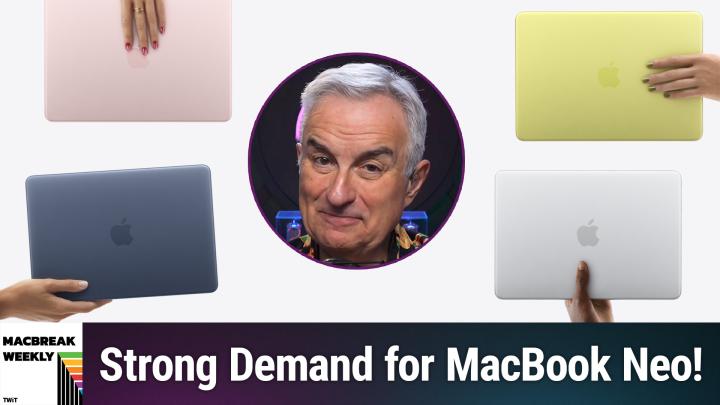
It's time for MacBreak Weekly. Jason's here, Andy's here, Christina's here. We'll talk about the MacBook Neo. Turns out sold a lot better than Apple expected. What's next for the Neo? We'll talk about Apple's AI glasses. Mark Gurman says they're on their way. And some great picks, including a classic Apple game. That's back.
Leo Laporte [00:00:21]:
MacBreak Weekly is next. This is MacBreak Weekly. Episode 1020 recorded Tuesday, April 14, 2026: AirPods for Your Face. It's time for MacBreak Weekly, the show we cover the latest Apple news.
Leo Laporte [00:00:49]:
Apple news of which there is very little. Hello, Christina Warren. How is it going back to work?
Christina Warren [00:00:57]:
It's been good. I mean, look, it's been a day and a half. So.
Leo Laporte [00:00:59]:
So did everybody. Did you have a cake? Did they give you a cake?
Christina Warren [00:01:03]:
They did not give me a cake. They did not give me a cake. But everyone's very thrilled to see you. Nice. Yeah. And I'm excited to be back, so. Yay.
Leo Laporte [00:01:11]:
Yay.
Christina Warren [00:01:11]:
And excited to be here.
Leo Laporte [00:01:12]:
Yay. We're glad to have you. Sorry to keep you waiting. I had a little network snafu. We'll get it. I'll explain that in a bit because we've got very little news. Jason Snell is also here from SixCollies.com.
Jason Snell [00:01:23]:
it's a three hour long show guaranteed. Now because you said we don't have much to talk about. We'll fill. Challenge accepted. It's good to be here networking for us all. Yeah.
Leo Laporte [00:01:34]:
And Andrew, and not co. He doesn't have to worry about the network because he's using civic property.
Andy Ihnatko [00:01:41]:
Exactly. It's, it's, it's nice to. It's nice to have 1 gigabyte up and down that's more reliable than what I get at my house. Also nice not to have. Now that the weather is really, really nice. It's like, I can't in the middle of the day. I'm wondering, it's Tuesday afternoon. Why are you tootling about in your muscle cars and your motorcycles? Did you.
Andy Ihnatko [00:01:57]:
Shouldn't you be at work? Shouldn't you be at school?
Leo Laporte [00:02:02]:
I saw that it was going to be 88. Is this possible? 88 degrees tomorrow in New York City, Is that possible?
Andy Ihnatko [00:02:09]:
Is it that anything's possible?
Christina Warren [00:02:11]:
It was cold last night.
Leo Laporte [00:02:13]:
It's very strange.
Andy Ihnatko [00:02:14]:
The planet's in a death spiral. Okay, let's just accept that and move on.
Leo Laporte [00:02:21]:
Let's talk Apple News. So there's some question about what's going on with the Neo. I guess either they didn't make enough or they made enough and everybody bought them and now they don't have any more because they're sold out.
Jason Snell [00:02:37]:
Well, they're still out there. But yeah, there are reports that Apple increased their build to like 10 million is one report. And that the idea was that they, they were anticipating, you know, whatever, sales of 5 to 8 million and, and it's going even better than Apple anticipated. But the real drama, they're using a binned chip from an iPhone that was released in 2024. And the. And one report said they're going to run out and it's unclear. That's one report. We don't know if it's.
Jason Snell [00:03:10]:
If it's right or not. But since they're using a chip that has, I mean, the advantage of it, it's basically free. They already bought it as part of the process of building the iPhone 16 Pro. But what happens if they sell so many MacBook Neo is a good problem to have, right, that they run out of the chip that is required to make the, the MacBook Neo. And I think that's an interesting question of like, you could go back to Taiwan Semiconductor, but like, that probably blows up your margins on the computer. It's a good question. There's also a story that sort of breathlessly reported this week that, that, oh, guess what, there's going to be a new MacBook Neo in the future made with the, the next generation A series processor, which is like. That's like saying that there's going to be an iPhone 18 after the iPhone 17.
Jason Snell [00:03:55]:
It's obvious. The question is, are they going to have to like scramble to get it out sooner because they're going to run out of MacBook Neos. I just. What a good problem to have. But also what a fascinating way since you're a, you know, a company with a single source chip provider, you are your own chip provider. If you run out of chips, what do you do?
Andy Ihnatko [00:04:15]:
Yeah, Tim Culpin, who used to be at Bloomberg, now he has his own newsletter, had a really good piece about it. Basically mentioned basically going into a lot of this. Stratary was also talking a little bit about this, but his piece was basically explaining that the thing is, you can. It's a 3 nanometer chip and capacity is already booked up absolutely solid. So Apple is going to. If Apple wants to make more of these, they're going to have to contact TSMC and make it rain for him to say Please let us skip the line and make us more 3 nanometer chips. He's also mentioning the problem of aluminum is going to be a little bit short and they need aluminum to make it and, and basically DRAM is going to be a problem. Basically.
Andy Ihnatko [00:04:58]:
It's really, really weird, isn't it that Apple, Apple apparently didn't anticipate exactly how popular this thing was going to be. The idea of basing it on a chip that it is, there is a hard limit to how many we can access. We can't just simply keep rolling and rolling, rolling. We don't have, we have a, we have a, we don't have a stockpile, we just have an inventory and when that goes, that's going to present us with a problem. I forget whether it was Ben or, or Tim, that it's possible that one solution to the problem is going to be that Apple kind of that the 200, the low margin version of it, the 256 gigabyte one or at least becomes like four to six weeks so they can use existing components to fulfill like the higher margin 512 gig ones. But it's like you said Jason, it's a good problem to have. But it's kind of weird to have a conversation about how Apple was not apparent. Assuming that all this is true.
Andy Ihnatko [00:05:56]:
Tell a story about how Apple did not manage its supply chain adequately. To be able to sell to everybody who has money in their fist to buy the hottest laptop. Exactly.
Jason Snell [00:06:05]:
I don't believe that one bit that Apple. First off, if there's any company that believes the upside, it's of themselves, it's Apple.
Andy Ihnatko [00:06:12]:
Yeah.
Jason Snell [00:06:12]:
I cannot believe that Apple would come out with a MacBook Neo and not think that it might be a hit. Right. Like of course they can't. Which means they always had a plan for what to do. Even if it's higher than the top of their head thing. They've always had a plan for what to do. We don't know what it is. And it's interesting right, because.
Jason Snell [00:06:29]:
Because what, what is the plan? I keep thinking the plan was probably that when that bin is empty, you just introduce the next processor from the next bin over and just keep it going and maybe they do something. I saw some speculation that maybe what you do is if you have to bring in the new A chip, you make that the high end model and you take all the last scrapings of the bottom of the low end of the previous bin and that's the low end model and you kind of extend its availability but you Just kind of keep rolling. And changing chips in a, in a computer doesn't have to be a big story. Right. They could literally just say, oh, you know, as of this week, the 6, you know, 99 version comes in with, with the newer A series processor. But I refuse to believe that Apple is not, did not have a game plan for the MacBook Neo being a hit. I just, I, of course, there's no way. There's no way.
Christina Warren [00:07:23]:
Yeah, I think the only way that they would be caught off guard is if the, the actual supply, like demand rather was say like double what they projected out for it to be. Right. And I don't think that there's any sign that that's been the case. I mean, yeah, like right now if I look on the Apple Store online, it says, you know, three to four weeks, I guess, for delivery. But I can get one delivered between April 29 and May 6 or I can pick it up at a store on May 7th.
Leo Laporte [00:07:48]:
So that's not so bad, that's three weeks.
Christina Warren [00:07:51]:
So it's not ideal. You know, it's not great that you can't go into a store and buy one. Right. Like that's not a good thing. You want people to be able to go to the store and buy a laptop. However, I don't know what the situation is like at their retail channel partners. I don't know if Walmart, if Best Buy, if Amazon, if, you know, whoever, whoever else has more. And like Jason, I have to think that they had some sort of plan for this, whether it was further cutting down other chips, whether it's, you know, changing however they do their bidding process, if it is a matter of having to change, you know, what variants are available, maybe that's the case.
Christina Warren [00:08:29]:
What I do think this indicates though, is that if these reports are accurate beyond just what we see on the supply chain availability on the website right now, which could just be a blip for a lot of things. I mean, hey, have you guys heard it's kind of hard to get things out right now. There are kind of some broader geopolitical things happening that might make some of this a little bit more complicated. But I do think that if there's any truth in this being a bigger hit than they anticipated, then I would expect them for, say, next year to do several more runs of chips that they might not have anticipated doing otherwise, just so they can either have their bend, whether through software or otherwise ready to go for the Neo in 2027.
Leo Laporte [00:09:13]:
So it sounds like they didn't anticipate well, did you guys anticipate demand like this? Let's ask that question.
Andy Ihnatko [00:09:25]:
I didn't anticipate a $500.
Jason Snell [00:09:28]:
It's always, I mean, for. Look, I think everybody who was thinking about this product, I mean, we've been kind of talking about this product for two years now. Like, everybody has said this could be really big because it's putting app a different place than that's true.
Leo Laporte [00:09:42]:
We're saying that you're right.
Jason Snell [00:09:43]:
And on the day, I think everybody had an expectation that, like, when you saw it and you saw the price, you thought this could be big and that this could be a really big hit product for Apple. Nobody really surprised.
Leo Laporte [00:09:56]:
Apple certainly would.
Jason Snell [00:09:58]:
I don't, I don't think so. I mean, Apple knows, look, if these are all binned iPhone chips, then Apple knows the finite number of these that they can make. Right. They knew that going that was always an issue. And so I'm sure they always had a contingency and we just don't know what it is. And maybe their contingency has been fouled a little bit by what's been like, as Christina said, gesturing at all of this. Maybe so, but I don't know. I just keep coming back to the fact that they've got, They've got an A19 Pro chip in the bin from the iPhone 17.
Jason Snell [00:10:30]:
Like, they could, they could, they could switch this.
Christina Warren [00:10:32]:
They could.
Jason Snell [00:10:34]:
And, and it doesn't have to be. In fact, I would say I actually don't believe that you designed the MacBook Neo without thinking about how you want to as easily and cheaply as possible put whatever chip you want the next a chip in there and the next a chip in there so that you can do it. Almost like a slipstream update where you're just like, we're just popping the new one in and that'll be the 699 model now. And then, and then when, you know, eventually there'll be another config, that'll be the 599. When we run out, like, the only question is timing. And if they get caught with their pants down a little bit, where they have like no Neos to sell for four months or whatever, that would be bad, right?
Christina Warren [00:11:09]:
That would be really bad.
Leo Laporte [00:11:10]:
You can't have momentum before there's an announcement. Hey, good news. The Neo now has what would be the next chip in a 19. A 19.
Christina Warren [00:11:19]:
They might not do a pro though, right? Like, that would be the interesting thing. Like, like, like that get more ram.
Leo Laporte [00:11:24]:
That would be a big jump.
Christina Warren [00:11:26]:
Well, that would Be a big jump. And that would be a thing that I, that I think that would be difficult to kind of make an argument. Well, why are you going to turn off this ram? Especially with as valuable as RAM is right now. But what you could do is you could look at like the regular chip that's in the A19 or even in the, you know, so the one that's in the 17 or the 17E, you could look at that and you could go, okay, this is an 8 gig chip. This has similar kind of core count. We can swap this in. We can make sure that we are going to get the allowances and whatnot. You could do that because you're still producing those chips and if you need to do more runs of that, you could.
Christina Warren [00:11:59]:
Right. So I think that there are options there. I think the only thing I imagine that Apple might not have anticipated and this I think would probably be similar for us is like I think all of us knew that this was going to be big. The timing on this was so good because in the rest of the industry everything else is going up in price. All the other manufacturers are being squeezed by, you know, the RAM stuff. Now to be clear, how come Apple isn't. Well, they prepaid. This is what the trades have reported.
Christina Warren [00:12:29]:
They're like the, like the chip maker trades basically reported that Apple prepaid a year in advance. Whereas most of the other manufacturers, Dell, hp, Lenovo, they buy by the quarter, which probably makes sense when you're doing the volumes of those places are you can get better spot pricing except if there's going to be massive shortages. So Apple, by paying in advance was able to lock in prices. Now I don't know what that means for next year.
Leo Laporte [00:12:55]:
How long does that last?
Christina Warren [00:12:56]:
Precisely.
Andy Ihnatko [00:12:57]:
Right.
Christina Warren [00:12:57]:
But for right now they're in a really good place. But that I think is the one thing that could have, maybe not to a point where I think it's a problem, but maybe could have made demand to be a little bit different. Because it's one thing like a price, you know, 499 with the education discount was I think lower than all of us were expecting. Like that was a best case scenario. And then it came out, we're going, oh my gosh, this is not what I ever expected to see from Apple. When you couple that with the fact that the inconceivable. Right, but, but, but what makes it really conceivable is like we're at this weird point where like the prices that Apple used to charge for memory and for storage are now like almost in line, rather than being exorbitantly overpriced because of the rest of the market. So even though everybody else in the industry, unless you are a Chromebook, was already at the 16 gigs of Ram Place, now it's like, no, you know, if any other laptop maker is going to have to make the same constraints that Apple was doing just for margin reasons, they're going to do it just so they can not be losing hundreds of dollars per device.
Leo Laporte [00:13:57]:
I'll give you some input from our chat room. Andre, who's watching on YouTube, makes a good point. He said it'd be real gut punch for people who bought the Neo if three months later they upgrade the chip for the same price.
Jason Snell [00:14:11]:
Here's the thing. I heard somebody say they'll never do it because they don't want to offend people who already bought the MacBook Neo.
Christina Warren [00:14:17]:
Please.
Jason Snell [00:14:17]:
Are you kidding? No. In the end, in the end, depending on your bad timing or timing on a product, it happens. You got a Great computer for 599.
Leo Laporte [00:14:26]:
This is the way of the world.
Jason Snell [00:14:28]:
And if the alternative is not being able to sell that computer to other people, it's not an alternative. So, yeah, I guess, I guess you might be bummed out a little bit, but like, the computer you bought is still the computer. A man doesn't come to your house and like punch the screen when they release a new one.
Christina Warren [00:14:42]:
Right, right, right. I mean, it was one of those things that happens. I mean, look, remember when the iPhone came out and they lowered the price? They got rid of the four gig variant, right? You know, the two months after it came out and after the outrage, they did give people, you know, I think like an itunes credit or something. $100, you know, like $100, right. But they cut the price $200 and got rid of the lower storage variant, you know, within like 60 or 70 days of being out. Like, these things happen. The iPad4 came out, I think, 10 months after the iPad3, maybe seven months. Might have been less than that.
Christina Warren [00:15:10]:
It was, but it was a very short period of time because I was somebody who bought the retina iPad3, which was not a good iPad. No, it was a bad one. And then the lightning version comes out a few months later. I'm like, okay, but did I not buy an iPad again? No, of course I did. I was just like, well, this was unfortunate. This happens.
Jason Snell [00:15:25]:
So, yeah, I mean, it. We can all acknowledge the bad feelings of people who are in that state. But like, if you're a business, like you're trying to, you're worried about who's going to buy your next one, not who bought the last one.
Andy Ihnatko [00:15:37]:
Yeah.
Jason Snell [00:15:37]:
And not losing momentum. That's why like I don't think that this is likely because I feel like they must have had another trapdoor. But like if they got, if the story is they got desperate and they did need to pay TSMC to fab some more of these, which I really doubt. But like that would probably kill their margin on it. That said, if your only choice is temporarily killing your margin but allowing your hit product to continue to be sold and available or taking your hit product and stopping all momentum, I'd probably pay the hit on my margin in order to keep the products flowing. Right?
Christina Warren [00:16:11]:
No, I think, I think you'd have to keep it. I think you'd have to keep production
Leo Laporte [00:16:14]:
as long as you're still making money. Right. You know, money's money.
Christina Warren [00:16:17]:
I mean even if you're losing money. And I don't think they would be your Apple. You have to look at this on like a pendulum and you go a. We have enough of this that we can, we can, we can absorb any loss. If that were to be the case, I don't think that would be. I think their margins are probably well over 40% on this product. But secondarily this would be a limited time thing because where they save money on this product is not just using the bin chip, although that's part of it is that they're using. You know, I think Jason, you pointed out like basically the keyboard feels like it's the older magic keyboard that they used to sell.
Christina Warren [00:16:45]:
Right. Like with the, you know, a trackpad element. The screens are screens that they probably had laying around. Right. The aluminum is recycled and so these are, and they're, they're designing these similar to the E series phones at least this is my opinion, kind of trying to read tea leaves where they will be able to use the same, you know, exactly a drop in for years and years to come. So they've already amortized, you know, amortized whatever. They've already played out how much they're going to be making off of this. And so the idea is that the longer these go on, the more the margins will go up that the chip is the one kind of piece in flux.
Christina Warren [00:17:21]:
So if even you had to say okay well for six months we have to take a little bit of a hit on margin on this product. Okay. For however many years you're going to be making it in hand over foot
Leo Laporte [00:17:34]:
Scooter X in our Discord Chat, our club, Twitch Chat, says that his local Costco has the Indigo 512 for 10 bucks off list 689. That's up in Sacramento area.
Jason Snell [00:17:47]:
I saw them at Costco too. I, I mean I, I think the. Sorry, go ahead. Andy, you talked about this yet?
Andy Ihnatko [00:17:53]:
Well, I was going to say. Is this so? Yeah, we're talking about a lot of moves here as remember that the Apple's next quarterly call is the end of this month and there's already a lot of. So if Apple, if this becomes a louder sort of problems discussion, I think a lot of shareholder questions, a lot of analyst questions are going to be, well, how are you managing supply? Also, how are you managing. What's your profit margin? Can you afford to like weather this storm? And if not, like, how are you going to basically make up to this? Because Apple shareholders do not like to know that. By the way, we believe that Apple had a plan, but they're going to want to know how much money are you making off of these $599 laptops? And could you be, should you, should we have expected you to charge $100 more just to make sure that there is some extra margin compared to everything else that you do? Is this a, is this a pivot towards Apple moving away from the model of we're going to make premium products that are at a very, very high margin. Are you pivoting away from that to. We want to get market share now so we can grow the market for Macs by basically reversing that and taking less money per unit and risking not sabotaging sales of the MacBook Air, but diverting some people away from a very high margin item to a lower margin item. There's going to be a lot of really pointed questions I think in a couple of weeks about this exact subject.
Leo Laporte [00:19:18]:
So what color should I buy again?
Jason Snell [00:19:22]:
Oh, indigo.
Leo Laporte [00:19:23]:
Indigo, Really? I think that's not the lemon yellow, by the way. It looks so much lemonier than your,
Jason Snell [00:19:29]:
than it does in person.
Leo Laporte [00:19:30]:
I know I'm looking at the Apple store.
Christina Warren [00:19:32]:
If it looked at that, if it looks like that, I think that would be the one to get.
Andy Ihnatko [00:19:35]:
The first Neo I saw in the wild I saw from it was a citrus and I saw it from like 40ft away.
Leo Laporte [00:19:41]:
Yeah, you do? Yeah. Well, that could be a good thing or a bad thing. It is announcing, hey, over here. Here's a Neo.
Andy Ihnatko [00:19:48]:
Well, no, no, what you're announcing is that, hey, well, someone has. Oh, well, no, it's the $599 so
Leo Laporte [00:19:53]:
I can get the silver one, which obviously no one wants. Right?
Christina Warren [00:19:56]:
I was going to say. I was going to say the silver one is available now. And it's interesting on a. I'm at Costco's website and at least in my area, I can get any of them delivered except for the Indigo 256 base model. The Indigo 256 base model is back ordered for two weeks.
Leo Laporte [00:20:15]:
So, Jason, your favorite color is indigo.
Jason Snell [00:20:17]:
I think that's the. I think that's my favorite preferred.
Leo Laporte [00:20:19]:
How about you? I think Christine has the best taste,
Christina Warren [00:20:22]:
however, I mean, I like the blush, but. But I have to say, I like the blush. I wish it were a little bit pinker, a little more saturated, but I do feel like that indigo is actually like a really nice balance between, like having. Well, I'm not going to say classier, but like, you can tell that it's a unique color, but it's also not like, I. If that citrus were really as yellow as it appears on the website, I would love it. But when I saw it in person, I was like, ugh, this looks like
Leo Laporte [00:20:49]:
the color of my magic keyboard on my iPad. Actually looks a lot like the magic keyboard on my iPad. Almost identical to. Well, you know what? You have to really admire Apple for their ability to do some recycling. Right? This is smart. The studio display is the same thing. It's basically, hey, we got these chips. What can we do with it? I know they've always wanted to make an inexpensive Mac and this is a perfect use.
Leo Laporte [00:21:12]:
Okay, you're right. When I said at the beginning of the show, I don't have anything to talk about. Jason said, talk about the Neo. You're gonna get good mileage out of that. And we did.
Jason Snell [00:21:20]:
Told ya you were right.
Leo Laporte [00:21:22]:
Thank you.
Jason Snell [00:21:24]:
To button that up. I'll just say, I think the most likely scenario is that they just bring forward their plans to slide in the new chip and they find a way to make it work. And everybody's got these sort of rules that they built up about what Apple does, and it's like, well, Apple's not gonna put out another model. The that they put out that it's like if they've got to, they will. And again, another model is a very, you know, people who pay attention to computers way of thinking about it. There could absolutely just be a press release or maybe even nothing. And the 699 model gets a different chip or whatever. And it's like a footnote, basically.
Jason Snell [00:21:57]:
And I think that's the most likely scenario is that they will make every last one they can out of the bin and then they'll just flip the switch. So I mean we can write that down. That's my prediction.
Leo Laporte [00:22:08]:
I think in the next few weeks you're probably right. They're going to, we'll see. And they won't need to do a press release because guess who will talk all about it for now. Yeah.
Andy Ihnatko [00:22:16]:
And just, just to button it up. I mean anything. I think a lot of options are going to be attractive to Apple because this is around the time of year when people are buying laptops for their kids to go back to school, college or high school. And also the great thing about the Neo is that it, it basically puts the Apple hook into, into kids young and makes them into like foundational Mac users so that the next, next time they need a new, a new laptop, they're going to ask for the, the high margin ones. So I could definitely imagine Apple doing things that five years ago we said, no, no, Apple doesn't do that. Apple doesn't like trade away like profits for. They protect that 35%, 40% margins to the depth. Like, I think they could do a lot of things if it means that the NEO becomes not just something that, oh well, gosh, a couple times a year they burn off unused chip inventory by putting these cheap laptops is no foundationally.
Andy Ihnatko [00:23:11]:
This is a $599 laptop that is fast enough and built really, really well and competitive. And it will always be part of the lineup. It's strategic.
Jason Snell [00:23:19]:
Another smart thing that they might be doing since they are thinking ahead, is I wonder if they're looking at the size of their bin of the chips that they're still manufacturing. Make some more. Right? Like literally, let's, let's make more. And you're thinking like, well, that's going to increase the expense. It does. But I think one of the key things to think about when you're thinking about the MacBook Neo is that they get away with this. Like Christina was talking about the costs and the increased costs. One of the reasons they get away with the MacBook Neo and a lot of the competitors struggle is they're dealing with iPhone volumes, like all of the parts that they're using the chips.
Jason Snell [00:23:57]:
So much of what they're doing is like extra stuff left over from the iPhone. And like, yeah, building a bunch of custom computer chips for a run of computers is a just, it's a different calculation than building millions of chips for iPhones and then just sweeping the excess into a laptop. And that's what their game they're playing is. So that gives them a lot of advantage just on volume. That the volume of the iPhone is so huge. And I know it's a joke, make it up on volume. But they are kind of making it up on volume here. But so that's a thing that they could do as part of this process is if they're caught flat footed now and they're really mad about it, one thing they could do is say let's make some more of the current iPhone chip than we really need.
Christina Warren [00:24:40]:
Exactly.
Jason Snell [00:24:41]:
Because we could put it in the MacBook Neo if we have to maybe.
Leo Laporte [00:24:45]:
All right. Boy, that was the story that just keeps on giving.
Jason Snell [00:24:50]:
It's good. I love it because it's got like the drama of like did Apple make a mistake? But it's like a good mistake, but it could be a bad mistake while it's being. It's like that's, that's good stuff.
Andy Ihnatko [00:24:59]:
Also did you see that a couple of different YouTubers decided, well, if this really is like a phone chip and a phone board. If we sourced a one terabyte storage chip from, from China and we know how to basically could we make a one terabyte version of this? And I'll be darned. Exactly like upgrading an iPhone. You have a one terabyte of Mac. I love how, I love how the, the consensus is like, wow, Apple did a very sensible, mainstream, practical for everybody laptop. What if we put a shoebox sized water cooler on the back of it and try to overclock it like you're ruining it. That's not the idea. This was a simple cheeseburger.
Andy Ihnatko [00:25:39]:
This is not. You're putting crap on it. That was not supposed to be there
Leo Laporte [00:25:44]:
security wise. And I think Scooter X for he's. He's been out scrounging for other stories we can. We could cover. Thank you. Scooter X always useful. Mac Rumors just reported this. I actually saw it.
Leo Laporte [00:25:55]:
I didn't see it. It came out minutes ago. A fake Mac app and it was in the Mac store. Designed to look like a crypto wallet. Actually snuck past Apple's review team and it's now estimated that users have lost $9.5 million in cryptocurrency. Apple has removed that wallet app from the App Store. But that's bad news. This is from Coindesk, a fake Mac OS version of the Ledger Live Crypto wallet was on the Apple a Mac store, not the iPhone, but the Mac store.
Leo Laporte [00:26:35]:
Between April 7 and April 13, less than a week, 50 people downloaded it in that week. There is an official ledger app. It's not on the App Store. Apple approved the fake app and As a result 3 of the 50 people who downloaded it lost 7 figure sums. I know if I were able to get my wallet into somebody else's wallet, that'd be 7.85 bitcoins that would be lost to a bad guy. That's why I've been very careful about my wallet. That's a lot of money. Apple removed it from the App Store.
Leo Laporte [00:27:11]:
It was live for a couple of weeks. It's not known how it got past review. Apple hasn't commented. This is breaking news just happened literally 15 minutes ago, 20 minutes ago. So yeah, word of warning, if you downloaded that crypto apps are going to
Andy Ihnatko [00:27:27]:
force both Google and Apple to change what their app review process is like because it's getting bigger and bigger. This is one of the reasons why, Sorry, this is the reason why Google says that they have, that they're restricting sideloading on Android from now on because they cite is that look, especially in Asia, it's just flooded with banking apps and crypto apps that are just there to steal crypto, steal banking information and we can't have the Wild west anymore. Now people are arguing that no, they're using this as a really good excuse to take some control back and make the Google Play store more important. But I think that things like this, when it's possible to make these big, big, big scores based on fraudulent apps, if Google and Apple aren't revising how they screen their apps, given the repercussions of a mistake, it's not just like people losing five bucks for a bad flashlight app anymore.
Christina Warren [00:28:23]:
Yeah, I mean I think that this is, I think this kind of underscores why, even though I'll admit I was very critical of Apple at the time when they refused to allow any sort of crypto wallets in the app stores, I was very critical of that decision. I do feel like if you are not going to be able to notarize and approve these things the right way, if you can't guarantee that the ones you're approving are actually going to be legitimate wallets, then maybe there is an argument made like I might come around and change my opinion a bit to be like, okay, well if the gatekeeper can't guarantee that what it's letting into these services is legitimate, then maybe these shouldn't be things that, that exist in the app stores. Which is not a position that I feel good about taking, but I do feel like this is one of those. This was only the Mac app, which I think is why the only. There were like 50 victims or something, I think is what the reporting says, which is. I'm not trying to downplay that at all, but at least it was, you know, contained to that over the course of a week. Whereas if it had been, I think, a mobile app, it would have been a lot more. And there's certainly like no victim blaming here because you're supposed to be able to trust what's, what's in these stores.
Christina Warren [00:29:34]:
Having said that, I think it just, it kind of just underscores like this is a difficult area. And, you know, anybody who's getting these things should be ideally only clicking on links that are affiliated, you know, with those sites themselves, if they exist. I don't know. This is, this is kind of a messy situation. But I feel for anybody who was
Andy Ihnatko [00:29:53]:
impacted, I think, I think that's a really good point that what is the responsible thing for Apple to do? Maybe the responsible thing for them to do is admit that we are not set up to validate an app that can be, that if used wrongly, can be used to steal millions and millions of dollars from you personally. Therefore, until and unless we can have create a separate sideline certification so that we can scrutinize the hell out of it, we are not willing to promise you that any app like that is trustworthy. So sorry if that makes it super inconvenient, but we're not going to promise something that we can't deliver that might be the most ethical thing for them to do,
Leo Laporte [00:30:34]:
actually. Eclectic Light company. We often talk about Howard's excellent blog Max and Painting no AI content, talks about why you can't trust Apple's privacy and security settings. And it's kind of a technical article, but it's probably worth reading. Privacy and security. You've probably run into it. I know I do all the time. When you install an app and it says, oh, you've got to go into privacy and security and allow me to do this, have accessibility settings, access to files, that kind of thing.
Leo Laporte [00:31:10]:
I'm glad that the Mac has that. And you would assume because of it you're getting good protection. But he points out that it is possible for apps to bypass it. It's the intent mechanism. The app says, I have an intent, I need an intent. I need to be able to write to a folder or open a folder. And Apple in theory will say, okay, you've got to ask the user first. The app won't be able to do it until they ask the user.
Leo Laporte [00:31:41]:
But he's written a little app called Incent that you can use to kind of see how it's possible for apps to kind of bypass that security setting. So, you know, this might be worth reading if you're, if you're absolutely worried about security. He says Incent is, is. Is notarized. It's an ordinary notarized app. It doesn't run in a sandbox. It doesn't pull any clever tricks. System integrity protection does block some of its operations, but not all.
Leo Laporte [00:32:20]:
And it can get around some of the intent security. Its conclusion, access restrictions shown in privacy and security settings, specifically those to protected locations and files and folders, aren't an accurate or trustworthy reflection of those that are actually applied. It's possible for an app to have unrestricted access to one or more protected folders while it's listing in files and folders showing it being blocked or for there to be no entry at all. Okay. I don't know if that's how the Bitcoin Wallet app got around Apple's protections. Probably people assuming that it was a legitimate wallet said, yeah, yeah, you can access my Bitcoin wallet. Sure. I mean, how else would you do it? And that's when your troubles began.
Leo Laporte [00:33:10]:
Take one more break here. As we go on, we've got the weekly Mark Gurman report. And he actually has some interesting things to say about glasses this week, so we can talk about those. You're watching Mac Break weekly with Andy and Ako. I almost said Alex Lindsay. The dear departed Alex Lindsay. No, he's still alive. He just works at Apple, which means he's invisible.
Andy Ihnatko [00:33:32]:
He's gone to a different kind of afterlife.
Jason Snell [00:33:34]:
Behind the curb, curved glass curtain.
Leo Laporte [00:33:37]:
I hope he got to see Paul McCartney. I don't know. I hope he won that lottery. Yeah. Christina Warren, though ably filling the Lindsay honorary seat of Apple distinction. Also here, Jason Snell from sixcolors.com Mark Gurman. You know, the last few weeks have been kind of think pieces. I don't know if this is.
Leo Laporte [00:33:56]:
You can tell me, Jason, you're good at reading the tea leaves on this. It doesn't sound like he has an inside person telling him what they're doing. But Apple, he says, is working on the display. Free smart glasses, that they weren't always the plan. They did form a vision Products Group 10 years ago, but at the time, they were looking at an iPhone, tethered augmented reality headset with a wireless controller. Kind of like the Vision Pro at high end. Mixed reality headset. Actually, that's the Vision Pro and standalone AR glasses, those are ones with displays.
Leo Laporte [00:34:32]:
I think the success of the Meta glasses has changed everything. He says that started in 2022 with the Meta Ray Bans. He says Apple's now developing its own version. He says the internal code name is N50 Gold. The target release is end of next year or maybe early 2027. Capturing photos and videos. Yes, that kind of surprises me because the camera is the one thing people complain about with a meta. There's that, you know, privacy issue, syncing with a smartphone for editing and sharing.
Leo Laporte [00:35:07]:
The metas do that and obviously iPhone is perfect for that, handling phone calls. Meta can do that, but the problem is Meta doesn't have a phone.
Jason Snell [00:35:15]:
Yeah, I feel like the best way of thinking about this product, it's kind of like AirPods that you wear on your face instead of on your, in your ears. And, and so it's connected to your iPhone. And they're going to. Part of what Gurman says is, you know, they'll be able to do really nice integration with iOS. And I feel like the EU immediately cranks up its engine of like, why are you building this thing? I mean, and again, I don't think Apple should build smart glasses integration in speculatively for other people's products. But if they're going to build their own, then it becomes a question of like, how much home field advantage are they going to withhold and only make a available on theirs. But be that as it may, yeah, you think about this. They are, you know, they're going to have Siri access, they're going to be able to play audio and the difference is the cameras.
Jason Snell [00:36:02]:
And I mean that's like, that's why you have this thing is because it gives you a camera that can see what you're seeing and that There are various AI applications I think, I think more so than probably not very good photos and video. I think it's probably more about like AI applications that currently require you to take your phone out of your pocket and that with this device you won't have to do that. I mean they've, they've already got features like this, like navigating. If you've ever tried to navigate walking directions in a downtown with tall buildings, the GPS signals get really sketchy. And they have a feature where if you hold up your phone, it looks at the buildings around you and knows where you are. It's really great. Well, imagine if you could just do that walking with these glasses. That's one Example.
Jason Snell [00:36:44]:
Visual intelligence is another example. I don't know how practical that all is, but I think that's what they're thinking involving this product. So yeah, I mean we'll see, we'll see where it goes. But I think that they decided that that more lightweight after doing the Vision Pro, I think they decided that more lightweight products are probably a place that they should experiment and iterate and that's what they're looking at here. And then he says they're looking for something, something kind of iconic in terms of, I think it's in terms of the camera. He says there's going to be kind of like an oval camera housing. I think what they want is something that you on the glasses that makes you go, yeah, oh, those are Apple glasses. And they're going to have four different frame designs.
Leo Laporte [00:37:25]:
He says a big Apple on the nose piece.
Jason Snell [00:37:28]:
No, I think it's, it's just glowing. You know that plateau on the back of the phone. I think it's going to be like that where like everybody's going to know that that kind of ovally thing with the lights and all of that means that those are Apple glasses. But you know, you're right, like they had to have to have a privacy story because this is a huge issue and it's part of Apple's brand. So what's that story like? Is it privacy for me but not for the. I don't, I don't know what story is here, but I do think they need to be trying this stuff out instead of just they got caught flat footed by.
Leo Laporte [00:37:57]:
He apparently has some insight because he says according to employees working on the project, Apple's strategy is to outdo competitors by integrating the glasses with the iPhone and offering a better build. Instead of going to Esselor Luxottica as Meta does, or they're going to do it their own, of course, design and build it in house and all of that stuff. In fact, he points out, even Google and Samsung are using Warby Parker to make the glasses. There are four, according to again, Mark Gurman at Bloomberg. Four different types, four different styles. The design team has come up with a large rectangular frame like Wayfarers, like the ones I'm wearing right now, which are Ray Ban Wayfarers from Meta, although they're very, very geeky, black and thick. A slimmer rectangular design like Tim Cook's glasses. What a surprise.
Leo Laporte [00:38:50]:
Larger oval or circular frames and a smaller, more refined oval or circular option. It's so early though. I don't know if these designs will Hold. They're looking at ocean blue, light brown and black.
Andy Ihnatko [00:39:05]:
Yeah.
Leo Laporte [00:39:06]:
As you said, they want it to be instantly recognizable as an Apple product. Yeah.
Andy Ihnatko [00:39:11]:
And that might mitigate a little bit the privacy thing, because everyone knows what an Apple watch looks like. Okay. You recognize it immediately. Whereas these are meta went with Ray Bans, the most iconic frame design ever that gets duplicated everywhere. So you don't know that those are smart glasses until you actually look really, really closely and carefully. Whereas if Apple were to design an iconic frame, at least I would say, okay, those are clearly Apple glasses, or they look exactly like Apple glasses. I better ask if you are record, basically say, please don't make sure the microphones are off. Please don't take pictures while you're doing this.
Andy Ihnatko [00:39:46]:
I still. The thing is, I would be a little bit more. I wouldn't say skeptical, but I would be a little bit more puzzled by it if not for the fact that Apple continues to sell the airtags, which are by definition, a privacy nightmare. And again, I want to make sure that I'm really clear. Apple is not doing anything wrong by selling these things, but they are trackers by nature, these devices, so they are going to be abused by people who are going to use it to surveil people without their knowledge. And the only thing that puzzles me has always been, how much money are you making from these AirTags to make it worth that terrible, terrible hit of all these news stories about, oh, a car ring has been broken up and they were using airtags to track people. And worse stories than that, how much money they're making to mitigate those terrible, terrible stories that keep coming up time and time again. And with that already in play, I believe that, yeah, Apple is going to put cameras in these glasses, even though, God, wouldn't it be? I really wish that they would do.
Andy Ihnatko [00:40:52]:
Two years ago, they would have done basically, AirPods glasses, which are simply, there are no cameras in there. We feel as though there's no solution to this problem right now. Also, we feel as though people don't necessarily want to have cameras on their glasses. There's no features within the iPhone. In the near term, they're gonna be able to really take advantage of that. But, however, this is the best way to talk to Siri. This is the best way to get notifications from your phone in a surreptitious way. And we think it's a valuable addition to the AirPods lineup.
Andy Ihnatko [00:41:19]:
And then two or three or four years in the future when society's maybe a little bit more accustomed or has figured out how to adapt the cultural language to accommodate smart glasses. That's when Apple comes in and that's when Apple adds glasses, adds cameras to the thing. So as a thing, as it is, that's going to have to be a third of their messaging. But here is why we are not going to be associated with people doing creepy things with our glasses, because we have done things specifically and explicitly to make that extremely difficult and extremely embarrassing for the person who tries to do that.
Christina Warren [00:41:55]:
Yeah, I mean, I think you make a good point that, like, if a Apple design is iconic enough, similar to AirPods or anything else, or an Apple Watch, like, you'll instantly know that it is an Apple device. And so then people can have their expectations of privacy to be whatever it might be. What I don't know is because the backlash about the meta glasses has been relatively recent, if we're being honest. When they first came out, I think people were skeptical. And then the second version, when they got like, really good, and then they continue to improve them with software. Like, I even saw it with my own circle of friends, and I went through this myself, where the first version, I don't think they were called the, the meta glasses, but they had the partnership with Ray Ban. I can't remember what it was, what it was called then, but this was probably four years ago. I was skeptical and I was like, this is creepy and I'm not going to have these spy glasses on my person.
Christina Warren [00:42:42]:
Then they kept, then they came up the next version and I was like, okay, but these are now actually compelling as a product, right? Like, the fact is that they've got like headphones and they have some interesting kind of AR VR type of stuff. And the way that it's recording video, you know, there is a light on it and it seems like it integrates well. Also, many, many people out there have their phones out recording all the time and we don't know about it. So it felt like there was a moment for a period of time where I'm not going to say this is the case for everyone, and probably not for a lot of listeners of this show, but at least in my life and people that I hang out with, it seemed like a lot of people kind of let their guards down and were like, okay, these are fine. These are useful in other ways. And so the privacy implications that really were strong in like, say, the Google Glass era just aren't here anymore. Now, I think, ironically, because of the AI stuff, the things have come back again and people are Bothered by them. Even though the way that these glasses exist, there's not a whole lot you can really capture or do.
Christina Warren [00:43:47]:
I mean, there are circumstances where certainly things could be bad, but in terms of surreptitiously, you can't record for very long. Yeah, you know, battery's a problem if someone wants to capture you surreptitiously. GoPros and other types of cameras are much easier to get a hold of and can do, you know, a much better job of that. Anyway, so. So I felt like people let it go, but now with the AI stuff, I feel like there's a backlash again. So I agree with you. I feel like that'll have to be important part of the messaging. But I also kind of wonder, I mean, I feel like with you brought up airtags, I feel like the reason airtags get a pass, even though they are trackers.
Christina Warren [00:44:24]:
A Apple did make some software, you know, adjustments so that you are at least supposed to be alerted if something is following you for a certain period of time. Although whether people see those alerts or not is to be determined. But I think the secondary thing is that a lot of us kind of decided, even though this is creepy and even though this is surveillance tech, it is really nice to know exactly where my suitcases or my passport or something else. And the utility outweighs the creepy factor. And I think that's going to be ultimately the thing that will determine any of these products, whether it's from Apple or anyone else, if it's successful, is does the creepiness factor? Is it outweighed by actual utility? And I don't know if there's actual enough utility. I think the price works really well for the meta Ray Ban glasses right now. I think the higher end ones it doesn't, but I think the lower end ones, you're like, okay, I can see the utility and a gadget for this. That's I think the thing that Apple would have to.
Christina Warren [00:45:19]:
To overcome and that.
Andy Ihnatko [00:45:21]:
And that's. And you point out like one of the constant problems with technology where the benefits are enjoyed by the people who adopt them, can afford them and use them. However, the downsides affect pretty much everybody, even the person. So basically anybody who's walking around like there was a piece in the New York Times, I think, a few weeks ago, pointing out the problem of like a counter worker at a takeout place who did not know that a YouTuber was actually recording their interaction and ask him questions about politics, asking questions about this and that, which you might have. Okay. In addition, in a 30 second interaction while you're bagging up someone's sandwich, you might say a couple of simple things. But if it's recorded and now it's taken out of context, it's like I would not have, if you, if you had put, if you had held up a GoPro, if you were wearing a GoPro, if you were holding up a phone, I might not, I might have still answered your question, but I would have answered it differently. And the idea of everybody in the world suddenly having to be on guard about what I say and how I say it, how I present myself and who I, how I'm presenting myself to certain people, that's a shift in society.
Andy Ihnatko [00:46:29]:
And again, people who do not necessarily have $500 to spend on a pair of Apple glasses are going to have to bear that burden without getting the benefits of turn by turn directions or being able to get notifications in the side ears. So that's definitely something that we're going to have to keep an eye on. And I feel as though it's just as you say, as these technologies become actually useful, they are not simply gadget guys, gadget people who buy them and rich gadget people who buy them. They become. You go into the eyeglass store and say, well, we have two versions of these glasses. For $150 more you can have smart glasses. Do you like the smart glasses? Just like if you buy the tinting, you buy the coating, stuff like that. When they start to become everywhere and useful and they actually are helping people on a day to day basis, that's when it becomes kind of unstoppable.
Andy Ihnatko [00:47:21]:
And finally there are people for whom this is not just a gadget. The idea of having this device that can help them navigate through the world despite the fact that they have low vision, despite the fact that they might have hearing issues, despite the fact they might have cognitive problems. There is a dimension here where we really have to allow these things to happen because the benefits to these people far, far outweigh any creepiness that I, and I know I'm speaking as a guy here. So my, my quote vulnerabilities are very, very different from women. But that might overweigh my skeeving out skiing, my worry that I'm being recorded and having to basically every time I'm introduced to someone look at the bridge of their nose or look to the left side of their lens to see if there's a little hole there. It's going to be a complicated thing and it's going to be this is one of these things that makes technology, technology makes us revisit a whole bunch of long standing questions that we have as a society. And we're not going to find. We're going to have to get used to it and figure out where our comfort level is.
Jason Snell [00:48:21]:
Yeah, I just wanted to say that the. I mean, I think that Andy bringing up the airtags is a good point and Christina's right. The utility determines whether they work or not. But I think I have heard people make the argument of like, well, Apple's never going to release Product X because it's controversial. And it's like, that's not enough because the airtag is a great example of that. I do, I don't want to be this guy, but I am going to be this guy and say, the thing is, Apple's participation or not in this is not going to change the fact that societal society will adapt. And that theoretical or actual person at the counter who got recorded in five years will expect that they might be recorded. And that's just how it's going to be.
Jason Snell [00:49:04]:
Because you could also already tuck a phone in your pocket with it peeking out. There are so many ways to do it that are not even noticeable that that technology exists. That what it's going to mean. And I'll say this because this has already happened. My neighbor. This sounds like a tangent. It's not. My neighbor has a lemon tree and they're a new neighbor.
Jason Snell [00:49:22]:
The old neighbors we had a lemon sharing Accord, right? New neighbors we haven't. I haven't had a chance to say, hey, do you mind? You've got like 90 lemons on your tree. Can I take a lemon? I need some lemon juice. But I'll tell you what, I have an expectation that that neighbor has a camera and that the last thing I really want is to be a bad neighbor who takes a lemon and they're like, that guy is stealing our lemons is how the world has changed. So I mean, I think these are conversations we should have. I don't necessarily think that anybody can stand in the way of it. I do. Here's why I'm encouraged about Apple doing this is Apple is also going to have these conversations because they've made privacy and security such a part of their brand.
Jason Snell [00:50:06]:
They're the ones who are blitting a green dot into the MacBook Neo screen that you can't. That's part of a secure exclave so that you can't rig the camera to go on without you seeing a dot. Right. I would imagine that these glasses will have something similar where they're going to make it really hard or impossible for somebody to sort of like disable the thing that says that you're recording an image. And they may have some very specific rules about what, where those images go. And, and maybe they aren't going on your camera roll. I mean, we don't know. I'm encouraged by that because at least if you've got some major vendors that are making these products and they're thinking about these issues and they're being criticized when they don't, like with the air tags, when they don't live up to it.
Jason Snell [00:50:51]:
And Apple and Google were both criticized about tracking technology, that it at least puts some constraint on what happens. But I do, I just am a believer that we already live in a world where everybody has to expect that, that somebody could be recording them on audio or video or taking their picture. And 20 years ago, that wasn't the case. But I think it is the case now, and I think it's going to be the case from now on. And that's why I, you know, I didn't want to steal a lemon from my numbers.
Andy Ihnatko [00:51:21]:
That's fine. I agree. I agree with you. I agree with all the points you made. I just want to add that one of the thing that, that I keep coming back to when I think about the air tags is that what if Apple just simply said, you know what, that's a great product. I'm glad they exist. I'm glad that tile is making them. I'm glad that it's becoming a competitive market.
Andy Ihnatko [00:51:42]:
We feel as though we don't have to get into that market. They could have made that choice. And I'm not making a decision here about what they could or what they should or should not have done. I think the part of the problem when we have conversations like this is that we, if we rush through it, we can make the mistake of ignoring the fact that not making these glasses is an option for Apple. They can do that if they make the airtag. It's because they were very aware of the problems that this is going to create and they decided that. We feel as though we can mitigate it. And we also feel as though this is too big of business opportunity for us to overlook, even though it does conflict with our privacy, privacy, privacy mantra.
Andy Ihnatko [00:52:24]:
We feel as though the opportunity is too great for us to overlook it. And again, you can approve of that, you can disapprove of that, but let's not ignore the fact that they had the option of saying, you know what? This isn't for us. We're glad the tile exists. We're going to leave this as an opportunity for Motorola and Samsung and other people. But we're happy to leave this money on the table. And with the glasses that they do have the option of saying that what if we were to hold back for three or four years until we figure out where the guardrails are within society for there and then rather than inflicting this product upon society and saying what are you going to do about this? You're going to have to deal with it simply saying that we decided to hang back and figure out how people are going to use this, how it affects people in the public and how we can make the most polite, the most courteous, the most thoughtful version of this technology that is also an option that's available to them. So let's just, let's let that.
Leo Laporte [00:53:21]:
I wouldn't if I were them because the Meta glasses are out there. They're selling fairly well. I don't know. I think 10 million units last time
Andy Ihnatko [00:53:28]:
I saw again, I'm just saying it's an option.
Leo Laporte [00:53:30]:
People love them and I think Apple could today make a better device already. Oh by definition of course the next question I mean easily and just the fact that it would be an Apple product instead of a meta product by itself if it were identified.
Andy Ihnatko [00:53:46]:
The lack of the meta logo is a feature in itself.
Leo Laporte [00:53:48]:
Yeah that's. That will transform the industry. Number two, it's going to also come down to right now the meta AI is okay, not great if app. A lot of this is going to come down to how well Apple delivers on Siri and AI. That's a big one. Now the other point in Gurman's piece on Sunday was that John Giandrea is nearing the end of his rest and vest period on April 15 a chunk of stuff vests and Gurman says you're going to hear that Giandrea has now left the building. He's rested, he's vested, he's done, he's got his money. He says he doesn't think Giandrea is going to go on to another company but just going to take some time to enjoy his money and I think that's fine.
Leo Laporte [00:54:31]:
Giandrea you may remember came from Google very heralded move about eight years ago to save Apple AI not only didn't save it buried it. Now the question is if moving to Gemini will save it. And there's a very good article I thought I think a very Thoughtful piece. It's actually a blog piece. Ad El Rocha or adult Roca. I don't know how you say it beyond the code. A D L R O C H A. How the AI loser may end up winning.
Leo Laporte [00:55:05]:
Apple's accidental moat. And I actually completely agree with this because what we're seeing right now, I will, I will come to you as a messenger from the front of the AI wars because we cover this, of course, on our show Intelligent Machines. And I've been watching it carefully. Anthropic and OpenAI are now spending billions of dollars a minute competing with one another trying to produce, you know, the winner before it's all over, before they run out of money. It's become very clear and this actually affects the issue of ram, availability of hard drive. All of this, all of the supply shortages we've seen, it's become very clear in my opinion, and I don't think I'm alone in this, that it, it is scaling does matter that in fact more compute makes a big difference. One of the data points in this is last week's announcement from Anthropic. We've got this incredible new model, mythos.
Leo Laporte [00:56:00]:
They said it's too dangerous to release publicly. We're going to give it to 50 companies, let them fix their security flaws before we release it. But I think there's also strong evidence that they can't release it because they don't have enough compute for it, that it would actually they don't have enough data centers. And so this means that it's, I think for both OpenAI and Anthropic, they are now hitting the limit of what they can do with the data centers they have. They need more Nvidia GPUs. They're making their own GPUs. They're going to Google for their TPUs. There is a desperation in the air by these companies looking for this hardware.
Leo Laporte [00:56:39]:
This battle is getting vicious. I think somebody's going to die. I think probably OpenAI. You know, I seriously think that these companies are going to be a shakeout out. Apple, meanwhile, watches this. This cartoon kind of says it all. Apple watches this capex burn. Actually, there's an even better chart in this post.
Leo Laporte [00:57:00]:
Here's the Capex burn. Amazon up 42% year over year. What do they say? 180 billion this year. Spent capital expenditure almost entirely on AI and data centers. Microsoft and Alphabet. Close, meta close. Look at Apple down 19% in their capital quarterly capital expenditure. So Apple's just sitting back.
Leo Laporte [00:57:22]:
They're enjoying the show. They're watching the world burn. They've got to deal with Google. Let Google spend the money.
Jason Snell [00:57:29]:
Fine.
Leo Laporte [00:57:30]:
They've got this privacy moat. We've talked about the other thing that's coming out that's very interesting. For a long time Nvidia had a huge advantage because of Cuda, which is a proprietary language that they use to access their GPUs. And everybody wants Nvidia GPUs and CUDA. But Apple's always had these machine language processing components. They call it mlx. And more and more I'm seeing models designed to support mlx, most recently Google's Gemma model, which you can use with Ollama natively on a Macintosh. So Apple's unified memory gives them a lot of ram.
Leo Laporte [00:58:06]:
That's a great strategy. They have the hardware in the Apple silicon and now the software is coming along. I always said if you had some way to break Cuda's stranglehold on AI, Apple would have a real advantage. Well, people are working hard on that. So this is the point of this blog post and I think it's accurate that Apple has a moat. And by standing back, watching these companies burn money, watching these companies fight between each other and just standing back, they may in fact be the winner, maybe. Discuss. Christina, you've worked in this area, you know.
Christina Warren [00:58:41]:
Yeah, I mean, I do work in this area. I mean, so I mean, I think that there is some truth to this, which is to say that by failing they might wind up succeeding. And let's just call it what it is, right? They whiffed it two years ago badly, and they were slow when they came out with their announcements in 2024. And I think that they have managed to still stay part of the conversation because of the strength of the hardware, which I don't think was necessarily intentional when it was designed that it would be used the way that it is. I think that was a happy end accident and that's obviously very good. And the tooling winds up following, you know, hardware that people can get and can like. So I think all that is true. The only thing I would kind of maybe point out, I think is that like the amounts of money that are being spent in the data center problems and whatnot, like what Apple is essentially doing right now is they are offloading that problem to someone else.
Jason Snell [00:59:31]:
Right.
Christina Warren [00:59:32]:
And, and, and that works, but the same constraint problems that the rest of the industry is going to face case, it's not as if Apple will be immune to that. Right. It's great that they haven't Split the capital expenditures to build their own data centers. That's, that's all well and good but if Google becomes you know, like, you know, constrained on capacity, I have no idea how the arguments, you know, the arrangements and whatnot work but, but I can't see that this would be one of those situations where you know, Google would say for instance, shut off its, its own access to things so that, that Apple could have more. Right. I feel like it'd be one of those situations where everyone is just going to have to, to accept that we don't have enough capacity for these things to run at their best capabilities. So instead things will be kind, become kind of nerfed as they were or there will have to be more investments which is what obviously the big Frontier Labs are, are trying to raise money to do.
Leo Laporte [01:00:26]:
$122 billion raise by OpenAI last month. The largest raise ever history.
Christina Warren [01:00:32]:
Yeah, it's ridiculous, right? And then the money is going out just as fast as it's coming in. And I, to be clear, I don't think that's sustainable and I don't think that it's a bad decision to just kind of sit back and watch with the chips fall and then try to partner up with the biggest winners. The only thing I would say that I think is, is always gives me a little bit of pause is that if it were that easy I think that you'd have a lot of players who would just sit back and do that. And what you, you risk when you sit back is that you will lose mind share and you will lose potential future moats that already exist in ways that people already use things. So it is sort of a tricky thing right in that yeah, Apple, you know, people know that they make really great hardware and that they will be willing to build tooling for it whether Apple will or won't to help work in that space. But let's also not like mix metaphors here. Like the type of graphics, graphical performance and you know, AI type of stuff that you can do on even a Mac studio is not equivalent of what you can do on you know, the, the twenty thirty thousand dollar cars from Nvidia and amd. Like it's not even in the same wheelhouse.
Christina Warren [01:01:36]:
And so yes it's fine for some types of post training stuff and some sort of inference work but it's not as if it's the power is, is there unless you're doing, you know, thing you're literally just, just producing millions and millions and millions of chips to shove into data centers it's not like this is a real competitor against, you know, what these needs are. But no, I mean, I think it's a good article and it's certainly thought provoking. I think for me the fear is always okay, you're in this really good spot and you can kind of watch where the chips are going to lie. But what if one of these companies breaks through and makes an operating system or makes a phone or makes something else and then takes the mindshare away? Because that's the problem with sitting still.
Andy Ihnatko [01:02:19]:
Yeah, Apple's biggest problem is if AI really does become a thing and it becomes like social media where everybody simply expects that this is something that you do with this device. And just like Instagram, just like Facebook, just like TikTok, just like YouTube, the iPhone becomes irrelevant to that function. It's just simply the platform that you run the third party app that you actually like on. So that's, that's a point where Apple basically needs to make sure that doesn't hang back quite as long as they, as, as they might. Every time, I'll just say that every time I see an article like this, we've seen a lot of them, it's like, yeah, that's good, that, that's good. And that's an advantage again because Apple has never been in the position where they can make money by having huge, huge servers and huge, huge amounts of compute. Whereas that is why Amazon AWS exists, That's why Google exists. They can, they can make serious bank here because anything that involves having a big, big bank of computers, they can charge a lot, they can find a lot of customers for it.
Andy Ihnatko [01:03:16]:
That's fine. But when I see these articles that sometimes are headlined that hey, well Apple just, Apple's in the catbird seat. Apple's pursuing the right plans. Like I feel like it's like that the, the famous people who like didn't get the wake up call and they failed to board the Titanic that morning. It's like that wasn't your plan. It worked out great. I mean, thank God that like things are working out okay. But just let's not make sure we give like for Apple credit for being extremely wily by putting 10 million, $10 billion into like an electric car instead of investing in AI.
Jason Snell [01:03:52]:
This is, I mean, this is why I think Christina's disclaimer at the beginning is the most important thing that we've said so far. Which is, let's be clear, they, they tried and failed. Right? All the. So I would argue that maybe their failures, the Roots of their failures is that they were trying to be something they weren't like Apple is not a cloud infrastructure company. And that's kind of what was required here in a way. But I will say, yeah, they may, they may get away with it. And that's how we should look at this. This is, this is like playing poker.
Jason Snell [01:04:18]:
And you have a chance to win, but you're disadvantaged. That's where they are is like if your opponent ends up drawing the right cards, you can't win. And. And that's true. I think I like the scenario though, as Leo said, Leo dramatically said, someone's going to die. But like, I think the idea that there's so much money being spent right now and it can't all be a good investment, right? Like somebody's going to be disadvantaged or over invest. And I just some numbers that I looked up while we were talking, which is last quarter, Apple ended the quarter with 100 $145 billion in cash and marketable securities. Now they have a capital return program.
Jason Snell [01:04:59]:
They do a stock buyback. By the end of the quarter, their net cash was 54 billion. But I am reminded that one of the things that Apple has as an advantage, sitting here on the sideline watching this happen, is an enormous cash machine. The cash flow of Apple is enormous. And if there is a moment of weakness anywhere where something teeters or starts to crash, Apple can basically swoop in and say, for, like we talked about that, that, that OpenAI spend of $100 billion or whatever. It's like Apple could do that with cash if it wanted to, and it hasn't done anything like that before. But that puts it in a position where unless everybody else succeeds and they all take their balls and go home and Apple is left sitting thinking, oh no, the music stopped and we don't have a chair to sit down on, we're here all by ourselves. Unless that happens.
Jason Snell [01:05:53]:
And seems almost impossible. Apple has this get out of jail free card a little bit, which is their iPhone business is so. It's still so enormous. And it's a hedge against the success of AI in a lot of ways because it's a device that's in everybody's pockets and they can run AI on it. So, yeah, I mean, in the end, the story is they tried it, they failed. Maybe they were a bad fit for it. They may still get away with it. And one of the reasons they'll get away with it may be that they could buy their way into succeeding because they have so much cash, doesn't have
Leo Laporte [01:06:23]:
to go to the money changers for cash. They've got, they have so much cash flow.
Jason Snell [01:06:27]:
When you think about the cash flow, they stopped doing a stock buy that for a minute.
Leo Laporte [01:06:31]:
There are a few companies like that that can sit back and watch.
Jason Snell [01:06:34]:
Covers a lot of weakness when you can just write a check for $100 billion and fix it.
Leo Laporte [01:06:39]:
I do have to point out though, and maybe Christina will disagree with me, but Anthropic is at this point kind of racing ahead. I mean, their lead may not last, but they are in an unusual position. They really have a strong product.
Christina Warren [01:06:55]:
Well, I think their model is my opinion. I think their models are probably the best right now in terms of capabilities, at least for the stuff that I do. And I mean, OpenAI's models are good too, but I, but it, you know,
Leo Laporte [01:07:07]:
a lot of people like codecs and are happy with it.
Christina Warren [01:07:09]:
Absolutely. And, but, but, but I think like Anthropic does a lot of things right. And like this is scenario, especially with, with coding and things like that. I think it's closer on some other things, but, but especially for coding tasks.
Leo Laporte [01:07:19]:
Oh yeah, Nobody's better than Nano Banana for images.
Christina Warren [01:07:23]:
Yeah. Google, I think, has. Has the image and video generation down. I think that research. Google is a little bit better there too. I think writing is probably mixed, but yeah, in of terms, terms of coding stuff, no, I think Anthropic's definitely in the lead there. I think the big challenge for Anthropic, frankly is probably just the same as anything else, which is, okay, how do we get more, you know, data centers? How do we get, how do we support the demand that we're.
Leo Laporte [01:07:46]:
People complain over the last three weeks, there've been a lot of complaints over Claude, the coders saying it's nerfed, it's not as good and they have a lot of evidence it's the case.
Christina Warren [01:07:55]:
Right.
Leo Laporte [01:07:55]:
Not that Anthropic, I think is doing it on purpose. It's that they've run out of computer.
Christina Warren [01:07:59]:
Well, that's the problem, right. Is that when you run out, there are finite resources. And even though they're, you know, I think really steaming ahead, it's like, you know, OpenAI, even if their models aren't as good, they're much better capitalized. And so they, and they, you know, are able to make some of these types easier. So it's, it's definitely an interesting position. I mean, I think it makes both Google and Amazon look very smart to see their investments in Anthropic.
Leo Laporte [01:08:24]:
And I should not Ignore the Chinese, these companies, because I do when I I code in Anthropics Opus 4.6 all the Time in quad code, that's pretty much what I use hours a day. But I have a fallback because every once in a while Anthropic goes belly up. I'm not kidding. You get a 401, it's like, I don't know. And I fall back to glm, which is a very good model from Zi Zai GPU which is a Chinese company. Deepseek kind of started this all a year ago. You a little more than a year ago by challenging everybody with a model that everybody went what? How could this be that good? They can't even buy the Nvidia chips they need. There are many other very good Chinese models.
Leo Laporte [01:09:07]:
There's some evidence that they're good because they steal, they distill Anthropics Claude and maybe it is GLM is pretty much identical to Claude. I can swap in the brain and Claude code and. And there's very little difference. So there is competitors. There are competitors in China. There will at some point. I think local models will be very good as we are today, but they'll always be these frontier models. I don't know.
Leo Laporte [01:09:34]:
We're going to. This is such an unpredictable time. I think it's very exciting.
Andy Ihnatko [01:09:38]:
Personally, it's also very dangerous because every company has ideals and ethics. So long as there's money in the bank. What happens when OpenAI starts to feel this incredible pressure where again it just seems, again, I'm not a financial reporter, but it just doesn't look like they have any path to profitability. What happens when they start getting desperate? Will they simply say that we need to attract more investors, let's release this thing that's a little bit sketchy or let's do this stuff with this user data that we said five years ago we would never ever, ever do. But now we really need to keep this ruse going for at least another three years before so we. So that we can get out of it before it completely collapses. That's my biggest worry right now.
Leo Laporte [01:10:26]:
Yeah, I have to say I've been, you know, Amazon came out with this new A Word plus on its Echo devices and at first it was really annoying. It's gotten better and better. It's interesting. Amazon is not as though we don't talk about them a lot. They are, they are still kind of working on it and I do think that a smart voice assistant for the, for the general public on a voice enabled device like a HomePod will be probably how most people will use AI. It isn't the best way to use AI. I mean, coding is the best.
Andy Ihnatko [01:11:00]:
But I've been saying this for a while. I think that the best, the best opportunity for wearable computing is simply a Bluetooth earbud or, or again, a pair of glasses that have, like, you don't have to put anything in your ear. It has a microphone, has a thing, and you can simply ask questions and get magic voice giving you responses in the background. That's, I think, the sweet spot. You can do it for 20 bucks, you can do it for $400. And by making these models better, these assistants better, better, better, better, more agenic, more useful. That's when people are going to start to simply buy defaults by putting this thing in your ear, walking around. Because when you've got a geolocated navigation app and it says, oh, by the way, you're almost at the building where you've got your meeting, look for the Sbarro, there should be like sort of an orange roof next to the building.
Andy Ihnatko [01:11:50]:
That's the building you want to go to. I don't necessarily have to see a little screen wave guy that says, oh, by the way, here's a picture from Google street view of what it looks like. It's like, just describe it to me and I'll get there.
Jason Snell [01:12:00]:
Andy, this is, I mean, in this theme here, which is like, out, Apple may succeed despite their failure. This is one of those moments, right? Because what you're like Apple because people have iPhones and people have AirPods or other devices, but the AirPods are very popular. Like, if that's the primary scenario, Apple's already got it, you know, other than the good assistant part. But like, this is, this is why I think it's more likely than not that Apple escapes its failure on AI is because of stuff like this. Because there are a lot of scenarios that we end up in where you need good hardware to interface with the AI and Apple's got the good hardware. And so it gets away with it, right? Like, and they are, I mean, again, they're getting away with it, right? They tried and failed, but they, but they may. It turns out maybe it's like sitting down a friend and saying, you know, you got your strengths and your weaknesses
Andy Ihnatko [01:12:49]:
and this is a weakness.
Jason Snell [01:12:50]:
Maybe don't focus on that, right? I feel like that's a little bit of what this is, is like, you know, Apple, the AI model thing, it's not your best move. Your best move Is like you make amazing hardware and you do some nice feature integration. Focus on that and let that. Let the AI people in the back room worry about that part. You just don't worry about that. And they may get away with it because in the end you do need to stick something in your ear. You do need to have a connection to a network. These are things Apple is good at.
Jason Snell [01:13:20]:
And maybe their moat is reduced or maybe it's not. Maybe you still need a nice smartphone in your pocket and you still need a nice pair of earbuds, in which case they get away with it.
Leo Laporte [01:13:31]:
I've been playing with because I want my goal. I think the real goal for AI is ambient computing. I don't know if it's on your face, it's in your ears, or it's in your house or somewhere, but you should be able to just talk and have it do stuff. I've been playing with using Claude. This is Openclaw running on that old rabbit R1, which turns out to be really good for this. I can talk to my Claude. It's running on the framework, but I talk to it through the Rabbit it, or I could talk to it through Telegram. I can actually talk to it through my Apple Watch and get it to do stuff.
Leo Laporte [01:14:05]:
This is an ESP32. These are cheap. This is about 60 bucks. This is the only one of those that is voice activated, so I can say hi esp, and then talk to my Claude instance and get it to do stuff.
Jason Snell [01:14:18]:
Right.
Leo Laporte [01:14:18]:
This is the goal to me. These are cheap enough. I could put one in every room and then be able to talk to my AI assistant. By the way, not just any AI assistant. This is the problem with Echoes and even HomePods is they are kind of more generic. They can sort of understand a little bit about you, but they're basically generic. Your own assistant. Mine knows everything about me because over a long period of time I've stored more and more information and it keeps track of that.
Leo Laporte [01:14:46]:
This is the goal to me is a personal assistant that knows you. You know what it is? It's that old John Scully made it Knowledge Navigator video. Do you remember that?
Andy Ihnatko [01:14:56]:
Yep. It was made out of wood, but
Leo Laporte [01:14:57]:
it was a good deal with the little AI in a bow tie. He says you have a 3am appointment and oh boy. So your mom is calling. Apple's really close to that. Who better to make that than Apple?
Andy Ihnatko [01:15:10]:
Yeah, and I mean, just 15 minutes ago I said that one of the possible dangers for Apple is that AI becomes really, really ubiquitous. And now the iPhone is just simply the carrier for the AI. That could be a problem if it means that basically, hey, why don't you buy a Pixel phone? Why don't you buy a Samsung phone? Why don't you buy a $250 Motorola phone? But it could work the other way around, which Apple is simply saying, you know what, knock yourself out. Spend hundreds of billions of dollars developing this AI. We will make a platform that will simply works best, works great with whatever AI you want to use it with. We will include the APIs, so developers at Google, developers at Anthropic, whatever, can do the agency stuff within our, within our rules and within and safely on our platform. But we are not necessarily going to say that when you finally come to Apple Intelligence, you have to leave behind this assistant that knows that you've been talking to for four or five years and knows all your rhythms, knows all of your pronouns, knows all of your nouns, knows everything about you. And you have to start once again, all over again with a brand new assistant, brand new intern, fresh from college, who doesn't even know how to make coffee yet.
Andy Ihnatko [01:16:19]:
But if Apple simply says, guess what? Take your. Take your claw and take your claw. Take your open claw, take your. Whatever it is, we will. How about you use it through a beautiful pair of glasses or a beautiful phone? We will let you do that. We don't care. We just want your hardware money through your Vision Pro.
Leo Laporte [01:16:35]:
We're gonna do the Vision Pro segment just a little bit.
Andy Ihnatko [01:16:38]:
No, no.
Leo Laporte [01:16:40]:
Jason, the only one who has one in the family says no, no.
Jason Snell [01:16:44]:
What must we.
Andy Ihnatko [01:16:45]:
Hey, Jason, at least you're getting some, some use out of it every week now.
Leo Laporte [01:16:49]:
No, you're watching MacBreak Weekly. Jason Snell, the naysayer. That's your new title, the Naysayer. Oh, no. Oh, no.
Christina Warren [01:16:57]:
Oh, no.
Leo Laporte [01:16:58]:
Mr. Bill, Andy Inaco and Christine Warren, we're so glad you're here. And now it's time for the Vision Pro segment.
Christina Warren [01:17:05]:
What do you see? What do you know?
Andy Ihnatko [01:17:08]:
It's time to talk to Vision Pro.
Leo Laporte [01:17:10]:
By the way, I'm still wearing my Meta ray for no apparent reason.
Andy Ihnatko [01:17:14]:
I guess I could take them off now.
Leo Laporte [01:17:16]:
Vision Pro. There's not a lot, but there's something. Blackmagic's camera for Vision Pro content is now available widely.
Jason Snell [01:17:24]:
Now we really need Alex here, right?
Christina Warren [01:17:26]:
Only $30,000, guys.
Leo Laporte [01:17:27]:
Only 30k. Such a deal.
Jason Snell [01:17:31]:
I'm going to make a. Yep. Yeah, no, I mean, this is, it's an amazing piece of technology and I think Alex would tell you that 30k is entirely in line with what this piece of technology is, right?
Leo Laporte [01:17:40]:
Nothing.
Christina Warren [01:17:41]:
To be clear, this is actually very inexpensive for something like this.
Leo Laporte [01:17:45]:
I bought a. I bought a camera from Alex that he had purchased for hundreds of thousands of dollars from Lucas. The problem is these, they depreciate very quickly. I don't think I spent more than
Jason Snell [01:17:55]:
a few thousand on it when I was at Apple park for the. With Alex for the same like immersive video day that they did. And then they hired him, so that was the end of him. But they didn't, they didn't take me. I escaped.
Leo Laporte [01:18:06]:
Did they come over? Did you. Did you notice there was a moment where some guys in a black. Black jackets came over to him and
Jason Snell [01:18:11]:
said, I mean, it was very much like I was there. And I turned around and Alex was there. And I was like, oh, Alex is here. And I thought, of course he is. But anyway, while I was there, I got to talk to some people from blackmagic. And I know I've said this on the show before, but just to reiterate, they thought that they would sell like a handful of these, right? And they. This is one of those. We Talked about the MacBook Neo, where they did not anticipate the demand.
Jason Snell [01:18:33]:
And it turns out that there are a lot of people out there who really want to shoot immersive video. And they, and they want to make. Vision Pro is the place where you can do that right now. But I think they are all feeling like in the long term having 3D immersive video is going to be a format that people are going to experience. Maybe you'll experience it in something like cosm, you know, which is kind of like mini version of the sphere. Maybe it will be on a headset in five or 10 years. But these are filmmakers who think like, this is going to be a format that's going to be really interesting. I want to get up to speed on it now.
Jason Snell [01:19:05]:
And so blackmagic was kind of taken aback. Like they really, they were happy to build it because Apple was like, you know, we're hand building all this stuff. You got to help us here. But they didn't anticipate the demand. So now this means that it's gone beyond the kind of like, you know, I can get you one right? Kind of thing to the, yes, it is a product you can buy. But I think that was an interesting data point that blackmagic was itself surprised that there was a market for this $30,000 immersive camera. But there is, and so that's great.
Leo Laporte [01:19:35]:
News for the Vision Pro, right?
Jason Snell [01:19:36]:
Yeah. And then they've got. I mean, they're also making the live version of this that they're using for the Lakers games that will probably go to other sporting events as well. And it is good for the Vision Pro because, I mean, the Vision Pro's price makes it, you know, pretty much impossible for this sort of thing. But if there's a thing Vision Pro does really well, it's this. It's immersive video. It's the most impressive thing the Vision Pro does. So perhaps getting more content is at least a way forward for the platform eventually.
Leo Laporte [01:20:05]:
Also in the Vision Pro segment, this is just another app. It's on the App Store, the space between. I just thought it was really a cool use of the Vision Pro. It's a father and son photography exhibit. Coffee and Sons. So the father who says, I fell in love with photography the day my son was born five years ago, from the moment he could hold a camera, I've been sharing that passion with him. So what they're doing is a gallery and you zoom into the photograph and now you get this kind of Vision Pro environment that is you can walk through. That's the photograph.
Leo Laporte [01:20:42]:
They call it this. I think this is just a. See, to me, this is the kind of innovative stuff that makes this platform make sense. Not just let's do 3D versions of what we already have, but a unique, unique way to do it. It's a spatial photography exhibit. It's free in the app store for Vision Pro. I just thought I'd mention it just because I think this is, to me, this is kind of neat. This is inspiring.
Jason Snell [01:21:06]:
I have a. I have a Vision Pro item to put on the table that is not on our list. It's more like a promise for next week. But I do now have with me in my hand right now the Logitech Muse, which is the big ass spatial pencil for Vision Pro that Logitech made. So it is a full spatial aware stylus, purple crayon, and yeah, you can paint the world, man. I haven't used it yet. This is my promise, is that I will use this thing. I'm making a promise now, so this will force me to do it.
Jason Snell [01:21:39]:
I will use this thing and report back next week. But, like, what is it for? How does it work? I don't know. We'll find out together. But anyway, I do have the Logitech Muse now.
Leo Laporte [01:21:51]:
And that, ladies and gentlemen, is your Vision Pro segment.
Christina Warren [01:21:54]:
Now you see, now you know, we're
Leo Laporte [01:21:56]:
done talking The Vision pro Jason and this giant crayon. One last story Andy brought to the table just broke today. We'd heard rumors about it. You remember that Apple did satellite phone with a company called Global Star. They actually put a bunch of money, billions into Global Star's satellite network.
Christina Warren [01:22:19]:
Yeah, they own 20% of them I think.
Leo Laporte [01:22:21]:
Yeah, they use it for the, you know, sat phone stuff. Well, Amazon has just announced it's going to buy globalstar. Amazon has its own kind of starlink, they call it leo, Low Earth orbit satellites. They're rolling out. Delta announced they're gonna use Amazon leos in some of their planes but they don't have enough satellites and Unlike Elon, unlike SpaceX, they don't have the capability just launch every week. So they decided well we'll buy Global Start so we get access to their low earth orbit satellite network.
Andy Ihnatko [01:22:55]:
Yeah, $12 billion. The official Amazon press release has quotes from Apple to assure basically Apple and
Leo Laporte [01:23:03]:
Amazon have an agreement to continue these services.
Andy Ihnatko [01:23:06]:
Not just, and I think that the wording of course is really really precise. Not just continue it but also we're collaborating on future stuff. So it's not as though Congratulations Apple, as soon as this contract is over with. You thought that this was going to be forever thing but no, in 18 months you have to find a new dance partner. So that was the biggest. The Financial Times broke this story last week and they were saying that was one of the hangups of this deal that they didn't know basically they had to basically make Apple really really happy and really, really confident this is be to going to work out for them. They're not going to have a problem with, they're not going to have any problems with the FCC because the FCC is basically said no, we're very, very gung ho on this deal. So that's going to go through very very nicely.
Andy Ihnatko [01:23:46]:
But it's kind of like what Jason said earlier, that this was a $12 billion deal which is an enormous amount of money. But Apple could have written that check and not have to worry about buying groceries that week. They could have bought.
Leo Laporte [01:23:59]:
But they are going on Amazon creating a satellite Internet.
Andy Ihnatko [01:24:04]:
But that's the sort of power operational power that Apple actually has. And it's interesting buy into the future because of course Blue Origin hasn't been doing as well as SpaceX but they do have launch platforms. They are going from the New Shepard to the New Glenn. So they are basically trying to get into the delivering things to low earth orbit business. They have had to fight Elon Musk Elon Musk, at least a year and a half ago was filing petitions after petitions with the FCC saying oh no, you shouldn't. It's getting really crowded up in space. I don't think there'll be room for our 20,000 satellites and Boeings and Amazon, so you basically better just give us exclusive access to less.
Leo Laporte [01:24:52]:
Surprised me that the government said they they'd approve it because I really thought Elon would make a phone call and say no.
Andy Ihnatko [01:25:00]:
Well, this is something that he's been on even in the previous administration. Basically he does not like the. Whereas the.
Leo Laporte [01:25:06]:
He doesn't like competition.
Andy Ihnatko [01:25:08]:
Well, no, no, I'm sorry. I met the FCC commissioner, Brendan Carr. Like he was basically even when for two administrations it was like, well, if we're going to increase access to broadband in the United States, basically we want to invest in infrastructure. We want to basically have all these companies lay fiber optic cables and basically do terrestrial stuff. Whereas Brendan Carr's position has been we can make this happen really, really fast if we basically make satellite communications really popular and really, really accessible and remove roadblocks to more of these networks being put in. Basically that solves the problem of if you have a rural district that doesn't have access to broadband, you ship them a box and they set it up as opposed to they wait two or three years for permitting and right of ways for all these trenches to be dug. I think that's shortsighted. It's not the first thing that I disagree with our FCC commissioner about, but it is.
Andy Ihnatko [01:25:58]:
I respect the point of view, I just disagree with it. But that's the reason why deals like this were very, very easy to make because it basically promotes his long term agenda of let's increase access to broadband through satellites, not through fiber.
Leo Laporte [01:26:14]:
All right, ladies and gentlemen, we're glad you're watching MacBreak weekly now, pick of the week time, ladies and gentlemen. I'll kick things off real quickly with a. This is an example, I think, of Vibe coding and how Vibe coding is going to start replacing the commercial apps we buy, we use. People are writing their own versions, they're posting them on that little thing Christina might know about it called GitHub. Yeah, this is. And you, you almost always can tell if it's a Vibe coded because it'll be MIT licensed. Often the vibe coding will say, you know, made by Leo Laporte and Claude Code. My stuff all says that just because I don't want to hide it, but you can turn that off.
Leo Laporte [01:26:56]:
But when you see the MIT license, which Means basically do what you want. Anything you want. So there is one. This is from Moman Basil. I think that might be a Swiss poison. It is a replacement, a free replacement for CleanMyMac. It's a free open source Mac cleaner written in native Swift ui, which is nice. Yes.
Leo Laporte [01:27:18]:
AI is pretty good at doing this. You can install it with Homebrew. It's called Pure Mac and you can see what it does. I don't use CleanMyMac. I don't know if I need this, but I did look at some of the things deletes and it probably is something I should be doing. System caches, logs. Not all of the logs are automatically rotated as they should be temporary App data empties, the trash bins downloaded email attachments could be. They don't have to be deleted.
Leo Laporte [01:27:51]:
Big files older than a year can be deleted. Again, you get the choice. Lots of good stuff. The Homebrew cache, which can get quite big. So this is a. This is nice. Free open source, no telemetry, nothing. It doesn't have an app uninstaller and it doesn't have a malware scanner, both of which I think are fine.
Leo Laporte [01:28:14]:
So if you're interested, you'll find it on GitHub. You could search for Pure Mac P U R E M A C on the Momen Basel Repo I By the way, one of the issues, I think with a lot of these vibe coded projects is people immediately fork up. And so I always try to get it from the original poster because you don't know what's going to happen when it gets forked. There are 84 forks of this all already. One and a half thousand GitHub stars. That's always a good way to. That's a good signal. If you have a lot of stars, that means people are using it and like it.
Leo Laporte [01:28:46]:
From M O M E N B A S e L on GitHub. Christina Warren, your pick of the week.
Christina Warren [01:28:52]:
Yes. Okay, so I had two, but I think I'm going to actually, actually talk about one of them more. But I will just as a quick.
Leo Laporte [01:28:59]:
You can have two. We allow that.
Christina Warren [01:29:01]:
Okay. All right. So the first one is DaVinci resolve is really coming after Adobe and they released a photo app that is.
Leo Laporte [01:29:09]:
This was interesting to me.
Christina Warren [01:29:10]:
Yeah, I think this is really interesting. You've already been able to basically do this where you've been able to kind of edit photos in DaVinci Resolve if you kind of did it as stills, and now they've just kind of made it a separate app.
Leo Laporte [01:29:20]:
Because it's a video editor.
Christina Warren [01:29:21]:
It's a video editor. Editor. Yeah. And, but, but, but if you use those features, like, you know, you could take a, a still frame and you could do a lot of the same things with color grading and other stuff that you would otherwise do in Photoshop. And now they've just, actually just made it their own app. And, and because we just talked about blackmagic, you know, they make their money on cameras. They can sell their software for very reasonable prices. Um, the free version lets you do a ton, and if you spend, I think it's $295 to get the, the suite one time, no subscribe, lasts forever, you know, brings you into the ecosystem, which of course then encourages more people to spend money for their cameras and make plugins and do all kinds of other things for them.
Leo Laporte [01:30:00]:
So I think it's interesting. It imports directly from Lightroom as well as Apple Photos, and it also imports the tags, the ratings, the favorites and the keywords. This is a shot across the bow to Adobe.
Christina Warren [01:30:12]:
It really is. I mean, to be clear, you can still do a whole lot more with Photoshop than you could with something like this. But the fact that if you have your video editor and you have other things, I mean, all they really need is kind of a vector, kind of, you know, tool. And, and, and they really have, you know, a strong tether package.
Leo Laporte [01:30:28]:
Yeah, a lot of stuff that pro
Christina Warren [01:30:30]:
photographers, I was going to say for pro photographers, I think this is great. And so that, that's, that's the, the first one, I think I haven't really had a chance to look at it much. It came out yesterday. I did download it, but I haven't done more than just open it. But think that that's impressive. But the one that I wanted to mention, Jon Gruber put this on Daring Fireball this morning and I thought this was great. Similar to what you were talking about, about people using AI to either create new apps or alternatives. In this case, it was a developer who created the app Glider, which was a classic Mac from the 80s.
Christina Warren [01:31:05]:
And then he released a Glider Classic, kind of a revamp version of that in the early 2000 and tens. But he hasn't updated it in 14 years. Something with the retina screen broke and he had to remove it from the App Store. Well, he used Claude to basically just say, okay, fix this for me. It did, and now it's back in the App Store. And I think that is actually fantastic.
Leo Laporte [01:31:29]:
This is amazing. So is it the original developer that did it?
Christina Warren [01:31:32]:
It's the original developer. Yes.
Leo Laporte [01:31:33]:
That's awesome. So he used Claude to fix it.
Christina Warren [01:31:36]:
He used Claude to fix kind of his rewrite that he did 15 years ago, and now it's true to the game back at the App Store. So I think that's amazing.
Leo Laporte [01:31:47]:
This is the original Flappy Bird.
Christina Warren [01:31:49]:
Yes, it is the original Flappy war. It's been 11 years between releases.
Jason Snell [01:31:53]:
So basically he just asked Claude, like, why, how can I fix this to make it up to modern standards? And it was. Which is. I feel like that's some of the undersold things about AI coding assistance is I heard this from a friend of mine who's a professional app developer who said they don't use Claude to do code, but they have a lot of old code in their app and they'll literally paste in the code and say, what was I doing here? Because it's not commented or anything. And Claude is like, oh, that's what this does. And he's like, yeah, that's great.
Leo Laporte [01:32:23]:
It's really good.
Jason Snell [01:32:24]:
Or this where it's just. He's not. He's not developing Glider all the time and thinking about it and up to date on all the latest, but he can point Claude at the Glider code and say, okay, what is broken here on modern OS's that I need to fix? And have it come in and go, oh, yeah, you got to do this and you got to do that, and then boom, it's back in the story. Isn't that great? That's great.
Andy Ihnatko [01:32:48]:
I'm especially pleased that it was. It was the author who actually did this, as opposed to someone who's. Remember of Glider. I spent the afternoon Vibe coding a version of it.
Leo Laporte [01:32:56]:
Well, if you have the source code, Claude's really good at taking. At reading source code.
Christina Warren [01:33:01]:
Absolutely.
Leo Laporte [01:33:02]:
In fact, it's one of my projects. We have a sales system that was written years ago by a guy who left and has not maintained it. And it's never been great. And Lisa's got a lot of features she'd like to add. And I'm just. I've got the source code. I'm going to have Claude rewrite it. And I said, lisa, all you have to do is sit down with me.
Leo Laporte [01:33:18]:
I'll show you an mvp. You add features you want, and I'll type and we'll make it work. That's very exciting. There's a lot of COBOL code that Claude can very easily rewrite. We live in interesting times. Yeah. Thank you for that Glider. Thank you.
Leo Laporte [01:33:33]:
John doesn't say by John. Calhoun and Claude. Though I just have to point out Claude's not getting credit on this one. Andy Inotko, Pick of the Week.
Andy Ihnatko [01:33:43]:
Apparently Google thought that, gee, too many people are using Whisper Flow and other relief cool AI dictation apps. We should do one of them ourselves or figure it out so they have one and you can enjoy it. Until of course, they cancel the whole thing and you can't use it anymore. It's called an experiment. I love this Google AI Edge Eloquent. And the name of the app is actually Eloquent. Google AI Edge is simply the framework or the technology they're using to build it. Google AI Edge is their models and their frameworks for doing on device AI.
Andy Ihnatko [01:34:16]:
But it's a really good little app. It works basically the way that a dictator.
Leo Laporte [01:34:22]:
It's more than dictation though. That's what's cool about it.
Andy Ihnatko [01:34:25]:
Exactly. So basically there are four. In its easiest mode, basically you can just hit the microphone button and just keep talking, keep talking.
Leo Laporte [01:34:32]:
Anything would be better than Siri. It's dictation is so awful.
Andy Ihnatko [01:34:36]:
And I tested it out on a 40 minute interview with Stephen Sondheim and it did a really good. And if you want a word for word transcription, it does a really good word for word transcription without any hallucinations. But the big deal is that it basically uses the AI to basically figure out it can remove pauses and ums and also things as complicated as well. What we really need to talk about right now is the failure of the construction. Oh, wait, no, we talked about that yesterday. And so basically all of that will not appear in the transcript because the person basically said, yeah, forget about that, I didn't want to say that. And they're not giving instructions to the transcription either. Just simply as it's taking notes, it's basically scratching out something that's no longer relevant.
Andy Ihnatko [01:35:18]:
I like it because there are four different, I think four different settings for it where as it's going on, as soon as you hit pause, it basically fixes everything up. You can actually go for word for word, literal translation, keep in all the ums, keep in all the pauses. If you want, you can basically ask it to polish, which means that again, get rid of the ums and stuff like that. You can make it give me not word for word, but a long version, give me a short version or just give me bullet points. Which is why people are using Whisper Flow, because it's just simply. I don't think I would want anybody to understand a 45 minute lecture or a 45 minute meeting based on a 8 bullet point summary. However, that said, if you're trying to figure out do I need to pay more attention to this, to the transcript, this meeting, what was basically was said, okay, great. I need to actually, I have a summary of what worked there.
Andy Ihnatko [01:36:12]:
The other good things about it is that it works completely on device if you want. If you flip a switch, it will connect to the cloud and it will use the Gemini models. If you are using it offline, it will use the on device Gemma models which are not quite as good. One of the things that I kind of experimented with was I had it do the literal word for word transcription, got that text and then compared the bullet point summary that the app generated with what Gemini Pro would generate if I pasted it into the web app. And of course the full Gemini Pro, there's a lot more nuance to it. It wasn't that much longer, but you understood the context and the color of what Sondheim was saying in response to questions. So take that with a grain of salt. Like I said, it's not a Google Labs thing, but it is called an experiment.
Andy Ihnatko [01:36:58]:
So. So maybe it's something where they're figuring, they're trying to get data on how people would use such an app and based on that, either move forward by adding a new app to the Google suite or simply saying, great, thanks for the data. We understand how to compete with this product now.
Leo Laporte [01:37:12]:
One of the things I like about this is you don't have to have your Google account to use it, but if you do log into your Google account, it'll look at your Gmail and add to your dictionary from your sent emails. So if you say things that aren't in the dictionary will be smart enough to add those. That's a nice feature. I don't use Gmail, otherwise I would care.
Andy Ihnatko [01:37:33]:
It was very agile because of course, like in the Sondheim interview, he's using the names of people, he's using the names of theaters, and mostly it was getting them perfectly right. So it's not just simply going phonetically like some other models do or seem to do. It really is doing an intelligent appreciation of here's what was said and here's what was probably meant. And again, mostly I was concerned about is there going to be stuff in here that was absolutely never said or is it going to get something completely wrong? And since then I've tried it on a couple of different things and I haven't been able to spot anything that was actually a mistranscription.
Leo Laporte [01:38:07]:
I wish they put this out for the Mac maybe I wish they put
Andy Ihnatko [01:38:10]:
it out for Android for.
Christina Warren [01:38:11]:
Hell yeah. I was going to say that's the interesting thing is that because it came out last week and we didn't have have a chance to talk about it. But I thought that was interesting that even, even you know, within like, you know, the Labs team or whoever put this out at Google, that they put this out on an iPhone. Only thing I can guess is that if they put it on Android they would probably have to limit it to very specific devices. Whereas on an iPhone they can probably say, okay, we can download enough space and we know that there will be enough guaranteed processing power to run to run the local model. That's the only thing I can think
Leo Laporte [01:38:41]:
that's a very good.
Andy Ihnatko [01:38:42]:
It's interesting they did mention an Android version like in the original App Store posting and until like they got follow ups from reporters saying oh, so when's that Android version came up and then they simply deleted that mention from the App Store listing.
Christina Warren [01:38:54]:
That's interesting.
Leo Laporte [01:38:54]:
It's probably using Gemma, which is their latest.
Andy Ihnatko [01:38:57]:
They are using Gemma.
Leo Laporte [01:38:57]:
Yeah, very smart, very small on the model. We talked about it a couple of weeks ago. You can actually download that as well as part of their Edge product. Very interesting. I'm. I just downloaded anything. I wish I could just have it use that all the time though. Anything's better than Siri and Siri's better than typing on the stupid keyboard.
Andy Ihnatko [01:39:18]:
I use the voice recorder all the time app on my Pixel phone because it does such a good job in transcription.
Leo Laporte [01:39:24]:
That's better.
Andy Ihnatko [01:39:25]:
And it's just the number of times where it saves your bacon is just immense.
Leo Laporte [01:39:30]:
The biggest problem I have with Siri is I have to give it punctuation, period, comma, new paragraph and whisper and all the other stuff I use everywhere else does that automatically. So now if I get in the habit of saying period at the end of the sentences, it shows up now in my whisper dictation when I'm talking to other things. So I will say that, I will say just quickly.
Andy Ihnatko [01:39:49]:
I do like that because the thing is like the transcription that it produces is just one big blob of text, even though it's an interview with two distinctive voices. And I'm like, couldn't you just at least break it up into different voices? So when I do voice dictation, Siri, I like being able to say new paragraph like oh, delete that, delete that, delete the next sentence.
Leo Laporte [01:40:08]:
An AI should be smart enough to do that. But I guess that leaves one more person on the panel.
Jason Snell [01:40:15]:
Your pick of the week.
Leo Laporte [01:40:18]:
One of them will die.
Jason Snell [01:40:23]:
Mine's really easy, which is. It's Straw Pole.
Leo Laporte [01:40:27]:
Oh, yeah.
Jason Snell [01:40:27]:
I cannot believe I have not mentioned it before. A lot of people are fans of Doodle. Back in the day. Straw Poll is like a competitor doodle. I think it's better, certainly better for my purposes. I actually pay for it. But there's a free tier as well. If you're trying to get everybody together for a meeting or a podcast, which is what I use it for, or anything else, and you're, and you look back in the day, I used to do this.
Jason Snell [01:40:51]:
It was like an email thread or a Slack message, which is like, all right, well, I could do a Tuesday or Thursday or Friday. And then somebody replies, well, I could do it Thursday and maybe Friday. And somebody else says, well, I could just do Tuesday and Friday. It's like, can I just say, for
Andy Ihnatko [01:41:05]:
people who are listening and not watching visually, Jason has the expression of a man who knows pain reliving something he's trying not to, doesn't want to relive.
Jason Snell [01:41:14]:
This is the proverbial herding cats, right? Especially if you're trying to get people who are like, I work in my garage, I work with people in lots of other places. So it's really disparate it. How do you get people on the same page? Doodle will let you do it. They've got a, they've got a poll option, but they've also got this schedule a meeting option. You can pick dates, you can put in times. It's all set to the local time zone of the user. So everybody, you're like, oh, I'm free at nine. Oh, not nine your time, only nine my time.
Jason Snell [01:41:42]:
They will see it in their time zone. And, and then there's like a quick grid at the end of it where you can see everybody's availability, and you're like, oh, everybody's available. Then, then let's do it then. And then you're done. It's just, it's really nice. You can start using it for free. I pay for some extra features, but, like, I just, especially if you're still using Doodle, which is, you know, it's okay, but Straw Poll is better. Little developer.
Jason Snell [01:42:06]:
It just, it does the job. I, I, if you, if you are listening to me describe this, you have probably, if you felt this pain, try Straw Poll. It is a much better way because you're literally giving the people you're trying to Organize boxes to check about when they're available. And then you get to see, oh, that's when everybody's available, problem solved. And it's like, it's a huge benefit. I use it all the time and I can't believe I haven't picked it before. So I'm picking it.
Leo Laporte [01:42:32]:
We had a listener many years ago who wrote Strawpoll Me. We used it a lot. This is good, though. I've written my own straw poll right now. Which one will die? Anthropic, OpenAI, Amazon, Google, Apple or Chuck Norris. And you can go and you can vote on it. So you get a link which you can customize, right?
Jason Snell [01:42:52]:
So that's the poll, which is sort of their primary focus. But then they've got the schedule a meeting feature, which is what.
Leo Laporte [01:42:56]:
I like that a lot. Yeah, that's really good. It's editable, fantastical, will do that. Newer features.
Jason Snell [01:43:03]:
The issue is that then you're building it in an app and then everybody else gets a box. Like, what I like about straw poll is it's just a web page. Nobody needs to do anything weird. You can just go there.
Andy Ihnatko [01:43:12]:
There's no onboarding.
Jason Snell [01:43:13]:
And it's yeah, and, and, and, and yeah. And there's an if need be option. So you can. People are like, well, I'll do it if I have to, but I don'. Can be really useful because, like, if there's all green, it's solid. If there's like all green, except one person is kind of yellow, like, if need be, you can go to them and say, is this going to be a problem? And they usually from. In my experience, they're like, if that's the only time people can make it, I'll make it work. And yeah, it's really smart.
Jason Snell [01:43:35]:
Very good, very nice. And you can use it for signups for things where there's limited number. You can say, like, only let somebody sign up for a couple of these or whatever, and. And that'll work too. So there's some flexibility in it. Really love it. Strike.
Leo Laporte [01:43:47]:
That's simple. Thank you, Mr. Snell. Yes, thanks all of you. We really appreciate it. It's always great to get together on a Tuesday, even if my network fails and everything's going wrong.
Jason Snell [01:43:57]:
And I appreciate your patience for nothing much happening this week. It was a banger of a show.
Leo Laporte [01:44:02]:
It was a banger.
Jason Snell [01:44:03]:
It really was.
Leo Laporte [01:44:03]:
Thanks to you guys. Half of those stories were stuff you found, so I appreciate it. Andy Yanaka always does a bunch of great stories. Do you still do the post Show.
Andy Ihnatko [01:44:14]:
No, I did that for a few weeks. I did not find an efficient way to keep on doing it. Plus, I've got another project that needed slash, needs my time. I hope to revive that in some way, shape or form because I keep hoping I can figure out video at some point because it looks like a lot of fun. It's just I don't know how to do it efficiently.
Leo Laporte [01:44:31]:
Yeah, no, I know. I don't know how to do it efficiently either, but it's my day job, so. Thank you. Andy.
Andy Ihnatko [01:44:39]:
Andy.
Leo Laporte [01:44:39]:
Anako. I H N A T K O Just remember how to speak. Someday it will come in handy. Yes, Christina Warren. She is a developer advocate at beautiful GitHub, which we love. Keep up the good work there. I'll tell you, I am now up to 13 repos on GitHub, about three quarters of them clauds.
Christina Warren [01:45:01]:
Heck, yeah, it's great.
Leo Laporte [01:45:02]:
I love it. It's fantastic. Thank you for the work you do there. Thank you for being here in the Alex Lindsay Memorial Chair of Distinction Filmgirl on Blue sky and elsewhere. Anything else to say to relay your opportunity here? Is Teddy Ruxpin working yet?
Christina Warren [01:45:22]:
I have not played with Teddy Ruxpin. He. Look, he was not working a long time ago, so he is just for decoration, but he looks like he just.
Leo Laporte [01:45:30]:
He's dying to say something. See, now you gotta tie it into your clot and then it.
Christina Warren [01:45:33]:
I was going to. Well, I was gonna say this is the real thing, right? Like, like remember the, the. The company, you know, a few months back that. The Chinese company that sold the. The AI Teddy bears that said terrible things and gave kids advice on how to like, set things on fire, which is amazing. See, like now I think I could just do like a DIY one of those things myself. I don't know if I could get the mouth moving. I think that would be the hard part.
Christina Warren [01:45:52]:
But like, otherwise, I think that would probably be not that hard.
Jason Snell [01:45:56]:
It should make a mod.
Leo Laporte [01:45:57]:
It should be coming out of Teddy's base. Absolutely, absolutely. Thank you, Christina. Jason snell. He's@sixcolors.com he does so many podcasts, I don't know how he keeps them all straight. You'll find him@sixcolors.com Jason.
Jason Snell [01:46:11]:
Yep. It's great to be here talking about for all mankind again. Right? Is that this podcast? Oh, no, that's a different podcast idea. Well, anyway, whatever podcast this is, it's been great to be here.
Leo Laporte [01:46:20]:
What's your favorite show right now? Is it For All Mankind?
Jason Snell [01:46:24]:
Oh, right now. Wow. Well, I mean, the Pit is just about ready to wrap and I think. I think the pit is kind of tops and shrinking. Just wrapped. And it's really great too, for all mankind. Like, it's weird because I am reviewing it every week, so I'm seeing it out of sync with everybody and, you know, you and taking notes while I watch it, which is not a normal thing I do with television shows. But I do love it.
Jason Snell [01:46:48]:
It's my exact. It hits all the good spots of like space stuff and all of that. And that's been a fun ride. It does wild for all mankind, makes wild moves and is not afraid to just have wild terrible things happen in space, which I really enjoy. And if people are digging it, we have a podcast on the Incomparable that Dan Moran and I do called NASA Vending Machine. And momentarily after the episode is released, you'll get our comment on it because we saw it in advance, which is also pretty sweet. It's a fun thing to do. So yeah, people should check that out.
Jason Snell [01:47:22]:
It's a fun show. And their spin off is coming in May, the cult Star City, which is taking it back to the late 60s, but from the Soviet point of view, which is going to be a lot of fun to review as well.
Leo Laporte [01:47:36]:
Well, there you go, ladies and gentlemen. Christina. Did you have a favorite show? I can't ask Jason and not ask you.
Christina Warren [01:47:43]:
Well, no, I mean actually similar to Jason, I think the Pit is my favorite show. And that ends this week. Hacks just started back up and Hacks has been a favorite of mine and I really like that euphoria also started. It was. The first episode was not good, but I. But I'm holding out hope that it will get insane and I'd have to
Leo Laporte [01:48:01]:
watch all the old episodes because it's been so damn long.
Christina Warren [01:48:04]:
Well, that's the problem. I like went back and like tried to like remember like what had happened and I was like, maybe the moment for this show has ended. But, but, but, but yeah, I'm looking forward to the Pit ending and I'm really looking forward to Hacks, the final season of Hacks.
Leo Laporte [01:48:18]:
I just wanted to warn people about the Apple Movie comeback featuring Keanu Reeves, which is God awful. Just wanted to warn you, you might want to watch it because it's so awful. Especially featuring Jonah Hill in a weird beard doing a weird character that just doesn't work. Just doesn't work. And poor Keanu Reeves stuck in the. That Andy. I don't know, do you have a show or do you even watch TV? I feel like you don't even watch TV.
Andy Ihnatko [01:48:47]:
Last. Well, last week, Taskmaster Series 21 debuted. So basically, that's the focus of my. And if you're in. That's the. The signpost of my week is when the new episode drops on YouTube.
Jason Snell [01:48:59]:
And if you're in the U.S. yeah, you just go to YouTube and watch it. That's it. Like, it's on channel four in the
Andy Ihnatko [01:49:04]:
YouTube a day later. A day later.
Jason Snell [01:49:06]:
So good. So also, I'm gonna. I'm gonna pile on there, Andy. On that channel. They also have Taskmaster New Zealand. It is not quite as good as the UK Vers. It's almost as good as the UK version. Highly recommend Taskmaster New Zealand.
Jason Snell [01:49:20]:
When you run out of 20 seasons of Taskmaster, go to the New Zealand version. It's also great.
Leo Laporte [01:49:24]:
Yeah. Wow. You know, I just used that as a way to get us to two hours. That's the.
Christina Warren [01:49:29]:
Thank you.
Jason Snell [01:49:30]:
Nothing much to talk about this week.
Leo Laporte [01:49:33]:
Thank you so much, all of you. Thanks to our club members for joining us, as always, and thanks to everybody for listening and watching. Club members can do that every Tuesday, 11am Pacific, 2pm Eastern, in our club, Twit Discord. Actually, everybody can watch live if they want because we stream it on YouTube, Twitch, x.com, Facebook, LinkedIn and Kick. Hello to all of you watching on all those channels. You don't have to watch live because we do make it a podcast. It's this new thing everybody's talking about, all the kids love. You can download a copy of the show, audio or video or Both at twit.tv/mbw.
Leo Laporte [01:50:10]:
There is a YouTube channel that's the latest podcast stuff right there for MacBreak Weekly. And that's a great way to share clips with friends and family. Let them know, you know, if there's something you heard here that they should know about. It's also a great way of sharing the show with new people. We appreciate it when you do that. Best way to listen or watch. Subscribe in your favorite podcast client. It's free and you'll get it automatically the minute it's available.
Leo Laporte [01:50:34]:
Thanks to our producer, John. What's his name? And by the way, John Ashley. By the way, do you edit the show or does somebody else edit it?
John Ashley [01:50:43]:
No, I edit it.
Leo Laporte [01:50:44]:
Okay. So producer, technical director and editor, Jack of all Trades, Jack of all. He wears many, many hats. John Ashley, it's always great to see you. Thank you all for being here. And now it is my sad and solemn duty to say you gotta get back to work because break time is over. Bye. Bye.