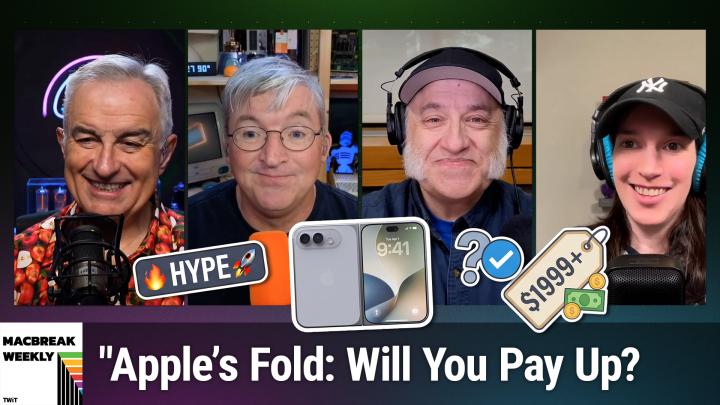
MacBreak Weekly 1041 Transcript
Please be advised that this transcript is AI-generated and may not be word-for-word. Time codes refer to the approximate times in the ad-free version of the show.
Leo Laporte [00:00:00]:
It's time for MacBreak Weekly. It's Christmas Eve for nerds. Tomorrow the new iPhones come out and maybe more. We'll talk about what tomorrow will bring and what else is coming from Apple later this year and how much they're paying Tim Cook to stick around. It's MacBreak Weekly. Join us, Andy Iannaccone, Jason Snell, Christina Warren, and me. It's coming up next. Podcasts you love.
Leo Laporte [00:00:27]:
From people you trust.
Jason Snell [00:00:29]:
This is TWiT.
Leo Laporte [00:00:35]:
This is MacBreak Weekly, episode 1041, recorded Tuesday, September 8th, 2026. Shame. Ladies and gentlemen, boys and girls, children of all ages, it's Christmas Eve and MacBreak Weekly is on the air with Christina Warren, Senior Developer Relations Advocate. I made you a senior again at GitHub. You're not a junior.
Christina Warren [00:01:02]:
I'm not a junior. I mean, technically my title is senior, but yeah.
Leo Laporte [00:01:05]:
Oh, okay. So you are a senior.
Christina Warren [00:01:06]:
Okay. Yeah, yeah, yeah. But, but we'll just say, you know, I'm 29 forever if anybody wants to know.
Leo Laporte [00:01:13]:
Not my kind of senior. Lately, my AI cameras, when they identify me, say I'm elderly. They used to say older. Now they say elderly.
Jason Snell [00:01:23]:
Wow.
Leo Laporte [00:01:23]:
So I must have crossed a bridge somewhere. Sometimes they say I'm bald.
Christina Warren [00:01:27]:
So, okay, well, see, then you can't take anything they say seriously.
Leo Laporte [00:01:30]:
I don't take it too seriously.
Christina Warren [00:01:31]:
So I would just dismiss the whole thing and go, no, no, that's, that's not the case.
Leo Laporte [00:01:35]:
Yeah.
Jason Snell [00:01:35]:
Yep.
Leo Laporte [00:01:36]:
Also here, ladies and gentlemen, Andeanutko from the library. Hello, Andrew.
Andy Ihnatko [00:01:44]:
I have a really good AI camera. It identifies me as insecure.
Leo Laporte [00:01:48]:
Oh, I wish I could do that. You look a little down today, Leo. What's the matter? That's what I have the chat room for. And from sixcolors.com, Jason Snell. Hello, Jason. What's the t-shirt today?
Jason Snell [00:02:03]:
It's, uh, Star Trek Captain's Log, stardate 2609.8. It's like the 60th anniversary of Star Trek, and also there's an Apple event tomorrow.
Leo Laporte [00:02:14]:
Yeah, 60th.
Jason Snell [00:02:15]:
And in some ways, the communicator was the first foldable phone.
Christina Warren [00:02:20]:
I was gonna say, your communicator, you are on point. That is amazing. That it is.
Jason Snell [00:02:23]:
It is 60 of Star Trek, so I'm wearing my Star Trek shirt, and I broke out my, the, my prototype iPhone, which is the Star Trek communicator. Shout out to my friend John Moltz, who 3D prints these. They're amazing.
Leo Laporte [00:02:36]:
Oh, neat.
Jason Snell [00:02:37]:
That's cool. Yeah, he's the best.
Leo Laporte [00:02:39]:
So it was kind of a flop. It was a flop, wasn't it? They didn't do very many seasons of Star Trek.
Jason Snell [00:02:44]:
You know, it's a, it's, it's a little bit misleading. It was, it was at a very weird time. They did only 3 seasons, although that was enough to because they did like 26 episodes in the season or something.
Leo Laporte [00:02:57]:
Right.
Jason Snell [00:02:58]:
To make it successful. And they had like writing campaigns to save it, although the fact is that NBC wasn't gonna, wasn't really gonna cancel it. It was kind of like overstated. It was weird timing because it was just as demographics and ratings started to matter. And the fact is, if they had held out like even another year, Star Trek's audience was actually kind of huge, especially it was young and it was well-educated, but it was a little too early for them to— for that to have taken hold as the way you sold commercials on TV. And, and there's some great books called These Are the Voyages that tell the detailed stories of the making of the original Star Trek. And a little-known fact is that mostly they didn't make a 4th season of Star Trek because NBC was tired of Gene Roddenberry, who was just insufferable. And I mean, seriously, like, Yes.
Jason Snell [00:03:48]:
he was insufferable. He totally like dropped out of the production of the 3rd season. So it had— and he drove away all the talented people who had written the first 2 years. So 3rd season is kind of lousy. But you know what? In hindsight, if they had gone on and made, like, a couple more seasons of Star Trek: The Original Series, I don't think there ever would have been a Star Trek after that. I think that the cult— we got the moment that this weird 3-season show became a thing that 60 years later, they're still making and talking about.
Leo Laporte [00:04:17]:
Right.
Jason Snell [00:04:17]:
So, you know, you can't— you don't want to step on that butterfly But it was, yeah, it was more popular than, than I think we, we're told the stories we're told about it are because it was just super popular in some areas of the culture. And yeah, if it had been literally 5 years later, it would have been a hit because they would have said everybody who's watching this is young and well-educated. And, you know, that was—
Leo Laporte [00:04:40]:
It was a cult hit.
Jason Snell [00:04:41]:
It was, it was, but it was, I mean, it was pretty broad. And the bright colors, my favorite Star Trek fact actually is that the bright colors that they wore, those shirts, those red and blue and yellow shirts, was because NBC, owned by RCA, wanted to sell a lot of color TVs.
Leo Laporte [00:04:55]:
Color TVs!
Christina Warren [00:04:56]:
That was one of the big things with it, right?
Jason Snell [00:04:58]:
It was in color. Yeah, bright colors of Star Trek.
Leo Laporte [00:05:01]:
Oh yeah, when the color TV era came along, all the sets, all the TV studio sets—
Jason Snell [00:05:07]:
Got all garish.
Leo Laporte [00:05:08]:
Very garish.
Jason Snell [00:05:09]:
Yeah, yeah, yeah, yeah, yeah. My parents bought their first color TV because of the moon landing, which is hilarious because of course the cameras on the moon were in black and white, but you could watch Walter Cronkite in Right.
Leo Laporte [00:05:19]:
Color, right. My dad refused for years to buy a color TV. He said the colors don't look right.
Jason Snell [00:05:25]:
Yeah, it's just a fad.
Leo Laporte [00:05:27]:
Yeah. Hey, that's really not what we're here to talk about. I don't know why I'm delaying.
Andy Ihnatko [00:05:32]:
We're filling, we're filling time because there, everybody who wanted to have any news this week decided, you know what, all the air is going to be let out of whatever announcement we make by the Apple. Let's wait until mid-September.
Jason Snell [00:05:45]:
It's true. Anticipation. This is our anticipation episode, everybody.
Leo Laporte [00:05:49]:
Mark Bloomberg, Apple to kick off Ternus era with its biggest ever slate of new products. So first thing Lisa wants to know, and I imagine that she's not alone, she wants a new laptop. They're not gonna announce new laptops tomorrow.
Jason Snell [00:06:05]:
No, I don't think so.
Andy Ihnatko [00:06:06]:
No.
Jason Snell [00:06:06]:
No, I don't think so.
Leo Laporte [00:06:09]:
That's what I told her, but they might next month.
Christina Warren [00:06:12]:
Yeah, yeah, they usually do an October— they've often done an October Mac event refresh.
Jason Snell [00:06:17]:
Yeah, late October, early November, like a Halloween-ish thing.
Christina Warren [00:06:20]:
Yeah, they've done that for a long time.
Leo Laporte [00:06:22]:
There may be no money left in the piggy bank, however, because, uh, tomorrow they may announce a phone that some are saying maxed out will be $3,000.
Jason Snell [00:06:33]:
Yeah, and maybe $2,099 to get in the door.
Leo Laporte [00:06:37]:
So the, so that's, uh, wow. Is that more, I guess this is a Ramageddon and, and, and storageageddon.
Jason Snell [00:06:44]:
Well, Gurman said today that their original concept was a $1,999 price point, but then, you know, I mean, that's perfectly fine.
Andy Ihnatko [00:06:52]:
That's, that's, that happens to be what folding phones cost. Like every single, even folding phones of this exact same size and form factor, now that the panels are widely available, every phone is like a $2,000 phone. And then they bumped up the price by like $100 because of supply shortages. So if Apple were to make a 256GB storage base-level phone for $2,099, I don't think that would merit any attention. If they were to decide to say that, hey, you know what, this is a premium Apple product and we're Apple and our customers like to spend money, and say, you know what, we're gonna make the entry point $2,300, that's when everybody should line up and say, yeah, how is yours better than Google's and Samsung's and even Huawei's at that? Why, what are you giving us for the extra $200? Outside of you know greater compatibility with our devices, which is something we should just simply have for free anyway.
Christina Warren [00:07:44]:
I mean, I hear you on that. I do feel like if they did want to, my my bet I think about a month back, six weeks back, was that that $2,299 is where I was thinking the price point. Sure. But to be clear on that, that was for a 512.
Leo Laporte [00:07:57]:
Yeah, that's the base model.
Christina Warren [00:08:00]:
Well, that's what I was thinking. If it had 512, if if if it based on 512 gigabytes, it'd be $2,299. Now, if they do base at $256, they could do— yeah, they could do $2,099. And I think that would be in line, as Andy said, with anything else. I would have a hard time, I think, justifying to Andy's point, even though I do think that there are a lot of reasons why people will buy, even if it were to be $200 more for a lower storage device.
Jason Snell [00:08:27]:
Right.
Christina Warren [00:08:27]:
Which, to be clear, I hope is not the case. I think that there are enough differences where if you are someone who wants a foldable iPhone, you want a foldable iPhone. You're not looking at Samsung. You're not looking at Huawei. Like, that's not even entering into your, into your ecosystem thoughts. And so I think that it's— yes, you're right, Andy. The compatibility stuff should all just be there, but that's not. And the reason that you buy an iPhone is because of all the things that you get from an iPhone, which is the, the whole ecosystem play.
Christina Warren [00:09:00]:
And so I wonder, I mean, there is a point where this becomes too expensive for anyone to buy into. It's going to be an interesting question to see if Apple can overcome what, frankly, their competitors have not been able to do, because we have not had a hit foldable phone, even though they've been around for a long time. None of them have sold in tremendous amounts of volume. They lose their value very quickly. But, you know, Samsung, Motorola, Huawei, a bunch of companies, you know, Google, they've all been in this space for quite some time. But it isn't like this is a breakout category. So I do think that there is an open question which says even if the price is justified, And even if the price matches what we see from competitors, regardless of RAM and storage considerations, is this still going to be too expensive to be the successor of sorts or to be a hit the same way that the iPhone Pro and the Pro Max are, which very easily people were willing to spend over $1,000 for the phones and not blink? I do think that going over $2,000 is a different chasm. Yeah.
Leo Laporte [00:10:07]:
So I'm looking at, and this would probably be a good thing for everybody to do today, looking at your existing iPhone and see how big it is and how much you've used. I'm looking at mine. I bought a 512, but I've only used, I've used 183 gigabytes after a year with all my music and stuff. So maybe I don't need more than 256 if they offer it.
Andy Ihnatko [00:10:27]:
Yeah, I agree. I had a, I was, I had to fall back to like my backup phone when my Pixel 6 did the big firework in like last year. And that one was basic specs for 4 years ago. It had only 128 gigs of storage, and that was switching from a 512-gig model to 128. And I was really surprised at how well I was getting along with 128. It was definitely too, a little bit too little, but it made me convinced that if I could cheap out by getting 256 gigs with my next phone, I certainly wouldn't miss out on anything. Unless you're shooting a lot of video, like so, and you're shooting it so quickly that it's not as though you get home then it automatically syncs up, and then you've got that space free again. Uh, but it's, it's going to be a— I think that there's so many really good folding phones right now.
Andy Ihnatko [00:11:17]:
It is a very mature category that, uh, Apple, if they had introduced one 3 or 4 years ago, they could say, well, Samsung's phones are just not really good, and they're not very durable, or they don't have the right specs. Right now there are at least 2, and if you include China, 3 really best-in-class foldable phones that Apple has to contend with. And when I said that, when I talked about Apple hopefully not charging too big a premium for the price, yeah, I don't think anybody's going to switch to— if anybody was willing to switch to Android to get a folding phone, they certainly would have done so like last year or the year before when the category really started to pop. But what I mean is that I think it's correct when we're evaluating these things that if Apple were to sticker price this at $2,300, God forbid, bid $2,400 for a 256GB entry-level model, that's when we start to compare it to these other 2 or 3 foldables and decide and ask Apple what exists. What, what, how are you giving us $200 more value to this other than we just don't wanna switch to a different operating system? Like, are you gonna give us better— Absolutely. Are you gonna give us better cameras? Are you gonna give us better, higher connection speeds? Are you gonna give us a desktop mode? All this sort of stuff, I think, are gonna be relevant questions for us to ask next week. In the iPhone space, in the regular phone space, iPhones cost roughly as much as top-tier phones made by any other top-tier manufacturer. I think for the reasons that they're all not equal, but they all have the same positives and negatives that even each other out.
Andy Ihnatko [00:12:53]:
I don't think that if Apple decides to charge $2,300 for it, they can get out of it by saying, well, it's Apple, and the Apple logo means something.
Jason Snell [00:13:03]:
It's a, it's a measuring stick. I think it's fair. It's sort of like how, how much is Apple pushing their platform advantage if they overprice it versus the competition? But, you know, Andy's right. This is if you wanted a fold. This is not a competition where people are going to be like, I want to buy a folding phone regardless of operating system. What this is about, it's about iPhone users getting access to a folding phone.
Leo Laporte [00:13:26]:
I think iPad-style interface once you open it up.
Jason Snell [00:13:29]:
Exactly. And that's one of their great advantages is they have, they have been doing really well with larger screen and interface apps with the iPad for ages, and they can apply that to this. I think, you know, one of the, one of the real questions is going to be how do we judge it? Because all I've seen, the estimates I've seen are that, you know, maybe it's what, 2% of phone sales are folding phones, if that. And that's worldwide. And there are some markets, especially I think in Asia, where the number is higher and it's lower in North America. And Europe, which are 2 of Apple's key markets. So, and keep in mind, by the way, the iPhone Air and the iPhone Mini were both derided as being failures and stopped by Apple with market shares or sales percentages out of, let's say, you know, estimated at like 6 or 8% of total iPhone sales. So what's the— I mean, what's the hope here?
Leo Laporte [00:14:27]:
What's the benchmark?
Jason Snell [00:14:28]:
What do they need to accomplish? Is it, is it really? I mean, I've said this before because we've been talking about this thing for so many years now. So this goes back to the start This is a Star Trek conversation.
Leo Laporte [00:14:37]:
Don't be premature.
Jason Snell [00:14:39]:
Well, we don't know what the bar is here.
Leo Laporte [00:14:41]:
Give it time to grow.
Jason Snell [00:14:42]:
Exactly. And so, I mean, first off, I will throw this out there. I suspect that in 6 months or a year, this will be the best-selling iPhone model ever.
Christina Warren [00:14:53]:
Without a doubt.
Leo Laporte [00:14:54]:
Because of the iPad card.
Christina Warren [00:14:55]:
I think the minute that— yeah. No, not, not, not iPhone, but I think foldable.
Jason Snell [00:15:00]:
Yeah.
Leo Laporte [00:15:00]:
Oh, that's easy.
Jason Snell [00:15:02]:
It'll be the best-selling foldable today.
Christina Warren [00:15:04]:
I think it will.
Jason Snell [00:15:05]:
But the question is, how? How else do we measure it? And it's going to be hard. I think it's going to be a hard sell because it's expensive and because it's new and people are going to need to see it. I think it is a long-term play for Apple. I think Apple figures like the beauty of the iPhone line is there's so many iPhones now that this doesn't have to be— this can be more esoteric. But is Apple going to be unsatisfied if it's 5% or 6% instead of 10%? I don't know. Maybe not. I would guess they'll be patient for a while with this. If you just look at the rest of the market, I'm sure they're well aware of what percentage of Samsung sales are their folding phones.
Jason Snell [00:15:39]:
And if Apple sales are in that ballpark, they'll probably be okay with it, understanding that it's just— this is the niche that it's in. Is it going to grow?
Leo Laporte [00:15:47]:
Is it going to build? I mean, there's probably some skepticism. I know I am about the folding phone in general.
Jason Snell [00:15:54]:
So I think there's going to be a lot of resistance.
Leo Laporte [00:15:56]:
Sure that Apple's done it right.
Andy Ihnatko [00:15:57]:
I think the main resistance is that I think the main resistance is to $2,000 phones. There are people that are just no way, shape or form are going to spend $2,000 for a But the thing is, there are many people that, you know what, as I keep saying, I have— I can afford it, thank God. And maybe it'll be good. And Apple people, Apple markets, Apple's market tends to be more deep-pocketed than others. They also tend to be more adventurous than others. So, yeah, Christine's absolutely right. This is going to be the top-selling foldable of the marketplace. It's probably going to goose interest in foldables across the board.
Jason Snell [00:16:29]:
For sure.
Christina Warren [00:16:29]:
Yeah. I also think that this— where this potentially takes market share, if it were to take anything from any Apple product, Because I don't think that it's going to necessarily— Jason makes a great point. What does success look like? We don't know what those numbers are going to be. I have a feeling just because of the price and the uncertainty that it's going to sell probably worse than the Air or, you know, the Mini. But I also feel like you give this a much longer period of time to prove itself versus the Mini or the Air. Right. Because those were essentially, you know, it's the same phone concept. It's just in a different form.
Christina Warren [00:17:03]:
It's in a slightly different package. One's thinner, one's slightly smaller, right? But it's still the phone. This, because it is a new form factor and has new app experiences, I think is different. And so I do wonder if— and maybe even cannibalize isn't the right word. Maybe this is save or expand, I guess. But I wonder, I think the big crossover here, at least how I think about this myself, is people who are iPad people and iPhone people and, and who have both and carry both, but don't always want— like you might have, you know, multi-year-old iPad Air or iPad Pro or even original iPad that you've got, you know, for, you know, consuming content or video or whatnot. You would like an iPad Mini, but you're not at that point where you're like, okay, I'm going to continue to buy an iPad Mini every time that the cycle refreshes because there's supposed to be an OLED iPad Mini later. Right, right, right.
Christina Warren [00:17:59]:
Presumably there is. But like I got the 2022 iPad Mini. I don't even know if that gets updated. anymore, but I'm not updating that, right? Yeah, it's fine.
Jason Snell [00:18:07]:
Right.
Christina Warren [00:18:07]:
It was like an 8, you know, an iPad Mini.
Leo Laporte [00:18:10]:
iPad Mini lovers will love this phone, right?
Christina Warren [00:18:12]:
Well, I was going to say, but, but like, but what I could see myself doing is, okay, maybe I'm not going to buy another iPad Mini, OLED or otherwise, but I will step up and pay 4 times as much to get the— which is, you know, presumably to get the— I mean, if I'm doing my math correctly, and I think I am, maybe it's 3.5 times. I'll pay more to have the mini that can also be a phone.
Jason Snell [00:18:39]:
I don't know. Because, I mean, there's value in— it's one product instead of 2, and there's value there. I just want to slide in because I think Andy is right in identifying the number one issue here, which is going to be the price. But I don't want us to sleep on the other issues here. If this was a $1,500 folding phone, I— the very first folding iPhone, There would still be a lot of hesitancy because it's a weird shape. It's gonna be squat and wide when it's closed. It's gonna be, it's gonna be weird in your pocket. It's gonna have compromised cameras.
Jason Snell [00:19:10]:
It's not gonna have the iPhone Pro cameras. How is the software gonna work on the inside? How is the durability? Is the, you know, are, is that, is that crease really essentially not there? And is the hinge gonna hold up over time? There are I mean, believe me, there are lots of reasons beyond price why a lot of iPhone buyers will be like, let's, let's see, right? Like there's lots of hesitancy that's going to be out there. I think even in addition to the price, which is why I do think there's a growth path here. I do think that if this product gets better and people also see like people are telling good stories about how they like it, it will, it will melt their hearts a little bit. But like, but even somebody who's got deep pockets might be like, I just, I'm just going to get the Pro again.
Andy Ihnatko [00:19:54]:
Yeah, there's so many questions that are still— are not going to be— not even going to be settled after the announcement. They're only going to be settled after about a month. And one of the biggest ones is, uh, conceptually, as a point of view, what is this device? Is it an iPhone that turns into an iPad, or is it an iPhone that turns into an iPhone with a larger screen? And that's not a subtle point. There are going to be people who, especially for—
Christina Warren [00:20:18]:
Price.
Andy Ihnatko [00:20:18]:
I'm sorry to keep coming back to the price, but there are people for whom this is a big, big, purchase. This isn't just, hey, I've got the money and maybe it'll be good. This is— they're really rolling the dice on this. And if they don't— if they have a vision in their mind that, my goodness, I'm going to be so much more productive, like, when I'm on that commuter rail every morning, I'll be able to zip through my appointments, I'm going to be zipping through my emails and responding to things, I might even be able to write some stuff and work on a spreadsheet or something like that. If they don't get the experience that they're hoping to get, above and beyond, oh wow, now I can watch movies like in a larger form factor, they're going to be very disappointed. And Apple's going to have to listen very, very closely and adapt the, the software as they go. I think it might even be an Apple Watch style moment where they've got the hardware, they're confident in the hardware, they think they've got the hardware design on lock, and now they have to listen to— watch and listen to how people are using this and change the character and the perspective and the point of view of the device to match the way that their actual customers are actually using it. I'm not terribly I'm not terribly worried about the hinge or the screen because Apple has the benefit of a lot of iterations from Samsung to copy off of and a lot of bad experiences to not want to repeat.
Andy Ihnatko [00:21:33]:
But again, just the simple things of, are people going to be expecting this to become an iPad when they open it or are they going to be happy just to simply have a larger desktop for iPhone apps? That's a question that is going to be unresolved for at least a month.
Leo Laporte [00:21:47]:
So I think maybe also, I remember with the Vision Pro, Apple was thinking this is a new form of computing and someday everybody will be doing spatial computing. And I'm wondering if they're seeing this, you know, the phone isn't a phone anymore. The phone is a portable computer. It's a pocket computer.
Jason Snell [00:22:06]:
Oh yeah.
Leo Laporte [00:22:07]:
And this form factor might actually be the better form factor for whatever that thing is. This still is kind of focused on the phone. You know, it's long, so you can have your mouth at one end and your ear at the other end. It's kind of focused on that use, and I don't think people use it that way anymore. So what if you start thinking about, well, what is this? Is it really a portable computer that you use for texting, messaging, playing games on? And I think that this might be a better form factor.
Andy Ihnatko [00:22:40]:
It's—
Leo Laporte [00:22:40]:
And that they may actually be kind of anticipating how people are going to use their phones in the future.
Jason Snell [00:22:47]:
It's a logical extension of what Apple learned in 2014 when they released the iPhone 6, which was big, and they had the 6 Plus, which was even bigger. And that was their response to Samsung discovering that larger phones sold. It turns out one of the— it's literally like crank up the size of the screen and you crank up your sales, which is a lesson we've all learned. And all phones are vastly bigger than they were in 2014. That's a thing that happens. This is kind of a take on that, right? Which is, okay, people want a big screen. They love a big screen. But beyond a certain point, a big screen is ridiculous because you can't put it in your pocket anymore.
Jason Snell [00:23:24]:
And this gets back to the, you know, Andy, I think I recall at one point pointing out that, you know, an iPad fits really well if you get a trench coat with a big enough pocket on the inside.
Christina Warren [00:23:35]:
Yes.
Jason Snell [00:23:35]:
You can maybe slide it in there. But it's like—
Leo Laporte [00:23:37]:
A French worker's coat.
Jason Snell [00:23:38]:
There's some fashion issues there. So this is like, okay, Well, we've got this folding technology. It's not a means, you know, or it's not an end unto itself. What does it enable? What it enables is you to have a much bigger screen in your pocket. And, and like, I think bottom— we can overcomplexify this, but Leo, I think you're right. Number one here is it's enabling people to carry around a larger screen with them and open up to the larger screen when they can, 'cause larger screens are better. And they're not just better for watching movies, they're better for everything you do. And even me, I'm somebody who bought an iPhone mini.
Jason Snell [00:24:09]:
I don't have a Pro Max or anything like that, but like when I, When I was using the iPhone Air instead of the iPhone Pro, I had that moment where I was like, oh, 'cause the screen's wider. And I'm like, oh, bigger screen, bigger screen, bigger screens are better. They just are. I mean, bigger phones aren't, but bigger screens are.
Leo Laporte [00:24:25]:
I have concerns 'cause I do put my phone in my breast pocket. Um, and maybe I'm one of the few, but if you wear a suit jacket, you could put it in the side pocket. I don't know. There's, that's concern number one is how are you gonna carry this? If you're a woman and you have a purse, I have a I have a man bag. I guess I'll put it in my man bag.
Christina Warren [00:24:43]:
I mean, purses are hard too. I don't know.
Leo Laporte [00:24:44]:
Like, it's not ideal because you have to dig it out.
Christina Warren [00:24:47]:
It's not. I mean, look, I mean, look, since, since the iPhone 6, frankly, it's been difficult if you have a smaller purse or anything to carry a phone around. It just has. So my default, especially if I'm wearing pants, is that I just have it hanging out of my back pocket, which is completely insecure and like not the best way of doing it. But that's just what I do.
Leo Laporte [00:25:05]:
That's going to raise the other issue of how do you protect it? Now, SpyGen This morning on X posted something provocative. It said, if your name is John, keep scrolling. And I think they're announcing that they've got a case.
Christina Warren [00:25:20]:
Yep, they are.
Andy Ihnatko [00:25:21]:
Yeah, there's actually a couple of case makers that have already like posted pictures. I've got one in my notes here. So they've got it. They're pretty confident what it's going to look like. It is. If all the rumors and all the information we have is true, if you've— Any pocket that you can put a passport in without having to fold it up should work okay. I mean, my question— and again, so many questions—
Leo Laporte [00:25:41]:
So are people walking around with their passports sticking them in all the pockets?
Andy Ihnatko [00:25:45]:
Yeah, that's— Does it fit?
Leo Laporte [00:25:47]:
Does it fit?
Andy Ihnatko [00:25:47]:
I have to say that I have— I got like the biggest like passport holder that I have, and I've been using it sort of as a mock iFold just to basically get a sense of—
Leo Laporte [00:25:57]:
Is it going to be this size? Is it going to be the passport?
Andy Ihnatko [00:26:00]:
A little bit.
Leo Laporte [00:26:01]:
I can fit that in my breast pocket.
Jason Snell [00:26:02]:
More or less.
Christina Warren [00:26:02]:
Yeah.
Andy Ihnatko [00:26:03]:
It's got to be thicker.
Christina Warren [00:26:05]:
Yeah.
Jason Snell [00:26:05]:
Thicker, but, but, but squat and wide.
Leo Laporte [00:26:08]:
Roughly that.
Jason Snell [00:26:09]:
Okay.
Leo Laporte [00:26:09]:
So that's not so bad. I can put that in my breast pocket.
Jason Snell [00:26:11]:
Yeah. And it'll be, and each of those planes will be thin. So while the folded won't be super thin, it'll be, it'll be thinner than you, than you think it is. Just as a reminder, these case makers, everybody who does this, there are leaks in the supply chain. There's bribery. There's all sorts of other things because if you want to be out with a case on day one or soon as—
Leo Laporte [00:26:29]:
Apple doesn't tell you, do they? They don't, they don't have some, they have some Trusted partners.
Jason Snell [00:26:32]:
I don't think for brand new iPhone shapes they do at all. I think that this is all— and you've seen it, case makers sometimes make a gamble on bad information or on missing a piece of the puzzle, and they have to trash those cases. But it's just part of the game.
Leo Laporte [00:26:44]:
Peak had to do that. Peak had— I think the buttons on the side were wrong. Not wrong, but they weren't effective.
Jason Snell [00:26:50]:
But if you wanted out even within a month of the phone coming out, you've got to make them in advance. Yeah. And so they, they, you know, they use their supply chain sources to get it. And so we see it now, and I see people kind of read it wrong and be like, oh, oh, it leaked. It's like, well, it leaked sort of, but like, this isn't— this isn't the phone. This is the, the, the, the numbers that they got handed to them, or maybe a blank shape that they got handed to them, and they're just gonna go with it. I like this.
Leo Laporte [00:27:20]:
Would you buy this, Christina? I mean, this seems like— because I need something, I'm not gonna carry that Yeah, I mean, $3,000 phone. I'm not gonna—
Christina Warren [00:27:29]:
I like Spigen stuff a lot. I've purchased a lot of their products over the years. Um, I've used their cases. I use one right now. I like their clear cases, to be totally honest.
Leo Laporte [00:27:37]:
By the way, notice no MagSafe ring on this, which worries me a little bit.
Christina Warren [00:27:41]:
Yeah, that worries me too. And I don't know if that is just a fact of them showing off a prototype earlier or, or what. Um, I cannot imagine a universe in which Apple Apple ships a phone that costs this much that doesn't have MagSafe, that would be catastrophic, I think, on a lot of levels.
Leo Laporte [00:27:58]:
It's not going to fit, though, in the pocket on my car, which my phone barely fits into now.
Christina Warren [00:28:03]:
Well, I was going to say, yeah, carmakers. Yeah, carmakers. I mean, anybody who's created anything, you know, for kind of like the long, you know, thin shape, this is going to cause issues. And I don't necessarily know if those are issues that'll ever be solved because I think this will Even though I do think this will be the most successful foldable ever, and and I think that if Apple is committed to this, this will probably be more successful than other phones they've put out in the in the category, at least long term. This is not going to suddenly, I don't think anyway, unless the price changes, this is not going to be the phone that everyone uses in five years. I I don't necessarily see that happening. That said, yeah, I mean, I have a lot of questions about the the form factor. I have questions about cases.
Christina Warren [00:28:46]:
I do wonder, you know, Apple last year introduced the the stupid slings or or you know. straps or whatever. And I bought one because I'm dumb.
Leo Laporte [00:28:54]:
And do you use it?
Christina Warren [00:28:56]:
Sometimes, yeah. Because if I'm wearing like a dress or something that doesn't have pockets, then I want a way to have my phone held.
Leo Laporte [00:29:02]:
This is like Tomb Raider when you're carrying it around.
Christina Warren [00:29:05]:
I mean, I mean, kind of, but like, it's fine. People have been doing that before Apple introduced that. So honestly, Apple was just following like the trends of other accessories.
Leo Laporte [00:29:13]:
Some of the case makers do have magnets on the, on the camera side.
Christina Warren [00:29:18]:
So, okay, so did you have that?
Leo Laporte [00:29:20]:
Again, these are all guesses, right?
Andy Ihnatko [00:29:21]:
And also, that's a, that's a big question. Like, there are other— I can't remember whether it's Samsung's or Google's phone that has— that definitely has MagSafe. And the thing is, it's fine if you've got it folded, but once you unfold it, it just won't stay in. There's just too much torque on it. And so what if Apple's navigating that? Are they okay with telling people, by the way, this is going to be really wonky if you open it, keep it open, so basically keep it closed? Or they're just going to simply say, guess what, you're going to plug it in because we don't want people to have a bad experience with MagSafe.
Leo Laporte [00:29:49]:
I never found a decent case, by the way, for my Samsung Folds. They were all like little shells that you put on one side.
Christina Warren [00:29:56]:
Yeah, I think the cases— cases are the hard thing here for a couple of reasons, I think. And I think it'll completely depend on how the hinge mechanism works and how you can do it, because like that's been the problem. I think the Samsungs and others, like you can have a shell that will go over part of it and kind of be a thin cover, but it's hard to have any sort of real protective case, which is why once again, I will implore anyone who buys this this, um, whether you have money for it, you know, a plum, or this is going to be, you know, maybe potentially a big purchase, get the AppleCare. Like, this is one of those non-negotiable ones where you have to get the AppleCare because no matter how durable they claim that the phone screen is, no matter how many bends they say it can hold, no matter how impervious it is to sand, like, this is just a category that even with the number of years that other companies have been doing this is not super well known. And this is the first generation of these things. So do I expect that Apple will be better than the rest? Yes, I do. Do I expect that this is a thing that I would spend, especially with this much money, you know, have it without some sort of protection plan? Absolutely not. So I think if you get one of these things, even more than a case or whatever you're going to do, don't do that.
Christina Warren [00:31:03]:
Screen protectors are another area. I have a feeling that that maybe even the official guidance will be not to use a screen protector. Exactly. I think typically you don't want to. And I don't use screen protectors in general anyway. I think they're kind of a bad idea at this point.
Leo Laporte [00:31:16]:
These aren't glass screens either. These are—
Christina Warren [00:31:18]:
Right, they're plastic.
Andy Ihnatko [00:31:19]:
Can I just— right, can I just say that, so, uh, I spent the weekend, Labor Day weekend, on Cape Cod, and I put my screen protector on my brand new Pixel 11 like a week ago. And of course it fell off, it slid off of my knee and onto like concrete and like crack the screen protector. The screen underneath is okay.
Leo Laporte [00:31:40]:
You're glad you have it.
Andy Ihnatko [00:31:41]:
And so, and so I kind of, I kind of hope that at least for the outer screen there is a screen protector for it. There's—
Leo Laporte [00:31:48]:
that would be a normal screen, right? The outer screen will be a standard screen.
Jason Snell [00:31:51]:
Yeah.
Andy Ihnatko [00:31:52]:
And again, when you, when you're talking about— Christina, you're 100% right. There is, there is— you absolutely have to have AppleCare on this, on this one. And but a lot of the accessory situation is there are people that are like They've had their butts saved so many times by virtue of the fact that they put a $30 case on their phone and they put a $35 screen protector on it. Maybe they're going to be expecting to have those accessories available. If they don't have them available, they're going to be very nervous people. On that basis, there should be an accessories market.
Christina Warren [00:32:25]:
Yes.
Andy Ihnatko [00:32:26]:
Also, I'm sure that Apple is going to want to make— I've never gotten an answer on this, on whether or not there are, as Jason says, has like some manufacturers that are very, very closely trusted and are quietly slipped a CAD drawing so they can have— so Apple would want—
Leo Laporte [00:32:44]:
Apple would want to have brand cases. dbrand went all in, man. They have got cases and they have announced hinge protection. They have announced camera buttons. Like, they know. Like, they know, you know.
Andy Ihnatko [00:32:57]:
And Apple would want to have this stuff available like on week one, because Apple wants to sell them in the store, right? Of course. And that's an online store, in-store. Yeah.
Leo Laporte [00:33:06]:
Yeah.
Andy Ihnatko [00:33:07]:
So I'm sure that there must be some people who have— who can be very, very confident of the engineering. A store like dbrand, which their marketing is as annoying as hell, but nonetheless they make really good cases that are absolutely fit for purpose.
Leo Laporte [00:33:21]:
This actually looks really nice.
Andy Ihnatko [00:33:22]:
Yeah.
Leo Laporte [00:33:23]:
And so, I mean, it's totally speculative unless they got, you know, advanced notice.
Andy Ihnatko [00:33:28]:
It's, I think it's, I think it does serve Apple's interests, uh, to make sure that at least on the Apple Store, uh, and the Apple Store page online, there are places where you can buy the people who want to buy the stuff that they expect to buy a case, expect to buy a screen cover.
Leo Laporte [00:33:41]:
This one says, this is a scan of the iPhone 17. We're working on an iPhone Ultra version. Your order will ship with the correct internals shown. This is that see-through case.
Jason Snell [00:33:50]:
Uh, I don't know, but who knows if that's the 17. I mean, that doesn't matter, but it's also a profit maker for Apple that for the first little while, the The only case that was designed knowing exactly all the specs of the hardware is Apple's.
Leo Laporte [00:34:03]:
Yeah, they're going to sell a lot of them. They always do, right?
Christina Warren [00:34:06]:
Yeah, they are. And, and I'm sure there will be a different power adapter brick that will no longer come in the box, but they will very much want to encourage you to buy and spend an extra $45 on. And there will potentially be a different power cable if there's rumors that, you know, they might have, you know, some sort of other sort of thing there. So they, they will have plenty of ways for people to, to add on and spend even more money on top of their phone.
Leo Laporte [00:34:27]:
But he's selling screen protectors, which cracks me up.
Christina Warren [00:34:30]:
Yeah, it's like, it's like you don't even know what this is going to be again. Like, no one should be buying any of these accessories until the phone is out. And but, but I also don't discount or like, I think it's completely fine for these companies to be doing this. This is their whole business, so to speak. And like Jason said, like there have been many years where they've just had to scrape the cases they've made and then redo them. But if your molds are close enough and you need to make a few alterations, I want it.
Leo Laporte [00:34:55]:
I want to buy it. Why not?
Christina Warren [00:34:58]:
I mean, yeah, I mean, like, I mean, look, dbrand also really likes to, uh, poke the bear of things. Like, they, you know, have—
Leo Laporte [00:35:05]:
they really are close to—
Christina Warren [00:35:06]:
they really like to, to get as close to violating IP as they can. Remember, I bought a, a skin from them once that was like an Animal Crossing Switch skin that looked very similar to the, the Animal Crossing edition of the Switch that Nintendo sold. And then, uh, Nintendo like slapped them and they're like, you can't sell this anymore. But they had already shipped mine to me. So I was like, that's fine. But yeah, I mean, they really like to get as close to the line as they can. So that's just— but it'll be interesting to see. Yeah.
Christina Warren [00:35:33]:
Like, because usually to Andy's point, like for new devices, I think it's different. But for like, I'm trying to remember, I think even last year when I got the iPhone 17 because I had to go to the store to pick it up and I'm trying to remember if there were third-party cases in the store that week or not. There might have been. Might not have been, but some years there definitely are. But for the Air, for instance, yeah, Apple was the only company who had anything, you know, for their case, which is really just a bumper for the Air last year for the longest period of time. But yeah, I mean, it'll be interesting to see how people use this, what this form factor is. I now regretfully, I think, have to give a belated, like, 12-year-old apology to BlackBerry because the BlackBerry Passport, which was a phone that I dragged and I dragged it for good reason, is, you know, BlackBerry 10. It was not a great device by any means.
Christina Warren [00:36:27]:
But, you know, if it turns out that form factor is similar to what we will have folded out, then I guess we all owe John Chen a mea culpa or something. You know, it's like unbeknownst to them, they actually did come out with a a good size for a phone in your hand, even though that one didn't fold out, you know, a bajillion years ago.
Jason Snell [00:36:49]:
There was a really good story about— I forget who wrote it, maybe The Verge. I think it was The Verge about how it's the same thing as saying Apple is going to have the best-selling one. And again, it doesn't mean that they were first. They're not remotely first. They let other people in this category, but it's the Apple effect. And The Verge story was just saying, like, the shape of this is almost certainly something that Apple tried a lot of different shapes. And they, they ended up with this idea of something that was squat but usable when it was folded. And then it was more like an iPad.
Jason Snell [00:37:23]:
Again, a 4:3 is what we're hearing. It's the original iPad aspect ratio. It's sort of classic iPad shape when you unfold it. And now there have been foldables in the last year or so with that look and profile. But the argument would be they exist because they knew Apple was going to do it. In the case of Samsung, and that phone, the latest phone has been really well received. I mean, Samsung is going to make the display. So it's like, of course they're going to be able to make one using that same material and it's going to be that same shape.
Jason Snell [00:37:51]:
And that's logical. But it's just another funny example where the game is different once Apple decides to play it and it affects everything. And it doesn't mean that Apple is going to win. It doesn't mean that they're right. Like, there's lots of things it doesn't mean. But once— and we've seen this time and again— I saw this with USB and with Bluetooth. Like, there are all these technologies where they're around and savvy people know that they're around. And then Apple comes in and like gives it a stamp and it can be a game changer.
Jason Snell [00:38:20]:
So I would actually— I'd go beyond our, I think, agreement that this is going to sell better than other folding phones to say I think it will also have the effect And that will have the side effect of selling more Android folding phones. I think that will happen too, just because it validates the concept and it gets people talking about why you'd use a device like this.
Andy Ihnatko [00:38:39]:
Yeah. Don't dismiss the power of marketing of just simply being on a flight and seeing somebody next to you using something that you've never seen in the flesh before and suddenly thinking, gee, I didn't think it was that small. Or gee, I didn't think it was that useful. Or gee, I asked a couple of questions like says that he's— that this is the best phone they've ever used or the best watch they've ever used, et cetera, et cetera. It's like they call it the anti-Cybertruck effect. You can't look at a Cybertruck in the flesh and think that anybody would ever want this. But nonetheless, the number of times that any— all of us in this conversation and a lot of people listening, we're often the first people to— that we are the brand ambassador because we're carrying like the first version of whatever it is that anyone's actually seen. And we have to answer the questions about what the new iPod Nano is like.
Andy Ihnatko [00:39:27]:
And yeah, well, it is tiny, tiny, tiny, but that doesn't mean that it still holds the same amount of songs. Yeah, the screen is tiny, tiny, tiny, but you can read it. And yeah, it's easy to sync and all that sort of stuff. And that's how people walk away with an impression that I'm not gonna run out and buy a folding phone now, but they are now, if they needed 72 points on the scoreboard to convince themselves that their next device is gonna be a folding, the next phone's gonna be a folding phone, they are now at least 13 points closer to that minimum.
Leo Laporte [00:39:53]:
We're gonna take a break. We'll talk about what else Apple might announce tomorrow. We will be streaming our coverage for the club only because Apple gets so upset when, when we, when we do that in public. So Micah and I will be sitting in the club, and I hope you will join us, 10:00 a.m. Pacific, 1:00 p.m. Eastern Time, 1700 UTC. Club members, and if you're not a member, it's not too late. twit.tv/clubtwit, and we will, uh, we'll be sitting there with our credit cards ready and our—
Andy Ihnatko [00:40:27]:
And our excuses ready.
Christina Warren [00:40:29]:
Yeah, our justifications ready. I'm only buying one phone, Jason. I'm making that commitment to you. I'm only buying one phone.
Leo Laporte [00:40:36]:
Only one. Keep your— keep your—
Andy Ihnatko [00:40:38]:
iPhone 16 is just so darn laggy.
Jason Snell [00:40:41]:
I believe in you, Christina. I believe in you.
Christina Warren [00:40:44]:
Thank you. Thank you.
Jason Snell [00:40:45]:
You can do it.
Christina Warren [00:40:46]:
I can do it. I'll be fine with the 17 and the, and the Yeah.
Leo Laporte [00:40:51]:
17's fine. It's fine. It's orange. It's fine.
Christina Warren [00:40:54]:
It is. It's orange.
Leo Laporte [00:40:54]:
I might have to buy a new watch. We'll talk about the Apple Watch in just a second. Christina Warren, Jason Snell. I'm really throwing— I'm trying to throw Anthony and Andy Iannacco. Anthony filling in for John Ashley, our regular producer who's on vacation. He is at a Magic: The Gathering tournament.
Christina Warren [00:41:15]:
Yeah.
Leo Laporte [00:41:15]:
He's a pro. Player, and apparently it's an open, but he's very good, so expect him to come home with prize money. Anyway, we'll talk about it.
Andy Ihnatko [00:41:25]:
Is there a pro-am where, where like amateur players get to go around with the—
Leo Laporte [00:41:29]:
Yeah, it's like an open. Anybody can, anybody can go.
Andy Ihnatko [00:41:32]:
I mean, on golf, on golf, uh, golf tournaments, there's always like a— there's always like a— before the actual thing, there's like a pro-am where like if you donate $50,000 to whatever bogus charity, you get to play around with Jack Nicklaus or Well, not recently.
Leo Laporte [00:41:47]:
Yeah, I've played, uh, in the US Open Chess Tournament, and you get to, you know, sit near a grandmaster, not necessarily play one, but, you know, you can see them in the distance. So we also think there'll be a new Apple Watch Series 12 in new colors, maybe even a ceramic case. Uh, they're also gonna do an Ultra, we think. Yes, Ultra 4. I don't feel the need to upgrade my Ultra. I'm very happy with it. Do you think though they'll make a smaller one?
Christina Warren [00:42:18]:
I wish they would.
Leo Laporte [00:42:20]:
I know, but I don't think so.
Jason Snell [00:42:22]:
For the ladies?
Christina Warren [00:42:22]:
Yeah, I mean, honestly, that's— I, I— there's, there's a photo, it was funny, um, it went viral, relatively speaking, a couple of years ago online, um, and, uh, people saw it and like didn't realize it was my wrist because they're like, oh, this person has a small wrist like you do. And I was like, that's actually my wrist, where I put on an Ultra at a store and just like compared it and was like, it's huge. I don't care how great this is. I, I will never buy this ever. The frankly, the larger size phone is too big. I have to get the whatever. It used to be 38mm. Now it's 40mm.
Christina Warren [00:42:53]:
Like, I have to buy that size. I wish that they would, but I don't know. And I don't know how much sense it makes. I'm sure they've done their market research and realize that the vast majority of people who are buying the Ultra are for very specific fitness purposes and other things, in which case you're okay. If you're a woman with the size difference, or you know candidly, you're probably someone who has a bigger wrist. But yeah, I mean, I I'm a I'm curious what they'll do with Apple Watch this year because to me it feels like if I'm in a RAM crisis, if I'm in like a CPU crisis, if I'm in a crisis of areas where I only have a certain amount of silicon to play with, I don't know if Apple Watch wear. we own the market for smartwatches is necessarily where I would put all my upgrades, if that makes any sense. Not to say that there wouldn't be changes.
Christina Warren [00:43:44]:
I just wonder how much of a change there would be. Like last year was almost nothing. And this year, you know, you would think, okay, TikTok, this is time for a bigger change. And maybe that will be the case. I just— I don't know. I'm just trying to think with like logistics hat on. Would I rather— you know, put the SoC and the RAM in the watch, or would I rather put it in, uh, the phones or even potentially a product like the, the TV where I know it's going to be one model that is sold for 4 or 5 years?
Leo Laporte [00:44:13]:
There really isn't a need to upgrade the watch at this point. There really isn't.
Christina Warren [00:44:17]:
Yeah.
Andy Ihnatko [00:44:18]:
Just a, just a quick jump in. I had an, uh, uh, if even if you are a barrel-chested, barrel-chested He-Man dude, Try out the smaller watch. It's not the men's— there's a reason why Apple didn't say, here's the men's model.
Leo Laporte [00:44:31]:
But how will I know if I fall in the water how deep I've gone?
Andy Ihnatko [00:44:35]:
Well, I mean, it'll— I mean, it's, it's the same features. It's just that I picked up, uh—
Leo Laporte [00:44:38]:
Oh no, the dive feature is not on the regular watch.
Andy Ihnatko [00:44:42]:
Well, he's saying the smaller of the 2. I'm saying they're the regulars.
Leo Laporte [00:44:46]:
I'm saying they're the regulars. I'm saying, but the Ultra is the one that tells you how deep you fall.
Andy Ihnatko [00:44:49]:
Okay, well, yeah, but it's big enough that's actually going to be dragging you down. to the bottom. So that's— you'll know how deep you were when you passed out.
Leo Laporte [00:44:57]:
Never use that feature.
Andy Ihnatko [00:44:58]:
What I'm saying is that I picked up like a smaller model, even though my default was, oh no, I need the bigger one, because I've got— again, I got— I'm a man, I've got a bigger wrist. And you know what? It solved a couple of the problems— or excuse me, personal issues that I had with the watch. It looked better proportioned on my wrist. It did not feel like I was wearing this big bulky gadget on my wrist. It wasn't a statement piece. It was more like an actual watch, and I liked it more than the larger size one that I had before. So a piece of advice for people out there: don't necessarily go for the more expensive watch. The smaller one— go to the Apple Store, try it on your wrist.
Andy Ihnatko [00:45:34]:
You might be surprised at how much you like it.
Leo Laporte [00:45:38]:
We don't really know anything else. I think they're gonna redo the— they're seeing competition from that band you have on, Andy, and the Loop and the Oura.
Andy Ihnatko [00:45:47]:
Then, I mean, the next step for them is that You've got the watches. You're doing a great job with them. There's no no reason to for anyone to complain about it. Not just the hardware, but the science that you're putting behind it and the software putting behind it. But you it's a good if you want to expand your the reach of Apple Health for good reasons for for for reasons of wanting to improve the health of your users and also wanting to get more get more customers. There are people who are not wearing a fitness watch for a good reason. There are and those people are when they see something like this simple band or they see a ring or if they see something. Something that they can wear on a bicep because they just want really, really good workout training and workout coaching.
Andy Ihnatko [00:46:28]:
Apple is not getting those people. And I think it's a good opportunity for them to put their design, their style and design expertise towards these other form factors. I can't, I really, really am anxious to see what they would do with something that reads as a piece of jewelry as opposed to a piece of tech. When you're making a ring, There's no screen, there's no display, there's no inputs. It just is. And my goodness, if there's some— if there's any one object that you could say, hey, Johnny, um, if you got a couple of weeks off from OpenAI, we would like to hire you back in as a subcontractor because I think this— the thing that I'm sure you would love to— love to— if you had fun designing the, the noses for Red Nose Day, we really want you to design a ring.
Leo Laporte [00:47:16]:
Are we going to see an Apple TV? Are we going to see any other— we'll see new AirPods 5 according to Gurman.
Jason Snell [00:47:23]:
That's the big question. I think, I think the big question is, does Apple make home announcements or not? I think they've got home announcements to make. And the question is, do they slide them in under the big spotlight where they're going to have to share the spotlight with so many iPhones? But a lot of people are watching, or do they just kind of like bail out and say, that's again, see you in October when we actually tell you about our home strategy? Because the home strategy is warming up. Up. They could do it any time. And given that a lot of the products that are rumored don't currently exist in any form, you're not going to eclipse sales of those products. You could announce that you're going to do a security device or a, or a, or that HomePod product and say it's not going to ship for 2 months and that would be fine. So you could do that any time you want.
Jason Snell [00:48:06]:
The question is, do they want to slide it into the iPhone event or would they be better off with its own event? I mean, my gut feeling is that they should do it now because they could— because the eyes of the world are on them and they're going to be talking a lot about Siri AI because the OSes are a part of this too. Everything is going to ship in a matter of days. And so, you know, those products are all driven by Siri AI too. So that's probably the right time to do it. But I could also see saying, yeah, we got enough here. Let's just hold those for next month and doing it that way. So it still feels like a coin toss to Yeah.
Christina Warren [00:48:42]:
Yeah. I mean, I kind of expect them to do it just because to Jason's point. Yeah. I mean, Siri AI is going to be such a big part of the software story this year. I think there will be 2 software stories. One will be however software works on the foldable, right? Like that will take a certain amount of time to kind of explain that. But I think the bigger thing is going to be Siri AI. And the big part of that, I think really that, that sells it beyond just being we finally caught up where everyone else was 3 years ago.
Christina Warren [00:49:09]:
Is we have an ecosystem and that ecosystem is home. This, this actually, this came out after we locked our stories, but this was from MacRumors. One of their contributors looked at code and basically said that the next Apple TV 4K will have an A19 or A19 Pro chip, meaning that it will have 8 gigs or 12 gigs of RAM up from 4 gigs of the 2022 model. I, given the RAM situation, unless they made these things months ago and they've just been sitting there. I do not expect these to have 12 gigs of RAM. I do not think that that is a thing that you would do.
Leo Laporte [00:49:44]:
But you do that if you wanna have Siri AI in there, right? That's why they would do that.
Christina Warren [00:49:47]:
Well, potentially, potentially. Although even then, I don't know if you need it locally, right? Like, I don't think that on the Apple TV you necessarily need to be running that locally. I think that you could just be calling back to the cloud. It'd be fine. But you could have potentially, maybe if you have this, you know, this home device that Jason has mentioned in the past, you know, maybe this hub, the screen, maybe that's the thing that you want 12 gigs of RAM for.
Leo Laporte [00:50:08]:
I don't know.
Christina Warren [00:50:11]:
But the fact that that sort of information is in the code does obviously suggest that a release is very imminent, whether it'll be tomorrow or a future time. We'll know in 24 hours. My bet is going to be that we will see the new devices tomorrow.
Andy Ihnatko [00:50:28]:
Yeah.
Christina Warren [00:50:29]:
Tomorrow.
Andy Ihnatko [00:50:29]:
It's hard to imagine, though. How could they redefine Apple TV? Yeah, I mean, how could they keep—
Leo Laporte [00:50:35]:
I mean, I think what they're saying is it's the faster processor and the larger memory. you're gonna have Siri AI.
Andy Ihnatko [00:50:39]:
Yeah, and that's nice.
Leo Laporte [00:50:41]:
It's gonna look the same.
Andy Ihnatko [00:50:42]:
It's not like they can do something, the things they do with the Apple Watch, just saying, oh, by the way, we can't tell you what your blood pressure is, but we can give you information about blood pressure trends, and that's because we've improved the sensors on the latest version. So, I mean, for most people, I mean, there's a reason why the Apple TV is just an undifferentiated black box that you're designed to pretty much hide anywhere. It's just the spirit that delivers Netflix and YouTube and Hulu and Disney+ to you. So it's— I can't— I'm not denigrating it. I'm just saying that it's hard for me to imagine what they can do that would make it, oh my God, I'm gonna— even though my existing Apple TV is working just fine for the past 4 or 5 years, I have got to get rid of that and upgrade it to something else. What can they deliver outside of Siri AI, if it is something that people value, that would make someone say, I know that my old one is working just fine, but I want this new one.
Jason Snell [00:51:40]:
And it may be cameras.
Christina Warren [00:51:41]:
It was part of— I don't— that's all I'm trying to think. Like if you had a home situation where you had cameras, you had other things, and then this is not just your TV, but also your hub where you can now view all of those things and you can control that. You have a remote that now finally actually works with Find My and, you know, is, is which like, come on. I think there are a number of different ways you could go there. I think to your point, I think it's harder the way I would view that, especially if that, if these RAMs You know, rumors are accurate would be you would need to make this an actual home hub that just happens to be its primary thing is an Apple TV.
Jason Snell [00:52:12]:
That's what I thought. It's already it's already part of the way there. Like literally right now, this is the best way to do a home hub in the Apple ecosystem is an Apple TV. But you know, I I don't given the TV OS hasn't changed. I don't think it's going to be revolutionary because that's what needs to change is TV OS needs an update. I I I don't look for revolutionary here. I think the answer is probably going to be. That it's been so long since they updated the thing that they need to get it on a chip that they're still making and that that is capable of working more with their modern home strategy, which is why I would say if you're going to update the Apple TV, you need to do it in the context of that larger home strategy.
Jason Snell [00:52:46]:
Because if they say we also have this camera and, you know, these 4K cameras work better with this and you can view them all from the screen on the HomePod or on your TV with the Apple TV, and it's all kind of— they're all enabling a set of features that work best together on the new Apple TV, that's a story that they can tell that is more exciting than, well, you know, we ran out of the chip, so we— now it's on the newer chip that we still have in a bin.
Andy Ihnatko [00:53:13]:
And I think, I think that's true. I think that's the most significant thing. That's a really, really good point based on the fact that they've got old— they're running old hardware and old chips that they don't really want to keep manufacturing. I don't know about— I don't know about the hub aspect, only because Because if people really want that kind of home security and home automation, then they probably already have a solution that they are at least mostly happy with. Maybe they would be interested in an upgrade, but I'm not sure if you're going to bring in brand-new users that way. I'm limited by my imagination, but the thing that I've always wanted for the Apple TV is, if you think of it in the abstract, here is a an OS X operating system that is extremely low power and is always on and is always connected to the internet. And it's great as a TV device, but if it could be the one device that can talk to all the devices on your network, and if you are out of the house, if you're across the country, across the globe, this device can basically patch your iPad back into your Mac mini and give you your desktop from wherever you are, without any mess, without any security problems, stuff like that. Be able to control things back in your house like home automation without any muss or fuss, simply because it is the one computer that is always on and always alive and active.
Andy Ihnatko [00:54:39]:
That would make it into a really interesting product for me as an Apple user.
Leo Laporte [00:54:46]:
Uh, all right, I think we've covered everything. Oh well, Tim Cook will be in the audience but not on stage.
Jason Snell [00:54:53]:
Of course.
Leo Laporte [00:54:54]:
And will you be inside the— no, you won't be.
Jason Snell [00:54:58]:
No, they would need to call me. I'm local, so they can just— if there's a spot that opens up, they can just give me a ring and I'll be there. But otherwise, I plan on being right here.
Andy Ihnatko [00:55:07]:
Get a call, Jason, can you bring like 8 folding chairs and bring a 9th for yourself?
Jason Snell [00:55:13]:
But we could really use some more folding chairs. Yeah, I could. You know, I have, I have my camp chair that I use in the backyard. If they need me to bring that to sit in the back of the Steve Jobs Theater, I will. I'll be right there.
Leo Laporte [00:55:23]:
It's there.
Jason Snell [00:55:24]:
And it took me about 80 minutes to drive there. So I just need, you know, a couple hours notice and I can be there. So they call me at 8:00 AM and say, Jason, okay, come now.
Andy Ihnatko [00:55:32]:
I will.
Jason Snell [00:55:32]:
I'll be there with bells on. But otherwise, the truth is the hands-on area is the thing that is the prize of going there, sitting in the Steve Jobs Theater and watching it on a screen. That's the same video that you watch here. Not as interesting. But afterward they let you go out there and it's a zoo.
Leo Laporte [00:55:51]:
Yeah.
Jason Snell [00:55:51]:
But if you are patient and you wait, you get to be one of the very first people to have an actual hands-on experience with a product like this. I imagine it will be even worse of a zoo. But the truth, the truth is, you know, for what we do in covering these events, in large part, it's better to do it remotely. And we learned that during the pandemic. But I can't I mean, if I get the opportunity to put my hands on a folding iPhone tomorrow, I will take it. Um, and if I don't, I will probably breathe a sigh of relief that I don't have to go into that nightmare. I, I am not claustrophobic, but I'm not great with crowds. The hands-on area is the worst place in the universe.
Andy Ihnatko [00:56:30]:
Especially when you have to throw elbows just to get like, hey, I was actually standing here for 8 minutes and now you just basically sidled in and jumped in and said, hey, Hey, it's Digital Steve here with an exclusive hands-on review. Yes, I was here before you and I just need 81 seconds. YouTubers are the worst.
Jason Snell [00:56:48]:
Let's just be clear, YouTubers are the worst. Influencers are the worst. They're rude and they cut the line and then they want to shoot their whole video right in front of you and you're like, I just want to touch the thing, okay?
Christina Warren [00:56:59]:
Like, I want to touch it, I want to take some photos. And like, and it's hard too if like you're the only person there from your outlet. and, and you don't have, you know, a photographer and they haven't let you do that. Like, because yeah, then you're having to fight with the, the people who are throwing elbows.
Jason Snell [00:57:13]:
I'm not gonna be sad if I get to sit in my, in my short pants and my pajamas or whatever at home and watch it here. I'm gonna, it'll be okay.
Andy Ihnatko [00:57:23]:
The, the most, the most valuable tip I can give anybody, if you get, so anyone who hears this conversation who gets like a last minute invitation or anybody who might get one in the future, always have like your phone nearby. always have Spotify or Apple Music open and always have it open to like any Eagles song. And if one of these influencers starts doing something funny, just start blasting copyrighted Eagles music so that they can't release whatever video they're recording when— and because they, they burst in front of you.
Leo Laporte [00:57:49]:
Are the Eagles the best to use? Are they the most litigious of all the bands?
Andy Ihnatko [00:57:52]:
A quarter million dollars, David Letterman said, because they were, they were gonna like just spontaneously have the band like play an Eagles song. And that became like a runner throughout the entire show because it's a scream from the side, no, no, no, no, don't play, don't play.
Leo Laporte [00:58:05]:
I was right.
Andy Ihnatko [00:58:07]:
Because they wanted $200,000. Eagles does not want it.
Leo Laporte [00:58:10]:
You can't even mention Winslow, Arizona. It's not, not even allowed. Nothing. Standing on a corner?
Andy Ihnatko [00:58:17]:
No. Hotel Calgary. That'll cost you $80. That's close enough. Hotel Cal. They've got it.
Jason Snell [00:58:23]:
Yeah, you can check out anytime you like. No, that's it. Anytime.
Leo Laporte [00:58:27]:
It's fine.
Jason Snell [00:58:28]:
Go ahead.
Leo Laporte [00:58:28]:
Go ahead.
Jason Snell [00:58:29]:
It's okay.
Andy Ihnatko [00:58:29]:
Okay, we don't need the rest.
Leo Laporte [00:58:30]:
Actually, uh, Mark Gurman's gonna owe them some money because I think he used the term Hotel California.
Jason Snell [00:58:35]:
That's my favorite phrase of the last, uh, of the last month is the Hotel California policy of Apple executives. They, they can, they can retire anytime they like, but they can never leave.
Leo Laporte [00:58:43]:
They can never leave.
Jason Snell [00:58:44]:
Never.
Leo Laporte [00:58:44]:
Tim's getting some money, uh, to hang around though, I have to say. Uh, he's getting a little less, like they cut his salary by a million.
Christina Warren [00:58:54]:
Oh no.
Leo Laporte [00:58:54]:
From $4 Well, let's see, Turness is going to get $3 million, and then mostly, of course, for both these guys it's about stock.
Christina Warren [00:59:02]:
It's all, it's all about the stock.
Jason Snell [00:59:04]:
Yeah.
Leo Laporte [00:59:05]:
Uh, but I think Tim's still getting, uh, so he got, uh, one— let's see, oh, this is old. Um, as executive chairman, $2 million salary starting, uh, September 26th. So poor guy is gonna have 3 weeks where he's just broke. Uh, and then, uh, he's gonna get a fiscal 2027 equity award targeting $45 million. That's for the next year.
Andy Ihnatko [00:59:33]:
Damn, that's gotta hurt.
Leo Laporte [00:59:34]:
In stock. Turness gets $58 million. Um, they're targets because of course the stock price fluctuates, but I think a certain amount is guaranteed. So I didn't see the actual paperwork, but, uh, he's, he's gonna be— in other words, He may be in Hotel California, but he can afford the champagne.
Andy Ihnatko [00:59:53]:
And I would say that if you were to— if you were to say, Andy, we want you to spend the next 5 years of your life being our point man to talk to the head of every government in the world, no matter who it is, I would be demanding at least $40 million.
Leo Laporte [01:00:07]:
Yeah, but if you got $4 million for every time you had to talk to Trump— by the way, it's funny, one of these articles said Tim is Trump's friend. Which I wonder, maybe he is, maybe they're friends.
Jason Snell [01:00:18]:
I don't know.
Leo Laporte [01:00:19]:
Maybe they're friends.
Jason Snell [01:00:20]:
I don't know that.
Andy Ihnatko [01:00:21]:
I think someone in the relationship thinks that Tim is their friend.
Jason Snell [01:00:24]:
He's sure. I can imagine somebody telling Mark Gurman, be sure to write that they're friends. Was it Gurman?
Leo Laporte [01:00:31]:
I think Gurman said they were.
Jason Snell [01:00:32]:
Does he like him or does he like like him? It's like, does he ever do some photo finger touch with the president?
Andy Ihnatko [01:00:38]:
Nobody. Making friendship bracelets with each other at summer camp. I don't see But okay, I want them to be happy. I want Tim to be happy. That's all I want. He's done so well for all of us.
Jason Snell [01:00:49]:
Insert your own joke here about how, given that Tim's primary job now is dealing with the Chinese government and the Trump administration, that he deserves as much money as they want to give him.
Leo Laporte [01:00:58]:
Yeah, well, and he's done a very good job up to now. They know him. They don't know Turnus. It just saves time because they've already got, you know, all the groundwork's done. You know, so I think that, uh, it makes— it seems like a lot of money. He must be doing something for $45 million. Yeah.
Andy Ihnatko [01:01:16]:
I mean, I wonder, I wonder what kind of foundations he has. I mean, I'm speaking seriously because there has to be a point at which, yeah, of course you're going to be paid, you're going to demand to be paid of what you think you're valued at, but he is already so frinky stinking rich. What dollar amount could be significant to him at this point? But I imagine that he must have foundations that nobody— that because he's a humble person and he's just doing it out of charity, not for his own promotion. that there is a fully funded foundation of $100 million that's going to— that's funding all kinds of issues that he can't talk about publicly and he can't promote publicly, but is nonetheless doing the good things that Tim Cook, the public face of Apple, can't do. I like to imagine that.
Leo Laporte [01:01:59]:
One thing John may not get, according to one analyst, Omdia, or Omdia, or Omdia, The folding Macintosh that was John Ternus's priority has been canceled. Now, Gurman says it's not canceled, so there's some debate over that. In fact, it's Gurman that called it a Ternus priority. I don't really want a foldable Mac.
Christina Warren [01:02:25]:
I was gonna say.
Jason Snell [01:02:27]:
This product never made sense.
Leo Laporte [01:02:29]:
Never made sense.
Andy Ihnatko [01:02:30]:
I don't know. I would only support it in the idea of, again, I love taking my Mac out and having a field day or traveling. And the idea of having a MacBook-sized device that turns into a small iMac-sized screen, even if it means that I've got like a little Bluetooth keyboard and a little Bluetooth mouse with me, that may— I couldn't afford it. It couldn't make financial sense, but that's a very appealing workspace for me.
Leo Laporte [01:02:57]:
Really?
Andy Ihnatko [01:02:58]:
Yeah.
Leo Laporte [01:02:58]:
But you already have, in fact, you talked about last week, that second screen.
Andy Ihnatko [01:03:01]:
Yeah, exactly.
Leo Laporte [01:03:02]:
Just plugged in.
Andy Ihnatko [01:03:03]:
But wouldn't it be nicer? I like the alternative form factors that are available. Like if they—
Leo Laporte [01:03:09]:
Lenovo makes one like this. Their number kind of—
Andy Ihnatko [01:03:11]:
Exactly. And they're really nice, especially if— and this is another question that I have about the folding iPhone— is that it would be wonderful if it's not just, oh well, you can— when you have it half open, you don't— you can't— you can use it and have like a virtual trackpad and a virtual keyboard so you don't have to take anything. Okay, that's fine. But what I would love if they They would, if Apple would make a device, if on the iPhone, they make like, they open up the APIs so that if a developer wants to treat it as, have it half open like a laptop, the part of the screen that is flat is user interface that could be completely customized for the app you're running. And then the vertical part is the screen. So if you're doing like a mobile audio editor or video editor, you've got like a scroll wheel and sliders like on the flat on the table. while you're looking at the waveforms in front of you like that. That'd be— and now imagine that expanding to you're using Photoshop and part of what the flat part on the desktop is actually sort of like a tablet or a trackpad, but there's also basically manual sliders for the curves that you're adjusting.
Andy Ihnatko [01:04:16]:
That could be kind of interesting. I don't know if there's a market for it yet. There are devices like that in Windows because there's, no matter what kind of device you can name, there is a— someone has taken a crack at it on Windows. Similar to a chair. Yeah, whether it's practical enough to— they can sell more than a couple hundred thousand of it, I haven't— I don't really— I don't think so.
Christina Warren [01:04:33]:
But I don't trust Apple, if I'm going to be completely honest, to support the software the way that you would want that software to be supported. I think the Touchpad shows that they were never committed to that. They never opened up third-party APIs for that. That was a disaster, honestly. I realize it's a different regime and it's different people and all that, and, and Jony Ive's been gone a a long time, but the touchpad debacle alone makes me go, I, I don't want you messing with the keyboard ever again. We finally got the keyboard that works. Like, I, I don't— a convertible makes sense and could be a good product. It would be interesting, but I don't trust you ever.
Christina Warren [01:05:07]:
I, I don't ever wanna see the, the word virtual keyboard and Apple ever on a Mac because it just, it brings up bad memories.
Jason Snell [01:05:14]:
It doesn't— to me, it doesn't make sense because when I think of what this product could be, all I can think of is that it should run iPadOS. If there's a large device that's a big screen, or you can fold it into something that's more laptop-shaped or close it, that feels— that doesn't feel like a Mac to me. That feels like a touch device. And that would mean that it's an iPad. And I kept thinking like, unless there's like a big reveal, you know, the prestige is that they are actually merging macOS and iPadOS. IPadOS together and that, you know, and then Mac is going to be touch native in the way that iPad is. It's going to support the pencil and it's going to support a software keyboard or a hardware keyboard and all of that. Like, but it doesn't in a— as Christina says, in a Mac context, it kind of sounds like a bad computer.
Jason Snell [01:06:02]:
In an iPad context, it sounds kind of amazing. Although again, I'm not quite sure who would want to buy it. But look, I want Apple. I want Apple to have wacky ideas like this and say, okay, Okay, is there an iPad or Mac laptop style thing that could use folding technology? And how would that work? And let's look at it, let's give it a shot. And how would the keyboard work? And what are the advantages and disadvantages? And how would you prop it up? And is there a stand? All that, like, do that work. And I believe they have done a lot of that work. And it makes me, all these stories, we, we are scratching our heads on the outside, but they actually built this stuff on the inside.
Christina Warren [01:06:39]:
Yeah.
Jason Snell [01:06:39]:
And I'm pretty sure that they got to the end of it and they're like, Like it doesn't make any sense, right? Like it just doesn't. And if there's ever a company that is not going to get tempted by releasing a product because they can, even though they don't know what it's for, and you know, we could argue about like Vision Pro or even the early Apple Watch where it's like, is this— do we know what this product is? But like, I want Apple's the company to say no, just because we could build this product, there's no way it makes sense. So let's not bother. And it sounds like what happened here is like the system worked.
Leo Laporte [01:07:08]:
worked.
Jason Snell [01:07:09]:
And then, and it rejected this product. They're like, no, don't try to make that product, it's a bad idea. And so they, they aren't going to. So good, good. It's a disaster averted, I think.
Leo Laporte [01:07:20]:
Time for a break. When we come back, Apple's secret shame. Uh, you're watching MacBreak Weekly with Jason Snell and Ian Naka. And why you laugh?
Jason Snell [01:07:30]:
It's not gonna be a secret anymore, is it?
Leo Laporte [01:07:32]:
It's not— won't be a secret anymore. And Christina So if you were using Apple Maps and you were heading north, maybe, you know, crossing over the bridge into, into the motor— from the Motor City into Windsor, or maybe you were going up to Toronto, you might have noticed that big body of water in the middle there is Lake America now, baby. Google did it, Apple did it. I don't know if they had to do it. German said some people claimed that everyone at Apple was against the move, but considering Cook is a friend and supporter of the president, the resistance was never that solid. Of course, they did the same thing with the Gulf of Mexico being renamed to Gulf of America.
Andy Ihnatko [01:08:15]:
There's a— I mean, there's a good example here with how Google does things, where their policy for a long, long time has been that all truth on Google Maps is local truth, and whatever, whatever the government of the area in which you're accessing Google Maps from says the name of something is, or a border is, that's the truth that they're going to honor within those borders. And this is hardly the first time that's happened. The Sea of Japan is not the Sea of Japan if you use Google Maps from Asia. Borders are disputed, of course, after the invasion of Ukraine. So again, inside Russia makes it illegal to publish the wrong borders there. So Google Maps suggests that there. The situation in China is, of course, there's a government— to publish map data in China, you have to be registered and approved by government authority. So again, Google observes and respects the laws and the truth presented by there.
Andy Ihnatko [01:09:14]:
I don't— I'm annoyed by it. I hate it. I think it's stupid.
Leo Laporte [01:09:16]:
Well, and I'd be very upset if I were Canada.
Andy Ihnatko [01:09:19]:
Well, but the thing is, like, what's the alternative?
Leo Laporte [01:09:22]:
If you're in Toronto, does it say Lake Ontario still?
Andy Ihnatko [01:09:24]:
Nope, nope. If you're in Canada or observe Canada, anywhere else in the world, it says Lake Ontario because only the United States of America believes that. Again, it's not that they're respecting the executive order. They're respecting the fact that the USGS updated their own database to reflect the executive order, and the USGS is what— That's the definitive database. Right. And so again, the alternative is you have a company like Apple or Google Google arbitrating who— arbitrating what the global truth should be. Like, okay, who does own this border? Is this area of Ukraine a state within Ukraine or is it part of Russian territory? It's— you don't want a multi-trillion-dollar company basically deciding that for the entire planet.
Leo Laporte [01:10:11]:
I guess that makes sense. It's just—
Andy Ihnatko [01:10:13]:
I hate it, but I can't blame Apple.
Leo Laporte [01:10:14]:
People who live in New Mexico are ready.
Jason Snell [01:10:18]:
Yeah. Constitutionally, that's the thing is the USGS can't change. I mean, that's in the state constitution. They can't change the name of New Mexico.
Christina Warren [01:10:26]:
I was going to say that that's up to their own legislators. They're going to have to—
Leo Laporte [01:10:29]:
Yeah, right.
Andy Ihnatko [01:10:30]:
And their own lawmakers. Trump respects laws that prevent him from doing something.
Jason Snell [01:10:35]:
The problem is that you've got a system that assumes a level of rationality and good faith on the part of the government organizations that are largely seen as being nonpolitical, to give things the proper name. But in some countries it is political. It's political, yes. And so you basically say, okay, if we're going to be in that country, we're going to have to play that game. And the issue here, you know, there's a lot of rage for Google and then there was a lot of rage for Apple. And I get it. But the rage— there's a good place to put your rage and it's on Pennsylvania Avenue. It's because that's where this comes from.
Jason Snell [01:11:16]:
And the system is the way it is for lots of reasons. And it's dumb, but like the original thing here is dumb. This is dumb. And I, but I'm going to, I'm going to be productive here. I'm going to be productive. You go to your, your Mac system settings and, and you go to language and region and you set your region to Canada, but you keep your preferred language as the US. If you're in the US, you can set your cal— you can set your temperature to Fahrenheit and your measurement system to US, and guess what happens? Lake Ontario is labeled properly. So if you want to do that, and it'll work on an iPhone too, set your region to Canada.
Jason Snell [01:11:52]:
You can set all of your other measurements to be American measurements if you like, or go metric. Who's going to stop you? Nobody. Not yet.
Andy Ihnatko [01:12:01]:
Yeah, can I say that this is not— this is not the first time that Trump has made Americans want to pretend to be from another country.
Jason Snell [01:12:06]:
Indeed.
Andy Ihnatko [01:12:07]:
Probably will not be the last. Nor will it be the last.
Leo Laporte [01:12:09]:
Now I'm going to— okay, I've just made myself Canadian. I'm just, I'm going to test this.
Jason Snell [01:12:16]:
Region is not related to your App Store account. It's not related to your Apple account. It is, it is made so that you can explain what region you want to be, uh, be in for, uh, language and location purposes.
Leo Laporte [01:12:32]:
Does that work for the Gulf of Mexico too? Is it now the Gulf of Mexico?
Jason Snell [01:12:35]:
Yeah, I think so.
Leo Laporte [01:12:36]:
It is. Holy cow.
Jason Snell [01:12:37]:
So give that a try if you want.
Leo Laporte [01:12:39]:
But it says in parentheses, Gulf of America.
Jason Snell [01:12:41]:
Well, this is, this is where Apple has failed, which is everywhere else in the US. John Gruber wrote about this and I agree completely. Everywhere else in the world that's not the US, it shouldn't say Gulf of America in parentheses after Gulf of Mexico because nobody else thinks that's the name.
Leo Laporte [01:12:57]:
Right.
Jason Snell [01:12:57]:
So it should be a US-only thing with US-only ridiculous names. And then everywhere else in the world, it should just go on as normal because we don't get to tell the rest of the world what to call a thing that's a geographic name. We don't.
Leo Laporte [01:13:09]:
So Apple is being a little extra friendly by doing that one.
Andy Ihnatko [01:13:14]:
But if the administration is, or someone's going to refer to, oh, well, this is happening like the south coast of the Gulf of Mexico or Lake America, I think it's handy to have both there just so that people who are seeking information will find it. Although I would support I would support either decision, and I would support probably Lake Ontario more than it— again, centuries of established procedure here, of such a precedent.
Jason Snell [01:13:42]:
The province is named for the lake, not the other way around.
Leo Laporte [01:13:46]:
Oh, that's interesting. Okay.
Jason Snell [01:13:48]:
All right. It is an indigenous word.
Leo Laporte [01:13:49]:
Plus, if you learned the names of the Great Lakes with the acronym HOMES, now you have to say HAMES.
Andy Ihnatko [01:13:56]:
Well, also—
Jason Snell [01:13:56]:
Shame.
Andy Ihnatko [01:13:56]:
Shame. I learned it as she made Harry eat onions, and now I don't know I don't know what's Harry eating now that starts with A.
Leo Laporte [01:14:04]:
Does that work? You got one extra. Superior Michigan— no, Superior Huron America Michigan Erie. I guess it works.
Jason Snell [01:14:15]:
Shame.
Christina Warren [01:14:15]:
Yeah, shame, shame, shame, shame, shame is the best acronym, frankly.
Jason Snell [01:14:18]:
Yeah. She made Harry eat anchovies.
Leo Laporte [01:14:24]:
That's just mean. Uh, so Lisa should wait, you think, till October to get a new MacBook? Because she wants to get one tomorrow. But she'd be getting an M5. The M6 MacBook Pro is coming out this fall according to everybody, right?
Jason Snell [01:14:40]:
Yeah, maybe early next year, undetermined.
Leo Laporte [01:14:43]:
How about a new Neo? The Neo 2 is on—
Christina Warren [01:14:46]:
I don't think we're gonna see that until next year.
Jason Snell [01:14:48]:
Next year.
Leo Laporte [01:14:48]:
That's with the A19s.
Jason Snell [01:14:51]:
So yeah, yeah.
Leo Laporte [01:14:52]:
Um, MacBook Ultra, that's the OLED screen.
Jason Snell [01:14:59]:
Yeah. Again, maybe this fall, maybe early next year.
Leo Laporte [01:15:02]:
I just don't know. And see, if I say, honey, hold on, I feel like you can hold on a month.
Jason Snell [01:15:07]:
A lot of this Mac stuff may end up getting delayed because of everything that's going on. And that's, you know, that's okay. I mean, there's like, I was, I heard from somebody who works at the Apple Store that the iPhone 17e is not currently available. And they're like, are they going to update it? And here's how weird the supply chain is right now. I suspect that Apple took— because remember those, those system, the chips that Apple does are actually packages and they contain components. And like, it's not like the RAM comes from somewhere. The RAM they use comes from a RAM provider.
Leo Laporte [01:15:44]:
Right.
Jason Snell [01:15:44]:
It's not, you know, magic that comes out on the M6 or the, or the A19 or whatever. So I think Apple took some of its lesser product lines and reduced the volume of them so that they could take that memory and put it in the ones they're launching this fall. And so something like the 17e is in short supply, not because they're making the 18e come out this fall, but because they got to get that RAM from somewhere. And if you're going to prioritize, you prioritize the 18 Pro, not the 17e or whatever. I think there's a lot of that going on and that's going to delay a lot of systems, including Mac systems, because they're going to want to use those parts in priority products that, that they can sell. So, I mean, I don't know if there's a lot of harm in delaying some Mac launches until early next year.
Andy Ihnatko [01:16:29]:
So they may, especially since the— especially since they've already sold as many of those to the back-to-school people as they possibly could. So they're not— it's not like they're leaving a lot of money on the table. Yeah.
Leo Laporte [01:16:41]:
Do you think some of that's going into Mac Studios? Mac Minis?
Jason Snell [01:16:45]:
I think that's the priority right now, is the products they just released and the products they're about to release. You want to build up a number that you can put them on sale and sell them, right? It wouldn't surprise me at all if in the last 6 months they've been stealing RAM from all their other products that have just been out there that are at lower volumes so that they could build more of the products they want to sell in the next few weeks.
Leo Laporte [01:17:09]:
I just sat down and specced out the order for a Mac Studio with 256 gigs, the current top of the line. January 21st, 16 to 18 weeks out.
Christina Warren [01:17:21]:
Yeah, right.
Andy Ihnatko [01:17:21]:
Well, that was 2027 or 2028.
Christina Warren [01:17:23]:
But that was the one thing I was going to say for, for, for Lisa. Like, if you're looking at a computer, if you need something, right? Like, I would look at now is the time just because we don't know how long this is. These things are going to be held out. And so if you need something, you need something. And I think you also like look at your needs and you go, okay, is this—
Leo Laporte [01:17:41]:
she doesn't really need that much more state-of-the-art.
Christina Warren [01:17:44]:
Yeah, well, if she doesn't need the state-of-the-art, I also would say, is that an opportunity then to look Best Buy, Amazon, other places that might have the configuration brand new? I'm not talking about used, that you could get potentially, you know, for slightly less than whatever Apple is offering or that might have even better availability if that's the case. Right. Because this has been the weird thing with this is that the availability historically has always been like this. But, you know, Apple's own supply channel has been the strongest. And so you've very rarely had to go elsewhere for that. What I've noticed with people like the Mac Studios and whatnot are different because they have always been smaller. But you're seeing, you know, many weeks out even on, on current, you know, Macs from, from directly from Apple. Whereas depending on what configuration you want, if you're not trying to get a special configuration, You might be able to get it immediately from, from Best Buy or Amazon or someone else.
Christina Warren [01:18:39]:
So I think all that has to play into it.
Leo Laporte [01:18:42]:
You can get the M3 Ultra with 256 gigs for 10 grand delivered Saturday. Right.
Christina Warren [01:18:49]:
Yeah, right. I'm sure they've just got, you know, backhaul, you know, of stock held up. Right. Because I—
Jason Snell [01:18:56]:
and I—
Leo Laporte [01:18:56]:
all of a sudden people stopped buying that.
Christina Warren [01:18:58]:
Right. People stopped buying it. Or, you know, maybe they were able to get more at whatever rate they needed to get them at. I'm not sure how their supply chain process works, if they only get it from Apple, if they get it from other resellers too. But yeah, I mean, that's the interesting thing is that the mix of these things in retail channels is really interesting. And so I think especially like when it comes to things like the MacBook Air and MacBook Pros that are not going to be the highest configuration things, you might have more flexibility in terms of if I need to get something something immediately from third parties just because Apple isn't cutting all of them off. Uh, whereas the, you know, if you go to the apple.com or go to a local store, even the availability that they have is, is going to vary, right?
Leo Laporte [01:19:42]:
Uh, you, you can now, if you're making apps for the Macintosh, stop making them for Intel Macintoshes.
Christina Warren [01:19:50]:
I hate that. I mean, I get it, but I hate it.
Leo Laporte [01:19:52]:
Good for you, Apple has told Mac Store developers, uh, Intel support no longer required. This is an email they sent out: We're reaching out to let you know that universal macOS apps on the Mac App Store that require macOS 13 or later can now remove support for Intel-based Mac computers. Which I presume a developer seeing that will, right?
Christina Warren [01:20:15]:
I, I think it depends on who their user base is. I think it depends on how much telemetry they have about who is using their product, right? Because if you, if you know that you still have, you know, 10 or 15% of users who are on Intel and it's not going to cause you tremendous amounts of overhead to continue to, you know, release for that, then maybe you continue.
Leo Laporte [01:20:33]:
This is the last version of macOS that will have Rosetta 2 in it, though. This next—
Christina Warren [01:20:37]:
This is right. Right. And already, you know, the, the next, the next version will not work on all on Intel Macs. You know, Tahoe was the end of the line, but there are still going to be people who were going to continue to run Intel Macs. And I— it'll come down to what developers want to prioritize. I think it's kind of sad that the final Intel macOS release we got was so terrible. And I wish that we'd been able to kind of go out on a Snow Leopard kind of high with some of the things being fixed. But it is what it is.
Christina Warren [01:21:11]:
I think the bigger problem for developers, at least the ones that I've talked to and the blogs that I've read, is that iOS, or not iOS, Xcode 27 doesn't work super well. And if you're trying to support— It works well. Sorry. It doesn't work super well if you're trying to support older versions of macOS. And so if you're wanting to, on a new operating system, have Xcode 26 and 27, that's not a great process. And so I think that's probably where you will see more people kind of drop support, less even that Apple's like, oh, you can get rid of the binary, make it smaller. It's more like, okay, the process of me testing and building this in my tools is now really complicated. And Xcode has never really made it super great to do that anyway.
Christina Warren [01:21:53]:
So I'm going to have to make the decision, do I cut people off or not? And at this point, I mean, I don't think you can— I think it's a fair argument to make that most people are on the Apple Silicon train, but you do still have lots of very capable computers that are Intel Macs. And that's the only part that makes me sad. I'm like, okay, well, you have these machines that could still be useful for things, but you're essentially not going to be able to use them as a Mac because many of the software applications will not work. They're not going to get security updates. There are some complications when it comes to depending on what version of an Intel Mac you have in terms of getting robust Linux support, although hopefully that improves. You know, installing Windows 11 has always been difficult because of some of the secure TPM stuff, although there are ways to do it. So, you know, you're just kind of in this position where, like, if you have, like, a, you know, 2019, 2020 era Intel Mac, which is still a very good machine, unfortunately, you're kind of stuck. It's the end of the road.
Christina Warren [01:22:53]:
And that is what it is. And I don't know, it just, it feels, I understand why Apple's the decisions they've made, but that doesn't make it feel any less great just from a, you know, e-waste standpoint, that there are now a lot of computers that could still be very viable, very usable computers for basic tasks that are not going to be able to be supported because of the architecture change.
Leo Laporte [01:23:15]:
Good to know. Just prepare yourselves, brace yourselves. Uh, you're watching MacBreak Weekly. Christina Warren, Film Girl, Andy Inako, Jason Snell. Uh, we're so glad you're here. We hope you will come back every Tuesday. We do the show 11 AM Pacific, 2 PM Eastern, 1800 UTC. You can watch us live on YouTube, X, Facebook— X, I said X— LinkedIn, Twitch.
Leo Laporte [01:23:44]:
If I do it out of order, I can't do it. On YouTube, Twitch, x.com, Facebook, LinkedIn, and Kick. There you go. Or in the Club Discord if you're in the club. And again, we'll be streaming the Apple event tomorrow in the club only, 10 AM Pacific. Micah and I will be doing it if you don't mind us talking over Mr. Ternus, uh, mocking these silly Craig Federighi hair bits and puns. Uh, I think that's part of the fun, you know, it's like hanging out with your friends.
Leo Laporte [01:24:17]:
But if you, if you don't mind that, tune in tomorrow. We'll be doing that. On we go. Let's do the Vision Pro segment. Yes, there's Vision Pro.
Christina Warren [01:24:25]:
What do you see? What do you know?
Andy Ihnatko [01:24:28]:
It's time to talk about Vision Pro.
Leo Laporte [01:24:31]:
This is of particular interest to people of my age. The Apple Vision Pro was used for successful hip surgery.
Christina Warren [01:24:42]:
I feel better.
Jason Snell [01:24:43]:
I feel so young now.
Leo Laporte [01:24:45]:
I can throw away the cane. I'm moving.
Andy Ihnatko [01:24:48]:
Yes, but Leo, as the Tower of Power horns once asked, what is hip?
Leo Laporte [01:24:52]:
What is hip? Tell you, tell you if you think you know. I don't need hip surgery, but so many of my cohort do and have had it.
Andy Ihnatko [01:25:03]:
But this is actually a big deal. This is the first time the FDA has actually approved a Vision Pro app for use within, like during live surgery.
Leo Laporte [01:25:11]:
It's what they call the de novo authorization. So that's like, it's, it's for a new technology. It doesn't say this is safe or effective.
Andy Ihnatko [01:25:20]:
Well, yeah, I mean, it's, it's, you can do it. It was about 10 years, I think it was about 10 years ago that de novo classification became a thing when I think it was, when I think it was the Obama administration under the FDA realized that technology's moving so fast that by the time a 3, 4, 5-year-long certification cycle is completed on new technology, it's old technology. So it's still, it's, it's, it still has to pass certain certifications, but it's with the understanding that We want to get this into we want to get this into the hands of doctors while it can still help people. So we've seen like some a lot of medical companies have had like press releases about the Vision Pro and surgery, and basically all they're doing is they're using it for like they're using a virtual display. So it's basically it's an HDMI. It's it's a it's a virtual like monitor so that they don't have to be always craning their necks to switch between monitors. This is a big deal because it is. It's giving the doctor multiple feeds of everything that they're looking at, the tools that they're using to— the cameras of the tools that they're using, the diagrams, the scans that they've got.
Andy Ihnatko [01:26:25]:
There's so much information that a surgeon needs to have access to. Normally, it's just a pile and pile of screens that are around the surgical theater. The ability to simply have a field— it's all in the field of view, no matter where you're looking. That's a pretty big deal, and it's a big feather in Vision Pro's cap that this was certified as, okay, this is reliable. This is going to work. This is not going to cause more harm than it helps. And so let's go ahead with that.
Leo Laporte [01:26:52]:
That's the Vision Pro.
Christina Warren [01:26:53]:
Now you see, now you know, we're done talking the Vision Pro.
Leo Laporte [01:26:58]:
I should say I am a little bitter about the Lenovo certification. I understand the point of it and I think it's good. But I want to make sure people understand it isn't a certification by the FDA that this is useful or that it works. In this case, it is useful. It's obviously useful. But I bought a $4,000 De Novo-approved FDA device that was supposed to cure tinnitus and absolutely did not.
Andy Ihnatko [01:27:24]:
Hmm.
Leo Laporte [01:27:24]:
And so, uh, you know, of course the company Lenire, L-E-N-I-R-E, put that on their webpage saying FDA approved Yeah, de novo, pretty much.
Andy Ihnatko [01:27:37]:
You're right, it pretty much means that we know it's not gonna hurt anybody.
Christina Warren [01:27:42]:
Yeah.
Andy Ihnatko [01:27:42]:
And the potential benefits, although absolutely untested, are good and are potentially good enough that, yeah, let's get this through.
Leo Laporte [01:27:49]:
So yeah.
Jason Snell [01:27:49]:
Yeah.
Leo Laporte [01:27:49]:
And there's good reason for it. I just think it should be very, very clear, we are not saying this does anything.
Andy Ihnatko [01:27:57]:
So don't go out and buy one for your operating theater just because we say so. Check with at least one other podcast before you make that kind of decision.
Leo Laporte [01:28:06]:
Right, exactly, exactly. And honestly, if I go in for the hip surgery, which I'm sure I will at some point, and the guy is wearing a nerd helmet, I'm not gonna quibble.
Jason Snell [01:28:18]:
Or as they'll—
Christina Warren [01:28:19]:
Well, you're not gonna know.
Jason Snell [01:28:20]:
In the future, yeah.
Christina Warren [01:28:20]:
I'll be out.
Leo Laporte [01:28:21]:
I'll be out.
Jason Snell [01:28:21]:
They will call it the doctor helmet.
Christina Warren [01:28:24]:
The doctor helmet.
Leo Laporte [01:28:26]:
Yeah, I mean, this is— I mean, they've done this for a long time with other kind of devices like microscopes. And that's fine.
Jason Snell [01:28:34]:
It's, you know—
Christina Warren [01:28:35]:
Well, I was going to say, I mean, this has been like one of the use cases of VR types of headsets and 3D glasses for well over a decade. One of the first use cases that people saw was medical, right? And so I think that this is potentially very interesting. And if, you know, hospitals want to adopt it and they think that it will actually add value to them, all power to it. I don't know. I mean, I think that—
Leo Laporte [01:29:01]:
Doctors are doing the same thing in arthroscopic surgery with regular screens.
Christina Warren [01:29:05]:
Well, exactly. And so I think that's, to me, would be the only real question that I would have would be like, okay, is this actually going to provide any sort of real tangible benefit by having these screens in this 3D space versus the setup that we have now? And is it worth the training that's involved, the other limitations that you might have? And not to mention the cost. And like, and if it's— if the answer to all of those things are this will be a net positive, great. I'm glad that we have examples of this. But I mean, the sad thing is this is once again for Vision Pro, and we keep talking about this. These are industry-specific use cases.
Leo Laporte [01:29:42]:
These are not consumer use cases.
Christina Warren [01:29:44]:
These are not going to sell. And it will— you get even more to the point, like you didn't position this as a you know, B2B type of product. You position this as a consumer product. So the fact that how great is it that this can be used in surgery? Okay. But why does someone who's watching this show who is not in charge of a surgery center care that the Vision Pro has this ability?
Jason Snell [01:30:08]:
Right.
Leo Laporte [01:30:09]:
Well, there you go. I just do it because it's the only way we can stay. We can retain our crown as the premier Vision Pro podcast. Yep.
Jason Snell [01:30:18]:
Number one.
Leo Laporte [01:30:20]:
Uh, Netflix has now 80— count them— 80 iPhone and iPad games. Yeah, and they're free if you're a Netflix subscriber. That's, uh, that's kind of remarkable.
Christina Warren [01:30:32]:
What I like about them, to be totally honest with you, I think I like some of the Netflix stuff better than Apple Arcade.
Leo Laporte [01:30:37]:
Really?
Christina Warren [01:30:37]:
Because many— honestly, in my case, sometimes, um, if I'll play things with my nephew and whatnot, Apple Arcade a decent selection, but not always. What I like about how Netflix does it is that you download the Netflix version from the App Store. It is the exact same game that is usually already in the App Store, but it doesn't have any in-app purchase stuff. Everything is kind of unlocked. And so the fact that they have 80 of them is, is great. But I mean, yeah, it's kind of like Arcade in a way. It's just like Arcade, except you get it as a benefit as part of your Netflix subscription. So, I mean, honestly, I'm not a big fan of any of these kind of services, but it's one of those things, if you do happen to get it either through an Apple bundle or, yeah, you're a Netflix subscriber and you have it.
Christina Warren [01:31:14]:
I have to be honest, I've played a number of them with my nephew and I haven't hated it. And there is a SpongeBob game that I had played, like the regular version that had the in-app purchase stuff. It's like a cooking, you know, time simulator game. That's one that like I probably gave real money to, right? Like—
Jason Snell [01:31:33]:
Sure.
Christina Warren [01:31:33]:
And the Netflix version is actually continued to be updated, whereas I think the old one is not. not, uh, and it doesn't have any of the in-app purchase stuff. So if you are a Netflix subscriber, you shouldn't sleep on it because some of the games are decent. Most of them, um, already exist in the App Store anyway, but they just get rid of the—
Leo Laporte [01:31:49]:
Yeah, uh, the Emmy Awards are, uh, Monday, the television industry's awards, and Apple is, uh, very present, shall we say, in the, uh, the Primetime Emmy In fact, they got— so let's see, they so far have 20 wins. I don't— I guess they've done some already.
Christina Warren [01:32:16]:
They did the Creative Arts Emmys on Saturday and Sunday.
Leo Laporte [01:32:19]:
Okay, so winners, they got 8 awards already.
Andy Ihnatko [01:32:23]:
Vince Gilligan picked up 4. He broke the curse.
Leo Laporte [01:32:26]:
For Pluribus.
Jason Snell [01:32:27]:
Yep.
Leo Laporte [01:32:27]:
Very nice. Oh, he hasn't ever won before?
Andy Ihnatko [01:32:30]:
According to— according to one—
Leo Laporte [01:32:32]:
That's crazy.
Andy Ihnatko [01:32:33]:
According to Gold Derby, it's, uh—
Christina Warren [01:32:35]:
Wow.
Andy Ihnatko [01:32:36]:
Which, of course, is where I get all of my—
Leo Laporte [01:32:37]:
Oh, I love Gold Derby.
Andy Ihnatko [01:32:39]:
All of my awards information.
Leo Laporte [01:32:40]:
It's like the Brown Derby, but it's gold.
Andy Ihnatko [01:32:42]:
His last show, Better Call Saul, was nominated for 53 awards and lost them all.
Leo Laporte [01:32:48]:
That's tragic. Uh, Apple's, uh, so-far haul for the 2026 Emmys, 20 wins. Uh, leads, HBO Max with 16, and Netflix, poor old Netflix, with a mere 13. I know, I'm amazed they have this many awards, period. It's kind of like, what do you get an award for everything?
Jason Snell [01:33:07]:
That's why they have to have a second award show for—
Leo Laporte [01:33:09]:
Right, this is the, the ones that aren't televised. Widow's Bay got 8, Pluribus got 4. Those are Vince Gilligan's awards. Margot's Got Money Troubles got 3, Palm Royale got 3, and the documentary Mr. Scorsese earned 1. Uh, so Betty Gilpin, good for her for Outstanding Guest Actress in a Comedy.
Christina Warren [01:33:29]:
That was competitive. That was a really competitive category too.
Leo Laporte [01:33:32]:
Production design for a narrative program, half-hour. Casting for a comedy series. Cinematography. Yeah, beautiful. This is all for Widow's Bay. Music composition, music supervision, sound editing, and sound mixing. Pleroma's got a production design award. Absolutely outstanding editing.
Leo Laporte [01:33:51]:
Outstanding original main title theme music. You know, I cannot for the life of me I could hum the Game of Thrones theme. I can't— I don't— What was the Pleiades theme?
Jason Snell [01:34:03]:
Anybody remember? It's like a weird chorus.
Leo Laporte [01:34:08]:
It wasn't a song. Yeah. Okay. Very good, Jason. Congratulations. You win the prize for best memory of main title theme music. And outstanding sound mixing, Margo's Got Money Trouble. Costumes, hairstyling, and makeup, Palm Royale choreography, period costumes, and period makeup.
Leo Laporte [01:34:32]:
And Scorsese got actually a more serious one, which is Mr. Scorsese got Outstanding Documentary, which I think it was. It was quite good. I enjoyed it. So 89 nominations, and already they got 20, and they stand to win some more on Monday night. This is Really, I, you know, I think it's earned. I, um, actually like Apple TV so much better than I did when it first started. We've talked about that before.
Andy Ihnatko [01:34:58]:
You think John Turturro is gonna show up for the— now that we've frosted the Terminator, he's gonna show up for the main Emmy Awards?
Leo Laporte [01:35:03]:
Didn't— wasn't Tim Cook at the last one? Yeah, I think so.
Christina Warren [01:35:06]:
Cook used to go.
Jason Snell [01:35:07]:
Yeah, yeah, for the Oscars.
Leo Laporte [01:35:08]:
He was there for the Oscars. That's right. Uh, Apple TV working on a spin-off of Silo. Okay.
Jason Snell [01:35:18]:
That's the rumor. Well, it's— so this is an interesting model that Apple is partnering not just with the, uh, the, these, uh, things created based on novels, but they're working with the people who wrote the novels. So Blake Crouch wrote Dark Matter, which they adapted into the first season of the TV show Dark Matter. He's the showrunner. He's the showrunner now on season 2, which is essentially like a sequel, but it's starting as a TV show rather than as a new novel. On the Silo side, because Silo, they picked up and shot, I guess, season 3 and 4 together. Season 4 comes out next year, and that'll be the end of that story. But apparently Hugh Howey has been working on, according to the reports, a trilogy of books in the Silo universe.
Leo Laporte [01:36:04]:
Ah.
Jason Snell [01:36:04]:
And the rumor is that those are going to be put into production on Apple TV. So it's almost like Apple's got this kind of relationship with the people who are the people who came up with the stories that fed the shows in the first place. And so if you want to stay in business with those people, I would assume that if this story— if this report is true, they're going to use Hugh Howey's source material, and they're probably going to bring back a lot of the production staff from Silo to do another Silo series. But it's kind of reasonable, right? If like, if that was written as a series of books—
Christina Warren [01:36:37]:
Sure.
Jason Snell [01:36:37]:
that has an ending, and they're going to tell the whole story and have an ending. And they're like, that was great, let's do more. If the author of the books is like, oh yeah, I've got another series set in that universe, maybe you have that conversation. So it sounds like that might be happening.
Leo Laporte [01:36:51]:
Very nice. Very good. And Mayday is doing very well. That's the new movie on Apple TV featuring Those guys. I, for a long time, I thought it was Jason Bateman because it's Kevin Branagh with a big beard. And then I realized, no, no, that's, that's Kenneth Branagh in there.
Jason Snell [01:37:14]:
Kenneth Branagh and Ryan Reynolds.
Leo Laporte [01:37:15]:
And Ryan Reynolds. Yes.
Jason Snell [01:37:18]:
I've heard good things about this, which is fun because usually you don't hear good things about Apple movies when they premiere. You hear bad things about them.
Leo Laporte [01:37:24]:
What's interesting about this, it's produced by David Ellison. It's a Sky The dancer.
Christina Warren [01:37:29]:
Yeah.
Leo Laporte [01:37:30]:
Yeah.
Jason Snell [01:37:30]:
I'm sure he was deeply involved with it.
Leo Laporte [01:37:34]:
It's, you know, it's a throwaway. It didn't— it was never in the theaters, streaming only. But it's, you know, it's fun. It's enjoyable. It's got some good lines in it. Ryan Reynolds is so appealing. And that's all I've got for media.
Christina Warren [01:37:53]:
Oh, there's a new— the breakout actress from Obsession, Uh, Indi Navarrete is set to star in an Apple TV series, a sci-fi thriller called The Waffle House Index.
Leo Laporte [01:38:04]:
And yes, yes, yes, yes, what a great name.
Christina Warren [01:38:08]:
It is a great name. I will say this, because I am from the land of Waffle House, it was founded in Norcross, Georgia. If they do not film that in Atlanta, like as part of the, the Georgia film thing, then everyone involved has failed because I'm hungry. I want like literally There are so many. I mean, I love the concept, which is basically, you know, some waitress has like a really insane shift at the Waffle House. And it kind of, I guess, talks about, you know, what the Waffle House Index, if you're not familiar, is basically this idea that as long as the weather is okay, like the Waffle House is always open. And so it's a really good predictor of how bad is a hurricane or tornado or anything else, because Waffle House is closed, it's bad.
Leo Laporte [01:38:46]:
FEMA uses it. It was—
Christina Warren [01:38:48]:
they do.
Leo Laporte [01:38:48]:
It was, it was not made up. FEMA was actually using it.
Christina Warren [01:38:51]:
Yeah, no, it's a real index. And, and again, like, you know, um, like the original Waffle House was in Decatur, Georgia. It is headquartered in Norcross. Like, it is a metro Atlanta, like, institution. I realize it's in other states, but yeah, I, I do hope that, uh, they, they film that, um, in the land of the Waffle House, which is like my—
Leo Laporte [01:39:09]:
We went down to Tucson for the Jem and Rock show last year, and as we're driving to the Jem and Rock show, I said, oh my God, there's a Waffle House and we had to stop.
Christina Warren [01:39:20]:
Yeah.
Leo Laporte [01:39:21]:
And, uh, it was good. It was good. It's not what I expected.
Andy Ihnatko [01:39:25]:
It's— can I sell this to you on the, on the logline, uh, based on The Hollywood Reporter? Uh, a Waffle House waitress whose already bad day gets worse when a stranger with a gun shows up during her night shift. What happens after involves a mass flood, killer crocodiles, a nuclear explosion, a magical bumpy A bunker under the Waffle House and aliens. I am so on board for this.
Christina Warren [01:39:47]:
I'm so on board. This is like a— this is like a Cocaine Bear, like it's giving vibes of that, which was a great film. Um, and honestly, other than the aliens and the bunker underground, most of those things are things that you, you could conceivably see on like a Saturday night at a Waffle House.
Leo Laporte [01:40:03]:
Or it does sound like a little bit derivative from a very successful, uh, movie I saw where the guy comes back in time to save the world and ends up going to like a Waffle House-style restaurant and enlisting all the diners. What was the name of that? It was a great movie to help him, and it sounds very similar. So this is the problem.
Andy Ihnatko [01:40:25]:
Oh, Last Thursday Night.
Leo Laporte [01:40:26]:
They copy everything. They copy— it was, uh, good. Have fun, don't die. Something.
Jason Snell [01:40:31]:
Oh yeah, have fun, good luck, don't die. Yeah.
Leo Laporte [01:40:33]:
Yeah, this sounds very similar to that. Maybe not.
Jason Snell [01:40:39]:
I don't care.
Andy Ihnatko [01:40:39]:
I'm very much in. Hollywood Reporter also says that this, the script was on the 2025 Blacklist, which is the famous list of unproduced scripts that people who've read them think, oh my God, this is, this is a great script. Someone should make this movie. A lot, a lot of really great movies were once on this blacklist and it was because they were publicized on this blacklist that they, okay, you know what? Here's $50 million. Don't screw it up.
Leo Laporte [01:41:05]:
Gore Verbinski directed Sam Rockwell in Good Luck, Have Fun, Don't Die, and it, it really feels like it's the same movie that you just described. So I don't know. Uh, let us, uh, pause, uh, to plug our club and then, uh, your picks of the week, boys and girls. You're watching MacBreak Weekly with Jason, Andy, and Christina, and you, our dear beloved Club Twit members. Without you, there would be no MacBreak Weekly. Let's do our picks of the week, and let's start with you, Christina Warren.
Christina Warren [01:41:39]:
All right, so my pick is— I'm sure that I will probably actually make this a proper pick.
Leo Laporte [01:41:44]:
Oh my God, everybody's talking about this.
Christina Warren [01:41:46]:
Everyone is talking about this. I have to mention this. So if you have followed me online for the last 11 years, you might be familiar with the fact that one of my favorite obsession, like, things that I I just have been very interested in the whole saga has been the entire Elizabeth Holmes Theranos saga.
Leo Laporte [01:42:02]:
Yeah.
Christina Warren [01:42:02]:
It's a fantastic grift. It's just an insane story. The trials, the Hulu miniseries, everything, the book Bad Blood by John Carreyrou, fantastic. Well, Nathan Fielder, who is a comedian, Canadian comedian, who you might know from Nathan for You, The Rehearsal, and he's also been in TV shows Cursed. And he's—
Leo Laporte [01:42:26]:
He's one of those weirdos.
Christina Warren [01:42:27]:
He's a total weirdo.
Andy Ihnatko [01:42:30]:
High-functioning weirdo, let's say.
Leo Laporte [01:42:32]:
Very high-functioning.
Jason Snell [01:42:33]:
Absolutely.
Christina Warren [01:42:33]:
Amazing weirdo. I mean, like, for the second season of The Rehearsal, he became a certified 737 pilot because the whole thing was about, like, airplane safety. So, the guy is intense and is great. For the last 3 years—
Leo Laporte [01:42:47]:
Who would— who is as intense? Who would be comparably intense to Nathan Fielder? Elizabeth Holmes.
Christina Warren [01:42:56]:
Yeah, honestly, you, you'd be correct. I mean, perhaps, right? But, but I think that, like, I, I'm much more impressed with Nathan Fielder than Elizabeth Holmes. But, uh, apparently, uh, he has spent the last 3 years, um, including the 34 days up before she reported to prison, where she is serving a federal sentence for 11 years. And the fed means you don't get a lot of good time off behavior, so she's going to do most that time, basically with her, with cameras on, no holds barred, as a documentary. Why? We don't know. But the 1-minute clip in the teaser is just incredible.
Jason Snell [01:43:30]:
It's wild.
Christina Warren [01:43:31]:
And so it's called You Can See Everything. It comes out in October. It debuted at the Telluride Film Festival over the weekend, got really, really good reviews, and no one was expecting it. Um, and, uh, I can't wait. I will obviously be seated. It's co-directed by, uh, Peter, um, Oppenheimer, who is the guy who directed the upcoming A24 film Prime Time, where Robert Pattinson plays, uh, Chris Hansen from Succession Predator fame. So the fact that—
Leo Laporte [01:44:01]:
yeah, he's also a weirdo, a perfect guy to direct this. His, his documentary Ren Faire was wild. He's made a lot of really interesting documentaries. This is a team to watch, and this will be a movie that you have to see.
Christina Warren [01:44:16]:
Yeah, no, I mean, everybody's already talking about it. It's almost 3 hours long, and— but the reviews have just been stunning, and I can't wait. I'm just— this is genuinely— there's a lot of great media coming out through the end of the year. This is already up on my highlights. So even if you don't know anything about the situation, just want to see 2 weirdos stare at each other for 60 seconds in the most uncomfortable silence you can imagine, this trailer is so good, and I can't wait. And apparently, like, it— they bring in, like, apparently at one point— I'm not trying to spoil anything, but this came from the reviews— they actually have her watch Amanda Seyfried's Emmy-winning performance of her in The Dropout and respond to that.
Leo Laporte [01:44:59]:
I can't wait. And, man, Twitter was all a-twitter when this trailer came out because—
Christina Warren [01:45:05]:
Yeah, no, I got so many texts from so many people. They're like, have you seen it? Have you seen it? I'm like, of course. I've seen it. I can't wait. This is the greatest thing to ever happen. This is the Venn diagram of my interests. I can't wait.
Leo Laporte [01:45:16]:
You can see everything. It comes out next month, uh, uh, 8/24 in the theaters. You'll have to go to the movie theater, at least for the first few weeks, to see it. I'm going to show you something I found that I know you guys have talked about for a long time. It's not new by any means, but it's really been helpful for me in my AI psychosis. So I, I thought, uh, you probably should know about— you— we— everybody loves Rogue Amoeba. They have a product, not their most famous product, but a really interesting product called Airfoil. Airfoil takes, uh, your Mac AirPlay and puts it on all the speakers in your house.
Leo Laporte [01:45:56]:
And I mean all the speakers in your house. all the speakers in your house. So I was looking for a way— my Mac Mini has my voice synthesis for my AI agents. I like them to talk to me. And I was looking for a way to route that sound to wherever I am. And I found this. And now I can literally have my AIs talk to me in my hearing aids. I can have them talk to me in the speakers in my ceiling.
Leo Laporte [01:46:28]:
I can have them talk to me from my TV, from my I believe it or not, I don't know how, Google Max speaker, uh, every speaker in my house, even the Linux boxes. There's a, there's a, a stub that you can put on Linux too. So now my AI is conversing with me and driving my wife crazy. Although the fact that I can put it in my hearing aids is good because when she says, can you shut those things up, I just say Okay, and now it's, it's really not good for my psychosis. They're talking to me in my head. I do hear voices in my head. Airfoil is great. $30.
Leo Laporte [01:47:09]:
Uh, it is, it is. Yes, of course, you know, you can do this onesie-twosie, but this is every speaker, including my HomePods, including my Sonos, including my Google speakers for some reason. Um, and of course my iPhone and my my tablets and my Pixel Tablet, everything. Very, very cool product. Airfoil. It's been around for a long time, but it was a— it's new to me. Andy and Ako, your pick of the week.
Andy Ihnatko [01:47:39]:
My pick is also audio related. Now I have the—
Jason Snell [01:47:44]:
if you—
Andy Ihnatko [01:47:44]:
if I pull down on, on the Bluetooth menu, I will see it's sort of a roll of honor of different Bluetooth earbuds that I've lost over the past—
Jason Snell [01:47:55]:
Me too.
Andy Ihnatko [01:47:56]:
But I can't, I can't bear to like delete them, even though I know that, I know that those AirPods are somewhere in the house, but I will never find them again. The original AirPods. My Sony earbud, my nice Sony earbuds. I've also, I've, I've, I've lost them and I found them once and then I lost them again. It's just, it's a very easy thing to lose. And I just, this year, I've had Google Pixel Buds A, which I got free with my last phone 4 or 5 years ago. It was time to get new earbuds. And rather than treat myself to a nice pair of $200 earbuds that I was probably going to lose again, I thought that, well, let's take a look at like what's happened in like the really, really cheap earbud line in the 5 years since I've really seriously shopped for one.
Andy Ihnatko [01:48:40]:
The last time I looked at them, yeah, you could use them. could, they're Bluetooth earbuds and there's no cord connecting the two of them, but they have trouble maintaining a connection and like they're really inconvenient to use cuz you can't, you have to unpair them from one device to pair them to the other one. However, so a couple months ago I bought these from Soundcore. Uh, these are the Soundcore P31s. Uh, and their list price is, uh, $50. Right now they're on sale for like $30 and I'll be damned, they They are absolutely everything that I want in a pair of regular earbuds, including they're cheap enough that if I were to lose them, I would be upset with myself, but it would not be like I could not financially recover from them. The sound is really, really good. I can't be technical about it except to say that the first time that I wore them to try to test out the sound, the best answer is, If you quickly forget that you're testing out a new pair of earbuds and you just find yourself listening to music for three or four hours, and that absolutely happens.
Andy Ihnatko [01:49:44]:
So the sound quality is really, really good. They seal really, really well inside my ears. They they can pair with more than one device simultaneously, so there's not that inconvenience. They are automatic noise canceling. I have not flown with them yet, but I have been on commuter trains, Amtrak trains, and the province. ferry on them, and in each case they were able to basically get rid of like the, the noise of the waves, the noise of the engine. Uh, they're not strong enough to get rid of the noise of people hurling, uh, at— on the other side of the boat. However, it would— but again, noise canceling works just fine.
Andy Ihnatko [01:50:17]:
Has 6 microphones for noise canceling, which also means that if you're actually using it for audio, it's fine. Uh, I wouldn't compare them certainly to a $200 or $300 pro anything. But the— that's not the point. The battery lasts, again, passes my usual test, which is the battery lasts so long that by the time the battery runs down, I've forgotten the last time that I had to charge it. And I'm wearing them pretty much every single day. Uh, they have, of course, they have, they have touchpads in each earbud that you can assign to whatever you want. So again, uh, voice assistant.
Leo Laporte [01:50:49]:
$32.99.
Christina Warren [01:50:50]:
Yeah.
Andy Ihnatko [01:50:51]:
And again, I, I'm, I'm sure that if I were to to compare them head-to-head with any $200 pair of earbuds, it would be really clear that one pair is $150 better. But the thing is, for someone who is wearing these earbuds to take their daily walks, to again ride the ferry, to ride the train, it's really good quality. It's $30. And once again, if I lose these like I've lost so many previously, it's not gonna be a really big deal. As a matter of fact, it's cheap and it's so cheap that I actually bought like a second pair so I could like one set that lives inside my laptop bag and the other side that is just part of my daily carry. Again, it's available in several colors. It's actually P55, IP55 water and dust resistant. Like I said, all the basics you would want are here and it's only $30.
Andy Ihnatko [01:51:37]:
It's routinely discounted to under $40.
Leo Laporte [01:51:40]:
I like Anker stuff. I— this is Anker.
Andy Ihnatko [01:51:42]:
That's what— that's why I almost picked these at random. It's not as though I deeply researched all car of all kinds. It's more like, oh, I, I trust that brand. Oh, that's the price I wanna pay. Oh, it's actually on sale. Great. I can, I can afford to give it a try for, I think I paid $38 for 'em at the time.
Leo Laporte [01:51:58]:
Very nice.
Andy Ihnatko [01:51:59]:
But yeah, good stuff.
Leo Laporte [01:52:00]:
And you can lose 'em with impunity.
Andy Ihnatko [01:52:02]:
Again, you're still, you're still, you should still give yourself the lecture on responsibility. However, it's not as though, well, congratulations, that was $200 that we won't be able to, we're gonna have to save for another month and a half before we can replace them. It's like, uh, Damn it. Okay. Hello, Amazon. So you can, it's actually cheap enough that you could actually put it on like a 3-month subscribe and save sort of plan. I bet. Just, just send me a new pair every 3 months.
Andy Ihnatko [01:52:26]:
If I haven't lost them by then, I'll just keep them as a spare pair until I do lose them.
Jason Snell [01:52:30]:
Yes.
Leo Laporte [01:52:31]:
Um, Mr. Jason Snell has his pick of the week and while you're doing it, I'm going to run and get mine.
Jason Snell [01:52:38]:
Oh, good, good. It's good to have competition for this. So, uh, little e-readers based on ESP32s are all the rage. And I feel like XT Inc., which has been working on these for a while, has finally got it solid. This is a $99 e-reader. It is teeny tiny. It will fit in whatever size pocket you have, basically incredibly small. These have been around for a while.
Jason Snell [01:53:01]:
The difference with this one is that it's got a touchscreen and it's got a backlight so you can read it in the dark or in poorly lit conditions, which is great. It is incredibly long battery life because of course it's an ESP32 and E Ink doesn't really use a lot of battery. And, um, one of the problems with a lot of these gadgets is that the software has been really bad on them, but now there is an excellent piece of open source software called Crosspoint Reader.
Leo Laporte [01:53:28]:
Crosspoint, we love it.
Jason Snell [01:53:30]:
And it, uh, you can flash it straight from a Chrome window, or even now you can do an update over Wi-Fi from the device. It comes—
Leo Laporte [01:53:38]:
that's what I do with Calibre. If you have Calibre, you could just automatically copy books over.
Jason Snell [01:53:42]:
You can, you can do it with Calibre. You can do it—
Leo Laporte [01:53:44]:
I even got the little cover. Look at that.
Jason Snell [01:53:46]:
Yeah, yeah, I got a little cover too that comes with it. That makes it like appreciably heavier and thicker because it's so tiny, but still it's a very nice, nice touch. It's just like, this is the kind of thing where you can like put it anywhere. It's so much more compact than than a traditional e-reader. The quality is really good. It's got different modes. The software is really great. The big issue right now is how do you, how do you read a book that you buy from a bookstore on it? And the answer is, you know, there are ways to remove DRM in something like Calibre, and you could do that.
Jason Snell [01:54:21]:
There's also a plugin architecture that now has a Libby plugin, which would allow you to jump through a couple of hoops, but you could basically read your library books on it. So it's getting there. I'd say that's the big challenge is how does a third party that doesn't have its own ebook store provide books? Or although there are lots of non-DRM books out there that you could also put on this guy.
Leo Laporte [01:54:40]:
I just convert everything to— it reads EPUB, right?
Jason Snell [01:54:42]:
But that's, that's what I do too. And, uh, and yeah, it's like—
Leo Laporte [01:54:45]:
I buy them, but I just convert them to EPUB.
Jason Snell [01:54:47]:
For $100, like to get something this tiny and now it's got backlight and it's got a touchscreen on it. And the plugin architecture means they've just added like dictionary support. So you can now tap and hold on a word and get on an offline dictionary right on the device.
Leo Laporte [01:55:04]:
It's so much improved. I had the original because of you.
Jason Snell [01:55:07]:
Yeah.
Leo Laporte [01:55:08]:
I have that for $99. I mean, this was a no-brainer just to upgrade it. And I love it. Yeah.
Jason Snell [01:55:14]:
They're really good.
Andy Ihnatko [01:55:15]:
Yeah.
Jason Snell [01:55:16]:
So if you're, if you, if you are a level of tech nerdiness that would have you reading or have you watching MacBreak Weekly, you can, this is the, you will work with this. This will work for you.
Leo Laporte [01:55:26]:
Do you glue it? Do you use the magnet to put it on the back of your phone or no?
Jason Snell [01:55:29]:
I don't. Uh, you kind of need their smaller one to get it to fit on the back. The X3 will fit on the back of an iPhone 17 Pro, but it is that tiny that it's, it's about as thick as the camera bump on an iPhone Pro is.
Leo Laporte [01:55:41]:
And it does hold on.
Jason Snell [01:55:42]:
And it's super small. Yeah, yeah, exactly. So, but I just find this is like, this is, this is a great, uh, e-reader to take with you wherever you want to go.
Leo Laporte [01:55:50]:
Yeah.
Jason Snell [01:55:51]:
And always have a book with you.
Leo Laporte [01:55:52]:
There's one bad thing, which is the charging. It is not USB-C anymore.
Jason Snell [01:55:57]:
There is a pogo pin adapter that is terrible.
Leo Laporte [01:56:01]:
Terrible.
Jason Snell [01:56:01]:
The good news is it does most of the things wirelessly and the battery lasts forever.
Leo Laporte [01:56:07]:
So it comes with the pogo pin, uh, you know, comes with it.
Jason Snell [01:56:10]:
It's a little magnet adapter with the pogo pins. Yeah, it's bad. But the good news is you don't, you don't have to use it very much at all. So, um, amazing. $100.
Leo Laporte [01:56:20]:
Amazing.
Jason Snell [01:56:21]:
Wow, for $100?
Leo Laporte [01:56:22]:
Yeah, like, because I should just mention, I, I have now so many ESP32 devices.
Jason Snell [01:56:29]:
I know, right?
Leo Laporte [01:56:30]:
Because it's very programmable. AI understands it. You can write any kind of software on it. In fact, I have these guys. I'm trying to figure out what to—
Jason Snell [01:56:40]:
yeah, they're all over the place.
Leo Laporte [01:56:41]:
Well, while we're waiting, Jason, I keep buying these guys. I have—
Andy Ihnatko [01:56:45]:
yeah, I know, me too.
Leo Laporte [01:56:46]:
I'm trying to figure out what to do with I've got the stopwatch, I've got the post-it notes. And this has like a presence sensor on the front of it. It has the screen, it has a speaker, it has a microphone. I'm just trying to— and a battery too. So, but I just don't know what I'm gonna do.
Jason Snell [01:57:04]:
So, for the record, the X3 is a little bit smaller, but it doesn't have a touchscreen and it doesn't have a backlight. And for me, the backlight is kind of the deal breaker. These other ones like nice ones that you could take to the beach or something or read out only outside. But if you want to read at night, or again, even in just changing light conditions, having that, that sidelight on an e-ink reader is a huge deal. And, uh, this will give it to you. And, and so yeah, it's— I mean, I don't know, for me it was a no-brainer. It's like, what, they did a touchscreen with backlight for $100? Uh, sign me up. So, and the cost point is great and it has— is rapidly getting better, like rapidly.
Jason Snell [01:57:38]:
It's amazing how good that software is already. And then the plugin architecture means there's like a whole other set. They support so many different ways to get, to get, um, books on this thing. It'll run its own web server. This little thing will run its own web server that you can connect to and then just drag your EPUBs in and do it that way if you want, or it'll sync with Calibre. Like, yeah, it's, it's just, it's, it's a great tech gadget. What a— one of my favorite tech gadgets of the last year.
Leo Laporte [01:58:03]:
I really want to get it. Yeah, free, free.
Andy Ihnatko [01:58:07]:
Can I just ask you, Jason, the only thing that's holding me back from doing a buy it now immediately is that I can imagine that it takes a while to get used to reading an ebook screen that's about the size of a Pokémon card.
Jason Snell [01:58:18]:
It's, it's small, but you can, I mean, one of the other features is that you can put your, you can put your preferred fonts on it if you want to. There's a hoop you got to jump through, but you can do it. Um, but it's, I think it's very readable. It'll also do portrait or landscape. So if you'd prefer longer lines, you can do that. It's got a, you know, it's It's got justification controls and a hyphenation engine you can turn on and off. And like, there's so many things about it. I find it very readable.
Jason Snell [01:58:41]:
It is like reading a little tiny book instead of a more comfortable, bigger book, but like, it's super, it's super usable.
Leo Laporte [01:58:48]:
There's like 33 fonts and you can add more. So you can—
Jason Snell [01:58:52]:
Like, I prefer Georgia, so I just put Georgia on it.
Leo Laporte [01:58:54]:
Yeah.
Jason Snell [01:58:55]:
Yeah. And that's not no big deal. Now, now I've got Georgia on it and it looks great.
Andy Ihnatko [01:58:59]:
Yeah.
Leo Laporte [01:58:59]:
This is all, these are all these— this is Crosspoint. You want to replace Georgia. You do want to replace the font.
Christina Warren [01:59:11]:
The font's the only way that's an accurate sentence.
Jason Snell [01:59:13]:
So, so, um, but yeah, it's got, yeah, it's remarkable how full-featured it is. And yeah, it is a little more cramped, but you've got control over the margins and control over the justification and all of those typesettings are there. And, um, and then for some people, yeah, you can also just read it. You get fewer lines obviously, but you can also just kind of read it sideways and do it that way. And it's just, it's really good. I mean, it's just, it's for a, I mean, $100 gadget is almost mad money at this point, but like, if, if as an e-reader, even if all you ever read it with is, is stuff from Project Gutenberg, stuff from standard eBooks, stuff that's out of, out of copyright, that alone would be great. And if you do the work to add the Libby plugin and read it with library books, then, you know, you're really flying.
Leo Laporte [01:59:56]:
So very good choice. I completely concur. And because of you, I bought the original one, and then when this came out, I immediately snapped it up. This is, this is the epitome of gadget.
Jason Snell [02:00:07]:
It is. Yeah, I love a gadget. That's good. Good, reasonably priced. It's not like— it's also not a $1,000 gadget, right? It's a $100 gadget.
Andy Ihnatko [02:00:15]:
And it's actually— yeah, it lets you be that weirdo, like, on the flight or on the train. What in the hell What the hell is that person using?
Leo Laporte [02:00:25]:
Ladies and gentlemen, uh, you have now heard the best that this country has to offer. That's why we call it Team America.
Jason Snell [02:00:33]:
From the shores of Lake America to the shores of the Gulf of America.
Leo Laporte [02:00:37]:
We are your American podcast. Uh, Christina Warren, she's an American girl, uh, comes to us from github.com where she is a Senior Developer Relations, Poisson Film Girl. It's always great to follow her and see what she's up to. I highly encourage you to do that. And apparently a Yankees fan and a Super Bowl something.
Christina Warren [02:01:02]:
Well, this is for the Seahawks because it is like the first week of the— I mean, I guess I have to support my hometown team.
Leo Laporte [02:01:08]:
Season begins. I'll be wearing my Niners shirt on Wednesday. We're in Australia. Yikes. Mr. Andy Ihnacko at the library. His website is ihnacko.com. And if you become a premium member, he will be so grateful.
Leo Laporte [02:01:23]:
He will send you a hair from his sideburn.
Andy Ihnatko [02:01:27]:
Uh, I need to create a new tier for that because I like my sideburns, but yes.
Jason Snell [02:01:31]:
It's not required.
Andy Ihnatko [02:01:32]:
It's not required.
Leo Laporte [02:01:34]:
It's probably illegal anyway.
Andy Ihnatko [02:01:36]:
There's also the tier to say that will promise that if there is like a mail-in bonus, I will make sure that double sure that there is no errant hairs of any kind on it.
Leo Laporte [02:01:46]:
Yes. Thank you, Andy.
Andy Ihnatko [02:01:48]:
Level 2 quality control. We've escalated for our $80 a month members.
Leo Laporte [02:01:52]:
If you see inspected by number 3 in that envelope, that's him. Uh, Jason Snell also is at sixcolors.com, does many, many podcasts. Many. Not all of them American, unlike ours.
Jason Snell [02:02:04]:
Many are hybrids. They're British and American together. Yeah, that's true.
Leo Laporte [02:02:08]:
I'm not gonna say anything, Jason. I'm just saying you could be tariffed. 6colors.com/jason to find all of them.
Jason Snell [02:02:15]:
Yes, indeed.
Leo Laporte [02:02:16]:
Look for the ones with the American flag.
Jason Snell [02:02:19]:
Do not.
Leo Laporte [02:02:19]:
There's none.
Jason Snell [02:02:21]:
They're all made by the Incomparable Incorporated, an American corporation.
Leo Laporte [02:02:25]:
In the US of A. Incorporated in Delaware.
Jason Snell [02:02:28]:
From Cali— in California.
Leo Laporte [02:02:30]:
Are you a California company?
Jason Snell [02:02:31]:
I'm a California corporation.
Leo Laporte [02:02:33]:
You know, we're a Delaware company, uh, because some— I think Kevin Rose said, oh yeah, do it in Delaware. Way back 30, 20 years ago.
Andy Ihnatko [02:02:40]:
But that—
Leo Laporte [02:02:40]:
you still pay California corporate tax, so it didn't really make any difference.
Andy Ihnatko [02:02:44]:
Exactly.
Jason Snell [02:02:45]:
So yes, I had to get a business license from my— the city that I live in.
Leo Laporte [02:02:49]:
Yeah, we have to do that too. Whatever, whatever it is. Lisa was all afraid that Petaluma wouldn't have to want to inspect the premises.
Andy Ihnatko [02:02:58]:
Fortunately, we don't need a kill floor. We're a podcast. It's not that competitive.
Leo Laporte [02:03:04]:
Exactly. Nobody's on ladders here, my friends.
Jason Snell [02:03:07]:
First Amendment, baby. First Amendment.
Leo Laporte [02:03:10]:
We do this show, as I mentioned, Tuesdays. I hope you will stop by. You can get a copy of it after the fact at our website, twit.tv/mbw. There's audio there, but there's also video. There's also video on the YouTube channel dedicated to MacBreak Weekly. Actually, all of our shows have YouTube channels. The best way to find them is to go to youtube.com/twit. And that's the main one, and then find the links there.
Leo Laporte [02:03:34]:
And, uh, of course, best thing to do, subscribe, because we are proudly an independent podcast, come to you via RSS feed like, like back in the day. And you can use a podcast client like Overcast. You know, it's interesting, Marco's client is now our number 2 client, not just for this show, for all of our shows.
Andy Ihnatko [02:03:53]:
Wow.
Leo Laporte [02:03:53]:
So it was iTunes, and for a long time it was Pocket Casts, But Overcast has done— even though there's no video, it is our number 2 way people listen. We like that if you subscribe because we want to support the whole idea of independent podcasting, and it's under assault. I hate to say it. Thank you all for being here. We will see you next week. But now I'm sorry to say it's my sad and solemn duty to tell you, you got to get back to work because break time is over.
Andy Ihnatko [02:04:20]:
Bye-bye.