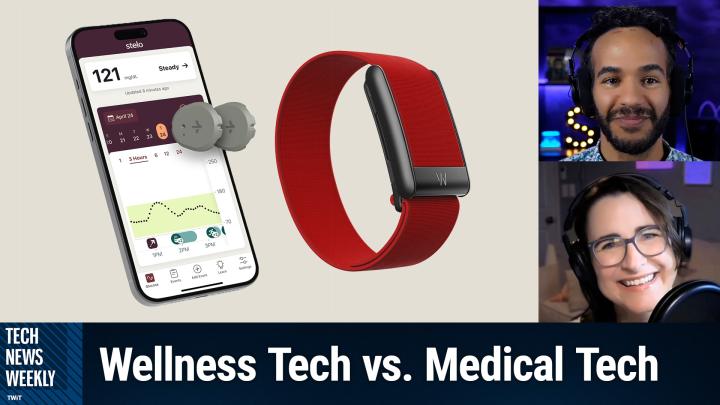
Tech News Weekly 398 Transcript
Please be advised this transcript is AI-generated and may not be word for word. Time codes refer to the approximate times in the ad-supported version of the show.
0:00:00 - Mikah Sargent
Coming up on Tech News Weekly. Jennifer Pattison Tuohy of The Verge stops by to talk about her time with Amazon's virtual assistant, now that it's gotten more agentic. Then Victoria Song, also from the Verge, stops by to tell us about how wearable tech companies are using wellness to escape FDA regulation. Finally, I round things out with a story of the week about Google's age verification tech, now that it's rolling out in the US. Stay tuned for this episode of Tech News Weekly.
This is Tech News Weekly episode 398, with Jennifer Pattison Tuohy and me, Mikah Sargent, Recorded Thursday, July 31st 2025. How wellness became tech's regulatory escape. Hello and welcome to Tech News Weekly, the show where every week we talk to and about the people making and breaking that tech news. I am your host, Mikah Sargent, and I am joined this week by Jennifer Pattison Tuohy of the Verge. Welcome back, JPT.
0:01:18 - Jennifer Pattison Tuohy
Hi, I know it's been a long time. Very happy to be back though.
0:01:22 - Mikah Sargent
So happy to have you here. For people who are tuning in for the first time, we typically kick off the show by sharing some of our stories of the week. These are stories that we think are interesting we want to share with you and, in some cases, stories we've written ourselves. What, as is the case this week. I think this is going to be an interesting one for our dear dear John Ashley, our producer, and our technical director and editor, who is going to have to work around the use of the A word.
We can just go with the A word yeah, yeah, or like Amazon's assistant or assistant would be good, because you finally got to try something out. Why don't you tell us about what's been going on?
0:02:12 - Jennifer Pattison Tuohy
Yes, yes, so I got access to Alexa Plus. Sorry, that will be the one time I say it.
0:02:19 - Mikah Sargent
We'll see yeah.
0:02:20 - Jennifer Pattison Tuohy
I'll try. I'll try. I've talked about this a bit and it's a challenge. Yeah, I'll try. I'll try. I've talked about this a bit and it's a challenge. But yes, the new generative AI powered assistant from Amazon, which launched officially in well, was announced officially for the second time in February of this year and it is started to roll out in March a slow rollout and it took a while, but now I think we're starting to see quite a lot of people with it. So there's been a few reviews out there, but I got access. So this would be about three weeks ago now. So I was on vacation last week, so sorry that my story of the week's a little behind, but I've actually written two stories about it so far.
I haven't done a full review yet because it is still in better and we don't normally review products until they're fully in the wild, although how long it will take for something like this to become fully cooked we may have to sort of. But eventually Amazon will launch this so that anyone can get it, and I think that would be the point where we look at it a bit more critically, because right now it is in an early access phase, so anyone can sign up to ask to access it. But you sort of have to get chosen and get an invitation to use it and when you do you can access it. They say ideally you need to have an Echo Show 8 or an Echo Show 15 or an Echo Show 21. And I tested it on a 21 and a 15. In fact I have the 15 right here. Oh hello. Yes To sort of show, because one of the key differences beyond the actual voice interaction when you get access to the plus version of Amazon's Assistant is a an entirely new interface on the show devices and this is really nice. On the bigger devices, the smart home panel in particular is great, much more intuitive. You can do more with it. You can see all your cameras If you have a lot of ring cameras, and Arlo cameras also work with it. There are other cameras too. I just haven't tested them all yet. So that's a big change.
But the big big change is that the assistant is much more conversational, understands you better. You can talk to it without saying the A word repeatedly. You start once and then you can just kind of go back and forth saying the A word repeatedly. You start once and then you can just kind of go back and forth. Actually, my biggest frustration with that is I kind of wished it would stay connected to the conversation for longer. If I paused for too long I'd have to start again, but generally like one of the things.
So I wrote two articles so far with my experiences, the first being sort of my first 24 hours, and then the second focusing on the generative AI, sort of AI agent features that have now come to the system which weren't really there before, and so the first 24 hours, the thing I found that I liked the most was that conversational back and forth and it was so good for cooking and this is something that I've wanted in my smart home for a while like a much better way to cook hands-free. And Amazon has sort of offered this with the A assistant, for you know, you can use your smart display to follow along with recipes, but it was never great. It was never a great experience. It would always lose the recipe and it was just frustrating.
But now, with this more so, the Amazon Assistant can now remember things that you tell it. So once I've told it what recipe I want, that recipe is now in its memory and I can sort of say, oh. So what is the number of? How hot do I need to turn the oven on? And it doesn't. I don't need to say for which recipe. It knows that that's what I'm talking about. It understands the context. So, for example, I, you know, I made fish tacos, um, salmon tacos. And you know, I was like, oh, I'd gotten halfway through the process and I said A what's the temperature I need to turn my air fryer to? And it could tell me, without me saying what's the temperature for the salmon taco recipe. So it's like having someone there reading the recipe for you.
That is nice, right, while you're in the middle of it, yeah that's been great, but on the flip side, there's limited number of recipes that it has access to. They tend to just sort of be the food network, and I'm a bit snobbish about my recipes. So, actually, in terms of a newsy thing right now, in fact, we just saw I think it was yesterday Amazon announced its partnership with New York Times, which had been announced earlier in the year, but now it looks like things like the New York Times cooking recipes will be coming to the assistant, which I'm excited about, because I actually did pay for that and it's expensive it's like $5 a month. So I'm hoping that those types of upgrades to the Assistant, more and better content. We need to get more out of these new capabilities it has, I think. Which leads me on to the other thing that I've been testing, which is its agentic AI features, which is a bit of a stretch to say.
I don't know whether this is really agentic AI or if it's just really good API integration. It's kind of a fine line there, and this is what we're seeing with generative AI. It's you know. I mean, chatgpt recently launched something that was able to go out onto the web and shop for you. What's happening here is that Amazon has partnerships with specific websites. So Ticketmaster, opentable, Thumbtack, and so the idea being, I can just say, hey, I wanna go see a show, what's a good thing happening in my area in the next few weeks, and it makes some suggestions and I was able to go through and book tickets. That actually worked really well, but it only works with Ticketmaster. Ticketmaster is pretty much the only way you can buy tickets, so that worked okay.
But then I went to book a table and it only works with OpenTable, not Resi, which is what most of the restaurants in my area use. So the options there were kind of limited and I I kind of tried to play with it a bit with the conversationalist, you know. I saw I sort of said originally I said book me a table for tomorrow. And then I said actually, no, changed my mind, book it for next week on Friday or book it for two weeks on Friday. That was what I said and it, admirably, was able to adjust and be like okay, I'll book it for Friday, july 28th. No, I think it says it on there, which would have been oh yeah, it said I'll book it for Friday, july 31st, something like that.
Actually Friday was August 1st, so it ended up booking me a table on Thursday. So it got messed up. So, yeah, it didn't, but I did throw a curveball at it. But it confidently told me it had done it correctly and it hadn't. And that's again a problem with generative AI all around, you have to sort of double check its work and it's a lot harder to double check the work of something that is a voice assistant as opposed to when you're sitting in front of your computer or with your phone, when you can kind of click a link. So this, I think, is one of the reasons why they're really pushing it. Amazon's really pushing that you should be using the show devices with the A-Lady.
Plus the assistant, Although it does work with speaker devices. So I've used just the regular Echo and I do get the new assistant in there. But what happens when you do use the show devices is it's showing you what you said. It's like a chatbot window on the show device, which is useful because you can kind of see how it's adapting to what you've said. And when you say something and it's heard it incorrectly, you can actually see it changing and understanding that it heard it incorrectly and it changes what you said to what you should have said. Does that make sense?
0:10:40 - Mikah Sargent
It like adapts.
0:10:41 - Jennifer Pattison Tuohy
Yeah, no, that makes sense, yeah, and so that's been really. I mean, having lived with Amazon's assistant for a decade, I've gotten used to speaking in a specific way to it to get it to do what I want, and this has been quite free. Them are still a bit limited in terms of the more it's going to go and do things for you, like booking restaurants and booking an electrician. I didn't have a lot of luck with that, and I think. And then the smart home would be the other side, and I have not done a sort of deep, deep dive on the smart home side yet, but I have done a few things which I've really enjoyed. The first is-.
0:11:31 - Mikah Sargent
Well, I would like, I want, to talk to you about it. I think we're going to do a little bit of a pivot here. Because I have a lot of questions.
And so what we'll do, and we'll continue with your story after we take a little break where I can ask you some questions about it and where things stand right now, because I have not had the opportunity to check out ALEXA Plus yet.
0:11:55 - Jennifer Pattison Tuohy
That's a good way of doing it.
0:11:58 - Mikah Sargent
I used to do the Smart Tech Today podcast and during that I sort of developed this little podcast and during that I sort of developed this little. My mouth sort of has this built-in A-L-E-X-A. It's just built in now.
But let me tell you about our first sponsor for today's episode of Tech News Weekly, brought to you by Starlight VMs, spaceship's virtual private server hosting built for performance. Super exciting, I love this. You probably already heard us mention Spaceship. They're a domain and web platform that simplifies choosing, purchasing and managing domain names and web products, including hosting. I talked about setting up a website very easily and now, wow, let's talk about even more. Have you ever struggled to find budget-friendly hosting that meets your needs? Well, introducing Starlight VMs, industry-leading VPS hosting that meets the high demands of seasoned web pros. It offers total flexibility, with options to fine-tune your plan to include bonus storage or a super-fast CPU, us or Singapore data center the choice is yours. You can choose the one closest to you to ensure faster response times. Starlight VM's detailed analytics offer a complete picture of how things are performing CPU, ram, network traffic, disk space. You get the whole picture so you can fine-tune for efficiency and forecast costs confidently. Starlight also includes a pre-installed software package allowing you to choose from some of the most popular operating systems around which you know you might be going. Okay, I'm hearing this. I'm hearing this virtual machine. Yeah, it's starting to add up. Sounds expensive, right Wrong. With flexible billing plans. You can pay monthly, yearly, or even try pay-as-you-go for an hourly rate where you pay for resources after you use them. Go to spaceship.com/twit to find more info about Starlight VMs and get custom deals on spaceship products. That's spaceship.com/twit and I think I might have to go there and set up a virtual machine. Start playing around in that space. Very exciting, spaceship.com/twit. Thank you, spaceship, for sponsoring this week's episode of Tech News Weekly.
All right, we are back from the break, as I mentioned, joined this week by Jennifer Pattison Tuohy of the Verge, and before the break, Jennifer was telling us about her time currently with ALAXA+, the beta version of Amazon's Virtual Assistant that is a little bit more agentic, a little bit more intelligent, allegedly a little bit more capable. And you talked about your experience. Yeah, in some ways, thus far, the first thing that I wanted to ask you because, as you're talking about it, you mentioned that it has integrations with other services, so you were able to buy tickets, you were able to do a few things sort of alluded to at the beginning. Sounds a whole heck of a lot like API integrations, which is something that we've had through IFTTT and even, to a certain extent, shortcuts from Apple and some of the other kind of automation platforms that are out there. When you first heard about Amazon's virtual assistants getting these new features, is this what you envisioned?
And then, secondarily, how would you compare this to something like the recent agent that ChatGPT released and forgive me if I'm putting you because I know you were just on vacation, but ChatGPT just released its agent that I just the other day, as a test, I said go to Etsy and find me sewing patterns I could use for a costume for the Renaissance fair, just to see what it would do. And it went to Etsy and it found a bunch of patterns and it created a graph and dah, dah, dah, dah dah. It doesn't have an integration with Etsy, it just did the browsing and went there and did it. Yeah, so maybe you could compare it to that and your expectations for what you were hoping it would be, with the understanding everyone watching and listening that this is currently a beta product and more could happen over time.
0:16:25 - Jennifer Pattison Tuohy
Yeah, I mean there are quite a few things that they said are still coming, that were announced at the launch, that are these more, more agentic kind of features. So right now it's as I said. It is limited to OpenTable, thumbtack, uber and then a couple others that I'd already mentioned. Ticketmaster and you know we used to have an Uber integration with ALAXIA before.
So the big difference is the natural language that you know. You are actually able to like converse rather than have to, because the problem with those a lot of those early ALAX-A-E-X-A skills I don't have it down as well as you was that they required very specific nomenclature that you would forget how to say and then you'd try and do it and it wouldn't work or it'd get confusing and try and do something else for you. So that's you know. That's where this is now much easier to use. I had never really had any luck with those. I think you could order like a Domino's pizza that was another one they had. Those kind of skills just never really took off. I think the natural language makes this a lot easier In terms of the comparison to what chat GPT agents, open AI agents, can do. I haven't tried them myself. We do have an article on our site of our AI reporter who did do sort of spent the day shopping with it, I think um. So right now I think we will see the um a plus get more of those capabilities. I think amazon is being very slow and deliberate here for a reason because, as I mentioned, it's different doing this type of thing in a browser or a text box on your computer versus doing it with your voice. It does need to be a little bit more tightly controlled in that environment because you don't have the ability necessarily to easily go check or confirm or act in a different way if it's done something you don't want it to do because it's contained in your computer, as opposed to being going off and doing things in your home, as I mentioned briefly. You know obviously this. Now there's the smart home component too, with A plus.
So there are. I'd like to see it be able to do more, but right now there are a lot of similarities to what you can do with things like ChatGPT. You can actually use a text browser in the ALXEA app on the phone and just in the same way as you would with ChatGPT, and you can send it things like I could send it a recipe that it didn't have when I was saying it was limited recipes. I could send it one of my recipes. I had to send a picture of it, I couldn't send a URL and then it would remember that recipe and I could use that recipe in the future. So it does have that sort of memory element which you also get from chat GPT in some versions, I think. I think it depends what you pay for, right? I'm not 100% sure, but yeah, yeah, it does, it does. Yeah, yeah. So obviously, Alexa Plus is going to be a paid-for service eventually $20 a month or included in Prime.
So there are, and I did. I wanted it to be able to do more. I wanted it, I wanted to be able to forward, so you can forward emails to it. You have an atalantacom email address that you send things to and so I could send, like I sent my book club email.
I got from my book club saying these are the books we're reading and these are the dates, and I wanted it to add those to my calendar. And I also said you know, I wanted it to add those to my calendar. And I also said you know, I wanted it to add the books to my Amazon shopping cart so I could buy the books or put them on my Kindle. And it got messed up and couldn't and got a bit confused and put the books on the wrong date and maybe it wasn't clear enough. But that's what you want these types of technologies to do is to be able to pass this information for you, and I think I also sent it like my kids' school lists, and I did what I think Amazon's ultimate goal here is. I said add these all to my, to my Amazon shopping cart.
Right, yeah, that's what they really want, because they want us to spend more money and it failed spectacularly at that, which I was very surprised about, like I figured that was kind of like table stakes. So yeah, there's still a lot of work to be done here and I think they know that that's why it's not out in the real world, but there is some potential. I've definitely enjoyed the conversational back and forth a lot more, although I do hear a lot of complaints about it getting kind of annoying, because if you're used to very terse responses from the old AI and now you've got this more conversational, like chatty, more personality, and actually I did change the voice the voice is so different the default voice that it's kind of jarring. Especially, you know, I've spent a long time with this AI in my home and suddenly there's this whole new one and it is very who are you? Yeah, my daughter's reaction was actually very similar, like oh, what is that? This is weird because you know she kind of grew up with the old Right.
0:21:36 - Mikah Sargent
Alexa that because she kind of grew up with the old Alexa. That's Auntie Alia.
0:21:39 - Jennifer Pattison Tuohy
Auntie A.
0:21:40 - Mikah Sargent
Yeah, auntie A, exactly Now, one of the things that you mentioned too that I thought was interesting is you make the suggestion that possibly one of the reasons why the show is the device category that Amazon is starting with in terms of being able to roll this out in early access, is because it gives you the ability to see how it is interpreting you or misinterpreting you and act on that.
And one of the things that I said I remember saying this you know, early on, when Amazon had come out with its, you know, echo Tower and the other big tech companies were working on virtual assistants.
You would see so many of these other virtual assistants because they had the ability to give up and kick it over through the phrase of I'm sorry, I can't figure that out, or you can search, I can search the web for you or check your device to see the response. Right, yeah, but Amazon, when it came out with that tower, the developers did not have the ability to kick it to something else that you either answered or you couldn't answer, and I think that it resulted in, in the early days, Alexa being pretty impressive because of that limitation where there was no opportunity. Yeah, forced it to answer more questions than maybe you would otherwise have, and now it makes me kind of wonder if, in this, because there's such a mad rush for everybody to be on the same level with AI, do you feel like that has impacted and this is as an aside you being someone who's watched what Amazon has done for so long? Well, let me not make it a leading question having its consumers test its products by launching them while they're still, you know, being worked out.
0:24:08 - Jennifer Pattison Tuohy
Yeah, well, so the thing that has become very clear. And they did. I spoke with Panos Panay at the event the launch event in February, and they said I spoke with Panos Panay at the event, the launch event in February, and they said clearly at that point this is not your old A-L-E-X-A, this is entirely new and that has been. I think that's to your point about the difference between the speaker and the display. Like this one is much more geared towards visual interface. More geared towards visual interface Because when you ask it questions about the cooking or about when I was looking for an event to buy tickets for, it brings up images for you to select, you can scroll through and tap. So it's almost like using a computer, more so than using just the voice assistant. There's more of an interactive touch component. You don't have to, you can use your voice, but it's quicker and the old version, as you say, definitely was much more tailored to voice.
This one feels more tailored to visual interaction, which I think is a sorry got momentarily distracted there which I think is a good. It really is going to be the future of this type of control because it's so much more detailed, like there's so much more you can do. I think amazon was always a little restricted because it didn't have that interface and when the when the show the original show out, we were kind of excited for more value that we could get and it never really fulfilled that. It always felt sort of a frustrating add-on to the voice assistant and not really bringing any much more value other than lots of ads. That was mainly what we got from the original shows.
So I think we have to view this as a new assistant. It's not the old one anymore and there are some teething pains there. And to your question about testing it with existing customers, I've seen a lot of complaints around things that it used to be able to do, that it can't now, and this was always going to be the problem mainly around smart home control. I'm sure that they're working on the bugs, working this out, making sure companies have brought their, you know, have updated their integrations. But ultimately, I think you know, especially with the smart home in general, the legacy side is hard. When the technologies change, it can be really difficult to keep the old stuff there while bringing the new, and it's admirable that Amazon's trying to do it. But ultimately, if we're going to get a better experience from this more conversational, this smarter in air quotes artificial and intelligent assistant, then that's going to be better in the long run rather than sticking to the old command and control way of doing things, which worked. But it took some work to get there on our part.
0:27:11 - Mikah Sargent
Yes, it really did. We did. We had to do a lot of work. Thank you for your initial impressions of ALlexa plus uh. I know there will be more to to see as the uh as it goes out of this early access and into its final form, or at least it's its shipping form. Of course folks can head over to theverge.com to check out the great work that you're doing there. Is there anywhere else they should go to follow along with what you've got?
0:27:40 - Jennifer Pattison Tuohy
Well, just on theverge.com, we have a new system, a new feature, now called Follow, so you can go there and just follow people like me or subjects, like you can follow Amazon. You can follow Smart Home, and we'll send you little daily digests of everything we're doing in your email. So do jump on there and follow me if you want to get more from what I've been doing, and I'm also going to be hosting a couple episodes of the Verge cast next month, so be sure to check those out. There's some fun stuff coming and I'm on the threads and the X's and the TikTok's coming
0:28:23 - Mikah Sargent
Thank you so much and wish you all the best and we'll see you again soon. Thank you All righty folks. It's time to take another break before we come back with what another Verge individual, Victoria Song, will be joining us soon to talk about wearables.
But first let me tell you about US Cloud, who are bringing you this episode of Tech News Weekly? Us Cloud, the number one Microsoft Unified Support replacement. We've been talking for a few months now about US Cloud. We know they're the global leader in third-party Microsoft support for enterprises, now supporting 50 of the Fortune 500,. Switching to US Cloud can save your business 30 to 50% over Microsoft Unified and Premier support and it's faster two times faster average time to resolution versus Microsoft. But now US Cloud is excited to tell you about a new offering their Azure Cost Optimization Services. I think this is actually super cool the way that this system works, you know.
Take a moment, be honest, if you're dealing with Azure, when was the last time you evaluated your Azure usage? It's probably been a while. If it's been a while, you probably have some Azure sprawl, a little spend creep going on. But, good news, saving on Azure is easier than you think with US Cloud, because US Cloud offers an eight-week Azure engagement powered by VBox that identifies key opportunities to reduce costs across your entire Azure environment. With expert guidance. You'll get access to US Cloud's senior engineers with an average of more than 16 years with Microsoft products. At the end of those eight weeks, your interactive dashboard will identify, rebuild downscale opportunities and unused resources, allowing you to reallocate your precious IT dollars towards needed resources. Or you can invest your Azure savings in US Cloud's Microsoft support, like a few of US Cloud's other customers, and completely eliminate your unified spend.
Sam, the technical operations manager at Bede Gaming, gives US Cloud five stars, saying we found some things that had been running for three years which no one was checking. These VMs were, I don't know, 10 grand a month Not a massive chunk in the grand scheme of how much we spend on Azure, but once we got to 40K or 50K a month, it really started to add up. It's simple Stop overpaying for Azure, identify and eliminate Azure creep and boost your performance, all in eight weeks with US Cloud. Visit uscloud.com and book a call today to find out how much your team can save. That's uscloud.com to book a call today and get faster. Microsoft support for less. Thank you, us Cloud, for sponsoring this week's episode of Tech News Weekly.
All right, we are back from the break. Joining us also from the Verge today is Victoria Song. Welcome, Victoria.
0:31:25 - Victoria Song
Thanks for having me.
0:31:26 - Mikah Sargent
Absolutely. So I came across your article and was immediately like, okay, we have got to have Victoria on the show to talk about this because you see this trend. But until you sort of talk about this because you see this trend, but until you sort of say the quiet part out loud, it's not like people aren't catching on, I think, or at least I hadn't sort of formulated it in the way that you had. So your article tackles the kind of growing overlap between consumer wellness, gadgets and regulated medical technology. So to start, what is happening in the tech industry right now that makes the distinction between wellness and medical so important for consumers to understand.
0:32:05 - Victoria Song
Right. So you know, like this is kind of an argument about semantics and for a lot of people, their wearables or smartwatches are health trackers and fitness trackers and something like tracking your steps, tracking your, and something like tracking your steps, tracking your heart rate, tracking your sleep. Those are all considered wellness, because what you're basically doing is establishing a baseline. You're learning, kind of just for fun, what your basic metrics are, learning more about yourself as educational. But you know, ever since the Apple Watch got FDA clearance for the EKG feature, what that does is it helps detect whether you have atrial fibrillation.
Now we're getting into a territory where these devices are marketed as being able to save your life, because maybe it flags or alerts you to when there's an abnormal health event going on, and these are borderline diagnostic in some cases. So the reason this AKG feature needs FDA clearance is because, well, it's telling you you need to go to a doctor, right, it's saying like, hey, we flagged something here. This is kind of off. You may want to consult a medical professional about that. So that's very different, right, it's not just tracking something for fun or learning more about yourself. It's something that could actually inform your treatment. It's something that you could go to a doctor with, so that's a very important distinction, but what's happening now is that consumers are increasingly expecting more and more advanced features like this. There we go Flash flood warning.
0:33:53 - Mikah Sargent
It was bound to happen.
0:33:57 - Victoria Song
But yeah, so see, exactly you know these devices are notifying you when your life is potentially in danger. And so with medical features, it becomes this gray area, because now we're getting stuff that seems like it could be wellness, but it could also be medical. So the way that the companies are talking about these features has increasingly blurred the lines. They're saying things like these are clinically proven. We've done research. Well, what does clinically proven mean? For most people? It sounds to the average person that clinically proven, clinically validated that means science happened right and science can be done poorly. Science can be done really well, but what does that mean?
So the reason we have FDA clearance and regulatory oversight is to give people a sense like this is legit. This has gone through our nation's highest regulatory standards. But even saying something like FDA cleared, it's not telling you the whole story, because all FDA cleared means is that this product, before being marketed to consumers, has gone through the appropriate vetting process and has been deemed not to be a super high risk. That's all that. That's the only thing that means. So yeah, it's very murky.
0:35:27 - Mikah Sargent
As opposed to being something where you are proving its effectiveness right, Its efficacy. Rather, it's just a thing. Saying this likely won't kill you by putting it on your wrist.
0:35:42 - Victoria Song
Yes, exactly, it's saying this likely won't kill you. It's reasonably accurate based on because when you do go through the FDA clearance process, it is very rigorous. You do have to do studies that show accurate based on because when you do go through the FDA clearance process, it is very rigorous. You do have to do studies that show that it works on people of different skin color. It has to be proven to be HIPAA compliant, so there's a lot that actually goes into it. It's very resource intensive and it's very time consuming. A lot of companies take years to actually get these features, unless you're Apple or a big company with very deep pockets and regulatory know-how. It can be very challenging for some of these smaller companies to actually go through that process, and so a lot of them kind of rely on the wellness moniker, because the FDA is not going to go in and require that from a wellness product because it's just for fun.
0:36:39 - Mikah Sargent
So let's talk about an example of a product I actually happen to have on my finger right now the Aura hey, the Aura Ring is an example you bring up. Can you talk to us about Aura's features and its partnerships to illustrate this kind of trend of a wellness device crossing over at some point into the territory of making medical claims?
0:37:04 - Victoria Song
Yeah. So Aura is a really interesting example because they really do care about clinical research and that sort of stuff. So Aura, you know it started out as a sleep and recovery tracker and they were doing a lot of research into algorithms to tell you whether you're sleeping well or whether you're recovering well. And then the pandemic happened and they partnered with a bunch of researchers from different universities to see whether the Oura ring and temperature data could predict illness, and a lot of wearable companies were doing this at that time. They weren't the only one. Whoop was also a company doing this at that time. Apple, Garmin all of these companies were participating with various researchers to kind of pinpoint whether or not illness could be predicted through different changes in your biometrics.
And then, earlier this year, I believe, Aura came out with a feature called symptom radar, and so what symptom radar does is that it tracks your baselines and if it detects an early health change, you'll get a little flag, something that says something may or may not be happening. So it's not like what the original purpose was, right. It's not saying, hey, you're falling sick and ill with the flu, or you're falling sick and ill with COVID, Like it can't actually detect that. But what it now does is says like hey, you're showing signs of some kind of health change, early stages. Maybe you're falling sick, Maybe you're just extra tired, but it's flagging something, so you might want to take some early level precautions like hydrate more, sleep more, just do whatever it is that you do when you think you're falling ill.
Now that's the exact type of feature that you're like hey, is this medical or is this actually wellness? Who you know? Like I saw a TikTok with a celebrity DJ who is going like oh yeah, the main reason I have my aura ring is because it's going to tell me when I'm going to get sick. And it's like, sir, that's actually not what it's doing. It's giving you a flag saying that you're showing signs of a health change. So, like you can see how the semantics there change for wellness versus what is considered diagnostic and medical and requires FDA oversight. So it's very murky.
0:39:36 - Mikah Sargent
Yeah, and that murkiness. This wasn't a part of the original questions, but I want to ask you this because I know you pay very close attention to these wearable devices. It's the other W that this murky area has resulted in features that aren't as powerful and useful as they otherwise would be, because companies aren't wanting to devote the resources necessary to create a more powerful feature, given that it would require them to go through FDA clearance. Does that make sense, avoiding kind of making them more powerful, because it's like, okay, if we do that, then we're going to have to get FDA clearance first and that's going to cost even more money to make that happen.
0:40:36 - Victoria Song
Yeah. So that's like kind of the crux of what the whoop versus the FDA situation is, and so, like to catch people up, the FDA sent a letter to whoop earlier this month saying hey, this new blood pressure insight feature you have you messed up that requires FDA clearance and your marketing. It's available in beta to people, as is. And this is clearly a diagnostic feature, because the feature requires you to calibrate with an actual blood pressure cuff and then, once you calibrated it, you get an estimate every day of your diastolic and systolic readings and it kind of indicates to you whether it's high, low or good.
And so you know, whoops argument is that this is not a diagnostic feature.
This is actually just a wellness feature, in the same way that you track heart rate variation to see if you're stressed, in the same way that you track your heart rate.
This is not diagnostic at all, because we're not like telling you whether you have high or blood or low blood pressure, like we're not telling you that you have hypertension or hypotension, and so you can see the conflict really clearly there, because whoop is saying um, you know, we're just trying to come out with something that's innovative, that's going to help people think about their blood pressure in a different way and the FDA is like no, no, no, no, this is inherently diagnostic in nature.
People are going to see this feature and they're going to think, oh, my device just told me that I have high blood pressure. So, like you can see that both sides kind of have a point, because it is true to your point that you know companies are tweaking what these features could be to kind of get around the liability. One it's a liability issue if they tell you your diet, if they're diagnosing you with something and it turns out not to be true. That's not right. And then two, um, you know it is a massive investment for some of these smaller companies who are trying to innovate in the space to go like well, your health.
That has immensely high stakes and that requires a lot of money, not just to develop the future, but to then go through the regulatory process of it all. So it's both of these things and it's very prevalent in the health tech space at this moment. There's so many examples.
0:43:00 - Mikah Sargent
Yeah, and one of the features that you talked about that sort of really falls along the side of wellness, almost because of its lack of capability, one would argue, was the antioxidant feature. Can you tell our listeners, if they haven't heard about this, what is the feature? And then, how did you test it?
0:43:25 - Victoria Song
Okay. So Samsung just came out with its Galaxy Watch 8 series and one of the marquee health features with that is the antioxidant index. So I think last year I believe it was last year Samsung basically released a new three in one active biosensor that doesn't just have the green and the infrared LED lights, it has a whole assortment of colors and they told me at the time that that's going to open up a whole lot of different metrics to test. So this year they have the Antioxidant Index and it uses, I believe, the blue and infrared sensors to measure the carotenoid levels in your skin.
Now carotenoids we're getting into a science lesson here, but carotenoids are a type of antioxidant. You probably have heard about them. They're like beta carotene, lutein. They're these molecules that fight off oxidation in your body, and oxidation is associated with things like aging, chronic illness, just all the bad stuff that you don't want to have a lot of in your body and the antioxidants fight against the free radicals and oxidation. So carotenoids are the pigment that give you know carrots their orange color, bananas their yellow color, like it's basically something that you'll find in dark, leafy greens and an assortment of yellow, red and orange vegetables and fruits. So to test this feature. I tested it on a Cheez-It and various other fruits and it basically said the Cheez-It had a 99% oxidant. It was like 99% on the antioxidant index.
0:45:14 - Mikah Sargent
It's like eat this now. It will save your life.
0:45:17 - Victoria Song
And so I was like, oh well, that's silly, but it turns out that Cheez-Its actually the predominant cheese is cheddar, and cheddars does contain carotenoids. Oh, so there are antioxidants in the cheddar and cheese it's and you know, I'm not a doctor, I'm not giving you medical advice, but to me that means it's a healthy snack.
0:45:41 - Mikah Sargent
This is. That is just a wellness statement, not a medical wellness statement. But yeah, you know.
0:45:46 - Victoria Song
I tested it on a bunch of different things. Like I tested it, I colored my thumb because you have to use your thumb on the sensor to to test this feature. But basically I colored my thumb because you have to use your thumb on the sensor to test this feature. But basically I colored my thumb different marker colors like yellow, orange and blue. When I colored it orange it was like you are great, you are getting 100% antioxidants. And when it was blue it was like zero antioxidants.
I eat a lot of vegetables and fruits so I was like this sounds a little sus. I tested it on broccoli 100% for broccoli. I tested it on a blackberry that exploded because it's a blackberry and berries don't do well when you press them against things. The berry only got 37 on the antioxidant index. So you know it's an example of a feature that sounds very scientific but can be fooled by various different things. And ultimately, how are you supposed to use it? Well, like I think the way that you use it is if you're starting out on a new diet or if you're trying to get better vegetable intake. You eat a certain amount and check it over time and you kind of level set that way and you learn like, oh, the amount that I'm eating every day, yeah, that's about what I want to be aiming for. So, like that is inherently what wellness features are supposed to do. You're supposed to learn a little bit about yourself, adjust your behaviors accordingly, and there's no real diagnostic element there.
0:47:24 - Mikah Sargent
Absolutely the last thing. I want to ask you some advice. For an average person trying to buy a smart ring, a watch, another wearable, it can be difficult to tell just by looking at it. What is a simple wellness tracker versus a validated health tool. Do you have any kind of red flags or key things that one should look for when they're attempting to determine is a feature going to actually provide helpful information? Is it just a suggestion, that kind of thing?
0:47:59 - Victoria Song
So one of the red flag phrases that I look for are things like clinically proven, clinically validated, clinically tested, because what does that actually mean? Right, like it implies that a bunch of rigorous science has been done, and in that case I would ask you to go to the company's science page. One, they should have a science page, if that's true, where they communicate what the science is. And two, you should look if they're peer reviewed or if it's going to be something just like a white paper, because some of these companies are like we have a white paper, are like we have a white paper. That's not clinical testing, my friends. Clinical testing is being published in a reputable journal, which also is an expensive thing for smaller companies to do, and it means that it's been peer reviewed. So, yeah, I would be very skeptical. Like I tested actually this is me going on a tangent again but I tested a product a while back that said it was clinically validated and I went to their science page and it was a very slick science page. And then, when I was clicking on all of their studies, it was by the same guy. It had very small sample sizes, like 10 people. That's not clinically validated, in my opinion. So you have to be very careful when you see clinically validated or clinically proven as a phrase.
The other thing I would look for is whether they say it's FDA cleared, because FDA approval actually is kind of a flag there, because it's not FDA approval, it's FDA clearance. There are different meanings attached to the words FDA approval versus FDA clearance. So any of these health tech claims you're going to want to look that they're using the correct verbiage, and clearance is a sign that they're being very transparent about how they are communicating what this feature can do. You're going to want to look for things that say like this is not medical advice. You actually, in these cases, really do want to read the fine prints, because there have been studies done showing that people become very anxious and obsessive, compulsive, about these health features that are meant to kind of be a. These are, these are just fine, fun health features.
Uh, you know people get very neurotic about the ekgs, even though it's not really telling you much about your your heart health other than what your heart rhythm is in a very small slice of time. So you know, I would just look for the marketing. Medical grade is another phrase that I am very suspicious of when I see. Because what does medical grade mean? Officially, medical grade means doctors are using it in hospital settings. Are they using your health tracker in a hospital setting? Probably not. So you know, be very careful when a consumer health product is saying that they are medical grade, because that's a very loaded term.
0:51:04 - Mikah Sargent
So this is actually an interesting question that came from our Discord. That I think is fascinating, and I'm curious to hear your answer to this. Dustin says I'm curious if Victoria believes non-invasive blood glucose is just around the corner or if we're still a decade away when it comes to that technology.
0:51:25 - Victoria Song
Hey, dustin, I could talk about this for a very long time. It is. I actually wrote a story about this on the Verge that you can read. It's called, I believe the title is like if you're a diabetic, don't count on a smartwatch to replace your needles. Basically, because you know, we have been, as a society and as a research community, trying to make non-invasive glucose monitoring a thing since 1975. It hasn't happened yet, no-transcript of trying to do non-invasive glucose monitoring.
There are and I get into it in this article but there are a lot of challenges when it comes to glucose monitoring non-invasively through through light. You know certain things, like if we're using infrared tech, which is like what a lot of them are doing, it can be affected by the temperature, so a hot day could change what it's basically saying for you there. And even if we do get non-invasive glucose monitoring, it is likely not going to be what you think it is, because we have CGMs and CGMs are continuous glucose monitors. They're invasive. And the fact that you know what you think it is because we have cgms, and cgms are continuous glucose monitors they're invasive. And the fact that you know, like you put it, on your body, there's a little needle. It goes into your actual skin and it reads the interstitial glucose, interstitial fluid, glucose levels. And interstitial fluid is the fluid that's in between your cells, so it's not actually your blood but it's an approximation of your blood glucose. Those took forever and have only just become over the counter for non-diabetics and I promise you I'm working on a thing about whether it's actually useful for non-diabetics or not. That'll come from me soon.
But it's an immense process and the stakes are so high precisely because people with type 1 diabetes. They produce little to no insulin. Many of them produce no insulin. So if you're having a non-invasive thing and they're using it and it doesn't tell them the correct glucose level, they could die. So what you're likely going to see is what I think is like trends, aggregated trends, going like we're monitoring your glucose levels and it seems like it's getting higher over a period of time.
Maybe you want to go check it out at a doctor, like, effectively, that's what I think you're going to see from consumer companies, just because the stakes and the liabilities of a feature like that are so incredibly high and that's a clear example of a feature that you want to go through this incredibly rigorous vetted process. So you know, if something does come around the corner which I am highly skeptical about I do think we are going to be waiting much, much, much, much, much, much, much longer, several years, before anything like that comes out. I also think that it's not going to be what you think it's going to be when it does arrive, like if they do come out in the short term, it's going to be something closer to what I said, where it's like a trend graph with no direct readings. So that's, that's my spiel. It's. It's a thing I'm very passionate about. I do a lot of coverage about it on the verge, uh, trying to debunk all the people who are saying it's just around the corner, it's it.
I've talked to a lot of diabetes tech experts over the years. All of them are like Nope, it is not happening.
0:54:53 - Mikah Sargent
It's not happening, Not for a long long time.
0:54:56 - Victoria Song
Not in the sense that your smartwatch will be able to give you as accurate readings as a CGM, which you know CGMs aren't perfect devices either, so I think we'll be waiting for a long time. Again, this journey started in 1975. That's 50 years ago.
0:55:14 - Mikah Sargent
Well, Victoria Song, I want to thank you so much for taking the time to join us today to walk us through this wellness versus medical conversation. If people would like to keep up with the great work that you're doing, where should they go to do so?
0:55:29 - Victoria Song
You can find me at VicMSong on all the social platforms Instagram, blue Sky Twitter. You can find me at VicMSong on all the social platforms Instagram, blue Sky Twitter. Oh God, it's X. Now there's that, and then you can also see my byline on theverge.com. You can follow your favorite Verge authors now, so go give me a follow there if you would like to keep up with this particular hill that I love to die on about wellness versus medical tech. So yeah, that's where you can find me.
0:55:55 - Mikah Sargent
Thank you so much. Well, hopefully see you again soon.
0:55:59 - Victoria Song
Yes, see you soon.
0:56:01 - Mikah Sargent
All righty folks, we've got a quick break and then we'll come back with my final story this episode of Tech News Weekly brought to you by ThreatLocker. Ransomware is harming businesses worldwide through phishing emails, infected downloads, malicious websites and RDP exploits. You don't want to be the next victim. ThreatLocker's Zero Trust platform takes a proactive deny-by-default approach that blocks every unauthorized action, protecting you from both known and unknown threats. Trusted by global enterprises like JetBlue and Port of Vancouver, threatlocker shields you from zero-day exploits and supply chain attacks, while providing complete audit trails for compliance. ThreatLocker's innovative ring-fencing technology isolates critical applications from weaponization, stopping ransomware and limiting lateral movement within your network. ThreatLocker works across all industries, supports Mac environments, provides 24-7 US-based support and enables comprehensive visibility and control. Mark Tolson, it Director for the City of Champaign, illinois, says ThreatLocker provides that extra key to block anomalies that nothing else can do. If bad actors got in and tried to execute something, I take comfort in knowing ThreatLocker will stop that. Go to threatlocker.com/twit to get a free 30-day trial and learn more about how ThreatLocker can help mitigate unknown threats and ensure compliance. That's threatlocker.com/twit. And, of course, we thank ThreatLocker for sponsoring this week's episode of Tech News Weekly.
All right back from the break and I just have a quick one for you. I wanted to mention what Google is working on currently rolling out a new technology that could reshape how we think about privacy, about child protection and AI surveillance, because the tech giant has begun using machine learning algorithms to automatically detect whether users are under 18, analyzing everything from search patterns and YouTube viewing habits to account longevity, all without asking for your birthday. Now this development comes as governments worldwide are implementing increasingly strict age verification laws for social media and online platforms, which, of course, creates a perfect storm where privacy advocates, child safety experts and tech companies are clashing over fundamental questions about digital rights and parental control in the internet age. So, when we take a look at the age verification tech, Google's age estimation system is different from those self-reporting methods of yesteryear back, whenever I got a Facebook account before I was truly the age I was supposed to be, by just putting in a birthday that was much later. Rather than simply asking users to enter their birthday, the company is analyzing what it says are a variety of signals already associated with a user's account so that it can make educated guesses about age. Google is looking at the types of information a user has searched for. So you can imagine, you know a certain trend of information, probably more related to someone below the age threshold, the categories of videos they've watched on YouTube, as well as the longevity of the account, creating a comprehensive behavioral profile that can, google hopes, determine whether someone is a minor without requiring explicit age disclosure. Now, what makes this particularly significant is that the system operates continuously in the background. Google isn't just checking age at account creation. It's constantly reassessing users based on their evolving digital footprint. So you know, maybe you start to pay more attention to what you watch on YouTube. But let's talk about kind of what happens if Google determines that you are below this threshold. When Google's AI determines a user is under 18, a cascade of restrictions automatically activates across the company's ecosystem, not just on YouTube, but elsewhere On YouTube it turns on digital well-being tools like reminders to take a break and to go to bed, and add safeguards to content recommendations, including limiting repetitive views of some kinds of content.
I'll say I have watched a, and hopefully this doesn't sound like me being a grandpa about the situation, but I remember watching a young one playing on their iPad right, and they were playing I think it was Roblox, but there was a sort of ritual to how they would play on Roblox or on their iPad, because what they would do is sit down in a chair, comfy chair, kick back with the iPad, launch Roblox and then, on the television in front of them, go to YouTube and have it play. These sort of YouTube I don't know what they're called on oh, shorts, not reels, but shorts and it would just be hours of these shorts about mostly about Roblox, but also other goofy little things, and I'm talking like bite-sized clips and those are playing in the background while the child is on their ipad playing roblox, and it was as if both things needed to be happening at once and I just thought, wow, that is a lot of stimulation, but also a sort of interesting use of attention, because they're short clips but it's for hours and hours and hours, and that's kind of wild, anyway. So back to this, including limiting repetitive use of some kinds of content. I wonder if that's part of it.
There are limitations in Maps, so it will disable timeline in Maps. That, of course, is the feature where Maps kind of tracks your location over time and can give you information about where you've been. Advertising controls disabling personalized advertising and restricting age-sensitive ad categories. And then Google Play restrictions prevent users who are recognized as minors from accessing apps restricted to adults. These changes happen automatically. Who are recognized as minors from accessing apps restricted to adults? These changes happen automatically. Users will receive an email notification after the fact If the system makes an error.
Users have the option to verify their actual age through government ID, digital ID, phone number lookup or credit card verification. So there are a few options. Some people kind of were concerned in the beginning that well, what if I don't have a government ID? What if I don't have this specific requirement? Google has made a few available to users who have a Google account to try and get this figured out. But here's the thing this may be what's going on in the US, but there's sort of a trend happening and because of that trend, it's not surprising to see that Google is rolling this out, testing it in the US, because all around the world there's a global push for age verification requirements and this kind of scale of activity is I mean, it's big.
In the United States, as of 2025, 19 states have passed laws requiring age verification for various online services, with dozens more currently considering legislation. Florida's law bans children under 14 from social media entirely, while states like Georgia and Louisiana or Louisiana require parental consent for users under 16. And there's also, of course, the international movement. Australia passed legislation banning children under 16 from social media. The EU is working on guidelines for device-level age verification using what is being termed a mini-EU ID wallet. So essentially, my first wallet, my first ID sort of system, where people under age 16 will have this ID that says you know they're not of age yet and then needing to kind of have that be proved once you're older. New Zealand and Kenya introduced similar proposals, creating a global regulatory momentum as we see even more countries hopping on board. And, of course, in the UK we've seen actual pressure. Secretary Peter Kyle warns that platforms face quote tough sanctions, including heavy fines and, in some circumstances, prison sentences for executives, if children access inappropriate content. So it's no surprise that we're seeing these companies actively rolling out this technology to get ahead of this. But remember at the beginning what I said we go from a system where we type in our age or use the drop-down menu to select an age to a system where the AI is constantly keeping track of your behavior.
Google's approach attempts to solve the contradiction in current age verification debates, because there is an argument that these age verifications that exist, requiring government IDs, credit cards, biometric scans are a privacy concern, not just for children, but for even adults, because, yes, I am an adult and I can use this, but I have to prove that I am. So now I've got to give you my ID. Google's behavioral analysis promises to avoid these issues by working with data it already collects. And that's the thing. This is the magic of it, right? Because what's happening is it's just a light being shined on the fact that Google has already been collecting this information. It's got this already, but now we're just seeing. Oh right, that's right, google does have this information and, mind you, big tech companies in general have this information. It's not just a Google specific thing, as the company states. This approach does not involve collecting additional data or sharing granular user information with all apps and websites. It doesn't need to collect additional data. It's been collecting this data for a very long time.
But of course, there are new concerns. The EFF, the Electronic Frontier Foundation, says that mandatory age verification is the wrong approach to protecting young people online. Such systems actually do more harm than good by creating surveillance infrastructure that can be misused and of course, there's the chance that the AI gets it wrong. What happens when adult users find themselves locked out of services or subjected to parental controls? For me, for example, when I'm about to do a show and then suddenly I'm not able to access something because and I've got to, you know run upstairs and get my ID and take a photo of it or whatever I have to do quickly so I could get that. No, that's frustrating False negatives as well Minors who access age-inappropriate content so it doesn't seem as if they are underage, which will, of course, keep it from having the system safeguards kick into place. And then, of course, because I was one, all of you, I'm sure, were savvy, tech-savvy individuals, and so tech-savvy miners are going to learn how to manipulate their digital behavior to appear older and game the system. So you know, perhaps this is more effective in some ways than the previous systems we've had in place, but it doesn't completely stop the issues.
The company Google has not disclosed accuracy rates or details about how the machine learning models were trained or validated, and Google isn't operating in a vacuum. The company notes it is already using age estimation in other countries and says it has quote worked well. It specifically mentions that parents that let children use their accounts are encouraged to create a separate profile and utilize account switching features. So that gives you know them the ability to kind of understand that there's a difference between the family account and you know sharing. That can complicate age detection. So if the child wants to go on YouTube, google is saying you need to create a child account for your child, otherwise you may find yourself locked out.
And we've got this precedent for AI-driven content control because companies are going okay, all of these lulls about content control are coming into play, but we don't want to spend a bunch more money on it, so let's throw AI at the problem. It normalizes this AI driven content restriction rather than relying on user choice or parental settings or on human beings who are hired to sort of figure this out. The system makes automated decisions about what users can access, based on algorithmic assessments. We've seen this play out on the algorithm side, so I'm not surprised to see it on this side either A significant shift towards what some critics call algorithmic paternalism. I love that term. I want a hat, an embroidered hat. Algorithmic paternalism AI systems make decisions about what's appropriate for users, rather than leaving these choices to individuals or families.
The precedent could extend far beyond age restrictions. Of course. If AI can determine someone's age from behavioral patterns, what else could it figure out? Could it restrict content based on perceived political views? Stop you from viewing content based on your mental health status? Stop you from viewing content based on other personal attributes? Who knows? Google's rollout is just the beginning. The company plans to expand the system over the next few weeks to a small set of users before bridging that out from there.
The EU is funding this white label AAV wallet, which is going into beta release in this current summer, ahead of the digital identity wallet that's rolling out in 2026. So we will see government-backed age verification systems in the EU, and I do believe that Security Now was talking about that recently. See and Paul in our Discord brings up the point that I was talking about earlier. If you're looking at adult content online, is that considered an adult action? And that is the argument that some were making, which is that a child who is performing what the algorithm considers adult action may be able to game the system, because the algorithm is unable to determine that that is a child, because they're not doing childlike things based on what the algorithm believes to be a childlike thing. It's all about the definition and training provided by the human beings.
So will these technological solutions balance child protection with privacy rights, using an algorithm that's sort of in a box, doing its thing without humans being able to see? For the sake of not making it so that you have to upload your ID? Upload your, because that's the other option. Right, there may be other options, but the current options appear to be let AI handle it and then you only have to do the ID verification if you for some reason, make the algorithm go you're a child or just, from the get-go, make you verify your age through your ID. I think I would prefer, if age verification is a requirement, to not have to give my ID unless I was required to, because my actions appear to suggest that. So that is something to bear in mind when it comes to that. And the approach doesn't involve collecting additional data or sharing granular user information with all apps and websites. That's Google's justification for this behavioral age detection that look, we're using what we already have, so it's just being repurposed in a new way. We'll see how much and how quickly this rolls out to all of Google's users in the US and as other companies follow suit on the age verification front.
That, folks, is going to bring us to the end of this episode of Tech News Weekly. I want to thank you so much for being here. If you would like to subscribe to the show we've got it, of course, in audio and video formats Head to twit.tv/tnw, where we publish the show every Thursday.
I want to remind you about Club Twit at twit.tv/clubtwit, a great place to go to chat with your fellow Club Twit members in the Discord, which is always a fun and lively place.
There is also the opportunity to get our wonderful Club Twit feeds that include clips and bits from different shows. We've got our special Club Twit shows that get published there and our news events are there as well. Great times in the Club Twit with those feeds with so much content. We were just talking the other day. Some of our longest recordings exist in the club. So Leo and my coverage of WWDC and the platform State of the Union and Richard Campbell's recent computer build, or PC build, are club twit exclusives, and those are two of our longest in duration bits of content that we've ever ever made. So if you want to gain access to that, you've got to join the club. Plus, I am planning on running a Dungeons and Dragons campaign well, a one-shot adventure, for it's looking like hosts and contributors of Twit and very excited about that, and that is going to be a Club Twit exclusive as well. If you want to get all of that plus ad-free content, you need to join the club.
twit.tv/clubtwit. We've got monthly and yearly plans available to you. Month, monthly and yearly plans available to you. Monthly and yearly options available to you. If you'd like to follow me online, I'm at Mikah Sargent on many a social media network or you can do chihuahua.coffee that's C-H-I-H-U-A-H-U-A.coffee, where I've got links to the places I'm most active online. Be sure to check out my other shows iOS, hands on apple, which published today, and tune in on Sunday because I'll be recording Hands-On Tech for the month of august. Thank you so much for being here and I'll catch you again next week for another episode of tech news weekly. Bye-bye
1:15:33 - Leo Laporte
Bye-bye the tech world moves fast and you need to keep up for your business, for your life. The best way to do that twit.tv. On this Week in Tech. I bring together tech's best and brightest minds to help you understand what just happened and prepare for what's happening next. It's your first podcast of the week and the last word in tech. Cybersecurity experts know they can't miss a minute of security now.
Every week with Steve Gibson. What you don't know could really hurt your business, but there's nothing Steve Gibson doesn't know. Tune in Security Now every Wednesday. Every Thursday, industry expert Mikah Sargent brings you interviews with tech journalists who make or break the top stories of the week on Tech News Weekly. And if you use Apple products, you won't want to miss the premier Apple podcast now in its 20th year, MacBreak Weekly. Then there's Paul Thurrott and Richard Campbell. They are the best connected journalists covering Microsoft and every week they bring you their insight and wit on Windows Weekly. Build your tech intelligence week after week with the best in the business. Your seat at tech's most entertaining and informative table is waiting at twit.tv. Subscribe now.