TWiT+ Club Shows 736 Transcript
Please be advised that this transcript is AI-generated and may not be word-for-word. Time codes refer to the approximate times in the ad-free version of the show.
TWiT.tv [00:00:00]:
This is TWiT.
Leo Laporte [00:00:03]:
Hello, club members. It's time once again for our photo segment with the super talented photographic guru, our leader, Mr. Chris Marquardt. Moin moin, Chris.
Chris Marquardt [00:00:15]:
Moin moin, Guru. That's nice. Ah, feels so good. These are great.
Leo Laporte [00:00:21]:
Namaste. You're the sensei. You're the photo sensei, which actually is kind of accurate.
Chris Marquardt [00:00:27]:
Uh, not really, not really.
Leo Laporte [00:00:29]:
You're our inspiration. Anyway, Chris is a very talented photographer. You'll find him at chrismarkwart.com, where he also leads some wonderful photographic, uh, workshops at discoverthetopfloor.com. And he joins us monthly to give us a photo assignment and review the previous assignment and cover some photo news, which you're about to do now. Normally we also take questions from the web, but, uh, something's wrong with Airtable today. Yes. And, uh, it's probably, you know, one of those, uh, server things, but, uh, we can do them from the chat room if you want. Um, hello Chris, how's everything going?
Chris Marquardt [00:01:09]:
Everything's going just fine.
Leo Laporte [00:01:11]:
Did it snow in Hanover? Was it really cool?
Chris Marquardt [00:01:13]:
Yes, it did. It did. We had a— we had a couple of weeks of snow and yeah, then we had no snow and now we had a bit of snow again and then we have no snow again. Again. So I think, I think this is the— this is the last spell of winter, and then we'll see the springtime. Light is coming back. That's good for photography.
Leo Laporte [00:01:32]:
One of the things that happens as the winter recedes and the snows melt is things get aflowin'.
Chris Marquardt [00:01:40]:
They do. Oh yes, they do.
Leo Laporte [00:01:43]:
Maybe that made it easier to fulfill your assignment this week.
Chris Marquardt [00:01:48]:
Well, I'm not sure. I guess most of the pictures here are not really about, about They're not flowing? Coming back. Well, no, they are all flowing. They're all flowing, but— Oh, okay. Spring, spring coming, light coming back. The first one I chose is by Damien Lante, our friends.
Leo Laporte [00:02:07]:
They're back at it again.
Chris Marquardt [00:02:09]:
And it's a night photo.
Leo Laporte [00:02:11]:
It's Thursday night to be specific.
Chris Marquardt [00:02:14]:
Thursday night waiting for the bus to go by. So that's a classic. It's a kind of a classic shot. Normally you would take that kind of a shot with a camera on a tripod or leaning against something. Uh, this one, if you look at the, like, the KFC logo on the right, is clearly handheld. So it's a handheld, um, how long was it exposed? 20 seconds. Oh, 20 seconds. Okay, so it is leaning against something, somehow stabilized.
Chris Marquardt [00:02:45]:
f/22, 20 seconds, um, semi— apparently semi-handheld shot. And, uh, yeah, you'll see, you see lights flowing by the car lights.
Leo Laporte [00:03:00]:
How would you do handheld at that length of time?
Chris Marquardt [00:03:03]:
That's— well, if you lean against something, if you have good in-body stabilization cameras— we'll talk in the news, we'll talk about how, how far that has come. But, um, uh, nowadays if you look at, um, if you look at cameras with, with good in-body stabilization, you get quite some stability.
Leo Laporte [00:03:22]:
Well, also, this is telephoto. This is 70mm, which makes it even harder to hold steady, right?
Chris Marquardt [00:03:28]:
Yes, it is.
Leo Laporte [00:03:28]:
Wow.
Chris Marquardt [00:03:28]:
And it's a, it's a, it's a 5D Mark IV, so that camera does not have in-body stabilization at all.
Leo Laporte [00:03:34]:
It's— and it's heavy to boot.
Chris Marquardt [00:03:37]:
Yeah, so they used it probably leaning on some, on something. It's probably set down on something.
Leo Laporte [00:03:44]:
It's a little jiggly, I have to say. It's not perfect, so it could— that's why. But that's like that KFC sign, which didn't move. So that means it is probably handheld, right?
Chris Marquardt [00:03:52]:
A tripod— it is kind of charming, you know. It's this ad hoc snapshot type of thing, but of something that is not necessarily snapshot material, right? Um, because it's moving. So I like it.
Leo Laporte [00:04:06]:
Yeah, I mean, you do it again. Now, you don't— we should mention this because people are saying Chris has a soft spot for Demi Lenti. You don't look at the I do
Chris Marquardt [00:04:19]:
not look at, at who's, who's the submitter. I look at the thumbnails. So the first— if, if you want to, if you want to kind of charm your way in, make sure the thumbnail looks good, because that's the first thing I look at, and that's often how I decide. And then you, um, you have a good chance if the thumbnail is enticing, if it's intriguing, then, um Yeah, I, I will definitely open it up. And, um, and even then I typically don't look at the names. If you, if you saw my screen here, they're actually like, the window isn't even big enough to show the names. I just see the picture. It's good.
Leo Laporte [00:04:58]:
Good for you.
Chris Marquardt [00:04:58]:
And the second one is— I think
Leo Laporte [00:05:00]:
the thumbnail got you on this one. This has got a great thumbnail, huh?
Chris Marquardt [00:05:05]:
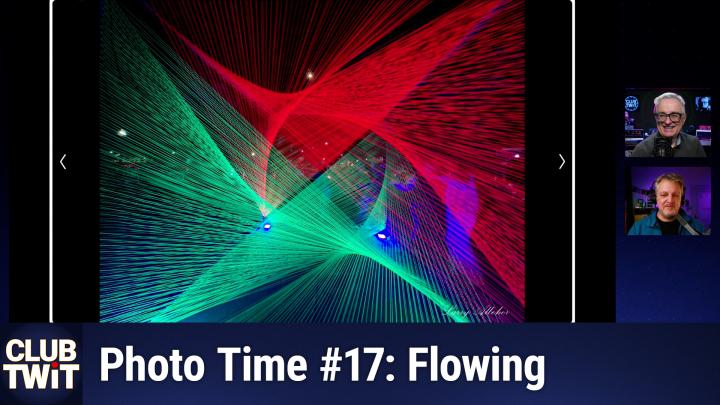
Webweaving Napa Lighted Art Festival. So they apparently have a festival about light. And this one, this is interesting because if you look closer, um, initially it looks like it's kind of a laser show thing with lights weirdly going around. But then looking closer, it looks more like it's a bunch of colored strings and lights on them. So— oh, Doesn't it look like— well, or it's lasers. I'm not sure.
Leo Laporte [00:05:39]:
Did they, when you were a kid, uh, I don't know if this made it to Germany. We used to have a toy called the Spirograph and it was— oh yes, I know this. Yeah, yeah. You put a pen in a gear and you turn it and it would— yes, and you keep going and it would make these— and it kind of looked to me, looks like a Spirograph a bit. A bit.
Chris Marquardt [00:05:57]:
Or, or have you, or have you seen these, these, um, where you have lots of little nails on the board and then you— yeah, yeah, more like that.
Leo Laporte [00:06:04]:
Yeah, yeah, yeah.
Chris Marquardt [00:06:06]:
That looks, that looks like that.
Leo Laporte [00:06:08]:
We had an Advent of Code problem this year that was— get this— you had nails on a board, you do the strings, and then you had to figure out how many times the strings crossed based on the nails. And it— and, you know, the— of course, the first problem is fairly easy. The second part of it is fairly hard. And it got to be— the image got to look like this, and that got— I mean, how would you count how many crossings There are.
Chris Marquardt [00:06:35]:
Find an algorithm for that.
Leo Laporte [00:06:37]:
There is an algorithm, believe it or not.
Chris Marquardt [00:06:39]:
I'm sure there is. I'm sure there is. I'm not sure— I, I'm not sure I could come up with it though.
Leo Laporte [00:06:44]:
I think I did, but you know, sometimes what I end up doing is I own— I have— I first I try it by brute force and I go, oh, you can't do that. And then I go, oh, there must be an algorithm. And I quickly— I, I close one eye and I quickly glance at Reddit to see if anybody mentions an algorithm. I'm not looking for a solution, just, just a hint in the right direction. And I think that's what happened. Anyway, this is pretty. I like it. And I like it's red and green.
Leo Laporte [00:07:12]:
That's— those are nice complement— they're nice complementary colors.
Chris Marquardt [00:07:15]:
Yep.
Leo Laporte [00:07:15]:
Yeah, yeah.
Chris Marquardt [00:07:16]:
Yes, they are. Yes, they are.
Leo Laporte [00:07:17]:
Yeah, yeah. I love that.
Chris Marquardt [00:07:19]:
All right, and, uh, the third one is by Joseph Lady Liberty. And like, this one, I don't know, it's, it's just one of these little forced perspective kind of shots, you know, you know how you, how you take the photo of the Leaning Tower of Pisa, right? Someone like propping it up and holding it up. This is along those lines, but then the, the hand in front that's kind of like tapping the Lady Liberty almost on the head is out of focus. It's a silhouette. It's, it's clear that there's like that it's not supposed to be that kind of a leaning Tower of Pisa shot, right? But, um, but also, you know, the moment you have a relation between two things, a relationship between two things in a picture, that's when stories happen in the, in the viewer's mind.
Leo Laporte [00:08:15]:
Yeah.
Chris Marquardt [00:08:16]:
And that's exactly— we have— I don't know what the person is doing. It could be a little Tap on the head.
Leo Laporte [00:08:23]:
This is Joe's picture, by the way. I'm thinking Joe was on a— one of the boats that goes— because you can't possibly even go out there anywhere. Oh, he shot it with his, uh, Leica M10. Very nice, very, very nice.
Chris Marquardt [00:08:38]:
It could also be that, that person just pointing at something that's on the right of the picture.
Leo Laporte [00:08:42]:
Is that your finger, Joe, or is that somebody else's finger? I, you know, I have some pictures.
Chris Marquardt [00:08:48]:
That would be hard to shoot with your, your one hand at the camera and the other hand out there.
Leo Laporte [00:08:53]:
Yeah, it must be somebody else doing it.
Chris Marquardt [00:08:55]:
Contorsionist Joe? I'm not sure.
Leo Laporte [00:08:57]:
He could do it, could do it.
Chris Marquardt [00:08:59]:
But I like it, I like it. It's, it's this— there's this relationship between two things in the picture, and that opens up, uh, very nice, a bit of a, bit of a, a space for, for constructing your own little story here.
Leo Laporte [00:09:13]:
He says this is from the Staten Island Ferry, which he told me if you, if you sit— I think it was, uh, if you sit on the rear, you can watch it recede from the city, and it's a beautiful view of the Battery Park and the, you know, the south end of the island. And then if you sit on it going the other way, you can get a good view of the Statue of Liberty. We actually— nice— how do we go out there? Oh, I remember, we were on a cruise ship, but we didn't go that close to it. And, uh, so I took some somewhat similar pictures, although I think I was trying to get the sun on the, on the flame there. It's really pretty. They were— oh, The people— it was somebody else's hand— were pointing at lower Manhattan, which is the view you get, not my— There we go.
Chris Marquardt [00:09:54]:
Someone's pointing.
Leo Laporte [00:09:55]:
Yeah, yeah, they're pointing.
Chris Marquardt [00:09:58]:
But do you notice how, how I came up with a different story? Because, yeah, that's— yeah, it was just—
Leo Laporte [00:10:03]:
that's what's fun about an evocative picture. It tells a story, right?
Chris Marquardt [00:10:08]:
Yes, absolutely.
Leo Laporte [00:10:09]:
And as with all good art, the story is in the eye of the beholder.
Chris Marquardt [00:10:14]:
Absolutely.
Leo Laporte [00:10:15]:
Very nice. So, 3 wonderful flowing photos. Thank you to our— all of our submitters. And now we go to the fishbowl.
Chris Marquardt [00:10:26]:
The fishbowl. It's fishbowl time.
Leo Laporte [00:10:31]:
Fishbowl, fishbowl, lovely, love. So to— for those who are new to the game, key— Chris has put a bunch of words in the fishbowl, and so to preserve complete, uh, integrity. He has no idea what he's going to pull out. He pulls it out, and that will be our assignment for the next 4 weeks. And the word is— mmm— dazzling! Oh, that should be fun. How did you think of all these words, by the way? These are— that's a good photo word.
Chris Marquardt [00:11:03]:
I, I took a dictionary and just went through.
Leo Laporte [00:11:06]:
Dazzling is excellent.
Chris Marquardt [00:11:08]:
Dazzling is amazing. So yeah, I'm looking forward to dazzling photos in a month from now. We'll review them.
Leo Laporte [00:11:15]:
Look at all the— and, and once again, uh, this is, this is how this works. This is our Flickr group. It's the Tech Guy group on Flickr. And, uh, look at— these are all the people who submitted, uh, what— some wonderful images, by the way. Andy and Michael and Uh, we had several from Demi Lenti and, uh, Joe, and we appreciate it. Joseph, Dustin, very nice. Thank you for playing our home game. Now, now the task will be to, uh, take a picture of something that is— represents that word or concept.
Leo Laporte [00:11:56]:
What's the word again? I forgot.
Chris Marquardt [00:11:58]:
Dazzling.
Leo Laporte [00:11:59]:
Dazzling represents the word or concept dazzling. When you've— when you got one, and you can only do one a week, that— so pick the best photo that week. The idea is to go out and take new photos, right? Uh, is to get the best photo from that week and, uh, tag it, upload it to flickr.com. By the way, free to make an account, although, uh, right now because of their birthday, they're 22 years old They are offering 20% off your pro membership. Chris and I are longtime pro members. We love Flickr. So, uh, if you want to pay for it, do. We want to support Flickr.
Leo Laporte [00:12:36]:
But if you don't, that's fine. You can do the free account. Upload your picture, one picture per week. Tag it TG— what was it again?
Chris Marquardt [00:12:48]:
Uh, dazzling.
Leo Laporte [00:12:48]:
Dazzling. I don't know why I'm having such a hard time remembering that. TG Dazzling, one word, TG for Tech Guy, and then submit it to the Tech Guy Group. You do need to join the group. You'll know you're in the right place. 14,000 members. There's my smiling yeet face on the front there. Uh, our wonderful moderator Ray Silverman will thank you, will welcome you to the group and thank you for your submission and add it to the pool.
Leo Laporte [00:13:17]:
And then we will— Chris will, in 4 weeks hence, examine them, pick 3, and talk about them.
Chris Marquardt [00:13:25]:
But by the way, what I'll do—
Leo Laporte [00:13:27]:
8,000 photos in the pool. So it's just amazing. It's just— there's, there's— it's worth just going there and taking a look at
Chris Marquardt [00:13:36]:
all— not just assignment pictures, just, just people, people who are fans uploading photos to share them, to discuss them. It's the original social network. Right? It was there before a lot of other things.
Leo Laporte [00:13:53]:
So, that's what— I do enjoy it. And I'm so— you know, we started this on the radio show almost 20 years ago.
Chris Marquardt [00:14:02]:
20— 2006, '07, '06, something along those lines. That would be 20 years ago.
Leo Laporte [00:14:08]:
Holy moly. Holy mergatroid. Uh, and we've been doing it ever since, and I think it's wonderful.
Chris Marquardt [00:14:18]:
I'm so glad I'm enjoying it. Yeah, immensely enjoying it.
Leo Laporte [00:14:21]:
Yeah, that's why— another reason we want Flickr to— it's owned by SmugMug now, which are, you know, the McCaskills are great stewards of this. Um, so we're glad that they, uh— and I guess that's why they're doing that poll. They want to get some input on— yes. Yeah. All right, next. That— so that— oh, we've got the— okay. Oh, you know, and I should change— I'm going to change the, uh, caption because I keep forgetting— PGQ. Yeah, I keep— I mean, maybe the
Chris Marquardt [00:14:53]:
questions go in there, maybe that part is, is working, but I cannot see
Leo Laporte [00:14:57]:
them because— so there's no point. Yeah, I mean, we can, we can
Chris Marquardt [00:15:02]:
save them for next time. Maybe they're not as timely, but, but in the chat is a good place to ask the questions this time.
Leo Laporte [00:15:10]:
Why is that— what, that there? There we go. Uh, I will change the caption here and, uh, it will, it will now say what, what, what is it? Dazzling? Dazzling.
Chris Marquardt [00:15:22]:
I think it's dazzling.
Leo Laporte [00:15:23]:
I think it is.
Chris Marquardt [00:15:25]:
I think it is. And while you do that, we have, yeah, we have, uh, news to talk about. And it, it feels like, like the Ricoh GR4 Every time, every time we meet, they have a new model out. There's the, like, the original color version, the baseline pretty much, and then they had the HDF version with the highlight diffusion filter. We talked about that last time. And like a week after we talked about that, they came out with the GR4 monochrome, which just ditches the, the color filters in front of the camera. Um, So this is— this has turned
Leo Laporte [00:16:09]:
into a monochrome camera for some time now. I'm kind of excited because this isn't going to be as much as that monochrome Leica would be.
Chris Marquardt [00:16:18]:
Oh no, no, no, not at all. Much, much cheaper— cheaper in air quotes because it's still not a cheap camera. But, um, I think we're talking— I'm not sure what's in the US— $1,600, $1,700, something along those lines.
Leo Laporte [00:16:32]:
So tell us again, I know you've said this before, but Why would I buy a monochrome camera instead of a camera that shoots color that I can turn into a monochrome image?
Chris Marquardt [00:16:43]:
There's a big difference if you shoot it— okay, so, so the one thing that has always been kind of a bit of a pet peeve for me in digital photography is that with the, the more tech these things get, the more you can delay decisions, right? You decide about the color, you should RAW, and then you decide about the color in the image back home. Yeah, um, you shoot a burst and then you decide about the timing of the shot later on. You do lots of things. You, you, you have so much resolution, so you decide for the crop later on. Um, the problem with that is that, yeah, you can, you can feed that hunting urge, but then of course sooner or later you'll have to do something with the photos. So you're building up this huge pile of work in front of you. And that takes so much joy out of photography. So the moment you make a decision upfront and a no backdoors decision, a decision that is a decision— black and white are one of those.
Leo Laporte [00:17:47]:
As soon as you do that— There's no going back. There's no point in coloring it.
Chris Marquardt [00:17:49]:
Everything changes. Everything changes. And, um, that's one of the reasons I'm such a fan of film photography, because you make that decision upfront, you make a lot of decisions upfront, and then the pictures are done and you have to live with them. And very often that makes you more happy. It's just a psychological thing that happens. So if you have one of these cameras that only shoots black and white, hey, that's what you have. So you can concentrate on, on the composition and on other things without, without in the back of your mind having that thought of, oh, do I want
Leo Laporte [00:18:21]:
to make this color?
Chris Marquardt [00:18:22]:
Do I want to make this black and white? Do I want to bring down the blues a bit or the reds or the greens? So you, you're, you're, you're freeing up Capacity for creativity.
Leo Laporte [00:18:32]:
And, and, and they're doing a pretty good job of explaining the technical details— why a monochrome camera is going to give you better monochrome images without that bare filter, the color filter, uh, and, and in fact they even show close-ups of black and white images from their color reco versus black and white images from the monochrome, and it's noticeably different. Now this is a fixed lens, right?
Chris Marquardt [00:18:57]:
It's— yes, 28mm equivalent.
Leo Laporte [00:19:00]:
Yes, because this is an APS-C camera, is it?
Chris Marquardt [00:19:03]:
Yes, it is.
Leo Laporte [00:19:04]:
Okay, so it's a smaller sensor, but that's not a bad thing nowadays.
Chris Marquardt [00:19:08]:
The entire camera is amazingly small. It fits in— it fits in your pocket. Yeah, and, uh, and still the image quality that comes out of these GR IVs is— now this might be one
Leo Laporte [00:19:19]:
for me to get because I've always wanted but I couldn't justify the expense of buying the Leica monochrome.
Chris Marquardt [00:19:26]:
It could be your walk-around camera. I guess you're always— it's pocketable, right? It's pocketable and it's a dedicated camera. That's the other thing. There's a difference between shooting with your phone, which is cool, which is fun, but the phone is also the thing that brings you all the negativity from the world and all the, all the pings and bongs and interruptions and, uh, and, uh, the, the dopamine trap and whatever it does. If you have a dedicated camera, that just makes it a very different experience because that thing won't, won't remind you of someone in the world doing something nasty. That is just a camera.
Leo Laporte [00:20:06]:
And as you said, for you it's just a black and white camera.
Chris Marquardt [00:20:09]:
So, and if it's just a black and white camera, black and white changes a lot of things about how you compose, how the images translate to the viewer. Color, color is great, but color can also be distracting. Like in black and white, you have contrast, you have bright and dark and grays and everything in between, and that guides your eye. Contrast and patterns in the picture guide your eye. Color does the same thing, but it does it by, by drawing your attention more towards warm colors— red, yellow, orange. These are kind of— these alert your eye, these want you to look
Leo Laporte [00:20:51]:
at them.
Chris Marquardt [00:20:51]:
Now imagine you have a picture, a black and white picture, that draws you to something contrasty, and you have the color on that picture drawing you to some other part in the picture. So you, you, you build tension where you might not want tension. You, you make this a bit of a, um, a distraction. Color can be a distraction sometimes. Black and white is just more pure in that respect.
Leo Laporte [00:21:14]:
The other thing about this GR4 monochrome, it has a built-in red contrast filter, what's that all about?
Chris Marquardt [00:21:21]:
And that is, that is kind of really cool thing. So, with a black and white camera, um, let's say you shoot color and convert that to black and white.
Leo Laporte [00:21:31]:
Yeah.
Chris Marquardt [00:21:32]:
You can always go in and say, oh, I want to make everything that's blue in the picture a bit darker, everything that's red in the picture a bit darker, I want to change the brightness of different color, uh, color values.
Leo Laporte [00:21:42]:
Yeah.
Chris Marquardt [00:21:44]:
With black and white, you can't do that because there is no color in there, so you don't have that vehicle. And what film photographers will typically do— like Ansel Adams, for example, he always had a red filter on him. Actually, most of the time when he shot in nature, he had a red filter on the camera. What that does is it makes the things that are not red darker. So imagine you're taking a picture of the sky there's clouds in the sky. So you have white in the sky and you have blue in the sky, and the red filter will bring the blue down in brightness. It makes the blue darker without making the clouds darker. So you're increasing the contrast between the, the sky and the clouds.
Chris Marquardt [00:22:26]:
So if you have a landscape shot with a beautiful cloudy sky, put that red filter on and you'll have just a stunning beautiful sky there. And, uh, like this. And the GH4 has that built in. It has this little, this little mechanical filter that you can— inside the camera, by pressing a button, you can kind of move that into the light path. So you can turn it off and on, and you'll instantly see on the display of the camera what that does to the, to the contrast. And I bet that most of the time you'll want that on because it makes pictures— just gives it a bit more drama, it gives it a bit more intensity. So this, this would be— yeah, I'm tempted. I am tempted.
Chris Marquardt [00:23:18]:
I have to, uh, I lifted the camera.
Leo Laporte [00:23:21]:
Hold me back.
Chris Marquardt [00:23:22]:
Hold— I'm not gonna— I would really like to know, we've— how long have we been doing this? 20 years?
Leo Laporte [00:23:31]:
Yeah.
Chris Marquardt [00:23:33]:
How much have I cost you?
Leo Laporte [00:23:35]:
You've never held me back. That's true. That's why I'm mad at you. You— you— jeez. No, sometimes you do, because you don't hold me back by saying don't buy it. You tell me things that make me not want to buy it. But I have purchased— oh, as if
Chris Marquardt [00:23:51]:
you would listen to me, as if I had any power over you.
Leo Laporte [00:23:55]:
This is cool. So it's really— it's little. It's APS-C, it's monochrome only. This would be sensible to carry in your pocket even if you were carrying another color camera, right, as a second—
Chris Marquardt [00:24:08]:
oh, this, this, this would— I would, I would use this as my only camera for, for just to get used to. Yeah, no, I— yeah, yeah, I mean, if I'm shooting for clients, maybe not, but even then I would probably have that with me just to Yeah, play with it.
Leo Laporte [00:24:25]:
So Demi Lenti has weighed in. They said it was not handheld, 20 seconds, be hard to— at 70mm, be hard to handle, but it was laying on the dashboard of the car.
Chris Marquardt [00:24:37]:
That's what I say. So, so in the car, of course, you'll have subtle motion. Someone will breathe or, or shuffle around, and that will certainly move that a bit.
Leo Laporte [00:24:48]:
Yeah. Yeah, uh, they also have a question which we will hold, uh, all questions. But I have your question, Demilente. Thank you.
Chris Marquardt [00:24:58]:
Yes, Anthony's taking tabs on those.
Leo Laporte [00:25:00]:
Anthony's doing that. Oh, thank you, Anthony. So we will get to that question. Don't worry, we're not going to ignore you. It's a good question, actually. I have a very— I'd be very curious to hear what you say.
Chris Marquardt [00:25:09]:
All right. Okay, speaking of, speaking of, of black and white cameras or expensive cameras,
Leo Laporte [00:25:19]:
um,
Chris Marquardt [00:25:19]:
You're, you're, you're a Leica fan.
Leo Laporte [00:25:20]:
Yes, I've spent way too much on Leica cameras. I have— this is M11-P, which I love, and I have the Q2, which I love. I gave my Q1, the predecessor, to my nephew who studied, uh, photography, majored in photography at the Rhode Island School of Design at RISD. Uh, so I think a good investment. Uh, you know, that's the thing about these Leica cameras, they do make good hand-me-down. I mean, they're a good, uh, it's like buying a good watch or something. It's going to be something that holds its value for the next generation, I think.
Chris Marquardt [00:25:54]:
Very likely.
Leo Laporte [00:25:55]:
So what's, what's the news about Leica? I'm worried.
Chris Marquardt [00:25:58]:
Well, I'm pretty sure you heard it. There's a rumor that Leica is exploring selling, uh, controlling stake in the company at around a billion dollars.
Leo Laporte [00:26:08]:
Whoa!
Chris Marquardt [00:26:09]:
But there's a rumor.
Leo Laporte [00:26:11]:
But to who?
Chris Marquardt [00:26:11]:
Well, it's— so, so we are early in enough— early enough in this time frame that nothing might happen still.
Leo Laporte [00:26:21]:
Just, just some— some family run since the beginning, or have they owned— it's
Chris Marquardt [00:26:27]:
owned by— I think the majority owner is Andreas Kaufmann. I think, I think he's Austrian.
Leo Laporte [00:26:33]:
That's correct.
Chris Marquardt [00:26:34]:
And, uh, 44-45% is owned by Blackstone.
Leo Laporte [00:26:40]:
Uh, which is a private equity, an investor.
Chris Marquardt [00:26:43]:
Yeah. Um, and there's, there's potential bidders, HSG, which is formerly known as Sequoia Capital of China, and a company called Altor Equity Partners. And that still doesn't mean too much because Blackstone apparently looked at selling their stake in 2017, but it never happened. So that has, that has, that has created a bit of an uproar in Leica circles.
Leo Laporte [00:27:13]:
I guess.
Chris Marquardt [00:27:14]:
I mean, so, so, so, uh, 4 things that I, that I've, um, come across in the short term. Even if that happens, um, it will probably not mean anything for Leica owners. Nothing will change immediately. Um, if a private equity company comes in, I've seen people claim that that might then turn into more of a luxury play, as in more limited editions, tighter, tighter control on distribution, these kind of things.
Leo Laporte [00:27:52]:
So, um, you know, to some degree this has already begun. Leica has sold its Red Dot to several smartphone manufacturers, although the Leica is
Chris Marquardt [00:28:04]:
always— this has always happened, right? Zeiss lenses in Sony cameras and so on. It's always been a, been a bit of a brand play. I don't think that's the thing, but we've seen Leica special editions a lot. We've seen the Safari Edition and the white one and a gold one, whatever. They have this, these, these, uh, small run of, uh, highly coveted— special— here's
Leo Laporte [00:28:29]:
the good news, uh, things at my age, I'm never gonna buy another Leica camera anyway. So I, I mean, I have, uh, my grail lens and my grail camera, uh, and there's— I see no reason. Yeah, I'm happy. And if, you know, if I maybe got this Ricoh, which I'm, you know, I'm going back and forth thinking about— if I maybe got this Ricoh Uh, I— there'd be no reason, because that was the only thing I was thinking of, is maybe I would want a Leica monochrome at some point, but I wouldn't, wouldn't need it. So then I'd be, I'd be done. I will never buy another camera, Chris. You heard it here first. Um, you don't believe me? You seem skeptical.
Chris Marquardt [00:29:15]:
So one, one of the fears, one of the fears I'm seeing is if, if the buyer is Chinese
Leo Laporte [00:29:21]:
Well, you know, Xiaomi makes apparently a very good phone with actual Leica optics in it. I, I wish we could get it in the US.
Chris Marquardt [00:29:30]:
The thing is that of course Leica is not just good camera craftsmanship, it's also, it's also a very diffuse cloud of Germany, Wetzlar, the tradition, the history, and so on. So people are afraid that that will dilute the brand. And so it's a bit— there's a lot of perception in that. Yeah, of course we see Hasselblad being owned by DJI, and Hasselblad is continuing making good stuff.
Leo Laporte [00:30:01]:
But there's— is Hasselblad as good as it used to be though?
Chris Marquardt [00:30:05]:
I don't know.
Leo Laporte [00:30:07]:
I don't know. I think when they started making, uh, DSLRs instead of medium format cameras, there was some question in my mind whether they had kind of deviated from the formula, you know.
Chris Marquardt [00:30:23]:
Oh well, but you won't buy a camera, a new camera anymore?
Leo Laporte [00:30:28]:
I'm never buying another one. I always wanted a Hasselblad, I admit, always wanted a Hasselblad my whole life. But, um, this is the, um, some, some have said— I've seen reviews in fact that said that this camera is the best This smartphone is the best camera phone because it is, uh, a Leica. Oh, that's not a picture. Let's get a picture of— yeah,
Chris Marquardt [00:30:56]:
hmm,
Leo Laporte [00:30:56]:
I, I don't know.
Chris Marquardt [00:30:56]:
This, this, it's got a big camera. Much— there's so much, so many other things that go into your decision of what camera, what phone you— phone to get, what ecosystem to be in, what, and so on. So the camera, for most people, the camera being good enough is, is good enough. Anyway, speaking of ecosystems, let's talk about Apple. Let's talk about Apple. And this is— I know what you're
Leo Laporte [00:31:27]:
going to say on this one.
Chris Marquardt [00:31:28]:
Yeah, this is a photography-related story because, um, so Sebastian de Witt, He's, uh, a Dutch guy. He co-founded Heylight. Uh, we have huge respect for him,
Leo Laporte [00:31:42]:
his company, and, and Sebastian— every time Apple comes out with a new phone, writes an amazing blog post explaining all the ins and outs of this new sensor system and this new software system, and then makes his Heylight app the best app for using, uh, uh, um, Apple phone. Camera.
Chris Marquardt [00:32:03]:
So he used to work for Apple, not full-time, but he used to work for Apple on projects. He was, uh, he was, um, somehow involved in iCloud and in the Find My app. And, uh, so, so it's described as a return in some ways because he is— he has joined Apple's human interface design team. And, uh, I'm sure you've talked about this on the TWiT network, but, uh, the the whole human interface of, of Apple is somewhat not quite what it used to be. And, uh, so, so the, the hope is that as he joins Apple, that that might have some influence on, like, the pro— the professional workflow in Apple's cameras user interface. Um, He was— he's always— his, his work's always on, on, on, like, very deep on the capture controls, very photographer first. Um, so the hope is that that might sooner or later result in less, less of the Apple magic and more, more affordances for photographers to be intentional about their photography with, uh, with more control. Um, I think any near-term impact of that is very unlikely.
Chris Marquardt [00:33:24]:
Because Apple is a big ship, and even the human interface design team is a big organization. So it's not like, uh, he will— we're stuck with change everything.
Leo Laporte [00:33:34]:
Let's face it, let's, let's face it, we're not— it's never going away.
Chris Marquardt [00:33:38]:
But then, but then it— but then, you know, Apple apparently, um, but that move shows me that Apple does value some indie— good point— design coming into the company. So good.
Leo Laporte [00:33:55]:
The question is whether he'll be swallowed by the Apple beast.
Chris Marquardt [00:33:59]:
You know, the— it's— this has often happened. Um, I don't know how much he can— how much weight he has in that, but at least it's, it's one more, one more, um, one more person who hopefully tries to move that ship in the right direction. So yeah.
Leo Laporte [00:34:16]:
Good. Yeah, I thought that was very interesting.
Chris Marquardt [00:34:19]:
I, I— and hey, it's supposed to continue, right?
Leo Laporte [00:34:21]:
Oh yeah, they're gonna still do it, right? Yeah.
Chris Marquardt [00:34:23]:
Yes, yes.
Leo Laporte [00:34:26]:
I just— I— it kind of puzzled me. They must have made him an offer he couldn't refuse, possibly. Yeah.
Chris Marquardt [00:34:33]:
Well, the thing, the thing is, with everything that Apple acquires, we will not find out because, right, These, these acquisitions go into a big black hole and then you don't really find out until 10, 15 years later where this actually went and what went down.
Leo Laporte [00:34:50]:
So it's actually very humorous. We make a joke about it because many of the people we work with have been hired by Apple, including most recently Alex Lindsay from MacBreak Weekly, and they just disappear. They just disappear from the face of the earth.
Chris Marquardt [00:35:04]:
Yep.
Leo Laporte [00:35:05]:
Yeah. You know, we, we, You hear nothing from them. They're now inside the belly of the beast, and presumably they're continuing their good works in there, but you wouldn't know because by the time it comes out of Apple, it's completely, you know, it's— yeah, yeah, yes. So anyway, though Apple announced that they are going to be putting, uh, several F1 races this year in movie theaters, in IMAX movie theaters, And I thought that might be a little Alex Lindsay touch because the last job he did before he left and went to Apple was supporting movie theater rebroadcasts of live events. So he is an expert in that field. So I am— now I'm thinking maybe that's something, uh, that's one of the reasons Alex got brought in. He certainly knows how to do it. Yeah.
Leo Laporte [00:35:58]:
What else is in the, uh, In the, uh, ether.
Chris Marquardt [00:36:01]:
Hasselblad. We need to talk Hasselblad because I
Leo Laporte [00:36:04]:
just like saying Hasselblad.
Chris Marquardt [00:36:06]:
It's a nice, nice word. Um, so, so I remember 10 years ago when Olympus had this sensational announcement about 5.5 stops of in-body image stabilization. Oh, and then they added— yeah, and they added another stop by including the lens, uh, built-in image stabilization. So they ended up doing 6.5 stops, which was pretty spectacular. And in an interview, I think one of their managers said that that's about what you can do because then the Earth's rotation gets in the way. And ever since— ever since I try to figure out why that is, and I really never got a good explanation. Until now. There's an article in PetaPixel about Hasselblad doing 10 stops of in-body image stabilization.
Chris Marquardt [00:37:05]:
I'll, I'll tell you in a second how much that is. It's, it's mind-boggling. Um, they do it with only a certain lens, only in— only with a certain lens, only with a certain, uh, only in the center of the frame. It's the X2D X-T2, X-T100C, that's the camera, and it's the XCD 120mm f/3.5 macro lens.
Leo Laporte [00:37:28]:
But they can— this is a medium format, uh, camera.
Chris Marquardt [00:37:31]:
It is a medium format camera.
Leo Laporte [00:37:32]:
Yeah, so it's not anything I'm ever gonna have.
Chris Marquardt [00:37:34]:
How interesting. The thing is how they do it, um, the problem really is the, the Earth's rotation because, um, you know, Foucault's pendulum, which— yes, if you have this huge pendulum, it will change its plane because the Earth rotates under it, right? So, um, that's how you show the Earth's rotation, and that will influence the sensor, and it can't be as accurate unless— unless you know where the camera is on this planet. So Hasselblad includes GPS info.
Leo Laporte [00:38:11]:
Oh, you're kidding!
Chris Marquardt [00:38:13]:
The second part is the camera has a compass, and you need the direction the camera is pointing in to have that much information to be able to do 10 stops. Also, nowadays, as, as opposed to 10 years ago, our hardware is better, it's more precise, it's just— it's just— can do it.
Leo Laporte [00:38:35]:
Well, this is the ultimate in computational photography, right? Well, it's compensating for the Earth's rotation in real time.
Chris Marquardt [00:38:45]:
It's not changing the photo though, it's just keeping the sensor so that it, it compensates your, your hand jitters, right? Um, and 10 stops— if, if you, if you can handle a 50th of a second without any, any stabilization, 10 stops means that now you can handhold over 20 seconds.
Leo Laporte [00:39:10]:
Demi-lenti! You can take that picture now.
Chris Marquardt [00:39:14]:
That's exactly what I thought, but you'd need an expensive Hasselblad with that specific lens.
Leo Laporte [00:39:18]:
Oh, imagine how good that KFC sign's gonna look.
Chris Marquardt [00:39:22]:
Just imagine 20 seconds of handheld photography. You've— no more tripods, no more, no more tripods. All the, all the, all the foggy water, all the— 20 seconds is plenty, it's plenty good for 99.9% of all photography. So, you know what else it would
Leo Laporte [00:39:43]:
be good for, uh, is high dynamic range photography, you know, where you take multiple shots. And of course, the problem with HDR multiple shots, usually you want to shoot it on a tripod because every one of those shots has to be exactly registered the same. I mean, I guess you can compensate now in software, but this would mean you could handhold, you know, a 5 exposure.
Chris Marquardt [00:40:06]:
But last, last month we talked about this lateral overflow capacitor thing, low FIC photography sensors that are supposed to come out with 20 stops of dynamic range in one shot. So we'll see that. We'll see that.
Leo Laporte [00:40:19]:
Wow.
Chris Marquardt [00:40:20]:
So you don't need— you don't need to do multiple images.
Leo Laporte [00:40:22]:
You take one picture.
Chris Marquardt [00:40:23]:
Yeah. Wow, that's, that's gonna happen. Maybe— I hope this year.
Leo Laporte [00:40:28]:
I hope this— maybe I haven't bought my last camera.
Chris Marquardt [00:40:32]:
They'll find something to make you buy another one, I'm sure.
Leo Laporte [00:40:34]:
Maybe. Yeah, they will.
Chris Marquardt [00:40:37]:
They're like cats with dangling things in front of you.
Leo Laporte [00:40:40]:
I just need to get the best camera, that's all. Yeah, I know, I have kids.
Chris Marquardt [00:40:44]:
All right, um, I know about that.
Leo Laporte [00:40:46]:
Yes. Yeah, what else?
Chris Marquardt [00:40:47]:
That's fine. Yeah, uh, the Olympics. Um, there's— we've all seen the drone video. Yeah, zipping behind someone on skis. Yeah. Um, the one thing that I've, that I've seen in an article of The Guardian is another way to look at winter sports, and that is infrared or, or temperature photography. So there's a snow— what does the
Leo Laporte [00:41:13]:
snow look like in infrared?
Chris Marquardt [00:41:14]:
Is it— well, there's, there's You know, these, these, these, uh, FLIR cameras that give you— yeah, the FLIRs, yeah, yeah, yeah, yeah, that show you where it's hot and where it's, where it's cold in a shot. Now, of course, what you need is, is, is contrast, and not visual contrast, but temperature contrast, cold and warm, to make good photos. Guess what you have at the Winter Olympics? It's perfect. So some photographers went and you looked at thermal images, uh, and took thermal images with some FLIR cameras, which are not that expensive nowadays. You can get them even as, as like smartphone attachments for a couple hundred of bucks. And, uh, um, and it's, it's— I think it's really interesting because you have the cold ice, you have the, the audience, you have the, the athletes, of course, and you also have an artistic component because the, the, the, the The thermal image— these images are usually a combination of the visual image and the thermal image. And the thermal image often lags behind, so you have this interesting double imagery between the vision— something moving fast means you have two images, a thermal and a visual image.
Leo Laporte [00:42:29]:
Oh, that's it. That's what's happened here. So on the blue snow of the, of the skeleton or whatever this is, the bobsled. No, I guess it's not the bobsled. You have, uh, the actual physical image of the racer and below— behind it, the bright yellow thermal image of the racer.
Chris Marquardt [00:42:50]:
It's like a thermal ghost following.
Leo Laporte [00:42:54]:
Yeah. Following. I thought at first it was flames spitting out of the back of the sled, but no, that's the, that's the racer.
Chris Marquardt [00:43:00]:
So it's an artistic experiment.
Leo Laporte [00:43:02]:
That's the loop.
Chris Marquardt [00:43:03]:
And it's a different way of looking at the world. I found this— Wow. Cool. Very cool.
Leo Laporte [00:43:08]:
That is so— or on the ice skating, the ice is blue, blue, and the audience is hot yellow and red. And then the skater, there's the image of the skater and then following right behind the thermal image. These are great! It's amazing, isn't it? I love this. Very cool. I mean, it's not— I wouldn't say it's artistically necessarily a great image. Well, maybe it is.
Chris Marquardt [00:43:36]:
Yeah, it's, it's the first time I'm seeing thermal images of the Olympics.
Leo Laporte [00:43:39]:
Yeah, so there's this— now I understand this image. There's the skier's image and there's the thermal image behind. That's how fast the skier is going. So that's really neat.
Chris Marquardt [00:43:53]:
Just, just another, just another range of wavelengths to look at the world in. So yeah.
Leo Laporte [00:44:00]:
And not a, not a wavelength we normally see with our eyes, so that makes it even— yes. Oh, look at that, that's so cool.
Chris Marquardt [00:44:07]:
And looking at that, I want— I'm— it, it made me want a FLIR camera. Yeah, so there we go.
Leo Laporte [00:44:14]:
There you— there's always something. Can you retrofit an existing camera to be FLIR? I guess not.
Chris Marquardt [00:44:21]:
No, I don't think so. But, but what you can do is you can, you can get these these modules you clip on your phone and then you have the phone camera and the FLIR camera kind of talk to each other.
Leo Laporte [00:44:30]:
That's what I thought. I thought I'd seen some FLIR images, uh, from phones. Yeah,
Chris Marquardt [00:44:36]:
yeah, yeah, yeah. For, for all I know, they might have done exactly that. I'm not sure. Okay, two more things. A nerdy one.
Leo Laporte [00:44:45]:
Okay.
Chris Marquardt [00:44:45]:
And a Kickstarter, uh, a Kickstarter tip. The first one is, um, a YouTube video of a guy who, um, who did something with an aperture. So have you ever tried cutting out like a shape, like a star or a heart or something out of black cardboard and put in front of the camera?
Leo Laporte [00:45:05]:
Yeah, yeah, we've— as an experiment we've done that. Yeah.
Chris Marquardt [00:45:08]:
And then what you get is you get like, if let's say little star shapes, and then you have a, a Christmas tree with point light sources and you get the bokeh in that shape. Um, What this guy does is he takes an LCD. Now, an LCD is translucent. What you see is usually light reflected from a reflector in the back. So he takes that apart, and now you can turn that LCD, uh, transparent or black.
Leo Laporte [00:45:39]:
But the— what's going on with the LCD is the, their little liquid crystal shutters opening and closing so the light can shine through. So in effect, these are exactly what you just described. They're cutouts.
Chris Marquardt [00:45:51]:
Yep. And then you have— that's— they're electronically controlled, and you have a polarizing filter, and then you can make that black and transparent. And, uh, so this is so— what he does is he puts that in a camera, in a lens, and makes that a digital aperture. So now he can, uh, if you, if you forward to like two-thirds into the video, you can see —actual results—
Leo Laporte [00:46:18]:
So he's put this in a lens. Okay. Look at that. That's very interesting. So now it's gonna be on the camera.
Chris Marquardt [00:46:29]:
Yes. And what happens is you get to choose not just the size of the aperture, but the shape of the aperture, and you can animate that. And the results are interesting because— I bet they are. Well, not just interesting, but also, I think, also scientifically interesting because you can now, um, look at different parts of the picture and you get an actual 3D in the picture because— Oh, that's interesting.
Leo Laporte [00:46:52]:
Why is that? I don't understand that. Well, because you're— Oh, I see it. That's rotating. So it's the left and the right part of the image sensor.
Chris Marquardt [00:47:01]:
Yes.
Leo Laporte [00:47:01]:
And so that gives you two different angles. So the persp— wow, that's interesting. Look at that, it's shifting back and forth. Not a lot, Just a little because it's a small sensor. That's very interesting. Oh, this is a very interesting image. So he's not using it for the bokeh. He's, he's, he's using it to, uh,
Chris Marquardt [00:47:24]:
to produce— he will use it for—
Leo Laporte [00:47:26]:
oh, here comes the bokeh.
Chris Marquardt [00:47:28]:
Okay, and now you see little star shapes in the bokeh. Yeah, okay, look at him, little rotating flower.
Leo Laporte [00:47:40]:
Wow. Oh, that's wild. So these are— he's shooting videos.
Chris Marquardt [00:47:46]:
He's shooting video and he's animating the, the aperture in different shapes, animated shapes.
Leo Laporte [00:47:54]:
Um, crazy.
Chris Marquardt [00:47:55]:
Which gives you just, just so much more creative control over things.
Leo Laporte [00:47:59]:
Oh no, okay, he's at a river. River's going— and you see the little
Chris Marquardt [00:48:03]:
white, the little white Straight up reflections in the river.
Leo Laporte [00:48:07]:
Yeah, he's changing them with— by changing the bokeh. Oh, look at that! Oh my goodness. And actually, you could shoot this as a still, but he just wants to show you how he's modifying it. Yeah, yeah. Oh, he's gonna turn it into a little horsies racing. Very funny.
Chris Marquardt [00:48:31]:
It's, it's a, it's a, it's a great concept.
Leo Laporte [00:48:33]:
It's amazing hardware hack.
Chris Marquardt [00:48:34]:
Look at the animation here. It looks like, looks like The Matrix.
Leo Laporte [00:48:37]:
Yeah. Wow. Who would have thought to— yeah, do that? That's very clever. Very clever. All right, what— oh, let's just— all right, quickly see, that's Ancient is the name of that, uh, YouTube channel. If you want to see this for yourself, it's the Ancient YouTube channel. Videos of things I've made, sometimes videos of me making things. Well, I'm subscribing to that.
Leo Laporte [00:49:04]:
That looks like a channel to watch. Very interesting.
Chris Marquardt [00:49:08]:
Absolutely. Very inventive.
Leo Laporte [00:49:10]:
No kidding.
Chris Marquardt [00:49:11]:
Very cool. And last but not least, here's a Kickstarter project I came across. Um, you know the— have you heard of the Hasselblad XPan, which is a— it's a panoramic camera that shoots on, on medium format film, very wide, very expensive. Um, we're talking— is this like the
Leo Laporte [00:49:31]:
thing that, uh, Jeff Bridges is doing
Chris Marquardt [00:49:33]:
with the— no, no, no, no, they're They've— there's panoramic cameras with a, with a turret-like lens that moves.
Leo Laporte [00:49:38]:
That's what Jeff Bridges is doing.
Chris Marquardt [00:49:40]:
That's the, that's the wide lux. But then the XPan does it in one shot.
Leo Laporte [00:49:44]:
Oh, so it's just got a big wide sensor?
Chris Marquardt [00:49:46]:
Yes. Well, it's film. It's film.
Leo Laporte [00:49:49]:
Oh, it's film.
Chris Marquardt [00:49:51]:
Um, so there is— you have to
Leo Laporte [00:49:53]:
use special film, I guess you would.
Chris Marquardt [00:49:56]:
No, you can just make the film longer and expose along the width of
Leo Laporte [00:50:00]:
the— oh, look at that!
Chris Marquardt [00:50:02]:
Look at that viewfinder. Here's a Dutchman, Robin Beerman. He makes— I love this— the, the Bearpan camera, which is a, a 35mm film camera. And, um, he's just started a Kickstarter for that that uses 35mm film. Oh, that's a good— um, does 20 photos per roll instead of the 36, so they are all much wider. And it needs a Bronica, Zenza-ETR lens, which is, which are medium format lenses because they need to cover a bigger image circle. They need to be able to cover that entire— So you're telling me that
Leo Laporte [00:50:42]:
film can be shot continuously? There's no like a line in between the frames or anything? It's just a one continuous piece of film?
Chris Marquardt [00:50:51]:
It is. All, all the lines you see between the frames is not on the film. The camera does that. The only thing that is on film are the numbers on the edge. Those have been, uh, exposed onto the film at the factory, but, uh, the rest is just one long strip of—
Leo Laporte [00:51:09]:
So you're going to have an— well, actually you won't, because he's not shooting the full height of the 35mm, is he? He's probably— he is leaving the top at the bottom off and is going the full— and it's going wider.
Chris Marquardt [00:51:20]:
Well, he's leaving just the sprockets off, right?
Leo Laporte [00:51:24]:
The— right.
Chris Marquardt [00:51:24]:
So you— where the holes are.
Leo Laporte [00:51:25]:
I don't see a number in these images. Maybe they added amount.
Chris Marquardt [00:51:27]:
Uh, no, no, he, he shoots between the sprockets.
Leo Laporte [00:51:30]:
Yeah, that's what I'm saying. Yeah, exactly. So yes, the numbers up on the sprockets. Yeah, exactly. Interesting.
Chris Marquardt [00:51:37]:
It's outside the sprockets even. It's, it's right at the edge of the film.
Leo Laporte [00:51:40]:
Yeah, yeah. So you don't get that anymore than you get the sprockets.
Chris Marquardt [00:51:43]:
Yeah. So, so if anyone's interested in that, he's, he's— I, again, Kickstarter, it's always, um, possible that nothing's going to come out of this, but I'm It looks pretty good. And he has a base version, which is mostly 3D printed parts with some aluminum parts, which is $780.
Leo Laporte [00:52:03]:
It's actually not expensive.
Chris Marquardt [00:52:05]:
And a more premium version, more premium materials, for about $1,000.
Leo Laporte [00:52:11]:
Not expensive. Does that not include the lens?
Chris Marquardt [00:52:15]:
It does, I think, not include the lens because, ah, it says the Bronica Zenza ETR lenses. You can, you You can get those, um, used, and they're amazing, good lenses, and they cover that field of view that you need for this panoramic image.
Leo Laporte [00:52:34]:
Well, he's raised— and the image quality
Chris Marquardt [00:52:36]:
is going to be great, you know, film resolution is, is, is great. It's not, it's not skimping on, on surface of the film. It's using a lot of surface so that, uh, depending on the film you put in there. And of course you can put in any kind of 35mm film, there's plenty out there. So it could be black and white, it could be, uh, slide film, it could be all sorts of color negative films.
Leo Laporte [00:53:03]:
Um, you know, yeah, this, this reminds me that the people who are pro photographers often have many, many cameras. They have their main camera, their whatever, their 5D Mark IV, their Uh, but they also have many like specialty cameras, like tilt— tilt-shift lenses or panoramas or black and white and stuff, that this is part of being a serious photographer is having a kind of almost a gadget kit of different things to get different images, different styles. I guess, is that from boredom?
Chris Marquardt [00:53:40]:
No, no, it's, it's It's the creative limitations, you know, if, if you limit yourself to a certain style of shooting, and that comes often from the hardware you use, um, it'll give you another— it gives you different kinds of creative impulses. And that could be a pinhole camera, that could be a Russian waist-level finder camera or something, um, they all give you something different. And, and then of course, depending on— like a Holga, for example, which is a Chinese plastic camera with a plastic lens.
Leo Laporte [00:54:16]:
It's an intentionally crappy camera.
Chris Marquardt [00:54:19]:
Depending on the subject you shoot, that Holga might be the perfect camera to— to depict it in a specific way, in the specific way the lens, uh,
Leo Laporte [00:54:30]:
it speaks— it speaks to you.
Chris Marquardt [00:54:32]:
They speak different languages. Different visual languages.
Leo Laporte [00:54:36]:
Nice.
Chris Marquardt [00:54:38]:
And that's one of them, the Beer— Beerpan, which has nothing to do with beer. It's the name of the guy.
Leo Laporte [00:54:44]:
Very fun. Yeah, B-E-E-R.
Chris Marquardt [00:54:47]:
Yes.
Leo Laporte [00:54:48]:
But is it pronounced beer or bear? You said bear earlier.
Chris Marquardt [00:54:51]:
Maybe this— I think it's Robin Bearman. I would say bear, man.
Leo Laporte [00:54:54]:
Yeah, bear, man. Very interesting.
Chris Marquardt [00:54:58]:
So that's the news. Do we have questions?
Leo Laporte [00:55:05]:
Uh, Anthony, I think, has been collecting.
Chris Marquardt [00:55:08]:
Uh, I only noticed the one.
Leo Laporte [00:55:10]:
You got the demi-lenti one? I can read that one. Yeah, that's cool. Um, question: our last submission had a lot of bokeh bubbles— oh, you got it— but we wanted them to look like musical notes. Oh, you know what you need? You just have to cut up in a CD.
Chris Marquardt [00:55:28]:
All you need is an LCD and some soldering and some software. No, you can easily do— this is easy.
Leo Laporte [00:55:35]:
Um, they said they tried cutting up cardboard, but it didn't work. Maybe they made it too big?
Chris Marquardt [00:55:42]:
Uh, you have to play with the sides for sure. Um, so a note shape out of black cardboard, very close to the lens usually. Um, and then you need to, to, to experiment with the distance and with how strong the bokeh is. Is the bokeh in front? Is in the back? And you need point light sources. That's the most important thing, right? So if you have, if you have like, um, here, little fairy lights in the background, that kind of stuff, they
Leo Laporte [00:56:10]:
won't— will— yeah, it won't translate into
Chris Marquardt [00:56:13]:
that bokeh when it's out of focus.
Leo Laporte [00:56:15]:
That's why we often play with Christmas tree lights, uh, for this.
Chris Marquardt [00:56:18]:
Exactly.
Leo Laporte [00:56:19]:
So here from Digital Photography School is a guide to creating custom bokeh shapes. Um, so let's see how— and then
Chris Marquardt [00:56:30]:
also some, some lenses are better at that. It depends a bit on, yeah, the setup. Yeah, but it's also not huge, right? You want it to be, you know, you know how you make it like a star shape of, uh, the, of the light with your aperture, like the sunburst kind of thing.
Leo Laporte [00:56:53]:
Yeah.
Chris Marquardt [00:56:54]:
Um, so you do want some— something relatively small.
Leo Laporte [00:56:58]:
Yeah, I like the question marks one. That's hysterical. Yeah, yeah, little question marks. And, and don't expect it to be a perfect image either, right? It's going to be a little fuzzy on the edge.
Chris Marquardt [00:57:10]:
Oh, and, and put it upside down. That's the other thing. They are upside down.
Leo Laporte [00:57:14]:
Oh. Oh, if it's oriented in a particular way, you might want to— question mark
Chris Marquardt [00:57:20]:
needs to point upside down, the dot needs to be on the top.
Leo Laporte [00:57:24]:
Yeah, nice. I now expect some good bokeh in our next episode. You know, ladies and gentlemen, the word
Chris Marquardt [00:57:36]:
is dazzling, dazzling question mark shape bokeh. How about that?
Leo Laporte [00:57:42]:
Yeah. Yeah. And, and so again, we're looking for images that are brand new. You don't— we don't want you taking old images and saying, well, that was pretty dazzling. Don't, don't— this is all about— the whole point of this is to get you to get out there and take new pictures. So go out, take your Ricoh GR4 monochrome. I'd be a challenge to get a dazzling picture with black and white. Oh, I like— I don't think that's
Chris Marquardt [00:58:14]:
out of the question.
Leo Laporte [00:58:15]:
You know, I'm gonna order that camera just so that I can— that's how flimsy the excuse needs to be, ladies and gentlemen.
Chris Marquardt [00:58:24]:
It's, uh, it's so easy. It's so easy.
Leo Laporte [00:58:28]:
Oh, I need it because, uh, I bought the challenge. I'm in the challenge. So, um, Uh, yes, Demi Lendi says, okay, we're gonna play around, maybe it was too big for the effect. Thank you. All right, uh, here, let me, uh, paste into the Discord chat or club chat the link to this, uh, I just— I mean, I did a quick search, so I don't know if it's the best thing, but it's Digital Photography School, and they did seem to have some, uh, some good tips for how to, how to, uh, get those images.
Chris Marquardt [00:58:59]:
So let me just— and, and they show you a picture of it so you can get a better idea.
Leo Laporte [00:59:04]:
Yes, of what the size, uh, is supposed to be. Exactly. Yeah, exactly. All right. Oops, I just messed that one up. Pasted my credit card number in instead. I wonder why my credit card number— what? That's weird. Why would my credit card number be on the clipboard?
Chris Marquardt [00:59:23]:
Because, because you were about to buy a camera, that's why.
Leo Laporte [00:59:27]:
What? How did that happen?
Chris Marquardt [00:59:29]:
Oops.
Leo Laporte [00:59:30]:
Oopsies. Um, and it's good I didn't paste my credit card number into the Discord chat either, because— not that I have not done that in the past once or twice. Um, so go out, take a dazzling image every week. Pick the most dazzling of the many, many images you took on your out-and-about journeys with your lovely new Ricoh GR4 monochrome camera. And tag it TG Dazzling, one word, TG for Tech Guy Dazzling. Upload it to the Tech Guy group. Rene Silverman, if you did it right, will say, oh, thank you for that submission. And, uh, Chris will have many, many dazzling shots to choose from next week— next month, 4 weeks from now.
Leo Laporte [01:00:16]:
Do you want to work on a date now, or should we— we already did.
Chris Marquardt [01:00:19]:
Anthony, I already did a date.
Leo Laporte [01:00:21]:
You guys are so good. So when is the next— 20th. The 20th.
Chris Marquardt [01:00:26]:
20th of March.
Leo Laporte [01:00:29]:
All right, so March 20th, which is probably pretty close to the first day of spring, so that will be a nice way to celebrate. Uh, March 20th, let's, uh, let's get out there and take pictures between now and then, get some dazzling shots, and we will see you. I did briefly, just to see what the price would be, when I go to B&H Photo I did notice that still in my shopping cart there was that crazy Instax camera that we talked about last month.
Chris Marquardt [01:00:58]:
Yeah, delete that.
Leo Laporte [01:00:59]:
Oh, I, I thank God did not order that. So I think, I, I think I was showing restraint. I, I deserve a new Ricoh GR4.
Chris Marquardt [01:01:08]:
Either you were showing restraint or you were distracted by something else.
Leo Laporte [01:01:12]:
I would actually— they were closed because it was the Sabbath, so I couldn't order it. It was that There you go. Close, close. Uh, Chris is at discoverthetopfloor.com. Do you want— do you— anything you want to highlight in your next, uh, no, few words?
Chris Marquardt [01:01:30]:
I'm, I'm, I'm still planning on a few English-speaking ones. The most of them are German right now, so anyone who speaks German, hey, check it out. There's plenty of, plenty of stuff coming up this year, and, uh, keep an eye on it for anything for anything.
Leo Laporte [01:01:46]:
Oh, you got the Poster Guy series coming up in April.
Chris Marquardt [01:01:49]:
It is, it is. I'm in the middle, I'm in the middle of an online workshop right now, which is also interesting, a 6-week-long, uh, online workshop titled Photography Without Tech.
Leo Laporte [01:02:01]:
So what's the point? I don't, I don't understand.
Chris Marquardt [01:02:06]:
I know, but maybe that workshop is exactly for you.
Leo Laporte [01:02:08]:
It probably— I should be going to that workshop.
Chris Marquardt [01:02:12]:
We're doing it— we're doing a lot of, a lot of, um, of things on the creative side, and then of course some film photography, large format and so on. So there's a lot going on.
Leo Laporte [01:02:23]:
Um, but yeah, experimenting with film, I like that.
Chris Marquardt [01:02:26]:
Still a lot in German right now.
Leo Laporte [01:02:29]:
Do you get a lot of repeat customers to your workshops? Yeah, yeah, I bet you do.
Chris Marquardt [01:02:34]:
Our— especially our, our Abbey workshop is, uh, it's almost like a family meeting.
Leo Laporte [01:02:39]:
That would be so much fun to go that one.
Chris Marquardt [01:02:41]:
Oh yeah, totally.
Leo Laporte [01:02:42]:
Is that Klostergeist?
Chris Marquardt [01:02:43]:
What is the— Klostergeist is Abbey Ghosts. Yeah, because we, we are up all night and doing fun things with flashes.
Leo Laporte [01:02:52]:
Do that one every year. That would be so much fun.
Chris Marquardt [01:02:54]:
I did an English one once, small group. That was fun. That was fun. Lots of German, lots to organize.
Leo Laporte [01:03:01]:
Our son speaks— uh, our son's fluent in German, so we'll take him and he can translate into our ears.
Chris Marquardt [01:03:07]:
Actually,
Leo Laporte [01:03:09]:
by, by, by April, they should be able to, you know, my AirPods should be able to follow along in English.
Chris Marquardt [01:03:15]:
Uh, there's actually a good chance they might.
Leo Laporte [01:03:17]:
Yeah, yeah, that'd be pretty cool.
Chris Marquardt [01:03:19]:
And, and all the Germans do speak some level of English.
Leo Laporte [01:03:23]:
Oh, Germans speak better English than Americans.
Chris Marquardt [01:03:27]:
You'd be just, you'd be just fine.
Leo Laporte [01:03:30]:
The excellent English, like this guy right here, Mr. Chris Marquardt, discoverthetopfloor.com. Chris, as always, a great pleasure. I love doing these with you. We'll be back on March 20th.
Chris Marquardt [01:03:43]:
Thank you for having me. This is so much fun. This is a blast.