TWiT+ Club Shows 739 Transcript
Please be advised that this transcript is AI-generated and may not be word-for-word. Time codes refer to the approximate times in the ad-free version of the show.
Leo Laporte [00:00:00]:
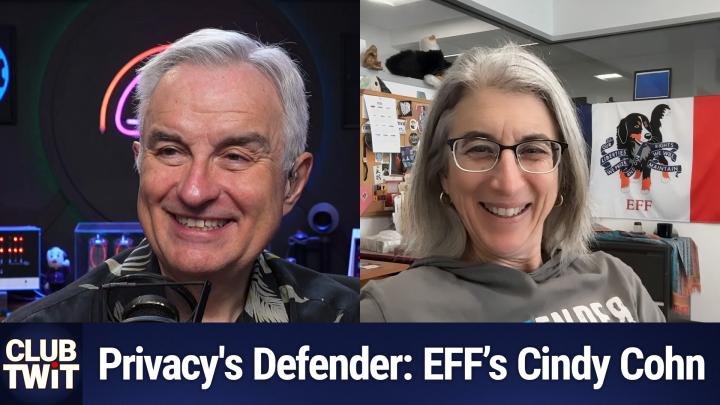
Hello, club members! Good to see you. We have a big shoe for you today. We're so grateful to the club members who make this possible. Every once in a while, it's not a regular thing, but I like to— still like to interview people who I think are super important to us all. And I don't think there's anybody more important than Cindy Cohen. She's been executive director of the Electronic Frontier Foundation for the last Well, it's 11 years now, winding up her tenure, but she's been privacy's defender for a lot longer. Cindy, welcome to the Twit microphones, and thank you for doing this.
Leo Laporte [00:00:41]:
I appreciate it.
Cindy Cohn [00:00:42]:
Oh, thank you so much.
Leo Laporte [00:00:44]:
Brand new book, Privacy's Defender, and it's kind of about your— it's a chronicle of your tenure at the EFF. You started back in the mid-'90s. As just a pro bono, I presume pro bono attorney.
Cindy Cohn [00:00:59]:
Yes. Outside lawyer.
Leo Laporte [00:01:01]:
In fact, this book is cool because, and I really like how you did structure this, it's 3 trials. And it's 3 seminal trials stretching back to 1996, all the way to the present. And of course, the battle rages on. And so the first thing I would say, for anybody listening now is go to eff.org and sign up, donate, and support their work because it's so important to those of us who care about the internet and care about freedom and privacy. You're focusing on privacy here.
Cindy Cohn [00:01:38]:
Yep.
Leo Laporte [00:01:39]:
Why privacy? Is that the key element of all of this?
Cindy Cohn [00:01:43]:
Well, I think it's an important one, and it's been central to the 3 biggest fights that I've led as EFF's executive— well, first our legal director and now our executive as executive director because I think it's a keystone to a lot of other rights. You know, privacy, people think of privacy and they think of kind of like the Harry Potter invisibility cloak that you put on before you do something. And that's certainly true, but it's really not why I think privacy is most important. I think privacy is important 'cause it's a check on power. It's a way that less powerful people can have a place to organize and put things together and learn things that powerful people might not otherwise want them to have access to or to see. And without that privacy, I don't think you can be a self-governing society. People don't act the same way when they're being watched all the time. And that's especially important on the kind of political democracy side of things.
Cindy Cohn [00:02:43]:
So, you know, I think without privacy, you can't have many of the other rights that people care about and many of the— in actually a self-governing society. If the people in power know everything you're seeing, doing, acting, and who you're talking to, you're not gonna be able to organize power against them. So this was one of the insights of the founders of the EFF. And it's the first case that they kind of roped me into or pulled me into. And it's just been a through line. And I think it's especially important now. I think people, we used to be talking about a scary future where the ability to marshal data against us was something that could happen. Um, and now I think more and more people are seeing that we're actually living in a lot of that future, and they're looking forward and they don't like what they see.
Cindy Cohn [00:03:32]:
So I hope it'll help people see, like, how we got here, um, that we didn't lose all the fights and that we can win other ones, but also the, the road ahead and what we need to do going forward.
Leo Laporte [00:03:44]:
Yeah, for a long time I thought, oh, privacy schmivacy, privacy is dead, get over it. As, was it Scott McNeely? Whoever said that, yeah. And I thought, well, so what? I'm gonna get an ad that's targeted at my interests. That seems like not a bad thing. But it became very clear, people always come up with straw men. Well, an insurance company gets your information that you're eating donuts, they're not gonna insure you and all that stuff. I kind of poo-pooed that, but it is increasingly clear as, first of all, as you point out, technology has collected all this information, made it possible to cross-reference all this information in ways that the founders never considered. And now that we have not just marketers, but nation states, including our own, and law enforcement using those databases, with abandon, it becomes more and more significant.
Leo Laporte [00:04:41]:
You know, we're going to talk about on Sunday the fact that a whistleblower says one of the Doge kids took a thumb drive and took this Social Security database with 500 million records out of the SS department, and, uh, and, uh, who knows where it ended up.
Cindy Cohn [00:04:57]:
Yeah, wow, places it ended up. I mean, I, I, it's, it's probably, you know, we have a case against the Office of Personnel Management for granting access to the Dogers without proper security and privacy protections. I would not be surprised to find that something similar happened at OPM. The one about Social Security Administration, I, I fear, is the tip of the iceberg of this kind of stuff because, you know, they really didn't take seriously the privacy, uh, needs of the people whose data they had, um, and, you know, the security needs as well, right? I mean, you know, this, this is information that that is scary for us as individuals, but as a nation, you know, it's no surprise that the Chinese already tried to get in, got into the Office of Personnel Management.
Leo Laporte [00:05:45]:
Yeah, they already had a breach.
Cindy Cohn [00:05:46]:
If it was worthless information that couldn't be used in any way to hurt you, if you've never done anything wrong, why is it a target of foreign nation states, right?
Leo Laporte [00:05:55]:
We're not talking Temu here, we're talking the Chinese.
Cindy Cohn [00:05:58]:
Yeah, so we're really concerned. And I, again, I do worry, you know, we're gonna be talking to a federal judge about the Office of Personnel Management case this spring, and we got an injunction getting them out last year, and we're gonna try to do a little more now at the end of the case, but it's very worrisome, and people are starting to see it. People are seeing, you know, we've got a terrible case out of Maine with the cops, with the law enforcement using facial recognition on protesters engaging in their First Amendment right to protest and— Saying your name is in the database now, Yep, and following them home, finding out where they lived, and really, you know, because all of that data is now tied together, it's easier than ever to do that, to take your face, find out where you live, find out who the other people are who you communicate with. So even if you're not at risk, you know, you got to think about who else is, who else do you communicate with, and what are their risk factors as well. So we're starting to see, you know, I feel a little sometimes like it, like like I've been a Cassandra, right? Like terrible things are not gonna happen. And now I, you know, it's, we're seeing a lot of this really come alive and be a reality in people's lives in a way that is really happening. And it's easier and easier for me to convince people that this is a problem, but not in a good way.
Leo Laporte [00:07:28]:
In a perverse way, you must be a little bit, Gratified, right? See, I told you.
Cindy Cohn [00:07:34]:
Yeah, it's a weird schadenfreude, you know, kind of feeling. But, you know, I would rather have been wrong, right, about this stuff.
Leo Laporte [00:07:42]:
So correct me if I'm wrong, but the word privacy does not appear in the Constitution.
Cindy Cohn [00:07:48]:
No, the Fourth Amendment is about being secure in your papers and things. And, you know, people have always read that secure in your papers to mean that the law enforcement can't get at it without a probable cause warrant, which effectively gives you privacy. So the word privacy isn't in the U.S. Constitution. It is in the California Constitution and many state constitutions.
Leo Laporte [00:08:10]:
And now, thanks to the CPCC—
Cindy Cohn [00:08:13]:
but it's never been— not never, but it's pretty long-standing, the idea that the Fourth Amendment is fundamentally about privacy. The First Amendment has the right to speak anonymously. That's very, very old, way predates the internet, and that requires privacy, right? To not be identified with everything that you might say, because that could lead to retaliation by the government. So that's a kind of privacy as well that's baked into the First Amendment.
Leo Laporte [00:08:42]:
Right. Privacy and the First Amendment crossed in your first case. You were just out of law school. Yeah. And I don't know if people— probably a lot of people who are watching, younger people, don't remember that encryption encryption was considered munitions. It was something the US government was trying to keep out of the hands of everybody else. There's a famous story of a fellow wearing a t-shirt with the encryption algorithm on it. It's the math is that simple.
Leo Laporte [00:09:13]:
So tell me, this is in 1996. You'd just taken the case. Judge Marilynne Hall-Patel was the judge. What were you— and the case was over— forgive me, I'm not a law student, I'm not good at stating the facts of the case, but it was Daniel Bernstein, who was a Berkeley math student, had developed an algorithm, wanted to publish the algorithm. The State Department said no, if you're going to do that, you have to register as an arms dealer.
Cindy Cohn [00:09:46]:
Correct, correct. So the U.S. Munitions List is the list of all the things you can't export from the United States without a license. It's got have things on it that you might expect, like surface-to-air missiles and tanks and things like that. Yeah, but it also had on it in the '90s software with the capability of maintaining secrecy. And, you know, if you think about historically, that's— it's not that crazy because, you know, you know, we won World War II because we were able to break the Germans' code machine and the Japanese codes, the Purple, as well. So It's not crazy that the US government kind of thought of software with the capability of maintaining secrecy as part of war and defense. But it was increasingly clear, especially to some of the founders of EFF and early internet people, that this government control over the tool of security and privacy— and encryption is kind of this magical thing that gives us both security and privacy— that that that was gonna get in the way of us building a secure internet.
Cindy Cohn [00:10:56]:
And so we took on the licensing regime that was then run by the State Department on behalf of a math PhD student at UC Berkeley named Dan Bernstein. And we challenged it and we said, you know, I mean, the second piece of this is that not only was software with the capability of maintaining secrecy called a munition, but publishing something on the internet is an export because foreigners can get access to it. It's, um, but it's also publication. And so we brought a case against the licensing scheme under the First Amendment, under a specific part of the First Amendment called the prior restraint doctrine that applies to licensing. So you have to go and ask for permission before you can say something. That's a prior restraint. And so, and that has very, very high standards in the law before when the government can do it. So we challenged the licensing regimes as a prior restraint on speech, and we won.
Cindy Cohn [00:11:53]:
The judge agreed with us that these encryption regulations didn't properly take into account that they were reaching speech when it came to encryption and threw them out. And we won at the district court level. We won at the Ninth Circuit Court of Appeals. And then about that time, the government, I think Al Gore wanted to be president, he was a guy who knew about technology and wanted Silicon Valley's support. And between the political pressure and the legal pressure that we brought and some pressure in Congress, the government backed out. And the encryption regulations now are a shadow of what they were before. They don't get in the way. And that's why we all have, whether it's Signal or WhatsApp has encryption, Apple Message has encryption, or even like some of the backend stuff that people— you don't see like Let's Encrypt certificate authorities and things like that that help, you know, put the HTTPS, the S part on things.
Cindy Cohn [00:12:59]:
All of those are because we were able to free up encryption and build it and really bake it in to lots of pieces of the internet in ways that we could not do so in the '90s.
Leo Laporte [00:13:10]:
We're talking to Cindy Cohn, who's the executive director of the Electronic Frontier Foundation. Her new book just came out, Privacy's Defender: "My 30-Year Fight Against Digital Surveillance." Congratulations, came out 2 days ago. I'm sure it's, I hope it's selling well. People should be reading this. It's interesting because now you won and we don't ever have to worry about encryption being thwarted ever again, right? I mean, congratulations.
Cindy Cohn [00:13:37]:
It turns out it doesn't work that way. I mean, I would say, you know, had we not won, the world would've, the internet would've looked a lot different. A lot different. It's important that we won. But yeah, it's not like the NSA just kind of hung up there. Okay. And went home. Yeah.
Cindy Cohn [00:13:52]:
We learned later that they were doing a lot of work directly to companies trying to weaken the encryption that the companies would offer to people. We learned that they were doing a whole lot of other kinds of tapping into the weak spots of the internet. Many of these we kind of heard about a little bit, but a lot of it was revealed by Mr. Snowden in 2013. 2019 and really brought forth a lot of the evidence about the various ways that the government was trying to undermine encryption so that they could always have access. And then we've had some straight ahead attacks as well, especially right now in Australia and Europe, we're seeing real direct attacks on encryption. So it continues to be a fight. I'm, you know, it's baked into enough things that enough people rely on that, And it's— they're fights that we are maybe not entirely winning, but winning more than where we started in the '90s.
Cindy Cohn [00:14:49]:
But yeah, it's— the one thing you learn when you're going up against the national security infrastructure is it's not like a TV show, you know, where by the third commercial it's all done and you're ready for the previews for the next episode. You always have to keep pushing back on them and you have to keep holding the line. And while the encryption win was fairly clean compared to some of the others, the other two stories I tell in the book are a little more, a little less clean in terms of the ways that we had to chip away and fight, and we'd win one and we'd lose one, and we'd go back and forth, and really needed to, you know, kind of be girded in for the long haul to try to do wins. We didn't have that same kind of clean win after the encryption one.
Leo Laporte [00:15:37]:
Although you can celebrate because many years later, Apple referred to this case when it refused to unlock the San Bernardino terrorist's iPhone. Correct. The FBI was demanding it, and they used you as a precedent.
Cindy Cohn [00:15:54]:
Yeah, we succeeded. Yeah. And they were right. You know, we tell the companies all the time that, you know, we're kind of frenemies, right? If they stand with their users, we stand with them. And if they stand opposing their users, we're the first in line. And you know, that was one where Apple did the right thing and we were perfectly happy to say so and to stand with them. Some of the other things Apple's done, maybe not so much, but we try to call them as we see them. And that was one where the work that we did in the '90s, I think, made it easier and clearer for Apple to say, you know, we're going to make— we're not going to make everyone insecure as a side effect of this one investigation.
Cindy Cohn [00:16:34]:
That's not right.
Leo Laporte [00:16:35]:
And that's kind of the fundamental thing. You point out that encryption is a double-edged sword. It protects both the innocent and the guilty.
Cindy Cohn [00:16:44]:
Mm-hmm, it sure does. But I, you know, I always, I try to think about it like, you know, what is it that we want the government to be able to do in order to protect us? And what is the consequence of that? And, you know, if your local police came up to you and said, look, we've got a problem of burglaries in the neighborhood. And so what we want you to do is to keep your back door door open. So in case you're a burglar, or a burglar ends up coming into your house, we have really easy access. That's, that's, that's how we're going to keep you safe. You would look at them and be like, find a better job. You're making me less safe. You're making me less safe to bad guys.
Cindy Cohn [00:17:27]:
You're making— I am not— I should not be one of your suspects. I mean, this— you're doing this for everybody. And you would think that that was ridiculous, but that's effectively the law enforcement argument about encryption is that we should all be less safe so that they can do their jobs a little easier. And this is not the right trade-off. It's wrong. And it's just as wrong as if they asked you to hold your back door open. It's just that because it's digital and it involves fancy math, they hope that people won't notice that that is actually what they're trying to do. And I think this is one where we just need to hold the line.
Cindy Cohn [00:18:04]:
There isn't really a middle ground where you, you know, the, the technology doesn't know the difference between a good guy and a bad guy knocking on the door. So if you dumb down the technology with the idea that only good guys are ever going to use it, like, that's a fool's game. That's not how it will work.
Leo Laporte [00:18:21]:
Yeah, they always, uh, say, well, we could keep the keys in escrow, you don't have to, you could trust us. But we already know, we just talked about breaches with the OPM and the Social Security Administration. We know that that's not—
Cindy Cohn [00:18:35]:
they tried it with the clipper chip, you know, way back in the '90s, right?
Leo Laporte [00:18:39]:
And Al Gore's clipper chip, he broke it in like 2 days.
Cindy Cohn [00:18:43]:
Um, so, you know, they don't have a very good record of it, and that's because it's a really hard thing to do. It's not because they're— I mean, right, they are inept, but it is actually a really hard thing to do. And it also depends on the government always being in the hands of people who are going to be responsible. And I think right now we're really in a moment where we're starting to see what happens when the government decides that it doesn't have to be responsible with our data, that it, it's, it, it, it's using, it's using some of these technologies in ways that I think a lot of people object to. Um, it's decided that the information you give to the IRS, which, you know, the long-standing deal was you tell the truth to the IRS and that information won't go anywhere else, and they're now, they're pushing to the very edge to be able to use IRS data to try to do other things. And, you know, right now they're targeting immigrants and looking for, you know, what they claim are illegal immigrants. But I don't think, you know, that's not where it's stopping. They're now going after protesters.
Cindy Cohn [00:19:44]:
They're going after other political opponents. So, you know, it also presumes that the people in power, you know, that it's okay for you to be less secure because the people in power will always be trustworthy and people who you agree with. Agree with about where they're targeting things. And I just don't think history right now is supporting that idea. I think it's better if we're just secure.
Leo Laporte [00:20:09]:
I think that's one of the things that has been an eye-opener for many of us in the last 8 years or 12 years is that how much of what we think of as the force of law is really just the force of norms. And when you have an administration or you have law enforcement that is willing to violate norms, It almost seems like there's nothing to stop them. Are you optimistic about the ability of our Constitution and the courts to keep a lid on this stuff?
Cindy Cohn [00:20:40]:
I mean, I don't know. I'm not very good at optimism or pessimism, honestly. I mean, I'm kind of fundamentally somebody who's like, it's not going to happen magically, right? You know, sometimes optimism makes you think, well, you don't have to do anything, you can just sit back and things will magically get right. I've never been that kind of an optimist. I think that if we dig in and we fight and we push back, that we can make real change, that we can step up and we can protect people better than if we don't. I mean, I kind of feel like right now we just have two paths, right? One is we don't fight and they just win. And the other is we do fight and maybe they win, but they won't win as much. And maybe we win.
Cindy Cohn [00:21:22]:
And those are really the only paths. I mean, you can't really opt out. Of the decision about whether we're going to live in a democracy or not. I've been quoting Ben Franklin recently, the passage of the Constitution. He was kind of a grumpy old guy at this point. And he got asked, well, what did you guys vote on? Did you vote on a monarchy or a republic? And he said, a republic if you can keep it. And I think we're in the if you can keep it part of that statement. And that means we all have to step up.
Cindy Cohn [00:21:56]:
I don't know if we're gonna win all the fights that we did, but I know that we will never win any fights we don't start.
Leo Laporte [00:22:07]:
Yeah. Um, now let's talk about Room 641A. Yes, a room you know well. This, uh, this is a famous case. We talked a lot about this one happen. An AT&T technician named Mark Klein— yes, uh, was a whistleblower, came to you, came to EFF, right?
Cindy Cohn [00:22:24]:
Yeah, he knocked on our front door.
Leo Laporte [00:22:27]:
And he said what?
Cindy Cohn [00:22:28]:
Trench coat with files. No. Knocked on the front door of EFF's offices and said, do you guys care about privacy? Um, and luckily, you know, Sherry Steele, who was our executive director at the time, answered the door and she said, well, sure, come on in.
Leo Laporte [00:22:44]:
Yeah, we do a little.
Cindy Cohn [00:22:45]:
Yeah, easily said, you know, there's, you know, there's a lot of people on Shotwell Street, the Mission, who, who might, you know, You might not have gotten in that easily. Yes. Yeah, but she made the right decision, and Mark showed up at our front door with the schematics of how some of the mass spying that the government was doing was actually happening in a building on Folsom Street in San Francisco, in a secret room called Room 641A on the 6th floor.
Leo Laporte [00:23:15]:
They had installed— the NSA had installed equipment that basically intercepted all the traffic routed through AT&T and sent it off to the government.
Cindy Cohn [00:23:26]:
Yeah, through the switching station, through the upstream part.
Leo Laporte [00:23:29]:
So it was internet backbone traffic, it wasn't phone traffic. Okay. Yeah. And so what did the EFF do in response to the guy in the trench coat?
Cindy Cohn [00:23:39]:
Yeah, well, we had already been working on a case. You know, the New York Times had released some information just a couple weeks earlier, which is how Mark put it together. He saw the New York Times story and he went, wow, that little kind of shady thing I saw that I didn't understand what it was. I think that was this. Wow. So the New York Times helped Mark put together something that he had been concerned about but didn't really understand what it was. And then he brought it to us. So we were already working on a case at the time, and we ended up launching a case just a couple of weeks later called Hepting versus AT&T.
Cindy Cohn [00:24:13]:
We decided to sue the phone company rather than the government because The government has a lot of immunities. There's a lot of gray areas in some of this, but the phone companies have actually a straight-up statutory requirement that Congress said that they can't do anything with your phone calls and internet traffic other than route it and protect their own networks. And so it was very easy to show that, you know, letting the government tap in and do what it wanted with the information was not legal under the statute. So we sued AT&T in Northern District of California here in San Francisco.
Leo Laporte [00:25:04]:
And you won, and the case is over, and we're all free at last, free at last.
Cindy Cohn [00:25:08]:
Well, we won initially, right? I mean, the first thing AT&T tried to do was to make give all the information back. And that didn't fly.
Leo Laporte [00:25:16]:
That's our private information.
Cindy Cohn [00:25:18]:
You're not supposed to have that. Yeah, it was proprietary, which, you know, on some level they thought they were being really tough by calling it proprietary information. But, you know, they made it clear that it was real. You know, we had always in the back wondered if it was real or not. But once somebody comes up and says, that's ours, we need it back, we were like, okay, well, you've— lawyers call this authentication. They authenticated it for us. And then, uh, and the judge initially, uh, agreed with us that the case had to be able to go forward, um, that everybody in the world at this point, because of all the press coverage, knew about this NSA spying and that the case shouldn't be dismissed. Now we went back and forth and up and down, um, and ultimately, oh my gosh, 16 or 17 years later, the Supreme Court said Essentially, even though everybody knows this, it's still a secret which companies are doing it, which is crazy.
Cindy Cohn [00:26:19]:
There's only two phone companies in the United States of any size, right? AT&T and Verizon. So it's a secret whether AT&T is participating in this program. And so therefore, we're going to dismiss the case. And it was in a slightly different case than ours, but it had implications for ours. It's really wrong. I think it's really problematic. It's not like people don't know now. They knew in 2006, and certainly after Mr.
Cindy Cohn [00:26:47]:
Snowden came forward. Like, it wasn't like this was all made up. And it was ripe for the court to decide whether it was legal and consistent with the Constitution rather than hiding behind this secrecy thing. And so there's work for us to do. You know, in the meantime, We had sued over 3 programs. I'm left-handed. I got to move over here.
Leo Laporte [00:27:07]:
I am too.
Cindy Cohn [00:27:07]:
That's okay. Um, we had to, uh, there were 3 programs. There was mass telephone records collection, uh, there was internet metadata collection, and there was this tapping into the backbone that, that Mark told us about. You know, 2 of those programs, one of those programs ended entirely, the internet metadata metadata program. The phone records program got dramatically changed by Congress. It's still too big, but it got dramatically cut back. And then the mass tapping into the internet, while it's still going on, is just now metadata and isn't content anymore. And we got the FISA Court involved at a much— you know, not enough, but a much deeper level than we did before.
Cindy Cohn [00:27:53]:
So this is what I mean by chipping away. Like, it's not like It's true we didn't win our case, but we won a lot of pieces along the way and, um, and slowly are chipping away at this. And when you're up against the national security part of the United States, they're very, very powerful, and they have a lot of tricks up their sleeve, and they have a lot of ability to scare members of Congress. So when you get any little victory, it's, it's, it's a pretty big deal.
Leo Laporte [00:28:21]:
Yeah, the Supreme Court used what— I consider almost a legal trick, saying you can't sue unless you could prove you were surveilled. But of course, if you don't have access to the information, the classified information, you can't prove it. So it's a loophole, kind of.
Cindy Cohn [00:28:39]:
Yeah, it was this weird circular logic, right? It was crazy from our perspective. It's like, well, first of all, you know, in most lawsuits, that's what discovery is for, right? Launch a lawsuit, you may not know all the facts. You just know you've been hurt, and you don't really know— you might not know all the reasons why. Let's say you're suing a, you know, a company that made a, a product that hurt you. Um, but we were not allowed to do the discovery, um, because it's the government against the government, because they kept claiming secrecy over everything, and the judge let them get away with it. So at the end of the case, they're like, well, you don't have enough information to prove prove that this mass surveillance is actually happening at AT&T. And we're like, well, you blocked every avenue for us to get the government— to force the government to confirm what we were saying, or to get us other information that would be admissible. So we really did feel like we had been, you know, kind of checkmated in a way that wasn't fair.
Leo Laporte [00:29:35]:
Yeah. And the Supreme Court ultimately decided not to rule. Yeah. Yep. Do you— those must be discouraging times.
Cindy Cohn [00:29:46]:
It's really discouraging. It's really— it's hard. On the other hand, again, you know, it was good to write the book to actually look back because I was really— believe me, I like— I'm a litigator. I like to win. I don't— I didn't think this was right. But sitting back and writing the book and looking at and actually counting up all the things we won along the way, including stuff that, you know, we got the FISA Court to publish its docket and publish its report. So people now have a lot clearer idea of the big decisions that the FISA Court made. There's all sorts of things along the way where we've built some transparency and accountability into these processes that were 100% hidden from the American people for many, many years.
Cindy Cohn [00:30:31]:
So those are good things. Again, there's still road ahead. We have a lot more to do. But we did accomplish a lot considering where we started.
Leo Laporte [00:30:40]:
Yeah, you sure did. And I guess that's the attitude to take, is we're making baby steps as best we can, because I don't think a total victory is going to happen. Even if you accomplish that, it's going to— there are many forces again arrayed against you.
Cindy Cohn [00:30:58]:
Yeah, I mean, the national security folks, and, and like, we want there to be a balance, right? We don't want national security to not have a lot of power. It should have a lot of power.
Leo Laporte [00:31:07]:
It's just that the rest—
Cindy Cohn [00:31:08]:
to be secure, the rest of us need to have our rights too. And it's always a balance, right? The whole Constitution is about thou shalt not for government, right? It's about ways of the things that, that we need to protect, especially the Bill of Rights, what that we need to protect ourselves against, uh, a despotic government, and a way to strike the balance of keeping us safe while also keeping us free. And we just think the balance for too long has been if law enforcement or if national security wants it, then the answer is yes. And we need to reassert the other side. That doesn't mean that they won't have powers. They should have powers. It just means we have to balance it a little better.
Leo Laporte [00:31:50]:
Actually, I think there are a lot of people, I include myself in this, who see everything very black and white. And if we can't have that, then we're screwed. And I think you have a more nuanced point of view from many years in the trenches that, you know, you get these little victories, you do what you can, you inch ahead because it isn't— it isn't black and white, and there is no total victory on either side. So you've just got to fight. Yeah, that's right.
Cindy Cohn [00:32:16]:
Is that something you had? Sorry, Corey says this thing, right? You have to keep fighting to look for higher ground, right? Right. And then once you get to higher ground, you may see the next thing, the next step, right? But you just, you just, this is, this is the nature of this kind of work.
Leo Laporte [00:32:32]:
I have a lot of stamina.
Cindy Cohn [00:32:33]:
I don't know. Security.
Leo Laporte [00:32:35]:
I don't know. Do you feel like you have unusual stamina? I know Corey does.
Cindy Cohn [00:32:40]:
Corey is crazy. He has far more than me. I think, I think my strategy is more that we have a team. We have people. We share it. Like, it's not all on— it's never been— I haven't done any single one of these things by myself. I've always had a team and a community and places to step back and rest and, and recharge. Um, I used to joke at EFF that we had like the outrage— we had like the outrage stick, you know? And, and so one person could have the stick at a time, and then they get to get out, and then they pass it, and then the next thing that happens is the The next person gets to be outraged, and the rest of us are there to support them and to keep going forward because everybody's going to get outraged and everybody's going to get despondent.
Cindy Cohn [00:33:21]:
But in the long run, if you have a community and you have a team, you can do this for the long run. And again, part of why I wrote it as a memoir and my personal story is that along the way, really interesting things happen. It's not just about the fight.
Leo Laporte [00:33:40]:
Right. You're right, outrage is exhausting, and often just you end up giving up because it's just so much outrage, so much. Did you— did you— is this something you wanted to do as a kid? I mean, how did this happen? I mean, there was no EFF when you were growing up.
Cindy Cohn [00:33:58]:
Oh no, and I would not have— I mean, I'm an English major, like, I am not a technical person either. Now, I've always really loved them. I've I've always liked the way that technical people think and approach the world. I've always thought that was great. I'm not a technologist, but I'm kind of techphilic. I just always knew I wanted to stand up for people who had less power. Some of this I tell a little bit in the story about a couple incidents from my childhood where somebody stood up for me and how important that was for me. And it made me think that's what I wanted to do.
Cindy Cohn [00:34:35]:
And then the tech thing, I really just fell into it. Like, I moved to San Francisco, I had a party and a bunch of hackers showed up at my house. And one of them was John Gilmore, another one was somebody who I dated. And I just started hanging out with these people. And they were thinking about what the world would look like when everybody got the technology that they were already playing with. People were, you know, out of MIT, out of the Media Lab and places like that. And I was interested in making the world a better place. I came out of— I did international human rights law in Geneva, and I just started seeing how what they were building was going to be really important to rights.
Cindy Cohn [00:35:19]:
And then, you know, I would say somewhat randomly, John Gilmore called me up one day and said, would you do this case for Dan Bernstein? And I I thought, well, this is a chance to take what I care about, about rights and the possibilities of this technology, and mirror it over to the tech world and use my lawyer skills. So I think I got lucky that I got this opportunity, but I was also open to it.
Leo Laporte [00:35:44]:
I have somewhere, John Gilmore, I think, signed the DES crack board. Oh, the DES cracker?
Cindy Cohn [00:35:53]:
Yeah. Yeah.
Leo Laporte [00:35:53]:
I have a board with one chip in it, but obviously it was a failed board. I have to find that somewhere and hang it up because it's a great piece of history. I hope people— well, this book will help people remember those days.
Cindy Cohn [00:36:05]:
Yeah, I hope so. So, John, just to give a little backstory. I don't know who your audience is, but the backstory—
Leo Laporte [00:36:09]:
Oh, they're geeks.
Cindy Cohn [00:36:10]:
Many of them will know. They know that Des was weak and John couldn't convince anybody that Des was weak, so he basically pulled together a team at BFF and built something to show how how easy it was that this was the government's encryption standard that they were saying was really strong, and how like, you know, with like less than half a million dollars they were able to build something that cracked it. Um, and, and that helped spur the change to what now we have as the Advanced Encryption Standard, um, and a much better process. You know, people are working on post-quantum cryptography now, and those processes are open and transparent at a level that is really grew out of the work that John spearheaded about the needy— need for transparency and real science, uh, behind security.
Leo Laporte [00:36:58]:
How did the EFF start?
Cindy Cohn [00:37:00]:
Yeah, it was before I got involved, but EFF started because there were some Secret Service raids on people who were doing things in early, like, you know, uh, newsgroups, working groups. Um, there was one There were a couple where there was an argument that the FBI got sold an argument that some conversations that were happening in this new digital world were very scary, and they started doing raids on people and interviewing people who were involved in the internet. And two of the early people that the FBI came and visited were John Perry Barlowe and Mitch Kapor. Mitch, of course, wrote the very first, or helped develop Lotus 1-2-3, Lotus Notes. And so he was already kind of a rich tech guy, and Barlow was, you know, very interested in the early internet, active in The Well, which was an early—
Leo Laporte [00:37:55]:
I was on The Well.
Cindy Cohn [00:37:56]:
You were on The Well, yeah.
Leo Laporte [00:37:57]:
And it was a bunch of deadheads too on The Well.
Cindy Cohn [00:38:00]:
Absolutely. I mean, the overlap between the Grateful Dead psychedelic world and the tech tech world in the '90s was really clear. But John Markoff wrote a whole book about—
Leo Laporte [00:38:09]:
that's right, What the Dormouse Said.
Cindy Cohn [00:38:11]:
Yeah, yeah. But, um, but both Mitch and Barlow had these weird visits from the FBI where it became clear to them that the FBI didn't really know what was going on in this new world and was doing really dumb things as a result of it. And so they put their heads together, and very quickly John Gilmore got involved, and decided that they needed to start an organization to defend defend some of these people who are getting caught up in these raids. And they called it the Electronic Frontier Foundation with the idea that they would give grants to lawyers to defend some of these people. I joke at this point that, you know, we're neither just electronic, it's not really a frontier anymore, and we're not a foundation. Like, none of these words are who we are anymore. But they put EFF together and they couldn't find any lawyers who knew enough enough about this world to actually give them the grant. I mean, they did a few, and we had some early people who were involved in that.
Cindy Cohn [00:39:07]:
But, you know, but so they started hiring kind of lawyers in-house. The very first one was somebody named Mike Godwin, who people probably heard of Godwin's Law, and, and really started putting together an organization to try to help make sure that the people who were inhabiting this new digital world had their rights protected. I often say EFF was created so that when you go online, your rights go with you. And especially building kind of a digital world that would stand with the users. So it was created with this kind of visionary idea of what was the world going to look like when everybody had this technology? Technology that in 1990 not that many people did, and to defend some of the people. The very first case that EFF took on was for Steve Jackson Games. Oh yes, a little gaming company in Austin people may be familiar with.
Leo Laporte [00:40:05]:
And they had— I took all their computers.
Cindy Cohn [00:40:08]:
Yeah, everything that was plugged into the wall. And, you know, they had a hard time getting it back. So the very first case that EFF took was about establishing you know, what does the government get if they've got a warrant to search your house, uh, for technology, and really limiting them to just the stuff that's related to the actual investigation. We're still fighting that fight today. We still see these overbroad warrants where they seize everything. And so we, you know, continue to have to stand up for that at EFF even today, although it's gotten better.
Leo Laporte [00:40:41]:
Of course, uh, no one can forget the very sad story of Aaron Swartz.
Cindy Cohn [00:40:46]:
Yeah.
Leo Laporte [00:40:46]:
Our friend, and another guy who was kind of overprosecuted.
Cindy Cohn [00:40:51]:
Absolutely, absolutely. And you know, Aaron was prosecuted. Aaron was a dear friend of mine, um, you know, and he was prosecuted for trying to free information for people to have— information that we paid for, taxpayers. Yes, for this information. And he tried to free it so that we could do things with it, uh, and it wasn't just locked up in these commercial databases that that academics pay a lot of money to have access to, um, and he was overprosecuted and, and ultimately, uh, ended his own life. It was still a tragedy.
Leo Laporte [00:41:24]:
Great tragedy under the CFAA. Is that the, the, the, the Federal, uh, Computer Fraud and Abuse Act? Is that overbroad? It is certainly overused.
Cindy Cohn [00:41:34]:
Yeah, I mean, it's overbroad. It's written very broadly. It was written, you know, long before really, you know, modern technologies. It was written, you know, the, the story about the CFAA is that, uh, President Reagan saw the movie WarGames and freaked out, and, and, uh, and the law was a result of him watching a movie, which anyway, I'm not sure how that is, but it is the story that we've been told.
Leo Laporte [00:41:59]:
It sounds right.
Cindy Cohn [00:42:00]:
Yeah. And but it hasn't been updated since the '80s, and, you know, we, we need to update it. So It is both overbroad in that it's written very vaguely and it's been overused. We got a good Supreme Court decision a few years ago that narrowed it, and the Justice Department actually agreed to some limits about how they will use it, which is good. But it's still— we still have a ways to go on that.
Leo Laporte [00:42:27]:
So your last trial— there's 3 trials in this book. We're talking to Cindy Cohen. His brand new book is just great, Privacy's Defender. And by the way, it is not just a list of trials. I don't want to give the impression that it's like a law book. There is— it's great, it's juicy, it's fun, it's interesting. It's a great story. My 30-Year Fight Against Digital Surveillance just came out 2 days ago.
Leo Laporte [00:42:51]:
The last story is about something that's really still kind of an issue, is the national security letters. Yes. Uh, what, what are those?
Cindy Cohn [00:43:01]:
So national security letters are a kind of subpoena. So a subpoena is something that the cops get to issue all by themselves. A warrant is generally something that they have to go to a judge and approve. Now, the term warrant gets tossed around by immigration authorities in ways that is really their subpoena nowadays.
Leo Laporte [00:43:18]:
It's an administrative subpoena.
Cindy Cohn [00:43:20]:
It doesn't— yeah, yeah. But, but, but national security letters are self-issued things by the FBI that let them go to your service providers and get metadata. So they get who you talk to, how often you talk to them, maybe where you live, whatever information this provider has about you, not the content of your communications. And this was something that existed before the Patriot Act, but the Patriot Act really supercharged that. And made them much— and we started hearing and learning that they were being issued by the hundreds of thousands, these national— and in crazy ways, like Post-it notes being sent to the companies and, you know, really broad things that later they paper over. There's some Office of Inspector General reports about how this just became the go-to thing by the NSA. And the other problem about them, in addition to the fact that they don't take a judge and that they they were being abused in terms of how they were being issued is that they came with these eternal gag orders. This is the big problem.
Cindy Cohn [00:44:26]:
Yeah. So they would show up at a company and say, we want— here's this secret order. You can tell nobody ever that you ever got it. And you have to give us information about your customers. And again, this was not something they were only using occasionally. I mean, you got to remember, there were 550 total terrorism prosecutions in the first 10 years total after 9/11. And they were issuing hundreds of thousands of these national security letters, you know, impacting far more numbers of people. So the proportion was— you know, this should have been something that was very narrow and used in real terrorism investigations, not as a go-to for the first step in whatever.
Cindy Cohn [00:45:09]:
So we started hearing about this. And ultimately we heard from a small phone company and then another tech company that they had received these national security letters and, and we're going to be gagged forever from doing it.
Leo Laporte [00:45:22]:
And was that a violation of the NSL itself to tell you?
Cindy Cohn [00:45:27]:
No. Well, they worried at the beginning. It was when the thing was first written. Congress didn't say you could talk to a lawyer about it. And so the FBI took the position that you couldn't for, I don't know, the first 4 years. And there was another case brought by, uh, uh, the ACLU for a guy named Nick Merrill and a company, uh, that he ran that challenged that and actually got clarity that you could tell your lawyer that you got a national security letter. But it was still crazy. And so when our clients called us, the first conversation I had with them was that they were— they had been told by the FBI still that they couldn't tell anybody about it.
Cindy Cohn [00:46:04]:
And I had to assure them that, that indeed they could tell me and that we could represent them. We had to keep keep who they were secret for 6 years while we fought these cases out in the court in secret. Um, it turned— one is Credo Mobile, which is a little phone company. It's based here in the Bay Area. And the other was Cloudflare, the big CDN company that, that helps protect people against DDoS attacks. We ended up taking both of them on and fighting these national security letters on their behalf for many, many years. And, you know, ultimately Congress stepped in a second time and scaled back the gags. Now, I think every 3 years they have to look at them and decide if they're still good.
Cindy Cohn [00:46:49]:
And they allowed a kind of transparency report where a company gets to report in little bands how many of these they receive. It's still not enough. For a while, I remember— where we've chipped away, we've chipped away a bit and there's more to do.
Leo Laporte [00:47:03]:
For a while, I remember people were doing something called a warrant canary where they would, they would say in their transparency report, and so far we have received no, no government requests for information. And then if that disappears, well, now we know they have.
Cindy Cohn [00:47:17]:
Yeah, I think Cloudflare still has a warrant canary.
Leo Laporte [00:47:22]:
Good.
Cindy Cohn [00:47:22]:
Yeah.
Leo Laporte [00:47:22]:
But they would go to Apple, they would go to Google. I mean, it's not just little phone companies, it's companies that have everybody's information. Yep. And were they fishing expeditions? Were they, or were they just about one person?
Cindy Cohn [00:47:34]:
We don't know. We don't know. We know that from the Office of Inspector General's reports that they would ask one request often for a lot of people. So we know some of them probably were targeted for just one person they were targeting, but many of them were really much, much more broad.
Leo Laporte [00:47:50]:
That's the original intent is we want information about this person. We don't want you to tell this person that we're looking looking at them. And that kind of makes sense. But if you do it about thousands of people, then there seems that's a little bit of a different story.
Cindy Cohn [00:48:04]:
And forever. I mean, look, grand juries operate in secret. Lots of things that law enforcement does are in secret so that they don't let the perpetrator know. The burglar doesn't know they're on his trail. I mean, all that works. But by the time you get to a trial, or even before then, like you need to give notice. And the thing about the NSLs was that they, they gagged them eternally. And that's why the FBI started using them all the time, because there was never any accountability for misusing them.
Cindy Cohn [00:48:32]:
I mean, this is what you learn, like, these accountability and checks and balances and limits are how you stop law enforcement from misusing these tools and how you create accountability for when they misuse them. And so when you When you lift off those guardrails, you really create a space for bad things to happen by, you know, sometimes well-meaning law enforcement, sometimes not.
Leo Laporte [00:48:59]:
Right. And you, during this trial, you couldn't really talk about it either, right?
Cindy Cohn [00:49:02]:
I mean, this— No, it was very secret. We called it Case Q. By the time we had 3 or 4 of them, they were Case Z and Case X.
Leo Laporte [00:49:10]:
You should have started at A.
Cindy Cohn [00:49:13]:
I know, we didn't know. And, uh, and, um, yeah, we had to keep the whole thing secret. The courtrooms had to be cleared. Um, it was just us and the judge when we do it, when we go to court, and we couldn't tell anybody we did. There was actually, you know, at one point in time, the Wall Street Journal, uh, Jennifer Valentino DeVries, who's a very good investigative reporter— she's now at the New York Times, but she was the Wall Street Journal— she actually did like reverse engineer engineered and talked to all these phone companies and ran a Wall Street Journal story that identified Credo, one of our clients. And we had to, like, you know, on the one hand, Credo wanted people to be sure that NSLs— they didn't want to be gagged. On the other hand, we were not going to risk them or us going to jail over this or very serious penalties. So we were in this funny position where, you know, we were happy that she was doing the research but not happy at the same time.
Cindy Cohn [00:50:10]:
And, uh, and, uh, you know, it's not like EFF, you know. Normally when we're doing something, we shout it from the roof, right? You know, uh, so we had to learn a whole new set of skills about, you know, how to keep things secret that, uh, that were not in our nature.
Leo Laporte [00:50:24]:
Now, this wasn't a clear victory in this one.
Cindy Cohn [00:50:27]:
No, no. We got some scale back. We got— we got every 3 years now they have to reevaluate. Both of our clients ultimately were able to reveal feel who they were because the government backed down for them. But these NSLs are still a problem. You know, a lot of the Office of Inspector General work looking at this has been scaled back under the Trump administration. They defunded and fired a lot of those. Right.
Cindy Cohn [00:50:53]:
And so we really don't know how they're being used right now. But I'm quite worried that because we left this hole, that, that that the administration is continuing to use them in a way that I think most people would not agree with and are not fair to users. So there's more work to be done there. And I think it'll come around again at some point. We'll get maybe another client who's courageous enough to let us stand up for them. I mean, this was crazy when we sued on behalf of Credo secretly, the government sued them back and claimed that they were, you know, impeding investigations by asking a judge to look at whether this was legal or not. Like, this was scary stuff for, for us and for the client because the national security people, you know, they bring weight and they can, they can have, they can, they can really be frightening and, you know, throw people in jail and stuff. So we had to really navigate this carefully.
Leo Laporte [00:51:56]:
We're talking to Cindy Cohn. She is executive director, but not for too much longer, but long-term, about 12 years as executive director of the EFF. Her new book is called Privacy's Defender: My 30-Year Fight Against Digital Surveillance. Do you know who's taking over for you as ED?
Cindy Cohn [00:52:15]:
They're in the middle of the process right now. They're searching. Okay. It'll be pretty soon. I think they're near near the end, and we'll be able to announce who the next— What are you going to do? Well, I'm not done suing the government.
Leo Laporte [00:52:28]:
I definitely— I love that. I'm not done suing the government.
Cindy Cohn [00:52:32]:
I mean, you know, defender, right? And part of— part of— I mean, look, EFF is big and strong and is able. They'll be fine without me, and I'm really excited to see what they do. But after 25 years, the organization— I think for organizational health. It's good for, for somebody else to come in with new ideas. That's fair. Um, I probably am not going far. I mean, I, if I had my dream job, I'd be a staff attorney at EFF, but it kind of turns out after 26 years at the head of an organization, it wouldn't really be fair to the new leadership for me to stay.
Leo Laporte [00:53:07]:
Yeah, you'd be kind of in the background.
Cindy Cohn [00:53:09]:
Hey, every— you know, I, I need to leave. Um, but I will. I'm looking, I'm talking to different— I'm looking for new opportunities, and, um, And, you know, I miss being in the fight. You know, these 3 stories are stories where I got to really write the briefs, some cases stand up in front of the judge and make the arguments. Since I've been the ED of EFF, you know, I just don't get to do that very much because there's a lot of other things to do. So I'm hoping to move closer to the fight than I've been able to be as ED.
Leo Laporte [00:53:38]:
Good. What fights remain for the EFF? What are the priorities these days?
Cindy Cohn [00:53:42]:
Well, I mean, I think right now it's still— it's definitely about mass surveillance and, and, and more than ever, really. Yeah. And it's, and it's, you know, when we lock cameras— oh my goodness, the national security people went first, right? And so a lot of these fights around national security, but now we're seeing the same kind of mass surveillance being used in hyper-local ways. Block ALPRs, Ring cameras, uh, facial recognition in the hands of like law enforcement right in your in front of these things. And so—
Leo Laporte [00:54:11]:
You don't have to leave your back door open anymore. You've got a Ring camera. They have all the information they need.
Cindy Cohn [00:54:17]:
You know, and so I think, you know, the good news is that I think that there's a lot of communities we're seeing stepping up and kicking these things out and realizing that the data doesn't just stay where they say it's gonna stay, that it gets made available more broadly. So there's a lot of surveillance work to be done now. And then you add the AI layer on top of this and it becomes very dangerous for people. You know, I think AI is interesting and cool, but if you let an AI into every single corner of your life, you really need to know what's happening to that data and how it's being used and make sure, you know, we need tools that stand with us as opposed to being weaponized against us. So I think that means going at the surveillance business model because this business model is pervading everything and it really, consumers, we're starting to see it, right? We're starting to see discriminatory pricing. We're starting to see the algorithm being used to make sure they extract as much money as possible from you based on everything else they know about you. So I think that people are starting to see it at a level that they didn't, and they're starting to get involved and push back. But it really has— it started at this high national security level, and now it's really all the way down to the local level that we're seeing surveillance being weaponized against people.
Leo Laporte [00:55:39]:
Yeah, there have been recent cases over AI-driven rent, you know, in apartment management. And just, it's, so it really hits people at home. It's really become real now for them. Why don't we have, why is there no comprehensive federal privacy legislation in this country?
Cindy Cohn [00:55:58]:
Oh God, if I could answer that, we'd have it. I mean, I think that I think that the political will hasn't been there. I think that consumers have not seen how the surveillance works in ways that hit their pocketbook like we're starting to see now. I think that the tech companies have been very disingenuous and pretended like unless they could surveil everybody all the time, they would go under, which isn't true. Moses didn't come down off of the mountain with stone tablets. Don't surveil. Let's spy on people to make money so we can fix it. But I think, you know, and law enforcement likes this.
Cindy Cohn [00:56:35]:
They're the number one purchaser of information from data brokers now. So when you've got the big companies plus law enforcement against the rest of us, it's hard to marshal our power to stand up for real comprehensive privacy law. And to me, it's not just stopping the companies from gathering the information, it's stopping the government from having access to what the companies gather. And we have to include both pieces. It's doable. It's not hard to write. You know, there's plenty of versions of this bill that EFF— these bills that EFF have supported. We do think they need to have real accountability.
Cindy Cohn [00:57:13]:
And a private right of action is one of the ways to do that. And that's the way we differ from some of the people in Congress who want to write these toothless bills that, you know, say a lot of nice things about privacy but are really not enforceable by you and me, the people who are impacted. Um, so we can do it. It's not hard to do in terms of like technical legal analysis. It's the political will. Yeah.
Leo Laporte [00:57:36]:
That we're missing. Write your, uh, Congress critter, as Cory would say.
Cindy Cohn [00:57:40]:
Yeah. And start organizing.
Leo Laporte [00:57:43]:
Start organizing. How can people support the EFF?
Cindy Cohn [00:57:46]:
Well, look, I wouldn't be the EDF EFF if I didn't say that we need money. Do you still raise money from people, uh, like, uh, Mohnish Kapoor or Um, well, uh, yeah, rich, rich people. I mean, Mitch has given us money in the past, he— but, uh, but not this year, but that's okay. Yeah, he's given us some—
Leo Laporte [00:58:05]:
he helped us buy a building. Pretty generous.
Cindy Cohn [00:58:08]:
Yeah, yeah, and we, we, we love him. But, um, yeah, uh, definitely some, some wealthy people and people who've been, you know, benefited from technology and want to be known for supporting technology that stands with users as opposed to technology that abuses them. And ordinary people. We have 30,000 members right now. We have lots of people who give at a smaller rate than that. And we love it. I love standing up in front of Congress or a court and saying, we represent 30,000 people who want tech to stand for good. We get money from— thank you.
Cindy Cohn [00:58:42]:
We get money from some philanthropy, some of the foundations. But we also get kind of all sorts bits and pieces. We, you know, recently with the kind of aging of tech, we've gotten a few bequests. People left us money in their will. So there's a chunk of support, but most of it does come from individuals. We have some corporate donors, but they're really not the big guys. We don't take money from the big guys. They really want you to always say nice things about them, and we won't.
Cindy Cohn [00:59:17]:
Um, so we, we don't take their money. But, you know, companies that are a little smaller, VPN companies or privacy companies that want to support us because we, we, you know, they want to stand with users and they want to be seen too. So, um, it's a, it's a pretty diverse— there's a, there's a page on the website that will show you kind of the pie of where the money comes from. And, and we're really proud of the fact that it has lots of pieces. It's just not one or two places where we get the money and the annual reports. You could see the pies in there and see where the money comes from and how we spend it. EFF is like almost 90% salaries and benefits. We're all people.
Leo Laporte [00:59:58]:
And by the way, great tools. You know, I use Privacy Badger in my browser, which does a lot of good blocking all sorts of advertising and tracking. And there's a very nice tool that you can use to cover your tracks to see if your browser— we talk about this all the time on our shows— if your browser is giving away information about who you are. And every time I do this, my browser is. So very disappointing. Yeah, many of them are. Yeah. So you could pick a browser that protects you.
Leo Laporte [01:00:35]:
The EFF is such a great organization. I'm very proud to be a supporter of it. And I'm so grateful to Cindy, for the incredible, uh, work you have done.
Cindy Cohn [01:00:44]:
Well, thank you. Look at— you've got strong protection against whoever did that.
Leo Laporte [01:00:48]:
Yeah, but if I scroll down, uh, I have a unique fingerprint, which is—
Cindy Cohn [01:00:53]:
oh, well, that's so hard.
Leo Laporte [01:00:55]:
Yeah, it is hard. That's the one, the one thing everybody has a hard time. Yeah, yeah, Safari does it, I think.
Cindy Cohn [01:01:01]:
Thank you. Yes, we definitely— we have a tech team, uh, that advises the lawyers and the activists but also, you know, Geeks Wanna Geek, who also started building tools that try to help people.
Leo Laporte [01:01:12]:
Yeah, I know you have a party to go to. Yes, uh, tonight is the, uh, opening night for Cindy's book. Uh, I don't know if people can go, but if you go to eff.org, uh, there, there's tickets.
Cindy Cohn [01:01:24]:
It's in Berkeley. It's in Berkeley at a place called the CL Creative Space. We, we did a little launch with Corey at City Lights, but if you've ever been to City Lights in San San Francisco's very, very small rooms, so we decided to do something a little bigger, uh, uh, tonight at this place called CL Creative Space.
Leo Laporte [01:01:42]:
And Annalee Newitz— Annalee Newitz is going to be there.
Cindy Cohn [01:01:44]:
I love her book. There with me. So I, I've just pulled on the pantheon of amazing people to—
Leo Laporte [01:01:51]:
everybody knows you and loves you. Yeah, um, really fantastic book, highly recommend it. Support EFF. There's a donate button right there at eff.org. Everybody should get over there right now. And if you get a chance, if you're in the East Bay, go, go see Cindy tonight, applaud her. The book is Privacy's Defender: My 30-Year Fight Against Digital Surveillance. Thank you for fighting the good fight for all of us.
Cindy Cohn [01:02:17]:
Thank you so much, Leo. You've been covering our work so well for so many years. We— it's a love-love relationship.
Leo Laporte [01:02:23]:
Yeah, very, very proud of what you're doing. So important.
Cindy Cohn [01:02:26]:
Thank you, Cindy.
Leo Laporte [01:02:27]:
Thank you. Cindy Cohen, everybody. Thank you for joining us. We thank our club members for making it possible. Now, if it's a choice between donating to TWiT and donating to EFF, if you've got, you know, limited funds, donate to EFF. That's more important. They need your money a lot more than we do. But if you happen to like the kinds of interviews we do here, the kind of work we do here, and you want to support that, you could do that too at twit.tv/clubtwit.
Leo Laporte [01:02:51]:
Cindy, have a great party. Have fun. And I'll see you soon, I hope. Thanks. Thanks. Take care. That was Cindy Cohen. Thank you to our Club Twit members for making this possible.
Leo Laporte [01:03:03]:
Again, the book Privacy's Defender: My 30-Year Fight Against Digital Surveillance. Well worth reading. Hope we will get to talk to Cindy again as she begins her new life. Thank you all for joining us. And club members, more to come tomorrow. 2 PM Pacific, 5 PM Eastern. We're going to do the AI user group. That's always a lot of fun.
Leo Laporte [01:03:27]:
I'm not sure what we're going to be talking about. Larry wants to— he's been playing a lot with, you know, these OpenClaw, you know. Oh, more. Yeah, we haven't really gotten into OpenClaw and Larry's— yeah, he's gonna— so yeah, we're gonna go deep. Good, good. I'm very interested. And of course, Monday Monday, we're going to find out about a new form of OpenClaw, NemoClaw, the new agent from NVIDIA. We're going to be covering Jensen Huang's keynote from GTC, the NVIDIA conference.
Leo Laporte [01:03:57]:
He always has something to announce. And there's— there— the rumors are he's going to announce this NemoClaw, but also new hardware that maybe even you could— I could own. We'll see. So that is something else we're doing. That's Monday. Is that 10 AM? Pacific? 1 PM Eastern? Yeah, 11. It's 11. Okay.
Leo Laporte [01:04:20]:
Yeah, I can look. It's on the Discord. Club members, you know where to go. 11. 11.
Cindy Cohn [01:04:25]:
Yeah. Okay.
Leo Laporte [01:04:25]:
Uh, and then actually we've got a big week. I'm— you're keeping me busy because I'm going to be doing— sorry, sorry. No, it's okay. Mike's Crafting Corner is Wednesday. Uh, we're gonna do Johnny Jet's Jet Set on Thursday. That's March 26th. That's not next week, is it? That's— no. That's 2 weeks from now.
Leo Laporte [01:04:43]:
Same thing for Micah's Crafting Corner. No, that's next week. That's the 18th. And then the photo time with Chris Marquardt is coming up as well on the 20th. Oh, that's this Friday. Okay. That's a week from tomorrow. Okay.
Leo Laporte [01:04:59]:
It's kind of out of order on the events page. So browse around to find what's going on. The interview will be posted. We do it live, of course, all our stuff we do live. To you, the club, in the Discord, but also open to the public on YouTube, Twitch, x.com, Facebook, LinkedIn, and Kik. We then post it on the TWiT+ feed. I think maybe this one we should make public as well. Usually what we do is we post it for club members only in the TWiT+ feed, and then a month later we make it public.
Leo Laporte [01:05:32]:
But Anthony, we can make this one public. Yeah, this will be in our YouTube channel. So it'll be the YouTube channel today. Yep. Okay, youtube.com/twit if you want to share it with friends. Yeah. So normally we do that, we hold on, but Dustin, you can do it right away, YouTube channel. Normally we hold it for a month.
Leo Laporte [01:05:53]:
Okay, thanks. Very big thanks to Anthony Nielsen who does not have a day off ever. Hardest working man in showbiz. Thank you, Anthony. No problem. Oh, it's— so Patrick's telling me it's the Twit+ Club Shows feed. So what does that mean? It's different feeds for every show? We split it up. No, um, basically all the club events will go in the Club Shows feed, the Twit+ Club Shows feed, and then like Clips has its own thing, and then there's, uh, the news stuff that's in a different feed.
Leo Laporte [01:06:27]:
Okay, so we have multiple feeds, but if How would somebody find out as a club member where those feeds are? Just add all 3 to your— Yeah, but where are they? You get it in the email when you join. Yeah, yeah. Is it at twit.tv? twit.memberful.com is where you can manage your— twit.memberful.com is where you can— actually, I should say that all the time. So if you're already a member, you can manage your membership at twit.memberful.com. The reason I don't talk about it is I'm not a member. I'm not like a normal member, so I don't have a login. That's the way to watch. Thank you, Patrick.
Leo Laporte [01:07:05]:
You're home. We're very happy to see that. Patrick Dillahunty has been in the hospital for a month, and now he's finally home. Not all better though. He's got a long recovery still ahead of him. So hang in there, Patrick. We appreciate everything. You do.
Leo Laporte [01:07:23]:
We got a great team. We're very lucky. Support them. twitch.tv/clubtwit. Doesn't support me. Doesn't go into my pocket. Goes into their pockets. Pocketses.
Leo Laporte [01:07:35]:
Anything else? I think that's it. Thank you. Well, I'd also like you to stick around for some recordings, but yeah, we could close out this. More recordings? Yeah.
Leo Laporte [01:07:47]:
They'll be short. Thank you, everybody. See you tomorrow for the AI User Group.
Bye-bye.