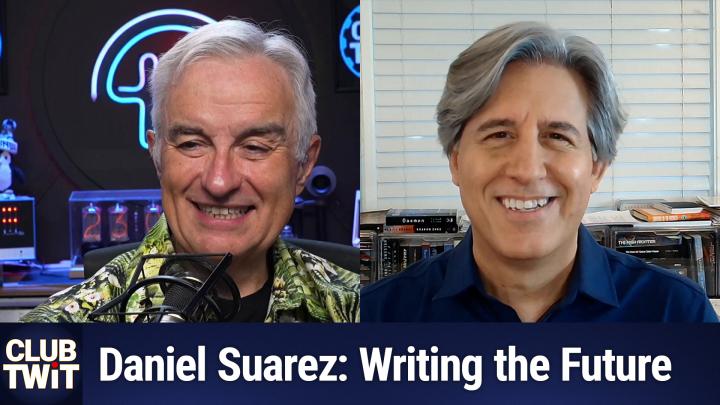
TWiT+ Club Shows 779 Transcript - Daniel Suarez
Please be advised that this transcript is AI-generated and may not be word-for-word. Time codes refer to the approximate times in the ad-free version of the show.
Leo Laporte [00:00:00]:
This is TWiT. Hello, my club members and all my friends. This is a special recording we're doing ahead of time for an interview that is going to appear on Intelligent Machines. But because you're in the club or you just happen to be hanging around at 1:00 PM Pacific on a Thursday with nothing else to do and you're watching YouTube or Twitch or x.com or Facebook or LinkedIn, You might be just catching this by accident. We're going to get to do an extra half hour, an hour with our guest. But I just want to tell you ahead of time, because I'm going to wait, it's going to begin. Well, I guess I'll just begin it like this. Let's say hello to Daniel Suarez, a dear friend who I think I first talked to about 16 years ago.
Leo Laporte [00:00:49]:
Yeah, beyond. Yeah, when his book Demon came out. Daniel is, of course, the author of some of the best sci-fi of the last decade, last 16 years. Daemon and Freedom™, which were kind of side by side. Then he decided to take— and by the way, that was a great one 'cause that was about an AI created by a deceased gaming mogul.
Daniel Suarez [00:01:13]:
Executive, yeah.
Leo Laporte [00:01:14]:
Yeah. And it was quite good. It was quite exciting.
Daniel Suarez [00:01:17]:
A narrow AI, which is, of course, it was very specific and very distributed, a bit different from LLMs. Didn't require a big data center. It wasn't a superintelligence or whatever we're calling it this week. It was narrow AI. Just—
Leo Laporte [00:01:31]:
that's a good point. And of course, in 2009, when the book came out, nobody really had a notion of what an LLM would be or what AI would even look like.
Daniel Suarez [00:01:40]:
Well, you know, the first— the first initially, by the way, lately we've been calling it Daemon simply because I've been—
Leo Laporte [00:01:47]:
Oh, have you decided it's Daemon now?
Daniel Suarez [00:01:49]:
Okay. They finally convinced me that it's not 14th century French. So, we're saying Damon. But, when I initially self-published Damon, that was actually— we're almost at the 20th anniversary. December 1st, 2006 was when I first self-published it. And boy, that was a heck of a—
Leo Laporte [00:02:09]:
With your name backwards, by the way.
Daniel Suarez [00:02:11]:
Yeah. Lenard Zierhaus was the German Czechoslovakian—
Leo Laporte [00:02:16]:
Oh, I am Lenard Zierhaus and I've written this book.
Daniel Suarez [00:02:20]:
That's right. And I did that because at the time I was working at a Fortune 500 company and I had my arms elbow deep in their network. And I thought, you know, publishing a book about hacking the world was probably not good for my consulting career.
Leo Laporte [00:02:33]:
Yeah.
Daniel Suarez [00:02:34]:
It turns out that everybody was very excited about it and they thought it was cool.
Leo Laporte [00:02:38]:
So yeah, it was— it's one of them. It was one of those books where in the first 2 pages you gasp and you're taken away and it doesn't end for another, you know, 2 books. So it's really—
Daniel Suarez [00:02:52]:
Well, I was on a mission, you know. I really—
Leo Laporte [00:02:55]:
Really? What was it? What inspired it? Why did it— where did Daemon come from?
Daniel Suarez [00:02:59]:
Daemon came from my feelings that we were creating a monocultural world, something— a modern civilization that had— that it was a house of cards, that it had many single points of failure. And also, I felt that I was contributing to it to some degree in my work. Are they going to evade confidentiality clauses? But part of my work at the time was creating production planning systems for very large corporations, some of them food companies, some of them defense companies, things like that. And when you're doing that, you're optimizing a network for moving things around to squeeze every ounce of efficiency out of it. And it was around that time that I think I read Omnivore's Dilemma by Michael Pollan.
Leo Laporte [00:03:46]:
Right.
Daniel Suarez [00:03:46]:
And started to think that, you know, fat serves a purpose in the natural world. And, you know, do we build in some, you know, capacity to deal with disruption? And I started to think of those things. And then a confluence of events happened. As a side project, I created a little app that was called Weather Master for creating fictional weather for role-playing games like D&D, things like that. And I Put it in a polymorphic encryption wrapper and put it out on the web, and it was just off selling itself. And then I got very busy on some Y2K remediation stuff, and then it had gone off and earned all this money for me. And I sort of connected those 2 things, and I started thinking, you know, if I die, this thing's gonna keep making money. What else could you do if you're dead in the modern society? And that's how I started to piece things together.
Daniel Suarez [00:04:38]:
You know, if you have an antagonist or, you know, for some people, you know, Sobel is a protagonist. If you have a person who is beyond punishment, they are dead, what could they do if they have a newsreader and they're reacting to headlines in the news? Now, you know, back then that was pretty radical. And of course now I think everybody immediately understands that. They immediately grasp that because we see it on a daily basis.
Leo Laporte [00:05:03]:
Yeah.
Daniel Suarez [00:05:03]:
But back in 2006, that was a heavy lift. And then of course I threw into that autonomous vehicles, cryptocurrencies before Bitcoin existed, a whole bunch of edgy things that had been brewing in my mind at the time. And for good or ill, a lot of them are here now. Do
Leo Laporte [00:05:23]:
you think it's because you worked in the tech industry that you had this prescience about where we were headed? I mean, I don't think anybody in 2009 was thinking about Bitcoin.
Daniel Suarez [00:05:32]:
Well, you know what's funny about that? Because I always thought Part of me thought, I'm gonna write this book, and because I want to, I want to get this out and kind of express this, these concerns, these feelings I have, and maybe chart a better course. But half of me was thinking that certainly somebody's gonna come up and say essentially, actually, Dan, you're wrong, because— but nobody did. And I remember I was invited to one of the intelligence agencies to give a speech at one point, and I think my opening line was, if I'm not the expert on this, we are all And that's sort of how I felt about it at the time. Like, surely we're not marching, you know, blithely into this future where we're making things more and more and more efficient. Surely somebody is thinking about it, the larger picture. And that's where the hole-ins in the books came from. As it turns out, there were, you know, great thinkers before me who have thought about these things, and their ideas at the time just didn't hold sway. So I wanted to pull some of those ideas from the past, Holins being one of them, and, you know, what do they call it? Resilience, to build communities of resilience.
Daniel Suarez [00:06:47]:
That's the mission I was on, was basically to say, you know, we can have modern technology, but let's have distributed resilient systems that are not a complete monoculture.
Leo Laporte [00:06:56]:
I remember Jerry Pournelle writing about this in Lucifer's Hammer. At one point, somebody says, We've built this world that no one knows how to maintain, create, recreate.
Daniel Suarez [00:07:12]:
And it assumes a perfect environment because if anything knocks it over.
Leo Laporte [00:07:16]:
Right. And I think we all kind of— I think one of the reasons these days we're all a little bit on edge, there are many reasons, but one of the reasons we're a little on edge is we— I think that knowledge has kind of spread a little bit and we all understand, well, if the food supply fails, we only have 5 days and things like that. And we start to realize we have built such a technological society that we are so interdependent that it's almost—
Daniel Suarez [00:07:44]:
Well, just-in-time inventory had just an enormous impact on all of us and it is unseen, at least until recently. I think what you just mentioned about the local food supply, seeing as I was working as a consultant for big food companies, I knew that. And I knew that when a storm happens, the food gets wiped off the I know how much food was in a region. And, you know, that is mirrored in everything from communications to airlines. For example, when you cancel, uh, some flights, that ripples through the system for weeks, sometimes months. So it's that ultra-efficiency that— it's impressive, but it also exposes us to some risk.
Leo Laporte [00:08:23]:
Well, it's, it's all been about saving money, right? And not having too much inventory and all that stuff. But it doesn't look at the other side of the consequence of this And I think we're all sensing this. I think we really are. We all know now that a storm in the East Coast can ruin your flight on the West Coast. We all have experienced this all directly. So after Daemon— I'm glad to know it's Daemon.
Daniel Suarez [00:08:46]:
Yeah.
Leo Laporte [00:08:47]:
Although
Daniel Suarez [00:08:47]:
I won't hold you to it. I'm just trying to train myself now because—
Leo Laporte [00:08:51]:
Okay. Yeah, somebody told me yesterday, oh, Daniel has decided it's Daemon. I said, really? Okay. Yeah, after David had freed—
Daniel Suarez [00:09:01]:
after all these years,
Leo Laporte [00:09:01]:
freedom— you wrote, again, completely prescient— this is 2012— Kill Decision, uh, about autonomous killing drones. And of course, the war in Ukraine—
Daniel Suarez [00:09:12]:
I did my TED Talk on that. Lethal autonomy was the— yeah, and you—
Leo Laporte [00:09:17]:
that was a warning shot that we should have all paid more attention to.
Daniel Suarez [00:09:20]:
It was, it was about basic— it was about drones that seek their own targets and, and kill people. And again, a heavy lift back in 2012. Uh, fortunately— I say fortunately, but also unfortunately— there were people in the U.S. military who took what I wrote very seriously by that point. And I think that was partly because of Damon, that I had been put on their radar screen for that. And so, you know, various scenario spinning exercises, they'd pull me in. But I'm not sure to what degree the overall defense industry and department took those people. So in other words, I would speak to them, and yet it's really Ukraine that's leading, that's the bleeding edge of that, the conflict between Russia and Ukraine.
Daniel Suarez [00:10:07]:
And of course, when I— my God, I've received images of people on the front lines who are holding up that book, and it just shocks me.
Leo Laporte [00:10:15]:
Yeah.
Daniel Suarez [00:10:15]:
Wow. It's not great that I was— sure, you could say prescient, but I think anybody assembling the pieces would've come to that conclusion that this was coming. You have a situation where it's difficult to attribute the attacker. Attribution for an attack, who is attacking you, is increasingly going to be a concern. And that's what autonomous war brings. So I think we've only seen the first round of that. I think the next round—
Leo Laporte [00:10:45]:
Oh, it's just beginning.
Daniel Suarez [00:10:46]:
Swarming is coming.
Leo Laporte [00:10:47]:
Swarming. Yeah.
Daniel Suarez [00:10:48]:
Swarming. Yeah, insect algorithms, things like that.
Leo Laporte [00:10:52]:
I would say—
Daniel Suarez [00:10:52]:
And this is where LLMs also can—
Leo Laporte [00:10:55]:
Sure.
Daniel Suarez [00:10:56]:
Can you couple those 2 things and we have a real risk on our hand there. My big concern, as always, is not that these machines or these AIs are going to get out of control. It's that they're going to do exactly what they're told. And it's just a question of who's telling them to do it.
Leo Laporte [00:11:11]:
It's always the humans that are the problem.
Daniel Suarez [00:11:13]:
And it goes to attribution once again. I think sometimes Well, actually, every new radically disruptive technology, it either further focuses and centralizes power or it further distributes power. That's part of its disruptive capacity. And right now, I think power is being centralized and focused into fewer and fewer hands, and those hands are increasingly invisible and unaccountable. And that's a big concern I have, and I'm sure many people.
Leo Laporte [00:11:42]:
We're talking to Daniel Suarez. His new book will be out in the spring. So we're not going to talk too much about Shadow Zone.
Daniel Suarez [00:11:49]:
We'll talk a bit about it. I'm happy to.
Leo Laporte [00:11:50]:
Can you preorder it now?
Daniel Suarez [00:11:52]:
You can preorder it now.
Leo Laporte [00:11:53]:
Oh, well, then everybody should just preorder it.
Daniel Suarez [00:11:56]:
But I'm happy to talk about it. And, you know, that is in some ways a con— it's not at all a sequel to Kill Decision, but certainly it carries on some of the themes there. Now, that story, I got to get my elevator pitch for that story together, but it is essentially this. It is— Shadow Zone is set on the brink of a global nuclear war where a social media post goes viral and it claims that there's a unique refuge from nuclear fallout in a remote New Hampshire valley, and, and millions of people flood there only to discover that—
Leo Laporte [00:12:33]:
Did you choose New Hampshire because of Stephen King? I just have to ask.
Daniel Suarez [00:12:36]:
Uh, no, actually, it's just, uh, I looked, I examined all around, and, and I wanted to find a place in the Northeast that was the farthest away from major targets for nuclear attacks and also population centers.
Leo Laporte [00:12:49]:
It makes sense.
Daniel Suarez [00:12:50]:
White Mountain, New Hampshire. But millions of people flee there only to discover that, that tech billionaires have a luxury bunker already commanding that site.
Leo Laporte [00:12:59]:
Of course they do.
Daniel Suarez [00:13:00]:
And they don't want visitors.
Leo Laporte [00:13:02]:
Of course they do.
Daniel Suarez [00:13:02]:
And that's really the impetus for the entire story.
Leo Laporte [00:13:05]:
I remember being very influenced in my teens by a book called On the Beach about a nuclear Holocaust, and the last surviving area is Australia, which at that time, I guess, was considered far enough off the map to survive. And it really kind of moved me. It really hit me hard. I imagine Shadow Zone is going to have the same impact on people as all your books.
Daniel Suarez [00:13:29]:
Yeah. Again, we fold in LLMs, AIs, autonomous weapons, drones, all of these things that— All the great
Leo Laporte [00:13:39]:
stuff that the world
Daniel Suarez [00:13:40]:
tech billionaires might use to defend themselves. And of course, large numbers of people and logistics issues that are inherent with all that chaos. So—
Leo Laporte [00:13:50]:
That's what always strikes me. You can buy, as they have apparently, decommissioned missile silos and turn them into— or if you're Mark Zuckerberg, buy an island and build a 5,000-square-foot basement for you to hide in.
Daniel Suarez [00:14:08]:
As you do.
Leo Laporte [00:14:09]:
As one does if one has unlimited funds. But, but I think you need to think a little farther forward because, okay, so let's say whatever the apocalypse is happens. You're going to be stuck down there. Everybody's going to know you're down there. Who's going to, who's going to keep the hordes at bay? Is it going to be—
Daniel Suarez [00:14:28]:
That's where Douglas Rushkoff is, uh, is smart when he brings up the idea of what's to stop your security force They're going to turn on
Leo Laporte [00:14:35]:
you.
Daniel Suarez [00:14:36]:
They're going
Leo Laporte [00:14:36]:
to say, nice place you
Daniel Suarez [00:14:38]:
built. In Shadow Zone, there is an answer to that. And actually— Ah. So—
Leo Laporte [00:14:43]:
I don't know, but I imagine that's somewhat how you work. I was just reading, and I really recommend it, your latest short— it's just a short story. It's called Heir Apparent. You can buy it for a couple of bucks right now on Amazon and put it on your Kindle. And it's a great read. I really enjoy it. And it reminds me a little bit of The kind of short stories you might have found back in the day in Analog or one of those pulp sci-fi— Yeah, yeah.
Daniel Suarez [00:15:06]:
And that's exactly what I was channeling. It was not quite a novel-length idea, but I still wanted to do it.
Leo Laporte [00:15:12]:
It was like a Philip K. Dick where you— and I think I kind of imagined, and you tell me, I don't know, that that's how it happens. You think of an idea and then you start to play with, well, what would— how would that— what would the consequences be? How would that— in this case, I don't think it's spoiling anything. to talk about a robot. I'm looking forward to, by the way, having this robot when I enter the old age home, which is imminent. An old age care robot. That's very sweet.
Daniel Suarez [00:15:39]:
A nurse practitioner robot.
Leo Laporte [00:15:41]:
Yeah, it's very sweet.
Daniel Suarez [00:15:42]:
In an old age home.
Leo Laporte [00:15:43]:
In an old age home. And what happens if one of the pensioners decides to leave her significant fortune to the robot? And I'll stop there. I won't go any farther than that. I don't think that's spoiling. That's the first scene.
Daniel Suarez [00:15:58]:
No, no, that's the setup.
Leo Laporte [00:15:59]:
Yeah. And so that's what I'm thinking. You think about that, then is this how you work? You go, now what would happen next and next and next? Is that how you work?
Daniel Suarez [00:16:09]:
Yeah. The way it works for me is an idea will occur to me and then it won't let me go. I'll be putting my head on the pillow at night and it will come to me unbidden, insistent. And then I, I will start taking more and more notes, and the more notes I take, the, the more it relents until I finally get it out of my system. It's typically— that's typically how I choose what it is I'm going to work on, those ideas that won't let me go. I usually have a couple, so I'm being pestered to varying degrees by very various ideas.
Leo Laporte [00:16:40]:
It's a blessing and a curse, Daniel.
Daniel Suarez [00:16:42]:
I, I appreciate it though, because, uh, there's no greater feeling when you feel that you've done an idea justice, like you've done well by whatever idea it was when you think, hey, that turned out better than I thought.
Leo Laporte [00:16:55]:
Is that kind of the feeling you get? You put down the pen. I'm sure you don't use one, but if you had a pen—
Daniel Suarez [00:17:01]:
I do to take notes.
Leo Laporte [00:17:02]:
Oh, do you? All right. Physical notes. You put down the pen and you go, ah, it is done. Or do you say, is it never done?
Daniel Suarez [00:17:11]:
I find that when I've finished a book that the idea lets me go.
Leo Laporte [00:17:17]:
Oh, that's how you know it's done.
Daniel Suarez [00:17:19]:
And that's how you know it's done for me. And, and that's why, you know, sometimes I'll be interviewed and I'll have difficulty remembering a character from a book a decade ago. I'll have to really fish through my memory for it because I've let it go.
Leo Laporte [00:17:33]:
You've completed it.
Daniel Suarez [00:17:35]:
Yeah.
Leo Laporte [00:17:36]:
Oh, that's so nice. That must be a very nice feeling.
Daniel Suarez [00:17:38]:
It is a nice feeling. Again, especially if you were able to spend the time on it and it turned out well. And so far, there's no books I regret. threat, which is a nice feeling.
Leo Laporte [00:17:47]:
Well, it's one of the things actually I notice about your books, and this isn't true of a lot of people. In fact, a lot of very eminent authors, your books finish. They are complete. And there is this sense of, yes, it's— well, I can't say that about Daemon because it ends in maybe a race and you have to buy another volume to finish it. But generally, your books Feel complete. Yeah. You don't have trouble ending books as some very well-known— I won't name any names.
Daniel Suarez [00:18:18]:
Yeah, we won't mention. But again, if the journey is wonderful, you know, one doesn't get too upset about that, I think.
Leo Laporte [00:18:27]:
No, it's true. I still read them.
Daniel Suarez [00:18:30]:
You know, I try to do it for myself most of all. It's like I want the story to feel satisfying. It doesn't necessarily mean it's a happy ending. but a satisfying one, one that seems fitting. You know, that's partly to me what story is about, is sort of exploring the territory ahead, and to come to some resolution is good. And, and I suppose you can have an ambiguous resolution in— as part of making that statement, whatever statement you're making, right?
Leo Laporte [00:18:58]:
Well, we'll look forward to it. That actually is a great premise. I cannot wait to read Shadow Zone.
Daniel Suarez [00:19:02]:
It is unfortunately a timely premise.
Leo Laporte [00:19:05]:
It is.
Daniel Suarez [00:19:05]:
I finished it back in 2025, and it's been a little longer going through the pipeline than is typical. But, you know, so that's why I'm saying— Are
Leo Laporte [00:19:14]:
you working on the next Delta V? Is that what you're—
Daniel Suarez [00:19:17]:
Yes, I am. I'm working on the 3rd book of that. Yeah, there you go.
Leo Laporte [00:19:22]:
I have inadvertently modified the COVID
Daniel Suarez [00:19:26]:
That's fine. The voting sticker is not on every copy.
Leo Laporte [00:19:30]:
In a way, though, this is how if you read Daniel's books, you might have something to say about what happens so that we don't necessarily live in these dystopian futures. Somebody in—
Daniel Suarez [00:19:41]:
You're right about that.
Leo Laporte [00:19:42]:
Huh?
Daniel Suarez [00:19:42]:
You're right about that. I think those are more aspirational books. You know, several of my books have been cautionary tales, but I would say the Delta-V series is much more of an aspirational one. And again, not a Pollyanna-ish story. I think it's rooted in reality. And, you know, if we are at an inflection point, a crossroads, there's a route we can take.
Leo Laporte [00:20:02]:
We have a choice.
Daniel Suarez [00:20:03]:
A very bright future.
Leo Laporte [00:20:04]:
Yeah.
Daniel Suarez [00:20:04]:
We just have to make that choice.
Leo Laporte [00:20:06]:
And we do need— I think we're really kind of at that junction, to be honest. I was out of the country in Indonesia on Election Day, and I thought, I'm either staying or I'm coming home in triumph. And I'm glad to say I am home. And I know you feel the same way.
Daniel Suarez [00:20:27]:
I do.
Leo Laporte [00:20:28]:
I do.
Daniel Suarez [00:20:28]:
I'm home too.
Leo Laporte [00:20:29]:
Right now, We're in the middle of, I think, a very difficult time, not really necessarily in politics, but with technology. Yesterday, Jensen Huang resigned, probably minutes before he was fired. Mm-hmm. For a variety of things, but mostly, I think, for betraying the trust of his customers, his family, and his company. And then we have people like Dario Amodei and Sam Altman, Mark Zuckerberg, who have immense power.
Daniel Suarez [00:21:05]:
Mm-hmm.
Leo Laporte [00:21:06]:
And really have their hands on the reins of the most influential technology ever, probably since maybe the Industrial Revolution. The difference is it's happening in a matter of months instead of a matter of decades. Um, and, and we don't really control it. They do. Now, one of the things that makes me sad about Jensen, uh, being banished is he at least really believed in open weights and open— and open hardware. Well, not his hardware wasn't that open, but in— but in— and at least in open weights.
Daniel Suarez [00:21:44]:
Yeah. And if you want a gaming machine, you're probably not too thrilled with him. But
Leo Laporte [00:21:47]:
yeah, yeah. Or RAM or a hard drive.
Daniel Suarez [00:21:53]:
Yeah, this, this has been really ruinous. But this is, you know, we had the same thing with the crypto mining people. It's like,
Leo Laporte [00:21:58]:
yeah, this started there and it was Nvidia there too, by the way. Yeah.
Daniel Suarez [00:22:02]:
What's that?
Leo Laporte [00:22:03]:
It was Nvidia then too, by the way.
Daniel Suarez [00:22:05]:
Yeah, it was mostly. Yeah. The AMD also had a little. But you do bring up a good point. You know, I think also, by the way, part of what Jensen was facing was geopolitical like national security risk. Personally, that's probably the bigger issue.
Leo Laporte [00:22:21]:
Absolutely. There was no question in my mind it wasn't about the infidelity. There's no question in my mind.
Daniel Suarez [00:22:27]:
And then there's 2 schools of thought on that. You know, do you spread the chips so that, you know, you don't compel China to have to develop their own, uh, or do you hold on to it and starve them of the chips? And either way, uh, I have a feeling that open-weighted, uh, you know, open-source AI is, I think, what the way it's going to go.
Leo Laporte [00:22:49]:
Yeah.
Daniel Suarez [00:22:49]:
Because you've probably seen a lot of people like, uh, Gary Marcus, Ed Citroën, people like that talking about the economics of AI companies and the circular financing and all of that. I'm starting to get the sulfurous whiff of like 2008 financial crisis, and we'll see what shakes out from that because I think On the far side of that, we may see smaller models that are less capable, but hopefully cheaper RAM, cheaper hardware that— so that you can have local AIs. I think Llama and others are doing that type of thing. And I think you just recently had a person on to discuss that.
Leo Laporte [00:23:27]:
We did. We do a show about AI. We actually do several shows.
Daniel Suarez [00:23:31]:
I wanted to watch that too. I just couldn't do it yesterday.
Leo Laporte [00:23:33]:
Yeah. The show Intelligent Machines is dedicated to AI. We also have Hands on AI. Micah does that. But I've become a massive, as people will tell you, I've definitely become AI-pilled and a massive advocate for open weights and local AI.
Daniel Suarez [00:23:50]:
See, that interests me very much. Yeah.
Leo Laporte [00:23:51]:
Yeah, I think you need to own your own intelligence and you don't want to— well, there are a number of reasons. You don't want to have to ask permission, for instance, to do the things you want to do with your AI. You don't want to have to send all of your data to a big company that might do who knows what with that data. Yeah.
Daniel Suarez [00:24:11]:
And let's face it, might? They will. They will sell it.
Leo Laporte [00:24:13]:
They will. That's their business model. And unfortunately right now, it's a luxury to have your own AI. It's very, very expensive. And plus it's technically difficult, challenging. But I don't think that's going to stay that way.
Daniel Suarez [00:24:26]:
I agree.
Leo Laporte [00:24:28]:
I mean, and Damon is, of course, is a billionaire game mogul who creates this purpose-built intelligence. But I think we're going to all have capabilities like that. So I know a lot more about you probably than I should tell the audience. First of all, I know that you were a dungeon master, which is a great way to become a storyteller and a geek, a techno geek.
Daniel Suarez [00:24:55]:
Yeah. You have that focus group right in front of you that will not be shy telling you what they think about your narrative.
Leo Laporte [00:25:01]:
Exactly. Exactly. Actually, I already have some comments in the chat room. For instance, this is from CR Moo. Is Daniel an optimist after writing about so many terrifying situations? What's your perspective?
Daniel Suarez [00:25:20]:
I don't think I'd be writing if I wasn't an optimist. Yeah,
Leo Laporte [00:25:24]:
but what would be the point? Yeah, you moved to New Hampshire.
Daniel Suarez [00:25:27]:
I'd just get my own bunker and hide. But I also don't shy away from writing about the truth, and that has caused me some degree of— oh, I don't want to say trouble, but I sometimes get disinvited from places because—
Leo Laporte [00:25:41]:
Really?
Daniel Suarez [00:25:42]:
Yeah, it's because, you know, when I write about burgeoning industries, I don't just write like the brochure. I write about it warts and all. Now, some— most people they embrace that. But there are some who will definitely get very frosty because their whole business plan is centered on X or Y. That will happen sometimes. I think that goes with the territory. It's key for me to just honestly address a new technology, a new event in society. I think that's part of the job of an artist, at least the self-appointed job, the job I've given myself.
Leo Laporte [00:26:23]:
So in a way, when you write these books, you want people to start thinking in the same way that you've been thinking about these problems.
Daniel Suarez [00:26:30]:
It's communicating some deep feeling I have about something. And very often it's, you know, I would say AI is partly that. I could see how it will be immensely useful. I also understand it's not going away. You know, this is one of those things that has been invented and we need to ingest it as a society. How do we retain human agency in the face of that?
Leo Laporte [00:26:52]:
And what is the role? What is the role of the human brain?
Daniel Suarez [00:26:55]:
That's right. And we cannot let our brain atrophy when this happens because, again, I think we'll start to develop subspecies here if we're not careful. I think it's been widely reported that the very wealthy, some of the people behind these systems, they don't let their children have smartphones at a young age or deal with You know, they make sure that they engage with the real world while they're, they're growing up and being educated. I mean, it's very important.
Leo Laporte [00:27:20]:
You guys don't have kids yet, right?
Daniel Suarez [00:27:22]:
No. But again, that makes us care almost more about coming generations.
Leo Laporte [00:27:27]:
That's true.
Daniel Suarez [00:27:28]:
We have the bandwidth to care about future generations. And, and you and I, we both grew up at a time when, you know, you had to do all your thinking yourself. I mean, we didn't have bicycle helmets when we were out. We did a lot of crazy things. You wouldn't learn about—
Leo Laporte [00:27:42]:
No seatbelt.
Daniel Suarez [00:27:42]:
No seatbelt? What is that? So, you know, I'm not saying we go back to that, but it is important, I think, for people to think for themselves and then to use AI as an assist to do extra, extra things. Right. That's largely the way I look at it. I never use AI in my art.
Leo Laporte [00:28:02]:
Actually, that's the next question. What is your relationship to AI? How do you use it? Do you use it?
Daniel Suarez [00:28:07]:
Well, I was just looking at a quote I have on my bulletin board from Rhiannon Giddens. The process is the point. And I thought that really stuck with me. The whole point of writing these things is to understand what I think. And in the course of writing, I learn more about what I think and what questions I want to answer. And that process is entirely the point. I do not want to offload that. And that's probably why it takes me years to do books, but that journey is very important to me.
Daniel Suarez [00:28:36]:
And so far my readers have been patient and wanting the result of that when it finally comes out.
Leo Laporte [00:28:44]:
The nice thing is, Daniel, yeah, it takes years, but you're very consistent. Every few years we're going to get another Daniel Suarez. People love Delta V. This is the 3rd volume you'll be working on now?
Daniel Suarez [00:28:55]:
Yeah. And I do love those books. That's the other thing is by taking the time, I really do feel attached to these books. You know, again, they're not always positive, but I think the best thing for me about the Delta-V series is it is a positive view of a potential future if we make the right moves.
Leo Laporte [00:29:13]:
Right.
Daniel Suarez [00:29:13]:
None of that, none of the tech in it is fiction. None of the moves we make, not even the trajectories in this book, are fiction. So those are things we can actually do to materially improve the future. And again, we go to future generations to improve, improve the lives of countless future generations. rather than making things worse. And again, not by degrowth, not by reducing our lives to that of a 17th century feudal farmer, something like that. Right. We really can have a very interesting, cool, wonderful life, and we can hopefully make that possible for many people.
Daniel Suarez [00:29:54]:
I mean, I think that that's a laudable goal. So getting energy and resources allows that. I think a lot of people, especially when they think of asteroid mining or space exploration, They think of it as, again, a way to concentrate wealth and power into fewer and fewer hands and also to abandon the Earth. I think that's a big mistake, that view, or anyone who wants to do that. I think it's to expand the amount of energy and resources that humans have to address issues on Earth. That's the key part for Delta-V for me.
Leo Laporte [00:30:25]:
Yeah. You don't think we're going to be living on Mars in a few years?
Daniel Suarez [00:30:28]:
No, I definitely do not. Anybody who's read Delta-V and the Potlatch chapter will have no doubt my opinion about that. Again, the books that I've written previously are what allow me to write the later books. For example, I had a conversation with Pete Worden, who was the then head of NASA Ames, about the perchlorates on the surface of Mars. Hearing him, that just opened my eyes about it and sent me in a direction where I realized that that's Not a thing we're going to be doing. We're not going to be settling Mars.
Leo Laporte [00:31:02]:
Yeah, before I read A City on Mars, I knew that from Delta-V. I already knew how impossible that was going to be. And actually, just last week we got news that the surface of Mars is even more deadly than we thought.
Daniel Suarez [00:31:15]:
Yes. It's like a Superfund site times 1,000.
Leo Laporte [00:31:18]:
It's getting worse.
Daniel Suarez [00:31:19]:
But here's the thing. I mean, to do science there, to have a scientific station, to have a station up on Phobos or Deimos, All of that stuff, we can do that, but we do have to try to avoid a cult-like behavior where we just believe, just have faith. Look at the data, look at the hard science, and I think we'll choose better.
Leo Laporte [00:31:45]:
I don't think anybody who's read your books, and I hope that if you're watching and you haven't, you will. You start with Daemon and just go work your way through them all.
Daniel Suarez [00:31:53]:
That would be appreciated.
Leo Laporte [00:31:55]:
Yeah. I don't think anybody who's read your books has any sense that you're preaching in any way in any of those books.
Daniel Suarez [00:32:02]:
No.
Leo Laporte [00:32:03]:
And yet I—
Daniel Suarez [00:32:03]:
No, all I did was— yeah.
Leo Laporte [00:32:04]:
Yeah. I do think it's very clear that— well, and certainly from talking to you, it's become very clear that there is a point of view in the sense that we can make this a better world.
Daniel Suarez [00:32:17]:
Absolutely.
Leo Laporte [00:32:17]:
That this doesn't have to be a dystopian future.
Daniel Suarez [00:32:21]:
And we have in the past too. I mean, we've improved the lives of so many people with modern technology.
Leo Laporte [00:32:28]:
Yeah, I think we're better off than we were 100 years ago.
Daniel Suarez [00:32:32]:
Yeah, you know, you're right about that. I mean, I think what happens, right, and this is where reading, uh, books like Evolution of Civilizations— I'm trying to remember the name, his last name is Carroll, can't remember— it's a book written in the '60s and it talks about the arcs of various civilizations. What happens is you develop some new capability that increases your population, which puts more burden on your land, and you're kind of back where you started from. And once you start to have that, let's say, that new technology, or let's say oil, something like that, it starts to falter, the carrying capacity of the land goes down, and you can't sustain your population anymore, and things tend to collapse. That's why trying to create a resilient system that is nonetheless modern is, I think, if we could be the first civilization to truly be sustainable over the long term, right there, that's a major innovation.
Leo Laporte [00:33:29]:
Yeah. We do certainly face challenges, but technology has brought us many gifts, but it's also brought us many, many challenges. I mean, climate change. One of the things, I love AI and I'm very interested in AI, but I also It's hard not to recognize the climate consequences of all these data centers and all the electricity we're using because AI requires a lot of power.
Daniel Suarez [00:33:57]:
Yeah.
Leo Laporte [00:33:58]:
And so I have this mixed feeling about this.
Daniel Suarez [00:34:00]:
Of course. And the other issue is creating a surveillance society. That's—
Leo Laporte [00:34:06]:
Yes.
Daniel Suarez [00:34:06]:
When I take a look at— and I'm sure you have discussed this ad nauseam in this show. But the idea that we need to have all of these data centers, I mean, for what? To build a society where there's cameras looking everywhere and tracking everybody's movements? I mean, that goes back— and it all sounds very dark, but I think the financing of it will pop, and I don't think that will eventually be an issue. But when you start to take a look at the planned numbers of data centers and you really start to think, why do we need this many? it starts to become alarming. I think that the contract, the social contract that we have with technology, I think really needs to be examined, and we're certainly doing that. But that's the big issue is what do we gain? What do we lose from adopting a technology? That negotiation is part of the ingestion of a new technology. It's something that we've always done. I'm always amazed when I think back. I think it was 1900.
Daniel Suarez [00:35:09]:
I think Tim Wu or Tim Wu. He wrote a book called The Master Switch.
Leo Laporte [00:35:13]:
Oh yeah. Tim Wu. Yeah.
Daniel Suarez [00:35:15]:
When he talks about how the Polaroid camera, a portable camera where you could take pictures on the street, was a massive invasion of privacy. Oh my God. And people were losing their minds. And it seems incredibly quaint now, but it was freaking people out at the time, which I think is funny.
Leo Laporte [00:35:31]:
Carol Quigley, by the way, The Evolution of Civilizations.
Daniel Suarez [00:35:33]:
Carol Quigley, Evolution of Civilizations. Really great book. Kind of dry but fascinating. It really explains a lot. I think it's like—
Leo Laporte [00:35:40]:
Are you a fan of history? Do you read a lot of history?
Daniel Suarez [00:35:43]:
I read a lot of history.
Leo Laporte [00:35:44]:
Isn't that interesting how history can inform a writer of science fiction of the future?
Daniel Suarez [00:35:49]:
Yeah. What do they say? It's, uh, if history doesn't repeat itself, it at least rhymes.
Leo Laporte [00:35:54]:
Yeah, I love that.
Daniel Suarez [00:35:56]:
And that's so perfect because it doesn't really truly repeat, um, but it does instruct. And, you know, we have proclivities as a, as a species. So I find it fascinating. And that's the thing. I mean, this all sounds very heavy, but the truth is, again, to go back to the commenter, I'm very optimistic about the future. You know, we— was it Winston Churchill said that— well, he was speaking about America, but America can— will make the right choice once they've made all the other ones. We seem to eventually, eventually come around.
Leo Laporte [00:36:32]:
That's, that's reassuring because we have made some poor choices of late. And so that's reassuring that maybe we're on our way to the right choices. Daniel Suarez is our guest. He's written many, many books. You should start at the beginning and work your way. By March, you'll be ready for the next, uh, the next edition of Daniel's, uh, books. We all are looking forward to it. Shadow Zone will be out March 30th of next year, which is sooner than it sounds.
Leo Laporte [00:37:01]:
Next year's coming on rapidly.
Daniel Suarez [00:37:03]:
It's amazing. Time is accelerating. Maybe it's the news cycle that's doing that.
Leo Laporte [00:37:09]:
Yeah, absolutely. So one of the things we were talking about is all these data centers. And I think if you— now, who knows what the reality is? But if you ask Sam Altman or Dario Mode, why are you sinking I think Sam said it's going to cost $1 trillion to create a superintelligence. Why are you doing this? They are— and again, I don't know what they really think, but their stated motivation is to create AGI, a superintelligence, something smarter than any human. Yeah. And it's their feeling that— in fact, they even, because they're going public in the week, they even are saying, well, we're very close to recursive self-improvement where The AI makes itself smarter. That's the singularity, of course, that Ray Kurzweil and others have talked about, where the intelligence gets to a point where it can create its own next generation. And at that point, it goes exponential because it could do it faster and faster and faster, much more quickly than any human agency could do it.
Leo Laporte [00:38:19]:
Do you believe that's nutty, or is that something we should be trying to achieve, or is it even achievable?
Daniel Suarez [00:38:27]:
Well, here's the thing. Again, what I'm about to say doesn't come from my personal knowledge. I read a lot of Yann LeCun, Gary Marcus, and many other experts. In reading the experts and understanding the architecture from them of LLMs and transformers, these are models that don't learn the same way we do. They need to go through training. That's how they learn. They don't learn while they're running. and answering while they're doing inference.
Daniel Suarez [00:38:59]:
That's why they're constantly having to issue this new model with many more parameters and so on. Now, if they redesign it and figure out a more efficient way to do the parameters or to handle the energy requirements, that's different. But the models in and of themselves, I don't think, are going to improve themselves.
Leo Laporte [00:39:15]:
You don't think they're going to suddenly become this genius?
Daniel Suarez [00:39:19]:
No. I mean, I think we see some discoveries in mathematics, but these are really arcane arcane sets that have been attempted for centuries in some cases. So there's a lot of data to crunch on, and they may find something that people didn't notice. But I don't think they're breaking new ground, at least not the way they're currently designed. And I think, uh, people like Gary Marcus have talked about, um, well, I think they call it harnesses now, this idea that you're going to put some added functionality on top of it, in this case a symbolic image of the world, like what the world is, because I think that's what's lacking from LLMs. LLMs don't know what reality is. They don't know what anything is. This has been a real bone of contention with people, the idea of a stochastic parrot.
Daniel Suarez [00:40:05]:
Sort of LLMs are talking, but they don't know what they're saying. There's no consciousness there. And I think that goes back to AI psychosis and so on. So right now, when I look at LLMs, To my mind, there is no consciousness there. They are a machine. They are a probability machine. They're predicting what the next word should be. And that's why they can get things fabulously wrong sometimes.
Daniel Suarez [00:40:30]:
And we've all seen that. One of my readers sent me this 4-page interview that they had. I'm trying to remember. I think it might have been with Claude. And they said— well, they uploaded a substantial portion of Damon, apparently.
Leo Laporte [00:40:45]:
Oh, wow.
Daniel Suarez [00:40:46]:
You are Matthew Sobel. I want to interview you. I'm a reporter. And then they started interviewing Claude as if it was Matthew Sobel. And this was very interesting.
Leo Laporte [00:40:56]:
I bet it was.
Daniel Suarez [00:40:57]:
And the first 4 pages of it were like, holy hell, that's just amazing. And then it went back crazy. It just started, you know, like up to a certain point and then it was just nuts.
Leo Laporte [00:41:08]:
Yeah, that's not right.
Daniel Suarez [00:41:09]:
So I realized it's kind of like a Pollyanna cracker. It just kind of went in that direction.
Leo Laporte [00:41:13]:
Yeah.
Daniel Suarez [00:41:14]:
And so it makes you realize— and of course, when you realize that the way these LLMs work, that when you're having a conversation, they don't retain a memory of it so much as resubmitting the entire chat stream every single time you do it, which is why they eventually run out of memory.
Leo Laporte [00:41:31]:
Right.
Daniel Suarez [00:41:31]:
So it doesn't work just like us. It is super impressive and immensely useful for certain tasks. I think we've seen recently companies taking much smaller parameter models like an insurance company and saying, okay, look, or a law firm, let's just take it on our entire law library and just— we don't need to write sonnets here, you know, we don't need to do paintings. And so they really pare it down and have a great deal of utility for their industry without so much overhead on energy and water and so on. I think that's future of LLMs is a lot of special purpose AIs used all over the place and more locally would be my guess. And again, all of this is coming from me reading widely on the topic, not because I'm— I have a PhD in it, certainly I don't, but I am pretty good at sort of being a bee and cross-pollinating and going around and talking to all sorts of people who don't normally talk to each other.
Leo Laporte [00:42:26]:
That's kind of how you do your research.
Daniel Suarez [00:42:28]:
It is. And, and I love it when I introduce 2 2 researchers who work in completely different fields and they start talking to each other. I love that so much when that happens. They realize that there might be a connection. And again, perhaps that's one of the purposes of what I do. I don't know.
Leo Laporte [00:42:46]:
By the way, I agree with you. One of the reasons I spend so much time, money, and brainpower on local AI is to really understand what they're capable of. And the more I get to know them, the more I I completely agree with you that they are incredibly useful in certain specific domains, but I don't see any evidence of them being able to achieve anything like human-scale intelligence, let alone superhuman.
Daniel Suarez [00:43:12]:
Yeah. No seat of consciousness. No. Sensorium is the word for that, and I don't see that at all. And as far as the singularity, I've always been— I'll be kind by saying extremely skeptical. I think we're far, far away from that. but also good, because I think we have a lot—
Leo Laporte [00:43:29]:
Yeah, good.
Daniel Suarez [00:43:30]:
A lot to do to try to figure out how, again, to retain human agency in the face of this type of thing. Not thrilled about this sudden adoption of superintelligence. I think that's a marketing thing. You know, it's like just—
Leo Laporte [00:43:44]:
It's funny because nobody ever— I say this— nobody ever questioned the artificial part of artificial intelligence. It was the intelligence part people questioned.
Daniel Suarez [00:43:53]:
That's right.
Leo Laporte [00:43:55]:
So, uh, they've kind of thrown out the wrong part of, uh, the 2 words. Uh, I still call it AI. Sorry.
Daniel Suarez [00:44:02]:
No, that's— so do I. And by the way, I meant to mention this earlier. There's this, uh, concept of encephalization. Uh, this idea of encephalization has to do with the size of the brain in a creature in relation to its overall mass. And so highly encephalated species like us. We have very large brains for the size of our body. I think the human brain uses about 25% of our calories. It's very calorically intensive brain tissue.
Daniel Suarez [00:44:32]:
And so whenever you see a brain in a species, you know, initially the question was, why is it there in dolphins and in ravens and things like that? And researchers very quickly came to the conclusion that it has to be for a purpose because Basically, you use it or you lose it.
Leo Laporte [00:44:48]:
Right.
Daniel Suarez [00:44:49]:
Species that don't use intelligence, like for example, why don't hawks have as big a brain as a raven? You would think, you know, a hawk would. And I explored this somewhat in Kill Decision, that ravens, they essentially try to manipulate predators, top-level predators like wolves and humans, by finding them prey and getting a share of the carcass. And they have to be able to read whether or not It's safe to go down to the carcass and they need to understand the body language and interactions between these predators to basically manipulate them. I thought all of this was fascinating. Now, this relates to AI in the sense that if we don't use our brains, we're going to lose it. Over time, we will start to lose our brain tissue. I'm convinced of that. Use it or lose it is very true.
Leo Laporte [00:45:40]:
I think we all have a good, uh, example of that. I think this is pretty universal. The more I use GPS, the less I am able to find my own way, right? I have to have GPS now.
Daniel Suarez [00:45:53]:
Yeah, I might be guilty of that. Yeah, but that's a perfect— Have you ever lived in LA when we had Thomas Guides? Do you remember?
Leo Laporte [00:45:59]:
Yeah. Oh yeah, yeah, the big Thomas Guide. And before you'd head out, you'd look it up, you know, A32 on page 76.
Daniel Suarez [00:46:07]:
Ah, it's right on the sign. Damn it, I can't see
Leo Laporte [00:46:09]:
it. You'd figure out, okay, I'm gonna take I'm going to take a left at Sepúlveda, and then I'm going to go—
Daniel Suarez [00:46:15]:
We're dating ourselves here.
Leo Laporte [00:46:16]:
You'd write it all down.
Daniel Suarez [00:46:18]:
Yes.
Leo Laporte [00:46:18]:
In fact, I didn't— for years, I wouldn't drive a car without a Thomas Guide in the backseat.
Daniel Suarez [00:46:22]:
Right, right in the backseat, right? It's just— But
Leo Laporte [00:46:25]:
now I won't drive a car without a GPS in the front dash because I couldn't find— I could still read a map. I mean, I guess I, I guess I could recover that ability, but I noticed that, you know, I'll get to somewhere and I go, I have no idea how I got here.
Daniel Suarez [00:46:40]:
Yeah, that is a risk. And I guess I'm guilty of that too.
Leo Laporte [00:46:42]:
Yeah. So that's, I mean, it's proof of what you just said.
Daniel Suarez [00:46:45]:
Yeah. Yippee.
Leo Laporte [00:46:46]:
Yeah. Although, and I mean, I'll ask you this. It also seems to me the case that what the human mind does, you just in a way kind of just described that. We are built by evolution to be a certain kind of problem solver. So for survival purposes, I don't know if there's anything— I don't know. What do you think? I don't know if there's anything special about the human mind. In fact, it looks— one of the things that's very interesting to me about how AI works is it looks very similar to that token prediction thing where I say one word and then the next word and then the word after that, all based on previous experience, all firing like an AI. I'm not sure there's anything magical, in other words, happening inside our brain.
Leo Laporte [00:47:33]:
I don't know.
Daniel Suarez [00:47:34]:
Well, let me throw this at you then.
Leo Laporte [00:47:35]:
Okay.
Daniel Suarez [00:47:36]:
Uh, I think the magical component is our ability to innovate, our ability to relate unrelated things.
Leo Laporte [00:47:43]:
Right.
Daniel Suarez [00:47:43]:
So for instance, uh, 2 subjects that have absolutely no connection to each other. Well, let's say a phone and a computer and somebody combines them. I, I don't think an LLM certainly would do that because I don't think they're, they're made to innovate. But the other thing is energy use. It's, it's incredible. I'm trying to remember. I think it's about 40 watts of energy the human brain uses.
Leo Laporte [00:48:04]:
Right.
Daniel Suarez [00:48:05]:
And it is essentially the most complex thing in the known universe that we did— well, in the known universe that we know of. And
Leo Laporte [00:48:13]:
yet it's so low power. So actually, Geoffrey Hinton, one of the Nobel Prize winners for AI work, said that exactly. He said the human brain, an analog brain, is designed to be very low power. We've only been able to do what we do with AIs by throwing massive amounts of power, 40 watts. We're talking gigawatts of power at this silicon to, to make it kind of emulate the human brain.
Daniel Suarez [00:48:41]:
Yeah, so I think we are pretty special, actually.
Leo Laporte [00:48:43]:
Yeah, maybe.
Daniel Suarez [00:48:45]:
There's another aspect.
Leo Laporte [00:48:47]:
I think there's also a certain vanity in saying, oh yes, we're special.
Daniel Suarez [00:48:52]:
But you know, especially when you take a look at the typical robot overlords, we'd better be pretty arrogant. I don't think we should accept being shoved aside. But the other thing is that a lot of people talk about neurons in the brain and those connections. And again, part of the research I think was for Influx when I was researching the human brain, that there is an analog component in human brains. And I'm trying to remember the names of it. I think they're called astrocytes. It's the type of cell that responds to— oh gosh, I'm going to get the chemicals wrong, but basically, it's a slower-moving process. The way I would describe it best probably is there's a whole history of Einstein's brain.
Daniel Suarez [00:49:41]:
Do you remember this? It being stolen and going on the road?
Leo Laporte [00:49:45]:
Yes, in the back of a Volkswagen, yes.
Daniel Suarez [00:49:47]:
It's a very improbable story,
Leo Laporte [00:49:49]:
but
Daniel Suarez [00:49:50]:
nevertheless true. But one of the things that was found was, when they finally examined it, is that the number of neurons— they were thinking he's going to have an exceptional brain, and it really— the number of neurons were not all that beyond the normal.
Leo Laporte [00:50:04]:
Yeah.
Daniel Suarez [00:50:04]:
But the number of these other cells was vastly increased. And so there's an aspect of the human brain that's more analog and chemical that works in conjunction with neurons. And so there's a lot we don't understand and haven't yet been able to connect. And again, that just makes me super fascinated about the natural world. But I think that might be part of it. And then there's, of course, subatomic microtubules and all of these other things. I think we're basically like toddlers poking around.
Leo Laporte [00:50:33]:
We don't know what's going on.
Daniel Suarez [00:50:34]:
And that's exciting though, because I mean, it's already incredibly cool and we have so much left to explore. That's exciting.
Leo Laporte [00:50:42]:
Yeah. Daniel Suarez, the author of so many great books. His newest coming in the spring, Shadow Zone.
Daniel Suarez [00:50:53]:
My website was at least— you see, it's preserved against these PHP and other attacks.
Leo Laporte [00:51:00]:
I have to say, I wonder—
Daniel Suarez [00:51:01]:
It's a 1990s website.
Leo Laporte [00:51:02]:
How did you make this? Well,
Daniel Suarez [00:51:04]:
I got to tell you, this was intentional because when Daemon came out, you'll laugh now, I had a Flash-based website. See, this was a poor choice.
Leo Laporte [00:51:14]:
Whoa.
Daniel Suarez [00:51:15]:
When everybody's coming at you like, oh, you know, I'm gonna pwn your website. And, you know, it was, of course, Daemon was a book about hacking.
Leo Laporte [00:51:22]:
Right.
Daniel Suarez [00:51:22]:
So I battened down the hatches, but good. I talked to some friends and really rolled—
Leo Laporte [00:51:26]:
This is static HTML, baby.
Daniel Suarez [00:51:28]:
Yeah, I know. We're welcome to the 1990s.
Leo Laporte [00:51:31]:
I haven't seen this Buy Me a Coffee button in a long time. Is there an email me animated—
Daniel Suarez [00:51:40]:
No, I didn't even do that.
Leo Laporte [00:51:45]:
Under construction? Do you have a guy in a hard hat digging a— I
Daniel Suarez [00:51:47]:
probably have one page somewhere.
Leo Laporte [00:51:50]:
This is awesome. This is such a—
Daniel Suarez [00:51:51]:
Yeah, it's like a trip to 1998. Well, here's the thing about it is the damn thing works.
Leo Laporte [00:51:58]:
And that's all you need.
Daniel Suarez [00:51:59]:
Yeah.
Leo Laporte [00:52:00]:
That's all you need. And you know, it's funny because what you should say if anybody asks you about this now Is you say, oh yes, because it's AI-friendly. I wanted to make it easy for AIs to scan
Daniel Suarez [00:52:12]:
and
Leo Laporte [00:52:12]:
ingest my content. And so, you know, no JavaScript.
Daniel Suarez [00:52:16]:
That sounds really kind of graphic.
Leo Laporte [00:52:20]:
All right. So we can expect volume 3 of Delta V.
Daniel Suarez [00:52:27]:
Yes. Still working on that. And I know there are people eager to see that. I am eager to finish it. I had to take a step off to the side to do Shadow Zone, just things happening in the world. This was a very timely—
Leo Laporte [00:52:40]:
That's interesting. So Shadow Zone kind of interrupted, and you said, now I gotta write about this.
Daniel Suarez [00:52:45]:
Yeah, I really did. And again, remember when I said those ideas that won't let me go? This was, I think, the first time that I had an idea that while I was working on another idea, just sort of hijacked the process. And as much as I wanted to get back to it, it really wouldn't let me go. Again, I have had access to so many interesting things in Silicon Valley and elsewhere. People who are fans of my books, I've been able to see some rarefied environments. That's pretty special. I fold all of that together, and not all of them positive. Then, of course, there's people who misinterpret your books at times.
Daniel Suarez [00:53:25]:
Folding that together with certain trends in society, not all of them good, not all of them positive. Where does that bring us? And again, ultimately, I have tremendous confidence and optimism about humanity as a whole. The average person, I think, is essentially, given half a chance, is good and wants to do good and wants to have community. I like that. And there's some pathologies that are on display, on full parade right now, that I wanted to address and talk about and explore. And so that, that's why I really felt compelled to do Shadow Zone. And again, that title comes from, uh, the concept of a radiological shadow zone, um, an area that's not reachable by electromagnetic, uh, radiation.
Leo Laporte [00:54:12]:
There's a fellow who, uh, just tuned in the middle of our conversation says, is he, is he bad-mouthing New Hampshire? No, no, this is a— this is good.
Daniel Suarez [00:54:20]:
The live free or die state? No.
Leo Laporte [00:54:22]:
Yeah, no, this is, this is a good thing. We've had Daniel on for, I think, every single book you've done, or at least as close to it as we could get. I'm just looking on the TWiT page at all your appearances.
Daniel Suarez [00:54:36]:
Oh, why are you doing that? Oh my gosh, you're right. Yeah, I've been on a bit.
Leo Laporte [00:54:40]:
You've been on quite a few times, but it's always a great chance to talk to you. And I know one thing I should never do with an author is say, what are you working on next? So I'm just going to say, Delta V, right?
Daniel Suarez [00:54:54]:
Well, yeah, I can say the 3rd book in Delta V is—
Leo Laporte [00:54:58]:
Okay.
Daniel Suarez [00:54:59]:
I'm working on it. And again, I understand people want to see that. I sure want to see it too.
Leo Laporte [00:55:04]:
Yeah.
Daniel Suarez [00:55:04]:
I do have to comment, by the way, the Nixie tubes behind you. Are those actual Nixie tubes?
Leo Laporte [00:55:10]:
Yeah. Unfortunately. Yeah. Isn't that great? It's a clock. It was made in Ukraine. It came in a giant wooden box.
Daniel Suarez [00:55:19]:
So are those Cold War Nixie tubes?
Leo Laporte [00:55:22]:
Probably.
Daniel Suarez [00:55:23]:
Oh, that—
Leo Laporte [00:55:24]:
they'd have to be, right?
Daniel Suarez [00:55:25]:
Coolest.
Leo Laporte [00:55:27]:
I, I think they're Russian. And, uh, and then, uh, unfortunately I can't program it anymore because the switch that lets me, uh, program the thing is broken. So it's just kind of doing its own little Nixie thing.
Daniel Suarez [00:55:40]:
Yeah, it does. But aren't those great? You said they're Russian. Hopefully it's not still hooked to some silo somewhere.
Leo Laporte [00:55:47]:
Oh God, who knows? You know, I think probably not, but, uh,
Daniel Suarez [00:55:52]:
those are cool. I, I was thinking about those Recently, there's a Japanese sort of maker site that found a source for those. And again, my problem is when I search through a whole bunch of technologies, I want to work on them all.
Leo Laporte [00:56:05]:
I bet that I could just see, like, you're not ADD. You wouldn't be able to write these novels if you were ADD. No, I'm not. You could focus.
Daniel Suarez [00:56:13]:
You get interested. Memristors and things like that.
Leo Laporte [00:56:15]:
Yeah, I could just see it.
Daniel Suarez [00:56:16]:
Things I buy and they wind up in the garage.
Leo Laporte [00:56:19]:
Steve Wozniak had a watch. It was about this big, as big as your fist. It was a Nixie tube watch. It had 4 Nixie tubes in it. Little Nixie tubes, baby Nixie tubes.
Daniel Suarez [00:56:30]:
That is some geeky stuff right there.
Leo Laporte [00:56:33]:
That was the ultimate geek silliness. Well, Daniel, I hate to take you away from your writing. I'm thrilled that we could talk again. I wrote to you probably 8 months ago saying, we're talking about AI now and I need to get you on because you're the guy who's seen this coming and has talked about this for more than a decade. And I hope you keep having those visions.
Daniel Suarez [00:57:00]:
Yeah.
Leo Laporte [00:57:00]:
And keep writing about this. And I think the most important thing, I said you're not preachy and you're not, but the most important thing that, and it does shine through, is that we have control of our future.
Daniel Suarez [00:57:12]:
We do.
Leo Laporte [00:57:13]:
We are not at the mercy of these currents that are Moving us back and forth. We can choose.
Daniel Suarez [00:57:19]:
It shouldn't be one person making the decision.
Leo Laporte [00:57:21]:
Yeah. So that's why I put the I voted sticker on the Delta V. There we go. That's it. Sticker not included, but you can— you know what? The best way to do this, get your own.
Daniel Suarez [00:57:34]:
That's right.
Leo Laporte [00:57:35]:
Daniel, thank you. Give my regards to your beautiful wife, who I think powdered your nose before you came on. I think I saw her trying to do that. Yeah, probably.
Daniel Suarez [00:57:44]:
Probably. She does. She wears many hats, and to Lisa as well.
Leo Laporte [00:57:47]:
Yeah. And next time you're in town, I owe you. That'd be great. I'll take you guys out to dinner.
Daniel Suarez [00:57:52]:
It's always a pleasure, Leo.
Leo Laporte [00:57:53]:
Always a pleasure. Daniel Suarez, everybody, just go right now, buy his book. Is the best way to buy it is go to your website, or does it matter to you?
Daniel Suarez [00:58:03]:
However you can go.
Leo Laporte [00:58:04]:
Go to Penguin?
Daniel Suarez [00:58:05]:
Go to independent bookstores, although I have links to all of those from the website.
Leo Laporte [00:58:09]:
Good. I like to support the independent bookstores.
Daniel Suarez [00:58:13]:
All that stuff.
Leo Laporte [00:58:14]:
And you always have audiobooks of your stuff.
Daniel Suarez [00:58:19]:
Yes.
Leo Laporte [00:58:20]:
We should mention that. Very, very good audiobooks. In fact, I went to my Daniel Suarez bookshelf and I could only find 2 hardcovers because all the rest are audiobooks.
Daniel Suarez [00:58:31]:
Yeah.
Leo Laporte [00:58:32]:
Because I love listening to them. Do you still have the same reader or is that changing or how's that going to shake out?
Daniel Suarez [00:58:41]:
No, I don't think that's changing. Antiques Roadshow. Michelle's telling me something. We were joking all the time. Oh, Michelle wanted me to point out— no, no, we're past that. Uh, you know, I usually— it's another month or so until Penguin Audio gets in touch with me, and then we talk about—
Leo Laporte [00:58:57]:
oh, and they hear—
Daniel Suarez [00:58:58]:
my understanding is it will just be the same process. I've had the same Jeff Gerner do all the books. I, I'm guessing it's—
Leo Laporte [00:59:04]:
Jeff does such a good job. I want him to keep doing it because he does absolutely the best job, and I love to
Daniel Suarez [00:59:10]:
do people. Frankly,
Leo Laporte [00:59:11]:
I hear his voice when I— even if I'm reading on the page, I hear Jeff Garner's voice.
Daniel Suarez [00:59:16]:
If you remember, we went up there one time to your studio.
Leo Laporte [00:59:18]:
He came and read.
Daniel Suarez [00:59:20]:
Yeah, he did. And it was funny because to do that, I had never actually listened to the audiobook. And it wasn't because I wasn't a fan of his. It's just I was afraid— see, when I write, I have a voice in my head when I write.
Leo Laporte [00:59:30]:
Yeah, yeah. That makes sense.
Daniel Suarez [00:59:31]:
And I didn't want his voice to mess that up. You know, it turns out it didn't. So it didn't make any difference.
Leo Laporte [00:59:36]:
No. And, but I, I got chills because that's of course how I listened to Damon and Freedom. And when he was reading this, a passage from your books in our studio, it was like, oh, that's, that's how it sounds. It was really a lot of fun. You can go back to one of the older Triangulation episodes. Uh, let's see, here it is.
Daniel Suarez [00:59:59]:
Yes.
Leo Laporte [00:59:59]:
Triangulation 140.
Daniel Suarez [01:00:01]:
Daniel's story is— There's a little Easter egg in there. At one point, I can't remember who did it, somebody was betting me. They were saying, we'll give money to charity if you say falafel. And somewhere in this episode I say falafel.
Leo Laporte [01:00:15]:
And no one knew that's what was going on. He said, let's go get a falafel, everybody. There's Jeff and Daniel. That's— if you want to listen to it, that was now 12 years ago, Triangulation 140.
Daniel Suarez [01:00:28]:
I have been on here. Hey, listen, I always have fun.
Leo Laporte [01:00:30]:
Oh, we love having you on. And I always ask you the same thing, and I hate to ask you this again. When are they making a movie out of Damon?
Daniel Suarez [01:00:38]:
Yeah, that's interesting. I cannot talk about that right now.
Leo Laporte [01:00:43]:
You never can.
Daniel Suarez [01:00:44]:
No, I can't. We see— okay, let's talk about that. That I can talk about, the process. So this is what happens. They option it and they develop a lot more things than they actually make,
Leo Laporte [01:00:55]:
right?
Daniel Suarez [01:00:55]:
And so a lot of my, my IP, my books, they get optioned and then they make scripts and then they don't make it. They, you know, so I have stacks of scripts of adaptations, but, uh, still influx is over at Sony. I can still— Oh, good.
Leo Laporte [01:01:11]:
Okay, good.
Daniel Suarez [01:01:12]:
And it's been there for a little while, but I can't talk about any details there, and I can't talk about the other one at all, uh, because of confidentiality clauses. But God knows I would love to. I would love it.
Leo Laporte [01:01:23]:
Yeah,
Daniel Suarez [01:01:24]:
but hopefully soon. In answer to your question, hopefully soon, because I think especially, you know, the timing is right for a lot of my books though.
Leo Laporte [01:01:32]:
I just think Daemon would be so hard to make. No, it would be so expensive to make, but I want to see it. No, not at all.
Daniel Suarez [01:01:40]:
It takes place in the present day. Yeah, what was hard earlier, you know, going—
Leo Laporte [01:01:44]:
That's true. Nowadays everything's easy.
Daniel Suarez [01:01:47]:
Well, going back into the day It would have been harder to convince people that autonomous vehicles— and nobody knew what augmented reality was and all that stuff. Now it's just, you know, everybody knows what that is,
Leo Laporte [01:01:58]:
right?
Daniel Suarez [01:01:59]:
So you don't have to waste a lot of time explaining those things.
Leo Laporte [01:02:01]:
You're— it always says in the blurbs about your books, his books are set in the near future. The near future is getting nearer and nearer and nearer.
Daniel Suarez [01:02:08]:
It's basically right up on you.
Leo Laporte [01:02:10]:
It's right here.
Daniel Suarez [01:02:11]:
Objects in the mirror may be closer than they appear.
Leo Laporte [01:02:14]:
Thank goodness. Daniel warned us. Thank you, Daniel. It's really a pleasure having you on. And, uh, I— you know what, come back in March and we can celebrate the launch of the novel.
Daniel Suarez [01:02:25]:
And I'll get you a copy.
Leo Laporte [01:02:27]:
Oh, well, you don't have to do that. I'll just get Jeff to read it to me.
Daniel Suarez [01:02:31]:
Okay, either way, just invite him over, sit in front of a fireplace.
Leo Laporte [01:02:35]:
Jeff, let's hear the book. Yeah, we can, we can record it and then just send it to Penguin. It'll make it easy.
Daniel Suarez [01:02:41]:
I think there's a little complicated, but I appreciate the segue.
Leo Laporte [01:02:43]:
Probably, yeah. Thank you, Daniel. Real pleasure.
Daniel Suarez [01:02:46]:
It's a pleasure. It's a pleasure.
Leo Laporte [01:02:47]:
Take care. Have a wonderful day. And, uh, thanks to all our club members who make these things possible. We really appreciate it. Uh, and we will see you all later. Bye-bye. Take care.