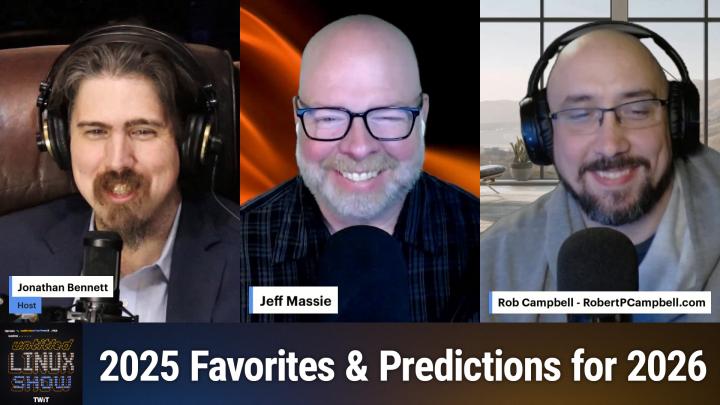
Untitled Linux Show 235 Transcript
Please be advised this transcript is AI-generated and may not be word for word. Time codes refer to the approximate times in the ad-supported version of the show.
Jonathan Bennett [00:00:00]:
Hey folks, last year we had predictions and some of them even happened. We go over and settle the score and talk about the things that we missed, the big stories and what is coming. We think in 2026, you don't want to miss it. So stay tuned.
Rob Campbell [00:00:17]:
Podcasts you love from people you Trust.
Jonathan Bennett [00:00:22]:
This is TWiT. This is the Untitled Linux show, episode 235 for December 27th. Happy holidays. Hey folks, it is Saturday and you know what that means. It's time to get geeky with Linux. But this is a little bit different. This is the Saturday between Christmas and New Year's and it means that right now the lights are off at TWiT and we are coming to you from Christmas past, well, actually about a month past. And we have pre recorded this segment.
Jonathan Bennett [00:00:57]:
We are going to go over our predictions from last year, talk about our favorite stories from this year, talk about the surprises, and then look ahead and see what we think is coming. It is at the very least going to be me, Jeff and Rob. And we may get some extras cut in from Ken. I'm not sure. That depends upon how much magic the people at TWIT want to do. And Ken actually gets his recorded. But welcome guys, to this very special holiday edition of the Untitled Linux Show.
Rob Campbell [00:01:31]:
Happy holidays.
Jeff Massie [00:01:33]:
Love being here as always.
Jonathan Bennett [00:01:35]:
Yeah, this will be fun. All right, so we're going to start with Rob, and Rob is going to tell us about his prediction. In fact, I can read Rob's predictions. Rob, here were your predictions. What's that old TV show this is your life or something? Rob, this is your predictions. You said first off that Linux would hit 3% on the Steam survey. That happened, didn't it?
Rob Campbell [00:02:00]:
I nailed that one. Linux hit 3.05% in October of 2025. And I would like to also just say that that was 50, almost 50% more than macOS on the same Steam gaming survey.
Jonathan Bennett [00:02:12]:
Yes, he also said we would get a Cosmic Desktop final release this year.
Rob Campbell [00:02:19]:
Did that happen at the time of this recording? Not yet, but their last announcement. Last time they announced, they said they plan to release by end of year. So in December is what they planned. So right now it's still too soon to call. We're going to have to judge this in the.
Jeff Massie [00:02:37]:
It's close.
Jonathan Bennett [00:02:38]:
So there's going to be a photo finish.
Rob Campbell [00:02:39]:
I think it's close enough. But.
Jeff Massie [00:02:43]:
You get at least partial credit.
Jonathan Bennett [00:02:44]:
Yeah, yeah, I'd say. All right. Rob also said that we would get a new Steam console, probably from Valve, but maybe from someone else, which is Interesting.
Rob Campbell [00:02:55]:
So I nailed this. But I didn't. I mean, so this has been announced and I don't recall if I specifically said it'd just be announced or we'd actually have it. So it's announced. We don't have it yet, but I don't know. That's a good prediction there.
Jonathan Bennett [00:03:14]:
I think it was. I also find it real interesting that you hedged your bet and said that maybe somebody else will bring out a Steam console and other people have brought out like Steam Deck competitors.
Rob Campbell [00:03:24]:
Yeah, I wasn't even thinking of that.
Jeff Massie [00:03:27]:
But it was pretty close, though. All right, I'll give you that one.
Jonathan Bennett [00:03:32]:
Yeah, yeah, yeah. You also said that Proxmox would replace VMware or try to replace VMware.
Rob Campbell [00:03:39]:
Yeah, well, and I said they would see major improvements as it tries to replace VMware. And then I said that the measuring metric for that was going to be a final release of Proxmox Datacenter. And at this time of the recording, this one is definitely. Well, it's a failure. Based off of the metric as proxmox itself, it has seemed some nice updates and I've heard many businesses switching to it. I've even some data centers. Not where I work, but I know of at least one ISP that has switched to Proxmox from VMware. But the Proxmox data center software itself unfortunately has not seen a single update since the alpha was released a year ago.
Rob Campbell [00:04:24]:
So that metric was a big failure. I thought they'd at least have another alpha, at least. I don't know what's going on there.
Jonathan Bennett [00:04:31]:
Yep. Yep. All right. Did you get your. Your premium ARM Linux laptop?
Rob Campbell [00:04:37]:
I did. Not quite. You know, I thought that was a softball prediction for sure to happen maybe. I don't know. Maybe I didn't think that. I think.
Jonathan Bennett [00:04:45]:
I don't know.
Rob Campbell [00:04:45]:
But it kind of fizzled out. There were plans, um, and they got canceled.
Jonathan Bennett [00:04:51]:
It's interesting, isn't it, that, that all of that didn't go quite as well as people anticipated and the brakes got put on.
Rob Campbell [00:04:58]:
Yeah, you know, it just seems like the, you know, those ex elites that were came out just didn't quite have the manufacturer support and weren't really up to what was needed for ARM yet.
Jeff Massie [00:05:13]:
Yeah.
Jonathan Bennett [00:05:13]:
Interesting. And then your last prediction from 2024, looking forward to 2025, was that the Whalen stragglers would be finalizing their plans to be all in on Wayland.
Rob Campbell [00:05:28]:
Well, what do you guys think?
Jeff Massie [00:05:32]:
I'd give you about 70% credit there's still a lot of people really hanging on to that x11 warm blanket.
Jonathan Bennett [00:05:40]:
I think at this point those people are not stragglers. I think they are just rebels.
Jeff Massie [00:05:45]:
Opposition. They're not.
Jonathan Bennett [00:05:46]:
Yeah, they're not, they're not straggling. They are, they're very happily where they're at.
Rob Campbell [00:05:51]:
Yeah. And I'm not even so much talking about the people. It's the distros.
Jonathan Bennett [00:05:54]:
So still though, I still. You're going to have distros that their whole thing is going to be we run X11 and you know, that's, that's fine.
Rob Campbell [00:06:03]:
Yeah.
Jeff Massie [00:06:04]:
When we say distros, I kind of just picture the top 20 or so and because there's always going to be those weird ones out there in left field that.
Rob Campbell [00:06:13]:
Yeah, I call this mostly a win.
Jonathan Bennett [00:06:15]:
I would say so.
Jeff Massie [00:06:15]:
Yeah.
Rob Campbell [00:06:16]:
But you know, as many of the, the more niche distros, you know, are running desktop environments that are a little behind the Whelen wagon, but they, you know, even they've announced, you know, MX Linux, I thought they might be a little behind because. Just because they're, they like the init 5 system but they also have system D. So you know, I guess that wasn't a hold up. Papa was going all in Cashy. All in. You know, they're all in on whaling. Some of the others, you know, Mitt has experimental slackware antics, you know, some of those other ones, you know, that they're, they're not all in on Whelen, but they're starting to get there. They're dipping their toes with experimental, even, even a niche desktop environment that I didn't expect.
Rob Campbell [00:07:01]:
Like Budgie, you know, they went all in a Wayland. So some went. Some, some not quite there yet.
Jonathan Bennett [00:07:08]:
Yep, yep.
Jeff Massie [00:07:09]:
Yeah, 70%.
Jonathan Bennett [00:07:10]:
Yeah. Okay, let's go to mine. I said that browsers will start supporting hdr. HDR will support it first on Linux. And that must be a, that must be a typo. That must be a typo. What, what's written there doesn't make any sense. I think Firefox will first support it on Linux is probably what I meant to say anyway.
Jonathan Bennett [00:07:31]:
And then by the end of 2025, YouTube HDR will just work. And I've got to say guys, it just works. Now we are at that point if.
Rob Campbell [00:07:42]:
You'Re on Wayland, if you're, if you're.
Jonathan Bennett [00:07:45]:
On Wayland, you're running a reasonably decent system. Like if you're on an up to date fedora and if you've got a monitor that'll do it then. Yes. You just. It works. It just works. No, no more hoops to jump through it. Just you turn it on and it works.
Jeff Massie [00:07:59]:
I'm recording this on HDR or with HDR capability on everything.
Jonathan Bennett [00:08:03]:
Yeah. Yeah. I was going to say you don't look like you're in hdr.
Rob Campbell [00:08:07]:
Yeah, you're all pale.
Jonathan Bennett [00:08:08]:
Definite standard.
Jeff Massie [00:08:09]:
That's just my natural color depth. But I'm brighter white now. Extra pasty.
Jonathan Bennett [00:08:17]:
You're a brighter pale.
Rob Campbell [00:08:18]:
Brighter whites in the face, darker darks in the background. Got it. Yes.
Jonathan Bennett [00:08:23]:
I also said that we would see more culture war issues in open source, more people getting banned. I. I think that absolutely happened.
Ken McDonald [00:08:30]:
The.
Jonathan Bennett [00:08:31]:
The other thing I predicted, I'm not sure that it has. I said that probably some of these forks will gain steam and threaten the original projects. And I don't know that I've actually seen that yet.
Rob Campbell [00:08:40]:
Yeah, I haven't seen that one.
Jeff Massie [00:08:41]:
I don't know what that would. Yeah, yeah. I can't think of any one of.
Jonathan Bennett [00:08:46]:
The ones that I was looking at that I thought might have a chance was the fork of Godot to. They made. Did they call it Red Dot or Reedo? I don't know how that was intended to be pronounced.
Rob Campbell [00:08:56]:
And I called out that prediction last year. I said, you know, these forks, because of culture wars, never make it. So I didn't expect it. Yeah, rarely, at least.
Jonathan Bennett [00:09:07]:
Yeah, well.
Jeff Massie [00:09:07]:
And I think a lot of times people think we need to do this and then they start doing it and go, whoa, this is a lot harder than we thought. You know, this, this, this is not the easy recompile we were planning.
Rob Campbell [00:09:19]:
They make it when they're technologically better or have something better that people want.
Jonathan Bennett [00:09:27]:
Right. Yeah, it. I think it's. It's probably a matter of like, what happens. What happens next is the big question. So like, when, when, when Godot went a little nuts and started banning people. Like, did they bring some of those people back? I'm not sure. I didn't know, actually.
Jonathan Bennett [00:09:45]:
I have not actually gone and followed up on that particular story, but there are ways to step back from the precipice as a project, as it were. So that has a lot to do with this as well, I think. I don't know. We're going to come back around to things we missed and I have more to say about that. But anyway, the other thing that I called is that we may see a BRICS kernel and if this has happened, it's not made the news, I'll put it that way. Brics in this case being Brazil, India, China, Russia, Korea and Russia I think is who makes up the BRICS nations anyway. It's sort of the anti NATO. And this was.
Jonathan Bennett [00:10:27]:
This came out of the Linux kernel getting sort of a notification that hey, by the way, you really should not have people that work at these countries that work in these companies listed as maintainers. Really, really bad. Breaking the law. Don't do that. Don't break the law. And so I looked at that and I said well if this continues then you're going to see a kernel for. We've not gotten to that point yet. I don't know if we will or not.
Jonathan Bennett [00:10:52]:
I am a little surprised. But the.
Jeff Massie [00:10:56]:
I've used some compile options and I bricked a kernel myself. I can give you partial credit for there.
Jonathan Bennett [00:11:01]:
There you go.
Jeff Massie [00:11:02]:
Give you 1%.
Jonathan Bennett [00:11:03]:
Yeah, there you. 1%. I'll take it. 1% is enough. I did say that we were going to get a PI 500 pro or XL. I missed it by that much. They called it the PI 500 plus. That is an improved PI 500 because I knew that there was the NVME slot and everybody wanted NVME on their Raspberry PI 5s.
Rob Campbell [00:11:25]:
Well, and you weren't specific on your name. You're like Pro XL or some other name like that. But basically an improvement which you do. You definitely got that. You just made a definitely name. Right.
Jeff Massie [00:11:34]:
I'd give you credit for that because it's the plus. I would file it under like Pro or Excel or. Same thing. It's a synonym.
Jonathan Bennett [00:11:42]:
Yep. And then the last thing that I talked about was legislation where software is. Is liable for damages caused. And we did not get this exactly. But we do continue to see, particularly out of Europe is where it's happening a lot is that the models for software and how liability works with it and the things that software companies are going to be required to do does continue to evolve. And I talked about a new funding model. I don't think we're quite there yet. I'm going to call this partially right because the things we were talking about are still going on.
Rob Campbell [00:12:19]:
There's just some slow progression. It just. It hasn't been a real hot year for it. But Right. Still there.
Jonathan Bennett [00:12:24]:
It's still happening. These things just happen very slowly because government's involved. So it happens slowly.
Leo Laporte [00:12:31]:
Hey everybody. Leo laporte here with a a little bit of an ask. Every year at this time we'd like to survey our audience to find a little bit more about you as you may know we respect your privacy. We don't do anything, in fact, we can't do anything to learn about who you are. And that's fine with me. I like that. But it helps us with advertising, it helps us with programming to know a little bit about those of you who are willing to tell us your privacy is absolutely respected. We do get your email address, but that's just in case there's an issue.
Leo Laporte [00:13:02]:
We don't share that with anybody. What we do share is the aggregate information that we get from these surveys. Things like 80% of our audience buy something they heard in an ad on our shows or 75% of our audience are it decision makers. Things like that are very helpful with us when we talk to advertisers. They're also very helpful to us to understand what operating systems you use, what content you're interested in.
Jonathan Bennett [00:13:26]:
So, enough.
Leo Laporte [00:13:28]:
Let me just ask you if you will go to TWiT TV Survey 26 and answer a few questions. It should only take you a few minutes of your time. We do this every year. It's very helpful to us. Your privacy is assured, I promise you. And of course, if you're uncomfortable with any question or you don't want to do it at all, that's fine too. But if you want to help us out a little bit. TWiT TV survey 26, thank you so much.
Leo Laporte [00:13:53]:
And now back to the show.
Jonathan Bennett [00:13:56]:
All right, Jeff, you talked about, you made some really boring predictions here. Jeff talked about the kernel LTS 6.18 and a new one being 7.0. I don't think we have a 7.0 yet, do we?
Jeff Massie [00:14:09]:
No. If it is going to be 7.0, it'll be in February, January time frame.
Jonathan Bennett [00:14:16]:
I have heard some rumblings that 619 is probably going to be the last of the six series.
Jeff Massie [00:14:21]:
Yeah, that's what they're talking about. But 619 is going to be, it's going to take us through the year.
Jonathan Bennett [00:14:28]:
Yeah. Yeah, seems to be. You, you called it that AMD Graphics were going to stumble this year in sales. Did they stumble in sales?
Jeff Massie [00:14:38]:
Yeah, they. Okay, it's, it's how you look at it. But they, they went up in, in their sales percentage but they dropped the ball so bad Nvidia basically handed them the market on a plate and they price themselves out of it. They, you know, it just how they handled everything was terrible. All, all reviewers just said, yeah, they, they could have had half the market by now if they would have played their cards right. And they didn't they really, they didn't order enough units. They, they were just behind the ball on a lot of different cases.
Jonathan Bennett [00:15:17]:
Yes. I think it's probably worth pointing out though that this year has been a very, very difficult year as a GPU manufacturer because the AI thing has just gone nuts. And so every bit of that fab time, the allocations are so tight. And I'm hearing from people that I know that fab allocations for next year are as bad, if not worse.
Jeff Massie [00:15:43]:
Oh, it's all sold out.
Jonathan Bennett [00:15:45]:
Yeah, but not only is it all sold out, but like people that want to manufacture devices, you know, the meme here, take my, take my money, that's actually happening. And people are just like, you wanted to buy 10,000 of those, you know, X, Y or Z, whatever it is, we can spare you 1,500. That's how many you can get for the year for the same price. Well, in some cases, sure. But yeah, apparently it's 26 is looking to be challenging again.
Jeff Massie [00:16:13]:
It is, but, but my reference was more that Nvidia handed them the perfect storm. They basically had paper launches. They had some driver issues. They, you know, the pricing, the it. It's like we couldn't hand you the market on any better silver platter. And AMD got a little greedy. They got, instead of looking at the law now, they did, they did do right when they didn't release, they didn't play Nvidia's game. They didn't release until the driver was ready because historically they'd release too early because, oh, Nvidia's release and we got to release too.
Jeff Massie [00:16:50]:
Well, it just, then the driver had issues and went bad there. So at least they did that. Right. But yeah, there's, there's a lot more they could have done better.
Rob Campbell [00:17:01]:
Okay, no hardware sales in 20 or don't buy any hardware upgrades in 2026. Wait till 2027. Unless it's a Steam Machine premium arm laptop works.
Jeff Massie [00:17:13]:
Well, the scary thing too is there, there's some rumors out there that, for example, Nvidia is not going to bundle the memory to some of their smaller board partners, which means the smaller board partners will have to source memory on their own. And that would scare me from, you know, board partners going, we want to undercut everybody. We found this really bargain basement memory and you know, is it going to have problems? Is it, you know, we'll see, we'll see what this next year holds because yeah, memory, memory is sold out for a long time.
Jonathan Bennett [00:17:50]:
Yep, yep.
Jeff Massie [00:17:52]:
All right.
Jonathan Bennett [00:17:53]:
You talked about there would be work continuing to fight Cuda and that some of these things would gain traction but not fully replace. Where are we with the CUDA alternatives?
Jeff Massie [00:18:04]:
I think it's actually becoming a real alternative now. We've had a few stories through the year where they've had pretty big improvement. I said not replace, but become valid because Cuda's got so much momentum with kind of being the de facto standard for a long time. But we now have the rock M and the hip and the other things that can actually now compete against Cuda. It's, it's, it's. And I don't. I won't. It, I won't say it'll beat Cuda, but it's at least viable.
Jeff Massie [00:18:41]:
It's not one of those where, well, we can run stuff. Yeah, but you 80 behind. It's like. No, you're much, much closer. The performance gap is closed quite a bit and I, I think it'll continue into this next year as well. Because intel also has a valid reason to want to get in on this because it's an AMD standard, is an open standard and like intel has also been helping with them and other. Other partners to, to get out of the proprietary CUDA lock in.
Jonathan Bennett [00:19:12]:
All right. You talked about Ubuntu and Fedora starting to fight to be cutting edge.
Jeff Massie [00:19:17]:
I kind, you know, I kind of think that's happened because they're using, you know, rc RC kernels in some cases, in some of their releases and they're really trying to get ahead now. LTS, they're much more careful. But other releases, they're really trying to.
Rob Campbell [00:19:36]:
All the rust that they're throwing in real early. Come on. Yeah, that's a definite win.
Jonathan Bennett [00:19:42]:
Yeah.
Jeff Massie [00:19:42]:
Yeah.
Jonathan Bennett [00:19:44]:
All right. And then the other thing was, ah, the first major distro. Jeff predicted the first major distro will at least propose dropping X altogether. Have we seen that?
Jeff Massie [00:19:58]:
Yep.
Jonathan Bennett [00:19:59]:
Which distro is that?
Jeff Massie [00:20:03]:
Wasn't that Fedora?
Jonathan Bennett [00:20:06]:
No.
Jeff Massie [00:20:07]:
Are there new releases?
Rob Campbell [00:20:08]:
Well, Fedora did propose it. Red Hat too, is that.
Jonathan Bennett [00:20:11]:
I think Red Hat is proposed to stop basically stop doing maintenance on X. Yes. I don't know. Is Fedora gonna drop X altogether?
Rob Campbell [00:20:21]:
Yeah, they did propose that I think in a couple releases here or something like that.
Jonathan Bennett [00:20:29]:
I know the desktop environments have. But I was not aware that they were going to drop support for it altogether.
Rob Campbell [00:20:39]:
Yeah, there was a story within the past couple. Couple weeks here, I remember.
Jonathan Bennett [00:20:43]:
Okay.
Jeff Massie [00:20:45]:
I'm just looking here and it says, yeah, Ubuntu and Fedora are both dropping X11 support in their default editions Now Red Hat default is good. Yeah.
Jonathan Bennett [00:20:55]:
See, I don't know if that counts. It's moving in the right direction. But if you can still open your package Manager and install X11. I don't know that it counts to say that they've dropped support for it yet. I'm going to get you on the technicality here.
Jeff Massie [00:21:09]:
Okay.
Jonathan Bennett [00:21:10]:
But I think at least directionally we're correct and that full drop is coming for some of these.
Rob Campbell [00:21:18]:
And I've seen recently KDE also dropping it too. I've seen a lot. I saw KDE just announce that I think real recently. So that's going to hit the KDE spins.
Jonathan Bennett [00:21:30]:
Well, for sure, for sure. All right. And then one other thing that Jeff called is that hardware would be bought boring this year. Was the hardware world boring in 2025? Yes, in some ways it really was. Yeah. Yeah.
Jeff Massie [00:21:46]:
Because intel, we were still riding on their release on their CPUs. It was. Yeah.
Rob Campbell [00:21:53]:
Ho hum, you know, I'm not going to disagree.
Jonathan Bennett [00:21:56]:
Yeah.
Jeff Massie [00:21:57]:
The 5000 series AMD or I mean Nvidia, just a minor update from the 4000 series. It wasn't a major jump like we'd seen historically.
Jonathan Bennett [00:22:07]:
Right.
Jeff Massie [00:22:08]:
AMD's 9000 series fell a little short of where we hoped it would be. It was not quite the game changer we thought it would be. And so it. Yeah, nothing if. Nothing super exciting.
Rob Campbell [00:22:21]:
If hardware is so boring and over 50% of your stories are about hard. What does that say?
Jeff Massie [00:22:31]:
I'm a boring person. I'm plain oatmeal.
Jonathan Bennett [00:22:38]:
Oh my goodness. All right, so Rob and we made just kind of free for all this one. But we'll let Rob get started with it. What did you miss that you should have known about? What didn't you see coming?
Rob Campbell [00:22:54]:
What did I miss? I didn't prep for this.
Jonathan Bennett [00:22:57]:
I know I'm putting you on the spot.
Rob Campbell [00:22:59]:
You are. I don't think I missed a thing.
Jonathan Bennett [00:23:02]:
Right, right, right, right. Sure.
Rob Campbell [00:23:04]:
Then that I remember.
Jonathan Bennett [00:23:07]:
Yeah. I didn't miss anything that I can remember. I don't recall. Okay. I'll tell you, I. I prep for this. I guess I sort of cheated. I'll tell you what I was thinking of.
Jonathan Bennett [00:23:19]:
I missed how much of a train wreck Windows 11 was going to be. I mean we kind of knew but man, it's been rocky. Particularly because of all of the weird stuff Microsoft keeps cramming in there. Like we're going to make. The newest thing now is we're going to make Windows 11 an agentic AI that's going to be the purpose of the desktop, man. A lot of people don't like that you have Windows recall. People did not like that. It's just, it's been sort of a train wreck then the end.
Jeff Massie [00:23:53]:
10 yeah, my mist was kind of tangential to that where I was going to say I totally missed how much mainstream tech was going to start picking up on Linux. You know, the LTTS, J's, 2 cents, gamers, Nexus, you know.
Jonathan Bennett [00:24:10]:
PewDiePie.
Jeff Massie [00:24:11]:
PewDiePie.
Jonathan Bennett [00:24:13]:
Yes. Yes. Yeah, that was something I had in mind as well. Tell you something else we missed was the Steam frame. Did not see that one coming. Not in that we knew. We knew Valve was making hardware, but we did not think about it coming in that particular combination.
Rob Campbell [00:24:29]:
At least not last year. Once they started working on some ARM stuff, we're like, what are they doing here? But that was pretty late in mid-2025 when we even noticed that.
Jonathan Bennett [00:24:39]:
Yep, yep.
Jeff Massie [00:24:41]:
Say we missed Clear Linux going away.
Jonathan Bennett [00:24:45]:
Yeah, that's true. So I actually have a note here that one of the things that we missed was the layoffs at intel and some other places that these companies would cut their Linux and open source stuff in the way that they have. Intel has been the big one, but not the only one doing this sort of thing. And that I think we missed the.
Jeff Massie [00:25:07]:
Other one, and I should preface that that intel cut a lot of things, not just the open source. It was they've been through. For anybody that doesn't know, they went through massive cuts and layoffs and shutting down entire divisions.
Jonathan Bennett [00:25:22]:
Yes, it was not a fun time to be at Intel. No, was not. And then the other thing I have under this, this kind of goes back to that prediction I made about forks gaining steam and threatening the original project, Ex Libre. I think that's maybe the one where.
Rob Campbell [00:25:41]:
Where.
Jonathan Bennett [00:25:43]:
You could make the case that it threatens the original project because the original project x11 they're trying to kill, they're trying to shut it down and Ex Libre is coming along and saying no, we won't let it die. The real ironic one about that is in my mind it's not primarily a culture war fork. It's just a we still want this thing to exist fork. And ironically they've kind of like the, the people doing the fork have tried to make the case that it's a culture war fork. And I don't think it is. I think it's sort of waving that false flag, which is a really weird thing to see.
Rob Campbell [00:26:16]:
And I think this is a big miss because I think this is something we could have predicted pretty easily, and a lot of those others hit and miss, but, you know, X is going away. We've known this for years, really. And we've known how much people love X and don't want to let it go and don't want to go to Waylon. It should have just been obvious that somebody would fork it.
Jonathan Bennett [00:26:39]:
Yes. But in retrospect. All right, any other misses that we should call out on ourselves? Jeff, you have anything?
Jeff Massie [00:26:51]:
I think I. I think you covered the big ones.
Jonathan Bennett [00:26:53]:
Okay. All right, let's talk about our favorite news from the year. We'll let Rob go first again. What happened this year that was your favorite?
Rob Campbell [00:27:02]:
My favorite news is all of the Valve announcements, their hardware announcements, their Steam survey showing Linux on the rise, and the work they've been doing with Proton, and now even Proton on arm. So everything Valve.
Jonathan Bennett [00:27:21]:
Yep.
Jeff Massie [00:27:22]:
That matches. I had that one, too.
Jonathan Bennett [00:27:23]:
Yeah.
Jeff Massie [00:27:25]:
I've got every exciting thing.
Jonathan Bennett [00:27:27]:
I've got three things. Got three things that are my favorite news. And the first one is Wayland getting sorted with hdr, which is Valve, that Val, Valve and KDE put their heads together and said, let's just fork Wayland. And the guys at Wayland said, oh, maybe we'll actually take your pull requests. We thought about it. We'll take your pull requests now. Okay. So that made things work.
Jonathan Bennett [00:27:48]:
Wayland. My second was Proton Gets Better. Again, that's Valve. They're the one putting the money into it. The third thing on my list that I find is just. It's hilarious and it's fun, and it was a lot of fun to talk about. And that's Anubis, aka the Linux CatGirls that you see in your browser when you try to go to certain places. It's just fun.
Jonathan Bennett [00:28:09]:
It's dorky. The security side of it does not necessarily work, as our friend Tavis Orbundy pointed out, but it's just hilarious. I like it so much just because it's fun. Those are my three. All right, Jeff, what. What was your favorite?
Jeff Massie [00:28:25]:
Well, I had. I had. Did you have some more, Rob?
Rob Campbell [00:28:28]:
No, that's. That's it. All together is mine.
Jeff Massie [00:28:32]:
So I've got. I've got one here that you'll, you know, Mr. Oatmeal Hardware Benchmarking. I really love seeing all the comparing distros, different hardware, different, you know, all that kind of. Hey, I'm a hardware guy. What can I say, you know? And I just. I just really enjoy those. And the third thing was I loved all the Linus Torvald's rants.
Jeff Massie [00:28:55]:
I loved all the, where he would just go off on people for bad code, improper pulls, you know, things like that. And it was, it was just really fun reading where he, you know, it becomes cathartic for him. You know, he's got all this balled up rage and he lets it go. Only it's more G rated now after he went through his training, anger management training. But you know, sometimes that's what you need just to keep that kernel on track. And you can't argue with the success of the Linux kernel. I mean, as much as people say, oh, this is the year of Linux, it's been the year of Linux for a long time. Just not on the desktop, it's one everywhere else.
Rob Campbell [00:29:37]:
Yeah, I think, I think, I mean they're fun, the drama's fun. I think you could do better though. I mean, there are ways to help guide people in the right direction without being a total jerk.
Jeff Massie [00:29:51]:
Well, but they have a. But they already have a lot of these rules. Here's how it works. Here's. It's the people that just try to go, wow, I'm just going to get this in here anyway. And they have just such horrible code. Or you don't ever put this into a. In the middle of an rc, you don't add all this stuff or you know, things like that.
Jeff Massie [00:30:10]:
And that's where he gets really mad of like, you missed the 12 road signs that said don't go here.
Rob Campbell [00:30:17]:
And I've been.
Jeff Massie [00:30:17]:
You still went there.
Rob Campbell [00:30:19]:
I've been seeing some old videos of his post and I mean, not that old, I don't know, probably five plus years ago, like one I saw recently. He is like saying, I've tried Ubuntu once and I couldn't just run make or make install or whatever. He said to compile my kernel. So that was a deal breaker for me. And I don't know, I thought that was kind of silly just because I don't think most mainstream distros have the dev tools with them by default either to do that. So all you got to do is install the dev tools.
Jonathan Bennett [00:31:01]:
I don't think that's what he was talking about. I think it was the idea that once you get your dev tools installed and you run a make install, it still doesn't install. The kernel in a place where you can boot. Was a little bit more sophisticated than that. I know the video you're talking about and what he was complaining about was a little more sophisticated than just I had to use apt to install make before I could do kernel it wasn't.
Rob Campbell [00:31:20]:
Just that he's like if you have to do install packages. And I don't know, I only caught a snippet too. So maybe the context is missing.
Jonathan Bennett [00:31:28]:
Yep, yep. The other thing with Torvalds is I've seen some of his before he went through anger management he had some comments about this, like why he's so abrasive and he actually talks about early on in the kernel when he had a he had a moment where he realized that like one the Colonel was going to be a really big thing and there were people that cared around the world that cared about it very deeply. And he talked about how that there were people that would have ideas and want to do things and he would not like it but try to be nice about it. And then someone would put all this time into it and finally get the pull request and he would have to tell them no. And apparently he had someone that got suicidal on him over it. And that was sort of at the point where he said I can't afford to be nice. I have to essentially have to be a painfully clear communicator. Is is where he came to and that's where a lot of that came out of.
Rob Campbell [00:32:25]:
I think you could be painfully clear without like using the words of you're an idiot.
Jonathan Bennett [00:32:32]:
You know.
Ken McDonald [00:32:34]:
Well, Jonathan, this is just Ken here calling in to give you my views over what happened this year that I thought were my highlights, as well as some predictions on what we can expect to see next year. Let's first start with the by looking back over 2025 where I saw caliber version 7.24 released back in January and I just recently saw that it has reached 8.16. So I'm looking forward to seeing some future releases as we go into next year. But what I really thought was important with those releases was some of the new features that they've included to include the ability to connect to a folder and treat it as though as a USB Ms. Base device improve Kobo support, allowing you to edit, view and convert Kobo's kepub format and of course the them adding an Ask AI tab to the dictionary lookup panel in Caliber's Ebook viewer. Now another popular utility almost you could say underpinning for Linux is pipewire. It actually started the year with version 1.2.7 and is ending the year with version 1.4.9 as of this recording though we may see 1.6 release before the end of the year since we are already up to the fourth release candidate for 1.6.
Jonathan Bennett [00:34:37]:
We are. My goodness, this is supposed to be like a 30 minute Christmas episode. We gotta move, guys.
Jeff Massie [00:34:44]:
Hey, this is Linux. We give you more for your money.
Jonathan Bennett [00:34:49]:
Hello, everybody.
Leo Laporte [00:34:50]:
Leo laporte here. You know what a great gift would be, whether for the holidays or at just any time. A birthday, A membership in Club Twit. If you have a Twit listener in your family, somebody who enjoys our programming and you want to give them a nice gift and support what we do, visit Twitter, TV Club Twit. They'll really appreciate it and so will we. Thank you. Twit. TV Club Twit.
Jonathan Bennett [00:35:16]:
Yep. Yep. All right. I have a couple of things noted here that I think is not my favorite news, but the important news from the year. A couple of big stories that didn't fall into the favorites idea and one was just this. Overall AI and open source. So many projects I've talked to over on Floss, you look at it in the kernel, they're all having to deal with this. Like you have the curl project where they have AI slop security vulnerabilities coming in that people have to take time to wade through.
Jonathan Bennett [00:35:49]:
Basically every project right now is getting AI. In some cases it's slop, in some cases it's decent. But pull requests like, hey, Gemini, it would be great if this project did this. Please write a pull request for me. And then they actually pull it, make the pull request. And then somebody on the other end has to slog through the 30,000 lines changed to see, oh, he wants this one thing and the AI changed, all this other stuff. It's been a big thing, big change for projects this year. And then the other one that I think is just a huge deal this year is Firefox losing so much market share, trying to turn it around and not necessarily being successful yet.
Jonathan Bennett [00:36:38]:
You see, Thunderbird has made great success. Firefox Jerry's still out. We'll see what happens.
Jeff Massie [00:36:44]:
Well, they did say they're going to. There's. And it's going to take while before we see the, the fruits, the development, but they're going to focus more on the browser itself and less of the little side show circus tricks.
Jonathan Bennett [00:36:55]:
Yeah. Yep. All right. Either of you guys have a story that comes to mind that was just important from this year? One of the. Something that really changed the landscape or did I claim the two that you would have thought of?
Jeff Massie [00:37:10]:
No, I, I think you covered pretty much. Yeah.
Rob Campbell [00:37:14]:
I, I think Ubuntu really pushing the limits with Rust is potentially Pretty big for.
Jonathan Bennett [00:37:22]:
Yeah, that's true. I think so too. I think that's a big deal. All right, let's talk about our favorite command line tips. Rob cheated. He's got two. He's gonna runner up.
Rob Campbell [00:37:31]:
I lied when I said that I have two first places and two runner ups.
Jonathan Bennett [00:37:36]:
He's got four of them.
Jeff Massie [00:37:38]:
All right, so Rod's indecisive. Rob's indecisive.
Jonathan Bennett [00:37:41]:
Yes.
Rob Campbell [00:37:43]:
My number one though ultimately is uptime Kuma. Since I've done that, you know, my tip was in the June 14. Since I did that one being able to know when there's an outage somewhere. I've had cloudflare outages and various things and be able to jump on and and try to resolve things quickly. I could do anything about the cloud failure 1.
Jonathan Bennett [00:38:05]:
I was going to say jump on and stare at the. Stare at Twitter or Facebook or wherever with all the rest of us down.
Rob Campbell [00:38:12]:
There have been some I've been able to resolve quickly before and anybody knows the next one, it's tied to it. But like I've had services stop on web server and when I did the learn the auto restart failed services in system d did that one, 8:30 or August 30th. That one's improved my uptime. My next two are the runner ups. They go together. Also Ansible I did on September 13 and the follow up on September 20 is Semaphore UI, which is the web user interface to Ansible. Those have been fun.
Jonathan Bennett [00:38:54]:
Yeah, very cool. I picked a favorite tip. The first one I picked was to which is the serial monitor. We didn't cover that this year. We covered it the year before. So I went back through. Okay, what did we actually cover this year that I use all the time and the one that I turn to so often such a simple thing is strings. The strings command goes through a binary or goes through a file and pulls out the strings.
Jonathan Bennett [00:39:19]:
You can then, you know, grep it or search it in whatever way you want to. Super useful for figuring out what's going on inside of a binary that otherwise you just wouldn't have any idea what it's doing. That is my favorite tip. Jeff, what is your favorite command line tip that we covered this year?
Jeff Massie [00:39:33]:
I did the same thing. I was like, oh, B top. And then I looked. I'm like, oh yeah, that predates 25 old news. Yeah. Then it would have to be cheat where it's like tldr, but it pulls from tldr. It pulls from stack overflow. It pulls from other places so it's like a more complete TLDR.
Jonathan Bennett [00:39:55]:
Yeah. Cool.
Ken McDonald [00:39:57]:
Well, Jonathan, my favorite command from 2025 has to be the wire plumber control command or wpctl especially its status sub command which I covered back on episode 215 though right now I'm going to have to say top grade. Going all the way Back to episode 136 is still my overall favorite command for updating all my systems from a single terminal, even remote systems.
Jonathan Bennett [00:40:34]:
All right, it's time. It is time for the big thing, the thing everyone is here for. We're gonna let Rob go first with this. What's your predictions man? What are we looking forward to in 2026?
Rob Campbell [00:40:45]:
So my predictions, these are I kind of soft but anything I missed last year I think is gonna happen. But no, it's not my prediction anyway, I'll start it. ASUS will make a Steam machine of their own like the Asus Rog machine or something. Okay, next Linux. Okay, I'm stretching this. I thought my 3% was a stretch last year because my soft was 2.5. So this year I'm just going to go right for the 4%. That's going to be a stretch but I think with the Steam machines out there let's go for it.
Jonathan Bennett [00:41:22]:
I think that's pretty reasonable actually we not terribly surprised me to see 4%.
Rob Campbell [00:41:26]:
Yeah, it's a bigger jump that we've had for a while.
Jeff Massie [00:41:28]:
Maybe stretch to 5 or ever.
Rob Campbell [00:41:30]:
No, I'm not stretching the 5. I'm gonna say 4%. It is not gonna hit 5. Sorry. Whelen will not be default but we'll move out of experimental on Linux Mint Cinnamon and to go with that I think the XFCE will make further steps to be wayland. Also two more. Okay, we won't see a premium ARM Linux laptop this year. We're not going to but it will be announced that Tuxedo Computers will be doing a Snapdragon X2 Elite laptop.
Rob Campbell [00:42:08]:
My last one, Canonical is going to roll back some of their rust changes for the lts.
Jonathan Bennett [00:42:17]:
Yep, I like it. I like it. All right, here's mine. I think in 2026 we're going to get announced probably not released but announced the next Steam deck and it's going to be ARM based. I think anti cheat is finally going to get sorted on Linux because the Steam machine thing is going to become so popular and so hot that there's not going to be any choice. People are going to just complain way too much. And so the holdouts are finally going to either get it together and make it happen or their games are just not going to be very relevant anymore.
Rob Campbell [00:42:56]:
Or they're going to say if on the Steam machine play nowhere else.
Jonathan Bennett [00:43:05]:
I guess that could be, that could be. We're going to see more Wayland drama because that group of people for whatever reason are just really good at their drama. You will, you will see probably KDE and Valve again coming to them and saying, you guys need to get it together and pull this, this needs to happen. Or maybe it'll be Google this time, but there will be something where, you know, they have been watershedding for three years over the very idea of, you mean you want your Windows to go to specific places and Google's going to come along and say pull the dang pull request, guys. Okay, something like that's going to happen.
Jeff Massie [00:43:44]:
That's a pretty safe one there.
Rob Campbell [00:43:45]:
Yeah, I'm going to say 100% not Google.
Jonathan Bennett [00:43:49]:
You say that they won't care. There is Chrome OS and there is the new Aluminium, which is probably going to be Wayland. So Google does care about some of this.
Rob Campbell [00:44:02]:
There's Chrome OS for now, but not for long. And I don't know what Aluminium is going to run. I mean it's Android, so Android's not going to run that.
Jonathan Bennett [00:44:11]:
Who says Android can't run Wayland?
Rob Campbell [00:44:14]:
I'm just saying.
Jonathan Bennett [00:44:15]:
Anyway, I've got one more that is in my relatively safe batch. We've not talked a whole lot about this, but NPM has been seeing terrible security problems. NPM, for those that don't know that, is the Node JS package manager. It is a repository of JavaScript packages, packages and for the longest time now people have been uploading malicious code there and they've been doing what's called typo squatting. So you know, if you have a package that's got the word color in it, C O L O R. Someone will upload a package that's the exact same thing but spelled C O L O U R the British spelling. And it'll have inside of the, like the, the install script part of the package. It will have some malicious code that'll, you know, look for a bitcoin wallet on the local machine and upload it, you know, that sort of thing.
Jonathan Bennett [00:45:07]:
The most recent thing with NPM is that that idea has been pushed to the limit and now people are writing worms, self replicating worms inside of these packages. And so it will do things like instead of going and looking for a bitcoin wallet, it will go and look for NPM credentials on the local machine and then it will push malicious code to any packages that are available using those credentials. And it's a couple times now, it's just been a terrible problem where hundreds and hundreds of packages have gotten compromised. NPM is actually owned by GitHub, which is owned by Microsoft. So it's kind of a big black eye for them right now. And I imagine that sometime in 2026 something big is going to change at NPM to try to address this, because it has to. We're kind of at the point now to where we're pushing towards not being sustainable for this, this model of real time package fetching, like live package fetching to work. There's something to be said for the old C and C model where you have your libraries permanently installed anyway.
Jonathan Bennett [00:46:15]:
And then my stretch prediction in 2026, I think we're going to see signs of decline of x86. Now, you might say that we've seen that already. I don't think we really have. But particularly if Windows 11 continues to be as unpopular as it is, when you get Windows 11 being sort of unhitched from the idea of what a desktop, what a computer is, you have a lot more flexibility to run Linux, which means you also have a lot more flexibility to run ARM and RISC V and all of those things. I think with that you're going to see less of the x86 monopoly. So that's my stretch prediction for 26. All right, Jeff.
Jeff Massie [00:46:58]:
I could see that. Just because Apple showing off their M hardware is proving what you can do with battery life.
Leo Laporte [00:47:08]:
Hi there. Leo laporte here. I just wanted to let you know about some of the other shows we do on this network you probably already know about. This Week on Tech. Every Sunday I bring together some of the top journalists in the tech field to talk about the tech stories. It's a wonderful chance for you to keep up on what's going on with tech, plus be entertained by some very bright and fun minds. I hope you'll tune in every Sunday for this Week in Tech. Just go to your favorite podcast client and subscribe this Week in Tech from the Twit Network.
Jonathan Bennett [00:47:38]:
Thank you.
Jeff Massie [00:47:40]:
I actually had you and I matched on one. I believe we're going to have it. I said at least one major game next year with anti cheat code working on Steam. So, like when I say major, I'm talking, you know, like a Call of Duty, a Fortnite, you know, a big one. Not, you know, Bob's Cookie Chase or something. I Think the open source. By the end of next year, the open source Nvidia driver is going to be within 80% or more performing performance match of the proprietary driver.
Jonathan Bennett [00:48:14]:
Now, which, which Nvidia are you talking? Nova. The Nvidia's Nova driver. Okay.
Jeff Massie [00:48:20]:
Yeah.
Jonathan Bennett [00:48:20]:
All right.
Jeff Massie [00:48:21]:
Right now they're on. No, no, Vu using it to kind of boot into the open stack that Nvidia's got because Nova's not quite ready yet. But I think we will have an Nvidia open source driver option and I'm gonna leave. Well, since. Since you try to get me on technicality, I'm just gonna say we're going to have an Nvidia open source driver within 80% of the proprietary driver. All right, here's a wild one for you. I think Ubuntu will either move away from Gnome or announce it's moving away from Gnome in the next year.
Jonathan Bennett [00:49:02]:
As its default.
Jeff Massie [00:49:04]:
Yes, I think they're going to try to find something else.
Jonathan Bennett [00:49:07]:
What do you think they're going to go to?
Rob Campbell [00:49:10]:
There's only one other option.
Jeff Massie [00:49:13]:
Well, for them, normally I would say kde, but they're going to probably. Oh, we're going to make this thing or we're going to.
Jonathan Bennett [00:49:23]:
Yeah, you're right. That's what it is. We're going to write our own desktop environment. That's an embody thing to do.
Jeff Massie [00:49:28]:
Yeah, I guess. Maybe Cosmic, Cosmic.
Rob Campbell [00:49:32]:
Or they could take Unity back.
Jonathan Bennett [00:49:36]:
Go hire the 13 year old.
Rob Campbell [00:49:38]:
Well, he's already, he's already backing out of it, so that's why they need to develop it again, so they'll stick it back to keep it alive.
Jeff Massie [00:49:46]:
Well, just imagine Cosmic, if you had canonical in there, go. Okay, we'll just dedicate 10 people to help fine tune and advance and cover a lot of ground really fast.
Rob Campbell [00:50:00]:
Yeah, you're right. That is another option. Actually, that's maybe the better option. I wasn't thinking of them for some reason.
Jonathan Bennett [00:50:07]:
Yeah, my mind went straight to Cosmic. I don't know if Ubuntu would do it, but knowing Ubuntu, it's more, it's probably more likely they would try to do a Unity 2.0 or something.
Jeff Massie [00:50:17]:
Yeah, that's why I said that. I'm like, yeah, they would. They got to shoot themselves in the foot, you know.
Jonathan Bennett [00:50:23]:
Yeah, of course.
Rob Campbell [00:50:26]:
I'm gonna say. I gotta say, with their big things like rust this, rust that. You know what, that makes it even bigger. Cosmic. I, I think I like that one. Cosmic, that's. That's the big stretch for Them and they've been stretching out the lts. But then in the fall.
Rob Campbell [00:50:40]:
Yeah, I like it.
Jonathan Bennett [00:50:41]:
You're right.
Rob Campbell [00:50:42]:
I'm with you.
Jeff Massie [00:50:43]:
Whoa, hey, we got that on. We got, we got that recorded.
Jonathan Bennett [00:50:46]:
It's on video.
Jeff Massie [00:50:47]:
That I was right.
Rob Campbell [00:50:48]:
I had to think about it. Well, next year I'll be saying you were wrong, but.
Jonathan Bennett [00:50:54]:
All right. Anything else, Jeff?
Jeff Massie [00:50:56]:
I have CPU hardware will be released, but it's, it's only going to be modest gains. We're going to see like 20% or less performance coming. Basically. The uplift will be underwhelming. But I do say GPU hardware will be released and it will have a much larger performance jump and really get people looking at having an upgrade. I'm not counting the people that always have to have the latest, greatest. I'm talking about, whoa, there's a nice step in performance from what I'm running to what this next one is and the last one is. I say I.
Jeff Massie [00:51:26]:
You know, people talk about AI being a bubble. I don't think it's gonna. I don't think it's a bubble. I think it's a balloon. And we're gonna see the air come out of it a little bit. It's gonna become a little more commodity. And it's not like, oh, the balloon popped. It's all going away.
Jeff Massie [00:51:44]:
We're going to see where people kind of take a chill on AI a little bit and go, okay, it's. It's going to be around. It's going to be like spell check or grammar check or. I mean, it's going to be in a lot of places. It's going to be another tool in the toolbox. But people aren't going to have the, the feverish build out. It's going to kind of slow down. There's going to still be build outs, but there'll be more planned, less, quick, throw money at it, you know, kind of things.
Rob Campbell [00:52:10]:
Have you read the posts on the Internet? I think spell check was a bubble that burst a long time ago.
Jonathan Bennett [00:52:18]:
I actually, I 100% agree with Jeff there. I say it a different way, but I've been saying this for a while. I think AI, I would say it is a bubble, but it is a bubble in the same way that the web was in the 90s and the personal computer was before that. You know, these things, people poured a lot of money into them, then the bubble burst. But those things still change the world. And so I think AI is set up in a very similar place. You have a bunch of businesses that are going to go bust and a lot of money is going to dry up. But there's no putting the genie back in the bottle.
Jonathan Bennett [00:52:49]:
So I'm with you. I like that balloon analogy, though. It's not a bubble, it's a balloon. I'll have to remember that one's pretty good.
Jeff Massie [00:52:54]:
Yeah. Because everybody has had a balloon. The air kind of went out of it. It shrunk a little bit, but it's still there. It's not an all or nothing, but you're still going to have a lot of hardware sales because you're going to have people going, oh, this hardware is a few years old. We got to replace it. But everything's going to be of cadence and scheduled and no, it's a.
Rob Campbell [00:53:12]:
It's a car tire and winter's coming.
Jonathan Bennett [00:53:15]:
Yeah, winter is coming. Yep.
Ken McDonald [00:53:18]:
And I'm going to assume y' all have already covered all my predictions from for this 2025, so I'm not going to review those again. But I do want to add my predictions for 2026 by continuing with Pipewire. If it doesn't happen before the end of this year, I'm predicting that early next year we're going to see version 1.6.0 rollout. And hopefully throughout the year we'll continue to see improvements with video routing, though I don't expect it to be ready for prime time by next December because video is a difficult animal to control. But hopefully we do see some improvements throughout the year, maybe to the point where we can use it to connect from obs to all the different browsers via pipewire.
Jonathan Bennett [00:54:23]:
All right, this has been a lot of fun, guys. We got to wrap this up so that we can go do today's show. I want to let each of the guys, though, plug some if they want to. We'll let Jeff go first today for this special holiday show.
Jeff Massie [00:54:37]:
For the special holiday show, I have a special poetry, a technical manual written by Dr. Seuss. If a packet hits a pocket on a socket on a port and the bus is interrupted at a very last resort and the address of the memory makes your floppy disk aboard, then the socket packet pocket has an error to report. If your cursor finds a menu item following followed by a dash and the double clicking icons, put your window in the trash and your data is corrupted because the index doesn't hash, then your situation's hopeless and your system's going to crash. If the label on your cable on the gable at your house says network is connected to the button on your mouse, but Your packets went want to tunnel to another protocol that's repeatedly rejected by the printer down the hall? And your screen is all distorted by the side effects of Gauss, so your icons in the window are as wavy as a souse. Then you may as well reboot and go out with a bang. Because you're sure. Because as sure as I'm a poet, the sucker's going to hang.
Jeff Massie [00:55:42]:
When the copy of your floppy getting sloppy on the disk and the microcode is instructions cause unnecessary risk. Then you have to flash your memory and you want to ram your rom. So quickly turn off your computer and be sure to tell your mom. Have a great week, everybody. And I hope you have a great year coming up.
Jonathan Bennett [00:56:03]:
That's fun. All right, Rob.
Rob Campbell [00:56:06]:
That was great, though I was worried it was not going to end. Hey, Happy holidays. Why don't you come and connect with me on the social medias and, you know, tell me Happy Holidays in whichever way you like. And to do that, you go to Robert P. Campbell.com there's links to my LinkedIn, Twitter, Blue Sky, Mastodon. And if you want to send me a little present, there's this coffee cup here and you can click there and donate a coffee to me. Happy holidays all.
Ken McDonald [00:56:37]:
All right now, as we prepare for the New Year, I just want to remind everybody, review your backup processes, especially if you have more than one, and also test your recovery methods because it doesn't do any good to back up and not be able to recover from that backup. And happy holidays to everyone to include a happy upcoming New Year.
Jonathan Bennett [00:57:07]:
Appreciate you guys.
Jeff Massie [00:57:07]:
It was actually hard to read that poem without laughing.
Jonathan Bennett [00:57:09]:
Yeah, we could tell. We could tell. Appreciate you guys being here for this special edition. Thank you so much. If you want to find more of me, well, there is of course Hackaday, that is, it is the home of Floss Weekly. And so if you are interested in more of this sort of thing. But talking with the people behind Open Source, that is the show to check out. We appreciate everybody that is here, those that get us live and on the download.
Jonathan Bennett [00:57:35]:
And we will see you next week, next year for another Untitled Linux show. Thanks.