This Week in Space 172 Transcript
Rod Pyle [00:00:00]:
On this episode of This Week in Space, we're talking about how we might make Mars our new home. Not eland's way, but with high speed terraforming. It's new, it's exciting, and it's really fascinating. Join us
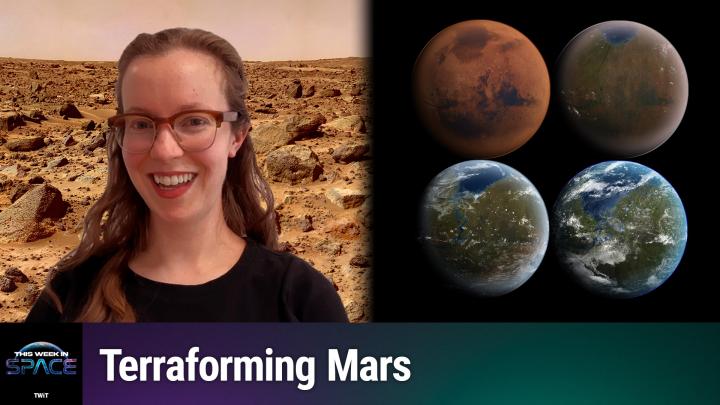
This is This Week in Space, episode number 172, recorded on August 8, 2025. Earth on Mars. Hello, and welcome to another episode of This Week in Space, your favorite podcast, the episode we like to call the Earth on Mars edition.
Rod Pyle [00:00:42]:
I'm Rod Pyle, editor in chief of Ad Astra magazine, and I'm with that paragon of good looks and brains, Rick Janay. Rick, how are you?
Dr. Rick Janet [00:00:49]:
I am good. I am good. Great to be here today.
Rod Pyle [00:00:52]:
We'll be joined in a bit by Dr. Erica Alden DeBenedictis, the CEO of Pioneer Labs and co founder of the Astera Institute, to talk about new ideas that she put forth in a recent paper on terraforming Mars. And this is not your usual terraforming Mars discussion. This is how we do it in a new and clever way, in decades, not centuries or millennia. So this one is really going to be a good one because when I saw this paper, I was gobsmacked. But before we start, please don't forget to do us a solid gobsmack and make sure to, like, subscribe and the other podcast things that you do, because we're counting on you. And now, dear listeners, a space joke from Scott Ulrich. Are you ready? Are you ready?
Dr. Rick Janet [00:01:44]:
Sure.
Rod Pyle [00:01:44]:
Yeah.
Dr. Rick Janet [00:01:45]:
Okay, let's hear it.
Rod Pyle [00:01:46]:
An alien visiting Earth was hungry and walked into the Apple store. A few moments later, he was choking and died on the spot. When the police interviewed the store clerk, he shrugged and replied. I just told him that model was only a single terabyte.
John Ashley [00:02:02]:
Where's the joke? :)
Rod Pyle [00:02:05]:
Okay. From Anonymous. Another joke. Because I thought we might need a backup. Sorry, Scott. Good effort. Send us another one. Another alien walked into a bakery demanding a custom cake to celebrate the invasion of Earth. After the clerk got over the tentacles in the third eye, she said, what do you want it to look like? The alien said, just make it look like your planet.
Rod Pyle [00:02:24]:
It should be terraformed. Well, I guess I should admit I. I made that one up, but it was from whole cloth. Okay. However, I've heard some people want us to be terraformed when it's time joke time on this show. But you can help by sending us your best, worst or mostly different space joke. We love them all at twis@twit.tv and now on to headline news.
Dr. Rick Janet [00:03:04]:
Do we always wait for that whole thing to go through?
Rod Pyle [00:03:07]:
Wow, everybody's a critic. Yes, we do, actually.
Dr. Rick Janet [00:03:13]:
Sorry, I'm new, but yeah, it's okay.
Rod Pyle [00:03:16]:
If you start listening other TWiT shows, you'll find ones that are even longer. Nuke the moon. So the new interim administrator of NASA has directed the agency to start working on contracts to design, test and build a 100 kilowatt reactor for use on the moon. Unsurprisingly, this comes a few months after China announced that they will land a fission reactor on the moon in 2036. Now, there's a lot of ways to look at this, this notion. One is if we're going to build a base on the moon, which we are still saying we plan to do, you need power. And especially if you're going to be in the dark polar regions, you're going to need nuclear power because solar panels aren't particularly effective down there. You can also look at it as a way that we, or the Chinese, depending on who does it first, could establish an exclusion zone in a place where you can't claim property, such as the moon because the Outer Space Treaty.
Rod Pyle [00:04:11]:
But you can claim an exclusion zone by saying, oh, we have a fission reactor. It's not shielded, it's not safe, so stay 100 miles over that way. Which means you effectively are claiming the resources in that spot also. And this is just my personal opinion, not that of the NSS or anybody else, the Artemis program was a Trump initiative. 2016, it's been going way slower than planned. It's been continuously kind of underfunded. I mean, that's a longer discussion itself depending on how you feel about what they're spending on SLS and so forth. But things are not going well.
Rod Pyle [00:04:44]:
We are way behind schedule. We may well not make it before the Chinese do in 2029. And if you start developing things for long term habitation there, as a geopolitician, you can say, well, we didn't really intend on getting back there first. We intended to be the first to get there, to set up shop and stay. So that's a possibility in my opinion. But who knows, it may be a way for us to save face. What are your thoughts, Rick? I mean, this is right in your wheelhouse in terms of property and resource utilization, so forth.
Dr. Rick Janet [00:05:18]:
Well, first of all, I love the bold vision. I think it is something we need to be looking at. Clearly we have to be looking at nuclear power sources in space in all aspects especially, I mean, both in just generating power so that we could be operating on a celestial body surface, but also nuclear power sources for propulsion and so forth that just. We have to. We have to start to really learn how to use that technology in space if we want to be space faring. And so I saw it as definitely a positive. There were. There's a few interesting things that do bother me again.
Dr. Rick Janet [00:06:01]:
You know, great work with, with. With Duffy coming out on this. Love that if I were advising him, there are a few things I would probably have advised him a little bit differently on. Especially his. When they mention what 100 kilowatt reactor can actually do, it's kind of understated. And there's a few things there that weren't actually properly stated physically. And of course, because my background's a physicist, I see that I'm like, oh, that's a little off.
Rod Pyle [00:06:32]:
Such as.
Dr. Rick Janet [00:06:34]:
Well, this Idea it was 100kW is only the same amount of power that a. Sorry. The same amount of energy that is consumed in a house in 3.5 days. The units are wrong. You can't even make that comparison, which is an interesting thing. And if you took 100 kilowatts and if a house used that in 3.5 days, they would be spending about $10,000 a month on. On power. If you look.
Rod Pyle [00:07:04]:
I didn't know that.
Dr. Rick Janet [00:07:04]:
If you look at that. So there are about two orders of magnitude off. That's all right. It can actually power about 80 homes. That's what's, you know, great about 80. About 100 kilowatts. It's not 100 kilowatt hours, which is an energy measurement is 100 kilowatt, which is.
Rod Pyle [00:07:22]:
Which is kind of a big boo boo because it was widely repeated across a number of portals.
Dr. Rick Janet [00:07:26]:
I know. And so I'm like, what, what. What's going on here?
Rod Pyle [00:07:31]:
And actually widely repeated by me on radio the night after. So thank you for clearing that up. I feel like a dunce now.
Dr. Rick Janet [00:07:37]:
Well, I mean, because if you had 100 kilowatt hour thing, that would just be a battery. It's no, it's just. That's total energy. It's not a power thing. They're talking about 100 kilowatts, which is a, you know, a fairly sizable thing. And if we consider Viper just required half a kilowatt, a hundred, you know, 500 watts is what all that power consumption was on. On the Viper mission. That gives you an idea of what this is.
Dr. Rick Janet [00:08:00]:
So it's great to see the now.
Rod Pyle [00:08:01]:
Dead Viper mission Yeah, yeah, I know, right.
Dr. Rick Janet [00:08:05]:
The other interesting thing that I like how I'm really excited that people are starting to understand that we have an Outer Space Treaty and starting to pick that up again. That's really awesome. But you know what? There's no such thing as an exclusion zone. It doesn't talk about an exclusion zone. It doesn't say, implies that if you're going to launch something and it's going to bother someone else, you should talk to them. That's what the wording actually says. It doesn't say that there's an exclusion zone or anything like that. So it's just interesting.
Dr. Rick Janet [00:08:38]:
I'm very happy though that we're moving in this direction. The right things, it is the right path and the right thing being done in my humble, in my humble opinion. But as a physicist and as someone who's read the Outer Space Treaty, there are a few things that I think need to be, you know, fixed and adjusted.
Rod Pyle [00:08:58]:
That's fair. John wants us to keep these stories short, so I'll, I'll try to contain myself. Also around the same time, Mr. Duffy put out another edict on private space stations. So NASA has a program called Commercial Low Earth Orbit Destinations that's supposed to fund a clutch of private developers to build commercial space stations to in some cases dock with or co orbit with the International Space Station and then stay up there and fill the gap once the ISS is deorbited. They're all behind schedule, they're all short on funding, thank you Congress. And so he put out a new edict wanting to look at this again and, and issue I guess new contracts and then down select to one or two, preferably two companies to move forward with it. So effectively a new competition for two or three providers to cover this gap.
Rod Pyle [00:09:59]:
And it's worth mentioning, you know, we have a number, Axiom, Blue Origin, Voyager that do have this contract with NASA. Then we have Vast, which is the weirdo one off that just decided now we're going to build a space station. We don't need NASA money. And they are, as far as I could tell, the furthest along. They've actually pressure tested their vessel. It's small, but it is a private commercially developed orbital station that should go up later this year or early next. So you know, and at the core of this of course, is the question of okay, once the ISS is deorbited, if we don't have private stations up there, then China will be the sole tenet of orbital space and we can't have that. And I guess the question I have for you, Rick, is maybe we can have that.
Rod Pyle [00:10:47]:
Because that doesn't mean that they are standing jackboot to jackboot completely orbiting the Earth. It just means they have a presence up there while we're not having a presence up there. What do you think?
Dr. Rick Janet [00:11:01]:
Well, I think the United States prides itself on leading the world in space exploration and development. And I think we're right at the precipice of where I supposed the right word. No. Anyway, we're right at this point, an inflection point, where I think we're starting to see the real value of commercial leo. There's always been the what's the business case? If we're going to put this in the private industry, what's the business? How are we going to make money on this stuff? And there are things that are coming out now that we're realizing that we can do a lot better in micro G took a while. I think it took a lot longer. I think it took 20 years longer than we thought it would. But things are starting to come out now where certain biological things can be developed in space in zero G better than they can be.
Dr. Rick Janet [00:11:52]:
Certain crystal growth can happen better. And we're starting to see some real uses of that. To stop now seems like it would be a big mistake. And I think that's a lot of, you know, the NSS is definitely, you know, considering a lot of these. This thing. It's like, should we be. Is this really the right time to do this? Kind of like, you know, in the shuttle when we just shut the shuttle down and we had nothing to replace it. Now you could say, well, but it did, it did spur us into action, but maybe it took a little bit longer than it developed certain reliances.
Dr. Rick Janet [00:12:29]:
Fortunately, we don't have now, which is good. So I think it would be a mistake to stop now. And I think this new. I, I'm still trying to get my head around what this new Phase two means. I, like, part of me just wants to say, oh, they're just handing it to Vest because that looks, that's what it looks like the Phase two is doing. It's like, yeah, we just want to, you know, buy the whole thing out. And it only has to have a small number of astronauts at first. And we'll grow it, you know, we'll grow it up.
Dr. Rick Janet [00:13:00]:
It's just like, whoa, that's. That's kind of like telling. It's like the Phase one people. It's like, you know, we're not going to do what you are doing. And we like what Vast is doing. So we're going to tailor this so that we can just give the money to Vast is what it, you know, my, my quick reading of the whole thing looks like, which is awesome because they are, they do look like they're the frontrunners in this, in this whole thing. So big mistake to I think, to shut down our LEO operations right now. And maybe this is the right direction to support what may be the right place to go.
Rod Pyle [00:13:34]:
I hope so, because otherwise it feels like a slightly less dramatic version of lurching from one foot to the other, right to left, up to down, when funding space initiatives and canceling and funding and canceling and funding and canceling and eventually going nowhere. But let's move on to the last story, a very quick one. Another SpaceX record. The company just reached 100 launches for 2025, 97 of the venerable Falcon 9 and 3 of Starship. And of course we always compare these things with China's, which is far less. There's not a firm number published, but it was a bunch. But the global total, including the other American competitors like United Launch alliance, is 174. So SpaceX is clearly leading the package.
Rod Pyle [00:14:24]:
So, you know, Elon's gotten a bit odd. You can have a lot of different opinion opinions about them, but when you look at what SpaceX with Musk and Gwynne Shotwell and all the hardworking, brilliant people there have accomplished, it is nothing less than the revolutionizing of space access. I mean, this is just amazing. And a huge percentage of those launches were on previously flown boosters. So from an industry that I don't know, as late as 10 years ago, 12 years ago, was saying, you can't use a rocket twice. That's silly. Who is this guy? It's come a long way.
Dr. Rick Janet [00:15:00]:
This is the dream, right? I mean this is, I think it's even one of the major milestones in NSS's plan to human settlement is to have a large number of launches and consecutive launches. So it's, you know, in some sense it's like, oh, it's 20 years later than we wanted it to be again. Right. But it's, it's just fantastic that it's, that it's here. And Kudos to the SpaceX engineers for making it happen.
Rod Pyle [00:15:27]:
Well, and thank God it isn't the 20, 30 years that we're always talking about with regard to nuclear fusion and sending astronauts to Mars. All right, we will be back in just a moment with Dr. Erica Alden de Benedictus to talk about terraforming Mars. Stay with us. And we are back. And we are here with Dr. Erica Alden de Benedictus. Thank you for joining us today.
Rod Pyle [00:15:49]:
And I hope I pronounced your name correctly.
Erika Alden DeBenedictis [00:15:52]:
Nice job. Yeah, thanks for having me.
Rod Pyle [00:15:54]:
So you're a, at least by the standards of Rick and I, a moderately recently graduated professional and you have formed your own company. You've also worked for a number of other outfits, including I believe, jpl in your time since school. Can you tell us more detail about what you do and who you do it for and critically how you got interested in space in the first place?
Erika Alden DeBenedictis [00:16:21]:
Yeah, so I first got interested in science when I was a teenager. I went to astronomy camp and I was very enchanted just by the whole idea that you could learn really a lot about pretty fundamental things about the universe by taking pictures of the sky, which is both fun and romantic and gives you this wonderful in to science. As a young person and in undergrad, I went to Caltech. I got to do some research at JPL in the mission planning section. So I got to figure out what orbits can you use to Mars in this launch window to get your humans and all their, all their radiation shielding and all their equipment to Mars. And that was a really fun area as a young scientist because you can do a lot with pretty simple math and physics. You can get quite far. And I ended up doing a full 180.
Erika Alden DeBenedictis [00:17:19]:
So I had done computational physics and I ended up becoming interested all the way in experimental biology as far as you could get because I had a friend who suggested I work at D.E. shaw Research, which is computational protein company. So they try to simulate, not the solar system, which is mostly vacuum and thus reasonably easy to simulate. They try to simulate proteins inside of cells. I was so amazed by how incredibly hard, how incredibly hard it is. I wanted to know, how do you know if your simulations are right? And so I became a experimental biologist. I did a PhD and then ran an academic lab that both focused on how to use robotics and software to do better protein engineering and better, faster microbial engineering. And during COVID I kind of had a lot of time to reflect on all the things that had happened in space science since I had last been super involved and was amazed both by all the really cool developments in private space.
Erika Alden DeBenedictis [00:18:26]:
That's now a big deal. I think the whole field is really excited to see what new players have to contribute. And I was amazed by how little biotech is used. I now had all this experience with what's possible to create with biomanufacturing. Especially. And I was very struck that it's not a technology today that is considered mission critical for space missions. Even though it's a great fit, it's something that can do isru for a ton of stuff on missions and would solve a lot of sort of just the very basic arithmetic problems that I was familiar with that human missions to Mars especially are really heavy, right? You need to bring so much stuff. So I decided to figure out, I guess what are the technical things that could happen that would really move the needle on people using biotech in space.
Erika Alden DeBenedictis [00:19:20]:
So I started this organization called Pioneer Labs. It's a nonprofit research org that is engineering the first useful microbes that hopefully the first human astronauts will use on Mars to make everything from building materials to recycle water and stuff like that. So that's what I do. Now Pioneer is again, it's a nonprofit research org. It's supported by the Astera Institute, which has sort of like a residency program, is sort of like an incubator for scientific projects that are not quite academic and also not quite for profit startups. And so that's something that Pioneers in that in between place itself.
Dr. Rick Janet [00:20:04]:
Well, fantastic. When Rod was telling me what was about to happen this week and saying that we were going to get Dr. De Benedictus here, I thought it was fantastic and I thought I had a great opportunity to be able to meet you somewhat in person. Of course, looking over your Nature Astronomy paper, the case for Mars Terraforming Research, which is fantastic. I'd love to, well, to segue into that, I'd love to hear kind of what was your inspiration to write that paper and then kind of get into, you know, more about what's happening, you know, what you're seeing is happening, the challenges to humans being on Mars and what the, you know, we'll start the discussion of the roadmap and so forth.
Erika Alden DeBenedictis [00:20:49]:
Yeah, totally. So I guess I again I sort of started thinking about this area like right during COVID and a lot of the people who had sort of like are, you know, in my cohort of like MIT graduates. Like I know I actually have a lot of friends who have now started like climate biotech companies who are trying to figure out how do we use the fact that biotech is this like incredibly scalable chemistry technology. Essentially you have like microbes are literally self replicating chemistry robots. Like the nanites are here, right? We know how to make them. And I have a lot of friends who are sort of trying to figure out how to apply that to Earth climate engineering. And I think there's sort of this obvious equivalent for Mars, which is a place that is incredibly hard both to study and also to survive, but because its climate is objectively so much worse than even Earth's. Right.
Erika Alden DeBenedictis [00:21:50]:
And a lot of really cool things have happened recently in, I mean, there's just like a lot of new technology we now have. I mean, Starship is starting to work. There's new proposals for how one could create materials for greenhouses and things like that on Mars or other ways to warm it, create areas that are warm enough to actually grow things. And then I know a lot about what's possible with synthetic biology. And synthetic biology is super good at creating organisms that can be tailored to thrive in a specific extreme environment. And so I think when you put those pieces together, it sort of seemed clear that it was time to revisit this very inspirational and out there concept of terraforming itself. Like instead of just going to Mars and surviving in a sterile bubble, could we make it into a garden that maybe mimics what we know it used to be like? And it's like a really provocative big vision that is maybe now possible and really worth thinking more about, especially because there are loud voices alluding to it, perhaps with the wrong approaches, let's say.
Rod Pyle [00:23:09]:
That is a really, really good way of putting it. We are going to dip to a quick break and then we'll be back with my next thrilling question. So go nowhere. So, Erica, to sort of set the stage, maybe you could walk us through briefly the past Martian environment versus the current one as most popularly accepted. Because as I recall, there's still some acrimony over cold Mars, warm Mars, wet Mars, dry Mars. But I think it's pretty popularly accepted that it was warmer and wetter, correct?
Erika Alden DeBenedictis [00:23:39]:
That's right, yeah. So the sort of consensus seems to be that Mars, like in geologic time a long time ago, did have liquid water. It was warm and wet. There's some thought that during that era it might have cycled between warm and wet and cold and dry, kind of in the same way that Earth had ice ages. And on Mars that's because it has like a lot of high altitude surface area that water can get trapped at as it forms ice and then it sort of takes itself out of the water cycle. But that's consistent with, you know, there's tons of geologic features on Mars. Like you look at the rocks and you're like, there was flowing water here. Now today we know like, I would maybe highlight three important things we know now about Mars, number one, it does, it has a lot of not water, but ice on it.
Erika Alden DeBenedictis [00:24:37]:
So like the, just the near surface water on Mars is quite abundant to the level that if you were to melt it and distribute it evenly across the surface, you'd have a planet wide ocean like 100ft deep. Like there's actually like a lot of water less than Earth, but a lot. Number two, there are ice caps. So there's a northern ice cap that's so cold, it's a CO2 ice cap. And it used to be thought maybe you could terraform the planet just by releasing that CO2 to make an atmosphere. So if you warmed it up just enough to melt that carbon dioxide, maybe you'd be done. And we now know that's not at all true. It's nowhere near a big enough ice cap for that to work just off the table.
Erika Alden DeBenedictis [00:25:25]:
And then number three, the third thing that we shockingly didn't know until like quite recently is that the dirt on Mars is just like toxic. It has perchlorate in it, which is really bad as a human, for your thyroid and for many other organisms, Perchlorate is very similar to bleach, right, which is something you have in your house to like kill things. And so perchlorate, it creates oxidative stress and it's everywhere. It just happens when you have basically sand that gets irradiated with uvc, which Mars has a lot of. And that was discovered so recently that it's not even in the Martian, the book. When that was written, we didn't realize you couldn't just grow potatoes in the dirt straight up. You have to fix the dirt before you have to remove the toxins before you could farm in it. So, yeah, so those are sort of three important things to keep in mind about Mars today.
Rod Pyle [00:26:23]:
So as regular listeners, the show will recall, because I talk about it probably more than I should, but I'm not ashamed. The reason I put up a picture of Mars while she was talking about the surface from the Viking program is because unlike you two, I'm old enough to remember all those early Mars missions. So, Erica, I actually was a sentient child when Mariner 4 went past Mars. So I can remember, you know, we used to think, oh, there probably aren't canals, but there looks like there's plants. There's this wave of darkening. You know, there could be water draining down from the poles with or without canals to irrigate these plants, maybe lichens, that kind of thing. And the atmosphere might have been half the density of Earths. And all that.
Rod Pyle [00:27:09]:
And then Mariner Forest slung by and it's like, nah, now this is an arid horrid wasteland, so hope no more. Then Mariner 9 went into orbit in 1971 and after a dust storm blew away, showed us all these incredible. We just had a picture up there for a second. Not from Mariner 9 from a later probe, but all these incredible clearly water etched features that were just. It was totally mind blowing. And then of course viking lands in 1976 and we're able to finally get a look at the surface. And interestingly, in the Perchlorate discussion, as I'm sure you know, there was that life science experiment on the Viking landers. One of them gave very weird head scratching, producing results.
Rod Pyle [00:27:50]:
And a lot of arguing ensued about did we find microbes, did we not find microbes? The conclusion they came to was this was some kind of chemical reaction when we added the fluid to the soil sample. And we think it's a perchlorate. And then lo and behold, I think it was Mars Phoenix, if I remember correctly, that actually detected perchlorates in the soil.
Erika Alden DeBenedictis [00:28:11]:
Yeah. So like on that note, so we both know so much more about Mars now and yet I wish we had so many more measurements, especially about what's in the dirt. So we spent, Pioneer Lab spent like a lot of last fall scrutinizing the Phoenix wetchem data. So basically Phoenix is this, they had this wonderful experiment that's like basically the only time this has happened where they took a little scoop of dirt, added water, did a bunch of chemistry on it to see what's in it. And we literally had so many meetings about the measurements of nitrates in the soil because this is super important because if you're going to grow anything on Mars, there's some non negotiable atoms that you need to get from somewhere. Nitrogen is one of them. If you could get it straight from the dirt, that would be absolutely amazing. It would be much easier than fixing it out of the air because it's quite low nitrogen content in the air.
Erika Alden DeBenedictis [00:29:10]:
And the Phoenix wetchem instrument, it took three measurements of nitrates in the soil. Two of them read just above the detection limit and one of them read zero. But that's because it's at the detection limit. Right. So we're literally still at the point with our understanding of Mars where we start, started to take the measurements and you know, like, I wish we could go back with another instrument that had like a lower detection limit to like really get a read on it and that's true for, for so many things. But yeah, we, we now, we now have measured the perchlorates in the soil. They're definitely there.
Dr. Rick Janet [00:29:43]:
So this is a great area to start this question, which is something I know has been on my and Rod's minds, which is, what are your thoughts on a Mars sample return mission? Yes. No, too expensive. We should do it tomorrow. What's the. Yeah, where are you on that?
Erika Alden DeBenedictis [00:30:01]:
Look, there's nothing I want more than Mars sample return. I have, like, on my desk over there, we, we have some, like, Mars dust samples that are from. That are Mars regulus simulants. Right. So, so what we, what we have to deal with on Earth today is we can look at the chemistry of the soil that has been measured actually on Mars, and we can sort of try to reproduce it by looking, finding Earth rocks, grinding them up, and making a powder. But it's not the same. It's fundamentally a different rock. And so there are just sort of inherent unknowns about what is different, like what can't we simulate? There's no substitute for, for the original.
Erika Alden DeBenedictis [00:30:47]:
And so that's why sample return, I mean, it would be incredibly scientifically valuable. I mean, I think, practically speaking, we really are struggling with costs. It's just incredibly hard to launch something from Mars. You need an ascent vehicle. Right. And that is also the fundamental blocker for human missions, too. So we need to solve it at some point. I don't know if it's going to happen for sample return or whether we need a bigger reason to actually sort of manufacture the ascent vehicle fuel on site so that we can get the humans back.
Erika Alden DeBenedictis [00:31:21]:
Right. People care a lot more about. About human lives than rocks, as much as I like rocks.
Rod Pyle [00:31:28]:
Well said. And I assume when you say grinding up rocks to get an idea of Martian. So you're talking about Martian meteorites.
Erika Alden DeBenedictis [00:31:36]:
Oh, yeah, that too. So, yeah, some of the simulants we use are. Yeah, meteorites. And so you get, like, the real deal, but it's been altered by both being in space for a long time and going through the atmosphere. Another route, which is how you can manufacture, like, a lot of simulant in bulk for testing your rover tires is you literally take rocks from Earth and grind them up and you sort of try to match, like, the, the mineral properties and stuff like that. But I mean, we, you know, we do what we can, and if you need a lot of it to test rover tires, that there's maybe not enough meteorites to grind up. Right. So people try a whole bunch of different ways to simulate it.
Rod Pyle [00:32:19]:
Well, that's, that's, that's good. It's good to make Martian simulith and to not add perchlorates. We are going to take a perchlorate free ad break. We'll be right back. So stay put.
Dr. Rick Janet [00:32:31]:
So, Erica, I was looking at your LinkedIn, as you probably guessed in earlier conversations, and you kind of touched on this. You said you're a computational physicist. So does that mean that somewhere you have a huge computational model for Mars involving lots of cloud resources and all of that kind of stuff, or what's the plan there?
Erika Alden DeBenedictis [00:32:54]:
Yeah, so one of actually the cool things about being part of the Astera Institute and part of the incubator there is that we actually have physics collaborators who are, who literally study Mars climate. So, so Astera is funded, it's a philanthropic science org funded by Jed McCaleb, who's also the founder of Vast, which is one of the private space station companies. So Jed is like one of these people who like, lives in the future, right? Like, like for him, space travel really is happening. And it's like urgent to like, figure this stuff out. And so I'm not the only person at Astera that is thinking about Mars. So I have a collaborator, Edwin Kite, who is more on the modeling side. So he's been working on climate models for Mars, especially to simulate what would happen if you heat a particular area of Mars. You know, where would the water vapor go, stuff like that.
Erika Alden DeBenedictis [00:33:55]:
So there is some of that. And it's an interesting challenge because we have, it's a little bit beyond our current modeling capabilities because current climate models for Mars make assumptions based on facts about how it is today. And so you can't. It's not always a simple matter of just adjusting temperature and seeing what happens. You have to simulate new effects. So yeah, some of that is happening, which is very cool, very neat.
Rod Pyle [00:34:27]:
So we would be remiss if we didn't actually get into the, the core of your paper, which was fascinating by the way, and I don't read that many papers, so when I do, I like to have one that's sort of engaging. And that definitely was. So you talk in there about not just terraforming Mars, which has been written about plenty, but usually on the scale of centuries to millennia. You talk about ways of going after this in decades, which is, I think, the revolutionary part of this. So could you kind of walk us through how you would do it?
Erika Alden DeBenedictis [00:34:59]:
Yeah, maybe. Maybe let me do it sort of back to front. So the potential target end State for a terraformed Mars that again, this is all very early, but I can't find a physics reason why this isn't possible. Let's say the desired target end state is a Mars that's green. So it has a plan planetary wide biosphere that's, that's active, metabolically active. It has a, a thin but breathable atmosphere that is almost entirely just oxygen. So it has to be thick enough that if you're a human and you go outside, you can breathe it and you won't die. It won't be super comfortable, but it'll be like a 100 millibar.
Erika Alden DeBenedictis [00:35:46]:
So about what like fighter pilots breathe. And that amount of atmosphere would protect the surface from like most radiation. So it wouldn't be a problem that there's no magnetic field backing up to. How do you get there? I think one of the main sort of insights is that again it used to be thought, and we've now debunked this idea, used to be thought that you could just melt the ice cap and it's just not big enough. So where do you get the atmosphere from? That's like the fundamental question. And I think the thing that changed when sort of I and a bunch of other people gathered last year at a workshop kind of to figure this out, I think the new idea is to do it the way we did it on Earth. So taking you back some billions of years, Earth didn't used to be habitable either. We didn't used to have very much oxygen in the atmosphere.
Erika Alden DeBenedictis [00:36:44]:
And what changed was photosynthesis evolved. And photosynthesis, what it does is it takes water and it splits it into oxygen which it throws away and then it takes the hydrogens and stores them as sugars. Right. And so the arrival of photosynthetic microbes on Earth is what literally split water and released the oxygen into the atmosphere. And so that's the idea is to basically take the actually quite plentiful water on Mars and use it to generate an atmosphere with photosynthesis again, walking one step back from that. To get enough photosynthesis going, you have to grow stuff. To grow stuff, you have to warm it up. And so you need ways to create either structures that will be warm enough to allow for plant growth or other ways of warming things again.
Erika Alden DeBenedictis [00:37:36]:
Edwin, my collaborator, he works on basically like a type of glitter that reflects heat, like IR radiation specifically. So you could release it in an area and it would sort of make a little blanket to keep that area warm. Oh, and on this timeline thing, yeah, there's I think it's again very early to estimate, but in principle, especially with some of these new warming techniques, like the glitter combined with the fact that we have quite heavy launch vehicles for getting to Mars, if you do the math, you could warm Mars quite a lot to the state where it can grow stuff outside in a couple decades. So you could get to green Mars very fast. It would then take longer to give the lifetime to generate that atmosphere. But even before you have sort of like planet wide oxygen, if you dropped a dome down, the plants could fill just the dome in a year or two with enough atmosphere for you as a human to live in. So it's terraforming. It requires that we recognize that Mars will never quite be Earth.
Erika Alden DeBenedictis [00:38:56]:
So it's like the endpoint is not identical. Right. But certainly something that is more amenable to life and much more amenable to human life.
Dr. Rick Janet [00:39:07]:
So I'd love to sort of change the direction a little bit here. You've touched on this in the paper and there were some fascinating insights I would say has to do with the ethics of terraforming. Now I'm sure as a scientist we can argue both sides. So I'd just love to hear where do you fall on the ethics of terraforming a celestial body like Mars?
Erika Alden DeBenedictis [00:39:33]:
Totally. I think this is such, it's like space is such a wonderful both challenge and opportunity for getting the ethics right. I think in general we have some more search for life experiments to do on Mars. It's really important for us to check, especially subsurface water. Seems still pretty reasonable. We may, we may find some, some, you know, existing microbes there. I think beyond that we do know a lot more than we used to. It doesn't seem like there's stuff alive on the surface.
Erika Alden DeBenedictis [00:40:08]:
Seems like there's nothing sentient, almost certainly. And I think you, you then get into this risk reward scenario. Like all of our actions as humans have pros and cons and every time we change a landscape, we're maybe making it more amenable to human life and maybe changing what would happen without our presence. And that's a choice. There's ethics on both sides. Right. Choosing not to terraform is also a choice, I think also I would love for people to think more about the fact that things like the search for life and you know, the study of Mars, they don't end with the first human mission, they don't end with the first greenhouse or when you terraform it. It's totally possible that maybe there is life on Mars from way Back when it was habitable, that is now desiccated or frozen, and that by terraforming it you might revive that life and actually be able to find it.
Erika Alden DeBenedictis [00:41:12]:
And that's a perspective that I don't think people have thought much about, in part because it wasn't possible even recently. Right. So I think there's a lot to be unpacked and there's a lot of steps to take before we get to any sort of thing that's really terraforming, including just indoor stuff that's useful, that's totally compatible with, with planetary protection, and that all of that should happen first while we talk about it.
Rod Pyle [00:41:46]:
This discussion really interests me because there is of course the camp that says of course we need to go and of course that needs to be the next human destination. And there's the way Elon Musk says it and then the way the more reasonable people say it. And then there's also the, as some point it, the rocks have rights crowd that says, no, look what we've done to Earth, we can't do this to another planet. Never shall that happen over my dead body kind of thing. And again, just jumping back to my distant past, there was a time when we thought that the solar system was, if not verdant, at least the nearby terrestrial planets would be roughly analogous to Earth. And we soon discovered that's not the case. And the solar system's a lot nastier and meaner than we thought. You know, Venus is a total trailer park of a planet, so we're not going to be spending any time there.
Rod Pyle [00:42:35]:
The Moon is the Moon. It's got less of a sense of place and a hard vacuum and so forth. So it's a good interim step. But you know, Mars is about it unless we decide that we're actually going to go beyond the asteroid belt and settle Titan or something, which is a much longer pull. So in that discussion, when you have Mars as kind of the only, only real possible off Earth target for a large scale settlement, excluding the idea of free space settlements, was a whole different discussion. How do you feel about it personally?
Erika Alden DeBenedictis [00:43:09]:
I mean, I think that's the right observation, which is that Mars is like so enchanting because it has like uniquely has the potential to be again, not quite another Earth, but it has all the raw materials that are necessary to actually have a planetary scale biosphere, like be a living planet in a way that yeah, Venus can't do it. Venus, again with the water math. Venus has like a centimeter or less than that of water. If you were to actually put it into liquid and put it across the surface. It just doesn't have enough water. The moon doesn't have enough nitrogen. And even Titan, it has literally oceans of liquid methane, oceans of bacteria, food. But there's no electron acceptor.
Erika Alden DeBenedictis [00:43:56]:
You couldn't burn it because there's no oxygen. There's no way to release that energy without importing huge amounts of atoms, which is hard. And so, agreed, Mars is really special. That makes the choice harder, but also I think, focuses the conversation.
Rod Pyle [00:44:13]:
I think that's a very good way of looking at it. And I would just add, as I kind of alluded to, you know, it comes up somewhat often in these discussions of free space, settlements. It's kind of an inverse existence. You have this upward, if they're built the way o' Neill suggested, upward curved floors, limited sight lines. So if you move there, you'd have to do a lot of adjusting. And if you were born there, I suppose you'd be conditioned to it. But I think, and this is a very subjective, non scientific view, I will admit, but Mars being a planet, has a sense of place that you're not going to get elsewhere. It's got a real horizon, it's got an atmosphere that creates a tone to the sky.
Rod Pyle [00:44:54]:
You can walk across the surface. So while it'll be some time before you can breathe the air and feel the wind on your face, even as Mars exists now, it seems like the only real option. We're going to go to a quick break and we'll be right back with Rick, so stay tuned.
Dr. Rick Janet [00:45:10]:
So another question, and again you touched on this paper, which again fascinating was the idea of microbes or plants or whatever sort of biological organism would be necessary to help terraform. I'm curious about your thoughts of how do we find or create this necessary thing and you know, how long is that going to take? Do we have it now? Is it ready to go? What's the status of that?
Erika Alden DeBenedictis [00:45:35]:
Yeah, so that's, that's what Pioneer is trying to do. So Pioneer, our mission statement is where no microbe has gone before, it's very cute. We're trying to make those microbes or find them, as you say, working backward again from full planet. Beautiful trees and stuff, big plants. Plants need a lot of things from the soil in order to grow. There are some plants that may be compatible with growing in perchlorate, but most aren't. So, so you may need to remediate the soil. You ideally have an active soil microbiome that helps the plant grow.
Erika Alden DeBenedictis [00:46:19]:
You Ideally have organic matter in the soil, not just rock. And on Earth, we have all sorts of terminology to describe this process of ecological succession, which is what happens after, say, a volcano has sterilized, essentially an area. And you have to build your way back up from rock all the way to dirt, all the way to the first small plants to trees and so on. And so what I work on at the moment is trying to both scope out what are the steps in that process and what's first. First up, we're literally just trying to find organisms that can grow, grow in the dirt. And we have. So we now have some organisms in lab that if you take Mars regolith and you add water, they can grow in just that. It turns out that Mars dirt, it actually has a lot of nutrients in it that things need to grow.
Erika Alden DeBenedictis [00:47:19]:
It has all the nutrients that are necessary to grow. It just also has the toxins. And so the challenge is finding organisms that are sufficiently robust to tolerate the toxins or, or eliminate them, that they can take advantage of the nutrients. We now have examples of organisms that can grow in just Mars dirt plus water, and produce useful things like bioplastic building materials. So we've made phas from these microbes. Now they don't grow well, which is why I have this whole team of strain engineering people who are trying to make them better. So fortunately, I think biotech knows a lot about how to engineer microbes to thrive on unusual feedstocks, let's say. And so that's what we're doing now.
Erika Alden DeBenedictis [00:48:13]:
We're trying to go from organisms that kind of just barely can survive in Marsdir to organisms that actually thrive in it and maybe even use the perchlorate as an energy source so they get rid of it and eat it at the same time.
Rod Pyle [00:48:28]:
So what gas mix do you need in the atmosphere to accomplish your goals? To have a stable, terraformed atmosphere and to keep it from becoming so oxygen rich that the first guy that steps out and lights a cigarette doesn't set the whole planet on fire.
Erika Alden DeBenedictis [00:48:45]:
Yeah, I think this is an area where, I mean, the community of scientists who think about this is really small. And this is why we wrote this perspective piece, because there's just an enormous amount of amount that needs to be studied, like, including exactly what the target atmosphere composition is. Like at the moment, people largely think it's probably about 100 millibar, just basically straight oxygen, although there would also be like some amount of nitrogen in there. And things that need to be studied include, yeah, if you have it, be too High pressure, you get into this rampant forest fire scenario where if you have just a pure oxygen atmosphere and anyone lights a spark, like all your biomass will go up in flames, right? So you don't want that. So you want, you want it to be like low enough pressure to not have the flammability issue, high enough pressure to support humans, and you need enough other like elements in the mix, including probably nitrogen, that you probably can still do nitrogen fixation and things like that, but not so much that you wreck your ability to create ozone, which, which is facilitated by having basically a pure oxygen atmosphere. So, so you're totally right that this is like a whole area that needs a lot more investigation. And right now it's at the stage of sort of like a little bit more than the napkin math of like trying to check the sanity check. Like does that as a target atmosphere make sense? Which so far it checks out.
Erika Alden DeBenedictis [00:50:21]:
But yeah, it's like a lot more is needed to be confident in it.
Dr. Rick Janet [00:50:26]:
So when it comes to space exploration and development, one of the big questions that always comes up, it's almost the elephant in the room. It's the question of why are we doing this? Right? So, okay, there's the science, we all know, there's the science issues, great science that we'll learn about and so forth. So. But you know, we're getting into commercial space. We're getting into a case where you need a business case in order to move this forward, which. So what are some of the business cases that you're, I'm sure you're, you're having discussions about this. So what are some of these business cases that might potentially close in the next 10 to 20 years that would make the case for both getting to Mars and potentially start the terraforming process?
Erika Alden DeBenedictis [00:51:11]:
Maybe. I'll give two answers here. The first is like, why do I care beyond the business case, right. I think the world would be really different if when we looked up at the sky, the Mars dot was like slightly green rather than slightly red. Like that's something you can literally see with your naked eye. And I think if humanity knew that there was an example of us having a positive impact on our surrounding environment rather than a neutral or negative impact, I think that would be really empowering, like for us as a species. And I also like, I like flowers, like the, the idea of living in like a sterile space station or something. I don't know who came up with that idea.
Erika Alden DeBenedictis [00:51:58]:
Like it made some cool, it's like a cool esthetic for sci fi movies. But like that's not what I want. Like, I think it would be cool to live in a garden. Like esthetically, I think that is both pleasing and I think it's a wonderful thing to like cultivate like a place and like be a good steward of it. Right on the business side, I think this is terribly fraught at the moment. I mean, actually you're, I think the most recent podcast that you released was partially touched on this. That in the absence of being able to own land, it's very hard to figure out how to protect assets that maybe you have created on a celestial body if you're a for profit company. And I think that is a whole area of space law that needs to get figured out before a commercial interest in space can actually be economically viable and be secure and be like a viable funding mechanism for making this stuff happen.
Erika Alden DeBenedictis [00:53:03]:
But setting aside maybe the mechanics of making money for a moment, I think if you valuable in situ resource utilization technologies are just a must and I think anything you could do to produce useful like physical assets on another planet is net positive. So as a concrete example, one of the things we are trying to scope out is could we make a refrigerator sized lander, has a solar panel on the top, you put dirt and water into it from Mars and out pops like sheets of transparent bioplastic that you can use to make greenhouses. Right. And what's cool about this concept is there's no consumables, right. If I could plop that box down on Mars and have a little robot feed it constantly, it would just sit there producing something really valuable indefinitely until someone comes by to assemble the greenhouse and use it. So I think generating value is something we have a line of sight toward. I think the specifics of how to actually make money, those are tied up in space law, which needs to mature a lot before anyone can do this.
Rod Pyle [00:54:25]:
Rick, she checked us out and luckily for us, it was your episode, so that was good. I have kind of a two part question, and this is partly just my fantasy mind projecting forward decades when I won't be around anymore to actually being a person on Mars. But I kind of want my canals, you know, and instead of canals, I'll. I'll take an ocean. So in the model that you're looking at, are oceans likely to be formed? Are they necessary for a stable environment? And do they then feed a rain cycle that would act to help wash the soil cleaner perchlorates, which, as I understand it, experiments have been done and that is feasible.
Erika Alden DeBenedictis [00:55:06]:
Oh, that's interesting. Yeah. This is where again, I think there's a lot of climate modeling. One of the fundamental things that is not necessarily well enough modeled right now is the water cycle. And so this is where there's a lot of research that needs to happen to answer this question. But that's exactly the right question, which is like, okay, suppose we heat Mars, we have some rough idea of how to do it, then what, what is the water distribution? Right. Yes, I think the. It does seem like there would be oceans in the sense that it's actually really hard to distribute the water evenly.
Erika Alden DeBenedictis [00:55:46]:
Like it'd be much easier to get an ocean than like a bog, even though I would rather have the bog, because bogs are actually like super biologically metabolically active. So deep water is less photosynthetically efficient than shallow water. But yes, I think a lot of the idea for how you might be able to remediate the perchlorate is in ponds or oceans because it's much easier to get things to grow in water and then they can use that perchlorate as an energy source. So yes, but exactly, exactly the right idea and I think a lot more needs to be done to sort of build out that concept.
Rod Pyle [00:56:31]:
So you sort of want Mars to look like Scotland.
Erika Alden DeBenedictis [00:56:34]:
Yeah, I, it's like there's, I don't know what the ideal. It may not be the sexiest biome, but like, yes, Scotland is kind of the, kind of the target.
Dr. Rick Janet [00:56:48]:
So Scotch, that's the business model or maybe much.
Erika Alden DeBenedictis [00:56:51]:
There we go. There we go.
Dr. Rick Janet [00:56:52]:
There it is. There it is. So you've definitely pointed to a lot of different directions and things that need to get done is to move the needle here. So what's your next thing? What's the next thing you're going to do to move this needle forward?
Erika Alden DeBenedictis [00:57:09]:
Yeah, so I mentioned we have some examples of organisms that can use the nutrients in Mars dirt. They still are struggling a little bit with the toxins. And so that's kind of the first thing we're working on is we have several different techniques booted up in the lab to try to improve these organisms. So we have normal, just adaptive evolution. So you just continue to subject them to the environment and let nature sort of evolve them for you. We're also trying a bunch of interesting stuff with taking genes out of extremophiles and putting them into these microbes that grow pretty fast already in order to try to enhance their properties, make like, make poke bond fusions out of, you know, the five different microbes that have the five different traits let's sort of smush their genomes together so we get something that is the right combo. So that's what we're focused on right now. And I would say some of our attention is also on thinking to next steps.
Erika Alden DeBenedictis [00:58:12]:
So right now we're just thinking about growing in the dirt. What happens when you're growing in the dirt in a greenhouse that maybe experiences quite a lot of temperature swing day to day? Because you're starting to not supervise these organisms quite so much, you're trying to make them more and more outdoor compatible. So we're also kind of trying to create the specification for what does it look like to live in a greenhouse on Mars, Literally. What is the day, night, temperature profile, stuff like that?
Rod Pyle [00:58:41]:
Well, anything's got to be better than how we do it without the kind of work you're talking about, which is either living under a couple of meters of dirt inside a metal tube, or living in a cave with fake views of the outside. So I'm a big fan of what you're doing, unless you think we missed a big point somewhere along the way. I guess my wrap up question is if you could sort of wax philosophical on a statement that I think I got for your paper which said Mars would not be a replacement for Earth, but an addition. And I thought it was an elegantly simple comet that has a lot of depth to it.
Dr. Rick Janet [00:59:16]:
Yeah.
Erika Alden DeBenedictis [00:59:20]:
I think, you know, it's almost a semantic question, like what does terraforming mean? And like if you pick that word apart, it's like make like like Earth. Right. Is like what's inside of literally the word. But then when you really think about it and you actually consider the realities of how you might do it and the realities of what Mars is like, it will never be identical. And I think that is part of what is interesting about doing space travel. It challenges us to consider our existence in places that are less familiar, less like the planet we literally co evolved with. Right. And so yeah, Mars is never going to be exactly identical to Earth and maybe that's okay.
Erika Alden DeBenedictis [01:00:11]:
Right. And this is like, I think part of the attraction of space. It invites you to imagine humans in new environments that are maybe eerily familiar. Right. This is sort of the power of science fiction to get us to think in new ways. And I think that's also true of terraforming as an idea. It's like, what would it look like to really live on a planet that isn't Earth? How close do you have to get?
Rod Pyle [01:00:40]:
Well, this has been a real treat. Thank you so much for joining us today for an episode that we like to call Earth on Mars. Erica, where's the best place for us to steer our browsers to stay current with your work?
Erika Alden DeBenedictis [01:00:51]:
Yeah, you can check out pioneer-labs.org we also use substack to post sort of technical essays pretty often. So if you want to sign up, you can see our research results in pretty close to real time, pretty accessible. So look out for that.
Rod Pyle [01:01:11]:
All right, Rick, where should we direct our maneuvering thrusters to rendezvous with your latest efforts?
Dr. Rick Janet [01:01:16]:
A good place is www.expanding.frontiers.org. and of course, there's always nss.org and look for the International Policy Committee work.
Rod Pyle [01:01:26]:
That is, for the National Space Society, of which we are both avid members and supporters. And of course, you can always find me at that organization's magazine website, adastramagazine.com or at pylebooks.com with my increasingly aged website. Now remember, you can always drop us a line at twis@twit.tv. That's twis@twit.tv. We get a fair amount of fan mail. We enjoy it, we love it. And even if you're not a fan, you can send something and I'll pay attention and I'll answer it because I answer all the emails. We love getting your comments.
Rod Pyle [01:01:58]:
New Episodes this podcast publish every Friday on your favorite podcaster. So make sure to subscribe, tell your friends, and Give us reviews. 5 stars, 5 thumbs, 5 squints. Whatever you got, we'll take them. And you can head to our website at twit.tv/twis And finally, don't forget, as I remind you every week, we're counting on you to at least consider joining Club Twit in 2025. Ad revenue is shrinking and memberships are what help support this network and this show. We want to keep bringing you good stuff and you can help us do that by joining. It's only, only, I tell you, $10 a month.
And what can you get for $10 a month besides a very large double macchiato frappe soy thing at Starbucks and who needs that? And there's also some extras there that you can only get. And you get all the programming ad free, which is a blessing because then you just listen to us. Thank you very much. You can follow the Twittech Podcast network at TWIT on Twitter and on Facebook and twitch.tv and Instagram. Thank you, Erica. It's been a pleasure having you. I hope you'll come back and join us again.
Erika Alden DeBenedictis [01:03:03]:
Thanks so much. This was fun.
Rod Pyle [01:03:05]:
And Rick, thank you for sitting in the co host chair for this hour.
Dr. Rick Janet [01:03:08]:
It's been fantastic.
Rod Pyle [01:03:10]:
All right, we will see you next week. Goodbye, everybody.
Leo Laporte [01:03:16]:
Get your tech news exactly how you want it with twit.Tv. Tech News Weekly with Micah Sargent delivers quick hit coverage and exclusive journalist interviews, giving you the inside scoop on breaking tech stories in under an hour. Now for deeper dives, I hope you'll join me, Leo Laporte, and a great panel of tech industry experts. That's every Sunday with this Week in Tech. We'll break down everything from AI breakthroughs to privacy concerns to cybersecurity alerts in the tech world's longest running and most trusted tech news roundtable. So efficient or in depth, the choice is yours. Subscribe to both shows wherever you get your podcasts. And head on over to our website, twit.tv, for even more independent tech journalism.