This Week in Space 177 Transcript
Please be advised this transcript is AI-generated and may not be word for word. Time codes refer to the approximate times in the ad-supported version of the show.
Tariq Malik [00:00:00]:
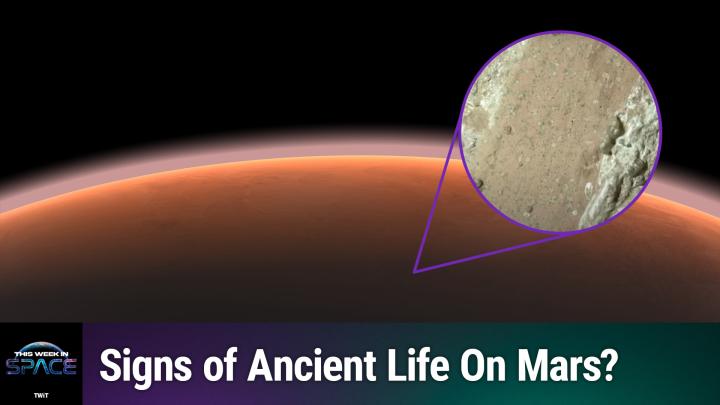
Coming up on this week in space, NASA's interim chief says, go NASA beat China. A photo of Earth from a satellite in orbit reveals a bit more about China than we were expecting. And Dr. Michael Tice is here to decode the latest discovery on Mars by the Perseverance Rover. The best signs of life yet. Tune in.
Rod Pyle [00:00:21]:
This is This Week in Space, episode number 177 recorded on September 12, 2025: Life on Mars. Hello, and welcome to another episode of This Week in Space. I'm very pleased to call this the Life on Mars edition. There's a question mark there because we're not sure, but we have, for the first time really ever, a very good chance of this turning out to be something really spectacular. So this last this is a heck of a story.
Rod Pyle [00:01:00]:
I am, of course, Rod Pyle, editor chief of Ad Aster magazine, the one, the only space magazine still on a newsstand near you. RIP to the others. And I'm here with our returning hero, Tariq Malik, editor in Chief for the one, the only, the all overwhelming space.com hello, my friend.
Tariq Malik [00:01:20]:
Hello, Rod. Happy podcast day. How are things going?
Rod Pyle [00:01:26]:
Well, they're good. They'll be great if this paper turns out to be accurate. We've actually found something and I just have to say and you'll all soon find out what we're talking about. I'm really stunned that the press hasn't picked up more on this, but that's why we're here. So pursuant to that, in a few minutes we'll be joined by Dr. Michael Tice, a research scientist and planetary geologist at Texas A and M, and the co author in position number two. I'll add on the recently published paper called Redox Driven Mineral and Organic Associations in Jezero Crater, Mars. And I'll let him explain what that actually means, because what the heck do I know? Now, before we start, please don't forget to, like, subscribe and so forth of healthy podcast things for us because we're counting on you.
Rod Pyle [00:02:12]:
And it's all for the greater glory of twists. But perhaps more importantly, we have a space joke from Trey Harmon, also known as the Quindar Cowboy Quindar. And for people who don't know, Quindar is the beep that you hear during during spaceflight radio transmissions. So that's a bit esoteric. Hey, Tariq?
Tariq Malik [00:02:34]:
Yes, Rod?
Rod Pyle [00:02:35]:
Why does. And you're gonna have to think about this one because it's a double hit. All right. Why does Dr. McCoy get all agitated when they use the transporter room in the Enterprise?
Tariq Malik [00:02:44]:
Oh, I don't know. I know what he says in the show, but for this sake of the joke inner. His inner.
Rod Pyle [00:02:51]:
Inner Dr. McCoy.
Tariq Malik [00:02:52]:
I don't know, because he can't feel it in his bones.
Rod Pyle [00:02:56]:
That's actually very good.
Tariq Malik [00:02:58]:
Oh, I got close.
Rod Pyle [00:02:59]:
But that's not it. Because whenever he sees the crew headed in there, he knows he's about to lose his patience. Patience. Patience. Smelled the same means different things. Okay, Now, I've heard that some people want to turn us into Martian fossils when it's joke time in this show. Oh, I gave away the lead. But you can help send us your best work or worst or most.
Rod Pyle [00:03:22]:
A different space joke. If I can say that correct to twist twit tv. Just like Trey did. Yay, Trey. You are a man. Okay. And now, ladies and gentlemen, it is time. Making sure John's ready for headline news.
Tariq Malik [00:03:43]:
Headline news. Headline news.
Rod Pyle [00:03:49]:
You did that on purpose.
Dr. Michael Tice [00:03:51]:
100%.
Rod Pyle [00:03:54]:
Hey, go NASA beat China. So our interim NASA administrator, Sean Duffy, come out and says beating China before Trump leaves office in a new space race is the top goal of the agency. And, you know, if only punchy videos and a great tan were enough, he'd have it made. But, you know, guys, put your money where your mouth is and make this work. We have a moon rocket. That's great. We have a space capsule. That works.
Rod Pyle [00:04:27]:
That's great. We need a lander. There's basically two roads to a lander. One's with SpaceX and one's a blue origin. Both are a little behind the curve, although we still don't really know where Blue Origin's blue moon is because they don't put out a lot of material. But, Tariq, what does this really mean?
Tariq Malik [00:04:47]:
Well, so. So Sean Duffy had an internal NASA town hall last week, just one day after the Senate. The Senate Commerce Committee had a hearing all about the space race with China. I had air quotes there. I don't know if people following can hear that over the radio, but, but, but basically, in this internal town hall, Duffy, the interim NASA chief right now, really lit in to the. The current. He's called it the second space race. He actually said it during a press conference that we're going to talk about for this Mars thing later on, too.
Tariq Malik [00:05:25]:
That, that, that, you know, we as the United States and NASA are locked in with China about this race to get back to the moon. And all of these comments came one day after the Senate committee hearing that was called There's a bad moon on the rise is ahead in the space race with former NASA administrator Jim Bridenstine pretty much laying it out there that right now like China's gonna win if things keep going the way that they are because there isn't a way for NASA to just really effectively get people to the moon. Prior to that. And the deadline I just moved out.
Rod Pyle [00:06:01]:
Want to insert that the assembled people, Bridenstein and other very worthy folks were pilloried by the administration for coming out. And that's truth.
Tariq Malik [00:06:12]:
That's right. That's right. So, so Duffy had this, this internal NASA like, I don't know, it's a memo. It's. It's basically like a town hall that they, they get all the workers together to, to tell people like this is what's going on. And he said that we are going to beat China to the moon. We are going to do it safely, we're going to do it fast and we're going to do it right. You might have seen some headlines claiming that Duffy said that they're going to trade safety and for expedients.
Tariq Malik [00:06:39]:
And that really isn't true. He said that they kind of have to make sure that they're taking a balanced approach and that in the past NASA has let the like safety above all slow them down instead of actually, you know, trying to figure out ways through it that both adhere to safety as well as experience. And that's what he was cautioning the agency to, to go. But he was saying that letting China beat the United States back to the moon was not us. He said, I'll be dam. That's a story we write. You know, by the way, when I work for the newspaper and I, we.
Rod Pyle [00:07:13]:
Write the stories, don't we?
Tariq Malik [00:07:15]:
Right. Well, there's that, but he means like as an agency, as an agency leader for that. And I was just telling my staff that, you know, back when I was a wee space reporter or not not even space reporter, just a wee reporter cub. When I used the, when I quoted a city councilman using the word damned, I got in a lot of trouble for curse words. And, and so we had that in the headline and I was remarking that I'm happy to be in a place where I'm not going to get in trouble for that anymore.
Rod Pyle [00:07:41]:
It's a world. And I just want to say, you know, when you. And I just comes to mind because I'm writing a book that covers Apollo history again, this is about the fifth time I've done it. And when you look Back at what we flew with in the 60s, which was really late 50s at best, early 60s technology that was pushed right to the edge. I mean, you're talking about two guys standing in a lunar module for the last. The computer got them down near the surface and the rest of it was all joysticked, you know, and when I say computer in air quotes, I'm talking about something that would barely power my toaster today. It's incredible that it worked. But I think more to the point, when you look at how risky that was.
Dr. Michael Tice [00:08:27]:
Yeah.
Rod Pyle [00:08:27]:
Particularly Apollo 8. One engine, if it didn't fire, they were there for keeps. And then any of the lunar landings, if anything happened to the descent or the ascent engines, you were on the moon for keeps, either in a pile of bent aluminum or just sitting there waiting for your air to run out. So the risks those guys faced were continually underplayed by the NASA of the time. When you look at it from today's.
Tariq Malik [00:08:50]:
Standpoint, didn't buzz or a broken button with, like a pen thing to.
Rod Pyle [00:08:55]:
So as they were leaving the lem on Apollo 11, Neil Armstrong's backpack tapped a little plastic plunger that broke off. And when they came back in and started to desuit, they looked over and realized, oh, oh, look, what's that on the floor? Oh, it's a switch. Probably nothing. It was the ascent engine arming switch. And it was put in just a spot, perfect to be snapped off by an errant backpack twist. And after that, they put switch guards over those things. So NASA, while the astronauts are sleeping before liftoff, I'll keep this short. NASA goes into a bit of a twist with the Grumman guys saying, we gotta find a workaround for this.
Rod Pyle [00:09:35]:
We gotta find alternative circuit routing and all that. And, you know, it wasn't really designed for that. But when. When the time comes, as you alluded to, when the time comes to get ready to leave, good old analytical. Buzz looks at it, kind of squints, takes a felt tip pen out of his pocket, uncaps it, goes bink, and sets the circuit breaker. And NASA's mission is rescued for then the retail price of 79 cents.
Tariq Malik [00:10:01]:
There you go.
Rod Pyle [00:10:02]:
Which is very possibly the cheapest thing that NASA has ever acquired. All right. Speaking of China, China SpaceX Starlink satellite, and they do a lot of photobombing, particularly for astronomers who are tearing the hair out about all these white streaks across their images. On that's Looking up came into an image looking down at a secret Chinese air base.
Tariq Malik [00:10:25]:
This is interesting because it comes From Maxar Technologies. Maxar, a well healed Earth observation imagery provider. They've got a lot of satellites, very high powered and so, so they released this image of a SpaceX Starlink crossing their field of view. And it's very interesting. If you're watching our stream or the video recording, you can see the Starlink satellite in the upper left and then like some kind of after images in different spectra.
Rod Pyle [00:10:55]:
Yeah, there's the little kind of rainbow effects.
Tariq Malik [00:10:59]:
Yeah, yeah. In different. As it, as it, as it passed through because it detected it in different, different spec and it looks like a box with some solar rays. It's very flat satellite. These, these SpaceX. So very interesting to see them up close like this in orbit. But even more interesting, and Maxar says capturing another satellite like this in an Earth observation image is extremely rare. That's a direct quote, so very exciting too.
Tariq Malik [00:11:22]:
But the image that they released, it is this top secret Chinese airbase.
Rod Pyle [00:11:28]:
Oops, how did that happen?
Tariq Malik [00:11:30]:
I'm sure I'm going to pronounce this wrong. The Ding Shen Air base in China. And so the, by a Worldview Legion satellite. And, and it's in the Gobi Desert. And so it's one of their like most secret, you know, air bases. But it's a nice public reminder that satellites in space can see everything. So you know, if we are in this space race with China, well, we can see your air bases, China. I'm sure that just like we know that China can see our air bases.
Tariq Malik [00:12:01]:
Right, but, but this is a bit of it kind of recalled back to when in the first Trump administration, Trump unveiled images of the Iranian rocket launch site where they had had the big explosion. And a lot of people were a little alarmed because by showing that image publicly, which he released on Twitter at the time, right, it let everyone know exactly what the capabilities of, of, of the, the Earth. You know, National Reconnaissance Offices satellites were capable of what they could see and orbit planes that they're in. And that' letting everyone, including China know that we know where your air bases are and look how much detail we can see in them all the way, you know, also look, there's this cool Starlink satellite in it. But if you look at this, you can see like individual planes and stuff on the Runway. It's crazy.
Dr. Michael Tice [00:12:49]:
So.
Rod Pyle [00:12:51]:
Well, it's a good thing nobody's watching us at that level of resolution. And finally I have to do it. I'm sorry because last, last week we had a story about flatulence, today we have a story about interstellar flatulence in an image from the James Webb Space Telescope. Jet shooting out of a star.
Tariq Malik [00:13:11]:
Yeah, well, this, this was just a fun one. I, you know, we had a lot of space, a lot of China, a lot of space policy. So I wanted just to bring up the nebula SH2,284, which is actually formed out of two particle jets that are being erupting out of a massive star. And I think they're like 8 billion, 8 light years long. Like 8 entire light years. That's a long stretch there. And, and so they've, they've been around spewing out material at hundreds of thousands of miles an hour, creating this dazzling nebula that we can see. And it's, it's a key kind of demonstration of massive star formation and maybe like how it could end its life too, over time that they've been able to figure out with James Webb.
Tariq Malik [00:14:00]:
And I just thought it'd be nice to let people know that whenever you're, you're stressed out, there's a star that is so much more stressed out. This stuff out there, I'm gonna remind.
Rod Pyle [00:14:12]:
You of that every week.
Tariq Malik [00:14:13]:
All right? I remind myself, my friend.
Rod Pyle [00:14:15]:
And just before we go to the break here from the mailbag, we got a message for Tucker Drake. And I'm gonna have to sort of drill through this to follow it because it's lightly paranoid. Just listen to the latest episode of Alan Stern. I have to say that the one thing that really jumped out was when he mentioned that it was the Subaru telescope that spotted Arrokoth as a good target for New Horizons, because Subaru is the Japanese name for the Pleiades star cluster so many people seem to think is home to space aliens. Despite the fact that the stars are so young they probably haven't formed planets yet. Tucker's a very informed guy. You would think that conspiracy nuts would be leaping on this fact, saying, this proves the movie Star Trek the Motion Picture Yawn was priming us for a NASA probe to discover ancient alien, excuse me, alien life. That sometime in the near future, New Horizons will be revealing unequivocal proof, unequivocal proof of space aliens.
Rod Pyle [00:15:07]:
But so far, I've not heard anything. Given some of the crazy stuff Richard Hoagland has said in the past, you'd think he'd be pushing this, but maybe not.
Tariq Malik [00:15:17]:
By the way, two things. Number one, don't, don't, don't, don't slam on Star the Motion Picture. It's got its place in.
Rod Pyle [00:15:25]:
No, I loved it. It's just most people kind of Want to blow their brains out about what seems like third hour of Mr. Sulu staring at beer. But I love the movie.
Tariq Malik [00:15:36]:
I'm just. I'm just looking. And number two, speaking of aliens, I forgot to mention there was like a whole UFO Senate hearing or House Congressional hearing.
Rod Pyle [00:15:45]:
Oh, that.
Tariq Malik [00:15:46]:
This. This year. Where. Where. We're still trying to figure out where. Where all the aliens are. But secrets. You're keeping secrets.
Tariq Malik [00:15:54]:
Allegedly. And I can't verify this. I didn't watch it all the way through, but there is a claim that the Navy fired a missile at a UFO and quote, unquote bounced off. Yeah.
Rod Pyle [00:16:06]:
Now, it's pretty rare that a modern missile isn't armed and ready to go bang when it runs into something. But that's their claim.
Tariq Malik [00:16:12]:
I know, I know.
Rod Pyle [00:16:13]:
I'm just saying I think it's very clear that there are aliens in Congress. And so, I don't know why. I mean, maybe they're the ones that are slowing down the investigation.
Tariq Malik [00:16:21]:
Hey, yeah. ME thinks they protest too much, Right?
Rod Pyle [00:16:25]:
Let's channel Art Bell and bring him on the show from the great beyond. Wait, where's my eight ball? Okay, that's good. We will be back in just a moment for one of the. I gotta say, if things turn out the way we hope. One of the biggest episodes of this season for us, Dr. Michael Tice from Texas A and M about life on Mars. Question mark.
Tariq Malik [00:16:47]:
Mars. It's gonna be great.
Rod Pyle [00:16:50]:
And we are back with Dr. Michael Tice of Texas A M. Thank you so much for joining us today.
Tariq Malik [00:16:56]:
Welcome.
Dr. Michael Tice [00:16:56]:
Thanks for having me.
Rod Pyle [00:16:58]:
Well, I mean, I. I truly appreciate you coming on with this short notice. We had a cancellation and then I saw this story pop up and I thought, holy, holy gracious, this is a blessing because this is one of the most.
Tariq Malik [00:17:13]:
You saw this story? I thought I mentioned it to you.
Rod Pyle [00:17:18]:
Are you done now?
Tariq Malik [00:17:19]:
Oh, my gosh.
Rod Pyle [00:17:20]:
Okay. I saw the story and I thought, you know, this is potentially the news of the decade, if not bigger. And I'm sort of stunned that it hasn't gotten more traction in the press than it has. But there's a lot of other things going on. But my one. So I've had two visits to this event, type of event before. One was, of course, the Allan Hills meteorite, which we all remember. False alarm about, you know, fossilized worms in an Antarctic meteor that turned out to be.
Rod Pyle [00:17:51]:
Not that. The other one, which neither of you probably remember, is back in the early 90s when America Online on April 1 put up a story that said life found on Jupiter and I just about went through the ceiling. I was so excited and I thought a couple hours about it and ramifications of what that could mean, that, oh, wait, sure enough, it was an April Fool's joke. And I wrote a very strongly worded nasty gram to Steve King case over their doing of that because I thought that was very low class. But here we are.
Dr. Michael Tice [00:18:29]:
Yeah, I, I think one of the ways I got into astrobiology originally was as a, as a young kid, I, my parents subscribed me to one of these science magazines and they did an April 1 thing where they, they claimed Viking had discovered life on Mars. And it took me a full day to realize that it was an April Fool's thing, but it kind of got me into it.
Rod Pyle [00:18:52]:
Well, and Viking thought they had. I mean, Gil Levin, Levine Levin. What was it? Tariq says last name? I'm sorry, did I, did I wake you up? One of the scientists had a life science experiment in that package on Viking 1 and they thought they had seen a biological reaction and then realized it was probably just perchlorates. But let's get to you. So this is an amazing thing. What are you a professor of and how did you find yourself coming into the, the role that you now fulfill?
Dr. Michael Tice [00:19:27]:
Well, I'm a research scientist in the Department of Geology and Geophysics at Texas A and M. My main specialties are astrobiology, geobiology and sedimentary geology. And I ultimately got into Mars research. I think just like if you were to pull any other geologist, it's pretty circular route. I think it's especially the case for people who wind up getting into Mars. But I majored in environmental engineering in college. I wound up taking my first geology course my junior year and thought, no, wait, this is the thing to do. And got into early life when I realized that, wow, you can, you can learn about things that were alive three and a half billion years ago by looking at rocks.
Dr. Michael Tice [00:20:21]:
I just thought that was the most amazing thing. And at that point, most of the research was done like that was being funded by NASA because they were interested in essentially doing the same thing on other planets. And so I spent most of my time thinking about the early Earth. At some point picked up X ray spectroscopy because I thought that would be a really interesting way of looking at those rocks. And then one day my friend Abby Allwood called and said, hey, we're, we're crazy enough to stick one of those instruments on the end of a rover arm. Why come look for life on Mars with it? So, yeah, so signed up and really Been enjoying it.
Rod Pyle [00:21:05]:
Well, that's fantastic. And I just. Before you go, Tariq, I just want to say I spent. I wrote a book on Curiosity a few years ago and some other Mars books, which of course means spending a lot of time with geologists. And you guys are the most fun of the scientists because you wear flannel shirts and boots and sit around campfires telling great stories. So credits to you, Tariq.
Tariq Malik [00:21:26]:
Yeah, well, I was just curious, Mike, if space was something that was always on your radar or like, as you mentioned, on your path to geologic greatness on the red planet, if it was something that you discovered later on in your academic career or. Or if you always had an inkling of getting involved in that cosmic frontier since you were a kid, like Rod and I, I suppose, who were early true believers at that one point in time.
Dr. Michael Tice [00:21:55]:
When I was a kid in middle school, I was living in Alabama around the time of Star Wars. And so there are a lot of people who were thinking about space. And I decided I wanted to be an aerospace engineer. And then I think, like a lot of kids with adhd, I kind of went. I got interested in a whole bunch of different things. Space was always on the radar, but I guess I. I never really thought I was going to get a chance to work in it, really, up until about a decade ago when Abby called and I got involved in the Pixel instrument. So, yeah, I cared a lot about it.
Dr. Michael Tice [00:22:34]:
It was always sort of as an interested spectator. But Kay really got into it professionally through the backdoor study in early Earth.
Tariq Malik [00:22:44]:
Interesting.
Rod Pyle [00:22:45]:
Well, I have to say, going from interest to spectator to where you are now on this paper is pretty exciting stuff. And the paper is called Redox Driven Mineral and Organic Associations in Jezero Crater, Mars, which is a delightfully short title for this kind of paper. So thank you for that. And as I think I alluded to, you guys were delightfully careful for whatever reasons were discussed in how you framed this. Basically saying, okay, saying to the experiment, prove to me that this is life. I'm not going to assert that it is. Prove to me that it's something else. So can you tell us a little bit about how this came about?
Dr. Michael Tice [00:23:32]:
Yeah. So we saw these things in area of the valley entering Jezero Crater, Neurope Vallis, as part of a campaign really to go see what these interesting weird looking rocks were. And maybe I'll just start out with. We. We got our first look at those rocks and trying to figure out what they were, we set our instrument down on it and almost Immediately realized geochemically these things were really different from everything we'd seen yet on the mission. And I'll just. I'll give the visceral reaction that we had when we started reporting these. These compositions to people on the rest of the mission.
Dr. Michael Tice [00:24:21]:
We. We always do call in, call in meetings. Everybody works remotely on this mission. And there were open mics left on when we were reporting the magnesium to iron ratios of all things in these rocks. And they were so different. We actually got gasps over the open mics. It was really pretty funny. And so we knew we were in something really different.
Dr. Michael Tice [00:24:47]:
And the cameras were telling us we've got these weird green spots in these early rocks. We didn't see leopard spots yet. And I was looking back through the presentations that we were giving from my instrument team around the time. And really early on, we said something like this combination of oxidized stuff and reduced stuff could be a potential biosignature. And that was the last we really said of it, because it was really more sort of a matter of, yeah, let's keep an eye out for this. But, boy, we can think of any number of things that would do that. And then we got to the leopard spot, and those things again in the camera looked really weird and different. We hadn't seen anything like that.
Dr. Michael Tice [00:25:36]:
The compositions over the course of the next couple of weeks that we were getting out of them again were things that we hadn't seen before. We were starting to see minerals that we had expected we might see on Mars, but we hadn't seen it all yet. We were confused why. And here they were in this really weird place. And by the time we saw those, I think everybody more or less just stopped talking about biosignatures because nobody wants to. To immediately jump to that conclusion. I think everybody, certainly, of my generation has really strong memories of ALH8401. We don't want to bias ourselves towards jumping towards life or getting people excited when we shouldn't.
Dr. Michael Tice [00:26:23]:
And so the more we batted the stuff around, the more it became clear that there were redox reactions that have been important in forming these things that they had formed in place that the context of the rock made it really difficult to explain in turn, in some of the other abiotic pathways that we were trying to come up with. And at some point, I think it was probably close to two weeks after we first saw the leopard spots. The lead author on the paper, Joel Hurwitz, in a call with me because is there really any reason anymore why we're not calling these things potential biosignatures and says, you know, I don't think so. Why don't we try that? And so that's, that's the first point that we actually seriously proposed that these things were that. And then the next year, we've just been, it's been a whole bunch of really smart, creative people trying everything they can do to come up with other hypotheses and completely failing to come up with something that did as good a job at explaining these things as potentially life.
Rod Pyle [00:27:28]:
And that is how good science with a capital S is done. We're going to go to a quick break and we will be right back with more, so stay with us.
Tariq Malik [00:27:36]:
Well, thanks for that overview. Of course, it was really exciting to see the announcement from NASA. I think that the interim administrator, Sean Duffy, called it the clearest science, clearest signs of life yet, which really got, I think, a lot of folks excited about it. But I'm really curious if you could explain exactly what piques the biosignature interest as a scientist in it. Is it just kind of the fact that these leopard spots and the other features were there in, in, in the rocks that caught your eyes at all or, or just that their makeup at all that makes them really stand out and how they're formed? Because I, you know, leopard spots is very evocative to, to, I think, the public because it's like, oh, there's like a weird thing on Mars. But what, what does that even actually mean on the science level that would help you get to, I guess, that, that conjecture or that, that, that, that theory that this could be a potential bio, Biosignature there?
Dr. Michael Tice [00:28:36]:
Sure. Well, as geologists really are, the thing we're doing all day when we get data back from Mars is we're just trying to explain what we see in the rocks and how the rocks formed, how they were, how they changed over time, and ultimately what made them look the way they do when we come up to them. And like I said, the, the leopard spots, the poppy seeds, they just looked completely different from any of the rocks that we'd seen previously. They're not the normal kind of thing that you expect to see when you drive up to a sandstone or a siltstone or mudstone. Right. And so that's originally what tweaked our interest. And in order to figure that out, we need to find out what they were made of. So what made them distinctive from the surrounding rock.
Dr. Michael Tice [00:29:20]:
And it started to become really clear that there was what we'll call a redox gradient. So the surrounding rock was full of essentially rusty mud. It was all ferric iron and mud. It's what you would get if you were just to leave a cast iron pan out or something like that. The leopard spots themselves were ferrous minerals. They were reduced. In fact, in the center they had sulfide, which really doesn't like to hang out next to ferrous iron. They tend to back react.
Dr. Michael Tice [00:29:58]:
And so it became really clear that this was an assemblage of things that wouldn't normally just like to form next to each other. In fact, there would be energy released by allowing these things to react with each other if you were to mix them. And that's the kind of thing that life really likes. Organisms take advantage of redox gradients like that in order to make their living. And. And then it turns out there was organic matter in there as well. And a really good way to get reduced stuff sitting in a sea of oxidized stuff is to have organisms breathe the oxidized stuff while eating the organic matter. So that gave us a really natural mechanism to make it happen.
Dr. Michael Tice [00:30:44]:
And then the next question was, are there abiotic ways to take the same things and make the same thing happen? It's, it's actually pretty easy to do with the iron, with the sulfur making the sulfide in the center. It's not so easy. And we can talk more about that in a bit. But that's the, that's the big thing.
Tariq Malik [00:31:02]:
Abiotic meaning non life.
Dr. Michael Tice [00:31:05]:
That's right.
Tariq Malik [00:31:05]:
Ways. Right. Great. I, I did want to follow up because you mentioned the Pixler instrument on the Perseverance Rover earlier as like a, like, like the critical tool. And just for folks who, who may not be aware, I think you said it's the planetary instrument for X ray. Am I going to pronounce this right? Lithochemistry. I was going to say light, but thank you for jumping in there.
Dr. Michael Tice [00:31:28]:
We completely made that word up to make pixel work.
Tariq Malik [00:31:32]:
So, so like, how does that instrument work for you to use it to make these detections? I mean, is it just a camera with like some kind of laser on it or, or what are you looking for with it that you can tell with only that at the end of this robotic arm?
Dr. Michael Tice [00:31:46]:
So, yeah, and so I'll say that the two instruments that were really important with looking closely at these rocks were pixl. Talk about that in a second then, Sherlock. So Sherlock is the instrument that was able to detect the organics, and PIXL was the one that was Measuring the elemental compositions and making inferences about what minerals were present. So pixel, it does have a camera. In fact it's that the camera is multi spectral, so it's, it's telling us about the color all the way from near infrared up to ultra near ultraviolet. But the, the, the hard working end that, that tells us about the chemistry is it's an X ray instrument. It fires a small X ray beam at the rock that interacts with atoms and whatever is present that, that then fluoresce X rays back to two detectors that we have. And by counting the X rays and measuring the energies that come back, we're able to tell not only what elements are present, but also how, how abundant they are.
Dr. Michael Tice [00:32:55]:
And we can, we can look at elements like that anywhere from sodium up regularly to around like bromine or zirconium we regularly get as well. Yeah. And we make maps like that. So we, it's actually, I mentioned earlier it was somewhat crazy that Abby Elwood had this idea to build this at the end of a rover arm. The way it works is the rover comes along, it sticks pixel over a rock and then over the course of about 12 hours, 10 typically it just moves slowly back and forth over a postage stamp sized area and it makes a really detailed map of what the chemistry is.
Rod Pyle [00:33:38]:
That was a good graphic illustration. So if I understand correctly and I'm jumping ahead of myself a little bit because I'll be mentioning, you know, the importance of getting these samples back one day a little later on. But what you've accomplished now, if I read the paper correctly, is operating right at the bleeding edge of what the instrumentation is capable of doing in terms of resolution and technology.
Dr. Michael Tice [00:34:06]:
Absolutely. Yeah. There are things even that we've learned how to do during the course of this mission with operating the instruments that we're using to look at this stuff that we didn't know how to do before this and we applied all of that to, to try to get what this, what these things are and what they mean and more. I mean one of the things just at the base level I'd love to do is to get something like pixel, but higher resolution and look at exactly the same things. There are, there are mineral phases in there that we have to say this is, this is where things mix towards this is this is what we think you'd get if you were able to just stick to stick the X ray on a smaller spot made of only of that thing. You know, we're, we're reasonably certain it's there, but I'd Love to get the smaller view and see exactly what those minerals are touching and what that might tell us more about how they formed.
Rod Pyle [00:35:08]:
Well, and you alluded to something that, that I think is kind of important also, not specifically to this subject, but just in general, which is, and this is just my editorializing, so nobody else needs to own this. But when government or the public complains about what missions cost, robotic missions in particular, by NASA and JPL and others, I think what's often overlooked is how much invention goes on after the hardware has been baselined and manufactured and tested and integrated, and indeed after launch and landing. You know, the kind of things that you and others pull together post haste to try and really maximize the returns from these Mars rovers, missions that can go on for a decade and a half, maybe more, is kind of astonishing to me. And I worked around it a long time and it still blows me away how clever everybody is.
Dr. Michael Tice [00:36:04]:
Absolutely. I had no clue before I joined this instrument team that almost the standard mode of operating when you've got something new like this is the. You just pour all of your effort into developing the hardware up front. You spend your money and your time getting that dialed in as well as you can. Then you stick the thing on a launcher and you figure out how you're going to interface with it with software. And then you get to Mars and you slowly test it and you start realizing, wow. Actually the fact that say we have two detectors on Pixel allows us to do things with it that we never anticipated we were going to be able to do. Let's figure out how to make that work too.
Dr. Michael Tice [00:36:45]:
Yeah, it's just, it's an amazing combination of science and engineering on the fly that I feel like it's been a real privilege to get to participate in.
Rod Pyle [00:36:56]:
Very good. And we are going to go to a short break where perhaps we'll discover life in our audience and then we'll be right back.
Tariq Malik [00:37:05]:
Well, Mike, I mean, that was a. It's really exciting. Just the idea that what this could be, that it could be, you know, past evidence or clear evidence of the potential, you know, I guess basic processes for life, microbial life, et cetera. But like you alluded to earlier about the potential for abiotic sources, non life sources. I'm just kind of curious to give our listeners and viewers an idea of what sorts of processes could be potential. I don't want to say red herrings for life. Right. But like, could be potential explanations because when it comes to life on Mars, we heard a lot about like, oh, there's methane.
Tariq Malik [00:37:45]:
But the methane could be from the rocks too, not just from life or like space cows, I don't know. But, but for something like this, where you really want to dot all the I's and cross the T's, what are some of the things that you, as a scientist, your team, you know, can consider as, as things that could, that could be responsible for what you're seeing there?
Dr. Michael Tice [00:38:07]:
Well, I'm gonna jump straight to the one that I think is maybe the most interesting alternative. I guess. So we inferred then, for informing these leopard spots, not only was producing iron important, using organic matter to converting the rust into these ferrous phosphates, but then also reducing sulfate using organic matter. And that's something that life has known how to do for billions of years. It turns out that you can also do it just geochemically, as long as you crank the temperature up high enough. So sulfate is a really difficult thing to reduce. Even in reactions that release energy, it takes a lot of energy input into the reaction to make it go forward, unless you catalyze it with enzymes and so on Earth, this is something that's been studied really carefully because it's a process that actually fouls petroleum. So petroleum geologists have been interested for a long time in trying to figure out where is the sulfide coming from in my petroleum.
Dr. Michael Tice [00:39:21]:
And with lots of careful experiments, they wound up discovering that you can, can do this abiotically by heating your system up to, let's say around 120 degrees C and doing that over hundreds of thousands to millions of years. So you dump enough heat into the system for long enough, you can make sulfate reduction happen without organisms. And on Earth, anything below around 100 degrees Celsius, it's really all life that does it.
Tariq Malik [00:39:52]:
Yeah.
Dr. Michael Tice [00:39:53]:
And so one potential way to get these things would be, let's say, let's say that, you know, right now we have the, the outcrop sitting out for us on a hill, exposed for us. There originally had to be rocks above this. We know this because the stuff has all been exposed by wind erosion. And so you had to erode something. Well, what if. What over the. What if over the top of that, there was originally a lava FL flow that heated the rocks underneath it sufficiently high temperatures and for long enough to make it happen. And so a big part of what we tried to do in testing the biosignature hypothesis was look around and evaluate the potential evidence for heating from geologic sources.
Dr. Michael Tice [00:40:47]:
Ultimately, from what we're able to tell from the rover, we don't think that happened, but it's conceivable that we could get these samples back on Earth and use some sensitive geothermometer, get it in the lab, where something's able to find a mineral that can tell us the heat history of this rock. And I don't think it's likely, but they could wind up telling us that this stuff actually was heated for long enough to make the sulfate reduction happen, and then we'd have to give up the life hypothesis.
Rod Pyle [00:41:23]:
Well, I personally don't like that hypothesis as much. What, what is the, what is the.
Tariq Malik [00:41:29]:
Lava one or the life one? Which one?
Rod Pyle [00:41:31]:
I don't like the, the hot rock hypothesis, and I haven't heard a whole lot of stories about hot Mars, but. Yeah, I get, I get the point.
Tariq Malik [00:41:38]:
Really hot, he said 120 degrees C. That's like, I don't know, I can't do the math, but that sounds like it's.
Rod Pyle [00:41:43]:
I was going to say you come from a part of the world where they care about Centigrade. Oh, Celsius. Good Lord. Listen to me, Grandpa, how old is this sample? As far as you can tell, probably.
Dr. Michael Tice [00:41:57]:
Around three and a half billion years old. The, the, the uncertainties in the age estimate for Jezero in general are still a little bit fuzzy, but it's, it's somewhere around there.
Rod Pyle [00:42:10]:
And is that a period where you would expect a lot of volcanic activity?
Dr. Michael Tice [00:42:15]:
Yeah, in fact, the, the floor of Jezero Crater is, is lavas around that age as well. So, yeah, it's, it's perfectly reasonable that there could have been lavas. The thing that makes us think it's unlikely in this case is just that when you heat rocks like that for long enough, you also change what's there in, in, in the rest of the rock. And we don't see any evidence for that kind of thing. So, you know, for instance, had there been lavas flowing by nearby and gained the rock here to that kind of temperature, we might expect some of the other stuff to have melted a little bit and that would, that would have been really clearly visible.
Rod Pyle [00:42:55]:
Okay. And this is sort of an overarching question, so feel free to say, Rod, that's a stupid question, if you think it's a stupid question. But, you know, ever since Mars Pathfinder, beginning with the Mars Exploration Rovers Spirit and Opportunity, we started hearing about the search for water. The search for water, the story of water on Mars, and that kind of became the mantra, Follow the water. How does that story dovetail into what you've discovered?
Dr. Michael Tice [00:43:27]:
Well, so the entire story of water thing is part of a but really systematic search for potential life. And so NASA's mantra for a long time was follow the water, because to the best of our knowledge, any life that we know of requires water. And so searching for water was searching for habitable environments. More recently, you'll start to hear people talk about follow the energy. And in fact, that was a big part of what was informing our search strategy here. We saw things in the rock that, that could have been either sources of energy for organisms or could have marked where organisms were using other things for energy. And so really, Perseverance, the Perseverance rover is sitting at the long end of NASA search strategy for life on other planets, where we essentially initially backed off from the Viking approach of just going all the way to the end and look for, for life. Said, well, and in fact, maybe let's figure out where life could be and what the, the history is of where life could have been and then start to narrow down within there.
Dr. Michael Tice [00:44:48]:
What were the opportunities for organisms to make a living in those watery environments? And ultimately were they there?
Tariq Malik [00:44:57]:
Can I ask, is it, is it frustrating to be like, to see all of these findings and not be able to like, grab the sample with your own hands as like a geologist, right where you, you know, you study Earth, you can walk out to the mountain, you can take out your rock hammer, you can chip it out, you can study it in a microscope. But, but with, with the rover, I mean, you're how many miles? 12 million miles. How many miles is it rock to Mars? A lot of miles.
Rod Pyle [00:45:25]:
It depends on when. 30 million plus.
Dr. Michael Tice [00:45:27]:
Yeah, I appreciate you didn't ask me that. I wouldn't have remembered, but no, the answer to your original question. Heck yeah, the. I like to think of using the instrument that I work with as essentially being given these magical insect X ray eyes that I can use to, to look at rocks with way more detail than I normally would just walking around. But man, what I wouldn't give for the ability to just walk up to a rock and then just move slightly off to an angle and see it from in with light hitting it a different way, or to walk 5 meters that way and see what this outcrop does. You know, the, the rovers are incredible at getting levels of detail that you can't possibly get just walking around in the field. But humans are awfully good at just walking around and looking at a whole bunch of stuff until you get an idea of what's going on.
Rod Pyle [00:46:32]:
Well, let's walk ourselves into a break and we'll be right back. That was a good one.
Tariq Malik [00:46:37]:
Well, you know, I think we've gotten to the part where, Mike, we have to ask about, like, getting these samples back on Earth. You mentioned studying samples from Mars and what you could do in a laboratory. And in fact, I think Katie Stack, Morgan, during the announcement press briefing, said that we're kind of at the raggedy edge of what we can do on Mars remotely with these instruments without having the samples in our hands. Like, we're just talking about to really piece that story together up close with all of the resources that, you know, I guess an Earth lab might have to bear. So I'm curious what that next step would be. You know, if you can get these samples back to Earth, how would having that sample in your hands really open up, you know, more avenues to either, you know, put the case of. Of biosignatures or not to bed there? Like, what sorts of things can we do that we can't do with. With the instruments on the rover themselves?
Dr. Michael Tice [00:47:47]:
I think really clearly one of the things that we'd want to do is find out more about the organics that are in these rocks. You know, we can tell that they're there. We can tell that they're not, say, simple sugars or something else like that. Using the instruments that are on board the rover. We need to know a lot more about what those organics are and where they came from, and if the organics that are inside the leopard spots are systematically different from the organics that are outside the leopard spots and maybe didn't undergo the same reactions that we're hypothesizing for making the leopard spots go. There is a lot of isotopic work that could be done, so that would be looking at the. The relative amounts of different isotopes of both the carbon and the sulfur and the iron and potentially other elements that are in there. Living things tend to.
Dr. Michael Tice [00:48:46]:
Tend to prefer one isotope to another. And so looking for the isotopic signatures of biological processes would be really important here. Maybe there would be little fossils in there as well. I would be. I'd actually be a little bit more surprised to find those, even if these were formed by life, because they're really hard to find even on Earth, especially in places where, like this, we think organic matter is being actively eaten. But I was gonna say.
Tariq Malik [00:49:16]:
He said. He's. He said the F word, Rod. You know, I got really excited about.
Rod Pyle [00:49:20]:
It, and I just want to say very quickly. Sorry to interrupt, but when I was writing that book on curiosity, I Spent about a year and a half shadowing John Gratzinger, who is the chief scientist on that mission for, I don't know, five years, I guess. And, you know, he looked at me one day at his office and, and he, he wasn't really normally an excitable guy, but he said, you know, we're all waiting for that dinosaur femur moment up there. And I thought, I hadn't really thought of it that way. That would be incredible. And this, you know, it was a little smaller, but this might kind of be that moment. If you do find something that looks like a fossil.
Dr. Michael Tice [00:49:57]:
Yeah. You go back to rocks at the same age on Earth and. Well, back to three and a half billion years ago, actually. I don't think we have any really good obvious microfossils of that age. I'd have to go back and look in the last couple of years to make sure I'm not completely overstaying that. But you get a little bit younger and you start to find actual body fossils of microorganisms, the bacteria or archaea. They're really hard to preserve, and that's part of why it's so difficult to find them, even at times where we're convinced there was life. But the other thing we could do by having the samples back on Earth, like I was saying, is far more sensitive tests to try to evaluate the thermal history of these rocks, try to find out if that thermochemical sulfate reduction pathway is viable at all.
Rod Pyle [00:50:50]:
Well, so while we're waiting for somebody to bring back these samples, whether it's NASA or SpaceX or China or whoever are. Is there a lot more work to be done looking at terrestrial analogs to try and understand more detail on what might be happening here? Or do you already have that, given the kind of coarseness of the evaluation you're able to do with the onboard instrumentation?
Dr. Michael Tice [00:51:18]:
Oh, no, absolutely. I expect there's going to be a lot of research done on, on analogs. In fact, there are members of our team who are already planning some, some work around that. So we know of places today where there are little iron phosphate nodules forming and they're, they're often associated with sulfides. Oh, what are those called?
Rod Pyle [00:51:40]:
They've got a funny name.
Dr. Michael Tice [00:51:42]:
The, the, the mineral or the actual. There's vivianite and grigite are the two minerals. Yeah. And so looking around the variety of places where these things form to find out, are there any places that look more or less like the, the leopard spots that we see? That's a, that's a big one. There are also people who've been doing experiments with microorganisms for about the last decade or so that are already somewhat relevant to this and could be made even more relevant by setting them up in the right kind of experimental setting. And I think there's also going to be a lot of experimental work done trying to see if we can identify low temperature ways to form the things that we're seeing in the leopard spots as well. Like I said right now, where we're not aware of any really clear ones. But that's something that experiments are a really good way to find out.
Tariq Malik [00:52:47]:
You know, I'm curious, you know, Mike, about your thoughts on the. Just how the evolution of how we search for signs of life or that past history of Mars has changed, you know, over the, I guess over the centuries because, like back in the 1800s, there was like the, the potential for connection canals on Mars. And then as we got better telescopes, we're like, no, they're not really canals. It was an optical illusion. And then, well, maybe there's like, like bushes and trees and it's a lush place. Then we get those orbital views and it's like, well, no, it's not really like that. And then, well, you know, at least it'll be habitable for, for critters and whatnot. Viking lands and it's a pretty stark desert place.
Tariq Malik [00:53:26]:
But the more that we've refined and with spacecraft, with rovers like Perseverance and the others, the story about what Mars could have sustained with water, with subsurface glaciers, that sort of thing has gotten more and more complicated. But also much more, I want to say, like tantalizing, right? Because there's so much, and I'm just curious as a scientist, when you look on that evolution, what does that, that say about the process of science and, and I guess of Mars as a destination and a target? Just, just keep studying.
Dr. Michael Tice [00:54:07]:
I think maybe the biggest thing it says to me is that the best kind of hypotheses are the ones where you find out you were wrong about something in interesting ways and then you go off and you do the more interesting thing. And so I think that the Viking experiments were absolutely the sophisticated thing to do at the time. Go there and try seeding Martian regolith with something that organisms on Earth would like to eat and see if they eat it. As we've gotten more sophisticated about microbiology, we now realize that if you try to overload a system with something that the organisms see, barely any of you could just wind up choking the things, and they're not going to do a thing to.
Rod Pyle [00:54:53]:
Oh, my God. I hadn't thought of that. So we might have killed our very own sample.
Dr. Michael Tice [00:54:57]:
Huh? It's conceivable we've gotten more sophisticated about Martian geology. So now we know about perchlorates and how that could potentially give false positives. Yeah. So now people who think about looking for current life on Mars, they have far more sophisticated ways to do it. Same things happened with looking for evidence of past life life. An awful lot of stuff originally focused on let's go find the organic stuff and, and try to characterize it. Well, we've gotten a lot more sophisticated about knowing what other things produce organic matter and, and can spoof those kinds of results. And at the same time, we've, we've realized that it's not just the organics that are interesting in Iraq.
Dr. Michael Tice [00:55:44]:
It's the, the inorganic stuff that life could have interacted with that can give you at least as much of a story. In fact, having the two sides of that are really important for making a compelling case for life. And so, yeah, I think all of this. I don't look back on anything that's been done on Mars or the ways people have looked for life in the past and say that was a real mistake. All of that was part of a process of learning about how to do this and learning about what's going on on Mars and on the Earth and with life in general and getting better and better at asking the questions and finding the interesting things.
Rod Pyle [00:56:25]:
Percival Lowell thanks you from beyond the grave. Sorry, go ahead.
Tariq Malik [00:56:29]:
I was gonna say, do you ever worry that we're looking in the wrong place? We're looking at these rocks and at samples that are so, so small. But, you know, in Mission to Mars, they just went to the face, face on Mars and it opened up or, or in Total Recall, they, they go to the pyramid in the mountain and unleash all the, all the water and, and, you know, huzzah for life. I mean.
Rod Pyle [00:56:47]:
Okay, okay, calm down.
Tariq Malik [00:56:50]:
I'm just, I'm just asking if you worry that there could be something that's that obvious that we're just missing. Missing because of the rocks themselves. I don't know. It's just, I'm just curious.
Dr. Michael Tice [00:56:59]:
Right.
Tariq Malik [00:57:00]:
He knows what I'm talking about. He laughed. He knows what I'm talking about. These movies. Movie.
Rod Pyle [00:57:04]:
So he's, he's being nice.
Dr. Michael Tice [00:57:06]:
I, I think we're taking a really complete slate approach. So, yeah, the idea of looking at transient gases in the atmosphere and trying to figure out where they're coming from. That's a really good sort of whole planet way of. Of trying to. To get the question of current life or. Or the environments where life could be. Getting up close to the rocks is another really good way of doing it. You just have to have proxies.
Dr. Michael Tice [00:57:29]:
You have to have things that you can measure that are sensitive at both kinds of scales. And we've gotten a whole lot better at that.
Rod Pyle [00:57:36]:
That's great. Well, I guess my closing question is if Michael Tice was the lord of space exploration, which we have the power.
Dr. Michael Tice [00:57:46]:
To do in this show, we can always hope not.
Rod Pyle [00:57:50]:
Well, but if you were, what would your. Let's say for the next 10 years, what steps would you take, given your interests, with no budget restrictions at all?
Dr. Michael Tice [00:58:02]:
I think, I think a combination of sample return. I think combination of sample return on boots, on the ground actually is the way to do things. You can't replicate the samples that we have right now with perseverance by sending people to Mars. We just. You can't put a human on the surface of Mars and have them spend the time looking over a large area and collecting kind of detailed information about the context of these rocks that the rover did.
Rod Pyle [00:58:40]:
That's really interesting because we always hear people say the opposite. Oh, you get a geologist up there and they'll have this cracked in an hour. But this is an interesting point. So because the robot, excuse me for saying this, can persevere and continue to just slowly move from one thing to the next, there's actually maybe some additional value to that over humans.
Dr. Michael Tice [00:58:59]:
There's huge benefits to that. There are huge benefits to having a human on the surface and being able to walk around. Human mobility and the ability to visualize things in place. You can't replace that either. And I think in an ideal world, we'd be thinking about sending robots to explore a region and collect a huge number of samples from that kind of context. And then with the knowledge that we gain from those robots, we send humans to do really detailed work in one particular area? But, yeah, I don't think you can possibly substitute one for the other. They really ought to be working in tandem.
Tariq Malik [00:59:38]:
Would it be awesome if you had a team of geologists on Mars and also a team of robots that were being controlled by Optimus Team, and then everyone's working together. You get so much stuff done. So much stuff done. Also a lot of jobs for that, so.
Dr. Michael Tice [00:59:52]:
That's right. Yeah, that's. That's my dream. Absolutely.
Rod Pyle [00:59:57]:
Well, Michael, I want to thank you and everybody else for joining us today for episode number 177 that we like to call life on Mars. And I did put a question mark on there just to keep everything square. Mike, where's the best place for us to keep up with your current research and future endeavors?
Dr. Michael Tice [01:00:16]:
Oh, well, probably looking me up at Texas A and M, I think. Yeah, certainly there's going to be more stuff coming out there in the near future about not only Mars, but early Earth. But then going and checking in on the, on what's happening with perseverance, I think you're going to see lots of really amazing things updated there regularly and great place to check out.
Rod Pyle [01:00:42]:
All right. And taking a huge step down. Tariq, as always, where could we keep up with your efforts to save the solar system online?
Tariq Malik [01:00:51]:
I'm going to pretend I didn't hear that slight right. But I'm going to say, I'm going to say that you can, you can find me on space.com as always at Tariq J. Mallock Across Blue sky and the Twitter or the X, pardon me, that spacetron plays on YouTube. I'm gonna be playing Marvel rival season four. It starts out today. Very excited. And that's my weekend. You know that and laundry.
Rod Pyle [01:01:14]:
Okay. And taking another huge step down. You can always find me at pylebooks.com or@astromagazine.com and we will have an article coming out on this topic as soon as we reasonably can, given the work quarterly. So we don't get to jump in the exciting stuff right away like Space.com does. Always remember, you can drop us a line at twis@twit.tv. That's twis@twit.v. We welcome your comments, suggestions and ideas and we love getting your comments and messages and they will be answered by somebody, probably me. New episodes of this podcast publish every Friday on your favorite podcaster.
Rod Pyle [01:01:50]:
So make sure to subscribe, tell your friends and give us reviews. Five stars, thumbs up, whatever you got. Five empty bottle caps. I don't care. Also, don't forget, we're counting on you to subscribe support us through Club Twit in 2025. Besides supporting the wonderful network, you'll also be helping to underwrite this show, which is kind of expensive. Not because of me at Tarik, but it's kind of expensive.
Tariq Malik [01:02:12]:
I know I got a high day rate, everybody. We'll see.
Rod Pyle [01:02:14]:
Keep the dream on and keep keep us on the air with our great guests like Mike Tice and our terrible jokes and it's only $10 a month and you also get a lot of other stuff you can only get there, like TWiS After Dark. Do we have a TWiS After Dark yet, John?
John Ashley [01:02:33]:
We could. We could talk about it.
Rod Pyle [01:02:34]:
Okay, we need to do that. Easy to do with me on the mic. All right, thank you, everybody. Thank you, Michael, it's been a real pleasure having you on.
Dr. Michael Tice [01:02:42]:
Thank you, guys. This is a lot of fun.
Rod Pyle [01:02:44]:
Great, Tariq. Well, see you later. Okay, everybody, take care. See you next week. No matter how much space, spare time you have, twit.t has the perfect tech news format for your schedule. Stay up to date with everything happening in tech and get tech news your way with twit.tv. Start your week with this Week in Tech for an in depth, comprehensive dive into the top stories every week. And for a midweek boost, Tech News Weekly brings you concise quick updates with the journalists breaking the news.
Rod Pyle [01:03:16]:
Whether you need just the nuts and bolts or want the the full analysis, stay informed with twit.tv's perfect pairing of tech news programs.
Post Show:
All righty.
Tariq Malik [01:03:36]:
Thank you so much.
Dr. Michael Tice [01:03:36]:
Seriously, thank you. That was, that was a lot of fun.
Rod Pyle [01:03:40]:
Well, good. We. We figure if we're going to drag you guys here without a paycheck, the least we could do is make it fun and hopefully ask intelligent questions. I'm always a little challenged on that front, but Tarik brings up the level of intellectual rigor. See, Tarik, I say nice two things about you once we're off the air.
Tariq Malik [01:03:56]:
I know, I know. Everyone else that's still watching should.
Dr. Michael Tice [01:03:58]:
Should, you know, I'm going to throw that at the very end of the show. It's a little post credits now, so you're welcome.
Rod Pyle [01:04:05]:
I'm caught out.