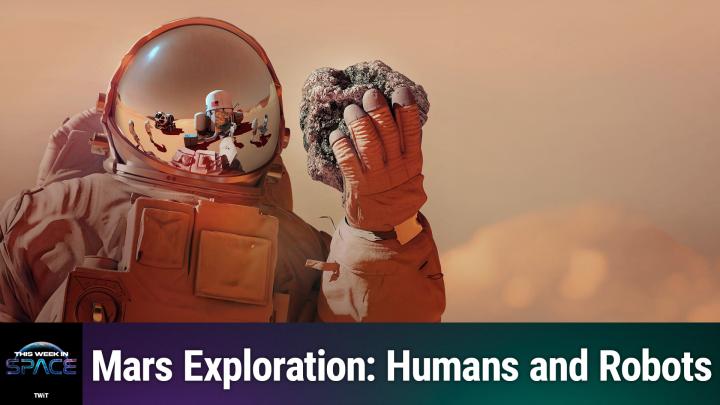
This Week in Space 199 Transcript
Please be advised this transcript is AI-generated and may not be word for word. Time codes refer to the approximate times in the ad-supported version of the show.
Tariq Malik [00:00:00]:
Coming up on This Week in Space, NASA's Artemis plan just got massively revamped. We finally know which astronaut had to be medically evacuated from the ISS. And what should astronauts do first when they go to Mars? With us is Dr. Pascal Lee with the National Academies report all about that. Check it out.
Rod Pyle [00:00:27]:
This is This Week in Space, episode number 199, recorded on February 27th, 2026: The Obsolete Astronaut? Hello and welcome to another episode of This Week in Space, the obsolete astronaut question mark edition. I'm Rod Pyle, editor-in-chief at Ad Astra Magazine. I'm here with my man Tariq Malik of space.com. Say hello, Tariq.
Tariq Malik [00:00:50]:
Hello, everybody. Hello.
Rod Pyle [00:00:52]:
And much more importantly, with Dr. Pascal Lee, friend of the show, who's a planetary scientist with the SETI Institute, director of the Houghton Mars Project, which he built with his own bare, gnarled hands, my favorite vacation spot in the Arctic, an all-around smart guy. Say hello, Pascal.
Tariq Malik [00:01:11]:
And Apollo.
Rod Pyle [00:01:12]:
And Apollo.
Tariq Malik [00:01:13]:
With Apollo's help. Hey, Pascal, welcome.
Dr. Pascal Lee [00:01:16]:
Yeah, he's around.
Rod Pyle [00:01:20]:
And before we start, of course, please don't forget to do us a solid. Make sure to like, subscribe, and support this podcast with all your might because it means the world and beyond to us. And now a fresh space joke and a timely one, once again from Barry Hayworth, who's becoming sort of our sole contributor of space jokes.
Tariq Malik [00:01:38]:
Barry!
Rod Pyle [00:01:38]:
So other people, you got to pick up the slack. Hey Tariq.
Tariq Malik [00:01:42]:
Yes, Rod.
Rod Pyle [00:01:43]:
In Artemis— hey Tariq.
Tariq Malik [00:01:46]:
Yes, Rod.
Rod Pyle [00:01:47]:
In January, Artemis was postponed because of a hydrogen leak. In February, Artemis was postponed because of a helium leak. Let's just hope they don't have to work all the way through the periodic table before launch.
Tariq Malik [00:02:00]:
Ah, I know, that's a good one. That's a good one.
Rod Pyle [00:02:05]:
That one bad. Ouch.
Tariq Malik [00:02:05]:
That's a very elemental joke, right?
Rod Pyle [00:02:06]:
So, oh, well done. Now I've heard that some people want to turn us into noble gases when it's joke time on this show, but you have the power to help by sending us your best-based jokes at twist@twit.tv, and we will be happy to blame it on you on the air. And now onward to headline news.
Tariq Malik [00:02:28]:
Headline news. I got it that time. I know it. Hey, this is, well, big breaking news first.
Rod Pyle [00:02:37]:
On an otherwise slow news day.
Tariq Malik [00:02:39]:
Where are you, Rod? You're not, you're not, you're in a different place. We, we, we didn't talk about that. Yeah. I'm just saying this is like a different news thing. Yeah.
Rod Pyle [00:02:46]:
Why? Yeah. So I'm, I'm in Josh, lovely Joshua Tree in Southern California. Astronomy retreat with my son, testing out my old but relatively unused Celestron C8 and his new Dwarf 3.
Tariq Malik [00:03:01]:
Wow.
Rod Pyle [00:03:02]:
Image stacking Skycam, which you had told me about it, Tariq, and I know that it's been written about much in space.com, but this thing could punch through clouds, mist, haze. Half moon was up last night and we still got good pictures of the Orion Nebula and the Beehive Cluster and something else. So I'm really blown away. And it's this big, you know, it's the size of a paperback book.
Tariq Malik [00:03:27]:
We're not, we're not, we're not, we're not sponsored, but Dwarf R lines are open.
Rod Pyle [00:03:30]:
So, but what's shaming about it is, you know, if you're an old fart like me, you spent all this time learning how to set up your telescope on a polar mount and use setting circles and all that. Now it's like, yeah, you idiot, just push the button and it'll go do it for you anyway.
Tariq Malik [00:03:45]:
Yeah, I was gonna say, I wish I could be on an astronomy retreat right now, but unfortunately there was news today that we got to talk about.
Rod Pyle [00:03:50]:
So yeah, so we woke up to an interesting press release about Artemis —and others.
Tariq Malik [00:03:56]:
Not just release, it's a conference. The press conference. They had a conference today.
Rod Pyle [00:04:00]:
Well, I probably slept through that, but gosh, I guess to sum it up, Isaacman, among other things, said—
Tariq Malik [00:04:08]:
Jared Isaacman, NASA chief. Yes.
Rod Pyle [00:04:10]:
We are going to take the lessons learned from the Apollo program and emulate what they did, which basically involves a more step-by-step process than what they've been planning. Which is probably good for astronaut safety for a couple of reasons. And I'm going to let Tariq run with this one in just a second because he knows the whole skinny. But it wouldn't hurt to have a little extra time to work on that heat shield, which has caused some concern. And, uh, some other people have come out recently, some geophysicists I think, and said, uh, hey, you know, the flight date you're planning to go to the moon, we're not really sure how the solar activity is going to be. It could have some spikes, which would be dangerous for them. So later in the year for Maybe leaving the Earth orbit mission might be a good thing.
Tariq Malik [00:04:56]:
Oh, you saw that story too? Yeah. Yeah, we had that on space.com today as well. So it's been an interesting day. It's been an interesting day. So for folks who don't know, the Artemis II mission is delayed, right? It rolled back into the VAB this week. So now it's in the hangar and they're trying to figure out why the healing system on the upper stage is kind of all messed up. And they're trying to see if they can fix it in time to go out to April. So NASA announced late yesterday that they're going to have this press conference today, which is an update on how everything has gone for Artemis II, as well as their plans for Artemis overall, the program, which when you see that as a press statement that they're going to have, that they're going to talk about the program overall, when they just rolled the vehicle back, that raises a lot of— yeah, raises a lot of flags.
Tariq Malik [00:05:43]:
Yeah. So the big, the big takeaway now is that Artemis 3, like Artemis 2, they're trying to figure it out. They're hopeful for Artemis, for an April launch. Okay, that's great. The window opens on April 1st. Still, we're going to put that to the side. But the really big news is that the Artemis 3 mission now is not going to land on the Moon. Instead of waiting until 2028 to try to launch that mission and hoping that stuff is going to be ready, they're going to launch Artemis 3, hopefully, quote unquote, in 2027.
Tariq Malik [00:06:16]:
So next year, around the middle of next year, it's going stay in Earth orbit. They're gonna try to dock or rendezvous with one of the two private landers they're looking at. So that's either Starship, Rod, you know, if it's ready by then, or Blue Moon—
Rod Pyle [00:06:30]:
cue the laugh track—
Tariq Malik [00:06:32]:
or the Blue Moon, the Blue Origin's Blue Moon Mark 2 lander.
Rod Pyle [00:06:36]:
Well, excuse me, but they said either or both.
Tariq Malik [00:06:39]:
Either or both. Yeah. So, and, and then they would try to launch the next year after that 2028 to the Moon with Artemis IV, maybe even— big maybe— launch twice, Artemis IV and Artemis V, to go land on the Moon so that you get two Moon landings. And if that sounds familiar, it's because that kind of pace, although still even more accelerated, is what we saw during the Apollo program, where when Apollo 11, you know, launched to the Moon in July of '69, Apollo 12 launched in what, October or November, right, of that year. You had all these missions a few months apart. And Jared Isaacman has said that the low flight rate of Space Launch System for Artemis is one of the biggest issues, because every— if you're launching every 3 years, it's fundamentally a different rocket because you've upgraded big things. So that's the other big change. The SLS that we have now, the Block 1 or whatever it is, it's Block 1.
Tariq Malik [00:07:33]:
That's it. That's what they're locking the design. They're not going to go and build the interim, the, the, the Advanced Exploration Upper Stage, which was supposed to give a lot more capability to get to the Moon. It's why they can't launch a lander. On the spacecraft because the upper stage isn't powerful enough. And they're going to accelerate the plans for those lunar landings. It's a really wild swing and a bit of a shock that they're making that big of a change right now. But Isaacman believes that the low flight rate of the SLS rocket is a problem for the program because it means that it's slowing everything down..
Tariq Malik [00:08:11]:
And so you have, you have an issue that it takes 2 years to get to, then it takes another 2 years to fix it. And that's why we're right now, it's like we're 4 years away from the 2022 test flight of Artemis 1. So it's really interesting to see how this is all going to develop.
Rod Pyle [00:08:29]:
And so for the elder statesman in the room, which is Pascal and myself, we remember seeing something similar to this with Apollo 9. So Apollo 7, was the first orbital test of the Apollo command module. Apollo 8 was the journey out to the moon without a lunar module, which was very dangerous, and they were very lucky everything worked, they got them back, but it was an amazing mission, kind of a Hail Mary. Then Apollo 9 was this kind of oddball, okay, we're back at Earth orbit for this one, we're just testing the lunar module 'cause it's finally ready. So they pulled it free of the upper stage of the rocket, docked, undocked, flew it around, that kind of thing. And then Apollo 10 headed down towards the moon but did not land with the lunar module. They just got down about 50,000 feet and then staged to come back to make sure it would work. So it was this incremental set of steps to make sure that each critical piece of the technology did what it was supposed to do.
Rod Pyle [00:09:26]:
So I guess, you know, if you're looking at that and saying, look, that worked and, you know, we're trying to do this on a shoestring budget in comparison, so let's just emulate that experience. Maybe that's the right thing to do. And I did see a chart the other day, by the way, charting the spend across time of Apollo and Artemis. And Apollo has a big spike in the mid to late '60s. And Artemis is just kind of this slow growth. It's been over a decade plus, this sort of slow growth of a lot less money.
Tariq Malik [00:09:58]:
Yeah, it's, it's, it's, it really casts a light on what the original Artemis plan was. You know, they were going to skip everything. Right? Everything was going to be magically ready to just go straight to the Moon and land after the flyaround. And clearly, like, nothing has worked out the way that that plan in the first Trump administration, I point out, really was kind of set out. You don't have the lunar landers. You don't even have the spacesuits yet. You don't have the rovers. You don't have anything right now, you know, except SLS and Orion.
Tariq Malik [00:10:33]:
And so what I took from the press conference today, because Isaacman was really pressed on all the kind of ins and outs of what they're looking at right now, and there aren't a lot of details. They said that they will not be making like mission plans in the press conference, like talking about when they're going to decide on a crew for Artemis 3 now that that mission is much closer, or even 4 and 5, and how they're training for that. But they're saying that they want to emulate like you were saying, that Apollo stepping stone approach with a much faster flight cadence because they need to understand the vehicle, have it more reliable so you lock the design and you don't just keep upgrading and changing it over and over again. And then hopefully you're on the moon by the end of the decade, maybe by the end of the administration, which I'm sure is a big motivator here. All right.
Rod Pyle [00:11:25]:
Let's go to a quick break and then we'll wrap this story up when we come back. So Pascal, as I already pointed out by embarrassing you to call you an oldster like me, you have some, some observations on this, both as a person who saw this the first time around and more importantly, as a person who's deeply involved in the space business these days. What do you think?
Dr. Pascal Lee [00:11:46]:
I actually really welcome this, this change. I think beyond the sort of tactical change of not landing with Artemis III, but doing it only with Artemis IV, etc., there's, there's really an important strategic pivot here. And, you know, my first point is that I've always been in favor of the SLS rocket being used more than, than it had, um, than we were going to. You know, there was talk of phasing out SLS when the new administration came in, etc. And I, I really think that the SLS, the cost of it, first of all, is behind us, uh, in, in large part. The development of this rocket cost a lot, and flying so few of it is really not a very productive way of moving forward. So envisioning that we will have more SLS rockets, the, the, the first version, the Block 1, fly more missions, I think that's really a good use of, of that capability, especially because We don't have anything that can really come, you know, that's not operational yet for launching humans to get to places like the Moon.
Dr. Pascal Lee [00:12:58]:
The second thing is I suspect that the next discussion, which will be about Gateway, which was a topic that was avoided today in the press conference, I suspect that we're going to pivot to doing a Moon base at the surface of the Moon and back away from Gateway is my guess.
Dr. Pascal Lee [00:13:19]:
And I think the reason why it was that discussion was delayed today is because it involves the Gateway right now, involves a lot of international partners, and everybody has to be somehow ready for that pivot to move to the surface of the Moon for base rather than doing it in lunar orbit. I mean, that's just my guess. And so I wouldn't be surprised if we transition from Gateway to surface base on the Moon very soon.
Rod Pyle [00:13:47]:
And I kind of wonder if you're in the seat of an international partner at this point, if you've kind of been looking at Gateway and going, I got a bad feeling about this because it's been dawdling.
Tariq Malik [00:13:56]:
And Gateway is a weird one because it's a space station that was built to be in a certain orbit, that near rectilinear orbit, really weird one around the Moon, because the ISPCS can't really reach the lunar orbit really easily, but it can get to that orbit a bit more accessibly. But it depends really on what the final approach is going to be. Are they going to have one lander versus another lander? Is that lander going to have additional, like, fuel capacity to get them to a different orbit? Do they even need Gateway? And then what do they do about those international partnerships? And how do they honor them if they decide not to do it? I think Lockheed already built the bus for the power bus, right? Isn't that— that's one of the first things they put together. And it's just sitting there, you know.
Dr. Pascal Lee [00:14:44]:
So, and then, you know, a couple more things. There actually still is talk of an upper stage for SLS, uh, except that it would be a standardized one. So using something that is, uh, proven, uh, not changing in configuration or design every time you use it.
Dr. Pascal Lee [00:15:00]:
And there's a lot of talk about using a Centaur, uh, stage that's already in existence as, as a, as a sort of a replacement for this Advanced Exploration Upper Stage. And then finally, my guess is that we're going to see the lunar rover, the LTV, whenever its selection is announced, fly to the Moon, possibly with the first crew that lands.
Dr. Pascal Lee [00:15:25]:
Because right now, the way we're looking at Artemis III and Artemis IV as surface missions are still with just 2 astronauts on foot for, you know, 4-6 days. And that to me is a real bummer in terms of exploration range, exploration capability. It's hard for me to understand how after Apollo 15, 16, and 17, on which we had rovers for astronauts to move around and increase their range, that we would be back to sort of an Apollo 14 situation with, you know, just astronauts on foot around there.
Tariq Malik [00:16:01]:
With a cart? With a bike?
Dr. Pascal Lee [00:16:02]:
They should take a bicycle, right? So anywho, this is just my guess, uh, and hopefully we'll— it's a, it's a good step back to actually have a bigger leap forward down the road.
Rod Pyle [00:16:15]:
All right, well, let's move on to our next story because we've got a lot of territory here to cover. Speaking of stumbling around on foot, um, I've already introduced Pascal to you, but he also, uh— what I did not include is the recent discovery of a major find on Mars. Well, two major finds. A— not extinct is not the word I want— a really old glacier.
Tariq Malik [00:16:40]:
Relict, that's what you call it.
Rod Pyle [00:16:41]:
A relict glacier. And perhaps more importantly, a volcano that we had been staring at since the Mariner 9 days, but it took Pascal and his associates to actually say, hey, that's a volcano. So that was a big deal. And he's a space artist. But pursuant to what we're talking about today, he is also a recent member of a National Academy study on how we're going to send humans to Mars, and, uh, that's really important. But before we ask that question, I believe Tariq has one he's just itching to get out.
Tariq Malik [00:17:14]:
Wait, so, so are we— we're skipping the Mike Fincke thing? Is that—
Rod Pyle [00:17:18]:
is that—
Tariq Malik [00:17:18]:
yes.
Rod Pyle [00:17:19]:
Okay. All right, we got a lot to do here.
Tariq Malik [00:17:21]:
All right, all right. Well, TL;DR: astronaut Mike Fincke was the one that had to be medically evacuated from the ISS, everybody. Read it.
Rod Pyle [00:17:27]:
But we still don't know what— why. So we don't know why. Nothing burger.
Tariq Malik [00:17:30]:
They announced that this week too. Yeah, so just to reintroduce Pascal, because you are obviously a friend of Rod, friend of Tariq, also friend of the show. But for folks that are just tuning in for the first time, could you kind of let folks know how you got into space and, you know, building your own Mars base at the top of the world and fighting polar bears with your dog? You know, like, can you let people know where that all started for little Pascal Lee, you know? Somewhere in the past.
Dr. Pascal Lee [00:18:00]:
Yeah, well, little Pascaly was born in Hong Kong, in the least Mars-analog place on Earth. It's an urban tropical jungle. Then I grew up in France in boarding school where I started dreaming of the stars. And to me, America was the country that, that sent people to the moon, where people could walk on the moon if they, if they went there. So I followed my American dream. I came to America. Went to graduate school at Cornell to study planetary science. I was lucky to, to become Carl Sagan's last TA.
Dr. Pascal Lee [00:18:37]:
But my advisor, Joe Ververka, was an incredible advisor to me. And, and from then on, I moved to California to NASA Ames, and then the SETI Institute, now still with NASA Ames as well, where I've been working on on advancing Mars science mostly, although the Moon as well lately, and especially the human exploration of both. I think, you know, as much time as we spend on scientific missions, robotic missions, both these places, the Moon and Mars, will experience a giant leap forward in terms of our knowledge and understanding of them when humans go or go back to them. So I think, I think we're living in a great age right now. And part of my helping plan for this is to, is to do field work in the Arctic. We have established a base on Devon Island in the Arctic, which Rod has joined us at just a couple of years ago and did really well. This is a place that's pretty amazing. It's called Devon Island.
Dr. Pascal Lee [00:19:46]:
It's the largest uninhabited island on Earth. It has a giant, well, 20-kilometer-wide meteorite impact crater. And Tariq, I hope you get to see this.
Tariq Malik [00:19:59]:
I would like to, not least of which because you said that Rod did a good job, so Tariq has to do a great job, right? If we go—
Dr. Pascal Lee [00:20:07]:
Yeah.
Dr. Pascal Lee [00:20:07]:
And in fact, you should both come back and then we'll see who does a better job.
Rod Pyle [00:20:12]:
No, we go together. And I'm going to arm wrestle you on the crater rim.
Tariq Malik [00:20:17]:
Oh, we can do an episode from there in the space suit.
Rod Pyle [00:20:19]:
Actually, because of where we are and the conditions, we can mud wrestle. I don't know about that.
Dr. Pascal Lee [00:20:27]:
Now that we have Starlink working really well, you could do your This Week in Space live from there, which could be fun. Absolutely. Where I'm getting at with this is that The site is still actively conducting research, and we, we are hoping to go back this coming summer or next summer to Devon Island. It's a place we call Mars on Earth. The geology is incredibly similar to Mars in many ways beyond even just the impact crater. And we're also learning how to explore by testing vehicles, spacesuits, exploration strategies and procedures.
Dr. Pascal Lee [00:21:09]:
Yeah, it's a, it's a good project. Well, that sounds great.
Tariq Malik [00:21:12]:
Do you call it MIRTH for short? Mars on Earth? MIRTH? No, you can have them for free, Pascal.
Dr. Pascal Lee [00:21:20]:
So I'm quite following, but sure.
Rod Pyle [00:21:23]:
What would we do without Tariq Malik on this show? Um, so, uh, can you tell us— I mean, there's a lot to, to tell with your career over the last few years, but I guess we ought to jump right in the National Academies thing. So how did you get engaged with them, and what was the study group commissioned to do? And then we'll get around to what you— the results you actually came up with. Yeah, the—
Dr. Pascal Lee [00:21:46]:
this National Academies study was really groundbreaking in the sense that for all this time, National Academies, uh, has supported NASA's missions by providing, uh, studies on, you know, this or that aspect of space exploration, astronomy. It has certainly put out all these decadal survey reports that guide NASA science in, in all fields—astrobiology, human biology in space, planetary science, deep space astronomy, and astrophysics.
Dr. Pascal Lee [00:22:22]:
But the National Academies had never addressed sort of centrally the human exploration of Mars, which is this low-hanging fruit now in our human exploration future. Uh, and so sure enough, about 2 years ago, NASA commissioned the National Academies to conduct a study on identifying the top science priorities for humans should they go to Mars. And NASA provided a few guidelines. There were specific scenarios or Mars campaigns that we had to consider. A campaign is defined as a salvo of 3 flights in the context of human missions. So one example of a campaign was 3 30-day or 30 sol campaigns. Sol is the duration of a day on Mars. So in other words, you fly a mission to Mars, you land on Mars for 30 days, the crew comes back, then you follow that same, that mission with another 30-day mission at the surface of Mars.
Dr. Pascal Lee [00:23:26]:
And then a third 30-day mission. So that's a scenario in which you would consider 3 short stays, relatively short stays at the surface of Mars. Another campaign scenario is, is you send the first crew for a 30-day mission, and then the next mission is uncrewed, but it sets up a larger infrastructure robotically. And then the third mission now is is going to use that infrastructure and conduct a mission that lasts 300 or more days. And so, so that person was my personal favorite in terms of, you know, why I thought it was a stronger approach strategically for long-term exploration of Mars. But that is also what this committee agreed was probably the better scenario among the the few that we had to consider. In any case, we finally have a sort of officially National Academies recommendation on what the science priorities for humans should be.
Dr. Pascal Lee [00:24:33]:
And no surprise, the very top science priority is the search for signs of life. Yeah. And I can talk more about that.
Rod Pyle [00:24:43]:
But I don't want to monologue for too long. Okay, uh, before we get to Tariq's question, let's go ahead and jump to a break because we're a little overdue. So stand by, we will be right back to Rendezvous. Well, Pascal, let's talk about—
Tariq Malik [00:24:56]:
let's talk about the search for life on Mars, because that feels like an obvious, like, primary goal for human astronauts on Mars for any type of expedition length. But why did you and the committee feel like it was important to make that kind of like the primary uh, uh, I guess like the linchpin for what everything else was going to be targeting. Because I did see in this study there's things like genomics, there's things like Mars dust, there's a lot of other stuff in there, but that search for life was a bit of an umbrella to say we're going to do this and then all this other stuff.
Dr. Pascal Lee [00:25:30]:
Yeah, the search for life was identified as essentially a big looming, um, scientific but also philosophical question that everybody would be interested in the answer to. And so, and more importantly, depending on whether or not we find life on Mars, especially if it somehow were still alive, that would have major consequences in how we would do our science afterwards. So it's both a top priority in terms of its, its perceived scientific importance, but also in terms of its strategic, uh, and chronological importance, uh, in terms of how it might shape the rest of what we do on Mars and how we move. So, so that's why it's up there.
Dr. Pascal Lee [00:26:23]:
Now, uh, obviously this 240-page report actually ended up, uh, plus appendices. And I should point out that it wasn't just the committee that I was a member of that put it together, but there was major input and work done by different separate panels on planetary geology, on Mars geology, on atmospheric sciences, on life sciences, and humans in space as well, etc. So these, these contributions really helped shape this project, this, this report. And it's really, in the end, a consensus report where everybody's more or less in agreement with what was put out. And in this whole report, in the end, there are only 4 recommendations. Recommendation number 1 is that we really have to address planetary protection, and I'll get back to that in a second.
Dr. Pascal Lee [00:27:19]:
Recommendation number 2 is that we need to figure out how to set up a Mars surface lab. What would it take? What sort of— how much in situ What analysis do you want to do as opposed to bringing the samples back to the Earth? What do you want to equip it with, etc.?
Dr. Pascal Lee [00:27:36]:
And in particular, how much crew time will it take to operate a lab on Mars? Because while you're in the lab, you're not out in the field doing field observations.
Dr. Pascal Lee [00:27:45]:
The third priority, the third recommendation was to work out sample return.
Dr. Pascal Lee [00:27:51]:
And we're not talking about the robotic sample return that's so controversial right now.
Dr. Pascal Lee [00:27:56]:
In terms of its cost versus benefit.
Tariq Malik [00:27:58]:
But like grabbing moon rocks, that kind of thing— or not moon rocks, that'd be pretty amazing to do that on Mars, right?
Dr. Pascal Lee [00:28:04]:
But grabbing Mars samples, packaging them safely, you know, how do you process the samples, what do you bring back, how much of what, uh, etc. So, so that is still a big, big unknown and has to be nailed in terms of at least disarmament. And then finally, the recommendation was to investigate human-agent interactions, but on a regular basis, to convene summits that would bring together the AI and robotics community with the planetary exploration community to work out, to stay abreast of progress in robotics and how these new emerging technologies could significantly improve the human exploration of Mars. So the recognition was that if you design a human mission to Mars today with robotic and AI support, it might look quite different from what you might be designing 5 or 10 years from now. And so because of this rapid pace of progress in AI and robotics, we want to stay abreast of what's going on in that field in particular. Now back to planetary protection. You know, right now when we go explore Mars, uh, if you're searching for life, then you need to sterilize your spacecraft. If you're not, then you don't need to.
Dr. Pascal Lee [00:29:25]:
You just have to make sure that it's relatively clean. But we already know that there is Earth life on Mars because we, we brought it with us. There are, you know, microbes from the Earth to the tune of, uh, tens of thousands to hundreds of thousands of microbes.
Tariq Malik [00:29:41]:
I thought we microwave every probe that we send to Mars though.
Dr. Pascal Lee [00:29:44]:
Pascal, like a big cooker oven, right?
Dr. Pascal Lee [00:29:48]:
We bake them, we zap them with UV, but there are extremophiles that will survive. And then, you know, meanwhile, by the— between the sterilization and the launch, you can still get exposed to terrestrial microbes. So it's a really tough thing to do, to sterilize anything. In any case, right now the guideline for planetary protection in terms of human missions, or, you know, in general, even robotic missions, is to not go to places where you might come in contact with water, with actual water ice or liquid water. And then meanwhile, if you are going to prioritize for humans the search for life on Mars, then they will—
Dr. Pascal Lee [00:30:27]:
especially if the life is still alive, you have to target places where there is water, etc.
Dr. Pascal Lee [00:30:33]:
So there's a, there's an overlap here that has to be There's a lot— there's a line that needs to be drawn here somewhere, and where that line gets drawn is, is what the committee is recommending, uh, in particular, that, that, uh, the community get together and really discuss and hash out. Uh, I mean, in some sense, humans are going. That might be the given, and preventing them from going to places where you might find life is a bit counterproductive scientifically. So how do you draw the line and what, what can you do and not do? So those open questions that were identified by this committee, and I'm actually pretty proud of the report that was put out, and it's available for download on the National Academy's website. You can just Google National Academy's Mars exploration and you'll get to where you can download them. I think hard copies of the report will come out in a couple of months.
Tariq Malik [00:31:28]:
Yeah, you can order them, I think. Was that right? You can download the PDF, or you can reserve a hard copy, like a paperback or a hard copy, like an actual, like a hardback hardcover book. That'd be pretty cool to have. So, but it's—
Dr. Pascal Lee [00:31:41]:
so, well, just one final thing. I mean, the, you know, there are a lot of things that one would expect this report to contain, but somehow it doesn't. Uh, you know, there are not a lot of specifics on the types of instruments you would necessarily take to Mars or the, you know, vehicles and exploration tools you might want. And that is largely because the committee was under the mandate to produce a report that was a little bit timeless. I mean, it's recognized that, you know, it reflects the questions we have about Mars today. But these are also big overarching scientific questions that are likely to remain front and center for, you know, for at least a few decades. So we wanted to have a, so we were mandated essentially to produce a report that was a little bit agnostic when it came to specific technologies and their maturity and offer something that was very fundamental in its value.
Rod Pyle [00:32:43]:
All right, John, why don't we go ahead and jump to our next break early here and we'll be right back, so don't go nowhere. Pascal, we've been dreaming of sending people to Mars all our lives, you and I, and certainly I'm sure Tariq has thought about it quite a bit in his significantly shorter lifetime.
Tariq Malik [00:33:04]:
Significantly shorter? What do you know that I don't know? Because you're young. Oh, I just got a physical this week. What are you talking about?
Rod Pyle [00:33:13]:
Oh, Hutch. When I, and I'm sure I'd never mentioned this on the show before, But when I won my 8th grade science fair, my prize was a copy of The Mars Project by Wernher von Braun, which was, as I've discussed on the show before, actually the technical appendix to his absolutely unreadable science fiction novel Mars: A Technical Tale. Boy, that gets your romance boiling, doesn't it? But The Mars Project was a very respected book. It was the first real, fully fleshed-out attempt to try and figure out how to send a human expedition there. All men, of course, all military, an armada of ships. I think there were 3 cruise ships and 7 cargo, if I remember correctly. Gliders that were going to— well, in fact, would have crashed, but were supposed to glide down to the surface and land and so on. A very, very complex, huge, huge endeavor requiring, as I recall, about 950 launches to Earth orbit just to outfit the fleet.
Rod Pyle [00:34:10]:
And since that time, The sort of tagline about Mars among the snarky of us has always been, hey, it's only 30 years away, it's only 30 years away, it's only 30 years away. So having just been an integral part of a group that's looking at this question of how and why, did you guys also address the when?
Dr. Pascal Lee [00:34:32]:
We did not, actually. The when was almost explicitly out of scope I mean, we obviously were, you know, had a timeline in our minds.
Dr. Pascal Lee [00:34:44]:
And, you know, in other words, this, this was about the first human missions to Mars in particular. Uh, and, um, you know, and, and in that sense, we're anticipating this to happen in the next few decades, uh, essentially.
Dr. Pascal Lee [00:35:02]:
So, so we went, you know, thinking about terraforming Mars and if that— that's not even a good idea in my view. But anyway, that, that's the type of thing that would have been, you know, projecting us into the far future. No, we were, we were looking at something that would be, you know, relatively short-term in terms of, of what would be— what, what we would be doing on the Mars front, uh, you know, in the next few decades. But no specific date, no specific timeline.
Tariq Malik [00:35:29]:
It's interesting that you mentioned that because, uh, Jared Isaacman, NASA's administrator, in an interview with the New York Times this week, uh, that was published this week, has cut that time rod down from like 20 years down to 10 years now is when we're going to be on Mars.
Rod Pyle [00:35:44]:
So, and if we're just saying it would make it happen, I mean, I know I've griped about this before, but, you know, through the, the 2010 through 2018-ish time span, we saw this, I guess 2016, we saw this endless loop of the journey to Mars, the journey to Mars, Constellation Project's going to— oh wait, no, Moon to Mars. The SLS is going to send us on the journey to Mars. And we had the infamous Mars tentacle poster, which was the Earth on one side, Mars on the other, and this weird— you know, they were denoting technical accomplishments and requirements to get to Mars, but it had this weird kind of purple tentacle reaching one planet to the other, very reminiscent of H.G. Wells to me. But, but I digress. So yeah, it's gonna be really hard. And Pascal, you and I spent a fair amount of time sort of comparing notes about our thoughts on the big settlement question versus the expedition question. And I think, or as you would call it, sorties because you're of the French affliction.
Rod Pyle [00:36:50]:
But you know, just to touch on this question, you know, certainly Mars settlement has been talked about for decades, but Elon Musk certainly brought it to the fore. Oh, we've got to build a city on Mars. How hard can it be? We'll all go live there. Kumbaya. It'll be great. And you know better than most how a place that's similar to Mars on Earth can be a pretty— it's beautiful, but it's a tough place to spend a lot of time. And it's a place where the soil isn't trying to kill you with perchlorates and you can breathe the air and you can walk around in 1G and you're not being baked by radiation. So when you add those things to the equation, You know, what are your feelings on the idea of long-term— not, not just scientific outposts, because I think we both support that— but this whole long-term settlement thing versus just going out in a series of sorties?
Dr. Pascal Lee [00:37:41]:
Yeah, I mean, you know, I'm definitely, uh, in favor of the human exploration of Mars, and, uh, and including establishing— and I think that should be our priority if once we go there. This is my personal view now. Of setting up a base, a scientific research base. Now, just like we see in Antarctica, I do see a real opportunity for, you know, other non-science activities to actually take place there. And one of the leading ones in Antarctica today is tourism. And there's nothing wrong with tourism if it's done in a way that's, you know, responsible, uh, with, with, um, good environmental stewardship. And I see that as being actually a real possibility and a commercial opportunity both on the Moon and Mars down the road. I think, you know, we could conceivably have one day adjacent to, to a research base and sharing a landing pad and launch pad, a resort where essentially non-scientist people who want to visit Mars and experience Mars could come spend some time, etc.
Dr. Pascal Lee [00:38:53]:
But I don't see a city of a million biological humans on Mars anytime soon, and I don't think it's even desirable. The, you know, part of the argument is to sometimes look at Mars as sort of an insurance policy for life on Earth. You know, we should do this and have a large colony of humans because something bad could happen to the Earth and at least you'd have a backup. But if you think about it, there's no, there's no amount of combined asteroid impact on Earth with pandemic and nuclear war that could make the surface of Earth less habitable than Mars is today. Uh, so I, I really like the positive view that we should go to Mars and expand our human presence into the universe, um, because we're motivated by exploration and, you know, the sense of adventure. But, um, creating a lost city on Mars, a large city on Mars, is not something that I feel is, is viable for, you know, at least with biological humans, as demanding as they are with life support. But I think this, this whole, this whole, um, perspective might be changing now with, with the emergence of, of robots.
Rod Pyle [00:40:09]:
Okay, wait, wait, you're topic jumping here. That's next. That's next.
Tariq Malik [00:40:13]:
But he said adventure though, like the call to adventure. But we all know that adventure and excitement, that Jedi crave not these things. So there won't be any Jedi on Mars regardless of if there's tourists or scientists or whatever.
Rod Pyle [00:40:25]:
Uh, uh, what comic book shop did I find you in anyway? Jeez, doing that in the video games. Excuse me, excuse me, Rod.
Tariq Malik [00:40:33]:
Excuse me, that's from Star Wars. Star Wars has a bunch of special movies.
Rod Pyle [00:40:35]:
They're not comic books, but there are comics from— for them too. Yeah, they're those silly space operas that pretend to be a religion. I got it, I got it. Um, yeah, and we're gonna have a Star Wars joke next week. It's a really, really good one, although I had to use AI to explain it to me because I hadn't seen enough of the movies to get it. But then when I got it, when I got it, I, I laughed until, uh, I practically passed gas. All right, uh, let's, let's go to a quick break and we'll be back with our next topic. Stand by.
Rod Pyle [00:41:05]:
Pascal, you and I had a talk the other day after we had both watched a video clip on social media of Chinese robots dancing and playing with sabers and fortunately not killing the young children that were dancing next to them, but putting on a pretty astonishing display, presuming it's real and not AI, which I think we probably accept that it is real, which gives one pause. And we chatted a bit about this notion of, hmm, How much longer and how much further do we send the watery meatbags called human beings out into space, which in every way wants us dead, dead, dead, as opposed to advanced AI in machines and possibly maybe even in the distant future, some kind of Neuralink with an organic brain or something? Please avail yourself of your thoughts.
Dr. Pascal Lee [00:41:59]:
Yeah, I mean, You know, it's no secret to anybody now that we are experiencing a huge revolution in our way of life brought about by technology and in particular AI, and very soon AI combined with robotics. You are already able to purchase a humanoid robot to help you at home with some basic chores and even train it over time. The, you know, there's a, there's a tide that's happening, uh, with this emergence of android robots. I mean, there you, you might argue that, you know, giving a robot the form of a human is not necessarily optimizing the robotic services it can provide to you, but at the same time, there's no question that we are marching and running towards achieving that form of robotics. Among others, as we speak. There is essentially a race going on to create artificial humans. And, you know, obviously the idea is to put them to good use in the service of humans. But of course, there will also be military applications and other things that are maybe less friendly.
Dr. Pascal Lee [00:43:16]:
But in any case, this is this is outside of even the space program. We're going to see our societies pervaded by humanoid robots very soon. And the reason in particular why they're designed as humans is fundamentally twofold. One is that emotionally, and from a sort of a social and interaction standpoint, we like to interact with something that we can relate to optimally. And then the other thing, of course, is that our way of life is sort of organized around a certain mobility capability. We have stairs, we have ladders. These are things that are scaled and designed for humans. And if you're going to have robots sort of start to have some roles in replacing humans, then, then you want them to be adapted to this type of environment.
Dr. Pascal Lee [00:44:10]:
But what I'm getting at is that Right now, we're still seeing these as maybe not quite human yet, but not only is android or humanoid, human-form robotics really making fast progress, but of course, artificial intelligence is as well. We are essentially combining artificial intelligence with robotics to create an artificial human that would have artificial general intelligence. The intelligence that average humans have in terms of understanding the world around them, being able to process things, etc., and emotionally relating to others. Okay. And of course, there are prospects of artificial superintelligence, where now you would— might still have the humanoid robot in form, but then they would be equipped with superintelligence, meaning far superior to, to ours, And this is not just the ability to compute things, but just to reason, to do science, to come up with new theories, to maybe—
Tariq Malik [00:45:15]:
To take over the world. Yeah, like Ultron, right?
Dr. Pascal Lee [00:45:19]:
So meanwhile, you know, we're faced with this daunting, and let's face it, real obstacle of advancing ourselves into space.
Dr. Pascal Lee [00:45:32]:
And of course, you know, we go into space already to Mars and the moon and beyond, with robots, but there's still a thirst for sending humans there because we don't consider these robots to be humans. I mean, they, they are machines that we send, send to these places. We, we give them pet names, you know, Opie and— what is it, Purvey?
Tariq Malik [00:45:56]:
Or no, I hope not.
Rod Pyle [00:46:01]:
Perseverance. Purvey the Mars robot. Well, that, that kind of puts a whole new spin on fembots in this conversation, doesn't it? But you get my drift.
Dr. Pascal Lee [00:46:08]:
We try to humanize these things, but they're— we don't relate to them as real humans. They, they are still machines.
Dr. Pascal Lee [00:46:15]:
But, and therefore, we have a thirst of seeing, you know, the Neil Armstrongs and the Buzz Aldrins somehow inspire us and, and go forward physically into, into, into the solar system. But once we are surrounded by these humanoid robots with whom we will have a real attachment, um, you know, for whom we might even— I was just kidding the other day— but consider the right to vote, etc., or at least they would be consulted. Um, you, you are entering an entirely different relationship between the human and the robot, at which point, you know, it's just like in the Star Trek: The Next Generation, you have this character Data that is humanoid in form But, you know, we all know it's a robot.
Dr. Pascal Lee [00:47:02]:
But when Data is broken, you sort of feel sad for it. You want it to get fixed. You actually relate to it and you feel happier when it is back online. I think similarly, if once robots achieve this stage of being essentially artificial humans, our thirst for sending biological humans into space will, will probably, um, be reduced. We will be satisfied by the prospect of having these incredible, uh, humanoid machines be our representatives, be our heroes.
Rod Pyle [00:47:43]:
Excuse me, but this brings up a very interesting point of, you know, there's this kind of divergence that we could discuss about the technical requirements, you know, what a robot can accomplish in, in a certain period period unit of time versus a human being, all that kind of stuff. You know, the objective measure of this, and then the more subjective and, dare I say, romantic notions of human exploration— going over the hill, going into the great beyond, you know, setting your ship to the North Star, all that stuff Captain Kirk loved to rip off from Horatio Hornblower. I think that's important too, but you can't really put a price on it. You know, and that's, that's where it gets tough. And that's maybe where the conversation turns towards cyborgs, because it's going to be very hard if you end up putting a human consciousness or brain or however you parse that out into a machine that goes and all you have to protect is that little, you know, mushy grapefruit-sized thing up top. Well, yours is bigger than mine in Tariq's, but you get the idea. Tariq, excuse me.
Tariq Malik [00:48:48]:
I was going to say, who's Tariq? Is there another code?
Rod Pyle [00:48:52]:
You know, maybe that brings it to a more human form that we can buy into. I just think a lot of people are going to push back on the Optimus robot because of course it's going to talk just like Elon, among other things.
Dr. Pascal Lee [00:49:05]:
I think this distinction that we still have about humans versus robots is simply going to really progressively fade away. In terms of the things that really matter. I mean, we're not— obviously the biological functions will not— would not be represented in the robot, but, um, you know, in terms of an explorer, or in terms of what you want an astronaut to be doing for you, uh, in terms of, uh, you know, how you want even the astronaut to interact with others back on Earth, uh, we will get to the point where essentially humanoid robots will be as resilient and robust as the robots that we send to Mars today. They can do EVAs without a spacesuit, basically. And of course, that's going to assume some progress in thermal control and radiation hardening, etc. But at the same time, they will have the intelligence of humans, if not more, in terms of understanding their surroundings, exploring their landscape, So I truly see that—
Dr. Pascal Lee [00:50:14]:
I'm definitely not saying that humans biologically will no longer go to space or anything like that. I think we will still have the interest and urge to go, but a lot of our needs in space will be met by these humanoid robots who will essentially be our representatives. They are going to be no more different from us as individual citizens as an actual astronaut, a biological astronaut is to us in our everyday lives already anyway. There'll be, you know, other people who get to go. And, uh, but at the same time, we will have much better access to them. I mean, you could imagine that a robot like this would have a lot more bandwidth to, for example, meet a request that you might have. If, uh, you know, you wanted to look at something, you could just ask it and whenever it has a moment to do it, it would do it for you. So whereas an, you know, an actual astronaut, you will not have that access to that person when they're on Mars because it's all going to be filtered through Capcom or some, some onboard, on-site mission controller that it has.
Dr. Pascal Lee [00:51:21]:
So I guess what I'm saying here is these are humanoid robots that are going to be created for many other things on Earth. It's like the creation of the laptop. You know, we have laptops. NASA did not have to redesign a laptop for astronauts on the space station. They did— they just used commercial off-the-shelf laptops because they were mature enough and, and powerful enough as computers. So, so similarly, I, I see that there's going to be so much progress with humanoid robotics for reasons that have nothing to do with space that they will be accepted as our representative in a number of, of tasks, especially things that are dangerous Risky, time-consuming, life-support system hungry. Uh, and, and of course, think of what the competition will do. In our case, in space, it's China today.
Dr. Pascal Lee [00:52:12]:
I mean, you know, if China is starting to send humanoid robots into space to occupy this or that area or conduct this or that activity, you can be sure that we're not going to respond to this by sending only humanoid biological humans. We will be throwing our best humanoid robots at it as well.
Tariq Malik [00:52:30]:
So I know that Japan— sorry to interrupt— I know Japan has already planned and unveiled the humanoid robot that they want to send to the moon, for example. So, you know, I think that the race is already running for that one there, Pascal. Yeah, I'm very curious though, and this might have to be our last question, because we've been talking a lot about robots and humanoid robots. But you mentioned intelligence earlier. And I'm curious where you see just that function of automation being because I— you talk about Star Trek and Data. And yes, he is a very visible depiction of like an android or a robot in space. But they also have the computer that they just talk to, and it does stuff for them. And we don't have like a version of that to that effect on Earth? We have Siri, that works perfectly well.
Tariq Malik [00:53:24]:
But it doesn't like change your life support, fix your toilet, do all that stuff. But I'm wondering if you see in like, from everything, you can have an AI that would interact with the robots and send them out to go do the things that will study these life samples or these Mars samples. To look for things, parameters that you set up to make your job as a scientist on Mars easier, faster, and more effective. Are we there yet? Or are we still trying to figure out the robot side?
Dr. Pascal Lee [00:53:58]:
First of all, I— we're not there yet. But you raise a really key question. Because it's not just the onboard mobility or processing power. It's access to information and the ability analyze it, you know, we put that in AI data centers which are power hungry, volume hungry, and there's a lot of talk, as you know, of putting them in space. So, you know, a key thing will not—
Dr. Pascal Lee [00:54:27]:
the key system won't be just the android robot on its own, although maybe over time it might become more and more autonomous with its intelligence.
Dr. Pascal Lee [00:54:35]:
The key thing, of course, is that it has to be able to communicate with data centers and, you know, greater processing power to, to have the intelligence, you know, to match that of a human. But again, this is sort of like saying, you know, we need superframe big computers, but now, you know, they're all reduced to the size of a chip.
Dr. Pascal Lee [00:55:00]:
So, so ultimately, ultimately, I think the difference that I see with Star Trek is, you know, Data was the one android robot. Meanwhile, it's surrounded by a crew of biological humans.
Tariq Malik [00:55:10]:
Also his brother Lore, but, uh, you know, point, point taken. And Lal, their daughter.
Dr. Pascal Lee [00:55:14]:
Okay, okay, no, no, okay, okay, good lord. That's, that's a good one. I see it, however, as the other way around, you know, a crew of very few biological humans, if any, but a few, a few biological humans, but a crowd of, uh, of AI. Bots. And, and, you know, down the road, this opens a sort of an interesting prospect. Maybe this could be the final thought from my end, is, is this opens the way to interstellar travel. Because, you know, right now interstellar travel is looked at—
Dr. Pascal Lee [00:55:46]:
you either have to master hibernation, which of course means that you have to keep a life support system going on for, for centuries, if not millennia, before you get to your destination. Or you use multi-generational starships where, you know, the first generation that leaves the Earth is not the one that actually reaches the exoplanet that's habitable. It's many generations later that do. And meanwhile, you have to keep everybody alive throughout this, uh, this interstellar journey. But with the advent of android robots, uh, we can just travel to other stars in our you know, basic DNA form and a few other pieces of information we need. Yeah. Uh, and now they, they consume almost zero life support.
Tariq Malik [00:56:32]:
Uh, but you know, it's like this—
Dr. Pascal Lee [00:56:34]:
the stuff of science fiction there, Pascal. We get, we get cloned at the other end.
Tariq Malik [00:56:40]:
Yeah, that's what they do in Three Body Problem. They send the brain, you know, and then they clone the guy.
Dr. Pascal Lee [00:56:46]:
We send out DNA and We are, we're cloned on the other end. And I think this becomes a viable proposition. We— and it's not that expensive to put together either. You can imagine dispatching, you know, an army of Imperial droids, uh, across our neighborhood in the galaxy to different exoplanets where we have, you know, one or two android robot custodians of caretakers of our DNA. And now the only thing you really have to maintain a good environmental control around is, is that DNA.
Tariq Malik [00:57:19]:
Yeah. Yeah. Wow.
Rod Pyle [00:57:19]:
And I guess the remaining question we will not address is, will they be speaking English, Mandarin, or binary? But that's for another day. I want to thank Pascal and everybody for joining us for episode 199, which we like to call The Obsolete Astronaut? Uh, Pascal, before we go, where can we track your explorer's journey online? And please tell us about your upcoming art show?
Dr. Pascal Lee [00:57:44]:
Oh, I, I don't have anything specific to announce about the art show yet. Okay. But, uh, you can follow me on Twitter @pascalleetweets, uh, or X I should say, um, and also LinkedIn if you want to get in touch for other things. My website, pascalleet.net, I put up some space art there. There's some new stuff coming up soon. So anyway, thank you for the plug.
Rod Pyle [00:58:11]:
I'm glad somebody's still got a.NET website. It makes me feel young. Tariq, where should we look for you in the metasphere?
Tariq Malik [00:58:20]:
Well, you can find me at space.com as always, on the socials @tariqjmalik. I think it says @tariqjmalik on LinkedIn too. I should probably double-check. On YouTube @spacetron if you like video games. And on March 3rd, you will find me gazing up at the moon before dawn to see the last total lunar eclipse until 2028. It's gonna be a blood moon, people.
Rod Pyle [00:58:44]:
You can find all about it at space.com.
Tariq Malik [00:58:47]:
Blood moon just means lunar eclipse, right? Well, yeah, because, you know, well, there's— there are lunar eclipses that are not blood moons, Rod, you know.
Rod Pyle [00:58:56]:
There aren't blood moons that aren't lunar eclipses. I, I stand properly corrected. And of course, you can always find me at PileBooks.com or at AstroMagazine.com. Or if you're in the Southern California area, please consider joining me for a talk on Apollo and the Artemis program at the Bowers Museum in Orange County on March 19th. That's a Thursday at 10:30 a.m. They do charge. This is a charity event. For more information, you can go to Bowers.org and look for programs.
Rod Pyle [00:59:28]:
I'm on the second page of programs listing because they do a lot of programs, and that's March 19th. And of course, remember, you can drop us a line at twistedtwit.tv. We always welcome your comments, suggestions, ideas, and space jokes. Now, before we let you go, yes, I just want to repeat, next week is episode 200. It's our Ask Us Anything episode. So, you know, whether it's, it's scientific curiosity critique of the show, you want to insult Tariq. It's one of my favorite things to do. People have asked about that already, by the way.
Rod Pyle [01:00:03]:
It really is. It really, you know, science questions, space question, whatever you got. You know, if you need us to, to pull our lifeline down and call Pascal for an answer for anything other than basic arithmetic or science fiction, we'll do that. No differential equations, please. Please. Well, whatever you got, send it in to twist@twit.tv. And we'll put it in the roster. And, uh, hey, maybe by then I'll talk John Ashley into letting us do a 2-hour episode.
Rod Pyle [01:00:30]:
Yeah, it's TWIS, by the way.
Tariq Malik [01:00:34]:
twis@twit.tv. Not twist.
Rod Pyle [01:00:37]:
twis@twit.tv. That's, uh, my tongue's getting in the way. All right, thank you everybody. It's been a pleasure. Thank you, Pascal. It's always great having you on the show. Thank you. And, uh, great, Tariq.
Tariq Malik [01:00:50]:
I'm stuck with you whether I like it or not. So I know, 200, we made it. Yeah, how about that? That's like 4 years, man.
Rod Pyle [01:00:58]:
So next stop, 300. All right, thanks everybody. See you next week.