This Week in Space 213 Transcript
Please be advised that this transcript is AI-generated and may not be word-for-word. Time codes refer to the approximate times in the ad-free version of the show.
Tariq Malik [00:00:00]:
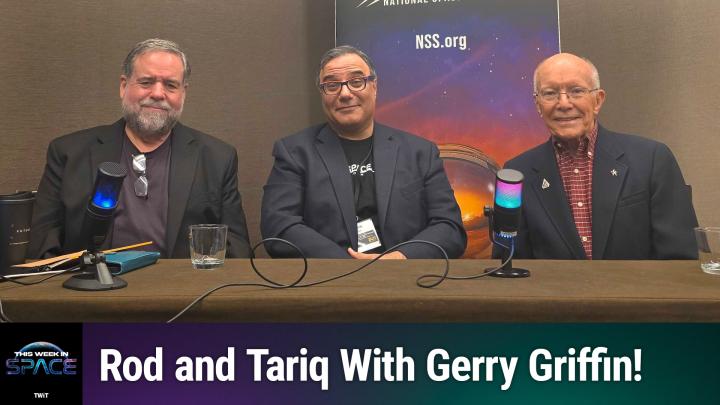
Coming up on This Week in Space, Rod and I are at the International Space development conference in McLean, Virginia, where we are going to talk with legendary flight director Gerry Griffin, who is going to tell us what it takes to have the right stuff to fly people to the moon and back and then do it again at the movies. Tune in.
Rod Pyle [00:00:24]:
This is this Week in space, episode number 213, recorded on June 5, 2026: Live From ISDC With Gerry Griffin. Hello, everyone. Welcome to another episode of This Week in Space. This is the Live From ISDC 2026 edition. Thank you. Wow. Normally we have to fake that, so we really appreciate it.
Rod Pyle [00:00:50]:
I'm Rod Pyle, editor chief, Bad Aster magazine, here with the national space side and with the one and only Tarek Malik of Space.com.
Tariq Malik [00:00:57]:
hello, hello, hello. Nice to see you, bro. How are you?
Rod Pyle [00:01:00]:
Nobody claps for you.
Tariq Malik [00:01:01]:
I know.
Rod Pyle [00:01:04]:
But more importantly, we're here with Gerry Griffin.
Gerry Griffin [00:01:08]:
Yeah.
Rod Pyle [00:01:12]:
Followed flight director, former director of the Johnson Space center, icon of the Texas business community, and my personal hero. So, Gerry, thank you so much for joining us today.
Gerry Griffin [00:01:22]:
Pleasure.
Rod Pyle [00:01:22]:
He usually says nice things about me, but we won't go there.
Gerry Griffin [00:01:25]:
I'll try to keep it that way.
Rod Pyle [00:01:27]:
So we'll be taking a look at Gerry's career in this episode. But first, I have a space joke from Joel Olson.
Tariq Malik [00:01:33]:
You did not have a joke. You have a joke, Joel. Hi, Joe.
Rod Pyle [00:01:36]:
Hi, Joel. What kind of. Hey, Tarik.
Tariq Malik [00:01:39]:
Yes, right.
Rod Pyle [00:01:40]:
What kind of paper do astronauts use to write home?
Tariq Malik [00:01:43]:
Space paper. Astro paper. I don't know.
Rod Pyle [00:01:45]:
Close. International space stationary.
Tariq Malik [00:01:50]:
Very appropriate. Very appropriate for today.
Rod Pyle [00:01:52]:
We got a half hearted rim.
Tariq Malik [00:01:54]:
That's a good one.
Rod Pyle [00:01:55]:
Some sympathetic.
Tariq Malik [00:01:56]:
That was very clever, Joel. I liked it.
Rod Pyle [00:01:59]:
I've heard that some people want to write us off when it's joke time in this show, but you can help by sending us your best joke, best, worst or most different space joke to TwistWit TV. And we'll be happy to credit you on the air or give you blame. Now let's go on to headline news. Headline news.
Tariq Malik [00:02:17]:
Do headline news. Headline news.
Rod Pyle [00:02:22]:
Wow.
Gerry Griffin [00:02:22]:
We wrecked it.
Tariq Malik [00:02:23]:
I didn't know we were going to do the thing.
Rod Pyle [00:02:25]:
Okay, our engineer is space bombing, so I nailed it.
Tariq Malik [00:02:29]:
You know, we'll just pretend that I nailed it.
Rod Pyle [00:02:31]:
We actually had some headlines lined up earlier and they have all been tossed out the window because speaking of tossing things out the window, the space station is leaking again.
Tariq Malik [00:02:40]:
Well, it's been leaking for like quite some time and. And today, like as we were getting ready to finish up with the show, we got word through the NASA public affairs. Public. Bethany, the Stevens. The public, what do they call it? Public communications. Yeah, that's right, that, that they had a kind of an impromptu repair, like, I can't say impromptu. We don't know very much about what exactly happened, but they sent five of the seven astronauts on the space station into the, the Crew 12 Dragon to do like Safe Haven Shelter because two of the cosmonauts went into the Zvezda PRK. It's like the docking vestibule that all the other stuff is attached to the Zarya module, the second oldest spacecraft or part of the space station, to look for the crack again to do some, some repairs.
Tariq Malik [00:03:29]:
And they didn't finish the repairs. They stopped right what they were doing. But while they were working on that, they sent all five of the astronauts, the other astronauts. So it's, it's three NASA astronauts, a European astronaut and then, and then one of the cosmonauts. Right. They all went in there and, and, and waited for about like an hour, two hours since NASA made the announcement. And then they said that they gave them the all clear, that they stopped the work that they were doing. It didn't sound like they finished the repair, but it sounded kind of urgent because we didn't know this was going to happen until it was already underway on the space station.
Rod Pyle [00:04:03]:
So, so when you say repair, this is like toothpaste or epoxy, right?
Tariq Malik [00:04:07]:
Something like that. Yeah. We should probably let people know what had happened. About a year or two ago, I want to say it was a while ago, there was a big report from the, that said that one of the biggest threats to the International Space Station was these cracks that were in the PRK service. Basically it's been leaking air and it's been leaking air consistently over time. And in the last year or so they said that those cracks, that, that leak rate had gone up. It was like 50% a day of the air in that module was leaking out and they would offset it with more air and keep the hatches shut. And this is a part of the space station that sees a lot of use.
Tariq Malik [00:04:43]:
So where the Soyuz dock, it's progress dock, they open the hatches shut the
Rod Pyle [00:04:47]:
hatches of flexing, a lot of, a
Tariq Malik [00:04:49]:
lot of, a lot of wear on, on, on, on that, that module. So they, they limited a lot of that, that, that activity in the area to try to address the issue. Well, it came back a few months ago. There was a report, we talked about it. I think on the podcast Eric Berger had a report about how the leak was back and increasing again, which was a problem because they had thought they were mitigating it. And clearly that's not the case. So today that's like the background for it. The space station is old.
Tariq Malik [00:05:14]:
It's 25 plus years old.
Rod Pyle [00:05:15]:
Well, and this module, I think dates back to the late 80s, early 90s.
Tariq Malik [00:05:18]:
That's right, that's right.
Rod Pyle [00:05:20]:
It was a spare.
Tariq Malik [00:05:21]:
It was the, it was the, the first edition after Zarya for Zvezda. And then it was the one that allowed them to live on the space station because Zarya was a control module. And, and so, so we're not. We didn't hear like exactly what they were doing. We didn't get any specifics. Maybe it's because it was a Roscosmos LED effort and NASA was just kind of saying what they were hearing from, from that. I'm sure we're going to get more details as the day wears on, but we just know that they were working in there to try to either address or find the leak, and that's about it. I don't know if the hatches were closed throughout the space station.
Tariq Malik [00:05:53]:
I would assume that they are because we were having the crew safe haven inside the Dragon. You wouldn't do that unless you were worried about a depressurization event or something that would incapacitate the crew.
Rod Pyle [00:06:02]:
Why don't we ask an expert?
Gerry Griffin [00:06:04]:
We should.
Rod Pyle [00:06:04]:
We have one right here.
Tariq Malik [00:06:05]:
Right.
Gerry Griffin [00:06:06]:
So, Gerry, I heard this for the first time from you today, but.
Rod Pyle [00:06:13]:
Yeah, just the idea that you're in mission Control and the word leak comes up. Can't you.
Gerry Griffin [00:06:17]:
It's been a long time problem, as you mentioned it. I think it was longer than two years ago. I think it's more like three or four.
Tariq Malik [00:06:24]:
It was a while. Yeah, I've been a while.
Gerry Griffin [00:06:26]:
And they tried to do some patching at that point and it's probably some sort of epoxy or some sort of fast ceiling caulk, if you will. Yeah, and I can't understand really why it's quite so difficult, but it must be probably in an odd place that they can't get to.
Rod Pyle [00:06:49]:
You said it was behind a shelf or a cabinet, right?
Tariq Malik [00:06:51]:
That's what I've heard. This is what I heard from my team again. Like we're here in D.C. my team is, I guess they're all over the place in the computer ether, but I was told they were, they were cutting behind a cabinet to be able to get access. They were cutting a hinge off a cabinet to get into the area that was really hard to reach to see if that's where it was, and then try to patch it up. And they didn't finish with whatever they were doing.
Rod Pyle [00:07:14]:
Well, I've had some of that Russian borscht in a tube that they take up in the toothpaste tube. I think, you know, you let it sit there long enough. All right, well, I think that. Is there anything else for them?
Tariq Malik [00:07:27]:
Well, I guess just watch this space. Right. Because the, the big takeaway I took away is that they didn't finish whatever they were doing. Yeah. Which means that the leak is still there. The risk, apparently, is not because they let the crew leave the Dragon, but I'm just curious how that's going to evolve over time. Do they have to go back? Maybe they have to check it. They're going to be watching that, that over time, and then we're going to see if they're going to keep using that docking port or if they're going to use something else.
Gerry Griffin [00:07:51]:
I don't know. I don't know.
Tariq Malik [00:07:52]:
We'll have to see.
Rod Pyle [00:07:53]:
The Americans went to the Dragon. Where did the Russians go to the Soyuz? Or did they just sit in that module and wait to see what happened?
Tariq Malik [00:07:59]:
Well, so all four of the SpaceX crew, 12 astronauts, which includes one cosmonaut, I believe, two NASA astronauts and a European, if not three NASA astronauts, I don't recall, are in. So you had five astronauts in the Dragon itself. Now, now, one of those was NASA astronaut Chris Williams, who did fly with two other cosmonauts. So we assume because there are only five of them in the Dragon, that the other two cosmonauts were the ones that were working in the prk. And again, we don't. We didn't get those specific details. That's what we can infer from the information that we got. So.
Rod Pyle [00:08:30]:
But can a cosmonaut sit in the Dragon if they don't have the same air fittings?
Tariq Malik [00:08:34]:
He, he launched on that Dragon.
Rod Pyle [00:08:36]:
Oh, okay. So he's wearing a marsuit.
Tariq Malik [00:08:38]:
He was probably wearing his flight suit.
Rod Pyle [00:08:39]:
Okay, sorry, I'm getting carried away.
Tariq Malik [00:08:42]:
That's all right. It's all right. It's good stuff. Luckily, everyone's safe. I think the big takeaway is everyone is safe for now. On the space station, there wasn't like a big emergency. We should all be thankful for that.
Rod Pyle [00:08:52]:
Is your phone going to be ringing in a minute for this emergency?
Gerry Griffin [00:08:57]:
You know, every spacecraft leaks a little bit, and you Want it out for sure and not, you know, big enough to. That you become a vacuum inside there. So. But this has gone on a long time, and. And those cracks are not getting stuffed up the way they need to be. So it must be a perfect perplexing issue for them. It's got to be.
Rod Pyle [00:09:28]:
So as an engineer, is this the kind of thing you look at from the ground and think, this could blow out at any minute, or is it just.
Gerry Griffin [00:09:35]:
Yeah, if it's fatigue, particularly, it's caused by fatigue. Every time you have a pressure cycle, everything gets moved again. And so it's. It's just like been in a piece of metal till it breaks. And so you don't. Yeah, you don't want to mess with it if it's. It's probably minimal, but it's enough to get your attention because the trend is up.
Tariq Malik [00:10:01]:
Yeah, exactly.
Gerry Griffin [00:10:03]:
So.
Rod Pyle [00:10:04]:
All right, well, we are going to trend ourselves into a short break, and we'll be right back. So go nowhere. And we are back with flight. Former Apollo flight director Gerry Griffin, Director of the Johnson Space center, deputy director of the Kennedy Space center, deputy director of the Dryden now Armstrong Research center, captain of industry in Texas. You ran the Houston Chamber of Commerce. You ran the, I guess central or west coast version of Korn Ferry for a while.
Gerry Griffin [00:10:41]:
No, that was in Houston. But you're thinking of. Of the company that I chaired, a public company in California. That took a lot of my time.
Rod Pyle [00:10:51]:
Yeah, you've been a busy man. And since then, as Gerry started thinking about retirement in his 80s and then now early 90s, you were tapped to lead the recovery efforts from flooding in Texas in 2025.
Gerry Griffin [00:11:06]:
Yeah, yeah, and I'm still in the middle of that. I live right where the. If you remember the Camp mystic, campers that got killed to and to counselors. I live probably two miles from the worst hit area, and then the two forks of the river come together right below my house. And the rivers kept coming up, but I was up. I'm up on the side of a mountain, so I was okay. But it. I've learned a lot about disasters that you don't recover from very fast.
Gerry Griffin [00:11:47]:
And we're in what we call the rebuild phase now, which is particularly tough because you're rebuilding businesses, you're rebuilding homes, infrastructure, roads, bridges. First thing you got to do is get everybody, you know, housed and get some food. And, of course, this happened on July 4th, so coldness, cold was not a problem. It. It was hot. And at my house, I had 16 inches of rain in three hours.
Rod Pyle [00:12:22]:
Wow.
Gerry Griffin [00:12:24]:
So it was a fixed cell that just sat there.
Rod Pyle [00:12:28]:
Wow.
Gerry Griffin [00:12:29]:
But, you know, we're resilient. Come back.
Rod Pyle [00:12:33]:
So I forgot to mention the. One of the more interesting parts of your career, which is when NASA headquarters sent you to Washington, D.C. to be the congressional liaison for four years, which we'll. A few minutes. But I'm wondering if that part of your job experience was the most useful prep for doing this flood recovery.
Gerry Griffin [00:12:52]:
It was. It was prep for doing a lot of things. For one thing, I learned how they make the sausage up in Congress, and it's not pretty.
Rod Pyle [00:13:04]:
Right down the street.
Gerry Griffin [00:13:05]:
Yeah, it's right down the street and. But you kind of have to be in the middle of it to understand it. And it's a. It's a arduous project. I was 6 foot 3 when I started, and I did four budget cycles on the Hill, mostly with George Lowe, who was the deputy administrator, NASA at the time. And we had. Had almost lost the shuttle. It was after Apollo.
Gerry Griffin [00:13:38]:
I was getting. Let me give you a little background there. I was the lead flight director on Apollo 17, the last one. And we went. That was December 72. We went in January, and I was getting ready to be a flight director for Skylab, and one day I get a call, actually, it was from Chris Kraft, who is now the center director, and said, hey, Gerry, Jim Fletcher, who was the administrator of NASA, and George Lowe wanted to talk to you. I said, about what? About a job. Said, a job? He said, yeah.
Gerry Griffin [00:14:17]:
I said, what is it? And he said, get on the airplane. Get up there and let them tell you, you know, that's typical craft. And so I did. I got on NASA airplane went up there, and I said, we want you to run legislative Affairs. I said, you want a Texas A and M aeronautical engineer to run the Hill for NASA and. And be the interface. And they said, yep, we gotta save the shuttle. And Walter Mondale, who was later a presidential candidate, but he was a senator that didn't like space, never did.
Gerry Griffin [00:14:55]:
And he put an amendment to the 72 budget that would have killed the shuttle.
Tariq Malik [00:15:01]:
Wow.
Gerry Griffin [00:15:02]:
Right as it was getting started, and it was defeated by one vote. That's what. That's when they said, we got to have somebody that can go on the Hill with George. Right. Lowell and I would have. We tried to meet all 535 members of Congress. Senate in. And it was an education for Gerry Griffin.
Gerry Griffin [00:15:25]:
Yeah, yeah, it was. It was wild.
Rod Pyle [00:15:28]:
Would have been for anybody. Well, so let's step back a bit because I believe you have A question I do.
Tariq Malik [00:15:32]:
Well, I'm very interested, Gerry, and how you even found yourself in the realm of space. You know, is it something that as a kid that you have always been fascinated with, or was it like an evolution of happenstance where you've just, you know, you found either a passion or a calling to it later in life? And then obviously something that you're clearly good at, because then you keep sending people to space.
Gerry Griffin [00:16:00]:
Well, you know, it was funny because I was an aeronautical engineer. That's what my degree is in. Because there was no space curriculum. None. Zero. Astronomers knew something about it. Astrophysicists knew something about how you change orbits and do. We didn't know any of that.
Gerry Griffin [00:16:25]:
I was in a fighter squadron. I graduated and got commission. I was in a fighter squadron. And in 19. I joined that squadron after training in 1958. And NASA was formed. That was July, and NASA was formed in October of 58. And I can remember when it first came out, I said, that sounds fun.
Gerry Griffin [00:16:51]:
And by the way, I was in a fighter squadron with Bill Anders, who later Flew on Apollo 8 and is no longer with us. But he and I were both. He was a Naval Academy graduate. We were both in a squadron. We didn't know anything about space, and we never thought we would be in space together, but we actually flew in the same airplane sometimes together. And it shows you how the world is not very big, because when we separated, we thought, well, we'll see you later, you know. And just a few years later, we were together in Houston. And he was an astronaut and I was a flight controller.
Gerry Griffin [00:17:34]:
So I kept knocking on. I knew I wasn't going to make a career at that time. I could tell that that's not what I wanted to do long term, particularly with space coming out. So I started knocking on NASA's door and I wouldn't give up. I talked with Gene Kranz, and eventually he tried to lowball me on a. On a salary. And. And by this time, I had.
Gerry Griffin [00:18:06]:
I got out of the Air Force. I was in Marin County, California, and I moved to the South Bay, to Sunnyvale, where Mikey Martin was building the Agena and also is where the control center was for the launches out of Vandenberg after the liftoff. So it's kind of like a Houston setting.
Rod Pyle [00:18:27]:
Excuse me. But at that point, the Agena was basically just an upper stage for small satellite.
Gerry Griffin [00:18:32]:
It was. It was the upper stage for the Thor, later the Thor Delta. And yes, it was an upper stage that put spy satellites into orbit, is what it did out of Vandenberg. And this was, this was in 60, around 62. And I can tell you we put about as many in the Pacific Ocean as we put into orbit, but we were learning every time. And I was zeroed in. I was systems guy for the Agena. Well, guess what? If you remember when Gemini came along and we were going to dock with the Agena and there was a fellow there that was going to run that piece of the business at Johnson Space center, he worked for Kranz.
Gerry Griffin [00:19:23]:
His name was Mel Brooks. No can do. The other one. And Mel said, hey, you got background with Eugenia, we'd love to have you come on. And he made an offer that I couldn't refuse. It was still a pay cut, but I was ready. I wanted to get into mission Control. I kept reading about it.
Gerry Griffin [00:19:43]:
I said, God, that sounds like a neat place. So, long story short, I never worked on the Eugene. I got there and I was there about a month and they came to me and said, we'd really like to move you over to the Gemini side of the equation. I said, don't throw me in that briar patch. I'm all for it. So I never worked on the Eugenia.
Rod Pyle [00:20:11]:
Okay.
Gerry Griffin [00:20:11]:
That's how it got in.
Rod Pyle [00:20:13]:
Well, let's.
Tariq Malik [00:20:14]:
Tenacity there.
Rod Pyle [00:20:15]:
Let's work our way to a quick break and we'll be right back. So go nowhere.
Tariq Malik [00:20:19]:
Well, thank you so much, Gerry. You know, so now you've gotten us to the Project Gemini and I'm very curious about that because we know, I know that Rod got to watch a lot of that stuff, right?
Rod Pyle [00:20:32]:
Just the last couple.
Tariq Malik [00:20:33]:
A lot of, a lot of us here in the audience, you know, like, like we're not able to understand, you know, we didn't see anything of that light. But it was so many firsts and everything coming into it as you did. I'm wondering what that environment was like, what you, what you thought about the goals of those flights and how they really set things up for, for really the Apollo missions that came after.
Gerry Griffin [00:20:54]:
You know, to put that in perspective, we actually were on average flying a Gemini flight every six weeks.
Tariq Malik [00:21:00]:
Every six weeks.
Gerry Griffin [00:21:02]:
Imagine that. How fast? Now, Mercury was a one person capsule and then it became the Gemini. Two person spacecraft, we called it. We actually don't use capsule for Gemini depress.
Rod Pyle [00:21:21]:
I've had fingers shook in my face.
Gerry Griffin [00:21:24]:
You do the. I noticed that. Anyway, so. So anyhow, we, Mercury, Gemini and Apollo were really all the Apollo. They were each one of us a learning state. Germany is first time we Rendezvoused. First time we docked, first time we got outside the spacecraft and did what we call an EVA spacewalk and extravehicular activity. Typical NASA and.
Gerry Griffin [00:21:56]:
And also long duration. We flew thing long enough in Earth orbit to go to the moon and back. So we knew we could do it.
Tariq Malik [00:22:06]:
And they survived in the spaciousness of Gemini spacecraft.
Rod Pyle [00:22:10]:
Just a note on that. For those who don't know, it was Gemini 7 or 6A was the 7. So imagine sitting in the front seat of. It's not even as big as a Toyota Corolla.
Gerry Griffin [00:22:23]:
No, it's more like a vw.
Rod Pyle [00:22:25]:
It's like if you've ever sat for a vet or a very, very small car. So you're sitting about this far away from the other guy. You can't stretch your legs out. You can't stretch your arms out. The hatch is literally right up against your helmet for 14 days.
Tariq Malik [00:22:40]:
Yeah, I love your ride.
Rod Pyle [00:22:41]:
But now that's icky. And now during that time, you, of course, as a human being, have to attend to all the bodily functions of a human being in that space for 14 days.
Gerry Griffin [00:22:53]:
Weightlessness. Yeah, yeah.
Rod Pyle [00:22:57]:
Which does funny things to fluids. So I know I'm kind of skipping ahead here, but from the perspective of mission Control, I mean, I'm sure you had sympathy for those guys, but there's nothing you could do on the ground. But I mean, what kind of words of solace did you send up because they were bored out of their minds?
Gerry Griffin [00:23:16]:
Well, you know, they never complained. They said, became. They became very friendly over the years, and no complaints. They never said anything about it. We did let one of them take off a suit at a time if they could get it off. Now, Pete Conrad, for instance, in Germany, was not an age taller than I am. He could get his feet straight out, even out of suit. But when he got out of the suit, he said he was pretty comfortable.
Tariq Malik [00:23:49]:
Yeah.
Gerry Griffin [00:23:50]:
And so. But we've learned. So we learned how to go to the moon on Mercury and Gemini. That's why Gemini was. Or Gemini was so important. NASA says Gemini.
Tariq Malik [00:24:02]:
I said, I was just going to say we should probably settle that once and for. You prefer Gerry.
Gerry Griffin [00:24:06]:
Yeah. And. And we called them. I call them both. Did then too. If you're talking to astronomer, you want to say Gemini.
Rod Pyle [00:24:17]:
Yeah, of course.
Gerry Griffin [00:24:18]:
Yeah. Yeah. So anyway, we learned so much in that that it made Apollo work because we knew we could get outside of spacecraft, get back in. When N. White got out on Gemini 4, he was kind of like Leon off did. The Russian had gone out right before that, and he got outside and of course, the suit expanded a little bit. Yeah, he had a hard time getting back in, Leon.
Rod Pyle [00:24:47]:
And he was, he was big, right?
Gerry Griffin [00:24:49]:
He was tall. Yeah, yeah. And. And McDivitt, the commander was pulling on him to get him back in. And they finally made it. Now, Leonov did the same thing with the Russians. He got outside, having trouble getting back in, and he actually reduced the pressure in his suit to make it softer.
Rod Pyle [00:25:09]:
Considered risky, very risky.
Gerry Griffin [00:25:12]:
And he couldn't have stayed at that pressure very long. He had to get in and get back up to partial pressure of oxygen being enough to survive. So he. That whole. Those years went by so fast. We were launching, it was 24 7. We would end one flight, start the next one. Turned out Apollo, we launched about every six months.
Gerry Griffin [00:25:37]:
It was still 24 7. Get one down and start the next one and let the crew go off and do their thing. That just came down. And I never will forget the first time I saw Neil Armstrong in a Mexican sombrero in a parade going down Mexico City, I think it was. And if you knew Neil, that was so far from him.
Rod Pyle [00:26:06]:
Bit of an introvert.
Gerry Griffin [00:26:07]:
Yeah, yeah, yeah. But he's shy or. He was shy. He was quiet. I tell you what, when he talked to everybody listened. That was. I've. I've been in a room of probably 150 people or more and they would be John back and there'd be all kinds of conversations.
Gerry Griffin [00:26:25]:
This was in a pre flight, kind of a get ready. What, what else do we have to do?
Tariq Malik [00:26:31]:
Yeah.
Gerry Griffin [00:26:32]:
And at the very end, Neil sitting in the back with Hank hold up his head there, his hand, and everybody get quiet because he's going to speak. And boy, when he did, he was right on. Great man.
Rod Pyle [00:26:47]:
So I want to jump back to Gemini 3 for a second. So this was the first spacewalk on the American side. And we are still, by much of the world, considered to be catching up with the Soviet Union. So it's a big deal. And Ed White climbed out of the spacecraft. He had a little handheld maneuvering nitrogen pistol that he depleted in about two minutes.
Gerry Griffin [00:27:08]:
Didn't work very well.
Rod Pyle [00:27:09]:
Yeah.
Tariq Malik [00:27:10]:
And then.
Rod Pyle [00:27:10]:
And he's not, he's on a tether, so it's not like he's going anywhere but get a little trouble getting it back in. And can you kind of narrate that and how Chris Craft responded to this?
Gerry Griffin [00:27:22]:
Well, Chris was always several people and.
Rod Pyle [00:27:28]:
Sorry. Chris was the flight director at this point. Yeah, through most of the Gemini missions. Right.
Gerry Griffin [00:27:32]:
Well. Well, he was one of them.
Rod Pyle [00:27:34]:
Okay.
Gerry Griffin [00:27:35]:
Because you had Kranz and Lonnie John Hodge. Okay. But he was the lead. He was. He was numero, you know, and so Chris never liked. And it was always a little unsettling to have a guy outside, you know, because so many things could go wrong.
Rod Pyle [00:27:58]:
Right.
Gerry Griffin [00:28:00]:
So you didn't want to stay any longer than you had to. That was a little different on the moon because he had a backpack and.
Rod Pyle [00:28:06]:
Right.
Gerry Griffin [00:28:07]:
Different kind of thing, but in a gravity field. But when you had a guy out on a. On a Gemini flight, until we learned later in the missions, we learned you got to have handholds, you got to have foot restraints that they could put their boots in, and then they could turn a wrench or do all kinds of things. We started out, they were just all loose. You know, they go to turn a wrench, and they put torque on it and turned her body.
Rod Pyle [00:28:37]:
Right.
Gerry Griffin [00:28:37]:
So you had to anchor them down, get their feet in restraints, have hand holds, tethers. They could move as they went. And by Gemini12, or when Aldrin did it, man, he aced it. But he had all the. The flights to learn from. Yeah. And so Kraft always wanted to get people back in. Don't say a second longer.
Gerry Griffin [00:29:09]:
That translated later to landing on the moon. Don't stay any longer, and you have to get the hell out of there. Yeah, yeah. Don't tell.
Rod Pyle [00:29:15]:
The problem on Gemini 4 was, if I recall correctly, the McDivitt, who is the guy that stayed inside the capsule, had his. I guess his push the talk button down, or he switched to manual instead of off.
Gerry Griffin [00:29:27]:
Yeah, he was.
Rod Pyle [00:29:28]:
So you guys were saying, can you tell him to get it back inside the spacecraft? And.
Gerry Griffin [00:29:32]:
Yeah. And he was either not answering us or he couldn't hear us. Anytime the crew didn't want to do something. Say again, Houston? No, can't read you. And I'm joking on that because they generally did everything we did. We asked him to. But it's a. That was a dynamic period of NASA, and, boy, did we learn a lot.
Gerry Griffin [00:30:02]:
And by the time we got to Apollo, we were comfortable with everything except the command module, because it was built by another contractor. And there was a little worry, I think, that. That bringing in a new contractor for a spacecraft, a manned piece of it. McDonnell had built Mercury, and he built Gemini spacecraft, so why not McDonald? Well, it turned out that North American had a better design. It really was, and it was bigger.
Rod Pyle [00:30:41]:
So for the uninitiated, the first two orbital spacecraft that the US used, Mercury and Gemini, were built by McDonnell Douglas. Very successful, worked great. Exactly what was needed.
Gerry Griffin [00:30:52]:
McDonald.
Rod Pyle [00:30:53]:
McDonald at the time, Douglas was later,
Gerry Griffin [00:30:56]:
before the MER, before all the mergers started happening.
Rod Pyle [00:30:59]:
But then when Apollo came along, they moved over to North American Aviation.
Gerry Griffin [00:31:04]:
Yeah.
Rod Pyle [00:31:05]:
And I think there are a number of people, even within your structure at NASA that were a little surprised by that.
Tariq Malik [00:31:11]:
Can I ask.
Rod Pyle [00:31:12]:
Move on.
Gerry Griffin [00:31:12]:
Oh, yeah.
Tariq Malik [00:31:13]:
We'll take a break.
Rod Pyle [00:31:14]:
Yes.
Tariq Malik [00:31:14]:
Okay.
Rod Pyle [00:31:15]:
You forgot.
Tariq Malik [00:31:16]:
I forgot.
Gerry Griffin [00:31:16]:
What?
Rod Pyle [00:31:17]:
He always forgets. Let's go to a break and we'll be right back. So stand by. So there's a lot to say about Gemini, and I guess I'll just summarize. We had Gemini 8, Neil Armstrong and Dave Scott, that went into a potentially deadly spin. It was a really close call.
Gerry Griffin [00:31:32]:
Right.
Rod Pyle [00:31:33]:
And that happened while they were out of communication with the ground. So you guys were kind of not even really knowing what was going on. Going on for a while, right?
Gerry Griffin [00:31:40]:
That's right. And they came up over a ship that picked them up first, had a big antenna on the ship. We had three of those ships in the. In those days. And. And they straightened it out fairly fast. And Neil Armstrong was the guy that really fixed that when he. He finally took bold action.
Gerry Griffin [00:32:05]:
And it was a stuck thruster that was spinning them up and then that coupled into pitch and it was actually spinning in, going over and like once per second. Yeah. One revolution per second. Yeah. So they were in danger of raining out, not being blacked out, but blood to the head. And. And Neil finally kill the primary system. He turned off all 16 thrusters and got onto the reentry system, which meant we had to come down.
Gerry Griffin [00:32:42]:
So we put them down in the Indian Ocean where we didn't have a carrier to pick them up. We had a destroyer that had been trained a little bit. We had those around the several parts of the world to encase.
Rod Pyle [00:32:55]:
Yeah.
Gerry Griffin [00:32:56]:
And they got them out of the water and got the command module out of the water, or got the spacecraft out of the water and made it. Okay. But that was close call, really close.
Rod Pyle [00:33:08]:
And then we go up through Gemini 12, which I'll mention, just because, you know, your last goal to prove out the techniques needed for Apollo, just in case they had to do an eba, was to get eva. Right. And you had tried, I think at this point, four or five times.
Gerry Griffin [00:33:24]:
Right.
Rod Pyle [00:33:25]:
And never completely successful. The guys would over exert themselves, as you mentioned, There weren't enough handholds of footholds, suits were stiff. But there was also, as I read it anyway, and you know better than I, obviously, a little Bit of a gap in the training. And Buzz Aldrin, hero of the moon, I mean, it was a NASA effort, but he really doubled down, I think, just as a personal thing.
Gerry Griffin [00:33:51]:
Right.
Rod Pyle [00:33:52]:
And they, NASA rented time in a, in a pool at a boys school in Maryland and they built a Gemini mock up. A very rough one was the capsule in the Eugenia in the deep end of the pool.
Gerry Griffin [00:34:06]:
Yeah, I think it was. Yeah, probably, yeah. Twelve it was.
Rod Pyle [00:34:10]:
Yeah, that's right where Buzz would go and simulate this 0, 0G maneuvering in this pool. But they could only do it after water polo practice when the boys vacated the pool. So this was NASA and it's rough and ready years. But Buzz, by at least talking to him and the people that knew him, you know, he wasn't the easiest guy to get to know, but he was dedicated to getting this right. And he was down there for hours and hours and hours moving, and there's only so much you can do. You get out of the hatch, you crawl to the back, you crawl to the front, you go to the busy box, you turn a few knobs, get out, take a rest and go back and do it again. Probably knowing Buzz as I do dozens and dozens and dozens and dozens of times. But when he got into space, he made it look easy.
Gerry Griffin [00:34:54]:
He did, he did. And by the way, that underwater facility led to. There is one now at the Johnson Space Center. It is huge, state of the art neutrality lab. And they can put huge pieces of hardware in there and space stations, the
Tariq Malik [00:35:14]:
whole space station is there.
Rod Pyle [00:35:15]:
Yeah.
Gerry Griffin [00:35:15]:
The reason that's important is because in water they can get you to neutral buoyancy, they call it, where you're, you're neither going up or down. You're down in the suit. You got your suit on and it's very much like zero G, except you still, of course, you can feel your feet on the bottom of the suit, but most of the movements and all you're kind of suspended. So it's very similar. It's excellent training, really good and drive me nuts. Get that water with a big old suit and backpack simulator.
Rod Pyle [00:35:55]:
Did you ever try it?
Gerry Griffin [00:35:56]:
Nope. It's like jumping out of an airplane. I don't care to do that.
Tariq Malik [00:36:01]:
What about going to space? Would you want to go to space?
Gerry Griffin [00:36:03]:
Oh, yeah.
Rod Pyle [00:36:03]:
Okay.
Gerry Griffin [00:36:04]:
Yeah, yeah. I'd go to Mark if I could do it.
Rod Pyle [00:36:07]:
We can ask around.
Gerry Griffin [00:36:09]:
Ask around.
Rod Pyle [00:36:09]:
Okay. We probably should move on to Apollo 1 because this was a big deal. Yeah. Big turning point. So the Apollo capsule originally was specked out to probably land on the moon by itself. So it was built in a certain configuration. Didn't have the front hatch for the docking with the lunar module and so forth. And then later they started working on the block 2, which would be able to rendezvous and dock and undock with the lamb.
Rod Pyle [00:36:38]:
And crews could transfer inside the tunnel and all that. But the original capsule was going to be used for the Apollo 1, Apollo 204 flight. Earth orbital flight. Right.
Gerry Griffin [00:36:50]:
Earth orbit.
Rod Pyle [00:36:51]:
That was supposed to be in 1967. So you were moving really fast at this point. And again, we got this new contractor, North American, putting this together. And this is a much more complex spacecraft than Gemini was. And according to. Depending on what you read, there were between dozens and many hundreds of change requests coming in from NASA constantly. North America was having trouble keeping up. So all this to say that the spacecraft design was a bit compromised.
Gerry Griffin [00:37:25]:
Yeah, I think. And a lot of people have taken that to mean that. That we were cutting corners because there was this space race. I don't agree with that. And we were cutting corners, trying to just get it done. And cutting corners is not even real accurate. We were in a hurry. And when you're doing something brand new, that's a tough place to be.
Gerry Griffin [00:37:54]:
But we never worried about the Soviet Union. We never thought about being in a race with them. It's kind of like when you're on a football team. You got to play your game. You can't worry about what the other guys, how they're coming along and their practices and all that. You know, you got to concentrate on your own. There were two problems that really caused. There was a fire that killed three guys on a pad.
Gerry Griffin [00:38:21]:
It wasn't a launch. It was a pad test. And. But there were two things that wasn't even fueled right. No.
Rod Pyle [00:38:29]:
Yeah.
Gerry Griffin [00:38:30]:
No, empty. And it counts down about T minus 9 minutes and then stops. So what happened? We had a bunch of flammable materials inside the cockpit. We had paper checklists. 8 and a half by 11. It was probably that big. Every phase of the mission, you had 100% oxygen, which we had done in Mercury. We did it in Gemini.
Gerry Griffin [00:38:59]:
We had done it way back when in high altitude airplanes. So it was kind of a standard thing to have 100% oxygen when you're going either up to the edge of the atmosphere or out of it. So we were kind of. The Russians or the Soviet Union had already changed to more. More like an air mixture. And. But we hadn't. We stuck with what we knew.
Gerry Griffin [00:39:27]:
So we had this 100% oxygen. You always like to have a little bit of leakage out if don't pull anything from the Florida coast inside.
Rod Pyle [00:39:36]:
So you over pressure.
Gerry Griffin [00:39:37]:
So you over pressure a psi or 2 pound per square inch or two. And then everything was going out. So it was 100% oxygen with flammable material. And then there was a short, which to this day has never been determined exactly what it was. But it caused a spark. It started a fire. I was still a guidance, navigation and control officer for that test for. I was just there to monitor the systems.
Gerry Griffin [00:40:12]:
And Gus Grissom finally. And we were having calm issues and he finally said, hey, we can't even talk between buildings. How are we going to talk when we get on the moon? And finally we called a halt and see if they could straighten out the palm issue. They had already been closed in. Hatch was sealed. And that was a change that came after the fire. But it was like that when it. When the spark happened and I just happened, not that we were taking a break and I didn't take my headset off.
Gerry Griffin [00:40:48]:
And I could. I heard somebody say fire. It's all I heard. And there were guys getting up out of the control room to go take care of things or get a drink of water. And I kind of yelled at him, I said, hold on, something's going on at the Cape. And it was the fire. And that's about all that I heard in real time. A couple other guys heard it too, because they hadn't taken their headsets off yet.
Gerry Griffin [00:41:16]:
Long story short, it was over in a few minutes. I mean, a few seconds. It was. They burned so fast and over pressurized it split the heat shield area that. Where on the bottom. It kind of separated that.
Rod Pyle [00:41:32]:
Yes.
Gerry Griffin [00:41:34]:
And the crew actually died from asphyxiation.
Rod Pyle [00:41:40]:
Right.
Gerry Griffin [00:41:41]:
And all the O2 was gone. So they. They couldn't breathe. And they got some birds too.
Rod Pyle [00:41:50]:
But if I could just add one point because this early capsule design, they had an interior opening hatch, which is a very smart thing to do because
Gerry Griffin [00:42:00]:
you're in space and you got.
Rod Pyle [00:42:02]:
You don't want a hatch that opens out because if you have one that opens in it just as you pressurized it.
Gerry Griffin [00:42:07]:
Plus it just plugs. Right, plugs.
Rod Pyle [00:42:09]:
So it's not going anywhere. Unfortunately, if you have a fire and now the pressure is building up inside the spacecraft, there's no way you can get it open until it's split open. So those guys didn't have a chance.
Gerry Griffin [00:42:21]:
They didn't have a chance. Out of that, we lost about 21 months to the next mission. And in October, we actually flew it in October of 68. And in the interim back in June, Craft was. George Loeb was brought in as the program manager. Kraft was elevated up to be the deputy director to Gilruth or godhood, depending
Rod Pyle [00:42:55]:
how you look at it.
Tariq Malik [00:42:55]:
Right.
Gerry Griffin [00:42:56]:
So he crayons and crafts had to have some more flight directors. So in those days it's very difficult to be a flight director. Today you got to go through paperwork and training and, and that was after Challenger and Shuttle caused that. But in those days, Kraft said, griffin, I want you to be a flight director. Yes, sir. And you name two more at the same time. So that's when I became a flight director before the first human mission got launched.
Rod Pyle [00:43:34]:
Okay.
Gerry Griffin [00:43:34]:
In Apollo.
Rod Pyle [00:43:35]:
Well, let's launch ourselves into a break and we'll be right back. So go nowhere.
Tariq Malik [00:43:40]:
So Gerry, now you're a flight director. And like as you mentioned, you know, it took 21 months to, to get to that, that first human flight with Apollo. And I'm really struck because it's 1968 now and we're going from that first flight, that first crude flight all the way to Apollo 8. At the end of the year, we're, we're going around the moon for the first time. And that seems amazingly short, at least from now when we're hoping to be able to launch it once a year. And I'm just curious what that environment was like because it seems like it's really fast and you're learning these lessons from the tragic Apollo 1 fire. And yet you know that you need to get to that end goal there.
Gerry Griffin [00:44:23]:
Yeah, we got the Apollo 1 fire satisfied, but changing the air and getting the paper out. In fact, 3M came up with a paper that was self extinguishing. You couldn't light it. I tried it. Well, that's what all the checklists are printed. They use that in operating rooms. I've been told that high oxygen.
Rod Pyle [00:44:45]:
Another space program spin off.
Gerry Griffin [00:44:47]:
Yeah, but we finally got it. Got the hatch opening outward, quick disconnect, all of that, that, that said, okay, now we can go. So we launched seven, worked like a charm, flew for ten and a half days.
Rod Pyle [00:45:04]:
Earth orbit only.
Gerry Griffin [00:45:05]:
Earth orbit only by itself. Yeah, very much like you're gonna get a little bit. Well, Apollo 8 then came next. Yeah, that was in October and then in December, just, it was so close that most of us on seven, I was one of the flight, three flight directors on seven and we didn't hear anything. We didn't know it. I was walking out of the Control center after splashdown. And this guy came up to me and said, did you hear we're going to the moon on 8. I can't repeat exactly what I said, but it was like, you're kidding me.
Gerry Griffin [00:45:49]:
That's close. And. And they said, no. We've had a small team, seven guys I think, in craft and Lowell working on. Could we do it? Could we go to the moon and circle it with just command module? We didn't have a lander yet very much like Artemis went through right now. Yeah, we didn't have a lander, so that's about all you could do. And it kept the momentum going. And it also said we can test out this whole system, all stages of the Saturn and the whole bit to get there, except for docking, however, that'll be first.
Rod Pyle [00:46:33]:
A difference? Well, yeah, because part of this was motivated by the CIA noticing a very large rocket being put up in Russia, which was attempting to do the same thing you were. It is worth noting that though, for Apollo 8, one difference between that and Artemis. Artemis didn't go into lunar orbit. It was a flyby.
Gerry Griffin [00:46:49]:
It's a flyby.
Rod Pyle [00:46:50]:
Apollo 8 was going into lunar orbit with the space, with the capsule. Excuse me, the spacecraft. I was going to say module, which had a 20,000 pound thrust rocket engine on the back.
Gerry Griffin [00:47:02]:
Right.
Rod Pyle [00:47:03]:
That would break them into lunar orbit. And if that didn't work, they'd sling around and come home just like Artemis 2 did. However, when you want to leave lunar orbit, if that engine doesn't light up, you're not going anywhere. There's no lunar module as a backup.
Gerry Griffin [00:47:16]:
That's right.
Rod Pyle [00:47:17]:
So looking back on that today, I know you guys are moving fast and you were submerged at the time, but you're really operating with kind of late 50s, early 1960s technology from today's viewpoint. Are you kind of astonished that it all works so well?
Gerry Griffin [00:47:34]:
Oh, yeah, because I am. I tell you, it was. To me, it was the gutsiest call that was ever made in the Apollo program was to put that thing out at the moon and put it in orbit around the moon and then take it out of orbit around the moon to come home. People asked me what my favorite Apollo mission was and I tell them I can't answer that because that's like asking, which one of your kids do you like the best?
Rod Pyle [00:48:06]:
That's
Gerry Griffin [00:48:09]:
what I do. Answer is that the one that I think was most important to our success was Apollo 8, because we proved that the whole Saturn V chain, for one thing, and they did prove that on Artemis too. That the OSLs, all stages and all that worked just fine. So I think what we did in eight, then we kind of fell back to Artemis 3. We go in Earth orbit, and then, and then 10, we almost landed. And we couldn't have landed that lunar module. It was too heavy. We could have gotten it down okay.
Gerry Griffin [00:48:53]:
We just couldn't come home.
Rod Pyle [00:48:54]:
The hard part. Yeah, that's a problem.
Gerry Griffin [00:48:56]:
And so that next block of spacecraft of lunar modules came out and that it was fine. So we landed. We tried 10, just first kind of. We called it a dress rehearsal, but we aborted out of the landing and came back up and came home. And then 11, we went all the way.
Rod Pyle [00:49:19]:
And the abort test was important too, because you needed know that if they had problems on the way down to the moon, that they could punch out
Gerry Griffin [00:49:26]:
and come home without land in the asset stage. Yeah, yeah, yeah. So.
Rod Pyle [00:49:31]:
Well, you know, I, I don't know about these folks. I would like to be here for another two hours.
Tariq Malik [00:49:36]:
Oh, my gosh, yes.
Rod Pyle [00:49:37]:
We've only got another 10 or 15 minutes.
Tariq Malik [00:49:39]:
We didn't get to the landing yet.
Rod Pyle [00:49:40]:
We need to get to Apollo 11. So take it away, brother.
Tariq Malik [00:49:44]:
Well, yeah, so, so you mentioned the dress rehearsal and you get there and obviously, Paul, 11. 11 comes after 10.
Rod Pyle [00:49:51]:
You should have been a scientist.
Tariq Malik [00:49:53]:
I know, right? It's a wonder why I didn't fly in space. So, but, but so that big moment arrives and I'm curious as a flight director, if there is anything different about that type of mission planning and overseeing a team, you know, where you're actually going to. Sat down and walk around on, on a different, A different. What do you call it? Call it a world. A different world. Right. A different service, you know? Exactly, exactly. And, and, and, or was it just, you know, just.
Tariq Malik [00:50:27]:
It's like the same process, just a different place because of all of the, the training that you've seen and, and systems you design.
Gerry Griffin [00:50:34]:
That's a good point to make, I think, because by the time we flew 11, we had done everything except land. And we gotten pretty comfortable with it. We were getting to feel that this thing could work. They could extract the lunar module off of the booster and do all of that. The trans, they call it transposition comfort
Tariq Malik [00:50:57]:
is different from complacent. We should make that clear. Right, right.
Gerry Griffin [00:51:00]:
Yeah, right. But we were, we had done it enough that you finally get your learning curve up. And we had, we hadn't hit a 13 yet, but, but we had faced some problems that, that taught us a lot. Space flight is Learning all the time. And that's what they're doing in Artemis right now. So by the time eleven got there, it was. We had been past those gulp. Moments of TLI translunar injection, when you added velocity and took them out of Earth orbit and shot them off toward the moon.
Gerry Griffin [00:51:40]:
And that was the first time we did that was gone.
Rod Pyle [00:51:44]:
You know, called those pucker points.
Gerry Griffin [00:51:46]:
Right. And. But we, we knew we could do it after we had done it a number of times. And, you know, when it was all over, I think we went to the. We had 11 missions. We had nine of them out to the moon. Two of those didn't land on purpose, and eight and 10, and then we lost 13. But we landed six times.
Gerry Griffin [00:52:10]:
I can tell you by the end of the program, if you just fast forward a little bit, we were hitting on all cylinders. We solved problems that we didn't know were coming, but we solved them all. And I think that's what they're going to. And by the way, in Apollo, the best exploration came on 15, 16 and 17. When we had a rover, we had longer stay time on the lunar surface. Dave Scott on 15 asked me, Commander said, you ought to come out in the field with us and in on Earth because they did this geology training and how to do it. So I did. I went out with them and it opened my eyes because we kind of had been back in the test days before 15, 16, 17, which I kind of called operational.
Gerry Griffin [00:53:11]:
We had, we just never had Delta. How do you do the exploration piece of why. And that's why we're going. We're not going there just to prove we can go land. We're proving to explore. And so I came back, I told Kranz, who was still running the astronaut office. Astronaut, the flight director office said, gene, you need to go out in the fields. And.
Gerry Griffin [00:53:38]:
And he did. Then another flight director did. And then the program manager went, this was 15, 16 over 15, 16, 17.
Rod Pyle [00:53:49]:
But these are geology field trips.
Gerry Griffin [00:53:51]:
Yeah, geology field trips. They go to Iceland and all kinds of places to try to find stuff close to what they were going to land in.
Rod Pyle [00:54:03]:
I think you got sort of the short straw because you just ended up in the desert of California.
Gerry Griffin [00:54:08]:
Right. Is the desert anyway, Mexico, New Mexico. But I learned so much. And then I said, you know, this is why we're going. That's why I thought it was important. And we ended up with headquarters guys going and saying, yeah, yeah, okay, now we get it. And the crew, I can tell you, the guys out on the surface of the moon. And Dave Scott's told me this, Charlie Duke has told me this, John Young has told me that.
Gerry Griffin [00:54:39]:
He said we never worried about our backpack in our. We were in a suit that heavy on the Earth but not too heavy on the moon 1:6. And, and they both, all of them said we never worried about the backpack because we knew you guys were watching our data and that if you had seen anything wrong, you would have gotten us out of trouble. Yeah. He said that's how much we trusted you because we had this total operation finally put together. Artemis is going to go through the same thing. Those first tests, those first few flights are going to be more test flights than they are right. Than anything else.
Gerry Griffin [00:55:26]:
But then eventually they'll get to aha, this is how you do this. And they'll. I think they'll get more comfortable never taking their off safety. Yeah, crew safety was number one concern.
Tariq Malik [00:55:38]:
It's funny what you say about the last mission being like the smoothest because we saw that on the shuttle program as well after Columbia, where each one gets just incrementally smoother and smoother and smoother. So it seems like that's a feature of this iterative process.
Gerry Griffin [00:55:55]:
You gotta, you gotta stay with it for a while. It's not something you're gonna. And one of the things that I worry about the public's view of, of all these commercial guys now are doing and they're doing well, one of them's gonna stub their toe one of these days. And they make some of the media guys make it sound like, well, you just crank it in and launch. You know, I tell you what, when you strap six and a half million pounds of high explosive to your rear end and light it.
Rod Pyle [00:56:28]:
Yeah.
Gerry Griffin [00:56:29]:
There's a danger, there's an inherent risk that you cannot drive to zero. You can drive it as low as you possibly can, but it, it's a inherently risky effort. Just like getting on my. An airplane to go back to Texas.
Rod Pyle [00:56:45]:
It's a bomb with one hole last week.
Gerry Griffin [00:56:48]:
That's right.
Rod Pyle [00:56:49]:
Yeah, I saw that with.
Gerry Griffin [00:56:51]:
So Apollo taught us. And people ask me sometime, what is the legacy of Apollo that you think you left behind? The crew will tell you. In fact, I spoke with Reed Wiseman just a couple of days ago. It was very nice.
Rod Pyle [00:57:08]:
As one does.
Gerry Griffin [00:57:09]:
Yeah, as one does. He was the commander of Artemis too. But they. It's one of these things where you want to say, how was it? Did you miss anything? Did you miss something systems wise or something you weren't ready for? I've Asked Reed that question. He said, nope. Said we were ready, fully ready to go, and felt comfortable with it all.
Rod Pyle [00:57:38]:
Well, you know, we're. We're running short of time.
Tariq Malik [00:57:41]:
That brings us right to the current.
Rod Pyle [00:57:43]:
Well, not quite yet, so. No, not quite yet because we need to touch on Apollo 13, which is a very big deal. But because you've consulted on five major movies now.
Gerry Griffin [00:57:53]:
Right.
Rod Pyle [00:57:54]:
Contact. Deep Impact. Apollo 18. Apollo 13.
Tariq Malik [00:57:59]:
I liked Apollo 18. Don't knock it.
Rod Pyle [00:58:02]:
And. And Fly Me to the Moon.
Gerry Griffin [00:58:04]:
Fly me to the Moon.
Rod Pyle [00:58:05]:
Scarlett Johansson.
Gerry Griffin [00:58:06]:
Scarlett Johansson.
Tariq Malik [00:58:07]:
I was confused. I thought it was the enemy, but.
Rod Pyle [00:58:10]:
Hush, you. But you. You were on Apollo 13. And I guess we can kind of look at the Apollo 13 mission through the movie, which is that there was only one flight director on that mission, and that was Gene Kranz. And then there are a couple extras in the background. And I always thought when I was watching that. Wait a second.
Gerry Griffin [00:58:29]:
So let me tell you how that happened.
Rod Pyle [00:58:31]:
Talk about that, if you would.
Gerry Griffin [00:58:32]:
I can tell you how that happened. I show up in. Actually, it was. It was in Culver City, I think is actually the address for. There were. There were three technical advisors. There was me. I was a systems guy and a flight director.
Gerry Griffin [00:58:54]:
There was a guy named Gerry Bostic, who was Fido flight dynamics officer that worked with orbits and that kind of thing. And then there was Dave Scott, who worked with the crew in that simulator where they had a. Or a set where they had, you know, those scenes where you see Frost blowing out of the. That's not fake. They took that whole set, that whole building down to about 38 degrees like it was. And the cameramen were all in. In parkas, you know, and everybody but the actors. Everybody but the actors.
Gerry Griffin [00:59:36]:
And they got. You know how they got the zero G effect where they're kind of floating around? Seesaw. They were on a seesaw one end, and they'd have a. A crew guy, you know, moving a grip a bit.
Rod Pyle [00:59:48]:
Yeah.
Gerry Griffin [00:59:49]:
And down a little bit. And they would kind of float around, touch a wall and stop and. But it was colder and hell, I went in there a few times. God, it was cold. And I said, I don't know how you guys are doing this. I go back over to the other building and because we had a control center there that was. It was a set. And it looked just like the real control center.
Gerry Griffin [01:00:10]:
In fact, Hank one time asked me, where do you. Where do you live? I said, oh, about a half mile back over here. And I pointed in direction. My house. And we were on a Movie set
Rod Pyle [01:00:23]:
actually pointing to Santa Monica.
Gerry Griffin [01:00:24]:
Yeah, yeah. I was probably pointing. I don't know where I was. So it was. It was fascinating. The. The situation was, is that he told me, Ron Howard, the director, told me. He said, jerry said, I want you glued to my hip, and if you see something wrong, tell me and we'll try to fix it.
Gerry Griffin [01:00:47]:
But he said, I'm not making a documentary. And he said, I'm probably going to have to tell you this several more times. And he did, because I would see something that. That's not exactly the way it happened. He said, mary, this is not a documentary. All of the technical stuff was right. But there were many places in the. Where he took a license.
Rod Pyle [01:01:11]:
The hustle and bustle, if you will.
Gerry Griffin [01:01:13]:
Oh, yeah, yeah. Oh, yeah. That was one of my biggest pet peeves that he never would take out. If you look in the Apollo 13 movie and you look at the background, there's always these people walk. They had extras that walk across and
Rod Pyle [01:01:28]:
they walk around carrying a clipboard, Right?
Gerry Griffin [01:01:30]:
Yeah. And they're talking to each other and looking very important. And of course, we would never stand for that, never stand for any kind of activity that wasn't needed in the room. Because it was particularly on 13, there were always a little more. Few more people in there than normal. We had four teams on some flights. We could figure out we could cover it better. And this is going to finally answer your question.
Gerry Griffin [01:02:03]:
Ron came to me and he said, I don't have time enough to develop four characters. He was short on time anyway. The movie's over two hours long. He said, I would like to make a composite out of Gene Kranz because he was on duty when the tank exploded. If it been Glenn Lunny. It had been Glenn. If it had been me had been. Been met with or whoever's on duty, because they faced first brunt of this thing.
Gerry Griffin [01:02:32]:
And so I said, yeah. And it was okay with everybody except one of them. I won't say which one, but one of the flight director's wives didn't like that at all, that their husband didn't get top billing, you know, And. And it didn't make any difference to me. So I made that decision.
Tariq Malik [01:02:59]:
Can I say that my daughter is writing a term paper this week that is about the historical accuracy of Apollo 13. And I'm going to tell her that you said that. That's a true story.
Gerry Griffin [01:03:11]:
The technical accuracy of the film is very good.
Tariq Malik [01:03:15]:
Yeah.
Gerry Griffin [01:03:16]:
But the way it got to. And some of you probably remember we had a CO2 problem that the guys on the ground had to figure out. How do we use a lunar module canister over a round hole? And it was square, so it was really around square peg and round hole. And, and they did. But the way they depicted it in the movie is this guy walks in and he's got this big bucket and he dumps this stuff out on the table. He said, now that's what they've got up there. And we got to figure out how to, to make it work.
Rod Pyle [01:03:52]:
Right. It's a great scene.
Gerry Griffin [01:03:54]:
It is, but it's not the way it happened. It happened with a bunch of guys sitting around a table with, with a list of everything they had on board and they figured out how to do it, and it worked like a charm. And, but. And I had guys, I had NASA guys. My friends said, heck, the thing was all screwed up. They had the guy throwing the stuff and said, that's not the way it happened. I said, no kidding. You know, I just, I didn't deal with it much.
Rod Pyle [01:04:28]:
But they were coming at you because you were.
Gerry Griffin [01:04:30]:
Yep, yep.
Rod Pyle [01:04:32]:
Just, just remember you got your SAG card.
Gerry Griffin [01:04:37]:
I didn't get in front of the camera on that one though. Contact Deep Impact and Fly me to the Moon.
Rod Pyle [01:04:43]:
Yeah.
Gerry Griffin [01:04:44]:
Is I got the sack card after the. They forced me in. What they do at half tartly.
Rod Pyle [01:04:51]:
Yeah.
Gerry Griffin [01:04:51]:
Force on the first one. And then when Deep Impact wanted to put me on, they said, oh, you've already been forced. We can't force you. You got to join the sag, the Screen Actors Guild. So I said, okay.
Rod Pyle [01:05:05]:
And you got them to pay for it.
Gerry Griffin [01:05:06]:
And they pay for it.
Rod Pyle [01:05:08]:
2500 bucks, I think to Gerry Griffin, movie star. You know, there's. There's so much left that I'd love to talk about where we're running out of time, but I think as kind of a public service, how many people here saw First Man? So you knew Neil Armstrong? I never met the man, but I probably listened to the downlink from the moonwalk and from Apollo 11. 80 times, 90 times, something like that. Ryan Gosling stumbling around the moon like he was on Prozac is not the Neil Armstrong I heard. And I don't think he was spending all that time bemoaning his life and his ill fortune and, you know, yes, his daughter passing was. It was a crisis, but he sounded pretty happy to be on the moon to me. What did you think of that movie when you saw it?
Gerry Griffin [01:06:04]:
Tell you the truth, I haven't seen all of it.
Rod Pyle [01:06:06]:
Yeah,
Gerry Griffin [01:06:09]:
Neil was different. He he was a very thoughtful. He engaged his brain before he spoke. He was a little bit shy. He didn't like the press. He even, he didn't mind the press. He didn't like being in front of. And he, he, he had a way of, of saying things that made really good sense.
Gerry Griffin [01:06:38]:
That's why people listen to him. But he didn't talk a lot. He was, he was quiet. And I think I didn't like the way first man kind of that he was always worried about his next job and getting a mission or getting a. I think he would have taken whatever came along. He just wanted to be part of it. And you know, even post flight with him, when he was. People were laying all this grace and wonder on him.
Gerry Griffin [01:07:17]:
He said, hey, I was just lucky enough to be the one chosen to step on the moon first. He said, there are 400, 000 people made that possible, right? And he said, they're the ones you ought to be telling what a great job in and all that. And he said, I've been a test pilot all my life. I've been an astronaut now. And to me it was just, good God, I got, I got selected to do that. And so he was, I don't think, ever quite understood by people that didn't know him and, and that were around him some then. And his wit was extremely sharp, but you had to be around him a while before he would, before you could see it. And, and he was quick.
Gerry Griffin [01:08:08]:
He was quick and he, and then I thought in his later years his, his words were even better when he started speaking publicly. And, and he was the right guy to send to the moon, I can tell you. And have him step on it first.
Rod Pyle [01:08:27]:
Well, I think it was kind of telling when he came back. So Mike Collins went on to run the National Aerospace Museum down the street.
Gerry Griffin [01:08:35]:
Right.
Rod Pyle [01:08:35]:
Buzz went on. He went through some personal challenges, but ended up becoming kind of a media darling. But it seemed that Armstrong's greatest desire was to go teach aeronautics at the University of Cincinnati and write a textbook, which I was.
Gerry Griffin [01:08:49]:
Teach and write a textbook.
Rod Pyle [01:08:51]:
Can you imagine being an undergraduate, the University of Cincinnati and sit next to some kids and who's that guy down there, that Rumple? Tweed jackets. He walked on the moon. What? That, that had to be pretty amazing. Well, I'm afraid we have to draw this to a close, but what words of advice do you have for the people currently running Mission Control?
Gerry Griffin [01:09:14]:
Well, I was, I was in mission control for the launch of Artemis 2. I stayed in touch with Johnson Space center of Course, after running the place, you kind of feel like, you know. And by the way, the best job I ever had, though, was being a flight director. Oh, that was fun. But I really think they're going to have to go through a period the. The control center guys and gals. We didn't have any gals, but about half of them now are women.
Rod Pyle [01:09:50]:
Yeah.
Gerry Griffin [01:09:53]:
And they look just like we did. Got that Steliad. We can do this. Look. I love to be around him. After I was actually in the viewing room right behind the flight ops console, and a guy came and got me. He's a flown astronaut, flew on shuttle. And he came to me and said, okay.
Gerry Griffin [01:10:20]:
He said, they want you in the back room. And I said, what? The back room? And they said, yeah, to where the flight directors that haven't come on duty yet are not. They're watching the green room.
Rod Pyle [01:10:32]:
Yeah.
Tariq Malik [01:10:32]:
For the mission.
Gerry Griffin [01:10:34]:
I went. Went back in this back room and here were three flight directors. And they were getting ready to go on when. After tli. And they look. Just got. They were young.
Tariq Malik [01:10:52]:
Yeah.
Gerry Griffin [01:10:52]:
And they had a desk set up that looked very much like a console, but it was just a little room with a desk. And said. And they don't. He said, jerry, don't you ever come back to this control center. You come back here. Don't go in that viewing room where you got all the riffraff. So they were just like we were. I don't worry about.
Gerry Griffin [01:11:16]:
I think they'll do fine.
Rod Pyle [01:11:19]:
And you did mention to me if they introduced themselves, apparently flight directors have, like a secret handshake.
Gerry Griffin [01:11:24]:
Yep.
Rod Pyle [01:11:25]:
So. Hi, I'm number 87. Yeah, I'm number one.
Gerry Griffin [01:11:28]:
101.
Rod Pyle [01:11:29]:
And you were six. I am number six.
Gerry Griffin [01:11:34]:
That was funny because they. They really have a pecking order that wasn't truth, as there were too few of us. But for some reason, when they did the master list, there's only been about 108 flight directors. A lot of that space station, shuttle and Apollo, Gemini, et cetera, working backwards. They ended up. There was an 83 in there and a 94. And I think the woman whose husband, I think, is an. No, he's another flight director.
Gerry Griffin [01:12:14]:
That's what it is. Both of them. And. And I think she was something like 63. She's been around a little longer. And anyway, they were introducing me and I shook hands with them and they said, I'm so. And so. I'm 63.
Gerry Griffin [01:12:33]:
You know, so. So 94, 74, whatever. And I said, Gerry Griffin, 6. And they got a big Kick out of that. And so it's a. It's a good group, you know, the. The flight controllers, flight directors, particularly very, very fortunate people. And they know it to be selected.
Gerry Griffin [01:12:58]:
And a lot of them worked hard to get there.
Rod Pyle [01:13:02]:
Well, what an exciting time to be in that job.
Tariq Malik [01:13:05]:
Yeah.
Gerry Griffin [01:13:05]:
Yeah.
Tariq Malik [01:13:06]:
Once again.
Gerry Griffin [01:13:06]:
Once again.
Rod Pyle [01:13:07]:
Well, I want to thank you from the bottom of my heart. Thank you, Gerry, coming to be with us today.
Gerry Griffin [01:13:12]:
Well, it's a pleasure to be here. I've seen. I see you guys every once in a while and you get out the good word.
Rod Pyle [01:13:21]:
Watch us as long as you can stand here.
Tariq Malik [01:13:23]:
That's a mistake.
Gerry Griffin [01:13:25]:
You kind of shoot each other.
Rod Pyle [01:13:27]:
I've been accused of that once or twice.
Tariq Malik [01:13:29]:
You got to be nicer.
Rod Pyle [01:13:31]:
Guitar. And I also want to thank our audience for being here today. So let's give you a round of
Tariq Malik [01:13:36]:
applause for an astrolog.
Gerry Griffin [01:13:40]:
All the time. A little so.
Rod Pyle [01:13:43]:
And thank you online for joining State for episode number 213 that we're calling live from ISDC 2026 with Gerry Griffin. Gerry, I think the best place to learn about you online is probably Wikipedia, but do you have another web presence?
Gerry Griffin [01:13:59]:
I don't have anything. I get a lot of people sending me stuff on me and. But you're probably right. And of course, I'm, you know, I'm working on a book.
Rod Pyle [01:14:11]:
I heard that.
Gerry Griffin [01:14:12]:
Yeah.
Tariq Malik [01:14:13]:
Whoever could you be working on it with, Gerry?
Gerry Griffin [01:14:16]:
I have a biographer that. That is helping me. Has now for, I think, two and a half years or so.
Rod Pyle [01:14:25]:
Yeah. I think I counted between 60 and 70 hours of interviews.
Gerry Griffin [01:14:30]:
Yeah. And. But it's one. Rod Pyle is. So we're. We're in the later stages of things.
Rod Pyle [01:14:40]:
Yeah. So I'm thinking release will probably be around Christmas, which is good, because what do you get for dad?
Gerry Griffin [01:14:46]:
Yeah.
Rod Pyle [01:14:47]:
Book about the Apollo project. Dart. Where can we find you fort-nighting these days?
Tariq Malik [01:14:51]:
Well, you can. That's a nice set pair.
Rod Pyle [01:14:53]:
Right.
Tariq Malik [01:14:53]:
You can find me at space.com, as always. Right now you can find me in the fabulous capital of the United States, Washington, D.C. but I guess McLean.
Rod Pyle [01:15:02]:
But you'll be online playing tonight.
Tariq Malik [01:15:04]:
Yeah. Well, tonight you'll find me on Fortnite because it's the end of season shattered to get for Fortnite. And I'm very excited about that. And. And then, of course, tomorrow my daughter's taking the SATs. Big moment. Big moment.
Rod Pyle [01:15:16]:
And you're playing computer games the night before.
Tariq Malik [01:15:18]:
Well, yeah. And if you're in New York City, keep your eyes out on Sunday because we might have some news about spacesuits on that day. It's gonna be really exciting. Prada and Axiom. It's gonna be really, really fun.
Rod Pyle [01:15:31]:
So, you know, being products of the space race era, does it seem right to have product designing spacesuits?
Gerry Griffin [01:15:38]:
Sure, yeah. Sure.
Rod Pyle [01:15:40]:
Shot me.
Tariq Malik [01:15:41]:
McLaren designing spacecraft.
Gerry Griffin [01:15:42]:
It's time.
Tariq Malik [01:15:43]:
Right?
Rod Pyle [01:15:44]:
And of course, find me at pylebooks.com and add adstarmagazine.com more here at ISTC. You can always drop us a line at twis@twit.tv. We appreciate your comments, follow ups ideas, especially space jokes. People are falling behind. I'm going back to listen.
Tariq Malik [01:16:01]:
Joel, I like your joke, Joe.
Rod Pyle [01:16:02]:
Yeah, Joel was good. We got, we got some real winners. But we need some more space jokes. And just a tip for those of you out there in Internet land, don't use AI because it does not have a good sense of humor. We tried. New episodes publish every Friday on your favorite podcaster. So make sure to subscribe, tell your friends, give us reviews, we'll take five thumbs up, drive, Rotten Tomatoes, whatever you got, we don't mind. Just give us five or something.
Rod Pyle [01:16:25]:
You can follow the Twit podcast network at TWIT on Twitter and Facebook, @twit.tv on Instagram. Gentlemen, it's been a pleasure. Thank you. It's been an honor flying with you. Thank you very much and thank you everybody.
Tariq Malik [01:16:38]:
Thank you everybody.