This Week in Tech 1050 Transcript
Please be advised this transcript is AI-generated and may not be word for word. Time codes refer to the approximate times in the ad-supported version of the show.
Leo Laporte [00:00:00]:
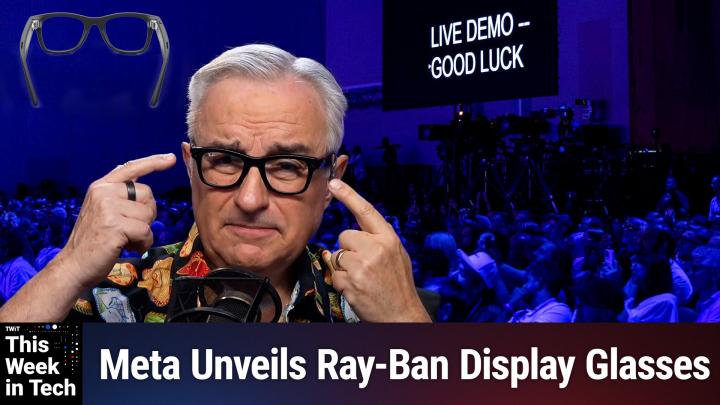
It's time for TWiT this week at Tech. I love this panel. Devendra Hardawar from Engadget is here. Nicholas De Leon from Consumer Reports, and our own Father Robert Balasser from the Vatican. We'll talk about the plan to make an AI pope. It's not going to happen, don't worry. Robert made sure of that. We'll also talk about Meta's amazing new glasses and the demo fail one after the other at the Meadow event.
Leo Laporte [00:00:26]:
The iPhone air turns out maybe it's a pretty good phone. And what is the TikTok deal gonna do for TikTok? That and a whole lot more coming up next on Twit podcasts you love from people you Trust. This is TWiT. This is TWiT this Week in Tech, episode 1050 recorded Sunday, September 21, 2025 live. Good luck. It's time for TWIT this Week in Tech, the show. We cover the week's tech news. I wasn't supposed to be here this week.
Leo Laporte [00:01:07]:
I was supposed to be on vacation and Devendra Hardawar, senior editor and gadget very kindly agreed to run the show. So I'm just going to sit back and watch Devindra. Do you mind?
Devindra Hardawar [00:01:17]:
That would be great.
Leo Laporte [00:01:19]:
No, it wouldn't. You're just being.
Devindra Hardawar [00:01:20]:
We should just put you in the guest spot, Leo and you should just.
Leo Laporte [00:01:22]:
Be kind of interesting.
Devindra Hardawar [00:01:24]:
Great being a guest.
Leo Laporte [00:01:25]:
I can't do it.
Devindra Hardawar [00:01:26]:
You just.
Leo Laporte [00:01:26]:
No, I can't do it. I can't do it. I can't. But I very much appreciate you sticking around and we'll take the burden off your shoulders. Thank you for being here. We always enjoy having you. Also with us from Consumer Reports, Nicholas De Leon, where he's senior electronics reporter is a storm a coming in beautiful New Mexico. So if Nicholas suddenly.
Nicholas De Leon [00:01:46]:
Well, Tucson, but yes, you're correct where it is late.
Leo Laporte [00:01:50]:
Oh, you're in Arizona. What am I saying? What am I saying?
Nicholas De Leon [00:01:52]:
Yes, yes, near Tucson. But yeah, there's a very, very dark clouds on the horizons. We'll see. I may. Dr. I may. You know, we'll see what happens.
Leo Laporte [00:02:02]:
This will be a test of Starlink though, because you are on Starlink, right?
Nicholas De Leon [00:02:05]:
Yes, still on Starlink.
Leo Laporte [00:02:07]:
I have.
Nicholas De Leon [00:02:07]:
I don't recall any major outages. I mean Starlink has gone out once or twice this year, like globally and I was affected by that, but I don't remember too many storm related shenanigans.
Leo Laporte [00:02:17]:
It's amazingly reliable. We have Comcast as our main bandwidth and if it fails, we fail. Over to Starlink which there's a little satellite up there above.
Nicholas De Leon [00:02:26]:
Yeah, it's, it's. You know, I was on the first time I talked about it and I wrote a big article about it for a little more than a year ago. It's very good. Obviously it's not as fast as like FiOS or fiber or any other fiber service.
Leo Laporte [00:02:39]:
Yeah, but it's fast enough for this.
Nicholas De Leon [00:02:41]:
It's fast enough for, you know, for streaming video, for downloading games off Steam, you know, it's not as fast as I would like, but eh, it's good enough. Also, I don't really have a choice so I'm rural enough where this. It's either this or nothing.
Leo Laporte [00:02:55]:
Or nothing. Right?
Nicholas De Leon [00:02:56]:
Or nothing.
Devindra Hardawar [00:02:56]:
So latency is fantastic for.
Leo Laporte [00:02:58]:
It's. It really works fine. It's kind of amazing.
Nicholas De Leon [00:03:02]:
Yeah, it's cheap, but it works. I think I was like an Elon shill or whatever when I wrote that article for the website, but I'm like, it's pretty good.
Leo Laporte [00:03:09]:
I gotta tell the truth. When it works, it works. Also with us from. Well, he comes to us from a higher authority. He's high above the Vatican. Father Robert Balasser, the digital Jesuit. Hi, Bobby. Hey.
Leo Laporte [00:03:23]:
Does anybody ever call you Bobby?
Father Robert Ballecer [00:03:25]:
No. My grandma used to. I think that was about it. But you know, just like you, Leo, I'm also not supposed to be here.
Leo Laporte [00:03:32]:
Where are you supposed to be?
Father Robert Ballecer [00:03:33]:
Well, according to the Twitters, there was supposed to be a rapture on Saturday.
Leo Laporte [00:03:39]:
Oh, really?
Father Robert Ballecer [00:03:40]:
And it's. It's been moved to Tuesday. Oh, Tuesday.
Leo Laporte [00:03:42]:
All right.
Father Robert Ballecer [00:03:42]:
Got time? I. I think tomorrow what I'm going to do is I'm going to start like laying out bundles of clothing all along the streets of the Vatican.
Devindra Hardawar [00:03:49]:
Just.
Leo Laporte [00:03:50]:
Just got raptured just to trick people. What are those shoes? They're just sitting there. Oh my God, they took him. Wonderful to see you, all three of you. Thank you for being here. I'm glad to be here. There's a lot to cover. In fact, there were a couple of big product announcements this week.
Leo Laporte [00:04:10]:
The biggest from the week was on Wednesday. Meta announced their three new pairs of smart glasses and updated Meta Ray Bans, the updated Oakleys, and a new one, the Meta Ray Ban. Meta display. Meta Ray Ban display. And two massive demo fails, which, I mean, I feel kind of bad.
Devindra Hardawar [00:04:37]:
At least they tried live demos. It's not just a scripted video.
Leo Laporte [00:04:39]:
Yeah, and I actually honored them for that. So I was very impressed. It started Mark Zuckerberg's backstage looking at his script and we're seeing Mark Sitting on the couch. And then he puts these glasses on. And I mean, they're a little nerdy, but that's Mark Zuckerberg, so they fit. And all of a sudden you're seeing what he's seeing, including a little screen in the lower right hand corner. And he walks out and there's the audience and you realize this is live. And I thought, bravo.
Leo Laporte [00:05:11]:
They're really taking a chance.
Devindra Hardawar [00:05:14]:
Yeah.
Leo Laporte [00:05:14]:
And then it all.
Father Robert Ballecer [00:05:15]:
That part worked.
Leo Laporte [00:05:17]:
Yeah, that's the last part that worked. I felt bad for Marx, really seemed chagrined. By the way, one of the people, at least one of the people responsible for the ability to take calls on Meta, was fired the following day.
Devindra Hardawar [00:05:32]:
Really? I didn't see that.
Leo Laporte [00:05:33]:
Yeah. So maybe there was a little anger. He hid.
Devindra Hardawar [00:05:39]:
It was supposed to be his Steve Jobs moment. This was supposed to be his, like, here's the iPhone. The world is different after this. And instead it's like everybody just said, boo. You know, the demos failed. And also, I don't think people are really swayed by this thing.
Father Robert Ballecer [00:05:51]:
He got halfway there. It was a Steve Ballmer moment in.
Leo Laporte [00:05:54]:
The freezing Windows Jobs bomber. There's a difference. Victoria Song, who was there from the Verge, she was on last week. I regret to inform you, Meta's new smart glasses are the best I've ever tried. $800. They'll be available on the 30th. You can get demos starting today at many lens crafters because they're made Ray Bans owned by Esselor Luxottica, which also owns LensCrafters. It's a massive monopoly.
Leo Laporte [00:06:21]:
They make them, they sell them. And so some LensCrafters will have demos of these. You can go in and do them. But a lot of the press got demos, and for the most part, they were pretty complimentary. You weren't. You weren't at. You. None of you were at the event, were you?
Devindra Hardawar [00:06:37]:
I was not there. Carissa Bell from Engadget was there and she. She liked them. She also called them the best, you know, smart glasses of this type she. She's ever seen. I do think they raised a question of, should we be living this way? Like, is this actually the future we want to live in? And I was looking at that thing in horror because he. It's a nice demo. The feeds look good.
Devindra Hardawar [00:06:57]:
Apparently it's a very bright single display in those frames. I don't want to be staring at notifications all day. I don't want to be staring at chat messages all day. Like, this is. This is the stuff we're trying to get away from, with being more mindful about smartphone use. So this sounds like hell, honestly.
Leo Laporte [00:07:12]:
This straps the smartphone to your face. Yeah.
Father Robert Ballecer [00:07:15]:
You know, that's a long time opponent. I've always wanted ar. I mean, just for decades now, I've wanted ar. And now that we're actually getting close, I'm with Devindra. I'm kind of backing away, going, you know, I already struggle putting my phone down. I don't know if I want it strapped to my face all day.
Devindra Hardawar [00:07:31]:
And the whole pitch is ridiculous because, you know, Zuckerberg is like, oh, it'll make you more connected with your friends because you don't have to take out your phone. And almost every single demo we saw one was hilarious. It was like outside in the street and it starts, you're having conversation with your friend. You have to tell your friend to basically shut the F up. I have to talk to my smart glasses to quiet. Quiet down. Okay, smart glasses, we can have a conversation now. Let's, let's chat, friend.
Devindra Hardawar [00:07:55]:
And it's so antisocial. It so breaks the flow of conversation. Like it is literally a barrier between you and the world. Yeah.
Leo Laporte [00:08:02]:
It seems everybody's showing though, this live translation feature. Apple showed it. Google's been showing it for 10 years. This is, it's cool. This is what the teleprompter said when. This is from the New York Times when Mark was to launch into the demo. It says, live demo, good luck. Mark was a little miffed because he said it worked 100 times in rehearsal, but he wasn't able to take a call.
Leo Laporte [00:08:25]:
And the guy kept calling. And apparently. So there were a couple of things that went wrong. There was a bug, which Meta says they fixed that the glasses would go to sleep as soon as the phone rang. So that's what Mark ran into. Before that, they brought in a celebrity, you know, influencer chef to cook something, and it just didn't work.
Father Robert Ballecer [00:08:52]:
It was awkward and he was, he was trying to sort of go with it, but it just kept failing and failing and it wouldn't give him simple instructions. And then it, it started moving ahead as if he had already done the previous.
Leo Laporte [00:09:02]:
Now that you've mixed it all together. No, wait, no. Meta's story. First, of course, on stage, Mark said, you know, oh, it's the WI fi. But actually Meta's story, which maybe is more compelling, is that as soon as anybody said, hey, Meta, to wake up the glasses, so many people in the audience had Meta glasses that they all woke up at the same time and they DDoS themselves. That's kind of more credible.
Devindra Hardawar [00:09:34]:
Probably mostly Meta employees too, because there were a ton of them and they all had the, like, company rep stuff going, so.
Leo Laporte [00:09:40]:
Yeah, yeah, yeah.
Father Robert Ballecer [00:09:43]:
I mean, I. Yeah, maybe, yes, but also no, because I've set up demos, live demos, on stage before, and you don't use public WI fi. You use a specific WI fi ssid and. And channel that no one else in the room is using to make sure that your devices. So no, it. I do think it got ddosed. I just think it got it ddosed itself. I think the product was failing and it kept sending the same requests over and over.
Father Robert Ballecer [00:10:09]:
If. If Meta wanted to show us. No, no, it was because we were attacked. It'd be super simple. Someone's monitoring their network. They could just release the logs and show what kind of traffic was happening on that, but they won't because the product killed itself.
Leo Laporte [00:10:21]:
They were half smart. They put the. They put it on a development server. But the problem is the development server had no capacity because it was a development server. And so everybody in the audience hit the development server at the same time. So they were half smart. You're right. They should have had it on a separate, not public, WI fi.
Leo Laporte [00:10:40]:
That would have solved some of it. I don't know. Maybe not. Now, one of the things that's pretty interesting about this, not only does it have the screen, and they made a big point of the fact that the screen is bright, it's brighter than the iPhone screen. I think they said 5,000 nits, it's.
Devindra Hardawar [00:10:55]:
5,000 peak, so that's pretty bright.
Leo Laporte [00:10:58]:
The iPhone's 3,000 peak. Right. So it's.
Devindra Hardawar [00:11:00]:
And you rarely see that direct sunlight.
Leo Laporte [00:11:02]:
Yeah, that's. That's going to hurt.
Father Robert Ballecer [00:11:03]:
You're like, ah, that would be great for my cataracts. I'm sure that's laser.
Leo Laporte [00:11:09]:
It's laser surgery. And they also said only 2% leakage, which implies no one will know that you're what you're looking, that you're looking at your glasses, which tells you right there, they anticipate a little social pushback. Right?
Father Robert Ballecer [00:11:26]:
Okay, look, they had the audio only version of this @ces last year @ Meta's booth. And it was interesting and it actually worked. And they wanted me to try a set in Rome. And then I started thinking, there's no place I could wear this. There's no place in my job where they would allow me to have a recording device that is sending data back to Meta at all times. Wait, you have that one, Leo?
Leo Laporte [00:11:51]:
Yeah. Of course I do. Hey, Meta. Oh, wait a minute. Don't everybody wake up at once. Actually, the New York Times has tells about the tiktoker who said I was getting a Brazilian wax. And I looked up and I saw that the waxer was wearing Meta Ray Bans, and whoo, that's a little scary. Although apparently the New York Times followed up and the.
Leo Laporte [00:12:16]:
The waxing company said, no, they were off. You know, these come on automatically. I don't know how you would turn them. I guess there's a button, there's a.
Devindra Hardawar [00:12:25]:
Little red light that you cannot possibly hide to show when it's recording. Right. It's.
Leo Laporte [00:12:29]:
But people get upset. I used to wear ridiculous. It is the AI pin everywhere that was recording everything. And people get upset. They don't like the idea.
Devindra Hardawar [00:12:38]:
I think rightfully. Rightfully. Like the. The stuff I'm seeing online right now is if I see you wearing a pair of Meta Ray Bans, you're going to get punched in the face, like walking. People don't want that. You walk into a bathroom. Disney's always been big on this, right? You go into a bathroom and you have, like a weird recording thing. You could get banned for life from Disney because you should.
Leo Laporte [00:12:57]:
Everywhere.
Devindra Hardawar [00:12:57]:
Because you should. But now they want to normalize wearing them on our faces at all times with really minimal awareness for the onlooker that something could be recorded at any point. I think this pushback is great. This is. This is exactly what they need to see.
Father Robert Ballecer [00:13:13]:
I updated the signs here, the signs in the Vatican. They now have no camera, no cell phone, no recording device, no microphone, and it has no smart glass. So it's always a glass, really.
Devindra Hardawar [00:13:22]:
Camera.
Father Robert Ballecer [00:13:23]:
Yep.
Leo Laporte [00:13:23]:
So when I went to visit the Sistine ceiling, the chapel, they're very big about. No pictures. No pictures. And everybody's taking pictures. Yep.
Devindra Hardawar [00:13:35]:
That's just Italy. Seriously, that's.
Leo Laporte [00:13:38]:
I mean, how do you. And since your camera phone is now a better and better camera, I don't know how you stop any of that anymore. But. Okay.
Father Robert Ballecer [00:13:47]:
They don't. They really. Every once in a while, a guard will remember that they're supposed to be angry about that.
Leo Laporte [00:13:52]:
But most got a little angry, but then everybody ignores them. So I don't, you know, can't stay outraged all day unless you're in America.
Father Robert Ballecer [00:14:00]:
I mean, you can if you're wearing notifications on your. Your eyeballs.
Leo Laporte [00:14:03]:
Yeah. Don't watch the news if you don't want to be outraged all day. Parents are outraged, according to the Guardian, because Meta has been using Photos of actual photos of young girls in ads. Instagram pictures of girls as young as 13 were used to promote threads, which is upsetting the parents of these young girls.
Father Robert Ballecer [00:14:31]:
Yeah, that sounds like a company. I want to turn over my information along with my streaming audio and.
Leo Laporte [00:14:35]:
Dude, exactly. The other thing that struck me is that what Emmett is missing is what Apple has, which is an ecosystem. I mean, would you have to use WhatsApp or Facebook messenger to get a notification through?
Devindra Hardawar [00:14:48]:
Whereas, so on the Ray Ban, like, same with Oculus. Like, you get messages through Facebook chat pretty easily, so that integration is likely there. But I have not seen these.
Leo Laporte [00:14:58]:
But what about my phone? Am I going to see phone messages?
Devindra Hardawar [00:15:01]:
I don't know. These things exist. All these glasses exist because Mark Zuckerberg hates smartphones. Right. Because they could never make the Facebook phone a thing.
Leo Laporte [00:15:10]:
Right.
Devindra Hardawar [00:15:10]:
We missed out on that. So, like, oh, this is the next thing we can. We can be the first entry platform here. And they spent tens of billions of dollars to make it happen. So they are actually pretty close. Turns out nobody wants to be a pervert all day. You know, like, these are pervert glasses. These are you just recording everything all day.
Devindra Hardawar [00:15:28]:
Nobody can trust you. Nobody can know of, like, can I have an honest conversation with you? Or are you just recording this for feeds or whatever or threads?
Leo Laporte [00:15:35]:
So it's an interesting situation, isn't it? Yeah.
Devindra Hardawar [00:15:39]:
And we should definitely be having this conversation because Facebook is not a meta, is not a trustworthy company. They've proven that time and time again. So now they're like, here, here, let us be the barrier between you and the world. I think that's ridiculous.
Leo Laporte [00:15:52]:
I mean, I noticed an Instagram icon on the screen, so you can watch reels, but if you're walking around doing stuff, you shouldn't be watching reels in your glasses. This is what Mark's view looked like as he's getting ready to go on stage.
Devindra Hardawar [00:16:12]:
Like, way to be present and in your moment.
Leo Laporte [00:16:14]:
Yeah.
Father Robert Ballecer [00:16:16]:
When will we get the first reel of someone walking into a street sign or traffic or worse?
Devindra Hardawar [00:16:22]:
Like, yeah, yeah.
Leo Laporte [00:16:23]:
$799. They'll be available September 30th. 3K video recording. It's got 12 megapixel cameras in either saying. It's got a 3X zoom. One advantage it has over the old meta Ray bans. You can at least see a viewfinder right now. You could take a picture, but you don't know what you're gonna get.
Leo Laporte [00:16:43]:
The screen will show you what you're seeing through the camera, so that's okay. Battery life may be an issue. Meta says six hours of mixed use, battery life per charge. And actually Mark was fairly upfront. He said, you know, you're only gonna get a few hours if you're gonna be on the phone the whole time. It's, it's the other thing that it did, which was I was kind of impressed that one of the demos that did work, there's a accompanying wristband. They called it a neural link controller, you know, a neural control. But it really, it's, it's.
Leo Laporte [00:17:16]:
You can see the little sensors in the bottom. It's sensing slight movements of your fingers and wrist and it looked like he was writing or typing in order to text like this.
Devindra Hardawar [00:17:30]:
A little bit of a twitching. It reminds me of that scene from Children of Men, which is one of my favorite movies, I think one of the most prescient movies ever made. But there's a scene where they go in and a kid is just like, heads down, staring at a phone, twitching their fingers because they're locked in. They can't see the world. It takes their father like five shouts to get their attention again. Wow, this is the future we want to live in. We're going to be weird little crap, twitchy people.
Leo Laporte [00:17:56]:
So it worked pretty well. I think that the strikes against it, besides the demo fails, are that it's meta.
Father Robert Ballecer [00:18:03]:
Yes, it's impressive tech. No, I mean, let's not confuse this. The tech. Aside from the fails, the tech is actually quite interesting and you could do a lot of very interesting applications with it. For me, it's all about. I'm not giving my info to meta. Just no, 100%. No.
Father Robert Ballecer [00:18:21]:
If they gave me the option to buy a set for $1,500 but absolutely no information would be kept or used by Meta, I might consider that. But like Devindra said, they are not a trustworthy company. Why would I turn over my information to a non trustworthy company?
Devindra Hardawar [00:18:35]:
It's also not just about your data, right? It's anybody who you're, you're looking at anybody around you. You are giving up their data, you're giving up their information. What they're saying, their visuals, everything. You are a little, little spy for Meta. That's great.
Leo Laporte [00:18:52]:
Also I think the lack of ecosystem, I think if Apple were to do something like this, at least it would be tied to your phone. You'd see your phone's notifications, there'd be an app store. There is no app store yet for these new glasses. I'm very tempted just to try it because it seems like, but it's a technology demo.
Father Robert Ballecer [00:19:11]:
The only app I would really want would be a contact list. Have pictures of everyone in my contact list. So it automatically pops up because my memory is not great.
Leo Laporte [00:19:20]:
And it specifically does not do that. It's not augmented reality.
Father Robert Ballecer [00:19:24]:
That's what that would be the killer app for me. Anything else? I don't want notifications when I'm just walking around.
Leo Laporte [00:19:30]:
You could be walking down the street and say out loud, hey, Meta, who is that?
Devindra Hardawar [00:19:37]:
Do I know you?
Leo Laporte [00:19:38]:
Do I tell you? And it would then take a picture and the meta AI, the LLM would. Would maybe be able to recognize it person, but he'd kind of be giving the show away.
Father Robert Ballecer [00:19:51]:
I will write an app where you can set the key phrase to be something like, oh, I haven't seen you since. And then. Then it knows the trigger.
Leo Laporte [00:19:58]:
Oh my God, it's.
Father Robert Ballecer [00:20:00]:
It's you.
Leo Laporte [00:20:03]:
You. Nicholas.
Nicholas De Leon [00:20:05]:
Yes.
Leo Laporte [00:20:05]:
What do you think? You haven't. You. You're. You're holding back. I feel.
Nicholas De Leon [00:20:10]:
It feels. I mean, the first. I have a couple thoughts. One, it does feel a little bit different than like what OpenAI has said where they. They think that people are tired of screens and our device that we're. That we're working on with Johnny, I've will be a totally different thing. That to me is just more personally interesting than another screen. I'm good with screens.
Nicholas De Leon [00:20:30]:
I've got my phone, I've got my computer. I don't really need another screen in my life. You know, I no longer live in the big city, so I don't know how popular the existing meta Ray Bans are, but I. It just feels like a limited utility.
Leo Laporte [00:20:44]:
They sold, they say, or the BBC said 2 million of them, which is, I think, I mean it's nothing like the iPhone sales, but it's a decent number.
Devindra Hardawar [00:20:52]:
I don't.
Nicholas De Leon [00:20:52]:
I haven't seen any CR readers write into us to be like, hey, you guys need to be talking about the Meta Smart glass.
Leo Laporte [00:20:58]:
A lot of people like me who have them but don't wear them in public. I don't wear them ever. You know what they're really good for? They're like. They're good for music.
Devindra Hardawar [00:21:07]:
Yes.
Leo Laporte [00:21:08]:
The sound is quite good on them.
Devindra Hardawar [00:21:09]:
And there are some like. There are some. That's just the music frames, right. I think was it Amazon just did the frames with just that. That's kind of cool.
Leo Laporte [00:21:17]:
If there's somebody I trust less than Meta, maybe it would be Amazon.
Devindra Hardawar [00:21:22]:
And who's so ready to get into smart Glasses. All the companies you hate don't. We love this category, folks.
Father Robert Ballecer [00:21:28]:
Amazon actually shipped their Fire phone though, so they've got one up on Meta.
Devindra Hardawar [00:21:31]:
That's true. It had 3D. It was real 3D.
Leo Laporte [00:21:37]:
So is this not a category that's going to go anywhere or are we just waiting for different, better technology from another?
Devindra Hardawar [00:21:45]:
It's a whole bunch of things. Like I'm working on a review of the xreal One Pro right now. And xreal is this company that's been doing tethered smart glasses. They're like big ugly goggles, but it's actually pretty cool. And I think the use case for a lot of people is going to be purpose driven spark glasses. Kind of the way somebody would put on a Vision Pro. Maybe like you're sitting down to work. You need a big, big, huge dynamic display.
Devindra Hardawar [00:22:08]:
You want to dive in and lock in and just work and get in your flow. Great. Do you want to walk down the.
Leo Laporte [00:22:13]:
Street, you have a wire coming out.
Devindra Hardawar [00:22:15]:
Of your head and then you have a wire with the one Pro. So people know like, hey, something, this is, these aren't normal glasses. Like this guy is connected.
Leo Laporte [00:22:22]:
I'm talking to a bot here.
Devindra Hardawar [00:22:24]:
Talking to a bot. But I was in a cafe, you know, waiting for my car to get repaired last week and I was just like staring off into the distance. I realized this looks weird. This looks weird because I'm wearing these shades out in public. It's connected to my computer. So people could think I'm staring at them. Like somebody really aggro could be like, what are you staring at me for, man? No, I'm just, I'm staring at a virtual display that's actually looks like it's, you know, a couple feet in front of me. And I'd have to explain that nobody.
Leo Laporte [00:22:48]:
I'm watching tv, man.
Devindra Hardawar [00:22:50]:
But you could plug into your phone, watch a big screen TV anywhere. Like these things are actually great, purpose driven. Not things to just take over your life.
Leo Laporte [00:22:57]:
And maybe that's why the Vision Pro is better. Because it's clear you're not looking at somebody when you're wearing the Vision Pro. You're, you're.
Devindra Hardawar [00:23:03]:
That's part of it too.
Leo Laporte [00:23:03]:
You're wearing a nerd helmet.
Devindra Hardawar [00:23:05]:
Helmet.
Leo Laporte [00:23:06]:
I would never underestimate our ability to get used to.
Devindra Hardawar [00:23:09]:
Yes.
Leo Laporte [00:23:10]:
Something weird that's on your face. I mean, we got used to the weird AirPods with the thing coming out and now it's everywhere. I think we can get used to these.
Devindra Hardawar [00:23:19]:
I don't know. We should, I think we should have that conversation now and be like, hey, maybe, maybe we should say no sometimes.
Leo Laporte [00:23:25]:
Maybe don't.
Nicholas De Leon [00:23:26]:
I think what's interesting is that maybe 15, 20 years ago, I feel like we weren't really having those conversations. Like, should we be doing this?
Devindra Hardawar [00:23:34]:
Yes.
Nicholas De Leon [00:23:34]:
It was just full steam ahead. You know, I was obviously.
Leo Laporte [00:23:36]:
Then Google Glass came out and we decided obviously.
Nicholas De Leon [00:23:41]:
It's funny, I was hyped for Google Glass. Maybe I was just younger and I was like, that sounds awesome. And now I'm not that I dislike it or I'm like anti it. It's just like I don't really have a use for that necessarily.
Devindra Hardawar [00:23:51]:
So yeah, society was fine. Like, how is this a net positive for society? What are you adding to the world other than being a new vect for delivering ads to people? Right. Other than being a new thing to capture an audience that you can eventually monetize with their data or whatever. Like that's all it is with all of these companies. And I think maybe we're a little more jaded or disillusioned now. But we've also seen these companies straight up lie to us, like they lie to, you know, get as many users as possible. And I think now it's, it's a great thing that we're maybe pushing back a little more.
Father Robert Ballecer [00:24:22]:
You know, Leo, last week we had the big Grace for the World concert in front of St. Peter's 200,000 people drone show, two hours, major musicians from around the world. And there was a person just outside the Colonnade who was wearing a Vision Pro and he was wearing it for at least an hour, just doing this because he was watching the concert that he was at on Disney. And I.
Leo Laporte [00:24:47]:
Was an interesting idea.
Devindra Hardawar [00:24:48]:
I was like, what?
Leo Laporte [00:24:49]:
What is?
Father Robert Ballecer [00:24:50]:
I don't know. I would not get used to that.
Leo Laporte [00:24:52]:
Sound might be better.
Father Robert Ballecer [00:24:56]:
Okay, yeah, the sound was probably better, but it would also be delayed by about 39 seconds. So I mean, I don't know why we would need that. I'm not sure the use case is quite there yet. I kind of see the same thing for these glasses. I'm sure there are a couple of very interesting service driven applications that will eventually come out, but right now it feels like people just want people to know that they're wearing something expensive and new.
Leo Laporte [00:25:23]:
Yeah, we're going to pause and regroup. Devinder, if you can boost your level up a little bit, that would be nice. I love this panel though. I'm very happy to have Father Robert Balaser here. Nicholas De Leon from Consumer Reports Congratulations, by the way, I still owe Stacey Higginbotham a letter because I'm going along reading the Consumer Reports thing saying, Microsoft, knock it off. You know, Windows 10 is in two weeks, gonna expire, and people will have security issues and Consumer Reports, actually, it was signed by your policy folks, Stacey Higginbotham. And the other guy was Jack Levine. I can't remember his name.
Nicholas De Leon [00:26:09]:
I forget. There's a lot of folks on that side. It's technically a separate department.
Leo Laporte [00:26:13]:
It's not you. Okay. Do they ask you about it for technology?
Nicholas De Leon [00:26:18]:
They asked. They asked. They gave us a head, a heads up that they were gonna do something like that and that if we wanted to have an article maybe to speak to someone about, you know, they gave us a heads up and then we did an article, which we were going to do anyway, but it, we did it a little earlier than I think we're gonna publish it, like Monday or Tuesday. There was one other person I wanted to speak to, but I didn't have time to. So we published our article on Friday. Just a very simple, like, hey, you're an everyday person, you're a consumer. You have a Windows 10 PC. What's going to happen? And then we link to the letter, you know, ready, disapproval, legit.
Leo Laporte [00:26:53]:
It's. By the way, it's Justin Brookman. I apologize.
Devindra Hardawar [00:26:55]:
That's right.
Leo Laporte [00:26:56]:
That's getting your name wrong. But yeah, I think it was appropriate. I think it was right on. Because as they point out in the letter, Microsoft was selling PCs that were. Are incompatible with Windows 11 as recently as a few years ago.
Nicholas De Leon [00:27:11]:
Yes, that to me is the biggest, you know, because this is the whole thing. It's like, okay, well, Windows 10 came out in 2015. 10 years of support to me feels normal, frankly. But if I bought a PC from Best Buy three years ago and all of a sudden it's not going to get security updates, that's where it gets a little strange. And we put our consumer rights hats on because, yeah, that doesn't feel sufficient. Three years of support.
Leo Laporte [00:27:38]:
No. And Microsoft, I think, is backing down a little bit. They've offered a couple of pretty de minimis ways to get the year's updates. But as Stacy and Justin point out, Microsoft's making these updates anyway, so really they're willfully withholding them. It's not like they're not doing the work to provide security Updates for Windows 10. They're willfully withholding them to kind of push you into buying a new PC.
Nicholas De Leon [00:28:03]:
And for the story that I published I guess Friday, you know, I sent like four or five pretty detailed questions to them earlier in that week. Asking all those sorts of questions is like, you know, what is Microsoft's responsibility to folks who bought a brand new PC, you know, maybe in 2022 or whatever that had Windows 10 on it and now all of a sudden it, you're telling them they don't get support. That feels kind of strange, don't you think? Microsoft question mark they didn't answer any of those questions. They just referred me to their kind of giant FAQ and a couple other documents. But yeah, they weren't really in the, they weren't answering the questions, I'll say that much.
Leo Laporte [00:28:38]:
I think this letter and general consumer upset will probably push Microsoft to offer some sort of path for at least another year of upgrades. I suspect that that's going to, and.
Nicholas De Leon [00:28:50]:
It'S, you know, this one, it's not like this was sprung up. Microsoft has been telegraphing this I think for a few years anyway. Oh yeah, so it's not like it came out of, out of the blue, but still, you know, if you're going to be making the updates, you know, can you do it another year? Because if Microsoft say, hey, just buy a new PC, you know, you can't. A lot of people just can't go buy PC.
Leo Laporte [00:29:08]:
I mean, that's offensive too. Especially if the PC is just a few years old. That's offensive. So you could pay $30 for a one year extension, which is not too bad. No, but there are. If you have a thousand Bing points, you can do it. And if you back up your. This is the one that tells me Microsoft's looking for loopholes to get around this.
Leo Laporte [00:29:27]:
If you back up your settings to OneDrive, another Microsoft product, you'll also get a free year. So my guess is Microsoft's going to find ways to make it pretty easy to get the update. However, and this is the real issue, there will be millions and millions of PCs that are not updated and they become a hazard to all of us on the Internet because they're now insecure. And it's not just the person who owns the PC who is the victim, it's everybody else. Correct.
Nicholas De Leon [00:30:00]:
And there's all sorts of reasons not to want to Upgrade to Windows 11. I mean, I personally don't like Windows 11 at all, frankly. I thought Windows 10 was, I thought Windows 7 was basically perfect. I thought Windows 10 was pretty close to per Windows 11. And every other day there's a new UI element that's annoying and not needed and they change the way things work. It's just, it's just a real hassle. I actually put GHH's new Linux distro Omarchi on this PC so I'm now dual booting between Windows 11 and.
Leo Laporte [00:30:29]:
How do you like that? He's been talking about that a lot.
Nicholas De Leon [00:30:32]:
I do like it. It's, it's very different if you're used to like Windows. Yeah, it's, it's, it took me about a week to get, to get used to it. I was, I, I've been messing around with like Claude code and other kind of AI agentic programming stuff and so on there on the Linux half of the system, all that stuff works great. It's very different. You know, it is not like Windows, but if you're a nerd, you know, you'll get used to it in a couple of days.
Leo Laporte [00:30:55]:
Well, that was my secret hope that this could bring on the, finally bring on the year of the Linux desktop. But I don't know, I don't know.
Father Robert Ballecer [00:31:02]:
If that we've heard that so many years on.
Nicholas De Leon [00:31:06]:
I did speak to Fedora for the story. You know, it is a lot easier than it was, you know, even, you know, 10, 15 years ago to jump into Linux. They all have the equivalent of like app stores.
Leo Laporte [00:31:17]:
Absolutely.
Nicholas De Leon [00:31:17]:
You know, app get, update. It's, it's all pretty easy and frankly a lot of consumers especially they're just using a web browser anyway, whether that's Firefox or Chrome. So it really doesn't matter what device you're using necessarily. But you know, once you start getting into, you know, I have specific software I need to use the Adobe suite, I need to use this. Okay, well then it's a little harder to change. But for the average person, Linux is I think totally fine, pretty easy, you know, depending.
Leo Laporte [00:31:45]:
I'm a fan, but that's just me. I'm not a fan of Windows, so I kind of. Anyway, thank you Stacy Higginbotham and Justin Brookman and thank you Consumer Reports for I think, fighting the good fight for all of us consumers. We're gonna take a little break as I said, and we'll get back with more. Did I thank Devindra Hardawar? He's also here, senior editor at Inkadget. Great to have all three of you. Our show today brought to you by speaking of Microsoft, US Cloud, the number one Microsoft Unified support replacement. Yes, you don't have to get your unified support from Microsoft.
Leo Laporte [00:32:20]:
We've been talking for a few months now about US Cloud. They are the global leader in third party Microsoft support. Now they do support 50 of the Fortune 500. In fact, switching to US Cloud can save your business 30 to 50% over Microsoft Unified and Premier support. And it's even better, right? It's twice as fast their average time to resolution versus Microsoft twice as fast. Their engineers are the best in the business with an average of 16 years with Microsoft products. And they'll tell you stuff Microsoft may not be anxious to tell you. For instance, US Cloud now offers an Azure cost optimization service.
Leo Laporte [00:33:02]:
And I'm going to bet. I may be wrong, but I don't think Microsoft really wants you to optimize your Azure spending. I mean, that's the thing about Azure. It creeps up on you, right? When's the last time you evaluated your Azure usage in your company? If it's been a while, you probably have some Azure sprawl, some spend creep. But good news, saving on Azure now is very easy with US Cloud. US Cloud offers an eight week the Azure engagement. It's powered by VBox and it identifies key opportunities to reduce costs across your entire Azure environment. You're going to get expert guidance from those senior engineers at US Cloud with an average of over 16 years with Microsoft products, including Breakfix.
Leo Laporte [00:33:46]:
At the end of those eight weeks, your interactive dashboard will identify, rebuild and downscale opportunities and maybe even more importantly, unused resources. VMs that you're not even using, right? Which means you can take that, reallocate those precious IT dollars towards things you need more. But can I make a suggestion? You might want to invest those Azure savings in US Cloud's Microsoft support. That's what a few other US Cloud customers do. Then you completely eliminate your unified spend and the savings keep on going. Ask Sam. He's the Technical Operations Manager at Bead gaming. He gave us Cloud 5 stars.
Leo Laporte [00:34:26]:
He said, quote, we found some things that have been running for three years which no one was checking. These VMs were, I don't know, 10 grand a month. Not a massive chunk in the grand scheme of how much we spend on Azure. But once you get to 40 or $50,000 a month, it really started to add up. Yeah, I bet. It's simple. Stop overpaying for Azure, identify and eliminate Azure creep and boost your performance all in eight weeks. With US Cloud, USCloud's on your team.
Leo Laporte [00:34:55]:
Visit uscloud.com and book a call today to find out how much your team can save. That's uscloud.com book a call today and get faster Microsoft support for less Better, too. Thank you, usCloud. We appreciate your support of this week in tech. You know, one of the things that comes up, I think, a little bit with this, these meta glasses, is this. I think there's increasing distrust, not just of meta, but of big tech in general. And maybe not even just big tech, but big enterprise, big companies, as there should be. You know, it's not really our purview, but the Jimmy Kimmel thing I think, really shows you that if you're that big, that you're very vulnerable to the government.
Leo Laporte [00:35:48]:
And government pressure can really be felt. This is why I like being a independent podcast. Not owned by anybody. We're not regulated by the government, by the fcc. You know, we can say stuff. We could tell the truth and not have to worry about this specter of pressure from the government.
Devindra Hardawar [00:36:11]:
But I think that's independent media for sure.
Father Robert Ballecer [00:36:13]:
Yeah, yeah.
Leo Laporte [00:36:13]:
I really. Independent media is the way to go now. I really wonder if generally people are starting to distrust big tech, big companies.
Devindra Hardawar [00:36:24]:
Have you seen the reports? And big government, the Disney adults, Leo, the folks who are like, so, so in the pocket for everything. Disney, a lot of them are canceling their subscriptions and producing content now saying, we're not going to stand for this.
Leo Laporte [00:36:38]:
That's huge, right?
Devindra Hardawar [00:36:39]:
That's huge. Like, you get those loyal fans to turn against you. I don't think they. I don't think Disney realized how big a deal this is. And also, yeah, it's about government overreach, but it's also, nobody expected this before a normal functioning US Government, this would never be happening. But we have a pretend, you know, we have somebody who's basically cosplaying as a dictator, and they're going to do the stuff they've seen other people do. This is a replay of history. What's scary is that these companies are just going with it.
Leo Laporte [00:37:07]:
There is a struggle right now. This H1B visa thing, I think, is symptomatic of it. This week, the Trump administration announced that they've kind of backed down a little bit, but they announced they were Gonna charge a $100,000 fee for H1B visas. Amazon has 14,000 H1B visit visa employees. Now, I think, you know, on the one hand, the instinct is appropriate, which is that companies. This visa is supposed to be used to hire highly skilled workforce that cannot. That doesn't replace American workers that cannot be found in the US Right. It also brings in, and a lot of people pointing this out.
Leo Laporte [00:37:52]:
It brings in students, experts from other countries who are going to come Here to study, to become more expert. It helps us. Many of our companies were started by people who came into the US on H1B visas. So there are two sides to it. And I understand kind of the nativist side, which is, well, these. I mean, I saw this at Disney. We have listeners who were IT people at Disney and talk about an indignity. They brought in foreign workers.
Leo Laporte [00:38:22]:
They said, train them. They trained these foreign workers, and then they fired the Americans and replaced them with cheaper foreign labor. So I'm sympathetic to that. But I also think that part of this $100,000 visa fee is to get Big Tech even more beholden to the federal government. Because when they announced this, they also said it's at the discretion of. Of the Department of Homeland Security.
Father Robert Ballecer [00:38:50]:
It's a shakedown.
Leo Laporte [00:38:51]:
The President can say, it's always a shakedown. You don't.
Father Robert Ballecer [00:38:54]:
It's pure. Pure and simple.
Leo Laporte [00:38:55]:
Keys.
Father Robert Ballecer [00:38:55]:
He did this with the tariffs. He did this with the do not sell technology to other countries list. This is going to be, oh, my goodness, this is so bad. This is so horrible. And then they'll start announcing, oh, but yeah, Facebook gets an exemption and Amazon gets an exemption because they gave us.
Leo Laporte [00:39:09]:
$600 billion to build American factory.
Father Robert Ballecer [00:39:12]:
Exactly.
Leo Laporte [00:39:12]:
A beautiful gold bar with a piece of glass in it, or whatever it is that they.
Father Robert Ballecer [00:39:17]:
We are at the rinse and repeat stage where it's not even original anymore because they know it works. They've done it multiple times. And not only are the tech companies going along with it, but the supporters, the hardcore MAGA folk, the uber maga, they love it.
Leo Laporte [00:39:33]:
They love it because, well, and again, if it's. If it protects America, if it protects American workers, I'm not against it, but I think it has other purposes, to be honest.
Devindra Hardawar [00:39:43]:
It's plainly obvious. Like, this is a. This is something to keep the immigrants out. Like, that's what a lot of people are doing. And also, hey, if we could shake down and get some extra money, that this is what they've been doing, this is what they believe, and it's disgusting.
Leo Laporte [00:39:56]:
There've already been changes to it, though. I have a feeling that phone calls were flying in from Cupertino and Menlo park and Seattle saying, dude, what are you doing here? You're killing us. Didn't you get the million dollar inauguration?
Devindra Hardawar [00:40:09]:
We had dinner with you so many times. Yeah.
Leo Laporte [00:40:12]:
Didn't we? Yeah. Elon Musk is a fan of the H1B visa. Tesla wouldn't exist. SpaceX wouldn't exist without it. One of the Things companies did do. Because the law, whatever it is, it's not a law. The demand takes took effect at midnight today. Companies were urgently telling their employees on H1B visas get back here because it's going to cost us $100,000 to repatriate you if you don't make it back.
Devindra Hardawar [00:40:42]:
There are so many posts of people on international vacations now being like oh at last minute I got to get.
Leo Laporte [00:40:47]:
Back home, I got to come home.
Devindra Hardawar [00:40:48]:
Stupidity.
Leo Laporte [00:40:49]:
Many of them.
Father Robert Ballecer [00:40:49]:
Then there was that clarification, that clarification flowing. She said oh no, no, no, this is for new H1B applications.
Leo Laporte [00:40:55]:
Yeah. They immediately changed it. Yeah. 4chan leapt into action in a clog the toilet op. They started buying tickets intending to inflate air travel prices so that the H1B visa holders couldn't come back.
Nicholas De Leon [00:41:13]:
Of course.
Devindra Hardawar [00:41:14]:
Hilarious. Hilarious.
Leo Laporte [00:41:16]:
Fares doubled, particularly in India. 4chan reportedly tried to block Indians from returning ahead of the deadline, but reserving seats without completing the purchases. A one way ticket from New York or from New Delhi to New York jumped from $420 to $908 because of the clog the toilet operation. But as you're, but as you pointed out it's, it's very unclear because now the White House says well if you already have a visas now it's only going to apply to new H1BS in the, in the lottery. So they've, they've backed down a little.
Devindra Hardawar [00:41:58]:
Bit and even then that's a disaster for what it means for future talent in America. Why would anybody come here to this insane place where a mad king is deciding every day to do something completely ridiculous and that should be illegal and nobody's telling him no. Yeah.
Leo Laporte [00:42:16]:
Is it not the case though that H1Bs are used by companies to bring in foreign tech workers that cost less?
Devindra Hardawar [00:42:24]:
Maybe there are other ways to. You, you give a company a little leeway to save some money and hey.
Leo Laporte [00:42:30]:
They'Re going to do it.
Devindra Hardawar [00:42:31]:
You know, this architecture of capitalism we've built will make that happen. It's not the employee's fault, it's the company's fault and it's our system's fault for allowing this to happen. But also I don't think it's necessarily a bad thing to bring in new people. So this, this is a country built on immigrants, built by immigrants. And this anti immigrant hatred is like a disgusting thing to see. And because it's coming from the top, it's becoming normalized. Least it's this. I can feel it around me and I live in the south and it's very weird to feel unwelcome more and more in the country that I grew up in.
Devindra Hardawar [00:43:07]:
And that's all because of Donald Trump and everything happening. But it's not just this. It's like every, every day there were some crazy thing. The general. The Jimmy Kimmel thing has long, like far reaching implications for what it means for First Amendment rights.
Nicholas De Leon [00:43:18]:
The 1.
Devindra Hardawar [00:43:19]:
What these companies are going to do.
Nicholas De Leon [00:43:20]:
I wanted to say about that Kimmel thing is like, dude, no one was watching that show. Like, I think, I think just, just gave them cover to. He hasn't been fired. His show has been. He's been taken off the air. It hasn't been.
Leo Laporte [00:43:31]:
He did say Seth Meyers next. He did say definitely Jimmy Fallon and Seth Meyers are next.
Nicholas De Leon [00:43:36]:
But if I'm, if I'm like the CEO of like Comcast or Disney, you know, I'm paying this guy how many millions of dollars a year to ostensibly tell jokes on the air? Dude, I can get chat GPT to do that for 20amonth. I don't need to pay Jimmy Kimmel millions of dollars for what. So it's like, I understand that there's some strangeness regarding what's his. What did the government censor him? But like, dude, no one was watching that show.
Devindra Hardawar [00:44:01]:
So it's like, I mean, the government absolutely did censor him though. Like, this whole thing started because of the stupid. It's crazy. We're living through another red scare. But the stuff after Charlie Kirk's assassination has been crazy because people have been losing job left or right. The Jimmy Kimmel thing, if you go.
Nicholas De Leon [00:44:17]:
But that was also happening before you couldn't say anything about the COVID It's like, yes, America has devolved into like a weird PVP server where like everyone is like standing like, you know, pistol out, ready to like, this is, this is insane. It's not good. But I also don't, you know, with Kimmel specifically, like, dude, no one's watching that show. I don't, I don't buy the idea.
Leo Laporte [00:44:40]:
Really? Was the ratings that bad?
Devindra Hardawar [00:44:41]:
It doesn't.
Nicholas De Leon [00:44:42]:
Ratings were. It matters if you're, if you're, you know, the CEO of Disney, it's like, what am I paying this guy for? Oh, we can get rid of him because he said something stupid.
Leo Laporte [00:44:50]:
Apparently they did not want to do this and now they are feeling the backlash, right? Because, I mean, I don't know how many people will cancel Disney plus, by the way, I did abc, Disney plus, Hulu, espn, There's a lot of cancellation. You got to be doing. This is the other problem. These companies get so big, they become hard to boycott. I would love to boycott Amazon. It's virtually impossible. Or Google. It's virtually impossible.
Father Robert Ballecer [00:45:17]:
I feel like there's a red line, though. There's a red line in the Kimmel example. Because, I mean, on one side you have. If a comedian is saying something that is extremely racist or is calling for violence. Yeah, okay, no, that's actionable. But the thing that got Kimmel in trouble was him saying, isn't it amazing how quickly the MAGA folk are suddenly trying to change the narrative now that the shooter turned out to be one of their own? That's. There's not even actually.
Nicholas De Leon [00:45:46]:
He did what the Governor Utah said.
Leo Laporte [00:45:48]:
He didn't even say that. He said, they're desperately trying to prove that he's not one of their own. Which isn't the same thing as saying he is. I mean, it was a very oblique joke. It wasn't a good joke, but it was a very oblique joke. Yeah, that's not the point. Cuz Trump's always hated Kimmel. Kimmel and Trump have been feuding.
Leo Laporte [00:46:05]:
It's like Rosie o', Donnell, who has now moved to Ireland because she doesn't want to stay, have a target on her back. If the president doesn't like you in this day and age, he's got a lot of power. He's got Brendan Carr, he's got the chairman of the fcc. This is why I'm glad. Although I can imagine, you know, in Michigan, 11 Michigan legislators have signed onto a bill that would not only ban porn entirely in the state of Michigan, but would ban VPNs, because obviously it banned porn. What's the first thing people do is they start using VPNs. Right. If you ban it in your state now, I think the law is performative, but it's a little scary that 11 legislators have signed on to that law.
Father Robert Ballecer [00:46:50]:
Wait till they hear about Tor.
Leo Laporte [00:46:56]:
I feel like, yeah, we're in an interesting time.
Devindra Hardawar [00:47:00]:
I guess interesting is not the word I'd use, but it is a scary and terrifying time. Like the Kimmel thing, specifically. It wasn't just that oblique joke. It was the fact that he pulled footage of somebody asking Trump, hey, what do you think about. What do you think about your friend Trump?
Leo Laporte [00:47:14]:
Have you seen my ballroom?
Devindra Hardawar [00:47:16]:
Like, did not care. Like, immediately moved on to something else. And a lot of people are saying, like, it's showing exactly that, like, embarrassing Trump is the bad thing. It doesn't matter how popular he was. It doesn't matter what his ratings were.
Leo Laporte [00:47:28]:
Right. Man.
Devindra Hardawar [00:47:29]:
Who is now throwing his power around.
Leo Laporte [00:47:31]:
No, no, no, seriously.
Nicholas De Leon [00:47:33]:
As well. So what, what, what are we even talking.
Devindra Hardawar [00:47:35]:
He's literally wielding power to destroy the First Amendment. Like that is what this is. It's the First Amendment.
Leo Laporte [00:47:42]:
If the government can come after anybody whether they're popular or not.
Devindra Hardawar [00:47:46]:
Yeah.
Leo Laporte [00:47:46]:
And say, hey, we want you to fire him because we don't like what he's saying. That's problematic.
Father Robert Ballecer [00:47:51]:
Don't you see?
Nicholas De Leon [00:47:52]:
If Kimmel. If Kimmel, if he's fired, if he's let go, that's fine. He's free to start a podcast if you start a twitch. And we'll see Conan o'. Brien. Conan was more successful to Kimmel's incredible content. We'll see. I'm skeptical.
Nicholas De Leon [00:48:05]:
Obvious.
Leo Laporte [00:48:05]:
You don't like Jimmy Kimmel, do you?
Nicholas De Leon [00:48:07]:
I don't watch those shows, dude. I haven't watched TV in like 20 years.
Leo Laporte [00:48:10]:
All these.
Nicholas De Leon [00:48:10]:
Well, that's Disney plus and Hulu. What are you doing with your life?
Devindra Hardawar [00:48:13]:
It's a bad sign when, when major content is being literally, basically censored and taken off the air because the person in power doesn't like it. And that's happened.
Nicholas De Leon [00:48:21]:
I mean, we had the same conversation when Roseanne was fired, when Gina Carano was fired.
Father Robert Ballecer [00:48:26]:
But that's. That is a company. That is a company making a business decision. The first. The First Amendment. The First Amendment specifically states that a government cannot impinge on the freedom of speech. A company is free to do what it needs to do in order to protect its core business. You have a president who is using these levers of power of the government to silence anyone who, who is critical of him or shows his reactions as non human.
Father Robert Ballecer [00:48:54]:
That. That is clearly a violation of the First Amendment rights. The stuff that happened with Carano or with any of the other MAGA stars. That's not because the government agency never advocated for their firing.
Nicholas De Leon [00:49:05]:
There's.
Father Robert Ballecer [00:49:05]:
There's a. Again, there's a red line there. It's a clear red line. You have to understand what is and is not a First Amendment violation. What we had before was a company deciding that they didn't want to lose a core business demographic.
Leo Laporte [00:49:18]:
But what next is a president saying, I don't.
Father Robert Ballecer [00:49:21]:
I don't think that you should be able to make fun of me.
Leo Laporte [00:49:23]:
What Nicholas is saying, though, is that Disney made a business decision, that ABC made a business decision, not a politically.
Devindra Hardawar [00:49:29]:
Motivated decision via pressure by the president.
Nicholas De Leon [00:49:31]:
Via pressure by Sinclair. Was Sinclair.
Father Robert Ballecer [00:49:33]:
It's not a business decision when you are the head of the FCC and the President of the United States saying, we're going to pull your license.
Leo Laporte [00:49:40]:
Well, it's also a little suspicious that nexstar needs FCC approval for its Tegna acquisition.
Devindra Hardawar [00:49:45]:
Yes.
Leo Laporte [00:49:46]:
This is very much like CBS paying, you know, settling the lawsuit with Trump because Sherry Redstone wanted to get rid of Paramount and sell it to the Ellisons.
Devindra Hardawar [00:49:58]:
What's $15 billion?
Leo Laporte [00:49:59]:
Yeah, I mean, but this is. Again, to me, this comes back to the issue of how interlocking all of these big companies are with our government and how little we. We matter compared to those larger. Yeah, I mean, it is a business decision. It's a business decision not to get on the wrong side of the President. It's why every single tech executive showed up at that White House dinner.
Devindra Hardawar [00:50:28]:
You got to say, I'm waiting for somebody to say, no, thank you to this invitation. But it.
Leo Laporte [00:50:31]:
Well, what's interesting, though, the one company that is apparently standing up a little bit and we'll see how this affects their business, is anthropic. Anthropomorphic. And they are. I'd be very. I don't think the President is very aware of anthropic. So I think. I think it might be okay. It might be safe.
Leo Laporte [00:50:53]:
They might be under the radar.
Father Robert Ballecer [00:50:55]:
They don't have enough zeros in their value.
Leo Laporte [00:50:57]:
Yeah, well, they do, but they do have a lot. Not in a way that the government cares. I don't know. We'll watch. Now let's move on to something much more exciting. The iPhone. Woohoo. It's kind of hard to talk about gadgets.
Leo Laporte [00:51:17]:
Let me pause and then we will. We will talk about the iPhone. I. Okay, I confess. I'm a sucker. I'm a sucker for orange. I'm a sucker for orange.
Father Robert Ballecer [00:51:28]:
Are we still calling that orange? I think Creamsicle is the perfect. Yeah, it really is. I love that color.
Leo Laporte [00:51:34]:
If it tasted like a cream skull. No.
Father Robert Ballecer [00:51:37]:
Leo, can you actually hold it like that? I thought it was so thin it could cut your hand.
Leo Laporte [00:51:42]:
No, this is not the air. This is the fat one. By the way, good on Apple for finally getting rid of titanium. This thing is much cooler. I could barely use. Adobe had that experimental camera pie, and I could barely use it because it would heat up. The phone would heat up so fast, the app would say, sorry, I have to stop. It's too hot in here.
Father Robert Ballecer [00:52:06]:
But doesn't that mean that the components are just getting hotter because the heat's not transferring to the case?
Leo Laporte [00:52:11]:
No, no, it has. This thing has. What is it?
Devindra Hardawar [00:52:13]:
Vapor chamber.
Leo Laporte [00:52:14]:
It's got a vapor. It's liquid cooled.
Father Robert Ballecer [00:52:17]:
Yeah, vapor cooling.
Leo Laporte [00:52:18]:
And then the. And then the aluminum is much more conductive than titanium was.
Devindra Hardawar [00:52:22]:
Aluminum. Aluminum unibody frame. Yeah, we're doing all the Apple hits over here.
Father Robert Ballecer [00:52:27]:
I wish we had Ian on because he could say aluminium.
Leo Laporte [00:52:30]:
Aluminium. The aluminium unibody. And look, I feel like.
Devindra Hardawar [00:52:34]:
What's the storage you got, Leo? Because I feel like this is the year of one terabyte storage. We're going to normalize more people bumping up their storage.
Leo Laporte [00:52:41]:
So I got a terabyte last year at a great expense, I might add, and I used 200 of it.
Father Robert Ballecer [00:52:48]:
Wow.
Leo Laporte [00:52:49]:
So this year I got 512. It starts at 256, which is actually, I think, finally, Apple's giving you a decent amount of storage. But I thought, all right, 512, maybe I'll use more. But I put all my. I put music on there for airplane travel. I put. I take pictures. And I mean, I use it.
Leo Laporte [00:53:06]:
I use the storage.
Devindra Hardawar [00:53:07]:
But it does for, like, video production. Well, if people are just taking videos.
Leo Laporte [00:53:11]:
More often, Pro is raw.
Devindra Hardawar [00:53:12]:
Yeah, maybe then.
Father Robert Ballecer [00:53:14]:
I mean, I shoot nothing but 4k on this. It's a 128 gigabyte model. I just offload. I. Wait, do you all keep all your photos and videos on your phones at all times?
Leo Laporte [00:53:25]:
Yeah, synchronize it to the cloud.
Devindra Hardawar [00:53:27]:
I don't do any offloading, though. Like, I don't manually move stuff off anymore. It's mainly because Verizon's offering this crazy deal. They're giving like 1100 off if you trade.
Leo Laporte [00:53:36]:
So you got a terabyte, but now you're stuck on Verizon for 36 months. Dude, did you notice that?
Devindra Hardawar [00:53:41]:
I did notice that. But, you know, whatever, it's. I'm. I'm on them because they're the best service around here.
Leo Laporte [00:53:46]:
But you weren't going to change anyway.
Devindra Hardawar [00:53:48]:
The price between the 512 and the 1tb for me was literally like $2 per month. I'm like, well, then let's go. Let's go terabyte for once. So we'll see.
Leo Laporte [00:53:59]:
This year, for some reason, the cellular carriers were going back to this kind of subsidized phone purchase thing, I guess because the phones have gotten so expensive. Or maybe they're getting ready for the folding phone next year, which will be in the $2,000 range. But you have to sign up for two or three years. And if you decide to get a new phone before then, you've got to pay the phone off. Did you notice that?
Devindra Hardawar [00:54:23]:
That's normal. That's typically like paying off because it's a subsidy. Yeah, I have to pay off.
Father Robert Ballecer [00:54:27]:
I'm never going back to subsidy. I just, I know I can't.
Leo Laporte [00:54:31]:
I got I think 700 bucks for my 16 Pro Max. So this wasn't too horrible. But I didn't get $2 a month's upgrade to terabyte.
Devindra Hardawar [00:54:40]:
Oh, they're basically giving away the iPhone Pro Max.
Leo Laporte [00:54:44]:
Yeah, I know.
Devindra Hardawar [00:54:45]:
It's interesting at this point. Not the Mac, but. No. So what are you thinking of it so far, Leo?
Leo Laporte [00:54:50]:
Well, let's, let's pause and then when we come back, we will. I just want a little amuse bouche in between the politics and the gadgets. We gotta separate the two out there. You're watching, you're watching this week in Tech with a spirited panel. I love that. Father Robert Balassaire, the digital Jesuit. On the left on the right, Nicholas De Leon. Actually on his right, Nicholas De Leon, senior electronics reporter, Consumer Reports.
Leo Laporte [00:55:18]:
And of course Devindra Hardawar, who is always, I don't know, in the middle. Is that right? I don't know. Senior editor at Gadget. No, I think, I think I'm not going to put anybody in any slots. You get to be whoever you want.
Devindra Hardawar [00:55:33]:
I'm far from the middle, I'll say that.
Leo Laporte [00:55:35]:
Yeah.
Father Robert Ballecer [00:55:35]:
So as I'm large in the middle.
Leo Laporte [00:55:41]:
Our show today, brought to you by Smarty. All right, Smarty. Smarty, the premier provider of. I love these guides. High performance cloud based address data tools trusted by leading organizations in insurance and real estate, finance, healthcare, e commerce, of course, technology in general. With more than 20 million non USPS addresses in the US can you believe that? That was a shock to me. I talked to Smarty, I was blown away. 20 million addresses in the US are not part of the postal service.
Leo Laporte [00:56:15]:
But Smartie's database covers those. But not just those. They go way beyond rural limitations. From US and international address validation to autocomplete to rooftop geocoding which makes delivery a lot easier to property data enrichment. Smarty offers the most advanced scalable solutions on the market. Backed by proprietary technology and data, Smarty delivers unmatched accuracy, consistency and insight. Every data, Every property has 350 data points. Rooftop level precision, which really helps deliveries.
Leo Laporte [00:56:52]:
Right. You know where the front door is. Real time processing speeds. They can handle 25,000 addresses per second plus per second. Smartie enables better decisions no matter the size and complexity of your business. Companies like Fabletics have drastically increased conversion rates for new customers, especially internationally with Smartie. Built for developers and engineered for scalability, Smarty's APIs are reliable, Lightning fast and easy to integrate and supported by expert documentation and real time technical support. I'll give you an example.
Leo Laporte [00:57:26]:
Speedway Motors, their E Commerce conversion rates were declining. The director of digital product and technology says we use Smartie to identify an address as a commercial address. Now conversion rates are super strong. Everything was well set up on the Smartie side. I've enjoyed working with this service. Smartie is a 2025 award winner across many G2 categories like best results, best usability, users most likely to recommend and high performer for small business. Yeah, Smarty's for everyone. It's also USPS CAS and SOC 2 certified and HIPAA compliant.
Leo Laporte [00:58:01]:
So if your organization is seeking the most accurate, reliable and future ready address data suite, Smartie is the way to go. Try it yourself. Get 1000 lookups free when you sign up for a 42 day free trial. Smarty.com TWIT to learn more, that's smarty.com Twitter we thank them so much for their support of this week in tech. I thought the iPhone air was kind of a joke. I don't know. Devindra, did you go to the event? The Apple event?
Devindra Hardawar [00:58:34]:
I did not get. I'm not doing much traveling these days, but our whole team was there. Yeah, I got kids and it's easier to be home. Judging from what I've seen from my team though, I think from the announcement it looks better than I thought. Like, I think it's more than just a gimmick. I think there is some, some genuine reason to like consider what a design like this is what something so thin looks like. We saw it with the iPad Pro and like folks on my team, Sam Rutherford who reviewed it, they're all saying like once you touch it, it's like you kind of see what's unique and different here. The problem is the compromises.
Devindra Hardawar [00:59:08]:
The potential battery life, you know, being lower than others, lack of cameras, you know, it's. That's the compromise. Like for me, I'm such a power user, I want the zoom, I want all the stuff. So I'm going to go for the thicker phone, but I kind of see what Apple's going for here.
Leo Laporte [00:59:23]:
Well, and if you got the iPhone 17, it would be 200 bucks less.
Devindra Hardawar [00:59:28]:
Yeah.
Leo Laporte [00:59:29]:
So you're paying a little bit of a premium for this thinness now I have to say Ifixit teardown came out. Let me pull that up. And they said it's very repairable, which is awesome. Yeah.
Father Robert Ballecer [00:59:41]:
Surprising.
Devindra Hardawar [00:59:41]:
Yeah.
Leo Laporte [00:59:42]:
You look at it, you think, oh, there's no way.
Father Robert Ballecer [00:59:45]:
I would have thought it was just a solid block of epoxy or something.
Leo Laporte [00:59:49]:
The air teardown shows, first of all, what Apple already said, which is that almost the entire phone is in the camera bump. The rest of it's practically. The rest of it is battery. Right?
Devindra Hardawar [00:59:59]:
Yeah. It's better for Apple if the phone's more repairable, because then they can fix issues and resell them.
Leo Laporte [01:00:05]:
Easier for them. Easier for them. Yeah. Here's the exploded, except it looks like it was nicely taken apart. You can see that almost the entire body is battery. This is the speaker, the cameras, the processors, everything. The antennas. They're all in there.
Leo Laporte [01:00:24]:
The top. The top part. Jerry rigged everything, tried to bend it, and it wasn't even that bendy, which is kind of a surprise.
Devindra Hardawar [01:00:35]:
Titanium, baby. Yeah.
Leo Laporte [01:00:37]:
Yeah, it is. It's titanium.
Father Robert Ballecer [01:00:39]:
That photo does not bode well.
Leo Laporte [01:00:43]:
You know how it is, though, with YouTube, you always got to put. It's all about the thumbnail. Right. But look how they. What they had to do to bend this thing. I mean, they really had to work at it.
Father Robert Ballecer [01:00:53]:
We shot it with a 50 cal, and wow, it just.
Leo Laporte [01:00:56]:
Yeah, right.
Father Robert Ballecer [01:00:57]:
That's amazing.
Leo Laporte [01:00:57]:
Yeah. Because it's really reinforced. Look, he can't. By hand.
Father Robert Ballecer [01:01:01]:
Yeah. Nice.
Leo Laporte [01:01:02]:
Nice flex he had. He had to have a. Like a device, put it in a vice.
Father Robert Ballecer [01:01:07]:
Yeah.
Leo Laporte [01:01:09]:
So I'm. You know, so it's durable. The screen is hard to scratch. Jerry rig everything kind of. You know, that's their thing, is they tried to scratch it and everything.
Father Robert Ballecer [01:01:22]:
Do you all have cases on your phones?
Nicholas De Leon [01:01:24]:
Yeah, I do.
Leo Laporte [01:01:26]:
Yes.
Father Robert Ballecer [01:01:27]:
Do you know anyone who carries naked phones?
Nicholas De Leon [01:01:30]:
Yes, my fiance.
Devindra Hardawar [01:01:32]:
Crazy people.
Nicholas De Leon [01:01:33]:
I do. I do.
Benito Gonzalez [01:01:34]:
This is Benito. There's some pain behind that. So that phone's been broken several times? Yes.
Devindra Hardawar [01:01:39]:
No.
Father Robert Ballecer [01:01:40]:
No, it has not. No. Really?
Leo Laporte [01:01:42]:
I would like to carry this without a case. I found a nice orange. Orange case. I say orange because I'm from Rhode Island. I find a nice orange case, but it's pretty, right? It's a shame to put these beautiful phones in a case, but, I mean.
Father Robert Ballecer [01:01:55]:
They'Ve all got the camera bump, and I don't feel comfortable having the camera bump being the part of contact.
Leo Laporte [01:02:02]:
And that's really true. On the air. The air is. Is quite wobbly. Right. You can't put it camera side down. I have to say that you don't.
Benito Gonzalez [01:02:08]:
Want to put it screen off the.
Benito Gonzalez [01:02:09]:
Most is that I can't lay it flat.
Leo Laporte [01:02:13]:
Well, okay, but you'd either have to. I don't know how you'd make it flat. You'd either have to make it a bigger phone or you'd have to have.
Father Robert Ballecer [01:02:22]:
The air could have easily been flat.
Leo Laporte [01:02:25]:
The air could have been flat.
Father Robert Ballecer [01:02:27]:
It wouldn't have been as thin as it is.
Devindra Hardawar [01:02:28]:
If it would have been very tall, maybe. No, you need space for the camera sensor too.
Leo Laporte [01:02:34]:
Yeah, yeah.
Father Robert Ballecer [01:02:35]:
Because the optics are the limiting factor. You need space for that. There's. You can't just put a raw sensor behind glass.
Leo Laporte [01:02:41]:
Yeah. I have to say that for most people, probably the 17, not the pro and not the Air will be the. The choice. Very positive reviews across. It's an increment as it has been for a while. In fact, there's some evidence that Apple holds. Holds back innovations to spread them through the years so that there will be at least something to upgrade for. I like the selfie cam.
Leo Laporte [01:03:07]:
I played with it last night in the restaurant, was able to get my waiter in the shot and it would automatically adjust the width of the shot. That's pretty cool. The battery seems to be quite good. Apple does warn you when you first set it up, don't expect good battery life for the first few days. As you know, we install and index stuff. But I've found the battery life pretty amazing on the Pro Max and I'm sure it's true on the Pro as well.
Nicholas De Leon [01:03:32]:
I've got a question.
Father Robert Ballecer [01:03:33]:
Ready for a lighter? I'm sorry, go ahead.
Nicholas De Leon [01:03:35]:
No, I got a question for the panel. I would like to know, when do you guys think was like the peak of kind of mainstream iPhone hype or like excitement? Because we were talking about that, you'd think the 10. Yeah, I was going to say the 10 as well.
Leo Laporte [01:03:49]:
This generation basically is the 10 and its successors. And what we're going to see is next year. This is what everybody, the Bloomberg and you know, Germanic Bloomberg and others are saying next year with the folding phone. And then in 2027, the 10, the 20th, 20th. Holy cow anniversary. Exactly. That will be the next big redesign. So we're still in the 10th 10 generation.
Leo Laporte [01:04:13]:
And I think the 10 was quite remarkable.
Devindra Hardawar [01:04:16]:
I have a fond memory of the five where it was like, oh, that was a nice. That was thin, that was sleek. And I think that was also the intro of lte. So like full on. Good, good point. So that felt like a little miracle device, honestly.
Father Robert Ballecer [01:04:32]:
5 was peak design.
Nicholas De Leon [01:04:33]:
5 was peak design for the iPhone, in my opinion.
Devindra Hardawar [01:04:35]:
Yeah. Peak design.
Father Robert Ballecer [01:04:36]:
The last iPhone I had was the two. So you're all Android peak device for me.
Leo Laporte [01:04:43]:
Peak two. The two. I don't even think there was a two. There was a. There was an iPhone and a 3GS, I think. Was there an iPhone two? Maybe there was.
Father Robert Ballecer [01:04:53]:
It was the 3G. It was the 3G, right?
Leo Laporte [01:04:56]:
3G.
Father Robert Ballecer [01:04:56]:
Oh, no. 3G, sorry, iPhone 3G, that's the one.
Leo Laporte [01:04:58]:
I. Yeah, yeah, I have that one right back here still, if you want it, you could borrow. It's rounded, it's rounded, it's round.
Father Robert Ballecer [01:05:05]:
Although, I mean, the phone that I really liked that made me switch from the I environment was when Leo got a Galaxy Note. Because I really, really like the screen on that. I love the size of the screen. Although now I think because I've got a pixel 8, I think this. I'm finally at the point where I don't want it any heavier than this because I did one of those late night drop on my face things the other night.
Leo Laporte [01:05:27]:
We're like, no, it's so embarrassing when you get hit with your phone, you fall asleep and it goes clonk. So get ready for this. I don't know which one is this? Is this the 3G or is this the first iPhone? This might be the first iPhone one.
Father Robert Ballecer [01:05:43]:
No, I don't think it's a first. I think that's. Yeah, it's a. Oh, maybe compare it.
Leo Laporte [01:05:49]:
Wow. Yeah, wow.
Father Robert Ballecer [01:05:52]:
I mean the, the, the, the, the iPhone, the smaller one looks like the screen that's inside Meta's new glasses.
Leo Laporte [01:05:57]:
Yeah, it does, doesn't it? Holy moly mercaroli. That is a big difference. We've come a long way.
Devindra Hardawar [01:06:06]:
We did make fun of the Galaxy Note early on, and I remember I loved the Note.
Leo Laporte [01:06:10]:
I own the Note.
Nicholas De Leon [01:06:10]:
I remember, man.
Father Robert Ballecer [01:06:11]:
Yeah, I slept that one time when Leo decided to put the stylus in backwards. Just people would actually break it.
Leo Laporte [01:06:17]:
Forget it. So what's on?
Nicholas De Leon [01:06:19]:
Release week always makes me nostalgic for, like the big releases over the past, you know, 15 years or so. The Note, the Moto X, the iPhone 6, which was the first, like, bigger one. Yeah, the 5 like you said, which I.
Leo Laporte [01:06:31]:
We're not in that era anymore, are we? No.
Father Robert Ballecer [01:06:33]:
Although remember when they did the, that Samsung Ode to Broadway release? That was a hot mess.
Leo Laporte [01:06:41]:
My nails are still wet. I can't touch the phone. Don't worry, you can talk to it, young lady.
Father Robert Ballecer [01:06:46]:
Oh, yeah.
Nicholas De Leon [01:06:47]:
Oh my God.
Leo Laporte [01:06:48]:
It's pretty bad, actually. The Pixel 10 announcement was a very close second in terms of cringeability.
Father Robert Ballecer [01:06:55]:
Of cringe.
Leo Laporte [01:06:56]:
Yeah. With the Jimmy Fallon one that was.
Father Robert Ballecer [01:06:59]:
I never understood why Google or Samsung can't get someone from Apple to teach them how to do presentations.
Leo Laporte [01:07:06]:
Yeah. That's why, in a way. Despite the demo fails at the Meta event on Wednesday, there was something honest about it. Right.
Devindra Hardawar [01:07:14]:
It was live.
Leo Laporte [01:07:15]:
It was live. It was Mark himself. It was a little chagrined. The demos didn't work, but it was real. And I kind of appreciate that Apple's so slick now.
Devindra Hardawar [01:07:26]:
It was real, but also at times, I think, real sad. Like the very end where Mark switches into sweats. Right. And then he's like, hey, Diplo, let's go for a run.
Leo Laporte [01:07:34]:
Let's go for a run. And by the way, that was a demo fail too, because it's pretty clear they wanted to show the run from Mark's glasses and they couldn't. So the whole point of that dopey thing where they go out the door and there's people waiting and they're gonna run together and they all have their glasses on. The whole point of it, which was to show what it looked like from Mark's perspective, didn't work. Yeah. And it made the whole thing like, why are, why are we running with Mark? What's going on? And at one point they passed the golf cart with the camera. Camera, Right. And you just go, goodbye.
Leo Laporte [01:08:08]:
Goodbye. Goodbye. Because we know it's over. The camera's sitting there and goodbye. We can't see it from Mark's point of view. It's over. Article in the Verge saying we're not getting the best battery tech. I thought this was interesting.
Leo Laporte [01:08:24]:
Silicon carbon cells coming to thinner phones with longer battery life. But not in the us, in China. This is a new kind of lithium ion battery. It's silicon carbon, which I guess. I don't know, you're the geek here. Father Robert, do you know anything about these?
Father Robert Ballecer [01:08:47]:
Yeah, I mean, it's basically like every advance in battery technology. You've got faster charge times, more cycles, higher energy density and it's less reactive. So if you have a puncture, you're not necessarily going to blow up your car. The there. It's, it's. It's good tech.
Leo Laporte [01:09:00]:
I.
Father Robert Ballecer [01:09:01]:
What I really like about it is it can accept a charge something like six times faster. Much faster than lithium ion. Lithium iron.
Leo Laporte [01:09:10]:
Yeah. In most batteries, the cathode is lithium based. The anode uses graphite. In silicon carbon batteries. The anode is a blend of silicon and graphite. Silicon has 10 times the energy Density of graphite. So. So according to the Verge, a little goes a long way.
Leo Laporte [01:09:31]:
The Honor phone, the Magic V5 foldable, the first to replace 15% of the graphite with silicon. So you're seeing more silicon, which means better battery capacity. You write faster charging, but for some reason not available in the US yet. Apple, Samsung and Google say that one of the problems is that these batteries die off sooner. Oh. In fact, there's EU regulation which says smartphone batteries have to retain 80% of their capacity after 800 cycles. It's not clear if these new silicon graphite batteries will do that.
Devindra Hardawar [01:10:10]:
That's a big issue.
Leo Laporte [01:10:12]:
Yes, it would be. Although the Verge quotes the manufacturer Group 14 saying, yes, we can do it. But that may be one reason you're not seeing this with the big three.
Devindra Hardawar [01:10:26]:
And even with like lithium ion, you know, there's degradation. Looking at EVs now, like that's a thing you kind of look at with all sorts of batteries. But I think we, a lot of people just realize if you have a phone for two or three years, you get that battery swap that feels like a new phone.
Leo Laporte [01:10:42]:
Yeah, that's true.
Devindra Hardawar [01:10:43]:
It is a thing that more people are aware of. Yeah.
Leo Laporte [01:10:46]:
I presume Apple will offer the battery swap, not slop battery swap for the air, right?
Devindra Hardawar [01:10:53]:
Oh, yeah.
Leo Laporte [01:10:54]:
It's usually 100 bucks thereabouts.
Father Robert Ballecer [01:10:56]:
You know, we went to the non replaceable batteries because at some point they realized that by using the entire compartment for the battery rather than having a holder, you could actually increase the battery life. However, if you were to move to this technology because it charges so much faster and it has a higher energy density, you could have the same amount of power with less weight, that charges faster, and then swap the battery every year, every two years. It's, it's actually a cheaper tech because it doesn't rely on lithium, which is now becoming scarce. So yeah, if, if you want to stay with the current model of having a non replaceable battery, it doesn't make much sense. If we were to go back to the replaceable battery model, this would be the number one thing to do.
Leo Laporte [01:11:37]:
Yeah, I do miss the days when I could pop open the back of my note, put in at the end of the day and put in a new battery and keep going for another day. That was.
Nicholas De Leon [01:11:47]:
Those were the day iPhone, night iPhone. I was never that. Never that fortunate.
Leo Laporte [01:11:54]:
No. Who was it said that that was funny was Jason Freed at 37signals, I think he said. I forgot who said he had two iPhones. One for the day, one for The.
Nicholas De Leon [01:12:01]:
I think that was a big Silicon Valley thing back in the day.
Leo Laporte [01:12:03]:
These last a long time now, I have to say. These, these new phones.
Devindra Hardawar [01:12:09]:
Yeah, yeah.
Leo Laporte [01:12:09]:
And they charge much faster. Yeah.
Nicholas De Leon [01:12:11]:
Of the ones I'm actually looking to the air, I don't. I'm debating whether I have a 14 max currently. Yes. And I think I said last time was on the air, I got a Fujifilm camera. So, like I have a camera. So the, the, the, the. I don't necessarily need the highest end camera in my phone because if I'm going somewhere, I'm actually going to have a real camera.
Leo Laporte [01:12:30]:
Camera.
Nicholas De Leon [01:12:30]:
So I don't. And you know, I'm not like a big Instagrammer or like tick tocker where I'm like shooting stuff. I don't really do that. I really only use this phone for like podcasts and to text people. And I'm at literally sitting in this chair all day, every day. So battery life is not necessarily the biggest.
Leo Laporte [01:12:46]:
I'm the same thing. I never leave the house. I don't need the battery life.
Nicholas De Leon [01:12:50]:
So the air looks cool. It looks the most like, you know, different and evolved of the, of the ten kind of aesthetic. So that's. We'll see. I'll probably go there.
Leo Laporte [01:12:58]:
Would you put in a case, Nicholas?
Nicholas De Leon [01:12:59]:
I would want to resist putting in it. I'll see. I might, you know, maybe I'll get AppleCare. You know, we'll see. But like, of the, of the batch this year, the air is. It looks the coolest to me and most interesting, even though I've had a pro, you know, since I started the.
Leo Laporte [01:13:13]:
Pros, basically is actually an iPhone user as well. Or she is.
Nicholas De Leon [01:13:16]:
She is. She's a pro. She has, I think the 13 Pro Max. And she also likes the air. She's like, like, she has sometimes she has like one of those big otter. Those giant mil specs.
Leo Laporte [01:13:27]:
Lisa's an otter box. Yeah, Lisa's an otter box.
Nicholas De Leon [01:13:29]:
What are you doing? It's like, we're not.
Leo Laporte [01:13:31]:
She's so nervous. She got her phone yesterday. She doesn't get her case till tomorrow. She's like, oh, God, I don't know. What if I said the house?
Nicholas De Leon [01:13:38]:
What's happening?
Father Robert Ballecer [01:13:40]:
I remember Otterbox when they used to actually make boxes, like equipment boxes and what really?
Leo Laporte [01:13:45]:
They predate iPhone cases.
Father Robert Ballecer [01:13:47]:
Oh, I love those things because at every ces, Otterbox, Otterbox used to give out one or two of those really nice cases for cards, glasses and such. I've got 20 of them, but they don't make them Anymore. They were fantastic for traveling with.
Leo Laporte [01:14:00]:
But now they were like the pelican case type.
Father Robert Ballecer [01:14:02]:
Yes. Yeah, they're awesome.
Leo Laporte [01:14:06]:
Well, I'm sure they're doing well as a, as a iPhone case or a phone case manufacturer.
Father Robert Ballecer [01:14:10]:
Well, do you remember that, that one CES where the entire west hall or whatever the cell phone iPhone accessories was iPhone cases.
Leo Laporte [01:14:19]:
It was, that's from the beginning. That was the beginning. And same with Macworld Expo. 90% of Macworld Expo was iPhone accessories. It's like, I think it's over.
Father Robert Ballecer [01:14:28]:
That was bad.
Leo Laporte [01:14:29]:
I think it's over. Well, since we're talking about Apple, a lot of rumors now about next year's Apple switching to a touchscreen MacBook Pro. Look that, that's Devendra hardware. A MacBook Pro touchscreen. He says about damn time. So you're, you're, you're anchoring, angling for the touchscreen. Huh?
Devindra Hardawar [01:14:52]:
Why, why not? It's, it's really stupid. Like this whole thing, it's so peak Apple. Right. Like because the whole reason we're all using capacitive touchscreens now is because Apple popularized it like with the iPad.
Leo Laporte [01:15:03]:
With the iPad. I know. Is that Apple, Apple did it.
Devindra Hardawar [01:15:06]:
But they, so they have refused to follow what the PC industry did because Microsoft and everybody was like Windows 8, let's get touchscreens on laptops, let's make convertible laptops. That became kind of the PC thing. And Apple's like no, no, no. You want a touchscreen, you get an iPad or you get an iPhone. Well, what's funny now is that iPads are becoming more like, more like Macs because there's, they've got the system, they've got Windows.
Leo Laporte [01:15:30]:
Yeah.
Devindra Hardawar [01:15:31]:
They've got movable Windows now. So it kind of makes sense. Just, just put a frickin touchscreen in the MacBook Pro. I just, when I'm lazy and I just, I'm like my fingers by the screen, I want to swipe up and down. It is the most organic interface mechanism my kids understand how to swipe on iPads like within two to three years. So just do it, make it happen.
Leo Laporte [01:15:50]:
And as you point out, and Mark Gurman said this too, basically touchscreens on PCs are universal.
Devindra Hardawar [01:15:57]:
Yeah.
Leo Laporte [01:15:57]:
It's hard to find a laptop that doesn't in the Windows space, it doesn't have touch screen.
Devindra Hardawar [01:16:01]:
I've seen some, like Asus had this one, they're super thin. I think it was the A14 where they did. Didn't put the touchscreen panel in because they want it to be as thin as possible, but otherwise it's everywhere.
Father Robert Ballecer [01:16:11]:
Yeah, but this is Apple though being like.
Nicholas De Leon [01:16:15]:
But macOS doesn't really work very well with touchscreens so we don't want to.
Leo Laporte [01:16:18]:
Well, they'd have to adjust it because the touch and Microsoft went through this too. In fact this was the horrific Windows 8 debacle where you got these what they call touch targets that are too small for big fat fingers like mine and you just can't manipulate the screen. Actually I'm having some of those problems on my iPad now because of this new ui. I can't hit the buttons and what they do is they, when you touch them, they make them big all of a sudden. But it still doesn't work quite right.
Nicholas De Leon [01:16:48]:
I did want to jump in and just say CR currently has 142 laptops in our ratings publicly facing of those 61 have a touchscreen.
Leo Laporte [01:17:00]:
Not even half. Wow.
Nicholas De Leon [01:17:02]:
No, but it's a lot and it feel like that's something that folks do do like and look forward to but it's. It's not quite a hundred. But I basically agree with you guys. I think it's over overdue for a touchscreen.
Leo Laporte [01:17:14]:
That's interesting. I didn't realize that that's so more than half don't. Still don't have it. Probably for price reasons I would guess as well.
Nicholas De Leon [01:17:21]:
Yeah, we try to keep a pretty decent matrix of like expensive ones, you know, middle priced ones, very cheap ones. So you know, if you're going to buy, you know, a very inexpensive laptop from Walmart or Target, whatever, it may.
Leo Laporte [01:17:33]:
Not have a touchscreen. Yeah, yeah. Apple is also going to put for the first time the OLED screens are going to use the same single stack OLED screen that they use on the iPad. According to the rumors, according to Ming Chi Kuo and Mark GURMAN in these MacBooks which will come out next year, maybe when you go to oled it's just kind of a natural thing to go to touch. Probably most of the OLED panels, the higher end panels have touch built in anyway. They also use the new M6 processor.
Father Robert Ballecer [01:18:02]:
So it's for purpose. I've got six laptops in my eyeline right now and three of them are touch and three of them are not. Like the gaming computer is not. The streaming computer is not. Because those are desktop replacements. It doesn't really make sense. They know people are going to put it on a stand and have it far away from them. But all the Ultrabooks are touched.
Devindra Hardawar [01:18:23]:
Right.
Father Robert Ballecer [01:18:24]:
And so yeah, it's really about what you're going to use it for if it's just going to sit on your desk. Touch is not super useful.
Leo Laporte [01:18:33]:
That's a good point. It's out there. Yeah. You know, it's funny because I use the iPad probably more than a laptop nowadays. Really? Yeah, Oddly enough. Interesting. Yeah. And I sometimes do reach out when I'm on the laptop to scroll the window or to touch a button and it's.
Leo Laporte [01:18:52]:
It just leaves a big thumbprint and nothing happens. So what do you do on the.
Nicholas De Leon [01:18:56]:
Ipad, Leo, if I can ask? I never like I've had iPads, of course, but I mostly just use them to read like comic books. I never really.
Leo Laporte [01:19:03]:
Well, you got to spend $3,000. That's the thing. You got to get the 13 inch iPad Pro with the M4 processor and then you got to get the keyboard case and now you got a laptop, a very expensive laptop. One of the reasons I use the iPad more is because the screen is so much better than any other screen.
Nicholas De Leon [01:19:24]:
Okay, let me see.
Leo Laporte [01:19:24]:
The OLED screen's unbelievable, but also a lot of what I do on the iPad, it's where I kind of bookmark news stories for this show and all the other shows I do. And it's very handy. I can scroll. I go that one, scroll that one. It's very natural. I journal on it. I use Obsidian and Obsidian works very well on that. But that's because I have a keyboard.
Leo Laporte [01:19:51]:
I don't know the iPad. And this was even before iPad OS 26 came out and I had windowing. I don't really need the windowing because I like the full screen. And you could swipe between screens. That's another thing. By the way, gestures like that really do better with touch. You know, to swipe between screens is very natural in touch.
Devindra Hardawar [01:20:10]:
And Macs have had that, like on the touch on the TrackPad since the MacBook Air, the original MacBook Air.
Leo Laporte [01:20:16]:
And I use that. I like full screen and I like swiping between screens and swiping between workspaces.
Nicholas De Leon [01:20:22]:
It's the whole Amarchi thing, the Linux. Yeah, it's all swiping. It's like code one, code two, code three, code like command and just swiping between. It's cool to mess around. I don't think you're going to stop using PC or Mac anytime soon.
Leo Laporte [01:20:38]:
But I use Cache. For a long time. I was an arch user then Manjaro, and now I use Cache, which is a Cashio, is very popular. It's. It's a kind of a GUI on top of arch. So it makes it very easy to install arch and it's fantastic and it has some real advantages. But I'll have to. I'll try out Marky.
Leo Laporte [01:20:56]:
I'll put it on one of my machines. Yes, I mean, I know you're vibe coding now.
Nicholas De Leon [01:21:01]:
I am a little.
Leo Laporte [01:21:02]:
What are you. What have you. What are you doing with it?
Nicholas De Leon [01:21:04]:
I'm. I have mostly settled on Claude code just because that was kind of the first one that I, you know.
Leo Laporte [01:21:09]:
I agree. I like cloud a lot.
Nicholas De Leon [01:21:10]:
It's very good. Although I been also been messing with the chatgpt between Codex which now.
Leo Laporte [01:21:15]:
Yeah, they just updated that.
Nicholas De Leon [01:21:16]:
Yeah, yeah, I've made, I've made a couple things. I updated my website which had been basically dormant for like 15 years. I made it look kind of geocities e and it was literally just like talking back and forth.
Leo Laporte [01:21:27]:
You know what? AI is really good at that probably.
Nicholas De Leon [01:21:30]:
It's very good.
Leo Laporte [01:21:30]:
Yeah, it's got a lot of examples.
Nicholas De Leon [01:21:32]:
I made a.
Leo Laporte [01:21:34]:
What's your website?
Nicholas De Leon [01:21:35]:
Oh, it's. It's a day lay own. So D A Y L A Y O W N. That's just.
Leo Laporte [01:21:41]:
That's clever.
Nicholas De Leon [01:21:42]:
Dayleon.org is the, is the website and it's just like a link to Mike Micah.
Leo Laporte [01:21:50]:
It's not an. It's not super active daily own.
Nicholas De Leon [01:21:54]:
Is it up, Is it down? It's just hosted on. No, it's up. Yeah. Daylay own.org o n e or just O N O W N like oh.
Leo Laporte [01:22:03]:
I didn't have the W in there.
Nicholas De Leon [01:22:07]:
It was funny when I was like 15.
Leo Laporte [01:22:09]:
This is somebody who suffered his whole life with people mispronouncing his name.
Nicholas De Leon [01:22:13]:
That's literally. Yes, you've literally discovered the thing.
Devindra Hardawar [01:22:18]:
Yeah.
Nicholas De Leon [01:22:18]:
So it's just kind of.
Leo Laporte [01:22:20]:
Oh look, you've got a little animated under construction. Very nice, very nice.
Nicholas De Leon [01:22:26]:
Yeah, just some. The thing I'm most proud of, the second one there, PS2 analog. Now this is deep in the weeds. This is if you have. Have a Sony DualShock 2 controller which is 25 years old. Now at this point, there is an adapter you can buy called the Reflex Adept adapt which lets you plug it into your PC. Okay, that's great. But until I made it, you were not able to use the analog pressure sensitive controls for the controller.
Leo Laporte [01:22:57]:
Wait a minute, you wrote firm updated firmware. You Vibe coded it?
Nicholas De Leon [01:23:02]:
Yes, I did. Yes. And it literally works. I built it because Metal Gear Solid Delta had just come out, but I wanted to play the original on my PC on the PCSX emulator. So I was like, okay, can I do that? Well, you really can't play that game unless you have analog control. And until I sat down and did it, you could not use analog control on.
Leo Laporte [01:23:28]:
This is the best argument for Vibe coding I've ever seen.
Nicholas De Leon [01:23:31]:
Now, is that, you know, is that going to change? Obviously, obviously not. It's a. It's a very niche application, but it didn't exist.
Leo Laporte [01:23:37]:
And is it an assembler? Is it in C? What is it? What did it write it in?
Nicholas De Leon [01:23:41]:
I was. What was it? I guess C. I don't.
Leo Laporte [01:23:43]:
I don't. You don't even know because you don't care. You just say you told it what to do.
Nicholas De Leon [01:23:47]:
Yeah, and the thing about all this C is that it's like, it's still, you know, I think people kind of poo, poo it a little bit because they think that they're just going to be like, make me Super Mario Brothers, make no mistakes and hit entertainment. And then it's going to do that. That's not how this works. You have to debug it. You kind of have to know what you want to make. So for someone like me, who hasn't really messed with programming since, like, you know, Python maybe 10 years ago, really so very little. But I use apps all the time. I can write very well.
Nicholas De Leon [01:24:17]:
I have a pretty good idea of, like, what I want. You could sit there and like, almost like, who's the. Who's that music guy? I don't know. He's.
Father Robert Ballecer [01:24:25]:
You could.
Nicholas De Leon [01:24:25]:
You could do it. I have an iOS app coming very soon. It's a few years.
Leo Laporte [01:24:29]:
So this, your chief skill is a bit. The ab. To write English.
Nicholas De Leon [01:24:34]:
Yes. Clear. You know, again, these things aren't perfect, you know, they're. I wouldn't do it for anything.
Leo Laporte [01:24:39]:
Like, have you coded before in actual coding?
Nicholas De Leon [01:24:43]:
Not. Not a little bit of python Again, maybe 20, 2010. So what is that?
Leo Laporte [01:24:48]:
Nothing really interesting.
Nicholas De Leon [01:24:50]:
Effectively nothing.
Leo Laporte [01:24:51]:
How do you. How do you vet the code that it's writing if you can't code, if you can't look at the C. Understand it.
Nicholas De Leon [01:24:58]:
I guess I have a limited ability to vet it. I mean, again, the only projects I've done are a website, some firmware for a thing that, like, you know, temporary.
Leo Laporte [01:25:07]:
Firmware is amazing that you could write firmware, to be honest with you.
Nicholas De Leon [01:25:11]:
It works.
Father Robert Ballecer [01:25:11]:
You can ask Chat GPT to comment the code, by the way.
Leo Laporte [01:25:15]:
Right. So you can understand what it's doing. In fact, it's a great way to learn how to.
Nicholas De Leon [01:25:18]:
I mean, I think it is an awesome way to learn to go because I, I don't know. C. I don't, I don't, I don't know Swift. I have an iPhone app that's like 90% done. Done. I mess with Swift when it came out, but I never published any projects, of course. But like, if you sit there and go, it's like having my favorite name is co pilot. Because I think that's the best kind of metaphor for what this is.
Nicholas De Leon [01:25:38]:
It's like you are the person in charge, but there's a person next to.
Leo Laporte [01:25:41]:
You who is, who knows how to land the plane. Yes.
Nicholas De Leon [01:25:43]:
And land the plane. And he will, he doesn't get tired, he doesn't get into a bad attitude.
Leo Laporte [01:25:48]:
And you know, if they're not landing the plane properly, you can, you can yell at and say, now I've seen.
Nicholas De Leon [01:25:54]:
There'S, there's, there's, there's, you know, I would never use this to like create an app where I'm handling people's private information because I don't, you know, I not confident enough to do that. You know, there was some dating app that came out about a month ago people suspected was vibe coded. Well, you probably shouldn't be accepting people's, you know, you should know a little bit more what you're doing than just leaving people's information on an open Amazon bucket. That's probably not a great idea. I think it was a Google fucking fire hose, if I'm not mistaken. But like, for like fun little things like the app I have coming out right now.
Leo Laporte [01:26:25]:
What's that one?
Nicholas De Leon [01:26:25]:
It's called, it's called Backlog Roulette. It's not done yet. It's like 10. I've like, I've got like 10 to go. I really just need to sit down for this.ios26 messed me up because now I got a liquid glass and all that stuff. But basically, if you're a big Steam user and you have a giant Steam backlog, which I do, it will go through your backlog and be like, hey, you have, have 400 games in your library that you haven't even touched here. You know, let's, let's spin the wheel and see which game you haven't touched and you might want to play and we'll save it to a list and you can share it with your friends. So it's like, you know, is it going to be the next Tick Tock? Of course not.
Nicholas De Leon [01:27:00]:
But it's like I've discovered games in my own library that I forgot that I purchased like 20 years ago. I was like, really? I have that. I don't even know that I should probably play that. So it just kind of helps with discovery.
Leo Laporte [01:27:10]:
This is wild. So if you have a PS2 controller and you want to hook it up to your PC, you better go.
Nicholas De Leon [01:27:18]:
I've made additions to the code since then. The way I was initially doing it was this adapter is really built for the Mr. Project. I don't know if you guys are familiar with it, it's like an FPGA gaming thing, but that's one platform. So I'm sitting here trying to make this firmware that works on Windows, that works on Mac, that works on Linux. And I was going back to and forth between Linux and Windows and it was just not. It would work in one, but it wouldn't work in the other, or it'd work in the other, but it work. I'm like, why is this not working? Even though it works here, it doesn't work there.
Nicholas De Leon [01:27:49]:
So eventually I was like, wait a minute, I have to make a firmware for Windows. Boom. I have to make a firmware for Linux. Boom. So I haven't publicly released that yet, but that's probably the smarter way to do it. When I released the one on my site, I was just like, hey, it works great. But I didn't actually thoroughly test it on both platforms. So that was, was a beginning error, a beginner error.
Nicholas De Leon [01:28:10]:
But yeah, it was very like, very like encouraging where it's like, okay, if you're someone who has an idea, has a clear concept of what you want to build and you can write clear English sentences, which I, not everyone can, to be frank about it. If you can describe what you want, these things can get you there. Perfect. You know, you're probably not going to build the next, you know, know, Twitter or Facebook on this thing.
Leo Laporte [01:28:39]:
No, but utilities, hardware, firmware, it's pretty amazing you could write that.
Nicholas De Leon [01:28:44]:
It's pretty, it's, it's.
Leo Laporte [01:28:45]:
Did you have the original source code for this or no, you just started from scratch?
Nicholas De Leon [01:28:50]:
Well, no, these were all open source products. The way it happened was it was like. So I just plugged it in, like plugged it in and it wasn't working. And so I'm going back for. I was actually going back and forth with chat GPT. I'm like, hey, it's not working. What? And then eventually I was like, like, wait a minute, this is all just open source stuff. The, the adapter, the, the, all the, the libraries are open source.
Nicholas De Leon [01:29:10]:
Could I theoretically just make my own firmware that does what I'm trying to get it to do? And ChatGPT was like, of course you could do that. Why wouldn't you be able to do that?
Father Robert Ballecer [01:29:19]:
I don't.
Leo Laporte [01:29:20]:
I could do anything.
Nicholas De Leon [01:29:21]:
You're right. You can do anything.
Leo Laporte [01:29:23]:
I can put the sun out. What do you would you like me to do?
Nicholas De Leon [01:29:26]:
It took about a week. I would say. I would, I would work. You know, again, I'm more or less a noob at this and you know, I have a day job.
Leo Laporte [01:29:34]:
It's quite a testament to what you can do with.
Nicholas De Leon [01:29:37]:
But like, so over the course of, I don't know, let's call it a week or so, I can now use my DualShock 2 controller with full analog control on this PlayStation emulator. And that literally did not exist until I did it. So I was like, I was telling Ashley and she's like, that's great, dear.
Leo Laporte [01:29:54]:
Yeah.
Nicholas De Leon [01:29:54]:
But I'm like, you understand?
Leo Laporte [01:29:56]:
Why are you doing that? What is a reflex adapt retro controller? Adapt adapter for PS2 analog button support? What is that?
Father Robert Ballecer [01:30:04]:
I think Nicholas, though, you nailed it in the beginning when you said you.
Nicholas De Leon [01:30:07]:
Have to know exactly what you want.
Father Robert Ballecer [01:30:09]:
And that's usually the problem people have is they have some vague idea of something that they want and they don't really know how to explain it.
Nicholas De Leon [01:30:15]:
And it's honestly. And I see a lot of pushback online from a lot of programmers saying, oh, this is junk. This is not producing perfect code. And it's like, well, of course it's not producing perfect code. But that's not really the assignment. You just want some, especially for like a trivial thing. Hey, I just want it to work. I want to make a.
Leo Laporte [01:30:32]:
Or doesn't in this case.
Nicholas De Leon [01:30:33]:
I want to make an app that's like useful to some people. It doesn't mean it's like the world's most like optimized assembly code that like Nintendo would have done in 19 years.
Leo Laporte [01:30:42]:
Now it doesn't matter anymore.
Nicholas De Leon [01:30:44]:
It's honestly the same argument that like a lot of writers of oh chat gbt, all these things will never make good enough article. It's like, I don't know, people's like, people aren't reading Dostoevsky in the evening. They're, they're, they're, they're flipping through Tik Tok. They're, they're watching Netflix shows of various quality. The bar for like entertainment is kind of low. So it's like, okay, we all have now the power to kind of do stuff. And that's. I think that's very powerful.
Nicholas De Leon [01:31:14]:
You know, again, these things are perfect. I don't work for any of these companies. I'm just a guy who wanted to make my controller work effectively, and now it does. And that would not have happened if it weren't for. For Claude Code. That's right, Claude Code.
Leo Laporte [01:31:30]:
Wow. So if you want it, if you're one of the 12 people that has this device, the Reflex adapt, they lay own D A Y L A Y.
Nicholas De Leon [01:31:40]:
I'll have to update. I'll put the new link, I guess.
Leo Laporte [01:31:42]:
Best feud with Netscape 4.0 at 800 by 600. Just so you know, ahead of time. Yeah.
Nicholas De Leon [01:31:48]:
And it's like, I have a bunch of little ideas for, like, little apps that are like, oh, we could do this, we could do that. Before, I did not have either the time or the technical ability to do that, but now it's like, okay, I have. I mean, they're on the site towards the bottom. They have. I kind of have, like, sketches of ideas. What's like, oh, I can do that. I could do that. I have a fun idea for a camera app.
Nicholas De Leon [01:32:06]:
I have a fun idea for, like a couple's app. There's a bunch of cool ideas, like, spinning in my head. It's like, okay, now the only barrier is it's literally time. Like, I worked like 12 plus hour days for the month of August. I had never felt that, like, locked in in a long time, let me tell you. I was like. Because I was obsessed with like, like the, the Steam app, the gaming app that is nearly done. I had also had an ESPN espn.
Nicholas De Leon [01:32:32]:
They have a new streaming service called ESPN Unlimited. And all the wrestling fans were like, wait a minute, do I get it for free? So if you go to espndtc faq.com I made that with Claude Code. And it walks folks through whether or not they. They have to pay extra to be able to get the new ESPN streaming app. And that was something I did that took about an hour. That was very quick. But that was like, I was retweeted by, like, some of the biggest, like, wrestling podcasters. It was like a real big deal for like a weekend.
Nicholas De Leon [01:33:04]:
And I was like, I did this. And like, people I know and respect and have respected for like 10 years easily are talking about the thing that I built in like an hour. That's incredible. So that was. That was also a very big, like, eureka moment for me where I was like, like, wait a minute, what? I also have an Article coming out maybe this week, a router article. I was using, I guess CLAUDE to kind of analyze the router ratings and like, what are some interesting ways to like present this data? Or can we like, have a deeper understanding of this data? And the kind of. The idea I landed on was using the idea of wins above replacement for routers. So we're going to try to see which router in our ratings, obviously we have ratings.
Nicholas De Leon [01:33:48]:
Ratings and. Oh, this is the best one. But trying to like cross reference these different ratings datas to, to create like, you know, this is the. This is the best for the money. This is. And I have like all sorts of baseball metaphors in there. It's. It's honestly.
Leo Laporte [01:34:02]:
And what did Consumer Reports think about that? When you.
Nicholas De Leon [01:34:04]:
Well, we'll see. Well, I haven't submitted it yet. My editor said that sounds cool. I need to see a draft before we actually can publish that. So we'll see. That may never see the light of day, but I have the draft, like 99. Done.
Leo Laporte [01:34:16]:
Done.
Nicholas De Leon [01:34:16]:
But that was something I was like. I lit. And to be totally frank, I actually.
Leo Laporte [01:34:21]:
AI is not writing the article, but it came up with presentation ideas for the article, which is interesting.
Nicholas De Leon [01:34:26]:
Exactly. I wrote. I wrote the article.
Leo Laporte [01:34:28]:
Yeah.
Nicholas De Leon [01:34:28]:
And frankly, I wrote the scripts using CLAUDE to scrape the data off my own website so I can have it in a spreadsheet. So I'm a big fan of this stuff. Again, it's not perfect. I don't think anyone is claiming it is, but it's a huge help. It's a huge time saver. Now, I can't imagine if you were like a programmer that actually has a comp Sci degree and do know what you're doing. You know, a bunch of languages. This must be like, you know, must be like Adderall or whatever.
Nicholas De Leon [01:34:56]:
You must just be so much more productive.
Leo Laporte [01:34:58]:
It's either exciting or it's terrifying, right?
Nicholas De Leon [01:35:00]:
Well, yeah, I suppose.
Leo Laporte [01:35:01]:
And I have to feel for the kids coming out of school with computer science degrees right now who are just.
Nicholas De Leon [01:35:06]:
Yes, that's the other. That's the other. I mean, that's all this AI stuff is like, you know, know if I. And it's funny, I see people, so many people, like, poo pooing, like, AI Slop. This is AI Slop this, dude. That's what people like. People like low.
Leo Laporte [01:35:20]:
They want AI slop people.
Nicholas De Leon [01:35:22]:
People watch the NFL. People gamble their money away. Don't tell me people don't love slop. So, like, they may not like Jimmy.
Leo Laporte [01:35:28]:
Kimmel, but they Like AI slop. And that's what matters.
Nicholas De Leon [01:35:31]:
The idea that like the next kind of William Randall Hearst, maybe the guy that crack crack the code on like how do I just have an automatically generated AI nonsense that's just a feed on your phone. It may be like not great for the human soul, but I, I bet it would be popular.
Leo Laporte [01:35:48]:
Oh, it's coming. I guarantee different, different conversations. Guarantee you. Let's take a break. I do want to talk about TikTok. There is a deal. Or is there? It's kind of a big question mark at this point. You're watching this week in tech with, with professional vibe coder Nicholas De Leon.
Leo Laporte [01:36:05]:
That's so awesome.
Father Robert Ballecer [01:36:06]:
Awesome.
Leo Laporte [01:36:06]:
From Consumer Reports and coming soon to a. We'll see, we'll see, we'll see. Do we see?
Nicholas De Leon [01:36:14]:
And if not, maybe I'll just give it to you guys and you can.
Leo Laporte [01:36:17]:
Read it, put it on the website. Yeah, that's good. Also Father Robert Balaser, the digital Jesuit. Digitaljesuit.net, we're going to ask you about the AI Pope I've been hearing about.
Father Robert Ballecer [01:36:26]:
Ah, yes, yeah, yeah, that's been on my plate.
Leo Laporte [01:36:30]:
Are you the Holy Father's AI guru expert? Are you?
Father Robert Ballecer [01:36:34]:
There are many AI people here. Are there here in the Vatican. And, and I. My stuff is more practical. We have a lot of people who are doing a lot of the theoretical work. I can actually build models, so that's a little different.
Leo Laporte [01:36:49]:
Oh, I can't wait to hear about that. And of course Devinder Hardware, who is going to be hosting this show. Aren't you glad you're not senior editor and gadget?
Devindra Hardawar [01:36:58]:
Nothing happened this week, Leo.
Leo Laporte [01:37:00]:
Nothing happened this week. It was such a quiet week. Good Lord. Great to have you, all three of you. Our show today, brought to you by ZipRecruiter. I love ZipRecruiter hiring, as you know, anybody who runs a business knows can be very time consuming and it's often at a time when you need somebody to fill a position. Right. You're kind of desperate, but you gotta wait for the right candidate to apply.
Leo Laporte [01:37:24]:
You have to search through resumes. Finally, you got to try to get in touch with a potential candidate. Well, the future of hiring looks much brighter because ZipRecruiter's latest tools and features help speed up finding the right people for your roles so you save valuable time. And now you could try ZipRecruiter for free at ZipRecruiter.com twit with these new ZipRecruiter advances, you can easily find and connect with qualified candidates in minutes, and if you see a candidate you're really interested in, you can unlock their contact info instantly. Over 320,000 new resumes 320,000 new resumes are added to ZipRecruiter every month, which means you can reach more potential hires. You know, the bigger the pool, the more likely that perfect person's there. Fill those roles sooner, and thank goodness ZipRecruiter puts the tools in your hands to find those people fast. No wonder ZipRecruiter is the number one rated hiring site based on G2.
Leo Laporte [01:38:26]:
Use ZipRecruiter and save time hiring 4 out of 5 employers who post on ZipRecruiter get a quality candidate within the first day and if you go to ZipRecruiter.com TWIT right now, you can try it for free again, that's ZipRecruiter.com TWIT ZipRecruiter the smartest way to Hire the President Got off the phone with President Xi of China on Friday and said, we have reached a deal with China. Didn't give many details and China has yet to confirm, so we'll find out. The clock is ticking, though. Trump has extended the TikTok ban again and again and again. Axios says the deal includes, and Scott Bessant, the Treasury secretary, said this US Control of the algorithm that the Chinese government, which said for a long time we are not going to sell. We'll sell TikTok, but we are not going to sell you. The algorithm has apparently made a deal to at least license the algorithm to us. White House press Secretary Carolyn Levitt said that the deal was done on Friday.
Leo Laporte [01:39:46]:
Chinese officials gave mixed messages, according to Axios. Remember that there is a American version of TikTok. Apparently TikTok users would have to move to that. The data will continue to be stored on Oracle. It has been since Project Texas last year. Oracle would be one of the owners, but there would be a number. In fact, 80% of the ownership would be US companies, including Skydance, which is Larry Ellison's son. The company that just made that Paramount deal and is apparently bidding to buy a Warner Discovery as well.
Leo Laporte [01:40:24]:
So they pretty much own everything. Rupert Murdoch is apparently in the deal. According to the New York Times this morning, there will be seven of the eight board members will be Americans. But again, this is all somewhat speculative because it's all coming out of the White House and we haven't seen any confirmation or it's a framework, according to Scott Besant. A framework.
Father Robert Ballecer [01:40:51]:
Now the Last time that the Trump administration announced a framework, it was for Saudi Arabia to buy $10 billion worth of U.S. products.
Leo Laporte [01:41:00]:
We'll talk about that.
Father Robert Ballecer [01:41:01]:
Never turned into anything.
Leo Laporte [01:41:02]:
Yeah, I'm wondering. So by the way, I just saw information that TikTok is still to this day probably the largest social network in the United States. Bigger than Facebook or Instagram. Most useful? Probably, yeah. This is from Similar Web, which I guess does some of the demographic research. Meta doesn't break out the user Numbers, nor does TikTok. It hasn't disclosed any numbers since March of 2024. So similar web did more recent estimates and according to these estimates, the dark purple is monthly active users.
Leo Laporte [01:41:48]:
The light purple is daily active users. TikTok has 183 million monthly active users compared to 169 for Instagram, 57. 157 for Facebook. Then it's Pinterest, Snapchat and Reddit. Much smaller. Facebook has somewhat more daily active users than the TikTok, but it's really neck and neck now. Again, this is an estimate. Daily active users on TikTok grew 19% year over year.
Leo Laporte [01:42:17]:
So it's growing, it's getting bigger. Will it continue to get big though? If it's. If it's. You have to download and install a new app and presumably the algorithm. I don't know, will the algorithm be exactly the same or is it going to.
Father Robert Ballecer [01:42:33]:
It's going to be a licensed version of an algorithm. Typically a licensed version of an algorithm will not be as good. It will have a few things that.
Leo Laporte [01:42:40]:
Are left out well. And you also have to wonder if the new owners will want to put their thumb on the scale in terms of the algorithm as well.
Devindra Hardawar [01:42:45]:
Why would they do that, Leo? Everything worked out great for X. That's growing like hotcakes. It's the same. It's the same thing. It is like basically right wing takeover.
Leo Laporte [01:42:57]:
It would be very much like X, wouldn't it? Yeah.
Devindra Hardawar [01:43:00]:
And that worked out well. That worked out so well for like X is in. In truth, like ending sarcasm now. It is a freaking Nazi playground over there.
Leo Laporte [01:43:07]:
It's pretty awful.
Devindra Hardawar [01:43:08]:
It's horrible. It's horrible. So I. This is not great news for x or for TikTok. And we should remind listeners, Leo, this whole story is very stupid. This all started in a very stupid way because there was never any legitimate argument against TikTok. It was. I think you can trace it back to the point where the TikTokers made Trump look bad when they like bought tickets to his rallies or like something back in 2016.
Devindra Hardawar [01:43:34]:
Yes. And they signed up for the rallies were like dead. And he, he was probably pissed about that because this is a guy who holds a grudge and will basically come back at his enemies. So we got to remind people there is no good reason for any of this.
Leo Laporte [01:43:51]:
And so Congress voted. Congress voted. And the Supreme Court upheld and President Biden signed a law saying TikTok's banned. It was supposed to be. We still don't know why.
Devindra Hardawar [01:44:02]:
We still don't know why.
Leo Laporte [01:44:03]:
Yeah, yeah. And I agree. I, I was kind of saying, because I have, to be honest, I have a little bit of a soft spot for TikTok because my son has made his career out of TikTok and has been quite successful. Yeah, yeah. So I could see how TikTok has helped people like my son build businesses, build careers. So many people right on TikTok. And yes, I understand it was owned by a Chinese company, which in theory is responsible the Chinese government. They had golden shares in TikTok.
Leo Laporte [01:44:37]:
And in theory, the Chinese government could slant the algorithm, could use TikTok to spy on American citizens. Not that they needed to do that because we have our own very effective companies in this country called Data Privacy Rules who spy on Americans and sell the data on the Chinese government officials cannot trust a.
Father Robert Ballecer [01:44:58]:
The Chinese are going to be terrible. TikTok on your phone is going to spy on you. Now I would like to sell you this pair of metaglasses that have cameras and microphones. Yeah.
Leo Laporte [01:45:07]:
Now. But I understand China is not our friend. I understand, you know, we are in.
Devindra Hardawar [01:45:12]:
An active basic cold war with China when it comes to cybersecurity. Like that has been ongoing for decades. Yeah, right.
Leo Laporte [01:45:18]:
In fact, there, it seems to be they're willing to do things that we are reluctant to do, that they are in our phone system. System that they are in our grid. And as far as I know, we haven't done the same back to them. Maybe we have. We don't. We wouldn't know necessarily.
Father Robert Ballecer [01:45:34]:
No, we haven't.
Nicholas De Leon [01:45:36]:
No.
Father Robert Ballecer [01:45:36]:
I feel like they're in, they're in our data centers, they're in the infrastructure that runs the Internet. There's no way to get them out without doing forklift upgrades that would cause massive interruptions. So part of the problem, anything like.
Leo Laporte [01:45:47]:
That, part of the problem is they don't even need really tick tock. So banning TikTok is like, like killing the flea, but the whole dog is infested. So it's, it's not going to be effective anyway. Tik Tok.
Devindra Hardawar [01:45:59]:
That wasn't the point. The point was to Destroy and own TikTok. Basically take over and now we own it.
Leo Laporte [01:46:05]:
Maybe, maybe, maybe.
Devindra Hardawar [01:46:08]:
Framework. It's a framework.
Leo Laporte [01:46:09]:
It's a framework. It's a concept of a plan. Yeah. Today the New York Times said that the President said the Murdochs may join the TikTok investors. Fox is considering investing party. Yeah. Lachlan Murdoch. This was on Fox News Sunday briefing.
Leo Laporte [01:46:30]:
He said Lachlan, a man named Lachlan is involved, said the president.
Devindra Hardawar [01:46:35]:
Oh, how many, how many Lachlan's are there?
Leo Laporte [01:46:38]:
He and Rupert Murdoch are probably a man, some man named Lachlan, Rupert Murdoch's son we know are probably going to be in the group. I think they're going to be in the group. Yeah, it will. I, this would be my concern is that it would, it will be turned into an organ of the Republican party. Basically.
Devindra Hardawar [01:46:57]:
Yeah, basically like.
Leo Laporte [01:47:00]:
Yeah, like X. Right. On the other hand, there is a perfectly good alternative to TikTok. Facebook's Instagram. I met his Instagram and you know, I'll tell you, when I, when Henry was big on TikTok, I said make sure you kind of diversify before, you know, you don't want to be dependent on any one platforms. But Instagram was big, but not as big as TikTok. YouTube is a little harder to get into because it's a completely different culture. You kind of have to design a YouTube style thing.
Leo Laporte [01:47:34]:
But he's done all right. He's opened a restaurant in New York and so forth. Silver Lake is also involved. And Michael Dell, who has long standing ties to Silver Lake is rumored to be one of the investors. General Atlantic and Susquehanna International Group. Jeff Yass, who's a big Republican contributor, this I think is why the President changed his mind on TikTok, because Jeff Yass owns 20% of it. I think that's how much he owns. And I think, I think Yass, who is a big donor to the Republican party, said, hey Mr.
Leo Laporte [01:48:09]:
President, you're killing me here. Can you not? Can you not? Yass is worth $59 billion. So you know, he's like, he's the richest man in Pennsylvania. So.
Father Robert Ballecer [01:48:23]:
Only 15. That's just rookie numbers really.
Leo Laporte [01:48:25]:
I mean, come on, Elon makes more than that in a year. That's nothing, man. He's the Susquehanna International Group and a major investor in TikTok. After Yass met with the president in March of last year, the president changed from being anti tick tock to suddenly pro tick tock. So I Don't know. I don't know.
Father Robert Ballecer [01:48:46]:
The dollar signs.
Leo Laporte [01:48:48]:
Yeah. Anyway, yeah, yeah, it's just another social network.
Devindra Hardawar [01:48:52]:
I don't, I mean it's, do we care more than we, we gotta, we gotta dive in, into this. Because it's not just this, another social network. Like, why did the whole X and Twitter thing happen? It's ego, partially, but it's also because a guy who has increasingly become unpopular wants a way to seem popular. He wants to go to a place where everybody thinks he's cool, everybody will be his stand and it becomes his network. And that's what Musk did to X slash Twitter.
Leo Laporte [01:49:21]:
Would people stay on TikTok if that happened? I guess people stayed on X.
Devindra Hardawar [01:49:25]:
Some people did. A lot of people. My account still there. I blocked it, but I'm not updating. But some people are priced to ground. But the energy, the ecosystem, what made.
Leo Laporte [01:49:35]:
It interesting is not going to persist.
Devindra Hardawar [01:49:37]:
It's the culture and it's the cultural aspect is something we've noticed over and over again. Conservatives just cannot, they can't get in there properly. Right. They'll get in with their talk radio and some other things, but when it comes to popular culture, they're not there. So. Okay. I guess the only thing we can do is buy it and make it our own thing.
Leo Laporte [01:49:57]:
Now, again, this is a strong argument for independent.
Devindra Hardawar [01:50:01]:
Yes.
Leo Laporte [01:50:01]:
Media. Yeah.
Devindra Hardawar [01:50:03]:
But you know, I just wanted to jump in the harder thing.
Leo Laporte [01:50:05]:
Yeah.
Nicholas De Leon [01:50:05]:
To say I, the only reason I'm still on or a big reason I'm selling X is because all the sports.
Leo Laporte [01:50:09]:
Report, like yes, that's right.
Nicholas De Leon [01:50:10]:
Was complaining about the mets on Twitter Five years ago, 10 years ago, people are still complaining about the New York Mets on X. It's, it's, so it depends what you're into. It could still be there. You know, I, I, I hear the, the broader point that it's, it's obviously different than it was before. But like if you're just like a normie who's like, I like sports ball, all that stuff is still.
Leo Laporte [01:50:34]:
No, I agree 100%. It really, if I look at the difference between the for you feed, which is the default feed, and the following feed, the people I'm following are the same people that I followed when I was regular on Twitter and they're pretty much doing the same thing. And the journalists that were there are still, for the most part still there. So yeah, I mean, I guess Twitter is still what or X is still what you make it A little bit.
Nicholas De Leon [01:50:59]:
A little bit, Yeah. I will say like a Lot of my colleagues are on Blue Sky. Every, every video game related adjacent person is on Blue Sky. I use it here and there. I don't have that much. I'm kind of over these social networks anyway, to be honest.
Leo Laporte [01:51:14]:
I am too. I think life is a lot better if you put the phone down and you go out and touch.
Nicholas De Leon [01:51:18]:
Look, I live in the middle of nowhere.
Leo Laporte [01:51:19]:
We don't even have grass.
Nicholas De Leon [01:51:21]:
We don't even have grass. We go on hikes, we drive around the desert. It is much better. Better for your soul, staring at your phone all day.
Leo Laporte [01:51:29]:
Yeah.
Father Robert Ballecer [01:51:29]:
Something that TikTok did better than YouTube, better than Facebook, better than Instagram, better than all its other competitors, is the way that the algorithm set up your feed.
Devindra Hardawar [01:51:42]:
Yes.
Leo Laporte [01:51:42]:
Right.
Father Robert Ballecer [01:51:42]:
It's, it's extremely good with finding not just popular content, but diverse content that you will actually like. YouTube really tried to do that with their shorts, but what they ended up doing is their algorithm just basically shows you the most popular stuff.
Leo Laporte [01:51:57]:
Yes.
Father Robert Ballecer [01:51:58]:
TikTok had something in that algorithm and this is what continues to make it popular and useful that can, can actually tease out your real preferences from the types of videos that you like. And it will show you other creators. And then they did it. They did an. Another step, the other step was they were incentivizing creators to build a following around themselves, not just their content. So they really bought into this whole. People don't want to follow a YouTube, a how to video. They want to follow a specific person living a specific lifestyle doing that how to video.
Father Robert Ballecer [01:52:32]:
And no one else has done that. And that's why that algorithm is so important, because if they can get that and if they can actually backwards engineer some of it, they can figure out what that secret sauce was.
Leo Laporte [01:52:42]:
They also did stitches and which I thought were very effective. I mean TikTok didn't take off until it bought musically. Right. And, and then the lip syncing site and then it had a lot of music, it had lip syncing, it had stitches, it had collabs. All of that made it. I think you're right, Father Robert, that, that they, they, you know, celebrated the individual creator, but at the same time they also celebrated community.
Devindra Hardawar [01:53:10]:
Yes.
Leo Laporte [01:53:11]:
And the creator community, the greater creator community. And I think that that really succeeded for them. People felt like they were welcome at TikTok.
Father Robert Ballecer [01:53:19]:
If you look at the content that is most promoted on TikTok, it's the collabs. Anytime you have a content creator working with another content creator, they will push it.
Leo Laporte [01:53:28]:
And, and you know, it's interesting, my son Son was really savvy. He paid attention to what would get to the for you page. He paid attention to what would generate likes. He modified his feed to generate traffic. And for instance, he noticed they real people really liked sloppy sandwiches. He was cooking a lot of different things, but they really liked the juicy sandwiches. So he made more sandwiches. They liked the chopping sounds.
Leo Laporte [01:53:54]:
So he did more of that. He was able to get this, this very powerful feedback loop from TikTok, just following what the algorithm did and was able to basically create this virtuous cycle, the flywheel, with the for you page. And he skyrocketed like 3 million followers.
Devindra Hardawar [01:54:16]:
And you'll notice that with a lot of creators, like once they find a thing that works, they hammer in that thing that works in their.
Father Robert Ballecer [01:54:21]:
Mr.
Leo Laporte [01:54:21]:
Beast always said that's with same. That's what he did was Mr. B said, I spent years studying the algorithm.
Devindra Hardawar [01:54:28]:
Yeah, but what, what if now that algorithm, algorithm also rewards you for, you know, hate speech, pushing hate speech and right wing talking points and whatever I'm like, then, then who knows?
Leo Laporte [01:54:40]:
Well, yeah, that's, you know, if, if you want to control how people think and vote and, and, and participate, that's the effective way to do it. You control the media, you control whatever social. This is where social really is very, very, very powerful. Right. And I'm not one of those people. I'm not a Jonathan Haidt fan and I don't think social media is killing our youth or anything, but it is a powerful tool and whoever controls it does have some real control over how.
Devindra Hardawar [01:55:17]:
People think and feel because it's about the information ecosystem. And if anything we're seeing, what's happening in America right now is like we are living in separate realities. Like the people across this country live in very separate realities.
Leo Laporte [01:55:29]:
Bubbles. Yeah.
Devindra Hardawar [01:55:30]:
Yeah. And that is going to be intensified and weaponized even more moving forward.
Leo Laporte [01:55:35]:
Yeah. Which I don't think is a good thing, is it?
Father Robert Ballecer [01:55:39]:
Plato was the one who said that, you know, you give me control of the music that a generation is listening to and I will control that generation.
Leo Laporte [01:55:46]:
Plato said that.
Father Robert Ballecer [01:55:47]:
That was Plato.
Leo Laporte [01:55:48]:
Yeah.
Father Robert Ballecer [01:55:48]:
It's. It's social media.
Leo Laporte [01:55:49]:
What were they listening to back in the.
Father Robert Ballecer [01:55:52]:
Because in the 6th century, music was the way that you conveyed history. You had songs, something about history.
Leo Laporte [01:55:59]:
Yes.
Father Robert Ballecer [01:56:00]:
So it guided the way that they thought of history and of the future. Now it's social media. It's the same thing. Give me control over the social media that a generation pays attention to.
Leo Laporte [01:56:08]:
Wow.
Father Robert Ballecer [01:56:08]:
And I can control what that generation cares about.
Leo Laporte [01:56:13]:
4Th century BC it was all about the music, the kids, what the kids are listening to, you know, that damn rap music. This is, again, I feel so serious about this that we really need to support independent media and not corporate media, because it's independent media of all stripes that will give you at least a variety of ideas and thoughts. And it's important to hear those because.
Devindra Hardawar [01:56:48]:
Pretty much every mainstream outlet has kind of disappointed us over the past.
Leo Laporte [01:56:52]:
Even whether you're left or right, none of the news channels are satisfying anymore. They're really awful. And regardless of your politics, they're not good sources of information.
Father Robert Ballecer [01:57:07]:
No, but okay, yes, but we're also part of that in this sense. I'll use Fox News, but you could also use MSNBC for the exact same example. After Trump lost 2020 Fox News for like a month, they really tried to pull back and say, look, let's look at the verifiable facts, right? So on, so forth.
Leo Laporte [01:57:30]:
And their stock price, price dropped, the.
Father Robert Ballecer [01:57:33]:
Ratings dropped, everyone defected to Newsmax or oan, right? And so someone at Fox News pulled the fire alarm and said, we can't, we can't because if we try to go back to being reputable journalists, we're going to destroy the shop. The same thing happens on msnbc, you know, msnbc, if, if they start reporting, hey, you know, so and so is kind of out of line and they will lose viewership. So yes, yes, they have done disappointed us, but also we are kind of telling them what we want to hear and we're punishing them if they don't tell us that.
Devindra Hardawar [01:58:06]:
I mean, that's absolutely true, but also the metrics that they're looking at and I, I with MSNBC and a lot of the others, you're kind of seeing these sort of like class structure where the people, well paid media people will not say certain things, right? No matter.
Leo Laporte [01:58:21]:
They want to stay well paid.
Devindra Hardawar [01:58:22]:
They want to stay well paid, you know, and that, that starts to hurt us. So anyway, support independent creators. Like, that's what I'm saying. Tector's been doing great. Mike Masnick's been doing awesome.
Leo Laporte [01:58:33]:
I love it. I love Mike. He's a great guy. We're gonna take a break. When we come back, let's talk hacking scattered spiders. Yeah, yeah, that's pretty interesting. Jaguar Land Rover shut down for weeks. For weeks.
Leo Laporte [01:58:51]:
And npm, the node package manager, is deeply compromised. Lots to talk about. And never steal a hacker's girlfriend's phone. Those are our stories still to come. We'll explain all in just A bit with Devendra Hardawar, senior editor at Engadget. Nicholas De Leon. I hope I'm saying that right. De Leon, senior electronics reporter at Consumer Reports.
Leo Laporte [01:59:18]:
Always great to have you, Nicholas. And please give my love to Ashley. Did you. Have you set a date yet?
Nicholas De Leon [01:59:24]:
Yes. I will not. It's coming. It's towards the end of the year.
Leo Laporte [01:59:27]:
Yeah. Are you gonna elope?
Nicholas De Leon [01:59:30]:
I'm not gonna talk about that year.
Leo Laporte [01:59:32]:
Ah, good man. You know what? I have a back channel.
Nicholas De Leon [01:59:35]:
Too much.
Leo Laporte [01:59:35]:
I have a back channel. You don't have to.
Nicholas De Leon [01:59:37]:
You have a very, very thorough. I'm like, what are you guys talking? Well, you guys can just be friends. Just forget. Forget.
Leo Laporte [01:59:43]:
Oh, we love it, Ashley. We love Nicholas. And I'm really happy for both of you. That's great. Also, Father Robert Balasair, who is married to his job. He's the digital Jesuit. And I do want to talk about the AI Pope. We'll get to that too.
Leo Laporte [01:59:58]:
I promise. This episode of this Week in Tech, brought to you by my mattress. Oh, and I love my mattress. My sleep scores have been getting better and better and better, and I owe it all to Helix Sleep. Your mattress is so much more than just the place you sleep every night. You know, movie nights with your partner. Morning cuddles with little doggo. Or in our case, Rosie, our little kitty cat.
Leo Laporte [02:00:23]:
Oh, she loves the. You know what she loves the Helix mattress. She comes every night. She comes and lies in bed with us because she likes it, too. Your wind down ritual after long days. I love curling up with my Kobo and reading or listening to audiobooks. Your mattress is at the center of a lot of your life. Life more than just that.
Leo Laporte [02:00:41]:
Eight hours of sleep a night. But if you're not getting a good night's sleep, maybe you're waking up in a puddle of sweat. Or you get up in the morning, your back's killing you because your mattress is like, this is sagging. Or you're feeling every toss and turn your partner makes. These are classic mattress nightmares. And I have a dream solution for you. Helix Sleep. No more night sweats, no back pain, no motion transfer.
Leo Laporte [02:01:07]:
You're going to get the deep sleep. You're going to. You deserve. One buyer recently reviewed with five stars said, quote, I love my Helix mattress. I will never sleep on anything else. That buyer could be me. I'll be honest with you, because I love my Helix mattress. Time and time again, Helix Sleep remains the most awarded mattress brand.
Leo Laporte [02:01:25]:
It's not just me. Wired magazine's Best Mattress for 2025 Best Good Housekeeping Bedding Awards for 2025 for Premium Plus Size Support GQ Sleep Awards 2025 for Best Hybrid Mattress the Wire Cutter 2025 featured for Plus Size Oprah's Daily Sleep Awards for 2025 the Best Hotel like feel. You know when you go to a really like great 5 star, 6 star hotel and you get in the bed and you go, oh this feels so good. I wish I had this at home. That's what it's going to be like. Go to helixsleep.com twit for 25% off site wise during the Labor Day sale. Extended that's helixsleep.com twit For 25% off site wide. This offer ends September 30th.
Leo Laporte [02:02:14]:
Oh, and make sure you enter our show name after checkout so they know we sent you. And if you're listening after the sale ends, don't worry. Be sure to check them out@helixsleep.com TWIT there's always great deals. Helixsleep.com TWIT Two UK chains charged in connection with a Scattered Spider ransomware attack. This was one of the worst ransomware groups out there. You've heard of all the things. 47 US companies, $115 million in ransomware payments over a three year span. A 19 year old was arrested in London and other Scattered Spy Spider members also arrested another an 18 year old in West Midlands charged by UK prosecutors.
Leo Laporte [02:03:09]:
They were going after them in the cyber attack on Transport for London, the London public transit system. I think there was another arrested this, I mean these guys actually I underestimated it. The U.S. justice Department said that Scattered Spider was part of a conspiracy that conducted 120 cyber attacks. 47 US companies. Five of the victims alone paid them $89.5 million in Bitcoin. After accessing servers under the control of one of the arrestees. Investigators found bitcoins at a blockchain analysis determined had been paid by victims US charges of computer frauds, conspiracy, computer fraud, wire fraud, conspiracy, wire fraud and money laundering.
Leo Laporte [02:04:02]:
Maximum penalty, 95 years in prison for this 19 year old. And then more scattered. I don't know if this is A teenage boy is being held in the Clark County Juvenile Detention center in Nevada in Las Vegas.
Father Robert Ballecer [02:04:25]:
I was there for that.
Leo Laporte [02:04:26]:
He disrupted it is thought the two largest Las Vegas casino companies. He's also part of Scattered Spider I believe. Yes. You were there for it.
Father Robert Ballecer [02:04:38]:
Oh yeah. No, there. Let's see there was that the casinos.
Leo Laporte [02:04:41]:
Then MGM and Caesars, right?
Father Robert Ballecer [02:04:43]:
That's right. The state database that controls their dmv. There was basically no state business that could be done for a month. So it's just a bunch of threat actors. And their number one go to move is something that is not so easy to defend against. Because when we're talking about cybersecurity, it's normally, well, we'll put up a better firewall or we'll have a better detection, intrusion prevention method. They're really good at social engineering. So one of the things that they do is they call up help desks and they get employees passwords reset.
Father Robert Ballecer [02:05:17]:
And once they're in, they can just run any ransomware software that they need. So they're not even trying to brute force. They're not trying to attack from the outside. They're just taking advantage of the weakest spot of every company's security. And that is humans. They are social engineering humans.
Leo Laporte [02:05:33]:
Scattered spider along with shiny hunters, also implicated in the same salesforce attack which has now bit so many companies and so many breaches.
Father Robert Ballecer [02:05:48]:
That village at DEFCON has really exploded the last couple of years. It used to be a niche thing, but they do live demos every year.
Leo Laporte [02:05:57]:
What's the village called? What is it?
Father Robert Ballecer [02:05:59]:
The social engineering village. I mean, seriously, Leo, if you're ever thinking about going back to defcon, you could go, go just for that.
Leo Laporte [02:06:06]:
And it's fascinating. So how does that work? You put them in a fake call centers?
Father Robert Ballecer [02:06:12]:
No, no, no, no. So the demo that they can, they will do is. It's a actual call, it's a live call that they're trying to get some sort of information that they shouldn't have from the person on the other side of the call. And they're in a booth, people are watching. They have just a tool set that they bring with them. And what these people can get more times than not is just incredible because.
Leo Laporte [02:06:37]:
Customer service reps and employees generally want to please.
Nicholas De Leon [02:06:42]:
Yep.
Leo Laporte [02:06:42]:
And we, we, we were talking about this on Wednesday on the Security now or Tuesday on security now with Steve Gibson. All you have to defend against this. You have to be perfect. You cannot, you know, employee cannot click on one link, employee cannot enter one password at the request of a social engineer. The bad guys, they only have to get through once. You can't make one mistake. And Steve is of the opinion. I don't know.
Leo Laporte [02:07:13]:
I'm curious what you think, father. That we can no longer count on training employees. It's just too difficult. We have to have better protection than that.
Father Robert Ballecer [02:07:23]:
We gave up on training about a decade ago.
Leo Laporte [02:07:26]:
They're gonna click on. They're gonna click on link blanks. Yep.
Father Robert Ballecer [02:07:29]:
We just assume that they're going to click stuff they. They shouldn't click on. We assume they're going to give out information that they shouldn't give out. So what we've done over the last two decades of me being in positions like this is we've changed the way that we store information. We change the way that we access services. We just assume zero trust.
Leo Laporte [02:07:47]:
One of the solutions to. Yeah, never assume anybody that's in the network is a good guy. Everybody is a bad guy. Unless everyone's bad actor. Yeah.
Father Robert Ballecer [02:07:55]:
Correct.
Nicholas De Leon [02:07:56]:
We still do. We still do the training. And the hacker is always like some guy with like a hat and he's.
Leo Laporte [02:08:03]:
It looks like, so obvious he's got a hoodie.
Nicholas De Leon [02:08:05]:
My favorite part.
Leo Laporte [02:08:06]:
My name is Mr. Robot. Would you give me your password? I mean, I.
Nicholas De Leon [02:08:11]:
What a great business to be in. We're the company that produces those hacker training videos for corporations. But there was a couple of years ago, they had like a big Free Kevin bumper sticker in the background. I was like, if you know what that sticker is, you should not have to take this test.
Leo Laporte [02:08:25]:
They did not look at me. Kevin was freed a long time ago, I might add.
Nicholas De Leon [02:08:29]:
Yes. And he too, he. He wrote a bunch of books. He was also, like.
Leo Laporte [02:08:33]:
He passed away a couple last year.
Nicholas De Leon [02:08:35]:
Yeah, but it's all social engineering. It's like there's technical skill.
Leo Laporte [02:08:39]:
Yeah. Kevin was very good at that. Yeah. Yeah.
Father Robert Ballecer [02:08:43]:
At defcon, there were always the Free Kevin stickers and. But last year they all changed to Reanimate Kevin or Clone Kevin.
Leo Laporte [02:08:51]:
I miss Kevin. He was. He was actually a great guy with a great sense of humor who lived on tuna fish in prison. Because he did get caught, by the way. You will get caught. So stop it. Knock it off. That's why I mentioned this arrest.
Leo Laporte [02:09:04]:
So Land Rover. Jaguar Land Rover has extended its shutdown. They've been shut down for weeks now. They discovered the problem in late August. They haven't been able to make cars this month at all.
Father Robert Ballecer [02:09:21]:
Their fault. This is their fault.
Leo Laporte [02:09:23]:
They're trying to restart their systems. On Tuesday, it said the process will take time and extended the shutdown till later next week. Some data was compromised. There was, apparently, even though they initially thought there was not, some stolen customer information. The hackers belong to Lapsus Shiny Hunters and Scattered Spider. They claim joint responsibility, going by the name scattered Lapsus Hunters 4.0.
Father Robert Ballecer [02:09:57]:
They're memeing themselves.
Leo Laporte [02:10:01]:
You know, at this point, they're so Cocky. They just, they know exactly how to get through.
Father Robert Ballecer [02:10:08]:
Well, in this case it wasn't just social engineering, it was some really bad security practices. So. So those Jaguar Land Rover are owned by Tata Group, which is an Indian multinational. Tata Group outsource security and infrastructure to Tata consultancy.
Leo Laporte [02:10:25]:
Another part could possibly go wrong which.
Father Robert Ballecer [02:10:28]:
Doesn'T know what they're doing. And they basically build a flat network. And a flat network means once you get in, you have access to everything.
Leo Laporte [02:10:34]:
You got lateral movement everywhere.
Father Robert Ballecer [02:10:36]:
You would never create this for a multinational company, but they did.
Leo Laporte [02:10:40]:
Did.
Father Robert Ballecer [02:10:41]:
So not only were the attackers able to get in and suddenly attack everything, but the problem that they're having, according to the people that I've been listening to, is they, they'll get a factory cleaned and then they'll get it back online and it will immediately get reinfected because all because it's flat, because they're getting reinfected from everything else. So this, this is worst case scenario. This is a, this is the worst case scenario of an advanced persistent threat. Or it's so deep in your equipment that you don't even know what to fix first.
Leo Laporte [02:11:12]:
That's. Yeah. Wow. Because the whole network's compromised. Yep.
Father Robert Ballecer [02:11:19]:
Yep.
Leo Laporte [02:11:19]:
So let's talk about the NPM hack because this is something that's been going on for a couple of weeks now. NPM is a package manager used by Node. And unless if you're not familiar with what package managers do, there are libraries of hundreds of utilities, library tools that are often automatically loaded by programs in the process of building those programs. For example, one of them, Tiny Color, is a package with over 2 million weekly downloads. TinyColor is automatically downloaded by many, many, many node applications. It's done automatically. You install the application, it goes out, you can see it. If you ever do it, they go out and they go download a bunch of libraries.
Leo Laporte [02:12:07]:
Well, Tiny Color was compromised along with 40 other npm packages. In a way, there's good news here. The attack was called Shai Hulud. Dune fans will recognize that that's the name of the worm, right? The sand worm.
Father Robert Ballecer [02:12:21]:
If you code without rhythm, you won't attract the worm.
Leo Laporte [02:12:26]:
The good news is the malware isn't really malicious. It just installs a bitcoin link to a bitcoin miner or something. It's not like it could be much worse. But what's scary is that all these packages were infected. Billions of downloads of these packages across. I mean, it could be everywhere. Right? Right. This is a massive supply chain attack and it's, it's going on.
Leo Laporte [02:12:56]:
It's ongoing. CrowdStrike was affected. Do you know anything more? Is there anything more you want to share about this, Robert? I mean, it's just.
Father Robert Ballecer [02:13:06]:
I mean, it's. It's not just Node js. This is an attack vector that we've been watching.
Leo Laporte [02:13:11]:
We saw it with P. Now, yeah, any.
Father Robert Ballecer [02:13:13]:
Any package that automatically downloads updates. We forget that they come from third parties that sometimes go under, that sometimes go bankrupt, that sometimes sell their services to another company. And those companies, if they're not trustworthy and most are not, can automatically upload malware to the systems that do automatic updates.
Leo Laporte [02:13:34]:
Oh, I have to correct myself. I thought I conflated this with the attack last week on multiple NPM packages. That was a bid to steal cryptocurrency. This is a new one, a different one. We can get two or three of these a week.
Father Robert Ballecer [02:13:50]:
Leo, we run so many servers across the world. I'm always cleaning up servers that are getting attacked by this. WordPress. WordPress installations have been getting attacked by their own versions.
Leo Laporte [02:14:01]:
WordPress extensions have a similar issue. So apparently Shy Halud is a worm, which means it's spreading itself to other packages. So this is really a mess. Okay, well, there you go. Now, here's the story that you really wanted to hear about. Well, never steal a hacker's girlfriend's phone.
Father Robert Ballecer [02:14:22]:
Wait, hackers have girlfriends?
Leo Laporte [02:14:24]:
This one does, apparently. This is from El Pais, the Spanish journal. It's in English. Hacker Martin Vigo was with his partner at a concert in Barcelona when her cell phone disappeared. He immediately sent a text message with his number in case anyone found it. Of course, it had been stolen. He got a text message and we've all seen these quote from icloud saying, I have found your iPhone. It's been located.
Leo Laporte [02:14:53]:
Oh, sorry. Apparently I've just been hacked by balloons.
Father Robert Ballecer [02:14:58]:
But your information is still on it, and I need you to delete it.
Devindra Hardawar [02:15:01]:
It.
Leo Laporte [02:15:02]:
Exactly. Please release it from Find My. So VGo said the text message was awful typos, a suspicious domain. But as a hacker, VGO wasn't going to let that message go unnoticed. He investigated. This is very similar to the the Cuckoo's Nest, right? He. He saw something and he investigated it. It concluded with a massive two year police operation.
Leo Laporte [02:15:29]:
Between 2022 and 2024, in six countries, 17 people were arrested. It was a cell phone stealing ring. And Viggo tracked him down and got him busted. So congratulations. Well done.
Nicholas De Leon [02:15:48]:
That reminds me, when I was at Vice. Motherboard. This would have been 2017. I got some spam email claiming to be from Plex. You guys know the streaming app Plex?
Leo Laporte [02:15:57]:
Yeah, yeah.
Nicholas De Leon [02:15:58]:
And I, I was friends with the founders of Plex from way back. And the email was like, oh, we're launching a new VPN service. Click here to. And so I was like, oh, well, this is a story. So I emailed the founders of Plex. I was like, hey, this isn't you, right, guys? And they're like, no, of course not. Here's our statement. Please don't down.
Leo Laporte [02:16:15]:
Well done.
Nicholas De Leon [02:16:15]:
So I published it and then like I was able to with pretty high confidence determine who was behind it because they called me, they sent some harassing texts and calls, calls. I'm pretty sure I was able to track down who was behind it. I don't want to speak public because there some legal stuff happened. But like it was a very. You would never have guessed this was the person that was behind that scam. I was like, really interesting. So, you know, be on your guard.
Leo Laporte [02:16:44]:
Sucks a lot of people and that probably shouldn't be sucked in. We have talked before with the New York Times at an expose about, about these scam centers where people are basically tricked into living there. This is a very interesting story from the Guardian. The huge growth of Myanmar scam centers that may hold 100,000 trafficked people. The scammer that you know is trying to scam you may in fact be a victim themselves. Stuck in a compound, unable to escape and forced to perpetrate these scams. And because Myanmar is owned by kind of a corrupt junta, is run by a corrupt junta, they turn the other eye. In fact, they probably encourage it.
Father Robert Ballecer [02:17:33]:
Well, as long as money is coming.
Leo Laporte [02:17:35]:
In, they don't care. This is an example of one of these scam centers with an on site hospital, restaurants, bank. He's got a neat line of villas with manicured lawns. But the people can't leave. It's heavily guarded. Myanmar, Cambodia and Laos have become havens for transnational crime syndicates, according to the Guardian. Amazing. Is that dark? Pardon me?
Nicholas De Leon [02:18:03]:
That's pretty dark.
Leo Laporte [02:18:04]:
Yeah, it's dark. Well, I mean out there, but yeah.
Father Robert Ballecer [02:18:07]:
Right now if you meet someone from Myanmar who's outside of the country, it means that they've been given permission to leave the country. The what they have to do is they have to give 25% off the top of whatever income they make straight to the government. If they do not do that, they are not allowed to come back to Myanmar.
Leo Laporte [02:18:26]:
Right.
Father Robert Ballecer [02:18:27]:
So I mean they're the, the government is so desperate for foreign currency right now. They'll turn a blind eye to basically.
Leo Laporte [02:18:34]:
Any much like North Korea, Right? Same thing going on in North Korea. Yeah. Boy, I really want to do this. All right, let's. One more break and then I. I want to hear about the AI Pope, Leo. Okay. The AI Holy Father, if you think about it, we've got AI therapists, we've got AI coders, we've got.
Leo Laporte [02:18:57]:
I mean, why not an AI Pope? I don't know. I don't know. Could they take confession?
Father Robert Ballecer [02:19:04]:
Neo.
Leo Laporte [02:19:05]:
Neo would be Neo. I like it. I like it. The blue pill. But we've got Father Robert Ballis there, Nicholas De Leon and Devinder Hardawar. Great panel. Great to have you all. We haven't even gotten through half of the stories, but we're not going to do them all.
Leo Laporte [02:19:21]:
Do not fear. We will go through a few at the end. We're almost done because it's been a long, long, hard day. The episode this week brought to you by Zscaler. Perfect timing. Zscaler, the leader in cloud security. They know that AI is both a blessing and a curse for modern businesses. It's a curse because hackers are now using AI to create incredibly effective phishing emails and scams, to literally write to vibe code tools to hack into you to breach your organization.
Leo Laporte [02:19:56]:
But your organization's probably using AI to power innovation. It drives efficiency. It may help bad actors deliver more relentless and effective attacks. It's true. Phishing attacks over encrypted channels increased last year by 34.1%, fueled by the growing use of generative AI tools and phishing as a service kits. And in some ways, AI is a real boon for an organization, but you have to use it. You have to be smart, right? Organizations in all industries, from small to larger, leveraging AI to increase employee productivity. They're using public AI like Claude code for, for engineers with coding assistance.
Leo Laporte [02:20:35]:
Marketers are using, you know, chat GPT with writing tools or copilot. Finance is creating spreadsheet formulas, doing things like pivot tables they had no idea how to do before. Companies are automating workflows for operational efficiency across individuals and teams. They're embedding AI in applications and services that are both customer and partner facing. Ultimately, AI helps companies move faster in the market and gain a competitive advantage. How can I leverage, though this duality of AI? Companies certainly have to think about, think hard about how they protect their private and public use of AI. They also have to think about how you defend against AI powered attacks. Well, we've got the solution.
Leo Laporte [02:21:18]:
Zscaler Zero Trust plus AI. Ask Steven Harrison, the CISO of MGM Resorts International. He says with Zscaler, quote, we hit a zero trust segmentation. Just what you were talking about, Robert. A separate segmenting the architecture. We hit a zero trust segmentation across our workforce in record time and the day to day maintenance of the solution with data loss protection, with insights into our applications. These are really quick and easy wins from our perspective. Don't fall prey to the bad guys that are out there attacking you all the time.
Leo Laporte [02:21:55]:
The problem is so many companies have relied on traditional perimeter defenses, you know, firewalls, but then they've got to have a VPN to get in through the firewall. And that gives you a public facing ip which is just something the bad guys can hammer on. It's a new attack surface. There's just no match in the AI era. It's time for a modern approach with Zscaler's comprehensive zero trust architecture plus AI that ensures safe public AI productivity, protects integrity of private AI and nothing works better than Zscaler Zero Trust to stop AI powered attacks. You could thrive in the AI era with Zscaler Zero Trust plus AI to stay ahead of the competition and remain resilient even as threats and risks evolve. Learn more@zscaler.com Security that's Zscaler.com Security so whose idea was the AI Pope?
Father Robert Ballecer [02:22:57]:
Not mine. I would never do that because I actually know Pope Leo and I don't know how much he would hate it, but it was a Catholic group so I have to own up to that.
Leo Laporte [02:23:07]:
He actually gave an interview you who said, he said, quote, if there's anybody who should not be represented by an avatar, I would say the Pope is high on that list.
Father Robert Ballecer [02:23:17]:
Absolutely, yes. I mean, look, it was an interesting thing. We have an AI called Magisterium AI, that's an LLM that uses church documents.
Leo Laporte [02:23:29]:
So they figured, is it, is it your own LLM or do you use LLAMA or some.
Father Robert Ballecer [02:23:34]:
It's our own LLM. I don't remember what they used as the base. We did not build it ourselves.
Leo Laporte [02:23:39]:
Do the train, the initial training. But you did the tune.
Devindra Hardawar [02:23:41]:
The five.
Father Robert Ballecer [02:23:43]:
Our train. So the one that we're building here at the Jesuit Courier, we did build it ourselves, so it is ours.
Leo Laporte [02:23:48]:
Really? How many, how many H100 GPUs does the, does the church have?
Father Robert Ballecer [02:23:54]:
We outsource that.
Leo Laporte [02:23:55]:
We don't actually, you know, actually everybody does nowadays. Right. Let Microsoft or, you know, somebody else buy them.
Father Robert Ballecer [02:24:03]:
I did ask if we could get a server room filled with them, right next to the particle collider that builds antimatter underneath St. Peter's sure, right.
Nicholas De Leon [02:24:13]:
But the Vatican has the money, though.
Father Robert Ballecer [02:24:15]:
The Vatican can afford this. We do not have. People always assume that we have money because. Yeah, look, we've got artwork that's priceless.
Leo Laporte [02:24:24]:
We have buildings. You can sell it.
Father Robert Ballecer [02:24:26]:
No, it's not liquid.
Leo Laporte [02:24:28]:
You're not going to sell the PA TA to fund an H100 network operations center. No, that's not going to happen.
Father Robert Ballecer [02:24:34]:
I mean, I asked, but. No. No, it's not going to happen.
Leo Laporte [02:24:38]:
This is from the register. Nice try, sinners. Pope Nix's idea of AI Pontiff blessing netizens. He must have laughed a little bit, right?
Father Robert Ballecer [02:24:50]:
I mean, yes, but also not so much. Look, look. Even the name that he chose for himself, Pope Leo xiv. The reason why he chose that was because Pope Leo XIII is famous for having written and promulgated a document called Reyrum Navarre. It's the encyclical against the dehumanizing effects of the Industrial Revolution in the late 18th century.
Leo Laporte [02:25:15]:
Isn't that amazing? And so he was very conscious of that when he chose this. Yeah.
Father Robert Ballecer [02:25:20]:
Oh, no, no. I mean, the name means something. The name is. It's not just a random name name. He realized in his mind that the AI revolution, which is really just the culmination of the IT revolution, is the exact same thing that we had with the Industrial Revolution. It's. It's this idea of we are changing the very nature of the way that we live. We are changing the way that we relate to one another, and we're changing our relationships.
Father Robert Ballecer [02:25:45]:
So therefore it. The same sort of lessons apply. Well, for a man who is speaking out against the harmful effects of AI Why would you think he would be okay with you making an AI avatar of him?
Nicholas De Leon [02:25:58]:
That's just.
Leo Laporte [02:26:00]:
Okay. I love this quote. He says, this is Pope Leo. If we automate the whole world and only a few people have the means with which to more than just survive, but to live well, have meaningful lives. There's a big problem, a huge problem coming down the line. I love that. That. That's a.
Leo Laporte [02:26:19]:
That is so right on.
Father Robert Ballecer [02:26:21]:
I mean, that's the conversation I had with Jason Calacanis the last time I was on Twit when he was talking about. Oh, yeah, well, AI is going to allow people to be. What was it to. To exercise radical independence. No, no, no, no. You're. You're selling desolation and darkness and no hope as a good thing.
Leo Laporte [02:26:40]:
Yes.
Father Robert Ballecer [02:26:41]:
Leo. And the people that he's gathering around him, they, they understand that with this move, if you do not care for the human, if you do not care for the person, you're going to be destroying entire generations.
Leo Laporte [02:26:52]:
And if, honestly, if, if the church doesn't care for humans, who's going to care for humans?
Father Robert Ballecer [02:26:57]:
Yeah, it's kind of our job.
Leo Laporte [02:26:58]:
That's kind of your job. I mean, maybe there'll be an AI church. A church for the AI is okay, fine, but kind of what we're doing.
Devindra Hardawar [02:27:07]:
Actually is that what we're building towards general intelligence, right? Like it's all, all. It's all like hope and prayer that they're going to reach AGI. This is a whole new religion we've built.
Leo Laporte [02:27:18]:
It is a religion.
Father Robert Ballecer [02:27:20]:
There is a technical possibility.
Leo Laporte [02:27:21]:
Even going to Mars is a religious belief, not a real possibility.
Father Robert Ballecer [02:27:26]:
So in the conversations that we've had over there, one of the things that he brought up that is very important to him is the idea that we cannot take something that is as important, important as building an actual personal connection and hand it over to a probability machine, which is what LLMs are. LLMs are just probability generators. So if, if he's telling people that, that you have to have that actual human connection, it means no. LLMs are off the table for that. We use LLMs. We use AI in the Vatican. We use it here for many of our tasks, really. But that is a task that just, just.
Father Robert Ballecer [02:28:05]:
It doesn't fit.
Nicholas De Leon [02:28:07]:
It doesn't.
Leo Laporte [02:28:07]:
We talked about that last time, didn't we? That ministers and priests are using AI to help generate sermons and homilies and things like that. Yeah. I mean, that's got to be an onerous task to come up with something smart to say every week. So AI could help a little bit with that.
Nicholas De Leon [02:28:26]:
That's their job, Leo.
Father Robert Ballecer [02:28:26]:
Okay.
Leo Laporte [02:28:27]:
Oh, it is.
Father Robert Ballecer [02:28:28]:
I like to say that every priest has, Every Catholic priest has, has three years of homilies. And that's because we have a three year cycle. There's a book, right, that goes for three years and then we restart with the same readings. Not much past three years, which is why I typically only stay at parishes for about three or four years.
Leo Laporte [02:28:46]:
Suddenly they start saying, I heard this.
Father Robert Ballecer [02:28:47]:
One, I heard it all.
Leo Laporte [02:28:48]:
I heard this one, Father. But the next guy's going to be reading from the same book, isn't he?
Father Robert Ballecer [02:28:54]:
But he brings his own slant. It doesn't matter if we're reading the exact or interpreting the exact same.
Leo Laporte [02:28:59]:
Oh, so you start. It's just the kernel of the homil that you then.
Father Robert Ballecer [02:29:03]:
Well, because.
Leo Laporte [02:29:04]:
Move on.
Father Robert Ballecer [02:29:04]:
The homily involves you as the minister.
Leo Laporte [02:29:07]:
You have to bring something into it.
Father Robert Ballecer [02:29:09]:
Correct.
Leo Laporte [02:29:10]:
If you're good, fine. You know what somebody, My English teacher in eighth grade told me there's only five stories. We just keep telling variations of the same five stories over and over again. He said this is why it's so important to read the Bible, the Odyssey and the Iliad. You know, there's certain fundamental texts that really are the basis for all the stories we tell from then on. He was a very smart.
Father Robert Ballecer [02:29:36]:
As Sun Tzu once said. I didn't say any of that stuff.
Leo Laporte [02:29:42]:
Come get him. Go get them, Sun Tzu.
Nicholas De Leon [02:29:45]:
So they're really only five episodes of Twit, right?
Leo Laporte [02:29:48]:
They're really. That is true, by the way. This is for. We've done 1050, but there's really only 200. Over and over again. The 5 CK. That's probably true. So I don't even understand this.
Leo Laporte [02:30:03]:
There's a Finnish firm called Bluefors. They make refrigerator systems for quantum computing which rely on Helium 3. They have just purchased $300 million worth of Helium 3. 10,000 liters of Helium 3 from the Moon. Apparently there's a commercial space company called Interlune. I hope they didn't give them the $300 million, but just promised it to them. Apparently, they're not the first customer. They're the third customer to sign up.
Devindra Hardawar [02:30:42]:
Quantum computing.
Leo Laporte [02:30:43]:
They have ordered.
Father Robert Ballecer [02:30:44]:
They need superconducting materials, so they have to drop them down super cold.
Leo Laporte [02:30:49]:
They have ordered two 10,000 liters of helium 3 every year for delivery between 2028 and 2037. I don't know how you get to the moon, get the helium 3 and bring it back.
Father Robert Ballecer [02:31:05]:
I mean, the first time they have a quench, it's going to be an epic destruction of billions of dollars worth of quantum computing equipment. But okay, sure. I mean, it's not stable. You cannot keep a data center super cooled.
Leo Laporte [02:31:21]:
Plus, doesn't the helium. It's such a small molecule. Doesn't it leak out? Especially helium? No.
Father Robert Ballecer [02:31:27]:
You're always losing helium.
Leo Laporte [02:31:28]:
Yeah. Huh. Well, apparently Interlude, which is founded by Interloony, maybe founded by former executives from blue origin. And an Apollo astronaut, says they're going to be the first entity to mine the moon, which is legal. I did not know this. Thanks to a 2015 law that grants US space companies the right to mine on celestial bodies.
Father Robert Ballecer [02:31:56]:
I mean, and they think they're going to do this in.
Devindra Hardawar [02:31:59]:
What was the date?
Father Robert Ballecer [02:32:00]:
Three years yeah, no, that's not happening. That's. No, no, I hope it was just.
Leo Laporte [02:32:06]:
Like, oh, yeah, if you can do it, we'll buy it.
Father Robert Ballecer [02:32:10]:
It's not just getting to the moon with all the equipment. You have to mine on the moon.
Leo Laporte [02:32:14]:
And then you have to get it back.
Devindra Hardawar [02:32:18]:
You have to get it back without exploding.
Leo Laporte [02:32:20]:
Without it. Well, helium doesn't explode. It's a nerd.
Devindra Hardawar [02:32:23]:
Forward and backwards.
Leo Laporte [02:32:23]:
But it does leak. Yes, it is lighter than air. So you're going to have to. I don't know, I mean, it would actually landing.
Father Robert Ballecer [02:32:31]:
Yeah, it would be cheaper to build a particle collider just to make helium 3 on Earth.
Leo Laporte [02:32:36]:
I feel like that might be a better. Well, all right. I don't know. We live in interesting times. That's all I can say.
Father Robert Ballecer [02:32:48]:
I mean, OpenAI did sign a. Was it a $30 billion contract with Oracle to provide the services for their AI.
Leo Laporte [02:32:55]:
Yeah.
Father Robert Ballecer [02:32:56]:
And they have no way to pay the $30 billion.
Leo Laporte [02:32:59]:
Well, we'll figure it out once we get AGI the Ig Nobel prizes.
Nicholas De Leon [02:33:06]:
It was 300.
Leo Laporte [02:33:07]:
I love these 300 million.
Nicholas De Leon [02:33:09]:
It was 300 billion, not 30. 300.
Leo Laporte [02:33:12]:
330. They'd have no problem. The 2025 Ig Nobel prize winners were announced September 18th. A couple of days ago at a late night awards ceremony at Boston University. Are you ready for the winners? Let me see the literature.
Father Robert Ballecer [02:33:35]:
The Literature prize is my favorite.
Leo Laporte [02:33:36]:
Leo. Okay, 10 Ig Nobel Prize winners announced in literature, the late Dr. William B. Bean for persistently recording and analyzing the rate of growth of one of his fingernails for over 35 years.
Nicholas De Leon [02:33:58]:
Compelling stuff.
Father Robert Ballecer [02:33:59]:
That hits me right here.
Leo Laporte [02:34:00]:
And then in the Journal of investigative dermatology, Dr. Bean published a note on fingernail growth. Actually, he got many papers out of it. He also published a discourse on nail growth and unusual fingernails for the Transactions of the American Clinical and Climatological Association. He published in the Archives of internal medicine nail 25 years observation. And then followed it up with a very popular sequel, nail 30 years of observation. Psychology goes to Poland, Australia and Canada to a number of scientists for investigating what happens when you tell narcissists or anyone else that they are intelligent.
Father Robert Ballecer [02:34:48]:
The Botany prize is actually interesting. I would not have guessed that that botany.
Leo Laporte [02:34:53]:
All right, we'll jump ahead. We'll jump ahead to botany. Where is botany? I don't see botany. Aviation, engineering.
Father Robert Ballecer [02:35:01]:
Germany, Brazil and US. Jacob White and Felipe Yamashita. They found evidence that when plants grow next to plastic plants, they will start to imitate the growth of the plastic. Would not have guessed that that's the.
Leo Laporte [02:35:17]:
Nutrition commission prize goes to. I'm not going to read everybody's name for studying the extent to which a certain kind of lizard chooses to eat certain kinds of pizza. The opportunistic foraging strategy of rainbow lizards at a seaside resort in Togo is the picture that.
Father Robert Ballecer [02:35:35]:
That was a lot of marijuana.
Leo Laporte [02:35:40]:
Oh, those. Those lizards are eating the pizza. Let's see if they like pineapple. Oh my. How about the biology prize which went to a number of Japanese scientists for their experiments to learn whether cows painted with zebra like striping can avoid being bitten by flies. Apparently they can.
Devindra Hardawar [02:36:00]:
Excellent.
Leo Laporte [02:36:01]:
Okay, it works. This actually builds on research by a team that was honored in 2016 with the Physics prize in the Chemistry prize. By the way, many of these sound silly. Yes, that's why they're ignoble. But there's some value in these.
Father Robert Ballecer [02:36:21]:
Hey, something here. Michael. We are a tech podcast, Leo, you have to do the engineering one.
Leo Laporte [02:36:26]:
Well, let me do chemistry first. Three scientists in the US and Israel for experiments to test whether eating Teflon is a good way to increase food volume and hence satiety without increasing calorie content. I don't know if it worked. I don't know if it worked, but they did get a patent. They got a patent, so it must have worked. The patent is for the use of non digestible, non fibrous volumizer of meal content as a method for increasing feeling of satiety.
Father Robert Ballecer [02:36:55]:
I mean, basically just eat rocks, right?
Leo Laporte [02:36:58]:
That works too.
Father Robert Ballecer [02:36:59]:
That's the same thing.
Leo Laporte [02:37:00]:
Told me to do that. The peace prize to three scientists from the Netherlands, UK and Germany for showing that drinking alcohol sometimes improves a person's ability to speak in a foreign language.
Devindra Hardawar [02:37:11]:
I knew it.
Father Robert Ballecer [02:37:12]:
Scottish. Definitely Scottish.
Leo Laporte [02:37:14]:
I can speak Scottish. Great. Give me a wee dram of whiskey and you'll never hear me say anything else.
Father Robert Ballecer [02:37:21]:
Take another drink.
Leo Laporte [02:37:22]:
And you're speaking Welsh Engineering from an engineering design perspective, how foul smelling shoes affect the good experience of using a shoe rack. Rack should be the other way around. The this the paper published in the Proceedings of the hwwe. Your guess is as good as mine. And what that stands for. Smelly shoes. An opportunity for shoe rack redesign.
Nicholas De Leon [02:37:52]:
Okay.
Leo Laporte [02:37:54]:
How about the aviation price to scientists who studied whether ingesting alcohol can impair be bat's ability to fly or. And you said you like the physics prize. Oh, this is perfect for you. It comes from Italy, of course. Discoveries about the physics of pasta sauce, especially the phase transition that can lead to clumping, which can be a Cause of unpleasantness.
Father Robert Ballecer [02:38:19]:
Finally, someone's asking the important questions.
Leo Laporte [02:38:21]:
The the paper is phase behavior of cacio e pepe sauce. Congratulations to all the winners.
Father Robert Ballecer [02:38:32]:
Oh, people go crazy over cachoa pepe. I don't understand it. I mean, it's Jeff Jarvis.
Leo Laporte [02:38:43]:
Jarvis loves cacio e pepe. He loves it. All right. It's easy to make. It's just super easy. It's just pepper clumps.
Father Robert Ballecer [02:38:52]:
Well, I know that some people put butter in their cocktail pepe. And then Italian go crazy. Italian people. People go crazy.
Leo Laporte [02:38:58]:
Oh, you're not supposed to have butter. You know, I hate it when they put cream in my carbonara. That's right out. That's right out. Although I had some excellent carbonara in Rome, your hometown, at Da Fortunata. And there was a nice mama.
Father Robert Ballecer [02:39:15]:
I know that restaurant. Yeah.
Leo Laporte [02:39:17]:
She was rolling. She was rolling the pasta in the window. And then they boil it and they made a fabulous. A fabulous carbonara. I love it.
Father Robert Ballecer [02:39:25]:
Excellent.
Leo Laporte [02:39:26]:
Yeah. Ladies and gentlemen, with that, we come to the thrilling conclusion of this episode. So aren't you glad, Devindra, that you didn't have to host it? Devindra, I really appreciate all your.
Devindra Hardawar [02:39:39]:
I chose this week specifically, Leo, because I knew post iPhone. It's gonna be interesting.
Leo Laporte [02:39:43]:
It would be a good week.
Devindra Hardawar [02:39:45]:
There's so much other stuff happening. So.
Leo Laporte [02:39:46]:
Yeah, I really appreciate it. I will. I should let you know that we've rescheduled the trip for 2027, so please keep that date open. I will be on duty June, July 2027.
Father Robert Ballecer [02:39:57]:
Yes, I'll probably still be here, Leo, so.
Leo Laporte [02:39:59]:
Oh, God, you're. I feel so bad for you. Father Robert Ballis here. I can't believe you've been there 10 years.
Father Robert Ballecer [02:40:05]:
Well, I had. Remember I told you the last time I was on, we had an agreement that I could look at going home in 2026. And then Pope Francis passed and all agreed agreements.
Leo Laporte [02:40:18]:
But Pope Leo loves you. What is. Do you have a portfolio with the new Holy Father? Anything particular that you're expected to do?
Father Robert Ballecer [02:40:27]:
The AI stuff is important. That AI is. That's.
Leo Laporte [02:40:30]:
And he trusts you. He trusts you to be a. The voice of sanity. Not anti AI but. But responsible.
Father Robert Ballecer [02:40:38]:
He trusts the Jesuits. So.
Devindra Hardawar [02:40:40]:
Here.
Leo Laporte [02:40:40]:
Oh, yes.
Father Robert Ballecer [02:40:41]:
Next to St. Peter's of course. It's what we need do. So we are actually assembling from our universities around the world people who are experts in everything that AI touches.
Leo Laporte [02:40:50]:
Oh, that's great. He's a. It's that right?
Father Robert Ballecer [02:40:53]:
He's an Augustinian.
Leo Laporte [02:40:54]:
Correct.
Father Robert Ballecer [02:40:54]:
Oh, and by the Way. The new leader of the Augustinians who lives next door to us is also an American, was a classmate of Pope Leo. So it's like a family.
Leo Laporte [02:41:06]:
We're taking over. That's good. Like a family. Well, Father Robert, it's always a pleasure. I know you stay up late to be with us. It's after midnight and my pleasure. I appreciate it. It's always great to see you.
Leo Laporte [02:41:17]:
Nicholas De Leon. Always a pleasure to see you. Senior electronics reporter for Consumer Reports. Where, gosh, you guys do such great work. So important. And there's a perfect example of a company that takes no advertising money, is not owned by anybody but its subscribers, its members. That's the way to do it. And as a result is absolutely perfect integrity.
Leo Laporte [02:41:41]:
It's totally.
Father Robert Ballecer [02:41:42]:
It's decades.
Leo Laporte [02:41:43]:
Yeah.
Nicholas De Leon [02:41:44]:
It's easily my. I mean I had a lot of cool jobs, but it's. It's by far my favorite. My favorite place I've ever worked. Just from Mission to my team. Yeah, the integrity, it's.
Leo Laporte [02:41:55]:
It's high integrity. Yeah. Paris is loving it. Paris Martineau just took a job there. She just went up to Yonkers. Oh yeah. She loves it. She is.
Nicholas De Leon [02:42:04]:
It's a very cool place.
Devindra Hardawar [02:42:05]:
Yeah.
Leo Laporte [02:42:05]:
Yeah, yeah, yeah. So really great. Thank you, Nicholas. Thank you, Robert. Thank you, Devindra. Thanks to all of you who watch. A special thanks to our club members that make our programming possible. We couldn't do without you.
Leo Laporte [02:42:18]:
Fully one quarter of our operating expenses are now paid by the club. I'd like to see it more. If you want to support independent, high integrity, responsible, without fear or favorite reporting on technology, this is the place and we, we really appreciate your support. You get ad free versions of all the shows. Of course, if you pay the 10 bucks a month, that's all it is. You also get access to our club Twit Discord special programming you don't do anywhere else. We stuck around after hours to do the Meta Connect that was a lot of fun with Anthony. Nielsen and I did that and we had a great time.
Leo Laporte [02:42:56]:
For the club members only. That's how we do it now. There's lots of club shows, lots of special events. Find out more. TWiT TV Club TWiT. We would love to have you in the club and your support means the world to us. Thank you. We do TWIT every Sunday afternoon, 2 to 5pm Pacific, 5 to 8 Eastern, 2100 UTC.
Leo Laporte [02:43:16]:
As I mentioned, I was gonna be on vacation. Wasn't gonna be here this week. Next week I am gonna take a little bit of time off to go back and see my mom in the nursing home in Rhode Island Island. So I was going to go have a French dip sandwich and my son's super hot sandwich shop. He told me I wouldn't even have to wait in line or anything. But he's not going to be there. So I'll just go out, I'll see Mom and I'll go get a French dip some other time at Salt Hanks. But I won't be here next week.
Leo Laporte [02:43:46]:
Next week. I'm actually thrilled. Alex Cantrowicz, the host of the Big Technology Podcast at the Big Technology Newsletter, is putting together his own panel. It'll be a big technology takeover next week. Another great independent podcast and newsletter from a very, very smart guy who has got great connections. So this should be very interesting. Show next week and then I'll be back the week after and the week after that and the week after that and the week after that until 2027. I'll be here.
Leo Laporte [02:44:16]:
If you don't want to watch live, and you can, by the way, if you're in the club, you can watch live on the Discord, but you can also watch on YouTube. Everybody can Twitch, TikTok, Facebook, LinkedIn, X.com and Kik. We're at Q Medical. We're everywhere. You might want to watch us, but you don't have to watch live. You can also download copies of the show. They're on our website. There's audio and video.
Leo Laporte [02:44:37]:
There's a YouTube channel that's got the video, of course. Well, I guess it has the audio too, doesn't it? It's got both in one. It's an amazing thing. I don't know how they do that. You can go there. The great way to share a click clip of something, if you liked something or there was a discussion you thought was interesting, put it on your TikTok. Just clip it from YouTube. You got my permission.
Leo Laporte [02:44:55]:
Put it up on the TikTok. Of course, you can also subscribe in your favorite podcast client because rss, right lives on, right? Just find a podcast client, search for Twit, subscribe to the audio or the video, and you'll get it automatically as soon as we're done editing it and putting it out. We should have it out by later this evening. Thank you everybody for being here. Thanks. A special thanks to our panel. Great panel. Devindra, Nicholas and Padre, thank you for being here.
Leo Laporte [02:45:23]:
And as I've said now for 20 years, another twit is in the can. We'll see you next week Actually, I won't. But somebody will. This is amazing.