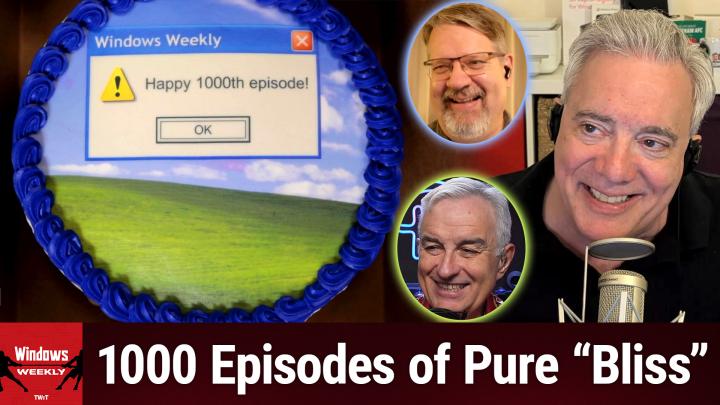
Windows Weekly 1000 Transcript
Please be advised that this transcript is AI-generated and may not be word-for-word. Time codes refer to the approximate times in the ad-free version of the show.
Leo Laporte [00:00:00]:
It's time for Windows Weekly, our 1,000th episode. We celebrate with Paul Thurrott and Richard Campbell. There might be cake. We'll actually get to celebrate a little victory lap for Paul, who finally got Microsoft to do the right thing on its financial reporting. Maybe they didn't do exactly the right thing on their pricing on Xbox Cloud Gaming. We'll, we'll talk about that. And it came from IFA, some of the interesting hardware. Paul saw last week in Berlin.
Leo Laporte [00:00:27]:
That's coming up next on Windows Weekly. Podcasts you love. From people you trust.
Paul Thurrott [00:00:38]:
This is TWiT.
Leo Laporte [00:00:45]:
This is Windows Weekly with Paul Thurrott and Richard Campbell, episode 1,000, recorded Wednesday, September 9th, 2026 in sheepified. It's time for Windows Weekly, the show we cover the latest micro news. Hello, all you winners and dozers. And fresh from his, uh, journey— I don't know, where have you been? I don't even know anymore. Paul Thurrott, he's in Lower Macungie.
Paul Thurrott [00:01:15]:
Yep.
Leo Laporte [00:01:15]:
In the Macungie Township in beautiful Pennsylvania. Hello, Mr. T.
Paul Thurrott [00:01:19]:
Hello, Leo.
Leo Laporte [00:01:20]:
And Mr. C is also here. Richard Campbell in the beautiful— I don't know, where are you? You're in a hotel room somewhere.
Richard Campbell [00:01:27]:
I'm in a hotel room. You can tell.
Paul Thurrott [00:01:28]:
Are you in the room I was in last week?
Leo Laporte [00:01:29]:
KC.
Paul Thurrott [00:01:31]:
That looks very familiar.
Leo Laporte [00:01:32]:
Beautiful KC. Uh, we're running a little late, but, uh, just about half an hour, which isn't awful. Uh, my Apple did the right thing and kept their, uh, conversation down to 76 minutes. So, uh, tight. That was a tough '76. They did some interesting things, including name their phone after— I think it's an homage really to the Surface Duo. Yep.
Paul Thurrott [00:01:55]:
You know, like, you know, you do due diligence and they're like, has anyone used this on a phone before? And they're like, no, no one has.
Leo Laporte [00:02:03]:
Nobody has.
Paul Thurrott [00:02:04]:
Didn't see a thing.
Leo Laporte [00:02:05]:
But as you pointed out, Richard, Apple did have a product named the Duo many, many years ago. So, right. It's not like they don't have that trademark.
Paul Thurrott [00:02:13]:
Well, yeah, but I think the full trademark is probably iPhone Duo. You know, it's not the Duo, it's—
Leo Laporte [00:02:18]:
Yeah, in fact, notice they didn't say Duo anywhere. It's always iPhone Duo, iPhone Duo, iPhone Duo.
Paul Thurrott [00:02:23]:
It was a fairly common term too.
Richard Campbell [00:02:25]:
But yeah, they're being— they're always careful. They, they're always on message.
Leo Laporte [00:02:30]:
Well, those guys, I do remember that when they announced the iPhone, it turned out there was another company had an iPhone.
Paul Thurrott [00:02:38]:
Yes, there was. But it was a networking company, wasn't it? Was— who was someone fairly—
Leo Laporte [00:02:42]:
Yeah, I think that they eventually made a deal of some kind.
Paul Thurrott [00:02:45]:
Yeah, they did.
Richard Campbell [00:02:45]:
They paid.
Leo Laporte [00:02:46]:
Gentlemen, there is something to celebrate here. Did you get your— did you all get your cakes?
Paul Thurrott [00:02:52]:
Uh, man, uh, let me check the front door just in case.
Leo Laporte [00:02:56]:
I checked my front door and look, lo and behold, something has come. And I wish I could just send you all a little bit. I don't— I haven't actually looked at it yet.
Paul Thurrott [00:03:08]:
Let's open it up and see.
Leo Laporte [00:03:09]:
Let's just open it up, see what's inside. Oh, look at that!
Paul Thurrott [00:03:15]:
Oh, geez.
Leo Laporte [00:03:17]:
It says, it says, happy 1,000th episode, and it's got the Microsoft Bliss desktop.
Paul Thurrott [00:03:24]:
Yep.
Richard Campbell [00:03:24]:
Yes.
Leo Laporte [00:03:25]:
How did they do— it's a miracle, a miracle of cake science, ladies and gentlemen.
Richard Campbell [00:03:31]:
The dialogue that normally says object not found is corrupt.
Paul Thurrott [00:03:36]:
You can't have a blue screen if You agree with it. Something happened.
Leo Laporte [00:03:41]:
Wow, I think that's pretty, uh—
Paul Thurrott [00:03:43]:
That is really cool. Who sent that?
Leo Laporte [00:03:44]:
Uh, I think— who sent it?
Paul Thurrott [00:03:48]:
Well, or did you just get it?
Leo Laporte [00:03:49]:
I think we just purchased it at a local Safeway, as a matter of fact.
Paul Thurrott [00:03:52]:
Oh, I see. Oh, well, they spare no expense.
Leo Laporte [00:03:55]:
I'm gonna get it delivered right here if I can.
Richard Campbell [00:03:57]:
Burke.
Paul Thurrott [00:03:57]:
Burke made it.
Leo Laporte [00:03:58]:
Burke sent it.
Paul Thurrott [00:03:59]:
There's probably a knife in there somewhere.
Leo Laporte [00:04:01]:
Oh yeah, did they give me it? I'm gonna turn on the, uh, overhead. Or a file.
Paul Thurrott [00:04:06]:
Out of there.
Richard Campbell [00:04:06]:
Is it the prison cake?
Leo Laporte [00:04:07]:
Yeah, the file's inside. It comes with a file built right in.
Paul Thurrott [00:04:11]:
What?
Leo Laporte [00:04:12]:
I don't remember how to turn this camera on.
Paul Thurrott [00:04:14]:
Flip camera.
Richard Campbell [00:04:15]:
Flip.
Paul Thurrott [00:04:16]:
What?
Richard Campbell [00:04:17]:
Lift. Yes.
Leo Laporte [00:04:19]:
There we go. Come on, camera. Come on. So, uh, we'll show— we'll show you a close-up of the cake in a little bit. Let's get right to it. I thought that was a good-looking cake. We are a little bit constrained.
Paul Thurrott [00:04:31]:
Right.
Leo Laporte [00:04:31]:
Uh, you got a little victory to celebrate, Mr. T.
Paul Thurrott [00:04:35]:
I don't think anyone in the world understands that this is my victory, but I'm going to take it. So tell us a little about it. Well, I mean, anyone who's been watching this podcast or reading my website knows that I've been complaining about Microsoft's lack of transparency on financial reporting for at least 15 years. I, and have complained as it's gotten worse and worse and as it's gotten exponentially worse almost, uh, during the AI era. And while I was in Berlin, Microsoft announced it in such a passive-aggressive way. They posted a slide deck to their investor website and there was no presentation. No one ever stood anywhere and told anyone they were doing this. It just appeared one day.
Paul Thurrott [00:05:20]:
And look, I want to be 100% clear here. I don't think they're going to address even most of my concerns.
Richard Campbell [00:05:26]:
Right.
Paul Thurrott [00:05:29]:
Literally, the opening line of the quote from Satya Nadella was to reflect provided— or, geez, actually, that's bad English. I copied that wrong. I'm going to say, to provide increased transparency to investors, we're updating our financial reporting to mirror how the business is operating, how we allocate resources, and where we are headed. I'm like, oh, that's cool. I'm trying to think of an example of this, because I don't really follow a lot of, especially in the non-tech space. But imagine you're a simple company, like HP is a simple company. And what I mean by that is, they sell 2 things. They sell printers and they sell computers.
Paul Thurrott [00:06:07]:
So they have 2 business units. I don't remember the names of them, but one of them is for computers and one of them is for printers. That's HP. That's the whole thing. Microsoft, by my count, sells approximately 1,111 different things. And they have gone from 3 primary business segments to 2, just like HP. And basically there's something called Devices and Consumer, which is what personal computing used to be, plus a couple of small changes. And then there's this other one, which is the worst name I've ever seen in the history of business segment names, which is called Agents and Infra.
Leo Laporte [00:06:48]:
Okay.
Paul Thurrott [00:06:49]:
Because they make $0 on agents and infrastructure is too hard to spell, I guess. I, I, I might've just called this one infrastructure if I was given a choice here, but it's basically what used to be Productivity and Business Processes, which is Microsoft 365, and Intelligent Cloud, which is Azure, right? And lumped into one big thing. So this is, if you look at their previous quarter where they had these 2 segments, these 2 segments still existed, this is 84% of Microsoft's revenues.
Richard Campbell [00:07:19]:
Wow.
Paul Thurrott [00:07:20]:
is in this one thing. So, it's kind of like when Alphabet— no, it's not quite that bad, but it's getting there. Alphabet does their earnings, and 99-point-something, sometimes it's 105% of their earnings comes from Google, and then the rest comes from these other things no one cares about, has ever heard of, and we don't know why they have Alphabet. But my little corner—
Richard Campbell [00:07:40]:
I always felt like Alphabet was them disguising revenue sources, or more importantly, expense sources.
Paul Thurrott [00:07:47]:
Yeah, that could be. I mean, their earnings aren't— well, they're not as bad as Microsoft, honestly.
Richard Campbell [00:07:53]:
Still a search company. Yep.
Paul Thurrott [00:07:55]:
Well, it's an advertising company, right? I mean, search being their literally their only innovation until— well, unless you want to look at the AI stuff, I guess, heading into that era, certainly the only thing they ever made that was successful that they made, right? But the The real success of that is the advertising part that was tacked onto it, which of course they acquired. But yes, I don't remember the numbers, but somewhere between 69%, 81%. So it's in the roughly 70% range every quarter for them for revenues. But for Microsoft, the stuff that we associate with the cloud or with infrastructure, the productivity stuff that falls into Microsoft 365, including by the way, Windows commercial revenues, right? We're all in this agents and infra business, which I'm never going to get used to. The remaining 16% is that part of the company I care about. So if you're kind of wondering how I'm feeling squeezed out of things these days, there's your percentages. 84% of the company I could not care less about.
Richard Campbell [00:09:01]:
But isn't this also them— they're not talking about revealing their AI spend or revenue either, right?
Paul Thurrott [00:09:07]:
And so that's the thing. You see the headline, you read the, in this case, a presentation, I guess there's several pages of this thing. Legally, they're required to restate their earnings from the past 2 years to match up with the new segment reporting. The new model, yeah. But that's also an example of decreased transparency because now it's going to be harder to compare these businesses with things more than 3 years old, right? 3 years old. Not that they were providing transparent revenue reporting in here anyway. With very few exceptions, and those exceptions are always hit or miss on any given quarter, Microsoft does not deliver what I call this— I'm a simple man— the hard numbers. Azure generated dot, dot, dot in revenues.
Paul Thurrott [00:09:56]:
They say Azure revenues grew.
Richard Campbell [00:09:59]:
Right.
Paul Thurrott [00:09:59]:
There was one quarter in the When did Azure get announced? 2010, 2012, somewhere in there.
Richard Campbell [00:10:06]:
Yeah.
Paul Thurrott [00:10:07]:
So in that, whatever that is, 13 to 14 years, one time they said what the Azure revenues were. But now I had read reports that they were going to explicitly report Azure revenues going forward. I don't actually see that in their announcement.
Richard Campbell [00:10:24]:
Right.
Paul Thurrott [00:10:25]:
So we'll see. Some of this is a wait-and-see sort of thing.
Richard Campbell [00:10:29]:
Part of me just feels like this is to distract from the AI expenditures. Hey, you always wanted this cloud stuff, so here you go! Look over here! Look over here! The numbers are big!
Paul Thurrott [00:10:39]:
Right. We'll see. I don't want to be completely cynical here. It's just hard not to go there by default. But when the current quarter is reported, probably in October or whatever that is, we'll see what that looks like.
Richard Campbell [00:10:55]:
Yeah.
Paul Thurrott [00:10:55]:
I mentioned this last week, I think, and if not, it was the week before. Well, this notion of, I'm sorry, of like, you know, if you look at what used to be more personal computing, right? So it's Windows, Surface, Xbox. Well, yeah, no, Windows, Surface, Xbox, Windows consumer, right? Because then the commercial stuff came out of it. And then some sort of like search Bing, you know, whatever commercial, whatever it is. Um, you know, I made the point whenever I talked about this last, uh, probably every week. So it would have been last week, um, that at one point they moved Surface out of it. out of its own reporting column or whatever the term is, not an account. And they just pulled it into Windows.
Paul Thurrott [00:11:33]:
And so, when you look at what Windows was, the names have changed, but it was Windows and Devices or something like that. What we're looking at here are the revenues that Microsoft gets from Windows that are based on PC makers paying them for licenses.
Richard Campbell [00:11:48]:
Right.
Paul Thurrott [00:11:48]:
And then, the revenues that Surface generates, which are negligible or negative, And then there's this sort of Windows other thing, which they're not reporting explicitly anymore, but honestly, they weren't reporting anyway. But what that is, is things like somebody pays for OneDrive extra storage or someone pays for a Clipchamp, uh, whatever that thing's called, the professional, um, uh, subscription. So those are all kind of negligible numbers anyway, but they're not, they're not explicitly stated anymore. And Once you pull that into what's now called Windows and OEM devices, OEM meaning like PC makers, essentially hardware makers. Original equipment manufacturers.
Richard Campbell [00:12:28]:
Yep.
Paul Thurrott [00:12:28]:
This is a small thing. It's not a big deal, but I am saying in this small area, it's actually less transparent already. So I have to see what the actual financial reports look like.
Richard Campbell [00:12:41]:
I mean, I appreciate this proper 21st century doublespeak. Then, like, I'm so relieved. I thought we were approaching a new era of openness. Like, no, not that at all.
Paul Thurrott [00:12:49]:
I think Microsoft's accounting principles can probably be explained in the Kids in the Hall movie Brain Candy.
Leo Laporte [00:12:57]:
And, um, maybe you better, uh, tell—
Paul Thurrott [00:13:01]:
this is possibly 20 years old, but there's a, there's a great scene where it's like a, it's a boardroom and the guys are all arguing or whatever the product they're making, and the guy says, hold on, hold on, hold on. All right, look, we're not agreeing here. Sky's blue, right? And the guy goes, yep. He goes, good, now we're in agreement. All right, let's move on. And then they just kind of go from there. So in this case, there have been complaints apparently. I feel like I'm one of the only ones, but there have been complaints from investors or potential investors from Wall Street journalists, whatever, shareholders, I guess.
Paul Thurrott [00:13:33]:
You don't really hear a lot about this, but—
Richard Campbell [00:13:35]:
Yeah, the term activist investor is not thrown around much anymore.
Paul Thurrott [00:13:40]:
It's only been thrown around one time in the Sacchin-Adela era, and it was pretty early on. And I believe they just brought that guy— I can't remember who it was.
Richard Campbell [00:13:47]:
They—
Paul Thurrott [00:13:47]:
I think they made him a board member. It was like—
Richard Campbell [00:13:49]:
That's the usual answer, right?
Paul Thurrott [00:13:51]:
Yeah, like just shut him up, you know. And, uh, you know, look, this is— we've heard your complaints, here's an answer. Does it answer the complaint? You know, I'm not sure. You know, I guess we're gonna wait and see, but We'll see, I guess. Like I said, the important thing is going to be this coming quarter. Well, it's the current quarter when they report this, the next one, the next one, et cetera. So I'm curious to see how this goes down. Somewhere in this report, I think it's the one that— yeah, the thing I wrote probably.
Paul Thurrott [00:14:25]:
Yeah. I believe in the most recent quarter, which was the last quarter of last fiscal year that ended June, Azure revenues. Let me just make sure this is correct. Yeah, we're about $29 billion, which is good. It compares pretty well.
Leo Laporte [00:14:46]:
Billionaire, billionaire.
Paul Thurrott [00:14:47]:
Well, I don't have the— look, there's a couple of things going on here. One is they invent this thing that doesn't exist called Microsoft Cloud so they can talk about what used to be Microsoft Commercial Cloud, where they want to compare themselves to AWS. But really, I think when people are comparing AWS and Microsoft, they're looking at Azure, right? So you can look at whatever the numbers are for AWS. It's going to be higher than 29, by the way, but not like twice as high. And then you look at the 29 from Azure, you're like, okay, like these guys, they're in the ballpark. I mean, they're competing, blah, blah, blah, whatever. That's fine. But the other part of it is just like, well, okay, but what about everything else? And what are the costs? Like, we already know they have twice this calendar year.
Paul Thurrott [00:15:29]:
change their accounting to hide AI spend. So yeah, this change is fun, but they don't ever address that. And that's not going to change, right? I mean, if anything, AI spending is going to accelerate unless something really falls apart.
Richard Campbell [00:15:42]:
For the most part, AI spending is just data centers anyway, which you can throw under the Azure umbrella and everything's fine.
Paul Thurrott [00:15:49]:
But yeah, but that's not how they report everything.
Richard Campbell [00:15:52]:
That's the thing. That's what I'm thinking. Much less how if they're starting to borrow money for some of the data centers they're building, which seems to be going on. Again, pretty carefully hidden.
Paul Thurrott [00:16:03]:
There are some line items. I'm not an accountant, in case it's not obvious, not an accountant. But there are some things that Microsoft is only legally required to report once a year, which is why the last quarter was kind of interesting because that was that time. That was the end of fiscal, yeah. Look, this quarter will be interesting. Next few quarters will be interesting. The end of the fiscal year will be interesting. But I just look at these 2, I look at these business units and I think to myself, okay, so more personal computing could have just stayed the same.
Paul Thurrott [00:16:33]:
I don't even know why they renamed it. That's fine. But then we have this, God, agents and infra. Agents, I mean, I guess that's the where we're going part of that Nadella quote I mentioned. Infra is where we are today, if you think about it, from the majority of revenues. $69.7 billion in revenues from a total of— I don't even have that number here. Whatever that was, it must have been low 80s, whatever, in billions. Yeah, it's a significant chunk, but we're not talking profit either, right? Microsoft hasn't—
Richard Campbell [00:17:09]:
No.
Paul Thurrott [00:17:10]:
Well, except for the whole company, right? They have to report that actually, right? Net income, which is profit, has not reported the profitability of an individual business, be it a segment or anything inside of it, to my recollection. I can't even remember how long it's been. I bet it's been 15 years-ish and maybe more depending on the business. I don't know. It's been a long time. They don't do that. So I don't know. Like I mentioned HP, HP also, 2 primary business segments.
Paul Thurrott [00:17:41]:
We actually get to see profits, although they hid that a little bit this past quarter, by the way, because everyone's doing it. It's like riding a bike. But you get revenues, you get profits, you get an idea of how those 2 businesses are doing relative to each other and also relative to the rest of the world. And then, you can make a decision as an investor. And then, you look at Microsoft, and what you just see is a bunch of big numbers. And when you ask for details, they say, shut up, look at the big numbers.
Richard Campbell [00:18:07]:
We've said all we need to say. The big numbers are big.
Paul Thurrott [00:18:10]:
Yep, they are big. And you can't argue with that. So, I mean, there you go. Yeah.
Richard Campbell [00:18:14]:
Okay. Yeah. And I've always felt like this was all gonna be fine until the stock started taking real hits and investors are like, hey, I'm not making as much as I was. What's going on?
Leo Laporte [00:18:25]:
Yeah.
Paul Thurrott [00:18:25]:
And that hasn't happened.
Richard Campbell [00:18:26]:
And that seems to be this year.
Paul Thurrott [00:18:27]:
Yeah, we'll see. I mean, you know, I keep, uh, you know, we keep talking about the bubble bursting and it's gonna be more of a bubble exploding thing, but whatever it is.
Richard Campbell [00:18:34]:
Yeah. I don't know. It, because it has been deflating this year, but it's been doing it very gracefully. I'm waiting for somebody to run outta money.
Paul Thurrott [00:18:42]:
Right. So—
Richard Campbell [00:18:43]:
That we can't ignore, like an Oracle or an OpenAI. Right.
Paul Thurrott [00:18:48]:
I do feel like that's inevitable. There are small things like this. There are agreements that OpenAI has made. There are agreements that NVIDIA has made, NVIDIA being the one company that's literally making money right now, right? That have been either pushed back or, yeah, we're not really doing that anymore. There's been little things, but when you think about that kind of circle jerk of money that is AI these Where it's just the same 7 companies passing the same invented amount, whatever the sum is.
Richard Campbell [00:19:14]:
Yeah. The trillion dollars is sort of bombing between the companies and keeps multiplying like a credit default swap.
Paul Thurrott [00:19:20]:
Yeah. So I think there are little hints of the beginning of the end, if you will. One of them I think is Nvidia is because Nvidia, like I said, has created vast wealth. They're actually making these physical things that all these companies need. and want and will pay exorbitant amounts for. And they're starting—
Richard Campbell [00:19:38]:
But they're also investing in the companies to buy their things.
Paul Thurrott [00:19:42]:
Right. So there's that. So yeah, there's the kind of paper money you could make by investing in a company like that. But there's also like, and they're acquiring companies, but they're also creating almost like funds to help the ecosystem be healthy and putting money out there to make sure that this kind of gravy train continues or whatever.
Richard Campbell [00:20:03]:
So it's the leper handing out aspirin. I get it.
Paul Thurrott [00:20:07]:
Right. Wow.
Leo Laporte [00:20:09]:
I've never heard that before. Is that a Canadian saying?
Paul Thurrott [00:20:13]:
And then you get it from them and you're like, so did you take this? Or—
Leo Laporte [00:20:16]:
If you take the aspirin, does your nose still fall off? Or is that—
Paul Thurrott [00:20:22]:
I don't know. I, I don't know. So anyway, like I said, I, I'm— this came out of nowhere. There was no indication this announcement was coming. It was made in the most bizarre way imaginable. I kept thinking there's more to this, like I've missed something, right? And there isn't. This is it.
Leo Laporte [00:20:35]:
Do you think that maybe some regulatory agency made a phone call and said, hey, now—
Paul Thurrott [00:20:43]:
Yeah. So it could only be one regulatory agency and it could only be in the United States because it's a US company and—
Leo Laporte [00:20:49]:
Security and Exchange Commission.
Richard Campbell [00:20:52]:
Yeah.
Paul Thurrott [00:20:52]:
I don't. I actually don't think that's what happens because I don't know why—
Richard Campbell [00:20:55]:
I think it's more likely that a foreign Forbes or a Wall Street or one of those organizations called up and said, hey, I'd like some press quotes on this issue.
Leo Laporte [00:21:03]:
Well, didn't we say that when the Wall Street Journal said something about it that Microsoft would pay attention? And they did, right?
Paul Thurrott [00:21:10]:
Yeah, although that's the 3rd time, maybe 4th time in the past year that the Wall Street Journal, which has been the only high-profile kind of financially pointed publication to ever write anything about this. Like, the thing that's bizarre to me is when I went— you go and look at like Bloomberg and Reuters and the Wall Street Journal and Times and you read what they write about this change, they're like, investors have been increasingly uneasy about Microsoft's lack of transparency. Where? I listen to or read these conference calls that they have with financial analysts and it is a circle jerk of stupidity.
Richard Campbell [00:21:45]:
Love fest.
Paul Thurrott [00:21:46]:
Yeah, it is a love fest. It's like, guys, thank you for letting me ask a question. You guys nailed it. Amy, you said last quarter you were going to do this. You did that in spades. This is unbelievable. And then softball questions, softball questions. Thank you.
Paul Thurrott [00:21:58]:
That was exactly what I needed to know. You're the best. And it's like, what is happening here? Like, what is this? You know, like, it's so— I, I, where were these people? I, I, okay. I don't know. I feel like a lone voice out in the wilderness on this one, but, um, but okay. I mean, maybe anyway, I'm glad something is happening, I guess, you know.
Richard Campbell [00:22:18]:
Uh, yeah, I'm with you. Let's wait for the next quarterly and See if we feel like we know.
Paul Thurrott [00:22:22]:
Yeah, I don't want to celebrate too, too much, but, you know, we'll see. We'll see.
Leo Laporte [00:22:29]:
We'll see.
Paul Thurrott [00:22:30]:
Well, I mean, I can't— there's no way to know.
Leo Laporte [00:22:32]:
It's about time. No way to know. It's about time. Uh, you're watching Windows Weekly. I will now give you a, uh, a view of the— no, of the cake.
Paul Thurrott [00:22:42]:
Nice.
Leo Laporte [00:22:46]:
I really want to cut into this. I wish I could Somehow share this with you. Alas, it's okay, I cannot.
Paul Thurrott [00:22:56]:
I like it, it's very crisp, you know. I wish XP had done that.
Leo Laporte [00:22:59]:
They must have some sort of inkjet printed thing.
Richard Campbell [00:23:02]:
It's really nice.
Paul Thurrott [00:23:04]:
And I'm sure it's not that like food dye that kills people. It's probably fine. No, um, I wouldn't eat the close button, that's all I'm saying, if I were you.
Leo Laporte [00:23:10]:
But you know what, you know what's cool is that this, uh, Bliss, uh, desktop actually was taken Just a few miles away from here. Yeah, it's a Sonoma County, uh, scene. Yep. So it's appropriate. Anyway, happy 1,000th, you guys. I mean, Paul gets the— you've only—
Paul Thurrott [00:23:27]:
Paul gets the credit.
Richard Campbell [00:23:28]:
I'm the new guy, man.
Paul Thurrott [00:23:30]:
You've only been on hundreds of episodes.
Leo Laporte [00:23:31]:
Hundreds of episodes.
Richard Campbell [00:23:32]:
You showed up, jerk.
Leo Laporte [00:23:34]:
Yeah, I'm pretty happy for you.
Paul Thurrott [00:23:36]:
That's— you're still the new guy in the band, like Def Leppard's newest guitarist is from 1992. You're like that guy. Like, who do you think you are? It's like, I've only been a man for 35 years, you jerk.
Leo Laporte [00:23:46]:
You just got here, man.
Paul Thurrott [00:23:47]:
Yeah, I just got here.
Leo Laporte [00:23:49]:
Uh, anyway, congratulations, uh, 1,000 episodes. Pretty darn, pretty darn good. And, uh, neither Paul nor I eat carbs, so Richard, it's all yours.
Paul Thurrott [00:24:01]:
Well, great. I mean, I'd probably have some more carbs in my life.
Leo Laporte [00:24:04]:
Whiskey's not a carb, is it?
Paul Thurrott [00:24:07]:
No, whiskey is the anti-carb.
Leo Laporte [00:24:10]:
Oh, really?
Paul Thurrott [00:24:10]:
Well, it's not a carb is the way to say it, but it's not really.
Leo Laporte [00:24:13]:
Doesn't alcohol turn into sugar in the bloodstream?
Paul Thurrott [00:24:15]:
No, only if you try hard.
Leo Laporte [00:24:17]:
Well, I'm not trying.
Richard Campbell [00:24:19]:
I like the blue icing in the teeth too. That's a feature. It's—
Leo Laporte [00:24:22]:
they did a nice job.
Richard Campbell [00:24:24]:
Yeah.
Leo Laporte [00:24:24]:
Is this Safeway, Burke? I think it is. It says fresh baked in store.
Paul Thurrott [00:24:29]:
I'm sorry. No, I'm sure it's good.
Leo Laporte [00:24:32]:
Um, I am gonna go get a cake knife while you continue. Because I can't, I can't take this. I gotta, I gotta have some.
Richard Campbell [00:24:40]:
Well, the good news is there's conversation to be had about Windows.
Leo Laporte [00:24:43]:
Oh yeah, let's talk about Windows.
Paul Thurrott [00:24:46]:
Yeah, Windows stuff has happened too.
Leo Laporte [00:24:48]:
What else? I see a graph.
Richard Campbell [00:24:50]:
It's Windows 12.
Leo Laporte [00:24:52]:
Yeah, is it 12? Is 12 coming?
Paul Thurrott [00:24:54]:
No, no, no, no, no, sorry.
Leo Laporte [00:24:55]:
Got my hopes up.
Paul Thurrott [00:24:56]:
No, you silly people. Um, no, um, but we did have Patch Tuesday and I remember last week.
Leo Laporte [00:25:05]:
Oh my God, did we have a Patch Tuesday.
Paul Thurrott [00:25:07]:
Yeah.
Richard Campbell [00:25:08]:
Yeah.
Paul Thurrott [00:25:09]:
And honestly, from a new features perspective and from a security vulnerabilities fixed perspective, kind of one of the bigger ones, actually in the latter case, by far the biggest one. But this is the set of features that will be, that is sort of thought of as 26H2, even though these are coming today to 25 and 24H2, because that's how this works, right? So I don't know, you know, if you have 26H1, you got nothing. Uh, there's not much going on there.
Richard Campbell [00:25:39]:
Orphaned.
Paul Thurrott [00:25:40]:
Yeah, well, not orphaned, but just lagging behind. You know, he'll catch up eventually. He'll, you know, he's slow. He's a slow starter. Um, so this is the new, uh, Start menu, uh, the Start menu that you can resize between small and big. Um, there's 3 main sections. Recommended has been renamed to Recent. Let me see if this is on here.
Paul Thurrott [00:25:59]:
Yep. You can individually turn off each of those sections, configure them in different ways, et cetera. So that's pretty good. It's not, you know, you can't drag it out and, you know, like you could Windows 10, but probably good enough. Taskbar, you can move around to different locations on the screen, which is nice. And you can have the smaller taskbar, which I love. And I do that on all my computers, although I just said that and I'm looking at this computer and why is it not configured like that? I don't know why. Anyway, Don't worry about that.
Paul Thurrott [00:26:25]:
Um, so there's that. Uh, Windows Search improvements, uh, search, uh, highlights gone. Awesome. And you can turn off web results and store results. Um, so you could actually search for files. I mean, what? It's crazy. Um, so that's kind of cool. And there's a bunch of other stuff, but you know, that's the big— those are the big ones, right? And that's, you know, the— this is the pain point stuff.
Paul Thurrott [00:26:46]:
This is what they were talking about. Like, so here we are. It's what, you know, 6 months later.
Richard Campbell [00:26:49]:
Yeah. It's also a reminder we still haven't hit peak yet. This is a new high. The high is only going to keep coming.
Paul Thurrott [00:26:56]:
Yeah. Now if you are in 26H1, what you're getting is the stuff everyone else got about a month ago. So, right, um, not a lot that's super major in here. But if you want a blast from the past, like one of the things I used to complain about was how you could type— if you started typing the name of an app in Windows like Excel and you typed X C-E-L without the E in the front, Windows was like, yeah, I've never heard of this.
Richard Campbell [00:27:21]:
No idea.
Paul Thurrott [00:27:22]:
But now, now it knows. Like, it actually handles those kind of things. Nice, right?
Richard Campbell [00:27:26]:
Hypo-tolerance.
Paul Thurrott [00:27:28]:
And that's the only one I'm going to pull. I don't know. Windows Hello Enhanced Sign-In Security supports external fingerprint readers. You might've heard of this one. We were talking about that over the summer. So it's stuff, you know, it's a little bit behind, but the big one is of course 24H2 and 25H2, because this is essentially 26H2, I assume we're still on track for an October release of 26H2, but this is going to be enablement package. You're not going to notice it, right? There's a couple of— we talked about this last week. There's no unique features that I'm aware of, but there are a couple of unique default configurations that will not occur if you upgrade.
Paul Thurrott [00:28:01]:
You'll get those on a new PC. So it doesn't matter, right?
Richard Campbell [00:28:03]:
No big deal.
Leo Laporte [00:28:04]:
Nice.
Paul Thurrott [00:28:05]:
So that's that. The big news, which we have not written about on my site because it's fricking crazy, is, Microsoft released fixes for 974 security vulnerabilities in this—
Richard Campbell [00:28:21]:
It's a new high.
Paul Thurrott [00:28:23]:
Oh yes.
Richard Campbell [00:28:24]:
By all time, by a lot.
Paul Thurrott [00:28:26]:
Oh yeah. Um, this graphic is very small in this little screen that I'm looking at, but I want to say the previous high was 1,750. Is that what it says? Um, it's, it's over double last month. Um, the only, the only— oh, I'm sorry. These are for years. I'm sorry. Sorry. Sorry.
Richard Campbell [00:28:41]:
Yeah, you know, there were, there were more patches this month than there were—
Paul Thurrott [00:28:46]:
or I'm sorry, that's not true. There were more patches through this point this year than there were all of last year by far.
Richard Campbell [00:28:52]:
By a lot.
Paul Thurrott [00:28:53]:
By double. Yeah, right. It's over double. Yeah, it's over double.
Richard Campbell [00:28:56]:
But you're almost as many patches this month as there was last year.
Paul Thurrott [00:29:01]:
Yep. Yeah.
Richard Campbell [00:29:01]:
And I'm thinking next, you know, next month we're gonna hit 1,000, guys. We're gonna keep wondering if we've hit the peak. But maybe not.
Paul Thurrott [00:29:08]:
I bet we're not even close. One thing I will say though, by the way, um, we'll bring this up, uh, or this will come up in a few minutes about browsers, but you know, Apple has had problems with, you know, it's AI. It's not just AI-generated bug reports, right? It's also AI-generated content of whatever kind. It could be apps going into a store, you know, it could be whatever, you know, extensions. We'll talk about that in a minute. Um, companies are having a hard time keeping up with that stuff, right? It's almost a little overwhelming. Oh no.
Richard Campbell [00:29:34]:
On RunAs, this is a huge talking point.
Paul Thurrott [00:29:36]:
It's just like, um, but I, for, but Microsoft, for what it's worth, I don't know anything about the, you know, the inside story here or whatever, but they just seem to be doing this. I, I kind of have to give them a little bit of credit. I, I, you don't, you don't hear complaining here, right? No.
Richard Campbell [00:29:52]:
How do you get angry at, we're finding vulnerabilities that could be exploited anytime now, so we're fixing them as fast as I can?
Paul Thurrott [00:29:59]:
It's a nuisance, Richard.
Richard Campbell [00:30:00]:
I mean, um, no, I mean, there's a fundamental transformation of the quality of software, I think.
Paul Thurrott [00:30:06]:
Yes, 100%.
Richard Campbell [00:30:07]:
We've yet to have the real fallout of it. I've yet to see— because it looks like the hackers aren't using these tools yet meaningfully, or where they are, they're still doing the old hacks just faster. They're not taking advantage of newly found vulnerabilities.
Paul Thurrott [00:30:20]:
So that's—
Leo Laporte [00:30:21]:
I think they're being kept from those tools. I think that we're seeing companies that like to keep them private.
Paul Thurrott [00:30:28]:
This is one of the reasons.
Richard Campbell [00:30:29]:
That's only going to last so long.
Paul Thurrott [00:30:31]:
I know, it's only a matter of time. Either they—
Leo Laporte [00:30:33]:
Right, so fix them now.
Paul Thurrott [00:30:34]:
China figures it out. So yeah, no, that's, that's actually a good part of the story. Um, a lot of these— I mean, uh, let me see if I can find the number— 112 of the 974 vulnerabilities were critical severity. I mean, these are like, these have to be fixed, um, immediately, right? And so yeah, no, you're not hearing a lot about exploits in the wild, at least in The Microsoft world, right? Which is mostly Windows in this case. So 723 of the 974 vulnerabilities they fixed were in Windows. Office across— I don't know why they call it out this way, but Office is over, you know, 222. But it's really, you know, if you count like Exchange, SharePoint, Skype for Business, et cetera, probably in the 250 range. DevTools, 22.
Paul Thurrott [00:31:19]:
Azure, just 12, right? Which is kind of crazy.
Richard Campbell [00:31:23]:
It's kind of—
Paul Thurrott [00:31:23]:
Newer software.
Leo Laporte [00:31:24]:
Yeah, or as you suspected, maybe Richard, earlier, they're focusing, you know, they're aiming the debugger lens and they haven't aimed it at Azure as much.
Paul Thurrott [00:31:37]:
Yeah, well, I mean, but that would— is it this? I guess it would be. Is it the same?
Leo Laporte [00:31:42]:
You can't debug everything all at once. It's too big a code.
Paul Thurrott [00:31:44]:
No, no, but who's— but who's you in this story? Like, is there a team at Microsoft Security that does security for all products or does, do all the products have their own security teams?
Leo Laporte [00:31:52]:
They all have their own teams. Yeah.
Richard Campbell [00:31:54]:
But also, but you have limited— point at Azure. What are you talking about? Azure is not one thing.
Leo Laporte [00:32:00]:
Right. Right.
Paul Thurrott [00:32:01]:
I don't know.
Richard Campbell [00:32:03]:
And also they don't have to deploy those patches. That's totally internal. They don't have to tell you what they're fixing in Azure.
Paul Thurrott [00:32:09]:
Right.
Leo Laporte [00:32:10]:
We got the number in the middle of Security Now yesterday and Steve was saying it'll be interesting if the number, if number go up. Or number go down, right? At some point, he says the numbers— I'm sorry, I'm eating.
Richard Campbell [00:32:21]:
I'm wondering if we're at the peak.
Leo Laporte [00:32:23]:
At some point, it will start going down.
Paul Thurrott [00:32:25]:
It's so early though. I, I don't— you're right, but I— there's also going to be—
Leo Laporte [00:32:28]:
Not yet.
Paul Thurrott [00:32:29]:
Well, there's going to be the off quarters where— or the months, I guess— where it goes down, but that goes— we've already seen that, right? So we had it down. I don't have it in front of me, but one of the months this year that the count went down. But other than that, it's been a pretty upward climb. So it's going to be up for a while. I think so.
Leo Laporte [00:32:47]:
6 months maybe, right?
Paul Thurrott [00:32:49]:
Where this is, you know, we talk about the new normal of, uh, all the hardware buying so expensive and everything.
Richard Campbell [00:32:54]:
What aren't they patching? What— yeah, what's the fix they can't figure out how to deploy, right?
Leo Laporte [00:33:00]:
Right.
Paul Thurrott [00:33:00]:
This might just be the new normal for this kind of thing.
Richard Campbell [00:33:03]:
And so shipbreaking change.
Paul Thurrott [00:33:05]:
Yeah. Um, so we don't know. There's no way. We're just This is a moment in time, but it is rather incredible how fast this has gone up.
Richard Campbell [00:33:12]:
Um, so anyway, you know, I think everybody got back from summer holiday and got to work. The list is long.
Leo Laporte [00:33:19]:
How fast this cake is disappearing is also incredible.
Paul Thurrott [00:33:23]:
I see, I see.
Leo Laporte [00:33:25]:
Um, I'm so sorry I can't share this with you guys. It's really good.
Paul Thurrott [00:33:30]:
I updated a bunch of my computers yesterday with this Patch Tuesday thing, and I guess with the exception of this— interestingly, this one is an exception, but, um, a lot of times with these new features, they don't always appear immediately. And I hate that. And I, I, for the most part, I've been seeing, I've been looking for the big 3 start, you know, Taskbar Search. And with this exception, I guess, um, the new stuff has been appearing right away. Right. So that's actually pretty cool. Um, maybe they're just doing it for me to shut me the hell up, but, um, but either way, I don't care. It's fine.
Paul Thurrott [00:34:04]:
Um, and then yesterday, which was Patch Tuesday, but ahead of the Patch Tuesday releases, Microsoft announced, you know, 5 Windows Insider builds because, you know, let's keep everyone busy.
Richard Campbell [00:34:16]:
Mm-hmm.
Paul Thurrott [00:34:17]:
Um, and these are across beta experimental, uh, beta 26H1 experimental, 26H1, and experimental future platforms. And Microsoft called out 3 features, um, 2 of which are just accessibility feature improvements that aren't super, super interesting, but some cross-device resume improvements in experimental, which will be news to anybody because I can't imagine there's a human being on this earth who's seen cross-device resume actually work. But the way this, you know, if you're using OneDrive on your phone and you're looking at a document maybe, and then you put the phone down and sign into your computer, OneDrive will pop up a thing that— well, it's actually Windows, but will pop up a thing and say, hey, do you want to Do you want to resume with that? You know, the other one that you may have seen, if you use Spotify, Spotify will do this as well. But this is one of those features, it's kind of a nice platform capability, but you don't see it very much. Like, I don't, I certainly don't, but you could see it. And so one of the other ones is for web browsers, but the way that's worked so far is that you have to have the same web browser on your phone and your computer, which isn't always possible, right? So.
Richard Campbell [00:35:22]:
Yeah.
Paul Thurrott [00:35:23]:
Samsung, if you have a Galaxy device, they have their own browser. I think it's just called Samsung Internet. Sometime in the past year, they released a desktop version of it, and probably for this purpose, for all I know. So you can get it for Windows, but I mean, who would? But I guess if you have a Galaxy device or you're into that for some reason, or maybe you bought a Galaxy Book laptop, you might have that. So it would pop, you know, you're doing something on your Samsung Internet app on your phone, you go to the computer, you can get that resume notification, but now it will work if you don't have the same browser. And it's not as seamless as it should be, but the dialog that comes up, the notification dialog, has 2 buttons which don't have name, you know, words next to them, which is a little strange. But one of them is download this product if you don't have it. And the other one is just use my default browser, which is to me should always be the way this works.
Richard Campbell [00:36:13]:
Yeah.
Paul Thurrott [00:36:15]:
that will work, I guess. And again, if you've seen— more people have seen Bigfoot than have seen this feature in Windows. So it's not super, not super well documented or widespread or whatever, but okay, that's fine. I think the new Run dialog, like the WinUI-based Run dialog, you know, Windows key plus R, I sometimes feel like I'm the only person on earth that uses this feature. I use it all the time. But if I think that one might be I don't remember. It might be experimental, but it's—
Richard Campbell [00:36:45]:
I popped mine up and it said Regedit and I'm delighted with myself.
Paul Thurrott [00:36:48]:
Yes, exactly. Mine always says WinVer by default. Um, right. But then I— you can go, uh, do I— oh no, no, I don't have Regedit actually. I guess not on this computer. But yeah, Regedit would be the other one for sure.
Richard Campbell [00:36:59]:
Yeah.
Paul Thurrott [00:37:00]:
Um, okay, so there's that. Back at Build, Microsoft talked about— yes, exactly, moving on. Um, I know we're in kind of a Well, you don't have to move on.
Leo Laporte [00:37:13]:
Yes, you do. Well, yes.
Paul Thurrott [00:37:15]:
Yeah, no, I really do. Um, so, um, this is— this to me is misguided, right? So back when Windows 10 was still the ongoing concern, Microsoft started talking about how it wanted Windows to be the place for developers, right? So it kind of looked out at the world and it was like, okay, we get it. Like, some people are using Linux, can't really help if you're using a Mac. Uh, although they tried that a little bit in Windows 8, you know, 8, early Windows 10 days, but pretty much Linux. And so this is where we got the Windows Subsystem for Linux. It was where we got the Windows Subsystem for Android for a little while, although that's come and gone. And then in, I don't remember if it was 10 or 11, but at some point we also got the Dev Hub and our Dev Center or whatever that was called, Dev Hub, I guess, whatever.
Richard Campbell [00:37:58]:
Mm-hmm.
Paul Thurrott [00:37:58]:
And the, we could have like dev drives that had ReFS formatting and blah, blah, blah, whatever. This stuff was kind of buried in settings and no one ever used it. And I don't think everyone, anyone ever will, but whatever. Now we have that advanced page like we talked about a couple of weeks ago, whenever that was. But, um, they keep trying this kind of thing and I, I, I don't, I don't understand why they do this, but at Build this past June, right? 'Cause it wasn't May this year.
Richard Campbell [00:38:22]:
Yeah.
Paul Thurrott [00:38:22]:
Microsoft talked about having a, um, kind of like a developer optimized Windows 11 experience. And you could go to get, you can still do it. You can go to GitHub right now and go find it if you want. It's essentially a set of scripts that you run and it configures Windows in a certain way. And I hate it so much. I don't understand what they're doing. Why?
Richard Campbell [00:38:45]:
Yeah, why?
Paul Thurrott [00:38:47]:
Because, well, first I should say they're going to ship this thing on new computers, right? Almost certainly the new NVIDIA RTX Spark-based computers we're going to talk about in a minute. And here's the thing. This is— my problem with this is manifold, but I'll give you the 2 big ones. Not every developer wants their computer configured exactly the same way. But one thing that probably is true of most developers is they are very specific about how they do want Windows configured. And this thing may install a couple of things by default that you do use. I, and I guess that's a minor convenience. It actually pins a couple of things to the taskbar, which is the dumbest playschool stupidity I've ever heard of in my life.
Richard Campbell [00:39:29]:
But Okay.
Paul Thurrott [00:39:31]:
But the thing is, like I said, you know, developers have different needs. All of them do. And they're very particular about their computer configurations. A better feature would have been a way to capture configuration on a PC, which you might do as an individual developer, or you might do as a business that has maybe a bunch of developers where you want them to have certain tools and whatever configurations, and then allow you to apply that thing later. But what they're doing instead is just pre-configuring it and they're installing things like Visual Studio Code, GitHub Copilot, PowerToys, WinApp CLI, Windows Dev Skills, blah, blah, blah, whatever. And okay, but not everybody needs those exact things. And I don't understand, this is doomed to be, this is pointless is what it is. And it's just, look, if you want to say, check a box, I'm a developer, right?
Richard Campbell [00:40:22]:
It should be a template.
Leo Laporte [00:40:23]:
Yep.
Paul Thurrott [00:40:24]:
Just, or you choose, right? Or, you know, whatever it is. But like I said, I think the better thing.
Richard Campbell [00:40:29]:
It's not a problem.
Paul Thurrott [00:40:30]:
Yeah. The better thing to me would be the thing I mentioned up front, like let these guys capture a configuration, whatever, a system-wide configuration. And then, you know, have a UI where they can say, well, yeah, but not this. I want, you know, I want this stuff. I always want to have this and I want to put it over there on that new computer because what they're talking— the reason this thing exists. And so the, the pre-install of this thing on Windows, which is not a new version of Windows or a new Windows 11 product edition, it's called Project Zenith. It's just a different default configuration, right? Is it, it's so misguided. Like it makes me crazy.
Paul Thurrott [00:41:07]:
Like how misguided this is. Like I, I don't, I, they did say it's going to ship first on these AMD Ryzen AI Halo processor-based PCs, right? Which we'll talk about in a second. But the short version is this is AMD's response to NVIDIA RTX Spark, right? So super high-end. This is going to be— these are CPUs that have integrated graphics that are incredible. It has inline— what do you call it? RAM that's on the chip. It's all that stuff. It's for on-device AI, blah, blah, blah, whatever. If you think about a typical developer and maybe it doesn't matter what they're doing, but Maybe they're doing like AI stuff.
Paul Thurrott [00:41:46]:
They're doing local AI that, you know, whatever it is, it doesn't matter. Even the most aggressive developer, like meaning I move forward to new hardware all the time, all the time, all the time. You know, every 3, 6, 12 months they have a new PC. You spend, I don't know, an hour, 2 at most doing this. That's the time you're saving them. The time you should be saving them is the other 99.99% of the time they're working in the computer. Like, this is, this is not a— this is not very helpful. This is, um, it's like you got a new car, we wrapped it for you.
Paul Thurrott [00:42:20]:
Thanks. Now I have to unwrap it and then I can drive it. And I think most developers are going to still do whatever they do to configure a PC. So even though some of this might be there and it's like, okay, thanks for that, I guess.
Richard Campbell [00:42:32]:
Most devs are using BoxStarter and NuGet and Winget and a set of scripts to configure their machine.
Paul Thurrott [00:42:40]:
Right. And so one of the things I looked at this year, because there's— WinGet has been evolving, right? WinGet has this notion of like YAML-based configuration files. There is this notion of importing and exporting of these kind of profiles or whatever. So you can go to a PC, by the way, today and use WinGet to export the list of applications that you have installed on that PC. And then you could reverse that and apply them to a different PC. So that's a super basic version of what I was saying, although it doesn't handle the Windows— we're showing file name extensions in File Explorer or whatever those things are, right? That's not part of that. But to me, that is, even though that's still kind of half-assed in the sense that what you're not getting through Winget, which should be in Winget, I feel like has to be in Winget eventually, is the ability to capture the configuration of an individual app, save it somewhere, and then have you apply that along with the app, right? So it's one thing to get like Visual Studio installed, but I also want the particular workloads that Windows Visual Studio supports. Could you just do that for me? See, that would save time, right? If you just did that.
Leo Laporte [00:43:50]:
Right.
Paul Thurrott [00:43:50]:
Or, and then apply that to any tool you care to mention. Like these people probably want to configure Windows Terminal a very specific way. If they use Visual Studio Code, actually you get the configuration just by signing into your account. That's kind of automatic. But Um, it varies by app is the point. And putting this in, like, making— going to the trouble to do what they're doing here, to me, makes no sense. Um, this is the wrong audience. This is the type of thing, like, people who don't know what they're doing need, you know.
Paul Thurrott [00:44:17]:
The people who know what they're doing are just going to be, you know, this is just another thing you're doing that's getting in my way. Like, what do you— I don't need you to configure a computer. Like, I'm like a local AI developer. I got this. Like, this is I don't know. To me, this is crazy, but whatever. We're spending time. I spent more time on it than I should have, right? That's how mad it makes me.
Paul Thurrott [00:44:37]:
I just don't understand the point of it, but, um, but there it is. So, yay.
Richard Campbell [00:44:41]:
Well, I mean, and devs would, but devs inevitably vote with their feet, right? Like you watch the complete lack of use of your tool and wonder whatever has gone wrong.
Paul Thurrott [00:44:51]:
Yeah. Somewhere there's going to be a little bit of a, like a telemetry signal, which is the Project Zenith, uh, configured PCs that shipped and were wiped immediately. And, uh, you know, someone blasted their own, uh, image onto this thing, which also would make a lot more sense.
Richard Campbell [00:45:06]:
You've made a double guess here, right? Not only are you trying to guess that developers have a— you can tell, you can set up a machine that developers are gonna like, but AI dev, the one that everybody's still just figuring out?
Paul Thurrott [00:45:19]:
I know. What do you— I like— God, I'm, I'm— we're lucky they didn't specify specific models, you know? Like, what are you doing? Like, just They got it. Like, this is— you don't have to help this guy. I, I know, I do understand the, the— well, at a high level, I understand the point of it, right? And it's the same point as it was whenever that was, 8 years ago, whatever, when they're like, we want Windows to be the best place for developers, is the point. Like, I get it. What you don't want is people leaving Windows who are developers because they're going to go to Linux or they're going to go to the macOS.
Richard Campbell [00:45:48]:
Mm-hmm.
Paul Thurrott [00:45:49]:
You'll never get those guys back. And if you can keep them on Windows, like, that obviously is a good thing. But like nanny stating them is not the way. I just don't, they're not, nobody wants this. I don't think, but, you know, prove me wrong.
Leo Laporte [00:46:02]:
I don't know.
Paul Thurrott [00:46:03]:
Um, and then, uh, this is, this is kind of related to the thing I was talking about earlier where AI has generated an increase in dot, dot, dot, right? And so there are, uh, new app submissions, right, to the Apple and probably the Google Play stores that, that stuff has probably exploded because anyone can make an app now and anyone is, and my God, are they so high quality. And there's that. But then they're also using AI, which to me, to this point, I mean, look, eventually maybe it's going to solve diseases and things like that. And that will be amazing. Right. But, but for right now, I would say the one little shining star other than helping me not send a stupid text message with a typo, which is pretty useful, has been this finding bugs in software thing.
Richard Campbell [00:46:45]:
Right.
Paul Thurrott [00:46:46]:
Right. Like Mozilla is doing this with Firefox, Microsoft, all the platform makers are doing it, et cetera. They're all a little overwhelmed because there's so much of it, but a good thing, right? So I guess they've seen an explosion of submissions to something no one should be using anyway, which is the Microsoft Edge add-in website, which is where you get extensions for Microsoft Edge. You could just get them from Google, right? Those all work fine too, but because they're the same extensions, but thanks to the rise of AI assistant coding tools. People are building extensions faster than ever, right? And it's overwhelming Microsoft a little bit. So what they're going to do is stop even looking at them. They're just going to publish them to the store.
Leo Laporte [00:47:29]:
I'm kidding.
Paul Thurrott [00:47:30]:
But I'm almost not kidding because they literally are automating the quality checks on these things so they can—
Richard Campbell [00:47:35]:
Oh boy.
Paul Thurrott [00:47:35]:
Yeah, speed up the turnaround times. And then this is the humidifier/dehumidifier joke in a nutshell. They're also introducing something called a featured badge. So when you go to the Edge Add-ons website, there'll be a featured badge, like I said, and these are highlighting extensions that Microsoft knows have good quality, reliability, security, and user experiences. And it's kind of like a Good Housekeeping badge of, you know, quality, whatever.
Richard Campbell [00:48:02]:
How do I— so on the one hand, how do I push one app in front of all the other chaff apps?
Paul Thurrott [00:48:06]:
So we're gonna, we're gonna let a lot of— we're gonna push through extension review process. We're gonna streamline that. Never a good thing. But don't worry, you can ignore all of those. We're going to show you the good ones over here on the left.
Richard Campbell [00:48:21]:
Um, we know we're creating a problem.
Paul Thurrott [00:48:23]:
Yeah. So, so we're gonna fix it. We're gonna fix it by creating another feature, which, uh, geez.
Leo Laporte [00:48:28]:
Okay.
Paul Thurrott [00:48:28]:
I don't know.
Richard Campbell [00:48:30]:
It's us. Indeed.
Leo Laporte [00:48:35]:
Crazy.
Richard Campbell [00:48:36]:
Crazy.
Leo Laporte [00:48:37]:
Well, I'm in a sugar coma.
Paul Thurrott [00:48:38]:
So, um, Was it a white cake, Leo?
Leo Laporte [00:48:42]:
No, it was delicious. It was dark chocolate. It was so good.
Paul Thurrott [00:48:47]:
That blue color, I mean, other than not appearing in nature, is probably staining the inside of your body right now.
Leo Laporte [00:48:55]:
Oh, for sure.
Paul Thurrott [00:48:56]:
That unique blueness.
Leo Laporte [00:48:59]:
I had to— I'm watching my blood sugar and it's so far because I drank a protein drink immediately after surviving Yeah, but it's gonna, it's gonna, it's not gonna go up like this.
Paul Thurrott [00:49:09]:
It's gonna like, it's gonna look like that chart we showed you of all the Microsoft vulnerabilities.
Leo Laporte [00:49:15]:
I didn't actually show that chart. It's in the show notes. That is a, that is a wild, uh, graph. Uh, the year isn't over. I mean, there could be 1,000 more every month for the next 3 months.
Paul Thurrott [00:49:27]:
Yep. I think we're going to be looking at 3 to 4x over last year at least, you know.
Richard Campbell [00:49:31]:
Yeah.
Leo Laporte [00:49:32]:
That's again, that's thanks to AI. And again, and I said this yesterday on Security Now, and you said it, and that we should reiterate it. This is a good thing, right? These are bugs that were there. They're getting fixed.
Richard Campbell [00:49:43]:
Yeah. Yeah.
Paul Thurrott [00:49:44]:
I don't, uh, these companies are not going to publicize this, but somewhere out there absolutely are companies that do not want to talk about this thing. And those companies are stupid and you should not support them. This is, we should be promoting this. This is a good thing.
Richard Campbell [00:49:57]:
I bet there's a huge number of patches going through Azure right now. You just never hear about them because they're totally internal.
Paul Thurrott [00:50:04]:
Right. And it's not— no one is rebooting a computer anywhere that we can see. Oh, they are.
Richard Campbell [00:50:08]:
You just can't see.
Paul Thurrott [00:50:09]:
No, that's what I mean. We don't see it. Like, there's the whole failover thing, so we're on the one that's working fine. We never notice it. That's actually the hidden— well, not the hidden. That's one of the benefits of cloud computing, right? We don't have to worry about that kind of thing.
Leo Laporte [00:50:21]:
You are watching, and I'm glad you are, Windows Weekly. That's Paul Thurrott. That's Richard Campbell. And on we go with the show. What's next, Mr. T?
Paul Thurrott [00:50:34]:
So what's next is what was last, meaning last week. So when we did the show last week, we were on the cusp of IFA, sort of, right? Because IFA actually doesn't begin until the Friday.
Leo Laporte [00:50:44]:
Yeah, you were already in Berlin, but it hadn't started yet.
Paul Thurrott [00:50:49]:
Yeah. So Lenovo had an event, Acer had an event, HP wasn't actually there in person, but they made an announcement as well. And then a million other companies, but I'm just focusing on the PC stuff, right? Um, everyone is— everyone has announced some form of NVIDIA RTX Spark-based computer. I got to see several of these things. Um, I, I had a moment that I will equate to the moment in, I, I believe it was February 2024, when I went out to New York to see Qualcomm and see the, like, they were prototype PCs at the time, but actually see hardware and see what these things, you know, what Snapdragon X was actually like and was like, okay. Like, because until that moment it was, you know, you can look at marketing slides, you can see things on a stage and you're like, okay, this sounds good, but you guys have disappointed us every single time, uh, when there's been new versions of these chips. And so I'm gonna take a wait and see kind of attitude there. Um, but the, uh, the Nvidia RTX stuff is kind of fascinating to me because They, A, they're, first of all, remember this is Windows 11 on ARM, which almost no one talks about anywhere.
Paul Thurrott [00:51:54]:
And by almost no one, I mean Microsoft, Nvidia, you know, like you really don't hear about that part of it. It's, it is Windows 11 on ARM, right? Um, but with an integrated, I guess I call it, or however you want to phrase it, a dedicated, whatever the GPU is, it's insanity, right? Blackwell-based. I don't remember the core count, but it's somewhere in the billions or whatever it is. It's crazy, right?
Richard Campbell [00:52:16]:
Yeah.
Paul Thurrott [00:52:16]:
Um, there is a Copilot Plus PC capable NPU on all these PCs. They don't really talk about that either, by the way. Um, these things will be Copilot Plus PCs and yes, they are still using that brand. Um, that's happening.
Leo Laporte [00:52:28]:
Wow.
Paul Thurrott [00:52:29]:
Um, and look, there's, I, I, I'm gonna have to just tell you what I saw and that's not gonna be a, it's not a good demo. It's not a good, you know, you kind of almost have to take my word for it. But, and, and some of this stuff are things that I just don't do, so I don't really understand it. If you're developing a game or whatever else you might use the Unreal Engine for, you have this editor and it's a 3D environment and it's happening in real time. And so if you want to move, like the one, one of the demos they showed was a very complex city with roads cutting through the buildings and all this stuff. And the way it exists today on basically every computer, I think there are some high-end workstations where maybe you have whatever crazy graphics chipset, but with this, you might see some semblance of this, but—
Leo Laporte [00:53:11]:
Yeah.
Paul Thurrott [00:53:12]:
In this demo, what you could do is just take a building out of the middle of a bunch of buildings and just move it around. And it happens in real time and you can spin the view as you're doing it. And this is the type of thing that actually has to be rendered today. And then you look at it after it's kind of complete. It doesn't take minutes or anything, but it does not happen in real time. And on this thing it does. Um, and the other big one is gaming, right?
Leo Laporte [00:53:31]:
Mm-hmm.
Paul Thurrott [00:53:32]:
And that was one of the things I was explicitly kind of wondering about. And, um, There is a— they literally verified for me what I figured was going to happen. Because when you hear that Nvidia is coming to market with a PC chipset that is as good as any dedicated graphics, essentially, or better even, whatever it is, I think gaming. Now, this is not necessarily what it's for, but in the sense that one of the wonderful things about PCs is that these things are versatile devices. And modern PCs, you could buy a business-class laptop from Lenovo, Dell, HP, whoever, and that thing will run AAA games really well. But that thing is x86, right? It's an AMD or an Intel chip.
Richard Campbell [00:54:16]:
Right.
Paul Thurrott [00:54:16]:
But that's still a miracle, right? I mean, in the past you could run older games maybe on a typical laptop if you were lucky, but you couldn't run the modern AAA, you know, 3D shooters, whatever. Now you can, like you really can. Like I do this every day. Like It's awesome. Um, but this thing's ARM, right? And so I know from my experience with multiple Snapdragon X, multiple Snapdragon X2 PCs now that it's gotten better, but we're still emulating the game, right? It's always going to be emulated. And yes, things have improved from X to X2. I, you know, whatever, but there are some specific games, for example, the most recent Doom game, which I think is called Doom: The Dark Ages. Um, I can't get that to run on any ARM-based computer.
Paul Thurrott [00:54:57]:
And this thing was running on this NVIDIA RTX thing at 110 frames per second.
Richard Campbell [00:55:02]:
Crazy.
Paul Thurrott [00:55:03]:
Gorgeous. Like just gorgeous. Zero hitches and glit— you know, whatever. And so, but I asked them, I said, okay, look, I, I, you guys are coming to market. I know you have this pull and push with these guys, whatever. I know things are going to happen. Gamer— game makers are going to support this computer, which means they're actually going to support Windows on ARM. which means, does it mean they're going to, they're going to make Windows and ARM versions?
Richard Campbell [00:55:27]:
Native games.
Paul Thurrott [00:55:28]:
And the answer to that was no, that's not what that means. And that's interesting because they are going to support it, but it's not going to be fully native. What they're going to do is what they have to do to get this thing to run well on ARM, which means that the game by and large, depending on the game, right, will still be this x86 thing that runs emulated. But, you know, Microsoft years ago built tools where you can kind of mix and match the architecture and the code so that you, the parts that have to be run native, you could just have a library that does that. And that is what's happening. And so that, and I think the guy thought I was gonna be critical of this 'cause he was very defensive at first. I said, no, no, no. I said, I actually do understand this.
Richard Campbell [00:56:09]:
Yeah.
Paul Thurrott [00:56:10]:
The goal is like, if you're a user, like you're not buying this to play games, but You are buying this to do local AI, probably, or you're a developer, you're an engineer, you're whatever, you're a power user. I don't know, whatever it is. And like I said, you have a PC. So you're like, well, I would like to play games. If I could, I would, you know? And, um, their goal is not that I want to hear that this is running natively, you know?
Leo Laporte [00:56:34]:
No.
Paul Thurrott [00:56:35]:
I want to make sure this thing works. I want it to look as good as it can. I want it to run really fast. And they were like, yeah, that's what we're going to do. So I was like, okay, that's good. Then to me, that is problem solved. So there's gonna be a kind of a bleedover effect with this, I believe, for all ARM computers. So Snapdragon X will benefit from this to some degree.
Paul Thurrott [00:56:55]:
Obviously high-end 3D shooters, modern games are gonna run faster on the Nvidia things. No doubt about it. It's, that's the type of computer it is. It's, you know, it's basically a workstation, but they are impressive. And I, you know, like I said, the 3D thing, the other thing they did on this, and they did this on the AMD one as well, we'll talk about that in one second, but the, I don't know the environment, basically they have it in an environment where you load a local AI model. It's an LLM. I mean, it's the type of thing that would have only been in the cloud like 2 seconds ago, but it's a local model for doing image generation. You give it a prompt.
Paul Thurrott [00:57:34]:
prompt it with an image and then add to it. You can do, you know, all the things you do. And it is astonishing. It's astonishing. It's really fast and super realistic. It's like photo quality. Um, really, really, really nice. And this is kind of a, I think it's like a, a mile— well, milestone benchmark, however you wanna say it, of like kind of where we are in time.
Paul Thurrott [00:57:53]:
Um, you do need to have 128 gigs of RAM. You know, it has to be on the chip. Uh, you have to have a really powerful chipset, which is gonna be this Nvidia thing or the new AMD stuff. And I'm sure 2 seconds from now we'll hear about whatever Intel is going to do in this space as well. But, um, this stuff is— it's, it's pretty neat. And I didn't hear this for RTX Spark, but in AMD's case— and I don't know if this was a— in this case it was Lenovo. Yeah, Lenovo. Um, I don't know if there's something Lenovo does or if this is just a platform capability anyone could do this, but they're kind of— it's not, it's not like a tiny NUC SFF, but it's like, I think it's called a 1.6L size.
Paul Thurrott [00:58:31]:
So it's kind of A little bigger. Small.
Richard Campbell [00:58:34]:
Yeah. Um, like the, um, remember that, uh, the, uh, um, the Qualcomm dev unit? It was like sort of an oversized NUC.
Paul Thurrott [00:58:43]:
Yeah, yeah. I mean, and but yeah, these are by 8. It's weird to me how all the desktop, uh, versions of the RTX thing I saw were like, like almost identical, like both in size and shape. It's kind of—
Richard Campbell [00:58:53]:
It may be only one manufacturer.
Paul Thurrott [00:58:55]:
There might be a literal— yeah, the chipset might you know, the ports are all the same, the, you know, it's all the same. But, um, in the, in the case of the AMD one, which is, uh, what's it called? AMD, I think it's called AI— I can't remember, it's like AI Halo or something, whatever that, that chip's called.
Leo Laporte [00:59:11]:
Yeah, the Strix Halo is their chip, full-size workstation, right?
Richard Campbell [00:59:15]:
Like, it's a piece of a case.
Paul Thurrott [00:59:16]:
Well, you can— they're doing a small version, uh, this is Lenovo, but you can, um, you can daisy chain them. So if you need like Yeah, yeah, power, you can just get away with it. Yeah, yeah. So I was like, okay, like, this is—
Leo Laporte [00:59:29]:
this kind of sounds fun. How fast is the, uh, Ethernet though? How fast is the connection?
Paul Thurrott [00:59:32]:
Oh, so there—
Leo Laporte [00:59:33]:
I don't— I'm not gonna have— Using something called ConnectX, which is, uh, 200 gigabytes.
Paul Thurrott [00:59:39]:
Oh, this is— I don't have this in front. This is the type of thing I wouldn't have written in my, uh, article. But there— I, I do know there are choices there, and I believe you have a fast enough connection Yeah, you can just do that.
Leo Laporte [00:59:50]:
I mean, I have one model across those 2 DGXs.
Paul Thurrott [00:59:53]:
It was— I think it was— it might have actually been an Ethernet cable connecting them. It was like a, like a cluster of, um, I think they only had 2 in the one I was looking at.
Richard Campbell [01:00:02]:
But, um, yeah, so the ConnectX starts at 10 gig and goes up to 200 or 400 gig. Yeah, I had InfiniBand-class speeds, man. That's crazy fast.
Paul Thurrott [01:00:12]:
I didn't write this down. I'm sorry. I, I, somewhere there's a spec sheet that explains this. Uh, far better than I ever could. But, uh, anyway, there's that. So the— these things, this is impressive. The one thing no one was talking about, no one, was price. Um, I did get some of the kind of QT stuff like, okay, look, um, you know, it's gonna be a little expensive.
Paul Thurrott [01:00:32]:
Um, it's not like new Honda Civic expensive, but I, I do— I think it's going to be in that $3,500, $4,500 range.
Richard Campbell [01:00:39]:
Um, that's not outrageous because it was that AMD foldable. size, like $100 grand?
Paul Thurrott [01:00:44]:
Geez, I don't remember. But, um, but you know, I look the way things are going with just regular PCs, and if you could— like, these are, these are workstations. I mean, um, yeah, they're gonna be, they're gonna be expensive, but they're not gonna be second mortgage expensive. I, I, I— so we'll see.
Leo Laporte [01:01:02]:
Or are they aimed at just works? I mean, it's locally. Yeah. Yeah. So those are— I mean, look, System76 just announced its Thelio Astra, their AI machine, and if you put what you want in it, which is 2 RTX 6000s, it's $42,000.
Richard Campbell [01:01:18]:
There you go.
Leo Laporte [01:01:19]:
Uh, the DJ— the DGX, uh, the station from NVIDIA is $100,000. So—
Paul Thurrott [01:01:26]:
No, these are not going to be that expensive. These are— and by the way, most of them are laptops.
Leo Laporte [01:01:31]:
Yeah, the RTX series is—
Paul Thurrott [01:01:33]:
Not all of them.
Leo Laporte [01:01:34]:
Because it's not designed to connect more than one. It has a regular Ethernet port.
Paul Thurrott [01:01:39]:
Okay.
Leo Laporte [01:01:39]:
So, and that's why it's probably why it's going to be cheaper is it doesn't have a ConnectX port. It has a standard, you know, 10 gigabit Ethernet on it because you don't daisy chain those.
Paul Thurrott [01:01:50]:
Right.
Richard Campbell [01:01:50]:
Yeah, right.
Leo Laporte [01:01:51]:
But who they're aiming this at is a business that wants to run its own local AI.
Paul Thurrott [01:01:57]:
So, yeah, so the laptop versions are going to be for the developer working on those things, right? And then they'll have those kind of mini workstation form factors, which yes, they'll probably stack in a rack or whatever.
Leo Laporte [01:02:07]:
So I spent almost $10,000 on the 2 DGX Sparks, but it's, I mean, if you want, it's not gonna— it's not economical in the sense that you're saving money over using the cloud, but it's private and it always works even when the cloud doesn't. And I think for me, I'm very, very happy.
Paul Thurrott [01:02:26]:
I mean, it requires one of those like, uh, clothes dryer connections for power.
Leo Laporte [01:02:31]:
No, actually, that's what's interesting.
Paul Thurrott [01:02:33]:
No, I'm kidding.
Leo Laporte [01:02:34]:
Max 450 watts max.
Richard Campbell [01:02:36]:
Wow.
Paul Thurrott [01:02:37]:
Well, that's it. Look, there are GPUs that are up there, right? I mean, that's not, that's not stupid. I mean, no, they're not.
Leo Laporte [01:02:44]:
They're pretty— I mean, they get hot. I, I just ordered a fan for the rack to blow air across them, right? And by the way, uh, everybody's doing this. We're, we're capping the CPU at 2 GHz.
Paul Thurrott [01:02:58]:
Okay.
Leo Laporte [01:02:58]:
Uh, because the CPU perform— it's, it's, it's, uh, bandwidth gated on the, on the GPU access. It's not the CPU.
Richard Campbell [01:03:05]:
Just stop it from overheating.
Leo Laporte [01:03:06]:
Yeah. And it really cuts it down. So it was getting up to like 90 degrees centigrade, Celsius. And it's now much more like 70. Yeah.
Paul Thurrott [01:03:16]:
I can tell you that these things will not be coming with like a 65-watt power supply.
Richard Campbell [01:03:20]:
Yeah, pretty sure.
Leo Laporte [01:03:21]:
You know, yeah, I mean, if you're, if you're putting CUDA in there, you know, those Nvidia cards, they're gonna be big.
Paul Thurrott [01:03:27]:
But I mean, I'm trying to think, like, the biggest— I don't know what the— like, maybe during the break I'll go take a look at the gaming laptop. But the, um, like a kind of a pseudo-workstation class, it could be 110, 120 watts. Like, you know, kind of—
Leo Laporte [01:03:39]:
Right now I'm— this is for all 3 of my devices, it's 39 watts total because they're not working. Nothing.
Paul Thurrott [01:03:46]:
Oh, that thing's sitting there.
Richard Campbell [01:03:48]:
That looks like idle.
Paul Thurrott [01:03:49]:
That's a light bulb. I know.
Leo Laporte [01:03:53]:
And then one of them's, uh, 49 degrees. So, and it's working, it's doing these, it's coating right now. So it's not bad.
Richard Campbell [01:04:01]:
I mean, it's not hammering though.
Leo Laporte [01:04:04]:
No. And if you do buy like these quad, you know, 5090 machines, you're talking, you're gonna have to put in a 20-amp circuit.
Richard Campbell [01:04:14]:
You're not gonna just Oh yeah, no, and you need a 1500-watt power supply. It's just a lot of amps. Those, yeah, those 5090s suck a lot of power.
Leo Laporte [01:04:22]:
Exactly. So I'm very happy with the Sparks, or the— that's why people are looking at the Max, right? Because they're also very—
Paul Thurrott [01:04:29]:
Yeah, well, those things are right, which is, by the way, why Nvidia went with an ARM chipset, right? Same thing. I mean, exactly, except now we can do, you know, they could— I don't know, I don't know that they're— I don't know if they use this language, right? It's just like, dead— like, I think, is this like a dedicated— it's on-die, it's on the chip, but it's also, you know, dGPU, right? Um, class, I guess, or whatever you want to say it.
Leo Laporte [01:04:55]:
Yeah, I mean, these, these are Grace Blackwells, but they're GB10s. They're kind of— they're not super duper. And you see, you know, they're 120-watt GPUs. They're not— yeah, right now they're hardly using anything. So this one is a 3090, and it's a lot hotter and a lot—
Paul Thurrott [01:05:12]:
Yeah, 350.
Leo Laporte [01:05:13]:
Yeah.
Paul Thurrott [01:05:14]:
Juice.
Leo Laporte [01:05:15]:
So it's using a lot more juice, which is ironic because it's not, it's not as smart.
Paul Thurrott [01:05:20]:
When's the last time you saw like heat fins on a power adapter? You know, like it's gonna be some— it's gonna be something like that.
Leo Laporte [01:05:27]:
But it's pretty amazing.
Paul Thurrott [01:05:29]:
We shall see.
Leo Laporte [01:05:29]:
The ability to— what blows me away is, you know, I remember November 24th last year. It's a day I'll never forget, is when Opus 4.5 came out.
Paul Thurrott [01:05:40]:
Yeah.
Leo Laporte [01:05:41]:
And it was like, oh my God, you can— these things, you can do stuff with them. They're really good. You can code.
Paul Thurrott [01:05:47]:
Right, right, right.
Leo Laporte [01:05:48]:
And I have now in my house something that's actually slightly better than Opus 4.5, uh, you know, 4.6 to 4.8 quality. It's really good. That's amazing.
Paul Thurrott [01:06:00]:
Yeah.
Leo Laporte [01:06:00]:
You know, we're coming— and that was last year.
Richard Campbell [01:06:01]:
And it begs the question, like, for what you're working on, do you really need to spend on these Frontier models? Do you care about Astra? You know, or any of that.
Leo Laporte [01:06:09]:
The trick is to divide the code up into smaller chunks. It can't, it can't, it can't handle long protracted sessions like Astra can.
Richard Campbell [01:06:18]:
No, it requires you to be organized.
Leo Laporte [01:06:21]:
But you know what, if you're a human, you do that too. You don't, you don't encompass the entire Windows code base in your brain.
Paul Thurrott [01:06:28]:
First make a universe.
Leo Laporte [01:06:30]:
You start with a little, you know, you do one page at a time. Do as little as possible.
Richard Campbell [01:06:35]:
Yeah, right.
Leo Laporte [01:06:36]:
It makes sense. You know, this is working pretty well. By the way, uh, it's a lucky thing you don't have, uh, the cake because, uh, according to, uh, our friends on, uh, the Club Twit, all our teeth—
Richard Campbell [01:06:49]:
well, just yours because you're the one with the cake.
Leo Laporte [01:06:51]:
Yeah, you're not, you're not getting any. Sorry, no cake for you. But if you were, we might look like This, let me show you.
Richard Campbell [01:07:02]:
Delightful. Oh boy.
Paul Thurrott [01:07:07]:
Oh boy.
Leo Laporte [01:07:08]:
Uh, I don't have blue teeth, do I? It's a—
Richard Campbell [01:07:11]:
they're a little blue.
Leo Laporte [01:07:12]:
Yeah, they're a little blue. And never— okay, I just talk like this anyway.
Paul Thurrott [01:07:19]:
Anyway, okay. Anywho, um, Lenovo always shows off prototype PCs, um, I think I can't remember now.
Richard Campbell [01:07:27]:
Yeah.
Paul Thurrott [01:07:28]:
And sometimes they're a little out there. Some of them, sometimes they're silly. Like last year, I think it was—
Richard Campbell [01:07:34]:
I love that they're front runners and wacky. Right. Yeah.
Paul Thurrott [01:07:37]:
It's, it's, it's interesting. They don't all pan out. They don't all necessarily make sense. But, um, the, the 2 they had this year to me both make sense. And I was told kind of privately one of the 2 is absolutely coming out before the end of the year anyway. So that's good. So The first one, Dell had showed off something like this, I want to say a year ago, CES, but they don't still have a product in the market. And that thing is a, I don't remember, there's a small company, actually we'll have this small, let me see if I can find it.
Paul Thurrott [01:08:05]:
Where's this thing? Um, there is somewhere, there is, I swear to God. Where is this thing? I don't know where the— oh yes. Um, so there's a small company, if I could just find it, um, that, oh yeah, Fore Systems, F-O-R-E Systems, has something called AirJet. And AirJet is a way to, cool, uh, the insides of a laptop without having active cooling like a fan or liquid cooling or anything like that. And, um, it's basically these super flat metal little sheet pieces of sheets and things that go around inside and they just vibrate. And that keeps the laptop cold with— or cool without, uh, requiring the CPU to, you know, ratchet down or whatever.
Richard Campbell [01:08:44]:
Mm-hmm.
Paul Thurrott [01:08:45]:
So the thing they showed off, which is the one that will come out, is a— the name of it is just for now is Project AeroBlade, but This thing is 10 millimeters thin. It's like nothing. There are no vents anywhere. There's no fans. There's no active cooling. It makes no sound basically. I mean, I, I suppose if you hear ultra high frequency waves, you could probably hear it like a little like vibration sound or something. Um, and the, this was an Intel—
Richard Campbell [01:09:09]:
My dog doesn't like my laptop.
Paul Thurrott [01:09:12]:
Yeah. Like, what's, why is the dog howling? It's like, oh, I'm playing a game.
Richard Campbell [01:09:14]:
Sorry.
Paul Thurrott [01:09:15]:
Um, This thing is like stupid, stupid thin. And it is, I've experienced this kind of thing sort of from time to time, but it's so light, uh, meaning like 1.8 pounds, like 830 grams, um, where you pick it up and it almost like flies into the air because it's so light. Like you think this is an empty shell.
Richard Campbell [01:09:34]:
It's missing something. Yeah.
Paul Thurrott [01:09:35]:
Something's not in it. And it is astonishing. Um, so that is, that's awesome. Like that's awesome. The other one is related to rollable displays. So I'm forgetting when and where they did this, but I wanna say 2 years ago they showed off a rollable display where the display kind of expands vertically.
Leo Laporte [01:09:54]:
Yes.
Paul Thurrott [01:09:54]:
And that thing is for sale. They actually sell this today. It's a ThinkBook something. I don't know what it is, but of course I see that and of course the first thing that comes outta my mouth is, yeah, that's nice, but what about one that goes this way? Last year, what they showed off was something that instead of expanding, you know, rolling the screen, it's just a screen where the screen can rotate. So you could have it in portrait mode. And I think when you did, there was a space for the phone and you could charge it probably on there or whatever. And then if you put it back into horizontal, you know, landscape mode, whatever. And I'm like, okay, that's cool.
Paul Thurrott [01:10:25]:
But what if you did the thing where it goes like this? You know?
Leo Laporte [01:10:27]:
Yeah.
Paul Thurrott [01:10:28]:
And so this year they showed that off and I made a little video of it and whatever, but it's a, This is awesome in so many ways, but it's a ThinkBook, right? So you look at this thing, you're like, yep, ThinkBook. Okay, cool. It is a 14-inch 4:3 screen. Now, just, I want you to think about that for a second because—
Richard Campbell [01:10:45]:
Super old school.
Paul Thurrott [01:10:47]:
Wow. This is what all laptops were for a long time, right? Until the 16:9 thing kind of took over. I tie this to Media Center. I swear to God, I think it was Microsoft's fault. Microsoft created Media Center for the first version of Windows XP. Well, for Windows XP. The second version of— and the original optimization was for 4:3 screens because that was a typical TV.
Richard Campbell [01:11:11]:
That's what TV screens were.
Paul Thurrott [01:11:13]:
Yeah. But as TVs go to HDTV and, you know, at the time it's HD, but then eventually 4K, they're 16:9, right? And so the second version of Media Center, and then from there on, were optimized for that wider screen to And of course, PCs went that way. You know, Windows 8 was designed for that kind of thing. We have these panoramic experiences, yada, yada, yada. Not ideal. But then anyway, you see this 4:3 thing and you're like, oh my God, I need this. We need this back so bad.
Richard Campbell [01:11:40]:
Oh, you miss it, do you?
Paul Thurrott [01:11:42]:
It's so beautiful. And the only thing that comes close is the 3:2 displays, right? Let's Surface it, right? That's actually, that's pretty good. It's very good. I should say it's very good. But what you don't see, because it's Microsoft, right, is you don't see like an external display of that aspect ratio. They—
Leo Laporte [01:11:57]:
No.
Paul Thurrott [01:11:57]:
There's no ecosystem anywhere. Like, it's just, we just make the computers. Um, anyway, this 4:3 14-inch laptop display expands out to a 17-inch, interestingly 16:9 display. It's super fast, super seamless. There's no ripples, there's no folds, there's no— it's— and it just happens. And of course they have this beautiful swan image that like, you know, the swan's flapping his wings and the thing kind of opens just for the demo, but, um, it's awesome. And I need this so bad. And I was like, seriously, I'm going to write you a check.
Paul Thurrott [01:12:24]:
I'm stealing this. Like, I'm just going to walk out of here with this. I need this so bad. And this is the, you know, Apple today just announced the, you know, the, uh, the folding iPhone thing and the promise of any hybrid device. Well, not any, but a lot of these computing devices, phones, whatever, is that you carry this thing that's small and it could be like the little compact style phone where you open it up and then it's like a real phone or It's in the size of a phone. You open it up and it's the, you know, 2— it's like a mini tablet, right? And this is the type of thing where what you're carrying is a 14-inch laptop, but when you use it, it could be— you don't have to, you could do it either way, but it could be a 17-inch laptop, right? Um, and I— boy, do I want— I need this thing so bad. I, I need this so bad. You know, Richard, I know for years and years has carried a second display with them, right? That's plugged in right now.
Paul Thurrott [01:13:11]:
Yeah, a lot of people do this, right?
Leo Laporte [01:13:13]:
Mm-hmm.
Paul Thurrott [01:13:13]:
And, um, and I always kind of debate this when I travel. Like, I, I, I don't wanna carry extra stuff around. I hate it so much. But then if I'm on a laptop and it's 14, even 16 inches, whatever, it's small, you know, compared to the, what I'm used to at home where I've, in this case, I have 3 displays. Um, it feels very, you know, kind of constrained and, you know, being able to even that little bit is like, ugh, I need this so bad. Um, so anyway, those are the exciting things. I mean, there's a lot more. all these companies announced a bunch of computers.
Paul Thurrott [01:13:42]:
There's a lot of color stuff happening, especially with Lenovo laptops and all-in-ones with cool lighting effects. You, um, you could pop the keys off of their color laptops and put different color keys on there if you want. So you could have like the blue laptop with the yellow keys if that's your thing, you know, that kind of stuff. That's cool. Like, I like this kind of stuff. So that's fun. Um, but I don't know, this is the big thing to me was RTX Spark. And then I would say these Lenovo prototypes are just always, always great.
Richard Campbell [01:14:13]:
Exciting.
Paul Thurrott [01:14:15]:
Yep.
Richard Campbell [01:14:15]:
It was a good IFA is what you're telling me.
Paul Thurrott [01:14:17]:
Yeah. I mean, well, I don't know about IFA, but it was a good, you know, it was good for the PC stuff.
Leo Laporte [01:14:22]:
Sounds like something you'd say on the night of Passover or something.
Paul Thurrott [01:14:25]:
Good IFA. Yeah. Have your matzo soup and blessings to your family.
Leo Laporte [01:14:31]:
I'm glad you had a good IFA. so frustrated last week because you knew a lot of this and you couldn't tell us.
Paul Thurrott [01:14:37]:
Right. I'd already seen the, uh, the at least the Lenovo stuff by that point. And, um, I don't remember the exact schedule anymore, but, um, yeah, I could say it's— you have to kind of see stuff and play with it to understand whether or not it's— it may—
Richard Campbell [01:14:51]:
it—
Paul Thurrott [01:14:52]:
whether it meets what they say. Because, you know, the, the Snapdragon stuff, like Qualcomm had been working on chips for PCs from what, 2017 until 2024 and they were all garbage. They were garbage. Yeah, they were garbage. And every time there was this story, it's, this is it, we did it, blah, blah, blah. It's not just them. I mean, Microsoft was promoting it. Um, and it's just like, yeah, no, this is a step change.
Paul Thurrott [01:15:14]:
Not a step change. It's not even a step change. It's a minor change. And I, you know, so you kind of doubt it and you want to believe and it looked good, but then I finally got to go hands-on with those things a couple of years ago and I was like, okay, okay, this is This is actually going to be awesome. And, um, it's pretty clear the RTX stuff is going to be amazing. And I already kind of felt good about it, but it's, um, yeah, this is going to be great. And I think it's going to help the whole ecosystem, like I said, because this will, you know, help, uh, rise a lot of boats, so to speak, um, in the ARM space. So it's good.
Paul Thurrott [01:15:48]:
Okay. Um, I don't even want to talk about this. It doesn't even matter. It's a couple of app things I didn't want to put these in the back of the book, but a new version of Vivaldi's out, uh, PWA and address bar improvements. And then Brave, every once in a while now, they've, they've said we're just going to do this from time to time. Um, we're going to, uh, just rate our browser against every other browser for performance. And not just like this raw one benchmark thing, it's like efficiency and all these— there's a whole suite of tests that they do, and they're going to do it on mobile as well. And Brave is either faster or dramatically faster than any browser on the desktop.
Paul Thurrott [01:16:24]:
And a lot of it is tied to the stuff they've stripped out and tied to the stuff that they, um, uh, block, right? All the, uh, trackers and ad blocking and stuff, uh, actually improves performance pretty dramatically. It turns out when you're not wading through a sea of crap, um, yeah, things move pretty quick. So, um, so that's kind of cool.
Leo Laporte [01:16:44]:
Nice.
Paul Thurrott [01:16:45]:
Yeah.
Leo Laporte [01:16:47]:
Ladies and gentlemen, this is Windows Weekly. So glad you're here. We do this show every Wednesday. We were a little late today because of the Apple event, but you know, Apple kept it tight, which is good. And as a result, we were able to get this done only half an hour late. Normally be 11:00 a.m. Pacific, 2:00 p.m. Eastern on a Wednesday.
Leo Laporte [01:17:09]:
Maybe that's about 18:00 UTC. And of course, we do stream live if If you want to watch it live. It's the only reason I mentioned the time. Otherwise, you just watch it when you feel like it. But we do stream it live, right? I mean, it's this podcast, but if you want to watch live—
Paul Thurrott [01:17:22]:
I mean, if that's what you want to do, I guess. Yeah, I guess.
Leo Laporte [01:17:26]:
You see all the nudity, which we cut out.
Paul Thurrott [01:17:29]:
Yeah, you'll see the TV version.
Leo Laporte [01:17:32]:
Yeah, yeah, you get the R-rated. The streams are on YouTube, Twitch, There's x.com, there's Facebook, there's LinkedIn, and there's Kick. So that's with the club, that's like 7 different, 6 different places you can watch it. But again, you can also download the podcast. We also put it on the website, twit.tv/ww. I think that brings us to the long-awaited AI segment.
Paul Thurrott [01:17:59]:
Right.
Leo Laporte [01:18:00]:
Polly?
Paul Thurrott [01:18:01]:
I don't have this in the show notes because I haven't written about it, but I was amused. Well, Maybe not amused, but I was interested to see that other— that people had written about the thing I had seen, which is the— if you're an author and you got the Anthropic settlement stuff in the mail, what you've probably discovered is that your publishing company is going to take anywhere from 80 to 95% of the revenues.
Leo Laporte [01:18:19]:
We thought it was going to be half. It's 80 to 90?
Paul Thurrott [01:18:22]:
Right. It depends on the publisher, right? And yeah, that's a little deflation moment, but we'll see. Some people are fighting this and it's an interesting thing. This isn't why I left traditional publishing behind, but it is a reminder of how terrible these middlemen can be and how they add almost zero value to anything and never did really. But at a point where we were printing things on paper, we kind of needed, at that time anyway, a company to go through. But of course, the problem with paper is once you print something, that's it. You don't get to update that thing unless there's a new edition of the book, which is really difficult and expensive to publish. So one of the nice things about electronic publishing is that you don't deal with that.
Paul Thurrott [01:19:06]:
And so I left traditional publishing of my own volition. Nobody pushed me out. I left. I was like, no, I had begged my publishing company, my main publishing company over 2 editions of whatever Windows books, like you need to have some form of electronic something because this product changes over time and we need to be able to update. And they were like, yeah, no, you're right. And we're not doing it. And I'm like, okay, well, and then I just went off on my own. So whatever.
Paul Thurrott [01:19:32]:
But a lot of people have done that. And interestingly, I don't recall getting anything from any of those books where I could have gotten 100% of the revenues. But we'll see what happens. I don't know. Anyway, I did not write about that. At least not yet. I mean, we'll see what happens. But since last week, Newsday and the Seattle Times have both together sued OpenAI and Microsoft for the same thing that the New York Times sued these companies for, are stealing their copyrighted content, right? At great scale.
Paul Thurrott [01:20:00]:
They, just like the New York Times, have often awesome examples of, uh, here's the content that we have, it's behind a paywall, and here's the thing that their AI chatbot regurgitated. And it is either, it's somewhere between 85 to 100% exactly the same text.
Leo Laporte [01:20:14]:
Yeah, but you know how they get that? They give it, this is a bogus, I'm sorry, this really irritates me. The way they get it to do that is they give it the first 3 paragraphs of the article. And then they say, and what comes next?
Richard Campbell [01:20:28]:
Right.
Paul Thurrott [01:20:28]:
Okay.
Leo Laporte [01:20:29]:
So it's not like you're going to read the New York Times that way. It's not, and I hope the judge is smart enough not to fall for this. It is ingested, it's ingested as your books are and stored not as text, but as tokens. And it's part of its memory, but it is not— you couldn't say, give me Paul Theroux's Windows Guide, Field Guide to Windows 11.
Paul Thurrott [01:20:54]:
No, no, right, but that's not, I mean, that's not really the point, right? Like, people aren't going to—
Leo Laporte [01:20:57]:
Oh, that's the point.
Paul Thurrott [01:20:58]:
Well, no, it isn't. Like, people aren't going to an AI chatbot to, um—
Leo Laporte [01:21:02]:
No, that's exactly the point. The New York Times is saying you will not be reading the New York Times because you'll get it from—
Richard Campbell [01:21:08]:
Right.
Leo Laporte [01:21:09]:
But the chatbot, but you won't.
Paul Thurrott [01:21:11]:
Okay, look, um, we're gonna, we're gonna have to disagree on this one, but, um, this is, uh, there's no doubt they stole this content, I think, is the main point, and we'll see what happens. So, whether it's fair use or not, I think, is what the courts are going to have to decide.
Leo Laporte [01:21:25]:
It's absolutely fair use, in the same way it is you reading it is fair use. In fact, everything we do on our shows is exactly that. We read these sources. You did some genuine reporting at IFA. You went to IFA. That's original. But if I regurgitate that, which I will, in other shows, it's exactly the same thing.
Paul Thurrott [01:21:46]:
But you're paying me. Like, whatever. You know what? It's okay.
Leo Laporte [01:21:50]:
I'm not paying Engadget when I regurgitate their stuff or Zach's.
Paul Thurrott [01:21:53]:
Yeah, but you're not sitting there reading it online either. Okay, whatever.
Leo Laporte [01:21:57]:
It's the same thing.
Paul Thurrott [01:21:59]:
Okay. Anyway, if you— I don't know. We live in kind of interesting times. There's been a There's been an effort from the Computer History Museum over many years to interview important people in an industry at great length and just publish those things. You get these people describing their story in their own voice while they're still alive, super important. I just watched a 2-part one with Andy Hertzfeld, one of the original members of the original Mac team, right?
Richard Campbell [01:22:29]:
Mm-hmm.
Paul Thurrott [01:22:30]:
Who looks sad and sickly and I, God, I feel bad about him. He's awesome. That stuff's important. But the other thing we're seeing that's kind of tied to this is like these documentaries, right? So I mentioned a documentary, actually, which one was it? Oh, on C++, right? So some sort of, I don't know, I don't even know the organization that makes this, but I was interested to see that there's a documentary about the making of Visual Studio Code. And the timing for this was kind of personally interesting for me because— I'm working— I have an on-again, off-again series of articles I've written about tech nostalgia. And I'm trying to think of like, of these themes, like why— it's not just, oh, remember when things were awesome? It's not like that. It's more like there are these what-if scenarios. Like I mentioned the Amiga recently where I was saying, you know, the Amiga to me is the greatest what-if in the history of personal computing.
Paul Thurrott [01:23:21]:
Like the— there are other ones, you know, what if IBM had in fact connected with Digital Research and used CP/M for their operating system? Would Microsoft have ever gotten into operating systems? systems, right? Microsoft dominated that world for 2 decades after that. There's a lot of that stuff. So that's one thing, like what-ifs, right? There's also like the general nostalgia thing, which I think I probably mentioned many times, which is just, you know, of course we remember the past fondly because life was simpler. We didn't have any responsibility. We didn't have a wife or kids or like a house and a mortgage and whatever this stuff was or a job. And of course, like, you know, remember when I wasn't stressed every day and I could sleep like a normal human being. I miss those days. Like, of course you do.
Paul Thurrott [01:24:01]:
Those days were awesome. Not because the 1980s exactly were awesome, although they were.
Richard Campbell [01:24:05]:
Yeah.
Paul Thurrott [01:24:06]:
But, you know, there's that part of it. I want, I kind of want to go beyond that. But one of the other things, and this has come up from time to time, you might remember me joking about like 6502 assembly language or whatever. There is this notion that limitations really aid innovation. This is kind of the life will find a way thing from Jurassic park, right? Where, um, when you're, when you're a software developer, it's the 1980s, the 6502 is the processor, or maybe if you're lucky, you've moved on to the 68000 or whatever. Um, these things have whatever they have compared to the nearly infinite resources we have today, even with all the component crisis stuff, right? Um, uh, you had to write really good code. Like it was important. And then over time that became less important because, and over time, software developers stopped thinking about it, right? So with the component crisis, we are having a thing where the Apple, Google, Microsofts of the world are relooking at their platforms and trying to optimize them finally, right? They're going to run better and that will benefit everyone.
Paul Thurrott [01:25:07]:
But that was a need-based thing that we— things are expensive, right? And I am— I don't think this— this is not correct. It's not correct to say that Visual Studio Code is the most recent example in our industry of this happening. not, because I think there's some AI stuff that would go into this. But if you watch this thing, Richard probably knows the guy's name, but Microsoft approached this guy who had written a really famous programming book about patterns, and he had created over time a lot of IDEs that were not for Windows, probably for Unix and Linux.
Richard Campbell [01:25:39]:
You're talking about Chris Diaz?
Paul Thurrott [01:25:40]:
Yeah, Chris. Yeah, I think so. But there's an interesting line in there from him where he says, Microsoft approaches me and they're like, hey, we've got this crazy idea, but no one knows how to do it. We want to create a full-featured IDE and code editor that runs completely on the web. And at the time it was literally supposed to be in a browser, right? And eventually it turns into the Electron thing and it's an app, but there is a browser version of it. It's not called Visual Studio Code exactly, but it's like whatever that thing is called, whatever that is. But anyway, whatever.
Richard Campbell [01:26:08]:
Yeah.
Paul Thurrott [01:26:08]:
And so the guy's response was, you know, I don't need a job. I don't need any money, but I do like a challenge. And I sort of liked that he said, I'm going to make this work. And then he did. And he brought together this team of people that mostly were people he knew very well and had worked with a lot in the past who were dying to work with this guy. And I think they stayed in Zurich in Switzerland and created like a research lab essentially and made this thing. And so it took, I don't know, 3 years, 4 years, I don't remember. If you look at Microsoft and their embrace of open source, this is right when this happens, right? And so—
Richard Campbell [01:26:43]:
Yeah, this is one of the parts of this project was, can we make an open source project from scratch, not open source something we've already seen or any of that?
Paul Thurrott [01:26:51]:
Yes, and an acknowledgement, which is slow to come when you're— and this is not just Microsoft, but I focus on Microsoft. So you're Microsoft and you've become rich and famous because of Windows, right? And you do these things that are kind of like Windows, like Server, obviously. obviously, or Office where you kind of— parts of the business model get reused, etc. Everything's going great. But at some point you realize, belatedly, always, but belatedly, there's a lot of software development going on because we've missed these waves or we just didn't dominate these waves like web and then mobile.
Leo Laporte [01:27:22]:
Yeah.
Paul Thurrott [01:27:22]:
And we are not reaching all of the developers anymore. We have these very powerful tools that have evolved over many years. Visual Studio dates back to '96, '97, somewhere in there. And, um, it's— but it's Windows, you know, mostly, mostly Windows. There certainly was only Windows for a long time. And what we need to reach this world somehow. And, um, that to me is— that, that is its own kind of form of miracle. But anyway, they did it.
Paul Thurrott [01:27:48]:
And I believe to this day, Visual Studio Code is still the most popular, like, uh, programming tool in the world.
Leo Laporte [01:27:56]:
Yeah.
Paul Thurrott [01:27:57]:
And it's open source. It's Microsoft. It's the one thing, if you're like a Linux guy, open source guy, whatever it is, you're like, yeah, no, I use— like, it's really well regarded. And it should be. It's great. And it's interesting. But again, it's worth watching if you like this kind of stuff. But it is, I think, an example of this limitation thing.
Paul Thurrott [01:28:15]:
We're not working on a platform that has infinite resources and capabilities. Some of the standards are still evolving as they do it. And the guy said, no, we're going to make this work. We're going to figure it out. And now it is like—
Richard Campbell [01:28:26]:
Oh, you know what? It's Eric Gamma is who you're talking about.
Paul Thurrott [01:28:29]:
Yeah, I think that's correct.
Leo Laporte [01:28:30]:
Yeah.
Paul Thurrott [01:28:30]:
Very interesting. And, um, it's, it's, uh, I— He was a distinguished engineer. Yeah. I, I, this, like I said, I, there, I, there are other examples I'm sure in the modern era. This is, you know, 15 years-ish ago. Uh, so it's not like the FDA— 2015.
Richard Campbell [01:28:44]:
Yeah.
Paul Thurrott [01:28:45]:
Okay. So 10 to 12 years. Okay. But, but I feel like this type of thing happened way more In the early days of home computing and then personal computing, because by nature it's a new market, it's a new thing we don't know. And you get these guys or people who are just innovating in ways that no one sort of— John Carmack making a 3D shooter that could run in real time on a crappy computer of 1990 or '92, whatever it was when he did that.
Richard Campbell [01:29:12]:
Yeah, but he didn't give that away. He sold that. That became a very valuable product for him.
Paul Thurrott [01:29:17]:
No, I don't mean he gave it away, but I mean he did— he He, like the Amiga, it was like alien technology handed down to humans, except in this case, the, yeah, the alien was John Carmack, right? And he did it again with Doom and he did it again with Quake and—
Richard Campbell [01:29:31]:
Still an alien.
Paul Thurrott [01:29:32]:
Yeah, still an alien. But, but I mean, but, but it was such a giant leap forward, but also something that anyone would have looked at the PC of that day and said, no, this is impossible. And he said, actually, I'm going to do it, you know.
Richard Campbell [01:29:46]:
Well, so the other part on VS Code was Microsoft also recognizing that, uh, they could have a win in open source, which they'd done unintentionally with TypeScript, and that they were becoming a cloud company, and any— every workload is a good workload, whether it's Windows or not, right? So they genuinely had a need to be able to reach the broader market.
Paul Thurrott [01:30:07]:
Yeah, and it's, it's a coincidence, but at the top, near the top of the show, I was talking about this new effort that Microsoft has, the Project Zenith or whatever it was, not a vacuum cleaner, whatever it was, um, to, uh, you know, we want to keep developers on Windows. I mean, this was kind of the beginning of that because before this, the assumption was, of course you want to be here, it's Windows. But, uh, the world had moved on, right? Was moving on and has since moved on. And, you know, uh, the fact that they made this thing is astonishing. This should never have come out of Microsoft. It's crazy, right? But it's awesome. I mean, but it did, right? And anyway, I'm kind of fascinated by that aspect of it.
Richard Campbell [01:30:49]:
Totally.
Paul Thurrott [01:30:49]:
Just me.
Richard Campbell [01:30:50]:
I don't know.
Paul Thurrott [01:30:50]:
I'm into this stuff. And then, and there are a lot more too, right? There are other documentaries out there. I mentioned one. There's one about Java, the C++. Like I said, there's a lot of stuff is starting to happen. I mean, I guess this is us being old because it's like the things I grew up on or whatever are now, they're in museums, they're making documentaries. It's like, are you kidding me?
Leo Laporte [01:31:09]:
Yeah, I don't think it's gonna happen. They're all gonna die.
Paul Thurrott [01:31:12]:
I know, I know. I saw Andy Hertzfeld in that video, which— this was recorded—
Leo Laporte [01:31:18]:
Andy Rice?
Paul Thurrott [01:31:18]:
Yeah, he looks old. He looks sickly to me.
Leo Laporte [01:31:20]:
He's old.
Paul Thurrott [01:31:21]:
He's old. He's over 70. I mean, but he— but this video was recorded a year ago. And when I saw it, I was like, oh, wait.
Leo Laporte [01:31:31]:
He does look older. Yeah.
Paul Thurrott [01:31:32]:
I was like, did he pass?
Leo Laporte [01:31:34]:
Yeah.
Paul Thurrott [01:31:34]:
And he didn't.
Leo Laporte [01:31:35]:
No, no, Andy's great too. He's— I love Andy.
Paul Thurrott [01:31:38]:
He's the best.
Leo Laporte [01:31:39]:
He was always very boyish, so to see him—
Paul Thurrott [01:31:42]:
I know, I know, it's hard. As a grown-up looking aged. But I ended up watching— so this is a 2-parter. This has got to be 3-ish, maybe more hours of video, but there are other interviews with him over some period of time. There's videos of him with Bill Atkinson, who I know has been on Twitter a lot, for example.
Leo Laporte [01:31:57]:
Oh yeah, the late Bill Atkinson.
Paul Thurrott [01:31:59]:
He did pass away. But you can kind of see this, you know, it just happens to everyone. We get old. It's just— but I think of him as this young kid, you know, who helped make the Mac. And—
Leo Laporte [01:32:12]:
He's an old man now.
Paul Thurrott [01:32:14]:
He's an old man.
Leo Laporte [01:32:14]:
But they all are.
Paul Thurrott [01:32:15]:
But he loses his way a lot. He forgets things. He starts talking. He says, I forget what I was talking about. And the whole time I'm like, oh my God, I feel so bad. Like, I love him. And I I don't know. I hope he's okay.
Leo Laporte [01:32:28]:
Oh, he's one of the greats.
Paul Thurrott [01:32:30]:
Genius.
Leo Laporte [01:32:30]:
I knew him back in the day when he was very boyish, very young.
Paul Thurrott [01:32:34]:
And an example of— and that whole team, like Bill Atkinson with the Regent stuff, and are also examples of this should have been impossible. And they did something wonderful. And it's amazing. And it's still, you know, 40-whatever years later, you look back on it, you're like, I don't know how they did this. General Magic's another one. He was kind of the primary actor, so to speak, in General Magic. That company made the iPhone in the early '90s, and it's astonishing. And it failed utterly, right? But astonishing.
Richard Campbell [01:33:09]:
It was a good product, right?
Leo Laporte [01:33:11]:
Well, here's— this is only 16 years ago. Andy—
Paul Thurrott [01:33:16]:
I just watched. I literally just watched this.
Leo Laporte [01:33:18]:
and Bill.
Paul Thurrott [01:33:19]:
And they're using an emulated version of the original macOS to show stuff from that era. And you can see the Apple logos upside down. So this is PowerBook, right? It is astonishing. Like, and there's a moment in that video, it's that exact video. So this guy—
Leo Laporte [01:33:36]:
This is also from the Computer History Museum, both of these documentaries.
Paul Thurrott [01:33:38]:
I literally just watched this. Steve Kapps, another famous figure from the early, you know, the original Mac team had created a game called Alice, which shipped as a slightly different game. It looks like chess, but it's like kind of a fast-moving thing. There's a moment in that video that you just showed where they show that game, which looks great. It's, you know, a black and white game, whatever. And, but it's running on an emulator, which today, that laptop, that Mac would be horribly, stupidly slow compared to what we have. The old original version of macOS running an emulation, this thing is running so fast, the game is unplayable. And the way that he laughs, Andy Hertzfeld, is he is like a child.
Paul Thurrott [01:34:20]:
Like it is the, it's a giggle. It's the giggle of a 5-year-old child who was having the best moment of his life. And it made me so happy to hear that. It was wonderful. I love that guy so much. I've never met him. I mean, but I just, he is amazing. It's amazing.
Paul Thurrott [01:34:36]:
Okay, sorry, I don't mean to go on and on, but I—
Richard Campbell [01:34:38]:
yeah.
Leo Laporte [01:34:39]:
Well, this is, uh, actually near and dear to my heart because one of the reasons, uh, I cherish working at TechTV and one of the reasons I started Twitch shortly after leaving TechTV, right, was so that I could get these people on camera and record this history.
Paul Thurrott [01:34:55]:
Yeah, and you've done that a lot. And I know that, uh, Bill Atkinson had been on Twitch a bunch of times.
Leo Laporte [01:35:00]:
4 or 5 times. Yeah.
Paul Thurrott [01:35:01]:
And he, he comes up, you know, when you search for him, which I did. Um, that whole thing is amazing to me. That's crazy.
Leo Laporte [01:35:08]:
I mean, we interviewed, uh, as many of those original pioneers who got us here. And man, I have to think when we look at what we're doing today with technology, you know, and what even just what Apple announced today and what we're doing with local AI now, and the frontier AIs, it's remarkable. It really, we've come so far and maybe farther than they would have anticipated, I think.
Paul Thurrott [01:35:35]:
Yeah. I mean, you know, different era. You're kind of a product of your times, I guess. But these guys definitely saw the future, right? To some degree. And I love the whole Bill Atkinson thought he saw overlapping windows at Xerox PARC and did not, and then implemented it in the Mac or I guess in Lisa originally. And then the guys from Xerox PARC came to Apple and looked at this. What's that? How did you do that? And he's like, what are you talking about? You guys did. He goes, no, we didn't.
Paul Thurrott [01:36:00]:
And he thought he saw it, you know? And so he invented it and he thought he was just doing a, like his own implementation of something other people had figured out. Like, no, you're the only person that ever figured this out. Like, it's awesome. Like, that stuff is amazing to me.
Leo Laporte [01:36:15]:
I feel fortunate. I mean, I'm one of these older guys myself to be living in, to have have seen anyway this far.
Richard Campbell [01:36:21]:
Yeah.
Paul Thurrott [01:36:22]:
And I, um, you know, I, I was a teenager in the 1980s, and so I would read all the books— books were already coming out about Apple, Microsoft, all the early companies, right? And I was always fascinated by this, but I also felt like, you know, I missed it. Like, I missed it. And, you know, Windows 3.0 comes out 1990, I'm like, yep, I missed it. I'm not part of this, you know? And I was— and it always bothered me. And then when the internet happened, and now I am in the industry. I'm like, okay, I could ride this wave at least. Like, I'm here for this. Like, and then of course all the stuff that's happened since.
Paul Thurrott [01:36:52]:
So it hasn't stopped, but—
Richard Campbell [01:36:53]:
It's been a couple things since then.
Paul Thurrott [01:36:55]:
A couple, yeah.
Leo Laporte [01:36:56]:
People wonder why Twit has jumped so heavily on the AI, uh, thing. And I just, I see this as a massive revolution. And I want, you know, I, I want us just as we were in with the internet and with smartphones. I mean, we had, uh, Woz on waiting in line to get the iPhone. I mean, right, we've been there all along, and I think that that's part of our mission. And so I didn't do that, by the way, I want to point out, for nerd helmets. There's some technologies I, I don't think are going very far.
Richard Campbell [01:37:27]:
But you're taking a pass on—
Leo Laporte [01:37:29]:
Yeah, some of them I take a pass on. Yeah. You're watching Windows Weekly. Paul Thurrott, Richard Campbell, and now ladies and gentlemen, and Kevin King, of course, our producer. We'll play the world-famous reverse Halo theme.
Paul Thurrott [01:37:44]:
Reverse Halo?
Leo Laporte [01:37:45]:
It's a reverse Halo, just in time for—
Paul Thurrott [01:37:48]:
It's like a chess move. He pulled a reverse Halo.
Leo Laporte [01:37:51]:
It's more like an Uno move, but okay.
Paul Thurrott [01:37:54]:
Okay, fair enough.
Leo Laporte [01:37:58]:
Xbox time.
Paul Thurrott [01:37:59]:
Xbox.
Richard Campbell [01:38:00]:
Xbox.
Paul Thurrott [01:38:01]:
So, I suppose if it weren't for the Microsoft financial accounting thing, This, this might've been kind of the top story in a way. It's kind of, I, I suppose this was inevitable, but when you think about, um, Xbox Game Pass or Game Pass, whatever we're calling it this day, um, you know, this kind of opposing thoughts there. I mean, some people think it's the greatest thing in the world. Some people think it's terrible. Um, it's obviously evolved over time. It began as kind of a back catalog thing, which to me was just a, uh, not something anyone could criticize. You go to a, publisher, you're like, look, you put this game out 3, 5, 10 years ago, whatever. You're not making, you're never making money on it.
Paul Thurrott [01:38:39]:
Put, we'll put it on Game Pass. You'll make some money on it. Right. And it was like, yeah, of course. You know, but of course over time as Microsoft is trying to compete with Sony especially, but like Sony and Nintendo, I guess, um, you know, more and more they start promising things and doing things. They start putting all first-party games on there day one. Right. So if you have Game Pass, a new Gears of War game comes out, you get it on day one.
Paul Thurrott [01:39:01]:
It's like, awesome. This is, You know, for the player, kind of a no-brainer. Um, and then Call of Duty and Activision happens and it blows the model up and then they have to pull back and now people are really mad at them cuz you, you said, you know, like the thing I get all the time, you said, and it's like, yeah, but you know, like things have changed, right? So they're, they're kind of ups and downs here, obviously. But one of the minor kind of pieces of the Game Pass puzzle is this cloud gaming thing. The, um, I already forgot the name of it, whatever they used to call it, Project something. Um, and game, Cloud gaming for a long time was a perk of the ultimate tier of Game Pass only. That was the only way you could get it. And then as they started changing the way these things work, the different tiers of Game Pass, they've added some form of cloud gaming rights to all of the tiers.
Paul Thurrott [01:39:45]:
So, well, except for the very lowest one. So if you have the— they don't really do this anymore, but the version for console, version for PCs, the ultimate version, you get different things, you know, different amounts of time or different quality levels, whatever it might be. Um, and then last week happened, and they are, you know, perhaps not surprisingly given how once you switch things like, um, uh, the AI chatbot stuff to actual usage models, and then you get a peek of actually what this costs, you know, uh, it changes usage a lot. Of course, why wouldn't this impact Microsoft and, uh, gamepad or cloud gaming, I should say? Um, these are hosted up in the data centers as Well, and so what they had to do was, or what they will be doing as of November, is instituting limits and the ability to do 2 things. One is to buy additional time per month and just have a cloud gaming subscription, which they've not announced how that's going to work exactly. But instead of getting Game Pass, you could just get the game streaming thing as a standalone offering, which I always felt was inevitable. The problem is if you actually use this thing, and I, Can't imagine too, too many people do. Um, the limits are pretty low.
Paul Thurrott [01:40:57]:
So if you have Game Pass Essential, you're gonna have 5 hours per month you could play on this thing as part of your subscription.
Leo Laporte [01:41:03]:
5 hours?
Paul Thurrott [01:41:04]:
I know, I know. You could do that one night, you know, every month.
Leo Laporte [01:41:08]:
Oh man.
Paul Thurrott [01:41:09]:
Yeah. Uh, if you have Game Pass Premium, it's going to be 10 hours, and then on the Ultimate tier, it's 15 hours. Like, this was unlimited.
Richard Campbell [01:41:16]:
When I think Ultimate, I think 15 hours.
Paul Thurrott [01:41:20]:
It's— you're the type of person who, when you hear you have like unlimited internet, you think it means unlimited internet. And I don't know—
Leo Laporte [01:41:27]:
An hour a day.
Paul Thurrott [01:41:29]:
That's ridiculous. Well, that's not right. So I, look, I, I don't— the, the— well, the way Microsoft described it was that there is only some tiny percentage, um, of people actually using it that, you know, for, you know, for hours and hours and hours every, every month, right? I think some people, I think one of the, this kind of emerged over time. I don't think Microsoft saw this coming, but as they started adding day one games and so forth, um, game, I keep, sorry, these games, these names are terrible. Cloud gaming, which is the streaming service, is kind of interesting because if the, like, uh, Call of Duty is gone, but if there's some, uh, day one game that's out and you just want to see, maybe I don't know if I want to play this, you can stream it and be like, oh, Cool. And then at that point you could, uh, just download it and play it as part of, um, right.
Richard Campbell [01:42:18]:
And then it no longer counts to your 15 hours. This is just for the cloud stream.
Paul Thurrott [01:42:22]:
And so I think that, I think that's, I don't think this is why they're doing this, but I think that might be one of the major use cases for the service. And so for those people, this won't change anything, right? It doesn't matter. You're kind of evaluating the game, right? Because otherwise you'd have to download the thing. And then, you know, install it and then play it that way. And it's like, oh, that's a, that could be an hour-long process if it's like a Call of Duty game. And then you play it for 10 seconds. You're like, yeah, no, I don't want this thing. You know? So it's, it's still good for that.
Paul Thurrott [01:42:52]:
And if for some reason your subscription falls short, uh, they haven't provided any details. This is coming down the pike, but, um, you'll be able to buy extra minutes like we used to do for our phones. Remember we used to—
Leo Laporte [01:43:02]:
Nice.
Richard Campbell [01:43:03]:
We had to buy extra minutes. Now to play your game, but only your cloud streaming game.
Paul Thurrott [01:43:08]:
Yes.
Richard Campbell [01:43:08]:
Right.
Paul Thurrott [01:43:09]:
So I don't know, like, I, I know this is gonna rub a lot of people the wrong way.
Richard Campbell [01:43:13]:
This, yeah, this seems like a way to affect very few people and annoy many.
Paul Thurrott [01:43:19]:
Right. And, and, and right. And that's actually, that's a good way to put it. 'Cause this is a, this is one of those perfect storm. Xbox is, I don't know if you guys have known this, some bad PR over the past couple years and, uh, a rough couple of months.
Richard Campbell [01:43:30]:
Yeah.
Paul Thurrott [01:43:31]:
Uh, and this is not going to help, but the, the real-world impact of this is actually very small, right? Sure.
Richard Campbell [01:43:37]:
Yeah.
Paul Thurrott [01:43:37]:
Uh, but that's not going to stop anyone from—
Richard Campbell [01:43:39]:
Because you're a serious gamer, you're not playing a cloud streaming game, right? That's just not how you play the game.
Paul Thurrott [01:43:44]:
Listen, all you people that complain about the taskbar on Windows 11, I go out in the world, and when I do, I look at computers. And I'm not saying I will never see a taskbar at the top of the screen, but I won't. Like, I know I won't. Almost no one does that. So, okay, you know, um, whatever. I mean, so people who don't use this thing are going to complain, but okay, well, uh, that's what we do, we complain. So I don't know, it is bad news. I mean, it's a step back and yada yada yada, but I—
Richard Campbell [01:44:13]:
It just seems like a self-own.
Paul Thurrott [01:44:16]:
Yep, yep. It's like the irony is, you know, Microsoft had this cloud streaming thing and it never worked well. And now that it does, they're like, oh no, we can't do this anymore. It's too expensive. Like what? Um, and there might, there's something to that, right? I mean, that's definitely a little part of it, but, um, anyway, it's happening. So whatever. I'm sorry. Um, not my fault, but I feel your pain, uh, whether it's real or imagined.
Paul Thurrott [01:44:39]:
Um, and then, uh, not a big deal. This is one sentence of discussion, but the Xbox app is coming to select, uh, meaning modern TCL smart TVs. It's already on.
Richard Campbell [01:44:49]:
Smart TVs.
Paul Thurrott [01:44:50]:
any variety of smart TVs. Yeah, it's a smart TV with a TCL logo on it. I don't know, it's like a— it's like some— probably some Chinese brand that I have no idea.
Leo Laporte [01:44:58]:
It is. Yeah, it's actually—
Richard Campbell [01:44:59]:
people who bought one are gonna be really excited.
Leo Laporte [01:45:01]:
Well, you know, no, no, no, no, what are you talking about? TCL's huge. You've never heard of them? Oh my God, yes. Okay, they're probably the top Chinese brand.
Paul Thurrott [01:45:11]:
Really?
Leo Laporte [01:45:12]:
They've been very aggressive in the market. Yeah. And they make—
Richard Campbell [01:45:15]:
if you want to— if you—
Leo Laporte [01:45:15]:
they're one of the first to do Roku built in as its operating system.
Paul Thurrott [01:45:21]:
Oh, okay.
Leo Laporte [01:45:21]:
Actually, do I have a TCL? You can get now a 100-inch TCL. I saw it at Costco the other day for like $1,500.
Paul Thurrott [01:45:27]:
I know. Yeah, yeah, yeah. So they're like the new Vivio. Um, I, I'm trying now. I'm wondering if the thing I have in Mexico is a TCL.
Leo Laporte [01:45:35]:
I'm sure it is.
Richard Campbell [01:45:36]:
It could be. It probably is.
Paul Thurrott [01:45:38]:
What the hell's a TCL? It's like the thing you're looking at right now, idiot. Um, I, I bought my mom TCL for the nursing home, right?
Richard Campbell [01:45:45]:
Yeah, but I mean, even in Canada, the 75-inch is only $900.
Leo Laporte [01:45:49]:
Yeah, they're very expensive.
Paul Thurrott [01:45:51]:
Incredible.
Richard Campbell [01:45:51]:
I still have—
Leo Laporte [01:45:51]:
since Gamer Nexus has revealed what these smart TVs are actually doing, I'm—
Paul Thurrott [01:45:56]:
Yes, yes, yes, yes. Um, yeah, it's bad enough they have software updates, but now they're spying.
Leo Laporte [01:46:01]:
That was with the LGs, but I gotta think if LG is doing it—
Paul Thurrott [01:46:03]:
Yeah, they're not the leading edge of this little bit of work, you know, like, I know. Like, so I don't know what to say about that, but all I know is I have these Samsung TVs and they're constantly annoying me to sign in and I'm like, yeah, you're not getting online.
Leo Laporte [01:46:17]:
I hate the Samsung operating system.
Paul Thurrott [01:46:18]:
Not doing it.
Leo Laporte [01:46:19]:
They will pop up in— you're watching a show and they'll pop up a pop-up on the screen saying, oh yeah, you know, our terms have changed, would you like to read those now? No, I'm watching a show.
Paul Thurrott [01:46:30]:
Yeah, we were at an Airbnb in August, I guess, and that happened 3 times. We're trying to watch some It's like, guys, what is this? Um, anyway, okay.
Richard Campbell [01:46:39]:
I hate the Pi-hole with you. Make your life better. Tune up your Pi-hole.
Paul Thurrott [01:46:43]:
Basically, Xbox app is on numerous, uh, smartphone or smart TV brands at this point. So there's that.
Leo Laporte [01:46:51]:
As is the Apple TV app, as you know, they're all—
Paul Thurrott [01:46:54]:
Yeah, yeah, they're all garbage.
Leo Laporte [01:46:56]:
Um, and they're not good, are they?
Paul Thurrott [01:46:58]:
I'm pretty sure it's 6502, by the way. Um, so I don't know. I'm kidding, but, uh, they might as well be. They're garbage. Like, uh, yeah, the 1 megahertz, you know? Yeah. Um, okay. And then finally, uh, there's an Xbox ecosystem feature called Xbox Remote. Well, okay.
Paul Thurrott [01:47:15]:
Yeah. Rex, uh, sorry. Xbox Remote Play. This is where you can, if you have a console, you can stream from the console to a PC or another device, play the games you already own.
Richard Campbell [01:47:25]:
Right.
Paul Thurrott [01:47:25]:
And, um, they're bump or they're testing now as part of a set of, uh, insider updates, uh, that just went out today, I think. Um, and I mentioned this in the past, you know, it seems like the console new feature testing through the Xbox Insider Programs has exploded this year. It just seems like there's a ton of it. Um, and this is, this is just one of several updates they announced today that they're working on. It's not out for the public, but, um, you can now stream at, uh, 1440 or— 1440, sorry, over the, over your network from a console, or you will be able to soon. Uh, 1080p was the previous limitation there. There's other stuff in there, but whatever. We'll talk about that stuff more as they come out to the general public.
Richard Campbell [01:48:10]:
Yay.
Leo Laporte [01:48:11]:
And that, I believe, if I am correct, completes the Xbox segment.
Richard Campbell [01:48:19]:
If the blue icing hasn't wiped you out.
Paul Thurrott [01:48:21]:
Right.
Leo Laporte [01:48:22]:
Are you spiking?
Paul Thurrott [01:48:22]:
I'm checking my blood sugar here. You got the spike that actually goes off the top of the chart?
Leo Laporte [01:48:28]:
114. It's pretty good.
Paul Thurrott [01:48:30]:
When I was doing this in, I think it was July or August or both, I was— I, I had a bagel just knowing it was gonna— it went off. It would— the, the numbers didn't go high enough. It literally just disappeared and then eventually came back down on the other side.
Leo Laporte [01:48:44]:
I was like— That's what we call a spike.
Paul Thurrott [01:48:45]:
I should be dead. What's it called for bagels?
Richard Campbell [01:48:48]:
Peak?
Paul Thurrott [01:48:48]:
Yeah, it's not good.
Leo Laporte [01:48:49]:
I remember I, I was making bagels and Micah Sargent was horrified. He said, you know, that's what they use to test if your blood sugar's out of control. They give you a bagel.
Paul Thurrott [01:48:58]:
Right. Yeah, no, it's the worst. It's the worst of all. It literally is. It's worse than any pasta. It's worse than anything.
Leo Laporte [01:49:05]:
So good. Not worse than this blue cake. I'll tell you that right now.
Richard Campbell [01:49:09]:
Blue icing will get you.
Leo Laporte [01:49:11]:
There is nothing better.
Paul Thurrott [01:49:12]:
Yeah, but I bet blue icing on a bagel would be amazing.
Leo Laporte [01:49:16]:
Ooh. Ooh, that okay button. It looked like I cracked it a little bit.
Paul Thurrott [01:49:22]:
I was gonna say, it looks like— was there an earthquake in Northern California?
Leo Laporte [01:49:25]:
I bit into it. Oh, it was good.
Paul Thurrott [01:49:31]:
You should have cut that in the shape of a mouth, like it— make it look like someone just bit into it.
Richard Campbell [01:49:36]:
Yeah, took a bite out of it.
Leo Laporte [01:49:37]:
I almost did that. I almost just— this show is, well, coming up, the back of the book. And of course, That usually means something delicious from Richard's closet. Now, on we go with the 1,000th episode with the 1,000th back of the book, starting off with Paul's tip of the week.
Paul Thurrott [01:49:59]:
So, I can't remember the name of this thing, but at some point, I don't know, 6, 8 months ago, Gmail— let me see if I can find my— it must be in here somewhere. But Gmail came out with this experimental feature where get like a here's your day, you know, kind of thing. Like, you know, this is the traditional Outlook thing. Like you open Outlook, it has your whole day, you know, this is where you organize your life, et cetera. And, uh, you know, doing this in an email inbox makes a certain amount of sense. I was like, okay, this is pretty cool. And, uh, man, the thing is garbage. It's like, it's terrible.
Paul Thurrott [01:50:28]:
Um, and so last year—
Richard Campbell [01:50:30]:
The M365 Copilot version of that is very good.
Paul Thurrott [01:50:33]:
Oh, okay. So, all right, well, this, I'm gonna talk about one from Google that is actually very good, which is weird to me because I don't know where this came from exactly. Like, I don't know how these things interrelate, but I feel like this might be tied to it. When the Pixel 10s came out last year, there was going to be a kind of daily brief thing. There was briefly actually, but then it disappeared because it was terrible. And I wonder if this isn't the new version, but it's right now it's US only. It's tied to Gemini. It's actually free.
Paul Thurrott [01:51:05]:
So if you just have a Google account, you could just sign into Gemini and get this thing every day. I don't know why. I don't, it might be because I turned off notifications, I guess. You have to, but I don't, I don't see it on my iPhone. I do see it on my Pixel. Right. And so it's a notification. It's in, it's, it's generated from Gemini, so to speak.
Paul Thurrott [01:51:23]:
So it's not like in Gmail or somewhere else. It's in Gemini. If you go to the Gemini app, you can actually go, it's in the sidebar. Jelly Brief is one of the items. You have to, you know, enable personal intelligence, I think is what they call it. You have to connect to at least some Google apps because it's pulling stuff from, you know, your schedule, your contacts, your email, whatever it might be. Although the stuff I've seen in this thing is clearly from— I don't even— I'm actually not 100% sure how they're doing this because it's from the web. Like, I'll be researching something, like I talked about Andy Hertz and that stuff, and it will say, hey, it looks like you've been looking at the early history of the Macintosh.
Paul Thurrott [01:51:58]:
So there, you know, is there anything you'd like to know about that? It's like, whoa, whoa, whoa, whoa.
Leo Laporte [01:52:01]:
That's a little creepy. Come on.
Paul Thurrott [01:52:04]:
That is YouTube.
Richard Campbell [01:52:04]:
Lots of uncanny valley around there.
Leo Laporte [01:52:06]:
Yep.
Paul Thurrott [01:52:06]:
Yep. And yeah, it's heavy on that, but I have to say, so the Gemini Daily Brief is surprisingly good. And, you know, my wife was telling me, like, we, we're not actively looking for a car, but we were talking about this in Berlin because we saw some car and she did do 10 seconds of research when she got home. And she's like, I just got this thing where it's like, you know, you want to follow up, find out this, you want to know, you know, do you want to compare it to this other kind of car? And I was like, All right. Like, look, I know there's some natural suspicion here and it is Google and there is that uncanny valley thing, but I have to say, I'm surprised by how good it is. And it's available everywhere. So if you use it in the web app, mobile app, you know, blah, blah, blah, whatever, you don't have to pay for it. It's not, you know, and it's worth looking at.
Paul Thurrott [01:52:47]:
I'm kind of surprised by how much I like it. Like it's not horrible.
Leo Laporte [01:52:51]:
Have you seen Dream Beans? Oh, do you know that? Google Dream Beans? Yeah.
Richard Campbell [01:52:58]:
Yeah.
Paul Thurrott [01:52:58]:
Yeah.
Leo Laporte [01:52:58]:
Yeah. It's even creepier.
Paul Thurrott [01:53:01]:
Right. So wait a minute, I do— I have heard of this.
Leo Laporte [01:53:04]:
Yeah, if you don't have the app, let me show you. Let me see if I can pull up my Dreamcase. It's— so the idea is that—
Paul Thurrott [01:53:13]:
Oh, so it's actually this on steroids in a way, or this—
Leo Laporte [01:53:16]:
It's that on steroids.
Paul Thurrott [01:53:17]:
Maybe this is the original version. I don't know.
Leo Laporte [01:53:19]:
Yeah, let me pull it up here. I have it on this computer.
Paul Thurrott [01:53:25]:
Look, I don't understand why anyone here wouldn't just open their lives up to Google. I mean, just do it.
Leo Laporte [01:53:29]:
It's too late. I'm now doing it, by the way, with Meta too, because Meta's doing the same thing now. So this is Dream Beans. I don't know how I scroll up.
Paul Thurrott [01:53:40]:
It's a goofy name, by the way. This is a nicer presentation than what I see in the Daily Mail. It is.
Leo Laporte [01:53:47]:
I don't know how to use the— I'm sorry, it's on my computer.
Paul Thurrott [01:53:52]:
Yeah, you have to— I think you have to click and hold to like scroll. Is that what you're trying to do? This is like—
Leo Laporte [01:53:56]:
Yeah, yeah, this is the phone view thing. It's like the, you know, the Phone Link on them on Windows.
Paul Thurrott [01:54:01]:
Yeah, yeah, yeah.
Leo Laporte [01:54:01]:
Anyway, there's a whole bunch of them. Often they have pictures of me and like friends and stuff, right? Like Anthony Nielsen and I were eating a hot dog at the ballpark. It suggested doing that. It's really kind of weird.
Paul Thurrott [01:54:16]:
This is gonna— this is really gonna get weird because they're going to be like, um, hey, you haven't called Bob in a while. You should see how he's doing.
Leo Laporte [01:54:22]:
Yeah.
Paul Thurrott [01:54:23]:
And it's like, wait, what?
Leo Laporte [01:54:24]:
Like, so this knows, I guess, knows that I play piano. So, oh, there it is. I can do it with this. There we are. Lisa and I are catching bluegrass legend Peter Roehm at the Miskatonic Theater. No, we're not. Uh, uh, we're packing a lawn picnic for Opera in the Park. And see, it's, but this is what's weird.
Leo Laporte [01:54:41]:
It knows. It's like, that's pictures of us.
Richard Campbell [01:54:44]:
Right.
Paul Thurrott [01:54:44]:
That could be you.
Leo Laporte [01:54:46]:
Today we did do one of the things it suggested. It knows I'm going to Singapore and Bali in the next couple of months, so it's giving me ideas for there.
Paul Thurrott [01:54:54]:
Oh, and this is when you unfortunately fell off the boat in Bangkok, and now Lisa's by herself so she can enjoy that, but you know, time alone.
Leo Laporte [01:55:01]:
Yes, yes.
Paul Thurrott [01:55:02]:
What?
Leo Laporte [01:55:03]:
Oh, there's the famous Harvard Mach II computer bug log. Today's the anniversary of, uh, uh, oh yeah, this is the first bug, right? What's her name?
Richard Campbell [01:55:13]:
Admiral Relay.
Leo Laporte [01:55:14]:
Yeah. Yeah. I got, I got a question in trivia right once because of that.
Paul Thurrott [01:55:20]:
It was like, what kind of bug was it?
Leo Laporte [01:55:22]:
Yeah. It was a moth, right? Yeah. Here's how you soften wheat fibers for open crumb sourdough. Everybody needs to know that. Uh, it knows I use Hermes. I don't know how it knows this stuff.
Paul Thurrott [01:55:35]:
Uh, we're a little concerned you're not using it with Gemini, Leo. Do you want us to just install it for you?
Leo Laporte [01:55:40]:
So, as you know, I play with all the AI models and I was having some big trouble yesterday with my computer. I couldn't do things on the Macs and I have a very complicated setup. I asked Gemini, it fixed it. The new Gemini 3.1, it fixed it all. It just, it's incredible. Anyway, I'm sorry, I didn't mean to. Here I am talking about AI again. Go ahead, Paul.
Paul Thurrott [01:56:01]:
No, no, it's, this is, that's actually a more graphically pleasing version of the thing you were just describing.
Leo Laporte [01:56:07]:
Yeah, I think Google figures this is how we're gonna get people, right?
Paul Thurrott [01:56:10]:
I think they might have a point. I am not, like everyone else, I think I don't like that stuff. Like, oh, the phone's listening to me, I can tell. You know, like I don't like that feeling. But then again, like I've looked at this and I'm like, you know what? Actually this is pretty good. Like it's pretty good. Anyway, so whatever. But I'm just saying it's worth looking at.
Paul Thurrott [01:56:31]:
You guys probably didn't hear this problem Sonos had a couple years ago. They lost a lot of their audience, I bet. Um, but I also think a lot of their audience was captive because they spent thousands of dollars on these speakers. And the, the point I made at that time was that Sonos actually always had problems. Like, the app was always garbage. Um, the new app was exponentially worse. I mean, it takes a special talent to take a piece of junk and turn it into an epic piece of junk, but they did it. Um, you know, complete tone deafness with their customers and all that kind of stuff.
Paul Thurrott [01:57:07]:
Um, they spent the past few years kind of digging out of this hole, but I— and they had other issues, by the way. I mean, back in, I think it was 2020, they tried to obsolete some older hardware, which honestly was understandable. Some of that stuff was 15 years old, but of course everyone lost their mind and they figured out a different way forward for that stuff. And that's great. And of course, now when they make new hardware, it's, um, uh, repairable and user serviceable and it will last. If you don't want to use it with Sonos, you can plug in a line in, or you can use it with Bluetooth. Like, they're doing the right thing now at least, right? And so there's that. And I, like a lot of Sonos people, because I've spent thousands of dollars on this stuff, I was like, you know what, I'm done with these.
Paul Thurrott [01:57:46]:
I can't do this anymore.
Leo Laporte [01:57:47]:
We had the same conversation yesterday on MacBreak Weekly.
Paul Thurrott [01:57:50]:
But here's the thing, like, I know. So you know what, I, I, they, they're starting to release new products, but the bigger thing to me is they just announced what they're calling Sonos 27, which is the They're starting to give names to things which always existed, which is interesting and makes sense. They're being more transparent about what's coming down the road. The stuff they're introducing is actually very exciting. There's software services, whatever. And it's open. To me, the initial promise of Sonos, which is still not completely realized anymore today because of their Google thing, was that you don't buy into Apple, you don't buy into Google, these smart home ecosystems. You buy this thing that works with everything.
Paul Thurrott [01:58:32]:
Right? And it was, you know, it basically worked with all the stuff. If you have Amazon services, you use Amazon Music, it works with that. If you use TIDAL, it works with that. You know, like you could do this. And the thing that's fallen apart is it's not as good on Android. That's the problem because they have this legal thing with Google right now. And they've talked about it. I mean, the guy that Tom Conrad, I think is the CEO, talked about this a lot, but when they announced this last week, I paid a lot of attention to it.
Paul Thurrott [01:58:58]:
I wrote about it a lot. I watched the part of the launch event that they put up on the web, which is just a small part of it. But I think they're onto something and I think this guy's great and I think what they're doing is great. And I was one of those guys where I'm like, I'm done. I'm leaving this. The thing is, I've spent the past 2 years researching the alternatives. I gotta tell you, there is stuff. It's expensive.
Paul Thurrott [01:59:18]:
There's a lot of work and it's just— and I have stuff that just works great and I don't know why I—
Richard Campbell [01:59:23]:
Yeah, it's either much more expensive or you have to build it essentially.
Paul Thurrott [01:59:27]:
And you could do a— like, I'm gonna get like a Wiim receiver or multiple Wiim receivers, I'm going to get passive speakers, I'm gonna do— you know, you could do it, you could do whatever you wanted.
Richard Campbell [01:59:34]:
Amplifiers.
Paul Thurrott [01:59:35]:
Yeah, there's, there's all this stuff you could do, but the Sonos OS stuff, which they're going to do an annual release of, of course, the Sonos Fabric stuff where they have these features now where you can bring in their newer portable speakers, put them in a room where there's a soundbar And it, it just becomes rears for that thing. You can use it for like a home theater thing, and then you could still carry them around and use them out in the world and whatever. And I'm like, yep, no, they— this is the— this is what Sonos was to me before, and I feel like they're, they're, they're getting it back. And so, um, just today, or I guess it was yesterday, they actually released the first version of the app update that has this OS 27 stuff in it. So the UI Uh, and again, I get it. You know, when you hear the phrase Sonos app update, I think somebody would be like twitching a little bit or whatever. Like, I get it. Um, it's deserved.
Paul Thurrott [02:00:25]:
I, I, you know, never forget hashtag, you know, but, uh, actually, I, I, for all the problems the new app has had for the past years, it is actually an attractive looking app. And now it actually performs well. They've done some analog type things on here, which I love. So for example, um, Uh, on, um, iPhones and soon on Android, but today on iPhones is like a live, um, uh, like a notification thing or whatever it is on the, on the lock screen. And instead of like a, like one of the problems with Sonos is like you want to adjust the volume, but there's like the volume on the device you're using and then there's a volume in Sonos. And so it's like a, you know, it's like your finger, it's a little screen, you're trying to adjust the volume and it's like too loud, too You know, and they actually just have plus and minus buttons on this thing. And it's like, I know this sounds stupid, it's awesome. It's like actually awesome.
Paul Thurrott [02:01:14]:
Um, and then what was the other one? Uh, there was one other thing I really— uh, geez, I'm already forgetting. I just looked at this.
Leo Laporte [02:01:21]:
Speakers have always sounded good.
Paul Thurrott [02:01:22]:
Speakers are always—
Leo Laporte [02:01:23]:
I fired the CEO that put out that last bad.
Paul Thurrott [02:01:26]:
Yeah, it took a, took a while to do that, but they finally did that. The other thing is, by the way, if you own Sonos equipment, you can go to their website. There's, um, what's the term for this? It's not— you're not trading anything in, but you're getting like a 15% discount because you own previous devices. You just get this discount. You don't have to— you don't give them anything back. You just get a 15% discount.
Leo Laporte [02:01:46]:
I swore I would never buy any more Sonos stuff.
Paul Thurrott [02:01:48]:
I did too. That was 2 years ago. And like I said, I will now. Look, here's the thing. Because we use Apple TV for TV, I bought HomePods here and in Mexico. The Mexico ones are the small ones. They're terrible. These things Has anyone ever tried to update the software on AirPods or HomePods? You can't.
Leo Laporte [02:02:09]:
No, you can't.
Paul Thurrott [02:02:09]:
It's magic. It just happens or it doesn't happen. There's nothing you can do to force it. It's the stupidest system on earth. And the ones we had in Mexico would have just been dead weight had someone in the building not had a Mac I could borrow to reset them multiple times. They're a nightmare, right? And, you know, whatever. Anyway, this stuff, I have to say, I, I've been playing with this stuff with the speakers. I have 9 speakers here in Pennsylvania, and, um, I, I— God help me, I actually really like this app.
Paul Thurrott [02:02:43]:
But I, I always hated the Sonos app. I— back when you could from Google Play Music control the speakers from there, I would do that. You can do it today still through AirPlay. You can do it through Spotify, obviously. You could do it through Tidal. You don't have to use the app, um, unless you— well, unless you're like a Google guy and you have an Android phone and you want to use Google or YouTube Music or whatever. Pretty much, uh, pretty much have to use the Sonos app. But you know what? It's not a problem anymore.
Paul Thurrott [02:03:10]:
So if this is something you've never looked at or something you were like, I'm done with these guys, I'm going to walk away, um, I would just tell you, uh, pay attention to what they're doing, but look at this app update and see what they're doing right now. And it's been 2 years. I mean, they've really kind of fixed it. And now it's like progressing in a very nice way. So, just worth looking at. That's all.
Leo Laporte [02:03:36]:
Just gonna throw it out there.
Richard Campbell [02:03:38]:
Sigh.
Paul Thurrott [02:03:39]:
I know.
Leo Laporte [02:03:40]:
You know, when you hate somebody, you want to keep hating them. You don't ever want to forgive them.
Paul Thurrott [02:03:43]:
Did I tell you this story? So, I had this experience in Berlin last year. No, 2 years ago where we had a horrible experience at a bar. I was losing my mind. The manager said, I'm going to make this right for you. And I said, I am pretty sure there's no way you can do that. And he gave me a glass of wine to try. And I was like, you want to hate it. You want to be like, no.
Paul Thurrott [02:04:03]:
And I drank it and I was like, holy crap, this is the best glass of Riesling I've ever had in my life. And then he gave me the bottle, bought us dinner.
Leo Laporte [02:04:11]:
He made it right. Okay.
Paul Thurrott [02:04:13]:
It's a bottle. And then bought us, gave us a bottle to go take back to the room. And I, I couldn't, I'm like, now stop, just stop. Like, now you're being silly. But like, that was astonishing to me. So I look, I'm just saying comebacks can occur. So, um, I'm not, I'm not saying Sonos is perfect, but I mean, if you have invested a lot in this, um, and you want something that's not tied to one of the ecosystems, right? And, oh, I didn't even mention the AI stuff they're doing. They've got a whole MCP thing.
Paul Thurrott [02:04:41]:
That's available now in early access. They're just open to everybody. So they're not forcing you to use their thing. If you have ChatGPT or something, you can use that. You can use whatever you want. You can use whatever assistant. They're opening up the platform for that kind of extensibility. So a lot of good stuff in there.
Leo Laporte [02:05:00]:
Ah, thank you, Mr. Paul Theroux.
Richard Campbell [02:05:02]:
Yep.
Leo Laporte [02:05:03]:
And for being the bigger man.
Paul Thurrott [02:05:05]:
The bigger man? Well, I'm trying to lose weight. What do you— what do you—
Leo Laporte [02:05:09]:
why do you got to go there? I got some cake you might want to— No, I know. In fact, I was using a third-party app. I hated the Sonos app so much I found a third-party app.
Paul Thurrott [02:05:19]:
Of course. Yep.
Leo Laporte [02:05:21]:
But, you know, I have Sonos speakers in the ceiling. I have Sonos speakers in the TV.
Paul Thurrott [02:05:24]:
Here's one for you. Let's say you're— one of the things I'll probably write about this, right? Um, I— because I've not thought about using Sonos for a long time, even though I use the speakers all the time. If you're one of those guys who's like, I've had it with streaming services, I'm going to do my own thing, I have an MP3 collection, I'm going to put it on a NAS, blah, blah, blah, whatever. Guess what? That works in Sonos awesome. And you can create playlists in Sonos if you want to that use music from there, from this service, from that service. They're all in one thing. And it's like, I'm sorry guys, but this thing actually works really well. Like, it's really good.
Paul Thurrott [02:05:53]:
That's all.
Leo Laporte [02:05:54]:
And, and I'll be honest, uh, and it hurts me to say this, they sound better than the Apple HomePods, the big ones.
Paul Thurrott [02:06:00]:
Oh, they sound dramatically better.
Leo Laporte [02:06:01]:
They're much better.
Paul Thurrott [02:06:02]:
I, every time we go back and forth between the two. It's—
Leo Laporte [02:06:05]:
yeah, well, I had the Sonos, the little ones, the 100s, in the bedroom, the Era 100s, and we were listening. But Lisa can't talk to them, and she likes to say, hey, Shlomo, play some music. So I put the HomePods back, and she said, what happened to the good speakers?
Paul Thurrott [02:06:21]:
So one thing you can— so I don't know if this is there right now, but you— they will soon, like this year, allow you to use— like, you'll put a smart speaker like those in a room so you can talk to the thing, but it will play through the Sonos speakers. So like, actually, I do know that, uh, today you can do that with Siri. So with your HomePods, you could talk to the HomePod but have it play through Sonos.
Leo Laporte [02:06:43]:
Oh, that's nice.
Paul Thurrott [02:06:44]:
That's as of yesterday, I believe.
Leo Laporte [02:06:46]:
Oh, well, maybe I'll, maybe I'll bring them back.
Paul Thurrott [02:06:50]:
Yep. Just work with them.
Leo Laporte [02:06:51]:
I can talk to them. My AI understands them. And, uh, in fact, I can now channel all my AI voices there any speakers in that?
Paul Thurrott [02:06:57]:
So this is one of the things that we're talking about. I know you guys were— I think you were both doing this where they said, look, we— all these people are out there doing CLI MCP stuff. We're like, you know what, love you, love it.
Leo Laporte [02:07:07]:
They let me—
Paul Thurrott [02:07:08]:
we'll make it official. We'll just do it. This is going to be— it's not going to be a back, a back channel thing. Like, we'll just do it.
Leo Laporte [02:07:14]:
I had to reverse engineer it. It was hard, uh, at first. It was very tricky. Uh, yeah, now it's simple.
Paul Thurrott [02:07:20]:
Now it's just going to be part— it's part— it is, it's part of the platform. Like starting today or yesterday. Yeah.
Leo Laporte [02:07:25]:
All right, I might have to buy some more. Uh, Mr.— damn it.
Paul Thurrott [02:07:29]:
We'll have Sonos Speaker of the Week will be the new segment.
Leo Laporte [02:07:32]:
Oh, dang nation.
Paul Thurrott [02:07:33]:
I'm kidding.
Leo Laporte [02:07:34]:
I don't want to get the, the, the really expensive ones, the 5 Series or whatever. Those are big ones. But I— but the Era 100s, which are small, really sound great.
Paul Thurrott [02:07:43]:
All of them sound great. Even the little dicky thing, the little, uh, portable one, the little Roams. That sounds awesome. These are all things that for their size sound way better than they should. Way better.
Leo Laporte [02:07:54]:
I hate it. I want to hold the grudge.
Paul Thurrott [02:07:56]:
Yeah.
Leo Laporte [02:07:56]:
Mr. Richard Campbell, what's coming up on Run As Radio?
Richard Campbell [02:08:01]:
Episode 153, which I did with Adam Marshall, I've had on the show years before, and he is a Windows Server Update Services guy. This is one of like 5 different ways you can control how your workstations and servers get updated with the new patches, which is obviously a big deal these days, more so than ever before. But Microsoft said that WSUS was deprecated as of September of 2024, so 2 years ago. Although, as Adam points out, still shipping in Windows Server 2025 and slated for vNext. So the reality is it's an essential service for Configuration Manager. So many of the largest Microsoft customers not only still depend on it, have no path to not depend on it. Like, they have not made a replacement product for granular control of updates, which is what big organizations require. Meantime, they have basically stopped maintaining WSUS.
Richard Campbell [02:09:04]:
So, other than a few security patches, just been nothing. And that's really where Adam came into play because he built some free tools to help with management of WSUS. That's now grown into a business where he also has some paid products as well. So it was great to sort of get his view on the situation, you know, what the stability of all this stuff was, and then exactly the stuff he's building to keep people who just have nowhere else to go until someday Microsoft actually gives granular control of updates in another path, which they so far have not done. Like, Config Man doesn't seem to be going anywhere, so... I don't know how this actually all pans out, but that's where we are. And it was great to just get up to speed with Adam on the situation as it stands.
Leo Laporte [02:09:47]:
Nice. And now we have a good 15 minutes to, uh— oh, I should play the theme though, shouldn't I? I forgot about it last week. We have this wonderful, uh, music that Suno wrote for us. And now that Suno is— by the way, I don't even actually know if it'll still work because they got in so much trouble with the record industry.
Paul Thurrott [02:10:06]:
Let me just, let me just see if I can So I thought they announced something today where they're going good with—
Leo Laporte [02:10:12]:
Yeah, they made a deal with BMG and Universal. Yeah, but this is version 5, ladies and gentlemen.
Paul Thurrott [02:10:19]:
So much.
Leo Laporte [02:10:20]:
This is so good.
Paul Thurrott [02:10:22]:
It's so weird how much I like this.
Leo Laporte [02:10:34]:
I love it.
Paul Thurrott [02:10:36]:
There's a rye from a farm where the scarecrow knows my name. A malt that spent its winter in a barrel marked Bicycle Flame. A corn whiskey golden as a plumber's shiny shoe. And a tiny little dram that says I might remember you.
Leo Laporte [02:10:56]:
It's— I didn't even write the lyrics. They're so good.
Paul Thurrott [02:10:59]:
The good bottles roam from the island to the prairie. Every cask can tell its home. Raise a glass for— This is actually better than most music of this kind of music, you know what I mean? Like, it's kind of weird.
Leo Laporte [02:11:14]:
It's whiskey time. It is.
Richard Campbell [02:11:15]:
It's so good.
Paul Thurrott [02:11:16]:
I'm just saying, like, it's so good. Curiously good, buddy.
Leo Laporte [02:11:20]:
Uh, or what's our whiskey of the week?
Richard Campbell [02:11:21]:
I'm in Kansas City. I'm in Kansas City, Missouri, so you think I'd do a Missouri whiskey, which I have done before, because I'm often here. And in fact, I will be touring a distillery this weekend.
Paul Thurrott [02:11:32]:
Ah.
Richard Campbell [02:11:32]:
But as I was at a party, uh, with a group of friends, including the, the, the, the hosts are a bit of whiskey collectors as well.
Leo Laporte [02:11:41]:
Ooh.
Richard Campbell [02:11:42]:
So we got into a lot of different whiskies, and one of them really grabbed me, and that was the Belgrove bottle, which is from Tasmania. Specifically Kempton, Tasmania, which is in the Tasman Highlands, about 45 miles drive north of Hobart. This is the primary agricultural region for the island. This is in the rain shadow of the western mountain ranges of Tasmania. So a little lower rainfall, more sunshine, bigger temperature swings over the course of a year. They actually get frost in the wintertime and they have warm, dry summers. And we're talking about a farmer, a guy named Peter Bignell. As he says it, 5th or sometimes 6th generation farmer.
Richard Campbell [02:12:23]:
I don't know if they forget whatever that is.
Leo Laporte [02:12:26]:
Has a degree in agricultural science. 6th generation somewhere.
Richard Campbell [02:12:29]:
Something like that. He's an older man at this point, but— and your classic sort of solo farmer type. Like, I don't see any family around him or anything other than he mentions a brother. And he is a rye farmer with sheep. That's very synergistic, right? The sheep fertilize the fields when they— after they cut the grain, they'll go after the stubble, that kind of thing. Also a bit of an artist known as a sort of ice and sand sculptor and so forth. And he obviously is adjacent to the whiskey industry before he got into it himself. There is a story of him restoring an old water drive flour mill, which would eventually become the Nant Distillery.
Richard Campbell [02:13:05]:
And he met in that process Bill Clark, the guy who brought whiskey to Tasmania in the '90s. And so In 2008, as, uh, Bill— as Peter tells his story, uh, that he had a bumper crop of rye and was struggling to sell it and thought, well, maybe I should just distill it and make some whiskey out of it instead. Like I said, he had this adjacency to the market already, so he had some idea. So it— that sort of puts him firmly in the second wave group of craft distillers from Tasmania, the precursors being guys like Lark. Uh, so, but he went for a very farmer style. So all craft, not luxury, uh, to the point where he pretty much built all of his own equipment. Totally. Uh, he— because he has got agricultural science background in him, he immediately started to malt his own rye.
Richard Campbell [02:13:57]:
Now, we've talked previously about how difficult this is to do, and he did it very traditional ways with just some floor maltings, but he did find it also extremely difficult. It has to be very closely tended. The rye grain, which is much smaller than the barley grain, grows roots really quickly. So if you are not constantly turning the malts, they'll tangle up and just become a big mat and are kind of impossible to manage. He solved this by taking an old commercial clothes dryer that he happened to have for some reason and geared down the motor to slow the rotation. So basically making a drum malter, puts a little sprinkler system. So a couple of times a day, it sprays a little water to keep the whole thing moist. And after 3 to 5 days with no real work anymore, you get rye malt.
Richard Campbell [02:14:47]:
Now, what he doesn't do is dry his malt. He, quote unquote, uses it green. This is not normal practice. This is very odd. Now, why would he do this? Well, one argument is it's just really expensive to fully dry out malt. It takes a lot of energy, and that's not necessary. But there's also an argument for terroir, that it carries more elements of the malt itself in the plant by not completely drying it. His solution is he has a commercial meat grinder that he puts the malt through to pulp it up and then makes his wash from that.
Richard Campbell [02:15:24]:
He also only malts about 15 to 20% of his rye, just enough to introduce the enzymes. that will help produce sugars for the rest of the rye. So again, doesn't spend too much energy on any of these things, uh, keeps everything fairly efficient while still being— make a true 100% rye. And just for a kicker, he's not afraid to smoke his malt. And I say smoke his malt because I didn't say peat his malt, because he doesn't necessarily peat it. Now, I've seen a video Of his smoker. And he's not doing, again, the traditional big smoke wafted in on the floors and so forth to dry the malt out. That's not what he's doing.
Richard Campbell [02:16:03]:
He's taken 2 old propane bottles, cut the bottoms off, welded them together, and made it into this smoker. And he has done some smoking with local peat, not peat from Scotland, peat from his brother's farm. They call it the Brown Marsh Bog. He also very famously has smoked his malt with sheep dung. So he's a sheep farmer.
Leo Laporte [02:16:32]:
This is so do-it-yourself.
Paul Thurrott [02:16:34]:
You've got to think about this experiment.
Richard Campbell [02:16:36]:
What is peat but plant product?
Leo Laporte [02:16:39]:
Sure.
Richard Campbell [02:16:39]:
That has, you know, condensed and mold, you know, digested partially. The sheep just do it faster. And he's pretty specific about, like, his sheep sheds. It's very common to keep the you don't want the dung in the sheep's hooves, right? It will cause rot and so forth. And so you put— you use slatted floors in, in sheep, uh, shelters, so the dung naturally falls through into the slats. And if you keep that dry, it's kind of peatish. Like, it's really— it's just plant matter. They eat grass.
Leo Laporte [02:17:11]:
Sure.
Richard Campbell [02:17:13]:
And apparently— so, by the way, he calls that particular whiskey, uh, Holy Shit. Yeah, holy shit, smoking whiskey.
Leo Laporte [02:17:21]:
Only in Australia, my friend.
Richard Campbell [02:17:23]:
Apparently it's a hit.
Leo Laporte [02:17:24]:
By the way, you cannot buy this whiskey in the US.
Richard Campbell [02:17:27]:
You cannot buy it in North America at all. Okay, uh, famous enough that Gordon Ramsay did an episode of Uncharted in Tasmania and went to his farm, shoveled sheep dung, and had some of this whiskey.
Paul Thurrott [02:17:43]:
Wow.
Richard Campbell [02:17:44]:
Uh, this is not the whiskey I tasted, unfortunately. It's not the bottle that we have. Uh, I've seen, again, video of his shed. He has a stainless steel mash tun, about maybe 1,000 liters, that is actually a repurposed milk vat. Uh, he has wooden—
Leo Laporte [02:17:58]:
I love this guy. It's so do-it-yourself.
Richard Campbell [02:18:00]:
100%, all the way. And one guy. I can find nobody helping him.
Leo Laporte [02:18:04]:
That's so awesome.
Richard Campbell [02:18:06]:
He has wooden wine vats he's repurposed as his fermenters, and he very deliberately does not sterilize them. Again, I have video of him talking about, no, no, no, I don't want to kill the lactobacillus out of it. That's part of the character of the wood.
Leo Laporte [02:18:18]:
Right.
Richard Campbell [02:18:19]:
In fact, when he finishes his washes, right, in those mash tuns, he puts the, uh, he puts the wort into the fermenters, and then he doesn't add yeast for 24 to 36 hours to quote unquote give the, the lambic yeasts a chance to start establishing some character. Now, that's not gonna make very much alcohol, so he does add distiller's yeast later. And then after 3 to 5 days, he's got like a 7, 8% sort of classic wort, but with a bunch of other character in it.
Leo Laporte [02:18:50]:
With local terroir.
Richard Campbell [02:18:52]:
I mean, that's really great.
Paul Thurrott [02:18:53]:
Totally local terroir.
Richard Campbell [02:18:54]:
Green malt off of his farm, rye off of his farm.
Paul Thurrott [02:18:59]:
Wow.
Richard Campbell [02:18:59]:
And the local yeast, the local lactobacillus, like all of that is in there. The copper pot still he's got, yeah, made himself, learned to weld copper, but also did not bother with steam heat the normal way we use copper pot stills. No, direct fired, right?
Paul Thurrott [02:19:19]:
Wow.
Richard Campbell [02:19:19]:
But direct fired with biodiesel by converting cooking oil from the local fish and chip shops into biodiesel. So minimum transport, Reusable product to heat his, his stills, which also gives that old character to it because it's, it's a hotter flame. You know, steam's real steady and super safe, right? Uh, this gives more toasted notes. Like when I tasted this whiskey, I'm like, is this peated? It's kind of smoky. It's— now I realize, I think I was just tasting that it was a direct-fired still.
Leo Laporte [02:19:52]:
It was a little more burned.
Richard Campbell [02:19:54]:
It was a little burnt. It's a little crispy, you know. Anyway, and obviously he takes that spent grain that's used up in the distillation process, feeds it back to the sheep. Apparently they love it.
Leo Laporte [02:20:04]:
Sure.
Richard Campbell [02:20:04]:
Uh, he uses ex-bourbon barrels, not unusual, the least expensive barrels, but also has relationships with all the local breweries and the wineries. So he gets wine casks, he gets beer casks, like he used to try everything. And I even saw a clip of him where he talked about he, he went to a winery looking for wine casks and they said, Well, we've got these 3 pallets worth of barrels with wine still in them. We were going to dump them. We're not happy with them. And he's like, I'll take them for the barrel weight. And so he sold the barrels with the wine still in it, made it into brandy. Oh my God.
Leo Laporte [02:20:36]:
Apparently pretty good brandy. I love this guy.
Richard Campbell [02:20:37]:
He's amazing.
Leo Laporte [02:20:39]:
I love this guy.
Richard Campbell [02:20:40]:
They call him the Willy Wonka of distilling.
Paul Thurrott [02:20:42]:
Yeah.
Richard Campbell [02:20:43]:
He just— he does, and he does his own cooperage. So he'll take those barrels apart, he'll scrape them out, he'll refire them, he'll remake them. He's also done a technique, and I'd love to try this one, called barrel smoking, where after he's remade the barrel, he soaks it down, closes it up, and pumps the smoke into the barrel for a couple of days to actually infuse the barrel with the smoke rather than the malt, just to see how that infuses into the bottles. This guy's a little bit of a genius.
Leo Laporte [02:21:13]:
I gotta try all this. A little bit of a madman.
Richard Campbell [02:21:15]:
Brilliant.
Leo Laporte [02:21:16]:
Yeah.
Richard Campbell [02:21:16]:
So his first releases are in 2014, and very typical, like, 500ml bottles. He only does single runs out of a single cask, so any given run you're going to see 220 to 350 bottles max. That's—
Leo Laporte [02:21:29]:
Yeah, I can't imagine he makes much. I mean, he's— it's just him.
Richard Campbell [02:21:32]:
Yeah, it's just him. So the one I got a taste of is the, the link that I gave you, which is the classic Belgrove rye whiskey. It's 100% rye. but not the Canadian type of rye. This is a totally different approach to rye whiskey. So it tasted nothing like anything you expected. It was a 2022 edition, 1 of 250 bottles. It was not the peated type, 'cause he does label the peated type, including the Holy Shit variants and so forth.
Richard Campbell [02:21:58]:
Uh, so I think it was just the toasting caused by the still that gave it sort of that rich peaty flavor, but also lots of fruity notes, not a strong caramel note, and not a strong spice note.
Paul Thurrott [02:22:10]:
Yeah.
Richard Campbell [02:22:10]:
Like you'd normally think 100% rye, Spice, spice, spice. Nah, nothing like that. This guy's also— he— so he's won Craft Distiller of the Year, uh, in 2019. He won the World Whiskey Awards Southern Hemisphere Whiskey of the Year. So the industry recognizes this guy as—
Leo Laporte [02:22:28]:
Unbelievable.
Richard Campbell [02:22:29]:
But he's not scaling anything. He would— all of his stuff come from his farm, right? From literally from dirt to dram. And he only uses his product.
Paul Thurrott [02:22:40]:
That's a good phrase.
Richard Campbell [02:22:41]:
And he just makes these astonishing things.
Leo Laporte [02:22:42]:
And as Paul would say, this whiskey has been en-sheep-ified.
Paul Thurrott [02:22:46]:
Yeah, totally. Nice.
Richard Campbell [02:22:47]:
Uh, and it's not expensive. $129 Australian for a 500ml. This is not an expensive one. No, this does not.
Leo Laporte [02:22:56]:
But it's handmade. I mean, this guy puts his blood, sweat, and tears into this thing.
Richard Campbell [02:23:01]:
Yeah. No, I think it's literally an art form. him, right? This is a sculptor. This is an artist who happens to be a farmer.
Leo Laporte [02:23:08]:
I'm also relieved that it's actually good whiskey because you could put all that effort in and it could be terrible and get nothing, right?
Paul Thurrott [02:23:15]:
Yeah, not the right way to judge this, but it's a beautiful bottle.
Richard Campbell [02:23:18]:
It is gorgeous. Black, all handwritten labels, 100%.
Leo Laporte [02:23:22]:
You could tell, right?
Richard Campbell [02:23:23]:
Like, yeah, written on the bottle.
Leo Laporte [02:23:25]:
Very impressive. What a story.
Richard Campbell [02:23:28]:
We've talked about so many different ways of making whiskey. And this is the most old school of old school you could possibly imagine. It is a farm using excess grain to make a product.
Leo Laporte [02:23:44]:
Unbelievable.
Richard Campbell [02:23:45]:
And with as much closed loop in, you know, using his own resources, even down to repurposing cooking oil into biodiesel to fire his stills.
Leo Laporte [02:23:53]:
That's so cool.
Richard Campbell [02:23:55]:
Madness, but fantastic.
Leo Laporte [02:23:58]:
What a lovely story. What a great way—
Richard Campbell [02:24:00]:
Anyway, it overwhelmed me. Like, I couldn't talk about anything else after I realized what I was drinking.
Leo Laporte [02:24:06]:
No. I mean, this is remarkable. A very nice way to end our 1,000th episode. Yeah.
Paul Thurrott [02:24:16]:
Wow. A little cake, a little bit of whiskey. Yeah. We're looking pretty good. Yeah.
Leo Laporte [02:24:21]:
And of course, It's all because of something special. Oops, that's not it.
Richard Campbell [02:24:27]:
Something weird from my closet.
Leo Laporte [02:24:29]:
Something weird from Richard's closet.
Paul Thurrott [02:24:33]:
And here's to Richard Campbell's curiosity sincere with a cupboard full of surprises for our favorite segment here. Hey ho, pour it slow.
Leo Laporte [02:24:47]:
Everybody.
Paul Thurrott [02:24:48]:
Hey, I don't understand how this happened.
Richard Campbell [02:24:57]:
Yeah, how did we get here? This is not good.
Paul Thurrott [02:25:01]:
We live in a time of wonder, that's all I'm saying.
Leo Laporte [02:25:09]:
1,000 episodes. 1,000 episodes. Paul Theriault, congratulations.
Richard Campbell [02:25:16]:
Congratulations, Paul. You made it.
Leo Laporte [02:25:17]:
You can relax and retire. Thank you, Richard Campbell. Paul's at theriault.com, and of course, his books at leanpub.com. Become a paultheriault.com member, and you will get the books for free. Richard Campbell is at runhisradio.com. That's where you'll find his podcasts. And .NET Rocks! We thank you all for being here for 1,000 episodes, and we—
Paul Thurrott [02:25:38]:
now we're going in a different It's, it's Suno Radio.
Leo Laporte [02:25:41]:
I'm sorry, I didn't, I didn't mean to get into the next song. Uh, what fun, really, what fun. Thank you guys. Thanks everybody, uh, for being here. We'll be back next Wednesday with another Windows Weekly episode. Thanks to our club members for making it possible, uh, and we will see you all then. Happy 1,000th, everybody.