Windows Weekly 965 Transcript
Please be advised this transcript is AI-generated and may not be word for word. Time codes refer to the approximate times in the ad-supported version of the show.
Leo Laporte [00:00:00]:
It's time for Windows Weekly. Paul Thurat is here. Actually, he's in Makunji. Richard Campbell's in Acapulco. But we are going to talk about ces. Neither of them are in Vegas, but there were a lot of new PCs. We'll get you the rundown for that. We'll also talk about Windows.
Leo Laporte [00:00:16]:
Is it being rewritten? Maybe, maybe not. And Paul's got a pick for his favorite local AI. That and a whole lot more coming up next on Windows Weekly. Podcasts you love from people you tr. This is twit. This is Windows Weekly with Paul Thurad and Richard Campbell. Episode 965, recorded Wednesday, January 7, 2026. Almost meet.
Leo Laporte [00:00:50]:
It's time for Windows Weekly. Oh, my gosh. The first show of 2026. Hello, all you winners. Hello all you dozers. Hello to Paul Thurat in Makunjee, Pennsylvania. Hello, Paulie.
Paul Thurrott [00:01:03]:
Hello, Leo.
Leo Laporte [00:01:04]:
Happy New Year.
Paul Thurrott [00:01:07]:
Hello.
Leo Laporte [00:01:08]:
Could you be.
Paul Thurrott [00:01:08]:
Could you be.
Leo Laporte [00:01:09]:
Could you be cheerful for one show?
Paul Thurrott [00:01:12]:
I don't think we have enough drugs for that, but yeah, I mean, I don't know.
Leo Laporte [00:01:18]:
I don't know what we would do with a cheerful Paul.
Paul Thurrott [00:01:21]:
It would just be annoying.
Leo Laporte [00:01:23]:
But I. But I'm always happy to see you. Did you have a. Well, wait, before we say. Before we talk about the holidays, let's say hello to Richard Campbell, who is also with us. He's in Acapulco.
Richard Campbell [00:01:33]:
Yeah. Because, you know, the great gray of the Pacific Northwest gets old fast, so it's good to get a couple of weeks of sunshine, I bet.
Leo Laporte [00:01:40]:
How nice. So the last time we talked, you guys were sitting around the fire in snowy Makunjee enjoying a little bit of a tipple talk. It was fun. We told stories. That was really a fun show.
Richard Campbell [00:01:55]:
I had immersed myself in Pennsylvanian whiskey.
Paul Thurrott [00:01:59]:
Right.
Richard Campbell [00:02:00]:
It's all of those stories.
Leo Laporte [00:02:02]:
It's an excellent exfoliant, I believe. But that's.
Paul Thurrott [00:02:07]:
We had some Icelandic whiskey over New Year's, which was terrible, really. If you ever thought to yourself, you know, what whiskey needs is a vague fish taste, then try this. I think it's going to become the new gag gift that everyone gets at some point, because I've already given it to my brother in law as a thank you for whatever he did for us over the holidays. And he was like, is this a punishment or a.
Leo Laporte [00:02:31]:
What did I do to you? To be fair, Iceland's not known for whiskey. They're known for and they never will.
Paul Thurrott [00:02:36]:
Be based on this first. This first taste.
Leo Laporte [00:02:40]:
I Mean, if you go to Iceland, there are native beverages, I think, aren't there, that they prefer?
Paul Thurrott [00:02:46]:
Probably. I'm sure there's a fermented whale oil.
Richard Campbell [00:02:51]:
Fermented shark. Yeah, that's just.
Paul Thurrott [00:02:54]:
Anyway, everyone tried it and was like. Was like, oh, this is bad. And I was thinking, I'm gonna get to it. I'm gonna be like, these people just don't know whiskey. And I was like, oh, God, like, what happened? This is not good.
Leo Laporte [00:03:05]:
Nothing will be worse than the Silicon Valley whiskey I had. I think I let you taste that one. That was fabricated by machine. Tasted a little rubbery.
Paul Thurrott [00:03:14]:
It was an 18A process. It was nice.
Leo Laporte [00:03:18]:
They were doing some sort of chemistry thing. I don't know.
Paul Thurrott [00:03:20]:
I don't know.
Leo Laporte [00:03:22]:
Anyway, gentlemen, you, I note, are not in Las Vegas along with the rest of the world.
Paul Thurrott [00:03:29]:
No, it's because I value my time and my sanity.
Richard Campbell [00:03:32]:
They say attendance is way down, too. Like, it's.
Leo Laporte [00:03:35]:
Last year was 130,000. Not that many this year.
Paul Thurrott [00:03:38]:
Yeah, I don't know why anyone goes to this.
Leo Laporte [00:03:40]:
I don't either, to be honest.
Paul Thurrott [00:03:42]:
As a tech writer, journalist, whatever you want to call me. There's certain times of the year I cannot stand. And the Black Friday, all the holiday sale, it's just everyone selling, Selling crap, you know? And then this week, it's just like, you know, like I referenced in the notes, like the 4K hummingbird feeder. It's like, guys, could we not just not focus on the stupid for two seconds? Is this. Can we just pretend there isn't all this, like, someone who just went to CES and was like, all right, I wasted all my time, but I found these three things that are totally awesome.
Richard Campbell [00:04:12]:
They were awesome.
Paul Thurrott [00:04:12]:
That would be fine. But you know what? I can do that from here.
Leo Laporte [00:04:16]:
In fact, that's what I did. I looked. There's some nice laptops.
Paul Thurrott [00:04:19]:
Yeah, yeah. I'm actually a little surprised by some of that. In a good way, I should say.
Leo Laporte [00:04:26]:
All the chip makers made announcements, too.
Paul Thurrott [00:04:28]:
Yep, yep.
Leo Laporte [00:04:29]:
Of course. Story this year is AI and robots.
Paul Thurrott [00:04:33]:
Yay. Yeah. So now that we can move past Agenic, finally, and we're just going to go to full humanoid. Humanoid robots that are going to walk around your house cleaning up and stuff. It's just like, guys, so we're going.
Leo Laporte [00:04:46]:
To next show, we're going to talk about, we got Jason Heiner, he's going to be on the phone from the airport talking about the AI story at ces. And then Sunday on Twit, we've got Father Robert We've got Jason Heiner and we've got Jennifer Pattison Tuohy. Let me move myself over to the left so it doesn't. And those three are all in Vegas right now. Those poor folks.
Paul Thurrott [00:05:08]:
Yeah.
Leo Laporte [00:05:09]:
Jennifer's covering home automation. Robert, you know, looks for all the interesting gadgets. And Jason will be. He's right.
Paul Thurrott [00:05:16]:
He.
Leo Laporte [00:05:17]:
He's by the way, no longer at ZDNet. He now writes for an AI Forward newsletter.
Paul Thurrott [00:05:22]:
Really?
Leo Laporte [00:05:22]:
He's the editor in chief there, so he's there to cover AI. So we've got a lot of CES coverage, but I, I am, I'm counting on you guys. Paul, you're not in the middle. All right, sorry. Let me move everybody around. There we go. I'm counting on you guys to fill us in on the PC story there. Microsoft doesn't go anymore, does it? Is intel there?
Paul Thurrott [00:05:42]:
Yes. Yeah, they did a big presentation actually. So just to kind of put this in perspective, I guess, typically these companies, Intel, AMD and also, well, Qualcomm on and off, they're on their own thing, but typically announced new processors at IFA in Berlin in the fall. Right. In September, early September. And none of them did, you know. So everyone talks about how Snapdragon is on kind of the slow boil schedule, whatever. And yeah, maybe, I don't know, I can see that.
Richard Campbell [00:06:14]:
But Intel, I'm just learning to make processors at this speed. You know, we make a new process every year thing that's not by nature.
Paul Thurrott [00:06:23]:
That'S a decision, it may not be necessary. So I would say. It's hard to say this now but. Or think about this, but about a year and a half ago, when in the wake of the Copilot plus PC stuff was first gen Snapdragon, AMD and Intel both announced new gen at the time, Lunar Lake and Zen 5 chipsets, which both were big improvements in some ways over their predecessors. Right. The AMD was a dramatic improvement. So this year or this, CS AMD's next gen. So instead of AI 300 series, AI 400 series, still Zen 5 is what I would call a minor bump.
Paul Thurrott [00:07:00]:
The intel stuff, performance wise, graphics and processor and actually NPU sort of, but graphics and CPU are dramatically better. And this was the one when Richard was here, I was hoping to get like a prototype of one of these Panther Lake laptops. And the first one I got was just like the previous gen, same old, same old. I was like, oh, but then I don't know if you were here when it happened, but eventually I did get one. So for the past.
Richard Campbell [00:07:27]:
Yeah, I think I'd left.
Paul Thurrott [00:07:29]:
But okay. Right around. Yeah. So almost a month now, I've been using this Panther Lake laptop, which I have to say is pretty fantastic other than what I'm going to call the standard intel reliability issues. Right. But as far as like performance and possibly efficiency, there's still some things I need to figure out. It's actually a big deal.
Leo Laporte [00:07:52]:
Is Panther like the successor to Lunar?
Richard Campbell [00:07:54]:
Like.
Paul Thurrott [00:07:55]:
Yeah. Okay.
Leo Laporte [00:07:56]:
Because I have that Lunar Lake ThinkPad X1 card.
Paul Thurrott [00:07:59]:
The Aura Edition. Yep. That's. Yeah. And for that kind of stuff, it's great. Right. So the thing that's this is now a couple years old. In fact, it was starting with Meteor Lake, which I have to think back is two plus years ago now.
Paul Thurrott [00:08:12]:
I can't remember. Three, almost three years was the first. Well, AMD was doing this too. But at the time it was the first time you could get a laptop and actually play AAA games pretty well on like a standard, you know, productivity laptop. And Lunar Lake and Zen 5 made that much better, especially Zen 5. And now with a Pantal Lake and a second gen Zen 5, which is AI 400.
Leo Laporte [00:08:37]:
I was listening to Richard when I bought the laptop because I got the impression that AMD on a laptop is not yet as good as Intel. But that's not your experience. Remember I'm not gaming.
Paul Thurrott [00:08:48]:
It's more reliable to me. Reliable or amd? Amd?
Richard Campbell [00:08:53]:
Yeah.
Leo Laporte [00:08:53]:
Oh, interesting.
Richard Campbell [00:08:54]:
It's funny you say that because, you know, I built those two machines, one of which I did on the show and one I did as an, as an intel machine and one as an AMD machine. Guess which one isn't working right now.
Paul Thurrott [00:09:05]:
I don't have to guess which one?
Leo Laporte [00:09:07]:
I don't know. Amd?
Paul Thurrott [00:09:09]:
No. The Intel?
Richard Campbell [00:09:10]:
No, it. Yeah, the Intel's down and I'm not sure why.
Leo Laporte [00:09:13]:
I love this, so I, I, maybe I misunderstood but I thought AMD for desktop, I have the Strix, Halo desktop and intel for laptop only because of power and because I'm using Linux. I really didn't want to go with Snapdragon yet.
Paul Thurrott [00:09:27]:
They can both be fine. They're never going to be as efficient or quiet or reliable as like Snapdragon. But a lot of this is on the PC maker. Right. Their ability to through firmware make up for some. What are the issues are with the chips and everything. Like Lenovo is the biggest PC maker in the world. They do a great job with that stuff.
Paul Thurrott [00:09:47]:
HP tends to do a really good job too.
Leo Laporte [00:09:49]:
We learned that a couple of Years ago how much the OEMs do to make up for.
Paul Thurrott [00:09:54]:
And we learned that because Microsoft wouldn't do it. And their products were terrible, you know, weird.
Leo Laporte [00:10:01]:
They didn't, they had never made a peak computer before. They didn't know.
Paul Thurrott [00:10:05]:
Right. And it really showed.
Richard Campbell [00:10:06]:
It showed.
Leo Laporte [00:10:07]:
Yeah.
Paul Thurrott [00:10:07]:
Yep. It's like we've been dictating what these things should be for years. We got this. Yeah. No you don't.
Leo Laporte [00:10:12]:
No idea how much work the OEMs put in to make this stuff good. I have to say the X1 now, maybe it's a Linux thing, I don't know, but when I open the lid, turns on like that.
Paul Thurrott [00:10:23]:
Yeah, that's what you're looking for in every respect.
Leo Laporte [00:10:25]:
It's as good as a MacBook. And really that's what I was looking for, which was, yeah, I'm kind of thinking I want to go non proprietary with all of my systems now.
Paul Thurrott [00:10:36]:
And so we're gonna.
Leo Laporte [00:10:38]:
Windows and Mac, I think they're converging on this world. You know what? Okay, here, I'll run this by you.
Paul Thurrott [00:10:45]:
Paul, I don't want to do this. No, this is a big thing for me right now, but go ahead. Yeah, no, go ahead.
Leo Laporte [00:10:51]:
Honestly, the kernel, the stuff that's doing the work, I'm sure the Mach kernel on Apple, the Windows kernel on Windows and the Linux kernel are capable. Roughly capable, equally capable.
Paul Thurrott [00:11:04]:
I think that's fair.
Leo Laporte [00:11:06]:
So really what you're looking at is the customization on top of that. That's what distinguishes one from another to you.
Paul Thurrott [00:11:13]:
Yeah, the hardware, of course, hardware driver compatibility, it's going to be just kind of.
Leo Laporte [00:11:17]:
And the user interface, all of that's dictated. And so Microsoft has its point of view about that. And when you choose a Windows machine, you're choosing Microsoft.
Paul Thurrott [00:11:27]:
Microsoft's point of view is a blender.
Leo Laporte [00:11:30]:
I'm not making any aspersions yet, but I'm merely saying that Apple also has its very dogmatic point of view about what that experience should be. And both of them of late, and we were talking about this yesterday on security now, as is Google with Android are really pushing code signing, locking this stuff down. And I understand for security reasons and for naive users it's probably a good thing. But I want to say when your.
Paul Thurrott [00:11:59]:
House is on fire, what you worry about is insulation and you lock the doors, right? Yeah. And well, you know, it's just your perspective, like when you, you know, Linux had the benefit of, well, that's 30 years ago by the way. But you know, coming around in a world Where Windows was taking over the world and was hugely unreliable. Right. And so they had something to shoot for there, right. Unix levels of not just functionality, but also performance, reliability, security, etc.
Leo Laporte [00:12:27]:
But I'm going to even stipulate that roughly speaking, Mac, Windows and Linux are roughly speaking performance wise equivalent. Let's assume that there are going to be pros and cons in all of those.
Paul Thurrott [00:12:37]:
I would actually argue that within an order of magnitude, you know, but yeah, okay, yes, okay, fair enough.
Leo Laporte [00:12:45]:
To me, the biggest difference, I've always said this, you choose a laptop based on your keyboard and screen. It's the ui, it's the thing that you're interacting with is what matters to you, presuming that the underlying stuff is.
Paul Thurrott [00:12:56]:
Performance, a lot of it. It's also apps, right? Like if you think back 20 years, right? So Mac OS X out, Apple's doing great stuff with. Sorry, I just heard the alarm, but Apple's doing fire. Don't worry, lock the doors, it's an earthquake, it's fine. Apple was doing great technical work with Mac OS X, but they had trouble getting app developers. Remember Doge was a big holdout for a while to get their apps over, so the app gap was kind of a big problem. So I think with the advent of web apps, you have to. This says, well, I think it's less of an issue now than it's ever been.
Paul Thurrott [00:13:34]:
Right.
Leo Laporte [00:13:35]:
I think the differences on all three are evening out as time goes by.
Paul Thurrott [00:13:40]:
I think a lot of this is just inertia. It's when people are used to.
Leo Laporte [00:13:43]:
I'm choosing an operating system that I decide. And that's the beauty of Linux is because it's anything you want, basically because there's so many people using it and everybody gets it. So I want an operating system that I don't. That no company's made a decision about how I use it. I get to make that decision. So that puts the onus on the user. So a lot of people, that's not appropriate. But I prefer this.
Paul Thurrott [00:14:07]:
I don't remember how I was telling this over the holidays, but if you think Back to the mid-1990s again, Brian Livingston is writing his Windows Secrets books. And back then there were secrets in the sense that mainstream users, there were things we just didn't know, right? But as you move forward, 10, 15 years, 20 years, whatever, secrets, there's no more secrets, right? We have the Internet, everything's out there. And so for a while it becomes like, well, here's the correct way, if you will, to configure things. Right. And if you just move forward to today, I find myself more and more and this is something I've noticed in the books because I kind of did this in stages. It's like, here's how you reverse the crap that Microsoft did that is so anti consumer and anti user that it's become a problem. And so you're basically deinsurtifying it and that's become like the focus. It's like, how do I make this thing behave? Well, for me, yeah, it's a different focus, you know, and I, the, the only problem I have with Linux at all literally is just that it's, it's, it's just not enough of it and it just works experience for most people.
Paul Thurrott [00:15:06]:
Like it's good for like if I wouldn't put my wife or my brother, a normal mainstream user on Linux just because there would be too many questions, there'd be too many like maybe workflows or apps they're used to that aren't there. You know, maybe it's like a seamless cloud sync that you might get with iCloud or OneDrive or whatever. There's just some rough edges, you know, but it's, it's, I mean it's dramatically better than it used to be. And as far as like reliable and stuff, I put elementary os, the latest version on some HP laptop and it has that experience you're talking about. You open the lid, it actually comes on. I'm like, that's fascinating because this does not work with Windows, you know, so that happens. But yeah, I mean I, Leo and I at some point had kind of, we both had come to this like in the end I feel like open wins, you know, when it comes to computing platforms.
Richard Campbell [00:15:58]:
Yeah, I mean it's a cycle. You start with a closed system first where you control all the variables until you get it to a working state. And then you can create a more open system with multiple vendors to drive down prices and give you more choice. But the open platform has to be relatively stable so the walled garden always comes out with the new stuff first.
Paul Thurrott [00:16:18]:
And it works because it's way easier if you control everything, if you control variables. If you just look at some of the cross platform stuff that even Microsoft is struggling to get done, that Apple did many years ago. Even with Android, which is basically open source, it's hard. It takes years to get that stuff going and then you can't get it going at all with an iPhone because Apple locks that down. Right? Yeah, but yeah, I don't this is like in some ways is a very enthusiast centric conversation in a way because I think for most mainstream users the.
Richard Campbell [00:16:50]:
Average consumer does not care. They just want to do their thing.
Paul Thurrott [00:16:53]:
And you know, when you look at even people are like Apple fans, you know, like, like I have an iPhone, I have an Apple watch, you get an iPad, you know, like do you have a Mac? You know, like there's, there's a, a stigma associated with these computers that are basically for work because everything fun now happens on this fun device that you have, you know. Yeah, and, and for me I'm actually really into productivity and efficiency and all that. So for me the taking the onus off Windows in my case to be the center of everything was actually kind of a good thing because it, you know, or theoretically at least allows it to focus on that stuff, the stuff that matters to me or you know, I'm trying to get something done, you know. And then you know, of course Microsoft can't help themselves so they've been ruining it. But you know, that was that. That's sort of the idea.
Richard Campbell [00:17:44]:
Well, certainly our conversations between the Snapdragon machines and the AMD and Intel machines is just the layers of cruft that are in the older flavor of Windows. The Windows on ARM just stripped away literally a generation worth of cruft. And so of course the open the screen and it just starts up. It makes a huge difference.
Paul Thurrott [00:18:05]:
I still to this, it's over here when I came home from Mexico.
Richard Campbell [00:18:10]:
Microsoft has known this the whole time. This is what 10 trying to get us into.
Paul Thurrott [00:18:15]:
Well, this is what RT was. This was. We see that these things are more reliable, they're more efficient, they have these instant on experiences, they have instant on connectivity experiences which on the PC was, you know, not so common. And we need to get this thing to be more of a device type system. And look, you can take something big and complicated and chop away at it or you can take something brand new and kind of build it up. There's different ways to do this, but.
Richard Campbell [00:18:42]:
The power of iOS yeah.
Paul Thurrott [00:18:44]:
Well in the beginning though they had to chop away to get to iOS.
Richard Campbell [00:18:48]:
IOS had nothing and then it had.
Paul Thurrott [00:18:49]:
To be built up. But now, yeah, when Apple builds a new Apple TV OS or this HomePod OS, whatever they're going to call it, or whatever it is, they build from iOS up. You know, like you have this. Well they do. I mean that's how they do it. They have this componentized system and we'll build the pieces we need for this special purpose device.
Richard Campbell [00:19:07]:
We did that 10x show and, you know, really came to that same thing, which was everybody's got an app that won't run and it's always a different app. And as soon as that app doesn't run, they give up.
Paul Thurrott [00:19:18]:
The thing they should have done. Microsoft, with 10x or with anything, just with Windows, I guess at this point is they had this modern app. They still have it, but this modern app platform. Well, actually they don't still have it. I'm sorry. But they have this modern app platform that's basically mobile based. It has all these mobile platform capabilities, is really cool. It goes to sleep automatically, comes back instantly, et cetera, gives up memory, blah, blah, blah, one click uninstall, there's no files everywhere.
Paul Thurrott [00:19:45]:
You get all that stuff. It's nice. But like you said, this is one click thing, one app thing rather. And the 10x system was designed so that there were containers for each of the apps. These things would be sandboxed. But win 32 desktop apps, all of them would run in a single container. It was like, oh, it's too bad you couldn't figure out the. Because what you really want is that one app running in its own container where it can't screw up anything else related to win 32.
Paul Thurrott [00:20:11]:
It's all by itself and if we're lucky, that's the only thing you're running this win 32, other than drivers and underlying stuff like that. And I don't know, this is probably a hard computer science problem. I actually don't know what happened there. But the thing they came up with was untenable. And it was that situation, sorry, where not only did these people want the One app, but it just wasn't working right. You know, they couldn't get it to be reliable.
Richard Campbell [00:20:36]:
And this is also what people talk about with their first experience with Windows on arm. It's like there's something not quite right here.
Paul Thurrott [00:20:42]:
Yeah. And that thing is that it just works. And you're confused by that because.
Richard Campbell [00:20:46]:
Yeah, yeah.
Paul Thurrott [00:20:48]:
Well, Windows at ARM was a disaster until Snapdragon X. Like, it was a disaster.
Richard Campbell [00:20:53]:
And that's just because the emulator was that good. The emulator was finally good enough and.
Paul Thurrott [00:20:59]:
The hardware itself was powerful enough To Run emulated x6886 code, whatever you want.
Richard Campbell [00:21:06]:
To call it, fast enough that you didn't notice.
Paul Thurrott [00:21:10]:
Right. So they figured it out between them, Qualcomm and Microsoft. So it's great, but people still distrust it. And I sort of understand it. It's just that in My experience, like I run the lowest and cheapest Snapdragon anything you could buy and it's wonderful and I love it so much I can't put it down. I meant to leave it in Mexico so I'd have a good ARM laptop there and I couldn't bear not to have it, so I took it home. I've been using it this whole time I've been home. Like I, it's, it's just that good.
Paul Thurrott [00:21:38]:
It's easily the best laptop I reviewed this year and I paid for it myself. It's an OmniBook 5. So it's just the base. Well, it's, you know, 16 inch screen is no keyboard, which I love. It's a little smaller base Snapdragon X.
Leo Laporte [00:21:54]:
But you feel like at least with Windows, Snapdragon is a first class citizen at this point.
Paul Thurrott [00:21:58]:
Oh, 100%. Yeah, yeah, yep.
Leo Laporte [00:22:00]:
That's, that's been the big change over the last two years.
Paul Thurrott [00:22:02]:
That's humongous. And so we'll see. Look, intel and AMD are going to try to make their stuff better and they are still better in some ways. Right, of course. But, but as far as, like, I.
Richard Campbell [00:22:14]:
Actually feel like, especially from the legacy perspective.
Paul Thurrott [00:22:17]:
But yeah, and I think. Right. I think there's just, I don't think you get past this. Like, I, I don't know. We'll see. I mean I could be proven wrong. That would be fine.
Richard Campbell [00:22:25]:
Like, and this is where the, this is where the switches, the switch will happen is when you'll go, forget that app. Then this machine is that much better that I would rather give up that app.
Paul Thurrott [00:22:34]:
It's hard, it's hard to do that. I mean, and I get that. But, but look, a lot of the past year and a half has been about getting rid of those items. The, the reason you're not doing it, check mark is this one app, right? Or this one driver or whatever. I mean anyone who can't stand this stuff will always be able to pull out one thing. It's like, what was the thing someone brought up the other day? Autodesk does not, is not certified for arm. You're like, yeah, that's great. But anyway, for the rest of the 99% of the world who doesn't care about Autodesk, who cares?
Richard Campbell [00:23:06]:
Autodesk is a notoriously big bad citizen of the Windows world. Like notoriously, they still don't do Internet properly. They still don't do multi platform license probably. They do everything so awful. But so many governments and so many companies are so Bound to that product.
Paul Thurrott [00:23:23]:
Right. So your life will be miserable because you have this product. So enjoy that experience and let the rest of us run free. Because I just don't still care anymore. Like, I, you know.
Richard Campbell [00:23:38]:
We'Ll send you get well cards.
Paul Thurrott [00:23:40]:
Yeah, exactly. Condolences using Xasics. I'm so sorry. Sleep okay. So, ces, if I could kind of summarize this from a PC perspective, it's actually pretty big deal. I mean, we have. The major PC makers have all announced new products. Some of them are pretty interesting.
Richard Campbell [00:23:58]:
The ones they didn't announce at ifa.
Paul Thurrott [00:24:01]:
Yep. Well, there was one. So remember the road? It was the rotating screen Lenovo prototype from ifa, where if you moved over here, the screen would actually rotate with it. So that's a product now they're actually shipping that. Right.
Richard Campbell [00:24:13]:
Wow.
Paul Thurrott [00:24:16]:
Who needs that? But okay.
Richard Campbell [00:24:18]:
I love it.
Paul Thurrott [00:24:18]:
Lenovo has rollable screens in prototype.
Leo Laporte [00:24:22]:
They showed that last year. Oh, they go sideways too now.
Paul Thurrott [00:24:24]:
Yeah. So they have a gaming PC, Legion gaming PC where you get this, what, you know, 21:9, whatever the aspect ratio is when you're playing a game. That's awesome. Right?
Leo Laporte [00:24:32]:
It's made to impress people at Starbucks, I think is the real.
Paul Thurrott [00:24:36]:
Well, I mean, yes, I mean, it will do that and I'm sure the early adopters will do it for that reason. But honestly, any hybrid device, whether it's like a little folding phone that turns into kind of a mini tablet or a tablet that turns into a PC or whatever it is, like the goal here is you have one device that does two things without compromise and ideally it's something you can carry around that's not as big as carrying around the bigger of those two things normally. Right. And so like you're carrying around a 14 inch laptop, but what you have is essentially like a 17 inch screen that's kind of cool. Like it's kind of, you know, assuming it works and all that stuff. So it's kind of a cool idea, like Leo said, that all the three major chip makers have released new or announced and are about to release new versions of their chips. On the Snapdragon side, they went.
Richard Campbell [00:25:23]:
Including Nvidia.
Leo Laporte [00:25:26]:
Including Nvidia.
Paul Thurrott [00:25:27]:
Including Nvidia, yeah. Nvidia is like. Nvidia is the. Is in a weird spot because they've been so successful. We all sort of vaguely understand this cannot last forever. So it's like, well, where's growth going to come from once this peters out? And it's not going to be PCs, but they're getting into a lot of stuff, right. You're starting to see these things that are not data center GPUs for AI. Right.
Paul Thurrott [00:25:55]:
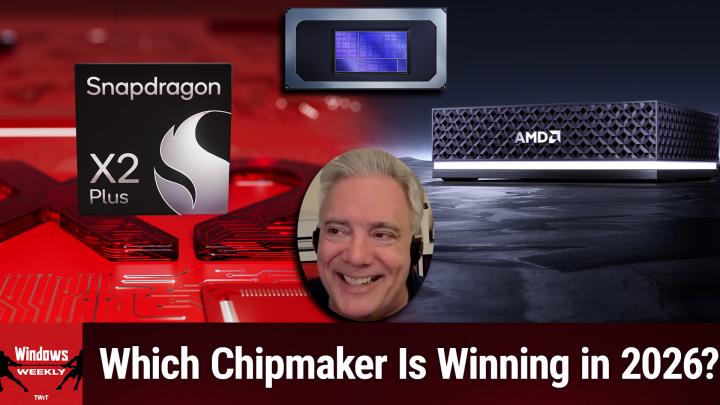
They're starting to kind of branch out a little bit because they understand this is not going to last forever. This is slightly different from, a little bit different from the way they did the first gen. But X2, when they announced that, they announced two sets of chips, the Elite and the Elite Extreme. The Elite Extreme is the one where the RAM is built literally into the chip die for faster access to RAM. And then at CES this past week they announced the X2 plus which is for kind of mid level PCs. Sorry, were they going to go down market as well like they had did in the first gen? But to me, I mean this is kind of under the radar a little bit. But a couple of things we're starting to see the first Copilot plus PC desktops.
Richard Campbell [00:26:38]:
Wow.
Paul Thurrott [00:26:39]:
And this is from all chips, Right. So very specifically, either the chip maker or some PC maker who's using those chips is touting whatever it is. So in some cases These are Tower PCs. There are little mini PCs. There's a little thing that looks like a USB dock from Lenovo that's actually a PC. There's an HP computer that is a keyboard that has a computer inside of it like a Commodore 64, which is like okay, maybe, I mean, maybe because you could bring like a USB C display and that's your whole thing. Like it's all there. I guess, I guess that's one way to do it.
Paul Thurrott [00:27:13]:
I, you know, I don't know. I mean, I'm not Really, I'm not 100% sure I see the use case there. But, but look, they're, they're trying to. The one thing that I do have is this is the HP OmniBook Ultra, the new one. So this one is like the thinnest. Thinnest what Paul? Thinnest consumer laptop I think is the way they're describing it. It comes in Snapdragon X2 and in the Intel Panther Lake versions I have the Panther Lake version which has 64 gigabytes of RAM. And I gotta tell you, for.
Paul Thurrott [00:27:47]:
This is a laptop. It's just a laptop, right? This is not a, not a gaming PC. It's super thin. You know, this thing plays Call of Duty better than any computer I've ever used. Like it's triple digit frame rates, it's running at 3K resolution, it is OLED and gorgeous and it's nuts. And it's like, it's, it's like you know, you get HD and you see things you never saw. You get 4K, see things you never saw. It's like that.
Paul Thurrott [00:28:14]:
Like, I've been playing this game for the last year or so, and I'm seeing, like, things in the game I've never seen. Like, it's, it's amazing and it's running faster and better than it ever has, even on the AMD stuff. So that's impressive. I mean, it's unreliable, you know, but. But it's also. It was a prototype.
Leo Laporte [00:28:34]:
Get hot and the fans get loud and so.
Paul Thurrott [00:28:37]:
No, actually you can hear the fan.
Richard Campbell [00:28:39]:
Wow.
Paul Thurrott [00:28:40]:
Yes. But it's not. No, it doesn't. It doesn't get.
Leo Laporte [00:28:43]:
Yeah.
Paul Thurrott [00:28:44]:
Yeah. Oh, yeah. It has to. I mean, it has to. It's. You know, but it's. The PC stuff has gotten interesting again, you know, without being stupid. Like, it's not like, oh, look, it's like three screens.
Paul Thurrott [00:28:54]:
You know what it. But, you know, there's some goofy things.
Leo Laporte [00:28:57]:
But how about that new material that LG announced for its gram?
Paul Thurrott [00:29:01]:
What do they.
Leo Laporte [00:29:02]:
What do they call that?
Paul Thurrott [00:29:03]:
Yeah, it was. It's a goofy. LG has always had like the thinnest, craziest thing. Like, and they would do like 13, 14, 15, 17 inch, you know, and there's like stupid thin. I mean, they were kind of flexible. That was the issue there. But still, it's like aero minium or something.
Leo Laporte [00:29:23]:
Arominum.
Paul Thurrott [00:29:24]:
Yeah.
Leo Laporte [00:29:24]:
So it's probably smells good, but I don't.
Paul Thurrott [00:29:26]:
Yes, yes. Right. It's a scratch and sniff. You open it up, it smells like flowers. I don't know. But it's. But no good for them.
Leo Laporte [00:29:33]:
Is it plastic? Is it metal?
Paul Thurrott [00:29:35]:
No, it's got to be a combination of materials. This is like, everyone's doing this kind of thing, I think. Is it this one or.
Richard Campbell [00:29:41]:
Because they use the phrase metallic look.
Leo Laporte [00:29:45]:
Right?
Paul Thurrott [00:29:45]:
Yeah.
Leo Laporte [00:29:46]:
And everybody who touches it says it's really soft.
Paul Thurrott [00:29:49]:
Right? Great. I mean, that's great. Like, what do we get? We're going to complain because there's plastic in it. It weighs like two pounds.
Leo Laporte [00:29:54]:
Who cares, right? Plastic is not a good. Is too good an insulator. So.
Paul Thurrott [00:29:59]:
Yeah, but you have to have a metal. There's always going to be the metal, all that stuff. Right. Plastic is good for wireless signals. Just throw. There's also a lot of repairability stuff. So the past three, four years, hp, Lenovo, all the big guys talk endlessly about sustainability and recycled components and blah, blah, blah. But to me, the big thing is like, you can pick one of these things up on screw four screws.
Paul Thurrott [00:30:24]:
Replace the SSD. It's pretty straightforward across the board. Replace the WiFi card. Yep. So Lenovo is taking up. I've been wondering when someone was going to do this. Basically do what Framework's doing and be like, all right, you can replace everything. It's easy that the USB ports, the video out ports are all in these little modules.
Paul Thurrott [00:30:43]:
You can just pop them out and pop in a new one and you have a new. Not a new computer but you know, but new. It's like a component, like a fully componentized thing. Like nice. Now this thing is hopefully it's not like 3 inches thick or whatever but. And I would also point out was driven by regulation and laws worldwide, but whatever, right to repairs had its effect and that's a big deal. Like this is, this is big stuff. So there is some good stuff here.
Paul Thurrott [00:31:09]:
And I think this is going to be a really good year for PCs. Except for that IDC thing about RAM prices screwing everything up and all that.
Leo Laporte [00:31:17]:
Although yeah, are we seeing that happen already in the.
Paul Thurrott [00:31:23]:
So I know this is price conscious, like especially in the PC space, but I see late in the year came out with a report they were saying RAM prices because of AI going up. It's going to be a big problem for PCs and smartphones. Like we're probably going to see slower growth or no growth this year because of this. The question's going to be like, well, what does that mean in the real world? Right. So people who build PCs are freaking out, but there's three of those guys, so you don't have to worry about that too, too much. The big issue to me is that laptops especially I just talked about, right to repair and everything. The one thing you don't see that much, I think I saw it on one laptop all year, was upgradable, slash repairable. Well, I guess it'd be upgradable or replaceable ram, like RAM is usually soldered on.
Paul Thurrott [00:32:09]:
So it's not like a dim this.
Leo Laporte [00:32:11]:
Lenovo because they used to be so great. You could take out the keyboard, you could take everything.
Paul Thurrott [00:32:16]:
So pragmatically part of it that makes.
Leo Laporte [00:32:19]:
Them heavy and complicated.
Paul Thurrott [00:32:20]:
It makes them slower too. So the newer chips slower when the.
Leo Laporte [00:32:23]:
RAM is on a. So DIMM instead of in the chip.
Paul Thurrott [00:32:27]:
Yeah, well there's in the chip in the die, literally like Apple does, like with Apple Silicon. Right. But then there's also just on the package, which is what intel did with Lunar Lake and what AMD does with all of their stuff. Now and so those really aren't a great upgradeable. Like people like, well, why couldn't you just add two DIMM slots? It's because that RAM would run at 50 to 60% speed. You just can't do that. And that's a shame. That's something I feel like we should try to figure out as an industry.
Paul Thurrott [00:32:53]:
But.
Leo Laporte [00:32:55]:
Well, especially now that people want more RAM for AI now it used to be.
Paul Thurrott [00:33:03]:
Iphones or whatever phone ship with like 16 gigs of RAM. Now it's like, it's amazing. The thing is like that's going to be more expensive. So the thing I'm looking for, and I've only seen one example is what's the real world impact on that on a customer? Like not someone building something, but you're buying a phone, you're buying a PC of whatever kind. Like are we going to start seeing PCs with 8 gigabytes of RAM now? Again, like, I don't think so, honestly.
Leo Laporte [00:33:24]:
You know who may do that though? Apple is rumored to be doing a low end.
Paul Thurrott [00:33:28]:
Yeah, okay, that one maybe.
Leo Laporte [00:33:30]:
And I bet you that has. Maybe you'll have 16, but I bet, yeah, it has eight.
Paul Thurrott [00:33:33]:
Yeah, but you know what, they'll charge nothing for the upgrade. I'm just kidding, they're terrible. But I, but so what I'd like to see is like 16 gig is the minimum on any PC and then you could go to 32 on your own and maybe it's something you put off for now because it's a little expensive and maybe it'll be better when you first put it off. No, you can't. There's no, you can't do it. The problem is you can't do it. The only example I've seen of this is there was a rumor that Samsung, I don't know if they said this outright or there was a rumor they were going to have to raise prices on the next gen phones. So I'm like, okay, this is going to be interesting.
Paul Thurrott [00:34:05]:
So if you could. I don't know what the price of a like a S25 Ultra might have started at 1299, but it's Samsung so it's always really on sale for like 800 bucks or whatever it is. Like how much is that thing gonna go up? It's gonna be 1500 bucks. If so like, yeah, they're gonna have some problems selling these things. Right. But the thing I saw was like they're gonna raise the price by $50 per phone. I'm like, that's just a normal year over Year upgrade. Like I, you know, cost whatever.
Paul Thurrott [00:34:30]:
So I. We'll see. But I don't know. This could be. It's a little wrench for sure.
Leo Laporte [00:34:37]:
But is it a monkey wrench?
Paul Thurrott [00:34:38]:
Yeah, it's an AI wrench.
Richard Campbell [00:34:43]:
Aren't they all?
Paul Thurrott [00:34:44]:
I asked. This is apropos of nothing, but it's just in my brain. The last article I put up on my site is a picture of a girl with three presents in front of her in the front of the Christmas tree. This is a big present. The medium sized present is a small present. So I asked Gemini to make this nano banana, whatever it's called. So the picture, it's great. So I'm like, this is perfect except for one thing.
Paul Thurrott [00:35:06]:
I need a 16 by 9 image. Could you just redo this as 16 by 9? So it says thinking and it spit out exactly the same image at four by three. And I'm like, yeah, okay. So like I said, this is a great image, but I just need it to be 16 by 9. And as it's doing it now, I'm thinking to myself, all right, I gotta find software that will do this generative fill. I can figure this out. It spits out a third version of this. Now I'm like, no, screw this, I'm going to make this thing do it.
Paul Thurrott [00:35:32]:
So I'm like, okay, listen to me. And so I very detailed, I explained why and blah, blah, blah. And then it said, here's a picture of an astronaut floating in space. And I'm like, when did you turn into Siri?
Leo Laporte [00:35:47]:
What?
Paul Thurrott [00:35:48]:
What is this? Like, what is like you just gave up on me. Like what? It's like, anyway, hilarious.
Leo Laporte [00:35:54]:
That, that is a real insult. When did you turn into Siri?
Paul Thurrott [00:35:57]:
I know, it's like flowers for Algernon moment.
Leo Laporte [00:36:02]:
What's going on here? Yeah, you know, this happens a lot with the AIs lately I've noticed is they internally get downgraded. Like just a couple of weeks ago, I was really happy that my Google home device could identify now the song that it was playing for me in the past.
Paul Thurrott [00:36:18]:
I don't know.
Leo Laporte [00:36:20]:
And I asked it today and I said, I don't know. So it's like, what happened? Did you get stupid again?
Paul Thurrott [00:36:26]:
Well, you don't have to be mean about it. You're not smart enough to know if I'm being mean.
Leo Laporte [00:36:30]:
I did. I found myself scolding Gemini scolding software. I think what happens is that if people start using it a lot, they dumb it down to save.
Paul Thurrott [00:36:43]:
So we'll talk about A little bit of AI stuff at some point. But one of the big debates right now is about these kind of robots and whether they should be human shaped or just little purpose built things. I feel very strongly it should be little purpose built things. But like we already have these examples in my own little stupid world where like we have this robot vacuum cleaner thing. We don't have the, it can't go up the stairs or anything. It's stupid. This is a little thing.
Leo Laporte [00:37:03]:
See, if it were a human sized thing, it could, it could walk it place.
Paul Thurrott [00:37:06]:
But we talk to it. Like, we just talk to it. You know, it plays little fun songs, it tells us stuff, can't hear us, it doesn't listen to anything we're saying. The other thing we do is like, you must do this. Like you drive. Like we drive up to Boston. So we go through like five states and like we're just sitting there, we're talking, listen to music, doesn't matter. And then suddenly the map thing goes, welcome to Connecticut.
Paul Thurrott [00:37:23]:
And my wife and I simultaneously, we were both like, thank you. Like I swear to God, like every time, like we can't stop doing it.
Leo Laporte [00:37:30]:
As a dad, reading the road signs is my job, okay? I'm just, I always used to announce, hey kids, we're in Connecticut.
Paul Thurrott [00:37:38]:
Well, it's like this end of Spaceballs where they're doing the countdown, they skip the number, it's fine. They're all clutching each other, things gonna blow up. And then she, she's like, three, two, one. And Zara, she's like, have a nice day. And they're all like, thank you. And then they blow up. It's like, you can't help it. It's bizarre.
Paul Thurrott [00:37:55]:
So we don't have to worry about humanoid robots. We're already treating these stupid little things like they're people.
Leo Laporte [00:38:01]:
I think the show floor is jammed with humanoid robots. And now Boston Dynamics announced that they have a deal to. Is it Hyundai? To start working those humanoid robots in Hyundai factory. So the reason being that the design for human were basically form factories for bipedal.
Paul Thurrott [00:38:19]:
Yeah, but once you take that out of it. I know. Okay, so you're gonna, you're upgrading it or you're using it in an existing facility. But right, realistically, whether you're best done. Robot vacuum is not a human with a fake robot like a, with a vacuum. It's a little thing that glides around the floor.
Leo Laporte [00:38:36]:
Why would you want a hundred little robots in your house? Or one that could do the laundry, the dishes?
Paul Thurrott [00:38:40]:
Oh, I desperately want Little robots. I want little robots everywhere.
Leo Laporte [00:38:44]:
They tuck me in.
Paul Thurrott [00:38:45]:
We're all snuggling at night. You know, they'll be purring.
Richard Campbell [00:38:48]:
You know, I. So I asked she who Must Be Obeyed. It's like, what would get you to tolerate a robot in the house? Because it ain't going to be the arumba. That's not the one.
Paul Thurrott [00:38:56]:
Yeah.
Richard Campbell [00:38:56]:
And she said toilets.
Leo Laporte [00:38:58]:
Oh, yeah.
Richard Campbell [00:38:59]:
If you can, if you can do.
Leo Laporte [00:39:01]:
A perfect toilet, then those Japanese toilets are awfully close. I wouldn't call them robots.
Paul Thurrott [00:39:05]:
So the robot toilet is built will. It will just.
Richard Campbell [00:39:07]:
They'll clean you.
Paul Thurrott [00:39:08]:
It will come to you. It will come to you in the living room and then it will walk away and shame.
Leo Laporte [00:39:13]:
Well, I'm hoping by the time that I need full time in home care that there will be something that could take care of me. I guess a human's all right, but, but a robot might be a little bit, I don't know.
Paul Thurrott [00:39:24]:
This is going to be like, listen, we looked at your chances and we're just going to pull the plug. You had a good run. That's true. You know, that's what the robot's going to be like. Your wife's not here. Sorry, buddy.
Leo Laporte [00:39:33]:
No. Take these quick.
Paul Thurrott [00:39:34]:
Yeah, before that time you kicked me on the way through the hall there. Yeah, I remember.
Leo Laporte [00:39:39]:
You know, my biggest concern with, with humanoid robots is they look cute and cuddly. They look like they're humans, but they're. It's like having a chimp in the house. You forget how strong they are. And they're made of metal. That thing could crack your skull. So if something goes wrong and it says, let me try this hat on.
Paul Thurrott [00:39:59]:
Yeah, exactly.
Leo Laporte [00:40:02]:
I mean, they're dangerous. And so you really. There is a very high level of care that has to be put into their code.
Paul Thurrott [00:40:09]:
It's too, it's too much complexity designing something to work like a human body. Why would you ever do that?
Leo Laporte [00:40:15]:
Your door, your, your nose looks like a doorknob.
Paul Thurrott [00:40:18]:
It's like a self driving car has a robot sitting in the seat taking up the spot and there's a steering wheel that it moves. Like, why would you do that?
Leo Laporte [00:40:24]:
No, you're right. That's.
Paul Thurrott [00:40:25]:
You're right.
Leo Laporte [00:40:25]:
You know, you know, you get a good point. That's dumb. It's dumb.
Paul Thurrott [00:40:29]:
It's weird thinking, but I don't know. Whatever.
Leo Laporte [00:40:32]:
Let's take a little break. And we come back. There's no CES Windows news. That's pretty much the CES story.
Paul Thurrott [00:40:41]:
Yeah. The related one is just Copilot plus PC on desktops you mentioned.
Leo Laporte [00:40:45]:
I do have. It's so funny, this Lenovo not only has a Windows key, it has a copilot key.
Paul Thurrott [00:40:50]:
Oh yeah, it's the best.
Leo Laporte [00:40:52]:
And there's really nothing I can do with it on Linux.
Paul Thurrott [00:40:55]:
If you cord those keys together, it will just install Linux.
Leo Laporte [00:41:01]:
Actually if I can figure out what the scan code is, I want to make it my button to press for.
Paul Thurrott [00:41:06]:
It's only a matter of time. So there are no copilot keyboard shortcuts. Right. You can press it, you can launch non standard key. Is that why there's no copilot key plus C copilot key plus you know this.
Leo Laporte [00:41:18]:
See that's what I want it to be is a super key or you know it's coming. Yeah. Claude Code has not figured that out yet. I've been asked. It does all my configuration now, which is amazing. I have it running all the time and if I say, oh, you know, can you make that menu font bigger? Instead of me going into the configuration stuff, I just say claude, make that font bigger.
Paul Thurrott [00:41:40]:
Experts say that you will never speak to your computer.
Leo Laporte [00:41:44]:
Oh I do.
Paul Thurrott [00:41:45]:
I know you do.
Leo Laporte [00:41:46]:
And I built in, I built in dictation using Whisper. So I press a button, it goes beep. I say it and it goes to Claude code. And Claude code does. It doesn't talk back to me. I don't want to talk back to me.
Paul Thurrott [00:41:57]:
The resistance to this would would be ludicrous if it wasn't for the fact that when GUIs were happening, people are like, oh no, I'm never going to need a mouse. It's a toy. I can do everything I want to do from the command line.
Leo Laporte [00:42:08]:
Remember what DeForex said about Matt? My sin? They're never going to catch on.
Paul Thurrott [00:42:11]:
Nobody wants to. Never going to catch on. Yeah.
Leo Laporte [00:42:13]:
All right.
Richard Campbell [00:42:15]:
On the other hand, off the keyboard.
Leo Laporte [00:42:16]:
I am a command line guy and.
Paul Thurrott [00:42:18]:
So I am too.
Leo Laporte [00:42:19]:
My Linux setup is very command line focused.
Paul Thurrott [00:42:22]:
For that reason, I'm not going to do this. Well, I'm not going to do this today. But one thing, when I was doing the year end story, I was looking through all this stuff, I was reminded that Microsoft came up with a text mode editor which by the way works in Linux as well as Windows. And I think it's just called Edit, if I'm not mistaken. But I was like, I could use that, you know, like I could actually put you doing this.
Leo Laporte [00:42:45]:
Like it was Edlin. Remember Edlin and Ed?
Paul Thurrott [00:42:48]:
Ed was. I forget which one was Better one was just like a. Edlin was an improvement on Ed. Yeah, it was like an actual environment. Yeah, I think so. I forgot. But those were the days.
Leo Laporte [00:42:59]:
Oh, man. And I still see many a page that says, okay, fire up Nano and edit the config file. Our show this week, brought to you by our great friends at Threat Locker. We're going to be going. Steve Gibson and I will be going to their big Zero Trust World conference in March. I'll tell you more about that in a second. But let me tell you first about Threat Locker. If you are paying any attention at all.
Leo Laporte [00:43:25]:
In fact, even if you weren't a computer user, if you just ask anybody, they know. Ransomware is a nightmare. It's harming businesses everywhere. Not just businesses, schools, infrastructure, companies. Everybody is threatened by this. Well, good news. Threat Locker can stop ransomware cold before it gets started. Recent analysis from Threat Locker shows how.
Leo Laporte [00:43:48]:
One, just a single. And there are dozens of these, but just a single ransomware operation. Qilin in 2022, 45 incidences, which is, which is bad enough. 45 incidents in one year, you know, four a month, that's bad enough. 800 in 2025. It'll probably be double that again in 2026. Threat lockers. Zero Trust.
Leo Laporte [00:44:11]:
So, I mean, I don't need this. I don't even know why I need to tell you those numbers. You know, it's bad. You need Threat Locker. Their Zero Trust platform does something nothing else can do. It takes a proactive, deny by default approach. This is what Zero Trust does. It's so incredible, it blocks every action unless it's explicitly authorized.
Leo Laporte [00:44:31]:
And of course, malware is not authorized, so it can't do anything. Zero Trust. Threat Locker protects you from both known and unknown threats, threats nobody's ever heard of before. Threat Locker. They call it Ring Fencing. Their innovative ring fencing constrains tools and remote management utilities so that attackers can't use them. They can't weaponize them for lateral movement. They can't use them to encrypt your files or exfiltrate information.
Leo Laporte [00:44:57]:
They cannot use them because you didn't say so. It's like Simon says, did you say so? No. Can't do it. That's the beauty of it. Threat Locker works across every industry it provides. They have the best US based support. They're there for you 24. 7, works on Windows and Macs and enables comprehensive visibility and control.
Leo Laporte [00:45:17]:
Let me tell you about some of the companies that use Threat Locker. Companies that can't afford to be down for one Minute Emirates, the big Emirates Airlines, they're Flight catering is a global leader in food industry. They have 13,000 employees. This is just the catering arm. Threat Locker gave full control of apps and endpoints to Emirates Flight Catering. They improved their compliance because if you can only do stuff that you have a log of everything that's happened, right? Who tried to do stuff, who didn't do stuff, who was able to do stuff, you have that all that's part of the deal. They also delivered seamless security with strong IT support. The CISO of Emirates Flight Catering said this quote, the capabilities, the support and the best part of Threat Locker is how easily it integrates with almost any solution.
Leo Laporte [00:46:04]:
Other tools take time to integrate, but with Threat Locker it's seamless. That's one of the key reasons we use it. It's incredibly helpful to me as a ciso. Just look at the list and you'll find it on the website of people global enterprises, people who can't afford to be down for one minute that use threat locker. JetBlue uses threat locker Heathrow Airport. Remember, they've had, they had some real problems a couple of years ago. They said never, never again. They use Threat Locker.
Leo Laporte [00:46:31]:
The Indianapolis Colts, the Port of Vancouver. Threat Locker consistently receives high honors and industry recognition. They're a G2 high performer and best support. Again with the support for enterprise. That was summer 2025. Peerspot ranked number one in application control. Get app best functionality and Features Award 2025 and the list goes on. Visit threatlocker.com TWIT get a free 30 day trial.
Leo Laporte [00:46:56]:
Learn more about how ThreatLocker can help mitigate unknown threats and ensure compliance. That's threatlocker.com TWIT now let me tell you, they've got this big conference they do every year. It's coming up this spring in Orlando, Florida. Zero Trust World and for a limited time we've got a code for you if you want to go. We'd love to see you. ZTW Twit26 all one word, all caps. ZTW Zero Trust World this weekend Tech Twit26 to save $200 off registration for Zero Trust World 2026. And this is the full pass.
Leo Laporte [00:47:32]:
You get access to all sessions, you get hands on hacking labs, you get meals. And they are famous for their after party. Steve Gibson and I will be doing a presentation on day one at the very end of the day and we're going to the party so you can buttonhole Steve and ask him questions. It's the. He'll be mad if I said that, but you can the most interactive It's a great event every year. I'm really excited about going. It's the most interactive hands on cybersecurity learning event of the year. March 4th through 6th put this down, write it down.
Leo Laporte [00:48:03]:
Tell your boss I gotta go to Zero Trust World. We'll be safer when I get back. March 4th through 6th Orlando, Florida and don't forget when you register, use the code to save 200 bucks. ZTW Twit26 we love threat Locker. Very excited about doing this and I hope we'll see you in Orlando in March and meanwhile go check it out. In fact, this is the time to start using Threat Locker. So when you have questions or you want to get more information, you'll be ready for zero trustworld threat locker.com TWIT thank you threat Locker for your support. Now let's see.
Leo Laporte [00:48:37]:
Let's talk about Windows.
Paul Thurrott [00:48:38]:
What a thought had to happen eventually. Yeah, you know, Microsoft takes most of December off, so not surprisingly there wasn't a lot of lot of news in our little time off. But there was some interesting stuff. So there's a guy who works on the Azure team, Microsoft, what do you call it? What is he? Distinguished engineer Galen Hunt. So he works for Mark Russinovich essentially, or Lisa.org and he put a job posting up that was like, my goal is we're going to eliminate every line of CNC plus code from Microsoft by 2030. We're going to use AI and algorithms to do this. And he explains the process. We're looking for someone who knows Rust to help us with this.
Paul Thurrott [00:49:26]:
So I wrote about this and nowhere in this article did I write that Microsoft was going to rewrite Windows in Rust. But I have, you may recall, speculated in the past that like at some point AI is going to get to the point where Microsoft and other companies are going to be able to point it at some code base and say, refactor this in Rust. And the fantasy scenario I've always talked about is the NT kernel, right? We're going to do this over in Rust. And refactoring literally means it's just going to work like it did before. But all those memory errors or memory vulnerabilities potential are not going to be the case anymore. And we'll see what happens. But unfortunately a lot of people misunderstood this like, oh, Microsoft's rewriting Windows in Rust. It's like, so the guy had to come up.
Paul Thurrott [00:50:09]:
Actually, I didn't say that. And neither did I when I wrote.
Richard Campbell [00:50:11]:
Wasn'T he looking to hire somebody?
Paul Thurrott [00:50:13]:
Yeah, I mean, look, Microsoft already has people writing Rust. It's not like they need a guy, they are hiring one. Or maybe they've hired by now someone to work on this. But obviously Rust has been a big deal for the past couple years, Windows especially. But Linux is adopting it not quite as aggressively as Microsoft. Microsoft has rewritten all the Surface firmware in Rust and open sourced it so other PC makers can use it. Mark Russinovich famously like two, three years ago. Three, maybe.
Richard Campbell [00:50:46]:
You have to justify not writing in Rust.
Paul Thurrott [00:50:48]:
We're not doing this anymore. Yeah. Yep, no more cnc.
Leo Laporte [00:50:51]:
That's actually great. I think that's really good news.
Paul Thurrott [00:50:55]:
The latest talk that he gave that I've seen about this is possible he did something night that I didn't see was he was talking about all the places in Microsoft that use Rust and it's all across the company. Like it's Office, Xbox, it's everywhere. And I guess when he made this little proclamation, he got a text message, email, whatever was from Satya Nadella. He's like, are you serious? He's like, yep. He's like, all right, you know, so look, this is part of that and it's not something that happens overnight. It's right now, it's a project. You know, it's like we're going to see where this takes us and whatever, but.
Richard Campbell [00:51:28]:
And typically they're going after optimization problems and reliability problems, right?
Paul Thurrott [00:51:32]:
Yes, that's right.
Richard Campbell [00:51:33]:
There was a big outcry about Microsoft abandoning C because they were rewriting a bunch of the C services in Rust. And it's like, actually Microsoft is in the business of running a cloud infrastructure.
Paul Thurrott [00:51:44]:
And they want low level code is exactly you need. This is.
Richard Campbell [00:51:48]:
Well, you're going to run 200 billion of instances of this every cycle. You save is real money.
Paul Thurrott [00:51:58]:
One of the big projects right now in the Rust ecosystem is literally Rust without the garbage collection. In other words, part of the overhead of high level languages like C or Java or whatever is that it does that stuff for you automatically. And it's like, well, what if we didn't do that? What if? And we'll see where that goes. But yeah, Rust solves a lot of problems and there's all these happy kind of byproducts that come from using it, one of which is like, oh, actually this code is smaller, it's more efficient, it's like less processor intensive and it's more secure. Right. I mean, so I feel like this is inevitable and I Don't want to jump too far ahead. Like I said, I did not write like they're going to do this, but I've been talking about this as a possibility. I talk about it in a very oversimplified way, but because, look, I can't even get it to write a text editor.
Paul Thurrott [00:52:49]:
But you know, you point it at the kernel, you're like, fix it. You know, I love that. Like, I love, like this, you know, this, look, this. Let's be clear here. This is going to happen, right?
Richard Campbell [00:52:59]:
Well, what I like about the story here is that they're hiring a skilled Rust person to use these tools to help writing Rust. Because if you don't have a skilled person, they can't assess what the tools generated.
Paul Thurrott [00:53:13]:
Yeah, I think bias is a strong word, but I think there's an inherent bias when people who are really knowledgeable, low level code in C or whatever it is going to Rust, will want to repeat some of the same code styles or whatever it might be. Whereas when you approach something in Rust, you actually might want to. I don't know enough about Rust, so I'm just kind of speaking very high level here. But you may want someone who thinks in Rust to kind of make sure this is the right thing, because it's not just like, okay, take this code block and rewrite it in Rust. It's not that simple. But I don't know, this is a good. I like to see this.
Richard Campbell [00:53:51]:
The distance between Rust and C is pretty small. They're both pretty low level languages. It's just certain decisions that are made in Rust that are very helpful in the way that it does type safety.
Leo Laporte [00:54:02]:
Well, that's the security difference, right?
Paul Thurrott [00:54:05]:
Oh my God. It eliminates like 80, 80% of the buffer overflow. Yeah, exactly. The most common security vulnerabilities all come out of the same thing and it gets rid of that. And that's humongous.
Richard Campbell [00:54:16]:
The first half dozen versions of C were written in C. It wasn't until Roslyn that they actually wrote out a. You suddenly had a whole bunch of C developers inside of Microsoft, which used to be C developers. But one of the things they. I remember we did these shows on. NET Rocks. There were bugs in C, the old version that applications relied on.
Paul Thurrott [00:54:41]:
You actually have to make sure they copy the bug.
Richard Campbell [00:54:44]:
Yeah. Do we copy the bug or do we fix it and break your app? That was the discussion. I got to wonder as you poke your way through Windows when you talk about what it was Galen hedging on. He was hedging on that, we're going to find code, we're going to rewrite, and it's going to work the way it was intended, and it's not going to work correctly.
Paul Thurrott [00:55:02]:
I have a software engineer friend who was here over New Year's and he was telling me a story exactly like this, which was basically that in Refactor, they weren't going to rust. But in Refactor, he works in the financial industry, and they were refactoring this old code base, and they kept coming up the same, like, two or three errors. And then they tried it against the original code base. Like, oh, wait, this does the same thing. It literally brought over the bugs.
Leo Laporte [00:55:23]:
They duplicated the bugs.
Paul Thurrott [00:55:24]:
It's like, actually, we kind of need that, you know, like, this is.
Leo Laporte [00:55:27]:
This is why I think it's a little. It's a little trendy to say we're going to rewrite this in Rust, because really, what you really want to do is have standard practices that keep people from making those memory mistakes and those type errors and all of that stuff. And you can make bad mistakes in Rust, too. I'm sure you can still make insecure code in Rust.
Paul Thurrott [00:55:49]:
That's.
Leo Laporte [00:55:49]:
I don't think you have to try.
Paul Thurrott [00:55:51]:
A little harder, but.
Leo Laporte [00:55:52]:
Yeah, maybe. But you could do type safe C, you know, you just have to stop.
Paul Thurrott [00:55:57]:
Typing type safe C. It's like. Sounds like an awesome auron. You know, it's like. It is like, what are you gonna say? It's like military intelligence or Lets you.
Leo Laporte [00:56:07]:
Do other things that are not type safe? Because it's. Because, I mean, it lets you do stuff you can do in C. So you can do, you know, you know, memory allocations and stuff and that don't. And then write to it.
Paul Thurrott [00:56:20]:
Yeah, there's no doubt that C. Sorry. These languages are all the same.
Leo Laporte [00:56:25]:
You can still do Malloc and not. I mean, there's all sorts of issues, but it's somewhat of having standards of not making those mistakes. And maybe Microsoft's already tried that. I just don't know if.
Richard Campbell [00:56:37]:
Cheaper language fiction. That's an old Bill Gates line. Right. If you write that, if they put that kind of bugs in and I fire it them. And he was Brian Valentine who responded. I'm sorry, Bill, they're your customers.
Leo Laporte [00:56:48]:
Yeah, that's the problem. I don't know. I mean, it's probably a good thing to refactor it. I'm not against that.
Richard Campbell [00:56:54]:
And I think that's what Galen was actually talking about.
Paul Thurrott [00:56:57]:
I think that's what they're talking yeah, he's talking about code bases. Right. He didn't like say the NT kernel or anything like that. But then again when you think look, this is really for Azure, but Azure and Server and Windows client share something. Right. There's some core components there that have got to be, you know, at least similar. So these benefits will trickle down, I'm sure. Yeah, we're already seeing like there's rust in Windows now.
Paul Thurrott [00:57:22]:
I mean that's already a thing, but sure. But yeah, refactoring as much of the low level current, let's call it kernel code, for lack of a better term of Windows is a great idea.
Leo Laporte [00:57:31]:
Linux did less.
Paul Thurrott [00:57:32]:
It's an excellent idea.
Leo Laporte [00:57:33]:
They start moving the kernel to rust, you know.
Paul Thurrott [00:57:35]:
Right, yeah.
Leo Laporte [00:57:37]:
And you know, so rust maybe is a little better. Although I, it bothers me because it's a little, you know, it's trendy. Like would have been 8 at 10 years ago and. 10 years, what is it gonna.
Paul Thurrott [00:57:46]:
Yeah, I mean it's, it's, I think it's trendy because it was found to work, you know, it wasn't like it didn't occur two seconds ago. Like this Russ has been around for 10 years plus I think, I mean Mazola at least. That's right. Yeah, it caught on recently at some point. I mean this world is so different from application development. I mean it's a different place. But drivers would be the right place to do Rust in Windows and Linux in any system. Right.
Leo Laporte [00:58:13]:
Although they're probably written in assembly, not C maybe.
Paul Thurrott [00:58:16]:
I don't know. Yeah, I actually don't. Yeah, I'm sure there are. Yeah, I'm sure it's a combination of C. I guess you don't want to.
Leo Laporte [00:58:20]:
Use assembly because you have multiple platforms now. It's a little hard to port stuff around.
Paul Thurrott [00:58:26]:
Yeah, yeah, yeah. Anyway, it's a good track, so it was misunderstood. But this is a big deal. I got semi excited earlier when you said bitlocker, but I guess you said it by mistake. So I was like yay, bitlocker. Where's the story? I don't even have it on my link. So Microsoft discussed something called Hardware Accelerated bitlocker and then didn't tell anybody when they released it as part of Windows 1125H2 and Windows Server 2020 25. And basically what they found is that with these faster NVMe based SSDs BitLocker was actually starting to have a meaningful performance impact on the system.
Paul Thurrott [00:59:06]:
Meaning like 1% or something. Like some, you know, 1, 2%, something like that. But they were like, all right, well, we could fix this. And apparently they have. And you actually, for this to work right now, I believe you have to have a generation of chipsets that is not yet shipped. I believe. I mean, it's possible some of the CPUs from last year or whatever will support this. But even on this Panther Lake system, for example, there's a command line you can run to see if it's enabled and it is not on this particular computer.
Paul Thurrott [00:59:40]:
So that would be the only one I would have right now that could even do this. I guess there will be a way to enable it. There's obviously, it's Microsoft, so there's going to let IT admins control it. You can turn it off, turn it on, whatever. But.
Richard Campbell [00:59:53]:
Well, there's certainly a movement towards all data encrypted at rest at all times to resist ransomware and extortion and the like.
Paul Thurrott [01:00:01]:
Yeah, Yep. And yeah, so if it's possible, like, this is a big thing with gamers, but in the IT space, it's possible. If you're using older computers, you might be like, look, we don't want to use bitlocker because it slows down these things too much, which honestly I think is semi made up. But. But maybe there's a perceptible difference. So this will solve that problem, apparently. So that's kind of cool. And 20.
Leo Laporte [01:00:24]:
2017, I just. This was the original Rust book, which I bought when it came out, 2017, so that's hilarious.
Paul Thurrott [01:00:31]:
Okay.
Leo Laporte [01:00:32]:
And yeah, it says fast, safe systems.
Paul Thurrott [01:00:35]:
Developed, but what would you do with Rust in 2017? Like, what was the use case for this thing?
Leo Laporte [01:00:40]:
Well, they rewrote Firefox. That was.
Paul Thurrott [01:00:42]:
I know, but there's a book about it. So, like, what's the. What's.
Leo Laporte [01:00:45]:
Well, everybody, I remember this was a. You. I don't remember if it was a. It was a go. It was a crowdsourced and you would get it chapter by chapter. That's why I have the final version of it. People were really excited and I think there's still a lot of excitement around.
Paul Thurrott [01:01:01]:
Yeah.
Leo Laporte [01:01:01]:
The other thing is concurrency and a lot of older languages, concurrency is kind of added on top of Rust is.
Paul Thurrott [01:01:08]:
Yeah. Oh. So it's natively concurrent. Natively concurrent. Okay.
Leo Laporte [01:01:11]:
And, you know, that was a big change.
Paul Thurrott [01:01:14]:
What do you do just like, have two panes of code and they run side by side?
Leo Laporte [01:01:17]:
When did intel decide, you know what, we're not going to be able to make single core go any faster than 5 GHz so let's do multi core.
Paul Thurrott [01:01:23]:
I think it was literally the core processor. I think that was the reason for that name Switch. Remember the first one was a Core Solo, which we forget about. But then it became Core Duo.
Leo Laporte [01:01:33]:
Right.
Paul Thurrott [01:01:33]:
And then intel was the one that. I'm gonna get this wrong, but I believe they went from dual core. Lasted for a little while and then we got to 8th gen core processors. They went. They just added. We're like we're gonna go quad core.
Leo Laporte [01:01:45]:
So they were doing Itanium.
Paul Thurrott [01:01:47]:
Yeah.
Leo Laporte [01:01:47]:
And they realized. Oh crap.
Paul Thurrott [01:01:50]:
Yeah.
Leo Laporte [01:01:51]:
And they.
Paul Thurrott [01:01:51]:
Fortunately they have made Skunk Works in history. A metal ton of nothing. Yeah.
Leo Laporte [01:01:56]:
And this and this Skunk Works had been working on this core thing and they. That saved intel and I think that must have been around 2005 somewhere maybe even.
Paul Thurrott [01:02:07]:
Yeah, right around. That sounds about right. Early 2000 step.
Leo Laporte [01:02:10]:
So then all of a sudden every computer is. Has multiprocessing.
Paul Thurrott [01:02:14]:
Well, AMD had done the x64 thing, which you know, intel was forced to adopt. That was one of the more embarrassing things people wanted with x64. Yep. Interesting.
Leo Laporte [01:02:27]:
I'm thinking maybe I should read this.
Paul Thurrott [01:02:28]:
And you could look at like I. If you look at any of the processors that were just announced, it's this crazy. It's like 21 cores and it's like this kind of core and these kinds of. It's like. It's insanity. It's not like it was. This thing used to be like a big block Chevy. You know, you just hit the pedal and it goes faster.
Paul Thurrott [01:02:46]:
Makes a lot of noise. If you're going up a hill, the gas tank will go down as you're driving. And now it's like this crazy. I don't know what you call it. Hybrid, electric, something. It's.
Leo Laporte [01:02:56]:
I said earlier in the Discord. One of the great blessings in my life is that I don't have to ever write production code. So I can still live in a single processor.
Paul Thurrott [01:03:06]:
Yeah, 6502 is enough.
Richard Campbell [01:03:11]:
But yeah.
Leo Laporte [01:03:14]:
I would need to be doing concurrency. I'd probably need to do type safety, memory safety and all that stuff.
Paul Thurrott [01:03:18]:
Hey, there's a different timeline where the Amiga wins and we have multi processing in the 1990s. You know, wow. Multitasking. What could have been. I know, I don't. Please don't get me started. It makes me want to.
Richard Campbell [01:03:29]:
But we, you know, these next generation languages emerged for a multicore.
Leo Laporte [01:03:34]:
That's right.
Richard Campbell [01:03:35]:
You know, processing, you know, you maybe go Rust. You might go go. Because both of those phenomenal. Yeah. And very set up for a cloud world. That's what it's about.
Paul Thurrott [01:03:46]:
That's right, yep.
Richard Campbell [01:03:47]:
Actually the platform changes, the languages reflect.
Leo Laporte [01:03:50]:
Darren was saying that in the discord in the club. Twitter discord. He says, because I work with aws. Go is the kind of native language for aws for that. Yeah, yeah.
Paul Thurrott [01:04:01]:
Languages like Java and C came out of an era. You're solving a problem. It's like, all right, what's the problem? Garbage collection. Right. People are not doing this or doing it correctly. We'll just do it for them. Now there's overhead and it's like, it's okay. Well, we have infinite computing resources now.
Paul Thurrott [01:04:16]:
It's not like we're flying to them, you know, go to the moon with like the, you know, this stupid chip with like four feet or whatever. Like this is. We're gonna. This. We have all the power in the world. But at some point, yeah, you have to be more. Not at some point, certain use cases like drivers and the kernel and all that stuff, you know, you actually still need this low level stuff and that's going to be assembly or C or whatever, you know, so it's, it's interesting. This is not.
Paul Thurrott [01:04:40]:
Yeah, this is another one. Alternate timeline. I might have been a developer too.
Leo Laporte [01:04:44]:
But who is that guy who bought Commodore and killed it? Basically? He was just awful.
Paul Thurrott [01:04:50]:
Well, the reason Commodore died was Irving Gould, who was a horrible person. He got rid of Jack Tramiel.
Leo Laporte [01:04:56]:
Jack Tramiel was bad too though. That's the guy I was thinking of.
Paul Thurrott [01:04:59]:
And then he was worse than Tramille. Oh yeah.
Richard Campbell [01:05:02]:
Was the original.
Leo Laporte [01:05:03]:
Yeah, yeah.
Paul Thurrott [01:05:04]:
Iringal was the guy who killed it. And then they were bought by Gateway. People forget this. They did nothing with it. Then the.
Leo Laporte [01:05:12]:
Who killed the Amiga? Was it gold?
Paul Thurrott [01:05:14]:
No, he didn't kill it. The Commodores went out of business. Like they, he killed.
Leo Laporte [01:05:18]:
That'll kill it. Yeah, that'll kill it quick.
Paul Thurrott [01:05:21]:
Commodore was a shell game at the end. It was like this Bahama based business that didn't really have to report to anybody on a regulatory basis. It was terrible. It was just a terrible company. Commodore was the worst thing that ever happened.
Richard Campbell [01:05:36]:
Well, and now, now a YouTuber's hauled the Commodore brand back and they're building a new Commodore 64 with an SD card slot.
Paul Thurrott [01:05:43]:
Right. So I'm, I'm interested in this Commodore 64 ultimate thing. But I gotta tell you, like an Amiga 500 right now, I could wrap my head around that, you know, like the Commodore 64, you're like, maybe like Commodore, like an Amigo 500 or 1200. Even better. Whatever, whatever you want to call it.
Richard Campbell [01:05:59]:
2000. Yeah.
Paul Thurrott [01:06:00]:
Would be super interesting, but we'll see.
Richard Campbell [01:06:03]:
It's a long time ago, man. Your memories are far better than reality. It's like Kentucky Fried Chicken. As a child you thought it was amazing. Now you go get it, you're like.
Paul Thurrott [01:06:11]:
What are you thinking? I still actually like Kentucky Fried Chicken, but you always remind me every time you say something about fast food, I always think of your Arby's slogan, which is like, it's almost meat.
Leo Laporte [01:06:23]:
We have the almost meat.
Paul Thurrott [01:06:25]:
I always thought was so perfect. Like, it's like it's. It's close. Anyway, sorry. So, all right. So since we last spoke, a couple of. There were. The last updates we got from the Insider program were on the 19th.
Paul Thurrott [01:06:39]:
I don't remember when our last show was, but it was probably 17th ish. Somewhere in there.
Richard Campbell [01:06:43]:
Around there.
Paul Thurrott [01:06:44]:
So there were two things. Devin beta, which for now. And this is going to change pretty soon, I bet. Got a bunch of updates related to AI agents on the taskbar. So there's the underlying architecture for these things, which Microsoft, I think is doing the right thing in the sense. We can argue whether agents and AI belong in Windows, but if you're going to do this thing, make it a normal interface for users. We're not going to do a full screen start menu. We're going to make it look and work like apps and stuff.
Paul Thurrott [01:07:14]:
And so I think that's smart. There's like an agent launchers experience which basically just gives you jump lists and app icons and little notifications and things. And then they release their first agent, which is the researcher agent, which you trigger through Copilot. And when you send it off to do a task, you'll have an icon in your taskbar you can click. It will give you a little. You can see the update, how it's doing. If it needs you, it will trigger a notification. Sounds kind of interesting.
Paul Thurrott [01:07:42]:
And then more broadly, there was a Copilot app update that added text editing actions to Copilot. So Copilot vision is that thing where you interact with the screen, but originally it was voice only, right? So I feel like this vision capability is maybe well, more useless, a strong term, but will more typically be used on a phone because you're out in the world, right? You can hold up your camera and be like, what is that thing? But you could use it for anything. And so in Windows you might be. You have a webpage up, it has graphics and text, you can Focus on different things and learn more about it as well, etc. Etc. So this basically adds text editing capabilities anywhere you have text, right? And so that means that could be in a field in a web browser, which is probably going to be the big use case. But for me, I use a markdown editor, which has basic spell checking, but not any, you know, I don't need this. But like the, you know, rewrite this, make it shorter, you know, longer, whatever you might want to, it adds it to that.
Paul Thurrott [01:08:45]:
So this actually just works with everything. And this is, you know, when, when people question why Microsoft would add AI to Windows, I will point to things like this because you're using whatever apps you use. Richard uses some set of apps, I might use some different set of apps, someone else uses yet another set. But these capabilities work across whatever apps are. Windows, like, Windows is the platform. It's where you want this thing. You don't want to add these features individually to each app, although we're seeing that as well. You add it to the system and then all apps benefit.
Paul Thurrott [01:09:15]:
That's the, you know, the point of the platform. Right. And so. Interesting. It's interesting, or it's interesting to me, maybe it might not be interesting to everybody, but I think it's interesting. And then I guess I already mentioned this. Maybe I thought this wasn't going to be in the notes. I can't remember.
Paul Thurrott [01:09:33]:
But yeah, idc, like I said, late in the year, came up with a report. Every year they do a set of predictions about the various industries for the coming year that happens in November. They did their forecast for PC and smartphone sales and probably for tablets and whatever other devices they cover. But they had to revise it in late December because of this RAM crisis caused by AI, their incredible needs. And this is one of those basic supply issues. Like, we only have a finite amount of the stuff that companies are making. There's only a finite number of those companies making this stuff. And typically, what has driven memory, like, meaning RAM sales, has been the sale of devices like PCs and phones that have RAM in them.
Paul Thurrott [01:10:16]:
But they are no longer driving this. It's AI data center use. And when Nvidia or Microsoft or Google or whatever goes to Micron or Crucial or whatever these companies are and says, we need all the RAM you can make. And they're like, oh, but we're giving it to PC makers or whatever, it's like, that's cute. We'll play double. Oh, yeah, you can have all the rip. And that's kind of what's Happening, right.
Richard Campbell [01:10:37]:
Micro shut down.
Paul Thurrott [01:10:38]:
Yeah, we're done.
Richard Campbell [01:10:41]:
Well, the other thing is that these are all pre orders. Like, you don't even know how many of these machines are actually going to take.
Paul Thurrott [01:10:47]:
I know.
Richard Campbell [01:10:48]:
It's almost the way it was described to me by one of the folks in the space was. It's like you've opened up 10 windows, 10 to get Taylor Swift tickets. You only want one pair of tickets, but you're opening as many as you can. And they're ordering anywhere they can from everything they can. So they get songs.
Paul Thurrott [01:11:05]:
I'm gonna call this wimpy accounting. And I don't mean wimpy like you're a wimp. I mean, you're like, maybe I have the name wrong. It's that character from Popeye. Yeah, Wimpy.
Leo Laporte [01:11:13]:
I'll gladly pay you Tuesday.
Richard Campbell [01:11:14]:
Yeah, right.
Paul Thurrott [01:11:15]:
For a hamburger today. That's what this is. You're like, listen, I'm gonna buy the hell out of this RAM eventually, but I need you to give it, all of it, to me now. Like, okay, yeah. And we'll see how that goes. It's not like the economy's riding or anything, so we'll be fine. You guys aren't retiring.
Richard Campbell [01:11:33]:
We might have a dark year in PC sales.
Paul Thurrott [01:11:35]:
Yeah, right. We might. But this is why I said earlier, I'm looking for real world impact of this, right? So Apple as a company has always overcharged for RAM upgrades. So you buy like an iPhone and it's a thousand bucks. And you're like, well, I want. Well, actually, you can't get RAM on an iPhone. That's a bad example. You buy a Mac for whatever.
Leo Laporte [01:11:53]:
On a Mac, Yeah. On a Mac, yeah.
Paul Thurrott [01:11:54]:
And you want ram. And they're like, all right, so you want to go from 16 to 32. That's 200 bucks. You're like, what? And actually, 200 bucks is pretty good pricing for that RAM.
Leo Laporte [01:12:03]:
So they have some headroom, right?
Paul Thurrott [01:12:05]:
But they're probably going to start charging 300 bucks for that thing. And I guess the question is what those amounts are, right? And so if you're hp, like, Lenovo is going to be good shape. Apple's in good shape because they, you know, they have such control, their own supply chain. It's just, you know, in Lenovo's case, just sheer size, right? So smaller companies, we'll see. But, you know, if you go to buy a Lenovo laptop, I'm just going to make something up. And it comes with 16 gigs ram. And 32 gigs is today would. Might be 50 or 100 bucks or something.
Paul Thurrott [01:12:33]:
And now it's 200. 250. Does that mean that people are buying fewer computers or less capable computers? I guess we're going to find out. But I, I feel like people buy these things so infrequently. I'm not sure they have their thumb on the pulse of this. You know what I mean? They might just look at it, be like, I guess this is what IT costs. I don't know.
Richard Campbell [01:12:50]:
I mean, from an IT perspective, you're way more sensitive and you're buying blocks of machines. And if it goes this way, what you will do is buy extended warranties.
Paul Thurrott [01:12:58]:
Yeah. And maybe low ball it. As long as it's 16 plus, I think you'll be okay. But like, those guys hopefully are benefiting, I'm sure are benefiting from some kind of volume discount, especially if they're doing a fleet of laptops or whatever it is they're buying. But.
Richard Campbell [01:13:14]:
But there's another side to this, which is what you're not seeing is anybody building new memory factories.
Paul Thurrott [01:13:18]:
Right.
Richard Campbell [01:13:18]:
Because they also see this as a bubble too.
Paul Thurrott [01:13:21]:
That's the thing. I mean, you're going to spend years putting this thing together. You're like, we did it. Yay. It's like, oh, we didn't RAM anymore. We moved on to the next thing. You're like, oh, God. You know, like, you could picture that happening.
Richard Campbell [01:13:31]:
Exactly.
Paul Thurrott [01:13:32]:
Yeah.
Richard Campbell [01:13:33]:
Yep.
Paul Thurrott [01:13:34]:
Now and then.
Richard Campbell [01:13:35]:
And as those orders disappear, because you didn't actually, you open 10 windows and only needed one.
Paul Thurrott [01:13:40]:
Right.
Richard Campbell [01:13:41]:
You know, things are going to change. And so I think a lot of these companies are also thinking the other way, which is I don't want to be got holding the bag with a whole lot of ram. I can't sell.
Paul Thurrott [01:13:48]:
Right. So this is fanciful. I'm joking in a way. But, you know, as things like this do collapse, we might enter a golden age of RAM and GPUs in the near future where it's like, yep. Oh, you were looking to get it, like, upgrade the GPU on your gaming laptop. Well, congratulations, you can get it in a box of cereal now for nothing, because we suddenly have a ton of these things. We'll see. I don't know.
Paul Thurrott [01:14:10]:
I'm not really. I don't expect it to be quite like that, but we'll see. Maybe they'll dump them in a landfill in Arizona or New Mexico. Whatever. Whatever happened to those Atari cartridges? We'll see. Albuquerque.
Leo Laporte [01:14:26]:
Steve did a whole thing on the bitlocker hardware acceleration.
Paul Thurrott [01:14:29]:
Oh, he did.
Leo Laporte [01:14:29]:
Makes a Big difference yesterday.
Paul Thurrott [01:14:31]:
So did he say any. Do you remember if he. What did he say anything about the hardware requirements, like, as far as he.
Leo Laporte [01:14:36]:
Was able to get it, where's the intel processor they announced yesterday?
Paul Thurrott [01:14:39]:
Okay, so I guess you're not gonna see it. So I actually, I do have that processor in one laptop.
Leo Laporte [01:14:46]:
Do you?
Paul Thurrott [01:14:47]:
Yeah, but I can't. It's not enabled. So I guess maybe I'll look it up and see if I can enable it.
Leo Laporte [01:14:52]:
Here's the.
Paul Thurrott [01:14:53]:
Yeah.
Leo Laporte [01:14:54]:
From Steve's show notes.
Paul Thurrott [01:14:55]:
Here's the.
Leo Laporte [01:14:56]:
This was at the Microsoft blog to check if your device is using Hardware Accelerated BitLocker. At the command prompt, as an administrator, run Manage BDE BitLocker Disk Encryption, Manage BDE Space Status, and then you can see if it's hardware accelerated or not.
Paul Thurrott [01:15:16]:
Yeah, so I tried mine and it does not.
Leo Laporte [01:15:19]:
Yeah, yeah, he said that. He said as of now, no one's got it.
Paul Thurrott [01:15:23]:
But. Right.
Leo Laporte [01:15:24]:
That will make a big difference. Like it like.
Paul Thurrott [01:15:26]:
But it's baked into the system. So as these things go out in late, starting in late January, February, they'll probably be pretty common and a huge difference.
Leo Laporte [01:15:35]:
I mean, this is the. You saw, you, I'm sure you saw this. This was, I think from the Microsoft blog post. But the graph, the yellow thing is software bitlocker.
Paul Thurrott [01:15:44]:
So the question I have here is a lot of computers, individuals are going to go with home, right. And today there's small things you could point to for like an enthusiast or a gamer. Even like DirectX 12 ultimate or whatever it's called is only in Pro. But Bitlocker is a pro feature.
Leo Laporte [01:16:03]:
Right.
Paul Thurrott [01:16:03]:
So I'm assuming this requires Pro because it requires BitLocker.
Leo Laporte [01:16:09]:
So that's what I was asking Steve.
Paul Thurrott [01:16:11]:
Because they do do now, you know, full disk encryption. No, I know, but it's not BitLocker. I mean, it's. What is BitLocker. Right. So BitLocker is obviously full disk encryption. It's full partition encryption, whatever you want to call it. But to me, it's also, it's the management interfaces and it's the ui, which is a control panel still, by the way.
Paul Thurrott [01:16:31]:
Or these command lines. Could you use these command lines against full disk encryption on home? I'm guessing no, but I don't actually know.
Leo Laporte [01:16:41]:
See, I'm thinking it's. The encryption's the same. It's still the same AES encryption.
Paul Thurrott [01:16:45]:
100%. Yeah.
Leo Laporte [01:16:46]:
And the hardware support is not for BitLocker, it's for AES encryption.
Paul Thurrott [01:16:51]:
Right.
Leo Laporte [01:16:52]:
So, I mean, that would be a decision Microsoft could make.
Paul Thurrott [01:16:56]:
Oh, they can. Yeah. No, I'm not. This is not right. What I'm saying is Microsoft's answer may be you need to upgrade the Pro. And then you pay whatever you pay for that.
Leo Laporte [01:17:04]:
Well, and it makes. On an ssd, it didn't make a difference when it was all spinning drives because they were so slow, but SSDs are so fast now. It makes a huge difference in disk speeds. You're not getting anywhere near the full throughput of your SSD.
Paul Thurrott [01:17:18]:
You're actually getting slower speed right now with BitLocker than if you didn't encrypt it.
Leo Laporte [01:17:22]:
Oh, absolutely.
Paul Thurrott [01:17:23]:
By far.
Leo Laporte [01:17:25]:
By like four or five times. And now I'm. Because I always turn on full disk encryption on all systems. It's on Macs. I turn it on on Linux.
Paul Thurrott [01:17:36]:
And so what are the use cases? Like, if you were using a computer only to play games, you could be like, all right, I don't care about this. Maybe that's about it. But even then, I'd be like, no, you got to have encryption. I don't understand how.
Leo Laporte [01:17:46]:
Especially because SSDs leak clear text. You can't be sure. Even if you overwrite it, you're going to lose that. You're going to erase everything. So I always turn it on. It's on on all four phones.
Paul Thurrott [01:17:55]:
There's good reason it's on automatically in Windows. If you sign in with a Microsoft account or work at school accounts.
Leo Laporte [01:18:00]:
That's right. Even on home and it's on automatically, you're getting some real performance hit.
Paul Thurrott [01:18:07]:
Yep.
Richard Campbell [01:18:08]:
Yeah. You just got to make sure you keep track of your recovery key. Or you can have a really, really bad day where you lose your truck.
Paul Thurrott [01:18:16]:
Right. And. No, that's true if you're living life correctly. By which I mean, you never store anything just on that one computer. You don't need to go to the cloud. You don't. Who cares?
Leo Laporte [01:18:29]:
Steve's recommendation, by the way, was don't use it unless you absolutely know you need it, because it's going to hit you hard. But see, I've always turned it on.
Paul Thurrott [01:18:38]:
No, I know. You got to leave that on.
Richard Campbell [01:18:40]:
I'm kind of surprised they didn't put the encryptor right on the M2, you know.
Leo Laporte [01:18:45]:
Yeah, that's.
Paul Thurrott [01:18:46]:
Maybe it's.
Leo Laporte [01:18:47]:
And there are drives. Steve mentioned the.
Paul Thurrott [01:18:48]:
This.
Leo Laporte [01:18:48]:
There are drives that have hardware encryption built, and they're very expensive.
Paul Thurrott [01:18:52]:
That's right. That might be why the component might be very expensive. So you do it in software.
Leo Laporte [01:18:58]:
Well, just because the CPU. And then it might be.
Richard Campbell [01:19:00]:
We're making CPUs now that are so fast that they can, you know. Yeah, they can do this on the side.
Paul Thurrott [01:19:06]:
What we need is AI that can predict what the next cycle is going to be. Never mind. Never mind. Yes.
Leo Laporte [01:19:14]:
Let's take a break and, and then we will go on. How about that? I think you're at the end of that section, are you?
Paul Thurrott [01:19:19]:
Yes.
Leo Laporte [01:19:20]:
Okay. I don't want to preempt your exciting conversations, but I do want to tell people about our fine sponsor. Especially since this sponsor is the company that makes it possible for you to download your podcasts without any hiccups, without any pauses. This episode of Windows Weekly, as always, and you heard me say it many times, brought to you by Cachefly at C-A-C-H-E-F l y.com twitt for over 20 years, cachefly, they are, they are our CDN, our content delivery network. And they've been doing it longer than we have. cacheflow has been delivering high performance, ultra reliable content to more than 5,000 companies in nearly 100 countries. And we've been using them practically since day one. We, they saved our life.
Leo Laporte [01:20:12]:
Without Cachefly, I don't know where we'd be. We've been trusting them for almost 20 years now. Lag free video, hyper fast downloads, seamless site interactions. Now you know, I would say it's non negotiable for you because you're tech savvy, but truth is every you know, somebody goes to your website and it doesn't load for two seconds, they're gone. If the video doesn't start right away, they say, yeah, I got something else to do. So it's important for everybody. cachefly delivers real performance and real results. Events stream smoothly with less than 1 second latency to millions of concurrent users worldwide.
Leo Laporte [01:20:54]:
Less than 1 second. Online games start 70% faster and play without lag. Software releases download flawlessly. No failed patches or updates. That's important, right? HD video plays on demand with sub second start times on every device. Podcasts reach global audiences at record speed at any scale. We deliver petabytes of data through Cachefly every month with nary a hiccup. And by the way, this is the really great stat.
Leo Laporte [01:21:27]:
100% availability over the last 12 months. 100% availability. Cachefly is the fastest, up to 100%, 158% faster than other major CDNs. And when you store your content on the cachefly cloud as we do, it's 100% cache hit ratio. There you never have a cache miss and that makes a big difference too. Cachefly is shielding your site content in its cloud for instant access if you want. We turned it on back. I think we must have been the first customers.
Leo Laporte [01:21:56]:
We love it. Build your own contract with cacheflow. This is a big deal for us too, because maybe you don't know when your peak times are, what your total amount will be. All of that you get flexible billing that suits your business needs. And if you know exactly what you need and what you want, after a while or even right away, you can. You can pay ahead for fixed. You get fixed term rates that are even lower. Learn how you can get your first month free right now.
Leo Laporte [01:22:22]:
cachefly.com TWIT I am happy to say it. Proud to say it, Thrilled to say it. Bandwidth for Windows Weekly is provided by Cachefly at C-A, C-H-E F L Y.com/TWIT. We love you Cachefly. Thank you. Thank you for the great stuff you do for us. Let's talk Alberta in. No, that's not what AI stands for.
Leo Laporte [01:22:47]:
Action, Intelligence. What does it say? AI. Let's talk about it.
Paul Thurrott [01:22:53]:
Can't spell hallucination without AI. Am I right?
Leo Laporte [01:22:56]:
That's true.
Richard Campbell [01:22:58]:
That's true.
Paul Thurrott [01:22:58]:
I do that for everything. Even if it doesn't. Even if AI isn't in the word. I try to say that that's True. So minimal AI news this week. You're welcome. ChatGPT has an app store now. Hilarious.
Leo Laporte [01:23:14]:
They just announced a health chatgpt this just minutes ago.
Paul Thurrott [01:23:19]:
Just the best.
Leo Laporte [01:23:20]:
So it's going to be trained, I guess, on healthy stuff.
Paul Thurrott [01:23:24]:
Okay. Yeah. So I haven't found a use for this yet. I did read an article, someone used it to move a playlist over from one service to another. But of course it only supports Apple Music and Spotify, and there's already easy ways to transfer between those two. But basically you take screenshots of your playlist on your phone or whatever and then you put them into open ChatGPT and say, make this playlist. That's cool. That makes sense.
Paul Thurrott [01:23:53]:
I did waste a lot of time over the holidays duplicating a playlist across three services, and that was a freaking nightmare. So yeah, there's a good use for AI, I guess. So there's that. I feel like the last time we talked, Mozilla had just hired a new CEO who was the guy who would run Firefox before that, and then just before that, if memory serves, they were talking about having a special browsing Mode similar to incognito or whatever we call it in Firefox for AI. And then this guy, the new guy said, look, this is the world. We're going to be doing AI. Don't worry, it's Firefox. If you don't like it, you don't have to turn it.
Paul Thurrott [01:24:29]:
It's going to be opt in, blah blah, blah. But now they're using the language kill switch for AI, which, okay, I kind of like the duck duck go thing where it's a little fire thing and it literally blows up that kind of thing. That's pretty good. And then I think it was right before Christmas or mid December, LG smart TV users woke up one day and found like a copilot app in their little list of smart TV apps and you could not remove it. And in this little world of people have these things that cause a little bit of a minor freakout. But LG said soon thereafter that do not worry, we're going to let you take that thing off your tv.
Richard Campbell [01:25:10]:
Such a bad mistake. I think that was late. No, that was late November that they did that.
Paul Thurrott [01:25:16]:
I don't remember but.
Richard Campbell [01:25:16]:
And it took him a month of people just screaming.
Paul Thurrott [01:25:19]:
Oh, and they still haven't done it, by the way. It still has not been implemented. This is, you know, it takes a while to get. They're probably writing it thinking, I don't.
Richard Campbell [01:25:27]:
Know, because it needs to be performant because everybody's going to run it. You know that I, I have a friend who had that, that experience of what he. He hard reset the TV disconnected from the Internet back to the original.
Paul Thurrott [01:25:43]:
Yeah, you don't get the app update and then.
Richard Campbell [01:25:46]:
And never done update again.
Paul Thurrott [01:25:47]:
Not a bad strategy for smart tv by the way. You might get a little banner thing every once in a while. Hey, you're not connected to your Samsung account or whatever account. Yep, thank you.
Leo Laporte [01:25:56]:
I know, but try and get one that's not.
Paul Thurrott [01:25:58]:
I know. Am I the only person on earth who wants a dumb tv? I just want a panel. What is this?
Leo Laporte [01:26:03]:
Yes, I've been saying that for years.
Richard Campbell [01:26:05]:
But I like having my Plex player and my Netflix and stuff integrated into the tv. I just had to set up the pie hole correctly so it can't call home.
Leo Laporte [01:26:13]:
Oh, that's one way to do it.
Paul Thurrott [01:26:14]:
Sure, that would do it too.
Leo Laporte [01:26:15]:
Yeah, yeah. Home theater geeks episode 435 finding a.
Paul Thurrott [01:26:20]:
Non smart TV that says this page intentionally left 404. Yeah, this is not why. Sorry.
Richard Campbell [01:26:30]:
If you knock it out of the Internet entirely, you don't get to use the features. You just have to knock it from calling home. And I'm not saying that's easy. Depends on the device. But there, you know what? There are people who work hard to make that possible for you. And you should use their scripts, configure your PI hole and send that guy five bucks.
Paul Thurrott [01:26:45]:
Exactly.
Richard Campbell [01:26:46]:
He's a good guy.
Paul Thurrott [01:26:47]:
Yeah, exactly.
Leo Laporte [01:26:47]:
I could do it probably too with Next DNS, which is what I use. It's my PI hole because you want to know the server names that it's calling home.
Paul Thurrott [01:26:55]:
So I only use it on devices. I've never taken that step of putting it on the router or the Internet, whatever you want to call it. The router, I guess. Do you do that? Do you use Next DNS at that level for everything? Okay, interesting.
Richard Campbell [01:27:08]:
I have a pair of Raspberry PIs mounted on the wall beside the router. There are the DNS servers. They're synced to each other and they. And they have a nice list of what to block.
Paul Thurrott [01:27:18]:
You should configure them to make a funny sound. Every time they block something terrible, you know, like.
Richard Campbell [01:27:25]:
Just be. They'd be screaming continuously. If you go look at your pie hole stats, you are.
Leo Laporte [01:27:34]:
Ubiquity. That will do what the pie hole does.
Richard Campbell [01:27:36]:
Yeah, Ubiquity too. I was thinking about.
Leo Laporte [01:27:39]:
You don't have ubiquity at home.
Richard Campbell [01:27:40]:
I do, but I haven't switched to it. But Ubiquity only just got it. I've had pie holes for years.
Paul Thurrott [01:27:45]:
Right. Yeah.
Leo Laporte [01:27:45]:
Yeah, that's what I thought that Ubiquiti had some capability to do.
Richard Campbell [01:27:48]:
Yeah, they have it now.
Paul Thurrott [01:27:49]:
Yeah.
Richard Campbell [01:27:49]:
And now I have to migrate that. I curated this. Not out of that list. I got to migrate that list of. That's.
Leo Laporte [01:27:54]:
Yeah, that's right.
Paul Thurrott [01:27:55]:
Yeah.
Leo Laporte [01:27:56]:
Yeah.
Paul Thurrott [01:27:57]:
Maybe you could use AI to take a picture of it. And then now you get the idea.
Richard Campbell [01:28:02]:
Just trying to keep the equipment I pay for under my control, you know?
Leo Laporte [01:28:07]:
Yeah, that's gets me.
Richard Campbell [01:28:09]:
Yeah, trying. I'm only trying.
Leo Laporte [01:28:11]:
Would you still have gotten the co pilot thing or would it. It would have blocked it. But you. And as a result you don't get any updates either. No, no.
Richard Campbell [01:28:21]:
Yeah.
Leo Laporte [01:28:21]:
Which is.
Richard Campbell [01:28:23]:
Well, it depends.
Paul Thurrott [01:28:24]:
Sometimes depends on what it is. But for the most part it is if you're not using like you're actually using some of the apps, I guess. But if you weren't like who cares? Like just.
Leo Laporte [01:28:32]:
Use any of the apps on the smart TVs because the CPU is not powerful enough to do A good job. I just have Apple TV on every tv.
Richard Campbell [01:28:40]:
I gotta tell you, just recently, my eldest daughter pigged me and said, you know that potential whole thing you got? Can I have one?
Leo Laporte [01:28:46]:
Good for her.
Paul Thurrott [01:28:48]:
So what. What made her. Well, what was the.
Richard Campbell [01:28:50]:
The TV incident?
Paul Thurrott [01:28:51]:
The tv.
Richard Campbell [01:28:52]:
The ads on the tv.
Paul Thurrott [01:28:54]:
Yeah. So your daughter may not think in these terms, but her TV has been certified. And then she's right.
Leo Laporte [01:28:59]:
That's right.
Richard Campbell [01:29:00]:
How do I fix this?
Paul Thurrott [01:29:01]:
Yeah. How do I fix this? Yeah.
Richard Campbell [01:29:03]:
Yeah. Well, he said, I've got ad block on my browsers. How do I get that from my tv? It's like, where do I get a pile from? You should ask your question, Father. Father, if I meatloaf, you know, maybe.
Leo Laporte [01:29:15]:
That'S why they banned raspberry pies at the New York City mayor.
Richard Campbell [01:29:19]:
That's it? Yeah, it's all the ad blocking.
Leo Laporte [01:29:21]:
I want you to block the ads.
Paul Thurrott [01:29:23]:
That's incredible.
Leo Laporte [01:29:25]:
We couldn't figure that out.
Paul Thurrott [01:29:26]:
We.
Leo Laporte [01:29:26]:
We kind of understood flipper zeros. But raspberry pies, really in your pocket.
Richard Campbell [01:29:30]:
Yeah. Well, pineapple, too, right? Like, you run pineapple.
Leo Laporte [01:29:33]:
They didn't ban that, though, right?
Paul Thurrott [01:29:35]:
They didn't probably know what it was. They're like, this is actually a more powerful version of a raspberry PI.
Richard Campbell [01:29:40]:
They actually don't know what a raspberry PI.
Paul Thurrott [01:29:41]:
Not on the list. Yeah, exactly. Yeah.
Leo Laporte [01:29:44]:
Very strange. Oh, well, okay. I think. Boys and girls, ladies and gentlemen, children of all ages, you've been patient. You've sat through Windows and AI and ces, you've suffered. We know why you come here. And yes, maybe it's for the liquor segment later, but most of the. You, I think you're here for one thing and one thing only.
Leo Laporte [01:30:10]:
And here it is, ladies and gentlemen, the Xbox segment. Mr. Paul.
Richard Campbell [01:30:16]:
Halo. Halo noises.
Paul Thurrott [01:30:23]:
Oh, except it's in reverse.
Leo Laporte [01:30:25]:
Is that backwards Halo?
Paul Thurrott [01:30:28]:
Yeah, that's backwards. You can tell from right there. That first part sounded like. Okay, maybe that's. That's it.
Leo Laporte [01:30:34]:
Yeah, well, that way we don't get pinged by.
Paul Thurrott [01:30:37]:
Yeah. Paul is dead, and then everything's fine. All right. So, yeah, I've been trying to branch out from Call of Duty in my own little thing, but that's not you. It's not going good. Although Battlefield 6 on this Panther Lake thing, it runs at, like, 120 frames a second. It's freaking crazy.
Richard Campbell [01:30:58]:
Sorry, I missed that.
Paul Thurrott [01:30:59]:
Yeah, it's not bad, so. Well, other than when it turns on, then it's terrible, but when it's running, it's pretty good. So it's January, New month, so we have the first batch of game pass games across various platforms. The two notable titles in there, as far as I'm concerned, are Resident Evil, Village, as I call it, and Star Wars Outlaws. Resident Evil is one of the games here, as I'm trying to play that. And I got Silent. What's it called? Silent Hill.
Richard Campbell [01:31:28]:
F. Silent Hill, Yeah.
Paul Thurrott [01:31:29]:
Yeah. I'm kind of. I'm interested.
Richard Campbell [01:31:30]:
Resident Evil is a huge set. Like.
Paul Thurrott [01:31:33]:
Yeah.
Richard Campbell [01:31:33]:
You went and played them all.
Paul Thurrott [01:31:35]:
I have not played them all thoroughly, but I finished Biohazard and I got part of the way through Village, as I will continue calling it. Okay. Even though it does not take place in France.
Richard Campbell [01:31:46]:
And you're not talking Bioshock. You mean Biohazard.
Paul Thurrott [01:31:50]:
You're right, exactly what it is. Biohazard. Did I say bioshock? I'm sorry, Biohazard.
Richard Campbell [01:31:55]:
No, you said Biohazard and I thought Bioshock.
Paul Thurrott [01:31:57]:
Oh, you thought Bioshock, right, Right. Yeah, yeah, Bioshock, the original one. I actually finished that one at least twice. That was a really good game. It's still. The opening sequence, you go down into the ocean is still astonishing.
Richard Campbell [01:32:08]:
Really? Yeah, really.
Paul Thurrott [01:32:10]:
And if you thought Copilot on your LG Smart TV was bad. You can also get Xbox cloud gaming on Hisense and the latest Fire TV smart TVs, which actually is not horrible. Honestly. That's fine. This news is kind of cool. So if you're familiar with gog, which used to be good old gamers or good old games, I guess.
Richard Campbell [01:32:28]:
Good old games, yeah.
Paul Thurrott [01:32:30]:
GOG.com, i guess I didn't fully understand this, but they were owned by cd. What's it called? CD Projekt. The guys that made. I'm losing my brain here. Cyberpunk. Cyberpunk, Is that the name? The one with Keanu Reeves?
Richard Campbell [01:32:48]:
Yeah, Cyberpunk.
Paul Thurrott [01:32:50]:
Cyberpunk, yeah. So they just. There's a guy who co founded gog, who co founded whatever it's called Project cd, whatever the heck the name of the stupid company is. And he bought GOG from his employer and for like 25 million bucks. CD Projekt. Excuse me, it's Polish company, but. And he's going to keep it independent. And the point of this service now, obviously it's an alternative to Steam and Epic games and all that, but their games are mostly DRM free.
Paul Thurrott [01:33:21]:
And they push this kind of game preservation angle, which I really like. And they're going to keep the company independent and they're dedicated to this DRM free. Thing and I think that's great. So when you have a choice, you can buy games. If it's different services, check.
Richard Campbell [01:33:36]:
And a good prices too. Yeah, it's on gog. It's a bargain. There's no reason not to pay for it.
Paul Thurrott [01:33:41]:
Like, yeah, if you wanted to buy the original Doom or Doom 2 right now, I bet it's like five bucks or less. It's probably less. $50. Yeah, nothing, you know, so that's cool. I think that's really great. I also just. I. You ever just make yourself laugh, right? You ever just catch yourself saying something or doing something where you're like, I cannot believe I just did that.
Paul Thurrott [01:34:01]:
And I thought so much of this. I wrote an article about this, but I was playing. Well, I should go. Let me go back in time for. So in the mid-1990s, Doom came out. Doom had multiplayer, but it was only on like the old Novell network style. Novel networks like ipx, spx. Remember? Right.
Paul Thurrott [01:34:20]:
No one had this in their house. Right. So I happen to work at a computer lab where we could play this on the computers in the school and off hours. And we would do this like four person death batch. And then one day this one of the guys was like, hey, I just installed projectors in the classrooms and they have intercoms and we could all play. We played Doom like all at our own giant screen like on the wall. And it was freaking awesome. But this is a big part, you know, so.
Paul Thurrott [01:34:45]:
And then we'd do things like there were services. You could do this online. Like Duango, what do you call it? Duke Nukem 3D came out. Yeah, same thing, you know. And then eventually Quake and. And what? Quake World and all this stuff. So I had this mine and pipe.
Richard Campbell [01:35:00]:
Bombs, man, my favorite bd Boom.
Paul Thurrott [01:35:02]:
Exactly. So that. That's exactly where I'm going with this. So that was. Same thing. So there was a. There was an add on for Quake World called. It was called Runes.
Paul Thurrott [01:35:09]:
And it was these little things you could pick up and then leave them around the map and, you know, so I would put them on the teleport pad so when someone teleported in, they would blow up immediately and you could hear it go. This awesome sound. It was hilarious. So my friend and I would run around dressed up like clowns in the game, talking to everyone else, saying everyone loves a clown and making everyone insane. And then. But because of Duke Nukem and all of the kind of imitations they did, like you know, Schwarzenegger or whatever movies, like every time Someone would kick ass.
Richard Campbell [01:35:40]:
And chew bubble gum, and I'm gonna let it go.
Paul Thurrott [01:35:42]:
The one I would always repeat was. It was have a blast. And, like, basically it would be like, someone would step on one of these bombs and I would blow up and I'd be like, have a blast. And they would like, would you shut up? Would you just shut up? So I carried.
Richard Campbell [01:35:58]:
I like that their bits of them were stuck to the wall where. So I'm here to look at your gore.
Paul Thurrott [01:36:05]:
Him and I were playing one game, running around. It was the original. Well, Quake. Quake, Robot, doesn't matter. But I was following and we were on the phone. I had the phone, like, crooked in my arm to kick ass and bubble gum. And I was, I was, I was doing that thing like in Star wars where they're going down the trench. He's like, stay on target, Stay on target.
Paul Thurrott [01:36:19]:
And, like, I'm following him and I'm blast. I'm like, throwing. Nobody got him. Rocket launching, like, rockets at him. Just missing him as he goes around the corner. And I'm like, behind him, and I'm like, stay on target, stay on target. He's like, shut up, shut up, shut up. So, yeah, the modern era Halo happens, you know, all the Call of Duty's Call of Duty has always had some version of this.
Paul Thurrott [01:36:40]:
It could be like a claymore, it could be a little Bouncing Betty in the World War II. It doesn't matter. There's always a version of this. And I think of this as like the passive income of online multiplayer. It's like, you put a little bomb down, someone blows up, you're like, you know, you get a little. Just.
Richard Campbell [01:36:54]:
Everybody's happy, right?
Paul Thurrott [01:36:56]:
So the other day, or over Christmas break, I was playing and some guy, I could hear him, right? So I knew he was behind me, coming around the corner. So I got up and ran around the corner. I dropped one of these things on the ground. And then I took a step around the corner and I literally said out loud. And I was laughing at so hard, I was crying. I was like, have a blast. And just as I said it, he goes. And he could hear him go.
Paul Thurrott [01:37:17]:
And I was like, it was, it was so perfect. I got it. I am 59 years old. I'm mental. Like, I, I, I literally had. I. I think I got killed eight times in a rough. I was laughing so hard.
Paul Thurrott [01:37:29]:
I was like, oh, my God. I'm like, I have to write about this. I was like, this is the stupidest story. But I was like, it just made me laugh so Hard. I was beautiful. It's not the one.
Leo Laporte [01:37:41]:
This is not the one. That's not the one.
Paul Thurrott [01:37:45]:
No. But it was always like, you know, like stick around, you know, or whatever. Like, you know, whatever.
Leo Laporte [01:37:51]:
Anyway, I just thought it was beautiful.
Paul Thurrott [01:37:54]:
And then we'll see where I told.
Richard Campbell [01:37:55]:
You I'd kill you last.
Paul Thurrott [01:37:57]:
Yeah, yeah, right. Have I thanked you yet? No, I will.
Leo Laporte [01:38:01]:
Style. Those were the. These were really kind of. I'm looking at them. They were kind of rude, some of them.
Paul Thurrott [01:38:07]:
Oh yeah, no, there's a lot of.
Richard Campbell [01:38:09]:
Them you cannot play on the show. You can think of several.
Paul Thurrott [01:38:13]:
But the one that's stuck in my brain is just have a blast. Because I've just. I think literally I've spent 30 years playing these games and I still say it out loud to nobody. I'm in the room by myself. No one. Well, the guy heard. Actually here I was on the microphone, but see you. Like hell.
Paul Thurrott [01:38:28]:
Yeah, just.
Leo Laporte [01:38:29]:
I'm giving you some more in case you need it for next time.
Paul Thurrott [01:38:32]:
Yeah, this is.
Leo Laporte [01:38:33]:
It was.
Paul Thurrott [01:38:34]:
Anyway. And then finally we don't. We'll see what happens with the Steam. What's it called? The Steam Box or whatever it's called Steam Machine. Yeah, Steam Machine.
Richard Campbell [01:38:43]:
I like Gabe Cube better. But yeah, yeah, there you go.
Paul Thurrott [01:38:46]:
So we'll see what happens there. I think last time we talked about this we were spec. Or there's a rumor that Half Life 3 would actually be coming as a launch title for that, which would be amazing. And then just before Christmas, Valve quietly stopped selling the LCD version of the Steam Deck. So that's only. Well, it's notable for a couple reasons. One, it means now the entry level price for these things is like 550 bucks. That was a $400 version.
Paul Thurrott [01:39:11]:
Although I would argue, I mean, you're going to need more storage than that thing had anyway, whatever. It's kind of a small screen, etc. But this is overdue for an upgrade. So I'm kind of curious what they do with this. But the. The old entry level version is now gone, so they're going to be more expensive. But it's okay.
Richard Campbell [01:39:30]:
Like it's understandable but it's also a speaking talking point towards something new is coming. They're clearly. It's interesting when billionaires with plenty of time on their hands.
Paul Thurrott [01:39:43]:
Yes.
Richard Campbell [01:39:43]:
Decide, you know what I'm going to do. I'm going to change the game. Right. And that's clearly what Gabe is up to.
Paul Thurrott [01:39:48]:
He's such a word. There was a last May or July or something. There was an interview with him on YouTube. Some young YouTuber kid could barely speak. I don't know why he has a YouTube channel. But he asked him for an interview and Gabe said yes. And he got it from his. He got it from his yacht out in the ocean somewhere.
Leo Laporte [01:40:05]:
Oh Lord.
Paul Thurrott [01:40:06]:
It's worth watching. Just because he never really. You don't see a lot of this guy and.
Richard Campbell [01:40:10]:
No.
Paul Thurrott [01:40:10]:
Very rare. Yeah. He's kind of fascinating. But it made me kind of look him up. And there's no like really good history of Valve or Gabe Newell other than the stuff they've done around their commemorative sets for like Half Life one or two or whatever. And I bought a book last year that was self published that was terrible too. But like this is a guy who despite being a billionaire and could do whatever literally works in a bathrobe on a yacht. You know.
Paul Thurrott [01:40:36]:
Yep. Has somehow managed to keep his life fairly secret. You know. Fairly secret. You know.
Richard Campbell [01:40:44]:
I consider him a proper billionaire. It's like shut up. Don't go stand out in public. Are you crazy?
Leo Laporte [01:40:51]:
You.
Richard Campbell [01:40:51]:
You've got. You can do whatever you want. The last thing you need is public attention.
Paul Thurrott [01:40:55]:
I know. And he really. Yeah. He doesn't. He doesn't seem to care so.
Richard Campbell [01:41:00]:
Well. And this play on changing the video game market is interesting. Right.
Paul Thurrott [01:41:05]:
Right.
Richard Campbell [01:41:06]:
To get it out. Get it out of Sony and Microsoft's hand. Say why don't we just make a machine and we make games.
Paul Thurrott [01:41:12]:
This guy left. He was at Microsoft. Right. Remember. And left 30 years ago. Ish. And to start Valve with a couple of the guys. But like it's just a curious.
Paul Thurrott [01:41:23]:
It's just real.
Richard Campbell [01:41:24]:
And he runs this super flat. Org. I have some friends that are in there and it's like Gabe's on every call.
Paul Thurrott [01:41:31]:
Do what it.
Richard Campbell [01:41:31]:
Right.
Paul Thurrott [01:41:32]:
Do it.
Leo Laporte [01:41:32]:
You want to. Cool.
Paul Thurrott [01:41:33]:
Actually.
Richard Campbell [01:41:33]:
And you vote and you vote with your feet. Where do you want to work on? Yeah. Like that's the reality is they.
Paul Thurrott [01:41:39]:
It is cool as. As a gamer who loved Half Life. It still does. I got. I wish they had just kind of completed that loop. You know. Like even just doing like episode three would have been enough. Like I don't.
Paul Thurrott [01:41:52]:
It's weird to me that that never happened. But.
Richard Campbell [01:41:54]:
No. There's a bunch of reasons. But it. It's fine. It is what it is. The downside of that is the bottom line is massive multiplayer games were worth a lot more money. And so the team that worked on that instead of working on. On the next one which they weren't sure what they were Going to do.
Paul Thurrott [01:42:09]:
Right.
Richard Campbell [01:42:09]:
Like again, that boat with your feet model. They had enough idea, but they didn't have a game yet. And eventually the team goes off and works out other things.
Paul Thurrott [01:42:17]:
Right. Anyway, yeah.
Richard Campbell [01:42:21]:
I sure hope there is a new game I would really like, you know, to wake up and smell the ashes.
Paul Thurrott [01:42:29]:
I know. I can't. I cannot wait.
Leo Laporte [01:42:33]:
We can have a special show just for that moment.
Paul Thurrott [01:42:37]:
Oh my God.
Richard Campbell [01:42:38]:
Yeah. Just call it Wake up and smell the Ashes. Like that. That would be.
Leo Laporte [01:42:43]:
You know what?
Richard Campbell [01:42:43]:
Let's do. No need. I don't need to own a console. But if this comes true, I would.
Paul Thurrott [01:42:49]:
Just buy it just to play this Steam machine.
Richard Campbell [01:42:51]:
It's the only thing I'm gonna do for it.
Paul Thurrott [01:42:52]:
Yeah. Yep.
Richard Campbell [01:42:52]:
It's the only thing I'll do with it.
Paul Thurrott [01:42:55]:
100%. I would do that right now. They're like, you can. The only way you can play this game for the next month, six months, whatever, be like, yep, I'll buy one right now.
Richard Campbell [01:43:01]:
Yeah, man, I don't care.
Leo Laporte [01:43:03]:
It's gonna be hard to get if that's the case.
Paul Thurrott [01:43:05]:
I know, I know. That's gonna be. I know.
Richard Campbell [01:43:06]:
No, no. I'll be tapping every. Every insider contact I got. I want one of your first release. Yeah, you're damn right I'm gonna make that call.
Paul Thurrott [01:43:15]:
Yep.
Leo Laporte [01:43:16]:
I feel like he's the game developer that was the prototype in Daniel Suarez head when he wrote Demon. Remember? Because his whole plot is this.
Paul Thurrott [01:43:24]:
Yeah.
Leo Laporte [01:43:24]:
Kind of crazy developer guy.
Paul Thurrott [01:43:27]:
It's gotta be.
Leo Laporte [01:43:28]:
It was Gabe. It was. That's who he was thinking. Yeah.
Richard Campbell [01:43:30]:
Yeah. Well, and the reality is, if Gabe Newell went off the rails, what the hell would you do about it?
Leo Laporte [01:43:36]:
Right?
Paul Thurrott [01:43:37]:
We wouldn't even know for like nine months, you know?
Richard Campbell [01:43:39]:
No. And then it'd be probably too late. And then it's literally a plot of a novel or any number of movies.
Leo Laporte [01:43:44]:
And ready player one, kind of same thing. Right. It was this crazed Metaverse guy.
Paul Thurrott [01:43:50]:
Yeah, it's. Yeah, it's a. Someone who grew up. Someone who grew up with video games, you know, it's sort of like suffering referential horror like with screen movies or.
Leo Laporte [01:44:02]:
It's like what Carmack wanted to be and.
Paul Thurrott [01:44:05]:
Yeah.
Leo Laporte [01:44:06]:
Couldn't quite do. Gabe did.
Paul Thurrott [01:44:09]:
Carmack is a genius, but he has that Sam Altman can't quite look at him straight thing going on where he's like, I am a human. You're like, no, you're not. You're not. It's okay. You don't have to do something.
Leo Laporte [01:44:19]:
Right. Gabe did something.
Paul Thurrott [01:44:20]:
Yeah. Yeah, Gabe is absolutely human. In fact, he's a little too human.
Richard Campbell [01:44:23]:
But I think that's part of it. He kept his private life private, and so.
Paul Thurrott [01:44:27]:
Yeah, that's right. Yeah. No, I mean, good for him. I mean, honestly. But.
Leo Laporte [01:44:33]:
Real quickly, before we get into the back of the book, which is tips, picks, whiskey, and we missed the whiskey selection of the week, I would just like to mention Club Twit, because I think it's really important that you know that there is a way to.
Paul Thurrott [01:44:49]:
Support.
Leo Laporte [01:44:52]:
What we do here. Oh, man. Joette. Joe, you've been saving this. Joe's been working hard.
Paul Thurrott [01:44:58]:
He's had too much time off.
Leo Laporte [01:45:00]:
Yeah, I think during the holidays, Joe. Joe was working hard and trying to create something for us. Let me see if I can pull this. Pull this up here. I'm in the wrong Discord. That's why I don't see it.
Richard Campbell [01:45:14]:
I'll slow you down.
Leo Laporte [01:45:15]:
I'm in the Kagi Discord. Must have clicked a button. Ladies and gentlemen, Club Twit, your secrets is starting the year off right. Enjoying your Club Twit subscription, of course, and gifting subs to others if you're not yet a member. I like the hairpiece, by the way. If you're not yet a member of Club Twit, you're missing a bunch of wonderful things. Club Twit is the way we raise money for these shows, you might say, but, Leo, you've got advertisers. Well, we do.
Leo Laporte [01:45:45]:
I don't want to be beholden to advertising, and frankly, advertising can be inconsistent, shall we say. Whereas you, the people who support these shows, we know we can count on you. We've got some great club members. Thank you to all of you. If you join the club, you don't have to hear this plug ever again. You also don't have to hear any of our ads. You just get the shows. You also get access to the Club Twit Discord, where people like Joe create fun stuff.
Leo Laporte [01:46:14]:
The conversation is always great. And the Club Twit Discord. Actually, when I missed you guys, I would go into the Club Twit Discord and we'd talk with the club members during the holiday break. That's where it is. That's where it's happening. You also get special programming. We do a lot of special programming in the club. In fact, we've got some events coming up.
Leo Laporte [01:46:34]:
We're going to do a home theater geeks recording on Monday the 12th. Micah's crafting corner next Wednesday the 14th. That's a chill place. To kind of get together with Micah. He's doing Lego. You can do whatever kind of craft you want. Cooking, coding, knitting, crochet, painting, whatever. Photo time Is that Friday, A week from Friday.
Leo Laporte [01:46:55]:
Photo Time with Chris Marquardt. Our assignment is glamorous. You got another week to take some glamorous photos and submit them. Stacy's Book club at the end of the month. We're doing a really great sci fi book, the Heist of Hollow London. Really fun, but I can go on. There's the. The point is that the club lets us do this special programming that's not sponsored.
Leo Laporte [01:47:19]:
You know, it pays for the special programming. It makes it possible for us to do this. It pays for a lot more than that. 25 of our operating costs are paid by the club producers, hosts, all the hosts. But me, we, Lisa and I, the way that, the way it works, we gotta pay all the bills first. And if there's anything left over afterwards, we get that. And there often isn't. So.
Leo Laporte [01:47:44]:
But I'm not worried about that. The club is paying for everything else and that's what's important. If you're not yet a member, it's 10 bucks a month, 120 bucks a year. There are from time to time we do offer codes. There isn't one right now, but there is a deal for people who are in businesses, they want to buy it for their co workers or for your family and so forth. Find out all the details. Club Twit is at Twit TV Club Twit. If you like the stuff you see on Twitter and you want to keep going, the best way to do that, join the club.
Leo Laporte [01:48:19]:
And I say that in all seriousness this year, just a little inside baseball. But we outsourced all of our advertising, which I think we needed to do. It was. Lisa was going crazy doing all of that. Let me close this out. But that means that it's been a little slow for the first quarter and it might continue to be slow. Nobody's as good as Lisa at selling those ads. So we are going to probably need a little more help from the club.
Leo Laporte [01:48:50]:
So you know my goal, I would love it if we didn't have to have ads at all and was just entirely listener supported. That was always the dream from 20 years ago to now. In fact, in the first few years of Twitt, I said never going to have any advertisers. But I realized pretty quickly we couldn't grow and do the shows like this that we wanted to do. So we did take on advertising. But I would love to get back to that original notion of the listeners pay for the content. That's how it should be. Anyway.
Leo Laporte [01:49:21]:
Show us that it works. Cast your vote. Twit TV Club Twit. Hey, everybody. Leo laporte here with a little bit of an ask. Every year at this time, we'd like to survey our audience to find a little bit more about you. As you may know, we respect your privacy. We don't do anything, in fact, we can't do anything to learn about who you are.
Leo Laporte [01:49:43]:
And that's fine with me. I like that. But it helps us with advertising, it helps us with programming to know a little bit about those of you who are willing to tell us. Your privacy is absolutely respected. We do get your email address, but that's just in case there's an issue. We don't share that with anybody. What we do share is the aggregate information that we get from these surveys. Things like 80% of our audience buy something they heard in an ad on our shows or 75% of our audience are it decision makers.
Leo Laporte [01:50:11]:
Things like that are very helpful with us when we talk to advertisers. They're also very helpful to us to understand what operating systems you use, what content you're interested in. So, enough. Let me just ask you if you will go to TWiT TV Survey 26 and answer a few questions. It should only take you a few minutes of your time. We do this every year. It's very helpful to us. Your privacy is assured, I promise you.
Leo Laporte [01:50:37]:
And of course, if you're uncomfortable with any question or you don't want to do it at all, that's fine too. But if you want to help us out a little bit. Twit TV survey 26, thank you so much. And now back to the show. All right, I've gone on too long. Let's go to the back of the book. Paul Thurat, kick it off your tip of the week.
Paul Thurrott [01:50:57]:
I believe that the Icelandic whiskey was called Flocky. If you're looking to ignore.
Leo Laporte [01:51:02]:
Was it.
Paul Thurrott [01:51:03]:
You're looking for something to ignore Flocky. You need a little flock in your life. So to Leo's point earlier, I feel like one of the big focuses I'm going to have this year is going to be on what I think of as little tech. Right. Like alternatives to big tech. Right. And not through some kind of like knee jerk, like I just have to get off of everything, like, you know, you want to be. Do the right thing for yourself, whatever.
Paul Thurrott [01:51:30]:
But increasingly I feel like, well, we'll see. I mean, right now I still prefer Windows, you know, to whatever else, but on a phone you don't have a choice. I mean, you're going to run some one of two major platforms. I mean, that's what we have. But I just feel like we're in a golden era of what I'm calling little tech solutions. The notions of the world Proton, all of the alternate browsers, et cetera. A lot of stuff. Right.
Paul Thurrott [01:51:57]:
But I was thinking about this in terms of AI, and I know this is also something Leo's been looking at a lot, and there's little AI, so to speak, in the cloud, which can take the form of something like Proton Lumo or what Opera's doing with neon or what DuckDuckDo's doing with Duck AI, where in some cases it's literally open source models, or in some cases it's a front end to a bigger AI model, but anonymizing your data back and forth, which is also kind of interesting. And then there's of course, local AI, Right. Which has been around for a little while, but it's technical and difficult. It's not as capable, et cetera. It's not as fast, which is kind of interesting.
Leo Laporte [01:52:38]:
What's interesting, though, is key. It's. It's only six months, I would say behind.
Paul Thurrott [01:52:42]:
Yeah.
Leo Laporte [01:52:43]:
So it's, you know, we're getting there.
Paul Thurrott [01:52:45]:
Yeah. This is a good enough area, I think. Or it's going to be soon where, you know, depending on your needs, you might be able to get by. I feel like people round robin through the free tiers of whatever AIs are out there and try different things. But I think this is going to be the year, like we're going to have this stuff, we're going to run it locally, it's going to be fine. Like, it's not always, you know, maybe it's not going to be perfect. Like if you use DuckDuckGo, like DuckDuckGo the search engine, or Brave Search or what's it called, Kaji or whatever. Kagi.
Paul Thurrott [01:53:17]:
Kagi is actually maybe not a good example because that works really good. But you might find yourself in a situation where you're like every once in a while you just like, all right, I got to go to google.com and just figure this thing out. But a lot of the times, like these things are just fine, you know, And I feel like that's where AI is going to be. But I've been kind of struggling to find something good as like a local. I'm Going to call it a client. And there's a lot of stuff that goes into this because there are local AI models that run against just the cpu, which is not necessarily great. Maybe the GPU if you have. That may be an MPU if you're really lucky.
Paul Thurrott [01:53:50]:
And then there are these kind of front end apps. And so I suspect Leo will have something to say about this. But I've looked at things like LM Studio, kind of a classic, which by the way has a native Windows 11 on ARM client, anything LLM. The one I kind of like the most is called Jan AI.
Leo Laporte [01:54:07]:
Jan's great.
Paul Thurrott [01:54:08]:
Yeah, yeah. And like it's.
Leo Laporte [01:54:10]:
I've used all three. I use LM Studio mostly, but Jan is fantastic.
Paul Thurrott [01:54:14]:
Yeah, it looks and feels like chatgpt. So I feel like it's the only little trick to it, and this is not gonna be a problem for anyone watching this show is you have to go pick a model, you know, so there's a giant model list. It's not really super clear where these things are going to run against. There's different versions of the same models that are different.
Leo Laporte [01:54:33]:
Yeah, that's where it gets a little weird.
Paul Thurrott [01:54:35]:
It gets. Yeah, it's a little. And then you'll see little descriptions where like this one's good for coding or this one's good for whatever it is. I saw one that was good for health, you know, for example. So I. This is not like, this is not gonna be every week, I mean, but throughout this year, I think this is something I'm gonna try to spend a little bit more time on and try to kind of figure this out. And in writing about little tech, I realized, you know, there's this kind of weird problem because big tech is obvious, right. If you look at the top 100 companies in the world by market cap, eight of the top 10 are big tech companies, right? Amazon, Alphabet, Microsoft, et cetera, Apple, whatever.
Paul Thurrott [01:55:14]:
Little tech companies are pretty obvious, right? The smaller companies. But I feel like there's this giant area in the middle, a gray area. I don't know what to call it. This is where Spotify is, which is some big tech tendencies, but not big tech or Epic Games, which is big enough that it could take on Apple and Google and Court and spend the billions of dollars that required and help all of us in the end. We'll see. It's like, do we need. Is there a middle tech or a medium tech or something? I don't think so. I think ultimately when it comes to picking whatever it is you're Using like some kind of product, service, whatever it is, platform.
Paul Thurrott [01:55:51]:
Ultimately it's about trust. And I feel like the trust has been lost with big tech by and large because they're insertifying all their products and you can tell they don't care about you as a customer and that there's no version of me voting with my wallet where they're going to listen or care. So the thing that to me defines a big, a little tech company is not just that they're little, although that's in the name, but that they're little enough that they actually have competition. They care about the customers and that relationship still matters. Like it's a two way street. So whether you're paying for that stuff or not, it's something you can trust and they actually are seeking to do the right thing for you as a customer. So those companies exist in all different sizes and you might be able to find an example of that in the big tech space. But I'm not going to hold my breath because I don't think there's a lot of that anymore.
Paul Thurrott [01:56:39]:
I think that's pretty much going away.
Richard Campbell [01:56:41]:
All of them are using your data for other purposes. I mean that's sort of the big metric to a certain size where the value of that data is so great there's just no way they're going to protect your privacy.
Paul Thurrott [01:56:52]:
Yeah, there's these stories, they're not anecdotal, I mean but like, you know, one of Cory Doctorow talks about this all the time. This is the moment where Google search had hit the ceiling. I guess they dominated the market. There was nowhere to go. They had all the customers. They'd have to wait for a new generation of people to come along to get more customers. Like what are you going to do? And so some guy at Google was like, I have an idea, let's make it worse. And that way people will have to search two, three times in a row and then we'll serve more ads and we'll make more money and that will be better for us.
Paul Thurrott [01:57:28]:
And that's what they did. And you're like, nice, I hate this company. And now what? That's what we're dealing with. And so like I said, this will be kind of a focus this year. We'll see how it goes. But little tech, so to speak is not just proton, VPN and notion and whatever else you're thinking of. Think about it in terms of AI too. Because Leo said and I said to like this is the year I think it becomes, it's going to be good enough, I think, for most people.
Paul Thurrott [01:58:00]:
For most things we'll see. But I think that's going to be a big, big space.
Leo Laporte [01:58:03]:
It's clearly going to get better and better.
Paul Thurrott [01:58:05]:
Oh, yeah, it clearly gets better and better on, like, a weekly monthly basis. That's.
Leo Laporte [01:58:11]:
Yeah.
Paul Thurrott [01:58:11]:
I mean, I did some queries through Jan AI where I waited for it, right? You sit there and you wait, and it's doing its thing and it's talking to you a little bit, and you're like, whatever. And then they even go to copilot, which I think we can all agree is not the greatest thing in the world. And I asked it actually, what was it? I could almost come. It was a. Yeah, it was. Give me. I wanted. It's something simple like the.
Paul Thurrott [01:58:32]:
Give me a summary of all of the movies in this series. And I can't remember what the movie series was. And. Oh, the conjuring series, because it was a conjuring movie that just came out in late 2025. None of them knew about it. Right. The local thing was wrong in a couple of cases, and it took a while, and then I just did it in copilot. It was like.
Paul Thurrott [01:58:51]:
Just came right out. So even copilot was like, no problem. But of course, it had to burn down a forest to make that happen. And I think polluted all of Oregon or something.
Leo Laporte [01:58:58]:
No, no, no.
Paul Thurrott [01:58:59]:
But. So. Well, I'm exaggerating slightly, but Jan comes.
Leo Laporte [01:59:04]:
With its own model, which they've tuned. Let me see how. I just asked it what the star wars movies are in chronological order. And it's doing a thinking thing.
Paul Thurrott [01:59:12]:
So it's telling you this is the thing. So, like, if you asked, like, chatgpt this thing, right? This. That would come out almost instantaneously.
Leo Laporte [01:59:19]:
Right.
Paul Thurrott [01:59:19]:
So this thing, what it's doing is it's like, all right, it's running locally.
Leo Laporte [01:59:22]:
It's running on my little MacBook air, right?
Paul Thurrott [01:59:25]:
But someday, and it's not someday, like 2030, 2040. It's like someday this year, you know, whatever. Like, this will be pretty quick, you know, like, it's definitely getting there.
Leo Laporte [01:59:36]:
So it's interesting. It's doing a lot of thinking here. It's kind of fun to watch it. This is a controversial question.
Paul Thurrott [01:59:43]:
Yeah, it is.
Leo Laporte [01:59:44]:
And because this is not a. The other thing it shows you is how many tokens per second it's doing.
Paul Thurrott [01:59:49]:
That's right.
Leo Laporte [01:59:50]:
And because this isn't a machine with a lot of RAM, only 24 Megs.
Paul Thurrott [01:59:54]:
Gigs, and this model, do you actually have any Understanding of what processor or processors it's running against. Is it just CPU or do you even know?
Leo Laporte [02:00:04]:
I'm sure because this is an M2 it's using. It doesn't matter because it's all in.
Paul Thurrott [02:00:10]:
Okay.
Leo Laporte [02:00:11]:
Yeah, but that's a good question. Jan. The Jan model is pretty tuned for all of this. And so by the way, when you download jan, which is free, you get. You don't have to use other models. You can say, quick start, use my model. And they've done a lot of tuning for this. So it's really.
Leo Laporte [02:00:30]:
This is going on. This is quite confused.
Paul Thurrott [02:00:33]:
I mean, if someone was talking to you like this, sort of. It's repeating at a dinner party, you'd be like, I'm just going to interrupt you here.
Leo Laporte [02:00:40]:
Exactly.
Paul Thurrott [02:00:41]:
I wasn't looking for a thesis. I didn't really.
Leo Laporte [02:00:43]:
I just, you know, care that much, but.
Paul Thurrott [02:00:47]:
Right.
Leo Laporte [02:00:49]:
No, I. People should be playing with this at.
Paul Thurrott [02:00:51]:
The very least, 100%. Yep. The trick is just finding. Well, there's a lot of tricks like you want to find the right app, I guess you could use Visual Studio code for this, by the way. And that's what I was using for a while, but I wanted to find something that was a little more like someone like my wife, normal person who could look at this and be like, okay, this looks like chatgpt or whatever Copilot. It's a little slower. Yeah, okay, I get that. But it'd be nice if you could find something that was optimized for either the types of work that you're doing, like whatever that might be, or.
Paul Thurrott [02:01:22]:
And for me, I'd really like to find things that ran off the MPU if possible, but the GPU otherwise, if that's a thing I'm trying to. Because when I first looked at this in Visual Studio code, that was the deal. You could filter the view to. I only want things that are running off a gpu, NPU or whatever, which I kind of liked.
Leo Laporte [02:01:46]:
Anyway, it was thinking for a long time and it's finally decided to give me a list.
Paul Thurrott [02:01:52]:
Oh, it did. So is it correct? And did it try to fit in other things?
Leo Laporte [02:01:56]:
What's smart about is I asked it an ambiguous question. The movies in chronological order could be in release date. It thought about this and decided, no, I'm gonna do it on in universe time.
Paul Thurrott [02:02:06]:
There you go. Which is probably.
Leo Laporte [02:02:08]:
And I, you know, I mean, it's not so hard.
Paul Thurrott [02:02:10]:
But it stuck to the movies, right?
Leo Laporte [02:02:11]:
The episodes. It doesn't stuck to the movies. Well, I said movies. I Think so. I should have just said, I know.
Paul Thurrott [02:02:16]:
You did, but you know how, like, this could be, like. Well, Rogue One could be in there. Right.
Leo Laporte [02:02:19]:
But there could be a lot more.
Paul Thurrott [02:02:20]:
The Star Wars Holiday Special is pretty.
Leo Laporte [02:02:23]:
Easy to answer because the episodes are numbered by Roman numerals. But, you know, that's a good test. You know, I agree, 15 tokens a second is pretty slow. You'd want maybe closer to 40, so. But this is local and it's running on a kind of underpowered machine. So I think, yeah, you know, this. That's kind of cool. And I don't think it's doing web search.
Leo Laporte [02:02:47]:
That's the other thing, that other. If you got more sophisticated with something like studiolm, you could add a web search component.
Paul Thurrott [02:02:55]:
These things support this kind of. You can.
Leo Laporte [02:02:58]:
You probably can.
Paul Thurrott [02:02:59]:
I guess you can be like, here.
Leo Laporte [02:03:01]:
It has a web folder. Yeah, yeah.
Paul Thurrott [02:03:04]:
And you could also put it on files. Like, you could say, look, we're going to work on this. That's right.
Leo Laporte [02:03:08]:
You can attach documents. Okay. So, yeah, this is all Janet makes it very easy, actually. I'm very impressed. Yeah.
Paul Thurrott [02:03:15]:
Yeah, that's a good one. To me, that's the one that's the most like a, you know, normal consumer app or whatever.
Leo Laporte [02:03:22]:
So then you have to add a browser extension if you want to have it be. I'll work with it as a browser mcp. So that's cool for Chrome browsers.
Paul Thurrott [02:03:31]:
Yeah. Yep.
Leo Laporte [02:03:34]:
Cool. Thank you, sir.
Paul Thurrott [02:03:36]:
Yes.
Leo Laporte [02:03:36]:
Does this mean.
Paul Thurrott [02:03:38]:
Well, you have more. Sorry, there's one real quick. I just wanted to do a straight up. I guess it's not really an app, but. Bonjour is the new tab extension I use in all the browsers I use. It works in basically everything, although Opera makes it really hard to change that. And actually Vivaldi, I believe, makes it impossible. But other than that, if you've ever used Momentum, it's like that.
Paul Thurrott [02:04:01]:
It's just a minimalist kind of new tab experience. Essentially the homepage. Right. And so I just have. You can see the picture. I mean, I have just two sets of icons for the. I don't use bookmarks. Right.
Paul Thurrott [02:04:14]:
So everything I need is.
Leo Laporte [02:04:15]:
Oh, that's pretty.
Paul Thurrott [02:04:16]:
Yeah, it's really neat. It's a neat little. It's free. It's 100% free. They just added a Pomodoro timer, if you're into that kind of thing, and improve the UI quite a bit, actually. But it's always been pretty great. And I just. I love it.
Paul Thurrott [02:04:30]:
I use it everywhere.
Leo Laporte [02:04:31]:
So this is your Start. What is this?
Paul Thurrott [02:04:34]:
Yeah, it's like, it's essentially the home. It's the new tab page. But meaning in today's world, that's like the home page. Right.
Leo Laporte [02:04:39]:
Like on your browser.
Paul Thurrott [02:04:41]:
On every whatever browser. Like whatever browser.
Leo Laporte [02:04:43]:
That's nice that it's any browser. Yeah.
Paul Thurrott [02:04:44]:
Yep. And because it syncs like this, like, you know, I sign into Edge or Chrome or whatever, I get this. It's the same. I don't have to. You can back it up to a JSON file if you want, if you need to, but. And I do, but it just. Just works like, it's great.
Leo Laporte [02:05:00]:
And that's bonjour with two Rs. B O N, J O U R.
Paul Thurrott [02:05:03]:
Yes, the British spelling. I don't know. Bonjour. Did I stutter? Yeah, a little bit.
Leo Laporte [02:05:14]:
All right, that's nice. I'm going to install that. That's cool. It works with Firefox. I like it a lot. All right, Richard, time to talk about Run as Radio.
Richard Campbell [02:05:24]:
Ah, first show of the new. So the two shows that didn't get air that we didn't talk about because we were off were the show I did with Paul about Window, what Windows wants for Christmas.
Paul Thurrott [02:05:34]:
Ah, two front.
Richard Campbell [02:05:37]:
Yeah, two front team. And then. And then I always do a show that sort of. Here's my thoughts on being a system in the next year, which is a popular show. I got a lot of feedback on that one, as usual. And this comes a lot from the conversations we have too. Just like.
Leo Laporte [02:05:50]:
So those would be 1016 and 1010 1017.
Richard Campbell [02:05:53]:
That's right. And so 1018 is this week's show published a day. And this is one that I recorded before Christmas at a conference with Cecilia Wieren. That's when we were in Lithuania together for Build stuff. And she comes from a strong DevOps background, so very much living between the developers and the operations folks and really focused on how you get software out in the field and, and monitor it and manage it and so forth. And so we were talking about AI tooling. It's just like what administrators can get from this because often it's about hammering through log problems and dealing with reliability. And so she talked about a bunch of third party tools, not just all the Microsoft stuff.
Richard Campbell [02:06:34]:
So we had a great chat and just another picture for administrators on stuff you can do to make yourself more productive as well as tools. Tools to help you understand the state of affairs and, and help you get through other issues. So there's so many moving parts. It's good to keep checking in Every so often say where are we at now? What do you think? And then this is one of those.
Leo Laporte [02:06:55]:
Shows run as radio 1018 runners radio1018.com and now we have a special label. This is the new Windows Whiskey Whiskey. It is premium small batch whiskey thanks to Darren. Oh man, that's a chat GPT creation I think.
Richard Campbell [02:07:14]:
Yeah, it looks like it.
Paul Thurrott [02:07:15]:
No Flossy was used in the making of this whiskey.
Richard Campbell [02:07:18]:
Yeah, I guess we could put together if people wanted a Windows week, a Windows whiskey we could put together a custom bottling. I go hunt down apparel and be somewhere between 200 and 250 bottles.
Leo Laporte [02:07:31]:
How much a bottle?
Richard Campbell [02:07:35]:
No, it'd be. They probably be 100, 150 a bottle.
Leo Laporte [02:07:39]:
If you could put Flocky in it, would it be less?
Paul Thurrott [02:07:42]:
Yeah, it would be $70.
Richard Campbell [02:07:46]:
I mean maker's Mark used to do this so we could go bourbon route. But you can also. You know I happen to be going to Scotland at the end of the month in between the NDC conference in London and the Spitag in in Stockholm. Going to pop up to Glasgow, hang with my friend David and we're going to. We booked tours at Ben Dronach and the new Macallan tour the masters of the ages. So we're going to be sampling some pretty high end Macallans to.
Paul Thurrott [02:08:19]:
That sounds terrible. I'm so sorry you have to do that.
Richard Campbell [02:08:22]:
Listen, my life is hard and you know I struggle to get through but it's those few days before I got to be over to Sweden and do the thing. So that's how we're going to fill it in. But that's not the whiskey we're talking about today. This is a whiskey that I got over Christmas which is the Singleton of dufftown which is a 12 where is duh. Duff Town is a town in the northern northeastern corner of the Spey and it has six distilleries in it. It is literally the center of Spain.
Leo Laporte [02:08:56]:
So this is a Speyside.
Richard Campbell [02:08:59]:
This would be except that it's weird way as is typical of me when I. It's like oh it's a whiskey fine. You can taste it. That's interesting. Let's read about it. It's bizarre what's going on here. So first thing is singleton is a term, an old term used to represent a single barrel of whiskey. That is not how this is being used.
Richard Campbell [02:09:18]:
In fact it's the exact opposite of how this is being used. So that's really going on now. This the term the singleton. This edition is started by an Organization called International Distillers and Vintners. And this group was formed in 1962 when another two companies, the United Wine Traders and W and A Gilby merged. And United Wine Traders owned another group called Gestorini and Brooks. And that's the names behind the J and B Rare. Now JB Rare is a very, very old blended whiskey.
Richard Campbell [02:09:52]:
Like very old as in first bottled in 1749. Right. So even in the 60s they were selling a million cases a year. Like it been around a long, long time. W.A. gelby was in the B booze business too. They made gin and they own the Glen Spay distillery. And IDV starts a brand new distillery called Orthrusk, which is spelt A U C H R O I S K so nobody knows how to pronounce it.
Richard Campbell [02:10:23]:
And they, this is in 1970. So they literally built, they bought 220 acres of land that was an existing barley farm and set up a new distilleries on it. Although for the first few years, of course it was as they're aging their own whiskey, they're mostly making stuff to go into J and B Rare. By the time they get to 86, realizing what a mistake using a name like Orthrusk is, they call it instead the Singleton. So that's where the term comes from. And they had a vision, a good idea. This is 1986, because at that time most people still drinking blends and those who drank single malts, it was a very snobbish time for whiskey. You know, there was not a lot of branding going on with single malts.
Richard Campbell [02:11:07]:
You kind of had to know what you were buying. And they were, they were very simple whiskies. But if you don't know what you're buying, like it's impossible. And so most people talk to blends just because you knew what you were getting and it was kind of consistent. Glenfiddich had only just started emerging as a single. They coined the term single malt, was starting to sell that way. And so the idea was let's make a super approachable single malt. And they did a few things that were important.
Richard Campbell [02:11:32]:
One was, I mean it was a Speyside, so it was a very light, easy drinking whiskey anyway. But then they also found finished it in sherry to put more color into it and ultimately also started doing caramel coloring to make it a darker looking whiskey because that's what the blend folks are familiar with. So this was a single malt that looked like a blend. You could drink it well and they did well, like they did win some awards. But it didn't sell particularly well because it was still a single malt. It was fairly pricey. Now IDV gets pulled in through another set of mergers with Metropolitan and Guinness, which ultimately comes Diageo. And Diageo is the 800 pound gorilla in the whiskey business.
Richard Campbell [02:12:13]:
Right. I just went read back over and looked at the numbers again. Diageo owns over 100 brands of whiskey and something like 35 of the 60 something distilleries that exist in Scotland, plus other distilleries all over the world. And so when Diageo chase Diageo in 2006 looks at the Singleton and says, well, this isn't working. But we like this idea of doing what you would call a recruitment malt, a whiskey to get people into drinking whiskey. The problem is you got to get price down.
Leo Laporte [02:12:49]:
The first one's free.
Richard Campbell [02:12:50]:
Yeah, that kind of thing. And the trick here is get the price down. You're used to drinking JMB Rare or bells or famous grass and so forth at $20 a bottle and suddenly I'm throwing $100 a bottle at you. You're like, you're not going to do it. So how do I get the price down? And they found a way. And the way was to use a single branding the singleton across three different distilleries, which kind of undermines the whole idea of a single malta. But they're not blending them. What they're actually doing is Diageo owns these three distilleries.
Richard Campbell [02:13:21]:
The Dufftown Distillery, the Glendula Distillery and Glen Ortiz. They also own orusk, but they're not using that for the singleton anymore. It's still going to JMB Rare. It's not part of the singleton plant. But they're using the overproduction from the distillery. So when they have excess barrels that they don't aren't going into blends, then they make singleton and that way they get it down to $45 a bottle. So it's a weird whiskey in the sense of it depends on, on where it's coming from. So I got to kind of talk about the three distilleries because they're not the same.
Richard Campbell [02:13:56]:
But we'll start with Dufftown because A, it's the one I've got and also it's a town, right. Like it's the whiskey town. And I, every time I'm in Scotland, I spend a little time in Duffon. It's been a town for 1500 years. You know, there's evidence of the picks there in the 500s. It is literally on the River Fiddick. So where the term Glenfiddick comes from. And that's the largest, largest distillery in Duffton.
Richard Campbell [02:14:18]:
Glenfiddich Balvini is on the same grounds as Glenfiddich Mortlock, which we've talked about. Kenivy, which is owned by the Glenfiddich folk. And then these other two distilleries, the Dufftown Distillery and the Glendulin Distillery. There are three other distilleries that are in Dufftown that are now closed. There's Conval Moor, which was opened from 1894 to 1985, and now it's Air. Its land is used by Glenfiddich for barrel storage. Parkmoor, 1894-1988, now owned by Edrington, that's Famous Grouse and the Macallan. They also whiskey storage.
Richard Campbell [02:14:51]:
And Pittivake, which was a modern distillery built in 1974, shut down in 1993, torn down in 2002. So the Dufftown distiller, again 1895, one of the old distilleries, originally operated by the Mackenzie Company until 1933. Then it was taken over by Arthur Bell and Sons, who make the Bell's blended whiskey. And that's primarily what Dovetown was used for, is to go into blends. And they've got a mid, what I consider a relatively large operation, 4 million gallons a year or 4 million liters a year, with 12 washbacks and three wash shelves and three spirit stalls. And they're when. So when they have excess capacity to stock going into bells, they make the Singleton. But that Singleton edition, the one they call Dufton, the Singleton of Dufton, is primarily sold in Europe.
Richard Campbell [02:15:41]:
And you will notice I bought it in Canada, so so much for that. Glenduelin, also in Dufton, started roughly around the same time, 1896, by William Williams, who named that guy, got merged into Distillers Company in 1925, had a full rebuild in 1962, and then they built an additional distillery in 1960 and then shut down the old one a few years later. Also similar size to the Duffton Distillery. 3.7 million liters a year. And they're primarily in blends. Williams and Old Parr are made with Glendulin. And then they make this version of the Singleton, which they say they primarily sell in North America. The weird one in this group is the Glen Ord Distillery.
Richard Campbell [02:16:24]:
This is actually an area called Black Isle, which is west of Ingles, Inverness. So it's not the space. Normally it's a Highland, but it's a Highland the same way Dalmore is a Highland. Like it's way off in the northwest. It's not really in the Highlands at all. It's relatively close to the water. It's a much older distillery. There are records of distilleries on the Black Isle going back to the 1600s.
Richard Campbell [02:16:45]:
This one was officially licensed in 1838, recognizing that the excise tax law comes in in 1824. Right. And it was owned by a wealthy family in the area who licensed it to a bunch of operators, most of which went broke and in 1923 got sold to John Dewars and Son. As in Dewars, which means that in 1925 they're acquired by Distillers Corporation. DCL Interesting about Glenor. It's a much bigger operation. So in 1961 they stopped doing floor maltings, the old fashioned way of malting barley and turning it with a shovel. They switched to this thing called a saladin box, invented by a French guy.
Richard Campbell [02:17:23]:
And that is a 50 meter, like 150 foot long big steel box with augers in it that turn the malt over. Plus they push air through that to let it mature. They ran that for less than a decade and then they switched over to drum maltings, which they still use today. In fact, Diageo, which of course owns Glen Ord, has expanded the drum malting system there. And it's actually where malt comes from. For all the northern distilleries that Diageo owns, like nine or 10 of them get all into all of the malt out of Glen Ord, but the facility itself is huge. 10 million liters a year. And they make a several other whiskies as well as a version of the Singleton that's supposedly only sold in Asia.
Richard Campbell [02:18:09]:
And there's the Singleton itself. You can get in the 12 of 15 and an eighth, 18 plus. It comes from possibly one of these three distilleries, so you don't know which is which. They're all cut to 40%. They're all colored to be consistent, and they typically sell for about $45. But it brings back the core question, which is, is it any good? And the answer is sure. Now I've had the Dovetown Edition, which is a Speyside. So it's very mild malt.
Richard Campbell [02:18:39]:
It's a very easy drinking, like they call it a recruitment malt. This is a whiskey for someone who's never really had a whiskey or doesn't like Whiskey per se because it's very easy drinking. There's certainly no peat in it. There's no real heat to it. It's relatively. It's a 40 alcohol. It's a good way to get into a whiskey. But if you like whiskey you're probably going to skip it because it's just not that interesting.
Richard Campbell [02:19:03]:
You know, it's just a pretty straightforward for basic whiskey. A whiskey that people who like blended whiskey would drink. Notice the bottle style is a little different if you're looking at the picture of it where you know we have a very typical whiskey bottle especially for single malt said, you know, sort of wine glass style bottle with a little ball half up close to the neck. This is sort of the flask style bottle.
Leo Laporte [02:19:26]:
A flattened looks like something that should go in a brown paper bag.
Paul Thurrott [02:19:30]:
I'll be honest. Totally.
Richard Campbell [02:19:31]:
Yeah. But it's. You know what's funny is they call it the singleton and it's everything but a singleton. You know, three different distilleries making it like it's just kind of all over the map. But it is a strategy by Diageo to create this thing they call a recruitment malt. And it's successful. It sells well. I think that's mostly due with its price is probably the lowest price single malt you could lay your hands on.
Leo Laporte [02:20:02]:
Very interesting. You're not recommending it.
Richard Campbell [02:20:06]:
Look, if like I said I'd keep one around to introduce somebody new to whiskey. But you could also do that with a Dalmore 18. But that's a $400 bottle of whiskey.
Leo Laporte [02:20:15]:
I can introduce him to that whiskey with that. No, no, no.
Paul Thurrott [02:20:17]:
Unless I really as a one software developer I'm distressed by the use of the term singleton to describe something else. But that's okay. Yep. No, no.
Richard Campbell [02:20:29]:
And you're totally right. Like it's a challenge to search on that term. And I was also going after the old term because I had read from guys like Gordon McPhail they used to have a thing they called singleton which was we have the single barrel. So we're making the singleton. But you know, Diageo is a marketing machine and your chances when you search on singleton of getting the object oriented mindset programming behavior versus this bottle of whiskey pretty low. They've definitely buried it.
Leo Laporte [02:20:59]:
Somebody in the chat room said how many of these whiskey segments end with the phrase which was eventually acquired by Diageo.
Paul Thurrott [02:21:08]:
Yeah, exactly. Or dot dot dot. Some Japanese whiskey company.
Richard Campbell [02:21:12]:
Yeah. Or Suntory.
Paul Thurrott [02:21:13]:
Yeah.
Leo Laporte [02:21:14]:
You're gonna a lot of of companies acquired by Diageo it's all made by Diageo. In the end.
Richard Campbell [02:21:19]:
Diageo, Suntore, Perno, Ricard, Edrington. There's literally only. There's almost.
Paul Thurrott [02:21:25]:
No, this is true. This happens everywhere. Like, there are only four or five major beer companies in the world.
Leo Laporte [02:21:31]:
That's right. And record companies and movie companies and et cetera, et cetera.
Paul Thurrott [02:21:35]:
And one ebook company, not really, but.
Leo Laporte [02:21:38]:
Almost, which eventually became Diageo Contests, will someday become Diage.
Paul Thurrott [02:21:46]:
We would like to thank our overlords at Diageo.
Richard Campbell [02:21:49]:
I like the demolition man version of. All restaurants are taco.
Leo Laporte [02:21:53]:
I love that.
Richard Campbell [02:21:54]:
I loved the Taco Bell. That's very.
Leo Laporte [02:21:56]:
That was hysterical. This is the upscale Taco Bell.
Paul Thurrott [02:21:59]:
We're going. It's almost meat.
Leo Laporte [02:22:02]:
Ladies and gentlemen, we have concluded the first show of 2020, 2026. The first Windows Weekly of 2026. It's so good to get you guys back on track. Next week they'll be together on the beach in Acapulco.
Paul Thurrott [02:22:18]:
Might be.
Leo Laporte [02:22:19]:
It'd be fun if you did it from the beach.
Paul Thurrott [02:22:20]:
I know. We should see if we.
Leo Laporte [02:22:21]:
Yeah.
Richard Campbell [02:22:22]:
As long as you don't need to hear us. It'll work just fine because the ocean here is pounding.
Paul Thurrott [02:22:26]:
We're both gonna do a cliff dive thing. It'll be fun.
Leo Laporte [02:22:29]:
Can you swim in the beach?
Richard Campbell [02:22:32]:
If you go far enough out in the water that you could really swim, you'll get hit by a riptide and yanked out of there. The lifeguards get pretty angry with that.
Leo Laporte [02:22:40]:
I love going to Mexico, but a lot of the beaches are red flagged. Oh, here we go. Get ready. We're going to the beach, everybody. Now don't go too far out because you might get riptided out to. Oh, let's see. It's got to adjust for the. It's a little bright.
Paul Thurrott [02:22:56]:
It's awfully bright there. Richard, I need two sunglasses.
Leo Laporte [02:23:00]:
I think he's turned off the.
Richard Campbell [02:23:02]:
I'm trying. I'm trying to.
Leo Laporte [02:23:04]:
On his camera.
Paul Thurrott [02:23:05]:
Wow.
Leo Laporte [02:23:06]:
There we go.
Richard Campbell [02:23:07]:
Even that is pretty blown out.
Leo Laporte [02:23:09]:
No, you need an ND filter. You gotta. Really?
Paul Thurrott [02:23:11]:
Yeah, exactly. Just put your sunglasses over it.
Richard Campbell [02:23:15]:
Yeah. Just fully white.
Leo Laporte [02:23:16]:
Paul, bring your sunscreen, I guess would be the place.
Paul Thurrott [02:23:19]:
I'm super sensitive to light.
Richard Campbell [02:23:20]:
It's gonna be.
Paul Thurrott [02:23:21]:
Yeah.
Leo Laporte [02:23:21]:
And sunglasses. Oh, man, I'm so jealous.
Richard Campbell [02:23:24]:
Oh, I think I got it.
Leo Laporte [02:23:25]:
Oh, look at. He's dialing it in. There's the sparkling waters of Acapulco Bay.
Richard Campbell [02:23:31]:
So the. Yeah, it's the west side. So the ocean never stops pounding. So it is loud.
Leo Laporte [02:23:36]:
Yeah, around the Pacific.
Richard Campbell [02:23:38]:
When we were in PV last year, we had a balcony facing the golf course, so it was a bit quieter. We could sit out there. I don't think it's practical this time around.
Paul Thurrott [02:23:47]:
This was. Yeah. In Hawaii it can be like this too, where it's just like the ocean. Sound never stops. You know, you might want that when you're sleeping, I mean. Yeah, I like it.
Leo Laporte [02:23:56]:
No, no.
Paul Thurrott [02:23:57]:
I mean, I have to go to the bathroom all the time, but it's, you know.
Leo Laporte [02:23:59]:
Yeah, right.
Richard Campbell [02:24:00]:
I like that too. But that's literally my house at home. Right. Like, that's what I'm used to. So.
Leo Laporte [02:24:04]:
Yeah, I love the ocean sounds. Yeah. Oh, well, I'd love to be in Acapulco right now. In fact, I think it's time for a taco. Richard, I don't know about you.
Paul Thurrott [02:24:14]:
Yeah, well, yeah.
Richard Campbell [02:24:16]:
Chance to do something.
Leo Laporte [02:24:17]:
But I think we saw somebody. Peace around the corner saying, are you done?
Richard Campbell [02:24:20]:
Oh, yeah. Are you done?
Paul Thurrott [02:24:22]:
Can I use the Internet, please? I just want to buy something on Amazon. Nothing.
Richard Campbell [02:24:27]:
She wants to make a call.
Paul Thurrott [02:24:29]:
Oh, right. Well, good.
Leo Laporte [02:24:30]:
Well, we're going to let you go now. Richard Campbell is@runasradio.com that's where you find run his radio and dot net rocks his podcast he does with Carl Franklin. And of course he joins us here for Windows Weekly every Wednesday. Paul Thurat is@risk thorat.com if you're a premium member, you'll see there's a lot of additional content, but there's plenty to read at the. Com. His books are@leanpub.com talking about plenty to read. The Field Guide to Windows 11 has Windows 10 built right in.
Paul Thurrott [02:24:58]:
He also is the author of Soft Noogity Center.
Leo Laporte [02:25:01]:
Yes, Tasty. And each week we get together to talk about Microsoft. Round about 11 Pacific. That would be. Let's see, 11, 12, 13, 1400 UTC. No, 1400 East coast time. That would be 1900 UTC. You can watch us live on Twitch, on YouTube, on X, Facebook, LinkedIn and Kik.
Leo Laporte [02:25:30]:
Of course, if you're in the club, you can watch on the Discord as well. We do stream it live, but you don't have to watch live. We do make a podcast out of this and. And you can download that audio or video from our website, Twitter TV www. There's a YouTube channel dedicated to Windows Weekly so you can go there, especially if you want to share a clip with somebody. That's a great way to do it. Or subscribe in your favorite podcast client. You get it automatically as soon as we are done.
Leo Laporte [02:25:56]:
Thank you, Paul. Thank you, Richard. Thanks to all our winners and dozers and our special club members. We appreciate you all. And we will see you all next week on Windows Weekly.