Windows Weekly 992 Transcript
Please be advised that this transcript is AI-generated and may not be word-for-word. Time codes refer to the approximate times in the ad-free version of the show.
Leo Laporte [00:00:00]:
It's time for Windows Weekly. Paul's here, Richard's here. And so as Patch Tuesday yesterday with a record number. We'll actually ask Fable to tell us a little bit more about those patches. Some new stuff on the docket for the Insider program and the Big Apple OpenAI breach. That and a whole lot more coming up on Windows Weekly. Podcasts you love from people you trust. This is Twit.
Leo Laporte [00:00:37]:
This is Windows Weekly with Paul Thurat and Richard Campbell. Episode 992 recorded Wednesday, July 15, 2026. Gassy Jack. It's time for Windows Weekly. Hello winners. Hello dozers. This is the show. We talk Windows, Microsoft and all that jazz.
Leo Laporte [00:00:55]:
The day after a record breaking patch Tuesday, I give you the fully exhausted Paul Thurrott and Richard Campbell. It's a good thing. You don't have to. We don't have to heft those patches manually. We can apply them automatically. Paul@therot.com Richard Campbell at Runas. I'm sorry.net no Runasradio. You know what? It's on the mug.
Leo Laporte [00:01:21]:
Run as radio.
Richard Campbell [00:01:22]:
There it is right there.
Paul Thurrott [00:01:23]:
All those things.
Leo Laporte [00:01:24]:
It's on the mug. Good to see you both, gentlemen. Richard is at home in beautiful Adira
Richard Campbell [00:01:32]:
Park, British Columbia, where
Leo Laporte [00:01:37]:
nothing really happens. The loons.
Richard Campbell [00:01:39]:
It's the loons.
Leo Laporte [00:01:42]:
And Paul is in Makunji, Pennsylvania, where everything happens. It's all happening. Something tells me it's all happening in Makunji.
Paul Thurrott [00:01:51]:
Makunji city of the future.
Richard Campbell [00:01:55]:
So we spent a chunk of the afternoon watching the Eagles fish yesterday. So.
Leo Laporte [00:01:59]:
Yeah, exactly as one does.
Paul Thurrott [00:02:01]:
And we spent a bunch of the afternoon watching Eagles in preseason football play. So it's the same.
Leo Laporte [00:02:06]:
Oh, yeah, there's Eagles everywhere. So let's talk about this massive patch Tuesday. It came out during security now and I think I bowled Steve over with the numbers. Wow.
Richard Campbell [00:02:20]:
Wow.
Paul Thurrott [00:02:20]:
It's crazy, right? So, Well, I mean, yeah, he thinks
Leo Laporte [00:02:25]:
it's because of AI, Right?
Richard Campbell [00:02:26]:
He thinks it is M Dash.
Paul Thurrott [00:02:29]:
No, Microsoft has acknowledged this. Yeah. It's weird to me when they make these announcements about Patch Tuesday. They don't just talk about. They should have a post with this immediately. I think this is the time to talk about this because it's a good thing. But yeah, when we learned a few months back that Microsoft was using this EM dash, it's really, I guess, a harness of AI models. But whatever it is to find bugs in their software, we knew that the number of bugs fixed in each patch Tuesday over the next forever months.
Paul Thurrott [00:03:00]:
I don't Know, we'll see. Would go up dramatically. And they have. Right. But you know, like so much in life, I wrote on a different topic. I was mentioning how knowing something and then experiencing it are often two different things. Like you can prepare yourself for having a baby for nine months and read books and watch videos and do whatever you do and then you have the baby. It's in your hands.
Paul Thurrott [00:03:19]:
You get to walk out of the hospital with it. And it's entirely. It's just
Leo Laporte [00:03:24]:
such a good analogy for anybody who's ever been a parent, it is such a good analogy.
Paul Thurrott [00:03:27]:
Like you, you can, you could be
Leo Laporte [00:03:28]:
as I read all the books, the classes.
Paul Thurrott [00:03:31]:
Doesn't matter. Doesn't matter.
Leo Laporte [00:03:32]:
It doesn't matter.
Richard Campbell [00:03:33]:
Yeah.
Paul Thurrott [00:03:33]:
Yep. Is the size of a baby squirrel and it's in your hands and you have to take it home. And it's not, you're not going to be prepared for that. Right. So knowing that we were going to see, you know, major increases in the number of bugs fixed is one thing, but then actually seeing it happening is like, yikes. So the. Whatever. I can't remember the number last month, but probably 100 and something.
Paul Thurrott [00:03:55]:
Somewhere in the hundred.
Richard Campbell [00:03:56]:
I thought it was 300, but yeah.
Paul Thurrott [00:03:58]:
Okay, well someone's saying it's a 3x increase over last month, this month. So I'm not, I don't remember. But 200 depending on who you talk to. Because I've seen different numbers. They either fixed 570 security flaws or 622. That was the register and others said that one.
Leo Laporte [00:04:14]:
Well, there's also Google fixed so many.
Paul Thurrott [00:04:16]:
I was going to say this does not include 468 chromium flaws which apply to Edge and yeah, you know, obviously historic and record breaking number.
Richard Campbell [00:04:27]:
Have you looked at any of these, these zero days, these vulnerabilities?
Paul Thurrott [00:04:30]:
Yeah, I didn't break it down, but yeah, There was several zero days. I think it was 57ish. Kind of critical security fixes, you know, whatever the numbers.
Richard Campbell [00:04:38]:
But like Keys to the Castle, you will have sys control of this machine.
Paul Thurrott [00:04:43]:
Yeah.
Leo Laporte [00:04:44]:
Remote code exploits we call them.
Richard Campbell [00:04:46]:
Well, and that exploit has been in there for 20 years.
Paul Thurrott [00:04:50]:
I suppose from Microsoft's perspective, who knows, maybe they'll start doing this a little more explicitly. But maybe they want to wait a week to give it time. You know, they just want to get the patch out, have it be applied everywhere and then start talking about it. You know, I'm just trying to give them the benefit of the doubt. But I would promote this. I would really talk about this but we're. Right now we're just hearing about it from third parties. So when Microsoft announces this, there was no indication, no one, no one.
Paul Thurrott [00:05:11]:
You know, the release notes of this never said, hey, by the way, yikes. Like, you know, it was just like, you know, just kind of a rote listing of like, here's what we're doing. It's like, okay, so yeah, that's, you know, that's good, right? Like I said, I think this is good.
Richard Campbell [00:05:27]:
But as far as the perspective that the bad guys would have these same tools and they would find these exploits and utilize them. So while the good guys have an edge, let's close those doors.
Leo Laporte [00:05:40]:
I think it's a good thing to emphasize because sometimes I think Microsoft doesn't want to talk about saying, well, a patch means there was a flaw, but all software has patches flaws. And this is good. The more you fix, the better.
Paul Thurrott [00:05:53]:
In fact, CSoft said
Leo Laporte [00:05:57]:
patchwork quilt. Elevation of privilege. This is from Bleeping Computer 254 elevation of privilege vulnerabilities, 17 security feature bypass, 145 remote code execution, 102 information disclosure, 35 denial of service and 16 spoofing vulnerabilities. But the key ones were that 59 were critical, 48 remote quote execution, nine elevated privilege, one security bypass and one spoofing. Critical means. Well, they're bad. They're serious. Yeah, not all of them are critical.
Paul Thurrott [00:06:30]:
Guess what? We're rebooting your computer. It doesn't matter what the schedule is.
Leo Laporte [00:06:33]:
Right. And three were zero days. And that's. That means that they are being actively being exploited.
Paul Thurrott [00:06:40]:
That's right.
Leo Laporte [00:06:40]:
That's.
Paul Thurrott [00:06:41]:
You know, if this was 20 to 25 years ago, there would be an Apple Keynote where they would make fun of Microsoft for this. But you know what? I'm guessing these days people are going to shut the heck.
Leo Laporte [00:06:50]:
They're in the same boat. Yeah, exactly.
Paul Thurrott [00:06:51]:
That's what I mean. Like everyone, Anyone who makes throw rocks. Nope. No one is going to. No one's going to make fun of anyone for this.
Richard Campbell [00:06:58]:
Here's the question. Is this number going to keep going up month over month? When does it go back up?
Leo Laporte [00:07:02]:
Okay, so that's going to bring this up because this is what Steve was talking about yesterday, which I thought was interesting. He said, and he thinks it'll happen within a year. There's going to be a soar and then plateau, plateau and then a dip. And he says within a year you'll have very few vulnerabilities to fix. That would be really Good news.
Paul Thurrott [00:07:22]:
I like the positivity of that. I hope he's right. I mean, it's like anything else. Like we talk about Xbox sales falling, like when does that plateau? Or PC sales going up or down. When does that plateau? Like, what's the natural end game for this thing? I don't know. There's one train of thought where you could make the argument that because AI is always escalating and they'll always be looking for new ways to find things, that there is some form of plateau that's much higher than the average was before, but maybe lower than these first several months. Because obviously this is going to be the big time to find things. I don't know.
Richard Campbell [00:07:57]:
I wonder if this is the peak.
Paul Thurrott [00:08:00]:
Well, yeah, every month we're going to wonder this, right? But I bet. You know what? I bet not. Honestly.
Leo Laporte [00:08:05]:
It's like that time I ate an edible.
Paul Thurrott [00:08:09]:
That one time.
Leo Laporte [00:08:10]:
That one time.
Paul Thurrott [00:08:11]:
Yep. By mistake.
Richard Campbell [00:08:12]:
How am I going to be
Paul Thurrott [00:08:15]:
so
Leo Laporte [00:08:16]:
I. I don't use and I haven't used in years.
Paul Thurrott [00:08:18]:
You know, no one is judging you either way.
Leo Laporte [00:08:20]:
When it was made legal in California, Lisa and I went to, we thought, oh, this will be interesting. We'll go to a store and we bought a chocolate bar and I ate just the smallest square, just a single square, because I hadn't, you know, and I kept saying, elisa, I'm peeking, right? She said, no.
Paul Thurrott [00:08:40]:
Nope.
Leo Laporte [00:08:41]:
Now, no. It's kind of like that. But here's the reason Steve, he fixed. He believes that there's a finite number of flaws that will eventually be.
Paul Thurrott [00:08:55]:
See, that I disagree with. I think there is an infinite number of flaws in software. And I mean. Well, you know, look, that part of this though is we don't know what they're looking at. Do you think they're literally throwing this at the 100% of the code base at one time and, you know, running. I mean, that's a good question. When Firefox started doing this, they went through, I believe, I don't remember, but I think they did something related to the JavaScript engine or whatever and they found some big chunk of bugs there and then they kind of moved on from there. I mean, what we might be seeing is a semi methodical pass through and then they'll keep doing it.
Paul Thurrott [00:09:26]:
But what would be the areas where the most dangerous vulnerabilities could exist and then, I don't know. Like I said, they're not really talking about that or about this too much at all. In a second we'll talk about what they have said. But I would like to see this get to the point where each month, when they fix these bugs, whatever the numbers are, they kind of just talk through it. I think that would really add to their credibility.
Richard Campbell [00:09:55]:
I can see when that. I can sort of anticipate when that would happen. Sooner or later, we're going to find a fix that's a breaking fix,
Paul Thurrott [00:10:07]:
change,
Richard Campbell [00:10:09]:
and you better have a conversation when that comes along.
Paul Thurrott [00:10:12]:
Yeah. In other words. Yeah, we're doing the firewall thing again. So this is going to break some stuff.
Richard Campbell [00:10:18]:
Yeah. That's when you're going to need to talk. And I wonder if they know that. And so they're literally keeping their powder dry. I don't want to flood the zone. I don't want to, you know, I don't want people to get complacent here. I want to wait till we really have a problem because we know there's one out there and we need people to help out.
Paul Thurrott [00:10:38]:
The timing on this is interesting because one of the things we'll talk about in a second is that they're allowing people to extend the amount of time where they don't have to install updates and reboot their PCs more than ever before in the modern era. You know, Windows 10, Windows 11. And now we're finding more bugs than ever. And it's like, actually, yeah, you can play with the calendar all you want, but we really need to reboot that computer.
Richard Campbell [00:11:05]:
Sorry.
Paul Thurrott [00:11:06]:
So, you know, whatever. It's like, whatever. It's all good. Like I said, I don't. Yeah, I don't know. This is not the type of thing I would bet money on because I don't really. I don't think anyone really knows. But, I mean, I just don't have.
Paul Thurrott [00:11:20]:
I don't have. I don't think. We don't have any insight into what's happening internally. So I am.
Richard Campbell [00:11:25]:
Yeah. We don't know how much of the system they've already explored and they shouldn't tell us because that's good info for the black hats.
Paul Thurrott [00:11:31]:
Right?
Richard Campbell [00:11:31]:
You know?
Paul Thurrott [00:11:31]:
Yeah, that's right. That's the line. Yeah. You're walking a line here. And not you. I mean, Microsoft.
Leo Laporte [00:11:38]:
Yep.
Paul Thurrott [00:11:39]:
So, look, they're doing it. I mean, you know, I. It's good. I just.
Richard Campbell [00:11:45]:
No, I'm with you. This actually feels like good news. And it's so strange. We're uncomfortable with it.
Paul Thurrott [00:11:53]:
Yeah.
Leo Laporte [00:11:55]:
Yes.
Paul Thurrott [00:11:56]:
Yes. Yeah.
Leo Laporte [00:11:58]:
So what makes you uncomfortable is it the thought that maybe it's an infinite
Richard Campbell [00:12:01]:
pool of horrible bugs? You know, it's that moment where you realize you were walking along the edge of a cliff, you just didn't know it.
Leo Laporte [00:12:09]:
Yeah. Or the ice is very thin on
Richard Campbell [00:12:12]:
this part of the lake.
Paul Thurrott [00:12:13]:
And I've seen Damien Omen too, and I know how this ends. Yeah, right. It is scary in a way, but it would be. It would be excellent. Whether it's next month or six months, whatever the timeframe, if this thing did kind of peak and come down and it. And not because they're not doing it as much. I mean, if anything, they would be doing it more and with greater efficacy, but. Meaning we actually got on top of this like that.
Paul Thurrott [00:12:39]:
That itself would be an incredible accomplishment, I mean, given the size of the code bases we're talking about here. Because it's not just Windows. Right. It's, you know, all the Microsoft 365 stuff, the Azure stuff. But, you know, this is. There's a whole body of code to
Richard Campbell [00:12:54]:
go through, but we don't know how much they've touched. Right. And we don't know. But again, it's like these all look like it was just software fixes and we're good to go. None of them were, oh, we have to redesign Entra, you know, like that. There's strategies that don't work here. Somebody mentioned the Ars Technica Post on Secure Butte and sort of acknowledging that Secure Butte has never really been secure, it was always circumventable. And so the question is like, do you just have to put a fully switches in place? And yeah, okay, now it's secure or is it misdesigned?
Paul Thurrott [00:13:29]:
Interesting. I mean, yeah, yeah. I'm not a security expert, but there's this whole world of what they call like, offline security issues where the computer could be tampered with between boots. And as the system comes up, what are the integrity checks you do to make sure that the image is what it was before and did something happen, et cetera, et cetera. Yeah, I feel like in something like that, I mean, because PC makers are so different, you know, Lenovo in particular does a really good job with that kind of stuff and. But other PC makers work on it as well. And it's in addition to whatever Microsoft does in Windows, which is always one of the weird things too.
Richard Campbell [00:14:07]:
Think about how we got into the situation with things like UAC back in the day, where it's like, hey, we just need to de escalate here and that might break things. So I got to put up a prompt like that at least would be an interruption of workflow as opposed to, oh, we need you guys to reconstitute all of these accounts or log them in and change them or, you know,
Paul Thurrott [00:14:26]:
so that's an interesting example because UAC was I guess a Vista debut. So we first saw it in what, 2000, 4005, whatever year and it blended
Richard Campbell [00:14:36]:
in so well with all the other good Vista news.
Paul Thurrott [00:14:40]:
Yes. But like anything horrible in your life, you get used to it over time and it just becomes part of your existence. But one of the things that they've done, which they don't really talk about is and because it's sporadic but every once in a while there'll be some like, action or thing that you might do in Windows that previously required an elevated privileges. Yeah. To do a UAC prop, whatever, which they're starting, you know, not starting. They've been overtime looking where they can to get those individual tasks out of that group when possible. Right. You know, like extend the amount of capabilities that a standard user account could do without damaging the system, etc.
Paul Thurrott [00:15:20]:
So anyway, through some combination of factors, UAC is not as annoying as it was, but that's why they have the new Windows to low, which is even more annoying. So they figured out a way to make that really terrible. But yeah, anyway, security is. Security is not an endpoint, you know, pardon the term, but it's a journey.
Richard Campbell [00:15:39]:
And you're right, there will always be more because there's always going to be new code introduced. But presumably they will run it through the evaluator before they ship it and get those patches done before we ever see it. We'll see.
Paul Thurrott [00:15:51]:
We don't know steps and flows. Microsoft always talks about some kind of security first development strategy and I. Yeah, okay, but the security initiative perhaps being the latest example. Yeah, but over on.
Richard Campbell [00:16:04]:
Net Rocks we're talking about these kinds of security testings as part of the CI CD pipeline to start picking up more. But it's all very new. Everyone's still struggling with what's the right way to go about this stuff.
Paul Thurrott [00:16:17]:
Yeah, and that too will change. I mean, that's the thing. There'll be best practices for now and then six months, a year later those things are going to shift as AA changes and whatever. But anyway, look, I know this is a big number, but whatever that number is, there seems to be some debate there, but several times it's also poking
Richard Campbell [00:16:34]:
back through decades worth of code.
Paul Thurrott [00:16:37]:
I hope there's some kind of. Well, some percentage of the people who wrote the code for these issues are long gone and then some percentage are still there. I hope there's some kind of an email thread or however they do it where it's like, bob, seriously, buffer over on.
Leo Laporte [00:16:53]:
But you might want to look at the bugs in line 43.
Paul Thurrott [00:16:57]:
I don't know if you knew it was 2026 and we don't do buffer overflow anymore. But yes, you managed to do it somehow. So, you know.
Leo Laporte [00:17:05]:
Yeah, I think that Steve's theory is that there'll be fewer codes and bugs introduced. So eventually you get all the bugs that are legacy bugs and then you write code.
Paul Thurrott [00:17:16]:
My entire life, the first time I found out about a computer being a thing and knowing that you could as an individual write software, make your own apps or games, whatever. I've said this many times. I've held onto this belief that software is just zeros and ones. It could be perfect. It should be perfect. It is never perfect.
Leo Laporte [00:17:33]:
Yeah, it is. Bizarre language.
Paul Thurrott [00:17:35]:
So he's as close as literally 01 once. Yeah, yeah, exactly. It's incredible. So I look for all the. We're going to be debating AI for the rest of our lives, probably at this rate. But, you know, there's the good and the bad. And I. This is.
Paul Thurrott [00:17:52]:
This to me is still this. I don't mean to say it makes it all worthwhile because that's a tough one, but this is to me the greatest use case for this. And it's the thing, you know, we see this with the platform makers. Apple's doing this, Microsoft's doing this in Windows, like taking a step back from just the relentless forward push for new improvements and evolution and whatever and just like fixing things, you know, like actually making it work correctly is awesome. It's just awesome. So, yes, good, bad, indifferent, whatever, but this stuff to me is just excellent. So anyway, okay, so there is this. This has been an interesting year because, you know, what are we now, seventh month? I would say four of those months that patch Tuesdays have been light on new features.
Paul Thurrott [00:18:42]:
The three that have been big have been changes related to this pain points thing that Devon Pavolori talked about way back in, I don't know, February or whatever. And we've seen over time improvements to some of the Windows Update stuff to just recently this is coming up later, but Windows Search is coming, Start Taskbar widgets. You know, there's all these things. But one of the big questions is, okay, I'm super excited to be doing this work. When are we actually going to see some of this stuff? Right? This goes back to the thing I wanted to do last year where I Wanted to do like a new feature Tracker for Windows 11, which I found to be impossible. And I have to say, the way they've changed the inside of program makes it even more difficult. I want to tie this into the book so that as things change on whatever monthly basis, that, like, I can update the book to reflect those changes. So that's never going to work, but that's my idea.
Paul Thurrott [00:19:32]:
This month is one of the more interesting ones because I would say there are, I guess I'll call it three major features that are important. So we talked about probably all of these because they've gone through the Insider program, but now they're unstable.
Leo Laporte [00:19:42]:
So just a second before you. That's a good teaser. Let me do an ad and then because I'm looking ahead.
Paul Thurrott [00:19:52]:
Fine. Run the business. I don't care.
Leo Laporte [00:19:54]:
This show is. Is gonna be a little heavy at the end.
Paul Thurrott [00:19:58]:
A little heavy at the end. She's got some foreshadowing right there.
Richard Campbell [00:20:02]:
Yeah.
Paul Thurrott [00:20:05]:
An hour and 15 minutes of actual content.
Leo Laporte [00:20:07]:
I want to get the ad in
Paul Thurrott [00:20:09]:
now
Leo Laporte [00:20:11]:
before it gets a little leaden. Back to speaking of sleep, the latest in the Windows Insider program.
Paul Thurrott [00:20:21]:
I do sleep poorly, Leo. Thank you for bringing that up, Paul.
Leo Laporte [00:20:26]:
I'm telling you, Alzheimer's, we all have to do our best to fight it. Get that cerebral spinal fluid flowing. I'm sure Richard's done a talk on it at one point or another.
Richard Campbell [00:20:35]:
I talk about it in the context of the space station. Right. Because that's one of the issues for anyone in free fall is the fluid builds up in your head to the point where it presses against your eyes and bends them. Every astronaut carries multiple pairs of glasses. Because it's going to.
Leo Laporte [00:20:50]:
Because there's prescriptions change as they're in
Richard Campbell [00:20:53]:
space, because their eyes change shape.
Leo Laporte [00:20:55]:
Is glaucoma a problem?
Richard Campbell [00:20:57]:
No, no.
Paul Thurrott [00:20:58]:
Do some of them actually get better vision? No, because that would be amazing.
Richard Campbell [00:21:02]:
That would be awesome.
Leo Laporte [00:21:03]:
Paul wants to sign up.
Paul Thurrott [00:21:04]:
Just like to shoot yourself out of space to fix your eyes, you know.
Leo Laporte [00:21:07]:
That would be cool, wouldn't it? Yeah.
Richard Campbell [00:21:10]:
That's why they're all puffy faced. Is that cerebral spinal fluid?
Leo Laporte [00:21:13]:
Oh, that's interesting.
Richard Campbell [00:21:14]:
Yeah, it's one of the things that doesn't function.
Leo Laporte [00:21:17]:
All right.
Paul Thurrott [00:21:17]:
Yes. So patch Tuesday for Windows 11, I would say three major features. Right. So point in time, restore. I think we talked about all these, really. But this is the modern replacement for System Restore, which is still in there.
Leo Laporte [00:21:34]:
I thought they were going to kill System Restore.
Paul Thurrott [00:21:36]:
Yeah, everyone did, but they all. Everyone thought they were killing the control panel too. But, you know, some things never go away. It's kind of there, so maybe they will in time. I feel like this thing needs to become a little more, I don't know, customizable on a granular level. But for right now, it's just automatic. It's once a day. There's a max size and number that you can store.
Paul Thurrott [00:21:58]:
So it's never going to be more than three or four, maybe five days at most. But it's performs that function that System Restore does, but you have to run it from the Windows recovery environment if you actually want to restore it. So it's not. It's not 100% ideal, but it is more modern and it incorporates more data, including your apps and settings and personal files. So it's not just about driver rollback or whatever. And we'll see what happens to the rest of your computer. And we'll see. So it's out now.
Paul Thurrott [00:22:28]:
It seems to work fine for what it is, but. But it is a modern replacement for something that's been in Windows for probably 25 years. I would think the widgets one is just as classic to me because for the past, I don't know, five years, ish or whatever, you've asked me how would you configure widgets exactly the way they're doing it now. Go in and turn off all of the notifications. Turn off the News Feed thing, which is terrible. Stop showing little things on the taskbar unless it's just like a weather display. They're doing that now by default, so nice. Right.
Paul Thurrott [00:23:05]:
And in a month or two, and actually later in the show, we'll talk. They're making similar changes to Search as well. But this is out in stable now, so nice. The one thing I don't know, and I think I mentioned this before, is if you have an existing computer, maybe you've configured widgets already the way you want it. Is it going to change your configuration? So that's this new quieter thing, I'm guessing no, but I need to experience this across more computers to be sure. But that's good. And then the Windows Update improvements are something I thought was actually already out. But the primary change here is if you go into Windows Update in the Settings app, you can.
Paul Thurrott [00:23:40]:
There's always been a way to pause updates for some number of days. And there was a dropdown before that was, you know. No, that's not true. There was just this. I think it was like pause it for one week and then you could click it again. It was like 14 days, 21 days, 28, that kind of thing. And now what you get is a calendar control and you can pause it for up to 35 days and you can keep doing that as much as you want. So you wouldn't do it every day, but if you did it today, 35 days, nice.
Paul Thurrott [00:24:03]:
And then you waited a week and you clicked it again, you go 35 days out from that date. Like you can just keep extending it. Now a patch Tuesday like the one we saw today, I'm guessing they would actually force this on you. You know, it's some day one or some zero day fixes, et cetera. So. So there's always going to be provisions for that kind of thing.
Richard Campbell [00:24:23]:
But there are also everything you've delayed up till that point all comes crashing
Paul Thurrott [00:24:28]:
down on you, right? So depending on how you have Windows Update configured, because you could do things like install preview updates, you can have it install software, other Microsoft software. So things like NET updates. Well, actually NET updates would be in there, but Visual Studio Studio updates will go in their Office updates, whatever else. They're lining these things up to have the same basic milestones. So that instead of you getting into a situation where maybe have two reboots a month or maybe even more, if you do reboot and you just stick to the normal schedule, it should be one reboot and it will be the same day every month. So a little bit more predictable and transparent, et cetera. So that's good. And then the rest of this is fairly minor.
Paul Thurrott [00:25:09]:
And again, we've talked about all this screen tint feature, which is kind of just a color overlay. I'm not sure about that one. But some magnifier zoom control improvements, the Bluetooth connectivity stuff, we've already talked about a bunch. Voice access typing improvements, not the feature I want in touchpads. But you can customize the size of the right click zone now by, you know, when you right click or like press and hold or do two finger, whatever, however you do it on your touchpad. What I want is the opposite. I want the entire touchpad to be used for right click every time. And that makes me crazy.
Paul Thurrott [00:25:43]:
I think I yell at my computer up to a dozen times a day for this exact issue. Like it makes me insane. And I don't.
Richard Campbell [00:25:52]:
But is it listening? Is it really listening?
Paul Thurrott [00:25:54]:
No, it's not. It absolutely is not. So that's irritating. And then if you have a 26H1 based computer, which means you have a Snapdragon X2 computer, you are getting the point. In time restore feature.
Leo Laporte [00:26:10]:
Right.
Paul Thurrott [00:26:10]:
So they're starting to line those up a little bit better. But for the most part that release is still, I would call it, I say month behind is the way to look at that. Okay, so that's cool. As far as Microsoft discussing this, I think it was before Patch Tuesday. Pavan Davalori wrote a post detailing how Windows is using M Dash, which the way they describe it is a multimodal agenic scanning harness. I love AI terms, by the way. It uses multiple AI models, including third party models. Right.
Paul Thurrott [00:26:45]:
So they're starting to talk about this a little bit. But some of this is in house, of course, to identify security issues before they go out to the public, in addition to the ones they're fixing, the ones that have probably been there forever in many cases. Not a lot of details there, actually. And I think this ties into what Richard was saying earlier. You don't want to provide the bad actors with too much information that they could use against you. Right. But in the current environment where AI is being used to discover vulnerabilities in software and potentially take advantage of that, you know, Microsoft and other platform makers are working to try to promote that.
Richard Campbell [00:27:26]:
The Windows code base is so large that in order for the Windows code base to get to GitHub, they had to submit to the Git library, a mechanism for storing very large source code files.
Paul Thurrott [00:27:39]:
I was, I thought you were going to say they had to physically deliver a disk of some kind because transferring this over the network would have been, you know, in violation of every terms of service that anyone has.
Leo Laporte [00:27:50]:
How big is it?
Richard Campbell [00:27:53]:
It's hundreds of gigs. Yeah, but the.
Paul Thurrott [00:27:56]:
It's like my movie library, really.
Richard Campbell [00:27:58]:
Don't point EM dash at the whole code base and go find the vulnerability because it'll never come back.
Paul Thurrott [00:28:05]:
Plus the planet drives to a halt, you know?
Leo Laporte [00:28:07]:
Yeah, that's a really good point.
Paul Thurrott [00:28:08]:
That's what I mean. I think a lot of this. Well, you have to look at the interdependencies as well. But I do feel like the first pass or passes is individual code blocks
Richard Campbell [00:28:17]:
or however those go after the kernel go after the most exploitables. Which means you're still making an assessment bit by bit, right?
Paul Thurrott [00:28:26]:
Yep. Well, as you clear things out. Sorry.
Leo Laporte [00:28:29]:
Some vulnerabilities are chained, so if you get.
Paul Thurrott [00:28:33]:
That's what I was going to. Exactly. That's the interdependency thing. There are. There's going to be a code module over here that hasn't been touched in 10 years, but there's a newer One over here and they interact and where's the problem? And sometimes when you fix an issue over here, it either causes one over here or suddenly you see something over here because now that thing's working properly, so to speak, or whatever, I'm sure it's a mess again. Look, I just have a stupid book. Just updating my book is a nightmare. The fact that this thing, which is exponentially bigger and more complex.
Richard Campbell [00:29:04]:
Well, back to the, you know, the original story here of the 600 fixes over what surface area of Windows?
Paul Thurrott [00:29:11]:
That's the thing, right? We don't know.
Leo Laporte [00:29:13]:
Well can you tell if you look at them? I mean, is it. Maybe it's not. You know what, I'm going to ask
Paul Thurrott [00:29:18]:
my AI actually I think you might be able to get some detail out of it that way.
Richard Campbell [00:29:21]:
Yeah.
Leo Laporte [00:29:25]:
What region of Windows are they?
Paul Thurrott [00:29:27]:
What region of Windows? Yeah, yes, yeah, the Nether region.
Leo Laporte [00:29:32]:
Only Microsoft would know though because they're the ones to kind of know what the chunks are. I mean we can surmise but they
Paul Thurrott [00:29:39]:
know where the libraries live, they know where the bodies are buried.
Richard Campbell [00:29:42]:
Yeah, yeah, but you can also imagine just to make a forest pass through the entire code base is probably going to be many different iterations. Many different.
Leo Laporte [00:29:51]:
Well, yeah, I mean even yesterday I asked Chad GPT to look at my health records and I said I can't do that. There's too many.
Richard Campbell [00:29:58]:
You've been alive too long.
Leo Laporte [00:30:00]:
There's so much.
Paul Thurrott [00:30:01]:
I'm not saying you have look, endemic problems.
Leo Laporte [00:30:04]:
I'm going to have to chunk it up because I just can't. I can't. I don't have enough memory to do all of it.
Paul Thurrott [00:30:10]:
He said inappropriate things to say during a health conversation.
Leo Laporte [00:30:13]:
There are thousands. Well, the reason is I imported all of my Apple health records for the last 15 years or something.
Paul Thurrott [00:30:20]:
Even do something like that.
Leo Laporte [00:30:21]:
That's crazy. It said literally there's, you know, 10,000 Apple Health records in here. So I think it made a SQLite database just. Or something.
Paul Thurrott [00:30:30]:
We're actually going to need you to get a full blown SQL Server license for this one, Leo.
Leo Laporte [00:30:35]:
So imagine, I mean that's just my health records. Imagine what Windows, the Windows code base must look like to it. You just can't get it all in context so it just can't work on it all at once.
Paul Thurrott [00:30:44]:
Not to mention just the various technologies they must have used over time. I'm sure there are giant code bases in C&C etc. But there have got to be also giant code bases and other things. Whatever Was modern framework at the time. Plus, I mean, depending on the platform, I'm sure there's a lot of assembly in there still. Right. For. From just performance reasons, et cetera.
Paul Thurrott [00:31:05]:
I mean, I can't even. I don't know. It's kind of scary, but.
Leo Laporte [00:31:11]:
Okay.
Paul Thurrott [00:31:12]:
So I assume you're going to work on that, Leo, because I actually do want. I'm kind of curious what it has to say about where I have.
Leo Laporte [00:31:19]:
It's done.
Paul Thurrott [00:31:20]:
Oh, it's done already?
Richard Campbell [00:31:21]:
Yes. Okay.
Leo Laporte [00:31:22]:
Oh, yeah. What do we got yesterday? Yeah. You want to know what my health is?
Paul Thurrott [00:31:26]:
No, not your health. I'm sorry. I meant the. Like, where the. Sorry.
Leo Laporte [00:31:29]:
Oh, oh, oh, oh. You meant. Oh, yeah. Do you really want me to do that? I could do that.
Paul Thurrott [00:31:32]:
I think it might be worth it.
Richard Campbell [00:31:34]:
I don't know.
Paul Thurrott [00:31:34]:
Kind of interesting just to see what it says.
Leo Laporte [00:31:35]:
Who should I ask? Should I ask Fable? Should I ask Saul? Should I ask them? I have them. All right, I'll ask Fable. Fable's not doing anything right now. It's been working very hard over the last.
Paul Thurrott [00:31:53]:
Oh, and by the way, I found the Most of them, so screw Microsoft.
Leo Laporte [00:31:57]:
Fable is, we think, Mythos with some. Some limits on it.
Richard Campbell [00:32:01]:
I think Anthropics basically said that.
Leo Laporte [00:32:03]:
Yeah, yeah. So it would be the one. All right.
Paul Thurrott [00:32:07]:
If you don't mind. I mean, you know, it's nothing. Now that you said that it's in my head, I'm kind of curious. That's a good use of AI, I think.
Leo Laporte [00:32:13]:
Yeah.
Paul Thurrott [00:32:13]:
Well, let's exactly analyze this like it seems like a good. Yeah, maybe. I don't know. I'm curious. I'm just curious what it says. So, again, you know, this came up earlier, but when you think back to the pain points memo or whatever that was the blog post from Pavan Davaluri, you know, didn't touch on all the big and certification stuff in Windows, but major improvements across some of the major surfaces, as Microsoft would call them, that users interact with every day. Right. So start Taskbar Widgets search like Windows Search.
Paul Thurrott [00:32:46]:
I just mentioned that the way they are now configuring widgets is the way that I've recommended it. What they're about to do for Windows Search is likewise similar to the way the recommendations I made and the things I do on my own computers. Because Windows Search, which is the thing, there's a million ways to get to this. It's access points or Legion. You bring up start. You just start typing. That's Windows Search. Right.
Paul Thurrott [00:33:10]:
If you have the search box on Your taskbar, you can type in a little box and that's Windows Search.
Richard Campbell [00:33:15]:
Right.
Paul Thurrott [00:33:15]:
You can just windows key +s bring up windows Search. You can just bring it up directly. Right. There are elements of Windows Search in the File Explorer, actually in Settings now as well. And Windows Search is this kind of multi headed hydra where as you type you can filter the results by things like apps, documents, settings, et cetera. And it searches the web by default, it searches your OneDrive by default. It does these things that I think in many people's cases either is not wanted or definitely not what they expected. Right.
Paul Thurrott [00:33:48]:
I think most people when they're searching within Windows, using UI in Windows are searching for files, you know, documents. They might be searching for settings. I get definitely, you know, could. Because we're used to it, searching for apps. Right. This is the main way to run apps, but they've insured ified this thing.
Richard Campbell [00:34:06]:
Right.
Paul Thurrott [00:34:08]:
And one of the things that is not addressed, and this goes to my original point from three, five months ago, whatever that was when I talked about this, a lot of fixes, it's good. But if you do click on a web browser search link or web link or whatever, it's going to open in Microsoft Edge.
Richard Campbell [00:34:23]:
Right? Right.
Paul Thurrott [00:34:25]:
Even if you've made Chrome or whatever the browser you default, they're not changing that. That's not in this list of fixes. Right. And to me that's the biggest problem here. There are third party tools that you can use to fix that, but they're not addressing that. What they are doing is make, and this is something we've seen actually Microsoft Edge are doing this as well. We're seeing this throughout the Microsoft kind of client ecosystem, kind of decluttering the ui, cleaning it up, making it more what you would expect. Right.
Paul Thurrott [00:34:54]:
So they're not going to. Well, there have been controls for a long time to turn off certain things like search highlights, which is terrible, or has been terrible, which is just a series of attempts to get you to click on something else. When you're in the middle of doing something which is super distracting, you know that you, you bring up the start menu, you're trying to find some Windows utilities. So you type in Windows and then over on the right there's this thing, it's like, hey, it's like Otter day. Do you want to find out more about otters? And you're like, yeah. And then you click on it and then like five hours later Edge opens and you're like, I didn't even know the thing was still on My computer. And then you forget what you were doing. Right.
Paul Thurrott [00:35:33]:
I mean, to me it's like the most ridiculous. But it's all about getting you in front of Microsoft's online services and advertising and. And tracking you and being able to
Richard Campbell [00:35:40]:
count you as a monthly active user.
Paul Thurrott [00:35:42]:
Yep. And so they're just toning that stuff down. I think it's great. I mean, there's some layout changes, you know, just to make it look clearer, et cetera, et cetera. They've taken some, I would say some promotional material out of web results. But again, you're clicking on this thing, it's going to go to Edge. It just is like, it makes me crazy. So this is one.
Paul Thurrott [00:36:02]:
Given the way things have gone, I would say with Starch Taskbar now, widgets and Windows Update. I'm guessing, and I have to guess, and this is the problem that we're going to see these improvements in stable before the next major feature update in October.
Leo Laporte [00:36:15]:
Right.
Paul Thurrott [00:36:15]:
I think this is a 26, sorry, 25H2, 26H1 kind of deliverable, but they don't really talk about that too much. There was one exception to that, by the way, and I don't think it's even in the notes. Yeah, I don't remember what I just saw. A. Oh, crap, I'm forgetting now. But there was a recent. It was in a tech community post. So they were talking about something in Windows and this is something for 26H2.
Paul Thurrott [00:36:41]:
And it was like, oh, look at you guys, like actually explaining when something's going to happen. But everything they're doing right now through the Insider program. Let me think about it. You know what it was? It was something tied to Windows Backup for Business, which is being renamed to, I think, Windows Backup and Restore. Right. So this is a 26H2 deliverable. It's not in the notes, but. But anyway, this thing, like I said, it's good.
Paul Thurrott [00:37:05]:
It doesn't address my biggest concerns. You know, this is fairly typical. They've done other things and some of this has already occurred in Windows where they're improving the. I would call it reliability and performance of search just throughout the system. Meaning that if you go to the Findbox and File Explorer or use Windows Search directly, whatever it is, and you start typing, it actually finds things that you're looking for quicker or at all, by the way, which is actually a huge problem in File Explorer or there used to be a problem in Windows Search. I'll just try this now because this has always drove me crazy. You start typing and if you left off the first letter by mistake or it just didn't catch it, it would never find that thing. So if you typed like oatpad without the N, you know, two months ago, eight months ago, two years ago, like.
Paul Thurrott [00:37:49]:
Yeah, that doesn't exist.
Richard Campbell [00:37:50]:
If you lift up the first letter, you got nothing, you get nothing.
Paul Thurrott [00:37:53]:
So by the way, that works now. So you can type odpad. I'm not saying you should, but I mean, that would work. Like, that's actually why I have typos
Leo Laporte [00:37:59]:
all the time that it sees through.
Paul Thurrott [00:38:01]:
And that is, that's how it should. I mean, that's how technology should work, right? It should fit in.
Richard Campbell [00:38:08]:
I just typed AutoCAD and it worked.
Leo Laporte [00:38:10]:
There is the other side to that, though. Steve was talking about this yesterday on Security now that if an AI is building something for you and it doesn't know the name of a library, it can hallucinate a name. And hackers have figured out that it tends to hallucinate along certain lines. So They've created malicious GitHub repositories with those names. So there may be, for instance, an oat pad GitHub repo.
Paul Thurrott [00:38:35]:
So this is the AI version of like a malicious URL that's sort of like Microsoft. Exactly. Microsoft.com. both of the one or something.
Leo Laporte [00:38:44]:
Exactly. Yeah, yeah, same idea.
Paul Thurrott [00:38:46]:
Interesting.
Leo Laporte [00:38:47]:
So, yeah, you don't want it to make up stuff, but at the same time you do want it to kind of understand what you meant, not what you mean.
Paul Thurrott [00:38:54]:
The big one for me, like this is like. Because I, I look at this all the time because I have to write about it a year ago, I'll call it maybe two years ago, but certainly somewhere in that timeframe, like a brand new Windows install. If you type cal, the first result would be camera and not calculator, which is cal. And you're like, what if you hit enter? Because you would just knee jerk hit enter, you're like, cal enter. And then it runs camera and you're like, why am I looking at myself? Now you have trained this thing that this is the thing you're looking for when you type cil. So you actually have to subvert it after that by correctly choosing the right app. And then it will kind of learn again. That doesn't happen anymore.
Paul Thurrott [00:39:37]:
Yeah, so I mean, that's how stupid Windows Search was. Like Windows Search was actually really bad. So between the backend stuff, which I think mostly has already occurred, and then the changes they're making to the UI here, you know, we're not getting 100 there. It's still edge and all that stuff, but there's some big, big improvements. So if you're in the Insider program, this is in the way they describe this makes it impossible to know for sure, but it's in the experimental channel. I think there are 11 experimental channels. I have trouble counting, but I don't actually know.
Richard Campbell [00:40:08]:
I'm so excited to see the plethora of insider stuff happen again because I thought we consolidated for a minute there, and I was shocked, shocked.
Paul Thurrott [00:40:15]:
And you're like, oh, look at these guys. You're like, no, that doesn't. Yeah. So this one I've not seen yet. I gotta. I'm gonna have to. I'm leaving soon, too. I gotta figure this out.
Paul Thurrott [00:40:23]:
But it is a controlled feature rollout because, yeah, we're never gonna solve that problem. It should be a feature flag. So if you. If you're familiar with the new Insider program, you can go in and say, no, I actually want this thing right away. I assume it's in there. I haven't seen it yet. So we'll see. We'll see what happens.
Paul Thurrott [00:40:37]:
But that's good. It's good. So I'm trying to think if there's anything major. They actually said that they haven't at least started testing any insider program. And I could be wrong, but I think. I think this is the last big one.
Leo Laporte [00:40:49]:
Wow.
Paul Thurrott [00:40:50]:
You know, and then we'll see what they have, you know, planned for 26H2, I guess, after this.
Leo Laporte [00:40:54]:
But I believe the big one. What did he say it is?
Richard Campbell [00:40:56]:
July.
Paul Thurrott [00:40:57]:
It's the big one, Elizabeth.
Leo Laporte [00:40:58]:
It's a big one, Elizabeth.
Paul Thurrott [00:40:59]:
Yep.
Richard Campbell [00:41:00]:
Yeah.
Paul Thurrott [00:41:00]:
And it might have been the greatest show ever made. So thank you for putting that in my head.
Richard Campbell [00:41:10]:
Nice.
Paul Thurrott [00:41:13]:
What was I going to say? Oh, yeah. So they're fixing these things in windows. This is 25H2. Like I said, 26. I guess 24H2 as well. And then as we head into the fall, we'll have this feature update, and I suspect we're going to have kind of around 2. There's at least one big thing, and that would be the start menu where they actually updated the start menu last year in kind of a major way. And then they are in the process.
Paul Thurrott [00:41:36]:
I don't think it's stable yet. Maybe it is where they've updated it as well, again as part of the pain point thing. But then there's a bigger one coming in 26H2, and that's going to be the full. The full update, so to speak. So like that. It's. These are. This is a pretty primary UI to be screwing around with so much, but they're actually doing it.
Paul Thurrott [00:41:54]:
And part of that, I know it's kind of exciting in some ways. So good for them, I guess. Okay. All right, what else do we got? Oh, and then in hardware news, the show notes linked to something hilariously wrong.
Richard Campbell [00:42:12]:
Yep.
Paul Thurrott [00:42:13]:
Sorry.
Leo Laporte [00:42:14]:
Has an AI do that?
Paul Thurrott [00:42:15]:
No, that's Paul, not Control V incorrectly.
Leo Laporte [00:42:20]:
I want a Paul AI.
Paul Thurrott [00:42:22]:
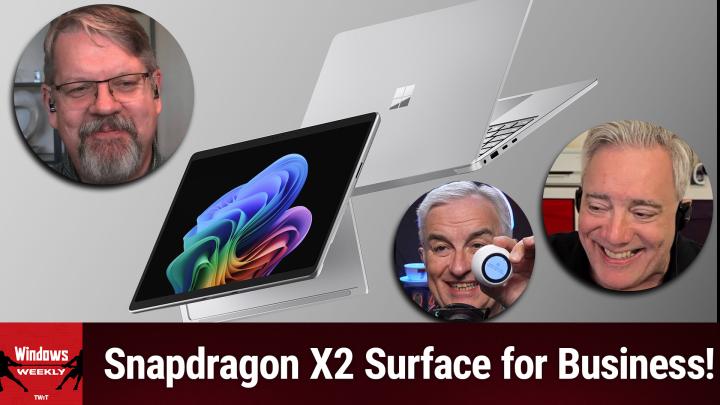
No, you don't. The one that never stops hallucinating. So back in, I don't know, two months ago, probably May, Microsoft announced the latest surface for business PCs. Right. With intel processors, the Core Altar 3. Right. Which is a good set of processors, honestly. Panth Lake.
Paul Thurrott [00:42:40]:
Right. So if I'm remembering this correctly, it was a. I don't remember if there were two sizes each, but there were at least one Surface Pro, probably a 13 point whatever inch. And then two Surface laptops, because they have 13.8 or 13.58, whatever that is, in 15 inch. Right. But running on Intel. And then a month later, they announced new versions of the Surface PCs for consumers with Snapdragon X2, which is the Qualcomm processor. So you get a choice of plus or Elite processor tiers, different things, whatever.
Paul Thurrott [00:43:12]:
Prices obviously went up pretty dramatically. And I think in that case we actually had two models of each. So there's two versions of Surface Pro, if I'm not mistaken. I could be. And then there are two versions of Surface Laptop, different sizes. Right. One of the things they said at the announcement for those is that at some point in the year they were going to introduce cheaper 8 gig configurations because of the component crisis. And I didn't expect to see that happen until kind of the end of the year, frankly, second half of the year sometime.
Paul Thurrott [00:43:39]:
But actually not that long after they did release. They didn't say anything about it, but they just added 8 gig configurations for the consumer products. So yesterday, I think it was, or two days ago, maybe they announced more Surface for business PCs, but with Snapdragon X2. So there are 13.8 and 15 inch configurations for Surface Laptop, 13 inch only for Surface Pro, different generation numbers, et cetera. But basically they're expensive, I think is the way to say it. I mean, on both sides, the cheapest configuration is $1,650. Like, yikes. There are no eight gig configurations.
Paul Thurrott [00:44:21]:
Although you never know that could happen. They didn't say that this time. At least you could spend as much as. What's the most expensive one yeah. 12 core Snapdragon X2 Elite with 64 gigs of RAM and a terabyte of storage on Surface Pro, 3700 bucks.
Richard Campbell [00:44:38]:
There you go.
Paul Thurrott [00:44:38]:
And I'm pretty sure that doesn't include the keyboard. Like, you know, it's like.
Richard Campbell [00:44:43]:
Because there is that 128 gig version floating around there somewhere, but not that anybody actually has one. Right. The Black laptop.
Paul Thurrott [00:44:50]:
Right, right, right. I've never. Yeah, this is kind of squirrely because, like, the Surface Laptop 15 for business, the new version on X2 with an elite processor, the highest end configuration, unless I'm missing something, I believe looking at it was 32 gigs of RAM and 1 terabyte of SSD for $3,000.
Richard Campbell [00:45:09]:
I looked at it on the Canadian site, and they had a 64 gig 2 terabyte version.
Paul Thurrott [00:45:14]:
Okay, it was Canadian. I could have missed it. Yeah, jeez. Yeah, they're expensive. And look, I mean, this is the component crisis I wrote. I think this morning I published something I had been writing called, you know, this is the absolutely worst time in history to buy anything. You know, if you need it, you need it.
Richard Campbell [00:45:29]:
I wish it was an exaggeration.
Paul Thurrott [00:45:31]:
I really do. I didn't want to write that, you know, but you can just look at, like, I looked at Pixel because there's been a lot of leaks. So we can look at, like, what the Pixel prices were a year ago, what they are today, like how they've changed. So they're more expensive in many cases, especially the base configs are coming with less ram, which is really weird.
Richard Campbell [00:45:48]:
Oh, I know what it was. The silver one was only 32. The black one was available in 64.
Paul Thurrott [00:45:54]:
And I'm like, what's that about? So that's two years ago when I bought my seventh gen Surface laptop, which is the first Snapdragon X processors. That's why I have a black one, because it was the only way. In my case, it was 32 gigs of RAM and a terabyte of storage. But I could not get that in the. Whatever, the platinum, whatever that color is, which is what I wanted, right? Because I knew that if I got this dark black laptop, which is anodized, anodized aluminum, I would just scratch the edges and the silver would shine through. And that's exactly what happened. You know, you want one that's like this? Let's make it as close as possible, the actual color. So if I scratch it or whatever, rub it with my wrists, you know, a bunch, it will just, you know, won't look terrible.
Paul Thurrott [00:46:38]:
But this is, you know, Microsoft is, you know, they're not a big PC maker. They don't have this infinite. Every color you want in every configuration you want is not a thing. So that might be. Excuse me. Why I didn't see the.
Richard Campbell [00:46:52]:
Yeah, and it's funny how you have to keep twiddling with the configuration.
Paul Thurrott [00:46:56]:
Well, if you hit a color before color changes. Your choice. Exactly. Which is. Yeah, I must have left it on the base color, whatever. The platinum color.
Richard Campbell [00:47:06]:
Yeah.
Paul Thurrott [00:47:07]:
Anyway, terrible time to buy a laptop,
Richard Campbell [00:47:09]:
but if you can buying a machine right now, you should.
Paul Thurrott [00:47:13]:
You are in good shape. If you can say no and just live with what you got, this is a good time for that. I mean, look, you need it or you don't. If you do need it, I mean, you can justify any of these purchases if you had to. And now you're going to use this thing for several years, maybe even a $3,000 surface. Something makes sense.
Richard Campbell [00:47:29]:
I don't know.
Paul Thurrott [00:47:30]:
But, but right.
Richard Campbell [00:47:30]:
The green only comes in 16. You have to select black to get the fun colors.
Paul Thurrott [00:47:35]:
That right, exactly. So two years ago, the light blue one was a cool color. And I was like, oh man, that's nice. I'm gonna get one of those. No, I'm not. You know, I think it was the same problem. I think it was 16 gig only. It's like, no, I need more than 16 gig.
Paul Thurrott [00:47:45]:
I needed it.
Leo Laporte [00:47:46]:
Then Apple invented this. I think like this is Apple, but Apple.
Paul Thurrott [00:47:50]:
Well, honestly, Dell invented this. But remember, Dell always had this like configurator thing. Like they have had this for 30 years. But when Apple, you know, Apple did the thing Apple does, which is they do a really good, like they eventually they used to have just models. Right. But then they did. You can configure anything on a Mac like, or whatever product. Like you're not.
Paul Thurrott [00:48:09]:
There's no version of you go to buy an iPhone and it's in whatever color choices and you can't get it in every storage configuration like they, they give you. You know what I mean? Like you have all the choices.
Leo Laporte [00:48:18]:
Right.
Paul Thurrott [00:48:19]:
This is one thing Microsoft just doesn't get. Well, it doesn't do well. Yeah, it doesn't do at all actually.
Leo Laporte [00:48:25]:
It's just an excuse like, okay, no, this is.
Paul Thurrott [00:48:28]:
They don't have the volume to justify it. They don't paying to have whatever. However they fabricate these things, they would end up with a bunch of stock because they'd have to buy some minimum and no one would want those configurations.
Richard Campbell [00:48:40]:
The US site is showing 64 gig 15 inch Ultras with a terabyte of storage. But only in black.
Paul Thurrott [00:48:50]:
But only right. How much?
Richard Campbell [00:48:52]:
37 for 37. Yeah, yeah.
Paul Thurrott [00:48:55]:
Okay. That matches Surface Pro.
Richard Campbell [00:48:57]:
Yeah. The Canadian site I just went and checked doesn't have any 64s anymore. They disappeared.
Leo Laporte [00:49:01]:
Oh yeah.
Richard Campbell [00:49:02]:
I mean it won't even show it as out of stock. It just does not show up.
Paul Thurrott [00:49:05]:
This is like finding the, the Willy Wonka pass in the chocolate bar. It's like it could happen.
Richard Campbell [00:49:10]:
But they also show 24s because, you know, why would you want a mutant memory configuration?
Paul Thurrott [00:49:16]:
Hey, I think 24 and 48 are going to become pretty big.
Richard Campbell [00:49:19]:
Yeah.
Paul Thurrott [00:49:19]:
You know, yeah, there's going to be a bunch of that kind of stuff. I didn't have this in the notes because this is what I was just publishing when we started the show. But the latest ThinkPad X1 carbon, which is not a Snapdragon, it's Panther Lake Core Ultra 3, whatever. Terrific. So this is like less than 2.2 pounds. It's a 14 inch screen, it's magically light. The performance is amazing. The reliability is really good.
Paul Thurrott [00:49:49]:
Everything's really good. The thing that's most interesting about it is they've taken like this sustainability to some new level at least for like a top tier PC maker. Right. So there's this list of recycled materials which is longer than I've ever seen in any laptop, which is whatever. But the amount of things you can replace yourself as a user, like as the customer is off the charts as well. So there are things like the SSD, which is on an M2 thing, the communication card, another M2 thing, the battery, whatever components. But you can replace the individual USB ports on this thing. Right.
Paul Thurrott [00:50:21]:
Which is like a framework style option. I've never seen that in a mainstream laptop. But the RAM is soldered on. It's like, guys, come on man, you got to figure out RAM, like CODIMs, whatever they're called. We got to move to a world where I could buy some 16 gig RAM computer today, or God help you, an 8 gig RAM computer with the understanding that in a year or whatever time frame, hopefully when prices go down to their sales or whatever it is, that I could upgrade that thing. Right?
Richard Campbell [00:50:50]:
Yeah.
Paul Thurrott [00:50:51]:
You know, and if one of the sides that kind of related to this with the Steam Machine is you also get into a single channel, dual channel problem with RAM. So if you somehow, if you have like two possible slots for RAM and only one is filled, it's running at like 2/3 the speed. Yeah, you have to have both slots to get the full speed. And I believe the base configuration on Steam machine software's from this. Now that one you can upgrade. It's a desktop computer. But if you get the base configuration, whatever that is, probably eight gigs, I don't remember. But you're going to have like.
Paul Thurrott [00:51:24]:
It's not just the amount of RAM that's the problem. It's the speed of the ram.
Richard Campbell [00:51:27]:
Right.
Paul Thurrott [00:51:28]:
So.
Richard Campbell [00:51:29]:
Well, and that's the other thing they're not defining in here at all. Right. And I don't think anybody wants to know like what's the speed of the RAM you're putting.
Paul Thurrott [00:51:36]:
Nobody wants to think about this, but it's okay because typically you never had to worry about it. No.
Richard Campbell [00:51:42]:
Because it always is the fastest rhyme in that would run properly.
Paul Thurrott [00:51:44]:
You're not going. You don't think about this. But now you have to think about this. So I don't think Microsoft.
Richard Campbell [00:51:49]:
Building up my list of why not to buy right now.
Paul Thurrott [00:51:52]:
Yeah, it's a solid list. It's a lucky.
Leo Laporte [00:51:59]:
Because we bought before this happened.
Paul Thurrott [00:52:01]:
Right.
Leo Laporte [00:52:01]:
Before it happened. Right.
Richard Campbell [00:52:02]:
Yeah.
Paul Thurrott [00:52:03]:
Right.
Leo Laporte [00:52:03]:
So I got 128 gigs of RAM and I'm.
Paul Thurrott [00:52:06]:
This might be. Look, I have. I've run into a thing where like phones is a problem, especially computers can be a problem. But I have to. I don't have to. But I do review these things and it's like if I have to buy a device, it's like I. I've had years where I've taken passes on certain things. Like I'm like I'm just not going to do it this year.
Paul Thurrott [00:52:24]:
And I'm looking at whatever they're going to release for iPhone in September, whatever they're going to release for Pixel in August. And I'm like, this might be Nicki.
Leo Laporte [00:52:32]:
I am going to make a prediction. I made this yesterday on Mac. Very quickly, this will be the year people do not upgrade their iPhones because Apple's already.
Richard Campbell [00:52:40]:
Yeah. Pixel for an 11. I think I'm not going to.
Leo Laporte [00:52:42]:
Yeah.
Richard Campbell [00:52:42]:
I was definitely all in for an X2 having missed the X and. No, I don't think so.
Paul Thurrott [00:52:47]:
Right. Yeah. So Pixel's weird because. And I was just looking at this now we'll see what actually happens when they release it. But there were different RAM and storage configurations across all these products. But. But they still had 128 gig configurations last year, which I think is terrible. Those are going away at least.
Paul Thurrott [00:53:03]:
So there's 256. But the base configuration I think on every phone except for maybe the Pro XL is going from 16 down to 12 or if maybe it was already at 12 depending on the phone. And then you have to upgrade.
Leo Laporte [00:53:16]:
Probably enough for a phone though, really.
Paul Thurrott [00:53:18]:
Probably. But it's just that the problem is last year you would have gotten 16. Right? So when you're buying like a Pixel, like for all the pros and cons, one of the big problems is the Tensor processor is kind of garbage. Like. Like it's not really an awesome processor. So you know that there's not going to be like a big year over year bump there. So it's possible, I think we're going to see this where like the base config on a Pixel Pro, whatever, 11 Pro might fall short of what it was a year ago, you know. And by the way, those year old phones, they're all on sale right now like for up to $300 off per configuration.
Paul Thurrott [00:53:50]:
Yeah, I'm just, you know, I'm not saying like, I don't mean this is a bit of advice per se, but maybe, you know.
Leo Laporte [00:53:57]:
Hey, Fable's back with its analysis.
Paul Thurrott [00:54:00]:
What does this say?
Richard Campbell [00:54:01]:
I don't know.
Leo Laporte [00:54:01]:
You know, this is interesting. I don't know how close this is to what we wanted. It said. I pulled the raw CVRF data behind that release note page from Microsoft's API. I gave it the Microsoft release note page and sliced it up. Yesterday's drop is a big one. Duh.
Paul Thurrott [00:54:17]:
Does it come up with a Number?
Leo Laporte [00:54:18]:
It counted 1150 CVEs in the release release note. 622 are Microsoft's own. The other 528 are third parties riding along via Azure Linux and Chromium Node TAR curl.
Paul Thurrott [00:54:33]:
Okay, okay, that makes sense.
Leo Laporte [00:54:35]:
So there's stuff that's in Windows, but is it.
Paul Thurrott [00:54:37]:
Yeah, whatever. Yeah, no, that. That actually maps to the numbers we were talking about.
Leo Laporte [00:54:40]:
It had three actively exploited zero days. We'd already mentioned that. But here's the patterns. This is what we wanted to know. Is there like where memory safety is still the whole ball game. The CWE distribution is brutal. 142 use after freeze 117 heap overflows, 6t out of bound reads. These are all human mistakes, right?
Paul Thurrott [00:55:00]:
Oh, of course.
Leo Laporte [00:55:01]:
Race conditions? I wouldn't necessarily say.
Paul Thurrott [00:55:03]:
I'd say also like kind of language compiler choice too. Right? Like, I mean look, if you're going to have this one of the key learnings here, I bet it's got, you know, Mark Russinovich, whoever is looking at this is going to be like, you Know, if we move to Rust, we would solve like eight of these.
Leo Laporte [00:55:20]:
Fable said 70% of the classified bugs are classic C C memory corruption in kernel mode and driver code. So that's the first thing it is.
Paul Thurrott [00:55:30]:
Kernel mode. Yeah. This is ring zero stuff.
Richard Campbell [00:55:33]:
And that's where you would want to point the tool at first. Everything running in ring zero.
Paul Thurrott [00:55:37]:
Exactly. And that's what you know, that was per the conversation we had earlier. It's like if you're looking at the code base, like where do you start? You start there. You know, the most vulnerable part, the most important part.
Leo Laporte [00:55:47]:
Privilege escalation. A lot of it. They say that's what attackers need from Windows bugs. The step from user to system file systems are getting fuzzed hard. NTFS there were 21 refs, 12 cloud files, mini filter brokering file system.
Paul Thurrott [00:56:04]:
Can you imagine? RFS is a big uptick.
Leo Laporte [00:56:07]:
58 CVEs in storage and file system drivers.
Paul Thurrott [00:56:11]:
Wow.
Leo Laporte [00:56:11]:
A huge Office document parsing cluster.
Paul Thurrott [00:56:14]:
104 cluster is the right word for the Office by the way.
Leo Laporte [00:56:19]:
I won't give you the second part of that. 104 CVEs in office, Excel board, PowerPoint, SharePoint, Exchange.
Paul Thurrott [00:56:26]:
So actually. Okay, so it pulled out office stuff too.
Richard Campbell [00:56:28]:
Yeah.
Leo Laporte [00:56:28]:
Excel alone has 34 server side network services took a beating. This sounds like you know, sports night server size network services took a beating multiple critical RCEs and DHCP server four exclamation mark. I love it. You know Fable has some personality DNS, SSTP, RMcast, multicast wormable class bugs and unauthenticated network listenings listeners. If you run Windows server infrastructure this is the patch first tier. The AI attack surface is now regular category so Copilot, Azure, OpenAI, GitHub, Copilot VS code mostly cloud side and auto remediated. That's nice. The one line story Microsoft is patching the same two structural problems.
Leo Laporte [00:57:20]:
It always patches memory, unsafe code and the user to system escalation path.
Paul Thurrott [00:57:25]:
Just a lot more of it. Yep.
Leo Laporte [00:57:27]:
While the in the wild action has moved upstack to identity infrastructure, SharePoint, ADFS, Entra and add CS.
Paul Thurrott [00:57:34]:
I bet the AI part which Cloud based so it's instantly remediated meaning they fix it once in the cloud everyone doesn't have to install that patch, right?
Leo Laporte [00:57:42]:
Yep. It sets for a show summary because it knows we're doing Windows Weekly Somehow Patch SharePoint and ADFS Today, Dhcp, DNS servers this week and everything else on the normal cadence.
Paul Thurrott [00:57:55]:
Here's a script you can use to you know, just like uninstall all of the useless crap on your Windows 11 computer.
Leo Laporte [00:58:03]:
I just want to point out when I read this, the notion that this is spicy autocorrect goes right out the window. I mean, this feels insightful. Am I wrong?
Paul Thurrott [00:58:13]:
Leo? EAA doesn't create anything. I don't know how we have to keep telling you this. Yeah, no, no. I think that's incredible. You know, I. This is good information. Like, this is good. It's good that it's doing this.
Paul Thurrott [00:58:26]:
I like that decision makers at Microsoft, like, people, whoever's in charge of this stuff, this is good for them, to help them kind of focus on the most important trends that we're starting to see, because we're looking at a month of data here essentially, or whatever, one thing. But they probably have several months. Well, they have forever, really. But they can kind of compare this month over month as they're going to see trends like that. And the memory safe stuff being number one does not surprise me in the slightest.
Leo Laporte [00:58:56]:
That's exactly what you expect. Right.
Paul Thurrott [00:58:58]:
It goes back to that exact conversation around Rust and it's like, oh, they're never going to redo the Windows kernel in Rust. And it's like, I bet they're doing it right now. I bet they're doing it well.
Leo Laporte [00:59:09]:
Especially that's the thing an AI is very good at, is translating from one language to another.
Richard Campbell [00:59:14]:
Yeah. And when you say patch, like, like, did you just mean replace that code base with one that isn't got the flaw in it that happens to be in a different language?
Leo Laporte [00:59:21]:
Maybe rewrite. You know what? That's what I'm in the process of doing. We have an old ad sales system we've been using limping along for 14 years. Mostly MySQL and mostly MySQL queries. And I'm rewriting it in Go.
Paul Thurrott [00:59:36]:
Yeah, there you go.
Leo Laporte [00:59:37]:
The nice thing is it gets all the business logic from the MySQL database schema from the queries, and it's easy for it to translate that into Go.
Paul Thurrott [00:59:44]:
And Go is a language. Go came out at Google. Right. Is this somehow related to. This is not related to Flutter in any way. Is it the same.
Leo Laporte [00:59:52]:
It knows I like Go. I could easily have done this in Rust or some other.
Paul Thurrott [00:59:57]:
But what was the impetus for go? Oh, why did they.
Richard Campbell [01:00:01]:
Cloud first language.
Leo Laporte [01:00:02]:
Yeah. It's also a. Concurrency is very good. It's multithread.
Richard Campbell [01:00:05]:
Yeah. So it's all about scalability, commutability, like just that mindset. If you're living in the cloud, there's going to be lots of everything. What do we do?
Leo Laporte [01:00:12]:
Yeah. And it's super fast. And one of the things I wanted was, you know, Lisa was complaining was how slow it was because the database is big if you include every ad we've sold over the last 20 years. So she wanted speed. So go is a good choice for that. Plus it is run. It's going to run in the cloud. It's going to run on Azure.
Leo Laporte [01:00:29]:
In fact, it is right now. We put it up on Azure for testing, so took it a week only because I was being really super cautious. I could have probably one shot at it, but I said no, I want
Richard Campbell [01:00:40]:
you to define it.
Paul Thurrott [01:00:41]:
Yeah. The phone rings. Some guy from Azure, he's like, hey, stop it.
Leo Laporte [01:00:45]:
Actually, here's a really. We're running it on a cheap Azure instance, running on arm because it was easy for it to.
Paul Thurrott [01:00:52]:
I mean, now when you say running on arm, it's almost certainly those Microsoft, whatever, the Maya processor, whatever those are, because those are all ARM based data center processors.
Leo Laporte [01:01:00]:
And it's fairly cheap. It's a small instance, but it can write it in ARM. It doesn't care. It can compile the ARM. And I don't know if we're using MySQL I think we're using PostgreSQL, but I'm not sure. So I should check. But. Okay.
Leo Laporte [01:01:14]:
This is the good and bad of doing this is I don't know what it's doing.
Richard Campbell [01:01:21]:
Let's just do it fast.
Leo Laporte [01:01:22]:
We're doing what we call BDD behavioral testing.
Richard Campbell [01:01:26]:
Right. Does it look.
Leo Laporte [01:01:28]:
It's saying things like have Lisa look at the spreadsheet. Do the numbers look right?
Paul Thurrott [01:01:34]:
If they do need a little more guidance than that. Like we went to our accountant today because we do taxes later or whatever because we're away. But Stephanie said to this guy, like, where did this number came from? This is you, right? Like you made this up or whatever.
Leo Laporte [01:01:48]:
Oh, good question.
Paul Thurrott [01:01:49]:
Yep. And she's like, I don't understand where this came from. And he's like looking at it right now. Neither do I. I was like, that's confidence inspiring. Ship it in. It's fine.
Leo Laporte [01:02:00]:
Let's just send it to the irs. See what they say.
Paul Thurrott [01:02:02]:
Don't just. Yeah, just see what happens. Possibly.
Leo Laporte [01:02:04]:
You're watching Windows Weekly. We're glad you're here. Every Wednesday with Mr. Paul Thurat and Mr. Richard Campbell and the latest Windows news Whiskey is coming up. I know you're all waiting for that with bated breath, but you know, maybe we should talk about since we've started already, AI.
Paul Thurrott [01:02:24]:
Yeah, yeah, yeah. I never know week to week where we're going to go with the AI.
Leo Laporte [01:02:29]:
Amazing.
Paul Thurrott [01:02:29]:
But this has been a fun week. So if there's anything better than two gigantic companies going at it. I have yet to know what that is, but in a kind of a replay of the we're going thermonuclear on Google thing from whenever that was 20 years ago, whatever, 15 something years ago, whatever. Apple sued OpenAI also IO products that Jony I've company that OpenAI owns now and two former employees, which really does little to describe how important these people were to Apple. OpenAI partnered with Apple about two years ago. Right. And I think to this day, if you use an iPhone or an Apple device and you're using Siri, whether it's the old crappy Siri or the new one, that's actually, by the way, pretty good. We'll get to this in the Settings app is configure it so that you can hand off things that Siri can't handle to OpenAI, ChatGPT and only ChatGPT.
Paul Thurrott [01:03:27]:
Right now, the number of things that Siri can't handle is approximately all of them. So if you configure that, you can opt in to not send them any of your information or you can log into your account if you're an idiot. Although I guess you would get higher usage numbers, whatever it is. And the point of this was a. For an Apple side to, you know, help, you know, with an AI thing that was not working and on OpenAI side to get traffic and potentially paying customers. There was a rumor, I don't want to say two months ago where OpenAI was apparently unhappy with the results they were getting from Apple usage and a rumor that they were going to sue Apple because of this and try to get out of this partnership. They're not going to have any problem getting out of it now because Apple sued them. OpenAI has poached over 400 former Apple employees, including some major executives, one of whom, by the way, has been at the company for over 25 years.
Paul Thurrott [01:04:24]:
He is as senior or was as senior in leadership as you could pretty much be without us ever having seen him on a stage. Right. And this is like astonishing. And there's been like a systematic campaign on OpenAI's part to bring people in from Apple to have them bring prototypes of Apple devices that haven't been made yet or blueprints or whatever they can steal out of there and use that as during the interview process as incentive for OpenAI to hire them. Now, look, these companies are all terrible. I get it. I'm actually not 100% sure what the legality is here. In other words, if the employee has an agreement with Apple that they've signed a legal agreement that they're never going to do something like this and they do it.
Paul Thurrott [01:05:10]:
But yeah, that's probably illegal. But on OpenAI side, just enticing them to do that. I don't know. I'm actually not sure. Like, is that actually a legal problem? I mean, it's the Apple guy breaking the law there. I don't know. It doesn't matter.
Richard Campbell [01:05:24]:
I mean, a company creating a circumstance for someone to break a law is definitely liable as well. I asked the question, like, why are these Apple guys going for it? What are they?
Paul Thurrott [01:05:34]:
Money. A buttload of money. That's the thing. So, you know, one thing that Apple and Microsoft historically have had in common or whatever, is that from just a pay package perspective, the base pay is not all that great. It's just kind of industry average or even below whatever. In both cases, I think you get into stock options and things and it might pay off over a long period of time, which makes these longtime hires, them leaving. Actually, that was 24 years. Sorry.
Paul Thurrott [01:06:01]:
But in one case, they have to be the backing up the money truck. That's why, like, how much? In the sense that everyone has another
Richard Campbell [01:06:11]:
racing side of the AI hype bubble.
Paul Thurrott [01:06:13]:
Yeah.
Richard Campbell [01:06:14]:
Is these companies have too much money.
Paul Thurrott [01:06:16]:
Yep. And zero morals. So, you know, you're an Apple guy. You've been there for it doesn't matter. Two years, 24 years, who cares? Whatever it is. And OpenAI's like, hey, we'd like to hire you. And you're like, yeah, I don't know. And they're like, we're going to give you a lot of money.
Paul Thurrott [01:06:28]:
It's like, yeah, I don't really care. And they're like, actually, we're going to give you like millions of millions of dollars. You're like, I'm listening. And you know, then you get into that kind of weird conversation. Right. But the thing that is so beautiful about this, I don't know which is stupider. So the Apple claim is that they reached out to OpenAI in February to raise concerns about all these practices and never heard back. Okay, you saw what happened.
Paul Thurrott [01:06:55]:
OpenAI's response is beautiful. They said you reached out to one of our employees who has a name similar to the person you thought you were reaching out to, and you sent that email to the wrong person, they
Leo Laporte [01:07:05]:
sent it to Chang, not Wang.
Paul Thurrott [01:07:08]:
Here's the thing. I'm sorry, have you as anyone. Look, I think all three of us have been involved in some situation where it's, I don't know, some kind of illegal thing or a money thing or whatever it is. When those people are trying to reach you, they do not stop. You don't get one email and then we're done. So the notion that Apple emailed one time and then was like, oh, they ignored us. Screw them. I mean these companies, they're not some random supplier.
Paul Thurrott [01:07:38]:
They have connections at the upper level. Most levels of both companies, like it's kind of, that's kind of incredible.
Richard Campbell [01:07:45]:
I totally suspect that Tim's got Sam's phone number. I'm just guessing.
Paul Thurrott [01:07:49]:
I can't imagine that. Well, not anymore. But I mean I, yeah, they had him in texting all the time, right?
Richard Campbell [01:07:54]:
Yeah.
Paul Thurrott [01:07:55]:
And I think the, and then OpenAI was like, I mean we did reply like, okay, what are you kids or something? What is this? So I, I don't know what comes out of this. I. Given the secret nature of both these companies, it would behoove them to settle this. Like I need, I, this doesn't, Nobody wants this to go.
Richard Campbell [01:08:16]:
At some point a judge is going to go, what are you people doing?
Paul Thurrott [01:08:19]:
It's insanity.
Richard Campbell [01:08:20]:
And again, they haven't responded well to that advice before. And I'm speaking specifically of Apple.
Paul Thurrott [01:08:25]:
Yep, that's absolutely true. Yep. Yeah, this is in the notes because it's not really, you know, on point for anything, but sometime this summer Google in the United States is going to allow multiple, any number of third party stores through Google Play because of that thing with Epic. And Apple is going to fight that tooth and nail until there is no Apple left. Like they just, if they ever are forced to do that, which they have been in certain regions or countries, like in Brazil for example, they just do it there. Google's just like, all right, we lost. Apple does not accept this.
Richard Campbell [01:09:03]:
Yeah, where is their Brad Smith? Where is that rational legal mind that goes, these are stupid fights, right?
Leo Laporte [01:09:10]:
Weirdly, the Apple attorney wasn't an in house attorney. It was some outside guy.
Paul Thurrott [01:09:16]:
I'm sorry, I. The whole thing to me is so ludicrous. The fact that they've named like lawyers and they talk about specific communications. Like I said, there's no way that Tim Cook did not reach out to Sam Altman about this. There's no way, like Sam Altman like the notion. I was like, well maybe he didn't know, you're like really, really.
Leo Laporte [01:09:37]:
Well, all of this the is will be revealed.
Paul Thurrott [01:09:42]:
I mean the real or it gets settled and it will never be revealed. Which I think would be the better outcome here, frankly. But not for me. I would love to see this revealed.
Leo Laporte [01:09:50]:
There's lots of questions about this. We've talked a lot about it on MacBreak weekly. But one question is what is Apple's intent here? Is it to stop OpenAI from releasing advice?
Paul Thurrott [01:10:00]:
Yeah, so the thing we just mentioned is tied to this I believe, which
Leo Laporte [01:10:04]:
is because remember they bought Jony Ives company. That's how they got Tang Tan and they spent $6.2 billion for it. So.
Paul Thurrott [01:10:13]:
Right. So look, Microsoft did this historically, you know, think about pen computing in the 1990s it actually was called go. Right, go was the name of the company back then. Bill Gates finds out about this, customers are asking about it and they're like oh no, we're doing the same thing. Yeah, we got a 10 just saying that is you can push it back and you know, you just scare and they did something garbagey but whatever. Eventually we had tablet PC but that didn't happen until like 10 years later. So Apple's stalling tactics with antitrust regulators and governments is designed to ensure that they keep collecting these ill gotten gains from app store fees for as long as possible because this is a huge revenue stream. If they can prevent a competitor from entering the market and potentially disrupting it with some kind of a new device, that might be the end of the iPhone.
Paul Thurrott [01:11:03]:
You never know. It makes sense to do that. Microsoft did this to Netscape, right? They went to federal antitrust court over this. So yeah, this is a known good tactic. Both companies technically, I guess have a lot of money, but Apple has real money and they will and can fight this as long as they have to just to put this stuff off. Now oddly, OpenAI has also said. I don't, I believe this was, I mean it was just reported. They, they have.
Paul Thurrott [01:11:32]:
Because we need one of these and it makes sense. But they could release a, their first smart device or at least announce it by the end of the year and then release it early next year. And the goal is to prevent that from happening. Not that what they, they're talking about like a smart speaker essentially, which sounds ridiculous to me, but yeah, whatever. But I think there's some few. Look, something eventually will disrupt smartphones. It may be some implantable things, it might be some combination of smart wearables, whatever their rings and glasses, we don't know. But it could come from an AI company.
Paul Thurrott [01:12:07]:
Right. And they did buy Johnny. Johnny. I was kind of a known good quantity. So we'll see. I just. I don't know. Look, Apple, when Steve Jobs is still around, threatened to go thermonuclear on Google.
Paul Thurrott [01:12:22]:
Apple, then they sued Samsung and did okay there, but they never really went after Google. And then they had this incredible partnership where I believe this year Google probably pays Apple $25 billion or more for search placement. Yeah, Thermonuclear. It's going to be one of the biggest partnerships in technology. Right. And now they're partnering on. With Gemini on Siri. So yes, I mean, like, whatever, I guess we'll see.
Richard Campbell [01:12:51]:
I don't know.
Paul Thurrott [01:12:53]:
I don't think we're going to learn as much as we want to. Tied to the Release of GPT 5.6, which is the latest frontier model or whatever from OpenAI, which by the way, releases new products every day. They're maddening. They released a new version of ChatGPT, which I think points to this future of. We're starting to hear this term, like super apparent. Microsoft has used this term. Right. There were rumors that Microsoft was working on a super app that would combine Copilot and the Cowork and whatever other features they have in there into one thing, which would be a Copilot, which by the way, to give them a little bit of credit, is something that's been thrown out as a possible.
Paul Thurrott [01:13:31]:
Like maybe this becomes the Windows user interface. Like instead of going to start, we go to Copilot and you type things in and it does the right thing. Right? Like that actually makes some sense. Satya Nadella, three years ago, two and a half years ago, said that he saw Copilot as the new Start menu. Right. He might have not been speaking, you know, vaguely. He might have been specifically like kind of previewing this idea. ChatGPT or rather OpenAI is doing that with ChatGPT.
Paul Thurrott [01:13:57]:
So they have had Codex for a while, like Anthropic. They were using their Codex in their case for productivity as well as programming. They a week ago or whenever it was announced something called Work, which is basically Codex, but just for productivity. So they actually have a new offering, a product, whatever you want to call it. And they had this thing, I think it was only Mac, I think it was just on the Mac, and I don't think that ever changed. But sometime late last year, they announced their Atlas AI web browser, which they're now getting rid of. So the new version of ChatGPT incorporates all those things they just said. So it's got an in app web browser based on Atlas, a chat, you know, chatgpt in the chat functionality we all know and love or whatever work, which is new Codex, right? And this is the super app.
Paul Thurrott [01:14:44]:
They're not describing it, but the rumors were they were doing this. And this is all those pieces. It is what Microsoft has said they are doing as well. And that makes sense. They know what OpenAI was going to do. And the thing that's changing is that we think of these things, or I do anyway, is like chatbots. Like you get a chatbot and there's a sidebar and then you go over here and there are options over here that we in their case would be things like work and codecs and whatever else. And Microsoft, they have projects and whatever different things that are over there, whatever the options are.
Paul Thurrott [01:15:13]:
But the primary interface is this chat box, right? And that's what's shifting here. Like this is becoming the ui, if you will. Like, this app is not chat. Chat now is in the sidebar. It's this other stuff. And when you think about it, we're going to have this kind of natural language conversation with these things. These companies are starting to kind of rethink what it means and what it looks like to interact with the AI. It's like, well, how are people solving problems? How are people getting work done? How are they getting from question to answer? Whatever it might be, chatting is still part of it.
Paul Thurrott [01:15:48]:
This is going to be a chat box. I mean, probably forever, but they're doing that work and it's kind of interesting. So this is kind of a space to watch. The other one, in keeping with my observations so many times, is like any major AI company that announces any feature, whatever it is. So it could be code or Codex or work or cowork or whatever the names of these things are in different AIs. If one of those companies announces something within 24 hours, at least one of the other competitors will announce the same thing and God help them. Anthropic. Less than 24 hours after this announcement was like, we have an INAPP web browser too.
Paul Thurrott [01:16:25]:
It's like, of course you do, of course you do. You know, like, do you see these
Richard Campbell [01:16:29]:
as the Stevie Batiste outside app model?
Paul Thurrott [01:16:35]:
Yes, but the differentiator, though. And I guess it's just the thing, like you come at it from a certain point of view, so you don't really kind of see this future when you talk about things like side by side apps, like the outside App, Right. Which is a copilot model. Right. You're like, okay, I get that. Like, I'm using this computer. This is the. It could be Windows, it could be a Mac, could be a phone.
Paul Thurrott [01:16:57]:
Doesn't matter what it is. Yeah, whatever I'm doing, this thing is over here on the side. Like, hey, buddy, you know, it can help you out. Like, neat.
Richard Campbell [01:17:02]:
That's the B side model. I think that's the original. Yeah, I want to. And then.
Paul Thurrott [01:17:06]:
And then you're like, okay, but we're going to evolve the software. You're like, yep, got it. So. And the Microsoft Office apps are classic example. Like, because you'll have a sidebar, because that makes sense. We'll add that first. We can do this. Okay.
Paul Thurrott [01:17:16]:
Here we are in the same. So you don't have to switch context. You know, we have all these terms for this, but ideally this thing adapt or is evolved to the point where AI is integral to the way it works internally, or maybe we have new apps, you know, whatever. But the AI is inside. Like, it's not like a little side thing. It's not a model.
Richard Campbell [01:17:33]:
It's the inside model.
Paul Thurrott [01:17:34]:
The inside model.
Richard Campbell [01:17:35]:
Yeah.
Paul Thurrott [01:17:36]:
But when you hear about AI, I guess outside or. Yeah, the third model, we're still thinking in terms of the thing we're already doing, right? So in this case, Windows. So we're like, all right, we have Windows, and I guess we could have, you know, we have agents. We're going to have agents on the taskbar, and those agents are going to go off and run autonomous tasks and then do it simultaneously, et cetera, et cetera. But you still have the same basic usage model. Like, the part of the transition there is that it's making it work within the thing, you know, and understand. So agents work like apps, and they put up banner notifications if they need you. And it makes sense within this thing that we know.
Paul Thurrott [01:18:13]:
But if you're anthropic or OpenAI or any company that's not Microsoft, Google, or Apple, you don't necessarily think about it this way. You have to get your stuff where people are now. That's why we have browser extensions and apps on platforms and whatever. You have to integrate with everything that you need to integrate with. So we have those backend things like mcp, et cetera. But this, to me is looking at the next thing, which is still, I guess, outside. But it's also like, do we actually need Windows anymore? You know, do we need, like, you know, like, we would joke maybe two weeks ago, because this Goes so fast, like some future day you'll have like an iPhone and it just boots into chat GPT and that's your interface and hahaha. But that's really kind of what they're talking about, right?
Richard Campbell [01:18:56]:
Yeah, that's what the outside model was really about is hey, I need a proxy for the whatever work. I just declare what work I need to do.
Paul Thurrott [01:19:03]:
You can't just go to it immediately, right? You have to that. All the work we've seen integrating with apps on Android, whatever Apple systems and Windows, integrating with backend services, which is fairly straightforward, whatever those things are, that has to happen because the world of work is occurring or whatever it is, we use apps and services. And that's what it is, it has to work.
Richard Campbell [01:19:23]:
It's also how people think about the workflow too. Right? When the cloud first came along, we wanted virtual machines because that was what we understood. If you brought us serverless at the beginning, which people tried to do, people didn't know what to do. Not that it was perfect.
Paul Thurrott [01:19:37]:
That's a good example actually, because I bring this up from time to time. But when they first announced Windows Azure, it was originally called, I didn't understand what they were doing. I didn't get. I was like, so this is Windows Server running.
Leo Laporte [01:19:46]:
Pronounce it no.
Paul Thurrott [01:19:47]:
Right?
Richard Campbell [01:19:47]:
No.
Paul Thurrott [01:19:48]:
I mean I just didn't. I really struggled with it. And that's where your experience, which is usually your advantage, can work to your disadvantage because the world is changing and you're not ready for it. You're used to this thing. So again, this is baby steps for right now, but they're very clearly working toward this. I don't like, let's make a simple example, and I'm just making this up, but You're a Microsoft 365 customer. You have access to Word, Excel, whatever else, and you can access it on your computer, your phone, whatever. One of the things you could do right now is use any of these AIs and go to it and say, look, I have this backend data source, whatever it is, I want to make a nice chart, which maybe you might have done in Excel previously.
Paul Thurrott [01:20:32]:
You just ask it to do, just does it. It's beautiful. You can talk to it and change it and whatever. Did it use Excel? I don't know. You don't know. But at some point you're going to have this conversation with yourself or maybe with your, the money people at your company, and it's going to be like, why are we paying for Microsoft 365 I believe that this thing could just do this and I don't need to pay for that thing. And the thing you pay for becomes the AI, not the Microsoft 365. A simple example, but.
Leo Laporte [01:20:59]:
But you saw that what OpenAI is planning is just a speaker. Their first product is just.
Paul Thurrott [01:21:06]:
Which sounds stupid, right?
Leo Laporte [01:21:08]:
Yeah, maybe not.
Paul Thurrott [01:21:09]:
No, I mean on first blush you're
Leo Laporte [01:21:11]:
like, oh great China, it's just a little ball.
Paul Thurrott [01:21:15]:
Do not put that in front of my camera. You just didn't put a virus in my house.
Leo Laporte [01:21:19]:
It connects.
Richard Campbell [01:21:20]:
Comrade G likes your citizenship score doing fine.
Leo Laporte [01:21:25]:
It's got a little tinny.
Paul Thurrott [01:21:26]:
By the way, that's the next interesting. You said deep sea, right? That's the next big disruption in the space. Because when this comes down to money, when they we're actually charging customers for usage and China's like, hey, we got lots of power. We, we can do this for 110 the price.
Richard Campbell [01:21:42]:
You know, great, great articles already saying, you know, what's the price per million token?
Paul Thurrott [01:21:48]:
No, and the, and the natural.
Leo Laporte [01:21:50]:
So let me give you an example. So fable is $10 for a million tokens in and $50 for a million tokens out. That's the answer is the results. Deep Seq is, I think it's 14 cents for a million tokens in and 50.
Paul Thurrott [01:22:04]:
So let's say Leo tokens out. You're a patriotic American and you're like, you know what? Screw that. Those guys stole from American companies. I hate it. I'm not doing that. Here's the problem. Yeah, so did OpenAI and Anthropic. They all stole.
Paul Thurrott [01:22:20]:
You're going to get up about stealing from thieves? Are you kidding me? I'm sorry, but in the sense that everyone has their price, if this goes from being unaffordable to anyone can afford it, I don't think anyone's going to question what country this thing is coming from.
Leo Laporte [01:22:36]:
I'll give you a great example. I asked my AI, okay, all the tokens I used, all the work I did last month, and by the way, I'm doing 10 times more this month. But all the work I did in June.
Paul Thurrott [01:22:47]:
Yeah.
Leo Laporte [01:22:47]:
If I'd been doing that with, with Fable, with a top end model from Anthropic, how much would have cost? It said $5,771 in one month. I said, if I use Deep Seek, how much would it have cost? 117 bucks.
Paul Thurrott [01:23:01]:
They're like, actually we would have cut you a check.
Leo Laporte [01:23:03]:
Yeah, we'll pay you.
Paul Thurrott [01:23:05]:
Yeah.
Leo Laporte [01:23:07]:
China may have an agenda with all that.
Paul Thurrott [01:23:10]:
Oh, by The Way Agenda. There is a company in our country called Intel. You might have heard of it. They used to be great. Actually, I'm not sure they were ever great. But whatever, they were great. They're a terrible company. They can't do anything right.
Paul Thurrott [01:23:23]:
But because they are backed by the US Government, now we're starting to hear they're getting deals with companies to do stuff, supposedly, and no one's ever actually done anything yet, but whatever. The United States government is artificially holding this company up to keep it or make it more successful. It's certainly been successful in Wall Street. This is the complaint we have against China. I'm sorry, but we're just doing exactly the same thing. What are we defending here? So, look, I don't know. At the end of the day, I think we just want to get the job done.
Richard Campbell [01:23:54]:
And if you're going to be exploited, be exploited by your own government, they're less likely to turn off all your stuff.
Paul Thurrott [01:23:59]:
I kind of like the government I'm being exploited by to be further away, actually.
Richard Campbell [01:24:04]:
Think about the push against Huawei when 5G was being deployed and the British did the analysis on their software and said, we can't tell what they're doing here. This software is so obfuscated. And basically the Western world said, okay, we're not going to use Huawei 5G gear because we just don't know what's going to happen.
Paul Thurrott [01:24:22]:
Yep, yep. So I, I, look, I'm not, I'm not, I'm not defending China. I don't mean it like that. I hope this is taken with the proper comedic approach or whatever, but I think AI is going to be very disruptive. So we see that. Like I said, keeping it to the topic we started with, you're seeing the super app kind of idea kind of evolve. And when you're a platform maker, whether you're Microsoft with Windows or Apple with whatever they have, or Google, these are companies are all involved in AI to some degree and great degree in many cases. But this is disruption.
Paul Thurrott [01:24:59]:
You know, when you're Apple, like you have a history of, in their case, disrupting themselves. Right. They did the iPhone because they didn't want the iPhone or the iPad, sorry, ipod, to be destroyed by some other company. So there's a certain amount of bravery to that, for sure.
Richard Campbell [01:25:14]:
It's a rare exception. Most companies, you know, Google.
Paul Thurrott [01:25:16]:
No, no, that's what I mean. Like, usually it comes from outside, right?
Richard Campbell [01:25:19]:
Yeah.
Paul Thurrott [01:25:20]:
And Apple is not going to bat a thousand on this. I mean, it's possible this is why they're going after OpenAI. They see the potential disruption here and to stall that as long as possible is what makes sense.
Leo Laporte [01:25:32]:
They may also really be pissed off.
Paul Thurrott [01:25:35]:
Oh, they're clearly. Clearly the language in that thing is amazing.
Leo Laporte [01:25:40]:
Yeah.
Paul Thurrott [01:25:40]:
The Apple lawsuit is classic.
Leo Laporte [01:25:42]:
That's great.
Paul Thurrott [01:25:43]:
It's like, see if I can find this thing. It's like coordinated pattern of misconduct and open. Open AI's recent. I'm sorry. Nascent hardware business rests on the shakiest of foundations, rotten to its core. Which is a nice term from an Apple by its illegal reliance on misappropriated trade secrets. Sure.
Richard Campbell [01:26:06]:
Wow. I mean, by the way, this case and the Elon Sam case, like, they both seem like.
Leo Laporte [01:26:13]:
Or thrown out by the way.
Paul Thurrott [01:26:14]:
Or the many decades of various cases involving big tech companies that are poaching employees from each other that have been occurring since the beginning of this industry. And sometimes it flares up in a big way. Steve Jobs used to get involved in that stuff personally. He didn't want certain companies stealing from him.
Leo Laporte [01:26:32]:
Yeah. He had a deal with. I can't remember, was it Microsoft or Intel that. I won't put your employees if you don't.
Paul Thurrott [01:26:38]:
It might have been Google. Actually. It was Google.
Leo Laporte [01:26:39]:
You're right.
Paul Thurrott [01:26:40]:
I think it was Google. And that's illegal. You can't. Yeah, you can't actually. Yeah, you can't do that. So the, the opposite of that is we're just going to poach 400 of your employees. It's unbelievable.
Leo Laporte [01:26:53]:
It's just a fascinating. It's good to be outside.
Paul Thurrott [01:26:56]:
It just couldn't. Couldn't happen to a better company.
Richard Campbell [01:26:58]:
Yeah.
Paul Thurrott [01:26:59]:
Yeah. So that's great.
Leo Laporte [01:27:00]:
Anyway, it also plays into people's kind of general sense that Sam Altman is a little weaselly and squirrel.
Paul Thurrott [01:27:07]:
A little Weasley. Look, I, I will. The only thing that Sam Altman has in common with any of the people running any of the big tech companies now or in the past is that he is an absolutely terrible human being. Yeah, I. He is. He fits right into this.
Leo Laporte [01:27:22]:
But so let's face it, so was Steve Jobs.
Paul Thurrott [01:27:24]:
And that's what I mean.
Leo Laporte [01:27:25]:
So was Bill Gates.
Paul Thurrott [01:27:26]:
No, not to some degree. To every degree. You kidding me?
Richard Campbell [01:27:28]:
The big difference here is he hasn't made a wildly successful product.
Leo Laporte [01:27:32]:
True.
Paul Thurrott [01:27:33]:
Yeah. Well, I, I mean, you spent a
Richard Campbell [01:27:36]:
whole lot of other kinds of money.
Leo Laporte [01:27:38]:
I actually don't know if I'd agree with that. I think.
Paul Thurrott [01:27:40]:
Yeah, right. It was so.
Richard Campbell [01:27:41]:
Well, successful being actually could pay for.
Leo Laporte [01:27:44]:
Oh, making money.
Paul Thurrott [01:27:44]:
Oh yeah. He's no Elizabeth Holmes. He's not faking it.
Richard Campbell [01:27:49]:
Yeah.
Paul Thurrott [01:27:49]:
You know, I mean, product. Yeah, he does. You know, people use it. I mean, I'm not saying it's like a good business model per se, but I mean, it's, you know, it definitely works. So it's not like he's faking blood tests or whatever, but. But give them time because they'll eventually expand into that market too. They're just terrible. So they're all terrible.
Paul Thurrott [01:28:09]:
Maybe that's the central point. Don't ever forget it because it's like, don't over romanticize any of these companies. They're all terrible. And then just real quick, Apple just the other day released the public betas of their OS 27 releases. So I've been using these things since the first developer betas. And I'd say Siri, which is a laughing stock and deservedly so and still has its like, just stupid stuff. Like, I literally. Stop.
Paul Thurrott [01:28:36]:
He just came once. Would you shut up? So after I wrote about Siri, I was working one day and it said something like, this drives me crazy. Everyone talks about how awesome the Apple ecosystem. Everything works together, right? So on my iPhone, actually it happened just. It just happened again when we were starting the show. So on my iPhone, if it's a slow, potentially spam call or whatever, they're starting to do a slightly better job about just not showing me that. Like, it will still pop up as a notification, but it's a silent notification and it doesn't like appear in the main screen of the phone or messages app. Like, it's just, it kind of hides it and it's like, okay, it's not as good as Google.
Paul Thurrott [01:29:12]:
Google does an awesome job of that stuff, but it's better than it was. So if you're in the Apple world and you see this, you're like, oh, nice. They've done a really good job. But every time one of those things comes in, my Apple watch is like, burpees. I look down and it says the phone number. And it's like, this is like over my phone. And the phone's like, oh, this is probably spam. Why are you telling me about it on my wrist? Like, it's ridiculous.
Paul Thurrott [01:29:33]:
The weirdest one of all though, is just the other day, I was just sitting there working, typing. My watch burbles and then it starts talking. It's never done this. Siri is don't wake up. Is talking out of my watch and it says, I don't remember the name. It says something like, matthew, somebody has left A very long message. Would you like me to read it? And I, I'm like, what? And so I assumed it maybe was like an email or something. So I look at my phone, it's a spam message and I had to go into the spam view to see it.
Paul Thurrott [01:30:02]:
And there he is. Matthew's in there. Let's look at it now. It's crazy. And it's just like, you know, you qualify for $329,000 in like business loans from. Did you. And, and why would you tell me.
Richard Campbell [01:30:17]:
So you made it all the way to the watch.
Paul Thurrott [01:30:19]:
There are still problems, but I will say this. So if you, I'm not saying if you're an Apple person, like you should install these things necessarily, but if you have been kind of angsty about Siri and how terrible it is, which you should be this new one, the way it works, I like the way it looks. You could do the chatbot app thing and you can ask questions like the types of things people use AI for today typically. Right. Maybe a travel itinerary thing being the kind of canonical example these days. It's pretty good and it does. Nice presentation. It will read it to you.
Paul Thurrott [01:30:51]:
It's like a beautiful looking report. Yeah, it's using I guess Gemini in the back end or whatever it's doing. Who cares? But it took them years but I think it looks like they're going to kind of get there. So I'm kind of surprised. So they were doing flowers for Algernon for a while there, but now it's, you know, it's getting there. And for whatever it's worth, I mean I honestly day to day, like to me the biggest single thing on a phone for AI is the visual intelligence stuff, as Apple calls it. But every phone has some version of this where you point the camera at something, it tells you what it is. And if it's a product, it tells you how to buy it.
Paul Thurrott [01:31:29]:
If it's a building or a monument, it tells you the history of it. And you know what it, you know, that stuff is awesome. Like that's a really cool thing to have on your person when you're out in the world. And actually that's something Apple has been doing pretty good for the past couple years.
Leo Laporte [01:31:42]:
You know, it's interesting because it turns out to be a really easy thing to do. A small purpose built model can do that very well. I have a Quen, a Chinese Quinn
Paul Thurrott [01:31:51]:
model that does visual analysis. You're all in on China, man. I'm all in.
Leo Laporte [01:31:56]:
I tell you. They're inside everything I got. Well actually they're inside everything you got.
Paul Thurrott [01:31:59]:
You got one of those little Chairman Mao hats on you just like.
Richard Campbell [01:32:02]:
But you get back to the reality here is as you these prices, you know there's this cult going on that believes if we keep making it bigger, just like science fiction tells us, that it'll mysteriously turn into a self aware piece of super intelligence. Meantime, the engineers are like what's the smallest lowest cost working unit that can do something useful?
Paul Thurrott [01:32:22]:
Right.
Leo Laporte [01:32:22]:
Prism ML is a good example. They've figured out how to get a good model down small enough to run in a few megabyte gigabytes of ram. In fact that's this Chinese model is. It's an analyzing all the input from my cameras, you know, I have all the security cameras and it just analyzes it and it's, it's, it's like a couple of gigabytes and it's really good. It says a woman in a brown hat and yellow shorts is walking down the right street with a package and a baby. And it's, it's surprisingly good. That's. Those things are not as hard to do as that whole general purpose.
Paul Thurrott [01:32:56]:
But there's, they can be, they can be very useful. It can be very useful though, right?
Leo Laporte [01:33:00]:
Like I think yes, it's not practical. It uses a lot of energy.
Paul Thurrott [01:33:03]:
No, I mean just the like general use stuff. Like those are nice. Like they're fine. I still, you know Google is probably better than anyone at this but you know, if you're like I can't see a screen on a phone anyway but you some photo on a phone that's
Leo Laporte [01:33:17]:
a very good use for.
Paul Thurrott [01:33:18]:
I want to get rid of this person in the photo and yeah, we can replace them with a smudge mark. Is that okay? And you're like no, like you know, like you kind of want, you know what I mean? Like you want it to be a little better than that. But I mean I feel like that will get there eventually. I don't know.
Leo Laporte [01:33:30]:
They're moving hard and I think that that is really one very interesting direction is these small purpose built models.
Richard Campbell [01:33:36]:
Yeah, yeah.
Paul Thurrott [01:33:36]:
We're going to see a ton of. We already. The truth is we already do. Right. And only, it will only grow.
Leo Laporte [01:33:40]:
It's driven by the desire to get them onto devices, right?
Paul Thurrott [01:33:45]:
Yep, yep. And not not get the cloud cost happening.
Leo Laporte [01:33:50]:
Right. And then the costs and the energy data centers.
Richard Campbell [01:33:54]:
I've had some good conversations with folks leading software projects thinking we're going to end up with a dedicated LLM in each app for doing modifications. That app, it's constrained by the architecture of the application, which is good for
Paul Thurrott [01:34:06]:
that app, actually, and the way you're using it, because that's what you want, you know, you don't want it to be like, I found a random web result that might apply to what you. It's like, no, I want you to use the thing.
Leo Laporte [01:34:14]:
Exactly.
Richard Campbell [01:34:15]:
Let me convert all this code to Rust while we're at it. Right, yeah.
Leo Laporte [01:34:18]:
Steve's been saying what you're going to get is small. For instance, coding models that they're really good at writing. Go. Yes. That's what they do.
Paul Thurrott [01:34:26]:
Yes.
Leo Laporte [01:34:27]:
You know, one of the questions Lisa had for this new ad sales system is, well, what happens if you're on the air and it's broken? Who's going to fix it? And I think I'm going to build a little purpose built AI model into a little chatbot in the corner that she can say, hey, something's not working,
Paul Thurrott [01:34:43]:
or hey, you know, and it's, yeah,
Leo Laporte [01:34:45]:
what did this company buy in the ads last month? That kind of thing.
Paul Thurrott [01:34:49]:
If you pay attention, and you guys do, but to anyone listening, if you pay attention to what's going on with like clis this year, it's kind of incredible. So there's like an Android CLI for Android development. There's a window, I don't remember the names anymore, but the CLI is for Windows. And the point of this is not, it's not because there's literally a single model that is for that language and framework, whatever, but you can ground it in just that. And that, that gets you there and that solves some real problems because its ability to grab information from everywhere is wonderful on some level, but it's also the problem. Everything you guys just said is like you're talking about an app. I want it to be grounded in the app and that's it. You don't get to see outside of this thing.
Paul Thurrott [01:35:32]:
There are ways to corral AI today to do that, but I do think purpose driven models that are relatively small in size and specific to that use case, we're going to be swimming in these things. And by the way, before anyone freaks out too much about that, every one of our devices already works this way to some degree with all these background processes and things. Every computer system of whatever kind has apps that we see, but they also have all these apps that run in the background essentially that you don't even know about. And it's going to be that kind of thing. And it's the new background processes or whatever, but I think it's. I don't know. There's no way this, this is going to exponentially increase. It's insane.
Leo Laporte [01:36:08]:
One of the fun experiments I do is comparing these expensive cloud based models with a local model. I'm running a local model that is a kind of distilled version of the Chinese model, Quinn. It's called Ornith and it's small and it's running on my machine. It's not good. It doesn't go out to the cloud. And for probably 90% of the stuff I do, it's plenty.
Paul Thurrott [01:36:31]:
Yeah.
Leo Laporte [01:36:32]:
So if I'm going to analyze the Microsoft code base and tell you what they've solved that I would use Fable for, but for a lot of other
Paul Thurrott [01:36:39]:
things that I do, maybe in six months you won't. It's interesting. I feel like we talk about this a lot, but at some point there's that orchestration thing where the 90%. Yep. But then you have whatever rules where if it can't, like it's like we already have them.
Leo Laporte [01:36:56]:
They're agent.
Paul Thurrott [01:36:57]:
Yeah, I just mentioned the iPhone will hand off the chat GPT. Right, Exactly. That's stupid, unsophisticated version of this. But that's essentially what it is. Like you can say, look, maybe you have to prompt me if it's going to cost money or whatever it is, but at some point, if we're online and we can access that model, you can't do whatever that last 10% is, go up and make that happen.
Leo Laporte [01:37:17]:
I'm going to rename this show Intelligent Machines and then give Paris and Jeff Windows Weekly because you guys, you're good. By the way, the chat room is saying I should call this little window in, in the Twitter ad sales thing, Bob. I don't know why.
Paul Thurrott [01:37:32]:
Clippy, clippy, little clippy Clippy. It looks like you're trying to.
Leo Laporte [01:37:38]:
It looks like you're trying to sell ads. Can I help?
Paul Thurrott [01:37:40]:
Yeah. Yeah.
Richard Campbell [01:37:40]:
Yes.
Paul Thurrott [01:37:41]:
Right. Yep. My ad sales are up 110%. Thanks.
Leo Laporte [01:37:46]:
If I could figure out a way to do an AI podcast sales agent, I would, believe me.
Richard Campbell [01:37:52]:
Goodness.
Paul Thurrott [01:37:52]:
I'm pretty sure you could actually change the world. Yep.
Leo Laporte [01:37:56]:
What do you think, Richard? You do all your own.
Richard Campbell [01:37:58]:
Sign me up? I mean. Yeah, yeah, yeah.
Paul Thurrott [01:38:01]:
This is what. Look, I mean, I mean, we're making fun of it, but really at the end of the day, it saves you money, saves you time. You're telling me you wouldn't want that thing? I mean, right? Yeah.
Richard Campbell [01:38:10]:
For a job.
Leo Laporte [01:38:11]:
I was skeptical when I started the rewrite, and I think I've kind of won her over because we. I ran through it a little bit, and she said, oh, okay.
Paul Thurrott [01:38:20]:
Right.
Leo Laporte [01:38:20]:
And. And now she's making me videos of the old system and saying, this is what I liked. This is. I'd get rid of this because now we're changing the user interface to match.
Paul Thurrott [01:38:29]:
She doesn't know it, but she's vibe coding it.
Leo Laporte [01:38:31]:
She's our. Yeah, don't tell her.
Paul Thurrott [01:38:33]:
I know.
Richard Campbell [01:38:33]:
I'm not.
Paul Thurrott [01:38:34]:
I'm just, you know, that's exactly what she's doing. But this is that moment we all have, all will have at some point. Because even the biggest doubters, the haters, whatever, there will be, you know, look, even the people hate AI. We keep talking about these bug things. I mean, come on. Like, I don't care how much you hate this stuff. You got to. You have to agree, like, this is.
Paul Thurrott [01:38:51]:
This is great.
Leo Laporte [01:38:52]:
Well, and somebody's written. I think it's called Nobili or something. A kind of headless Excel for Mac that can read and write Excel. Yeah, but you don't use. It's for an agent. So one of the things Lisa does is output all the sales into an Excel spreadsheet. Well, guess what? That's trivial.
Paul Thurrott [01:39:14]:
This is what I was talking about earlier. In other words, you might not care, but maybe you do care because you're paying for it. You don't care if it's actually using Excel on the back end. If it's not, that means you don't have to pay for Excel, meaning you don't Pay for Microsoft 365, which means you're saving a hundred bucks a month or whatever it is.
Leo Laporte [01:39:27]:
It does all the formulas. It's practically Excel. It's very close.
Paul Thurrott [01:39:33]:
Yep. And whatever output format you want, like, even, like the dumb version of this, like 10 years ago, 20 years ago, would have been, I work for. I write books. I have to, you know, have to go through a publisher. They have to take. It has to be Doc format. You have to use Microsoft Word. And if you're a real idiot, you could be like, well, I'm going to use LibreOffice or some other thing, and then I'll output it to Word Document format at the end.
Paul Thurrott [01:39:54]:
The modern version of that is. You don't even think about the tool, but it does output it to docx or whatever it is at the other end, and it's perfect. So who cares? You know, like, it doesn't matter what you use to get There. And that's. I think that what AI is going to change or is changing really, like right now. So I don't want to talk about Spotify, but I just want to mention I hate Spotify so much. And now I can tell it that I hate it because it has AI built into it, because God knows why. Because everything has to be conversation.
Richard Campbell [01:40:21]:
Everything else has to happen.
Paul Thurrott [01:40:22]:
Because what I want to do when I'm listening to music is talk. But you know what? It's okay, I get it. Like, everything's going to do this. So they've had AI playlist. I think there's an AI DJ up speaking, which last thing I want to hear when I'm listening to music is DJ talking. But. But which YouTube is starting to do. And YouTube music is starting to do in their playlist, which I hate so much.
Paul Thurrott [01:40:44]:
But you can, you can start talking to this thing. So you can, you know, I'm sure it's going to go in this direction where it's like, I really like, you know, Van Halen or something play. You know, these are things we already kind of do. Right.
Richard Campbell [01:40:56]:
Like, this is what Spotify already does. You play a song that you really like, it follows it up with songs you think you're going to like.
Paul Thurrott [01:41:03]:
Yeah. So but now you can do it explicitly, I guess, or something. I'm not going to do it. Spotify was one of those things.
Richard Campbell [01:41:08]:
They just had to answer the question of the board, what are you doing about AI?
Leo Laporte [01:41:11]:
Exactly. That's what you nailed it.
Paul Thurrott [01:41:13]:
What would you say your job is here?
Leo Laporte [01:41:17]:
I'll tell you what my job is here. It's to say you're watching Windows Weekly with Paul Thurat and Richard Campbell. We do this show every Wednesday, 11am Pacific, 2pm Eastern, 1800 UTC. And you can actually watch it live. We stream it into the club Twit, discord, but also YouTube, Twitch, X.com, facebook, LinkedIn and Kick. And if you're here at 11am Pacific, 2pm Eastern, 1800 UTC, watch it live with. Chat with us live as we're doing it. And actually Richard and Paul both go into the Discord chat.
Paul Thurrott [01:41:48]:
So when.
Leo Laporte [01:41:50]:
When Richard gets bored, he starts chatting with the people.
Richard Campbell [01:41:54]:
Poking me, poking you with stuff on.
Leo Laporte [01:41:58]:
We go with the show because, ladies and gentlemen, boys and girls, children of all ages, it's time for the vaunted, the revered, the beloved Xbox segment.
Paul Thurrott [01:42:09]:
And that introduction is longer than the
Richard Campbell [01:42:11]:
section, but the music is especially appropriate.
Paul Thurrott [01:42:15]:
Yeah, some weeks it's big. And last week was, you know, our date with Destiny or however you wanted to. Yeah. This week it's been pretty quiet. That makes sense. I think there's like kind of a trauma lull. I actually went up to the Xbox wires. I'd just be like, they missed something.
Paul Thurrott [01:42:31]:
Like, what's happening? Nothing.
Leo Laporte [01:42:32]:
You think this would be a good time to try to buy a house in Seattle? I'm thinking there might be some vacancies.
Paul Thurrott [01:42:36]:
Yikes.
Richard Campbell [01:42:37]:
Yeah.
Paul Thurrott [01:42:38]:
Too soon, man.
Richard Campbell [01:42:39]:
Sorry.
Paul Thurrott [01:42:40]:
I don't recommend that.
Richard Campbell [01:42:41]:
You think they just let go of all the people who know how to post on the newsfeed? That might be it.
Leo Laporte [01:42:45]:
Is it quiet suddenly?
Paul Thurrott [01:42:47]:
Very.
Leo Laporte [01:42:48]:
Oh, interesting.
Paul Thurrott [01:42:49]:
That's interesting.
Leo Laporte [01:42:50]:
Maybe they did.
Paul Thurrott [01:42:53]:
So I don't know where to go with this. So we talked last week, I guess, about some of the studios that are leaving. Some of them are going with the original team and going to be independent. Some of them are going with as yet unnamed other companies. Some of them are still looking for a home. Right. One of the ones that's sticking around but suffered pretty dramatic layoffs is Obsidian. And I don't understand why this is news, per se.
Paul Thurrott [01:43:18]:
You know, they. But they've been directed to make a new Fallout game.
Richard Campbell [01:43:26]:
Yeah. After success of the show, you would think they would have been on it immediately.
Paul Thurrott [01:43:30]:
Yep. You would think we would be swimming in Fallout content, that there would be new Fallout games on PC, console, mobile, you know, whatever. So what were these guys doing? I don't know. I mean. Yeah.
Richard Campbell [01:43:42]:
Yep.
Paul Thurrott [01:43:43]:
So we'll see what happens. I mean, they have games, you know, they have avowed. I think the outer. Was it called the Other Worlds, I think, and some other things. But, you know, when you look at Microsoft, Well, Xbox, sorry, today, which is, you know, Microsoft Gaming, essentially all the different studios you have, and you were to make a list of the top five, 10, whatever, you can say, whatever you want, whatever game or franchise, I mean, followed is right there. This should be job. I mean, this should be just something they're doing.
Richard Campbell [01:44:11]:
But Fallout 76 was a disaster.
Paul Thurrott [01:44:17]:
Yeah. Why, though? Like.
Richard Campbell [01:44:19]:
Like, just wildly buggy. It just was nowhere near the comparable story.
Paul Thurrott [01:44:24]:
How old is that game, though? Like, when did that come out? I feel like that was 18. Jeez. Yeah, yeah. I feel like this needs to be. Look, nobody wants the yearly Call of Duty model for anybody, including the people who play Call of Duty. But. But I feel like there needs to be a more regular cadence for these games, or at least for whatever, if they support them with DLC or whatever it might be.
Richard Campbell [01:44:45]:
Well, yeah, I think what they're really missing they're missing the visionary that paints the larger picture of that universe so that you can pick places to tell stories. We've done some Nevada, we've done some New England, we've done D.C. was 76.
Paul Thurrott [01:45:00]:
The Boston one or New England one. Or was it.
Richard Campbell [01:45:04]:
Yeah, I think it's the New England. Well, four was really the New England one.
Paul Thurrott [01:45:08]:
Okay. Yeah, I don't remember. I don't know. Yeah, Yep. They. Maybe AI could play that role. He says to the. In the influx of tomatoes coming toward him.
Paul Thurrott [01:45:20]:
I don't know. Anyway, that's all I got for X. There was really nothing. Yeah, yeah. Last week was terrible. So this week is like.
Leo Laporte [01:45:28]:
Yeah. And I, I'm sorry, I shouldn't have made light of this. That's a terrible thing for everybody who's laid off and only was thinking of it because I literally saw an article from the Seattle news organization saying how everybody was leaving Seattle because it was
Paul Thurrott [01:45:43]:
getting so they're all heading to Silicon Valley, baby, where everything. Oh, wait, yeah, yeah. You know, they could pull a commoner, bring everyone to Pennsylvania. That'd be great.
Leo Laporte [01:45:54]:
Maybe this is a good opportunity. I've seen this in the past where, where cities say, you know, we want to be the next Silicon Valley.
Paul Thurrott [01:45:59]:
Oh, 100%. Yeah. There's this bunch of places like that, I'm sure.
Leo Laporte [01:46:03]:
Yeah.
Paul Thurrott [01:46:03]:
Nashville is a. We were just there. So I just happened to see this. It's a big place for startups, you know.
Leo Laporte [01:46:07]:
Yeah, sure.
Paul Thurrott [01:46:08]:
And if you can stand like a thousand percent humidity, it's a great choice.
Leo Laporte [01:46:12]:
Many years ago, probably like 30 years ago, going to Nassau in the Bahamas.
Richard Campbell [01:46:16]:
Yeah.
Leo Laporte [01:46:16]:
And they said just like we were speaking Commodore. We were where the pirates went to hide their booties. We want to be where the.
Paul Thurrott [01:46:26]:
We hide our intellectual property.
Leo Laporte [01:46:28]:
Go to hide their intellectual property, or
Paul Thurrott [01:46:30]:
at least our revenues.
Leo Laporte [01:46:31]:
They were installing like undersea cables so they would have high speed Internet. I mean they really wanted to be a date. They said a data haven. I don't know. That was a long time ago.
Paul Thurrott [01:46:41]:
This is like we need it. So, you know, there's a book called like the Millionaire Next Door and it's about personal finance. We need a book called like the Billionaire Next Door and it's about why you have such crazy high speed Internet in your stupid town. You know, like that doesn't make any sense. And it's like, yeah, there's a guy over here who lives in a castle. I don't know. Our Internet is awesome. Like I, you know, there's a bunch of places like that.
Leo Laporte [01:46:59]:
It could be a shirt book that says simply, you don't have a billionaire next door. They bought up all the property around them.
Paul Thurrott [01:47:05]:
Right. They bought the block. Exactly. They put an emote in a wall.
Richard Campbell [01:47:08]:
The next city over.
Paul Thurrott [01:47:09]:
Yep, yep. You're going to need a trebuchet to get through that. Yeah.
Leo Laporte [01:47:13]:
The billionaire in the next city over.
Richard Campbell [01:47:15]:
That's more like it.
Paul Thurrott [01:47:16]:
Yeah. Yep.
Leo Laporte [01:47:18]:
Now, ladies and gentlemen, it is time for what we call the back of the book. We'll kick things off with Paul Farratt's tip of the week.
Richard Campbell [01:47:25]:
Paul.
Paul Thurrott [01:47:25]:
Yeah. So Tony Redmond comes up once a year now at least, because he does a new rev of his book, which is incredible. And by his book I mean it's an incredible group effort and is now multiple books because Tony has so much to teach me about breaking up content. Because this is a problem I've been having too. So what used to be called Office 365 for IT Pros has now finally been renamed to Microsoft 365 for IT Pros is the 2027 edition. You can buy this book at Gumroad and there are sub books or other books that go along with it too. Right. So they split it off where there's a.
Paul Thurrott [01:48:01]:
What is the thing? There's a purview book for IT pros.
Leo Laporte [01:48:06]:
Right.
Paul Thurrott [01:48:06]:
Power platform. And also automating Microsoft 365 with PowerShell. So they pulled it out of the main book to keep the main book manageable because the main book is over a thousand pages long. It's a big book. So Tony is, I guess, the editor. And then this reads like a who's who of who is to work with, like Paul Robichaux's lead officer. Author. Sorry, Brian Desmond's in there.
Paul Thurrott [01:48:27]:
He's a great guy and a bunch of other people. So as a Windows Weekly listener, you can get. What is the deal? I think it's 20% off. 20%? Yeah, yeah. So if you use the code Windows Weekly 27A capital W in both cases, you can get 20% off the book if you buy it directly from Gumroad and then you got the year of support, you know, for whatever updates, which
Richard Campbell [01:48:50]:
is to say you get updates as Microsoft keeps on changing every month.
Paul Thurrott [01:48:54]:
Yeah, yeah.
Richard Campbell [01:48:55]:
This covers the whole game never ends.
Paul Thurrott [01:48:57]:
Yep. Yeah. Well, like Microsoft, look, I took you take on Windows. You're like, this is a big topic. What would be a bigger topic? I don't know. How about Microsoft 365? You know, astonishing.
Richard Campbell [01:49:08]:
And Tony's put together a team that Just works on it constantly. It's amazing.
Paul Thurrott [01:49:13]:
Yeah, exactly. So anyway, great guys that I know, the ones I know, you know, There's a great group of guys. Tony's fantastic.
Richard Campbell [01:49:20]:
He's a regular on Run as too. Just every so often I need my. My Exchange fix.
Paul Thurrott [01:49:26]:
And then in the app, the app pick, I. So I've been working on a series, which it doesn't seem to let itself. Well, to app picks per se, but this is the friction thing, like adding friction to some technology interactions. Right. So I removed a bunch of subscriptions. I saved like $100 a month. I've written some articles about alternatives for reading as opposed to, say, just buying books from Kindle or Audible or whatever. I've written some about music.
Paul Thurrott [01:49:50]:
There'll be actually more there, movies and TV shows, et cetera. So it's kind of a whole thing. But in the process of going through this and trying to, like, think through strategies for different things, because different types of content are different. Like a movie or a TV show or a book is like this, where oftentimes you just have the one time and you're done. Right. And so buying that thing at full price and owning it doesn't always make sense. Like, you know, a lot of people like us and people listening here, the types that like to collect things, they want to have a bookshelf full of whatever it is, CDs or books or whatever. If it's electronic, you want to, like, you squirrel away all this stuff.
Paul Thurrott [01:50:28]:
I. I probably have over a thousand Kindle books in my library. I have close to a thousand Audible books. I have close to a thousand movies from Apple, which is stupid. So I'm trying to rein that stuff in. And music is different, though. Music is the one where if you're in, especially if you're trying to find new music, keeping a music subscription service makes a lot of sense. It's super easy to, you know, test something and say, oh, like, I like this song, but I'm looking so bizarre.
Paul Thurrott [01:50:55]:
It just feels like it's something from 30 years ago. But I'm trying to figure out, like, locally owned, like, I'm going to call it MP3, but a lot of it's flac, but just local music. Like, what does this look like? Like, what could this look like? And I have to say I found this app. It's not like, great looking, but it's awesome for correcting all of the metadata problems like that we always have with these files. You know, correct album art in the thumbnail for the file as well. As like in whatever application using the playback. And it's called Music Bee, it is free. It's actually fairly fantastic, like the way it works.
Paul Thurrott [01:51:28]:
I haven't thought about this type of thing in such a long time. And, you know, I think one of the daunting things about if you're going to buy music and you know, store it locally, put it on Nas or however you're doing it, and you have to get it to devices, there's a whole story there. And this may blow. I'm sure this will come up again. But you want to get it right before you put it anywhere and then start using it. So this is a great way to make that happen. This is just minor. But two, three, whatever.
Paul Thurrott [01:51:57]:
Weeks ago, Vivaldi 8 came out. There was a huge update. 8.1 is out now. And it is not a huge update. And this is a good example of this company doesn't care about AI. And they're like, look, look, we're just meeting your needs this month. We're focusing on refinement, but also just like fixing bugs and quality and everything. It's like we don't have a lot to say about it.
Paul Thurrott [01:52:16]:
It's just better than it's ever been and like, God love them, I love to see this kind of thing everywhere. So if you are interested in Vilvaldi or just an alternative web browser, you definitely take a look at that. And then, Richard, you now have 50 straight minutes, my friend.
Leo Laporte [01:52:32]:
I will mention coming up in 50 minutes. So you got lots of time for whiskey. We are going to cover the big Mozilla announcement a couple hours ago on the state of open source. So we have the CTO of the Mozilla foundation joining us to talk about the state of open source. So that should be very interesting. But that means there's a lot of Runway for you, Mr. Richard Campbell, starting with Run as Radio.
Richard Campbell [01:52:59]:
Yeah. Bringing back one of my favorites. Sammy Laho is a security professional out of Finland who scares the snot out of me on a regular basis.
Leo Laporte [01:53:08]:
As any good security pro should.
Richard Campbell [01:53:11]:
He's the he. Some of the stories, if you go back and listen to the catalog of RUN ads with Sammy, it's things like he helped fight an exploit for the healthcare system in Finland where he was both, you know, the prosecutor to find this guy and also one of the victims because his own data had been stolen by this guy. Oh, man. He. He was involved when the Ukraine war started off separating companies that have offices both in Finland and in Russia. So doing the thing that, that that Active directory was never meant to do to actually split the two things apart, you know, crazy. And so I, I bumped into him at a conference recently and said, can we, you know, what do you want to dig into? And he said, well, I'm really looking at what's going on with M Dash and Mythos and like all of these vulnerabilities. And so we sat and chatted for a while and again frightened the heck out of me.
Richard Campbell [01:54:01]:
But you know, great conversation about where the vulnerabilities lie, what these tools are good at and what they aren't at and then what the rest of us should do. You know, the big, big companies are doing things but I'm talking to plenty of mid tier and smaller software providers who they all run risks of being exploited too. And so there's different tooling and other opportunities to just try and use these tools to get ahead of the exploits that are coming.
Leo Laporte [01:54:28]:
Nice. I want to get him on intelligent machines. That sounds really. And I'll be.
Richard Campbell [01:54:32]:
Great conversation to have and just, you know, this whole idea of you've got the CVE engine out there pulling up exploits like you as a person don't have time to read all of them, but you really ought to have an agent aimed at that so that you are evaluating your own software as quickly as they occur. You know, Sammy was also in another show, was the one who said, said stop testing the Windows updates, deploy them, then worry about the fallout because the time to exploit is so short. Now.
Leo Laporte [01:55:01]:
Now, now for sure. Yeah, yeah.
Richard Campbell [01:55:03]:
We just don't have the time.
Leo Laporte [01:55:04]:
Yeah.
Richard Campbell [01:55:05]:
You know that, that being said, over on the dev side we've also come to realize, hey, you probably shouldn't take the updates of an open source library until they've been around for about 48 hours because black hats are pushing changes in and it takes time for the good guys to find them and remove them. So you know, don't be too quick there. But operating system side, that's different.
Leo Laporte [01:55:28]:
All of my libraries that you can't use them for two weeks after.
Richard Campbell [01:55:31]:
Yeah.
Leo Laporte [01:55:32]:
Come out just because.
Richard Campbell [01:55:33]:
Yeah. It's just amazing how that 48 hour window seems to be the thing you need.
Leo Laporte [01:55:37]:
Yeah. Yeah.
Richard Campbell [01:55:38]:
It is a weird time in security and so it's great to go back to the touchstones. Folks that have been fighting the fight for a long time and they're just rolling with the punches.
Leo Laporte [01:55:47]:
Love it. All right, I think it's time to talk Whiskey talk and you're back in Canada. Do you have a Canadian whiskey?
Richard Campbell [01:55:56]:
I do indeed have a Canadian. And look.
Leo Laporte [01:55:58]:
Oh, what a pretty bottle. And look almost half gone.
Richard Campbell [01:56:02]:
Yeah, oddly enough, yeah, I've had this one for a little while now.
Leo Laporte [01:56:05]:
Or half full, not half.
Richard Campbell [01:56:07]:
You know, the folks that I went down and, and spent July 4th with came up and spent the weekend with us. So we were drinking some, some Canadian and a bunch of other weird things because, you know, I have a bunch of weird things in my closet. But this particular one is my, is a B.C. so not Alberta, not Ontario. This is a real British Columbian whiskey called Sanctuary. And so this is my backyard. Right. We're in, we're, and you know, we're on the east side here.
Richard Campbell [01:56:36]:
And you've seen the view out the door, out the window there, across to the west side, because these guys are in the southeastern end of Vancouver island on the Saanich Peninsula, right in the city of Victoria. Now if we're really going to get our head around this, we got to go back away. So say 25,000 years ago in a period we call in this area the Fraser Glacier.
Leo Laporte [01:56:57]:
Oh my God, you weren't kidding.
Richard Campbell [01:56:58]:
I wasn't kidding because this is what makes the shape of the ground and a lot of the culture that this whiskey ultimately comes to depend on. And as my, my geology friends have said, you know, the ground I'm on here is the rock that the ice couldn't, couldn't crush, which is why it's so hard to build anything here and why we do have above ground wiring for everything. Like, what else can you do? So if you go back to 25,000 years, there was over a mile of ice here and there were mammoth and bison and musk ox and the giant short faced bear. Don't know if there was any people then. We're not, we're not entirely convinced of that. A few thousand years later, about 22,000 years ago, there's a warming period in the ice melts back. The Saanich Inlet, which is where Victoria is, becomes a large glacial lake that eventually has an ice dam failure. And we have this in the geological history.
Richard Campbell [01:57:55]:
And that burst creates this thing called the Colwood Delta, which is a source of a lot of sand and gravel even today. And then it cools down again 16,000 years ago and we get the glaciers back, but bigger than ever. These are the ones that push all the way into Puget Sound, down to Seattle and Tacoma. And the weight of that ice is so great that what we would consider current, currently consider sea level, this land was about 150ft further down. That rebound is massive. In fact, after the ice retreats again at about 14,000 years ago, it'll take 10,000 years for the land to sort of come all the way back up. Now that the reason that ice is such a big deal is it's actually what carves out the Salish Sea and the Puget Sound in the Strait of Juan de Fuca. So they're so very deep, right? That water, you know, we're only talking five kilometers over to Texas island, but the bottom, that's 200 plus meters down.
Richard Campbell [01:58:54]:
So it's very deep water. And it may. It's part of the character of this area. It's very fjordish. But also when that ice retreat happens about 14,000 years ago is when humans start to come down, the ones that we know of now and we know they come out of the north. So there's plenty of evidence to show that came across the Bering Bridge. It's when you get into archeology, that old. It's mostly down deep in the ground, and it's old fire pits and things like that.
Richard Campbell [01:59:23]:
So they're really just doing carbon measurements. There's not a lot of detail, not a lot of artifacts. Of course, also those. The people of that area very much lived on organic materials, right? Bone and stone and. And wood. And so there's just not a lot left. You gotta fast forward a bit more there. The courses land was incredibly prolific.
Richard Campbell [01:59:43]:
As the ice all melts off and there's all this freshwater flooding, it makes a lot of grasslands. The bison move in, the megafauna are gone. And of course the humans come down and the salmon always ran in this area, and they just get larger and more plentiful as the rivers grow bigger. Now, as I am a buff of archaeology and I do love this part of the world, I've spent some time on this. So we talk when we talk about known archaeological eras, and these are not based on people per se, but more about the technologies, right? Like what did their art look like? What kind of. What's the sophistication of the technology? So the earliest defined areas era is a time we call the Saint Mungo phase, which is just like 3500 BC to 1500. And a lot of this comes to an area known as Locano beach, which is right in Vancouver today, which on the other side is Salish Sea. But they were traveling all over this area.
Richard Campbell [02:00:32]:
And this is very much subsistence survivors on salmon, shellfish, sea mammals. They do woodworking with and out of wood and bone and antler. Pretty straightforward stuff. And as that period, a Couple thousand years goes by. You get in what known as the Larcano beach phase which is when the woodworking really evolves and they start to incorporate things that making bone chisels and, and using nephrite ads blades. So stronger, more complex materials, the construction gets larger. So they're starting to make big, big plank houses, canoe, larger canoes. There's also evidence of spear throwers.
Richard Campbell [02:01:06]:
So these are pieces of wood essentially that you place on your arm to increase the throw on spears. You know, it's an amplifier of strength. You also see the mythic creature masks and sort of the mythologies and shamanism that emerges from there. The Marpole phase is the last defined phage and this bridges across from BCE to CE times. So 450 to 450 now going up into the Roman periods. And that's where we have quite complex societies living around the Salishes. This is large plank houses, long duration habitation as evidenced by these midden piles, huge mounds of shells from people feasting and partying in different areas and so forth. Their woodworks are complex, they have more advanced tools all around, harpoons, sophisticated spear points.
Richard Campbell [02:01:56]:
They're wailing and you just. They're very successful people and so. And there's many different cultures spread across all of this, all lands in here. So when we talk about Victoria per se, we're talking about the Likkawungan people which originally were on the east side of the peninsula. Today that area is known as Oak Bay. And there was estimated more than 10,000 residents by about 900 A.D. which is important. The town name is remembered, it's called Secheltlam.
Richard Campbell [02:02:26]:
But it was destroyed in a tsunami. In 930 A.D. there was a major earthquake and it kicked a five meter tsunami up and down the strait and destroyed a huge amount of the homes and villages along this area, most of which never recovered. The land was fundamentally changed with this. A lot of it became marshy, literally textured the title marshes. And so the people that did survive moved inland. They moved to more sheltered waterways and things like that. And in the case of the Lekwungen Pico, they moved into an area we now know as Inner harbor of Victoria.
Richard Campbell [02:03:05]:
So it's across the peninsula in a more sheltered area closer to the river is a little safer all around. There wouldn't be another event like that, a major earthquake according to the geological record until about 1700. But at that point, even though it had been 800 years, people still were staying away from the coastline. So the tsunamis just didn't have the same effect and the largest state in place. And remember, this is all oral history matched to the geological record. So the evidence is pretty clear. So we don't get Europeans into this part of the world until 1774 when the Spanish make their way up here. This is Juan Perez and Bruno de Heaten.
Richard Campbell [02:03:45]:
And they don't actually come in here per se. They're mostly up the outer coast, although they are. They come to the conclusion that that land mass, the Vancouver what we now know is Vancouver island they call Isla de Quadra after one of their commanders is an island. So they do the mapping, but they don't stay. The first evidence of a smallpox epidemic is in 1780, which did not come from the sea at all. It likely came through continental routes. It is completely devastating. 30 to 50% of the indigenous people living in this area died of that first smallpox epidemic.
Richard Campbell [02:04:20]:
So you comparable to what happened to the Aztec and the Inca several hundred years earlier. Just took longer to get here. The first real establishment in this part of the world by Europeans is 1789 with Fort Nootka. This is on the west coast of Vancouver Island. Again it was called Isla de Quadrant and it's really the first fort and there's. There's not a whole lot left there. The full mapping of the Salishie doesn't come till 1792 when one George Vancouver. Yes, that Vancouver arrives in the Strait of Juan de Fuca in April of 1792 with the discovery in the Chatham.
Richard Campbell [02:04:55]:
He had thought that the strait would just turn into a river. He did not expect an inland waterway. But when he finds out that it is there, he sends his people all over the place. A guy named Peter Puget heads south to map all the way down to Tacoma Olympia, which is why it's called the Puget Sound. He also encounters all the Salish peoples that are far more in the inside sea where it's much safer and so there's lots of trade to be done. Later that year in June, he does actually meet with Juan Francisco de la Bodega de Quadra in the Nootka Sound establishment on the west coast of Vancouver Island. It could have easily ended up being the beginning of a war between Spain and England. Remember, they're at the the farthest reaches of the empire.
Richard Campbell [02:05:38]:
They're farthest away from everything and they're more like each other than different. So they get along really well and decide let's not make a huge fuss about. But they decide to let's name the island Quadra and Vancouver's island and meantime, he spends the rest of the year map fully mapping the Salish Sea proves that passage all the way around Vancouver island is navigable. And so Vancouver goes down in history and he's wildly famous. The. The waves of disease continue to run through this area for the next few decades. Smallpox, measles, diphtheria, you name it. The next major colony or establishment is actually comes from the Americans.
Richard Campbell [02:06:23]:
This is 1811. Fort Astoria is established in the Pacific Northwest. It's done by one John Jacob Astor. Do you recognize the name? So John Jacob Astor is the original American multimillionaire. He creates a company called. It's his great grandson, John Jacob Astor iv, that'll die on the Titanic some hundred years later. But he creates a company called the Pacific Fur Company and sends out two different routes to this location on the mouth of the Columbia River. He sends a ship called the Tonquin and also an overland expedition.
Richard Campbell [02:07:00]:
They're supposed to arrive at the same time, but they don't. The Tonquin gets there well ahead, and it has most of the supplies. So they construct this fort at the mouth of the Columbia River. This today would be Oregon. It's on the south side of the river. Call it Fort Aster. And then because the overland expedition hasn't arrived, they decide to do some trading. And the Tonquin heads north and ends up encountering a group of folks that they end up in the violent confrontation of.
Richard Campbell [02:07:24]:
And most of the crew is killed. And in a panic, one of the surviving clerks blows the ship up, leaving no survivors. By the time the overland expedition actually arrives at the fort, the ship is gone and won't be back. They're already starving because they took far longer to get there as they and then they planned. And so the establishment is basically crippled and begging for help right when The War of 1812 starts. And that doesn't go particularly well for the Americans. And the British burn the White House. And so most of the aspirations in the Far west die off for several decades.
Richard Campbell [02:08:04]:
And so a rival company to Hudson's Bay called the Northwest Company actually convinces the US to sell them Fort Astoria, which they can't support anyway. They rename it Fort George, and they're doing the operations in fur trade and opportunities in the Pacific Northwest. That'll end in 1821 when Hudson's Bay Company, the wealthier, larger company, buys out the NWC emerges together. But they also recognize that being on the south side of the Columbia river with the Americans coming back isn't a good idea. So in 1825, they establish a new Fort further inland on the Columbia river and on the north side and call it Fort Vancouver. Today there is still a town called Vancouver there across from Portland. Now this is part of Hudson's Bay Company. It actually comes to headquarters what they call the Columbia Department, which is really Hudson.
Richard Campbell [02:08:54]:
Hudson's Bay is interested, running all the way from California to Alaska and into the interior all along the west coast. And yes, this is why British Columbia is called British Columbia because it was the British side of the Columbia River. Now, still recognizing that there's pressure being put on by the Americans to push further north, the HBC sets up another fort further north in 1827 called Fort Langley. This is up the Fraser River, a part of the system that Vancouver himself didn't particularly explore. They did out identify the mouth of it. It's further inland. It's right on the fur trade routes. It's at the point where the river gets very difficult to navigate.
Richard Campbell [02:09:33]:
But otherwise it's a very large river. But it is all supported by Fort Vancouver. It's kind of the outpost in the original European settlement, or at least the British settlement in what is now known as British Columbia. Fast forward a few years in 1843, recognizing that the Americans are coming back strong 30 years after Fort Astoria. And they actually have this chant, 5440 or bust. Like they want to push the, the line up that far north. And so they build another fort, Fort Victoria, on the southern end of Vancouver Island. It's also an HBC trading post.
Richard Campbell [02:10:07]:
This finally gets all resolved in the 1846 Oregon Treaty, which draws the line between the British lands and the American lands along the 49th parallel. Well, so that's where the Columbia river is now. Between the Columbia river and the 49th parallel comes Washington State.
Leo Laporte [02:10:26]:
We probably should mention as a kind of footnote that 54, 40 year bust was all about extending slavery into more territory.
Richard Campbell [02:10:34]:
That too. I mean, there's a whole bunch of dynamics going on there. This is coming into the Civil War. Like all of that play is happening at the same time.
Leo Laporte [02:10:43]:
British history, really it is. What's interesting, it's really formed Canada too. I mean, that formed the boundary for
Richard Campbell [02:10:49]:
Canada that that line gets drawn with the British. And Canada's still several decades away from actually forming. And part and parcel of this whole dynamic is his recognition that Vancouver island was more important in many ways to the mainland. So the colony of Vancouver island is actually established in 1849. This is when they finally dropped the name of Quadra and Vancouver's island to just Vancouver Island. It was been like that for quite a few decades at that point, because the Spanish haven't really been involved. Although in the 1850s they will name another large island, not as big as Vancouver island, but a big island in the inland water body, Quadra island, which is still called that today. I've been there.
Richard Campbell [02:11:26]:
It's a nice place. The colony of British Columbia doesn't get formed until 1858. So almost 10 years later after the colony of Vancouver island. And that's really only defined because of the gold rush. When gold's discovered in the Yukon territory and up the different riverways, including the Fraser, Americans start coming up en masse and they start wanting to change the rules and have it controlled by the US and so forth. And the Brits freak out. This is a long way away, you know, they're way out there. So in 1858, at Fort Langley to declare the colony British Columbia and that it is part of the British Empire.
Richard Campbell [02:12:02]:
But then they also set up a different capital than Fort Langley. They used to use New Westminster as the capital. This is on the Fraser river, but closer to the to the Salish Sea. And it's good land, good rivers, has all the features needed. So it's the capital of the Colony of British Columbia. And by 1866, just less than 10 years later, Colony of Vancouver island, the Colony of British Columbia actually merge. And when that happens, they manage through some finagling, to actually make the unified capital Victoria rather than U.S. minstrels.
Richard Campbell [02:12:35]:
And then 1867 is Confederation of the of Canada. But British Columbia doesn't immediately join. They won't join until 1871. And of course, a key part of British Columbia being part of the Dominion of Canada was the railway. And so the Canadian Pacific Railway is trying to push through the Rockies to actually get a railway all the way to the west coast into the Pacific Ocean. Initially, they pick a location at the end of what's called Burrard's Inlet. They call that. They were going to call the area Port Moody, that it does exist, and it was going to be the original termination of the rail line.
Richard Campbell [02:13:09]:
But the owners of the rail line don't love the site so much. And so they actually look further down the coast to a logging area known as Granville, which also had a little bit of a town around it called Gastown after a guy named Gassy Jack who was a saloon operator and riverboat operator.
Leo Laporte [02:13:27]:
And it's a lovely part of Vancouver.
Richard Campbell [02:13:29]:
Yes, it is. But I bring at that point to say we don't get the city of Vancouver until 1886, much later in the equation of all of this, you know, Victoria and us, all that have been around for decades. And at that point it's only about a thousand people, mostly loggers, and within the first year burn the entire place down because they're using fire to clear the land and lose control of it. But there's so much money in the system now to get the railway up and running that within a year they've completely rebuilt. In fact, it's even bigger and more people have moved in and the train actually makes it to Vancouver in 1887. And so that kind of sets the terrain for. If you think about how the Pacific Northwest works, remember, Vancouver's a newcomer. Victoria is one of the oldest locations still actually important and became the capital.
Richard Campbell [02:14:19]:
And that's where Phillips Brewing and malting sits. So in 2001, a guy named Matt Phillips, who had been working in the brewing business for quite a few years, decided he really wanted to make his own including. He worked at a company called Whistler Brewing up in Whistler. And he really liked the beer culture in and around Victoria. So he sets up a brewery there. He's not the first. There's a bunch in the area. In fact, there's enough that the banks don't want to play.
Richard Campbell [02:14:45]:
He can't get a loan, so he pretty much funds it himself. He has a degree in biology, so he sort of understands the chemistry of making beer. But he turns out to be really mechanically inclined and constructs his own equipment. In fact, builds his own bottling system. I found a video of him from like 2002 where he's literally hand sticking the labels on his beer bottles. He specifically focused on large format, like 650mil bottles, which we call bomber bottles in this part of the world. Although there's a glass shortage in the early 2000s as well. And he ends up buying a whole bunch of bottles out of Portland that were what we call stubbies, the little brown bottles, short necked, they're not very popular today.
Richard Campbell [02:15:29]:
But his first product that sells decently is a thing called Phoenix Gold Lager. And from there his real hit becomes a product called Blue Buck Ale. In those big bomber bottles, he's successful enough that by 2008 he moves into larger premises. And while he before he even moved, he managed to get a distilling license. So he always had an eye to making whiskey because he was already working in be, but he didn't have the equipment, he didn't have the time. But he managed to acquire an old English pot still they call the still Old George. It had been built in the 1920s and shipped into the Okanagan, which is in the interior in the 1950s, where to spend about 20 years making cider. And then that operation shut down.
Richard Campbell [02:16:10]:
The still was essentially abandoned. So by the time he finds it, it hasn't been used in several decades. It's in a state of. So he gets it to his new facility where he has a space for it. But he doesn't have the equipment, skills or time to actually do anything with it. So it sits for a few years until he runs across a guy named Laurent Lafuente, who is an experienced distillery Swiss and he's worked all over the world. And that guy cleans up this still and starts building out the equipment to put together the company. Now he wants to call it Philip Distilling, but there already is a Phillips distilling in Minnesota.
Richard Campbell [02:16:42]:
So instead he calls it fermentorium. So 2014 he forms fermentorium Distilling. And the first thing they do is make gin, which makes sense. It's a quick product to make. They make a local with local botanicals running it through the still they call Old George with a couple of passes. Although eventually they buy a German Mueller Brunei combination column Potsdale, which is really good at making gin. He also starts working closely with the local barley farms up and down Vancouver island and into the in the peninsula as well enough that he recognizes buying local barley the malting processes are somewhat limited. He wants to do more.
Richard Campbell [02:17:20]:
So he sets up his own malt works. So in 2015, largely built his own craft scale malting work. So shaker and cleaner system for getting the barley prepped, his own grain elevators and conveyors for the storage. They got six grain storage shilohs for finished malt and for barley steeping tanks, aeration systems, germination systems with the rotators to keep it the right temperature to grow out and then the kilns to do the drying. And especially in the beer world, some toasting as well. You'll actually cook the malt for longer to add additional flavors to it. Because he's making a bunch of different kinds of beers. He's also now selling them the matured malt to other companies.
Richard Campbell [02:17:59]:
And then that actually gets him into doing some whiskey making as well. Now he already had been buying bourbon casks because he was doing bourbon finished beers. So he had a relationship with Heaven's Hill to buy their casks and getting the age their beer in it too. But now he starts to make whiskey and has a bunch of interesting storage locations. Very typical rack houses, wooden racks on the sides. But he's doing mixed barrels. And that was where we get to this particular whiskey, which is their reserve edition. So they make three different, no age statement sanctuary single malt whiskies.
Richard Campbell [02:18:33]:
One's called Reserve, another one called Signature, and a classic edition. And this is the reserve. So it's 100% BC barley. The yeast to use, and I'll notice this right away when I tasted it, is a London ale yeast. And coincidentally, I know this. Just like today or yesterday, we published the Carolus whiskey, the Belgian whiskey that had that ale flavor in it. Well, this one's got it too. That sort of that chewy kind of foamy ale flavor.
Richard Campbell [02:19:06]:
Boy, this is good, let me tell you. So the way they distill it is they use that old pot still. Joel George. They do two pass and then six to eight years, but they split the addition up into three different sets of barrels. There's Heaven Hill bourbon barrels, but they've also got a relationship with twisted oak, the winery. And they use ex rose wine barrels as well as the Phillips beer stave, US barrels, which is an imperial stave. And then from that they combine together to make this whiskey.
Leo Laporte [02:19:37]:
Wow.
Richard Campbell [02:19:38]:
So the fruitiness of the wine comes through really clear. It's absolutely got some bourbon notes in it. It's like, it's, it's warming. This is about 46% or 42% and. But it's got that Ailey kind of yeasty flavor to it, which I've just come to really admire as a cool way to make a whiskey for no age statement. They've really just done a great job of making a really interesting whiskey out of it. And so right away, my friends tasted this. I'm like, that's neat whiskey.
Richard Campbell [02:20:10]:
Like very interesting. Unfortunately only distributed in B.C. and Alberta in a 750 ML bottle for about $70. Oh, now that's $70 Canadian. So what is that, a buck 50American?
Leo Laporte [02:20:24]:
It's not much. Yeah, yeah.
Richard Campbell [02:20:27]:
But yeah, you may have to come over to get it, but believe me,
Leo Laporte [02:20:29]:
the views will be great.
Paul Thurrott [02:20:30]:
Yeah, you're no peso, that's all I'm saying.
Richard Campbell [02:20:34]:
But I here I was thinking it was only the Belgians that were clever enough to use a, you know, interesting yeast. And almost immediately I find a BC version of that. So, I mean, good on them. They've been doing this for 25 years. They're starting to figure it out. They've only been making Whiskey for about 10. I can't wait to see what a 10 or a 12 in this looks like. But they've definitely got a great dynamic going and an excellent product.
Richard Campbell [02:21:01]:
Somebody asked on the how is it compared to Shelter Point? Both of them are good. I would drink either one in a second. I think Shelter Point goes much more traditional. These guys have done a clever yeast and a clever set of barrelings and it's come through in the flavor really nicely.
Leo Laporte [02:21:15]:
Yum yum. Sanctuary Reserve Edition single malt whiskey from British Columbia.
Richard Campbell [02:21:22]:
And Paul, go quick. 25, 000 years of history just to make it easy.
Paul Thurrott [02:21:27]:
I love it or bar but yes, water.
Richard Campbell [02:21:31]:
Yeah.
Leo Laporte [02:21:32]:
Richard, you did it again. Something weird from his closet. You can find all of these at Something weird from my closet.com but actually easiest thing is go to twitt tv whiskey, the wonderful Kevin King, our producer and editor working to catch up. He's still a few behind, but we have a lot of this.
Richard Campbell [02:21:50]:
He's getting closer. I think we're down to like eight weeks behind.
Leo Laporte [02:21:54]:
We're very close.
Richard Campbell [02:21:55]:
Carolus was not that long ago.
Leo Laporte [02:21:56]:
It's really good. Good job. Good job. Truth TV Whiskey. Spell it with an E or without an e. We've got both, depending on if you're Irish or Scottish or Scots. Richard Campbell, you'll find it runasradio.com that's where his podcasts are, including Dotnet Rocks, and I can't wait to listen to that new one about security and AI. You'll also find him here every Wednesday for Windows Weekly, as will you find Paul Thurat.
Leo Laporte [02:22:25]:
He is at theat.com his books are@leanpub.com but hey, here's a little tip. If you become a premium member@therot.com you'll get all the books for free. That includes the field Guide to Windows 11, Windows Everywhere, and the new one, the Initiatify Windows, which is probably worth its weight in single malt whiskey, I would guess.
Paul Thurrott [02:22:45]:
Pretty lightweight whiskey, but yes.
Leo Laporte [02:22:48]:
What Was that campaign slogan? 84 proof for fight. I think that was it. No 84 proof.
Richard Campbell [02:22:55]:
I think 54 is plenty strong, but
Leo Laporte [02:22:57]:
54 is just fine. We do Windows Weekly as I mentioned, every Wednesday you can watch us live. But if you you don't have access to if you know you're working or something like that, you can always go to the website Twitt TV WW. There's a YouTube channel dedicated to Windows Weekly. Great way to share the video. Everybody's got YouTube. You can share little clips, even or simply go to your favorite podcast client and subscribe and you'll get it automatically the minute it's available, audio or video. And of course, your club members, you have a special URL just for you for the free versions of the show.
Leo Laporte [02:23:34]:
Thank you so much for being here, Paul and Richard. Thanks to all our winners and even those of you who fell asleep. You dozers.
Richard Campbell [02:23:42]:
You missed the whiskey bit.